Judgments and Decisions
      Psych 253


    Negotiations
   Negotiation: A process by which two or more
    people come to agreement on how to allocate
    scarce resources.

       Parties are interdependent; neither has complete
        power to choose
       The process is a decision, not a contest of wills
Common Problems in Negotiation

   Leaving money on the table (lose-lose
    negotiation)

   Settling for too little (winner’s curse)

   Walking away from the table (hubris)

   Settling for terms that are worse than your
    current situation (agreement bias)
Why Are People Ineffective Negotiators?

     Absence of relevant and diagnostic feedback
         Search for confirming information
         Egocentrism

     Satisficing
         Versus Optimizing

     Self-reinforcement
         Fear of change and experimentation
Myths

   Good negotiators are born, not made

   Experience is a great teacher

   Good negotiators are risk-takers

   Good negotiators rely on intuition


    Today’s Negotiation: Synertech-Dosagen

      Assign Roles
      Read ONLY your materials (do not look at your
        partner’s materials)
      You have 5 minutes to read, think, and prepare
      You have 15 minutes to negotiate and you can do
        this outside of the classroom.

      But come BACK in 20 minutes with the results of
        your negotiation on the handout.
Relevant Facts
Dosagen bought the plant 3 years ago for
 $15 M (but sellers was distressed)

Plant appraised 2 years ago at $19 M with
 5% real estate decline since then

Similar but newer plant sold for $26 M nine
  months ago
Key Negotiation Principles

     Best Alternative To a Negotiated Agreement
      (BATNA)
     Reservation price
     Bargaining zone
     Aspiration level
Key Negotiation Principles

   Best Alternative To a Negotiated Agreement
    (BATNA)
   Reservation price
   Bargaining zone
   Aspiration level
BATNA Tips
   Know your BATNA
       Do not think of your BATNA in aggregate
        terms

   Improve your BATNA before you
    negotiate
       “Fall in love with three” rule

   You want your counterpart to think you
    have a good BATNA
Key Negotiation Principles
    Best Alternative To a Negotiated
     Agreement (BATNA)
    Reservation price
    Bargaining zone
    Aspiration level
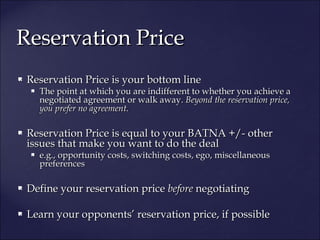
Reservation Price
   Reservation Price is your bottom line
       The point at which you are indifferent to whether you achieve a
        negotiated agreement or walk away. Beyond the reservation price,
        you prefer no agreement.

   Reservation Price is equal to your BATNA +/- other
    issues that make you want to do the deal
       e.g., opportunity costs, switching costs, ego, miscellaneous
        preferences

   Define your reservation price before negotiating

   Learn your opponents’ reservation price, if possible
Should You Reveal your BATNA and
Reservation Price?
   Do not reveal your reservation price!!!
     One of the critical pieces of information in a
      negotiation is the other party’s reservation point. If it
      becomes known to one party, the negotiator can
      push for a resolution that is only marginally
      acceptable to the other party.

   Do not state ranges

   Reveal your BATNA only when:
       You are nearing an impasse
       You have a strong BATNA
       You want to make an agreement in the current negotiation
Key Negotiation Principles
     Best Alternative To a Negotiated
      Agreement (BATNA)
     Reservation price
     Bargaining zone
     Aspiration level
The Negotiation Bargaining Zone

                                    Buyer’s Reservation Price (BR)
Buyer’s Target Price                         (e.g., $25M)


               Seller’s Reservation Price (SR)                       Seller’s Target
                         (e.g., $17M)

• The bargaining zone is the space between the buyer’s reservation price
(BR) and the seller’s reservation price (SR) – that is, the zone of possible
agreement.
• If BR > SR, then a Positive Bargaining Zone exists. The zone of agreement is
from SR to BR (e.g., $8M).
A Negative Bargaining Zone

                           Seller’s Reservation Price (SR)
                                     (e.g., $25M)


       Buyer’s Reservation Price (BR)
                (e.g., $17M)


If BR < SR, then there is no zone of possible agreement.
Key Negotiation Principles

   Best Alternative To a Negotiated Agreement
    (BATNA)
   Reservation price
   Bargaining zone
   Aspiration level
Aspiration Level

           Final Pr ice ( in m illion s)

$23.5
$23.0
$22.5                                      Buyer focused on
                                           BATNA
$22.0                                      Buyer focused on
$21.5                                      aspirat ion level
$21.0
$20.5
Distributive Bargaining Tactics

   First offers

   Concessions

   Persuasion
First Offers

     Who made the first offer?

     How did the first offer affect the
      negotiation?
First Offers in Synertech-Dosagen

         Final Price (in millions)
                                                    • There is a high
$25                                                   correlation between
$24                                                   the first offer and the
$23                                                   final price
$22
$21                                                 • Counteroffers and
$20                                                   later concession
$19                                                   behavior less
$18
                                                      predictive of final
$17
                                                      price
 Buyer made first offer   Seller made first offer
The First Offer
   How high should the first offer be?
      “As high as you can go without embarrassing yourself in
       front of a respected 3rd party” (Fisher & Ury, 1991)
      What’s embarrassing? What’s optimistic? Learn the
       market!

   Only let the other party make the first offer when
      You have no information

        It is inappropriate to do so (e.g., job negotiations)

   Immediately re-anchor if your counterpart makes the first
    offer
Concessions & Persuasion
   Allow yourself room to make concessions
     Don’t go in with a “first and final offer”


   Make bi-lateral, not uni-lateral concessions

   Make your concessions smaller as you approach
    your goal

   Use objective rationale to support your argument
     Again, learn the market
Distributive Negotiation Strategies
   Know your BATNA
      Strengthen your BATNA whenever possible


   Know your reservation price
      Do not reveal your reservation price


   Research the other party’s BATNA/reservation price

   Define your aspiration level and focus on that

   Make first offers whenever possible
     If they make the first offer, immediately re-anchor


   Watch how you are making concessions

   Prepare objective rationale for your arguments

Batna

  • 1.
    Judgments and Decisions Psych 253 Negotiations
  • 2.
    Negotiation: A process by which two or more people come to agreement on how to allocate scarce resources.  Parties are interdependent; neither has complete power to choose  The process is a decision, not a contest of wills
  • 3.
    Common Problems inNegotiation  Leaving money on the table (lose-lose negotiation)  Settling for too little (winner’s curse)  Walking away from the table (hubris)  Settling for terms that are worse than your current situation (agreement bias)
  • 4.
    Why Are PeopleIneffective Negotiators?  Absence of relevant and diagnostic feedback  Search for confirming information  Egocentrism  Satisficing  Versus Optimizing  Self-reinforcement  Fear of change and experimentation
  • 5.
    Myths  Good negotiators are born, not made  Experience is a great teacher  Good negotiators are risk-takers  Good negotiators rely on intuition
  • 6.
      Today’s Negotiation: Synertech-Dosagen Assign Roles Read ONLY your materials (do not look at your partner’s materials) You have 5 minutes to read, think, and prepare You have 15 minutes to negotiate and you can do this outside of the classroom. But come BACK in 20 minutes with the results of your negotiation on the handout.
  • 7.
    Relevant Facts Dosagen boughtthe plant 3 years ago for $15 M (but sellers was distressed) Plant appraised 2 years ago at $19 M with 5% real estate decline since then Similar but newer plant sold for $26 M nine months ago
  • 8.
    Key Negotiation Principles  Best Alternative To a Negotiated Agreement (BATNA)  Reservation price  Bargaining zone  Aspiration level
  • 9.
    Key Negotiation Principles  Best Alternative To a Negotiated Agreement (BATNA)  Reservation price  Bargaining zone  Aspiration level
  • 10.
    BATNA Tips  Know your BATNA  Do not think of your BATNA in aggregate terms  Improve your BATNA before you negotiate  “Fall in love with three” rule  You want your counterpart to think you have a good BATNA
  • 11.
    Key Negotiation Principles  Best Alternative To a Negotiated Agreement (BATNA)  Reservation price  Bargaining zone  Aspiration level
  • 12.
    Reservation Price  Reservation Price is your bottom line  The point at which you are indifferent to whether you achieve a negotiated agreement or walk away. Beyond the reservation price, you prefer no agreement.  Reservation Price is equal to your BATNA +/- other issues that make you want to do the deal  e.g., opportunity costs, switching costs, ego, miscellaneous preferences  Define your reservation price before negotiating  Learn your opponents’ reservation price, if possible
  • 13.
    Should You Revealyour BATNA and Reservation Price?  Do not reveal your reservation price!!!  One of the critical pieces of information in a negotiation is the other party’s reservation point. If it becomes known to one party, the negotiator can push for a resolution that is only marginally acceptable to the other party.  Do not state ranges  Reveal your BATNA only when:  You are nearing an impasse  You have a strong BATNA  You want to make an agreement in the current negotiation
  • 14.
    Key Negotiation Principles  Best Alternative To a Negotiated Agreement (BATNA)  Reservation price  Bargaining zone  Aspiration level
  • 15.
    The Negotiation BargainingZone Buyer’s Reservation Price (BR) Buyer’s Target Price (e.g., $25M) Seller’s Reservation Price (SR) Seller’s Target (e.g., $17M) • The bargaining zone is the space between the buyer’s reservation price (BR) and the seller’s reservation price (SR) – that is, the zone of possible agreement. • If BR > SR, then a Positive Bargaining Zone exists. The zone of agreement is from SR to BR (e.g., $8M).
  • 16.
    A Negative BargainingZone Seller’s Reservation Price (SR) (e.g., $25M) Buyer’s Reservation Price (BR) (e.g., $17M) If BR < SR, then there is no zone of possible agreement.
  • 17.
    Key Negotiation Principles  Best Alternative To a Negotiated Agreement (BATNA)  Reservation price  Bargaining zone  Aspiration level
  • 18.
    Aspiration Level Final Pr ice ( in m illion s) $23.5 $23.0 $22.5 Buyer focused on BATNA $22.0 Buyer focused on $21.5 aspirat ion level $21.0 $20.5
  • 19.
    Distributive Bargaining Tactics  First offers  Concessions  Persuasion
  • 20.
    First Offers  Who made the first offer?  How did the first offer affect the negotiation?
  • 21.
    First Offers inSynertech-Dosagen Final Price (in millions) • There is a high $25 correlation between $24 the first offer and the $23 final price $22 $21 • Counteroffers and $20 later concession $19 behavior less $18 predictive of final $17 price Buyer made first offer Seller made first offer
  • 22.
    The First Offer  How high should the first offer be?  “As high as you can go without embarrassing yourself in front of a respected 3rd party” (Fisher & Ury, 1991)  What’s embarrassing? What’s optimistic? Learn the market!  Only let the other party make the first offer when  You have no information  It is inappropriate to do so (e.g., job negotiations)  Immediately re-anchor if your counterpart makes the first offer
  • 23.
    Concessions & Persuasion  Allow yourself room to make concessions  Don’t go in with a “first and final offer”  Make bi-lateral, not uni-lateral concessions  Make your concessions smaller as you approach your goal  Use objective rationale to support your argument  Again, learn the market
  • 24.
    Distributive Negotiation Strategies  Know your BATNA  Strengthen your BATNA whenever possible  Know your reservation price  Do not reveal your reservation price  Research the other party’s BATNA/reservation price  Define your aspiration level and focus on that  Make first offers whenever possible  If they make the first offer, immediately re-anchor  Watch how you are making concessions  Prepare objective rationale for your arguments