Solutions for higher performance!
Third Party Cloud Services
Its Adoption in the New Age
Introduction
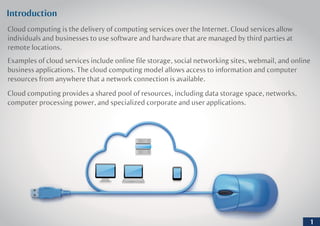
Cloud computing is the delivery of computing services over the Internet. Cloud services allow
individuals and businesses to use software and hardware that are managed by third parties at
remote locations.
Examples of cloud services include online file storage, social networking sites, webmail, and online
business applications. The cloud computing model allows access to information and computer
resources from anywhere that a network connection is available.
Cloud computing provides a shared pool of resources, including data storage space, networks,
computer processing power, and specialized corporate and user applications.
1
Service models
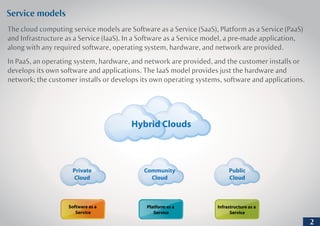
The cloud computing service models are Software as a Service (SaaS), Platform as a Service (PaaS)
and Infrastructure as a Service (IaaS). In a Software as a Service model, a pre-made application,
along with any required software, operating system, hardware, and network are provided.
In PaaS, an operating system, hardware, and network are provided, and the customer installs or
develops its own software and applications. The IaaS model provides just the hardware and
network; the customer installs or develops its own operating systems, software and applications.
Hybrid Clouds
Private
Cloud
Community
Cloud
Public
Cloud
Software as a
Service
Platform as a
Service
Infrastructure as a
Service
2
Private Cloud Defined
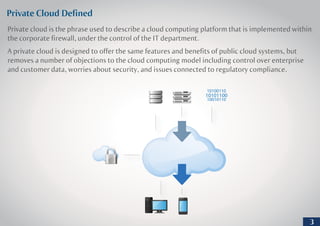
Private cloud is the phrase used to describe a cloud computing platform that is implemented within
the corporate firewall, under the control of the IT department.
A private cloud is designed to offer the same features and benefits of public cloud systems, but
removes a number of objections to the cloud computing model including control over enterprise
and customer data, worries about security, and issues connected to regulatory compliance.
10100110
10010110
10101100
3
Private Cloud Security
A private cloud implementation aims to avoid many of the objections regarding cloud computing
security. Because a private cloud setup is implemented safely within the corporate firewall, a
private cloud provides more control over the company's data, and it ensures security, albeit with
greater potential risk for data loss due to natural disaster.
4
Private Cloud Project Strategy
To create a private cloud project strategy, a company will first need to identify which of its business
practices can be made more efficient than before, as well as which repetitive manual tasks can be
automated via the successful launch of a cloud computing project.
By creating a private cloud strategy, the resulting cloud will be able to deliver automatic, scalable
server virtualization, providing the benefits of automated provision of resources and the optimal
use of hardware within the IT infrastructure.
5
Building a Private Cloud
With the idea of building a private cloud a daunting proposition for many companies, the best
advice for how to build a private cloud is to start small and then continue to grow the cloud
computing project over time.
In terms of specifics for how to set up a private cloud, a company needs to
Research the need and benefits for building a private cloud, particularly in respect to selecting a
public or hybrid cloud instead of a private cloud.
Analyze and ensure the proper processes and policies are in place to successfully build a secure
private cloud.
Research and acquire the private cloud infrastructure and cloud-enabling software that will be
used, such as OpenStack, CloudStack, Eucalyptus, etc.
Ensure the hypervisor(s) that will manage the virtual machines and virtualized storage are
available or can be purchased and installed.
Train IT staff on how to manage the private cloud and employees and partners on how to access
and use the cloud.
Develop and test the private cloud project in a non-mission-critical environment.
6
Managed Private Cloud
Managed Private Cloud refers to a principle in software architecture where a single instance of the
software runs on a server, serving a single client organization (tenant), and managed by a third
-party. This is in contrast to multitenancy where multiple client organizations are on a single server,
or an on-premises deployment where the client organization hosts their own instance. Managed
Private Clouds also fall under the larger umbrella of cloud computing.
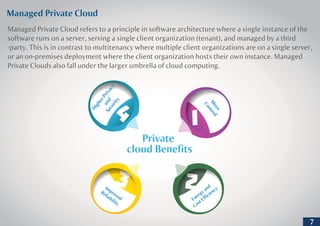
HigherPrivacy
andSecurity
M
ore
Control
Energy and
Cost EfficiencyImproved
Reliability
Private
cloud Benefits
7
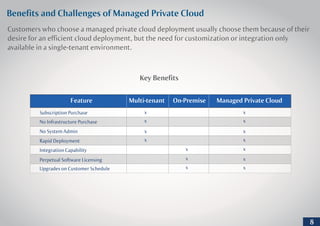
Benefits and Challenges of Managed Private Cloud
Customers who choose a managed private cloud deployment usually choose them because of their
desire for an efficient cloud deployment, but the need for customization or integration only
available in a single-tenant environment.
Key Benefits
Upgrades on Customer Schedule
Perpetual Software Licensing
Integration Capability
Rapid Deployment
No System Admin
No Infrastructure Purchase
Subscription Purchase
Feature Multi-tenant On-Premise Managed Private Cloud
x
x
x
x
x
x
x
x
x
x
x
x
x
x
8
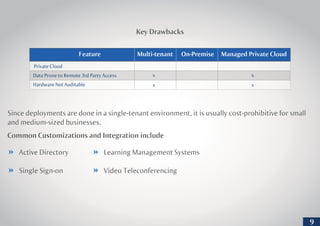
Since deployments are done in a single-tenant environment, it is usually cost-prohibitive for small
and medium-sized businesses.
Active Directory
Single Sign-on
Learning Management Systems
Video Teleconferencing
Common Customizations and Integration include
Hardware Not Auditable
Data Prone to Remote 3rd Party Access
Private Cloud
Feature Multi-tenant On-Premise Managed Private Cloud
x
x
x
x
Key Drawbacks
9
Online
file storage
Webmail
Social
networking sites
Online business
applications
Deployment
Strategies
Data storage
Data space
Data networks
Specialized
corporate
User
applications
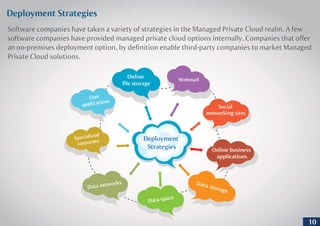
Deployment Strategies
Software companies have taken a variety of strategies in the Managed Private Cloud realm. A few
software companies have provided managed private cloud options internally. Companies that offer
an on-premises deployment option, by definition enable third-party companies to market Managed
Private Cloud solutions.
10
Amazon Virtual Private Cloud
Features
Amazon Virtual Private Cloud (Amazon VPC) lets you set up a private cloud (a private, isolated
section) within the Amazon Web Services (AWS) cloud computing service. Using Amazon VPC,
organizations can launch AWS resources in a virtual network topology.
Amazon VPC provides organizations complete control over the virtual networking environment,
including selection of your own IP address range, creation of subnets and configuration of route
tables and network gateways.
Additionally, Amazon VPC provides security features such as security groups and network access
control lists to enable inbound and outbound filtering at the instance level and subnet level. Users
can also choose to launch Dedicated Instances that run on hardware dedicated to a single customer
for additional isolation.
11
About Orchestrate
Orchestrate is a US based business process management organization with Headquarters in Dallas,
Texas. Orchestrate offers services to diverse outsourcing requirements of clients in an extensive
range of businesses including IT, finance, mortgage, and contact center. We provide a
comprehensive suite of technology and services to our clients that help accelerate sales and boost
their profit. Our solutions and services help SMEs and enterprises to implement technologies and
processes that boost their profitability across the organization.
1330 Capital Parkway, Carrollton TX 75006
success@orchestrate.comToll Free: 800-232-5130
www.orchestrate.com
Orchestrate © 2015. All rights reserved.
Solutions for higher performance!

Third Party Cloud Management

  • 1.
    Solutions for higherperformance! Third Party Cloud Services Its Adoption in the New Age
  • 2.
    Introduction Cloud computing isthe delivery of computing services over the Internet. Cloud services allow individuals and businesses to use software and hardware that are managed by third parties at remote locations. Examples of cloud services include online file storage, social networking sites, webmail, and online business applications. The cloud computing model allows access to information and computer resources from anywhere that a network connection is available. Cloud computing provides a shared pool of resources, including data storage space, networks, computer processing power, and specialized corporate and user applications. 1
  • 3.
    Service models The cloudcomputing service models are Software as a Service (SaaS), Platform as a Service (PaaS) and Infrastructure as a Service (IaaS). In a Software as a Service model, a pre-made application, along with any required software, operating system, hardware, and network are provided. In PaaS, an operating system, hardware, and network are provided, and the customer installs or develops its own software and applications. The IaaS model provides just the hardware and network; the customer installs or develops its own operating systems, software and applications. Hybrid Clouds Private Cloud Community Cloud Public Cloud Software as a Service Platform as a Service Infrastructure as a Service 2
  • 4.
    Private Cloud Defined Privatecloud is the phrase used to describe a cloud computing platform that is implemented within the corporate firewall, under the control of the IT department. A private cloud is designed to offer the same features and benefits of public cloud systems, but removes a number of objections to the cloud computing model including control over enterprise and customer data, worries about security, and issues connected to regulatory compliance. 10100110 10010110 10101100 3
  • 5.
    Private Cloud Security Aprivate cloud implementation aims to avoid many of the objections regarding cloud computing security. Because a private cloud setup is implemented safely within the corporate firewall, a private cloud provides more control over the company's data, and it ensures security, albeit with greater potential risk for data loss due to natural disaster. 4
  • 6.
    Private Cloud ProjectStrategy To create a private cloud project strategy, a company will first need to identify which of its business practices can be made more efficient than before, as well as which repetitive manual tasks can be automated via the successful launch of a cloud computing project. By creating a private cloud strategy, the resulting cloud will be able to deliver automatic, scalable server virtualization, providing the benefits of automated provision of resources and the optimal use of hardware within the IT infrastructure. 5
  • 7.
    Building a PrivateCloud With the idea of building a private cloud a daunting proposition for many companies, the best advice for how to build a private cloud is to start small and then continue to grow the cloud computing project over time. In terms of specifics for how to set up a private cloud, a company needs to Research the need and benefits for building a private cloud, particularly in respect to selecting a public or hybrid cloud instead of a private cloud. Analyze and ensure the proper processes and policies are in place to successfully build a secure private cloud. Research and acquire the private cloud infrastructure and cloud-enabling software that will be used, such as OpenStack, CloudStack, Eucalyptus, etc. Ensure the hypervisor(s) that will manage the virtual machines and virtualized storage are available or can be purchased and installed. Train IT staff on how to manage the private cloud and employees and partners on how to access and use the cloud. Develop and test the private cloud project in a non-mission-critical environment. 6
  • 8.
    Managed Private Cloud ManagedPrivate Cloud refers to a principle in software architecture where a single instance of the software runs on a server, serving a single client organization (tenant), and managed by a third -party. This is in contrast to multitenancy where multiple client organizations are on a single server, or an on-premises deployment where the client organization hosts their own instance. Managed Private Clouds also fall under the larger umbrella of cloud computing. HigherPrivacy andSecurity M ore Control Energy and Cost EfficiencyImproved Reliability Private cloud Benefits 7
  • 9.
    Benefits and Challengesof Managed Private Cloud Customers who choose a managed private cloud deployment usually choose them because of their desire for an efficient cloud deployment, but the need for customization or integration only available in a single-tenant environment. Key Benefits Upgrades on Customer Schedule Perpetual Software Licensing Integration Capability Rapid Deployment No System Admin No Infrastructure Purchase Subscription Purchase Feature Multi-tenant On-Premise Managed Private Cloud x x x x x x x x x x x x x x 8
  • 10.
    Since deployments aredone in a single-tenant environment, it is usually cost-prohibitive for small and medium-sized businesses. Active Directory Single Sign-on Learning Management Systems Video Teleconferencing Common Customizations and Integration include Hardware Not Auditable Data Prone to Remote 3rd Party Access Private Cloud Feature Multi-tenant On-Premise Managed Private Cloud x x x x Key Drawbacks 9
  • 11.
    Online file storage Webmail Social networking sites Onlinebusiness applications Deployment Strategies Data storage Data space Data networks Specialized corporate User applications Deployment Strategies Software companies have taken a variety of strategies in the Managed Private Cloud realm. A few software companies have provided managed private cloud options internally. Companies that offer an on-premises deployment option, by definition enable third-party companies to market Managed Private Cloud solutions. 10
  • 12.
    Amazon Virtual PrivateCloud Features Amazon Virtual Private Cloud (Amazon VPC) lets you set up a private cloud (a private, isolated section) within the Amazon Web Services (AWS) cloud computing service. Using Amazon VPC, organizations can launch AWS resources in a virtual network topology. Amazon VPC provides organizations complete control over the virtual networking environment, including selection of your own IP address range, creation of subnets and configuration of route tables and network gateways. Additionally, Amazon VPC provides security features such as security groups and network access control lists to enable inbound and outbound filtering at the instance level and subnet level. Users can also choose to launch Dedicated Instances that run on hardware dedicated to a single customer for additional isolation. 11
  • 13.
    About Orchestrate Orchestrate isa US based business process management organization with Headquarters in Dallas, Texas. Orchestrate offers services to diverse outsourcing requirements of clients in an extensive range of businesses including IT, finance, mortgage, and contact center. We provide a comprehensive suite of technology and services to our clients that help accelerate sales and boost their profit. Our solutions and services help SMEs and enterprises to implement technologies and processes that boost their profitability across the organization. 1330 Capital Parkway, Carrollton TX 75006 success@orchestrate.comToll Free: 800-232-5130 www.orchestrate.com Orchestrate © 2015. All rights reserved. Solutions for higher performance!