Cloud Computing and Internet of Things
Dr. Selvaraj Kesavan
Contents
2
➢Cloud computing introduction
➢Cloud computing- Service, deployment models and
characteristics
➢Cloud computing service platforms and Services
➢Internet of things(IoT)- Introduction
➢IoT stack landscape
➢IoT - Sensors, Protocols and Platforms.
➢Overview of various applications/Visualization Tools for IoT
Cloud Computing
➢ Cloud computing is the on-demand delivery of compute power,
database storage, applications, and other IT resources through a
services platform via the internet with pay-as-you-go pricing.
➢ It is the delivery of computing as a service rather than product
where shared resources, software and information are provided to
users as an utility.
➢ Moving from traditional to on-Demand model.
➢ The analogy is , 'If you need milk , would you buy a cow ?’.
3
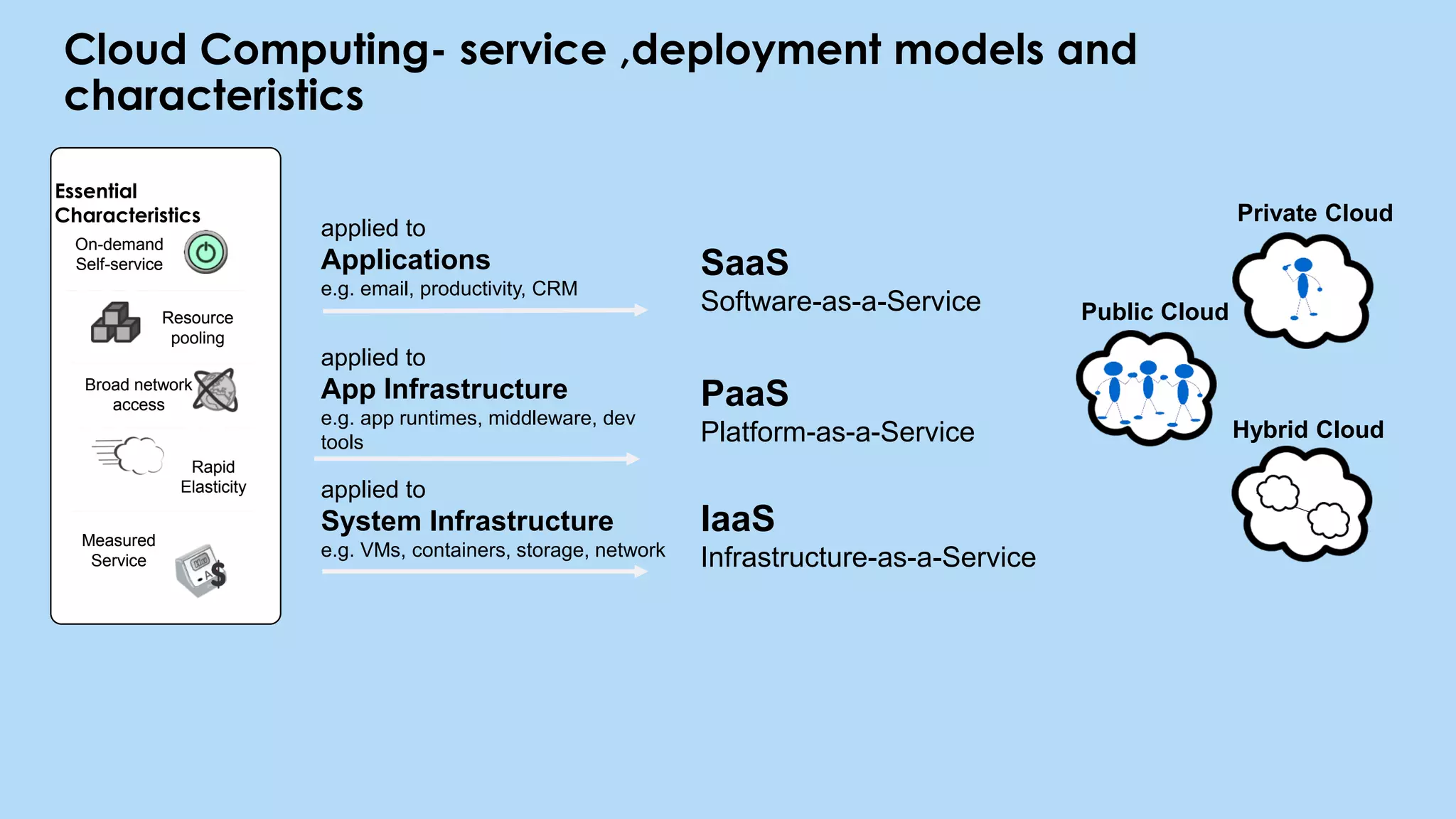
Cloud Computing- service ,deployment models and
characteristics
Essential
Characteristics
Resource
pooling
Broad network
access
Measured
Service
Rapid
Elasticity
On-demand
Self-service SaaS
Software-as-a-Service
applied to
Applications
e.g. email, productivity, CRM
PaaS
Platform-as-a-Service
applied to
App Infrastructure
e.g. app runtimes, middleware, dev
tools
IaaS
Infrastructure-as-a-Service
applied to
System Infrastructure
e.g. VMs, containers, storage, network
Private Cloud
Public Cloud
Hybrid Cloud
Cloud Computing Service Models
• SaaS (Software as a Service)
- Access the services from provider. consumer uses an application, but does
not control the operating system, hardware or network infrastructure on which
it's running
• PaaS (Platform as a Service)
- The consumer uses a hosting environment for their applications. The
consumer controls the applications that run in the environment but does not
control the operating system, hardware or network infrastructure on which they
are running. Provides the middleware framework
• IaaS (Infrastructure as a Service)
- The consumer uses fundamental computing resources such as
processing power, storage, networking components
5
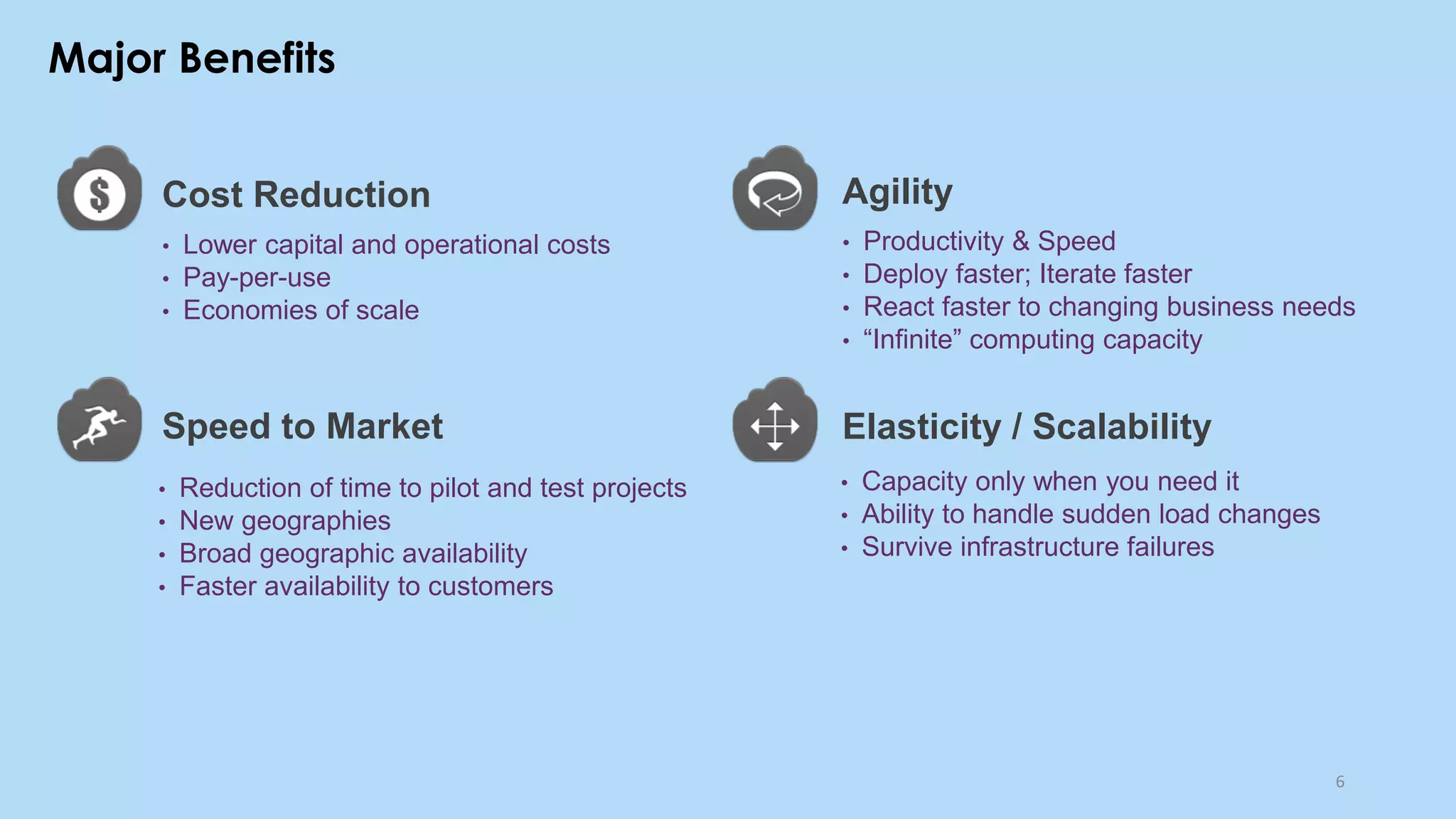
Major Benefits
6
Speed to Market
Cost Reduction
Elasticity / Scalability
Agility
• Lower capital and operational costs
• Pay-per-use
• Economies of scale
• Reduction of time to pilot and test projects
• New geographies
• Broad geographic availability
• Faster availability to customers
• Capacity only when you need it
• Ability to handle sudden load changes
• Survive infrastructure failures
• Productivity & Speed
• Deploy faster; Iterate faster
• React faster to changing business needs
• “Infinite” computing capacity
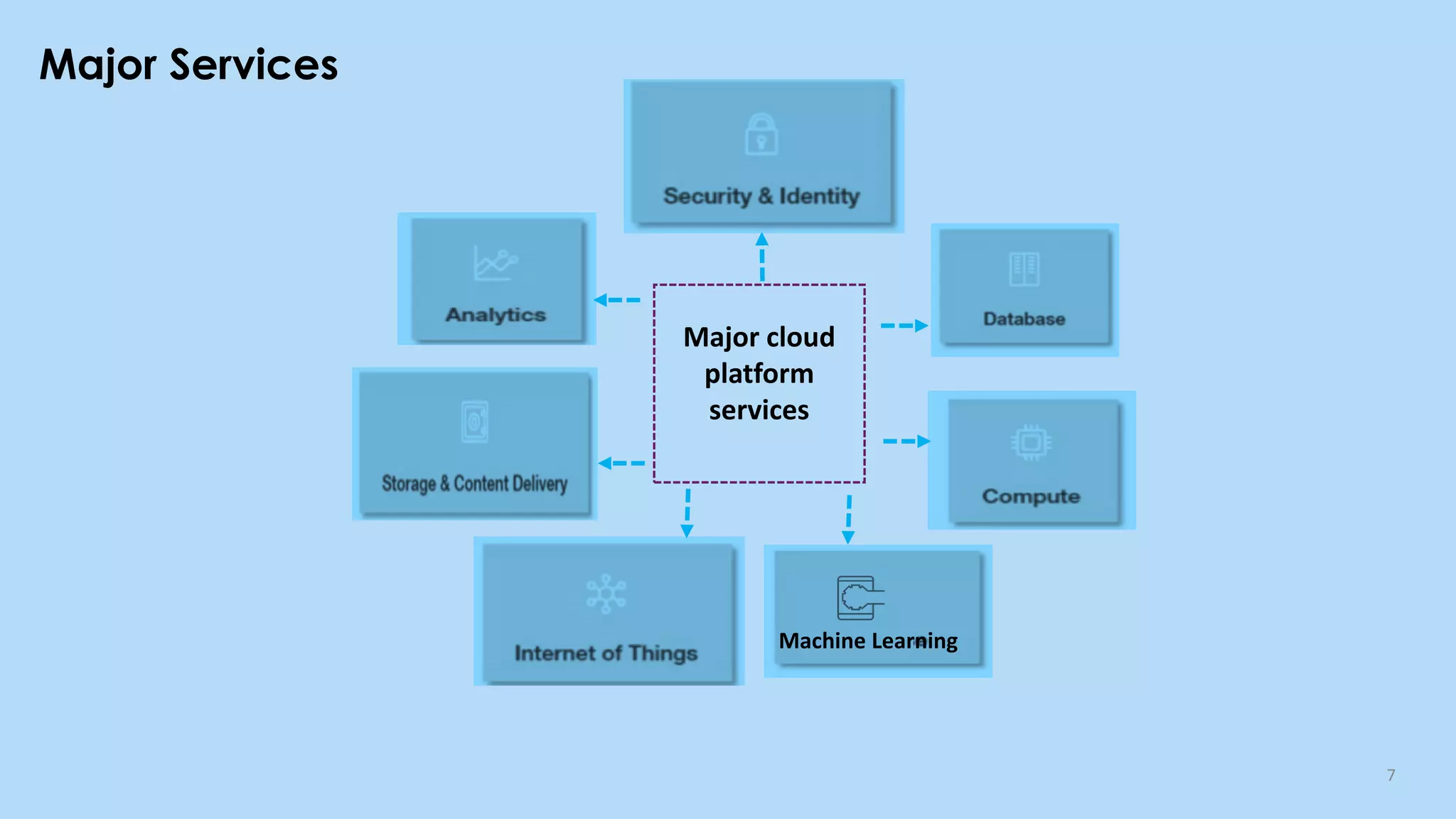
Major Services
7
Major cloud
platform
services
Machine Learning
Security and Identity Services
8
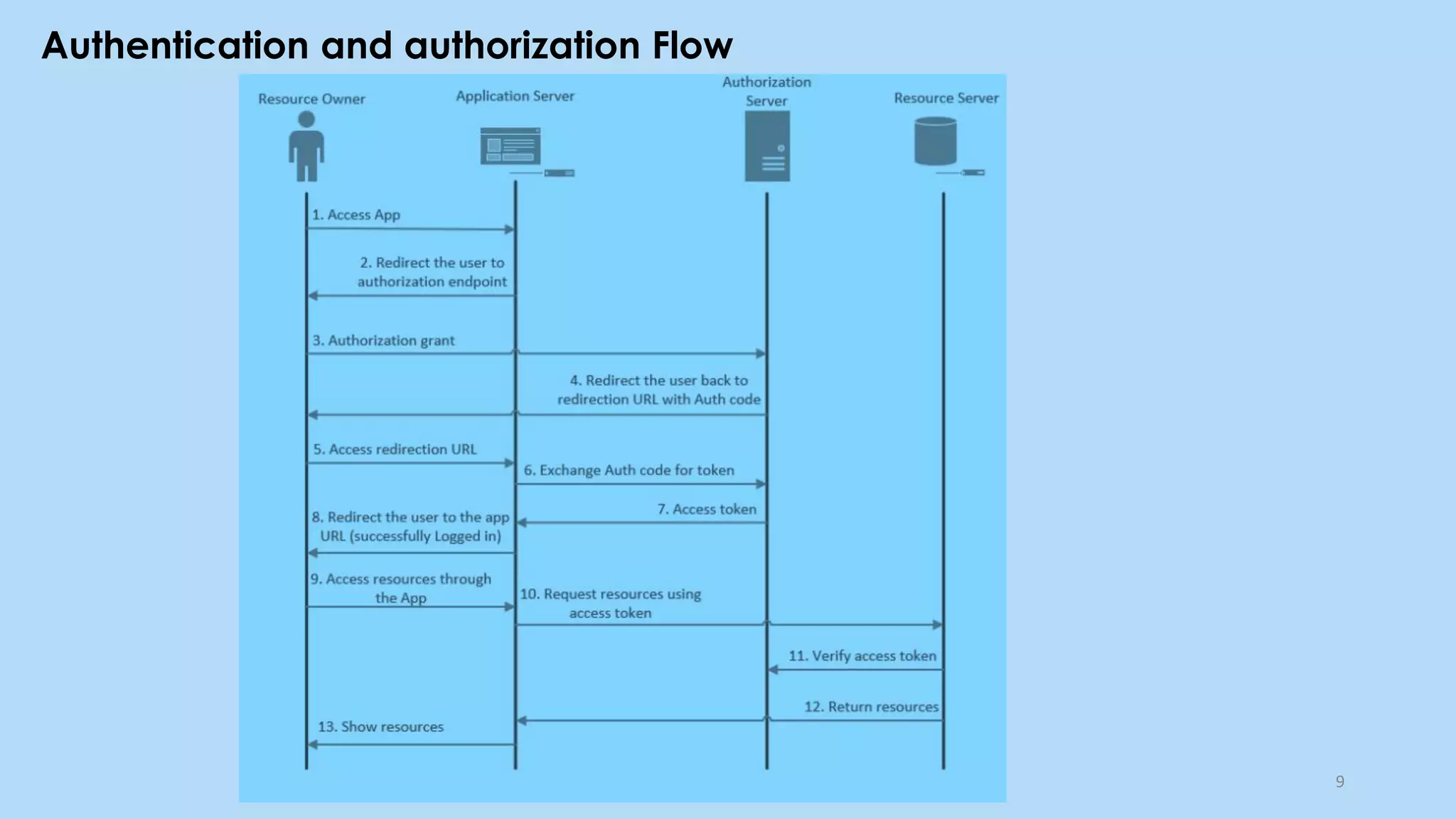
Authentication :
- Allow Apps to authenticate on behalf of users
- Allow users
Authorization:
- Fine-grained access control
- Attribute management
- Policy evaluation
- Policy Management
Implementation:
OpenID- Created for federated authentication. User obtain account with OpenID Provider and
use the account into sign in with any other web services. Allows communication between IDP
and SP.
OAuth (Open Authorization) is for token-based authentication and authorization. Allows
users/application to access resources.
SAML: Security Assertion Markup Language. Open standard for authentication and
authorization.
SSO( Single Sign On) for Federation and Identity Management. One user name and password
to access multiple services.
Authentication and authorization Flow
9
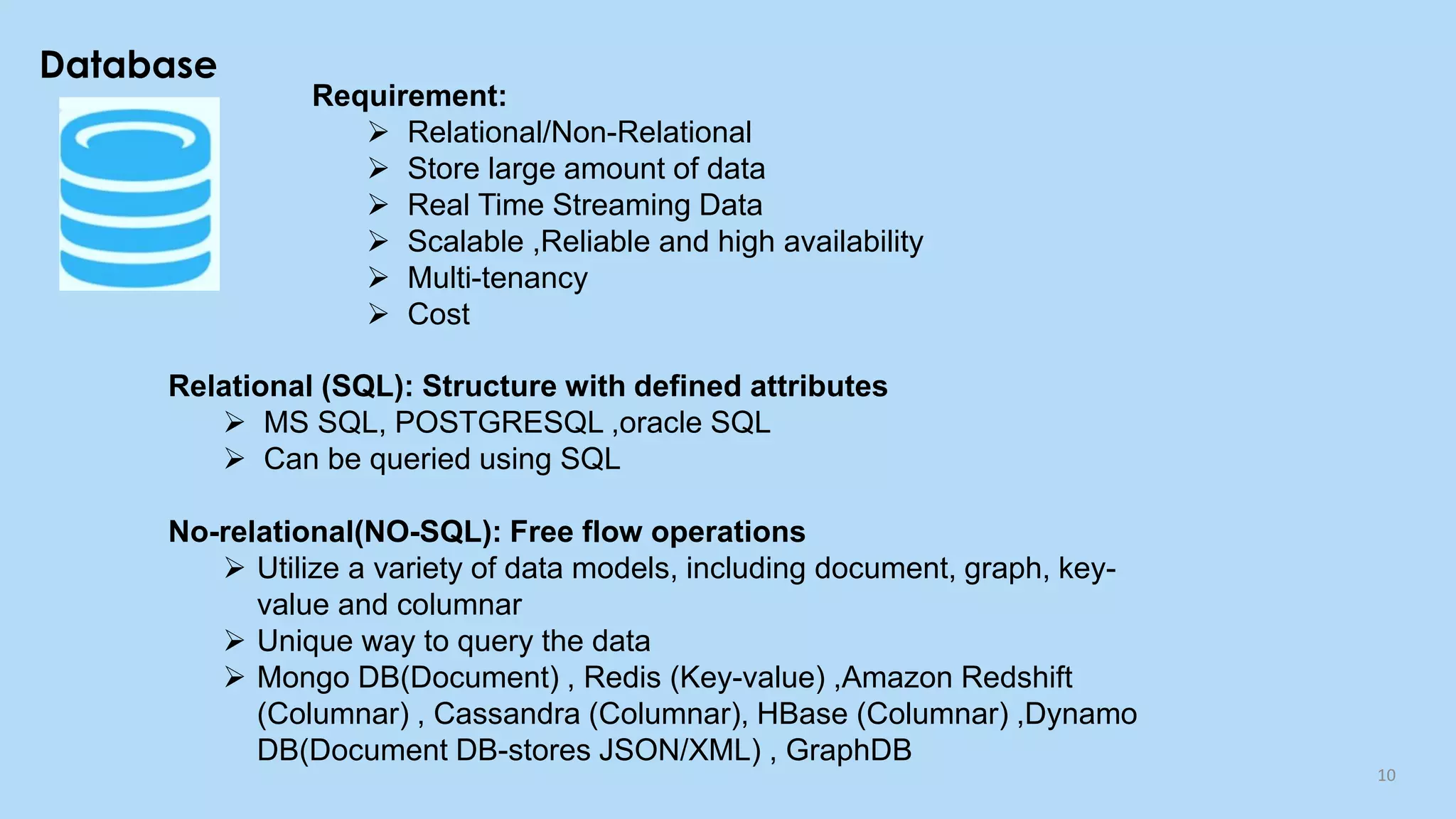
Database
10
Requirement:
➢ Relational/Non-Relational
➢ Store large amount of data
➢ Real Time Streaming Data
➢ Scalable ,Reliable and high availability
➢ Multi-tenancy
➢ Cost
Relational (SQL): Structure with defined attributes
➢ MS SQL, POSTGRESQL ,oracle SQL
➢ Can be queried using SQL
No-relational(NO-SQL): Free flow operations
➢ Utilize a variety of data models, including document, graph, key-
value and columnar
➢ Unique way to query the data
➢ Mongo DB(Document) , Redis (Key-value) ,Amazon Redshift
(Columnar) , Cassandra (Columnar), HBase (Columnar) ,Dynamo
DB(Document DB-stores JSON/XML) , GraphDB
Computing
11
Requirement:
➢ Able to deploy application or software
➢ Run and execute
➢ Scale based on conditions
➢ Balance and distribute the load
➢ Fail fallback
• Ramp up or ramp down resource on need basis
• Compute/memory/storage/GPU optimized
• Route the load to difference instances
• Virtual Network Environment
• Examples:
➢ Virtual Machines
➢ Load Balancers
➢ Auto Scaling
➢ Virtual Private Cloud
Machine Learning
12
➢ Machine learning is a method of data analysis
➢ Using algorithms it iteratively learn from data and allows to find insights into this
data
➢ It allows learning from previous computations to produce reliable, repeatable
decisions and results
➢ Machine Learning enables computer system to mimic the working of the human
brain
✓ Data Collection: Collect the historical Data
✓ Data Preparation: Choose and classify the data
✓ Model Training: Selecting the algorithm for model
validation and Training
✓ Model Evaluation: Feed the data and test the accuracy
✓ Performance tune and improvement: Choosing different
model
Data collection and preparation is the key in Machine
Learning
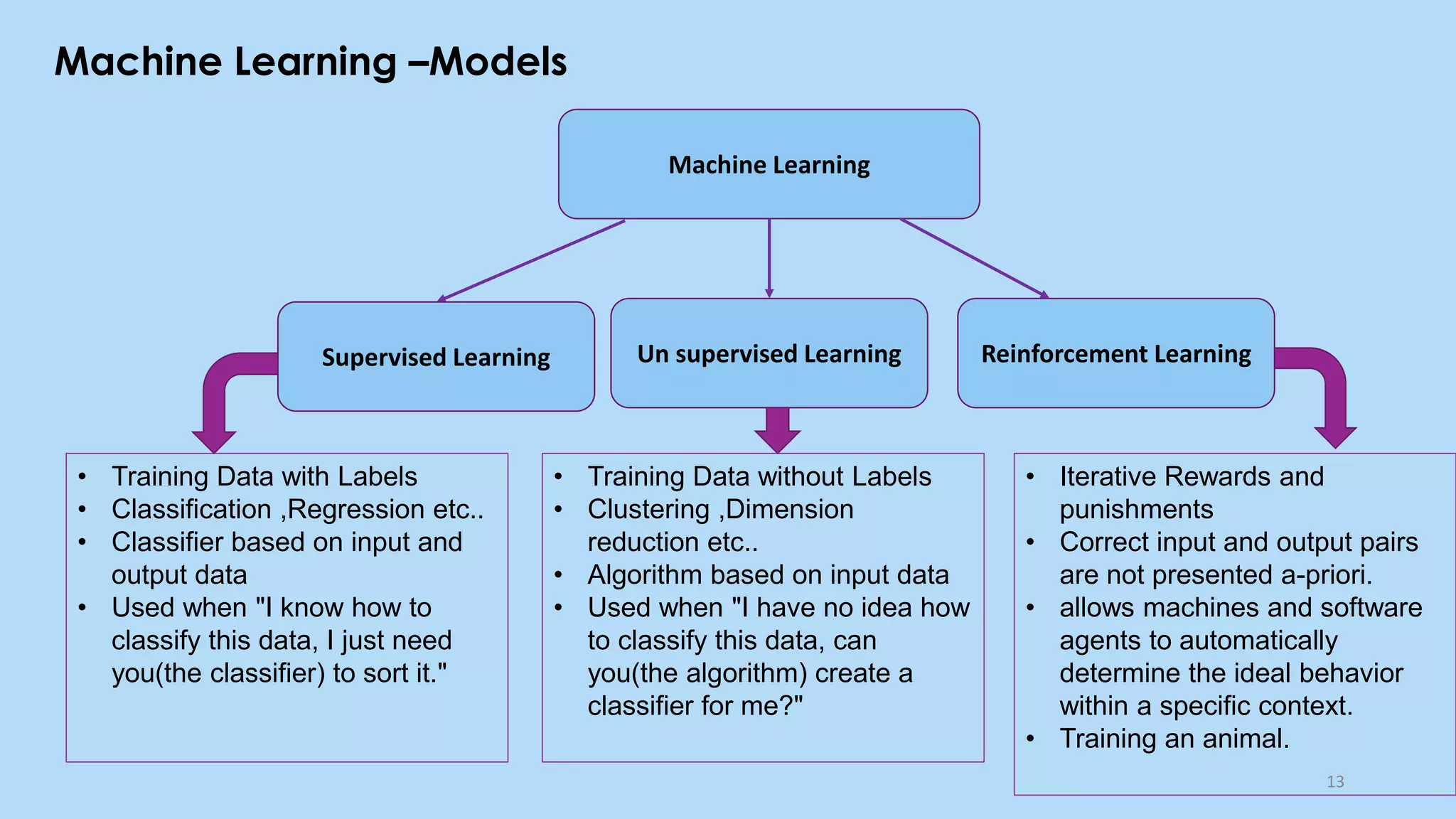
Machine Learning –Models
13
• Training Data with Labels
• Classification ,Regression etc..
• Classifier based on input and
output data
• Used when "I know how to
classify this data, I just need
you(the classifier) to sort it."
Supervised Learning
Machine Learning
Un supervised Learning Reinforcement Learning
• Training Data without Labels
• Clustering ,Dimension
reduction etc..
• Algorithm based on input data
• Used when "I have no idea how
to classify this data, can
you(the algorithm) create a
classifier for me?"
• Iterative Rewards and
punishments
• Correct input and output pairs
are not presented a-priori.
• allows machines and software
agents to automatically
determine the ideal behavior
within a specific context.
• Training an animal.
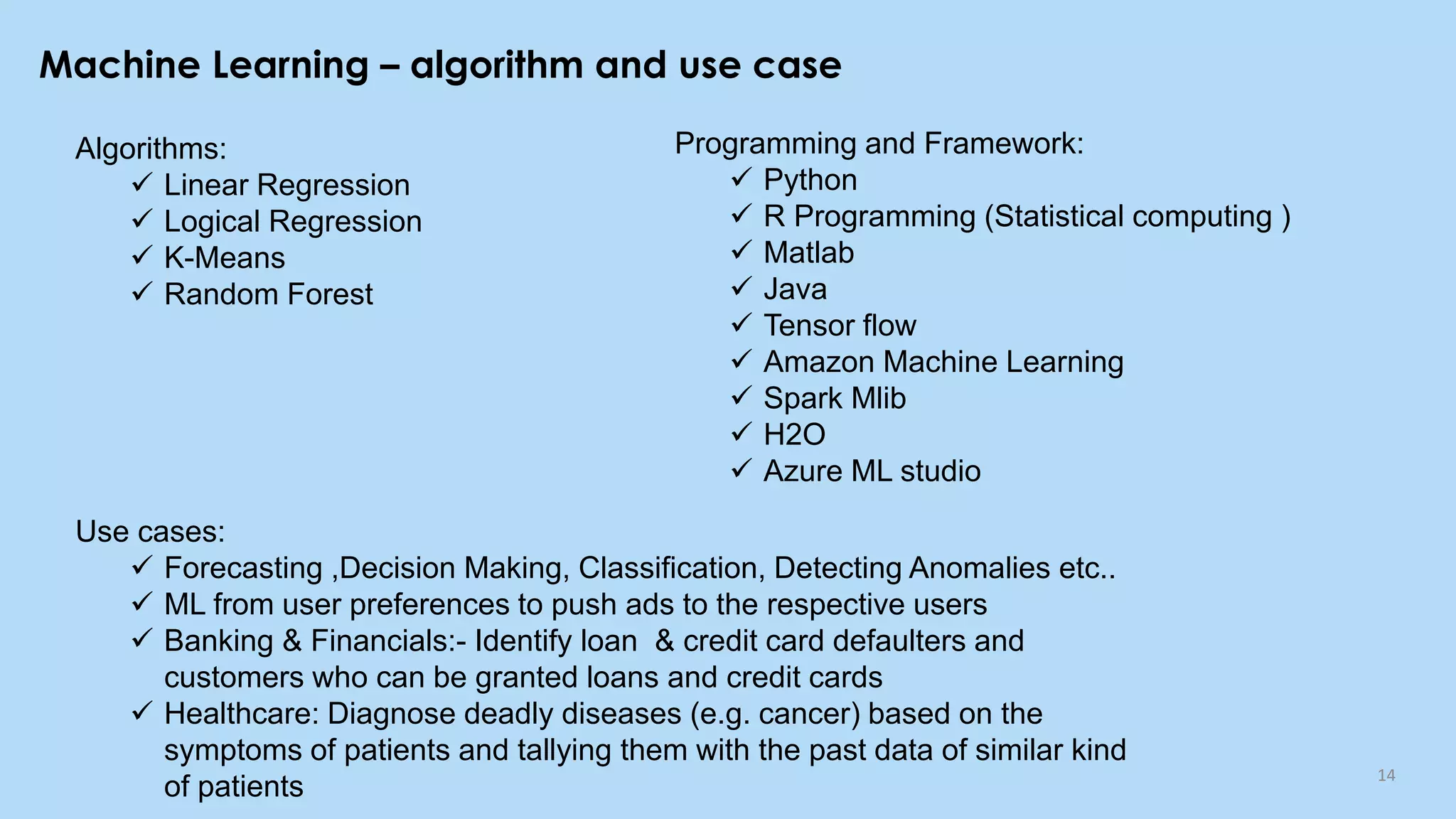
Machine Learning – algorithm and use case
14
Algorithms:
✓ Linear Regression
✓ Logical Regression
✓ K-Means
✓ Random Forest
Use cases:
✓ Forecasting ,Decision Making, Classification, Detecting Anomalies etc..
✓ ML from user preferences to push ads to the respective users
✓ Banking & Financials:- Identify loan & credit card defaulters and
customers who can be granted loans and credit cards
✓ Healthcare: Diagnose deadly diseases (e.g. cancer) based on the
symptoms of patients and tallying them with the past data of similar kind
of patients
Programming and Framework:
✓ Python
✓ R Programming (Statistical computing )
✓ Matlab
✓ Java
✓ Tensor flow
✓ Amazon Machine Learning
✓ Spark Mlib
✓ H2O
✓ Azure ML studio
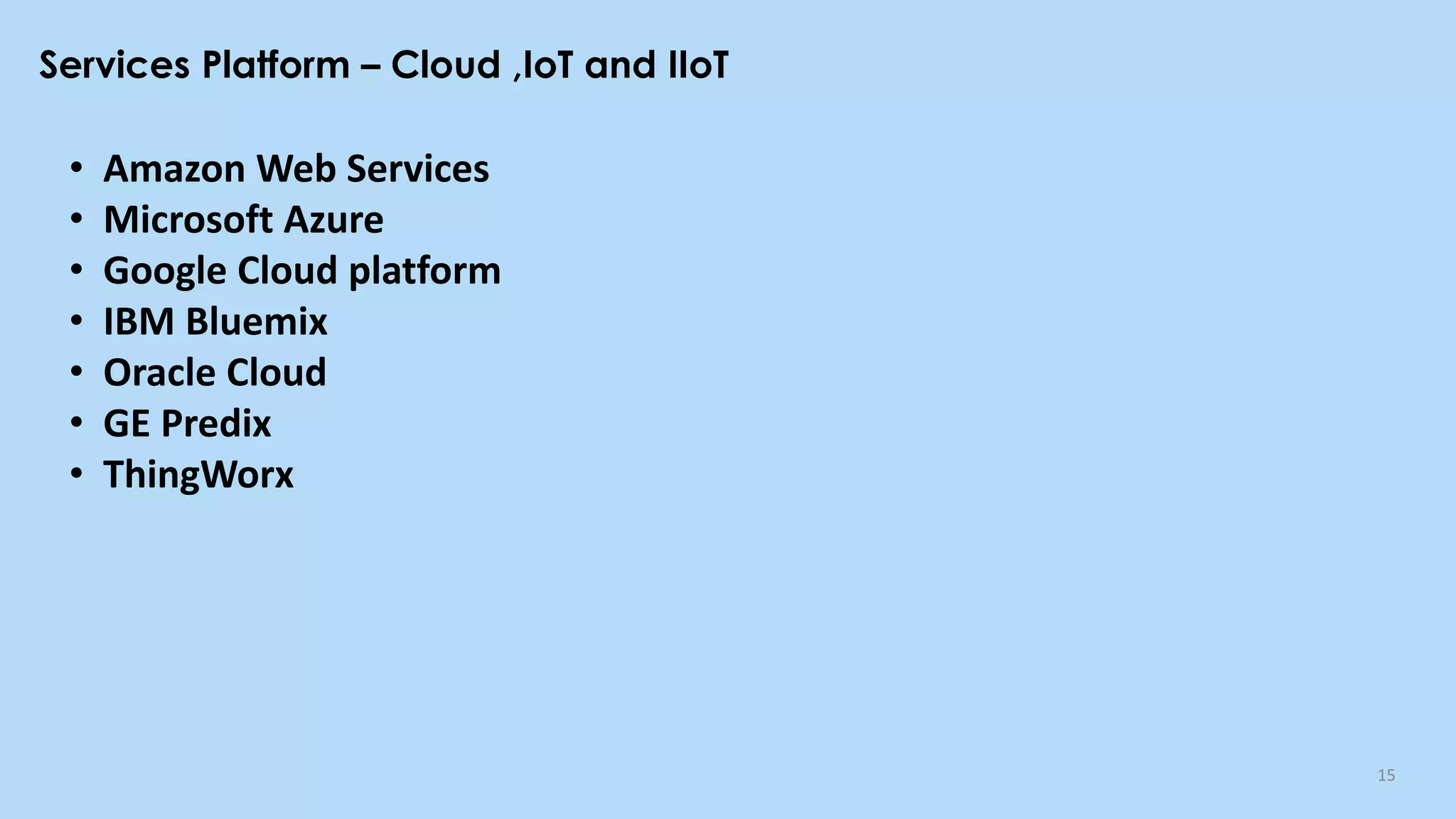
Services Platform – Cloud ,IoT and IIoT
15
• Amazon Web Services
• Microsoft Azure
• Google Cloud platform
• IBM Bluemix
• Oracle Cloud
• GE Predix
• ThingWorx
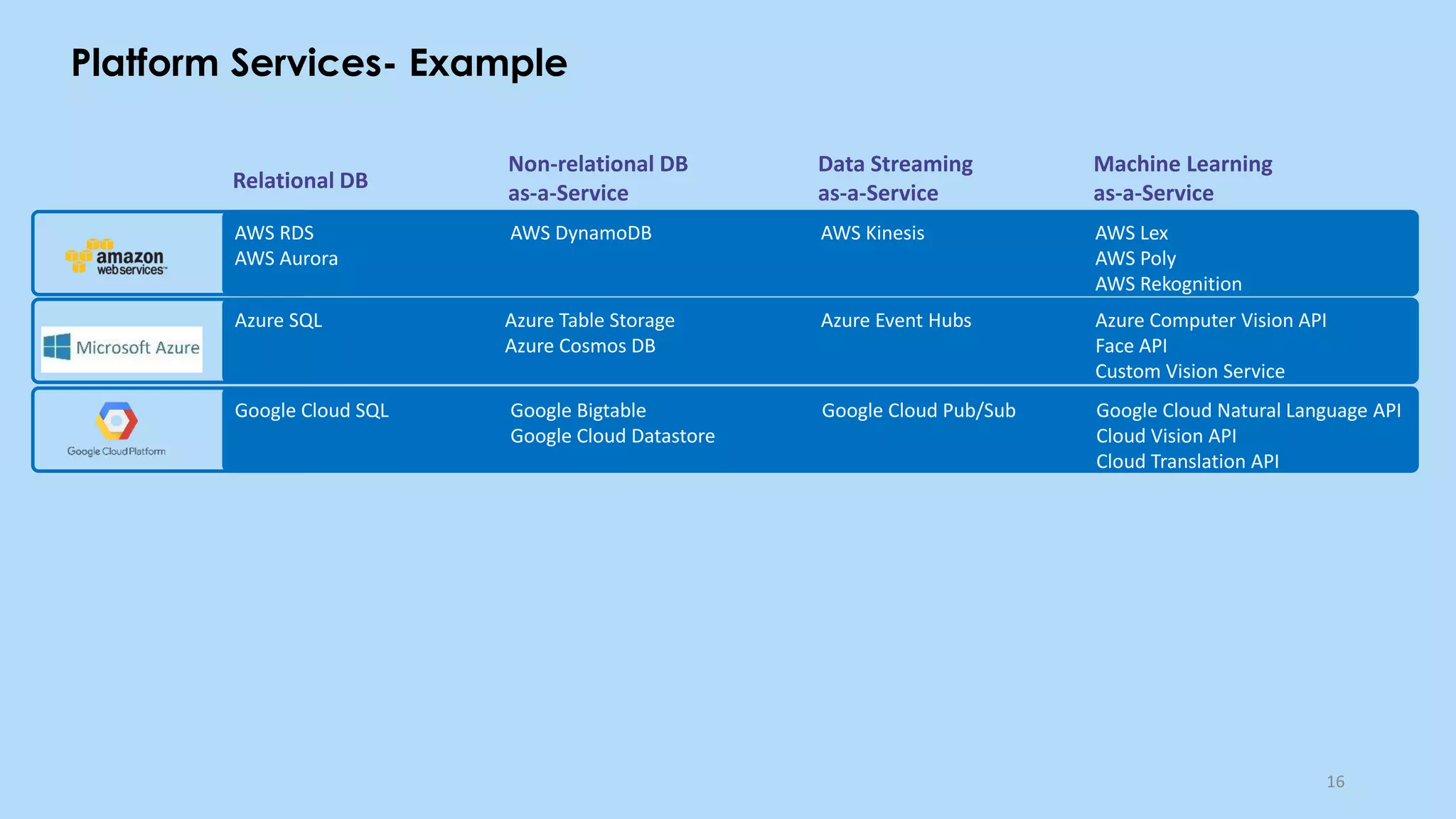
Platform Services- Example
16
AWS RDS
AWS Aurora
AWS DynamoDB
Azure SQL
Google Cloud SQL
Azure Table Storage
Azure Cosmos DB
Google Bigtable
Google Cloud Datastore
Relational DB
Non-relational DB
as-a-Service
Data Streaming
as-a-Service
AWS Kinesis
Azure Event Hubs
Google Cloud Pub/Sub
Machine Learning
as-a-Service
AWS Lex
AWS Poly
AWS Rekognition
Azure Computer Vision API
Face API
Custom Vision Service
Google Cloud Natural Language API
Cloud Vision API
Cloud Translation API
Programming/Connecting to cloud Services
17
Programming Toolkits:
• Portal
• CLI
• Power Shell
• REST API’s
Application to Cloud Services:
• SDK’s
• REST API’s
Device/Gateway to Cloud Services:
• Device SDK
• REST API’s
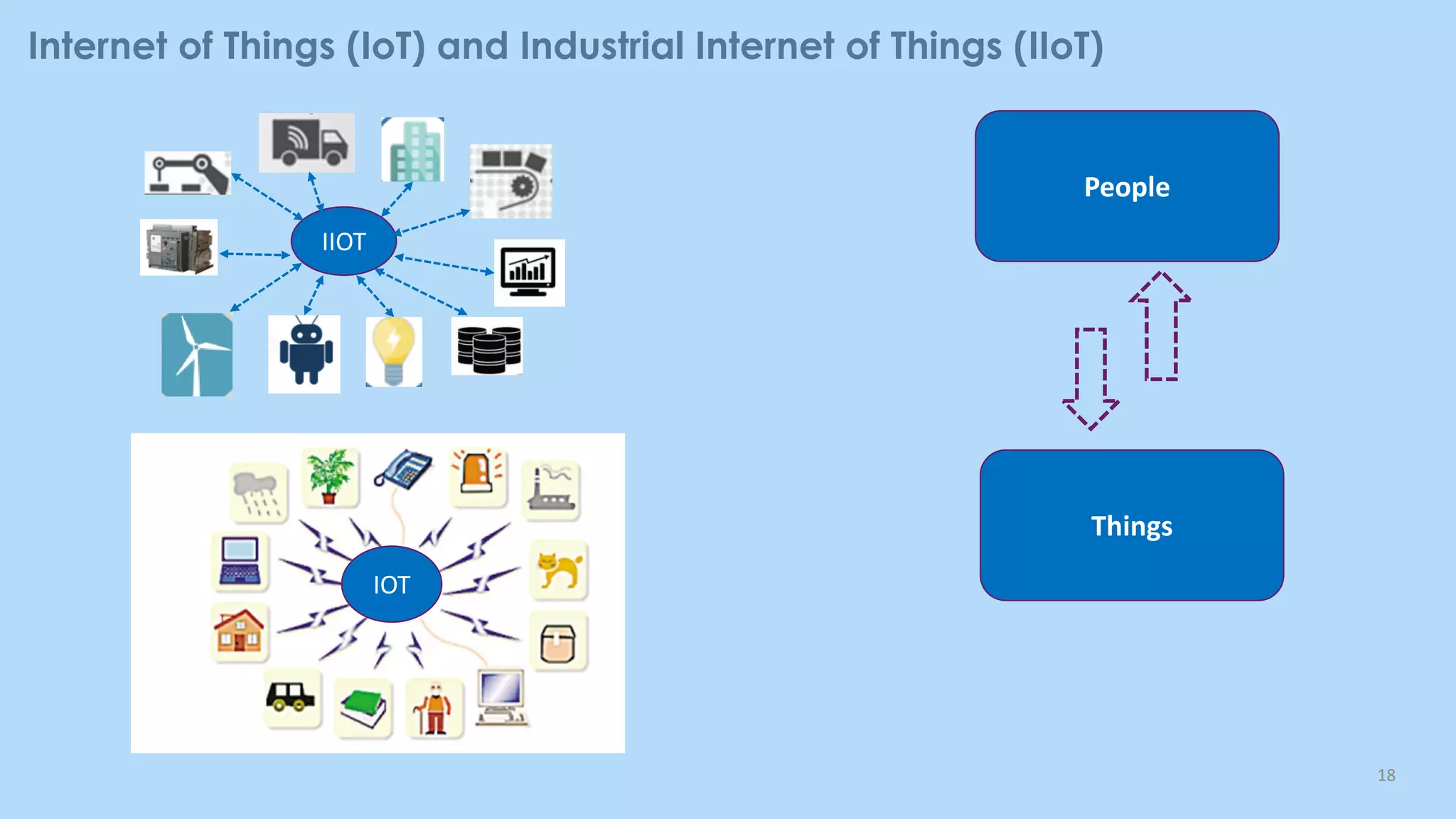
Internet of Things (IoT) and Industrial Internet of Things (IIoT)
18
People
Things
IIOT
IOT
What is IOT
➢ Internet is no longer just a global network for people to communicate
with one another using computers, but it is also a platform for devices
to communicate electronically with the world around them.
➢ Sensors/Things connected to server via network and deliver
connected industry solutions for efficient control and improved human
experience.
➢ Billions of connected devices is an indicator of IoT. The connectivity is
just an enabler but the real value of IoT is on data (business
insight/data-driven economy).
19
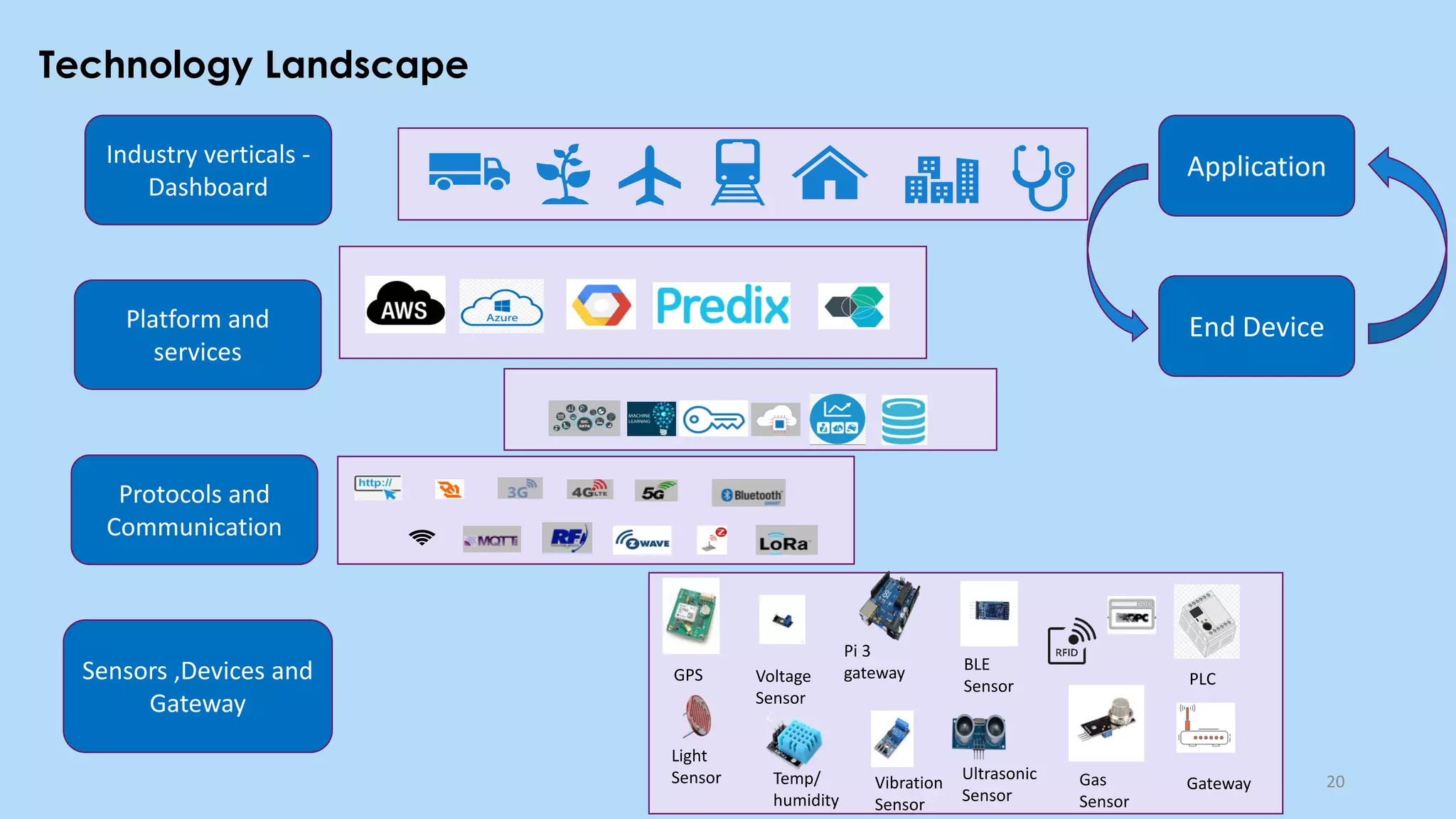
Technology Landscape
20
Industry verticals -
Dashboard
Platform and
services
Protocols and
Communication
Sensors ,Devices and
Gateway
Application
End Device
Light
Sensor
Voltage
Sensor
Temp/
humidity
Vibration
Sensor
Ultrasonic
Sensor
Gas
Sensor
BLE
Sensor
GPS
Pi 3
gateway
Gateway
PLC
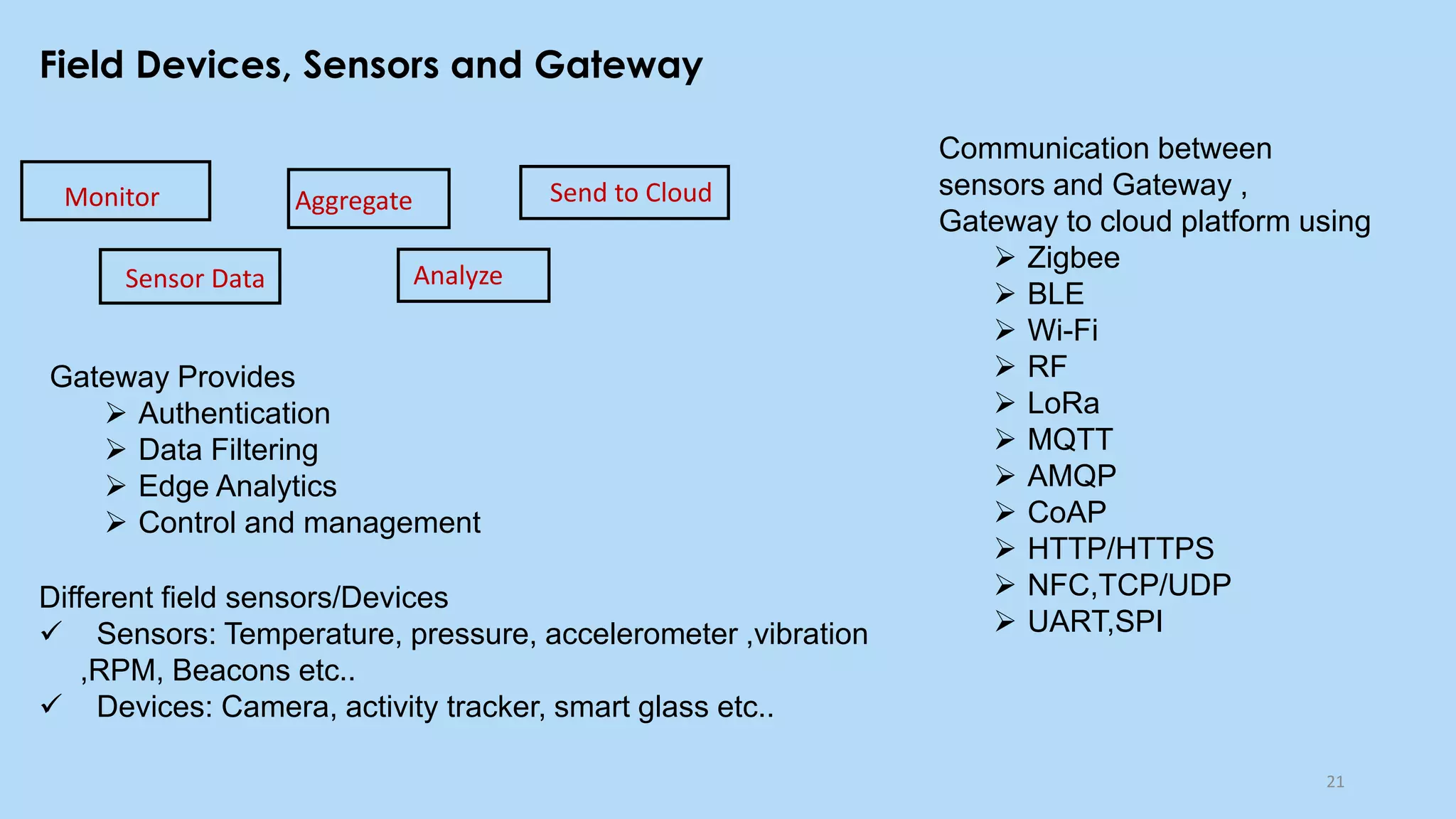
Field Devices, Sensors and Gateway
21
Monitor
Sensor Data
Aggregate
Analyze
Send to Cloud
Gateway Provides
➢ Authentication
➢ Data Filtering
➢ Edge Analytics
➢ Control and management
Communication between
sensors and Gateway ,
Gateway to cloud platform using
➢ Zigbee
➢ BLE
➢ Wi-Fi
➢ RF
➢ LoRa
➢ MQTT
➢ AMQP
➢ CoAP
➢ HTTP/HTTPS
➢ NFC,TCP/UDP
➢ UART,SPI
Different field sensors/Devices
✓ Sensors: Temperature, pressure, accelerometer ,vibration
,RPM, Beacons etc..
✓ Devices: Camera, activity tracker, smart glass etc..
IoT As a Service from Cloud platform
22
Major Functionalities:
➢Device Registration
➢Device Authentication and
Authorization
➢Device to cloud message
➢Cloud to Device message
➢Device state
➢Rules Engine
➢Communication with other Services
➢Communication with Edge devices
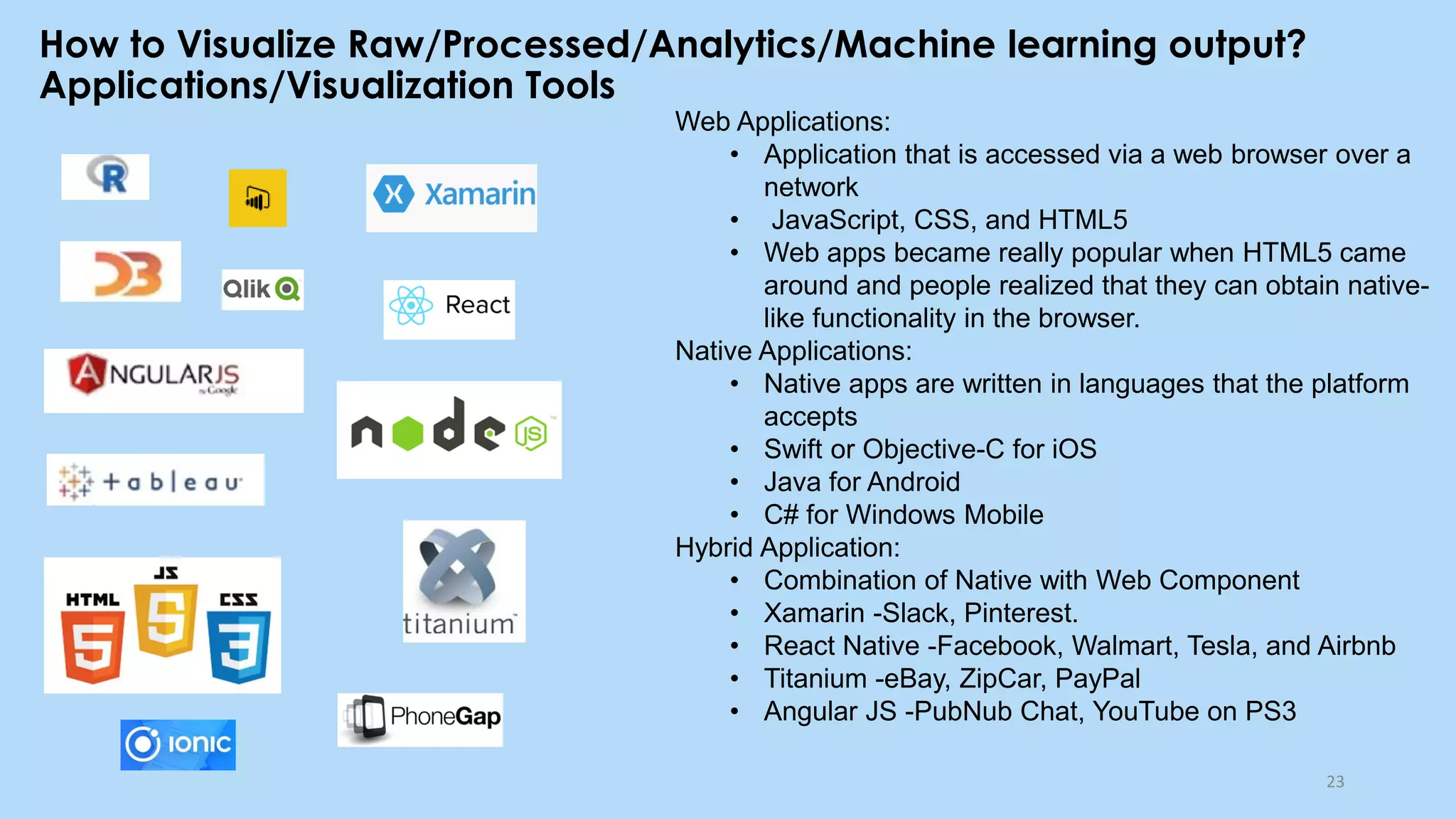
How to Visualize Raw/Processed/Analytics/Machine learning output?
Applications/Visualization Tools
23
Web Applications:
• Application that is accessed via a web browser over a
network
• JavaScript, CSS, and HTML5
• Web apps became really popular when HTML5 came
around and people realized that they can obtain native-
like functionality in the browser.
Native Applications:
• Native apps are written in languages that the platform
accepts
• Swift or Objective-C for iOS
• Java for Android
• C# for Windows Mobile
Hybrid Application:
• Combination of Native with Web Component
• Xamarin -Slack, Pinterest.
• React Native -Facebook, Walmart, Tesla, and Airbnb
• Titanium -eBay, ZipCar, PayPal
• Angular JS -PubNub Chat, YouTube on PS3
Thank You
24

Emergence of cloud computing and internet of things an overview

  • 1.
    Cloud Computing andInternet of Things Dr. Selvaraj Kesavan
  • 2.
    Contents 2 ➢Cloud computing introduction ➢Cloudcomputing- Service, deployment models and characteristics ➢Cloud computing service platforms and Services ➢Internet of things(IoT)- Introduction ➢IoT stack landscape ➢IoT - Sensors, Protocols and Platforms. ➢Overview of various applications/Visualization Tools for IoT
  • 3.
    Cloud Computing ➢ Cloudcomputing is the on-demand delivery of compute power, database storage, applications, and other IT resources through a services platform via the internet with pay-as-you-go pricing. ➢ It is the delivery of computing as a service rather than product where shared resources, software and information are provided to users as an utility. ➢ Moving from traditional to on-Demand model. ➢ The analogy is , 'If you need milk , would you buy a cow ?’. 3
  • 4.
    Cloud Computing- service,deployment models and characteristics Essential Characteristics Resource pooling Broad network access Measured Service Rapid Elasticity On-demand Self-service SaaS Software-as-a-Service applied to Applications e.g. email, productivity, CRM PaaS Platform-as-a-Service applied to App Infrastructure e.g. app runtimes, middleware, dev tools IaaS Infrastructure-as-a-Service applied to System Infrastructure e.g. VMs, containers, storage, network Private Cloud Public Cloud Hybrid Cloud
  • 5.
    Cloud Computing ServiceModels • SaaS (Software as a Service) - Access the services from provider. consumer uses an application, but does not control the operating system, hardware or network infrastructure on which it's running • PaaS (Platform as a Service) - The consumer uses a hosting environment for their applications. The consumer controls the applications that run in the environment but does not control the operating system, hardware or network infrastructure on which they are running. Provides the middleware framework • IaaS (Infrastructure as a Service) - The consumer uses fundamental computing resources such as processing power, storage, networking components 5
  • 6.
    Major Benefits 6 Speed toMarket Cost Reduction Elasticity / Scalability Agility • Lower capital and operational costs • Pay-per-use • Economies of scale • Reduction of time to pilot and test projects • New geographies • Broad geographic availability • Faster availability to customers • Capacity only when you need it • Ability to handle sudden load changes • Survive infrastructure failures • Productivity & Speed • Deploy faster; Iterate faster • React faster to changing business needs • “Infinite” computing capacity
  • 7.
  • 8.
    Security and IdentityServices 8 Authentication : - Allow Apps to authenticate on behalf of users - Allow users Authorization: - Fine-grained access control - Attribute management - Policy evaluation - Policy Management Implementation: OpenID- Created for federated authentication. User obtain account with OpenID Provider and use the account into sign in with any other web services. Allows communication between IDP and SP. OAuth (Open Authorization) is for token-based authentication and authorization. Allows users/application to access resources. SAML: Security Assertion Markup Language. Open standard for authentication and authorization. SSO( Single Sign On) for Federation and Identity Management. One user name and password to access multiple services.
  • 9.
  • 10.
    Database 10 Requirement: ➢ Relational/Non-Relational ➢ Storelarge amount of data ➢ Real Time Streaming Data ➢ Scalable ,Reliable and high availability ➢ Multi-tenancy ➢ Cost Relational (SQL): Structure with defined attributes ➢ MS SQL, POSTGRESQL ,oracle SQL ➢ Can be queried using SQL No-relational(NO-SQL): Free flow operations ➢ Utilize a variety of data models, including document, graph, key- value and columnar ➢ Unique way to query the data ➢ Mongo DB(Document) , Redis (Key-value) ,Amazon Redshift (Columnar) , Cassandra (Columnar), HBase (Columnar) ,Dynamo DB(Document DB-stores JSON/XML) , GraphDB
  • 11.
    Computing 11 Requirement: ➢ Able todeploy application or software ➢ Run and execute ➢ Scale based on conditions ➢ Balance and distribute the load ➢ Fail fallback • Ramp up or ramp down resource on need basis • Compute/memory/storage/GPU optimized • Route the load to difference instances • Virtual Network Environment • Examples: ➢ Virtual Machines ➢ Load Balancers ➢ Auto Scaling ➢ Virtual Private Cloud
  • 12.
    Machine Learning 12 ➢ Machinelearning is a method of data analysis ➢ Using algorithms it iteratively learn from data and allows to find insights into this data ➢ It allows learning from previous computations to produce reliable, repeatable decisions and results ➢ Machine Learning enables computer system to mimic the working of the human brain ✓ Data Collection: Collect the historical Data ✓ Data Preparation: Choose and classify the data ✓ Model Training: Selecting the algorithm for model validation and Training ✓ Model Evaluation: Feed the data and test the accuracy ✓ Performance tune and improvement: Choosing different model Data collection and preparation is the key in Machine Learning
  • 13.
    Machine Learning –Models 13 •Training Data with Labels • Classification ,Regression etc.. • Classifier based on input and output data • Used when "I know how to classify this data, I just need you(the classifier) to sort it." Supervised Learning Machine Learning Un supervised Learning Reinforcement Learning • Training Data without Labels • Clustering ,Dimension reduction etc.. • Algorithm based on input data • Used when "I have no idea how to classify this data, can you(the algorithm) create a classifier for me?" • Iterative Rewards and punishments • Correct input and output pairs are not presented a-priori. • allows machines and software agents to automatically determine the ideal behavior within a specific context. • Training an animal.
  • 14.
    Machine Learning –algorithm and use case 14 Algorithms: ✓ Linear Regression ✓ Logical Regression ✓ K-Means ✓ Random Forest Use cases: ✓ Forecasting ,Decision Making, Classification, Detecting Anomalies etc.. ✓ ML from user preferences to push ads to the respective users ✓ Banking & Financials:- Identify loan & credit card defaulters and customers who can be granted loans and credit cards ✓ Healthcare: Diagnose deadly diseases (e.g. cancer) based on the symptoms of patients and tallying them with the past data of similar kind of patients Programming and Framework: ✓ Python ✓ R Programming (Statistical computing ) ✓ Matlab ✓ Java ✓ Tensor flow ✓ Amazon Machine Learning ✓ Spark Mlib ✓ H2O ✓ Azure ML studio
  • 15.
    Services Platform –Cloud ,IoT and IIoT 15 • Amazon Web Services • Microsoft Azure • Google Cloud platform • IBM Bluemix • Oracle Cloud • GE Predix • ThingWorx
  • 16.
    Platform Services- Example 16 AWSRDS AWS Aurora AWS DynamoDB Azure SQL Google Cloud SQL Azure Table Storage Azure Cosmos DB Google Bigtable Google Cloud Datastore Relational DB Non-relational DB as-a-Service Data Streaming as-a-Service AWS Kinesis Azure Event Hubs Google Cloud Pub/Sub Machine Learning as-a-Service AWS Lex AWS Poly AWS Rekognition Azure Computer Vision API Face API Custom Vision Service Google Cloud Natural Language API Cloud Vision API Cloud Translation API
  • 17.
    Programming/Connecting to cloudServices 17 Programming Toolkits: • Portal • CLI • Power Shell • REST API’s Application to Cloud Services: • SDK’s • REST API’s Device/Gateway to Cloud Services: • Device SDK • REST API’s
  • 18.
    Internet of Things(IoT) and Industrial Internet of Things (IIoT) 18 People Things IIOT IOT
  • 19.
    What is IOT ➢Internet is no longer just a global network for people to communicate with one another using computers, but it is also a platform for devices to communicate electronically with the world around them. ➢ Sensors/Things connected to server via network and deliver connected industry solutions for efficient control and improved human experience. ➢ Billions of connected devices is an indicator of IoT. The connectivity is just an enabler but the real value of IoT is on data (business insight/data-driven economy). 19
  • 20.
    Technology Landscape 20 Industry verticals- Dashboard Platform and services Protocols and Communication Sensors ,Devices and Gateway Application End Device Light Sensor Voltage Sensor Temp/ humidity Vibration Sensor Ultrasonic Sensor Gas Sensor BLE Sensor GPS Pi 3 gateway Gateway PLC
  • 21.
    Field Devices, Sensorsand Gateway 21 Monitor Sensor Data Aggregate Analyze Send to Cloud Gateway Provides ➢ Authentication ➢ Data Filtering ➢ Edge Analytics ➢ Control and management Communication between sensors and Gateway , Gateway to cloud platform using ➢ Zigbee ➢ BLE ➢ Wi-Fi ➢ RF ➢ LoRa ➢ MQTT ➢ AMQP ➢ CoAP ➢ HTTP/HTTPS ➢ NFC,TCP/UDP ➢ UART,SPI Different field sensors/Devices ✓ Sensors: Temperature, pressure, accelerometer ,vibration ,RPM, Beacons etc.. ✓ Devices: Camera, activity tracker, smart glass etc..
  • 22.
    IoT As aService from Cloud platform 22 Major Functionalities: ➢Device Registration ➢Device Authentication and Authorization ➢Device to cloud message ➢Cloud to Device message ➢Device state ➢Rules Engine ➢Communication with other Services ➢Communication with Edge devices
  • 23.
    How to VisualizeRaw/Processed/Analytics/Machine learning output? Applications/Visualization Tools 23 Web Applications: • Application that is accessed via a web browser over a network • JavaScript, CSS, and HTML5 • Web apps became really popular when HTML5 came around and people realized that they can obtain native- like functionality in the browser. Native Applications: • Native apps are written in languages that the platform accepts • Swift or Objective-C for iOS • Java for Android • C# for Windows Mobile Hybrid Application: • Combination of Native with Web Component • Xamarin -Slack, Pinterest. • React Native -Facebook, Walmart, Tesla, and Airbnb • Titanium -eBay, ZipCar, PayPal • Angular JS -PubNub Chat, YouTube on PS3
  • 24.