Introducing
Private clouds
Private cloud
 Private cloud is a computing model that offers a proprietary
environment dedicated to a single business entity. As with other types
of cloud computing environments, private cloud provides extended,
virtualized computing resources via physical components stored on-
premises or at a vendor's datacenter
Private cloud
 One of the chief advantages of a private cloud deployment is the enhanced degree of
control offered to the organization. Because the private cloud is only accessible to a
single business, that organization has the ability to configure the environment and
manage it in a manner that is uniquely tailored to the specific computing needs of the
company.
 A private cloud strategy may be comprised ofa hardware hosted locally at a facility
owned by a business, or it may be hosted by a cloud service provider. Virtual private
clouds are typically paid for on a rolling basis, but provisioned hardware and storage
configurations maintain the benefits of a secure, exclusive network.
Benefits of private cloud
 Private cloud solutions bring value to an enterprise by abstracting computing processes
in a manner much more efficient than traditional virtualization. A few of the primary
advantages include:
 Security and compliance: For businesses operating in heavily regulated industries,
compliance is paramount. Private cloud infrastructure gives organizations the ability to
comply with strict regulations because sensitive data is held on hardware that cannot be
accessed by anyone else. This advantage is available through on-site hardware
installations as well as in hosted services.
 Customization: Private clouds are fully configurable by the organizations using the
solution. A fully private cloud is constructed by an on-site cloud architect, which means
stakeholders can specify the exact environment needed to run proprietary applications.
Hosted private clouds offer the same advantages but require no on-site setup. In that
case, the business works with a vendor to set up and manage a cloud for its exclusive
use.
Benefits of private cloud
 Hybrid integration: When an application needs additional computing
resources, hybridization extends the resources of the private cloud into
a public cloud to maintain uptime without needing to install additional
physical servers. This can be a cost-effective solution for organizations
that need the security of a private cloud but still want other functions to
operate with the power of a public cloud service.
Challenges of private cloud
 A private cloud can introduce challenges if an organization does not have consistent
computing needs. When resource demand is in flux, a private cloud may not be able to
scale effectively, costing the organization more money in the long run. Here are key
considerations IT stakeholders should review:
 Up-front costs: Fully private clouds hosted on-site require a substantial outlay of capital
before they can bring value to the organization. The hardware required to run a private
cloud can be very expensive and it will require an expert cloud architect to set up,
maintain and manage the environment. Hosted private clouds, however, can mitigate
these costs substantially.
Challenges of private cloud
 Capacity utilization: Under the private cloud computing model, the organization is
wholly responsible for maximizing capacity utilization. An under-utilized cloud
deployment can cost the business significantly.
 Scalability: If the business needs additional computing power from the private cloud, it
may take extra time and money to scale up the private cloud's available resource.
Typically, this process will take longer than scaling a virtual machine or requesting
additional resources from a public cloud provider.
Microsoft Azure stack
 Microsoft's Azure Stack solution brings the power of an advanced cloud to
any corporate data center. Azure is ready for hybridization, which means
organizations can take full advantage of compliance offerings while
benefiting from the full Azure cloud solution as needed. Learn how Citrix
and Microsoft are collaborating in the cloud so that you can move at the
speed of business.
 Other major private cloud providers include Dell, IBM, VMware, Oracle and
Red Hat. Each provider has a unique set of cloud offerings.
Open stack
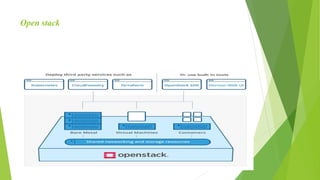
 OpenStack is a cloud operating system that controls large pools of compute,
storage, and networking resources throughout a datacenter, all managed and
provisioned through APIs with common authentication mechanisms.
 A dashboard is also available, giving administrators control while empowering
their users to provision resources through a web interface.
 Beyond standard infrastructure-as-a-service functionality, additional
components provide orchestration, fault management and service management
amongst other services to ensure high availability of user applications.
Open stack
AWS Green grass
 AWS IoT Greengrass is an Internet of Things (IoT) open source edge runtime and cloud
service that helps you build, deploy, and manage device software. Customers use AWS
IoT Greengrass for their IoT applications on millions of devices in homes, factories,
vehicles, and businesses. You can program your devices to act locally on the data they
generate, execute predictions based on machine learning models, filter and aggregate
device data, and only transmit necessary information to the cloud.
AWS Green grass
 AWS IoT Greengrass lets you quickly and easily build intelligent
device software. AWS IoT Greengrass enables local processing,
messaging, data management, ML inference, and offers pre-built
components to accelerate application development. AWS IoT
Greengrass also provides a secure way to seamlessly connect your edge
devices to any AWS service as well as to third-party services.
 Once software development is complete, AWS IoT Greengrass enables
you to remotely manage and operate software on your devices in the
field without needing a firmware update. AWS IoT Greengrass helps
keep your devices up-to-date and makes them smarter over time.
 Dr.Rajapraveen

6.introducing private clouds

  • 1.
  • 2.
    Private cloud  Privatecloud is a computing model that offers a proprietary environment dedicated to a single business entity. As with other types of cloud computing environments, private cloud provides extended, virtualized computing resources via physical components stored on- premises or at a vendor's datacenter
  • 3.
    Private cloud  Oneof the chief advantages of a private cloud deployment is the enhanced degree of control offered to the organization. Because the private cloud is only accessible to a single business, that organization has the ability to configure the environment and manage it in a manner that is uniquely tailored to the specific computing needs of the company.  A private cloud strategy may be comprised ofa hardware hosted locally at a facility owned by a business, or it may be hosted by a cloud service provider. Virtual private clouds are typically paid for on a rolling basis, but provisioned hardware and storage configurations maintain the benefits of a secure, exclusive network.
  • 4.
    Benefits of privatecloud  Private cloud solutions bring value to an enterprise by abstracting computing processes in a manner much more efficient than traditional virtualization. A few of the primary advantages include:  Security and compliance: For businesses operating in heavily regulated industries, compliance is paramount. Private cloud infrastructure gives organizations the ability to comply with strict regulations because sensitive data is held on hardware that cannot be accessed by anyone else. This advantage is available through on-site hardware installations as well as in hosted services.  Customization: Private clouds are fully configurable by the organizations using the solution. A fully private cloud is constructed by an on-site cloud architect, which means stakeholders can specify the exact environment needed to run proprietary applications. Hosted private clouds offer the same advantages but require no on-site setup. In that case, the business works with a vendor to set up and manage a cloud for its exclusive use.
  • 5.
    Benefits of privatecloud  Hybrid integration: When an application needs additional computing resources, hybridization extends the resources of the private cloud into a public cloud to maintain uptime without needing to install additional physical servers. This can be a cost-effective solution for organizations that need the security of a private cloud but still want other functions to operate with the power of a public cloud service.
  • 6.
    Challenges of privatecloud  A private cloud can introduce challenges if an organization does not have consistent computing needs. When resource demand is in flux, a private cloud may not be able to scale effectively, costing the organization more money in the long run. Here are key considerations IT stakeholders should review:  Up-front costs: Fully private clouds hosted on-site require a substantial outlay of capital before they can bring value to the organization. The hardware required to run a private cloud can be very expensive and it will require an expert cloud architect to set up, maintain and manage the environment. Hosted private clouds, however, can mitigate these costs substantially.
  • 7.
    Challenges of privatecloud  Capacity utilization: Under the private cloud computing model, the organization is wholly responsible for maximizing capacity utilization. An under-utilized cloud deployment can cost the business significantly.  Scalability: If the business needs additional computing power from the private cloud, it may take extra time and money to scale up the private cloud's available resource. Typically, this process will take longer than scaling a virtual machine or requesting additional resources from a public cloud provider.
  • 8.
    Microsoft Azure stack Microsoft's Azure Stack solution brings the power of an advanced cloud to any corporate data center. Azure is ready for hybridization, which means organizations can take full advantage of compliance offerings while benefiting from the full Azure cloud solution as needed. Learn how Citrix and Microsoft are collaborating in the cloud so that you can move at the speed of business.  Other major private cloud providers include Dell, IBM, VMware, Oracle and Red Hat. Each provider has a unique set of cloud offerings.
  • 9.
    Open stack  OpenStackis a cloud operating system that controls large pools of compute, storage, and networking resources throughout a datacenter, all managed and provisioned through APIs with common authentication mechanisms.  A dashboard is also available, giving administrators control while empowering their users to provision resources through a web interface.  Beyond standard infrastructure-as-a-service functionality, additional components provide orchestration, fault management and service management amongst other services to ensure high availability of user applications.
  • 10.
  • 11.
    AWS Green grass AWS IoT Greengrass is an Internet of Things (IoT) open source edge runtime and cloud service that helps you build, deploy, and manage device software. Customers use AWS IoT Greengrass for their IoT applications on millions of devices in homes, factories, vehicles, and businesses. You can program your devices to act locally on the data they generate, execute predictions based on machine learning models, filter and aggregate device data, and only transmit necessary information to the cloud.
  • 12.
    AWS Green grass AWS IoT Greengrass lets you quickly and easily build intelligent device software. AWS IoT Greengrass enables local processing, messaging, data management, ML inference, and offers pre-built components to accelerate application development. AWS IoT Greengrass also provides a secure way to seamlessly connect your edge devices to any AWS service as well as to third-party services.  Once software development is complete, AWS IoT Greengrass enables you to remotely manage and operate software on your devices in the field without needing a firmware update. AWS IoT Greengrass helps keep your devices up-to-date and makes them smarter over time.
  • 13.