Prepared by: Dr. Archana Naik
Introduction
 LCMS is hyphenated technique.
 Advantages:
1. Superior.
2. High sensitivity.
3. Rapid analysis.
 Applications :
1. Identification of protein and metabolites.
2. Impurity profiling.
 Problem:
Carry over ,matrix effect, adduct formation etc.
“Troubleshooting is essential”
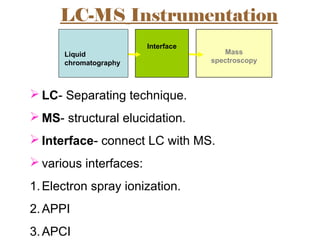
Mass
spectroscopy
Interface
LC-MS Instrumentation
 LC- Separating technique.
 MS- structural elucidation.
 Interface- connect LC with MS.
 various interfaces:
1.Electron spray ionization.
2.APPI
3.APCI
Liquid
chromatography
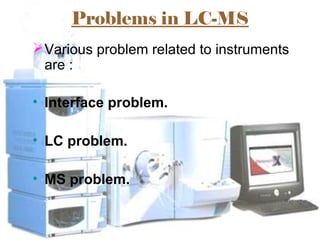
Problems in LC-MS
Various problem related to instruments
are :
• Interface problem.
• LC problem.
• MS problem.
Approaches for
troubleshooting
 There two approaches for troubleshooting:
1)Preventive maintenance attitude of analyst.
2)Troubleshooting attitude:-
a) Isolate area where problem arise.
b) Identify problem.
c) Solve it.
 Duty of analyst:
Competent to identify problems.
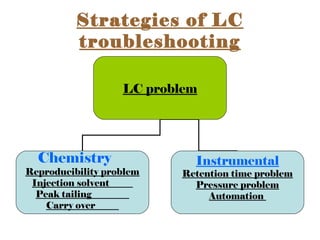
Strategies of LC
troubleshooting
LC problem
Reproducibility problem
Injection solvent
Peak tailing
Carry over
Instrumental
Retention time problem
Pressure problem
Automation
Chemistry
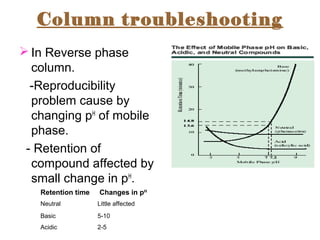
Column troubleshooting
 In Reverse phase
column.
-Reproducibility
problem cause by
changing pH
of mobile
phase.
- Retention of
compound affected by
small change in pH
.
Retention time Changes in pH
Neutral Little affected
Basic 5-10
Acidic 2-5
 Develop mobile phase that not sensitive to pH
change.
 Use proper buffer for mobile phase
 Negative effect of silanol group on column
retention is eliminate by using ace column.
Remedies
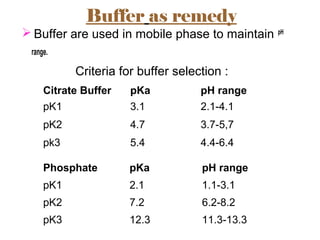
Buffer as remedy
 Buffer are used in mobile phase to maintain pH
range.
Criteria for buffer selection :
Citrate Buffer pKa pH range
pK1 3.1 2.1-4.1
pK2 4.7 3.7-5,7
pk3 5.4 4.4-6.4
Phosphate pKa pH range
pK1 2.1 1.1-3.1
pK2 7.2 6.2-8.2
pK3 12.3 11.3-13.3
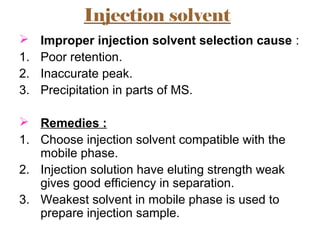
Injection solvent
 Improper injection solvent selection cause :
1. Poor retention.
2. Inaccurate peak.
3. Precipitation in parts of MS.
 Remedies :
1. Choose injection solvent compatible with the
mobile phase.
2. Injection solution have eluting strength weak
gives good efficiency in separation.
3. Weakest solvent in mobile phase is used to
prepare injection sample.
Injection solution selection criteria
1. Analyte adsorption , Enrichment retention and
Solubility.
2. Retention mechanism.
3. Solvent evaporation.
e.g. Omeprazole
Sound Sample Preparation
 Sample clean up in LC-MS is essential.
 Required to remove unwanted compounds.
 Sample is clean by various steps:
 Step 1 :
1)Solid phase extraction
2)Liquid liquid extraction
3)protein precipitation
 Step 2 :
Separate analyte from unwanted compound by
LC
Peak Tailing
 Peak tailing observed with basic compounds.
e.g. Pyridine ,amitriptyline, etc.
 Affect the selectivity of the analyte.
 Remedy:
- New Zorbax Eclipse Plus LC column.
 Advantages of Zorbax Eclipse LC column:
1. Achieve excellent peak shape & resolution.
2. Superior, reproducible, separation of basic
compounds.
3. Reduce peak tailing.
Carry over
 Extra peaks or Ghost
peak are observed.
 Due to entry of previous
injection sample into new
sample.
 Remedy :
• The injection clean with a
vial which is full of
solvent up to upper limit
level.
• It is predict by no
analyte peak in blank.
Fig. Carry over effect
Instrumental Problems in LC
1. Retention time problem.
2. Pressure problem.
3. Leakage problem.
Retention Time Problem
 Causes :
1. Column overloaded with sample.
2. Accumulation impurity.
3. Leaks.
4. Loss stationary phase.
 Remedies :
1. Flush the column with strong solvent.
2. Replace the leakage part.
3. Replace the column.
Pressure Problem
 Causes :
1. Salt precipitation in column.
2. Contamination at column inlet.
3. Air bubbles in the pump.
 Remedies :
• Improve sample clean up.
• Flush the column to dissolve the
impurities.
• Degassing the solvent.
Leakage problem
 Causes :
• Column losses stationary phase.
• Leak at injector.
• Leak at pump.
 Remedies :
• Replace column.
• Check and replace pump seal.
• Replace the valve rotors.
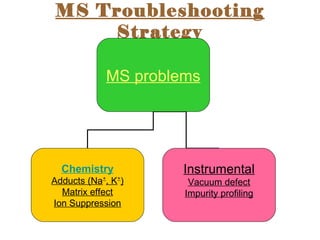
MS Troubleshooting
Strategy
MS problems
Chemistry
Adducts (Na+
, K+
)
Matrix effect
Ion Suppression
Instrumental
Vacuum defect
Impurity profiling
Adduct Formation
 Incorporation of unwanted matter in analyte.
 Formation of adduct in region of interface.
E.g. Na+
, K+
 Causes:
- Due to improper washing of glassware.
- Any compound of previous analyte remain in
system.
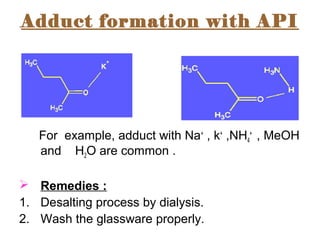
Adduct formation with API
For example, adduct with Na+
, k+
,NH4
+
, MeOH
and H2O are common .
 Remedies :
1. Desalting process by dialysis.
2. Wash the glassware properly.
Matrix Effect
 It is the effect on analytical method caused by all
other component of sample except the analyte.
 Matrix effect affect the interference in peak.
 Matrix effect affect the ionization , result in loss of
sensitivity.
 Effect eliminated by changing :
- API mode.
- LC column.
- Sample injection volume.
- Clean sample preparation.
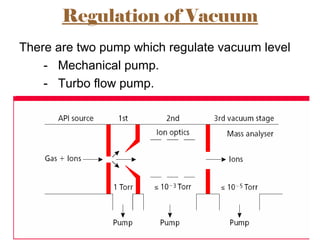
Regulation of Vacuum
There are two pump which regulate vacuum level
- Mechanical pump.
- Turbo flow pump.
Vacuum Defects
 Causes:
- Defect in mechanical pump.
- Air entered in vacuum.
- Moisture incorporate in MS.
“Moisture is poison for MS”
 Remedies: -
1. Doesn’t disconnect vacuum supply even the
instrument is switched off.
2. Correct gauge problem.
3. Replacement of defective pump.
Impurity Profiling
 Compound & impurity combinly detected in
MS.
 No clearly identification of the impurity peak.
 Compounds gives large & impurity gives small
peak.
 Remedies:
1. Compound is collect in waste ,after
separation.
2. Entry of only impurity in MS.
3. Impurity detection.
Sources Losses
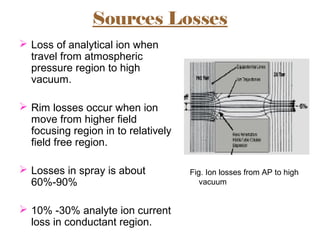
 Loss of analytical ion when
travel from atmospheric
pressure region to high
vacuum.
 Rim losses occur when ion
move from higher field
focusing region in to relatively
field free region.
 Losses in spray is about
60%-90%
 10% -30% analyte ion current
loss in conductant region.
Fig. Ion losses from AP to high
vacuum
Remedies
1) Laminated tube :
Rim losses eliminate by more fully control the
electric field along conductance pathway.
2) Array :
 Introduce ion from AP to vacuum by
eliminating rim loss.
 Introduce Only necessary amount of gas in to
vacuum.
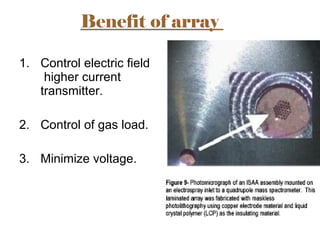
1. Control electric field
higher current
transmitter.
2. Control of gas load.
3. Minimize voltage.
Benefit of array
Case study
Aim : To know the synergistic effect of ionization and
sample preparation technique in matrix effect.
Matrix effect in bio-analytical drugs :
 Post column infusion experiment with morphine(10
µg/ml).
 Three bio- fluids pre-treated with 4 sample.
 Preparation procedure and analyze by LC-MS.
Result:
 The ESI is more susceptible two matrix effect than APCI.
 Synergistic effect ionization ,sample clean up reduces
matrix effect in various bio-fluid.
CONCLUSION
 LC-MS is hyphenated technique. which
has sensitivity ,selectivity , rapid analysis,
but due to chemical and instrumental
problem its efficiency reduces.
 By troubleshooting this problem one can
improve reproducibility and robustness of
the technique and make LC-MS a very
sophisticated and a “STATE OF ART”
instrument in pharmaceutical and
analytical works.
References
1. Whitehouse C. ,Dreyer R. ,Yamashita M., Fenn
Journal of Anal Chem 1985;57;675-679.
2. Zang K. ,Durky R. & Fales H., Journal of Anal
Chem 1996; 68 ;3288-3289.
3. Nissen M., Vandergreeg Journal of
Chromatographic science series 58;142-153.
4. Tomer K.,Parker C., Journal of
Chromatography 1989;492;189-196.
5. Verkey K., Edwards D., & Zerilli L.,Journal of
Chromatography 1989;488;73-85.
References (cntd..)
6. Veillon C., Patterson K., Analyst 1996;121;983-
986
7. Lin S., Wang J.,PDA Journal of
Pharmaceutical Science & Technology
1997;57; 257-263
8. Web search
www.water.com
www.agilent.com
www.pharmatech.com
Troubleshooting in lcms

Troubleshooting in lcms

  • 1.
    Prepared by: Dr.Archana Naik
  • 2.
    Introduction  LCMS ishyphenated technique.  Advantages: 1. Superior. 2. High sensitivity. 3. Rapid analysis.  Applications : 1. Identification of protein and metabolites. 2. Impurity profiling.  Problem: Carry over ,matrix effect, adduct formation etc. “Troubleshooting is essential”
  • 3.
    Mass spectroscopy Interface LC-MS Instrumentation  LC-Separating technique.  MS- structural elucidation.  Interface- connect LC with MS.  various interfaces: 1.Electron spray ionization. 2.APPI 3.APCI Liquid chromatography
  • 4.
    Problems in LC-MS Variousproblem related to instruments are : • Interface problem. • LC problem. • MS problem.
  • 5.
    Approaches for troubleshooting  Theretwo approaches for troubleshooting: 1)Preventive maintenance attitude of analyst. 2)Troubleshooting attitude:- a) Isolate area where problem arise. b) Identify problem. c) Solve it.  Duty of analyst: Competent to identify problems.
  • 6.
    Strategies of LC troubleshooting LCproblem Reproducibility problem Injection solvent Peak tailing Carry over Instrumental Retention time problem Pressure problem Automation Chemistry
  • 7.
    Column troubleshooting  InReverse phase column. -Reproducibility problem cause by changing pH of mobile phase. - Retention of compound affected by small change in pH . Retention time Changes in pH Neutral Little affected Basic 5-10 Acidic 2-5
  • 8.
     Develop mobilephase that not sensitive to pH change.  Use proper buffer for mobile phase  Negative effect of silanol group on column retention is eliminate by using ace column. Remedies
  • 9.
    Buffer as remedy Buffer are used in mobile phase to maintain pH range. Criteria for buffer selection : Citrate Buffer pKa pH range pK1 3.1 2.1-4.1 pK2 4.7 3.7-5,7 pk3 5.4 4.4-6.4 Phosphate pKa pH range pK1 2.1 1.1-3.1 pK2 7.2 6.2-8.2 pK3 12.3 11.3-13.3
  • 10.
    Injection solvent  Improperinjection solvent selection cause : 1. Poor retention. 2. Inaccurate peak. 3. Precipitation in parts of MS.  Remedies : 1. Choose injection solvent compatible with the mobile phase. 2. Injection solution have eluting strength weak gives good efficiency in separation. 3. Weakest solvent in mobile phase is used to prepare injection sample.
  • 11.
    Injection solution selectioncriteria 1. Analyte adsorption , Enrichment retention and Solubility. 2. Retention mechanism. 3. Solvent evaporation. e.g. Omeprazole
  • 12.
    Sound Sample Preparation Sample clean up in LC-MS is essential.  Required to remove unwanted compounds.  Sample is clean by various steps:  Step 1 : 1)Solid phase extraction 2)Liquid liquid extraction 3)protein precipitation  Step 2 : Separate analyte from unwanted compound by LC
  • 13.
    Peak Tailing  Peaktailing observed with basic compounds. e.g. Pyridine ,amitriptyline, etc.  Affect the selectivity of the analyte.  Remedy: - New Zorbax Eclipse Plus LC column.  Advantages of Zorbax Eclipse LC column: 1. Achieve excellent peak shape & resolution. 2. Superior, reproducible, separation of basic compounds. 3. Reduce peak tailing.
  • 14.
    Carry over  Extrapeaks or Ghost peak are observed.  Due to entry of previous injection sample into new sample.  Remedy : • The injection clean with a vial which is full of solvent up to upper limit level. • It is predict by no analyte peak in blank. Fig. Carry over effect
  • 15.
    Instrumental Problems inLC 1. Retention time problem. 2. Pressure problem. 3. Leakage problem.
  • 16.
    Retention Time Problem Causes : 1. Column overloaded with sample. 2. Accumulation impurity. 3. Leaks. 4. Loss stationary phase.  Remedies : 1. Flush the column with strong solvent. 2. Replace the leakage part. 3. Replace the column.
  • 17.
    Pressure Problem  Causes: 1. Salt precipitation in column. 2. Contamination at column inlet. 3. Air bubbles in the pump.  Remedies : • Improve sample clean up. • Flush the column to dissolve the impurities. • Degassing the solvent.
  • 18.
    Leakage problem  Causes: • Column losses stationary phase. • Leak at injector. • Leak at pump.  Remedies : • Replace column. • Check and replace pump seal. • Replace the valve rotors.
  • 19.
    MS Troubleshooting Strategy MS problems Chemistry Adducts(Na+ , K+ ) Matrix effect Ion Suppression Instrumental Vacuum defect Impurity profiling
  • 20.
    Adduct Formation  Incorporationof unwanted matter in analyte.  Formation of adduct in region of interface. E.g. Na+ , K+  Causes: - Due to improper washing of glassware. - Any compound of previous analyte remain in system.
  • 21.
    Adduct formation withAPI For example, adduct with Na+ , k+ ,NH4 + , MeOH and H2O are common .  Remedies : 1. Desalting process by dialysis. 2. Wash the glassware properly.
  • 22.
    Matrix Effect  Itis the effect on analytical method caused by all other component of sample except the analyte.  Matrix effect affect the interference in peak.  Matrix effect affect the ionization , result in loss of sensitivity.  Effect eliminated by changing : - API mode. - LC column. - Sample injection volume. - Clean sample preparation.
  • 23.
    Regulation of Vacuum Thereare two pump which regulate vacuum level - Mechanical pump. - Turbo flow pump.
  • 24.
    Vacuum Defects  Causes: -Defect in mechanical pump. - Air entered in vacuum. - Moisture incorporate in MS. “Moisture is poison for MS”  Remedies: - 1. Doesn’t disconnect vacuum supply even the instrument is switched off. 2. Correct gauge problem. 3. Replacement of defective pump.
  • 25.
    Impurity Profiling  Compound& impurity combinly detected in MS.  No clearly identification of the impurity peak.  Compounds gives large & impurity gives small peak.  Remedies: 1. Compound is collect in waste ,after separation. 2. Entry of only impurity in MS. 3. Impurity detection.
  • 26.
    Sources Losses  Lossof analytical ion when travel from atmospheric pressure region to high vacuum.  Rim losses occur when ion move from higher field focusing region in to relatively field free region.  Losses in spray is about 60%-90%  10% -30% analyte ion current loss in conductant region. Fig. Ion losses from AP to high vacuum
  • 27.
    Remedies 1) Laminated tube: Rim losses eliminate by more fully control the electric field along conductance pathway. 2) Array :  Introduce ion from AP to vacuum by eliminating rim loss.  Introduce Only necessary amount of gas in to vacuum.
  • 28.
    1. Control electricfield higher current transmitter. 2. Control of gas load. 3. Minimize voltage. Benefit of array
  • 29.
    Case study Aim :To know the synergistic effect of ionization and sample preparation technique in matrix effect. Matrix effect in bio-analytical drugs :  Post column infusion experiment with morphine(10 µg/ml).  Three bio- fluids pre-treated with 4 sample.  Preparation procedure and analyze by LC-MS. Result:  The ESI is more susceptible two matrix effect than APCI.  Synergistic effect ionization ,sample clean up reduces matrix effect in various bio-fluid.
  • 30.
    CONCLUSION  LC-MS ishyphenated technique. which has sensitivity ,selectivity , rapid analysis, but due to chemical and instrumental problem its efficiency reduces.  By troubleshooting this problem one can improve reproducibility and robustness of the technique and make LC-MS a very sophisticated and a “STATE OF ART” instrument in pharmaceutical and analytical works.
  • 31.
    References 1. Whitehouse C.,Dreyer R. ,Yamashita M., Fenn Journal of Anal Chem 1985;57;675-679. 2. Zang K. ,Durky R. & Fales H., Journal of Anal Chem 1996; 68 ;3288-3289. 3. Nissen M., Vandergreeg Journal of Chromatographic science series 58;142-153. 4. Tomer K.,Parker C., Journal of Chromatography 1989;492;189-196. 5. Verkey K., Edwards D., & Zerilli L.,Journal of Chromatography 1989;488;73-85.
  • 32.
    References (cntd..) 6. VeillonC., Patterson K., Analyst 1996;121;983- 986 7. Lin S., Wang J.,PDA Journal of Pharmaceutical Science & Technology 1997;57; 257-263 8. Web search www.water.com www.agilent.com www.pharmatech.com