THERMOLUMINESCENCE
DOSIMETRY
DR KIRAN KUMAR BR
• A Thermoluminescent dosimeter, or TLD, is
a type of radiation dosimeter.
• PRINCIPLE
THERMOLUMINESCENCE
Thermoluminescence
• Thermoluminescent (TL) means emitting light
when heated.
• Many crystalline materials exhibit the
phenomenon of thermoluminescence.
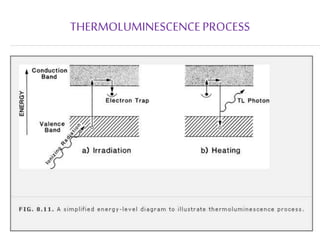
THERMOLUMINESCENCEPROCESS
• In an individual atom, electrons occupy discrete
energy levels.
• In a crystal lattice, on the other hand, electronic
energy levels are perturbed by mutual interactions
between atoms and give rise to energy bands: the
“allowed” energy bands and the forbidden energy
bands.
• In addition, the presence of impurities in the crystal
creates energy traps in the forbidden region,
providing metastable states for the electrons.
• When the material is irradiated, some of the electrons
in the valence band (ground state) receive sufficient
energy to be raised to the conduction band.
• The vacancy thus created in the valence band is called
a positive hole.
• The electron and the hole move independently
through their respective bands until they recombine
(electron returning to the ground state) or until they
fall into a trap (metastable state).
• If there is instantaneous emission of light owing to
these transitions, the phenomenon is called
fluorescence.
• If an electron in the trap requires energy to get out of
the trap and fall to the valence band, the emission of
light in this case is called phosphorescence
(delayed fluorescence).
• If phosphorescence at room temperature is very slow.
• But can be speeded up significantly with a moderate
amount of heating (~300°C)
• The phenomenon is called thermoluminescence.
TLD
• Thermoluminescent dosimeters (TLD) are often used
instead of the film badge.
• A TLD badge based on CaSO4: Dy Teflon discs has
been designed and is in regular Personnel Monitoring
use since 1975.
• A TLD measures ionizing radiation exposure by
measuring the amount of visible light emitted from a
crystal in the detector when the crystal is heated.
• The amount of light emitted is dependent upon the
radiation exposure.
• A very minute fraction of the absorbed energy is
stored in the crystal lattice.
• Materials exhibiting thermoluminescence in response
to ionizing radiation.
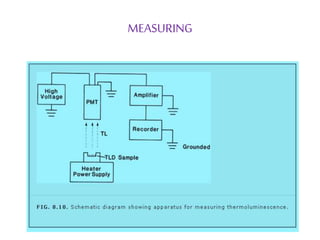
MEASURING
• The irradiated material is placed in a heater cup or
planchet.
• Where it is heated for a reproducible heating cycle.
• The emitted light is measured by a photomultiplier
tube (PMT).
• Which converts light into an electrical current.
• The current is then amplified and measured by a
recorder or a counter.
• The complete Personnel Monitoring TLD badge
consists of a TLD card.
• A plastic cassette for holding the TLD card.
• The badge is affixed to the clothing of a person with
the help of a crocodile clip attached to the badge.
• There are several TL phosphors available, but the
most noteworthy are lithium fluoride (LiF), lithium
borate (Li2B4O7), and calcium fluoride (CaF2).
There are three filters in the cassette
corresponding to each disc namely,
1. Cu + Al.
2. Perspex.
3. Open.
The Al should face the radiation and Cu should
face the TLD disc.
• The metallic filter is for gamma radiation.
• The perspex is for beta radiation.
• The filter are mainly used to make the TLD discs
energy independent.
• The card enclosed by a paper wrapper in which users
name is written.
• The discs are reusable after proper annealing.
• The badge can cover a wide range of dose from 10mR
to 10,000R with accuracy of (+-)10 percent.
ADVANTAGES OF TLD
• No need to processing.
• Insensitive to temperature, humidity, pressure.
• More accurate.
• Linearity of response to dose.
• Its relative energy independence
• Sensitive to low doses.
• Reusable.
• Automated readout.
• Small physical size.
Its applicationareasare :
• Measurement of output from Co-60 units and
accelerators used in medicine and industry.
• Area survey of medical (diagnostic and therapeutic)
and industrial radiographic installations.
• Measurement of stray and leakage radiation around X-
ray tubes and source containers
• Medical radiographic exposure measurement and
population exposure survey studies.
• Estimation of activities of various radionuclides used in
brachytherapy and nuclear medicine.
• Personnel Monitoring.
THANK YOU

Thermoluminesence dosimetry

  • 1.
  • 2.
    • A Thermoluminescentdosimeter, or TLD, is a type of radiation dosimeter. • PRINCIPLE THERMOLUMINESCENCE
  • 3.
    Thermoluminescence • Thermoluminescent (TL)means emitting light when heated. • Many crystalline materials exhibit the phenomenon of thermoluminescence.
  • 4.
  • 5.
    • In anindividual atom, electrons occupy discrete energy levels. • In a crystal lattice, on the other hand, electronic energy levels are perturbed by mutual interactions between atoms and give rise to energy bands: the “allowed” energy bands and the forbidden energy bands. • In addition, the presence of impurities in the crystal creates energy traps in the forbidden region, providing metastable states for the electrons.
  • 6.
    • When thematerial is irradiated, some of the electrons in the valence band (ground state) receive sufficient energy to be raised to the conduction band. • The vacancy thus created in the valence band is called a positive hole. • The electron and the hole move independently through their respective bands until they recombine (electron returning to the ground state) or until they fall into a trap (metastable state).
  • 7.
    • If thereis instantaneous emission of light owing to these transitions, the phenomenon is called fluorescence. • If an electron in the trap requires energy to get out of the trap and fall to the valence band, the emission of light in this case is called phosphorescence (delayed fluorescence). • If phosphorescence at room temperature is very slow. • But can be speeded up significantly with a moderate amount of heating (~300°C) • The phenomenon is called thermoluminescence.
  • 8.
    TLD • Thermoluminescent dosimeters(TLD) are often used instead of the film badge. • A TLD badge based on CaSO4: Dy Teflon discs has been designed and is in regular Personnel Monitoring use since 1975. • A TLD measures ionizing radiation exposure by measuring the amount of visible light emitted from a crystal in the detector when the crystal is heated. • The amount of light emitted is dependent upon the radiation exposure.
  • 9.
    • A veryminute fraction of the absorbed energy is stored in the crystal lattice. • Materials exhibiting thermoluminescence in response to ionizing radiation.
  • 10.
  • 11.
    • The irradiatedmaterial is placed in a heater cup or planchet. • Where it is heated for a reproducible heating cycle. • The emitted light is measured by a photomultiplier tube (PMT). • Which converts light into an electrical current. • The current is then amplified and measured by a recorder or a counter.
  • 12.
    • The completePersonnel Monitoring TLD badge consists of a TLD card. • A plastic cassette for holding the TLD card. • The badge is affixed to the clothing of a person with the help of a crocodile clip attached to the badge. • There are several TL phosphors available, but the most noteworthy are lithium fluoride (LiF), lithium borate (Li2B4O7), and calcium fluoride (CaF2).
  • 13.
    There are threefilters in the cassette corresponding to each disc namely, 1. Cu + Al. 2. Perspex. 3. Open. The Al should face the radiation and Cu should face the TLD disc.
  • 14.
    • The metallicfilter is for gamma radiation. • The perspex is for beta radiation. • The filter are mainly used to make the TLD discs energy independent. • The card enclosed by a paper wrapper in which users name is written. • The discs are reusable after proper annealing. • The badge can cover a wide range of dose from 10mR to 10,000R with accuracy of (+-)10 percent.
  • 15.
    ADVANTAGES OF TLD •No need to processing. • Insensitive to temperature, humidity, pressure. • More accurate. • Linearity of response to dose. • Its relative energy independence • Sensitive to low doses. • Reusable. • Automated readout. • Small physical size.
  • 16.
    Its applicationareasare : •Measurement of output from Co-60 units and accelerators used in medicine and industry. • Area survey of medical (diagnostic and therapeutic) and industrial radiographic installations. • Measurement of stray and leakage radiation around X- ray tubes and source containers
  • 17.
    • Medical radiographicexposure measurement and population exposure survey studies. • Estimation of activities of various radionuclides used in brachytherapy and nuclear medicine. • Personnel Monitoring.
  • 18.