DOSIMETER
DR.JAYAPANDIYAN
TOPICS TO BE COVERED
❑ Introduction
❑ Pocket dosimeter
❑ Thermoluminescent dosimeter
❑ Solid state detector
❑Advantages
❑Disadvantages
DOSIMETER
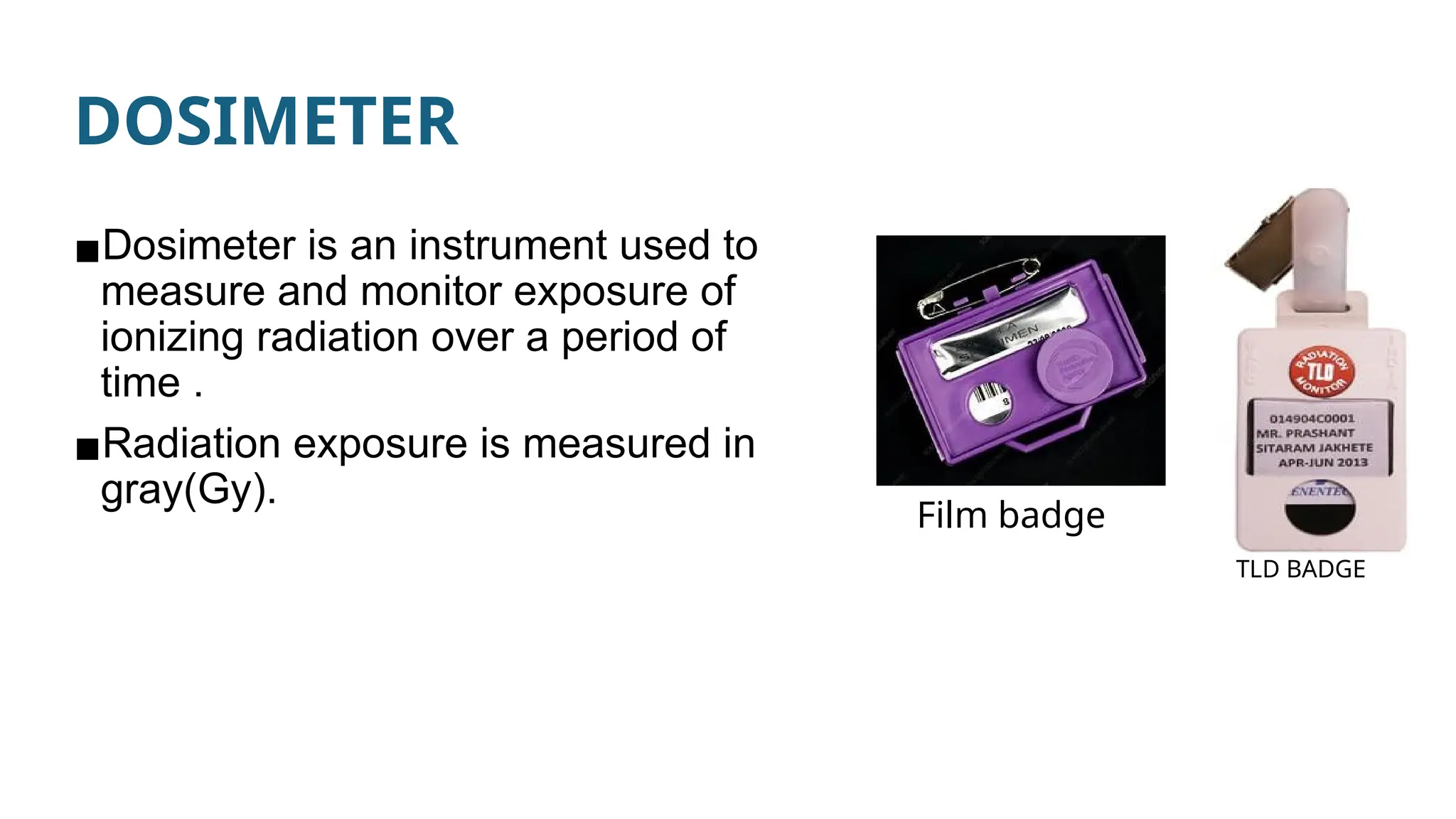
▪Dosimeter is an instrument used to
measure and monitor exposure of
ionizing radiation over a period of
time .
▪Radiation exposure is measured in
gray(Gy).
Film badge
TLD BADGE
POCKET DOSIMETER
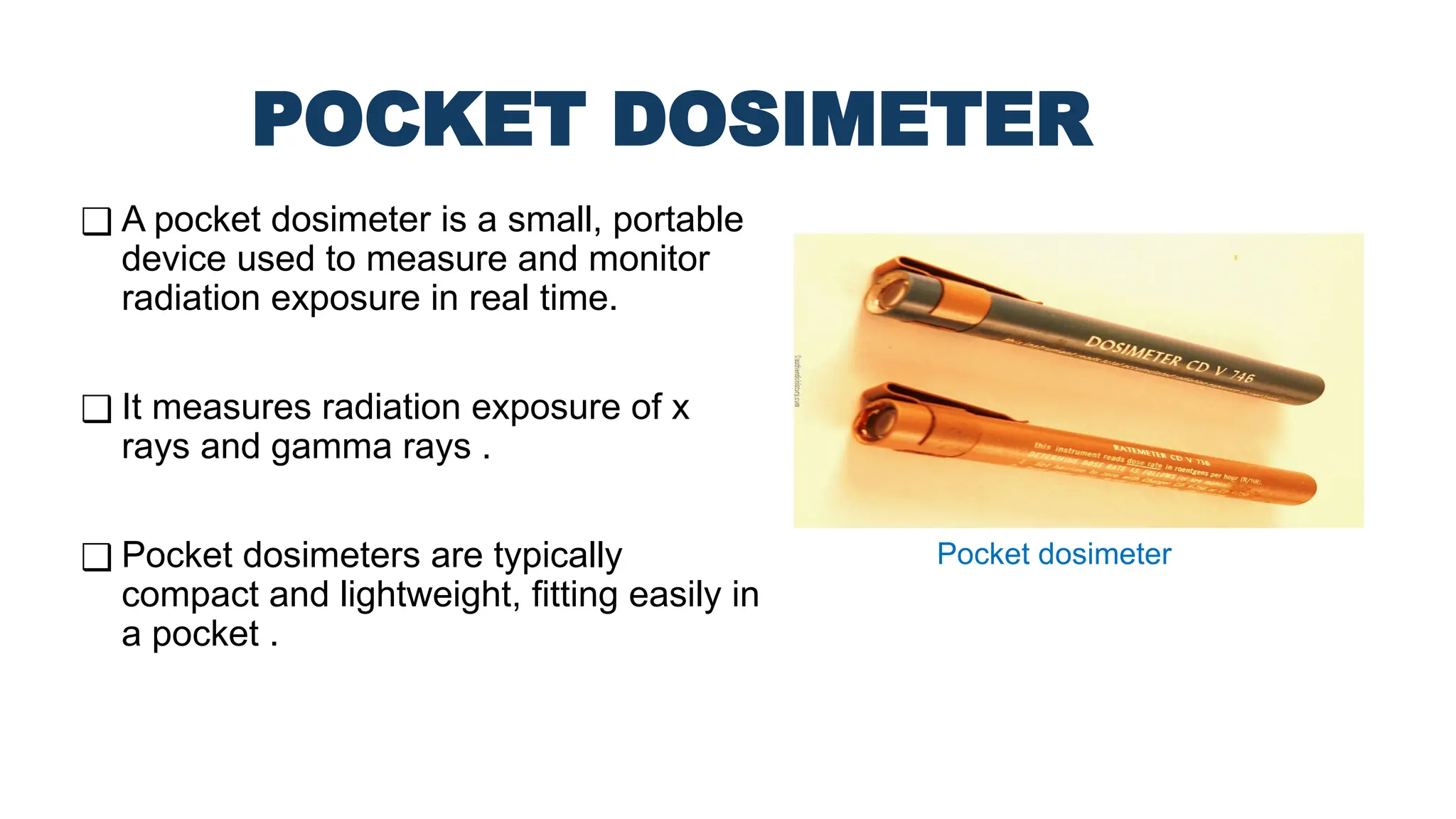
❑ A pocket dosimeter is a small, portable
device used to measure and monitor
radiation exposure in real time.
❑ It measures radiation exposure of x
rays and gamma rays .
❑ Pocket dosimeters are typically
compact and lightweight, fitting easily in
a pocket .
Pocket dosimeter
PRINCIPLE
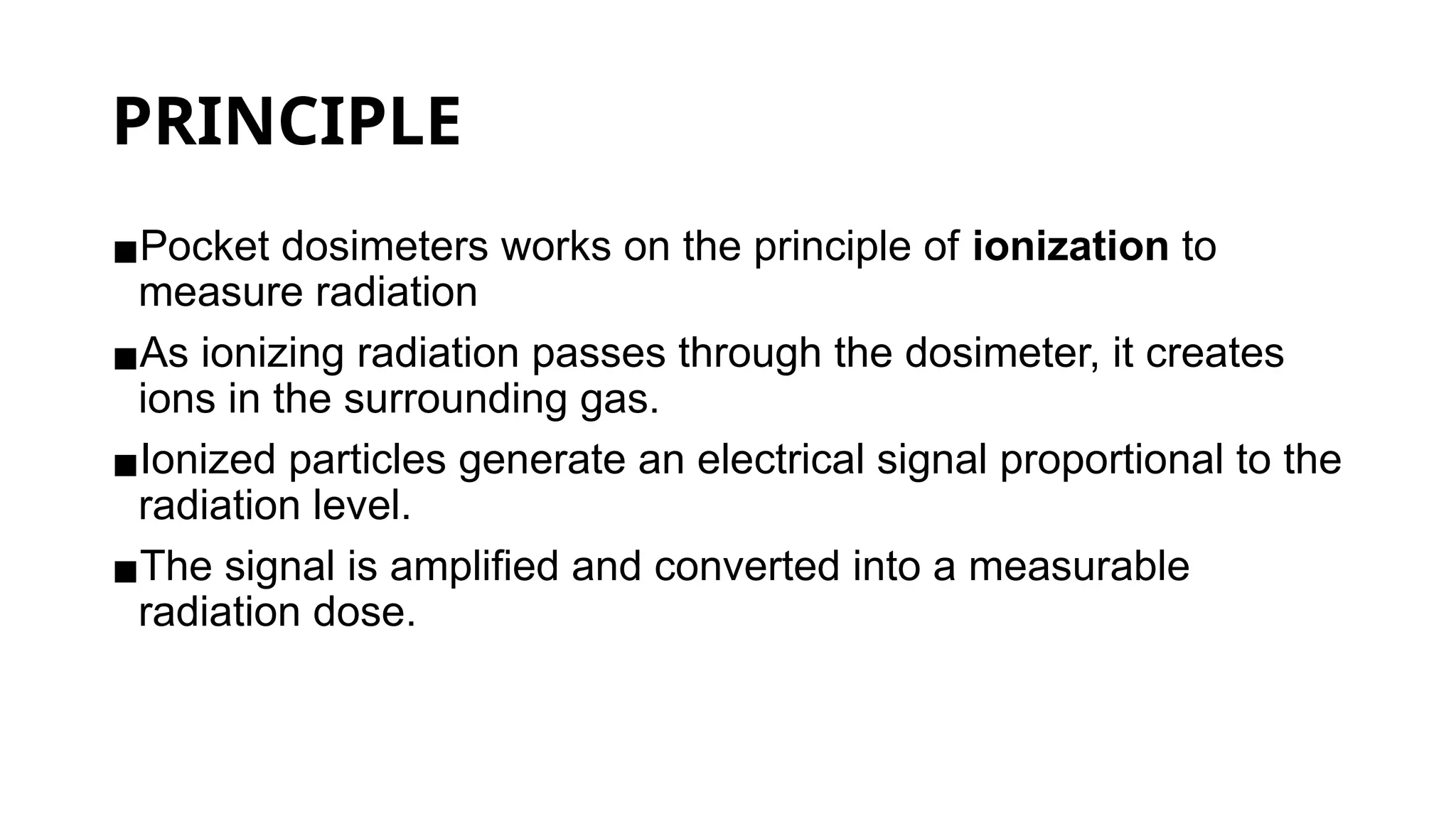
▪Pocket dosimeters works on the principle of ionization to
measure radiation
▪As ionizing radiation passes through the dosimeter, it creates
ions in the surrounding gas.
▪Ionized particles generate an electrical signal proportional to the
radiation level.
▪The signal is amplified and converted into a measurable
radiation dose.
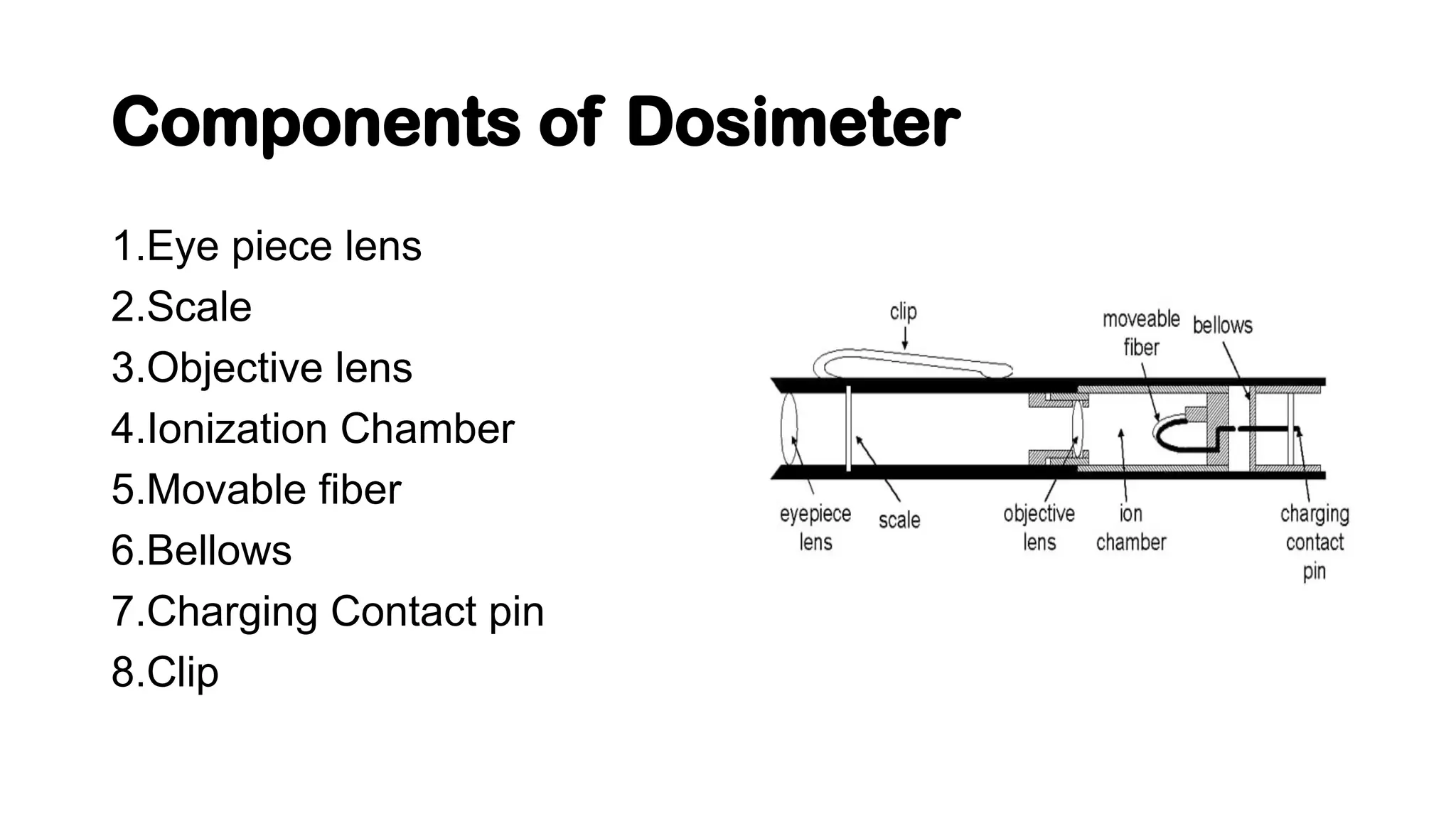
Components of Dosimeter
1.Eye piece lens
2.Scale
3.Objective lens
4.Ionization Chamber
5.Movable fiber
6.Bellows
7.Charging Contact pin
8.Clip
WORKING
▪The gas filling
The chamber contains a specific gas that is easily ionized by
radiation.
▪Radiation Interaction
Radiation enters the chamber, interacting with the gas and causing
ionization.
▪Electrodes
Electrodes are used to collect ionized particles , creating an
electrical current.
STEPS INVOLVED
❑ Exposure
The dosimeter is worn in a pocket or clipped to clothing for
accurate exposure measurement.
❑ Reading
The display shows the accumulated radiation dose, often in units
like mSv.
❑ Calibration
Regular calibration is required to ensure the accuracy of the
device's readings.
ADVANTAGES
⮚Compact and Portable
⮚ Real-time reading
⮚Easy to use
⮚Rechargeable and resettable
LIMITATIONS
⮚Limited sensitivity for certain types of radiation, such as beta
particles and neutrons.
⮚Accuracy may be compromised by high radiation levels that
saturate the detector.
⮚Requires calibration and periodic maintenance to ensure
reliability.
APPLICATIONS
▪Nuclear Power Plants
Workers are monitored to ensure their exposure stays within safe
limits.
▪Medical Facilities
Used by healthcare professionals working with radioactive
materials.
▪Research Laboratories
Essential for researchers handling radioactive materials.
▪Environmental Monitoring
Used to measure radiation levels in areas potentially affected by
radioactive sources.
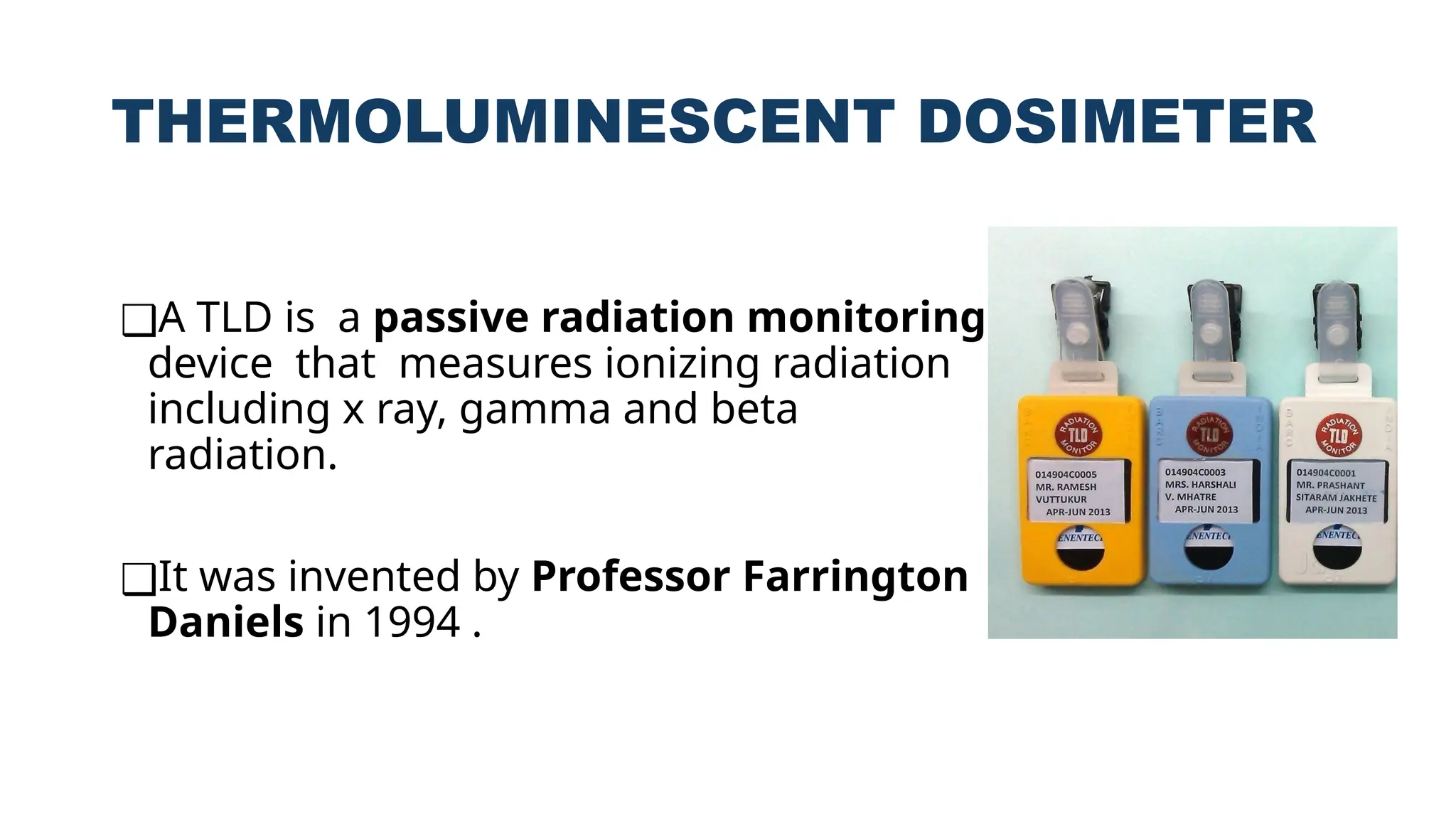
THERMOLUMINESCENT DOSIMETER
❑A TLD is a passive radiation monitoring
device that measures ionizing radiation
including x ray, gamma and beta
radiation.
❑It was invented by Professor Farrington
Daniels in 1994 .
PRINCIPLE
▪TLD works on the principle of thermoluminescence .
▪It works by trapping electrons from ionizing radiation and
releasing them as light when heated.
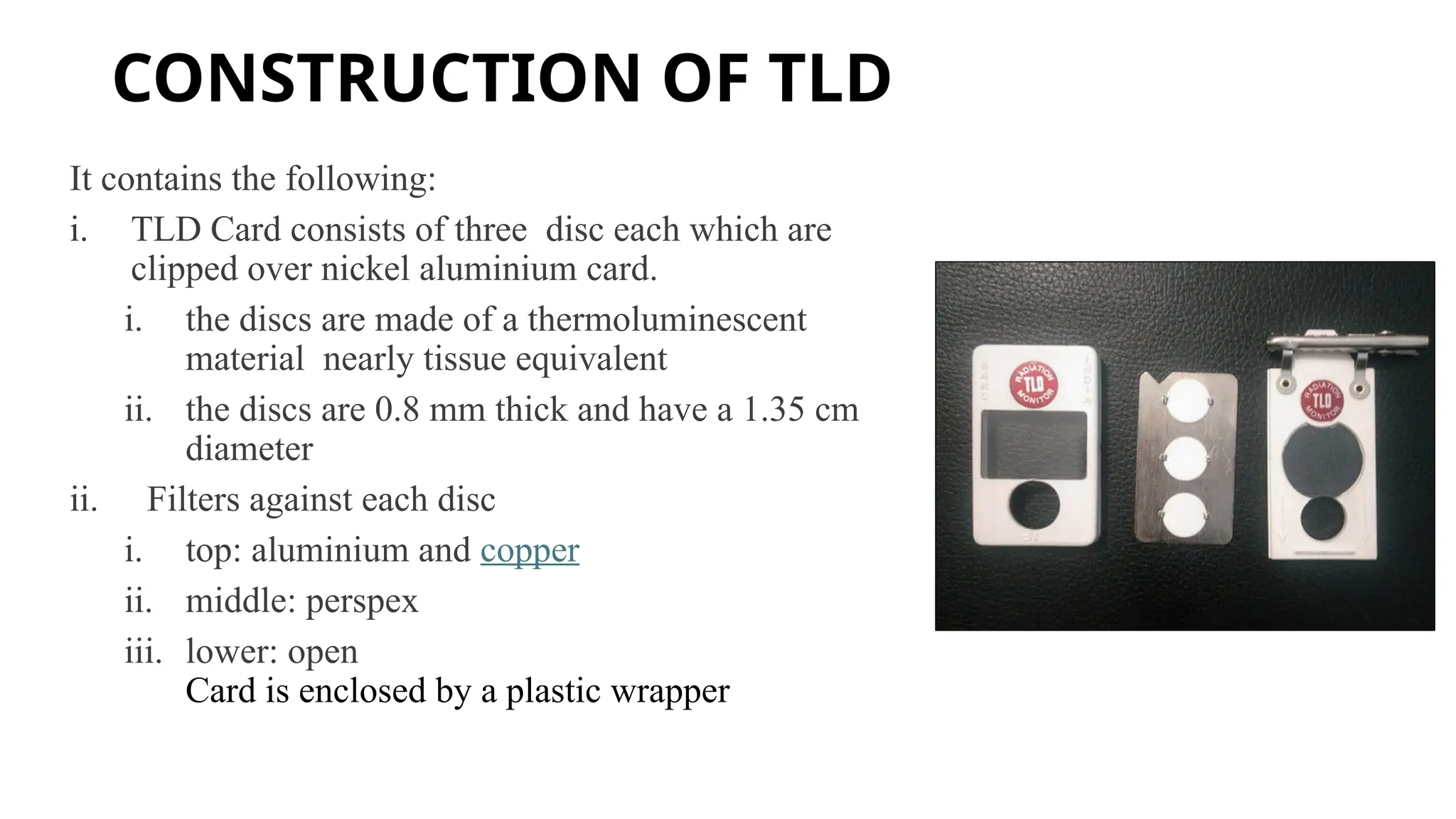
CONSTRUCTION OF TLD
It contains the following:
i. TLD Card consists of three disc each which are
clipped over nickel aluminium card.
i. the discs are made of a thermoluminescent
material nearly tissue equivalent
ii. the discs are 0.8 mm thick and have a 1.35 cm
diameter
ii. Filters against each disc
i. top: aluminium and copper
ii. middle: perspex
iii. lower: open
Card is enclosed by a plastic wrapper
THERMOLUMINESCENT MATERIALS
Some of the commonly used materials are
• Lithium fluoride
• Calcium fluoride
• Calcium Sulfate
• Lithium borate
The choice of thermoluminescent material depends on the specific
application , the radiation type and energy range involved.
WORKING
▪A TLD typically consists of a small chip of thermoluminescent
material, enclosed in a protective container.
▪When exposed to ionizing radiation, the material absorbs energy
and traps electrons within its crystal lattice.
▪As the material is heated, the trapped electrons are released, and
they recombine with holes, emitting light.
▪ The intensity of the emitted light is proportional to the absorbed
radiation dose.
▪ The process of heating and reading is typically automated in modern
TLDs allowing for efficient and accurate radiation dose
measurements.
TLD READER
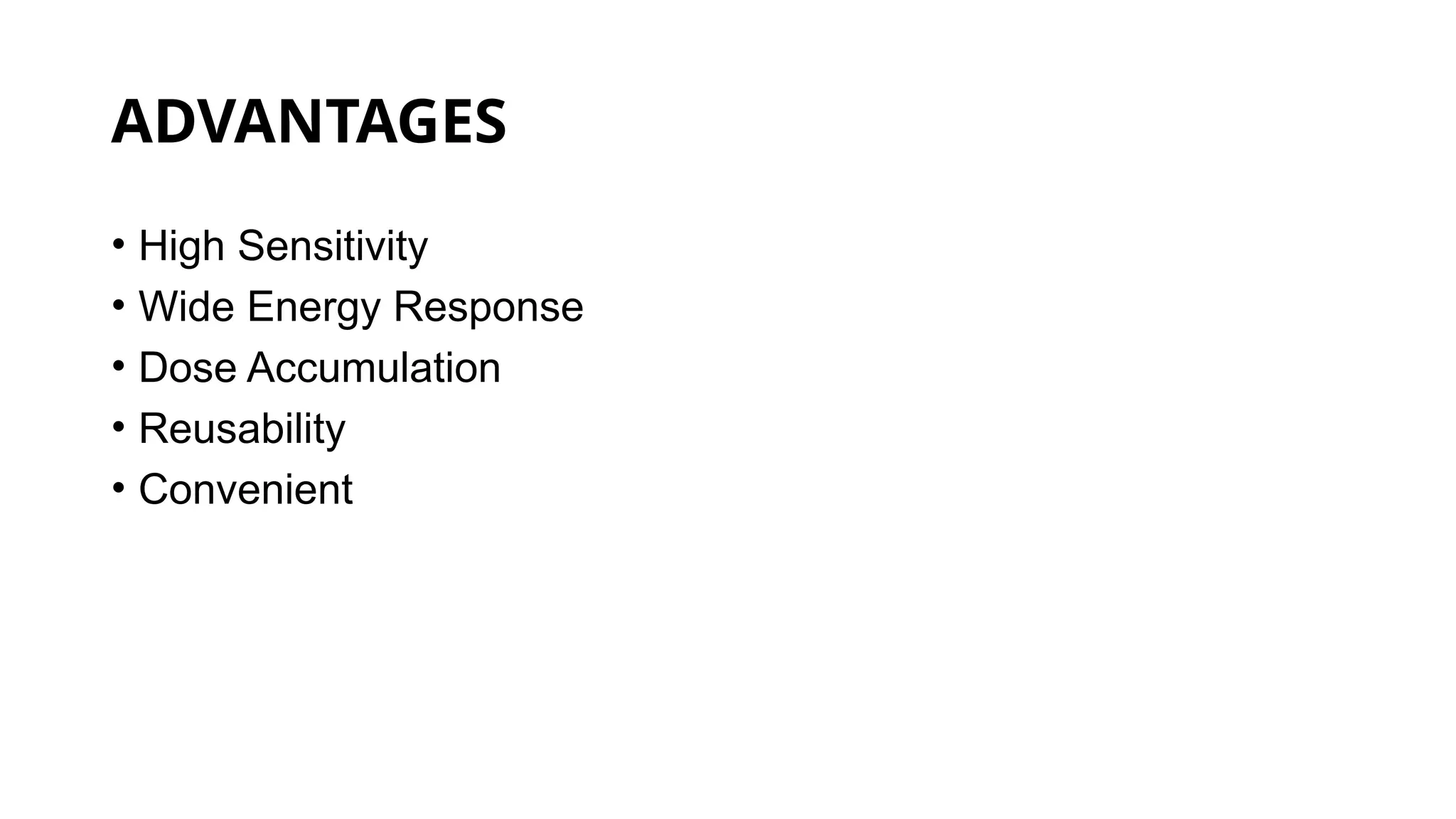
A typical basic TLD reader contains the
following components:
• Heater - Raises the temperature of the TL
material and light is emitted.
• Photomultiplier tube – Detects the
emitted light and converts it into electrical
signal.
• Amplifier – Amplifies the electrical
signal.
• Meter/Recorder. Recorder is able to
display and record data.
TLD READER
ADVANTAGES
• High Sensitivity
• Wide Energy Response
• Dose Accumulation
• Reusability
• Convenient
LIMITATIONS
• Require calibration and correction factors for accurate dose
measurements.
• Time-consuming and require specialized equipment.
• Environmental Factors such as humidity and light exposure, can
affect the dosimeter's response and accuracy.
SOLID STATE DETECTORS
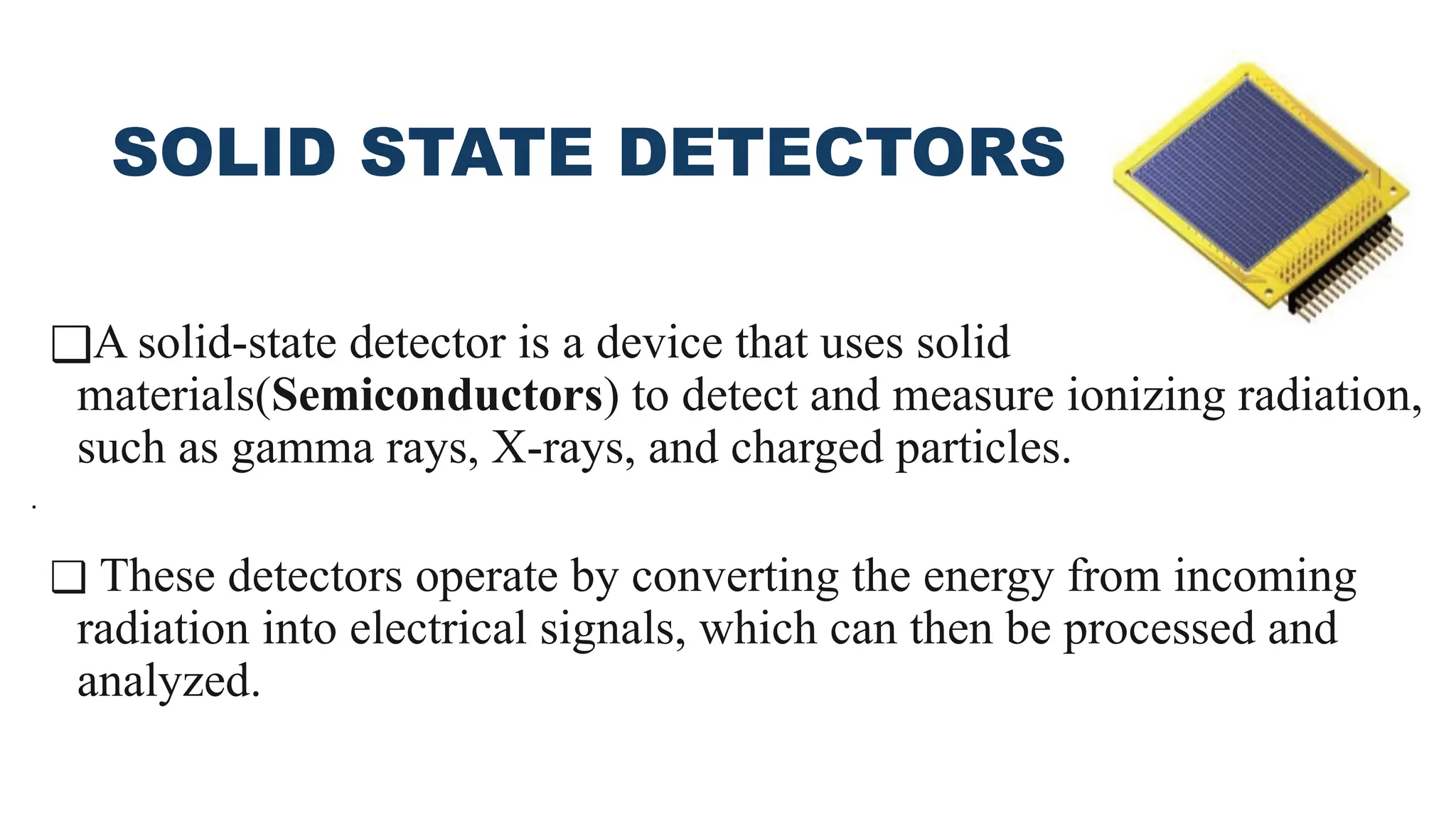
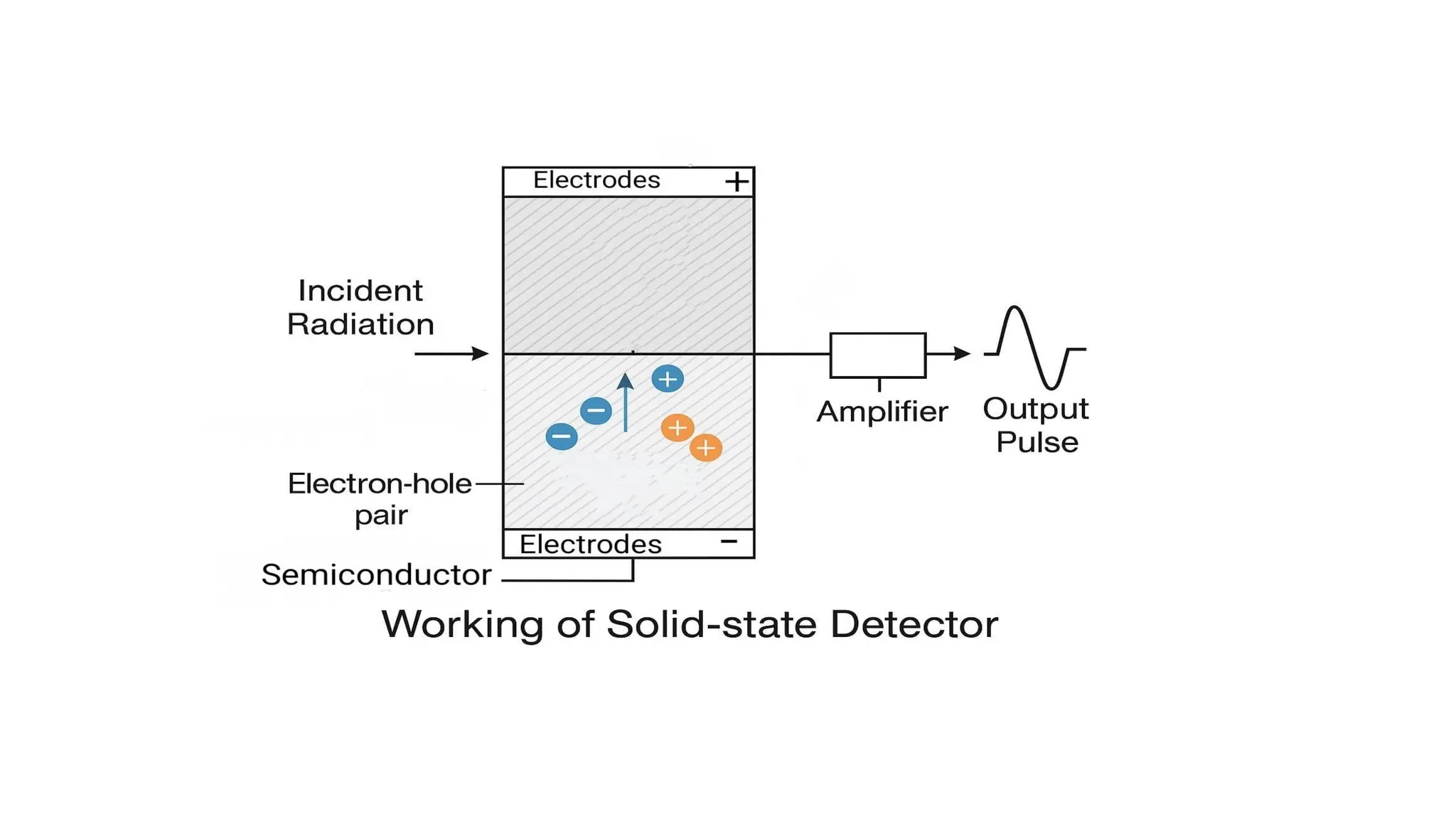
❑A solid-state detector is a device that uses solid
materials(Semiconductors) to detect and measure ionizing radiation,
such as gamma rays, X-rays, and charged particles.
❑ These detectors operate by converting the energy from incoming
radiation into electrical signals, which can then be processed and
analyzed.
.
PRINCIPLE
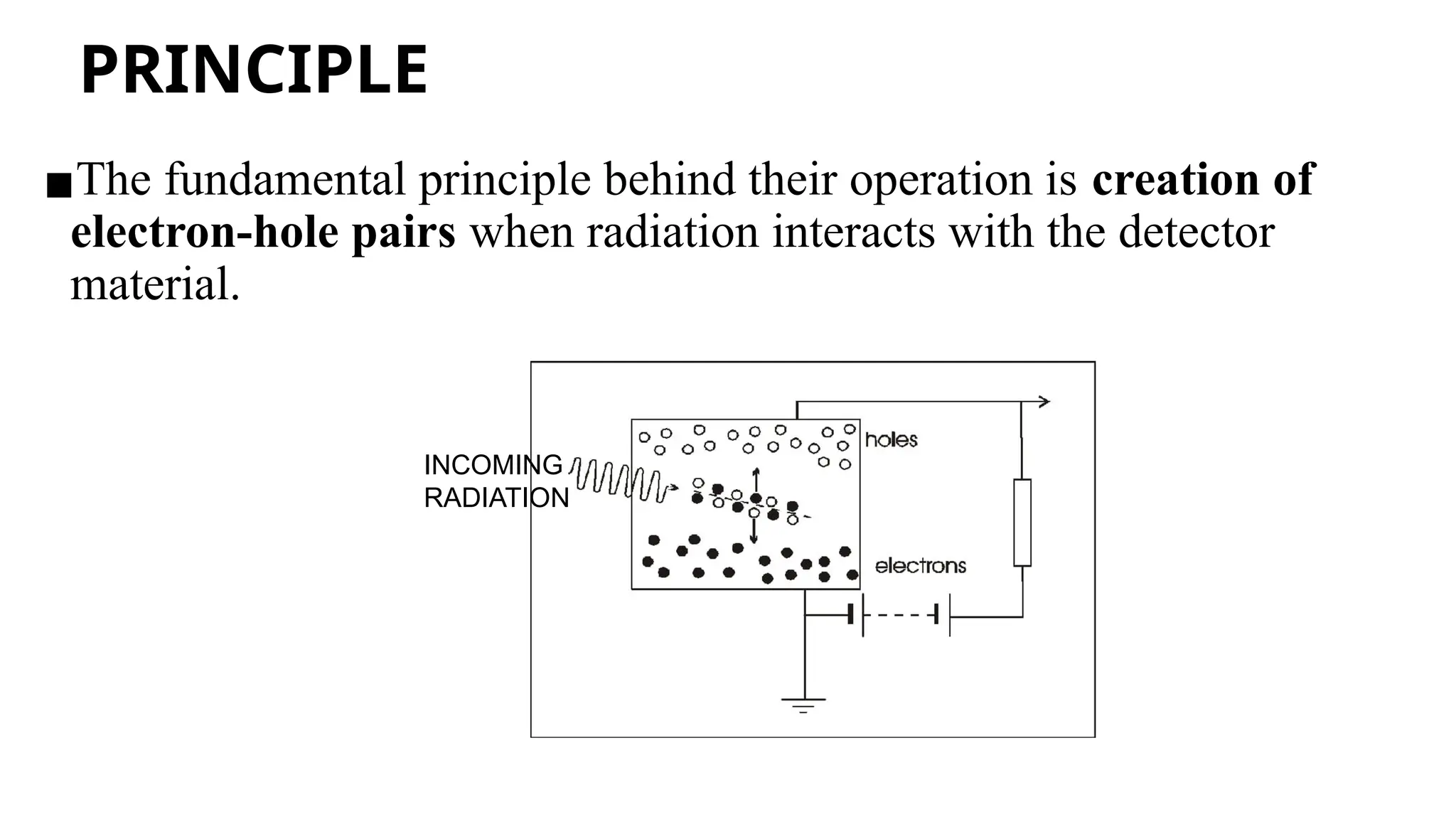
▪The fundamental principle behind their operation is creation of
electron-hole pairs when radiation interacts with the detector
material.
INCOMING
RADIATION
WORKING
1.Radiation Interaction: When an incident photon interacts with the detector
material, it deposits its energy in the semiconductor.
2.Charge Carrier Generation: The energy deposited creates a number of
electron-hole pairs proportional to the incident radiation's energy.
3.Charge Carrier Drift: The generated charge carriers are then driven by an
applied electric field towards opposite electrodes, resulting in a current flow.
4.Signal Amplification: The collected charge carriers are amplified enhancing
the signal strength for better detection and analysis.
5.Signal Processing: The amplified signal is then processed, digitized, and
analyzed to extract information about the incident radiation, such as its energy,
arrival time, and spatial location.
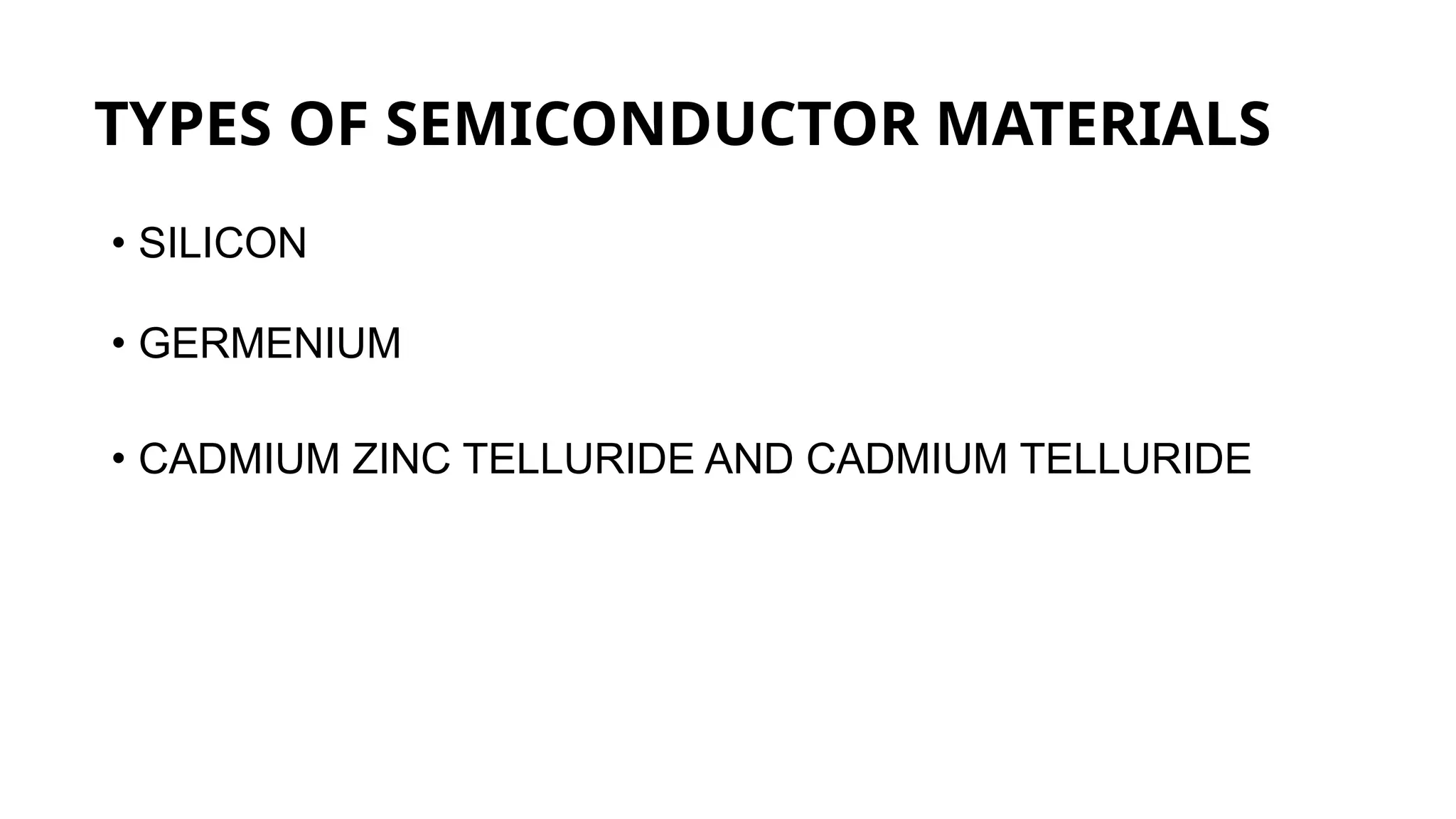
TYPES OF SEMICONDUCTOR MATERIALS
• SILICON
• GERMENIUM
• CADMIUM ZINC TELLURIDE AND CADMIUM TELLURIDE
ADVANTAGES
• High Sensitivity
• Good Energy Resolution
• Fast Response Time
• Compact Size
• Low Power Consumption
• Versatility
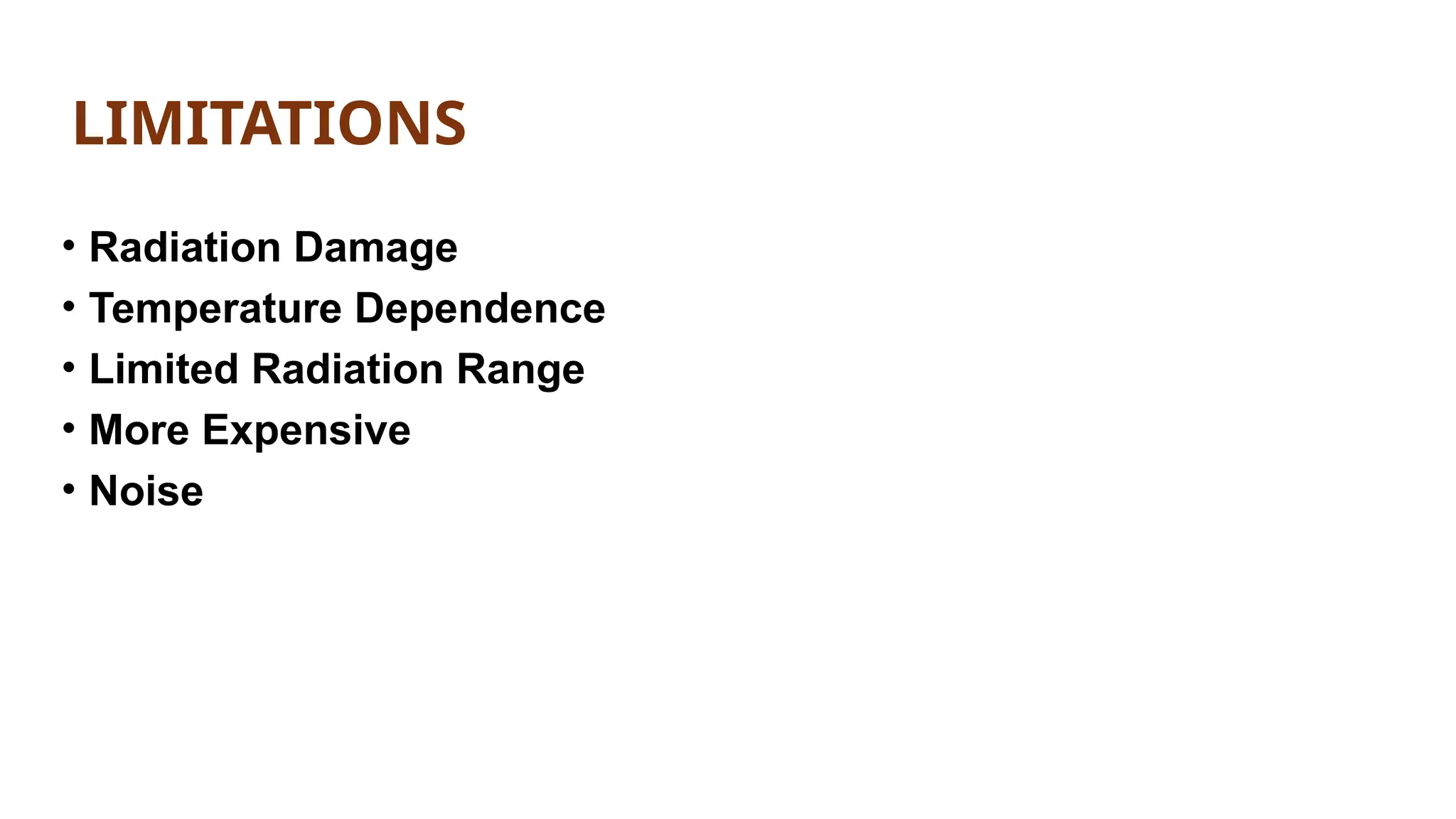
LIMITATIONS
• Radiation Damage
• Temperature Dependence
• Limited Radiation Range
• More Expensive
• Noise
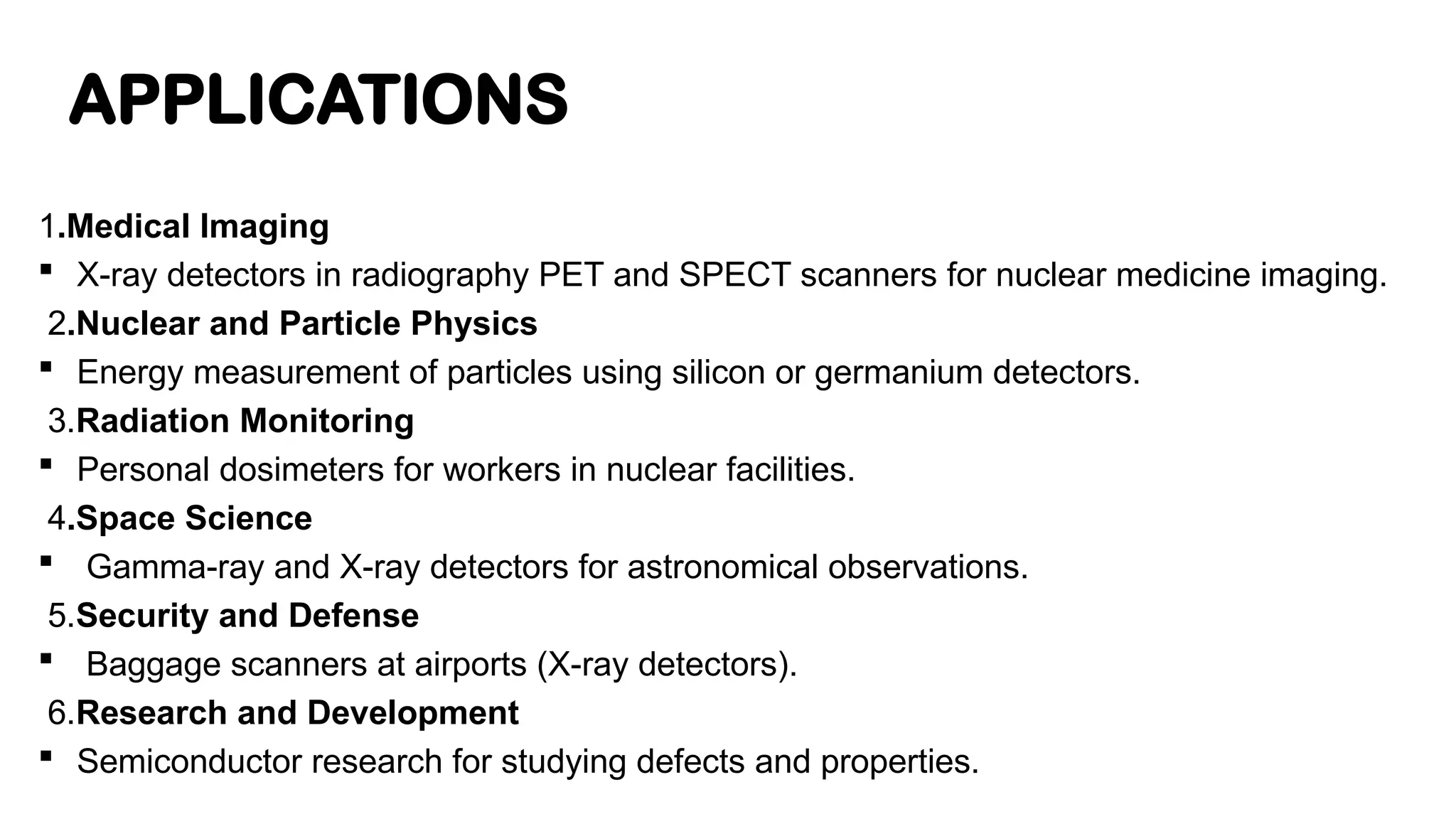
APPLICATIONS
1.Medical Imaging
 X-ray detectors in radiography PET and SPECT scanners for nuclear medicine imaging.
2.Nuclear and Particle Physics
 Energy measurement of particles using silicon or germanium detectors.
3.Radiation Monitoring
 Personal dosimeters for workers in nuclear facilities.
4.Space Science
 Gamma-ray and X-ray detectors for astronomical observations.
5.Security and Defense
 Baggage scanners at airports (X-ray detectors).
6.Research and Development
 Semiconductor research for studying defects and properties.

THANK YOU

Dosimeter used in Radio Imaging Technology

  • 1.
  • 2.
    TOPICS TO BECOVERED ❑ Introduction ❑ Pocket dosimeter ❑ Thermoluminescent dosimeter ❑ Solid state detector ❑Advantages ❑Disadvantages
  • 3.
    DOSIMETER ▪Dosimeter is aninstrument used to measure and monitor exposure of ionizing radiation over a period of time . ▪Radiation exposure is measured in gray(Gy). Film badge TLD BADGE
  • 4.
    POCKET DOSIMETER ❑ Apocket dosimeter is a small, portable device used to measure and monitor radiation exposure in real time. ❑ It measures radiation exposure of x rays and gamma rays . ❑ Pocket dosimeters are typically compact and lightweight, fitting easily in a pocket . Pocket dosimeter
  • 5.
    PRINCIPLE ▪Pocket dosimeters workson the principle of ionization to measure radiation ▪As ionizing radiation passes through the dosimeter, it creates ions in the surrounding gas. ▪Ionized particles generate an electrical signal proportional to the radiation level. ▪The signal is amplified and converted into a measurable radiation dose.
  • 6.
    Components of Dosimeter 1.Eyepiece lens 2.Scale 3.Objective lens 4.Ionization Chamber 5.Movable fiber 6.Bellows 7.Charging Contact pin 8.Clip
  • 7.
    WORKING ▪The gas filling Thechamber contains a specific gas that is easily ionized by radiation. ▪Radiation Interaction Radiation enters the chamber, interacting with the gas and causing ionization. ▪Electrodes Electrodes are used to collect ionized particles , creating an electrical current.
  • 8.
    STEPS INVOLVED ❑ Exposure Thedosimeter is worn in a pocket or clipped to clothing for accurate exposure measurement. ❑ Reading The display shows the accumulated radiation dose, often in units like mSv. ❑ Calibration Regular calibration is required to ensure the accuracy of the device's readings.
  • 9.
    ADVANTAGES ⮚Compact and Portable ⮚Real-time reading ⮚Easy to use ⮚Rechargeable and resettable
  • 10.
    LIMITATIONS ⮚Limited sensitivity forcertain types of radiation, such as beta particles and neutrons. ⮚Accuracy may be compromised by high radiation levels that saturate the detector. ⮚Requires calibration and periodic maintenance to ensure reliability.
  • 11.
    APPLICATIONS ▪Nuclear Power Plants Workersare monitored to ensure their exposure stays within safe limits. ▪Medical Facilities Used by healthcare professionals working with radioactive materials. ▪Research Laboratories Essential for researchers handling radioactive materials. ▪Environmental Monitoring Used to measure radiation levels in areas potentially affected by radioactive sources.
  • 12.
    THERMOLUMINESCENT DOSIMETER ❑A TLDis a passive radiation monitoring device that measures ionizing radiation including x ray, gamma and beta radiation. ❑It was invented by Professor Farrington Daniels in 1994 .
  • 13.
    PRINCIPLE ▪TLD works onthe principle of thermoluminescence . ▪It works by trapping electrons from ionizing radiation and releasing them as light when heated.
  • 14.
    CONSTRUCTION OF TLD Itcontains the following: i. TLD Card consists of three disc each which are clipped over nickel aluminium card. i. the discs are made of a thermoluminescent material nearly tissue equivalent ii. the discs are 0.8 mm thick and have a 1.35 cm diameter ii. Filters against each disc i. top: aluminium and copper ii. middle: perspex iii. lower: open Card is enclosed by a plastic wrapper
  • 15.
    THERMOLUMINESCENT MATERIALS Some ofthe commonly used materials are • Lithium fluoride • Calcium fluoride • Calcium Sulfate • Lithium borate The choice of thermoluminescent material depends on the specific application , the radiation type and energy range involved.
  • 16.
    WORKING ▪A TLD typicallyconsists of a small chip of thermoluminescent material, enclosed in a protective container. ▪When exposed to ionizing radiation, the material absorbs energy and traps electrons within its crystal lattice. ▪As the material is heated, the trapped electrons are released, and they recombine with holes, emitting light. ▪ The intensity of the emitted light is proportional to the absorbed radiation dose. ▪ The process of heating and reading is typically automated in modern TLDs allowing for efficient and accurate radiation dose measurements.
  • 17.
    TLD READER A typicalbasic TLD reader contains the following components: • Heater - Raises the temperature of the TL material and light is emitted. • Photomultiplier tube – Detects the emitted light and converts it into electrical signal. • Amplifier – Amplifies the electrical signal. • Meter/Recorder. Recorder is able to display and record data. TLD READER
  • 18.
    ADVANTAGES • High Sensitivity •Wide Energy Response • Dose Accumulation • Reusability • Convenient
  • 19.
    LIMITATIONS • Require calibrationand correction factors for accurate dose measurements. • Time-consuming and require specialized equipment. • Environmental Factors such as humidity and light exposure, can affect the dosimeter's response and accuracy.
  • 20.
    SOLID STATE DETECTORS ❑Asolid-state detector is a device that uses solid materials(Semiconductors) to detect and measure ionizing radiation, such as gamma rays, X-rays, and charged particles. ❑ These detectors operate by converting the energy from incoming radiation into electrical signals, which can then be processed and analyzed. .
  • 21.
    PRINCIPLE ▪The fundamental principlebehind their operation is creation of electron-hole pairs when radiation interacts with the detector material. INCOMING RADIATION
  • 22.
    WORKING 1.Radiation Interaction: Whenan incident photon interacts with the detector material, it deposits its energy in the semiconductor. 2.Charge Carrier Generation: The energy deposited creates a number of electron-hole pairs proportional to the incident radiation's energy. 3.Charge Carrier Drift: The generated charge carriers are then driven by an applied electric field towards opposite electrodes, resulting in a current flow. 4.Signal Amplification: The collected charge carriers are amplified enhancing the signal strength for better detection and analysis. 5.Signal Processing: The amplified signal is then processed, digitized, and analyzed to extract information about the incident radiation, such as its energy, arrival time, and spatial location.
  • 24.
    TYPES OF SEMICONDUCTORMATERIALS • SILICON • GERMENIUM • CADMIUM ZINC TELLURIDE AND CADMIUM TELLURIDE
  • 25.
    ADVANTAGES • High Sensitivity •Good Energy Resolution • Fast Response Time • Compact Size • Low Power Consumption • Versatility
  • 26.
    LIMITATIONS • Radiation Damage •Temperature Dependence • Limited Radiation Range • More Expensive • Noise
  • 27.
    APPLICATIONS 1.Medical Imaging  X-raydetectors in radiography PET and SPECT scanners for nuclear medicine imaging. 2.Nuclear and Particle Physics  Energy measurement of particles using silicon or germanium detectors. 3.Radiation Monitoring  Personal dosimeters for workers in nuclear facilities. 4.Space Science  Gamma-ray and X-ray detectors for astronomical observations. 5.Security and Defense  Baggage scanners at airports (X-ray detectors). 6.Research and Development  Semiconductor research for studying defects and properties.
  • 28.