THERMOLUMINESCENT DOSIMETRY
(TLD)
From:
Radiation Dosimetry - Instrumentation and Methods
Gad Shani - 2nd Edition
Presented By Mohammadi M.
Department of Medical Physics, KUMS
Outline
 Introduction
 LiF:Mg, Ti TL Dosimeter
 LiF:Mg, Cu, P Dosimeter
 CaF:Tm (TLD 300) Dosimeter
 Miscellaneous TLD
2
Introduction
 TLD is used in many scientific and applied fields such as radiation
protection, radiotherapy clinic, industry, and environmental and
space research, using many different materials.
 Good reproducibility, low hygroscopicity, and high sensitivity for
very low dose measurements or good response at high doses in
radiotherapy and in mixed radiation fields
 TLDs are relative dosimeters and therefore have to be calibrated
against absolute dosimetry systems such as a calibrated ion
chamber. A 60Co gamma source is generally used.
3
Introduction
 The use of TLDs in electron-beam dosimetry is inherently more
complicated than its use in photon dosimetry since, for each
incident electron beam energy, one obtains a different dose
response.
 Fading is an important phenomenon when dosimeters are used
for environmental or personal monitoring, which involves reading
after long periods of irradiation.
 The use of computerized glow-curve analysis (GCA) methods has
become a normal practice. The application of deconvolution-
based GCA methods to complex curves provides information on
the parameters of each individual peak.
4
LiF:Mg, Ti TL Dosimeter
 LiF:Mg,Ti (TLD-100), a nearly tissue-equivalent material of good
sensitivity, is perhaps the best choice for radiation dosimetry.
 it has a nearly tissue-equivalent material (effective atomic
number of 8.2 compared to 7.4 for tissue)
 The weakest characteristic of TLD-100 for radiotherapy dosimetry
is accuracy.
 The existence of fading and sensitivity changes also complicates
the situation. The TL response of TLD-100 is not linear for large
doses and its efficiency depends on the radiation field.
5
LiF:Mg, Ti TL Dosimeter
 An important use of LiF is dosimetry of mixed neutron-gamma
radiation. It is usually performed with a pair of 6LiF and 7LiF
dosimeters taking advantage of the difference in cross section of
the two Li isotopes.
 Muniz et al. studied LiF TLD-100 performance for mailed
dosimetry in radiotherapy, using glow-curve analysis for TL
evaluation and reusable chips.
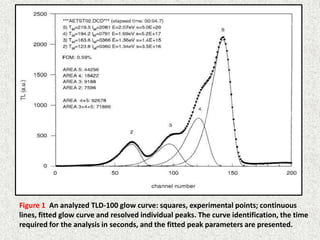
 Figure 1 shows the kind of result provided by the computer
program for a typical prompt LiF TLD-100 glow curve as produced
by the preparation treatment employed.
6
Figure 1 An analyzed TLD-100 glow curve: squares, experimental points; continuous
lines, fitted glow curve and resolved individual peaks. The curve identification, the time
required for the analysis in seconds, and the fitted peak parameters are presented.
7
LiF:Mg, Ti TL Dosimeter
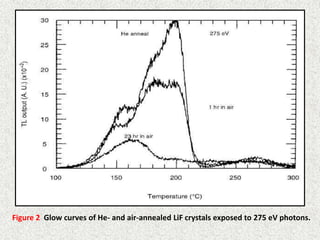
 The effect of the annealing atmosphere was found to be crucial
for reproducible TL output and glow curves.
 Three annealing treatments were tested by Carrillo et al.
 Figure 2 shows the glow curves of crystals annealed in helium and
in air for 1 and 23 h, when exposed to 275-eV photons.
 The adverse effect of an air anneal is clearly seen as an overall
reduction in the height of the peaks, mainly the dosimetric 200°C
peak.
 For crystals annealed in air for 23 h, the reduction is even more
pronounced. Similar adverse behavior for the air-annealed
crystals and chips was noticed for all other photon energies.
8
Figure 2 Glow curves of He- and air-annealed LiF crystals exposed to 275 eV photons.
9
LiF:Mg, Ti TL Dosimeter
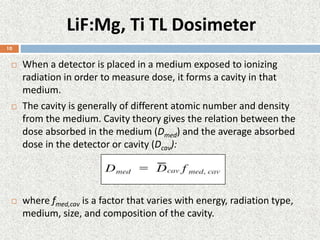
 When a detector is placed in a medium exposed to ionizing
radiation in order to measure dose, it forms a cavity in that
medium.
 The cavity is generally of different atomic number and density
from the medium. Cavity theory gives the relation between the
dose absorbed in the medium (Dmed) and the average absorbed
dose in the detector or cavity (Dcav):
 where fmed,cav is a factor that varies with energy, radiation type,
medium, size, and composition of the cavity.
10
LiF:Mg, Ti TL Dosimeter
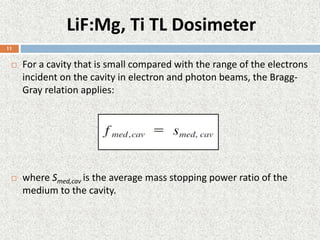
 For a cavity that is small compared with the range of the electrons
incident on the cavity in electron and photon beams, the Bragg-
Gray relation applies:
 where Smed,cav is the average mass stopping power ratio of the
medium to the cavity.
11
LiF:Mg, Ti TL Dosimeter
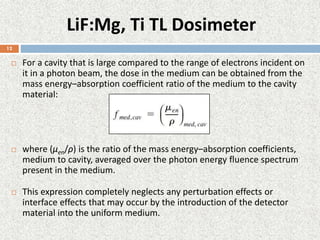
 For a cavity that is large compared to the range of electrons incident on
it in a photon beam, the dose in the medium can be obtained from the
mass energy–absorption coefficient ratio of the medium to the cavity
material:
 where (µen/ρ) is the ratio of the mass energy–absorption coefficients,
medium to cavity, averaged over the photon energy fluence spectrum
present in the medium.
 This expression completely neglects any perturbation effects or
interface effects that may occur by the introduction of the detector
material into the uniform medium.
12
LiF:Mg, Ti TL Dosimeter
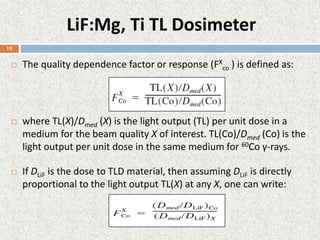
 The quality dependence factor or response (FX
co ) is defined as:
 where TL(X)/Dmed (X) is the light output (TL) per unit dose in a
medium for the beam quality X of interest. TL(Co)/Dmed (Co) is the
light output per unit dose in the same medium for 60Co γ-rays.
 If DLiF is the dose to TLD material, then assuming DLiF is directly
proportional to the light output TL(X) at any X, one can write:
13
LiF:Mg, Ti TL Dosimeter
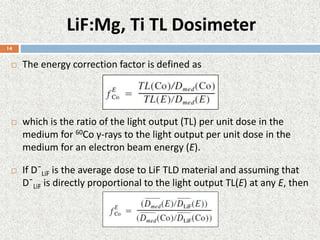
 The energy correction factor is defined as
 which is the ratio of the light output (TL) per unit dose in the
medium for 60Co γ-rays to the light output per unit dose in the
medium for an electron beam energy (E).
 If D¯LiF is the average dose to LiF TLD material and assuming that
D¯LiF is directly proportional to the light output TL(E) at any E, then
14
LiF:Mg, Ti TL Dosimeter
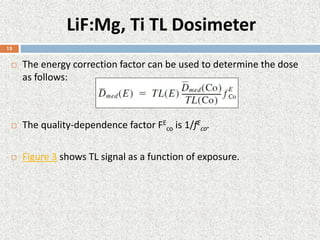
 The energy correction factor can be used to determine the dose
as follows:
 The quality-dependence factor FE
co is 1/fE
co.
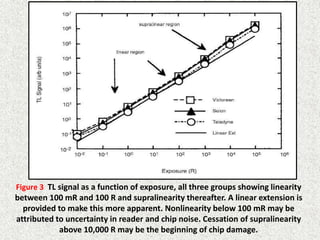
 Figure 3 shows TL signal as a function of exposure.
15
16
Figure 3 TL signal as a function of exposure, all three groups showing linearity
between 100 mR and 100 R and supralinearity thereafter. A linear extension is
provided to make this more apparent. Nonlinearity below 100 mR may be
attributed to uncertainty in reader and chip noise. Cessation of supralinearity
above 10,000 R may be the beginning of chip damage.
LiF:Mg, Ti TL Dosimeter
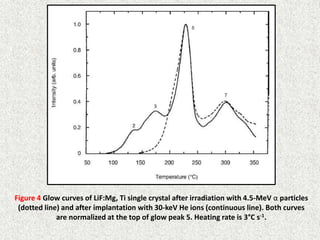
 Figure 4 shows two TL glow curves of LiF:Mg,Ti after irradiation at
room temperature with 4.5-MeV and 30-keV particles. The glow
curves (above 200°C) show great similarity, from which it is
concluded that in both cases the same trapping centers are
involved. This is plausible since the stopping powers do not vary
very much.
17
Figure 4 Glow curves of LiF:Mg, Ti single crystal after irradiation with 4.5-MeV α particles
(dotted line) and after implantation with 30-keV He ions (continuous line). Both curves
are normalized at the top of glow peak 5. Heating rate is 3°C s-1.
18
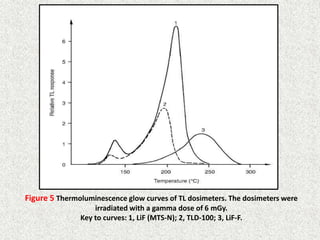
Figure 5 Thermoluminescence glow curves of TL dosimeters. The dosimeters were
irradiated with a gamma dose of 6 mGy.
Key to curves: 1, LiF (MTS-N); 2, TLD-100; 3, LiF-F.
19
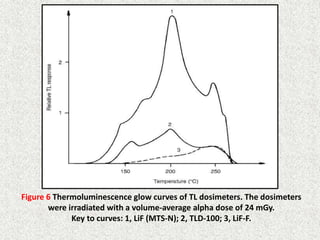
Figure 6 Thermoluminescence glow curves of TL dosimeters. The dosimeters
were irradiated with a volume-average alpha dose of 24 mGy.
Key to curves: 1, LiF (MTS-N); 2, TLD-100; 3, LiF-F.
20
LiF:Mg, Ti TL Dosimeter
 The glow curves demonstrate the gamma sensitivity and the sensitivity to
5-MeV alpha particles of the LiF dosimeters investigated.
 Comparing the TL responses, the following can be stated:
 1. The glow peak of the gamma-irradiated LiF-F single crystal dosimeter was
found at a higher temperature compared to TLD-100 and MTS-N LiF
dosimeters; the glow peak temperature of LiF-F is about 240°C (Figure 5).
 2. The effect of high LET alpha irradiation is considerable for each type of
dosimeter investigated, but the qualitative change on the structure of the
glow curve was found to be the most significant for the LiF (MTS-N)
dosimeter. (Figure 6)
 3. The LiF-F crystal does not show an explicitly high temperature peak using
alpha irradiation in the dose range 1–40 mGy.
21
LiF:Mg, Cu, P Dosimeter
 The development of high sensitivity TLD by doping LiF crystals with Mg,
Cu, and P was first done by Nakajima et al.
 The sensitivity of the new TLD was more than 20 times higher than that
of LiF:Mg,Ti. Wu et al. showed that LiF:Mg,Cu,P (LiF(MCP)) maintains its
sensitivity during prepared reuse cycles.
 Advantages of LiF:Mg,Cu,P include high sensitivity as compared to
LiF:Mg,Ti, almost flat photon energy response, low fading rate, and
linear dose response.
 The main drawbacks are still the relatively high residual signal and the
loss of sensitivity for high-readout temperatures.
 LiF:Mg,Cu,P is interesting in low-dose measurements due to its high
sensitivity and its good tissue equivalence.
22
LiF:Mg, Cu, P Dosimeter
 The response of LiF:Mg,Cu,P thermoluminescence dosimeters to
high-energy electron beams used in radiotherapy was
investigated by Bartolotta et al.
 They found that LiF:Mg,Cu,P phosphor is a suitable candidate for
quality control of in vivo dosimetry in electron-beam therapy.
 The TL chips (4.5 mm in diameter, 0.8 mm thick) used were
produced by Radiation Detector Works (Beijing) and are
commercially known as GR-200A.
 The sensitivity of GR-200A dosimeters to electrons was found to
be about 13% less than that of 60Co gamma-rays, in agreement
with similar results already known for LiF:Mg,Ti (TLD-100)
dosimeters.
23
LiF:Mg, Cu, P Dosimeter
 The simple dose dependence of GR-200 is in contrast to the
supralinear dependence of TLD-100.
 The proportionality between TL and dose found for GR-200 is in
favor of this material, as calibration can be simplified requiring
fewer calibration points than with TLD-100.
24
LiF:Mg, Cu, P Dosimeter
 Similar to LiF:Mg,Ti, LiF:Mg,Cu,P is available with different thermal
neutron sensitivities, depending on the concentrations of
LiF:Mg,Cu,P, i.e., 7.5%, 95.6%, and 0.07%, corresponding to TLD-
100H, 600H, and 700H, respectively.
 For use in personal dosimetry, the TLD pellets are encapsulated in
thin FEP-coated film and mounted in a standard Harshaw
aluminum substrate to form a TLD card.
 The TL response of this material is extremely sensitive to the
readout temperature.
25
LiF:Mg, Cu, P Dosimeter
 The sensitivity of LiF(MCP) is approximately 25 times higher than
the sensitivity of TLD-100, with a batch homogeneity of 8% (one
standard deviation).
 Once encapsulated in a TLD card, however, the relative sensitivity
drops to 10.
 The reason for this sensitivity decrease is that the heating applied
to the chip during manufacturing (the encapsulation process)
increases the temperature to 280–290°C for short periods of time.
 This results in permanent loss of sensitivity of the phosphor.
26
LiF:Mg, Cu, P Dosimeter
 LiF:Mg,Cu,P, with its high sensitivity, tissue equivalence, energy
independence, and low fading characteristics, is a natural choice
for environmental dosimetry.
 The badge consisted of a card and a plastic holder.
 The card contained several LiF:Mg,Cu,P elements encapsulated in
Teflon.
 The badge was symmetrical and used several fillers to
discriminate low-and high-energy photons.
27
CaF:Tm (TLD 300) Dosimeter
 TLD-300 dosimeters have been employed in high LET
radiotherapeutic fields generated by fast neutron, negative pion,
and heavy ion beams.
 By proper peak height analysis of the two main peaks of CaF2:Tm
glow curves after such irradiations, it is possible to separate the
high and low LET content of the radiation field.
 Therefore, the distribution of the biological equivalent dose can
be determined in a single irradiation.
28
CaF:Tm (TLD 300) Dosimeter
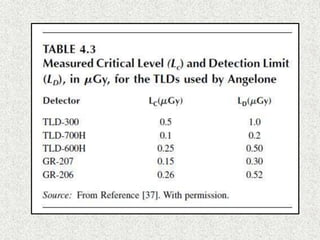
 Important parameters are the critical level (Lc) and the detection
limit (LD).
 Lc is the signal that provides a confidence level of 1-α that the
result is not due to a background fluctuation, while, as stated by
Hirning, LD is the smallest amount of signal that can be detected
at a specified confidence level.
 The results for Lc and LD are reported in Table 4.3.
 The results clearly indicate that peak 3 of TLD-300 has a very good
performance as a low-dose detector.
 The measured values are only twice that of LiF-600H and GR-206
and a factor five above that of LiF-700H and GR-207, which make
peak 3 suitable for most low-dose measurements.
29
30
CaF:Tm (TLD 300) Dosimeter
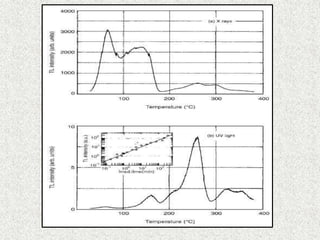
 Figure 7 shows the glow-curve pattern of natural CaF2, having
been irradiated with x-rays to 25 Gy (a) and UV light of 1.2 J (b).
 Although the TL intensity of UV irradiation is smaller than that of x
irradiation, the 260°C peak is prominent compared with low
temperature peaks.
 The inset shows the 260°C peak-intensity dependence on the UV
irradiation time over a wide range as t = 0.8 to 103 min.
31
32
Miscellaneous TLD
 Li2B4O7:0.1% Cu17 was chosen among different common TL
materials due to:
- - its relatively flat energy response (Figure 8)
- - its high sensitivity per unit volume
- - its dose-rate independent response
- - its water equivalence in this energy range
- - and the fact that its intrinsic response is not influenced by the
direction of the beam.
33
34
Figure 8 Ratio of mass energy absorption coefficient for the TL materials to the mass energy absorption
coefficient of water as a function of photon energy.
Miscellaneous TLD
 the absorbed dose at the surface of a water phantom for low-energy x-
rays can be determined from measurement of primary beam kerma and
BSF. This quantity is defined as a ratio of water kermas at the phantom
surface and free in air in the absence of the phantom. Within the range
of 10 to 100 kV, as charged-particle equilibrium is always achieved and
bremsstrahlung radiation is negligible, there is little distinction between
kerma and dose. Consequently,
35
Miscellaneous TLD
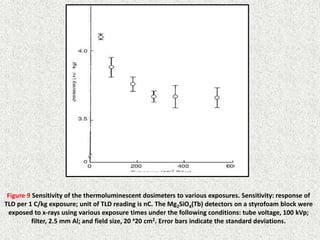
 Calibration of Mg2SiO4(Tb)(MSO) thermoluminescent dosimeters
for use in determining diagnostic x-ray doses was performed by
Kato et al.
 The results shown in Figure 9 demonstrate that the detector
sensitivities depend on their exposure in the low-dose region.
 The sensitivity at 20 mR was about 10% greater than that at 100
mR.
 For doses greater than 100 mR, it was quite uniform, within ±1%.
36
37
Figure 9 Sensitivity of the thermoluminescent dosimeters to various exposures. Sensitivity: response of
TLD per 1 C/kg exposure; unit of TLD reading is nC. The Mg2SiO4(Tb) detectors on a styrofoam block were
exposed to x-rays using various exposure times under the following conditions: tube voltage, 100 kVp;
filter, 2.5 mm Al; and field size, 20 ˣ20 cm2. Error bars indicate the standard deviations.
Miscellaneous TLD
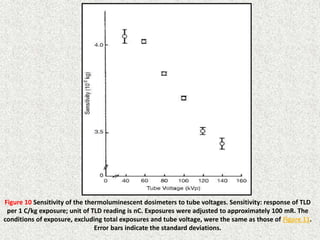
 The sensitivity of the MSO detectors used decreased linearly with
increasing tube voltage from 60 to 140 kVp. (Figure 10)
 The MSO detector, Mg2SiO4(Tb) phosphor, is more sensitive than
are other phosphors, such as LiF and CaSO4(Tm).
 The sensitivity of the MSO detectors depended on their
orientation to the central beam.
38
39
Figure 10 Sensitivity of the thermoluminescent dosimeters to tube voltages. Sensitivity: response of TLD
per 1 C/kg exposure; unit of TLD reading is nC. Exposures were adjusted to approximately 100 mR. The
conditions of exposure, excluding total exposures and tube voltage, were the same as those of Figure 11.
Error bars indicate the standard deviations.
Miscellaneous TLD
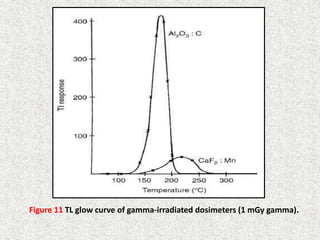
 Figure 11 shows the glow curve of Al2O3:C and CaF2:Mn after 1
mGy gamma irradiation.
The glow peak of aluminium oxide is at approximately 180°C and
of calcium fluoride, it is at 240°C.
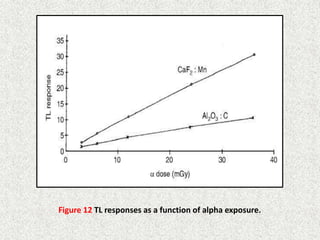
 Dosimeters were irradiated with alpha particles for 5, 10, 20, 40,
and 60 min (3, 6, 12, 24, and 36 mGy).
 The dose-response curves for the Al2O3:C and CaF2:Mn
dosimeters are shown in Figure 12.
 The TL light outputs measured under the peaks of dosimeters
irradiated with alpha particles are linear in the dose range
investigated.
40
41
Figure 11 TL glow curve of gamma-irradiated dosimeters (1 mGy gamma).
42
Figure 12 TL responses as a function of alpha exposure.
Miscellaneous TLD
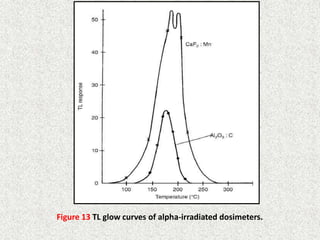
 The glow curves of dosimeters after 3-mGy alpha irradiation can
be seen in Figure 13.
 The sensitivity of CaF2:Mn to 5-MeV alpha particles is a factor of 3
higher than compared to Al2O3:C.
 The peak induced by high LET alpha radiation is split into two
components in the dose range investigated.
43
44
Figure 13 TL glow curves of alpha-irradiated dosimeters.
Miscellaneous TLD
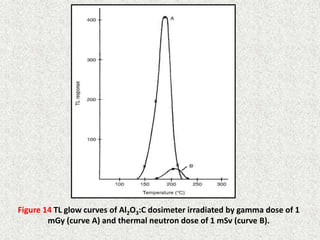
 Figure 14 represents the TL output of aluminum oxide to low LET
(curve A: 1-mGy gamma) and to high LET (curve B: 1-mSv neutron)
radiation.
 The thermal neutron sensitivity was found to be similar (about
0.04 as compared to gamma irradiation) for both materials.
45
46
Figure 14 TL glow curves of Al2O3:C dosimeter irradiated by gamma dose of 1
mGy (curve A) and thermal neutron dose of 1 mSv (curve B).
Summary
 LiF is used for dose measurements in radiotherapy since the effective atomic
number of 8.3 is close to that of water or tissue.
 Lithium tetraborate is more tissue-equivalent than LiF, but it is deliquescent
(absorbs moisture from the atmosphere) and its stored signals fade rapidly. Its
use is therefore only worthwhile for x-rays, where the closeness of its effective
atomic number of 7.3 to tissue outweighs the disadvantages.
 Calcium sulphate has an effective atomic number of 15.6 and is therefore much
less tissue-equivalent, but its effective atomic number is quite close to that of
bone.
It is very sensitive and therefore can be used for protection dosimetry.
 Calcium fluoride has an effective atomic number of 16.9 and is also used for
protection dosimetry, as it is also very sensitive.
47
Summary
 Investigation of Linear Energy Transfer (LET) dependence of TL
dosimeters indicates that for all commonly used materials, the
sensitivity (TL response/absorbed dose) decreases with increasing LET.
TLD-100 exhibits a supralinear dose response above about 2 Gy.
 Dosimetry of mixed neutron-gamma radiation is usually performed with
a pair of 6LiF and 7LiF dosimeters exhibiting various thermal neutron
sensitivities.
 By peak analysis of the glow curve of CaF2, it is possible to separate the
low and high LET components of a mixed radiation field.
 An LiF:Mg,Cu,P dosimeter is useful for low-dose measurement because
of its high sensitivity compared to the TLD-100.
 Knowledge of backscatter factor (BSF) for low energy x-ray is essential in
diagnostic radiology as well as radiotherapy dosimetry to determine the
absorbed dose at the surface of the patient.
48
49

Thermoluminescent dosimetry (tld)

  • 1.
    THERMOLUMINESCENT DOSIMETRY (TLD) From: Radiation Dosimetry- Instrumentation and Methods Gad Shani - 2nd Edition Presented By Mohammadi M. Department of Medical Physics, KUMS
  • 2.
    Outline  Introduction  LiF:Mg,Ti TL Dosimeter  LiF:Mg, Cu, P Dosimeter  CaF:Tm (TLD 300) Dosimeter  Miscellaneous TLD 2
  • 3.
    Introduction  TLD isused in many scientific and applied fields such as radiation protection, radiotherapy clinic, industry, and environmental and space research, using many different materials.  Good reproducibility, low hygroscopicity, and high sensitivity for very low dose measurements or good response at high doses in radiotherapy and in mixed radiation fields  TLDs are relative dosimeters and therefore have to be calibrated against absolute dosimetry systems such as a calibrated ion chamber. A 60Co gamma source is generally used. 3
  • 4.
    Introduction  The useof TLDs in electron-beam dosimetry is inherently more complicated than its use in photon dosimetry since, for each incident electron beam energy, one obtains a different dose response.  Fading is an important phenomenon when dosimeters are used for environmental or personal monitoring, which involves reading after long periods of irradiation.  The use of computerized glow-curve analysis (GCA) methods has become a normal practice. The application of deconvolution- based GCA methods to complex curves provides information on the parameters of each individual peak. 4
  • 5.
    LiF:Mg, Ti TLDosimeter  LiF:Mg,Ti (TLD-100), a nearly tissue-equivalent material of good sensitivity, is perhaps the best choice for radiation dosimetry.  it has a nearly tissue-equivalent material (effective atomic number of 8.2 compared to 7.4 for tissue)  The weakest characteristic of TLD-100 for radiotherapy dosimetry is accuracy.  The existence of fading and sensitivity changes also complicates the situation. The TL response of TLD-100 is not linear for large doses and its efficiency depends on the radiation field. 5
  • 6.
    LiF:Mg, Ti TLDosimeter  An important use of LiF is dosimetry of mixed neutron-gamma radiation. It is usually performed with a pair of 6LiF and 7LiF dosimeters taking advantage of the difference in cross section of the two Li isotopes.  Muniz et al. studied LiF TLD-100 performance for mailed dosimetry in radiotherapy, using glow-curve analysis for TL evaluation and reusable chips.  Figure 1 shows the kind of result provided by the computer program for a typical prompt LiF TLD-100 glow curve as produced by the preparation treatment employed. 6
  • 7.
    Figure 1 Ananalyzed TLD-100 glow curve: squares, experimental points; continuous lines, fitted glow curve and resolved individual peaks. The curve identification, the time required for the analysis in seconds, and the fitted peak parameters are presented. 7
  • 8.
    LiF:Mg, Ti TLDosimeter  The effect of the annealing atmosphere was found to be crucial for reproducible TL output and glow curves.  Three annealing treatments were tested by Carrillo et al.  Figure 2 shows the glow curves of crystals annealed in helium and in air for 1 and 23 h, when exposed to 275-eV photons.  The adverse effect of an air anneal is clearly seen as an overall reduction in the height of the peaks, mainly the dosimetric 200°C peak.  For crystals annealed in air for 23 h, the reduction is even more pronounced. Similar adverse behavior for the air-annealed crystals and chips was noticed for all other photon energies. 8
  • 9.
    Figure 2 Glowcurves of He- and air-annealed LiF crystals exposed to 275 eV photons. 9
  • 10.
    LiF:Mg, Ti TLDosimeter  When a detector is placed in a medium exposed to ionizing radiation in order to measure dose, it forms a cavity in that medium.  The cavity is generally of different atomic number and density from the medium. Cavity theory gives the relation between the dose absorbed in the medium (Dmed) and the average absorbed dose in the detector or cavity (Dcav):  where fmed,cav is a factor that varies with energy, radiation type, medium, size, and composition of the cavity. 10
  • 11.
    LiF:Mg, Ti TLDosimeter  For a cavity that is small compared with the range of the electrons incident on the cavity in electron and photon beams, the Bragg- Gray relation applies:  where Smed,cav is the average mass stopping power ratio of the medium to the cavity. 11
  • 12.
    LiF:Mg, Ti TLDosimeter  For a cavity that is large compared to the range of electrons incident on it in a photon beam, the dose in the medium can be obtained from the mass energy–absorption coefficient ratio of the medium to the cavity material:  where (µen/ρ) is the ratio of the mass energy–absorption coefficients, medium to cavity, averaged over the photon energy fluence spectrum present in the medium.  This expression completely neglects any perturbation effects or interface effects that may occur by the introduction of the detector material into the uniform medium. 12
  • 13.
    LiF:Mg, Ti TLDosimeter  The quality dependence factor or response (FX co ) is defined as:  where TL(X)/Dmed (X) is the light output (TL) per unit dose in a medium for the beam quality X of interest. TL(Co)/Dmed (Co) is the light output per unit dose in the same medium for 60Co γ-rays.  If DLiF is the dose to TLD material, then assuming DLiF is directly proportional to the light output TL(X) at any X, one can write: 13
  • 14.
    LiF:Mg, Ti TLDosimeter  The energy correction factor is defined as  which is the ratio of the light output (TL) per unit dose in the medium for 60Co γ-rays to the light output per unit dose in the medium for an electron beam energy (E).  If D¯LiF is the average dose to LiF TLD material and assuming that D¯LiF is directly proportional to the light output TL(E) at any E, then 14
  • 15.
    LiF:Mg, Ti TLDosimeter  The energy correction factor can be used to determine the dose as follows:  The quality-dependence factor FE co is 1/fE co.  Figure 3 shows TL signal as a function of exposure. 15
  • 16.
    16 Figure 3 TLsignal as a function of exposure, all three groups showing linearity between 100 mR and 100 R and supralinearity thereafter. A linear extension is provided to make this more apparent. Nonlinearity below 100 mR may be attributed to uncertainty in reader and chip noise. Cessation of supralinearity above 10,000 R may be the beginning of chip damage.
  • 17.
    LiF:Mg, Ti TLDosimeter  Figure 4 shows two TL glow curves of LiF:Mg,Ti after irradiation at room temperature with 4.5-MeV and 30-keV particles. The glow curves (above 200°C) show great similarity, from which it is concluded that in both cases the same trapping centers are involved. This is plausible since the stopping powers do not vary very much. 17
  • 18.
    Figure 4 Glowcurves of LiF:Mg, Ti single crystal after irradiation with 4.5-MeV α particles (dotted line) and after implantation with 30-keV He ions (continuous line). Both curves are normalized at the top of glow peak 5. Heating rate is 3°C s-1. 18
  • 19.
    Figure 5 Thermoluminescenceglow curves of TL dosimeters. The dosimeters were irradiated with a gamma dose of 6 mGy. Key to curves: 1, LiF (MTS-N); 2, TLD-100; 3, LiF-F. 19
  • 20.
    Figure 6 Thermoluminescenceglow curves of TL dosimeters. The dosimeters were irradiated with a volume-average alpha dose of 24 mGy. Key to curves: 1, LiF (MTS-N); 2, TLD-100; 3, LiF-F. 20
  • 21.
    LiF:Mg, Ti TLDosimeter  The glow curves demonstrate the gamma sensitivity and the sensitivity to 5-MeV alpha particles of the LiF dosimeters investigated.  Comparing the TL responses, the following can be stated:  1. The glow peak of the gamma-irradiated LiF-F single crystal dosimeter was found at a higher temperature compared to TLD-100 and MTS-N LiF dosimeters; the glow peak temperature of LiF-F is about 240°C (Figure 5).  2. The effect of high LET alpha irradiation is considerable for each type of dosimeter investigated, but the qualitative change on the structure of the glow curve was found to be the most significant for the LiF (MTS-N) dosimeter. (Figure 6)  3. The LiF-F crystal does not show an explicitly high temperature peak using alpha irradiation in the dose range 1–40 mGy. 21
  • 22.
    LiF:Mg, Cu, PDosimeter  The development of high sensitivity TLD by doping LiF crystals with Mg, Cu, and P was first done by Nakajima et al.  The sensitivity of the new TLD was more than 20 times higher than that of LiF:Mg,Ti. Wu et al. showed that LiF:Mg,Cu,P (LiF(MCP)) maintains its sensitivity during prepared reuse cycles.  Advantages of LiF:Mg,Cu,P include high sensitivity as compared to LiF:Mg,Ti, almost flat photon energy response, low fading rate, and linear dose response.  The main drawbacks are still the relatively high residual signal and the loss of sensitivity for high-readout temperatures.  LiF:Mg,Cu,P is interesting in low-dose measurements due to its high sensitivity and its good tissue equivalence. 22
  • 23.
    LiF:Mg, Cu, PDosimeter  The response of LiF:Mg,Cu,P thermoluminescence dosimeters to high-energy electron beams used in radiotherapy was investigated by Bartolotta et al.  They found that LiF:Mg,Cu,P phosphor is a suitable candidate for quality control of in vivo dosimetry in electron-beam therapy.  The TL chips (4.5 mm in diameter, 0.8 mm thick) used were produced by Radiation Detector Works (Beijing) and are commercially known as GR-200A.  The sensitivity of GR-200A dosimeters to electrons was found to be about 13% less than that of 60Co gamma-rays, in agreement with similar results already known for LiF:Mg,Ti (TLD-100) dosimeters. 23
  • 24.
    LiF:Mg, Cu, PDosimeter  The simple dose dependence of GR-200 is in contrast to the supralinear dependence of TLD-100.  The proportionality between TL and dose found for GR-200 is in favor of this material, as calibration can be simplified requiring fewer calibration points than with TLD-100. 24
  • 25.
    LiF:Mg, Cu, PDosimeter  Similar to LiF:Mg,Ti, LiF:Mg,Cu,P is available with different thermal neutron sensitivities, depending on the concentrations of LiF:Mg,Cu,P, i.e., 7.5%, 95.6%, and 0.07%, corresponding to TLD- 100H, 600H, and 700H, respectively.  For use in personal dosimetry, the TLD pellets are encapsulated in thin FEP-coated film and mounted in a standard Harshaw aluminum substrate to form a TLD card.  The TL response of this material is extremely sensitive to the readout temperature. 25
  • 26.
    LiF:Mg, Cu, PDosimeter  The sensitivity of LiF(MCP) is approximately 25 times higher than the sensitivity of TLD-100, with a batch homogeneity of 8% (one standard deviation).  Once encapsulated in a TLD card, however, the relative sensitivity drops to 10.  The reason for this sensitivity decrease is that the heating applied to the chip during manufacturing (the encapsulation process) increases the temperature to 280–290°C for short periods of time.  This results in permanent loss of sensitivity of the phosphor. 26
  • 27.
    LiF:Mg, Cu, PDosimeter  LiF:Mg,Cu,P, with its high sensitivity, tissue equivalence, energy independence, and low fading characteristics, is a natural choice for environmental dosimetry.  The badge consisted of a card and a plastic holder.  The card contained several LiF:Mg,Cu,P elements encapsulated in Teflon.  The badge was symmetrical and used several fillers to discriminate low-and high-energy photons. 27
  • 28.
    CaF:Tm (TLD 300)Dosimeter  TLD-300 dosimeters have been employed in high LET radiotherapeutic fields generated by fast neutron, negative pion, and heavy ion beams.  By proper peak height analysis of the two main peaks of CaF2:Tm glow curves after such irradiations, it is possible to separate the high and low LET content of the radiation field.  Therefore, the distribution of the biological equivalent dose can be determined in a single irradiation. 28
  • 29.
    CaF:Tm (TLD 300)Dosimeter  Important parameters are the critical level (Lc) and the detection limit (LD).  Lc is the signal that provides a confidence level of 1-α that the result is not due to a background fluctuation, while, as stated by Hirning, LD is the smallest amount of signal that can be detected at a specified confidence level.  The results for Lc and LD are reported in Table 4.3.  The results clearly indicate that peak 3 of TLD-300 has a very good performance as a low-dose detector.  The measured values are only twice that of LiF-600H and GR-206 and a factor five above that of LiF-700H and GR-207, which make peak 3 suitable for most low-dose measurements. 29
  • 30.
  • 31.
    CaF:Tm (TLD 300)Dosimeter  Figure 7 shows the glow-curve pattern of natural CaF2, having been irradiated with x-rays to 25 Gy (a) and UV light of 1.2 J (b).  Although the TL intensity of UV irradiation is smaller than that of x irradiation, the 260°C peak is prominent compared with low temperature peaks.  The inset shows the 260°C peak-intensity dependence on the UV irradiation time over a wide range as t = 0.8 to 103 min. 31
  • 32.
  • 33.
    Miscellaneous TLD  Li2B4O7:0.1%Cu17 was chosen among different common TL materials due to: - - its relatively flat energy response (Figure 8) - - its high sensitivity per unit volume - - its dose-rate independent response - - its water equivalence in this energy range - - and the fact that its intrinsic response is not influenced by the direction of the beam. 33
  • 34.
    34 Figure 8 Ratioof mass energy absorption coefficient for the TL materials to the mass energy absorption coefficient of water as a function of photon energy.
  • 35.
    Miscellaneous TLD  theabsorbed dose at the surface of a water phantom for low-energy x- rays can be determined from measurement of primary beam kerma and BSF. This quantity is defined as a ratio of water kermas at the phantom surface and free in air in the absence of the phantom. Within the range of 10 to 100 kV, as charged-particle equilibrium is always achieved and bremsstrahlung radiation is negligible, there is little distinction between kerma and dose. Consequently, 35
  • 36.
    Miscellaneous TLD  Calibrationof Mg2SiO4(Tb)(MSO) thermoluminescent dosimeters for use in determining diagnostic x-ray doses was performed by Kato et al.  The results shown in Figure 9 demonstrate that the detector sensitivities depend on their exposure in the low-dose region.  The sensitivity at 20 mR was about 10% greater than that at 100 mR.  For doses greater than 100 mR, it was quite uniform, within ±1%. 36
  • 37.
    37 Figure 9 Sensitivityof the thermoluminescent dosimeters to various exposures. Sensitivity: response of TLD per 1 C/kg exposure; unit of TLD reading is nC. The Mg2SiO4(Tb) detectors on a styrofoam block were exposed to x-rays using various exposure times under the following conditions: tube voltage, 100 kVp; filter, 2.5 mm Al; and field size, 20 ˣ20 cm2. Error bars indicate the standard deviations.
  • 38.
    Miscellaneous TLD  Thesensitivity of the MSO detectors used decreased linearly with increasing tube voltage from 60 to 140 kVp. (Figure 10)  The MSO detector, Mg2SiO4(Tb) phosphor, is more sensitive than are other phosphors, such as LiF and CaSO4(Tm).  The sensitivity of the MSO detectors depended on their orientation to the central beam. 38
  • 39.
    39 Figure 10 Sensitivityof the thermoluminescent dosimeters to tube voltages. Sensitivity: response of TLD per 1 C/kg exposure; unit of TLD reading is nC. Exposures were adjusted to approximately 100 mR. The conditions of exposure, excluding total exposures and tube voltage, were the same as those of Figure 11. Error bars indicate the standard deviations.
  • 40.
    Miscellaneous TLD  Figure11 shows the glow curve of Al2O3:C and CaF2:Mn after 1 mGy gamma irradiation. The glow peak of aluminium oxide is at approximately 180°C and of calcium fluoride, it is at 240°C.  Dosimeters were irradiated with alpha particles for 5, 10, 20, 40, and 60 min (3, 6, 12, 24, and 36 mGy).  The dose-response curves for the Al2O3:C and CaF2:Mn dosimeters are shown in Figure 12.  The TL light outputs measured under the peaks of dosimeters irradiated with alpha particles are linear in the dose range investigated. 40
  • 41.
    41 Figure 11 TLglow curve of gamma-irradiated dosimeters (1 mGy gamma).
  • 42.
    42 Figure 12 TLresponses as a function of alpha exposure.
  • 43.
    Miscellaneous TLD  Theglow curves of dosimeters after 3-mGy alpha irradiation can be seen in Figure 13.  The sensitivity of CaF2:Mn to 5-MeV alpha particles is a factor of 3 higher than compared to Al2O3:C.  The peak induced by high LET alpha radiation is split into two components in the dose range investigated. 43
  • 44.
    44 Figure 13 TLglow curves of alpha-irradiated dosimeters.
  • 45.
    Miscellaneous TLD  Figure14 represents the TL output of aluminum oxide to low LET (curve A: 1-mGy gamma) and to high LET (curve B: 1-mSv neutron) radiation.  The thermal neutron sensitivity was found to be similar (about 0.04 as compared to gamma irradiation) for both materials. 45
  • 46.
    46 Figure 14 TLglow curves of Al2O3:C dosimeter irradiated by gamma dose of 1 mGy (curve A) and thermal neutron dose of 1 mSv (curve B).
  • 47.
    Summary  LiF isused for dose measurements in radiotherapy since the effective atomic number of 8.3 is close to that of water or tissue.  Lithium tetraborate is more tissue-equivalent than LiF, but it is deliquescent (absorbs moisture from the atmosphere) and its stored signals fade rapidly. Its use is therefore only worthwhile for x-rays, where the closeness of its effective atomic number of 7.3 to tissue outweighs the disadvantages.  Calcium sulphate has an effective atomic number of 15.6 and is therefore much less tissue-equivalent, but its effective atomic number is quite close to that of bone. It is very sensitive and therefore can be used for protection dosimetry.  Calcium fluoride has an effective atomic number of 16.9 and is also used for protection dosimetry, as it is also very sensitive. 47
  • 48.
    Summary  Investigation ofLinear Energy Transfer (LET) dependence of TL dosimeters indicates that for all commonly used materials, the sensitivity (TL response/absorbed dose) decreases with increasing LET. TLD-100 exhibits a supralinear dose response above about 2 Gy.  Dosimetry of mixed neutron-gamma radiation is usually performed with a pair of 6LiF and 7LiF dosimeters exhibiting various thermal neutron sensitivities.  By peak analysis of the glow curve of CaF2, it is possible to separate the low and high LET components of a mixed radiation field.  An LiF:Mg,Cu,P dosimeter is useful for low-dose measurement because of its high sensitivity compared to the TLD-100.  Knowledge of backscatter factor (BSF) for low energy x-ray is essential in diagnostic radiology as well as radiotherapy dosimetry to determine the absorbed dose at the surface of the patient. 48
  • 49.