Radiation monitoring devices
Ram Datt Joshi
M..Sc. MIT Final year
IOM, Kathmandu,
Nepal
Monitoring devices:
Introduction
Radiation exposure to humans can be broadly
classified as internal and external exposures.
External exposure monitoring refers to measuring:
 radiation levels in and around work areas.
 radiation levels around radiation therapy equipment
or source containers and
 dose equivalents received by individuals working
with radiation.
Monitoring devices:
Introduction
Radiation monitoring is carried out:
 to assess workplace conditions and individual
exposures.
 to ensure acceptably safe and satisfactory
radiological conditions in the workplace and
 to keep records of monitoring, over a long period
of time, for the purposes of regulation or as good
practice.
Monitoring devices:
Introduction
Radiation monitoring instruments are used both
for area monitoring and for individual monitoring.
The instruments used for measuring radiation
levels in an area are referred to as area monitors
or area survey meters.
And the instruments used for recording the dose
equivalents received by individuals working with
radiation are referred to as personal dosimeters or
individual dosimeters.
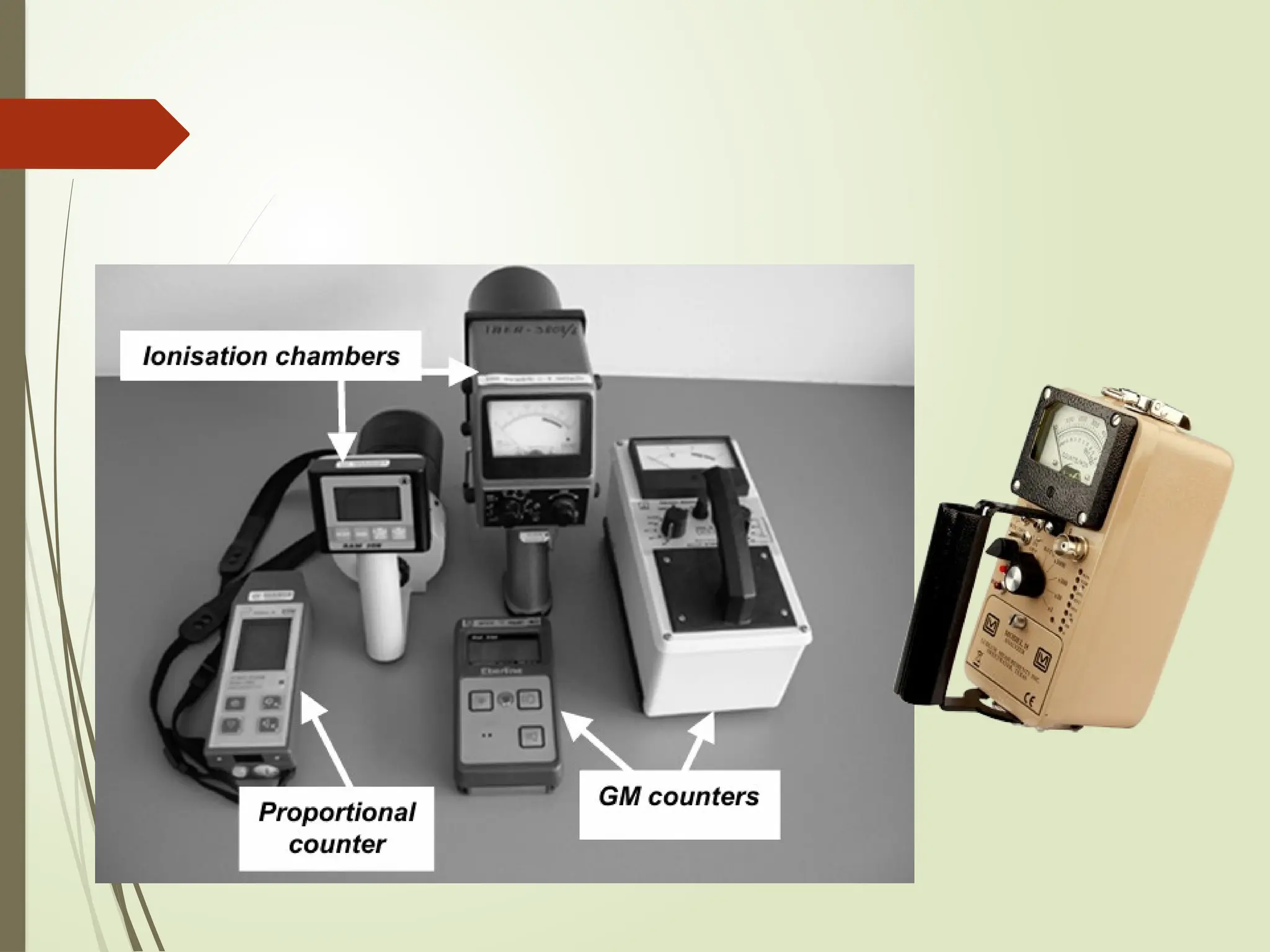
Area survey meters
Radiation instruments used as survey meter or area
monitors are either gas filled detectors or solid state
detectors (scintillator or semiconductor detectors).
Commonly available feature are;
 “Low battery” visual indication.
 Auto zeroing, auto ranging, auto back-illumination
facilities.
 Variable response time and memory to store the
data values.
Area survey meters
 Option for both the ‘rate’ and the ‘integrate’ modes
of operation.
 Analog or digital display, marked in conventional
(exposure/air-kerma) or recent “ambient dose
equivalent” or “personal dose equivalent” units.
 Audio indication of radiation levels (through the
‘chirp’ rate).
 Re-settable / non-re-settable alarm facility with
adjustable alarm levels.
 Visual indication of radiation with flashing LEDs.
Calibration of survey meters
Protection level area survey meters have to be
calibrated against a reference instrument that is
traceable (directly or indirectly) to a National
Standards Laboratory.
A reference instrument for gamma radiation is
generally an ionization chamber with a measuring
assembly.
Reference instruments do not indicate directly the dose
equivalent “H” required for calibration of radiation
protection monitoring instruments.
Calibration of survey meters
They measure basic radiation quantities, such as the
air-kerma in air for photon radiation, and the dose
equivalent H is then determined by using
appropriate
conversion coefficient h:
H = h N
⋅ R.MR ,
where, NR is the calibration factor (e.g., in terms of
air- kerma in air or air-kerma rate in air) of the
reference chamber under the reference conditions and
MR is the reading of the reference instrument corrected
Individual Monitoring/
Personal Dosimetry
The most widely used individual monitoring systems
are based on TLD or film dosimetry, other techniques,
such as optically simulated luminescence is also in
use.
Self-reading pocket dosimeters and electronic personal
dosimeters are direct reading dosimeters and show
both the instantaneous dose rate and the accumulated
dose at any point in time.
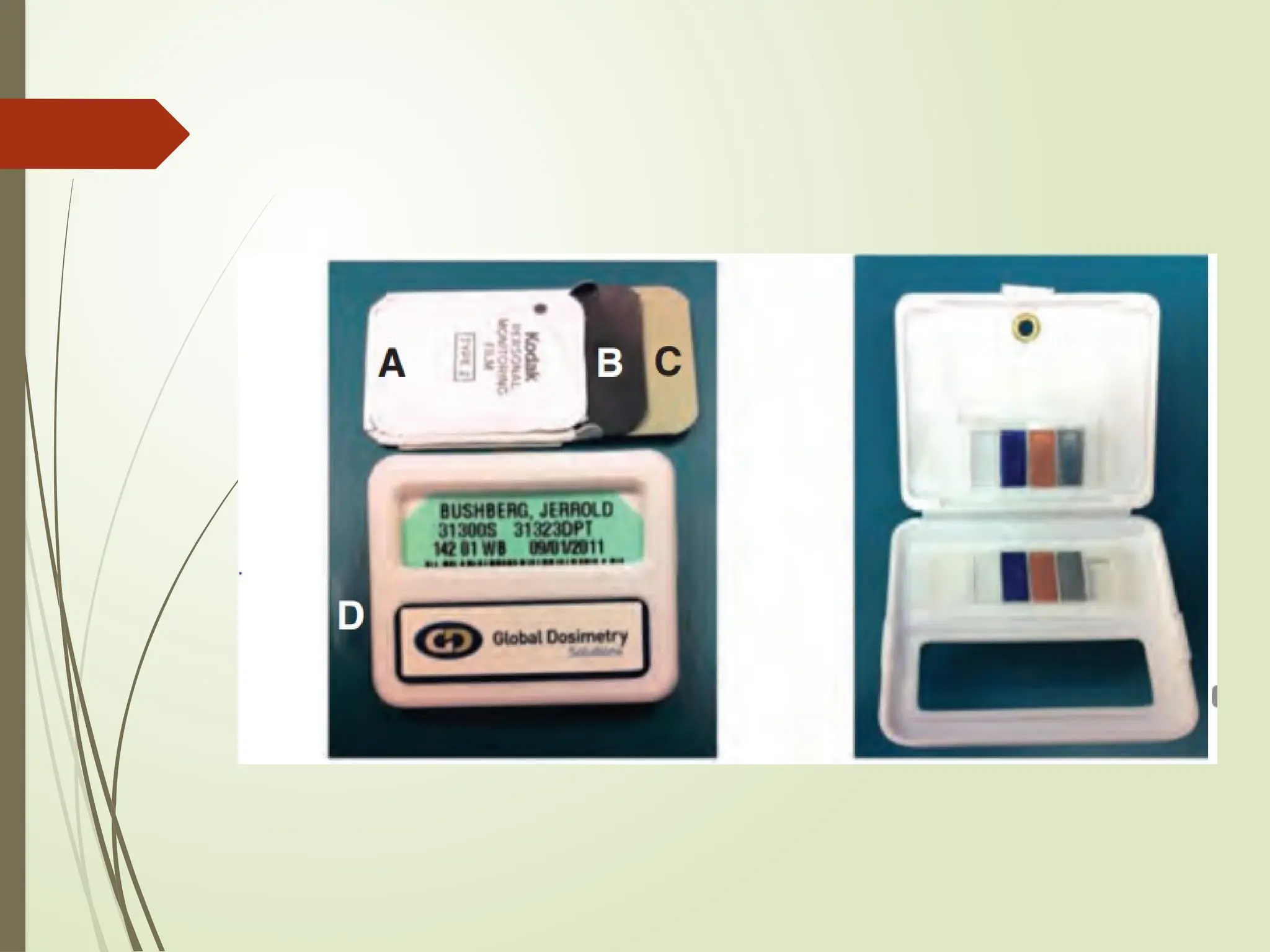
Film badge
Are small portable devices for monitoring
cumulative radiation dose due to ionizing radiation.
Film badges came into general use during the 1940s.
The badge consists of two parts: photographic film
and a holder.
The film is contained inside a badge.
Film badge
The piece of photographic film that is the sensitive
material and it must be removed monthly and
developed.
Doses up to about 10 Gy can be measured and
exposures less than 100 μGy (10 mR) are not
measured by film badge.
The metal filters, along with the window in the
plastic film holder, allow estimation of the x-ray
energy.
Film badge
Examples of filters:
There is an open window that makes it possible for
weaker radiations to reach the film.
A thin plastic filter which attenuates beta radiation but
passes all other radiations.
A thick plastic filter which passes all but the lowest
energy photon radiation.
Film badge
A dural filter which progressively absorbs photon
radiation at energies below 65 KeV as well as
beta radiation.
A tin/lead filter of a thickness which allows an
energy independent dose response of the film
over the photon energy range 75 KeV to 2 MeV.
A cadmium lead filter can be used for thermal
neutrons detection.
Film badge
Advantages:
It is very simple and cheap.
It provides a permanent record.
It is very reliable.
It is used to measure and record radiation exposure
due to gamma rays, X-rays and beta particles.
Film badge
Disadvantages:
Film dosimeter cannot be read on-site, instead it
has to be sent away for developing.
Film dosimeter is for one-time use only, it
cannot be reused.
Exposures of less than 0.2 mSv (20 millirem) of
gamma radiation cannot be accurately measured.
Thermo-luminescent
dosimeter/ TLD dosimeter
 Some materials glow when heated, thus exhibiting thermally
stimulated emission of visible light, called
thermoluminescence.
 A TLD dosimeter is used as personal monitoring device.
 It measures ionizing radiation exposure by measuring the
intensity of visible light emitted from a crystal in the detector
when the detector is heated.
 Measures radiation ranges from 10mR-10000 R with
accuracy of +/-10%.
Theory of TLD
In crystal lattice, mutual interaction between
atoms gives rise to energy bands.
Impurities in crystal create energy traps,
providing metastable states for the electron.
When the material is irradiated, some of electron
in valence band (ground state) receive sufficient
energy to be raised to the conduction band.
The vacancy thus created is called positive hole.
Theory of TLD
The electron and the hole moves
independently, until they fall into trap
(metastable state).
Heating causes electrons to drop back to
valence band, releasing a photon of energy
difference between trap state and ground state.
If it take long time to drop back then it is called
FADING.
Glow curve
Plot of thermoluminescence against temperature is k/a
glow curve.
As the temperature of TL material exposed to radiation
is increased, the probability of releasing electron
increases.
Optimum temperature for TLD readout is 170-2300
C.
Area under this curve is directly proportional to the
amount of radiation that was absorbed in the chip.
TLD materials
 The materials are usually inorganic crystalline or
polycrystalline crystal or phosphors which have
defects produced during synthesis including those due
to impurities added intentionally.
 TLDs are routinely used in nuclear medicine as
extremity dosimeters; a finger ring LED dosimeter
worn on the hand measure exposure during
radiopharmaceutical preparation and administration.
 The most commonly used TL phosphors are;
 LiF, CaF2, Li2B4O7, CaSO4
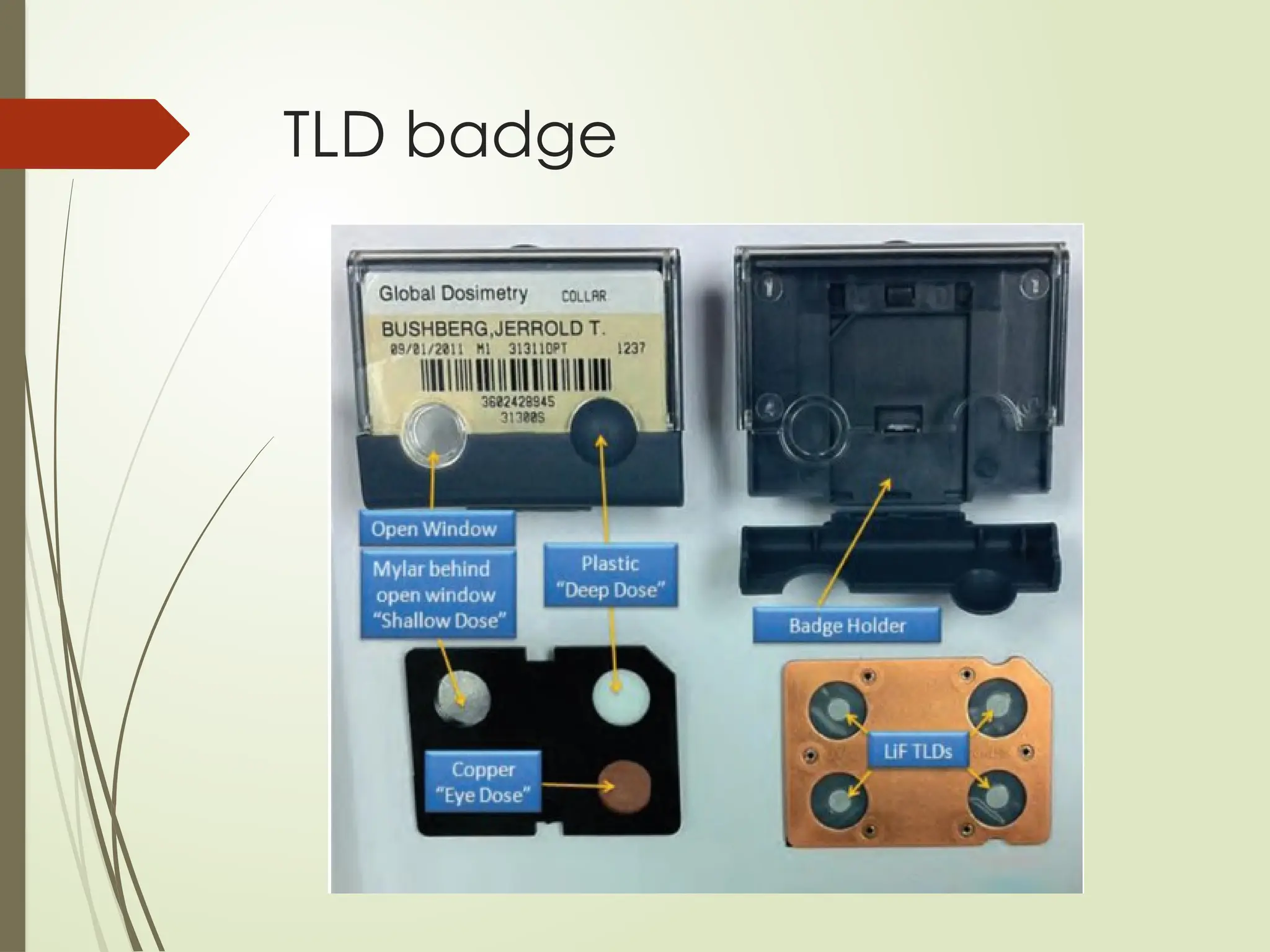
TLD badge
TLD badge
TLD reader construction
Irradiated material is placed in heater cup or
planchet and heated. The light is emitted.
Emitted light is measured by PMT and converts
light into electrical energy.
Current is then amplified and measured by
recorder.
TLD reader
Thermo-luminescent
dosimeter
Advantages;
Able to measure a greater range of doses
(100 μSv to 10 Sv).
Doses can be easily obtained.
Linearity of dose response.
Energy dependence.
Quicker turn around time for readout.
Reusable, small size and less expensive.
Thermo-luminescent
dosimeter
Disadvantages;
Lack of uniformity- batch calibration needed.
Light sensitivity.
Fading
No permanent record.
Dust on the detector will glow when heated
and will be recorded by the PMT as false
reading.
Optically stimulated
luminescence (OSL) dosimeters
Optically stimulated luminescence (OSL) dosimeters
contain a thin layer of aluminum oxide (Al203:C).
During analysis the aluminum oxide is stimulated with
selected frequencies of laser light producing
luminescence proportional to radiation exposure.
Commercially available badges are integrated, self
contained packets that come preloaded, incorporating
an Al203 strip sandwiched within a filter pack that is
heat-sealed. Special filter patterns provide qualitative
information about conditions during exposure.
Optically stimulated
luminescence (OSL) dosimeters
OSL dosimeters are highly sensitive; e.g., the Luxel®
system can be used down to 10 µSv with a precision of
±10 µSv.
This high sensitivity is particularly suitable for
individual monitoring in low-radiation environments.
The dosimeters can be used in a wide dose range up to
10 Sv in photon beams from 5 KeV to 40 MeV.
OSL dosimeters can be reanalysed several times without
loosing the sensitivity and may be used for up to one
year.
Optically stimulated
luminescence (OSL) dosimeters
Advantages;
High sensitivity.
High precision.
Fast, non destructive readout.
No significant fading.
No need for annealing.
Suitable for remote dosimetry.
Optically stimulated
luminescence (OSL) dosimeters
Disadvantages;
Sensitive to light.
Non tissue equivalent.
Self reading dosimeters
In addition to passive dosimetry badges, direct reading
personal dosimeters are widely used;
 to provide direct read-out of the dose at any time.
 for tracking the doses received in day-to-day activities.
 in special operations (e.g., source loading survey,
handling of any radiation incidents or emergencies).
 direct reading personal dosimeters fall into two
categories;
 Self-reading pocket dosimeters and
 Electronic personal dosimeters (EPD).
Self reading pocket dosimeter/
Quartz fiber dosimeter
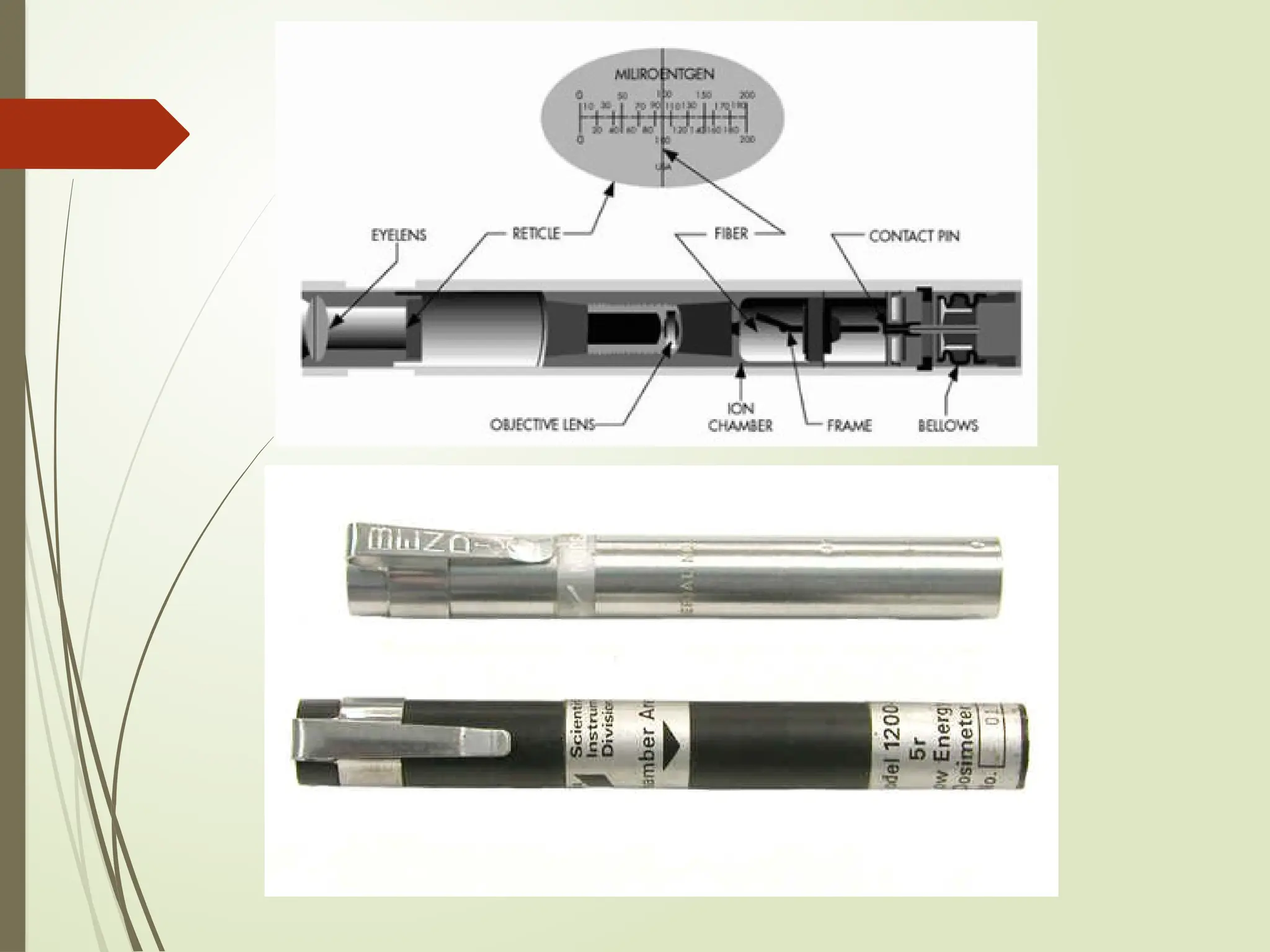
Is a pen-like device that measures the cumulative dose
of ionizing radiation received by the device, usually
over one work period. Commonly worn in the pocket.
The self-indicating pocket dosimeter consists of
an ionization chamber with a volume of approximately
two milliliters sensitive to the desired radiation, a
quartz fiber electrometer to measure the charge, and a
microscope to read the fiber image off a scale.
Inside the ionization chamber is a central wire anode,
and attached to this wire anode is a metal-coated quartz
fiber.
Electronic personal
dosimeter(EPD)
Is a modern dosimeter that can give a continuous
readout of cumulative dose and current dose rate.
Warns the person wearing it when a specified dose
rate or a cumulative dose is exceeded.
EPDs are especially useful in high-dose areas
where the residence time of the wearer is limited
due to dose constraints.
Electronic personal dosimeter
Advantages;
Direct reading of the detected dose and dose rate in real
time.
EPDs have a dose rate alarm, and a dose alarm, which
can warn the person wearing it when a specified dose
rate or a cumulative dose is exceeded.
The dosimeter can be reset, usually after taking a
reading for record purposes, and thereby re-used
multiple times.
It is capable of measuring a wide radiation dose range
from routine (μSv) levels to emergency levels
(hundreds mSv or units of Sieverts) with high precision.
Electronic personal dosimeter
Disadvantages;
EPDs are generally the most expensive dosimeters.
EPDs are generally large in size.
EPDs are used to measure and record radiation
exposure due to gamma rays, X-rays, sometimes
beta particles.
MOSFET dosimeters
MOSFET dosimeter is a small portable device for
monitoring and direct reading of radiation dose rate.
It is based on the MOSFET transistor, the metal-oxide-
semiconductor field-effect transistor (MOSFET).
MOSFET dosimeters
Ionizing radiation enters the sensitive volume of the
detector and interacts with the semiconductor material.
Particle passing through the detector ionizes the atoms
of semiconductor, producing the electron hole pairs.
The difference in voltage shift before and after
exposure can be measured, and is proportional to dose.
Direct ion storage (DIS) dosimeter
Direct-ion storage dosimeter, DIS, is an electronic
dosimeter, from which the dose information for
both Hp(10) and Hp(0.07) can be obtained instantly
at the workplace by using an electronic reader unit.
The DIS dosimeter is based
on the combination of an ion
chamber and a non-volatile
electronic charge storage
element.
Direct ion storage dosimeter
DIS dosimeter use an analog memory cell inside a
small, gas-filled, ionization chamber.
Incident radiation causes ionizations in the chamber
wall and in the gas, and the charge is stored for
subsequent readout.
The DIS dosimeter is read at the user’s site through
connection to an electronic reader unit.
Direct ion storage dosimeter
Detectors: three TMDIS (Direct Ion Storage) detectors
and two MOSFET detectors.
Detect: Gamma, X-ray and Beta radiation
Cross-over: insensitive to neutrons (<5 %)
Dose instant readout of ICRU dose equivalents:
-Hp(10):1µSv to 40Sv
-Hp(0.07): 10 µSv to 40 Sv
Practical aspects of dosimeter use
Nearly every medical facility obtains non-self reading
dosimeters, whether film badges, TLD dosimeters and /or
OSL dosimeters, from a commercial vendor monthly or
quarterly.
One or more control dosimeters are shipped with each badge.
They are stored in an area away from radiation source.
Typically at the beginning of a month, the new dosimeters
are issued to staff and used dosimeters from the previous
wear period are collected.
The used dosimeters and at least one control dosimeter, are
returned to the vendor for reading.
Practical aspects of dosimeter use
The vendor subtracts the reading of control dosimeter
from the reading of dosimeter that were used.
An exposure report is received in two to three days.
However reporting of unusual exposure or exposure
over regulatory limit is expedited.
The dosimetry report list the “shallow” dose,
corresponding to skin dose, the “eye” dose
corresponding to the lens of the eye and the “deep”
dose, corresponding to penetrating radiations. Most
vendors post dosimetry results on password secured
web sites.
Placement of dosimeter on
the body
A dosimeter is typically worn on the part of the torso
that is expected to receive the largest radiation
exposure or is most sensitive to radiation damage.
Most radiologists, x-ray technologists, and nuclear
medicine technologists wear a dosimeter at waist or
shirt-pocket level.
During fluoroscopy, a dosimeter is typically placed at
collar level in front of the lead apron to measure the
dose to the thyroid and lens of the eye because most of
the body is shielded from exposure.
Placement of dosimeter on
the body
Alternatively, a dosimeter can be placed at the collar
level in front of the radiation-protective apron, and a
second dosimeter can be worn on the torso underneath
the apron.
If selectively high doses are expected to hands and
head- additional wrist and head badges may be used.
A pregnant radiation worker typically wears an
additional dosimeter at waist level (behind the lead
apron, if worn) to assess the fetal dose.
At the end…
Different types of radiation detection and measurement
devices are available in commercial use. Proper use,
following manufacture’s instructions provide accurate
measurement.
Area survey meters are used for detection of low level
radiation, radiation emergencies and in detection of
contamination.
Personal monitoring devices give information about
personal radiation exposure. Professional use of these
devices is mandatory for accurate measurement.
Self reading type personal dosimeters provide accurate
personal dose record instantly.
Thank you

Radiation monitoring devices used in medical science.pptx

  • 1.
    Radiation monitoring devices RamDatt Joshi M..Sc. MIT Final year IOM, Kathmandu, Nepal
  • 2.
    Monitoring devices: Introduction Radiation exposureto humans can be broadly classified as internal and external exposures. External exposure monitoring refers to measuring:  radiation levels in and around work areas.  radiation levels around radiation therapy equipment or source containers and  dose equivalents received by individuals working with radiation.
  • 3.
    Monitoring devices: Introduction Radiation monitoringis carried out:  to assess workplace conditions and individual exposures.  to ensure acceptably safe and satisfactory radiological conditions in the workplace and  to keep records of monitoring, over a long period of time, for the purposes of regulation or as good practice.
  • 4.
    Monitoring devices: Introduction Radiation monitoringinstruments are used both for area monitoring and for individual monitoring. The instruments used for measuring radiation levels in an area are referred to as area monitors or area survey meters. And the instruments used for recording the dose equivalents received by individuals working with radiation are referred to as personal dosimeters or individual dosimeters.
  • 5.
    Area survey meters Radiationinstruments used as survey meter or area monitors are either gas filled detectors or solid state detectors (scintillator or semiconductor detectors). Commonly available feature are;  “Low battery” visual indication.  Auto zeroing, auto ranging, auto back-illumination facilities.  Variable response time and memory to store the data values.
  • 7.
    Area survey meters Option for both the ‘rate’ and the ‘integrate’ modes of operation.  Analog or digital display, marked in conventional (exposure/air-kerma) or recent “ambient dose equivalent” or “personal dose equivalent” units.  Audio indication of radiation levels (through the ‘chirp’ rate).  Re-settable / non-re-settable alarm facility with adjustable alarm levels.  Visual indication of radiation with flashing LEDs.
  • 8.
    Calibration of surveymeters Protection level area survey meters have to be calibrated against a reference instrument that is traceable (directly or indirectly) to a National Standards Laboratory. A reference instrument for gamma radiation is generally an ionization chamber with a measuring assembly. Reference instruments do not indicate directly the dose equivalent “H” required for calibration of radiation protection monitoring instruments.
  • 9.
    Calibration of surveymeters They measure basic radiation quantities, such as the air-kerma in air for photon radiation, and the dose equivalent H is then determined by using appropriate conversion coefficient h: H = h N ⋅ R.MR , where, NR is the calibration factor (e.g., in terms of air- kerma in air or air-kerma rate in air) of the reference chamber under the reference conditions and MR is the reading of the reference instrument corrected
  • 10.
    Individual Monitoring/ Personal Dosimetry Themost widely used individual monitoring systems are based on TLD or film dosimetry, other techniques, such as optically simulated luminescence is also in use. Self-reading pocket dosimeters and electronic personal dosimeters are direct reading dosimeters and show both the instantaneous dose rate and the accumulated dose at any point in time.
  • 11.
    Film badge Are smallportable devices for monitoring cumulative radiation dose due to ionizing radiation. Film badges came into general use during the 1940s. The badge consists of two parts: photographic film and a holder. The film is contained inside a badge.
  • 13.
    Film badge The pieceof photographic film that is the sensitive material and it must be removed monthly and developed. Doses up to about 10 Gy can be measured and exposures less than 100 μGy (10 mR) are not measured by film badge. The metal filters, along with the window in the plastic film holder, allow estimation of the x-ray energy.
  • 14.
    Film badge Examples offilters: There is an open window that makes it possible for weaker radiations to reach the film. A thin plastic filter which attenuates beta radiation but passes all other radiations. A thick plastic filter which passes all but the lowest energy photon radiation.
  • 15.
    Film badge A duralfilter which progressively absorbs photon radiation at energies below 65 KeV as well as beta radiation. A tin/lead filter of a thickness which allows an energy independent dose response of the film over the photon energy range 75 KeV to 2 MeV. A cadmium lead filter can be used for thermal neutrons detection.
  • 16.
    Film badge Advantages: It isvery simple and cheap. It provides a permanent record. It is very reliable. It is used to measure and record radiation exposure due to gamma rays, X-rays and beta particles.
  • 17.
    Film badge Disadvantages: Film dosimetercannot be read on-site, instead it has to be sent away for developing. Film dosimeter is for one-time use only, it cannot be reused. Exposures of less than 0.2 mSv (20 millirem) of gamma radiation cannot be accurately measured.
  • 18.
    Thermo-luminescent dosimeter/ TLD dosimeter Some materials glow when heated, thus exhibiting thermally stimulated emission of visible light, called thermoluminescence.  A TLD dosimeter is used as personal monitoring device.  It measures ionizing radiation exposure by measuring the intensity of visible light emitted from a crystal in the detector when the detector is heated.  Measures radiation ranges from 10mR-10000 R with accuracy of +/-10%.
  • 19.
    Theory of TLD Incrystal lattice, mutual interaction between atoms gives rise to energy bands. Impurities in crystal create energy traps, providing metastable states for the electron. When the material is irradiated, some of electron in valence band (ground state) receive sufficient energy to be raised to the conduction band. The vacancy thus created is called positive hole.
  • 20.
    Theory of TLD Theelectron and the hole moves independently, until they fall into trap (metastable state). Heating causes electrons to drop back to valence band, releasing a photon of energy difference between trap state and ground state. If it take long time to drop back then it is called FADING.
  • 22.
    Glow curve Plot ofthermoluminescence against temperature is k/a glow curve. As the temperature of TL material exposed to radiation is increased, the probability of releasing electron increases. Optimum temperature for TLD readout is 170-2300 C. Area under this curve is directly proportional to the amount of radiation that was absorbed in the chip.
  • 24.
    TLD materials  Thematerials are usually inorganic crystalline or polycrystalline crystal or phosphors which have defects produced during synthesis including those due to impurities added intentionally.  TLDs are routinely used in nuclear medicine as extremity dosimeters; a finger ring LED dosimeter worn on the hand measure exposure during radiopharmaceutical preparation and administration.  The most commonly used TL phosphors are;  LiF, CaF2, Li2B4O7, CaSO4
  • 25.
  • 26.
  • 27.
    TLD reader construction Irradiatedmaterial is placed in heater cup or planchet and heated. The light is emitted. Emitted light is measured by PMT and converts light into electrical energy. Current is then amplified and measured by recorder.
  • 28.
  • 29.
    Thermo-luminescent dosimeter Advantages; Able to measurea greater range of doses (100 μSv to 10 Sv). Doses can be easily obtained. Linearity of dose response. Energy dependence. Quicker turn around time for readout. Reusable, small size and less expensive.
  • 30.
    Thermo-luminescent dosimeter Disadvantages; Lack of uniformity-batch calibration needed. Light sensitivity. Fading No permanent record. Dust on the detector will glow when heated and will be recorded by the PMT as false reading.
  • 31.
    Optically stimulated luminescence (OSL)dosimeters Optically stimulated luminescence (OSL) dosimeters contain a thin layer of aluminum oxide (Al203:C). During analysis the aluminum oxide is stimulated with selected frequencies of laser light producing luminescence proportional to radiation exposure. Commercially available badges are integrated, self contained packets that come preloaded, incorporating an Al203 strip sandwiched within a filter pack that is heat-sealed. Special filter patterns provide qualitative information about conditions during exposure.
  • 33.
    Optically stimulated luminescence (OSL)dosimeters OSL dosimeters are highly sensitive; e.g., the Luxel® system can be used down to 10 µSv with a precision of ±10 µSv. This high sensitivity is particularly suitable for individual monitoring in low-radiation environments. The dosimeters can be used in a wide dose range up to 10 Sv in photon beams from 5 KeV to 40 MeV. OSL dosimeters can be reanalysed several times without loosing the sensitivity and may be used for up to one year.
  • 34.
    Optically stimulated luminescence (OSL)dosimeters Advantages; High sensitivity. High precision. Fast, non destructive readout. No significant fading. No need for annealing. Suitable for remote dosimetry.
  • 35.
    Optically stimulated luminescence (OSL)dosimeters Disadvantages; Sensitive to light. Non tissue equivalent.
  • 36.
    Self reading dosimeters Inaddition to passive dosimetry badges, direct reading personal dosimeters are widely used;  to provide direct read-out of the dose at any time.  for tracking the doses received in day-to-day activities.  in special operations (e.g., source loading survey, handling of any radiation incidents or emergencies).  direct reading personal dosimeters fall into two categories;  Self-reading pocket dosimeters and  Electronic personal dosimeters (EPD).
  • 37.
    Self reading pocketdosimeter/ Quartz fiber dosimeter Is a pen-like device that measures the cumulative dose of ionizing radiation received by the device, usually over one work period. Commonly worn in the pocket. The self-indicating pocket dosimeter consists of an ionization chamber with a volume of approximately two milliliters sensitive to the desired radiation, a quartz fiber electrometer to measure the charge, and a microscope to read the fiber image off a scale. Inside the ionization chamber is a central wire anode, and attached to this wire anode is a metal-coated quartz fiber.
  • 39.
    Electronic personal dosimeter(EPD) Is amodern dosimeter that can give a continuous readout of cumulative dose and current dose rate. Warns the person wearing it when a specified dose rate or a cumulative dose is exceeded. EPDs are especially useful in high-dose areas where the residence time of the wearer is limited due to dose constraints.
  • 40.
    Electronic personal dosimeter Advantages; Directreading of the detected dose and dose rate in real time. EPDs have a dose rate alarm, and a dose alarm, which can warn the person wearing it when a specified dose rate or a cumulative dose is exceeded. The dosimeter can be reset, usually after taking a reading for record purposes, and thereby re-used multiple times. It is capable of measuring a wide radiation dose range from routine (μSv) levels to emergency levels (hundreds mSv or units of Sieverts) with high precision.
  • 41.
    Electronic personal dosimeter Disadvantages; EPDsare generally the most expensive dosimeters. EPDs are generally large in size. EPDs are used to measure and record radiation exposure due to gamma rays, X-rays, sometimes beta particles.
  • 42.
    MOSFET dosimeters MOSFET dosimeteris a small portable device for monitoring and direct reading of radiation dose rate. It is based on the MOSFET transistor, the metal-oxide- semiconductor field-effect transistor (MOSFET).
  • 43.
    MOSFET dosimeters Ionizing radiationenters the sensitive volume of the detector and interacts with the semiconductor material. Particle passing through the detector ionizes the atoms of semiconductor, producing the electron hole pairs. The difference in voltage shift before and after exposure can be measured, and is proportional to dose.
  • 44.
    Direct ion storage(DIS) dosimeter Direct-ion storage dosimeter, DIS, is an electronic dosimeter, from which the dose information for both Hp(10) and Hp(0.07) can be obtained instantly at the workplace by using an electronic reader unit. The DIS dosimeter is based on the combination of an ion chamber and a non-volatile electronic charge storage element.
  • 45.
    Direct ion storagedosimeter DIS dosimeter use an analog memory cell inside a small, gas-filled, ionization chamber. Incident radiation causes ionizations in the chamber wall and in the gas, and the charge is stored for subsequent readout. The DIS dosimeter is read at the user’s site through connection to an electronic reader unit.
  • 46.
    Direct ion storagedosimeter Detectors: three TMDIS (Direct Ion Storage) detectors and two MOSFET detectors. Detect: Gamma, X-ray and Beta radiation Cross-over: insensitive to neutrons (<5 %) Dose instant readout of ICRU dose equivalents: -Hp(10):1µSv to 40Sv -Hp(0.07): 10 µSv to 40 Sv
  • 47.
    Practical aspects ofdosimeter use Nearly every medical facility obtains non-self reading dosimeters, whether film badges, TLD dosimeters and /or OSL dosimeters, from a commercial vendor monthly or quarterly. One or more control dosimeters are shipped with each badge. They are stored in an area away from radiation source. Typically at the beginning of a month, the new dosimeters are issued to staff and used dosimeters from the previous wear period are collected. The used dosimeters and at least one control dosimeter, are returned to the vendor for reading.
  • 48.
    Practical aspects ofdosimeter use The vendor subtracts the reading of control dosimeter from the reading of dosimeter that were used. An exposure report is received in two to three days. However reporting of unusual exposure or exposure over regulatory limit is expedited. The dosimetry report list the “shallow” dose, corresponding to skin dose, the “eye” dose corresponding to the lens of the eye and the “deep” dose, corresponding to penetrating radiations. Most vendors post dosimetry results on password secured web sites.
  • 49.
    Placement of dosimeteron the body A dosimeter is typically worn on the part of the torso that is expected to receive the largest radiation exposure or is most sensitive to radiation damage. Most radiologists, x-ray technologists, and nuclear medicine technologists wear a dosimeter at waist or shirt-pocket level. During fluoroscopy, a dosimeter is typically placed at collar level in front of the lead apron to measure the dose to the thyroid and lens of the eye because most of the body is shielded from exposure.
  • 51.
    Placement of dosimeteron the body Alternatively, a dosimeter can be placed at the collar level in front of the radiation-protective apron, and a second dosimeter can be worn on the torso underneath the apron. If selectively high doses are expected to hands and head- additional wrist and head badges may be used. A pregnant radiation worker typically wears an additional dosimeter at waist level (behind the lead apron, if worn) to assess the fetal dose.
  • 52.
    At the end… Differenttypes of radiation detection and measurement devices are available in commercial use. Proper use, following manufacture’s instructions provide accurate measurement. Area survey meters are used for detection of low level radiation, radiation emergencies and in detection of contamination. Personal monitoring devices give information about personal radiation exposure. Professional use of these devices is mandatory for accurate measurement. Self reading type personal dosimeters provide accurate personal dose record instantly.
  • 53.