1
Thermodynamics
“Thermodynamics is a funny subject. The first time
you go through it, you don’t understand it all. The
second time you go through it, you think you
understand it, except one or two points. The third
time you go through it, you don’t understand it
but by the time you are so used to the subject, it
doesn’t bother you any more.”
- Arnold Sommerfield
MIT,A'bad 2
Fundamentals of Mechanical
Engineering
Content:-
Unit I- Basic Concepts of Mechanical Engineering
Unit- II – Laws of Thermodynamics
Unit- III – Ideal and Real Gases
Unit – IV- Properties of Steam
Unit-V – Fuels and Combustion
Unit –VI- Mechanical energy converting Devices
Unit – VII – Sources of Energy
MIT,A'bad 3
Unit -I
Basic Concepts of Mechanical Engineering
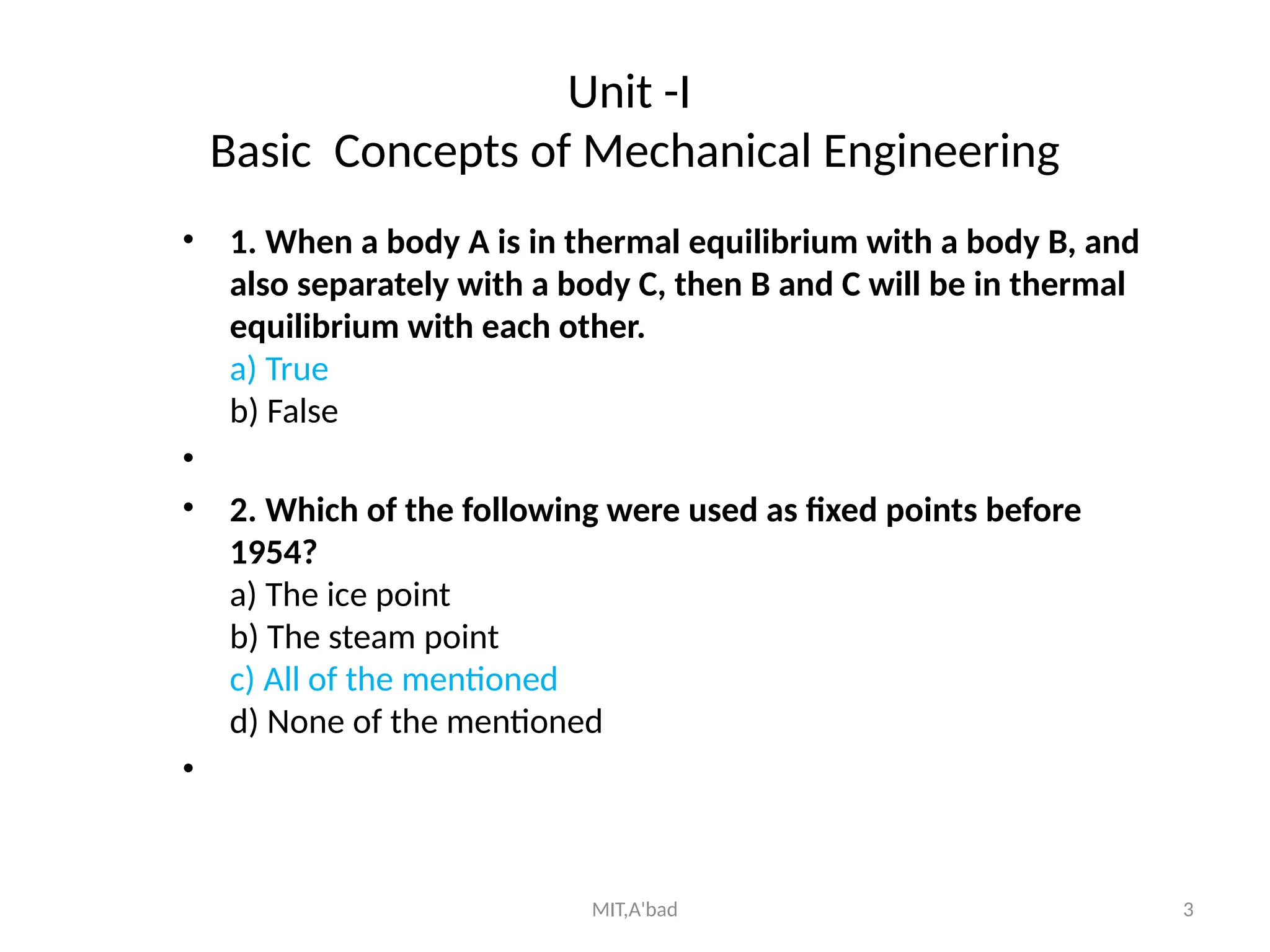
• 1. When a body A is in thermal equilibrium with a body B, and
also separately with a body C, then B and C will be in thermal
equilibrium with each other.
a) True
b) False
•
• 2. Which of the following were used as fixed points before
1954?
a) The ice point
b) The steam point
c) All of the mentioned
d) None of the mentioned
•
MIT,A'bad 4
Unit -I
Basic Concepts of Mechanical Engineering
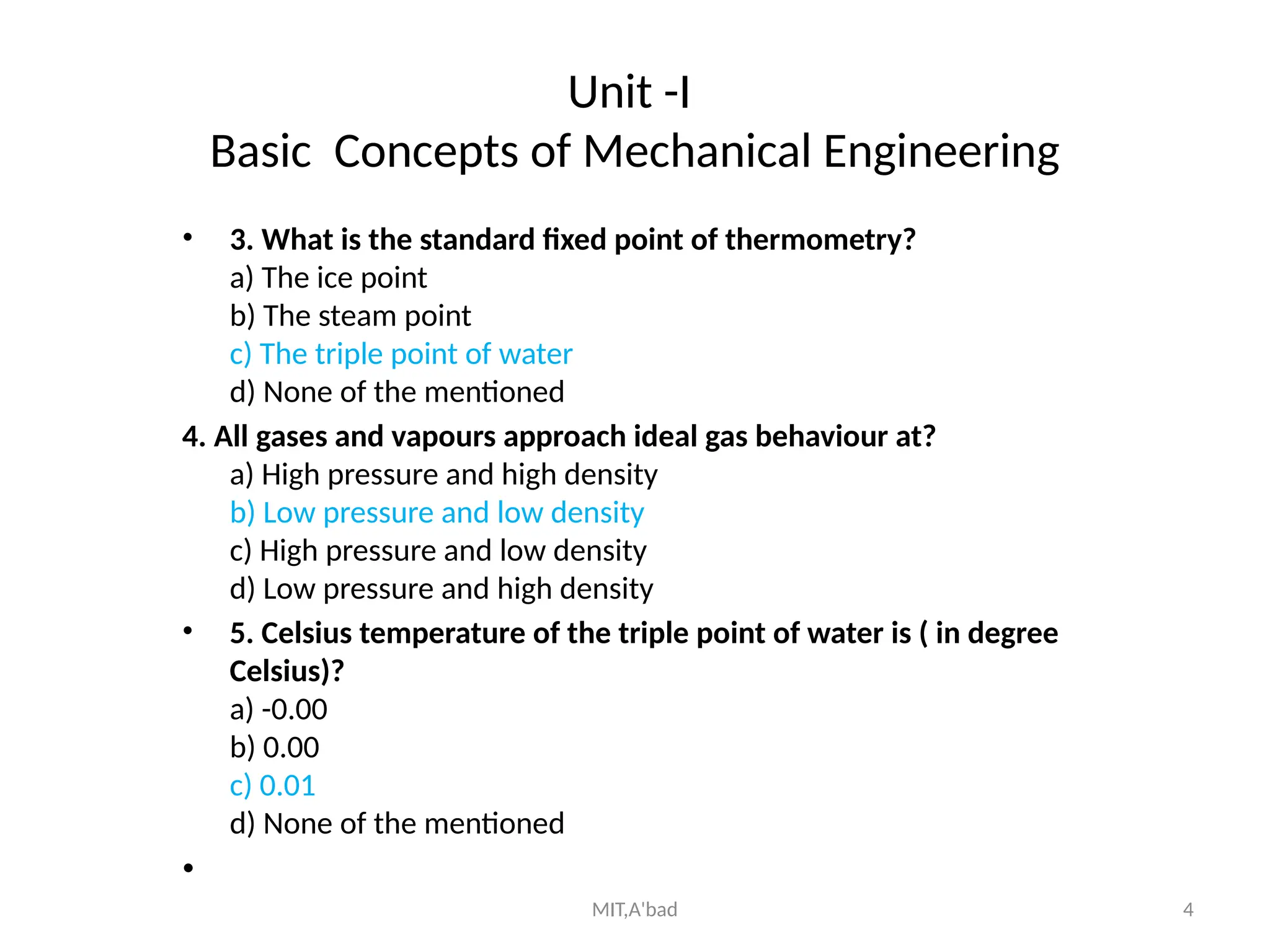
• 3. What is the standard fixed point of thermometry?
a) The ice point
b) The steam point
c) The triple point of water
d) None of the mentioned
4. All gases and vapours approach ideal gas behaviour at?
a) High pressure and high density
b) Low pressure and low density
c) High pressure and low density
d) Low pressure and high density
• 5. Celsius temperature of the triple point of water is ( in degree
Celsius)?
a) -0.00
b) 0.00
c) 0.01
d) None of the mentioned
•
MIT,A'bad 5
Unit -I
Basic Concepts of Mechanical Engineering
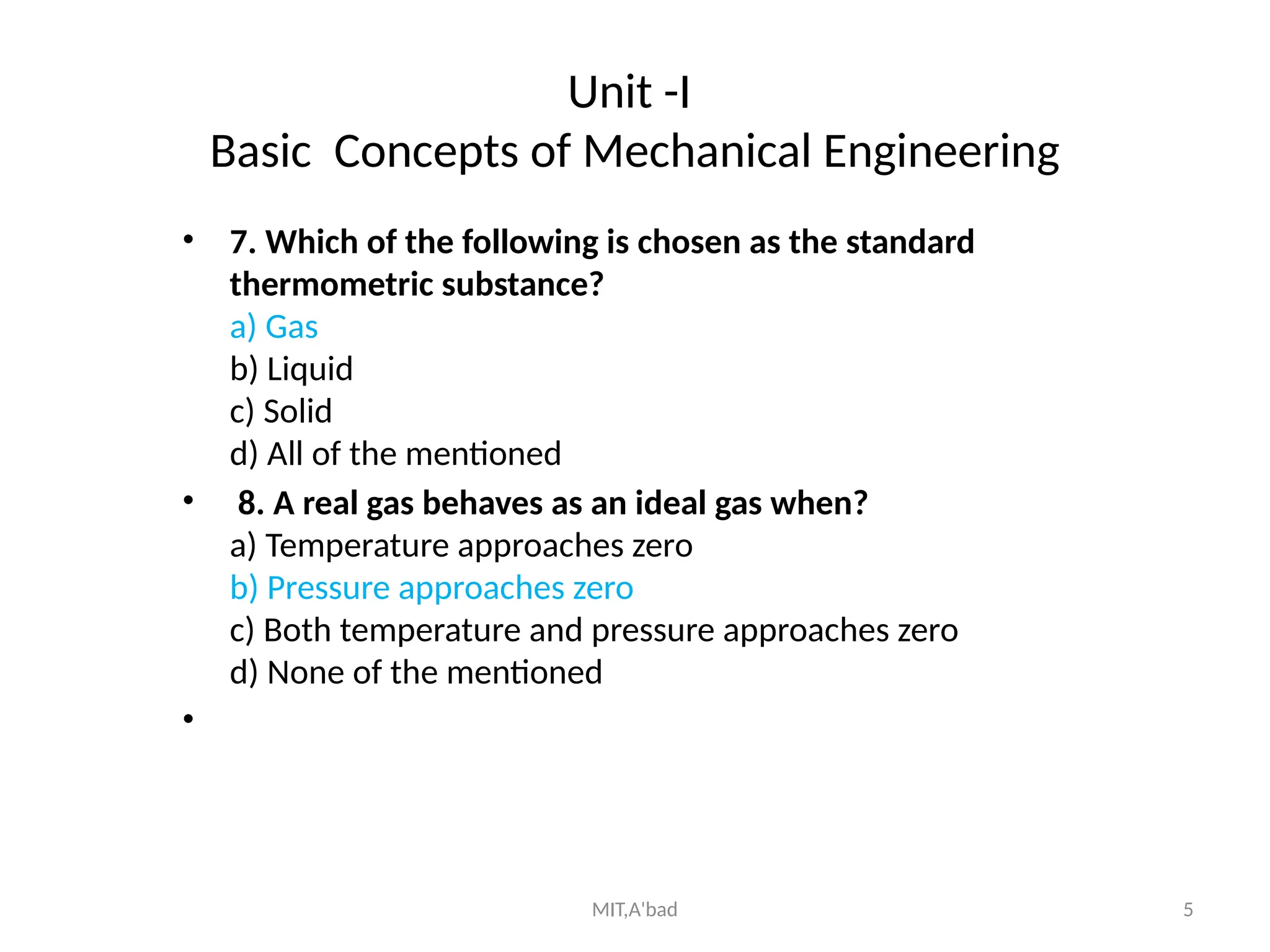
• 7. Which of the following is chosen as the standard
thermometric substance?
a) Gas
b) Liquid
c) Solid
d) All of the mentioned
• 8. A real gas behaves as an ideal gas when?
a) Temperature approaches zero
b) Pressure approaches zero
c) Both temperature and pressure approaches zero
d) None of the mentioned
•
MIT,A'bad 6
Unit -I
Basic Concepts of Mechanical Engineering
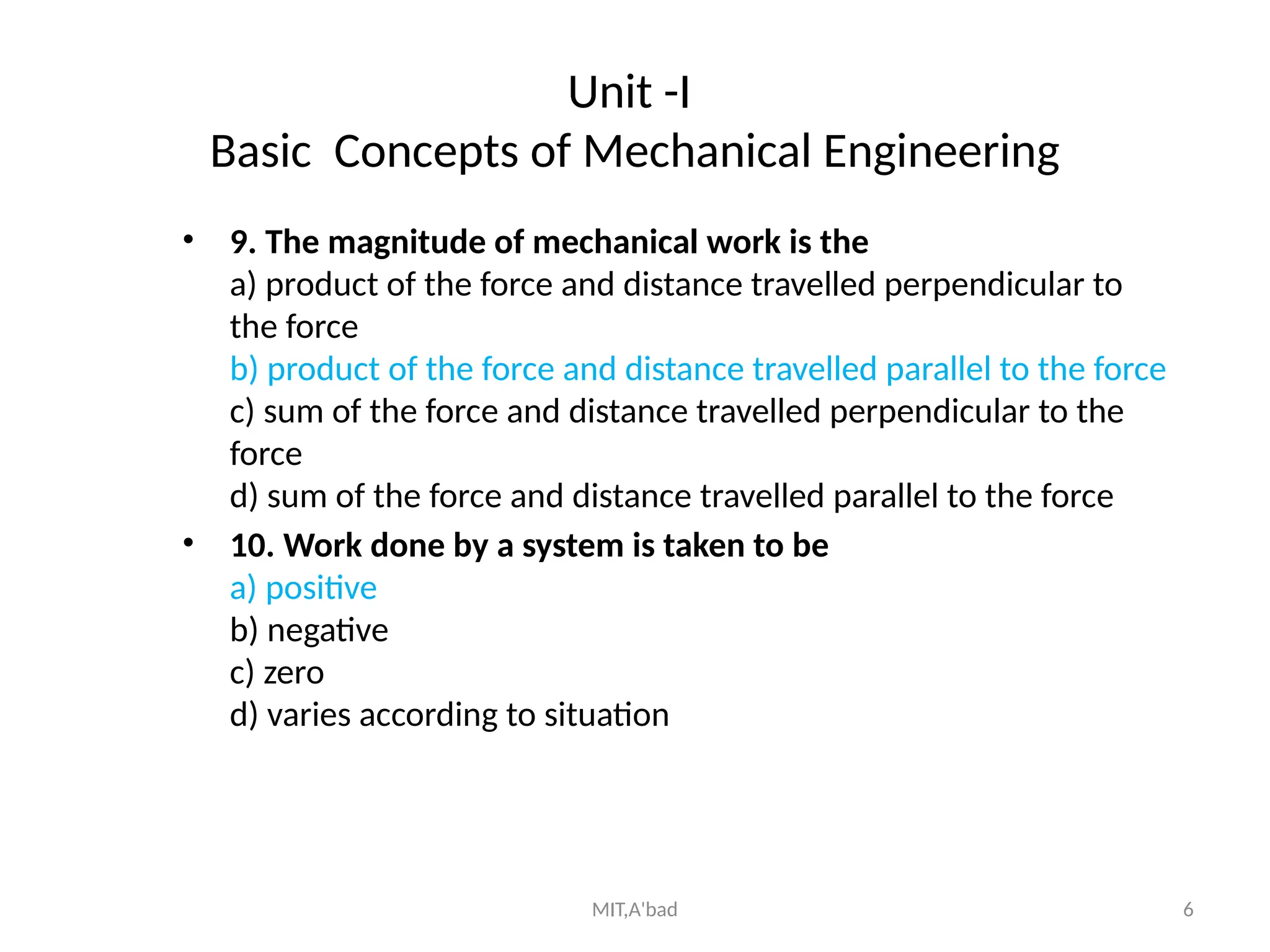
• 9. The magnitude of mechanical work is the
a) product of the force and distance travelled perpendicular to
the force
b) product of the force and distance travelled parallel to the force
c) sum of the force and distance travelled perpendicular to the
force
d) sum of the force and distance travelled parallel to the force
• 10. Work done by a system is taken to be
a) positive
b) negative
c) zero
d) varies according to situation
MIT,A'bad 7
Unit -I
Basic Concepts of Mechanical Engineering
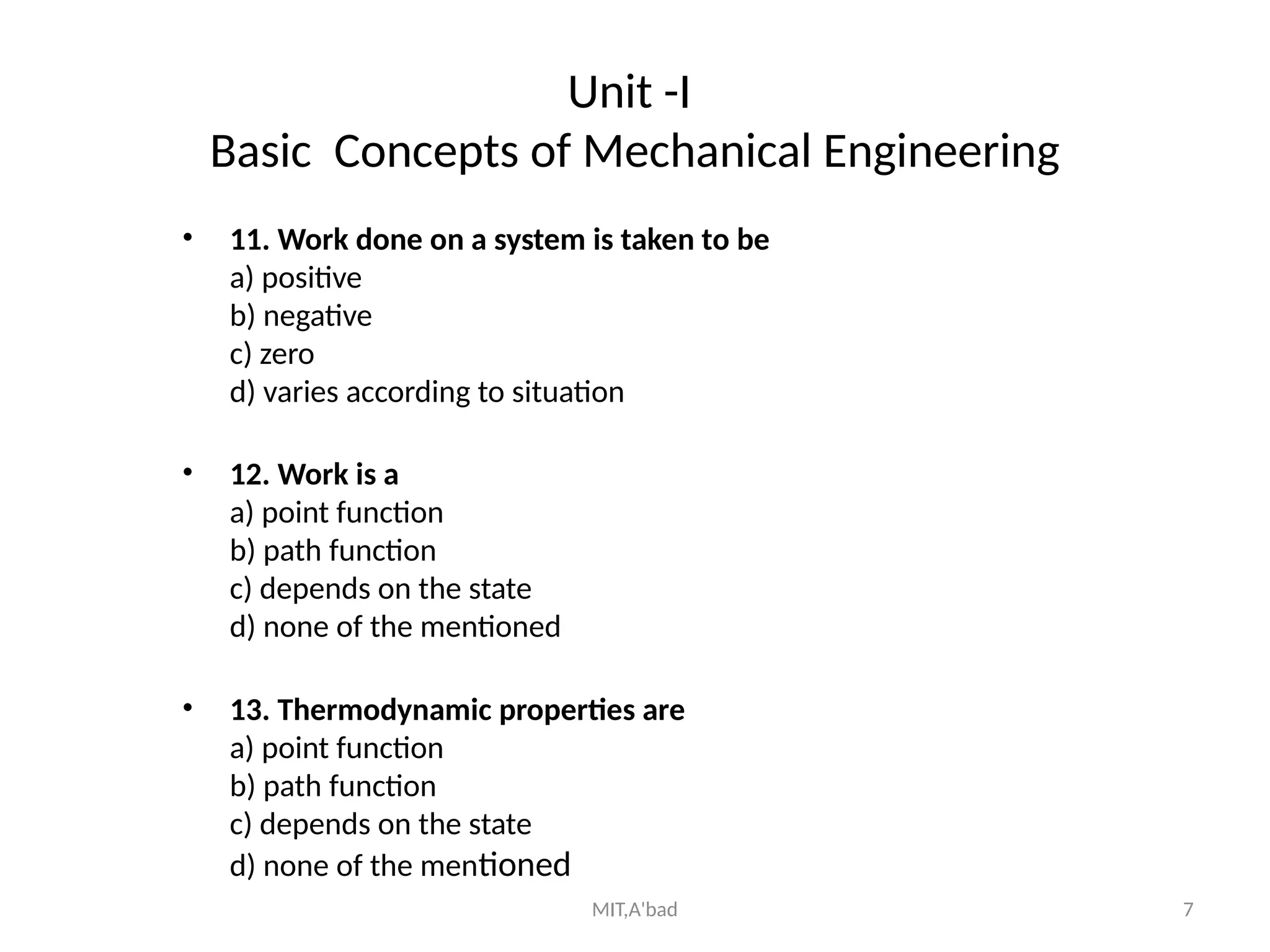
• 11. Work done on a system is taken to be
a) positive
b) negative
c) zero
d) varies according to situation
• 12. Work is a
a) point function
b) path function
c) depends on the state
d) none of the mentioned
• 13. Thermodynamic properties are
a) point function
b) path function
c) depends on the state
d) none of the mentioned
MIT,A'bad 8
Unit -I
Basic Concepts of Mechanical Engineering
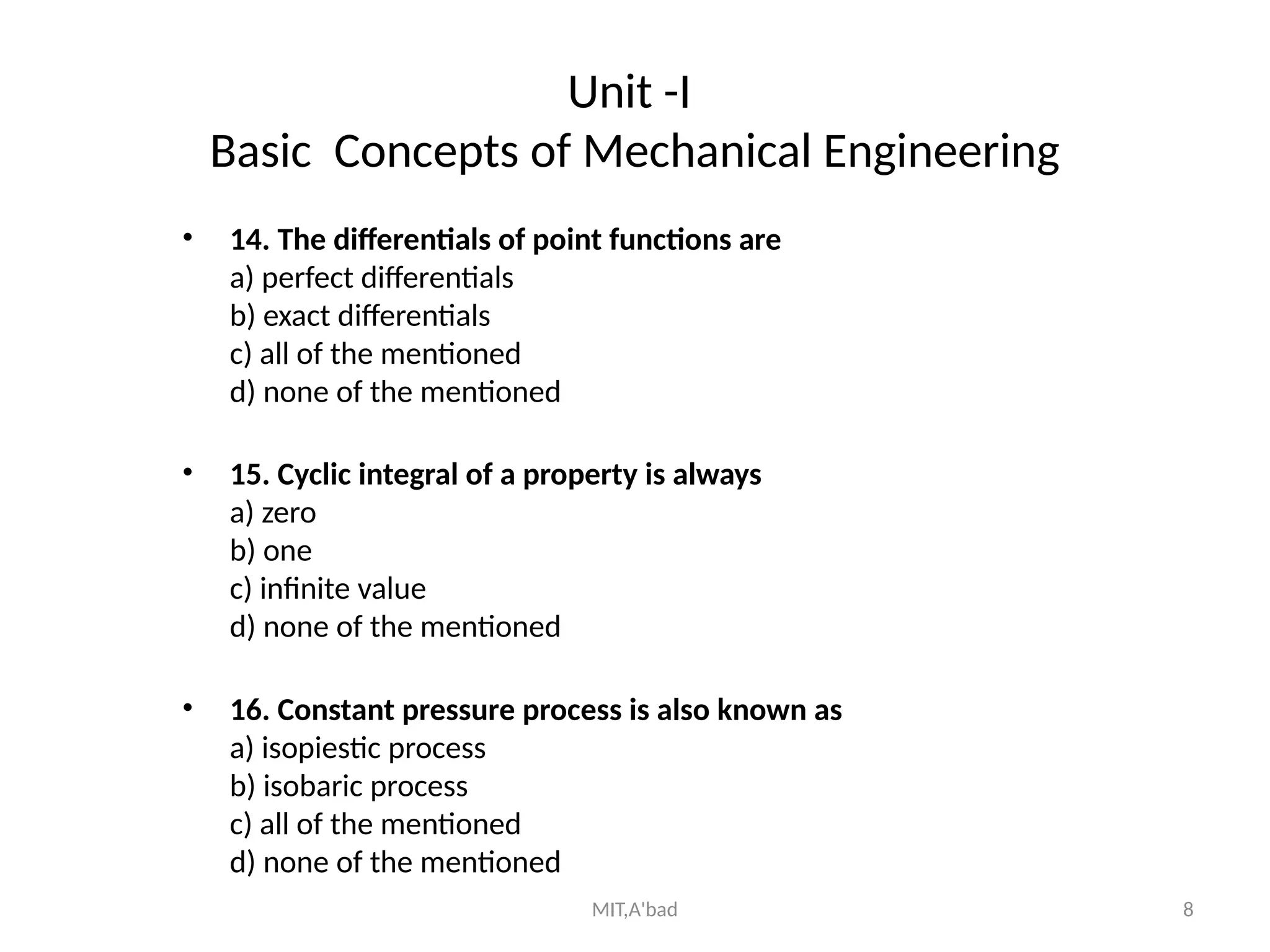
• 14. The differentials of point functions are
a) perfect differentials
b) exact differentials
c) all of the mentioned
d) none of the mentioned
• 15. Cyclic integral of a property is always
a) zero
b) one
c) infinite value
d) none of the mentioned
• 16. Constant pressure process is also known as
a) isopiestic process
b) isobaric process
c) all of the mentioned
d) none of the mentioned
MIT,A'bad 9
Unit -I
Basic Concepts of Mechanical Engineering
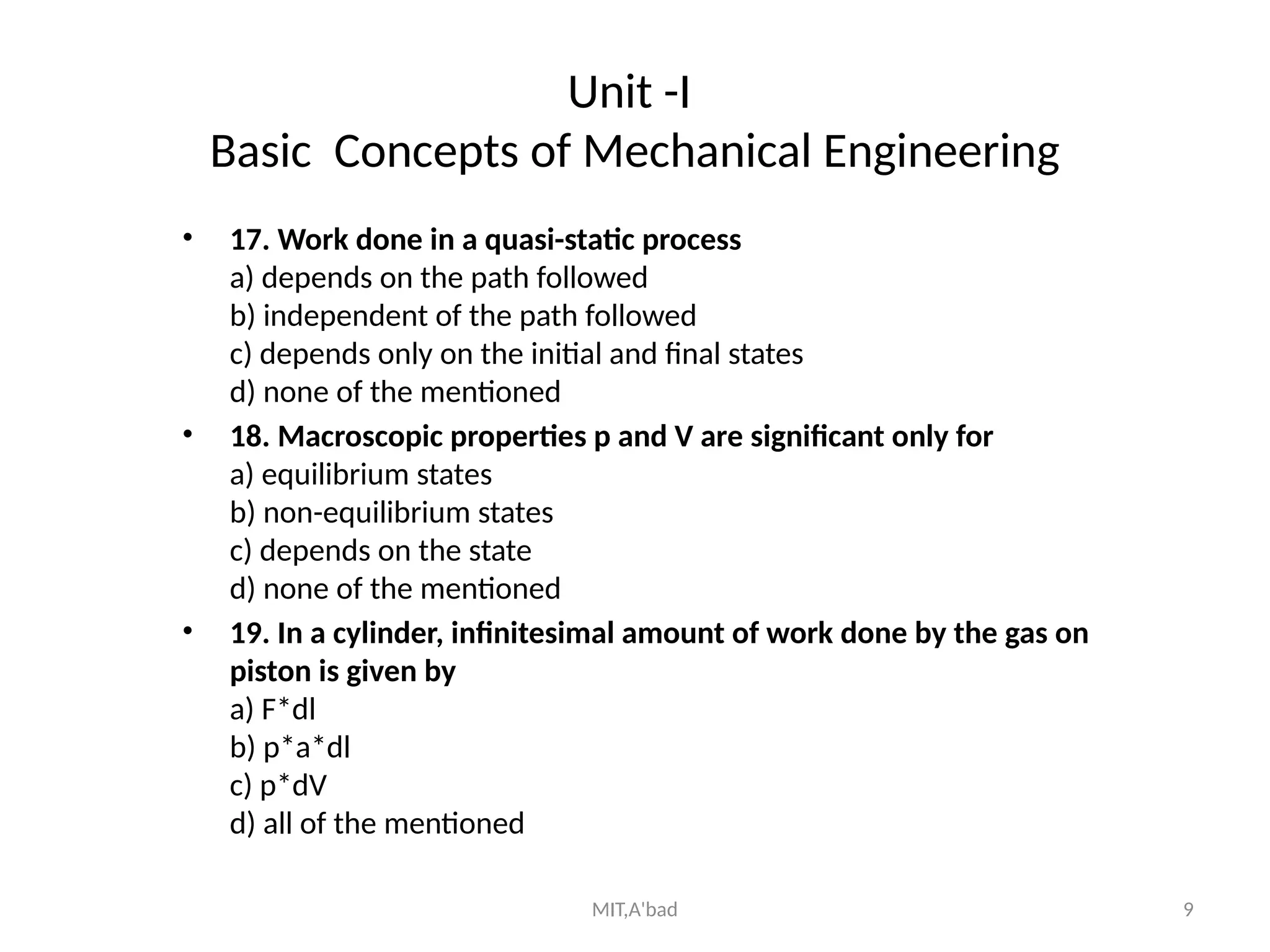
• 17. Work done in a quasi-static process
a) depends on the path followed
b) independent of the path followed
c) depends only on the initial and final states
d) none of the mentioned
• 18. Macroscopic properties p and V are significant only for
a) equilibrium states
b) non-equilibrium states
c) depends on the state
d) none of the mentioned
• 19. In a cylinder, infinitesimal amount of work done by the gas on
piston is given by
a) F*dl
b) p*a*dl
c) p*dV
d) all of the mentioned
MIT,A'bad 10
Unit -III
Ideal and Real Gases
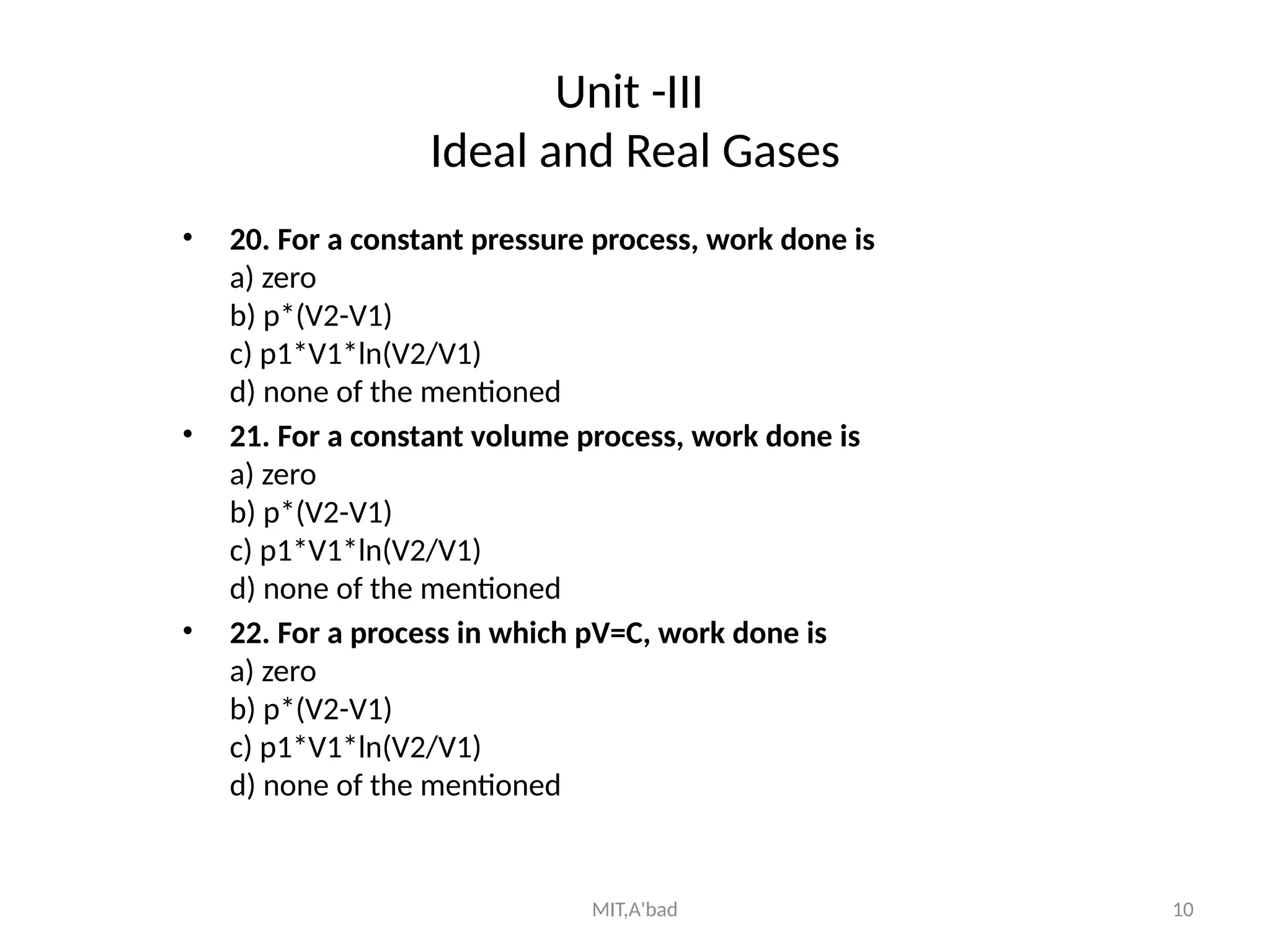
• 20. For a constant pressure process, work done is
a) zero
b) p*(V2-V1)
c) p1*V1*ln(V2/V1)
d) none of the mentioned
• 21. For a constant volume process, work done is
a) zero
b) p*(V2-V1)
c) p1*V1*ln(V2/V1)
d) none of the mentioned
• 22. For a process in which pV=C, work done is
a) zero
b) p*(V2-V1)
c) p1*V1*ln(V2/V1)
d) none of the mentioned
MIT,A'bad 11
Unit -VI
Mechanical Energy Converting Devices
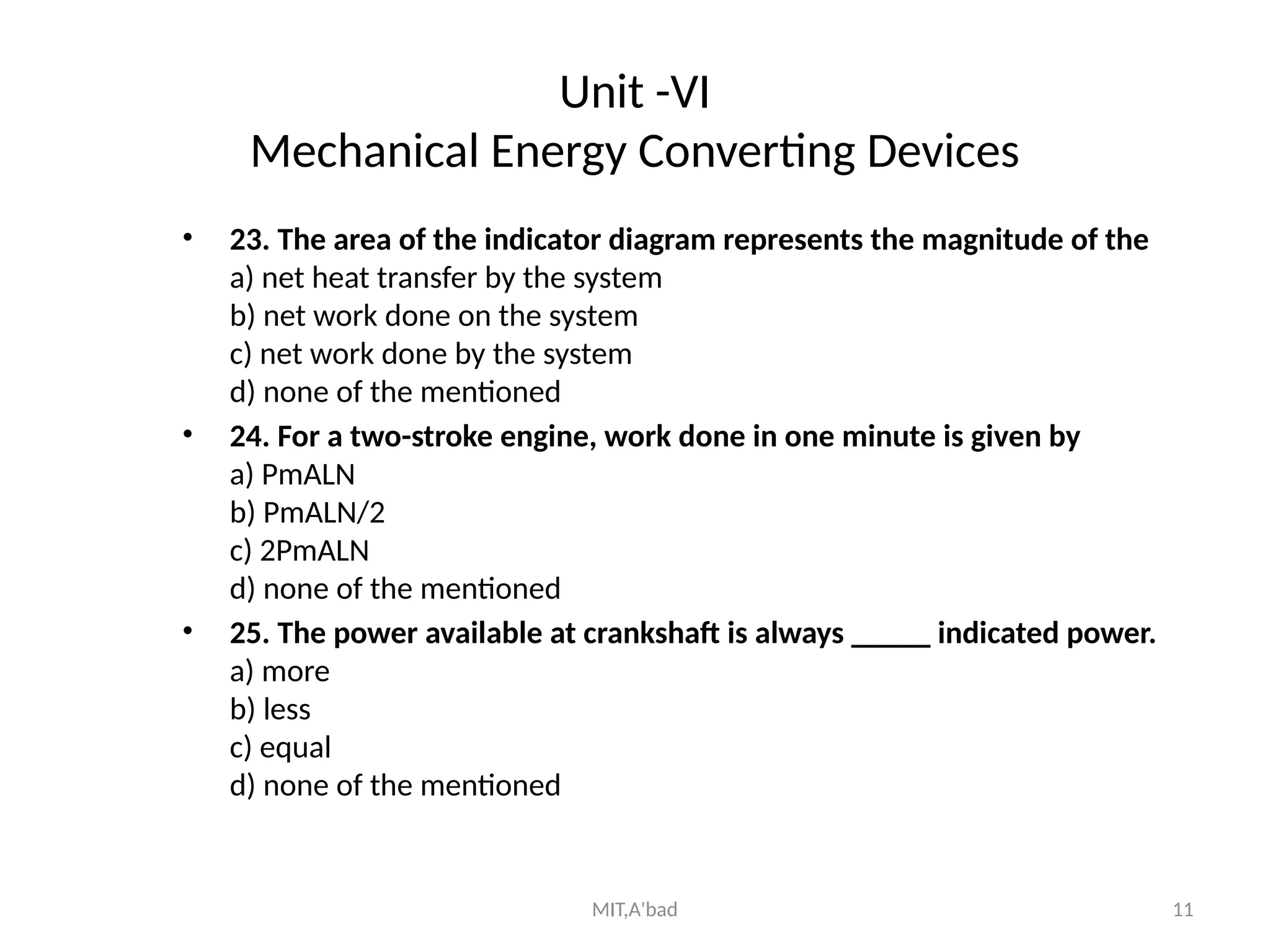
• 23. The area of the indicator diagram represents the magnitude of the
a) net heat transfer by the system
b) net work done on the system
c) net work done by the system
d) none of the mentioned
• 24. For a two-stroke engine, work done in one minute is given by
a) PmALN
b) PmALN/2
c) 2PmALN
d) none of the mentioned
• 25. The power available at crankshaft is always _____ indicated power.
a) more
b) less
c) equal
d) none of the mentioned
MIT,A'bad 12
Unit -VI
Mechanical Energy Converting Devices
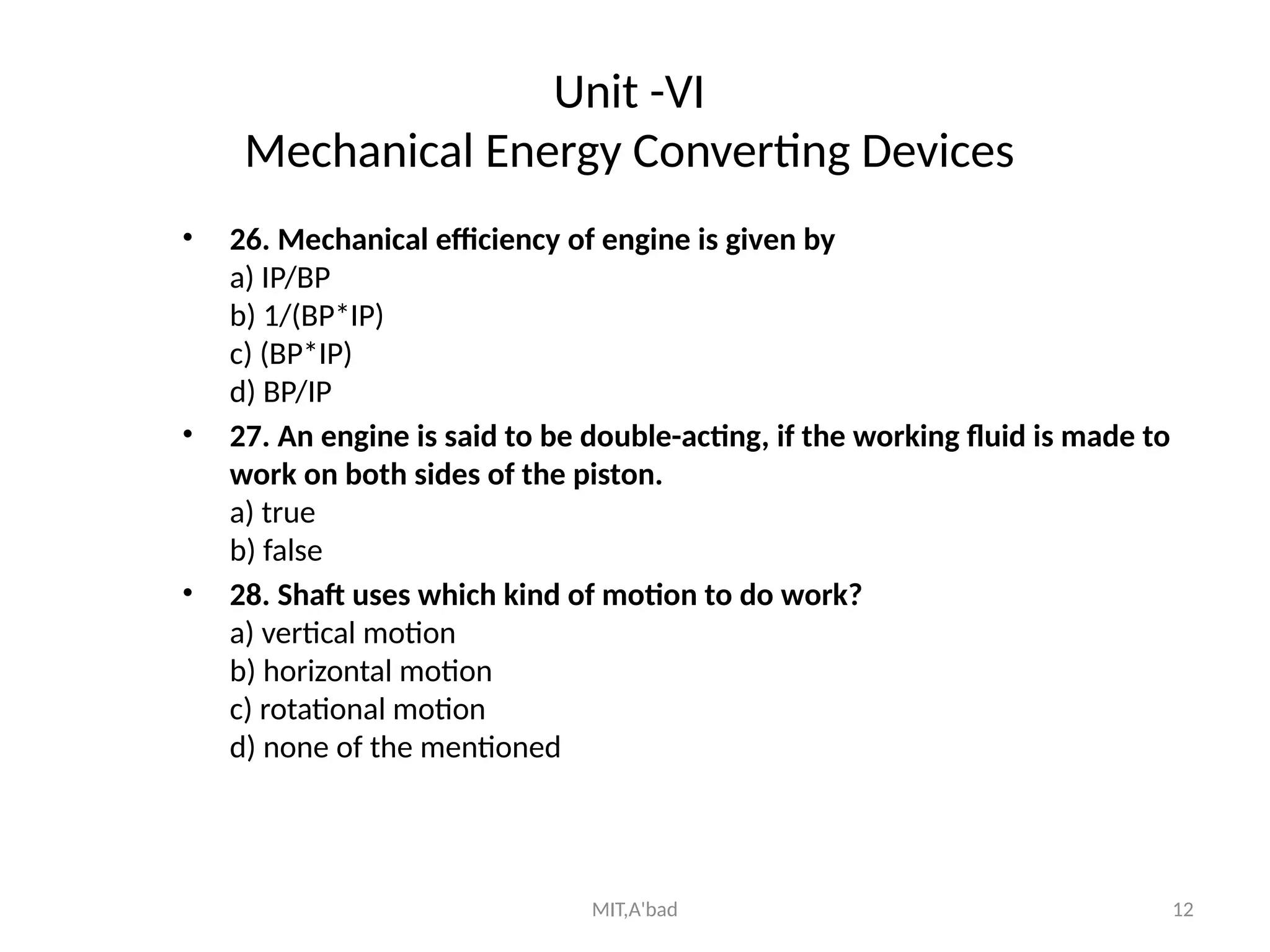
• 26. Mechanical efficiency of engine is given by
a) IP/BP
b) 1/(BP*IP)
c) (BP*IP)
d) BP/IP
• 27. An engine is said to be double-acting, if the working fluid is made to
work on both sides of the piston.
a) true
b) false
• 28. Shaft uses which kind of motion to do work?
a) vertical motion
b) horizontal motion
c) rotational motion
d) none of the mentioned
MIT,A'bad 13
Unit -VI
Mechanical Energy Converting Devices
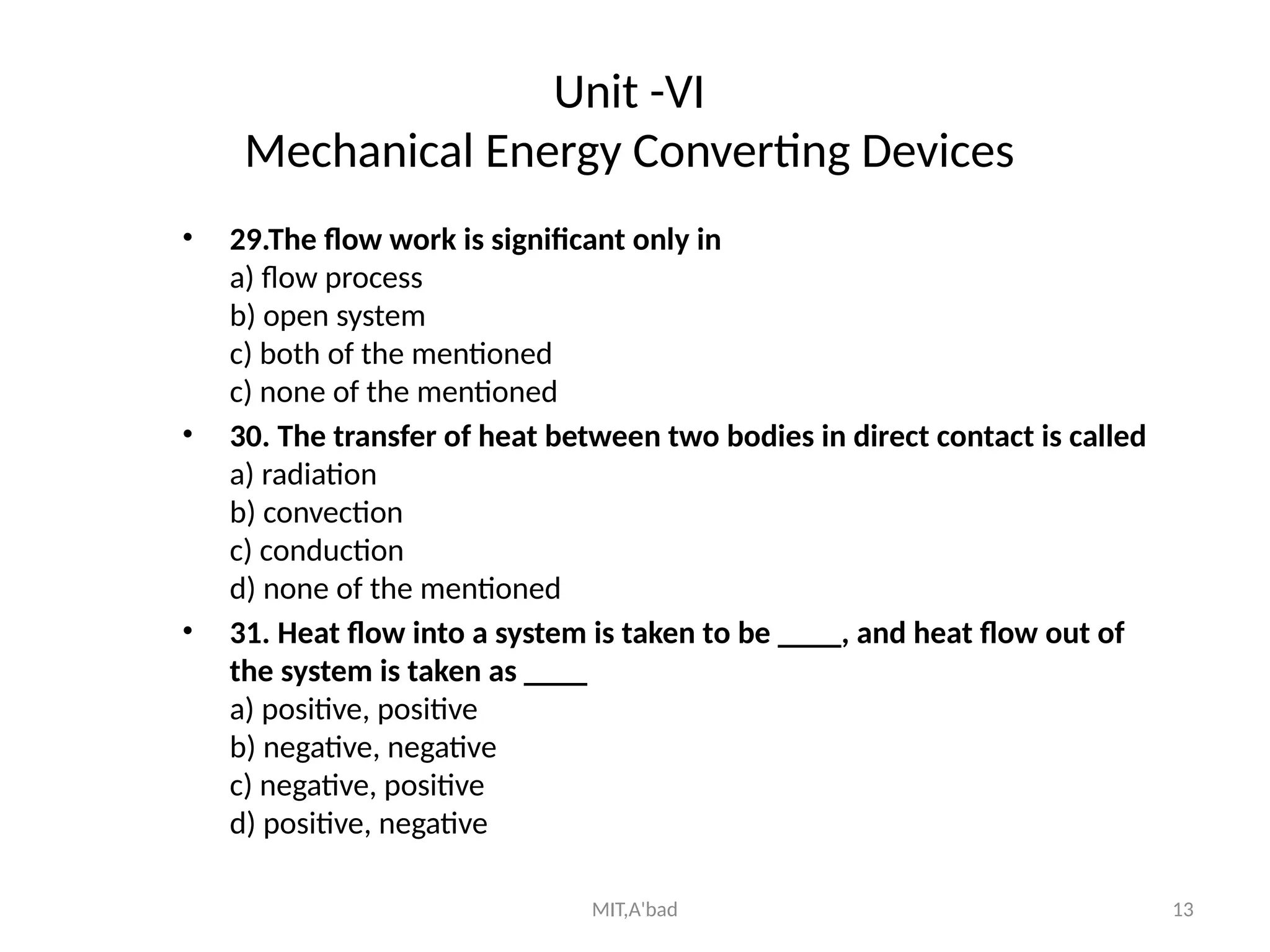
• 29.The flow work is significant only in
a) flow process
b) open system
c) both of the mentioned
c) none of the mentioned
• 30. The transfer of heat between two bodies in direct contact is called
a) radiation
b) convection
c) conduction
d) none of the mentioned
• 31. Heat flow into a system is taken to be ____, and heat flow out of
the system is taken as ____
a) positive, positive
b) negative, negative
c) negative, positive
d) positive, negative
MIT,A'bad 14
Unit -VI
Mechanical Energy Converting Devices
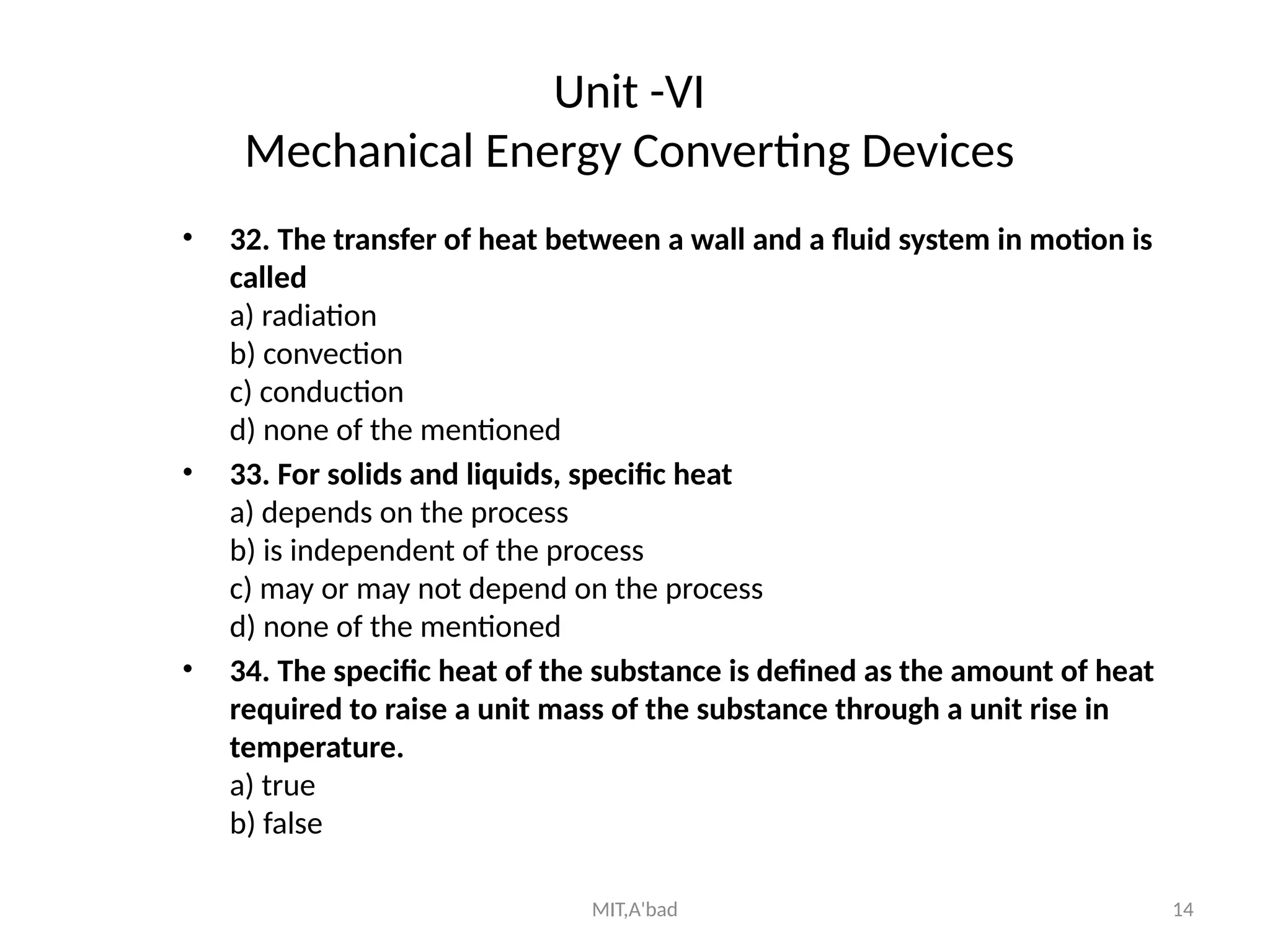
• 32. The transfer of heat between a wall and a fluid system in motion is
called
a) radiation
b) convection
c) conduction
d) none of the mentioned
• 33. For solids and liquids, specific heat
a) depends on the process
b) is independent of the process
c) may or may not depend on the process
d) none of the mentioned
• 34. The specific heat of the substance is defined as the amount of heat
required to raise a unit mass of the substance through a unit rise in
temperature.
a) true
b) false
MIT,A'bad 15
Unit -VI
Mechanical Energy Converting Devices
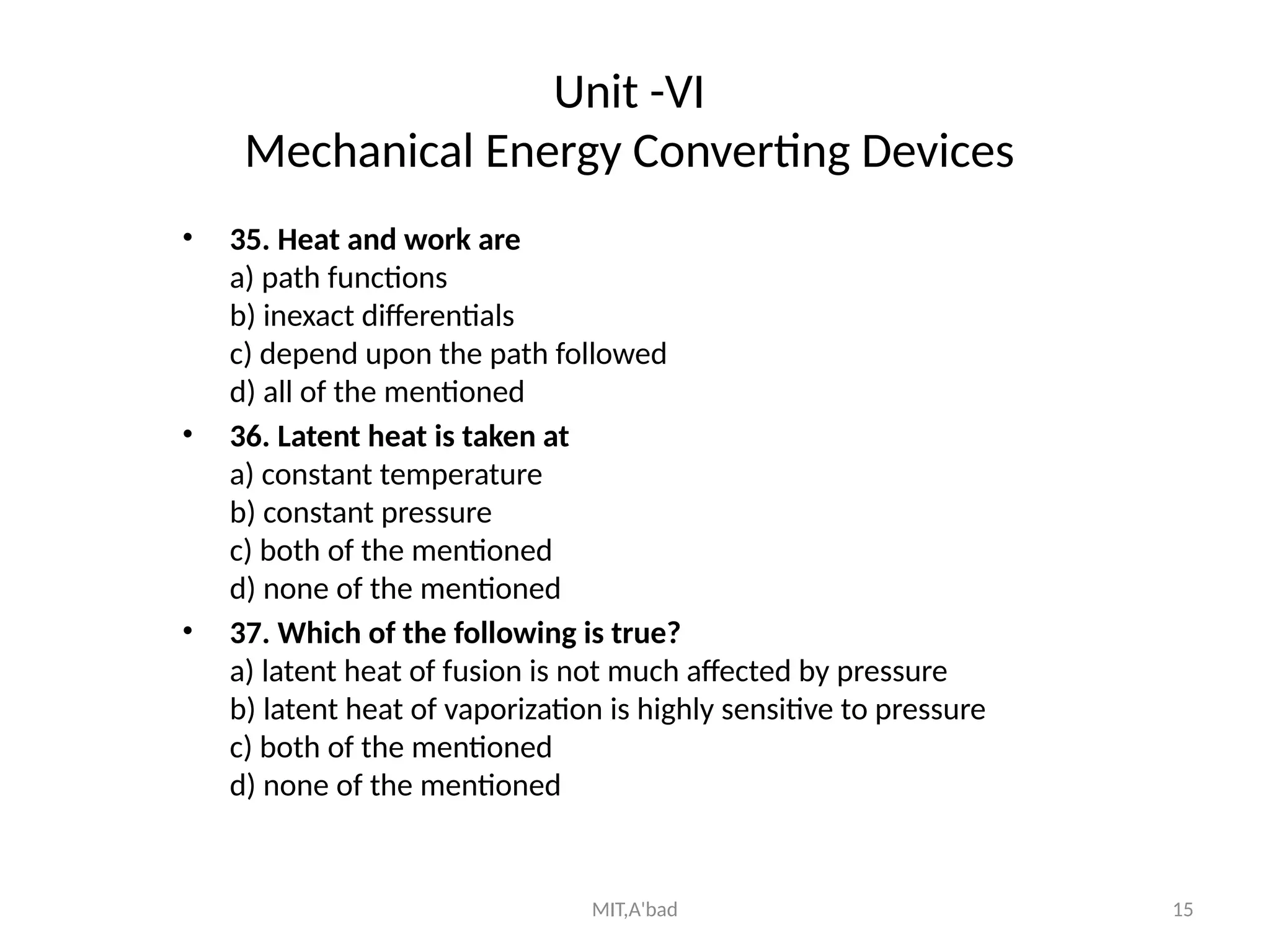
• 35. Heat and work are
a) path functions
b) inexact differentials
c) depend upon the path followed
d) all of the mentioned
• 36. Latent heat is taken at
a) constant temperature
b) constant pressure
c) both of the mentioned
d) none of the mentioned
• 37. Which of the following is true?
a) latent heat of fusion is not much affected by pressure
b) latent heat of vaporization is highly sensitive to pressure
c) both of the mentioned
d) none of the mentioned
MIT,A'bad 16
Unit -VI
Mechanical Energy Converting Devices
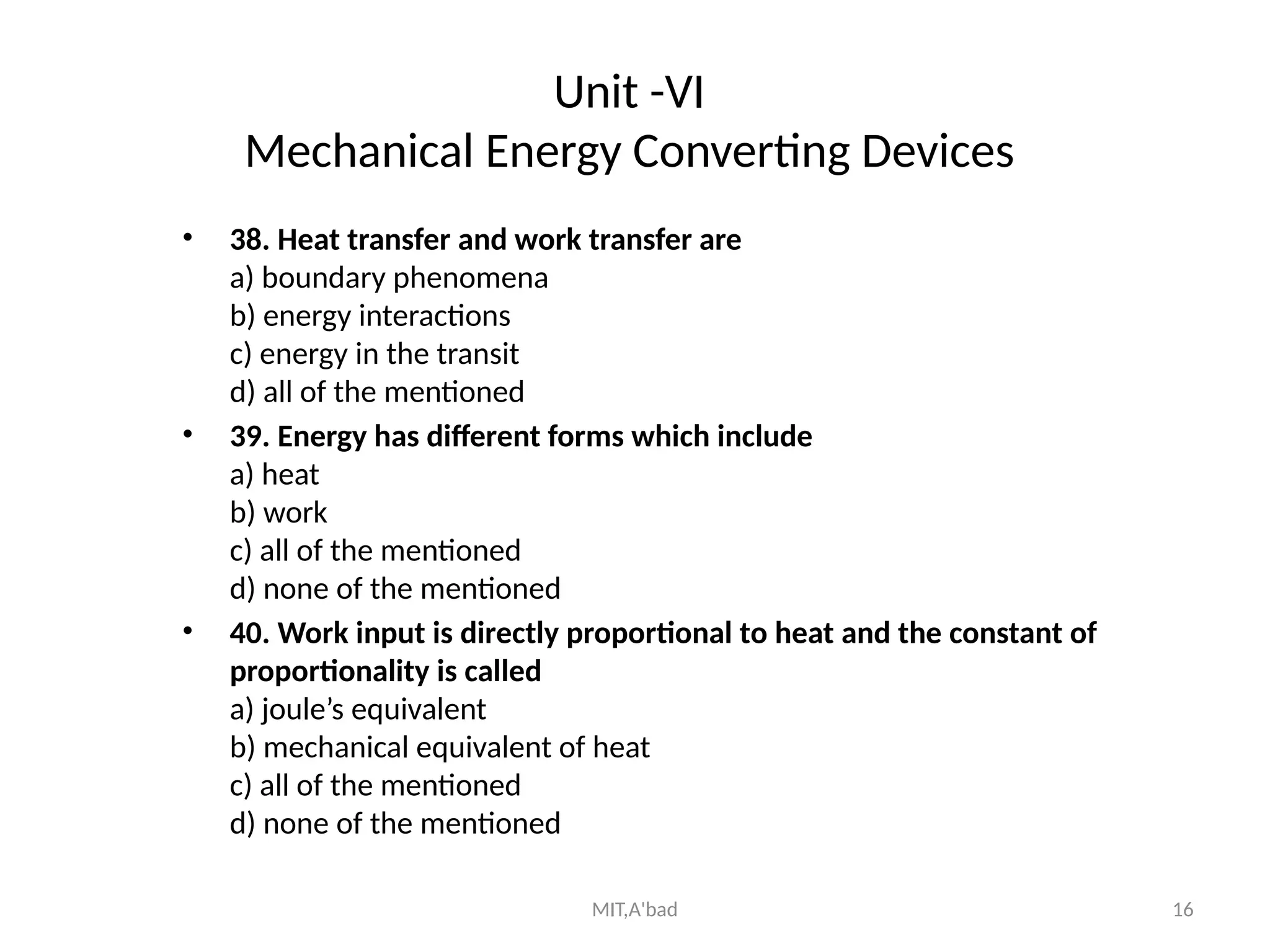
• 38. Heat transfer and work transfer are
a) boundary phenomena
b) energy interactions
c) energy in the transit
d) all of the mentioned
• 39. Energy has different forms which include
a) heat
b) work
c) all of the mentioned
d) none of the mentioned
• 40. Work input is directly proportional to heat and the constant of
proportionality is called
a) joule’s equivalent
b) mechanical equivalent of heat
c) all of the mentioned
d) none of the mentioned
MIT,A'bad 17
Unit -VI
Mechanical Energy Converting Devices
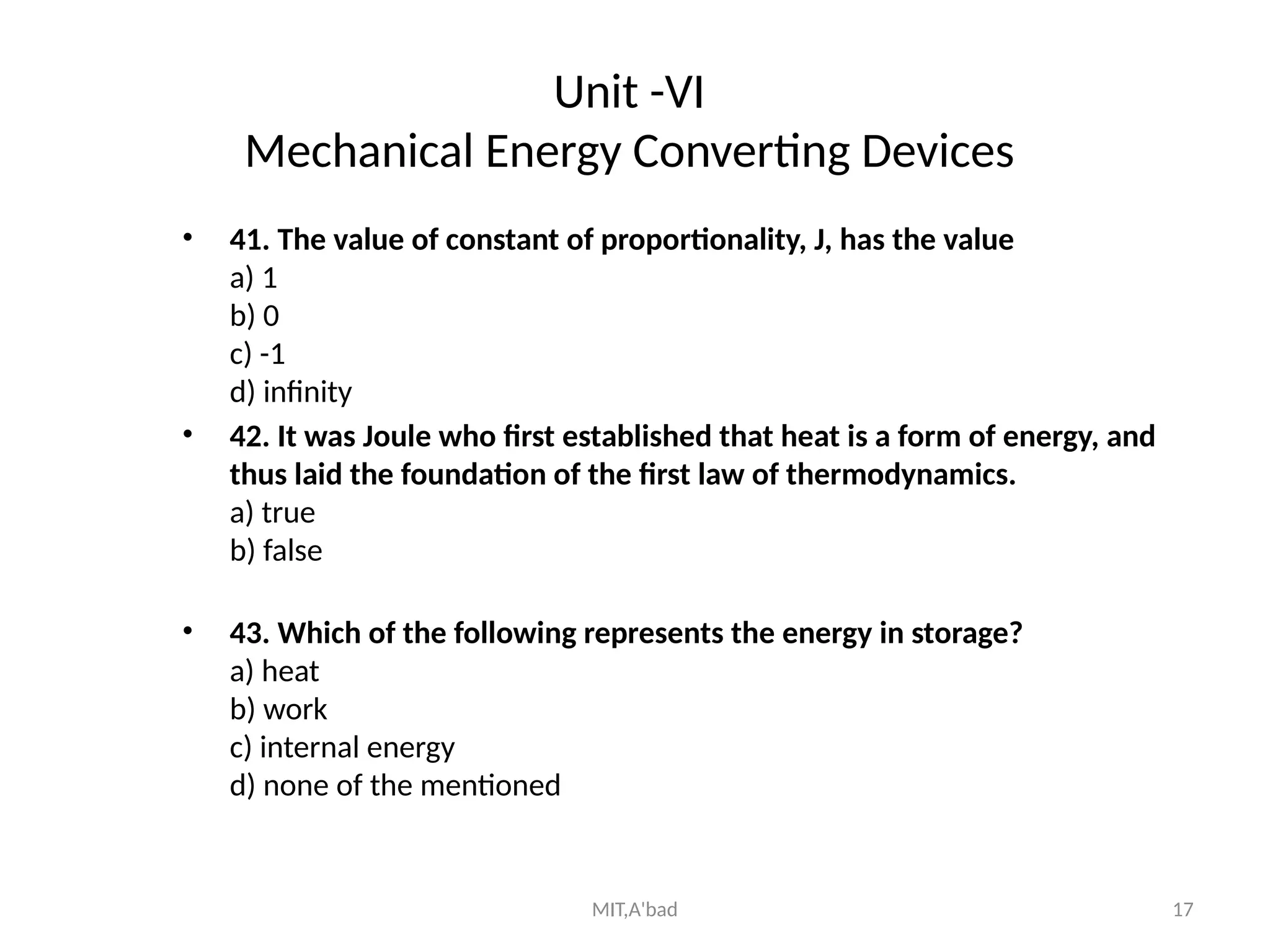
• 41. The value of constant of proportionality, J, has the value
a) 1
b) 0
c) -1
d) infinity
• 42. It was Joule who first established that heat is a form of energy, and
thus laid the foundation of the first law of thermodynamics.
a) true
b) false
• 43. Which of the following represents the energy in storage?
a) heat
b) work
c) internal energy
d) none of the mentioned
MIT,A'bad 18
Unit -VI
Mechanical Energy Converting Devices
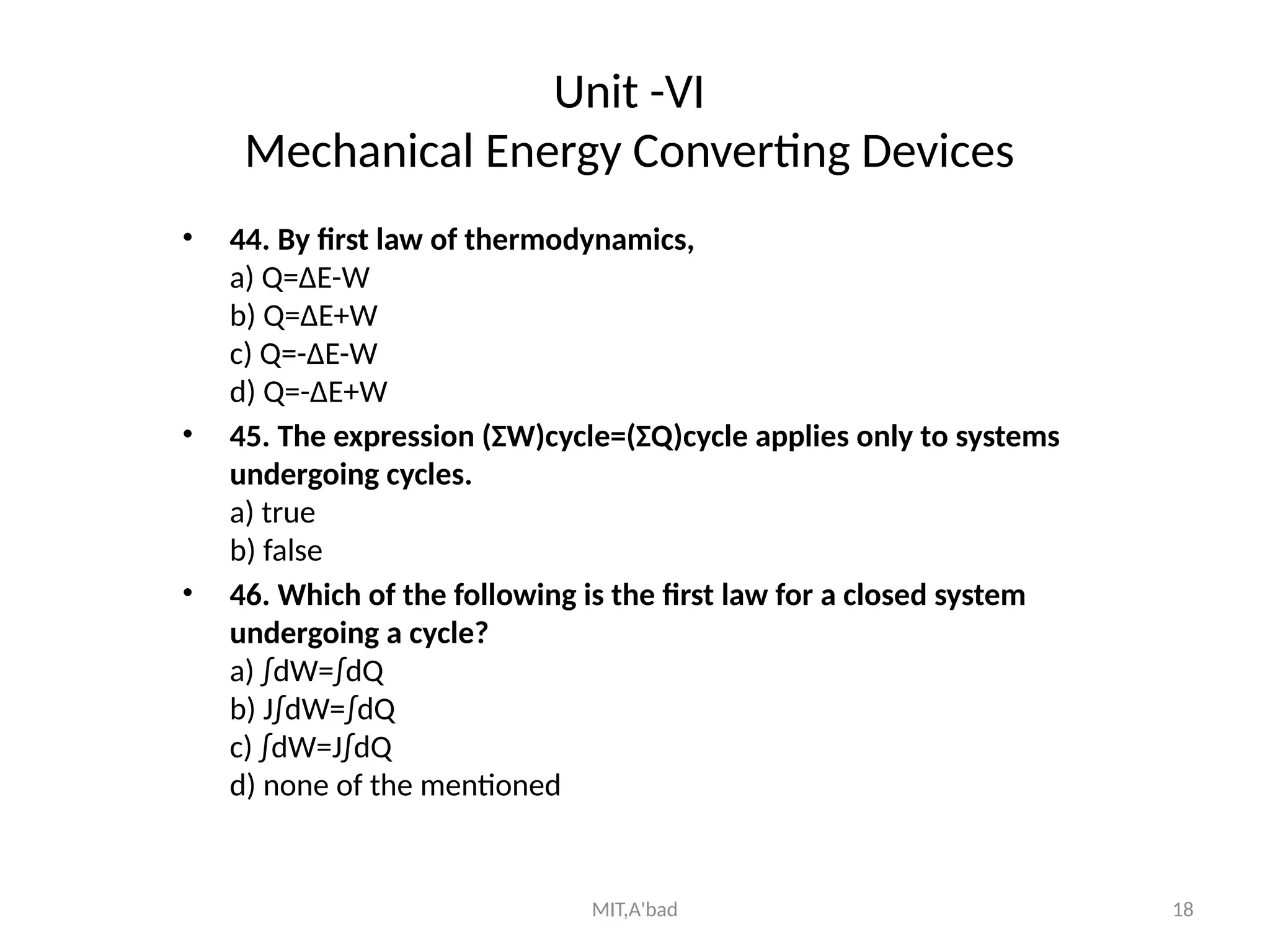
• 44. By first law of thermodynamics,
a) Q=ΔE-W
b) Q=ΔE+W
c) Q=-ΔE-W
d) Q=-ΔE+W
• 45. The expression (ΣW)cycle=(ΣQ)cycle applies only to systems
undergoing cycles.
a) true
b) false
• 46. Which of the following is the first law for a closed system
undergoing a cycle?
a) ∫dW=∫dQ
b) J∫dW=∫dQ
c) ∫dW=J∫dQ
d) none of the mentioned
MIT,A'bad 19
Unit -VI
Mechanical Energy Converting Devices
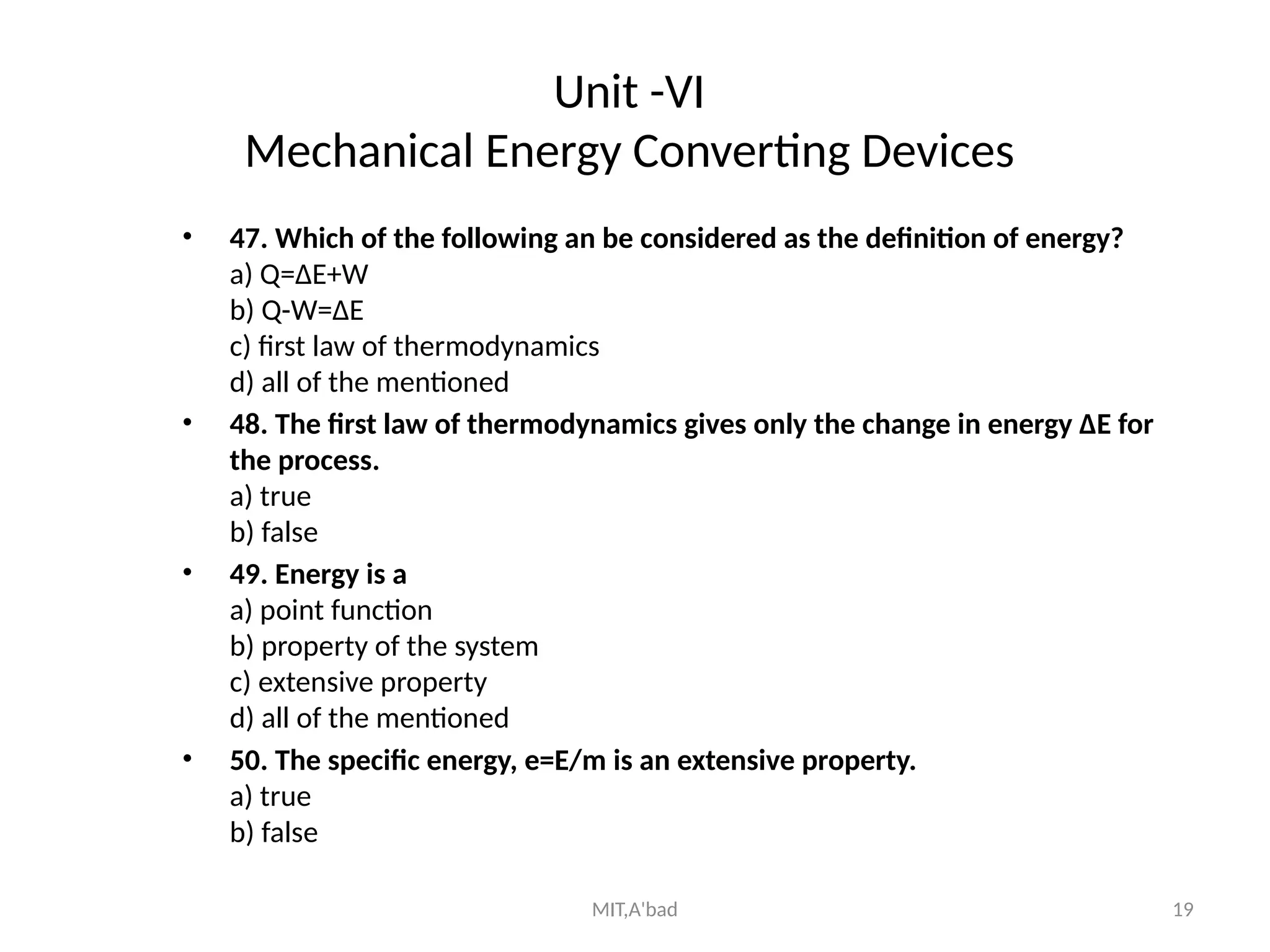
• 47. Which of the following an be considered as the definition of energy?
a) Q=ΔE+W
b) Q-W=ΔE
c) first law of thermodynamics
d) all of the mentioned
• 48. The first law of thermodynamics gives only the change in energy ΔE for
the process.
a) true
b) false
• 49. Energy is a
a) point function
b) property of the system
c) extensive property
d) all of the mentioned
• 50. The specific energy, e=E/m is an extensive property.
a) true
b) false
MIT,A'bad 20
Unit -VI
Mechanical Energy Converting Devices
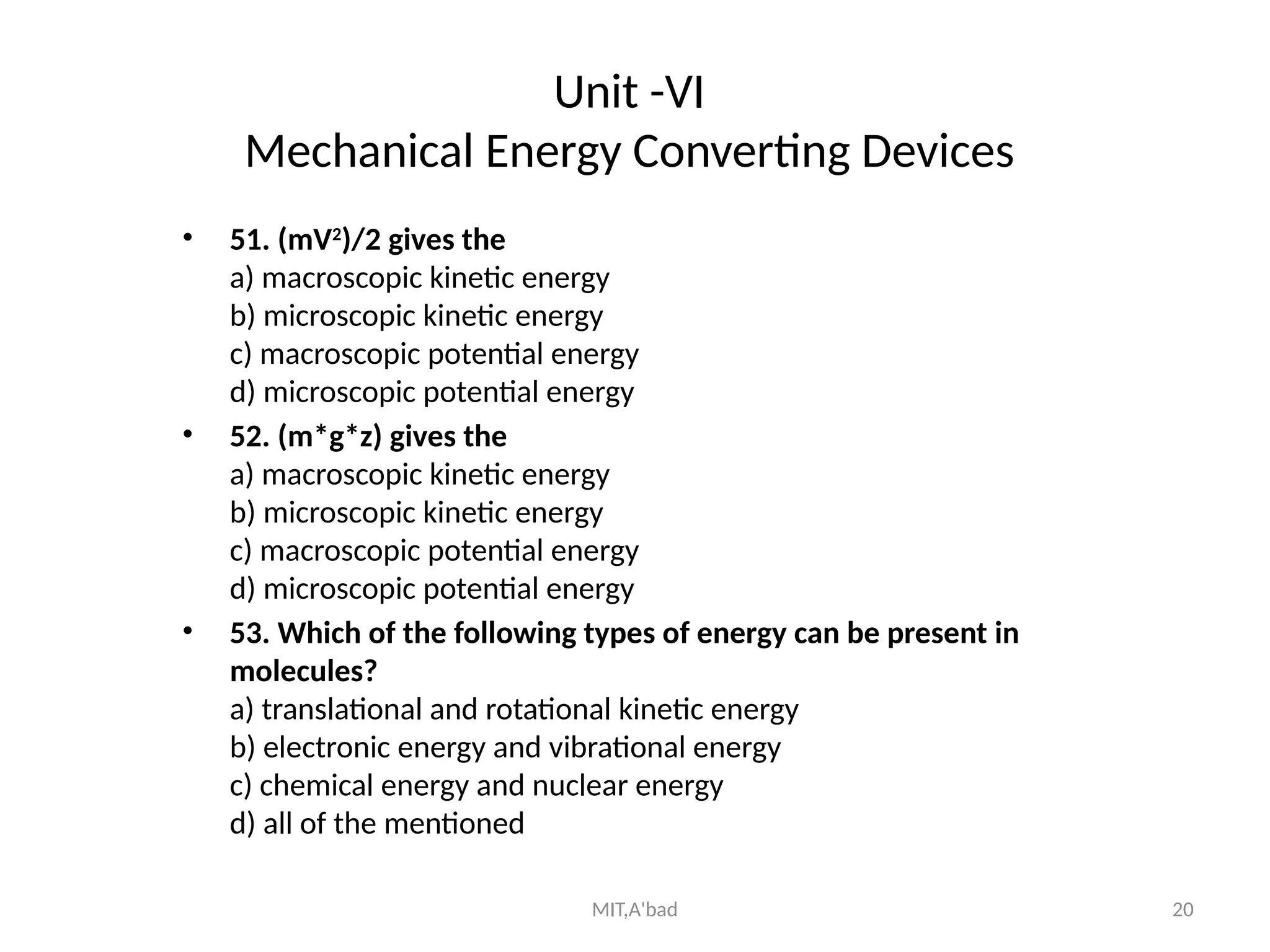
• 51. (mV2
)/2 gives the
a) macroscopic kinetic energy
b) microscopic kinetic energy
c) macroscopic potential energy
d) microscopic potential energy
• 52. (m*g*z) gives the
a) macroscopic kinetic energy
b) microscopic kinetic energy
c) macroscopic potential energy
d) microscopic potential energy
• 53. Which of the following types of energy can be present in
molecules?
a) translational and rotational kinetic energy
b) electronic energy and vibrational energy
c) chemical energy and nuclear energy
d) all of the mentioned
MIT,A'bad 21
Unit -VI
Mechanical Energy Converting Devices
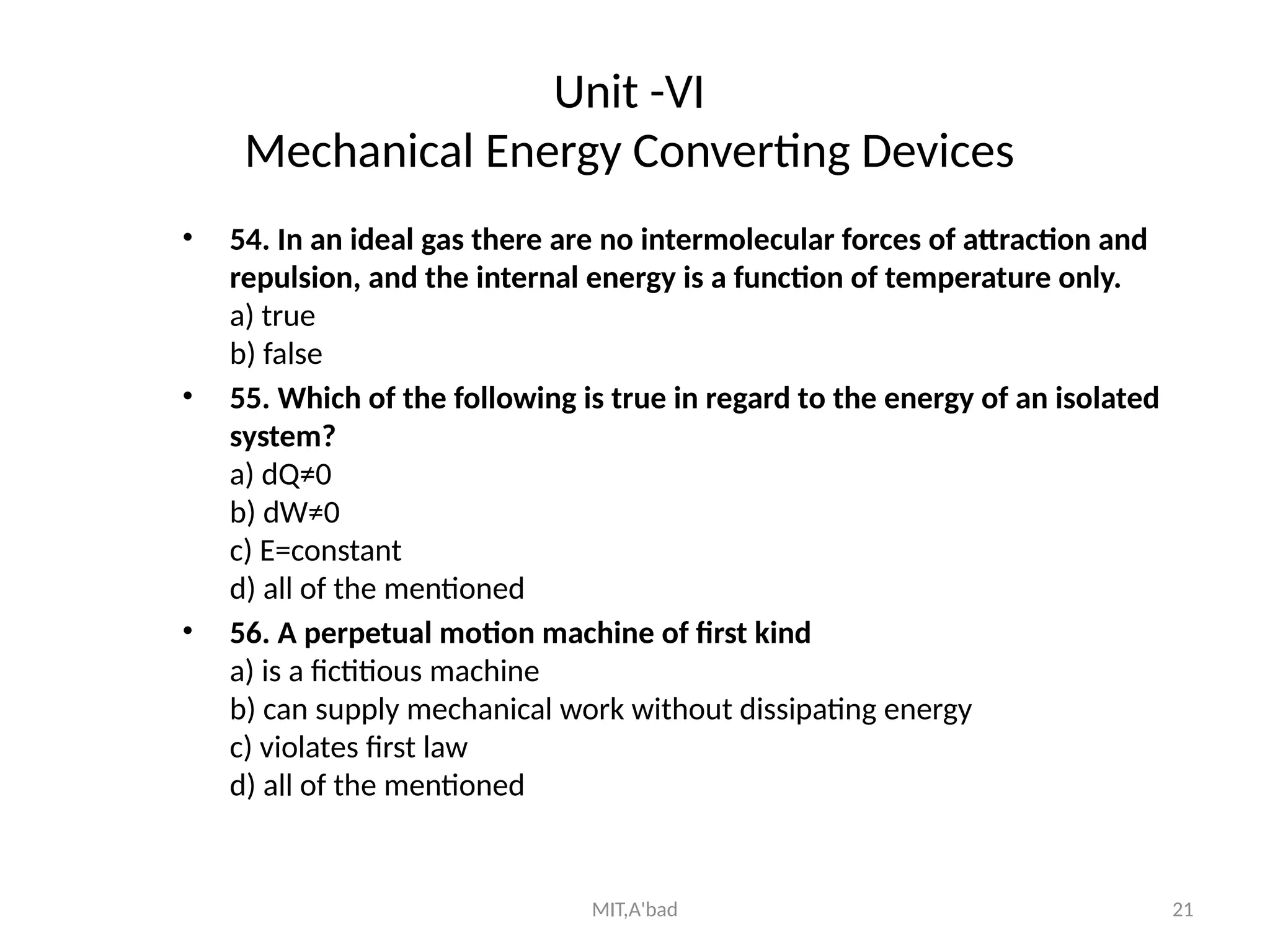
• 54. In an ideal gas there are no intermolecular forces of attraction and
repulsion, and the internal energy is a function of temperature only.
a) true
b) false
• 55. Which of the following is true in regard to the energy of an isolated
system?
a) dQ≠0
b) dW≠0
c) E=constant
d) all of the mentioned
• 56. A perpetual motion machine of first kind
a) is a fictitious machine
b) can supply mechanical work without dissipating energy
c) violates first law
d) all of the mentioned
MIT,A'bad 22
Unit -VI
Mechanical Energy Converting Devices
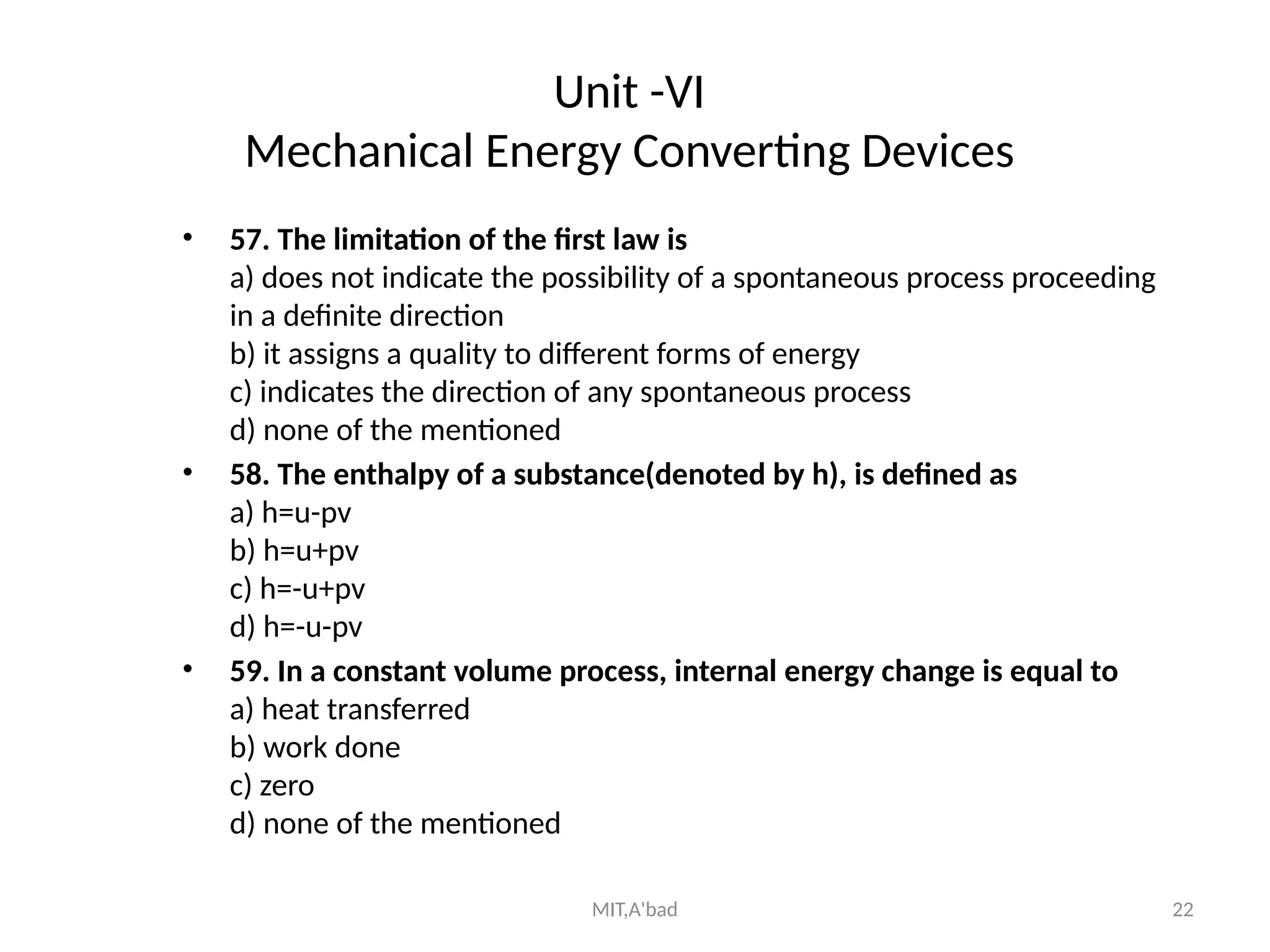
• 57. The limitation of the first law is
a) does not indicate the possibility of a spontaneous process proceeding
in a definite direction
b) it assigns a quality to different forms of energy
c) indicates the direction of any spontaneous process
d) none of the mentioned
• 58. The enthalpy of a substance(denoted by h), is defined as
a) h=u-pv
b) h=u+pv
c) h=-u+pv
d) h=-u-pv
• 59. In a constant volume process, internal energy change is equal to
a) heat transferred
b) work done
c) zero
d) none of the mentioned
MIT,A'bad 23
Unit -VI
Mechanical Energy Converting Devices
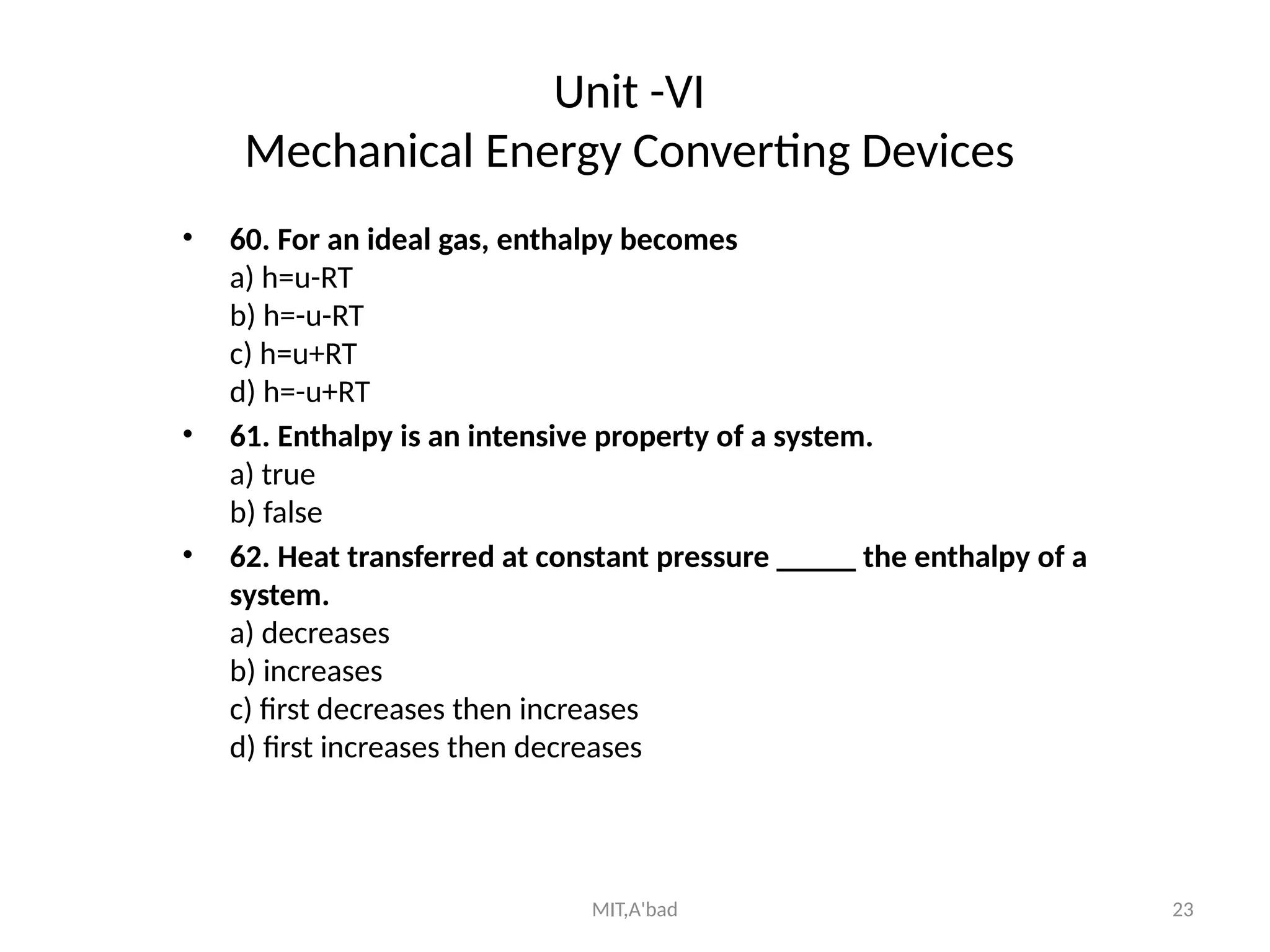
• 60. For an ideal gas, enthalpy becomes
a) h=u-RT
b) h=-u-RT
c) h=u+RT
d) h=-u+RT
• 61. Enthalpy is an intensive property of a system.
a) true
b) false
• 62. Heat transferred at constant pressure _____ the enthalpy of a
system.
a) decreases
b) increases
c) first decreases then increases
d) first increases then decreases
MIT,A'bad 24

Fundamentals of Mechanical Engineering Lecture.pptx

  • 1.
    1 Thermodynamics “Thermodynamics is afunny subject. The first time you go through it, you don’t understand it all. The second time you go through it, you think you understand it, except one or two points. The third time you go through it, you don’t understand it but by the time you are so used to the subject, it doesn’t bother you any more.” - Arnold Sommerfield
  • 2.
    MIT,A'bad 2 Fundamentals ofMechanical Engineering Content:- Unit I- Basic Concepts of Mechanical Engineering Unit- II – Laws of Thermodynamics Unit- III – Ideal and Real Gases Unit – IV- Properties of Steam Unit-V – Fuels and Combustion Unit –VI- Mechanical energy converting Devices Unit – VII – Sources of Energy
  • 3.
    MIT,A'bad 3 Unit -I BasicConcepts of Mechanical Engineering • 1. When a body A is in thermal equilibrium with a body B, and also separately with a body C, then B and C will be in thermal equilibrium with each other. a) True b) False • • 2. Which of the following were used as fixed points before 1954? a) The ice point b) The steam point c) All of the mentioned d) None of the mentioned •
  • 4.
    MIT,A'bad 4 Unit -I BasicConcepts of Mechanical Engineering • 3. What is the standard fixed point of thermometry? a) The ice point b) The steam point c) The triple point of water d) None of the mentioned 4. All gases and vapours approach ideal gas behaviour at? a) High pressure and high density b) Low pressure and low density c) High pressure and low density d) Low pressure and high density • 5. Celsius temperature of the triple point of water is ( in degree Celsius)? a) -0.00 b) 0.00 c) 0.01 d) None of the mentioned •
  • 5.
    MIT,A'bad 5 Unit -I BasicConcepts of Mechanical Engineering • 7. Which of the following is chosen as the standard thermometric substance? a) Gas b) Liquid c) Solid d) All of the mentioned • 8. A real gas behaves as an ideal gas when? a) Temperature approaches zero b) Pressure approaches zero c) Both temperature and pressure approaches zero d) None of the mentioned •
  • 6.
    MIT,A'bad 6 Unit -I BasicConcepts of Mechanical Engineering • 9. The magnitude of mechanical work is the a) product of the force and distance travelled perpendicular to the force b) product of the force and distance travelled parallel to the force c) sum of the force and distance travelled perpendicular to the force d) sum of the force and distance travelled parallel to the force • 10. Work done by a system is taken to be a) positive b) negative c) zero d) varies according to situation
  • 7.
    MIT,A'bad 7 Unit -I BasicConcepts of Mechanical Engineering • 11. Work done on a system is taken to be a) positive b) negative c) zero d) varies according to situation • 12. Work is a a) point function b) path function c) depends on the state d) none of the mentioned • 13. Thermodynamic properties are a) point function b) path function c) depends on the state d) none of the mentioned
  • 8.
    MIT,A'bad 8 Unit -I BasicConcepts of Mechanical Engineering • 14. The differentials of point functions are a) perfect differentials b) exact differentials c) all of the mentioned d) none of the mentioned • 15. Cyclic integral of a property is always a) zero b) one c) infinite value d) none of the mentioned • 16. Constant pressure process is also known as a) isopiestic process b) isobaric process c) all of the mentioned d) none of the mentioned
  • 9.
    MIT,A'bad 9 Unit -I BasicConcepts of Mechanical Engineering • 17. Work done in a quasi-static process a) depends on the path followed b) independent of the path followed c) depends only on the initial and final states d) none of the mentioned • 18. Macroscopic properties p and V are significant only for a) equilibrium states b) non-equilibrium states c) depends on the state d) none of the mentioned • 19. In a cylinder, infinitesimal amount of work done by the gas on piston is given by a) F*dl b) p*a*dl c) p*dV d) all of the mentioned
  • 10.
    MIT,A'bad 10 Unit -III Idealand Real Gases • 20. For a constant pressure process, work done is a) zero b) p*(V2-V1) c) p1*V1*ln(V2/V1) d) none of the mentioned • 21. For a constant volume process, work done is a) zero b) p*(V2-V1) c) p1*V1*ln(V2/V1) d) none of the mentioned • 22. For a process in which pV=C, work done is a) zero b) p*(V2-V1) c) p1*V1*ln(V2/V1) d) none of the mentioned
  • 11.
    MIT,A'bad 11 Unit -VI MechanicalEnergy Converting Devices • 23. The area of the indicator diagram represents the magnitude of the a) net heat transfer by the system b) net work done on the system c) net work done by the system d) none of the mentioned • 24. For a two-stroke engine, work done in one minute is given by a) PmALN b) PmALN/2 c) 2PmALN d) none of the mentioned • 25. The power available at crankshaft is always _____ indicated power. a) more b) less c) equal d) none of the mentioned
  • 12.
    MIT,A'bad 12 Unit -VI MechanicalEnergy Converting Devices • 26. Mechanical efficiency of engine is given by a) IP/BP b) 1/(BP*IP) c) (BP*IP) d) BP/IP • 27. An engine is said to be double-acting, if the working fluid is made to work on both sides of the piston. a) true b) false • 28. Shaft uses which kind of motion to do work? a) vertical motion b) horizontal motion c) rotational motion d) none of the mentioned
  • 13.
    MIT,A'bad 13 Unit -VI MechanicalEnergy Converting Devices • 29.The flow work is significant only in a) flow process b) open system c) both of the mentioned c) none of the mentioned • 30. The transfer of heat between two bodies in direct contact is called a) radiation b) convection c) conduction d) none of the mentioned • 31. Heat flow into a system is taken to be ____, and heat flow out of the system is taken as ____ a) positive, positive b) negative, negative c) negative, positive d) positive, negative
  • 14.
    MIT,A'bad 14 Unit -VI MechanicalEnergy Converting Devices • 32. The transfer of heat between a wall and a fluid system in motion is called a) radiation b) convection c) conduction d) none of the mentioned • 33. For solids and liquids, specific heat a) depends on the process b) is independent of the process c) may or may not depend on the process d) none of the mentioned • 34. The specific heat of the substance is defined as the amount of heat required to raise a unit mass of the substance through a unit rise in temperature. a) true b) false
  • 15.
    MIT,A'bad 15 Unit -VI MechanicalEnergy Converting Devices • 35. Heat and work are a) path functions b) inexact differentials c) depend upon the path followed d) all of the mentioned • 36. Latent heat is taken at a) constant temperature b) constant pressure c) both of the mentioned d) none of the mentioned • 37. Which of the following is true? a) latent heat of fusion is not much affected by pressure b) latent heat of vaporization is highly sensitive to pressure c) both of the mentioned d) none of the mentioned
  • 16.
    MIT,A'bad 16 Unit -VI MechanicalEnergy Converting Devices • 38. Heat transfer and work transfer are a) boundary phenomena b) energy interactions c) energy in the transit d) all of the mentioned • 39. Energy has different forms which include a) heat b) work c) all of the mentioned d) none of the mentioned • 40. Work input is directly proportional to heat and the constant of proportionality is called a) joule’s equivalent b) mechanical equivalent of heat c) all of the mentioned d) none of the mentioned
  • 17.
    MIT,A'bad 17 Unit -VI MechanicalEnergy Converting Devices • 41. The value of constant of proportionality, J, has the value a) 1 b) 0 c) -1 d) infinity • 42. It was Joule who first established that heat is a form of energy, and thus laid the foundation of the first law of thermodynamics. a) true b) false • 43. Which of the following represents the energy in storage? a) heat b) work c) internal energy d) none of the mentioned
  • 18.
    MIT,A'bad 18 Unit -VI MechanicalEnergy Converting Devices • 44. By first law of thermodynamics, a) Q=ΔE-W b) Q=ΔE+W c) Q=-ΔE-W d) Q=-ΔE+W • 45. The expression (ΣW)cycle=(ΣQ)cycle applies only to systems undergoing cycles. a) true b) false • 46. Which of the following is the first law for a closed system undergoing a cycle? a) ∫dW=∫dQ b) J∫dW=∫dQ c) ∫dW=J∫dQ d) none of the mentioned
  • 19.
    MIT,A'bad 19 Unit -VI MechanicalEnergy Converting Devices • 47. Which of the following an be considered as the definition of energy? a) Q=ΔE+W b) Q-W=ΔE c) first law of thermodynamics d) all of the mentioned • 48. The first law of thermodynamics gives only the change in energy ΔE for the process. a) true b) false • 49. Energy is a a) point function b) property of the system c) extensive property d) all of the mentioned • 50. The specific energy, e=E/m is an extensive property. a) true b) false
  • 20.
    MIT,A'bad 20 Unit -VI MechanicalEnergy Converting Devices • 51. (mV2 )/2 gives the a) macroscopic kinetic energy b) microscopic kinetic energy c) macroscopic potential energy d) microscopic potential energy • 52. (m*g*z) gives the a) macroscopic kinetic energy b) microscopic kinetic energy c) macroscopic potential energy d) microscopic potential energy • 53. Which of the following types of energy can be present in molecules? a) translational and rotational kinetic energy b) electronic energy and vibrational energy c) chemical energy and nuclear energy d) all of the mentioned
  • 21.
    MIT,A'bad 21 Unit -VI MechanicalEnergy Converting Devices • 54. In an ideal gas there are no intermolecular forces of attraction and repulsion, and the internal energy is a function of temperature only. a) true b) false • 55. Which of the following is true in regard to the energy of an isolated system? a) dQ≠0 b) dW≠0 c) E=constant d) all of the mentioned • 56. A perpetual motion machine of first kind a) is a fictitious machine b) can supply mechanical work without dissipating energy c) violates first law d) all of the mentioned
  • 22.
    MIT,A'bad 22 Unit -VI MechanicalEnergy Converting Devices • 57. The limitation of the first law is a) does not indicate the possibility of a spontaneous process proceeding in a definite direction b) it assigns a quality to different forms of energy c) indicates the direction of any spontaneous process d) none of the mentioned • 58. The enthalpy of a substance(denoted by h), is defined as a) h=u-pv b) h=u+pv c) h=-u+pv d) h=-u-pv • 59. In a constant volume process, internal energy change is equal to a) heat transferred b) work done c) zero d) none of the mentioned
  • 23.
    MIT,A'bad 23 Unit -VI MechanicalEnergy Converting Devices • 60. For an ideal gas, enthalpy becomes a) h=u-RT b) h=-u-RT c) h=u+RT d) h=-u+RT • 61. Enthalpy is an intensive property of a system. a) true b) false • 62. Heat transferred at constant pressure _____ the enthalpy of a system. a) decreases b) increases c) first decreases then increases d) first increases then decreases
  • 24.