THERMAL REMOTE
SENSING
Presented By:DANISH KHAN
Enrollment no:GI4947
Faculty roll no:2017 RSM 05
INDEX
• INTRODUCTION
• WHAT IS THERMAL REMOTE SENSING
• INFRARED WAVES AND IT’S WAVELENGTH
• FUNDAMENTAL RADIATION LAWS
• EMISSIVITY
• APPLICATION OF THERMAL REMOTE SENSING
INTRODUCTION
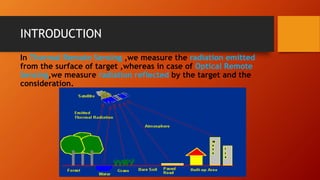
In Thermal Remote Sensing ,we measure the radiation emitted
from the surface of target ,whereas in case of Optical Remote
Sensing,we measure radiation reflected by the target and the
consideration.
What is Thermal Remote Sensing ?
• THERMAL REMOTE sensing is the branch of remote sensing that
deals with the acquisition,processing and interpretation of data
acquired primarily in the thermal region of Electromagnetic
Spectrum.
• It is based on the Infrared portion of spectrum more specifically
the Mid wave Infrared and Long wave Infrared portion.
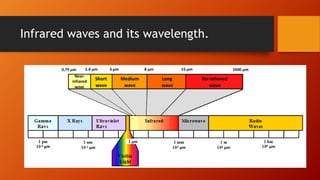
Infrared waves and its wavelength.
Most of the Thermal remote sensing is performed in the 8 to 14
micro meter range of spectrum because not only it ignores an
atmospheric windows but also it contains the peak energy
emission for most of the earth surface features.
Fundamental Radiation Laws obeyed in
Thermal Remote Sensing.
• Plank’s radiation law(Blackbody law),
• Wein’s displacement law and ,
• Stefan’s-Boltzman law.
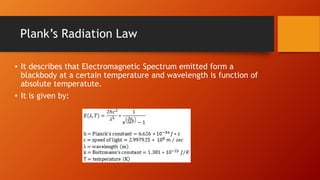
Plank’s Radiation Law
• It describes that Electromagnetic Spectrum emitted form a
blackbody at a certain temperature and wavelength is function of
absolute temperatute.
• It is given by:
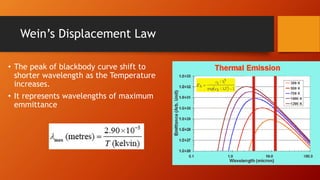
Wein’s Displacement Law
• The peak of blackbody curve shift to
shorter wavelength as the Temperature
increases.
• It represents wavelengths of maximum
emmittance
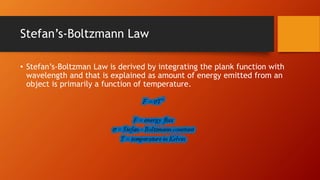
Stefan’s-Boltzmann Law
• Stefan’s-Boltzman Law is derived by integrating the plank function with
wavelength and that is explained as amount of energy emitted from an
object is primarily a function of temperature.
Emissivity
Emissivity of the material is the relative ability of the surface to emit heat
by radiation.
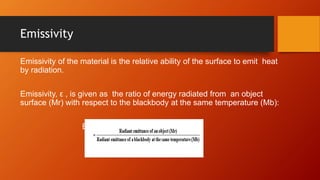
Emissivity, ε , is given as the ratio of energy radiated from an object
surface (Mr) with respect to the blackbody at the same temperature (Mb):
E
Factors affecting Emissivity
• COLOR --darker colored objects are usually better absorbers and
emitters (i.e. they have a higher emissivity) than lighter colored
objects which tend to reflect more of the incident energy.
• SURFACE ROUGHNESS --the greater the surface roughness of an
object relative to the size of the incident wavelength, the greater the
surface area of the object and potential for absorption and re-
emission of energy.
• MOISTURE CONTENT --the more moisture an object contains, the
greater its ability to absorb energy and become a good emitter.
• WAVELENGTH --the emissivity of an object is generally considered
to be wavelength dependent. For example, while the emissivity of
an object is often considered to be constant throughout the 8 -14
mm region, its emissivity in the 3 -5 mm region may be different.
APPLICATION OF THERMAL REMOTE SENSING
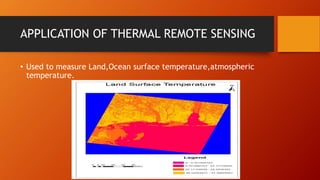
• Used to measure Land,Ocean surface temperature,atmospheric
temperature.
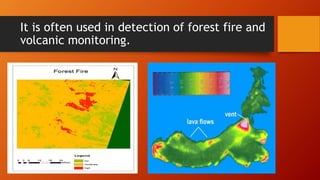
It is often used in detection of forest fire and
volcanic monitoring.
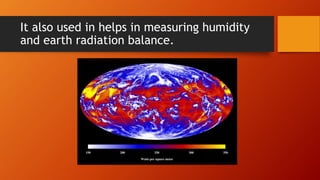
It also used in helps in measuring humidity
and earth radiation balance.
THANK YOU

Thermal remote sensing

  • 1.
    THERMAL REMOTE SENSING Presented By:DANISHKHAN Enrollment no:GI4947 Faculty roll no:2017 RSM 05
  • 2.
    INDEX • INTRODUCTION • WHATIS THERMAL REMOTE SENSING • INFRARED WAVES AND IT’S WAVELENGTH • FUNDAMENTAL RADIATION LAWS • EMISSIVITY • APPLICATION OF THERMAL REMOTE SENSING
  • 3.
    INTRODUCTION In Thermal RemoteSensing ,we measure the radiation emitted from the surface of target ,whereas in case of Optical Remote Sensing,we measure radiation reflected by the target and the consideration.
  • 4.
    What is ThermalRemote Sensing ? • THERMAL REMOTE sensing is the branch of remote sensing that deals with the acquisition,processing and interpretation of data acquired primarily in the thermal region of Electromagnetic Spectrum. • It is based on the Infrared portion of spectrum more specifically the Mid wave Infrared and Long wave Infrared portion.
  • 5.
    Infrared waves andits wavelength.
  • 6.
    Most of theThermal remote sensing is performed in the 8 to 14 micro meter range of spectrum because not only it ignores an atmospheric windows but also it contains the peak energy emission for most of the earth surface features.
  • 7.
    Fundamental Radiation Lawsobeyed in Thermal Remote Sensing. • Plank’s radiation law(Blackbody law), • Wein’s displacement law and , • Stefan’s-Boltzman law.
  • 8.
    Plank’s Radiation Law •It describes that Electromagnetic Spectrum emitted form a blackbody at a certain temperature and wavelength is function of absolute temperatute. • It is given by:
  • 9.
    Wein’s Displacement Law •The peak of blackbody curve shift to shorter wavelength as the Temperature increases. • It represents wavelengths of maximum emmittance
  • 10.
    Stefan’s-Boltzmann Law • Stefan’s-BoltzmanLaw is derived by integrating the plank function with wavelength and that is explained as amount of energy emitted from an object is primarily a function of temperature.
  • 11.
    Emissivity Emissivity of thematerial is the relative ability of the surface to emit heat by radiation. Emissivity, ε , is given as the ratio of energy radiated from an object surface (Mr) with respect to the blackbody at the same temperature (Mb): E
  • 12.
    Factors affecting Emissivity •COLOR --darker colored objects are usually better absorbers and emitters (i.e. they have a higher emissivity) than lighter colored objects which tend to reflect more of the incident energy. • SURFACE ROUGHNESS --the greater the surface roughness of an object relative to the size of the incident wavelength, the greater the surface area of the object and potential for absorption and re- emission of energy. • MOISTURE CONTENT --the more moisture an object contains, the greater its ability to absorb energy and become a good emitter.
  • 13.
    • WAVELENGTH --theemissivity of an object is generally considered to be wavelength dependent. For example, while the emissivity of an object is often considered to be constant throughout the 8 -14 mm region, its emissivity in the 3 -5 mm region may be different.
  • 14.
    APPLICATION OF THERMALREMOTE SENSING • Used to measure Land,Ocean surface temperature,atmospheric temperature.
  • 15.
    It is oftenused in detection of forest fire and volcanic monitoring.
  • 16.
    It also usedin helps in measuring humidity and earth radiation balance.
  • 17.