Physics of Functional Materials and Devices
Prof. Amreesh Chandra
Department of Physics, IIT KHARAGPUR
Module 05: Thermal properties of solids
Lecture 22: Thermal Properties of Solids
NPTEL
 Introduction
 Different Thermal Properties of Solids
 Thermal Expansion
 Thermal Stress
 Thermal Conductivity NPTEL
 In the Universe, all of us are surrounded by matter. Matter is different from each other
according to some of their intrinsic properties.
Different intrinsic properties of matter, are:
 Mechanical properties
 Chemical properties
 Physical properties
 Dimensional properties
 Thermal properties
NPTEL
What are the thermal properties of matter?
It is one of the main properties of matter, which deals with the heat conductivity and thermal
capacity of matter. It deals with heat fluctuation.
4 major components of thermal properties of matter:
 Heat Capacity
 Thermal Expansion
 Thermal stress
 Thermal conductivity
NPTEL
Heat capacity and specific heat of matter
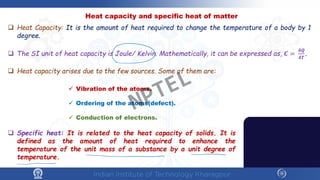
 Heat Capacity: It is the amount of heat required to change the temperature of a body by 1
degree.
 The SI unit of heat capacity is Joule/ Kelvin. Mathematically, it can be expressed as, 𝑪𝑪 =
𝜹𝜹𝜹𝜹
𝜹𝜹𝜹𝜹
.
 Heat capacity arises due to the few sources. Some of them are:
 Vibration of the atoms.
 Ordering of the atoms(defect).
 Conduction of electrons.
 Specific heat: It is related to the heat capacity of solids. It is
defined as the amount of heat required to enhance the
temperature of the unit mass of a substance by a unit degree of
temperature.
NPTEL
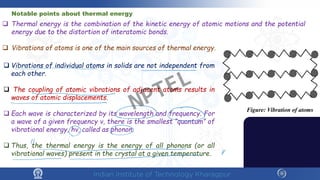
 Thermal energy is the combination of the kinetic energy of atomic motions and the potential
energy due to the distortion of interatomic bonds.
 Vibrations of atoms is one of the main sources of thermal energy.
Notable points about thermal energy
 Vibrations of individual atoms in solids are not independent from
each other.
 The coupling of atomic vibrations of adjacent atoms results in
waves of atomic displacements.
 Each wave is characterized by its wavelength and frequency. For
a wave of a given frequency ν, there is the smallest “quantum” of
vibrational energy, hν, called as phonon.
 Thus, the thermal energy is the energy of all phonons (or all
vibrational waves) present in the crystal at a given temperature.
Figure: Vibration of atoms
NPTEL
Temperature dependence of specific heat
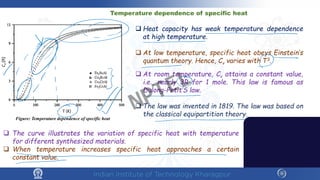
Figure: Temperature dependence of specific heat
 Heat capacity has weak temperature dependence
at high temperature.
 At low temperature, specific heat obeys Einstein’s
quantum theory. Hence, Cv varies with T3.
 At room temperature, Cv attains a constant value,
i.e., nearly 3R for 1 mole. This law is famous as
Dulong-Petit’S law.
 The law was invented in 1819. The law was based on
the classical equipartition theory.
 The curve illustrates the variation of specific heat with temperature
for different synthesized materials.
 When temperature increases specific heat approaches a certain
constant value.
NPTEL
Thermal Expansion of Matter
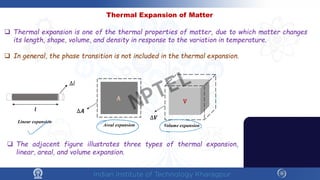
 Thermal expansion is one of the thermal properties of matter, due to which matter changes
its length, shape, volume, and density in response to the variation in temperature.
 In general, the phase transition is not included in the thermal expansion.
𝒍𝒍
∆𝑙𝑙
Linear expansion
A
∆𝑨𝑨
Areal expansion
V
∆𝑽𝑽
Volume expansion
 The adjacent figure illustrates three types of thermal expansion,
linear, areal, and volume expansion.
NPTEL
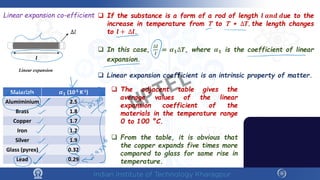
Linear expansion co-efficient
𝒍𝒍
∆𝑙𝑙
Linear expansion
 If the substance is a form of a rod of length 𝒍𝒍 𝒂𝒂𝒂𝒂𝒂𝒂 𝒅𝒅ue to the
increase in temperature from T to T + ∆𝑻𝑻, the length changes
to 𝒍𝒍 + ∆𝒍𝒍.
 In this case,
∆𝒍𝒍
𝒍𝒍
= 𝜶𝜶𝟏𝟏∆𝑻𝑻, where 𝜶𝜶𝟏𝟏 is the coefficient of linear
expansion.
 Linear expansion coefficient is an intrinsic property of matter.
Materials 𝜶𝜶𝟏𝟏 (10-5 K-1)
Alumiminium 2.5
Brass 1.8
Copper 1.7
Iron 1.2
Silver 1.9
Glass (pyrex) 0.32
Lead 0.29
 The adjacent table gives the
average values of the linear
expansion coefficient of the
materials in the temperature range
0 to 100 °C.
 From the table, it is obvious that
the copper expands five times more
compared to glass for same rise in
temperature.
NPTEL
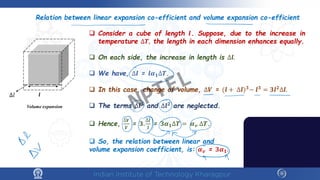
Relation between linear expansion co-efficient and volume expansion co-efficient
 Consider a cube of length 𝒍𝒍. Suppose, due to the increase in
temperature ∆𝑻𝑻, the length in each dimension enhances equally.
 On each side, the increase in length is ∆𝒍𝒍.
 We have, ∆𝒍𝒍 = 𝒍𝒍𝜶𝜶𝟏𝟏∆𝑻𝑻.
 In this case, change of volume, ∆𝑽𝑽 = (𝒍𝒍 + ∆𝒍𝒍)𝟑𝟑
− 𝒍𝒍𝟑𝟑
= 𝟑𝟑𝒍𝒍𝟐𝟐
∆𝒍𝒍.
 The terms ∆𝒍𝒍𝟑𝟑 and ∆𝒍𝒍𝟐𝟐 are neglected.
 Hence,
∆𝑽𝑽
𝑽𝑽
= 𝟑𝟑.
∆𝒍𝒍
𝒍𝒍
= 𝟑𝟑𝜶𝜶𝟏𝟏∆𝑻𝑻 = 𝜶𝜶𝒗𝒗 ∆𝑻𝑻.
 So, the relation between linear and
volume expansion coefficient, is: 𝜶𝜶𝒗𝒗 = 𝟑𝟑𝜶𝜶𝟏𝟏.
∆𝑙𝑙 𝒍𝒍
Volume expansion NPTEL
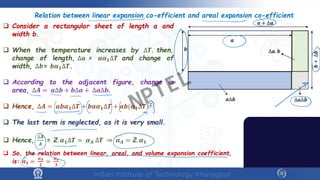
 Consider a rectangular sheet of length a and
width b.
 When the temperature increases by ∆𝑻𝑻, then,
change of length, ∆𝒂𝒂 = 𝒂𝒂𝜶𝜶𝟏𝟏∆𝑻𝑻 and change of
width, ∆𝒃𝒃= 𝒃𝒃𝜶𝜶𝟏𝟏∆𝑻𝑻.
 According to the adjacent figure, change in
area, ∆𝑨𝑨 = 𝒂𝒂∆𝒃𝒃 + 𝒃𝒃∆𝒂𝒂 + ∆𝒂𝒂∆𝒃𝒃.
 Hence, ∆𝑨𝑨 = 𝒂𝒂𝒃𝒃𝜶𝜶𝟏𝟏∆𝑻𝑻 + 𝒃𝒃𝒂𝒂𝜶𝜶𝟏𝟏∆𝑻𝑻 + 𝒂𝒂𝒃𝒃(𝜶𝜶𝟏𝟏∆𝑻𝑻)𝟐𝟐.
 The last term is neglected, as it is very small.
 Hence,
∆𝑨𝑨
𝑨𝑨
= 2. 𝜶𝜶𝟏𝟏∆𝑻𝑻 = 𝜶𝜶𝑨𝑨 ∆𝑻𝑻 ⇒ 𝜶𝜶𝑨𝑨 = 2. 𝜶𝜶𝟏𝟏
Relation between linear expansion co-efficient and areal expansion co-efficient
𝒂𝒂 + ∆𝒂𝒂
𝒃𝒃
𝒂𝒂
𝒃𝒃
+
∆𝒃𝒃
𝒂𝒂∆𝒃𝒃 ∆𝒂𝒂∆𝒃𝒃
∆𝒂𝒂. 𝒃𝒃
 So, the relation between linear, areal, and volume expansion coefficient,
is: 𝜶𝜶𝟏𝟏 =
𝜶𝜶𝑨𝑨
𝟐𝟐
=
𝜶𝜶𝒗𝒗
𝟑𝟑
.
NPTEL
Thermal Stress
 Thermal stress is the stress caused by any variation in a material's temperature. Thermal stress is
induced in a solid material when the temperature of the material is increased or decreased but the
material is not allowed to expand or contract.
 The term thermal stress includes both heat and cold stress.
 Stress is the force acting per unit area. The force can be of any form. When the applied force is
in the form of temperature the resultant stress is called Thermal stress.
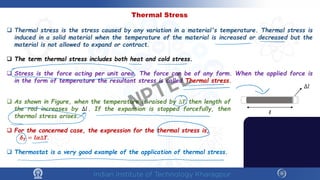
𝒍𝒍
∆𝑙𝑙
 As shown in Figure, when the temperature is raised by ∆𝑻𝑻, then length of
the rod increases by ∆𝑙𝑙. If the expansion is stopped forcefully, then
thermal stress arises.
 For the concerned case, the expression for the thermal stress is,
𝜹𝜹𝑻𝑻 = 𝒍𝒍𝜶𝜶∆𝑻𝑻.
 Thermostat is a very good example of the application of thermal stress.
NPTEL
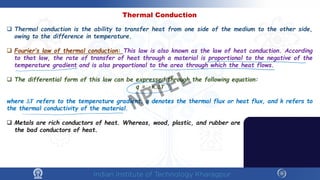
Thermal Conduction
 Thermal conduction is the ability to transfer heat from one side of the medium to the other side,
owing to the difference in temperature.
 Fourier’s law of thermal conduction: This law is also known as the law of heat conduction. According
to that law, the rate of transfer of heat through a material is proportional to the negative of the
temperature gradient and is also proportional to the area through which the heat flows.
 The differential form of this law can be expressed through the following equation:
q = -κ.∆𝑻𝑻
where ∆𝑻𝑻 refers to the temperature gradient, q denotes the thermal flux or heat flux, and k refers to
the thermal conductivity of the material.
 Metals are rich conductors of heat. Whereas, wood, plastic, and rubber are
the bad conductors of heat.
NPTEL
Steady-state heat transfer
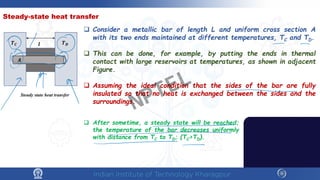
 Consider a metallic bar of length L and uniform cross section A
with its two ends maintained at different temperatures, TC and TD.
 This can be done, for example, by putting the ends in thermal
contact with large reservoirs at temperatures, as shown in adjacent
Figure.
 Assuming the ideal condition that the sides of the bar are fully
insulated so that no heat is exchanged between the sides and the
surroundings.
𝑨𝑨
𝑻𝑻𝑪𝑪 𝑻𝑻𝑫𝑫
𝒍𝒍
Steady state heat transfer
 After sometime, a steady state will be reached;
the temperature of the bar decreases uniformly
with distance from TC to TD; (TC>TD).
NPTEL
Steady-state heat transfer
𝑨𝑨
𝑻𝑻𝑪𝑪 𝑻𝑻𝑫𝑫
𝒍𝒍
Steady state heat transfer
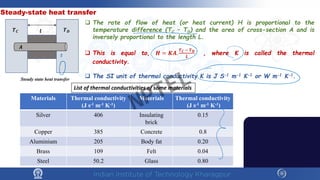
 The rate of flow of heat (or heat current) H is proportional to the
temperature difference (TC – TD) and the area of cross-section A and is
inversely proportional to the length L.
 This is equal to, 𝑯𝑯 = 𝑲𝑲𝑲𝑲.
𝑻𝑻𝑪𝑪 − 𝑻𝑻𝑫𝑫
𝑳𝑳
, where K is called the thermal
conductivity.
 The SI unit of thermal conductivity K is J S-1 m-1 K-1 or W m-1 K-1.
Materials Thermal conductivity
(J s-1 m-1 K-1)
Materials Thermal conductivity
(J s-1 m-1 K-1)
Silver 406 Insulating
brick
0.15
Copper 385 Concrete 0.8
Aluminium 205 Body fat 0.20
Brass 109 Felt 0.04
Steel 50.2 Glass 0.80
List of thermal conductivities of some materials
NPTEL
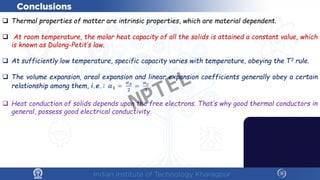
 Thermal properties of matter are intrinsic properties, which are material dependent.
 At room temperature, the molar heat capacity of all the solids is attained a constant value, which
is known as Dulong-Petit’s law.
 At sufficiently low temperature, specific capacity varies with temperature, obeying the T3 rule.
 The volume expansion, areal expansion and linear expansion coefficients generally obey a certain
relationship among them, i.e.: 𝜶𝜶𝟏𝟏 =
𝜶𝜶𝑨𝑨
𝟐𝟐
=
𝜶𝜶𝒗𝒗
𝟑𝟑
.
 Heat conduction of solids depends upon the free electrons. That’s why good thermal conductors in
general, possess good electrical conductivity.
NPTEL
• Physics of Functional Materials by Hasse Fredriksson & Ulla Akerlind.
• Thermal Properties of Matter by Joe Khachan.
• A Treatise on Heat by Meghnad Saha, B. N. Srivastava.
NPTEL
Thank you…
NPTEL
Physics of Functional Materials and Devices
Prof. Amreesh Chandra
Department of Physics, IIT KHARAGPUR
Module 05: Thermal properties of solids
Lecture 23: Negative and Zero Expansion Ceramics
NPTEL
Thermal expansion in ceramics
Negative and zero thermal expansion ceramics
Examples of Negative and zero thermal expansion ceramics
Applications of negative and zero thermal expansion ceramics
NPTEL
Thermal expansion
What is thermal expansion?
Thermal expansion refers to the phenomenon where a material undergoes
dimensional changes in response to changes in temperature. When a substance
is heated, its particles gain energy and become more active, causing them to
move and vibrate more rapidly. This increased molecular motion leads to an
increase in the average separation between particles (interatomic distance),
resulting in expansion or an increase in volume.
NPTEL
Thermal expansion
Expansion behavior of materials is
governed by lattice constant
What is lattice constant?
The expansion behavior of materials can be described by the coefficient of thermal expansion (CTE), which
measures how much a material's dimensions change per unit temperature change. The CTE is typically
expressed in units of length per temperature (e.g., millimeters per degree Celsius or inches per degree
Fahrenheit). NPTEL
Thermal expansion in ceramics
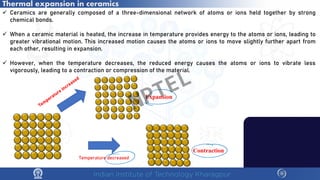
 Ceramics are generally composed of a three-dimensional network of atoms or ions held together by strong
chemical bonds.
 When a ceramic material is heated, the increase in temperature provides energy to the atoms or ions, leading to
greater vibrational motion. This increased motion causes the atoms or ions to move slightly further apart from
each other, resulting in expansion.
 However, when the temperature decreases, the reduced energy causes the atoms or ions to vibrate less
vigorously, leading to a contraction or compression of the material.
Temperature decreased
Contraction
Expansion
NPTEL
Thermal expansion in ceramics
General trends of expansion in ceramics:
 Due to stronger nature of the atomic bonds ceramics often have a lower coefficient of thermal expansion (CTE)
than metals, which means they expand or contract less for a given change in temperature.
 Ceramic materials exhibit anisotropic thermal expansion, meaning that their expansion or contraction rates can
vary depending on the direction or crystallographic orientation. This anisotropy arises from the preferential
alignment of atoms or ions along certain crystallographic planes or directions, resulting in different expansion
coefficients along different axes.
 Low coefficient of thermal expansion exhibited by some ceramics makes them desirable for certain applications
where dimensional stability is crucial such as in electronics, refractory materials, and high-precision engineering.
Why negative and zero thermal
expansion ceramics??
NPTEL
Negative thermal expansion ceramics
 Ceramics are tend to expand when heated and contract when cooled.
 But there are another class of interesting ceramics viz.,’negative thermal expansion ceramic’.
What are negative and zero expansion ceramics ?
Negative and zero expansion ceramics, also known as zero thermal expansion (ZTE) ceramics or negative thermal
expansion (NTE) ceramics, are a class of materials that exhibit minimal or even negative thermal expansion
coefficients. This means that they either minimally expand or get contract when subjected to temperature changes.
 Zero expansion ceramics have a coefficient of thermal expansion (CTE) close to zero, meaning they undergo
negligible dimensional changes when subjected to temperature variations.
 Negative expansion ceramics, on the other hand, have a negative CTE, implying that they contract or shrink in
volume as temperature increases.
Distortion or stress caused by thermal expansion CAN BE
AVOIDED USING NEGATIVE AND ZERO EXPANSION
CERAMICS
NPTEL
Let us take an example of
a functional ceramic
NPTEL
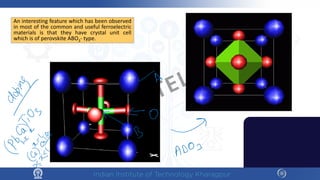
An interesting feature which has been observed
in most of the common and useful ferroelectric
materials is that they have crystal unit cell
which is of perovskite ABO3- type.
NPTEL
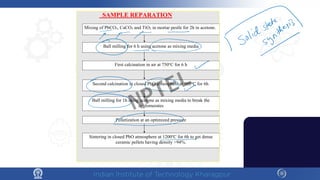
SAMPLE REPARATION
Mixing of PbCO3, CaCO3 and TiO2 in mortar pestle for 2h in acetone.
Ball milling for 6 h using acetone as mixing media
First calcination in air at 750o
C for 6 h
Second calcination in closed PbO atmosphere at 900o
C for 6h.
Ball milling for 1h using acetone as mixing media to break the
agglomerates
Pelletization at an optimized pressure
Sintering in closed PbO atmosphere at 1200o
C for 6h to get dense
ceramic pellets having density >94%.
NPTEL
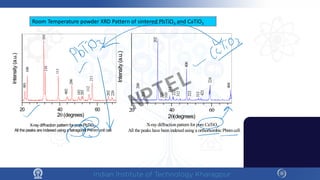
Room Temperature powder XRD Pattern of sintered PbTiO3 and CaTiO3
20 40 60
220
202
211
112
201
102
200
002
111
110
101
100
001
X-ray diffraction pattern for pure PbTiO3
.
All the peaks are indexed using a tetragonal P4mm unit cell
Intensity
(a.u.)
2θ(degrees)
20 40 60
404
223
313
421
224
400
312
222
311
310
221
202
201
200
X-raydiffraction pattern for pure CaTiO3
.
All the peaks have been indexed using a orthorhombic Pbnmcell.
Intensity
(a.u.)
2θ(degrees)
NPTEL
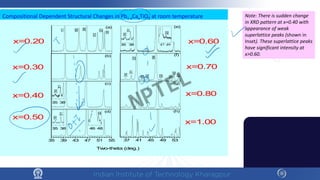
Compositional Dependent Structural Changes in Pb1-xCaxTiO3 at room temperature
46 48
35 38
35 38
47 49
35 38
120
021
012
200
002
111
(a) (e)
203
312
421
402
313
222
004
310
311
322
(f)
(b)
(c) (g)
35 39 43 47 51 55
(d)
Two-theta (deg.)
37 41 45 49 53
x=0.20
x=0.30
x=0.40
x=0.50
(h)
322
310
311
311
310
x=0.60
322
x=1.00
x=0.80
x=0.70
311
310
Note: There is sudden change
in XRD pattern at x=0.40 with
appearance of weak
superlattice peaks (shown in
Inset). These superlattice peaks
have significant intensity at
x>0.60.
NPTEL
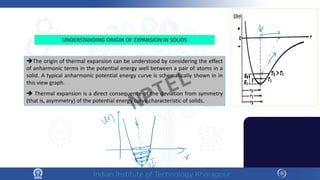
The origin of thermal expansion can be understood by considering the effect
of anharmonic terms in the potential energy well between a pair of atoms in a
solid. A typical anharmonic potential energy curve is schematically shown in in
this view graph.
 Thermal expansion is a direct consequence of the deviation from symmetry
(that is, asymmetry) of the potential energy curve characteristic of solids.
UNDERSTANDING ORIGIN OF EXPANSION IN SOLIDS
NPTEL
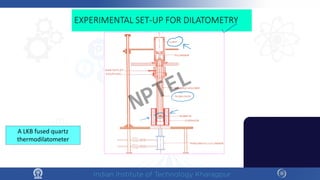
EXPERIMENTAL SET-UP FOR DILATOMETRY
A LKB fused quartz
thermodilatometer
NPTEL
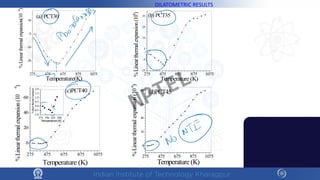
275 475 675 875 1075
0
20
40
60
80
(d)PCT45
Temperature (K)
%
Linear
thermal
expansion
(10
6
)
275 475 675 875 1075
0
20
40
60
275 350 425 500
-1.0
-0.5
0.0
0.5
1.0
1.5
2.0
(c)PCT40
%
Linear
thermal
expansion
(10
6
)
Temperature (K)
%
linear
thermal
Expansion
Temperature (K)
275 475 675 875 1075
-15
-5
5
15
25
35 (b) PCT35
%
Linear
thermal
expansion
(10
6
)
Temperature (K)
275 475 675 875 1075
-20
-10
0
10
(a) PCT30
Temperature(K)
%
Linear
thermal
expansion(10
-6
)
DILATOMETRIC RESULTS
NPTEL
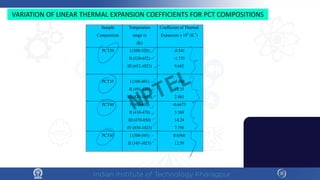
Sample
Composition
Temperature
range in
(K)
Coefficient of Thermal
Expansion x 106
(K-1
)
PCT30 I (300-520)
II (520-652)
III (652-1023)
-8.541
-1.735
9.662
PCT35 I (300-491)
II (491-820)
III (820-1023)
-5.688
12.35
2.863
PCT40 I (300-410)
II (410-470)
III (470-850)
IV (850-1023)
-0.6673
3.569
14.24
7.756
PCT45 I (300-345)
II (345-1023)
0.6568
12.59
VARIATION OF LINEAR THERMAL EXPANSION COEFFICIENTS FOR PCT COMPOSITIONS
NPTEL
275 475 675 875 1075
0
1000
2000
3000
4000
0
1000
2000
3000
275 475 675 875 1075
-20
-10
0
10 (a)
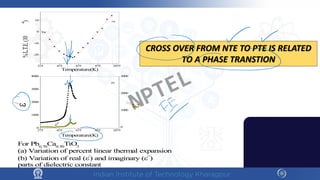
For Pb0.70
Ca0.30
TiO3
(a) Variation of percent linear thermal expansion
(b) Variation of real (ε/
) and imaginary (ε//
)
parts of dielectric constant
Temperature(K)
%
L.T.E.
(10
-6
)
(b)
ε
/
Temperature(K)
ε/
ε//
ε
//
CROSS OVER FROM NTE TO PTE IS RELATED
TO A PHASE TRANSTION
NPTEL
Thermal expansion behaviour of
PCT using X-ray diffraction studies
NPTEL
0 200 400 600 800
3.940
3.944
3.948
3.952
3.956
0 200 400 600 800
3.86
3.91
3.96
4.01
4.06
4.11
0 50 100
3.950
3.952
3.954
3.956
3.958
For Pb0.70
Ca0.30
TiO3
.
a) Variation of the unit cell a,c parameters
b) Variation of the unit cell volume
The inset shows the sudden change in
volume expansion at around 70K
b) cell volume
cell-volume
1/3
(A)
Temperature (K)
o
o
a)
cell-parameter
(a,c)
(A)
Temperature (K)
a param
eter
c param
eter
cell
volume
(a
2
c)
1/3
(A)
Tem
perature (K)
NPTEL
Variation of Bonds Lengths and Determination of Major bond lengths, which play the dominant role in introducing NTE
behaviour in PCT
Displacement Directions in
Tetragonal cell with P4mm
space group
2.33
2.36
2.39 Ti-OI (-)
1.74
1.78
Ti-OI (+)
1.97
2.00
Ti-OII
Bond
Length
(A)
2.761
2.786
2.811 Pb-O(I)
2.487
2.512
Pb(-)
O(II)
3.17
3.21
Pb(+)
O( II )
0 100 200 300
2.003
2.007
Average Ti-O
0 100 200 300
2.831
2.839
2.847
Average Pb-O
Variation of various
bond length in PCT10
Temperature (K)
NPTEL
1) PCT ceramics with x=0.30, 0.35 and 0.40 reveal presence of negative thermal expansion behaviour above. For x=0.45, the
expansion coefficient becomes positive.
2) For x=0.30 is quite large NTE coeeficient is (–8.541 x 10⁻⁶ K-1) in the temperature range 300 to 520K.
3) NTE behaviour has also been confirmed in the XRD studies.
4) The NTE behaviour is closely related with ferroelectric phase transition
5) The NTE behaviour is present only in the tetragonal compositions of PCT
6) The expansion coefficient of PCT ceramics can be tailored from negative to positive values by varying the Ca2+ content.
NPTEL
Examples of negative and zero expansion ceramics
 Zirconium Tungstate (ZrW2O8):
 Zirconium tungstate is a well-known negative expansion ceramic with a very low
CTE (average CTE of -7.2x10⁻⁶ K−1)
 It exhibits a contraction in volume continuously as temperature increases over
the range of 0.3 to 1050 K.
 It exhibits in cubic structure so the thermal contraction is isotropic - equal in all
directions.
 Silicon Carbide (SiC):
 Certain SiC-based composites can exhibit near-zero or even negative thermal
expansion behavior with CTE of SiC typically ranges from 4-6 x 10⁻⁶ per degree
Celsius (μm/°C) in the temperature range of 25-1000°C.
 SiC's low thermal expansion helps to minimize the potential for thermal stress
and deformation in components subjected to thermal cycling or high-temperature
conditions
 Alumina-Mullite (Al2O3-SiO2):
 Alumina-mullite ceramics can be tailored to have low or even negative
expansion coefficients, making them suitable for applications where thermal
stability is crucial, such as in refractory linings or high-temperature
environments.
NPTEL
Applications of negative and zero expansion ceramics
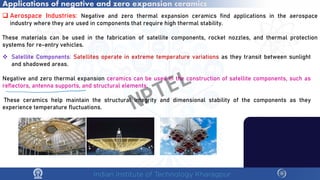
 Aerospace Industries: Negative and zero thermal expansion ceramics find applications in the aerospace
industry where they are used in components that require high thermal stability.
These materials can be used in the fabrication of satellite components, rocket nozzles, and thermal protection
systems for re-entry vehicles.
 Satellite Components: Satellites operate in extreme temperature variations as they transit between sunlight
and shadowed areas.
Negative and zero thermal expansion ceramics can be used in the construction of satellite components, such as
reflectors, antenna supports, and structural elements.
These ceramics help maintain the structural integrity and dimensional stability of the components as they
experience temperature fluctuations. NPTEL
Applications of negative and zero expansion ceramics
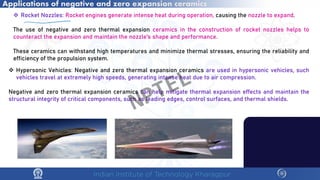
 Rocket Nozzles: Rocket engines generate intense heat during operation, causing the nozzle to expand.
The use of negative and zero thermal expansion ceramics in the construction of rocket nozzles helps to
counteract the expansion and maintain the nozzle's shape and performance.
These ceramics can withstand high temperatures and minimize thermal stresses, ensuring the reliability and
efficiency of the propulsion system.
 Hypersonic Vehicles: Negative and zero thermal expansion ceramics are used in hypersonic vehicles, such
vehicles travel at extremely high speeds, generating intense heat due to air compression.
Negative and zero thermal expansion ceramics can help mitigate thermal expansion effects and maintain the
structural integrity of critical components, such as leading edges, control surfaces, and thermal shields.
NPTEL
Applications of negative and zero expansion ceramics
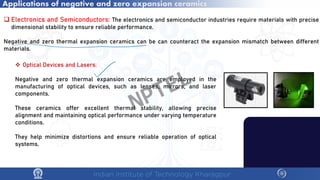
 Electronics and Semiconductors: The electronics and semiconductor industries require materials with precise
dimensional stability to ensure reliable performance.
Negative and zero thermal expansion ceramics can be can counteract the expansion mismatch between different
materials.
 Optical Devices and Lasers:
Negative and zero thermal expansion ceramics are employed in the
manufacturing of optical devices, such as lenses, mirrors, and laser
components.
These ceramics offer excellent thermal stability, allowing precise
alignment and maintaining optical performance under varying temperature
conditions.
They help minimize distortions and ensure reliable operation of optical
systems.
NPTEL
Applications of negative and zero expansion ceramics
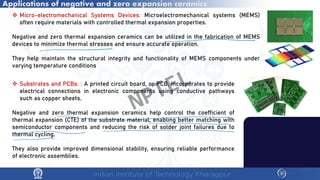
 Micro-electromechanical Systems Devices: Microelectromechanical systems (MEMS)
often require materials with controlled thermal expansion properties.
Negative and zero thermal expansion ceramics can be utilized in the fabrication of MEMS
devices to minimize thermal stresses and ensure accurate operation.
They help maintain the structural integrity and functionality of MEMS components under
varying temperature conditions
 Substrates and PCBs: : A printed circuit board, or PCB, incorporates to provide
electrical connections in electronic components using conductive pathways
such as copper sheets.
Negative and zero thermal expansion ceramics help control the coefficient of
thermal expansion (CTE) of the substrate material, enabling better matching with
semiconductor components and reducing the risk of solder joint failures due to
thermal cycling.
They also provide improved dimensional stability, ensuring reliable performance
of electronic assemblies.
NPTEL
Applications of negative and zero expansion ceramics
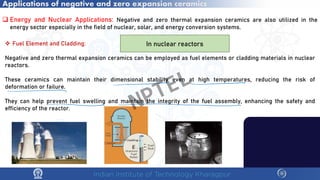
 Energy and Nuclear Applications: Negative and zero thermal expansion ceramics are also utilized in the
energy sector especially in the field of nuclear, solar, and energy conversion systems.
 Fuel Element and Cladding:
Negative and zero thermal expansion ceramics can be employed as fuel elements or cladding materials in nuclear
reactors.
These ceramics can maintain their dimensional stability even at high temperatures, reducing the risk of
deformation or failure.
They can help prevent fuel swelling and maintain the integrity of the fuel assembly, enhancing the safety and
efficiency of the reactor.
In nuclear reactors
NPTEL
Applications of negative and zero expansion ceramics
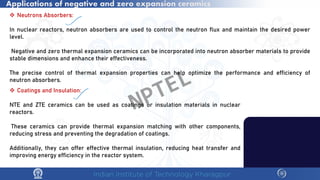
 Neutrons Absorbers:
In nuclear reactors, neutron absorbers are used to control the neutron flux and maintain the desired power
level.
Negative and zero thermal expansion ceramics can be incorporated into neutron absorber materials to provide
stable dimensions and enhance their effectiveness.
The precise control of thermal expansion properties can help optimize the performance and efficiency of
neutron absorbers.
 Coatings and Insulation:
NTE and ZTE ceramics can be used as coatings or insulation materials in nuclear
reactors.
These ceramics can provide thermal expansion matching with other components,
reducing stress and preventing the degradation of coatings.
Additionally, they can offer effective thermal insulation, reducing heat transfer and
improving energy efficiency in the reactor system.
NPTEL
Applications of negative and zero expansion ceramics
In solar cells
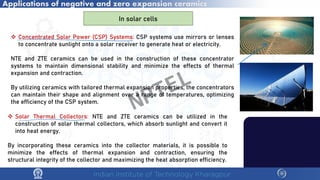
 Concentrated Solar Power (CSP) Systems: CSP systems use mirrors or lenses
to concentrate sunlight onto a solar receiver to generate heat or electricity.
NTE and ZTE ceramics can be used in the construction of these concentrator
systems to maintain dimensional stability and minimize the effects of thermal
expansion and contraction.
By utilizing ceramics with tailored thermal expansion properties, the concentrators
can maintain their shape and alignment over a range of temperatures, optimizing
the efficiency of the CSP system.
 Solar Thermal Collectors: NTE and ZTE ceramics can be utilized in the
construction of solar thermal collectors, which absorb sunlight and convert it
into heat energy.
By incorporating these ceramics into the collector materials, it is possible to
minimize the effects of thermal expansion and contraction, ensuring the
structural integrity of the collector and maximizing the heat absorption efficiency.
NPTEL
Applications of negative and zero expansion ceramics
In energy conversion systems
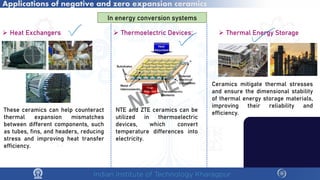
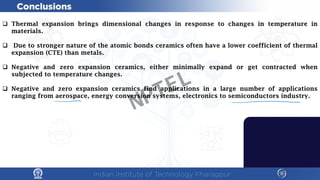
 Heat Exchangers  Thermoelectric Devices:  Thermal Energy Storage
These ceramics can help counteract
thermal expansion mismatches
between different components, such
as tubes, fins, and headers, reducing
stress and improving heat transfer
efficiency.
NTE and ZTE ceramics can be
utilized in thermoelectric
devices, which convert
temperature differences into
electricity.
Ceramics mitigate thermal stresses
and ensure the dimensional stability
of thermal energy storage materials,
improving their reliability and
efficiency.
NPTEL
 Thermal expansion brings dimensional changes in response to changes in temperature in
materials.
 Due to stronger nature of the atomic bonds ceramics often have a lower coefficient of thermal
expansion (CTE) than metals.
 Negative and zero expansion ceramics, either minimally expand or get contracted when
subjected to temperature changes.
 Negative and zero expansion ceramics find applications in a large number of applications
ranging from aerospace, energy conversion systems, electronics to semiconductors industry.
NPTEL
⮚ PhysicsofFunctional M
aterialsbyH
asseFredriksson&U
llaA
kerlind
⮚ IntroductiontoSolidStatePhysicsbyC
harlesK
ittle
⮚ A
tkins’sPhysicalC
hem
istrybyPeterA
tkins,andJuliodePaula.
⮚ ATextbookofN
anoscienceandN
anotechnology, P.I.VargheseandThalappil, M
cG
rawH
ill
E
ducation, 2017.
⮚ PhDThesis–A
m
reeshC
handra(2004), SM
ST, ITB
H
U
.
⮚ ResearchPublicationsofProf. A
m
reeshC
handra.
NPTEL
Thank you…
NPTEL
Physics of Functional Materials and Devices
Prof. Amreesh Chandra
Department of Physics, IIT KHARAGPUR
Module 05: Thermal properties of solids
Lecture 24: Heat Capacity
NPTEL
 Heat Transfer
 Specific Heat and Latent Heat
 Specific Heat at Constant Volume and Constant Pressure
 Enthalpy
 Relationship between CP and CV for an Ideal Gas
 Heat Capacity of Solid- i) Dulong–Petit law
ii) Einstein model
 Einstein model
NPTEL
Heat Transfer
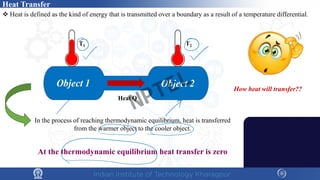
 Heat is defined as the kind of energy that is transmitted over a boundary as a result of a temperature differential.
In the process of reaching thermodynamic equilibrium, heat is transferred
from the warmer object to the cooler object.
At the thermodynamic equilibrium heat transfer is zero
How heat will transfer??
NPTEL
Process involve in heat transfer
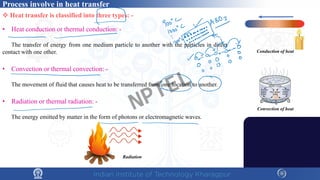
 Heat transfer is classified into three types: -
• Heat conduction or thermal conduction: -
The transfer of energy from one medium particle to another with the particles in direct
contact with one other.
• Convection or thermal convection: -
The movement of fluid that causes heat to be transferred from one location to another.
• Radiation or thermal radiation: -
The energy emitted by matter in the form of photons or electromagnetic waves.
Conduction of heat
Convection of heat
Radiation
NPTEL
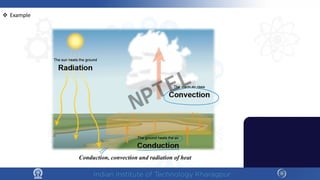
 Example
Conduction, convection and radiation of heat
NPTEL
Specific Heat and Latent Heat
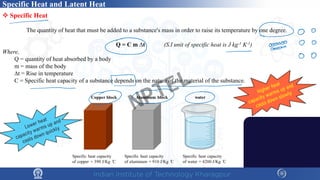
 Specific Heat
The quantity of heat that must be added to a substance's mass in order to raise its temperature by one degree.
Q = C m ∆t (S.I unit of specific heat is J kg-1 K-1)
Where,
Q = quantity of heat absorbed by a body
m = mass of the body
∆t = Rise in temperature
C = Specific heat capacity of a substance depends on the nature of the material of the substance.
NPTEL
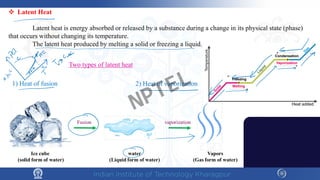
 Latent Heat
Latent heat is energy absorbed or released by a substance during a change in its physical state (phase)
that occurs without changing its temperature.
The latent heat produced by melting a solid or freezing a liquid.
2) Heat of vaporization
1) Heat of fusion
Two types of latent heat
NPTEL
Specific Heat at Constant Volume and Pressure
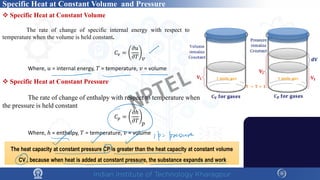
 Specific Heat at Constant Volume
The rate of change of specific internal energy with respect to
temperature when the volume is held constant.
 Specific Heat at Constant Pressure
The rate of change of enthalpy with respect to temperature when
the pressure is held constant
𝐶𝐶𝑣𝑣 =
𝜕𝜕𝜕𝜕
𝜕𝜕𝜕𝜕 𝑣𝑣
𝐶𝐶𝑝𝑝 =
𝜕𝜕ℎ
𝜕𝜕𝜕𝜕 𝑝𝑝
Where, 𝑢𝑢 = internal energy, 𝑇𝑇 = temperature, 𝑣𝑣 = volume
Where, ℎ = enthalpy, 𝑇𝑇 = temperature, 𝑣𝑣 = volume
The heat capacity at constant pressure CP is greater than the heat capacity at constant volume
CV , because when heat is added at constant pressure, the substance expands and work
NPTEL
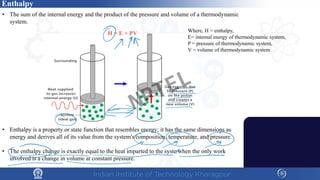
• The sum of the internal energy and the product of the pressure and volume of a thermodynamic
system.
• Enthalpy is a property or state function that resembles energy; it has the same dimensions as
energy and derives all of its value from the system's composition, temperature, and pressure.
• The enthalpy change is exactly equal to the heat imparted to the syste when the only work
involved is a change in volume at constant pressure.
Enthalpy
Where, H = enthalpy,
E= internal energy of thermodynamic system,
P = pressure of thermodynamic system,
V = volume of thermodynamic system
H = E + PV
NPTEL
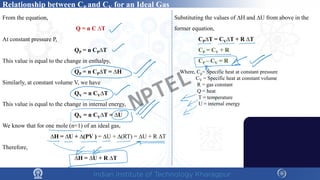
Relationship between CP and CV for an Ideal Gas
From the equation,
Q = n C ∆T
At constant pressure P,
QP = n CP∆T
This value is equal to the change in enthalpy,
QP = n CP∆T = ∆H
Similarly, at constant volume V, we have
QV = n CV∆T
This value is equal to the change in internal energy,
QV = n CV∆T = ∆U
We know that for one mole (n=1) of an ideal gas,
∆H = ∆U + ∆(PV ) = ∆U + ∆(RT) = ∆U + R ∆T
Therefore,
∆H = ∆U + R ∆T
Substituting the values of ∆H and ∆U from above in the
former equation,
CP∆T = CV∆T + R ∆T
CP = CV + R
CP – CV = R
Where, Cp= Specific heat at constant pressure
CV = Specific heat at constant volume
R = gas constant
Q = heat
T = temperature
U = internal energy
NPTEL
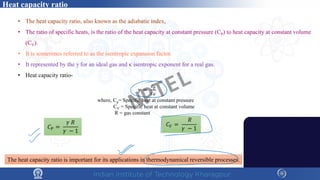
Heat capacity ratio
• The heat capacity ratio, also known as the adiabatic index,
• The ratio of specific heats, is the ratio of the heat capacity at constant pressure (CP) to heat capacity at constant volume
(CV).
• It is sometimes referred to as the isentropic expansion factor.
• It represented by the γ for an ideal gas and κ isentropic exponent for a real gas.
• Heat capacity ratio-
𝛾𝛾 =
𝐶𝐶𝑝𝑝
𝐶𝐶𝑉𝑉
The heat capacity ratio is important for its applications in thermodynamical reversible processes.
where, Cp= Specific heat at constant pressure
CV = Specific heat at constant volume
R = gas constant
𝐶𝐶𝑃𝑃 =
𝛾𝛾 𝑅𝑅
𝛾𝛾 − 1
𝐶𝐶𝑉𝑉 =
𝑅𝑅
𝛾𝛾 − 1
NPTEL
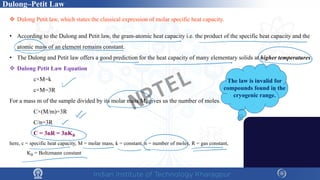
Dulong–Petit Law
 Dulong Petit law, which states the classical expression of molar specific heat capacity.
• According to the Dulong and Petit law, the gram-atomic heat capacity i.e. the product of the specific heat capacity and the
atomic mass of an element remains constant.
• The Dulong and Petit law offers a good prediction for the heat capacity of many elementary solids at higher temperatures.
 Dulong Petit Law Equation
c×M=k
c×M=3R
For a mass m of the sample divided by its molar mass M, gives us the number of moles.
C×(M/m)=3R
C/n=3R
C = 3nR = 3nKB
here, c = specific heat capacity, M = molar mass, k = constant, n = number of moles, R = gas constant,
KB = Boltzmann constant
The law is invalid for
compounds found in the
cryogenic range.
NPTEL
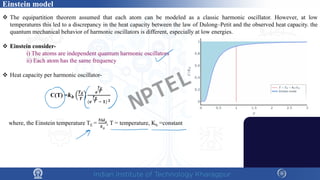
Einstein model
 The equipartition theorem assumed that each atom can be modeled as a classic harmonic oscillator. However, at low
temperatures this led to a discrepancy in the heat capacity between the law of Dulong–Petit and the observed heat capacity. the
quantum mechanical behavior of harmonic oscillators is different, especially at low energies.
 Einstein consider-
i) The atoms are independent quantum harmonic oscillators
ii) Each atom has the same frequency
 Heat capacity per harmonic oscillator-
C(T) =𝒌𝒌𝒃𝒃
𝑻𝑻𝑬𝑬
𝑻𝑻
𝒆𝒆
𝑻𝑻𝑬𝑬
𝑻𝑻
(𝒆𝒆
𝑻𝑻𝑬𝑬
𝑻𝑻 − 𝟏𝟏) 𝟐𝟐
where, the Einstein temperature TE =
ℏω0
𝑘𝑘𝐵𝐵
, T = temperature, Kb =constant
NPTEL
NPTEL
• Heat transfer from a higher temperature to a lower temperature. Therefore, at
equilibrium, heat transfer is zero.
• Specific heat is needed to increase the temperature by one degree.
• Latent heat changes the physical state of a material.
• Dulong - Petit law gives us an appropriate relationship of specific heat capacity and
atomic masses of solids.
• The Einstein model correctly predicts that the heat capacity drops to 0 as T→0.
NPTEL
• Physics of Functional Materials by Hasse Fredriksson & Ulla Akerlind.
• Thermal Properties of Matter by Joe Khachan.
• A Treatise on Heat by Meghnad Saha, B. N. Srivastava.
NPTEL
Thank you…
NPTEL
Physics of Functional Materials & Devices
Prof. Amreesh Chandra
Department of Physics, IIT KHARAGPUR
Module 05: Thermal properties of solids
Lecture 25: Thermogravimetric (TGA) analysis
NPTEL
 Introduction To Thermal Analysis
 Processes of mass change
 Working mechanism of TGA
 TGA thermogram analysis
 Example of thermogram
 Applications of TGA
NPTEL
3
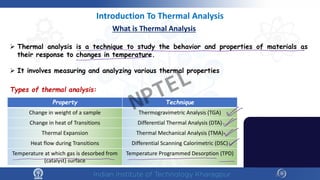
 Thermal analysis is a technique to study the behavior and properties of materials as
their response to changes in temperature.
 It involves measuring and analyzing various thermal properties
Introduction To Thermal Analysis
What is Thermal Analysis
Property Technique
Change in weight of a sample Thermogravimetric Analysis (TGA)
Change in heat of Transitions Differential Thermal Analysis (DTA)
Thermal Expansion Thermal Mechanical Analysis (TMA)
Heat flow during Transitions Differential Scanning Calorimetric (DSC)
Temperature at which gas is desorbed from
(catalyst) surface
Temperature Programmed Desorption (TPD)
Types of thermal analysis:
NPTEL
4
Introduction
Thermal Gravimetric Analysis
Temperature
variation
Mass change Microbalance
causing detected by
• Thermogravimetry or thermogravimetric analysis is an analytical
method that records the mass change by temperature of a
sample that is facing a controlled temperature profile.
• The sample undergo heating, cooling or isothermal steps.
• The resulting measurement signal gives the absolute mass
change in [mg] and relative mass change in [%].
What is thermogravimetric analysis?
Fig. : TGA Sensor setup in a typical
thermogravimetric analyzer
NPTEL
5
Processes of mass change
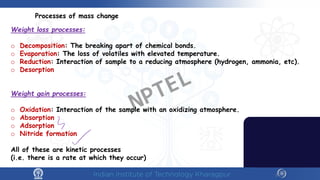
Weight loss processes:
o Decomposition: The breaking apart of chemical bonds.
o Evaporation: The loss of volatiles with elevated temperature.
o Reduction: Interaction of sample to a reducing atmosphere (hydrogen, ammonia, etc).
o Desorption
Weight gain processes:
o Oxidation: Interaction of the sample with an oxidizing atmosphere.
o Absorption
o Adsorption
o Nitride formation
All of these are kinetic processes
(i.e. there is a rate at which they occur)
NPTEL
6
Working mechanism of TGA
Weight change
Null detector
Restoring force
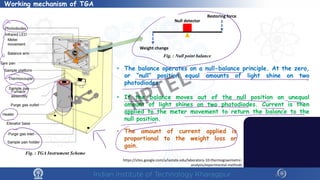
• The balance operates on a null-balance principle. At the zero,
or “null” position equal amounts of light shine on two
photodiodes.
• If the balance moves out of the null position an unequal
amount of light shines on two photodiodes. Current is then
applied to the meter movement to return the balance to the
null position.
• The amount of current applied is
proportional to the weight loss or
gain.
Fig. : TGA Instrument Scheme
Fig. : Null point balance
https://sites.google.com/a/iastate.edu/laboratory-10-thermogravimetric-
analysis/experimental-methods
NPTEL
7
Working mechanism
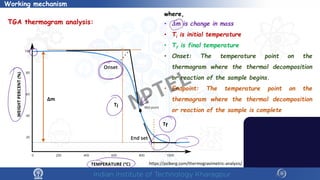
TGA thermogram analysis:
https://psiberg.com/thermogravimetric-analysis/
where,
• 𝜟𝜟m is change in mass
• Ti is initial temperature
• Tf is final temperature
• Onset: The temperature point on the
thermogram where the thermal decomposition
or reaction of the sample begins.
• Endpoint: The temperature point on the
thermogram where the thermal decomposition
or reaction of the sample is complete
NPTEL
8
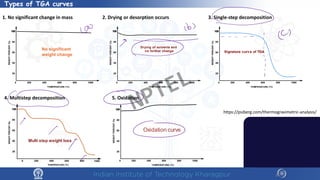
Types of TGA curves
WEIGHT
PERCENT
(%)
TEMPERATURE (o
C)
0
20
40
60
80
No significant
weight change
200 400 600 1000
800
WEIGHT
PERCENT
(%)
TEMPERATURE (o
C)
0
20
40
60
80
200 400 600 1000
800
Drying of solvents and
no further change
WEIGHT
PERCENT
(%)
TEMPERATURE (o
C)
0
20
40
60
80
200 400 600 1000
800
Signature curve of TGA
Multi step weight loss
WEIGHT
PERCENT
(%)
TEMPERATURE (o
C)
0
20
40
60
80
200 400 600 1000
800
Oxidation curve
1. No significant change in mass 2. Drying or desorption occurs 3. Single-step decomposition
4. Multistep decomposition 5. Oxidation
https://psiberg.com/thermogravimetric-analysis/
NPTEL
9
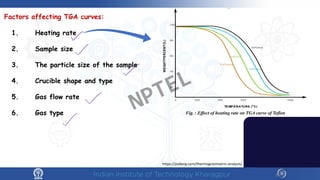
Factors affecting TGA curves:
1. Heating rate
2. Sample size
3. The particle size of the sample
4. Crucible shape and type
5. Gas flow rate
6. Gas type Fig. : Effect of heating rate on TGA curve of Teflon
https://psiberg.com/thermogravimetric-analysis/
NPTEL
10
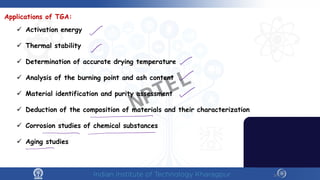
Applications of TGA:
 Activation energy
 Thermal stability
 Determination of accurate drying temperature
 Analysis of the burning point and ash content
 Material identification and purity assessment
 Deduction of the composition of materials and their characterization
 Corrosion studies of chemical substances
 Aging studies
NPTEL
NPTEL
 The thermogravimetric analysis (TGA) method has been discussed briefly.
 Different types of TGA curve has been highlighted.
 Heating rate, sample size, particle size, and other factors affect the TGA analysis.
 Different applications of TGA have been highlighted.
NPTEL
⮚ PhysicsofFunctional M
aterialsbyH
asseFredriksson&U
llaA
kerlind
⮚ IntroductiontoSolidStatePhysicsbyC
harlesK
ittle
⮚ A
tkins’sPhysicalC
hem
istrybyPeterA
tkins,andJuliodePaula.
⮚ ATextbookofN
anoscienceandN
anotechnology, P.I.VargheseandThalappil, M
cG
rawH
ill E
ducation, 2017.
NPTEL
Thank you…
NPTEL

PHYSICS MATERIAL FUNCTION,PROPERTY,DEVICES.pdf

  • 1.
    Physics of FunctionalMaterials and Devices Prof. Amreesh Chandra Department of Physics, IIT KHARAGPUR Module 05: Thermal properties of solids Lecture 22: Thermal Properties of Solids NPTEL
  • 2.
     Introduction  DifferentThermal Properties of Solids  Thermal Expansion  Thermal Stress  Thermal Conductivity NPTEL
  • 3.
     In theUniverse, all of us are surrounded by matter. Matter is different from each other according to some of their intrinsic properties. Different intrinsic properties of matter, are:  Mechanical properties  Chemical properties  Physical properties  Dimensional properties  Thermal properties NPTEL
  • 4.
    What are thethermal properties of matter? It is one of the main properties of matter, which deals with the heat conductivity and thermal capacity of matter. It deals with heat fluctuation. 4 major components of thermal properties of matter:  Heat Capacity  Thermal Expansion  Thermal stress  Thermal conductivity NPTEL
  • 5.
    Heat capacity andspecific heat of matter  Heat Capacity: It is the amount of heat required to change the temperature of a body by 1 degree.  The SI unit of heat capacity is Joule/ Kelvin. Mathematically, it can be expressed as, 𝑪𝑪 = 𝜹𝜹𝜹𝜹 𝜹𝜹𝜹𝜹 .  Heat capacity arises due to the few sources. Some of them are:  Vibration of the atoms.  Ordering of the atoms(defect).  Conduction of electrons.  Specific heat: It is related to the heat capacity of solids. It is defined as the amount of heat required to enhance the temperature of the unit mass of a substance by a unit degree of temperature. NPTEL
  • 6.
     Thermal energyis the combination of the kinetic energy of atomic motions and the potential energy due to the distortion of interatomic bonds.  Vibrations of atoms is one of the main sources of thermal energy. Notable points about thermal energy  Vibrations of individual atoms in solids are not independent from each other.  The coupling of atomic vibrations of adjacent atoms results in waves of atomic displacements.  Each wave is characterized by its wavelength and frequency. For a wave of a given frequency ν, there is the smallest “quantum” of vibrational energy, hν, called as phonon.  Thus, the thermal energy is the energy of all phonons (or all vibrational waves) present in the crystal at a given temperature. Figure: Vibration of atoms NPTEL
  • 7.
    Temperature dependence ofspecific heat Figure: Temperature dependence of specific heat  Heat capacity has weak temperature dependence at high temperature.  At low temperature, specific heat obeys Einstein’s quantum theory. Hence, Cv varies with T3.  At room temperature, Cv attains a constant value, i.e., nearly 3R for 1 mole. This law is famous as Dulong-Petit’S law.  The law was invented in 1819. The law was based on the classical equipartition theory.  The curve illustrates the variation of specific heat with temperature for different synthesized materials.  When temperature increases specific heat approaches a certain constant value. NPTEL
  • 8.
    Thermal Expansion ofMatter  Thermal expansion is one of the thermal properties of matter, due to which matter changes its length, shape, volume, and density in response to the variation in temperature.  In general, the phase transition is not included in the thermal expansion. 𝒍𝒍 ∆𝑙𝑙 Linear expansion A ∆𝑨𝑨 Areal expansion V ∆𝑽𝑽 Volume expansion  The adjacent figure illustrates three types of thermal expansion, linear, areal, and volume expansion. NPTEL
  • 9.
    Linear expansion co-efficient 𝒍𝒍 ∆𝑙𝑙 Linearexpansion  If the substance is a form of a rod of length 𝒍𝒍 𝒂𝒂𝒂𝒂𝒂𝒂 𝒅𝒅ue to the increase in temperature from T to T + ∆𝑻𝑻, the length changes to 𝒍𝒍 + ∆𝒍𝒍.  In this case, ∆𝒍𝒍 𝒍𝒍 = 𝜶𝜶𝟏𝟏∆𝑻𝑻, where 𝜶𝜶𝟏𝟏 is the coefficient of linear expansion.  Linear expansion coefficient is an intrinsic property of matter. Materials 𝜶𝜶𝟏𝟏 (10-5 K-1) Alumiminium 2.5 Brass 1.8 Copper 1.7 Iron 1.2 Silver 1.9 Glass (pyrex) 0.32 Lead 0.29  The adjacent table gives the average values of the linear expansion coefficient of the materials in the temperature range 0 to 100 °C.  From the table, it is obvious that the copper expands five times more compared to glass for same rise in temperature. NPTEL
  • 10.
    Relation between linearexpansion co-efficient and volume expansion co-efficient  Consider a cube of length 𝒍𝒍. Suppose, due to the increase in temperature ∆𝑻𝑻, the length in each dimension enhances equally.  On each side, the increase in length is ∆𝒍𝒍.  We have, ∆𝒍𝒍 = 𝒍𝒍𝜶𝜶𝟏𝟏∆𝑻𝑻.  In this case, change of volume, ∆𝑽𝑽 = (𝒍𝒍 + ∆𝒍𝒍)𝟑𝟑 − 𝒍𝒍𝟑𝟑 = 𝟑𝟑𝒍𝒍𝟐𝟐 ∆𝒍𝒍.  The terms ∆𝒍𝒍𝟑𝟑 and ∆𝒍𝒍𝟐𝟐 are neglected.  Hence, ∆𝑽𝑽 𝑽𝑽 = 𝟑𝟑. ∆𝒍𝒍 𝒍𝒍 = 𝟑𝟑𝜶𝜶𝟏𝟏∆𝑻𝑻 = 𝜶𝜶𝒗𝒗 ∆𝑻𝑻.  So, the relation between linear and volume expansion coefficient, is: 𝜶𝜶𝒗𝒗 = 𝟑𝟑𝜶𝜶𝟏𝟏. ∆𝑙𝑙 𝒍𝒍 Volume expansion NPTEL
  • 11.
     Consider arectangular sheet of length a and width b.  When the temperature increases by ∆𝑻𝑻, then, change of length, ∆𝒂𝒂 = 𝒂𝒂𝜶𝜶𝟏𝟏∆𝑻𝑻 and change of width, ∆𝒃𝒃= 𝒃𝒃𝜶𝜶𝟏𝟏∆𝑻𝑻.  According to the adjacent figure, change in area, ∆𝑨𝑨 = 𝒂𝒂∆𝒃𝒃 + 𝒃𝒃∆𝒂𝒂 + ∆𝒂𝒂∆𝒃𝒃.  Hence, ∆𝑨𝑨 = 𝒂𝒂𝒃𝒃𝜶𝜶𝟏𝟏∆𝑻𝑻 + 𝒃𝒃𝒂𝒂𝜶𝜶𝟏𝟏∆𝑻𝑻 + 𝒂𝒂𝒃𝒃(𝜶𝜶𝟏𝟏∆𝑻𝑻)𝟐𝟐.  The last term is neglected, as it is very small.  Hence, ∆𝑨𝑨 𝑨𝑨 = 2. 𝜶𝜶𝟏𝟏∆𝑻𝑻 = 𝜶𝜶𝑨𝑨 ∆𝑻𝑻 ⇒ 𝜶𝜶𝑨𝑨 = 2. 𝜶𝜶𝟏𝟏 Relation between linear expansion co-efficient and areal expansion co-efficient 𝒂𝒂 + ∆𝒂𝒂 𝒃𝒃 𝒂𝒂 𝒃𝒃 + ∆𝒃𝒃 𝒂𝒂∆𝒃𝒃 ∆𝒂𝒂∆𝒃𝒃 ∆𝒂𝒂. 𝒃𝒃  So, the relation between linear, areal, and volume expansion coefficient, is: 𝜶𝜶𝟏𝟏 = 𝜶𝜶𝑨𝑨 𝟐𝟐 = 𝜶𝜶𝒗𝒗 𝟑𝟑 . NPTEL
  • 12.
    Thermal Stress  Thermalstress is the stress caused by any variation in a material's temperature. Thermal stress is induced in a solid material when the temperature of the material is increased or decreased but the material is not allowed to expand or contract.  The term thermal stress includes both heat and cold stress.  Stress is the force acting per unit area. The force can be of any form. When the applied force is in the form of temperature the resultant stress is called Thermal stress. 𝒍𝒍 ∆𝑙𝑙  As shown in Figure, when the temperature is raised by ∆𝑻𝑻, then length of the rod increases by ∆𝑙𝑙. If the expansion is stopped forcefully, then thermal stress arises.  For the concerned case, the expression for the thermal stress is, 𝜹𝜹𝑻𝑻 = 𝒍𝒍𝜶𝜶∆𝑻𝑻.  Thermostat is a very good example of the application of thermal stress. NPTEL
  • 13.
    Thermal Conduction  Thermalconduction is the ability to transfer heat from one side of the medium to the other side, owing to the difference in temperature.  Fourier’s law of thermal conduction: This law is also known as the law of heat conduction. According to that law, the rate of transfer of heat through a material is proportional to the negative of the temperature gradient and is also proportional to the area through which the heat flows.  The differential form of this law can be expressed through the following equation: q = -κ.∆𝑻𝑻 where ∆𝑻𝑻 refers to the temperature gradient, q denotes the thermal flux or heat flux, and k refers to the thermal conductivity of the material.  Metals are rich conductors of heat. Whereas, wood, plastic, and rubber are the bad conductors of heat. NPTEL
  • 14.
    Steady-state heat transfer Consider a metallic bar of length L and uniform cross section A with its two ends maintained at different temperatures, TC and TD.  This can be done, for example, by putting the ends in thermal contact with large reservoirs at temperatures, as shown in adjacent Figure.  Assuming the ideal condition that the sides of the bar are fully insulated so that no heat is exchanged between the sides and the surroundings. 𝑨𝑨 𝑻𝑻𝑪𝑪 𝑻𝑻𝑫𝑫 𝒍𝒍 Steady state heat transfer  After sometime, a steady state will be reached; the temperature of the bar decreases uniformly with distance from TC to TD; (TC>TD). NPTEL
  • 15.
    Steady-state heat transfer 𝑨𝑨 𝑻𝑻𝑪𝑪𝑻𝑻𝑫𝑫 𝒍𝒍 Steady state heat transfer  The rate of flow of heat (or heat current) H is proportional to the temperature difference (TC – TD) and the area of cross-section A and is inversely proportional to the length L.  This is equal to, 𝑯𝑯 = 𝑲𝑲𝑲𝑲. 𝑻𝑻𝑪𝑪 − 𝑻𝑻𝑫𝑫 𝑳𝑳 , where K is called the thermal conductivity.  The SI unit of thermal conductivity K is J S-1 m-1 K-1 or W m-1 K-1. Materials Thermal conductivity (J s-1 m-1 K-1) Materials Thermal conductivity (J s-1 m-1 K-1) Silver 406 Insulating brick 0.15 Copper 385 Concrete 0.8 Aluminium 205 Body fat 0.20 Brass 109 Felt 0.04 Steel 50.2 Glass 0.80 List of thermal conductivities of some materials NPTEL
  • 16.
     Thermal propertiesof matter are intrinsic properties, which are material dependent.  At room temperature, the molar heat capacity of all the solids is attained a constant value, which is known as Dulong-Petit’s law.  At sufficiently low temperature, specific capacity varies with temperature, obeying the T3 rule.  The volume expansion, areal expansion and linear expansion coefficients generally obey a certain relationship among them, i.e.: 𝜶𝜶𝟏𝟏 = 𝜶𝜶𝑨𝑨 𝟐𝟐 = 𝜶𝜶𝒗𝒗 𝟑𝟑 .  Heat conduction of solids depends upon the free electrons. That’s why good thermal conductors in general, possess good electrical conductivity. NPTEL
  • 17.
    • Physics ofFunctional Materials by Hasse Fredriksson & Ulla Akerlind. • Thermal Properties of Matter by Joe Khachan. • A Treatise on Heat by Meghnad Saha, B. N. Srivastava. NPTEL
  • 18.
  • 19.
    Physics of FunctionalMaterials and Devices Prof. Amreesh Chandra Department of Physics, IIT KHARAGPUR Module 05: Thermal properties of solids Lecture 23: Negative and Zero Expansion Ceramics NPTEL
  • 20.
    Thermal expansion inceramics Negative and zero thermal expansion ceramics Examples of Negative and zero thermal expansion ceramics Applications of negative and zero thermal expansion ceramics NPTEL
  • 21.
    Thermal expansion What isthermal expansion? Thermal expansion refers to the phenomenon where a material undergoes dimensional changes in response to changes in temperature. When a substance is heated, its particles gain energy and become more active, causing them to move and vibrate more rapidly. This increased molecular motion leads to an increase in the average separation between particles (interatomic distance), resulting in expansion or an increase in volume. NPTEL
  • 22.
    Thermal expansion Expansion behaviorof materials is governed by lattice constant What is lattice constant? The expansion behavior of materials can be described by the coefficient of thermal expansion (CTE), which measures how much a material's dimensions change per unit temperature change. The CTE is typically expressed in units of length per temperature (e.g., millimeters per degree Celsius or inches per degree Fahrenheit). NPTEL
  • 23.
    Thermal expansion inceramics  Ceramics are generally composed of a three-dimensional network of atoms or ions held together by strong chemical bonds.  When a ceramic material is heated, the increase in temperature provides energy to the atoms or ions, leading to greater vibrational motion. This increased motion causes the atoms or ions to move slightly further apart from each other, resulting in expansion.  However, when the temperature decreases, the reduced energy causes the atoms or ions to vibrate less vigorously, leading to a contraction or compression of the material. Temperature decreased Contraction Expansion NPTEL
  • 24.
    Thermal expansion inceramics General trends of expansion in ceramics:  Due to stronger nature of the atomic bonds ceramics often have a lower coefficient of thermal expansion (CTE) than metals, which means they expand or contract less for a given change in temperature.  Ceramic materials exhibit anisotropic thermal expansion, meaning that their expansion or contraction rates can vary depending on the direction or crystallographic orientation. This anisotropy arises from the preferential alignment of atoms or ions along certain crystallographic planes or directions, resulting in different expansion coefficients along different axes.  Low coefficient of thermal expansion exhibited by some ceramics makes them desirable for certain applications where dimensional stability is crucial such as in electronics, refractory materials, and high-precision engineering. Why negative and zero thermal expansion ceramics?? NPTEL
  • 25.
    Negative thermal expansionceramics  Ceramics are tend to expand when heated and contract when cooled.  But there are another class of interesting ceramics viz.,’negative thermal expansion ceramic’. What are negative and zero expansion ceramics ? Negative and zero expansion ceramics, also known as zero thermal expansion (ZTE) ceramics or negative thermal expansion (NTE) ceramics, are a class of materials that exhibit minimal or even negative thermal expansion coefficients. This means that they either minimally expand or get contract when subjected to temperature changes.  Zero expansion ceramics have a coefficient of thermal expansion (CTE) close to zero, meaning they undergo negligible dimensional changes when subjected to temperature variations.  Negative expansion ceramics, on the other hand, have a negative CTE, implying that they contract or shrink in volume as temperature increases. Distortion or stress caused by thermal expansion CAN BE AVOIDED USING NEGATIVE AND ZERO EXPANSION CERAMICS NPTEL
  • 26.
    Let us takean example of a functional ceramic NPTEL
  • 27.
    An interesting featurewhich has been observed in most of the common and useful ferroelectric materials is that they have crystal unit cell which is of perovskite ABO3- type. NPTEL
  • 28.
    SAMPLE REPARATION Mixing ofPbCO3, CaCO3 and TiO2 in mortar pestle for 2h in acetone. Ball milling for 6 h using acetone as mixing media First calcination in air at 750o C for 6 h Second calcination in closed PbO atmosphere at 900o C for 6h. Ball milling for 1h using acetone as mixing media to break the agglomerates Pelletization at an optimized pressure Sintering in closed PbO atmosphere at 1200o C for 6h to get dense ceramic pellets having density >94%. NPTEL
  • 29.
    Room Temperature powderXRD Pattern of sintered PbTiO3 and CaTiO3 20 40 60 220 202 211 112 201 102 200 002 111 110 101 100 001 X-ray diffraction pattern for pure PbTiO3 . All the peaks are indexed using a tetragonal P4mm unit cell Intensity (a.u.) 2θ(degrees) 20 40 60 404 223 313 421 224 400 312 222 311 310 221 202 201 200 X-raydiffraction pattern for pure CaTiO3 . All the peaks have been indexed using a orthorhombic Pbnmcell. Intensity (a.u.) 2θ(degrees) NPTEL
  • 30.
    Compositional Dependent StructuralChanges in Pb1-xCaxTiO3 at room temperature 46 48 35 38 35 38 47 49 35 38 120 021 012 200 002 111 (a) (e) 203 312 421 402 313 222 004 310 311 322 (f) (b) (c) (g) 35 39 43 47 51 55 (d) Two-theta (deg.) 37 41 45 49 53 x=0.20 x=0.30 x=0.40 x=0.50 (h) 322 310 311 311 310 x=0.60 322 x=1.00 x=0.80 x=0.70 311 310 Note: There is sudden change in XRD pattern at x=0.40 with appearance of weak superlattice peaks (shown in Inset). These superlattice peaks have significant intensity at x>0.60. NPTEL
  • 31.
    The origin ofthermal expansion can be understood by considering the effect of anharmonic terms in the potential energy well between a pair of atoms in a solid. A typical anharmonic potential energy curve is schematically shown in in this view graph.  Thermal expansion is a direct consequence of the deviation from symmetry (that is, asymmetry) of the potential energy curve characteristic of solids. UNDERSTANDING ORIGIN OF EXPANSION IN SOLIDS NPTEL
  • 32.
    EXPERIMENTAL SET-UP FORDILATOMETRY A LKB fused quartz thermodilatometer NPTEL
  • 33.
    275 475 675875 1075 0 20 40 60 80 (d)PCT45 Temperature (K) % Linear thermal expansion (10 6 ) 275 475 675 875 1075 0 20 40 60 275 350 425 500 -1.0 -0.5 0.0 0.5 1.0 1.5 2.0 (c)PCT40 % Linear thermal expansion (10 6 ) Temperature (K) % linear thermal Expansion Temperature (K) 275 475 675 875 1075 -15 -5 5 15 25 35 (b) PCT35 % Linear thermal expansion (10 6 ) Temperature (K) 275 475 675 875 1075 -20 -10 0 10 (a) PCT30 Temperature(K) % Linear thermal expansion(10 -6 ) DILATOMETRIC RESULTS NPTEL
  • 34.
    Sample Composition Temperature range in (K) Coefficient ofThermal Expansion x 106 (K-1 ) PCT30 I (300-520) II (520-652) III (652-1023) -8.541 -1.735 9.662 PCT35 I (300-491) II (491-820) III (820-1023) -5.688 12.35 2.863 PCT40 I (300-410) II (410-470) III (470-850) IV (850-1023) -0.6673 3.569 14.24 7.756 PCT45 I (300-345) II (345-1023) 0.6568 12.59 VARIATION OF LINEAR THERMAL EXPANSION COEFFICIENTS FOR PCT COMPOSITIONS NPTEL
  • 35.
    275 475 675875 1075 0 1000 2000 3000 4000 0 1000 2000 3000 275 475 675 875 1075 -20 -10 0 10 (a) For Pb0.70 Ca0.30 TiO3 (a) Variation of percent linear thermal expansion (b) Variation of real (ε/ ) and imaginary (ε// ) parts of dielectric constant Temperature(K) % L.T.E. (10 -6 ) (b) ε / Temperature(K) ε/ ε// ε // CROSS OVER FROM NTE TO PTE IS RELATED TO A PHASE TRANSTION NPTEL
  • 36.
    Thermal expansion behaviourof PCT using X-ray diffraction studies NPTEL
  • 37.
    0 200 400600 800 3.940 3.944 3.948 3.952 3.956 0 200 400 600 800 3.86 3.91 3.96 4.01 4.06 4.11 0 50 100 3.950 3.952 3.954 3.956 3.958 For Pb0.70 Ca0.30 TiO3 . a) Variation of the unit cell a,c parameters b) Variation of the unit cell volume The inset shows the sudden change in volume expansion at around 70K b) cell volume cell-volume 1/3 (A) Temperature (K) o o a) cell-parameter (a,c) (A) Temperature (K) a param eter c param eter cell volume (a 2 c) 1/3 (A) Tem perature (K) NPTEL
  • 38.
    Variation of BondsLengths and Determination of Major bond lengths, which play the dominant role in introducing NTE behaviour in PCT Displacement Directions in Tetragonal cell with P4mm space group 2.33 2.36 2.39 Ti-OI (-) 1.74 1.78 Ti-OI (+) 1.97 2.00 Ti-OII Bond Length (A) 2.761 2.786 2.811 Pb-O(I) 2.487 2.512 Pb(-) O(II) 3.17 3.21 Pb(+) O( II ) 0 100 200 300 2.003 2.007 Average Ti-O 0 100 200 300 2.831 2.839 2.847 Average Pb-O Variation of various bond length in PCT10 Temperature (K) NPTEL
  • 39.
    1) PCT ceramicswith x=0.30, 0.35 and 0.40 reveal presence of negative thermal expansion behaviour above. For x=0.45, the expansion coefficient becomes positive. 2) For x=0.30 is quite large NTE coeeficient is (–8.541 x 10⁻⁶ K-1) in the temperature range 300 to 520K. 3) NTE behaviour has also been confirmed in the XRD studies. 4) The NTE behaviour is closely related with ferroelectric phase transition 5) The NTE behaviour is present only in the tetragonal compositions of PCT 6) The expansion coefficient of PCT ceramics can be tailored from negative to positive values by varying the Ca2+ content. NPTEL
  • 40.
    Examples of negativeand zero expansion ceramics  Zirconium Tungstate (ZrW2O8):  Zirconium tungstate is a well-known negative expansion ceramic with a very low CTE (average CTE of -7.2x10⁻⁶ K−1)  It exhibits a contraction in volume continuously as temperature increases over the range of 0.3 to 1050 K.  It exhibits in cubic structure so the thermal contraction is isotropic - equal in all directions.  Silicon Carbide (SiC):  Certain SiC-based composites can exhibit near-zero or even negative thermal expansion behavior with CTE of SiC typically ranges from 4-6 x 10⁻⁶ per degree Celsius (μm/°C) in the temperature range of 25-1000°C.  SiC's low thermal expansion helps to minimize the potential for thermal stress and deformation in components subjected to thermal cycling or high-temperature conditions  Alumina-Mullite (Al2O3-SiO2):  Alumina-mullite ceramics can be tailored to have low or even negative expansion coefficients, making them suitable for applications where thermal stability is crucial, such as in refractory linings or high-temperature environments. NPTEL
  • 41.
    Applications of negativeand zero expansion ceramics  Aerospace Industries: Negative and zero thermal expansion ceramics find applications in the aerospace industry where they are used in components that require high thermal stability. These materials can be used in the fabrication of satellite components, rocket nozzles, and thermal protection systems for re-entry vehicles.  Satellite Components: Satellites operate in extreme temperature variations as they transit between sunlight and shadowed areas. Negative and zero thermal expansion ceramics can be used in the construction of satellite components, such as reflectors, antenna supports, and structural elements. These ceramics help maintain the structural integrity and dimensional stability of the components as they experience temperature fluctuations. NPTEL
  • 42.
    Applications of negativeand zero expansion ceramics  Rocket Nozzles: Rocket engines generate intense heat during operation, causing the nozzle to expand. The use of negative and zero thermal expansion ceramics in the construction of rocket nozzles helps to counteract the expansion and maintain the nozzle's shape and performance. These ceramics can withstand high temperatures and minimize thermal stresses, ensuring the reliability and efficiency of the propulsion system.  Hypersonic Vehicles: Negative and zero thermal expansion ceramics are used in hypersonic vehicles, such vehicles travel at extremely high speeds, generating intense heat due to air compression. Negative and zero thermal expansion ceramics can help mitigate thermal expansion effects and maintain the structural integrity of critical components, such as leading edges, control surfaces, and thermal shields. NPTEL
  • 43.
    Applications of negativeand zero expansion ceramics  Electronics and Semiconductors: The electronics and semiconductor industries require materials with precise dimensional stability to ensure reliable performance. Negative and zero thermal expansion ceramics can be can counteract the expansion mismatch between different materials.  Optical Devices and Lasers: Negative and zero thermal expansion ceramics are employed in the manufacturing of optical devices, such as lenses, mirrors, and laser components. These ceramics offer excellent thermal stability, allowing precise alignment and maintaining optical performance under varying temperature conditions. They help minimize distortions and ensure reliable operation of optical systems. NPTEL
  • 44.
    Applications of negativeand zero expansion ceramics  Micro-electromechanical Systems Devices: Microelectromechanical systems (MEMS) often require materials with controlled thermal expansion properties. Negative and zero thermal expansion ceramics can be utilized in the fabrication of MEMS devices to minimize thermal stresses and ensure accurate operation. They help maintain the structural integrity and functionality of MEMS components under varying temperature conditions  Substrates and PCBs: : A printed circuit board, or PCB, incorporates to provide electrical connections in electronic components using conductive pathways such as copper sheets. Negative and zero thermal expansion ceramics help control the coefficient of thermal expansion (CTE) of the substrate material, enabling better matching with semiconductor components and reducing the risk of solder joint failures due to thermal cycling. They also provide improved dimensional stability, ensuring reliable performance of electronic assemblies. NPTEL
  • 45.
    Applications of negativeand zero expansion ceramics  Energy and Nuclear Applications: Negative and zero thermal expansion ceramics are also utilized in the energy sector especially in the field of nuclear, solar, and energy conversion systems.  Fuel Element and Cladding: Negative and zero thermal expansion ceramics can be employed as fuel elements or cladding materials in nuclear reactors. These ceramics can maintain their dimensional stability even at high temperatures, reducing the risk of deformation or failure. They can help prevent fuel swelling and maintain the integrity of the fuel assembly, enhancing the safety and efficiency of the reactor. In nuclear reactors NPTEL
  • 46.
    Applications of negativeand zero expansion ceramics  Neutrons Absorbers: In nuclear reactors, neutron absorbers are used to control the neutron flux and maintain the desired power level. Negative and zero thermal expansion ceramics can be incorporated into neutron absorber materials to provide stable dimensions and enhance their effectiveness. The precise control of thermal expansion properties can help optimize the performance and efficiency of neutron absorbers.  Coatings and Insulation: NTE and ZTE ceramics can be used as coatings or insulation materials in nuclear reactors. These ceramics can provide thermal expansion matching with other components, reducing stress and preventing the degradation of coatings. Additionally, they can offer effective thermal insulation, reducing heat transfer and improving energy efficiency in the reactor system. NPTEL
  • 47.
    Applications of negativeand zero expansion ceramics In solar cells  Concentrated Solar Power (CSP) Systems: CSP systems use mirrors or lenses to concentrate sunlight onto a solar receiver to generate heat or electricity. NTE and ZTE ceramics can be used in the construction of these concentrator systems to maintain dimensional stability and minimize the effects of thermal expansion and contraction. By utilizing ceramics with tailored thermal expansion properties, the concentrators can maintain their shape and alignment over a range of temperatures, optimizing the efficiency of the CSP system.  Solar Thermal Collectors: NTE and ZTE ceramics can be utilized in the construction of solar thermal collectors, which absorb sunlight and convert it into heat energy. By incorporating these ceramics into the collector materials, it is possible to minimize the effects of thermal expansion and contraction, ensuring the structural integrity of the collector and maximizing the heat absorption efficiency. NPTEL
  • 48.
    Applications of negativeand zero expansion ceramics In energy conversion systems  Heat Exchangers  Thermoelectric Devices:  Thermal Energy Storage These ceramics can help counteract thermal expansion mismatches between different components, such as tubes, fins, and headers, reducing stress and improving heat transfer efficiency. NTE and ZTE ceramics can be utilized in thermoelectric devices, which convert temperature differences into electricity. Ceramics mitigate thermal stresses and ensure the dimensional stability of thermal energy storage materials, improving their reliability and efficiency. NPTEL
  • 49.
     Thermal expansionbrings dimensional changes in response to changes in temperature in materials.  Due to stronger nature of the atomic bonds ceramics often have a lower coefficient of thermal expansion (CTE) than metals.  Negative and zero expansion ceramics, either minimally expand or get contracted when subjected to temperature changes.  Negative and zero expansion ceramics find applications in a large number of applications ranging from aerospace, energy conversion systems, electronics to semiconductors industry. NPTEL
  • 50.
    ⮚ PhysicsofFunctional M aterialsbyH asseFredriksson&U llaA kerlind ⮚IntroductiontoSolidStatePhysicsbyC harlesK ittle ⮚ A tkins’sPhysicalC hem istrybyPeterA tkins,andJuliodePaula. ⮚ ATextbookofN anoscienceandN anotechnology, P.I.VargheseandThalappil, M cG rawH ill E ducation, 2017. ⮚ PhDThesis–A m reeshC handra(2004), SM ST, ITB H U . ⮚ ResearchPublicationsofProf. A m reeshC handra. NPTEL
  • 51.
  • 52.
    Physics of FunctionalMaterials and Devices Prof. Amreesh Chandra Department of Physics, IIT KHARAGPUR Module 05: Thermal properties of solids Lecture 24: Heat Capacity NPTEL
  • 53.
     Heat Transfer Specific Heat and Latent Heat  Specific Heat at Constant Volume and Constant Pressure  Enthalpy  Relationship between CP and CV for an Ideal Gas  Heat Capacity of Solid- i) Dulong–Petit law ii) Einstein model  Einstein model NPTEL
  • 54.
    Heat Transfer  Heatis defined as the kind of energy that is transmitted over a boundary as a result of a temperature differential. In the process of reaching thermodynamic equilibrium, heat is transferred from the warmer object to the cooler object. At the thermodynamic equilibrium heat transfer is zero How heat will transfer?? NPTEL
  • 55.
    Process involve inheat transfer  Heat transfer is classified into three types: - • Heat conduction or thermal conduction: - The transfer of energy from one medium particle to another with the particles in direct contact with one other. • Convection or thermal convection: - The movement of fluid that causes heat to be transferred from one location to another. • Radiation or thermal radiation: - The energy emitted by matter in the form of photons or electromagnetic waves. Conduction of heat Convection of heat Radiation NPTEL
  • 56.
     Example Conduction, convectionand radiation of heat NPTEL
  • 57.
    Specific Heat andLatent Heat  Specific Heat The quantity of heat that must be added to a substance's mass in order to raise its temperature by one degree. Q = C m ∆t (S.I unit of specific heat is J kg-1 K-1) Where, Q = quantity of heat absorbed by a body m = mass of the body ∆t = Rise in temperature C = Specific heat capacity of a substance depends on the nature of the material of the substance. NPTEL
  • 58.
     Latent Heat Latentheat is energy absorbed or released by a substance during a change in its physical state (phase) that occurs without changing its temperature. The latent heat produced by melting a solid or freezing a liquid. 2) Heat of vaporization 1) Heat of fusion Two types of latent heat NPTEL
  • 59.
    Specific Heat atConstant Volume and Pressure  Specific Heat at Constant Volume The rate of change of specific internal energy with respect to temperature when the volume is held constant.  Specific Heat at Constant Pressure The rate of change of enthalpy with respect to temperature when the pressure is held constant 𝐶𝐶𝑣𝑣 = 𝜕𝜕𝜕𝜕 𝜕𝜕𝜕𝜕 𝑣𝑣 𝐶𝐶𝑝𝑝 = 𝜕𝜕ℎ 𝜕𝜕𝜕𝜕 𝑝𝑝 Where, 𝑢𝑢 = internal energy, 𝑇𝑇 = temperature, 𝑣𝑣 = volume Where, ℎ = enthalpy, 𝑇𝑇 = temperature, 𝑣𝑣 = volume The heat capacity at constant pressure CP is greater than the heat capacity at constant volume CV , because when heat is added at constant pressure, the substance expands and work NPTEL
  • 60.
    • The sumof the internal energy and the product of the pressure and volume of a thermodynamic system. • Enthalpy is a property or state function that resembles energy; it has the same dimensions as energy and derives all of its value from the system's composition, temperature, and pressure. • The enthalpy change is exactly equal to the heat imparted to the syste when the only work involved is a change in volume at constant pressure. Enthalpy Where, H = enthalpy, E= internal energy of thermodynamic system, P = pressure of thermodynamic system, V = volume of thermodynamic system H = E + PV NPTEL
  • 61.
    Relationship between CPand CV for an Ideal Gas From the equation, Q = n C ∆T At constant pressure P, QP = n CP∆T This value is equal to the change in enthalpy, QP = n CP∆T = ∆H Similarly, at constant volume V, we have QV = n CV∆T This value is equal to the change in internal energy, QV = n CV∆T = ∆U We know that for one mole (n=1) of an ideal gas, ∆H = ∆U + ∆(PV ) = ∆U + ∆(RT) = ∆U + R ∆T Therefore, ∆H = ∆U + R ∆T Substituting the values of ∆H and ∆U from above in the former equation, CP∆T = CV∆T + R ∆T CP = CV + R CP – CV = R Where, Cp= Specific heat at constant pressure CV = Specific heat at constant volume R = gas constant Q = heat T = temperature U = internal energy NPTEL
  • 62.
    Heat capacity ratio •The heat capacity ratio, also known as the adiabatic index, • The ratio of specific heats, is the ratio of the heat capacity at constant pressure (CP) to heat capacity at constant volume (CV). • It is sometimes referred to as the isentropic expansion factor. • It represented by the γ for an ideal gas and κ isentropic exponent for a real gas. • Heat capacity ratio- 𝛾𝛾 = 𝐶𝐶𝑝𝑝 𝐶𝐶𝑉𝑉 The heat capacity ratio is important for its applications in thermodynamical reversible processes. where, Cp= Specific heat at constant pressure CV = Specific heat at constant volume R = gas constant 𝐶𝐶𝑃𝑃 = 𝛾𝛾 𝑅𝑅 𝛾𝛾 − 1 𝐶𝐶𝑉𝑉 = 𝑅𝑅 𝛾𝛾 − 1 NPTEL
  • 63.
    Dulong–Petit Law  DulongPetit law, which states the classical expression of molar specific heat capacity. • According to the Dulong and Petit law, the gram-atomic heat capacity i.e. the product of the specific heat capacity and the atomic mass of an element remains constant. • The Dulong and Petit law offers a good prediction for the heat capacity of many elementary solids at higher temperatures.  Dulong Petit Law Equation c×M=k c×M=3R For a mass m of the sample divided by its molar mass M, gives us the number of moles. C×(M/m)=3R C/n=3R C = 3nR = 3nKB here, c = specific heat capacity, M = molar mass, k = constant, n = number of moles, R = gas constant, KB = Boltzmann constant The law is invalid for compounds found in the cryogenic range. NPTEL
  • 64.
    Einstein model  Theequipartition theorem assumed that each atom can be modeled as a classic harmonic oscillator. However, at low temperatures this led to a discrepancy in the heat capacity between the law of Dulong–Petit and the observed heat capacity. the quantum mechanical behavior of harmonic oscillators is different, especially at low energies.  Einstein consider- i) The atoms are independent quantum harmonic oscillators ii) Each atom has the same frequency  Heat capacity per harmonic oscillator- C(T) =𝒌𝒌𝒃𝒃 𝑻𝑻𝑬𝑬 𝑻𝑻 𝒆𝒆 𝑻𝑻𝑬𝑬 𝑻𝑻 (𝒆𝒆 𝑻𝑻𝑬𝑬 𝑻𝑻 − 𝟏𝟏) 𝟐𝟐 where, the Einstein temperature TE = ℏω0 𝑘𝑘𝐵𝐵 , T = temperature, Kb =constant NPTEL
  • 65.
  • 66.
    • Heat transferfrom a higher temperature to a lower temperature. Therefore, at equilibrium, heat transfer is zero. • Specific heat is needed to increase the temperature by one degree. • Latent heat changes the physical state of a material. • Dulong - Petit law gives us an appropriate relationship of specific heat capacity and atomic masses of solids. • The Einstein model correctly predicts that the heat capacity drops to 0 as T→0. NPTEL
  • 67.
    • Physics ofFunctional Materials by Hasse Fredriksson & Ulla Akerlind. • Thermal Properties of Matter by Joe Khachan. • A Treatise on Heat by Meghnad Saha, B. N. Srivastava. NPTEL
  • 68.
  • 69.
    Physics of FunctionalMaterials & Devices Prof. Amreesh Chandra Department of Physics, IIT KHARAGPUR Module 05: Thermal properties of solids Lecture 25: Thermogravimetric (TGA) analysis NPTEL
  • 70.
     Introduction ToThermal Analysis  Processes of mass change  Working mechanism of TGA  TGA thermogram analysis  Example of thermogram  Applications of TGA NPTEL
  • 71.
    3  Thermal analysisis a technique to study the behavior and properties of materials as their response to changes in temperature.  It involves measuring and analyzing various thermal properties Introduction To Thermal Analysis What is Thermal Analysis Property Technique Change in weight of a sample Thermogravimetric Analysis (TGA) Change in heat of Transitions Differential Thermal Analysis (DTA) Thermal Expansion Thermal Mechanical Analysis (TMA) Heat flow during Transitions Differential Scanning Calorimetric (DSC) Temperature at which gas is desorbed from (catalyst) surface Temperature Programmed Desorption (TPD) Types of thermal analysis: NPTEL
  • 72.
    4 Introduction Thermal Gravimetric Analysis Temperature variation Masschange Microbalance causing detected by • Thermogravimetry or thermogravimetric analysis is an analytical method that records the mass change by temperature of a sample that is facing a controlled temperature profile. • The sample undergo heating, cooling or isothermal steps. • The resulting measurement signal gives the absolute mass change in [mg] and relative mass change in [%]. What is thermogravimetric analysis? Fig. : TGA Sensor setup in a typical thermogravimetric analyzer NPTEL
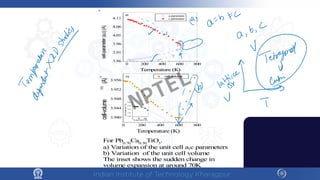
  • 73.
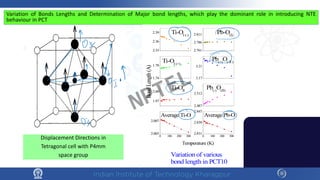
    5 Processes of masschange Weight loss processes: o Decomposition: The breaking apart of chemical bonds. o Evaporation: The loss of volatiles with elevated temperature. o Reduction: Interaction of sample to a reducing atmosphere (hydrogen, ammonia, etc). o Desorption Weight gain processes: o Oxidation: Interaction of the sample with an oxidizing atmosphere. o Absorption o Adsorption o Nitride formation All of these are kinetic processes (i.e. there is a rate at which they occur) NPTEL
  • 74.
    6 Working mechanism ofTGA Weight change Null detector Restoring force • The balance operates on a null-balance principle. At the zero, or “null” position equal amounts of light shine on two photodiodes. • If the balance moves out of the null position an unequal amount of light shines on two photodiodes. Current is then applied to the meter movement to return the balance to the null position. • The amount of current applied is proportional to the weight loss or gain. Fig. : TGA Instrument Scheme Fig. : Null point balance https://sites.google.com/a/iastate.edu/laboratory-10-thermogravimetric- analysis/experimental-methods NPTEL
  • 75.
    7 Working mechanism TGA thermogramanalysis: https://psiberg.com/thermogravimetric-analysis/ where, • 𝜟𝜟m is change in mass • Ti is initial temperature • Tf is final temperature • Onset: The temperature point on the thermogram where the thermal decomposition or reaction of the sample begins. • Endpoint: The temperature point on the thermogram where the thermal decomposition or reaction of the sample is complete NPTEL
  • 76.
    8 Types of TGAcurves WEIGHT PERCENT (%) TEMPERATURE (o C) 0 20 40 60 80 No significant weight change 200 400 600 1000 800 WEIGHT PERCENT (%) TEMPERATURE (o C) 0 20 40 60 80 200 400 600 1000 800 Drying of solvents and no further change WEIGHT PERCENT (%) TEMPERATURE (o C) 0 20 40 60 80 200 400 600 1000 800 Signature curve of TGA Multi step weight loss WEIGHT PERCENT (%) TEMPERATURE (o C) 0 20 40 60 80 200 400 600 1000 800 Oxidation curve 1. No significant change in mass 2. Drying or desorption occurs 3. Single-step decomposition 4. Multistep decomposition 5. Oxidation https://psiberg.com/thermogravimetric-analysis/ NPTEL
  • 77.
    9 Factors affecting TGAcurves: 1. Heating rate 2. Sample size 3. The particle size of the sample 4. Crucible shape and type 5. Gas flow rate 6. Gas type Fig. : Effect of heating rate on TGA curve of Teflon https://psiberg.com/thermogravimetric-analysis/ NPTEL
  • 78.
    10 Applications of TGA: Activation energy  Thermal stability  Determination of accurate drying temperature  Analysis of the burning point and ash content  Material identification and purity assessment  Deduction of the composition of materials and their characterization  Corrosion studies of chemical substances  Aging studies NPTEL
  • 79.
  • 80.
     The thermogravimetricanalysis (TGA) method has been discussed briefly.  Different types of TGA curve has been highlighted.  Heating rate, sample size, particle size, and other factors affect the TGA analysis.  Different applications of TGA have been highlighted. NPTEL
  • 81.
    ⮚ PhysicsofFunctional M aterialsbyH asseFredriksson&U llaA kerlind ⮚IntroductiontoSolidStatePhysicsbyC harlesK ittle ⮚ A tkins’sPhysicalC hem istrybyPeterA tkins,andJuliodePaula. ⮚ ATextbookofN anoscienceandN anotechnology, P.I.VargheseandThalappil, M cG rawH ill E ducation, 2017. NPTEL
  • 82.