http://www.iaeme.com/IJMET/index.asp 342 editor@iaeme.com
International Journal of Mechanical Engineering and Technology (IJMET)
Volume 7, Issue 3, May–June 2016, pp.342–350, Article ID: IJMET_07_03_031
Available online at
http://www.iaeme.com/IJMET/issues.asp?JType=IJMET&VType=7&IType=3
Journal Impact Factor (2016): 9.2286 (Calculated by GISI) www.jifactor.com
ISSN Print: 0976-6340 and ISSN Online: 0976-6359
© IAEME Publication
THERMAL CONDUCTIVITY ANALYSIS IN
VARIOUS MATERIALS USING COMPOSITE
WALL APPARATUS
Asst. Prof. Vikas Mukhraiya and Asst. Prof. Raj Kumar Yadav
Asst. Prof. Department of Mechanical Engineering,
AIST Sagar M.P, India
Sachendra Kori
M.Tech Scholar, Department of Mechanical Engineering,
AIST Sagar M.P, India
ABSTRACT
Heat transfer due to temperature difference and mass concentration
difference as heat and mass transfer. So many research has been made in past
on heat transfer through composite wall of different materials. Which I have
extended this work by taking a new materials like a charcoal and natural gum
as an composite material along with mild steel, Bakelite and wood. In which I
conduct a experiment on a composite material wall apparatus and fitted mica
heater plate centrally in the combination on the composite wall and varying
the voltage at 80 , 120 ,160 and current is different so I found the thermal
conductivity of the material as followed Bakelite – 0.976645 W/m-k , wood-
1.804670 W/m-k , charcoal- 0.272975 W/m-k, and natural gum – 0 according
to the found result i hope the natural gum can be used as a insulating material
in the future.
Cite this Article: Vikas Mukhraiya, Raj Kumar Yadav and Sachendra Kori,
Thermal Conductivity Analysis In Various Materials Using Composite Wall
Apparatus. International Journal of Mechanical Engineering and Technology,
7(3), 2016, pp. 342–350.
http://www.iaeme.com/currentissue.asp?JType=IJMET&VType=7&IType=3
INTRODUCTION
Heat is energy in transition from a region of higher to one of lower temperature in
such a way that the regions reach thermal equilibrium. This temperature difference is
the driving force for the transfer of the thermal energy, also known as heat transfer.
This is the Second Law of Thermodynamics. There are three modes of heat transfer:
Conduction, convection and radiation.
Thermal Conductivity Analysis In Various Materials Using Composite Wall Apparatus
http://www.iaeme.com/IJMET/index.asp 343 editor@iaeme.com
CONDUCTION
When temperature difference exists between different regions in solid or static fluid,
heat transfer occurs by conduction, a process of energy transfer from high energy
molecules to those of lower energy. Although conduction is molecular phenomenon,
on an engineering scale it can be treated as occurring on a continuum.
CONVECTION
When temperature different exists between a surface and a fluid flowing over it, heat
transfer between them will occur by convection. This heat transfer largely due to the
air motion close to the surface of the wall. The air motion is driven by natural or free
convection which arises from density differences due to temperature differences of
air. This is always the case of the interior surfaces. In forced convection the air
motion is produced by an external agency like a wind in a case of exterior wall
surface. Both mechanism may operate together.
RADIATION
The transfer of energy across a system boundary by means of electromagnetic
mechanism which is caused solely by a temperature difference where as the heat trans
by conduction and convection take place only in the presence of medium, radiation
heat transfer does not required any medium.
PROBLEM DEFINITION
in this innovative word there are so many materials are available researching are not
focused on all of than . so in my work I took charcoal and natural gum as composite
material along with mild steel , Bakelite and wood for determining and checking this
feasibility in the are as , where the insulating materials are use a making of glres
,coating of electric dives , for preparing of dress in hazardous places.
THERMAL CONDUCTIVITY
The amount of energy conducted through a body of unit area, and unit thickness in
unit time when the difference in temperature between the faces causing heat flow is
unit temperature difference.
THERMAL CONDUCTIVITY, HEAT TRANSFER REVIEW
Metal in general have electrical conductivity, high thermal conductivity, and high
density. typically they are malleable and ductile ,deforming under stress without
cleaving. In terms of optical properties, metals are shiny and lustrous.
Although most metal have higher densities than most nonmetals, there is wide
variation in their densities, lithium being the least dense solid element and osmium the
densest. The alkali and alkaline earth metals in group 1A and 2A are referred to as the
light metals because they have low density ,low hardness, and low melting point .the
high density of most metals is due to the tightly packed crystal lattice of the metallic
structure. The strength of metallic bound for different metals reaches a maximum
around the center of the transition metal series , a those element have large amount of
delocalized electron in tight binding type metallic bonds .
Vikas Mukhraiya, Raj Kumar Yadav and Sachendra Kori
http://www.iaeme.com/IJMET/index.asp 344 editor@iaeme.com
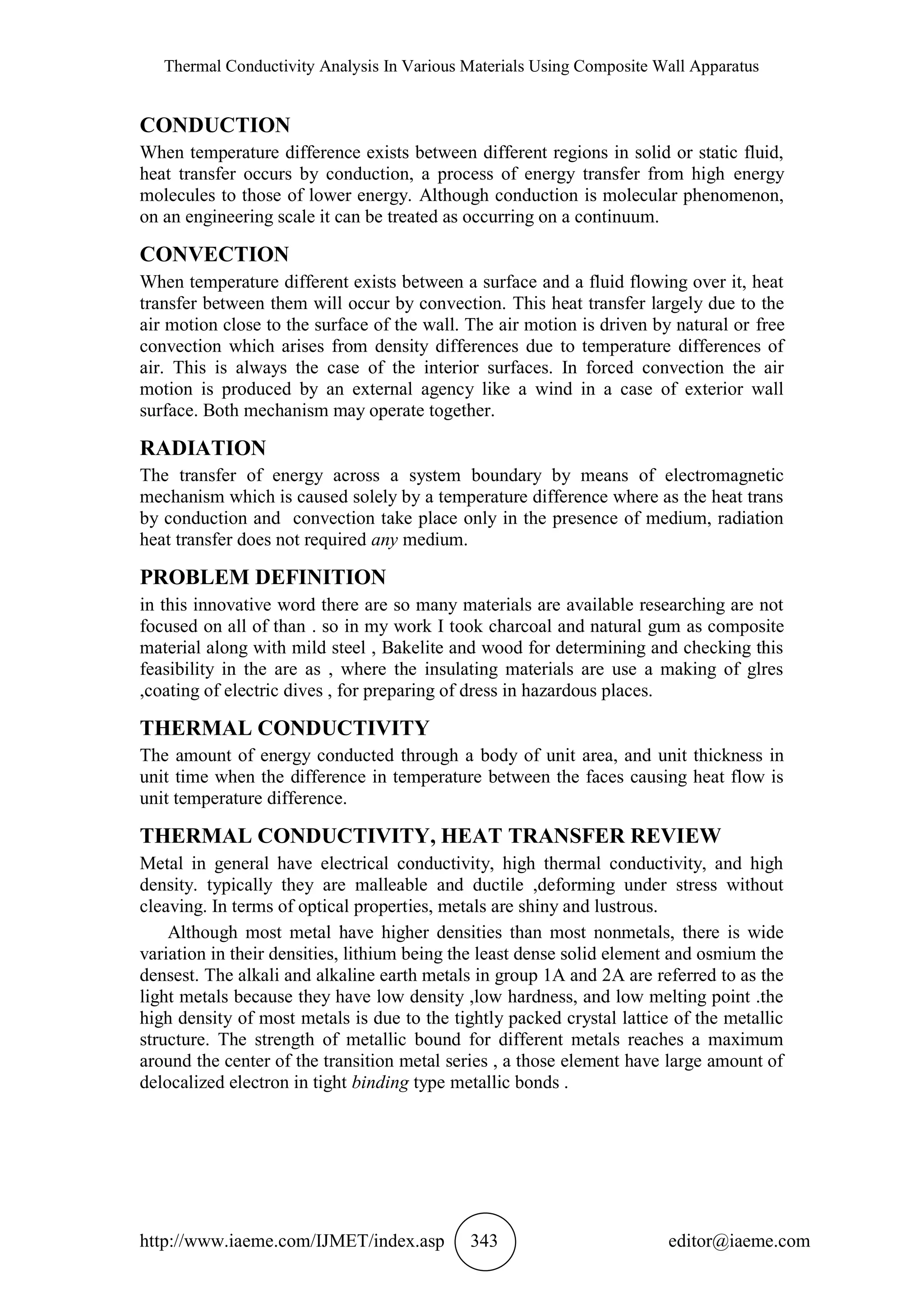
MILD STEEL
Iron –carbon alloy containing less than 0.25 percent carbon which makes it more
ductile and less hard thus rendering it unsuitable for structural work. after determining
that their usual would be ineffective ,the construction company employed mild steel
to create a more rigid building.
Thermal conductivity for cast-iron - (55-60) W/mk
Figure 4.2 Circular plate of mild steel
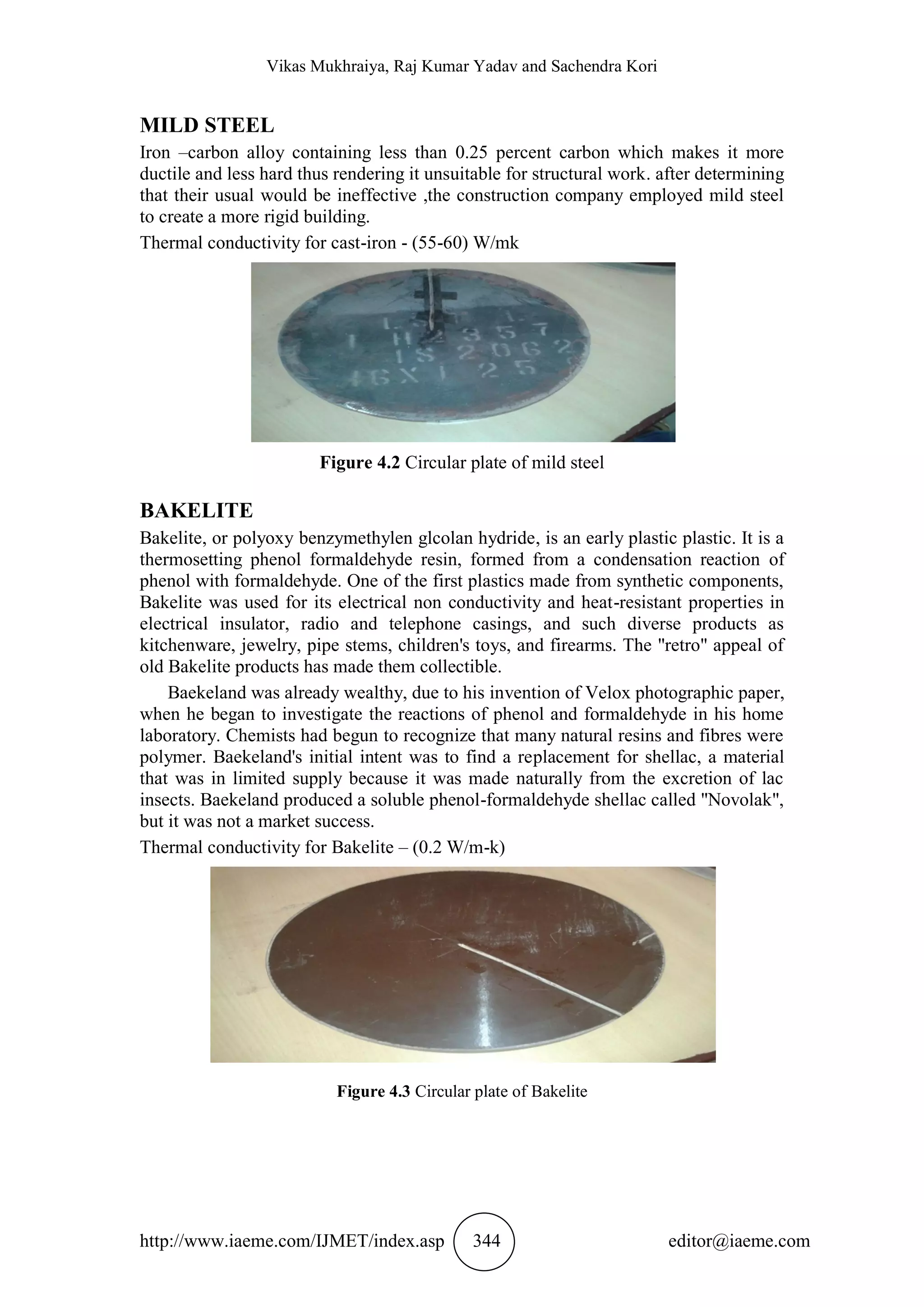
BAKELITE
Bakelite, or polyoxy benzymethylen glcolan hydride, is an early plastic plastic. It is a
thermosetting phenol formaldehyde resin, formed from a condensation reaction of
phenol with formaldehyde. One of the first plastics made from synthetic components,
Bakelite was used for its electrical non conductivity and heat-resistant properties in
electrical insulator, radio and telephone casings, and such diverse products as
kitchenware, jewelry, pipe stems, children's toys, and firearms. The "retro" appeal of
old Bakelite products has made them collectible.
Baekeland was already wealthy, due to his invention of Velox photographic paper,
when he began to investigate the reactions of phenol and formaldehyde in his home
laboratory. Chemists had begun to recognize that many natural resins and fibres were
polymer. Baekeland's initial intent was to find a replacement for shellac, a material
that was in limited supply because it was made naturally from the excretion of lac
insects. Baekeland produced a soluble phenol-formaldehyde shellac called "Novolak",
but it was not a market success.
Thermal conductivity for Bakelite – (0.2 W/m-k)
Figure 4.3 Circular plate of Bakelite
Thermal Conductivity Analysis In Various Materials Using Composite Wall Apparatus
http://www.iaeme.com/IJMET/index.asp 345 editor@iaeme.com
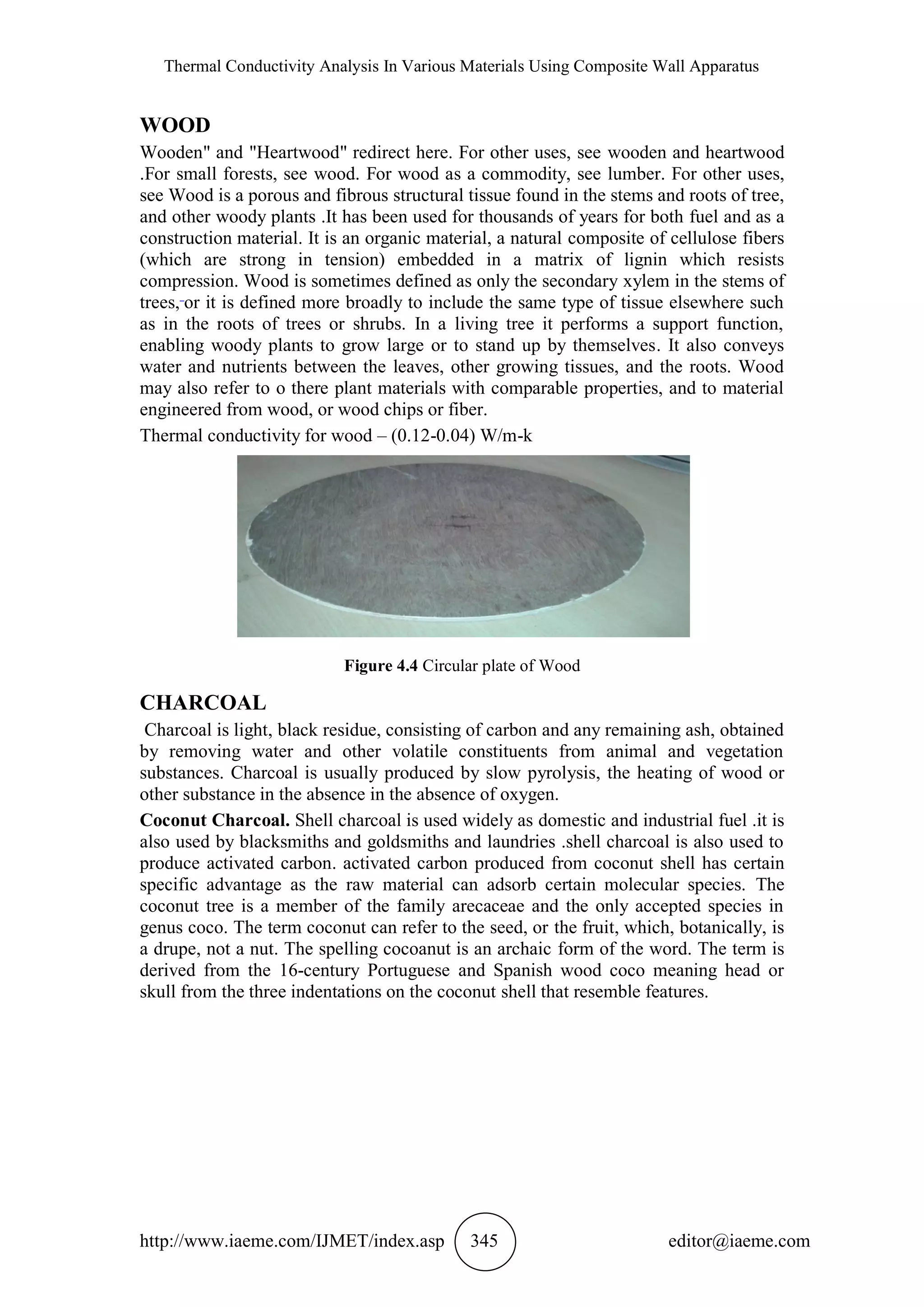
WOOD
Wooden" and "Heartwood" redirect here. For other uses, see wooden and heartwood
.For small forests, see wood. For wood as a commodity, see lumber. For other uses,
see Wood is a porous and fibrous structural tissue found in the stems and roots of tree,
and other woody plants .It has been used for thousands of years for both fuel and as a
construction material. It is an organic material, a natural composite of cellulose fibers
(which are strong in tension) embedded in a matrix of lignin which resists
compression. Wood is sometimes defined as only the secondary xylem in the stems of
trees, or it is defined more broadly to include the same type of tissue elsewhere such
as in the roots of trees or shrubs. In a living tree it performs a support function,
enabling woody plants to grow large or to stand up by themselves. It also conveys
water and nutrients between the leaves, other growing tissues, and the roots. Wood
may also refer to o there plant materials with comparable properties, and to material
engineered from wood, or wood chips or fiber.
Thermal conductivity for wood – (0.12-0.04) W/m-k
Figure 4.4 Circular plate of Wood
CHARCOAL
Charcoal is light, black residue, consisting of carbon and any remaining ash, obtained
by removing water and other volatile constituents from animal and vegetation
substances. Charcoal is usually produced by slow pyrolysis, the heating of wood or
other substance in the absence in the absence of oxygen.
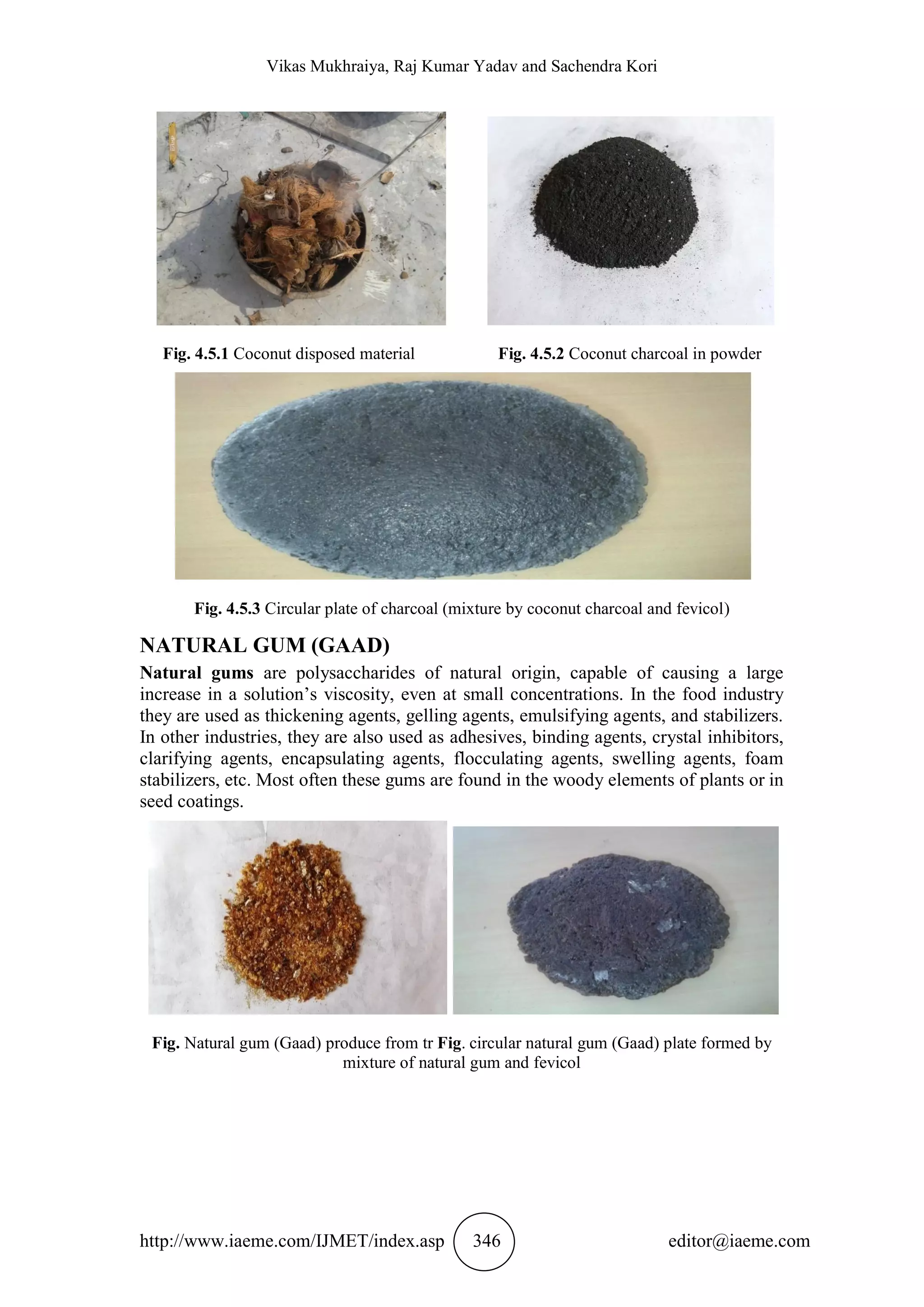
Coconut Charcoal. Shell charcoal is used widely as domestic and industrial fuel .it is
also used by blacksmiths and goldsmiths and laundries .shell charcoal is also used to
produce activated carbon. activated carbon produced from coconut shell has certain
specific advantage as the raw material can adsorb certain molecular species. The
coconut tree is a member of the family arecaceae and the only accepted species in
genus coco. The term coconut can refer to the seed, or the fruit, which, botanically, is
a drupe, not a nut. The spelling cocoanut is an archaic form of the word. The term is
derived from the 16-century Portuguese and Spanish wood coco meaning head or
skull from the three indentations on the coconut shell that resemble features.
Vikas Mukhraiya, Raj Kumar Yadav and Sachendra Kori
http://www.iaeme.com/IJMET/index.asp 346 editor@iaeme.com
Fig. 4.5.1 Coconut disposed material Fig. 4.5.2 Coconut charcoal in powder
Fig. 4.5.3 Circular plate of charcoal (mixture by coconut charcoal and fevicol)
NATURAL GUM (GAAD)
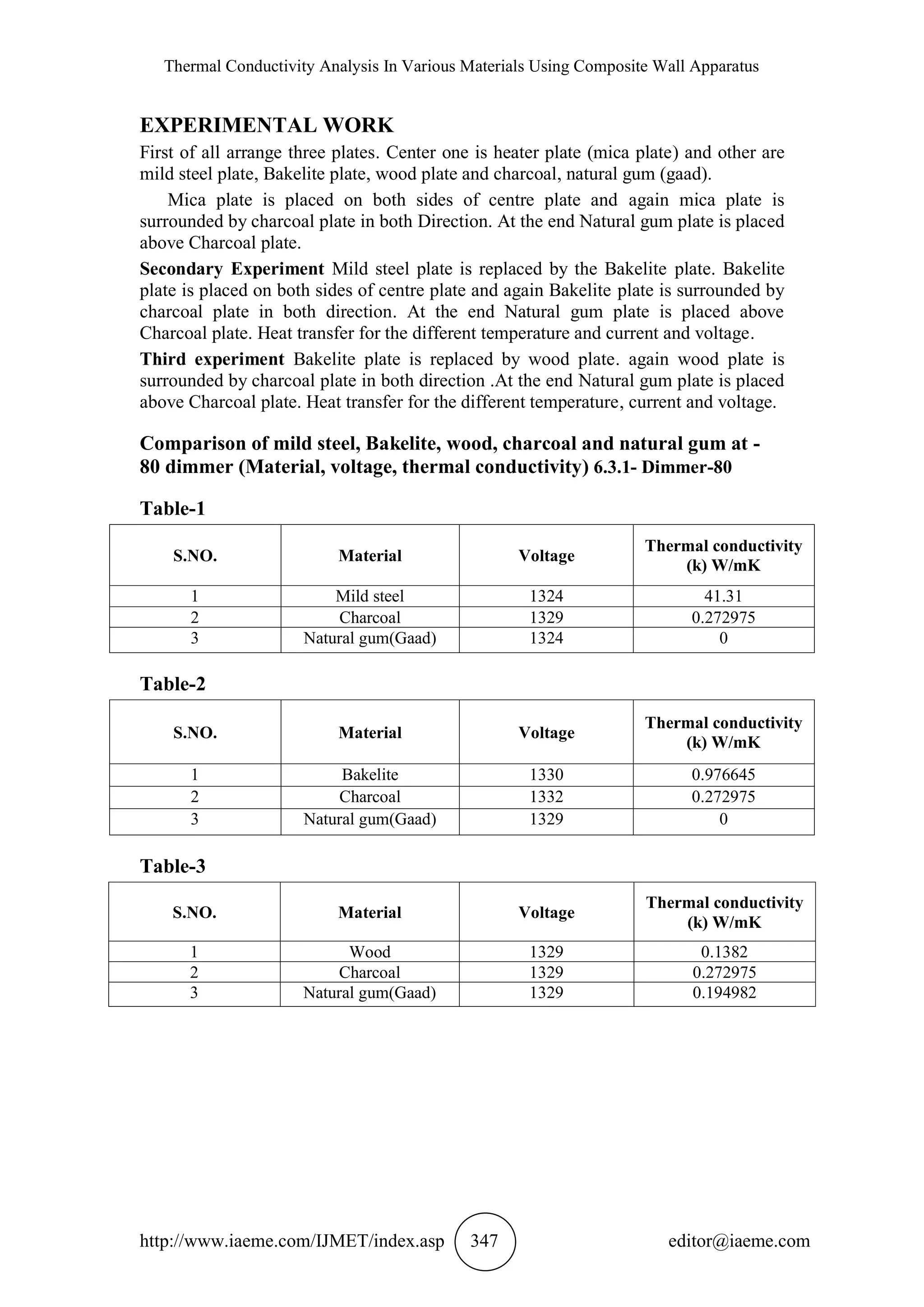
Natural gums are polysaccharides of natural origin, capable of causing a large
increase in a solution’s viscosity, even at small concentrations. In the food industry
they are used as thickening agents, gelling agents, emulsifying agents, and stabilizers.
In other industries, they are also used as adhesives, binding agents, crystal inhibitors,
clarifying agents, encapsulating agents, flocculating agents, swelling agents, foam
stabilizers, etc. Most often these gums are found in the woody elements of plants or in
seed coatings.
Fig. Natural gum (Gaad) produce from tr Fig. circular natural gum (Gaad) plate formed by
mixture of natural gum and fevicol
Thermal Conductivity Analysis In Various Materials Using Composite Wall Apparatus
http://www.iaeme.com/IJMET/index.asp 347 editor@iaeme.com
EXPERIMENTAL WORK
First of all arrange three plates. Center one is heater plate (mica plate) and other are
mild steel plate, Bakelite plate, wood plate and charcoal, natural gum (gaad).
Mica plate is placed on both sides of centre plate and again mica plate is
surrounded by charcoal plate in both Direction. At the end Natural gum plate is placed
above Charcoal plate.
Secondary Experiment Mild steel plate is replaced by the Bakelite plate. Bakelite
plate is placed on both sides of centre plate and again Bakelite plate is surrounded by
charcoal plate in both direction. At the end Natural gum plate is placed above
Charcoal plate. Heat transfer for the different temperature and current and voltage.
Third experiment Bakelite plate is replaced by wood plate. again wood plate is
surrounded by charcoal plate in both direction .At the end Natural gum plate is placed
above Charcoal plate. Heat transfer for the different temperature, current and voltage.
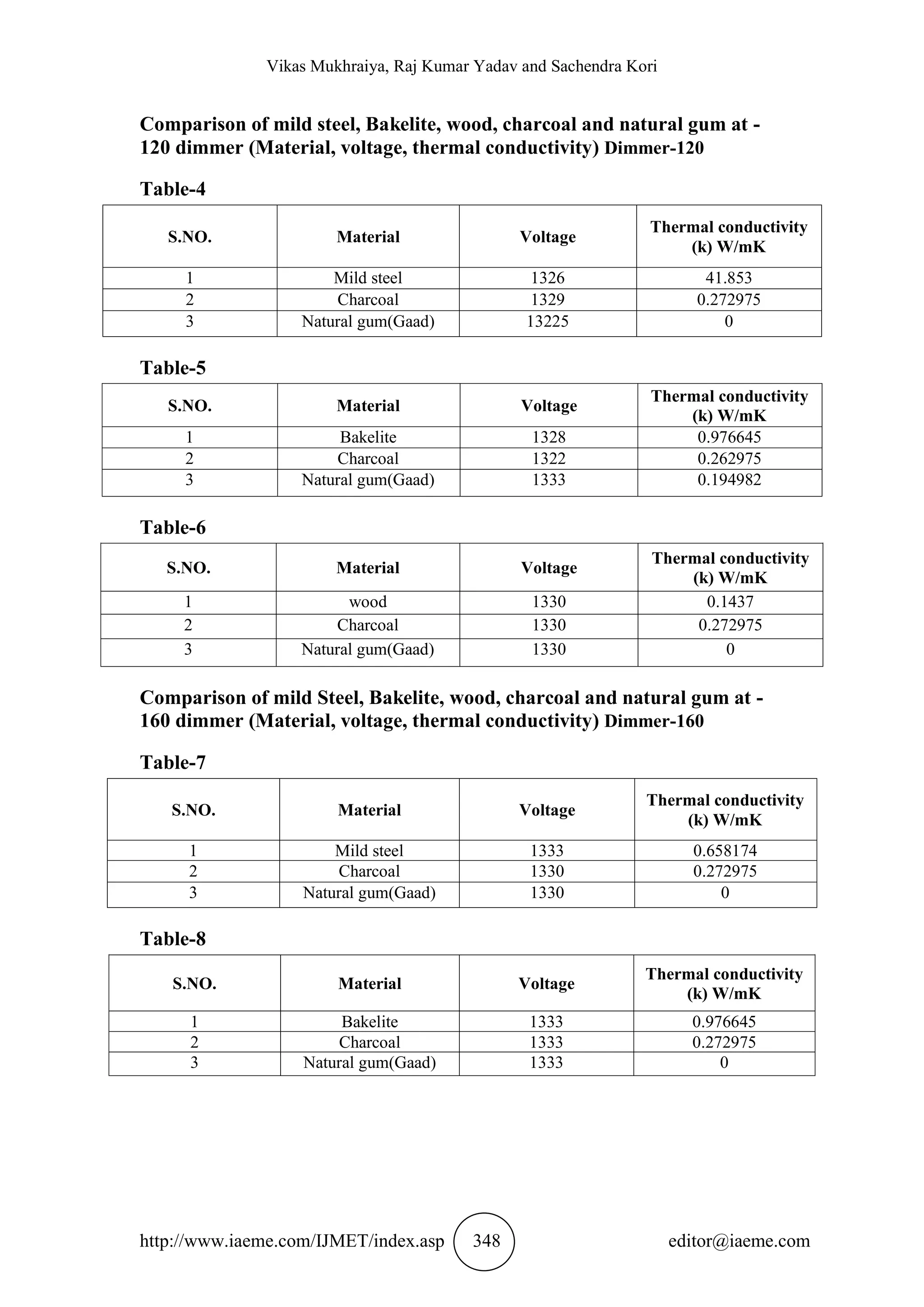
Comparison of mild steel, Bakelite, wood, charcoal and natural gum at -
80 dimmer (Material, voltage, thermal conductivity) 6.3.1- Dimmer-80
Table-1
S.NO. Material Voltage
Thermal conductivity
(k) W/mK
1 Mild steel 1324 41.31
2 Charcoal 1329 0.272975
3 Natural gum(Gaad) 1324 0
Table-2
S.NO. Material Voltage
Thermal conductivity
(k) W/mK
1 Bakelite 1330 0.976645
2 Charcoal 1332 0.272975
3 Natural gum(Gaad) 1329 0
Table-3
S.NO. Material Voltage
Thermal conductivity
(k) W/mK
1 Wood 1329 0.1382
2 Charcoal 1329 0.272975
3 Natural gum(Gaad) 1329 0.194982
Vikas Mukhraiya, Raj Kumar Yadav and Sachendra Kori
http://www.iaeme.com/IJMET/index.asp 348 editor@iaeme.com
Comparison of mild steel, Bakelite, wood, charcoal and natural gum at -
120 dimmer (Material, voltage, thermal conductivity) Dimmer-120
Table-4
S.NO. Material Voltage
Thermal conductivity
(k) W/mK
1 Mild steel 1326 41.853
2 Charcoal 1329 0.272975
3 Natural gum(Gaad) 13225 0
Table-5
S.NO. Material Voltage
Thermal conductivity
(k) W/mK
1 Bakelite 1328 0.976645
2 Charcoal 1322 0.262975
3 Natural gum(Gaad) 1333 0.194982
Table-6
S.NO. Material Voltage
Thermal conductivity
(k) W/mK
1 wood 1330 0.1437
2 Charcoal 1330 0.272975
3 Natural gum(Gaad) 1330 0
Comparison of mild Steel, Bakelite, wood, charcoal and natural gum at -
160 dimmer (Material, voltage, thermal conductivity) Dimmer-160
Table-7
S.NO. Material Voltage
Thermal conductivity
(k) W/mK
1 Mild steel 1333 0.658174
2 Charcoal 1330 0.272975
3 Natural gum(Gaad) 1330 0
Table-8
S.NO. Material Voltage
Thermal conductivity
(k) W/mK
1 Bakelite 1333 0.976645
2 Charcoal 1333 0.272975
3 Natural gum(Gaad) 1333 0
Thermal Conductivity Analysis In Various Materials Using Composite Wall Apparatus
http://www.iaeme.com/IJMET/index.asp 349 editor@iaeme.com
Table-9
S.NO. Material Voltage
Thermal conductivity
(k) W/mK
1 wood 1331 1.804670
2 Charcoal 1331 0.272975
3 Natural gum(Gaad) 1331 0
RESULT AND DISCUSSION
By performing the experiment at different voltage range I found that the thermal
conductivity of natural gum is zero at 1331 volt and thermal conductivity of charcoal
is 0.272975 at same voltage. According to changing the position of dimmer I found
the variation of thermal conductivity of Bakelite, charcoal and wood. But the thermal
conductivity of natural gum is remains zero.
CONCLUSION
According to analysis the most experimental researches gives the result that the
thermal conductivity of natural gum is zero. So we can use the natural gum as a
insulating material. Which is used as in manufacturing of electric wire, electrician
gloves, pluger & cable covers.
REFERENCES
[1] P. Keshavarz and M. Taheri, An improved lumped analysis for transient heat
conduction by using the polynomial approximation method, Heat Mass Transfer,
(2007), 1151–1156
[2] Jian Su, Improved lumped models for asymmetric cooling of a long slab by heat
convection, Int. Comm. Heat Mass Transfer, (2001), 973–983
[3] Jian Su and Renato M. Cotta, Improved lumped parameter formulation for
simplified LWR thermohydraulic analysis, Annals of Nuclear Energy, (2001),
1019–1031
[4] E.J. Correa and R.M. Cotta, Enhanced lumped-differential formulations of
diffusion Problems, Applied Mathematical Modelling (1998) 137–152
[5] A.G. Ostrogorsky, Transient heat conduction in spheres for Fo<0.3 and finite Bi,
Heat Mass Transfer (2008), 1557–1562
[6] Francisco Alhama and Antonio campo, The connection between the distributed
and lumped models for asymmetric cooling of long slabs by heat convection, Int.
Comm. Heat Mass Transfer,(2001), 127–137
[7] Clarissa R. Regis, Renato M. Cotta and Jian Su, Improved lumped analysis of
transient heat conduction in a nuclear fuel rod, Int. ComnL Heat Mass
Transfer,(2000), 357–366
[8] H. Sadat, A general lumped model for transient heat conduction in one
dimensional geometries, Applied Thermal Engineering, (2005) 567–576
[9] Ge Su a, Zheng Tan and Jian Su b, Improved lumped models for transient heat
conduction in a slab with temperature-dependent thermal conductivity, Applied
Mathematical Modeling, (2009), 274–283
[10] Z. Ziabakhsh and G. Domairry, Analytic solution of natural convection flow of a
non Newtonian fluid between two vertical flat plates using homotopy analysis
method Commun Nonlinear Sci Numer Simulat, (2009), 1868–1880
[11] Lee, B. J., Pessiki, S., 2006, Thermal performance evaluation of precast concrete
three-Wythe sandwich wall panels, Energy and Buildings, 1006–1014.
Vikas Mukhraiya, Raj Kumar Yadav and Sachendra Kori
http://www.iaeme.com/IJMET/index.asp 350 editor@iaeme.com
[12] Ho, C. J. and Yih, Y. L., 1987, Conjugate natural convection heat transfer in an
air-fileld rectangular cavity, International Communication in Heat and Mass
Transfer, 91–100.
[13] Tong, T. W. and Gerner, F. M., 1986, Natural convection in partitioned air-filled
rectangular enclosures, International Communication in Heat and Mass Transfer,
99–108.
[14] Kangni, A., Yedder B. and Bilgen, E., 1991, Natural convection and conduction
inenclosures with multiple vertical partitions, Int. J. Heat and Mass Transfer,
2819–2825.
[15] Torkoglu, H. and Yucel, N., 1996, Natural convection heat transfer in enclosures
with conducting multi le partitions and side walls, Heat and Mass Transfer, 2 1–
8.
[16] Lorente, S., 2002, Heat losses through building walls with closed, open and
deformable cavities, International Journal of Energy Research, 611–632.
[17] Antar, M. A. and Thomas, L. C., 2001, Heat transfer through a composite wall
with enclosed spaces: A practical two-dimensional analysis approach, ASHRAE
Transactions, 106, 318–324.
[18] Vikas Mukhraiya, Raj Kumar Yadav and Madhav Kumar, A Proposal For Wind-
Energy Conversion For Low Wind–Speed Areas of India. International Journal
of Mechanical Engineering and Technology, 6(11), 2015, pp. 84–88.
[19] Janvijay Pateriya, Raj Kumar Yadav, Vikas Mukhraiya and Pankaj Singh, Brake
Disc Analysis with the Help of Ansys Software. International Journal of
Mechanical Engineering and Technology, 6(11), 2015, pp. 114–122.
[20] Vikas Mukhariyia, Raj Kumar Yadav, Ashish Tiwari and Pankaj Singh, Damped
Vibration Analysis of Composite Simply Supported Beam. International Journal
of Mechanical Engineering and Technology, 6(11), 2015, pp. 106–113
[21] Raj Kumar Yadav, Pankaj Singh, Anurag Singh and Sandhya Yadav, Industrial
Waste Heat Used In Typical Thermal Power Plant. International Journal of
Mechanical Engineering and Technology, 6(11), 2015, pp. 57–63.
[22] Antar, M. A. and Thomas, L. C., 2004, Heat Transfer Through a Composite Wall
with an Evacuated Rectangular Gray body Radiating Space: A Numerical
Solution, ASHRAE Transactions, 36–45.

THERMAL CONDUCTIVITY ANALYSIS IN VARIOUS MATERIALS USING COMPOSITE WALL APPARATUS

  • 1.
    http://www.iaeme.com/IJMET/index.asp 342 editor@iaeme.com InternationalJournal of Mechanical Engineering and Technology (IJMET) Volume 7, Issue 3, May–June 2016, pp.342–350, Article ID: IJMET_07_03_031 Available online at http://www.iaeme.com/IJMET/issues.asp?JType=IJMET&VType=7&IType=3 Journal Impact Factor (2016): 9.2286 (Calculated by GISI) www.jifactor.com ISSN Print: 0976-6340 and ISSN Online: 0976-6359 © IAEME Publication THERMAL CONDUCTIVITY ANALYSIS IN VARIOUS MATERIALS USING COMPOSITE WALL APPARATUS Asst. Prof. Vikas Mukhraiya and Asst. Prof. Raj Kumar Yadav Asst. Prof. Department of Mechanical Engineering, AIST Sagar M.P, India Sachendra Kori M.Tech Scholar, Department of Mechanical Engineering, AIST Sagar M.P, India ABSTRACT Heat transfer due to temperature difference and mass concentration difference as heat and mass transfer. So many research has been made in past on heat transfer through composite wall of different materials. Which I have extended this work by taking a new materials like a charcoal and natural gum as an composite material along with mild steel, Bakelite and wood. In which I conduct a experiment on a composite material wall apparatus and fitted mica heater plate centrally in the combination on the composite wall and varying the voltage at 80 , 120 ,160 and current is different so I found the thermal conductivity of the material as followed Bakelite – 0.976645 W/m-k , wood- 1.804670 W/m-k , charcoal- 0.272975 W/m-k, and natural gum – 0 according to the found result i hope the natural gum can be used as a insulating material in the future. Cite this Article: Vikas Mukhraiya, Raj Kumar Yadav and Sachendra Kori, Thermal Conductivity Analysis In Various Materials Using Composite Wall Apparatus. International Journal of Mechanical Engineering and Technology, 7(3), 2016, pp. 342–350. http://www.iaeme.com/currentissue.asp?JType=IJMET&VType=7&IType=3 INTRODUCTION Heat is energy in transition from a region of higher to one of lower temperature in such a way that the regions reach thermal equilibrium. This temperature difference is the driving force for the transfer of the thermal energy, also known as heat transfer. This is the Second Law of Thermodynamics. There are three modes of heat transfer: Conduction, convection and radiation.
  • 2.
    Thermal Conductivity AnalysisIn Various Materials Using Composite Wall Apparatus http://www.iaeme.com/IJMET/index.asp 343 editor@iaeme.com CONDUCTION When temperature difference exists between different regions in solid or static fluid, heat transfer occurs by conduction, a process of energy transfer from high energy molecules to those of lower energy. Although conduction is molecular phenomenon, on an engineering scale it can be treated as occurring on a continuum. CONVECTION When temperature different exists between a surface and a fluid flowing over it, heat transfer between them will occur by convection. This heat transfer largely due to the air motion close to the surface of the wall. The air motion is driven by natural or free convection which arises from density differences due to temperature differences of air. This is always the case of the interior surfaces. In forced convection the air motion is produced by an external agency like a wind in a case of exterior wall surface. Both mechanism may operate together. RADIATION The transfer of energy across a system boundary by means of electromagnetic mechanism which is caused solely by a temperature difference where as the heat trans by conduction and convection take place only in the presence of medium, radiation heat transfer does not required any medium. PROBLEM DEFINITION in this innovative word there are so many materials are available researching are not focused on all of than . so in my work I took charcoal and natural gum as composite material along with mild steel , Bakelite and wood for determining and checking this feasibility in the are as , where the insulating materials are use a making of glres ,coating of electric dives , for preparing of dress in hazardous places. THERMAL CONDUCTIVITY The amount of energy conducted through a body of unit area, and unit thickness in unit time when the difference in temperature between the faces causing heat flow is unit temperature difference. THERMAL CONDUCTIVITY, HEAT TRANSFER REVIEW Metal in general have electrical conductivity, high thermal conductivity, and high density. typically they are malleable and ductile ,deforming under stress without cleaving. In terms of optical properties, metals are shiny and lustrous. Although most metal have higher densities than most nonmetals, there is wide variation in their densities, lithium being the least dense solid element and osmium the densest. The alkali and alkaline earth metals in group 1A and 2A are referred to as the light metals because they have low density ,low hardness, and low melting point .the high density of most metals is due to the tightly packed crystal lattice of the metallic structure. The strength of metallic bound for different metals reaches a maximum around the center of the transition metal series , a those element have large amount of delocalized electron in tight binding type metallic bonds .
  • 3.
    Vikas Mukhraiya, RajKumar Yadav and Sachendra Kori http://www.iaeme.com/IJMET/index.asp 344 editor@iaeme.com MILD STEEL Iron –carbon alloy containing less than 0.25 percent carbon which makes it more ductile and less hard thus rendering it unsuitable for structural work. after determining that their usual would be ineffective ,the construction company employed mild steel to create a more rigid building. Thermal conductivity for cast-iron - (55-60) W/mk Figure 4.2 Circular plate of mild steel BAKELITE Bakelite, or polyoxy benzymethylen glcolan hydride, is an early plastic plastic. It is a thermosetting phenol formaldehyde resin, formed from a condensation reaction of phenol with formaldehyde. One of the first plastics made from synthetic components, Bakelite was used for its electrical non conductivity and heat-resistant properties in electrical insulator, radio and telephone casings, and such diverse products as kitchenware, jewelry, pipe stems, children's toys, and firearms. The "retro" appeal of old Bakelite products has made them collectible. Baekeland was already wealthy, due to his invention of Velox photographic paper, when he began to investigate the reactions of phenol and formaldehyde in his home laboratory. Chemists had begun to recognize that many natural resins and fibres were polymer. Baekeland's initial intent was to find a replacement for shellac, a material that was in limited supply because it was made naturally from the excretion of lac insects. Baekeland produced a soluble phenol-formaldehyde shellac called "Novolak", but it was not a market success. Thermal conductivity for Bakelite – (0.2 W/m-k) Figure 4.3 Circular plate of Bakelite
  • 4.
    Thermal Conductivity AnalysisIn Various Materials Using Composite Wall Apparatus http://www.iaeme.com/IJMET/index.asp 345 editor@iaeme.com WOOD Wooden" and "Heartwood" redirect here. For other uses, see wooden and heartwood .For small forests, see wood. For wood as a commodity, see lumber. For other uses, see Wood is a porous and fibrous structural tissue found in the stems and roots of tree, and other woody plants .It has been used for thousands of years for both fuel and as a construction material. It is an organic material, a natural composite of cellulose fibers (which are strong in tension) embedded in a matrix of lignin which resists compression. Wood is sometimes defined as only the secondary xylem in the stems of trees, or it is defined more broadly to include the same type of tissue elsewhere such as in the roots of trees or shrubs. In a living tree it performs a support function, enabling woody plants to grow large or to stand up by themselves. It also conveys water and nutrients between the leaves, other growing tissues, and the roots. Wood may also refer to o there plant materials with comparable properties, and to material engineered from wood, or wood chips or fiber. Thermal conductivity for wood – (0.12-0.04) W/m-k Figure 4.4 Circular plate of Wood CHARCOAL Charcoal is light, black residue, consisting of carbon and any remaining ash, obtained by removing water and other volatile constituents from animal and vegetation substances. Charcoal is usually produced by slow pyrolysis, the heating of wood or other substance in the absence in the absence of oxygen. Coconut Charcoal. Shell charcoal is used widely as domestic and industrial fuel .it is also used by blacksmiths and goldsmiths and laundries .shell charcoal is also used to produce activated carbon. activated carbon produced from coconut shell has certain specific advantage as the raw material can adsorb certain molecular species. The coconut tree is a member of the family arecaceae and the only accepted species in genus coco. The term coconut can refer to the seed, or the fruit, which, botanically, is a drupe, not a nut. The spelling cocoanut is an archaic form of the word. The term is derived from the 16-century Portuguese and Spanish wood coco meaning head or skull from the three indentations on the coconut shell that resemble features.
  • 5.
    Vikas Mukhraiya, RajKumar Yadav and Sachendra Kori http://www.iaeme.com/IJMET/index.asp 346 editor@iaeme.com Fig. 4.5.1 Coconut disposed material Fig. 4.5.2 Coconut charcoal in powder Fig. 4.5.3 Circular plate of charcoal (mixture by coconut charcoal and fevicol) NATURAL GUM (GAAD) Natural gums are polysaccharides of natural origin, capable of causing a large increase in a solution’s viscosity, even at small concentrations. In the food industry they are used as thickening agents, gelling agents, emulsifying agents, and stabilizers. In other industries, they are also used as adhesives, binding agents, crystal inhibitors, clarifying agents, encapsulating agents, flocculating agents, swelling agents, foam stabilizers, etc. Most often these gums are found in the woody elements of plants or in seed coatings. Fig. Natural gum (Gaad) produce from tr Fig. circular natural gum (Gaad) plate formed by mixture of natural gum and fevicol
  • 6.
    Thermal Conductivity AnalysisIn Various Materials Using Composite Wall Apparatus http://www.iaeme.com/IJMET/index.asp 347 editor@iaeme.com EXPERIMENTAL WORK First of all arrange three plates. Center one is heater plate (mica plate) and other are mild steel plate, Bakelite plate, wood plate and charcoal, natural gum (gaad). Mica plate is placed on both sides of centre plate and again mica plate is surrounded by charcoal plate in both Direction. At the end Natural gum plate is placed above Charcoal plate. Secondary Experiment Mild steel plate is replaced by the Bakelite plate. Bakelite plate is placed on both sides of centre plate and again Bakelite plate is surrounded by charcoal plate in both direction. At the end Natural gum plate is placed above Charcoal plate. Heat transfer for the different temperature and current and voltage. Third experiment Bakelite plate is replaced by wood plate. again wood plate is surrounded by charcoal plate in both direction .At the end Natural gum plate is placed above Charcoal plate. Heat transfer for the different temperature, current and voltage. Comparison of mild steel, Bakelite, wood, charcoal and natural gum at - 80 dimmer (Material, voltage, thermal conductivity) 6.3.1- Dimmer-80 Table-1 S.NO. Material Voltage Thermal conductivity (k) W/mK 1 Mild steel 1324 41.31 2 Charcoal 1329 0.272975 3 Natural gum(Gaad) 1324 0 Table-2 S.NO. Material Voltage Thermal conductivity (k) W/mK 1 Bakelite 1330 0.976645 2 Charcoal 1332 0.272975 3 Natural gum(Gaad) 1329 0 Table-3 S.NO. Material Voltage Thermal conductivity (k) W/mK 1 Wood 1329 0.1382 2 Charcoal 1329 0.272975 3 Natural gum(Gaad) 1329 0.194982
  • 7.
    Vikas Mukhraiya, RajKumar Yadav and Sachendra Kori http://www.iaeme.com/IJMET/index.asp 348 editor@iaeme.com Comparison of mild steel, Bakelite, wood, charcoal and natural gum at - 120 dimmer (Material, voltage, thermal conductivity) Dimmer-120 Table-4 S.NO. Material Voltage Thermal conductivity (k) W/mK 1 Mild steel 1326 41.853 2 Charcoal 1329 0.272975 3 Natural gum(Gaad) 13225 0 Table-5 S.NO. Material Voltage Thermal conductivity (k) W/mK 1 Bakelite 1328 0.976645 2 Charcoal 1322 0.262975 3 Natural gum(Gaad) 1333 0.194982 Table-6 S.NO. Material Voltage Thermal conductivity (k) W/mK 1 wood 1330 0.1437 2 Charcoal 1330 0.272975 3 Natural gum(Gaad) 1330 0 Comparison of mild Steel, Bakelite, wood, charcoal and natural gum at - 160 dimmer (Material, voltage, thermal conductivity) Dimmer-160 Table-7 S.NO. Material Voltage Thermal conductivity (k) W/mK 1 Mild steel 1333 0.658174 2 Charcoal 1330 0.272975 3 Natural gum(Gaad) 1330 0 Table-8 S.NO. Material Voltage Thermal conductivity (k) W/mK 1 Bakelite 1333 0.976645 2 Charcoal 1333 0.272975 3 Natural gum(Gaad) 1333 0
  • 8.
    Thermal Conductivity AnalysisIn Various Materials Using Composite Wall Apparatus http://www.iaeme.com/IJMET/index.asp 349 editor@iaeme.com Table-9 S.NO. Material Voltage Thermal conductivity (k) W/mK 1 wood 1331 1.804670 2 Charcoal 1331 0.272975 3 Natural gum(Gaad) 1331 0 RESULT AND DISCUSSION By performing the experiment at different voltage range I found that the thermal conductivity of natural gum is zero at 1331 volt and thermal conductivity of charcoal is 0.272975 at same voltage. According to changing the position of dimmer I found the variation of thermal conductivity of Bakelite, charcoal and wood. But the thermal conductivity of natural gum is remains zero. CONCLUSION According to analysis the most experimental researches gives the result that the thermal conductivity of natural gum is zero. So we can use the natural gum as a insulating material. Which is used as in manufacturing of electric wire, electrician gloves, pluger & cable covers. REFERENCES [1] P. Keshavarz and M. Taheri, An improved lumped analysis for transient heat conduction by using the polynomial approximation method, Heat Mass Transfer, (2007), 1151–1156 [2] Jian Su, Improved lumped models for asymmetric cooling of a long slab by heat convection, Int. Comm. Heat Mass Transfer, (2001), 973–983 [3] Jian Su and Renato M. Cotta, Improved lumped parameter formulation for simplified LWR thermohydraulic analysis, Annals of Nuclear Energy, (2001), 1019–1031 [4] E.J. Correa and R.M. Cotta, Enhanced lumped-differential formulations of diffusion Problems, Applied Mathematical Modelling (1998) 137–152 [5] A.G. Ostrogorsky, Transient heat conduction in spheres for Fo<0.3 and finite Bi, Heat Mass Transfer (2008), 1557–1562 [6] Francisco Alhama and Antonio campo, The connection between the distributed and lumped models for asymmetric cooling of long slabs by heat convection, Int. Comm. Heat Mass Transfer,(2001), 127–137 [7] Clarissa R. Regis, Renato M. Cotta and Jian Su, Improved lumped analysis of transient heat conduction in a nuclear fuel rod, Int. ComnL Heat Mass Transfer,(2000), 357–366 [8] H. Sadat, A general lumped model for transient heat conduction in one dimensional geometries, Applied Thermal Engineering, (2005) 567–576 [9] Ge Su a, Zheng Tan and Jian Su b, Improved lumped models for transient heat conduction in a slab with temperature-dependent thermal conductivity, Applied Mathematical Modeling, (2009), 274–283 [10] Z. Ziabakhsh and G. Domairry, Analytic solution of natural convection flow of a non Newtonian fluid between two vertical flat plates using homotopy analysis method Commun Nonlinear Sci Numer Simulat, (2009), 1868–1880 [11] Lee, B. J., Pessiki, S., 2006, Thermal performance evaluation of precast concrete three-Wythe sandwich wall panels, Energy and Buildings, 1006–1014.
  • 9.
    Vikas Mukhraiya, RajKumar Yadav and Sachendra Kori http://www.iaeme.com/IJMET/index.asp 350 editor@iaeme.com [12] Ho, C. J. and Yih, Y. L., 1987, Conjugate natural convection heat transfer in an air-fileld rectangular cavity, International Communication in Heat and Mass Transfer, 91–100. [13] Tong, T. W. and Gerner, F. M., 1986, Natural convection in partitioned air-filled rectangular enclosures, International Communication in Heat and Mass Transfer, 99–108. [14] Kangni, A., Yedder B. and Bilgen, E., 1991, Natural convection and conduction inenclosures with multiple vertical partitions, Int. J. Heat and Mass Transfer, 2819–2825. [15] Torkoglu, H. and Yucel, N., 1996, Natural convection heat transfer in enclosures with conducting multi le partitions and side walls, Heat and Mass Transfer, 2 1– 8. [16] Lorente, S., 2002, Heat losses through building walls with closed, open and deformable cavities, International Journal of Energy Research, 611–632. [17] Antar, M. A. and Thomas, L. C., 2001, Heat transfer through a composite wall with enclosed spaces: A practical two-dimensional analysis approach, ASHRAE Transactions, 106, 318–324. [18] Vikas Mukhraiya, Raj Kumar Yadav and Madhav Kumar, A Proposal For Wind- Energy Conversion For Low Wind–Speed Areas of India. International Journal of Mechanical Engineering and Technology, 6(11), 2015, pp. 84–88. [19] Janvijay Pateriya, Raj Kumar Yadav, Vikas Mukhraiya and Pankaj Singh, Brake Disc Analysis with the Help of Ansys Software. International Journal of Mechanical Engineering and Technology, 6(11), 2015, pp. 114–122. [20] Vikas Mukhariyia, Raj Kumar Yadav, Ashish Tiwari and Pankaj Singh, Damped Vibration Analysis of Composite Simply Supported Beam. International Journal of Mechanical Engineering and Technology, 6(11), 2015, pp. 106–113 [21] Raj Kumar Yadav, Pankaj Singh, Anurag Singh and Sandhya Yadav, Industrial Waste Heat Used In Typical Thermal Power Plant. International Journal of Mechanical Engineering and Technology, 6(11), 2015, pp. 57–63. [22] Antar, M. A. and Thomas, L. C., 2004, Heat Transfer Through a Composite Wall with an Evacuated Rectangular Gray body Radiating Space: A Numerical Solution, ASHRAE Transactions, 36–45.