Wire Rope Design
Wire-Rope:-Selection,
Construction,
classification ,
designations,
stresses in wire ropes,
selection of wire rope for given loads.
C0NTENT
 What is Wire-Rope
How to Selection Wire-Rope,
 To study Construction,
Classification ,designations,
To study various Stresses in wire ropes,
Selection of wire rope for given loads.
ObjectivesObjectives
Rope Drives
The rope drives are widely used where a large amount of power is to
be transmitted, from one pulley to another, over a considerable
distance.
 It may be noted that the use of flat belts is limited for the
transmission of moderate power from one pulley to another when the
two pulleys are not more than 8 meters apart.
If large amounts of power are to be transmitted, by the flat belt, then
it would result in excessive belt cross-section.
 The ropes drives use the following two types of ropes : 1. Fibre
ropes, and 2. Wire ropes.
The fibre ropes operate successfully when the pulleys are about 60
metres apart, while the wire ropes are used when the pulleys are up to
150 metres apart.
Fibre Ropes
The ropes for transmitting power are usually made from fibrous
materials such as hemp, manila and cotton. Since the hemp and manila
fibres are rough, therefore the ropes made from these fibres are not
very flexible and possesses poor mechanical properties.
The hemp ropes have less strength as compared to manila ropes.
When the hemp and manila ropes are bent over the sheave, there is
some sliding of the fibres, causing the rope to wear and chafe
internally. In order to minimise this defect, the rope fibres are
lubricated with a tar, tallow or graphite.
The lubrication also makes the rope moisture proof. The hemp ropes
are suitable only for hand operated hoisting machinery and as tie ropes
for lifting tackle, hooks etc.
 The cotton ropes are very soft and smooth. The lubrication of cotton
ropes is not necessary. But if it is done, it reduces the external wear
between the rope and the grooves of its sheaves.
It may be noted that the manila ropes are more durable and stronger
than cotton ropes. The cotton ropes are costlier than manila ropes.
The fibre rope drives have the following advantages :
1. They give smooth, steady and quiet service.
2. They are little affected by out door conditions.
3. The shafts may be out of strict alignment.
4. The power may be taken off in any direction and in
fractional parts of the whole amount.
5. They give high mechanical efficiency.
Advantages of Fibre Rope Drives
Wire Ropes
When a large amount of power is to be transmitted over long
distances from one pulley to another (i.e. when the pulleys are
up to 150 meters apart), then wire ropes are used.
The wire ropes are widely used in elevators, mine hoists,
cranes, conveyors, hauling devices and suspension bridges.
The wire ropes run on grooved pulleys but they rest on the
bottom of the *grooves and are not wedged between the sides
of the grooves.
The wire ropes are made from cold drawn wires in order to
have increase in strength and durability.
It may be noted that the strength of the wire rope increases as
its size decreases.
The various materials used for wire ropes in order of
increasing strength are wrought iron, cast steel, extra strong
cast steel, plough steel and alloy steel. For certain purposes, the
wire ropes may also be made of copper, bronze, aluminium
alloys and stainless steels.
Why Wire RopeWhy Wire Rope
 Small Wires are stronger per cross sectional area
 Excellent for Tension
 Flexible-Can be wound
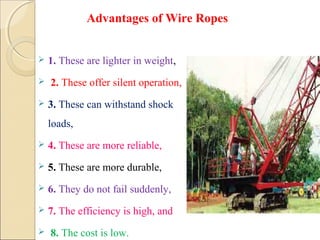
 1. These are lighter in weight,
 2. These offer silent operation,
 3. These can withstand shock
loads,
 4. These are more reliable,
 5. These are more durable,
 6. They do not fail suddenly,
 7. The efficiency is high, and
 8. The cost is low.
Advantages of Wire Ropes
Construction of Wire RopesConstruction of Wire Ropes
The wires are first given special heat treatment and then cold
drawn in order to have high strength and durability of the rope.
The steel wire ropes are manufactured by special machines.
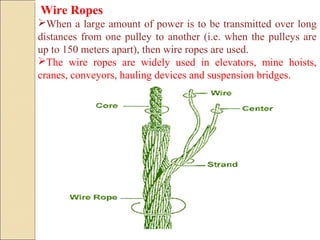
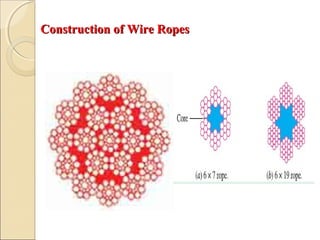
First of all, a number of wires such as 7, 19 or 37 are twisted into
a strand and then a number of strands, usually 6 or 8 are twisted
about a core or centre to form the rope as shown in Fig.
 The core may be made of hemp, jute, asbestos or a wire of
softer steel. The core must be continuously saturated with
lubricant for the long life of the core as well as the entire rope.
 The asbestos or soft wire core is used when ropes are subjected
to radiant heat such as cranes operating near furnaces. However,
a wire core reduces the flexibility of the rope and thus such ropes
are used only where they are subjected to high compression as in
the case of several layers wound over a rope drum.
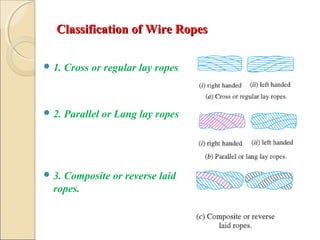
Classification of Wire RopesClassification of Wire Ropes
 1. Cross or regular lay ropes
 2. Parallel or Lang lay ropes
 3. Composite or reverse laid
ropes.
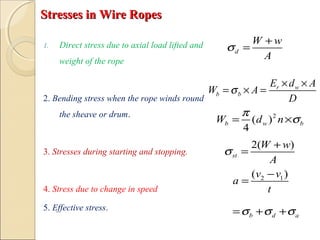
Stresses in Wire RopesStresses in Wire Ropes
1. Direct stress due to axial load lifted and
weight of the rope
2. Bending stress when the rope winds round
the sheave or drum.
3. Stresses during starting and stopping.
4. Stress due to change in speed
5. Effective stress.
d
W w
A
σ
+
=
r w
b b
E d A
W A
D
σ
× ×
= × =
2
( )
4
b w bW d n
π
σ= ×
2( )
st
W w
A
σ
+
=
2 1( )v v
a
t
−
=
b d aσ σ σ= + +
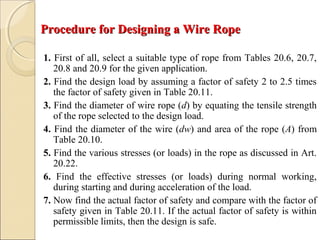
Procedure for Designing a Wire RopeProcedure for Designing a Wire Rope
1. First of all, select a suitable type of rope from Tables 20.6, 20.7,
20.8 and 20.9 for the given application.
2. Find the design load by assuming a factor of safety 2 to 2.5 times
the factor of safety given in Table 20.11.
3. Find the diameter of wire rope (d) by equating the tensile strength
of the rope selected to the design load.
4. Find the diameter of the wire (dw) and area of the rope (A) from
Table 20.10.
5. Find the various stresses (or loads) in the rope as discussed in Art.
20.22.
6. Find the effective stresses (or loads) during normal working,
during starting and during acceleration of the load.
7. Now find the actual factor of safety and compare with the factor of
safety given in Table 20.11. If the actual factor of safety is within
permissible limits, then the design is safe.
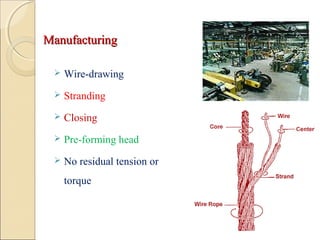
ManufacturingManufacturing
 Wire-drawing
 Stranding
 Closing
 Pre-forming head
 No residual tension or
torque
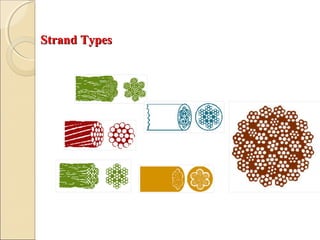
Strand TypesStrand Types
Design ConsiderationsDesign Considerations
 Breaking strength
 Flexibility
 Crush resistance
 Abrasion resistance
 Fatigue Resistance increases with more wires.
 Abrasion Resistance increases with larger wires
1.Quantity in feet or pieces
2.Diameter & tolerance
3.Construction
4.Material
5.Length required
6.Reel or packaging requirements, if any
7.Specification or drawing, if applicable
8.Lubrication, if not covered by specification
9.Delivery requirements
10.Transportation preference
11.Certification required
12.Any other special information
When requesting a quotation or placing an order,
please give us the following information about
your requirements.
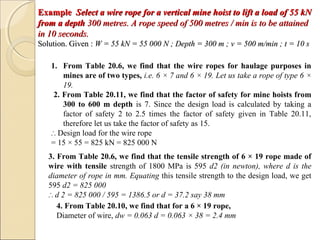
ExampleExample Select a wire rope for a vertical mine hoist to lift a load of 55 kNSelect a wire rope for a vertical mine hoist to lift a load of 55 kN
from a depthfrom a depth 300 metres. A rope speed of 500 metres / min is to be attained300 metres. A rope speed of 500 metres / min is to be attained
in 10 seconds.in 10 seconds.
Solution. Given :Solution. Given : W = 55 kN = 55 000 N ; Depth = 300 m ; v = 500 m/min ; t = 10 sW = 55 kN = 55 000 N ; Depth = 300 m ; v = 500 m/min ; t = 10 s
1. From Table 20.6, we find that the wire ropes for haulage purposes in
mines are of two types, i.e. 6 × 7 and 6 × 19. Let us take a rope of type 6 ×
19.
2. From Table 20.11, we find that the factor of safety for mine hoists from
300 to 600 m depth is 7. Since the design load is calculated by taking a
factor of safety 2 to 2.5 times the factor of safety given in Table 20.11,
therefore let us take the factor of safety as 15.
∴ Design load for the wire rope
= 15 × 55 = 825 kN = 825 000 N
3. From Table 20.6, we find that the tensile strength of 6 × 19 rope made of
wire with tensile strength of 1800 MPa is 595 d2 (in newton), where d is the
diameter of rope in mm. Equating this tensile strength to the design load, we get
595 d2 = 825 000
∴ d 2 = 825 000 / 595 = 1386.5 or d = 37.2 say 38 mm
4. From Table 20.10, we find that for a 6 × 19 rope,
Diameter of wire, dw = 0.063 d = 0.063 × 38 = 2.4 mm
Questions?Questions?
1. Under what circumstances a fibre rope and a wire rope is
used ?What are the advantages of a wire rope over fibre
rope ?
2. Discuss the uses and construction of wire ropes. How are
wire-rope ends fastened ?
3. Give the application of the following wire ropes : (a) 6 ×
7 rope (b) 6 × 19 rope, and (c) 6 × 37 rope.

Wire rope design

  • 1.
    Wire Rope Design Wire-Rope:-Selection, Construction, classification, designations, stresses in wire ropes, selection of wire rope for given loads. C0NTENT
  • 2.
     What isWire-Rope How to Selection Wire-Rope,  To study Construction, Classification ,designations, To study various Stresses in wire ropes, Selection of wire rope for given loads. ObjectivesObjectives
  • 3.
    Rope Drives The ropedrives are widely used where a large amount of power is to be transmitted, from one pulley to another, over a considerable distance.  It may be noted that the use of flat belts is limited for the transmission of moderate power from one pulley to another when the two pulleys are not more than 8 meters apart. If large amounts of power are to be transmitted, by the flat belt, then it would result in excessive belt cross-section.  The ropes drives use the following two types of ropes : 1. Fibre ropes, and 2. Wire ropes. The fibre ropes operate successfully when the pulleys are about 60 metres apart, while the wire ropes are used when the pulleys are up to 150 metres apart.
  • 4.
    Fibre Ropes The ropesfor transmitting power are usually made from fibrous materials such as hemp, manila and cotton. Since the hemp and manila fibres are rough, therefore the ropes made from these fibres are not very flexible and possesses poor mechanical properties. The hemp ropes have less strength as compared to manila ropes. When the hemp and manila ropes are bent over the sheave, there is some sliding of the fibres, causing the rope to wear and chafe internally. In order to minimise this defect, the rope fibres are lubricated with a tar, tallow or graphite. The lubrication also makes the rope moisture proof. The hemp ropes are suitable only for hand operated hoisting machinery and as tie ropes for lifting tackle, hooks etc.  The cotton ropes are very soft and smooth. The lubrication of cotton ropes is not necessary. But if it is done, it reduces the external wear between the rope and the grooves of its sheaves. It may be noted that the manila ropes are more durable and stronger than cotton ropes. The cotton ropes are costlier than manila ropes.
  • 5.
    The fibre ropedrives have the following advantages : 1. They give smooth, steady and quiet service. 2. They are little affected by out door conditions. 3. The shafts may be out of strict alignment. 4. The power may be taken off in any direction and in fractional parts of the whole amount. 5. They give high mechanical efficiency. Advantages of Fibre Rope Drives
  • 6.
    Wire Ropes When alarge amount of power is to be transmitted over long distances from one pulley to another (i.e. when the pulleys are up to 150 meters apart), then wire ropes are used. The wire ropes are widely used in elevators, mine hoists, cranes, conveyors, hauling devices and suspension bridges.
  • 7.
    The wire ropesrun on grooved pulleys but they rest on the bottom of the *grooves and are not wedged between the sides of the grooves. The wire ropes are made from cold drawn wires in order to have increase in strength and durability. It may be noted that the strength of the wire rope increases as its size decreases. The various materials used for wire ropes in order of increasing strength are wrought iron, cast steel, extra strong cast steel, plough steel and alloy steel. For certain purposes, the wire ropes may also be made of copper, bronze, aluminium alloys and stainless steels.
  • 8.
    Why Wire RopeWhyWire Rope  Small Wires are stronger per cross sectional area  Excellent for Tension  Flexible-Can be wound
  • 9.
     1. Theseare lighter in weight,  2. These offer silent operation,  3. These can withstand shock loads,  4. These are more reliable,  5. These are more durable,  6. They do not fail suddenly,  7. The efficiency is high, and  8. The cost is low. Advantages of Wire Ropes
  • 10.
    Construction of WireRopesConstruction of Wire Ropes
  • 11.
    The wires arefirst given special heat treatment and then cold drawn in order to have high strength and durability of the rope. The steel wire ropes are manufactured by special machines. First of all, a number of wires such as 7, 19 or 37 are twisted into a strand and then a number of strands, usually 6 or 8 are twisted about a core or centre to form the rope as shown in Fig.  The core may be made of hemp, jute, asbestos or a wire of softer steel. The core must be continuously saturated with lubricant for the long life of the core as well as the entire rope.  The asbestos or soft wire core is used when ropes are subjected to radiant heat such as cranes operating near furnaces. However, a wire core reduces the flexibility of the rope and thus such ropes are used only where they are subjected to high compression as in the case of several layers wound over a rope drum.
  • 12.
    Classification of WireRopesClassification of Wire Ropes  1. Cross or regular lay ropes  2. Parallel or Lang lay ropes  3. Composite or reverse laid ropes.
  • 13.
    Stresses in WireRopesStresses in Wire Ropes 1. Direct stress due to axial load lifted and weight of the rope 2. Bending stress when the rope winds round the sheave or drum. 3. Stresses during starting and stopping. 4. Stress due to change in speed 5. Effective stress. d W w A σ + = r w b b E d A W A D σ × × = × = 2 ( ) 4 b w bW d n π σ= × 2( ) st W w A σ + = 2 1( )v v a t − = b d aσ σ σ= + +
  • 14.
    Procedure for Designinga Wire RopeProcedure for Designing a Wire Rope 1. First of all, select a suitable type of rope from Tables 20.6, 20.7, 20.8 and 20.9 for the given application. 2. Find the design load by assuming a factor of safety 2 to 2.5 times the factor of safety given in Table 20.11. 3. Find the diameter of wire rope (d) by equating the tensile strength of the rope selected to the design load. 4. Find the diameter of the wire (dw) and area of the rope (A) from Table 20.10. 5. Find the various stresses (or loads) in the rope as discussed in Art. 20.22. 6. Find the effective stresses (or loads) during normal working, during starting and during acceleration of the load. 7. Now find the actual factor of safety and compare with the factor of safety given in Table 20.11. If the actual factor of safety is within permissible limits, then the design is safe.
  • 15.
    ManufacturingManufacturing  Wire-drawing  Stranding Closing  Pre-forming head  No residual tension or torque
  • 16.
  • 17.
    Design ConsiderationsDesign Considerations Breaking strength  Flexibility  Crush resistance  Abrasion resistance  Fatigue Resistance increases with more wires.  Abrasion Resistance increases with larger wires
  • 18.
    1.Quantity in feetor pieces 2.Diameter & tolerance 3.Construction 4.Material 5.Length required 6.Reel or packaging requirements, if any 7.Specification or drawing, if applicable 8.Lubrication, if not covered by specification 9.Delivery requirements 10.Transportation preference 11.Certification required 12.Any other special information When requesting a quotation or placing an order, please give us the following information about your requirements.
  • 19.
    ExampleExample Select awire rope for a vertical mine hoist to lift a load of 55 kNSelect a wire rope for a vertical mine hoist to lift a load of 55 kN from a depthfrom a depth 300 metres. A rope speed of 500 metres / min is to be attained300 metres. A rope speed of 500 metres / min is to be attained in 10 seconds.in 10 seconds. Solution. Given :Solution. Given : W = 55 kN = 55 000 N ; Depth = 300 m ; v = 500 m/min ; t = 10 sW = 55 kN = 55 000 N ; Depth = 300 m ; v = 500 m/min ; t = 10 s 1. From Table 20.6, we find that the wire ropes for haulage purposes in mines are of two types, i.e. 6 × 7 and 6 × 19. Let us take a rope of type 6 × 19. 2. From Table 20.11, we find that the factor of safety for mine hoists from 300 to 600 m depth is 7. Since the design load is calculated by taking a factor of safety 2 to 2.5 times the factor of safety given in Table 20.11, therefore let us take the factor of safety as 15. ∴ Design load for the wire rope = 15 × 55 = 825 kN = 825 000 N 3. From Table 20.6, we find that the tensile strength of 6 × 19 rope made of wire with tensile strength of 1800 MPa is 595 d2 (in newton), where d is the diameter of rope in mm. Equating this tensile strength to the design load, we get 595 d2 = 825 000 ∴ d 2 = 825 000 / 595 = 1386.5 or d = 37.2 say 38 mm 4. From Table 20.10, we find that for a 6 × 19 rope, Diameter of wire, dw = 0.063 d = 0.063 × 38 = 2.4 mm
  • 20.
    Questions?Questions? 1. Under whatcircumstances a fibre rope and a wire rope is used ?What are the advantages of a wire rope over fibre rope ? 2. Discuss the uses and construction of wire ropes. How are wire-rope ends fastened ? 3. Give the application of the following wire ropes : (a) 6 × 7 rope (b) 6 × 19 rope, and (c) 6 × 37 rope.