Therapeutics in Dentistry (General Principles) Iyad Abou Rabii
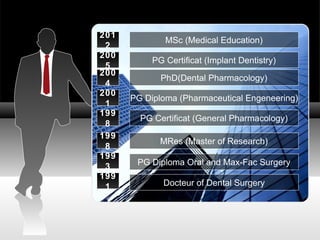
1991 MRes (Master of Research) PG Diploma Oral and Max-Fac Surgery Docteur of Dental Surgery 1993 1998 1998 2001 2004 2005 PG Certificat (General Pharmacology) PG Diploma (Pharmaceutical Engeneering) PhD(Dental Pharmacology) PG Certificat (Implant Dentistry) 2012 MSc (Medical Education)
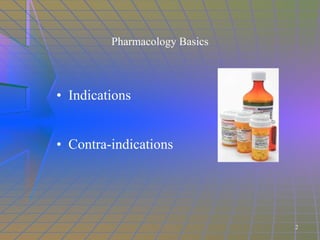
Pharmacology Basics Indications Contra-indications 2
Pharmacology Basics Indications The reasons for administering a medication or performing a treatment Contra-indications A factor that prevents the use of a medication or treatment (eg. Allergies) 2
Pharmacology Basics Dose Mechanism of Action 3
Pharmacology Basics Dose The amount of a drug to be administered at one time Mechanism of Action How a drug works 3
Pharmacology Basics Effects Side Effects 4
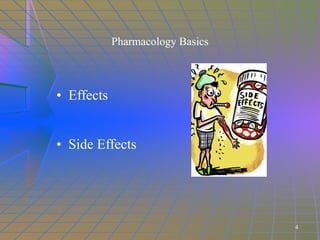
Pharmacology Basics Effects The desired result of administration of a medication  Side Effects Effects that are not desired and that occur in addition to the desired therapeutic effects 4
Medication Names Chemical Name Generic Name  Trade Name Official Name 6
Medication Names Chemical Name describes the drug’s chemical structure Generic Name  reflects the chemical name, but in shorter form Trade Name the name the manufacturer uses to market the drug Official Name the name used in the Pharmocopoeia 6
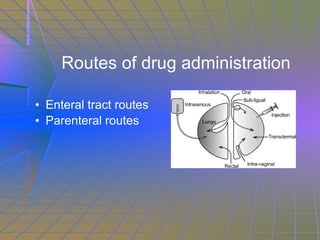
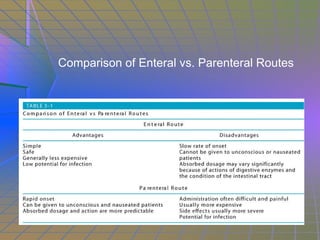
Routes of drug administration Enteral tract routes Parenteral routes
Comparison of Enteral vs. Parenteral Routes
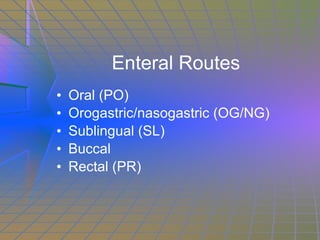
Enteral Routes Oral (PO) Orogastric/nasogastric (OG/NG) Sublingual (SL) Buccal Rectal (PR)
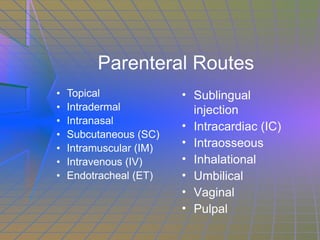
Parenteral Routes Topical Intradermal Intranasal Subcutaneous (SC) Intramuscular (IM) Intravenous (IV) Endotracheal (ET) Sublingual injection Intracardiac (IC) Intraosseous Inhalational Umbilical Vaginal Pulpal
No  single  method of drug administration is ideal for all drugs in all circumstances   Very Important Info!
What are the essential components of a drug prescription?  Drug prescription
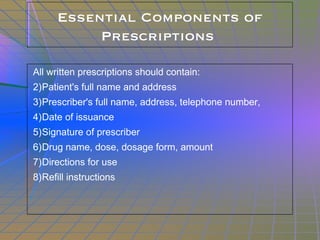
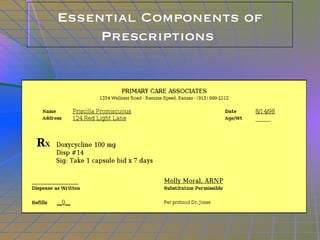
Essential Components of Prescriptions  All written prescriptions should contain: Patient's full name and address Prescriber's full name, address, telephone number,  Date of issuance Signature of prescriber Drug name, dose, dosage form, amount Directions for use Refill instructions
The Medication Order (Prescription) Medication desired Dose desired Administration route Administration rate
Before any Drug prescription Discuss with patient the possible consequences (god and bad) Prescribe drugs you know Keep updated (BNF, Vidal…others) Dose: consider age, physiology, and pathology  Drug interactions
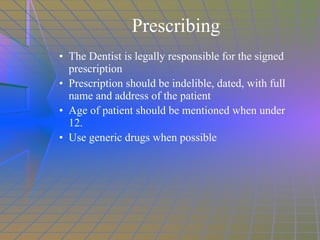
The Dentist is legally responsible for the signed prescription Prescription should be indelible, dated, with full name and address of the patient  Age of patient should be mentioned when under 12. Use generic drugs when possible Prescribing
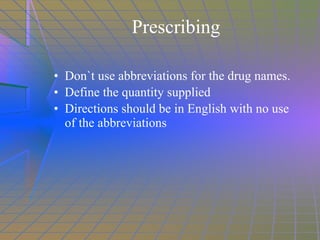
Don`t use abbreviations for the drug names. Define the quantity supplied Directions should be in English with no use of the abbreviations Prescribing
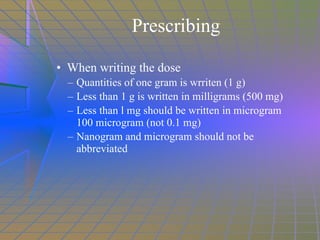
Prescribing When writing the dose Quantities of one gram is wrriten (1 g) Less than 1 g is written in milligrams (500 mg) Less than l mg should be written in microgram 100 microgram (not 0.1 mg) Nanogram and microgram should not be abbreviated
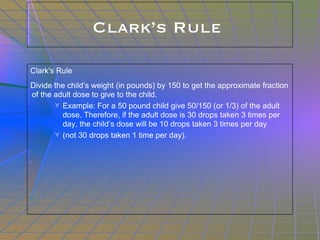
Clark’s Rule  Clark's Rule Divide the child’s weight (in pounds) by 150 to get the approximate fraction of the adult dose to give to the child. Example: For a 50 pound child give 50/150 (or 1/3) of the adult dose. Therefore, if the adult dose is 30 drops taken 3 times per day, the child’s dose will be 10 drops taken 3 times per day (not 30 drops taken 1 time per day).
Essential Components of Prescriptions  All written prescriptions should contain: Patient's full name and address Prescriber's full name, address, telephone number,  Date of issuance Signature of prescriber Drug name, dose, dosage form, amount Directions for use Refill instructions
Essential Components of Prescriptions
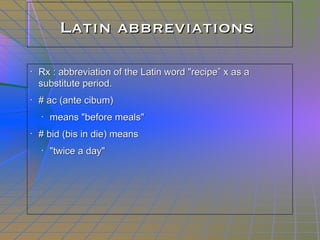
Latin abbreviations  Rx : abbreviation of the Latin word "recipe” x as a substitute period. # ac (ante cibum)  means "before meals" # bid (bis in die) means  "twice a day"
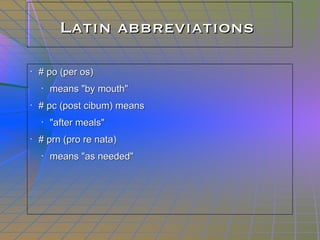
Latin abbreviations  # po (per os)  means "by mouth" # pc (post cibum) means  "after meals" # prn (pro re nata)  means "as needed"
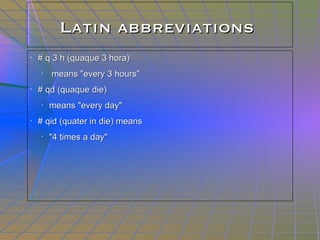
Latin abbreviations  # q 3 h (quaque 3 hora) means "every 3 hours" # qd (quaque die)  means "every day" # qid (quater in die) means  "4 times a day"
 
Feel free to use this PowerPoint presentation for your personal, educational and business. Do Make a  copy for backups  on your harddrive or local network. Use the presentation for your presentations and projects. Print hand outs or other promotional items. Don‘t Make it available on a  website , portal or social network website  for download . (Incl. groups, file sharing networks, Slideshare etc.) Edit or modify the downloaded presentation and claim / pass off as your own work. All copyright and intellectual property rights, without limitation, are retained by Dr. Iyad Abou Rabii. By downloading and using this presentatione, you agree to this statement. Please feel free to contact me, if you do have any questions about usage.  Dr Iyad Abou Rabii [email_address] Copyright notice

Therapeutics in dentistry(general principles)

  • 1.
    Therapeutics in Dentistry(General Principles) Iyad Abou Rabii
  • 2.
    1991 MRes (Masterof Research) PG Diploma Oral and Max-Fac Surgery Docteur of Dental Surgery 1993 1998 1998 2001 2004 2005 PG Certificat (General Pharmacology) PG Diploma (Pharmaceutical Engeneering) PhD(Dental Pharmacology) PG Certificat (Implant Dentistry) 2012 MSc (Medical Education)
  • 3.
    Pharmacology Basics IndicationsContra-indications 2
  • 4.
    Pharmacology Basics IndicationsThe reasons for administering a medication or performing a treatment Contra-indications A factor that prevents the use of a medication or treatment (eg. Allergies) 2
  • 5.
    Pharmacology Basics DoseMechanism of Action 3
  • 6.
    Pharmacology Basics DoseThe amount of a drug to be administered at one time Mechanism of Action How a drug works 3
  • 7.
  • 8.
    Pharmacology Basics EffectsThe desired result of administration of a medication Side Effects Effects that are not desired and that occur in addition to the desired therapeutic effects 4
  • 9.
    Medication Names ChemicalName Generic Name Trade Name Official Name 6
  • 10.
    Medication Names ChemicalName describes the drug’s chemical structure Generic Name reflects the chemical name, but in shorter form Trade Name the name the manufacturer uses to market the drug Official Name the name used in the Pharmocopoeia 6
  • 11.
    Routes of drugadministration Enteral tract routes Parenteral routes
  • 12.
    Comparison of Enteralvs. Parenteral Routes
  • 13.
    Enteral Routes Oral(PO) Orogastric/nasogastric (OG/NG) Sublingual (SL) Buccal Rectal (PR)
  • 14.
    Parenteral Routes TopicalIntradermal Intranasal Subcutaneous (SC) Intramuscular (IM) Intravenous (IV) Endotracheal (ET) Sublingual injection Intracardiac (IC) Intraosseous Inhalational Umbilical Vaginal Pulpal
  • 15.
    No single method of drug administration is ideal for all drugs in all circumstances Very Important Info!
  • 16.
    What are theessential components of a drug prescription? Drug prescription
  • 17.
    Essential Components ofPrescriptions All written prescriptions should contain: Patient's full name and address Prescriber's full name, address, telephone number, Date of issuance Signature of prescriber Drug name, dose, dosage form, amount Directions for use Refill instructions
  • 18.
    The Medication Order(Prescription) Medication desired Dose desired Administration route Administration rate
  • 19.
    Before any Drugprescription Discuss with patient the possible consequences (god and bad) Prescribe drugs you know Keep updated (BNF, Vidal…others) Dose: consider age, physiology, and pathology Drug interactions
  • 20.
    The Dentist islegally responsible for the signed prescription Prescription should be indelible, dated, with full name and address of the patient Age of patient should be mentioned when under 12. Use generic drugs when possible Prescribing
  • 21.
    Don`t use abbreviationsfor the drug names. Define the quantity supplied Directions should be in English with no use of the abbreviations Prescribing
  • 22.
    Prescribing When writingthe dose Quantities of one gram is wrriten (1 g) Less than 1 g is written in milligrams (500 mg) Less than l mg should be written in microgram 100 microgram (not 0.1 mg) Nanogram and microgram should not be abbreviated
  • 23.
    Clark’s Rule Clark's Rule Divide the child’s weight (in pounds) by 150 to get the approximate fraction of the adult dose to give to the child. Example: For a 50 pound child give 50/150 (or 1/3) of the adult dose. Therefore, if the adult dose is 30 drops taken 3 times per day, the child’s dose will be 10 drops taken 3 times per day (not 30 drops taken 1 time per day).
  • 24.
    Essential Components ofPrescriptions All written prescriptions should contain: Patient's full name and address Prescriber's full name, address, telephone number, Date of issuance Signature of prescriber Drug name, dose, dosage form, amount Directions for use Refill instructions
  • 25.
  • 26.
    Latin abbreviations Rx : abbreviation of the Latin word "recipe” x as a substitute period. # ac (ante cibum) means "before meals" # bid (bis in die) means "twice a day"
  • 27.
    Latin abbreviations # po (per os) means "by mouth" # pc (post cibum) means "after meals" # prn (pro re nata) means "as needed"
  • 28.
    Latin abbreviations # q 3 h (quaque 3 hora) means "every 3 hours" # qd (quaque die) means "every day" # qid (quater in die) means "4 times a day"
  • 29.
  • 30.
    Feel free touse this PowerPoint presentation for your personal, educational and business. Do Make a copy for backups on your harddrive or local network. Use the presentation for your presentations and projects. Print hand outs or other promotional items. Don‘t Make it available on a website , portal or social network website for download . (Incl. groups, file sharing networks, Slideshare etc.) Edit or modify the downloaded presentation and claim / pass off as your own work. All copyright and intellectual property rights, without limitation, are retained by Dr. Iyad Abou Rabii. By downloading and using this presentatione, you agree to this statement. Please feel free to contact me, if you do have any questions about usage. Dr Iyad Abou Rabii [email_address] Copyright notice