GENERAL
 PRINCIPLES OF
PHARMACOLOGY
Part 1 Topics
   Drug Names
   Sources of Drug Products
   Drug Classifications
   Food & Drug Administration
   Medication Administration
   Properties of Drugs
Pharmacology is the study
of drugs and their actions
       on the body.
Drugs are chemicals used to
diagnose, treat, and prevent
          disease.
Legal
 Knowing and obeying the laws and
  regulations governing medications
  and their administration is an
  important part of a paramedic’s
  career.
 These include federal, state, and
  agency regulations.
Federal…
 Pure Food & Drug Act of 1906
 Harrison Narcotic Act of 1914
 Federal Food, Drug, & Cosmetic
  Act of 1938
 Comprehensive Drug Abuse
  Prevention & Control Act of 1970
State vs. Local Standards
 They vary widely.
 Always consult local protocols
  and with medical direction for
  guidance in securing and
  distributing controlled
  substances.
Names of Drugs
 Chemical…states its chemical
  composition and molecular structure.
 Generic…usually suggested by the
  manufacturer.
 Official…as listed in the
  U.S. Pharmacopeia.
 Brand…the trade or proprietary name.
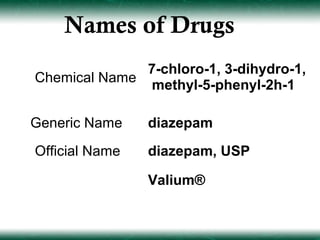
Names of Drugs
              7-chloro-1, 3-dihydro-1,
Chemical Name
              methyl-5-phenyl-2h-1

Generic Name    diazepam
Official Name   diazepam, USP

                Valium®
Sources of Drug Information

  United States Pharmacopeia (USP)

  Physician’s desk reference (PDR)

  Drug information
  Monthly prescribing reference

  AMA drug evaluation
Components of a Drug Profile

 Name                Routes of
 Classification       Administration
 Mechanism of        Contraindications
  Action              Dosage
 Indications         How Supplied
 Pharmacokinetics    Special
 Side Effects         Considerations
Names


 Most Frequently Include Generic
  and Trade Names
Classification

 The broad group to which a
  drug belongs. Knowing
  classifications is essential to
  understanding the properties
  of drugs.
Mechanism of Action

 The way in which a drug causes
  its effects; its pharmacodynamics.
Actions of Drugs
 Drugs that Act by Binding to a
  Receptor Site
 Drugs that Act by Changing Physical
  Properties
 Drugs that Act by Chemically
  Combining with Other Substances
 Drugs that Act by Altering a Normal
  Metabolic Pathway
Indications

 Conditions that enable the
  appropriate administration
  of the drug (as approved by
  the FDA).
Pharmacokinetics

 How the drug is absorbed,
  distributed, and eliminated;
  typically includes onset and
  duration of action.
Pharmacokinetics
 Absorption…a drug must find its
  way to the site of action.
 Distribution…a drug must then be
  distributed throughout the body.
Pharmacokinetics
 Biotransformation…the process
  of breaking down, or metabolizing,
  drugs.
 Elimination…drugs must
  eventually be excreted
  from the body.
Side Effects/Adverse Reactions


 The drug’s untoward or
  undesired effects.
Routes of Administration


 How the drug is given.
Contraindications

   Conditions that make it
    inappropriate to give the drug.
   …means a predictable harmful
    event will occur if the drug is
    given in this situation.
Dosage


 The amount of the drug that
  should be given.
How Supplied

 This typically includes the
  common concentration of the
  available preparations; many
  drugs come in different
  concentrations.
Drug Routes (1 of 2)

 Enteral:
  ď‚§ Deliver medications by absorption
    through the gastrointestinal tract.
  ď‚§ Oral, orogastric/nasogastric, sublingual,
    buccal, rectal.
Drug Routes (2 of 2)

 Parenteral:
  ď‚§ Delivers medications via routes other
    than the GI tract.
  ď‚§ Include intravenous, endotracheal,
    intraosseous, umbilical, intramuscular,
    subcutaneously, inhalation, topical.
Enteral – examples
                 (1 of 2)


 Oral (PO) — good for self-administering
  drugs.
 Orogastric (OG) / Nasogastric (NG) —
  alternate method to providing PO
  medications.
 Sublingual (SL) — excellent absorption
  without problems of gastric acidity.
Enteral – examples
               (2 of 2)


 Buccal — between the cheek/gum.
  Similar to sublingual.
 Rectal (PR) — reserved for
  unconscious or vomiting patients.
Parenteral – examples
                (1 of 3)


 Intravenous (IV) — preferred route in
  emergencies.
 Endotracheal (ET) — alternate route
  in emergencies for select
  medications.
 Intraosseous (IO) — alternative use in
  emergencies, mostly in pediatrics.
Parenteral – examples
              (2 of 3)


 Umbilical — provides alternate
  access in newborns.
 Intramuscular (IM) — slower
  absorption than IVs.
 Subcutaneous (SQ) — slower
  absorption than IM.
Parenteral – examples
                (3 of 3)


 Inhalation — very rapid absorption
  via the lungs.
 Topical — delivers drugs directly to
  the skin.
Most emergency
   medications are given
intravenously to avoid drug
  degradation in the liver.
Drug Forms

 Solid Forms:
 ď‚§ Such as pills, powders, suppositories,
   capsules.
 Liquid Forms:
 ď‚§ Such as solutions, tinctures,
   suspensions, emulsions, spirits, elixirs,
   syrups.
Solid Forms
 Pills—drugs shaped spherically to be
  swallowed.
 Powders—not as popular as they once were.
 Tablets—powders compressed into disk-like
  form.
 Suppositories—drugs mixed with a waxlike
  base that melts at body temperature.
 Capsules—gelatin containers filled with
  powders or tiny pills.
Liquid Forms (1 of 2)
 Solutions—water or oil-based.
 Tinctures—prepared using an alcohol
  extraction process.
 Suspensions—preparations in which
  the solid does not dissolve in the
  solvent.
 Emulsions—suspensions with an oily
  substance in the solvent.
Liquid Forms (2 of 2)
 Spirits—solution of a volatile drug
  in alcohol.
 Elixirs—alcohol and water solvent;
  often with flavoring.
 Syrups—sugar, water, and drug
  solutions.
Special Considerations


 Pregnant Patients
 Pediatric Patients
 Geriatric Patients
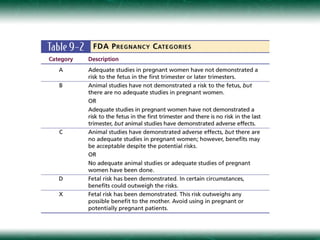
Pregnant Patients
 Ask the patient if there is a possibility
  that she could be pregnant.
 Some drugs may have an adverse
  effect on the fetus of a pregnant
  female.
 Teratogenic drug…is a medication
  that may deform or kill the fetus.
Providing Patient Care Using
       Medications (1 of 4)

 Know the precautions and
  contraindications for all medications
  you administer.
 Practice proper technique.
 Know how to observe and document
  drug effects.
Providing Patient Care Using
       Medications (2 of 4)
 Maintain a current knowledge in
  pharmacology.
 Establish and maintain professional
  relationships with other healthcare
  providers.
 Understand pharmacokinetics and
  pharmacodynamics.
Providing Patient Care Using
       Medications (3 of 4)
 Have current medication references
  available.
 Take careful drug histories including:
  ď‚§   Name, strength, dose of prescribed medications;
  ď‚§   Over-the-counter drugs;
  ď‚§   Vitamins;
  ď‚§   Herbal medications;
  ď‚§   Allergies.
Providing Patient Care Using
      Medications (4 of 4)

 Evaluate the patient’s
  compliance, dosage, and
  adverse reactions.
 Consult with medical direction
  as needed.
Know the 6 Rights of Medication
       Administration

    Right Medication
    Right Dosage
    Right Time
    Right Route
    Right Patient
    Right Documentation
Responses to Drug Administration
                   (1 of 5)


 Side Effect—unintended response
  to a drug.
 Allergic Reaction—hypersensitivity.

 Idiosyncrasy—drug effect unique to

  an individual.
Responses to Drug Administration
                (2 of 5)


 Tolerance—decreased response to
  the same amount.
 Cross Tolerance—tolerance for a drug
  that develops after administration of
  a different drug.
 Tachyphylaxis—rapidly occurring
  tolerance to a drug.
Responses to Drug Administration
                 (3 of 5)


 Cumulative effect—increased effectiveness
  when a drug is given in several doses.
 Drug dependence—the patient becomes
  accustomed to the drug’s presence in his
  body.
 Drug interaction—the effects of one drug
  alter the response to another drug.
 Drug antagonism—the effects of one drug
  block the response to another drug.
Responses to Drug Administration
                (4 of 5)


 Summation—also known as additive
  effect, two drugs with the same effect
  are given together — similar to 1+1=2.
 Synergism—two drugs with the same
  effect are given together and produce
  a response greater than the sum of
  their individual responses — similar
  to 1+2=3.
Responses to Drug Administration
              (5 of 5)


 Potentiation—one drug enhances
  the effect of another.
 Interference—the direct
  biochemical interaction between
  two drugs; one drug affects the
  pharmacology of another drug.
Factors Affecting Drug Response


   Age              Time of Administration
   Body Mass        Pathology
   Sex              Genetics
   Environment      Psychology
Part 1 Summary
   Drug Names
   Sources of Drug Products
   Drug Classifications
   Food & Drug Administration
   Medication Administration
   Properties of Drugs

Pharmacology part 1

  • 1.
  • 2.
    Part 1 Topics  Drug Names  Sources of Drug Products  Drug Classifications  Food & Drug Administration  Medication Administration  Properties of Drugs
  • 3.
    Pharmacology is thestudy of drugs and their actions on the body.
  • 4.
    Drugs are chemicalsused to diagnose, treat, and prevent disease.
  • 5.
    Legal  Knowing andobeying the laws and regulations governing medications and their administration is an important part of a paramedic’s career.  These include federal, state, and agency regulations.
  • 6.
    Federal…  Pure Food& Drug Act of 1906  Harrison Narcotic Act of 1914  Federal Food, Drug, & Cosmetic Act of 1938  Comprehensive Drug Abuse Prevention & Control Act of 1970
  • 7.
    State vs. LocalStandards  They vary widely.  Always consult local protocols and with medical direction for guidance in securing and distributing controlled substances.
  • 8.
    Names of Drugs Chemical…states its chemical composition and molecular structure.  Generic…usually suggested by the manufacturer.  Official…as listed in the U.S. Pharmacopeia.  Brand…the trade or proprietary name.
  • 9.
    Names of Drugs 7-chloro-1, 3-dihydro-1, Chemical Name methyl-5-phenyl-2h-1 Generic Name diazepam Official Name diazepam, USP Valium®
  • 10.
    Sources of DrugInformation  United States Pharmacopeia (USP)  Physician’s desk reference (PDR)  Drug information  Monthly prescribing reference  AMA drug evaluation
  • 11.
    Components of aDrug Profile  Name  Routes of  Classification Administration  Mechanism of  Contraindications Action  Dosage  Indications  How Supplied  Pharmacokinetics  Special  Side Effects Considerations
  • 12.
    Names  Most FrequentlyInclude Generic and Trade Names
  • 13.
    Classification  The broadgroup to which a drug belongs. Knowing classifications is essential to understanding the properties of drugs.
  • 14.
    Mechanism of Action The way in which a drug causes its effects; its pharmacodynamics.
  • 15.
    Actions of Drugs Drugs that Act by Binding to a Receptor Site  Drugs that Act by Changing Physical Properties  Drugs that Act by Chemically Combining with Other Substances  Drugs that Act by Altering a Normal Metabolic Pathway
  • 16.
    Indications  Conditions thatenable the appropriate administration of the drug (as approved by the FDA).
  • 17.
    Pharmacokinetics  How thedrug is absorbed, distributed, and eliminated; typically includes onset and duration of action.
  • 18.
    Pharmacokinetics  Absorption…a drugmust find its way to the site of action.  Distribution…a drug must then be distributed throughout the body.
  • 19.
    Pharmacokinetics  Biotransformation…the process of breaking down, or metabolizing, drugs.  Elimination…drugs must eventually be excreted from the body.
  • 20.
    Side Effects/Adverse Reactions The drug’s untoward or undesired effects.
  • 21.
    Routes of Administration How the drug is given.
  • 22.
    Contraindications  Conditions that make it inappropriate to give the drug.  …means a predictable harmful event will occur if the drug is given in this situation.
  • 23.
    Dosage  The amountof the drug that should be given.
  • 24.
    How Supplied  Thistypically includes the common concentration of the available preparations; many drugs come in different concentrations.
  • 25.
    Drug Routes (1of 2)  Enteral:  Deliver medications by absorption through the gastrointestinal tract.  Oral, orogastric/nasogastric, sublingual, buccal, rectal.
  • 26.
    Drug Routes (2of 2)  Parenteral:  Delivers medications via routes other than the GI tract.  Include intravenous, endotracheal, intraosseous, umbilical, intramuscular, subcutaneously, inhalation, topical.
  • 27.
    Enteral – examples (1 of 2)  Oral (PO) — good for self-administering drugs.  Orogastric (OG) / Nasogastric (NG) — alternate method to providing PO medications.  Sublingual (SL) — excellent absorption without problems of gastric acidity.
  • 28.
    Enteral – examples (2 of 2)  Buccal — between the cheek/gum. Similar to sublingual.  Rectal (PR) — reserved for unconscious or vomiting patients.
  • 29.
    Parenteral – examples (1 of 3)  Intravenous (IV) — preferred route in emergencies.  Endotracheal (ET) — alternate route in emergencies for select medications.  Intraosseous (IO) — alternative use in emergencies, mostly in pediatrics.
  • 30.
    Parenteral – examples (2 of 3)  Umbilical — provides alternate access in newborns.  Intramuscular (IM) — slower absorption than IVs.  Subcutaneous (SQ) — slower absorption than IM.
  • 31.
    Parenteral – examples (3 of 3)  Inhalation — very rapid absorption via the lungs.  Topical — delivers drugs directly to the skin.
  • 32.
    Most emergency medications are given intravenously to avoid drug degradation in the liver.
  • 33.
    Drug Forms  SolidForms:  Such as pills, powders, suppositories, capsules.  Liquid Forms:  Such as solutions, tinctures, suspensions, emulsions, spirits, elixirs, syrups.
  • 34.
    Solid Forms  Pills—drugsshaped spherically to be swallowed.  Powders—not as popular as they once were.  Tablets—powders compressed into disk-like form.  Suppositories—drugs mixed with a waxlike base that melts at body temperature.  Capsules—gelatin containers filled with powders or tiny pills.
  • 35.
    Liquid Forms (1of 2)  Solutions—water or oil-based.  Tinctures—prepared using an alcohol extraction process.  Suspensions—preparations in which the solid does not dissolve in the solvent.  Emulsions—suspensions with an oily substance in the solvent.
  • 36.
    Liquid Forms (2of 2)  Spirits—solution of a volatile drug in alcohol.  Elixirs—alcohol and water solvent; often with flavoring.  Syrups—sugar, water, and drug solutions.
  • 37.
    Special Considerations  PregnantPatients  Pediatric Patients  Geriatric Patients
  • 38.
    Pregnant Patients  Askthe patient if there is a possibility that she could be pregnant.  Some drugs may have an adverse effect on the fetus of a pregnant female.  Teratogenic drug…is a medication that may deform or kill the fetus.
  • 41.
    Providing Patient CareUsing Medications (1 of 4)  Know the precautions and contraindications for all medications you administer.  Practice proper technique.  Know how to observe and document drug effects.
  • 42.
    Providing Patient CareUsing Medications (2 of 4)  Maintain a current knowledge in pharmacology.  Establish and maintain professional relationships with other healthcare providers.  Understand pharmacokinetics and pharmacodynamics.
  • 43.
    Providing Patient CareUsing Medications (3 of 4)  Have current medication references available.  Take careful drug histories including:  Name, strength, dose of prescribed medications;  Over-the-counter drugs;  Vitamins;  Herbal medications;  Allergies.
  • 44.
    Providing Patient CareUsing Medications (4 of 4)  Evaluate the patient’s compliance, dosage, and adverse reactions.  Consult with medical direction as needed.
  • 45.
    Know the 6Rights of Medication Administration  Right Medication  Right Dosage  Right Time  Right Route  Right Patient  Right Documentation
  • 46.
    Responses to DrugAdministration (1 of 5)  Side Effect—unintended response to a drug.  Allergic Reaction—hypersensitivity.  Idiosyncrasy—drug effect unique to an individual.
  • 47.
    Responses to DrugAdministration (2 of 5)  Tolerance—decreased response to the same amount.  Cross Tolerance—tolerance for a drug that develops after administration of a different drug.  Tachyphylaxis—rapidly occurring tolerance to a drug.
  • 48.
    Responses to DrugAdministration (3 of 5)  Cumulative effect—increased effectiveness when a drug is given in several doses.  Drug dependence—the patient becomes accustomed to the drug’s presence in his body.  Drug interaction—the effects of one drug alter the response to another drug.  Drug antagonism—the effects of one drug block the response to another drug.
  • 49.
    Responses to DrugAdministration (4 of 5)  Summation—also known as additive effect, two drugs with the same effect are given together — similar to 1+1=2.  Synergism—two drugs with the same effect are given together and produce a response greater than the sum of their individual responses — similar to 1+2=3.
  • 50.
    Responses to DrugAdministration (5 of 5)  Potentiation—one drug enhances the effect of another.  Interference—the direct biochemical interaction between two drugs; one drug affects the pharmacology of another drug.
  • 51.
    Factors Affecting DrugResponse  Age  Time of Administration  Body Mass  Pathology  Sex  Genetics  Environment  Psychology
  • 52.
    Part 1 Summary  Drug Names  Sources of Drug Products  Drug Classifications  Food & Drug Administration  Medication Administration  Properties of Drugs

Editor's Notes

  • #7 Pure food – was enacted to imrove quality and labeling of drugs Federal food – empowered the FDA to set and enforce safety standards for drugs Comprehensive – replaced the harrison narcotic act, set a schedule of controlled substances from 1 to 5 with 1 being high abuse potential, severe dependance and no medical indications such as Heroin and LSD
  • #8 SEMAC/REMAC
  • #21 Untoward = side effects that are harmful to patient
  • #46 1. Right drug check name of drug b. If the drug is unfamiliar, seek information from an authoritative source. c. Read labels of drug containers accurately. d. Question the prescribing physician about the order if it is unclear or if the drug seems inappropriate for the client's condition. 2. Right dose Calculate doses accurately. d. Measure doses accurately. e. Question the prescribing physician about the dosage if it seems inappropriate for the client or does not fall within the margin of safety. 3. Right route a. Check that the medication can be given by the route prescribed. b. Give medications only by the route prescribed. c. Use correct techniques for all routes of administration. 4. Right time a. Schedule administration of a drug to maximize therapeutic effects and minimize adverse effects. Ie epi every 5 min 5. Right client a. Check identification bands on institutionalized clients to ensure the name and number match exactly those on the medication administration record every time a medication is administered. 6. Right documentation Record the medication immediately following its administration on the official record. Reduce medication errors by following the 6 rights.