Research
Nathan Mead
Terminology
• Circulation
• Circulation is the terminology used to describe the amount of print products that have been
distributed nationally/internationally
• Hits
• The amounts of hits something has is the amounts of views something has e.g. how many times a
webpage has been viewed
• Box Office Figures
• Box office figures is the amount of money a film has made whilst being screened at the cinema
• Ratings
• Ratings are a way people determine how good a film is by giving it a certain number, usually out of
ten, allowing people who haven’t seen it to decide weather its worth going to see or not
• Sales
• The amount of sales is simply how many/much of the product have been sold
Primary Research
• Definition
• Primary research is basically new research. This can be things such as
questionnaires or survey's. the provide new data which is useful
• Advantages
• It provides data that is new and fresh so you have the newest statistics on
whatever you are researching
• Disadvantages
• It can be very costly and requires a lot more effort than secondary
research
• Example
An example of this is taking a survey, as people are giving their opinions on things
there and then meaning its brand new
Secondary Research
• Definition
• Secondary research is where people use pre-written research from
maybe a few months or years ago.
• Advantages
• Its very cheap and provides info that can be useful
• Disadvantages
• The info can sometimes be out of date resulting in useless
information
• Example
• And example of this is a survey but that was taken maybe a few
months ago
Quantitative Research
• Definition
• Research that is in a large quantity and provides data on a large
scale
• Advantages
• It can give you a vey good platform to base data on as it will give
you a lot of simple data
• Disadvantages
• A disadvantage to this that the data isn’t very niche or specific so
you cant do much with it
• Example
– A simple yes or no survey with no explanation box
Qualitative Research
• Definition
• Research that goes in-depth and provides useful data on specific things
• Advantages
• You can get niche data so if your looking for something specific it can be
very useful
• Disadvantages
• A disadvantage to this is that its very niche so you can only really get
specific individual pieces of data and not really a solid generalised piece of
data
• Example
• Yes or no survey with and explanation box
Audience Research
• Definition
• What sort of people the product will cater to eg. Age, Gender, Socio economic
background etc
• Advantages
• You can create a product for a specific market and target them very well increasing
sales in that segment
• Disadvantages
• You may miss out on a whole market segment if you focus too much on a specific
audience
• Example
• A survey that asks about the age of the typical buyers/viewers or maybe an in
depth question box that can help decide what the most popular genre is
Market Research
• Definition
• Researching data on a specific market segment to gain accurate
data which will help you when deigning a new product
• Advantages
• It helps a huge amount when creating something new as you can
find things out about specific market segments and cater your
product to those needs
• Disadvantages
• It can be very expensive for small businesses and a waste of funds
• Example
• Getting a focus group together or making surveys for people to do
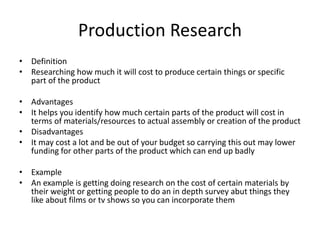
Production Research
• Definition
• Researching how much it will cost to produce certain things or specific
part of the product
• Advantages
• It helps you identify how much certain parts of the product will cost in
terms of materials/resources to actual assembly or creation of the product
• Disadvantages
• It may cost a lot and be out of your budget so carrying this out may lower
funding for other parts of the product which can end up badly
• Example
• An example is getting doing research on the cost of certain materials by
their weight or getting people to do an in depth survey abut things they
like about films or tv shows so you can incorporate them
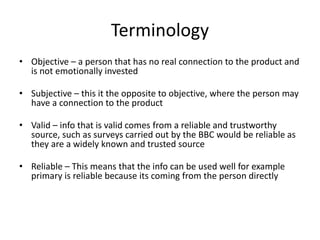
Terminology
• Objective – a person that has no real connection to the product and
is not emotionally invested
• Subjective – this it the opposite to objective, where the person may
have a connection to the product
• Valid – info that is valid comes from a reliable and trustworthy
source, such as surveys carried out by the BBC would be reliable as
they are a widely known and trusted source
• Reliable – This means that the info can be used well for example
primary is reliable because its coming from the person directly
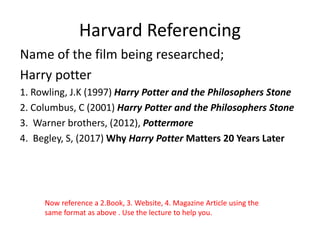
Harvard Referencing
Name of the film being researched;
Harry potter
1. Rowling, J.K (1997) Harry Potter and the Philosophers Stone
2. Columbus, C (2001) Harry Potter and the Philosophers Stone
3. Warner brothers, (2012), Pottermore
4. Begley, S, (2017) Why Harry Potter Matters 20 Years Later
Now reference a 2.Book, 3. Website, 4. Magazine Article using the
same format as above . Use the lecture to help you.

Theory research

  • 1.
  • 2.
    Terminology • Circulation • Circulationis the terminology used to describe the amount of print products that have been distributed nationally/internationally • Hits • The amounts of hits something has is the amounts of views something has e.g. how many times a webpage has been viewed • Box Office Figures • Box office figures is the amount of money a film has made whilst being screened at the cinema • Ratings • Ratings are a way people determine how good a film is by giving it a certain number, usually out of ten, allowing people who haven’t seen it to decide weather its worth going to see or not • Sales • The amount of sales is simply how many/much of the product have been sold
  • 3.
    Primary Research • Definition •Primary research is basically new research. This can be things such as questionnaires or survey's. the provide new data which is useful • Advantages • It provides data that is new and fresh so you have the newest statistics on whatever you are researching • Disadvantages • It can be very costly and requires a lot more effort than secondary research • Example An example of this is taking a survey, as people are giving their opinions on things there and then meaning its brand new
  • 4.
    Secondary Research • Definition •Secondary research is where people use pre-written research from maybe a few months or years ago. • Advantages • Its very cheap and provides info that can be useful • Disadvantages • The info can sometimes be out of date resulting in useless information • Example • And example of this is a survey but that was taken maybe a few months ago
  • 5.
    Quantitative Research • Definition •Research that is in a large quantity and provides data on a large scale • Advantages • It can give you a vey good platform to base data on as it will give you a lot of simple data • Disadvantages • A disadvantage to this that the data isn’t very niche or specific so you cant do much with it • Example – A simple yes or no survey with no explanation box
  • 6.
    Qualitative Research • Definition •Research that goes in-depth and provides useful data on specific things • Advantages • You can get niche data so if your looking for something specific it can be very useful • Disadvantages • A disadvantage to this is that its very niche so you can only really get specific individual pieces of data and not really a solid generalised piece of data • Example • Yes or no survey with and explanation box
  • 7.
    Audience Research • Definition •What sort of people the product will cater to eg. Age, Gender, Socio economic background etc • Advantages • You can create a product for a specific market and target them very well increasing sales in that segment • Disadvantages • You may miss out on a whole market segment if you focus too much on a specific audience • Example • A survey that asks about the age of the typical buyers/viewers or maybe an in depth question box that can help decide what the most popular genre is
  • 8.
    Market Research • Definition •Researching data on a specific market segment to gain accurate data which will help you when deigning a new product • Advantages • It helps a huge amount when creating something new as you can find things out about specific market segments and cater your product to those needs • Disadvantages • It can be very expensive for small businesses and a waste of funds • Example • Getting a focus group together or making surveys for people to do
  • 9.
    Production Research • Definition •Researching how much it will cost to produce certain things or specific part of the product • Advantages • It helps you identify how much certain parts of the product will cost in terms of materials/resources to actual assembly or creation of the product • Disadvantages • It may cost a lot and be out of your budget so carrying this out may lower funding for other parts of the product which can end up badly • Example • An example is getting doing research on the cost of certain materials by their weight or getting people to do an in depth survey abut things they like about films or tv shows so you can incorporate them
  • 10.
    Terminology • Objective –a person that has no real connection to the product and is not emotionally invested • Subjective – this it the opposite to objective, where the person may have a connection to the product • Valid – info that is valid comes from a reliable and trustworthy source, such as surveys carried out by the BBC would be reliable as they are a widely known and trusted source • Reliable – This means that the info can be used well for example primary is reliable because its coming from the person directly
  • 11.
    Harvard Referencing Name ofthe film being researched; Harry potter 1. Rowling, J.K (1997) Harry Potter and the Philosophers Stone 2. Columbus, C (2001) Harry Potter and the Philosophers Stone 3. Warner brothers, (2012), Pottermore 4. Begley, S, (2017) Why Harry Potter Matters 20 Years Later Now reference a 2.Book, 3. Website, 4. Magazine Article using the same format as above . Use the lecture to help you.

Editor's Notes

  • #3 Provide definitions for each term
  • #11 Provide definitions
  • #12 1. Film, 2.Book, 3. Website, 4. Magazine Article