THEORY of ARCHITECTURE
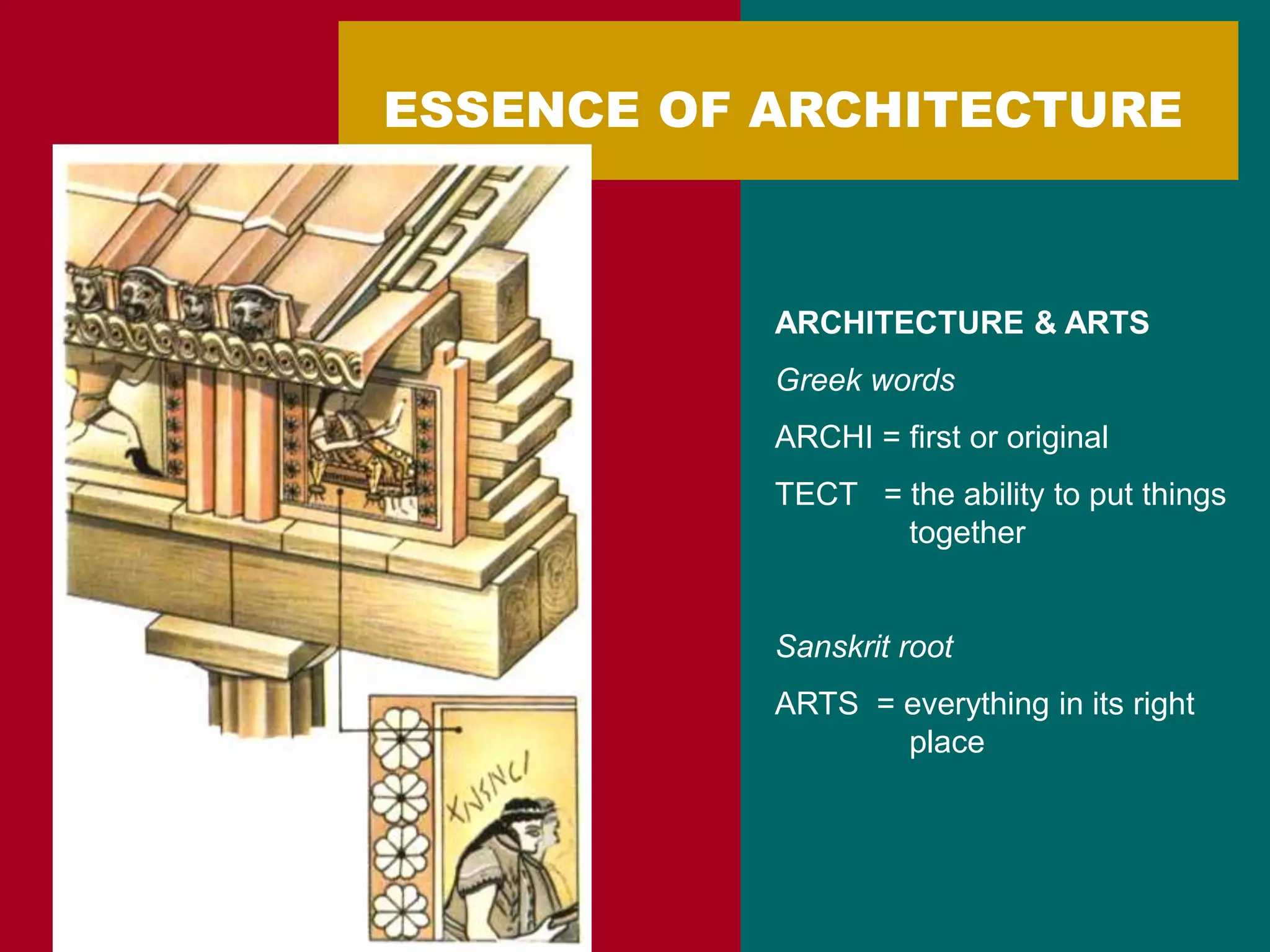
ESSENCE OF ARCHITECTURE
ARCHITECTURE & ARTS
Greek words
ARCHI = first or original
TECT = the ability to put things
together
Sanskrit root
ARTS = everything in its right
place
THEORY IN GENERAL
• Analysis of a set of facts in relation
to one another
• Belief, policy or procedure proposed
or followed as basis of action
• An ideal or hypothetical set of facts,
principles or circumstances of a body
of fact on science or art
• A plausible or scientifically accepted
general principle or body of
principles offered to explain
phenomenon
THEORY IN GENERAL
Forms/types of Theory
-Descriptive: Explains
phenomenon or events; they re
neutral and do not lean towards
any ideology
-Prescriptive: Prescribes bases
or guidelines
-Critical: Challenges relationships
between architecture & society
ARCHITECTURAL THEORY
Essence and Composition
 A collection of thoughts, view,
ideas
 Organized by theme or topic
 Evolution of thoughts
 There is not a grand theory or
unified theory of architecture; it is
a combination of various thoughts,
speculations, concepts
ARCHITECTURAL THEORY
Form
 In a conceptual form
 Needs to be translated
 From concepts to reality
 Discussed, tested, developed
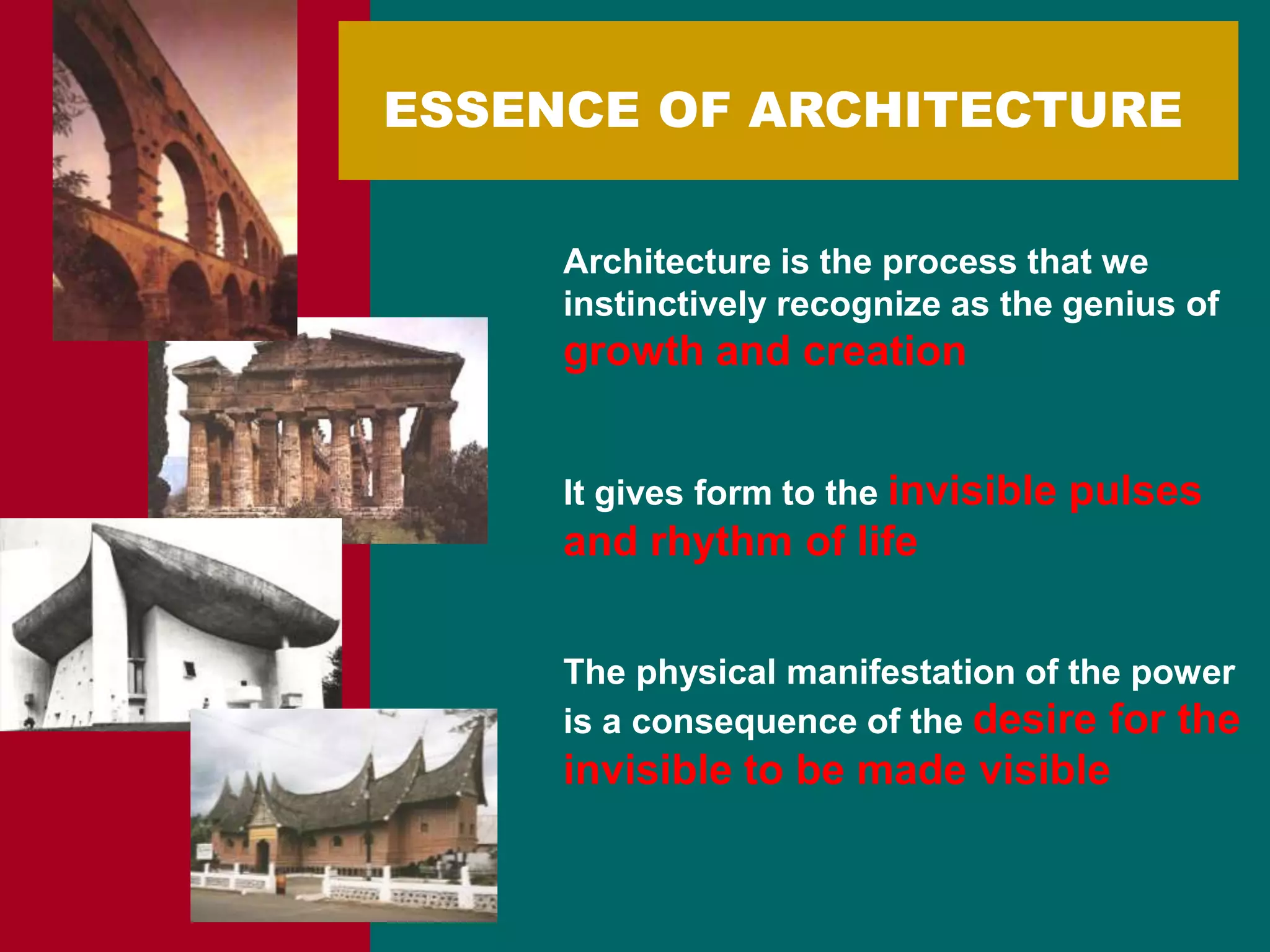
ESSENCE OF ARCHITECTURE
Architecture is the process that we
instinctively recognize as the genius of
growth and creation
It gives form to the invisible pulses
and rhythm of life
The physical manifestation of the power
is a consequence of the desire for the
invisible to be made visible
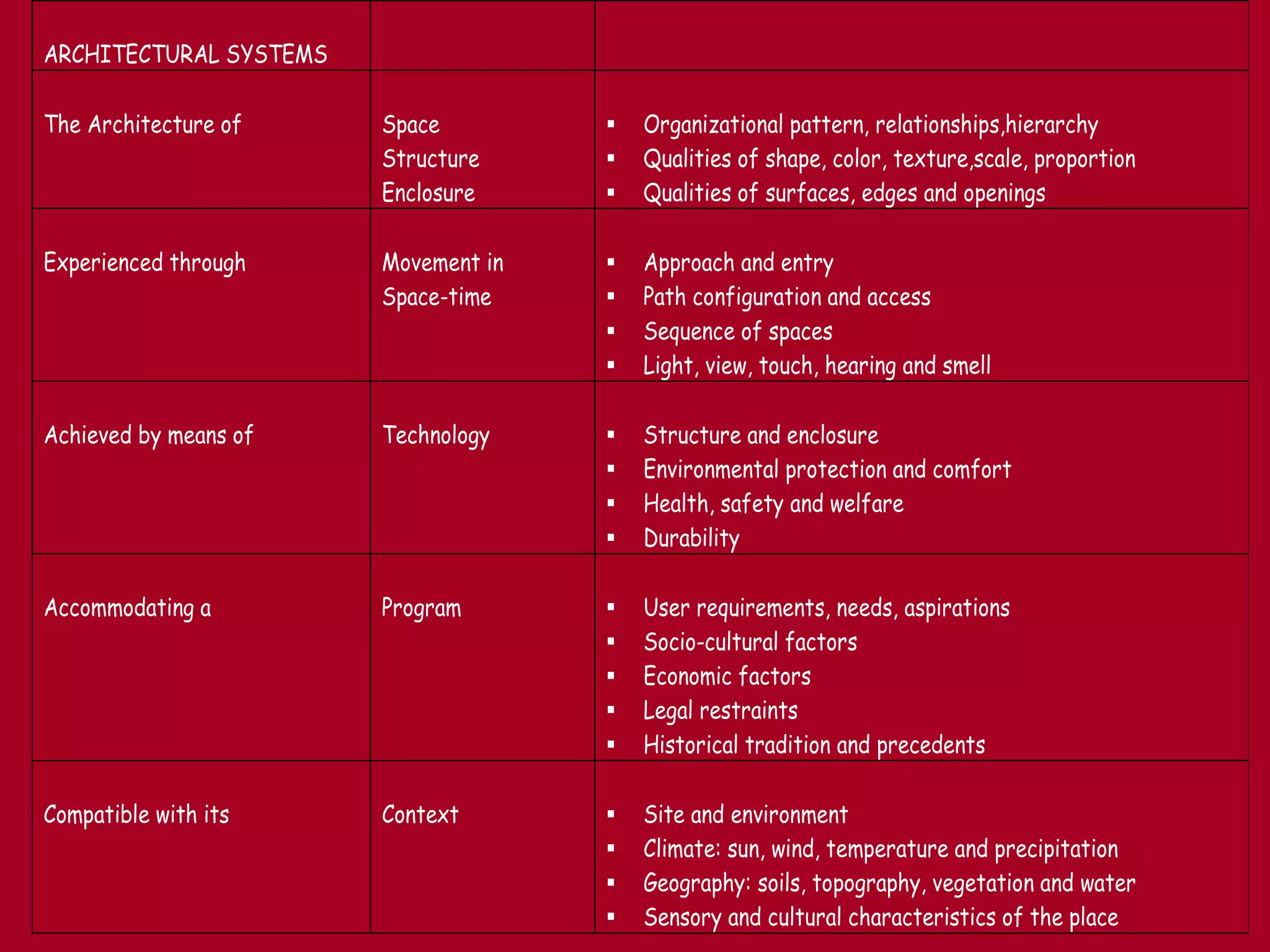
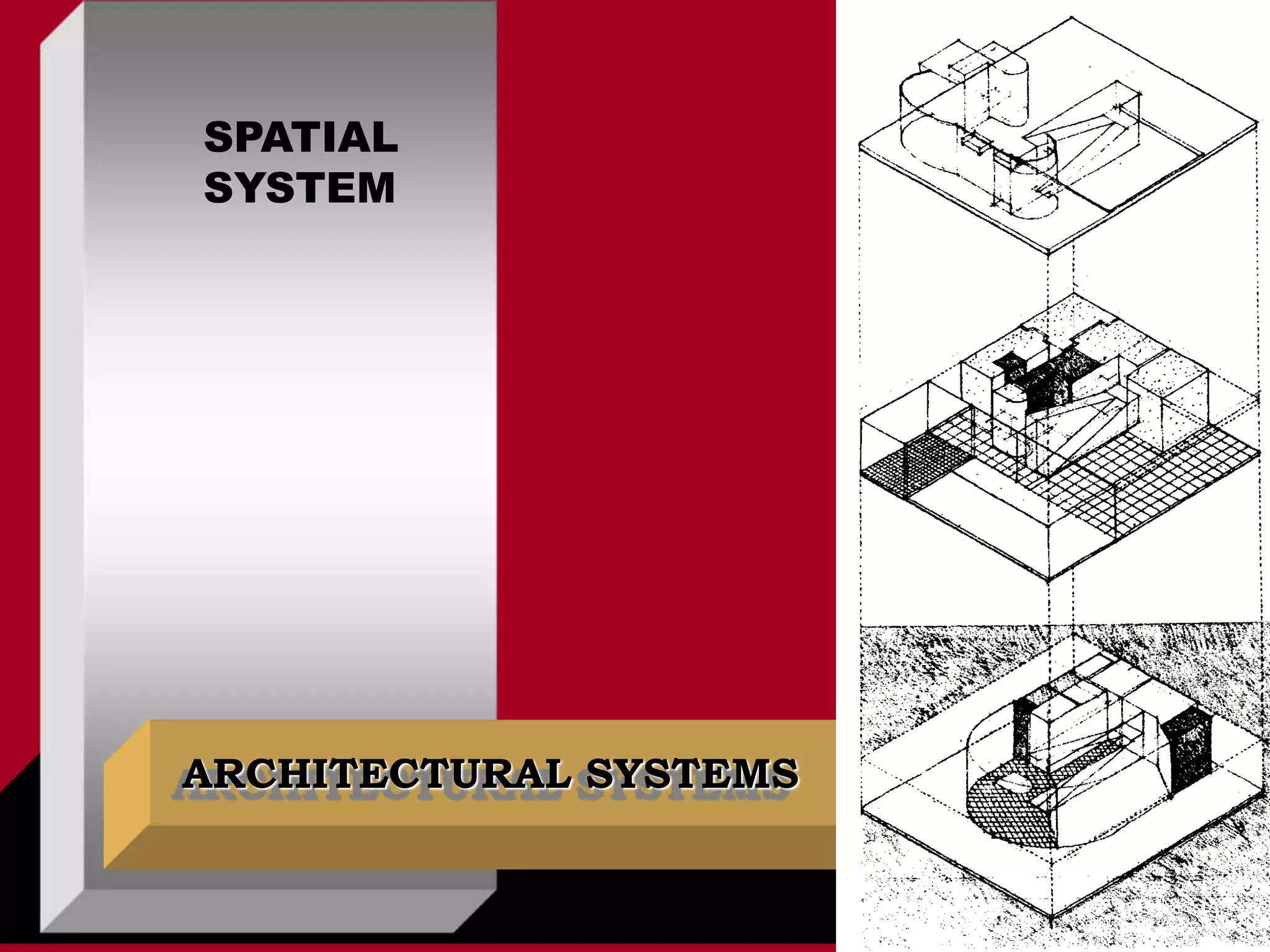
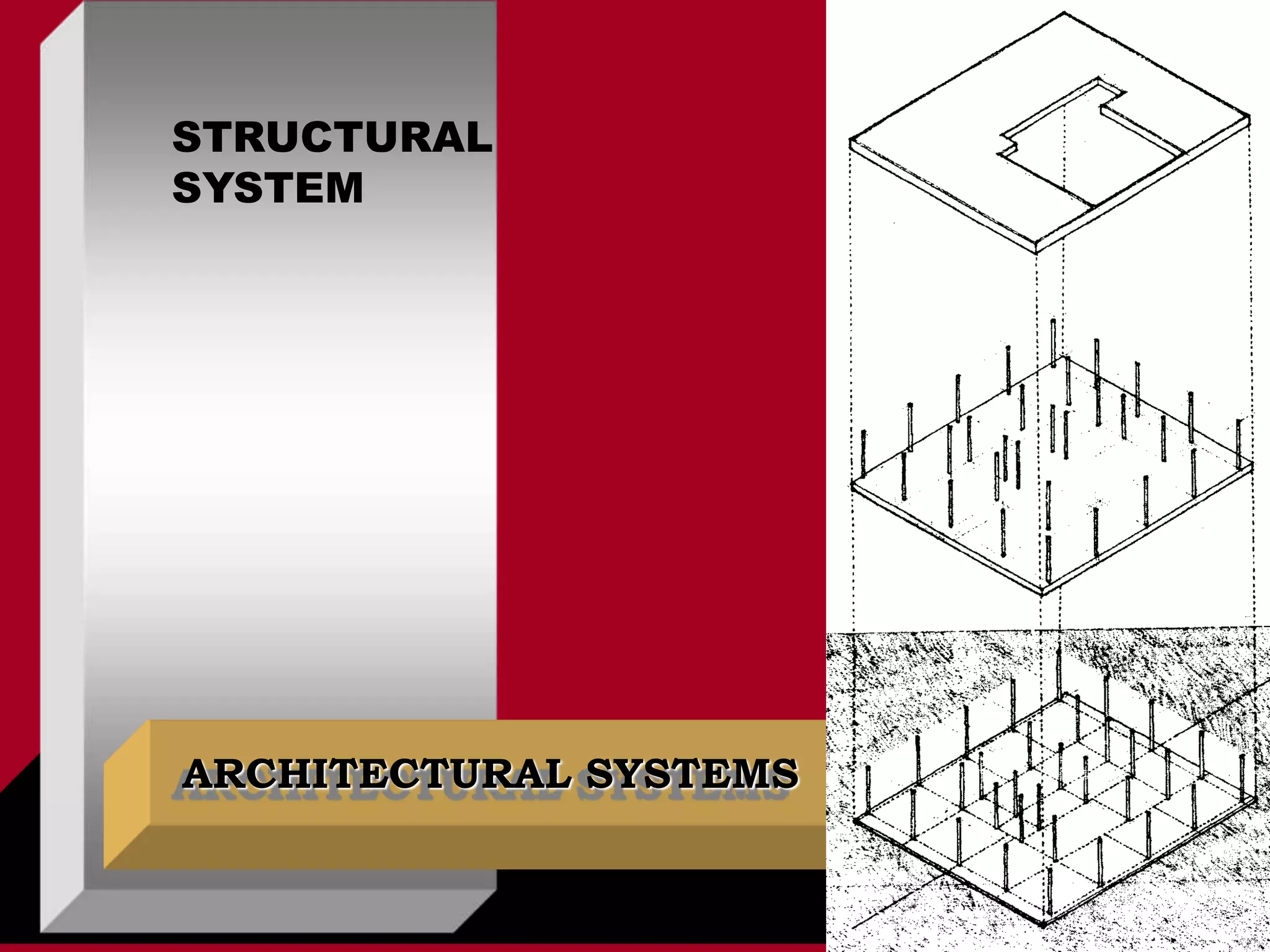
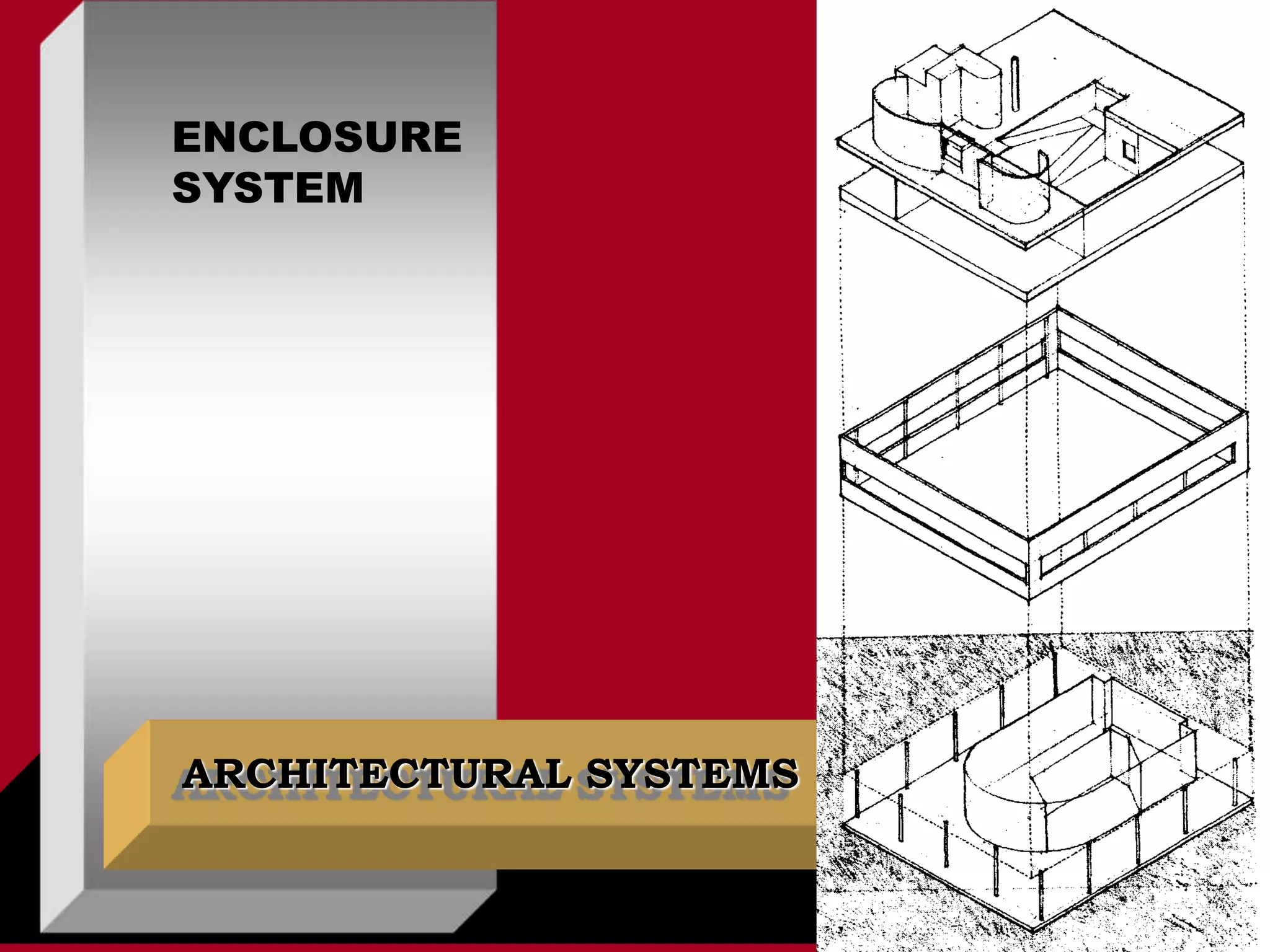
ARCHITECTURAL SYSTEMS
The Architecture of Space
Structure
Enclosure
 Organizational pattern, relationships,hierarchy
 Qualities of shape, color, texture,scale, proportion
 Qualities of surfaces, edges and openings
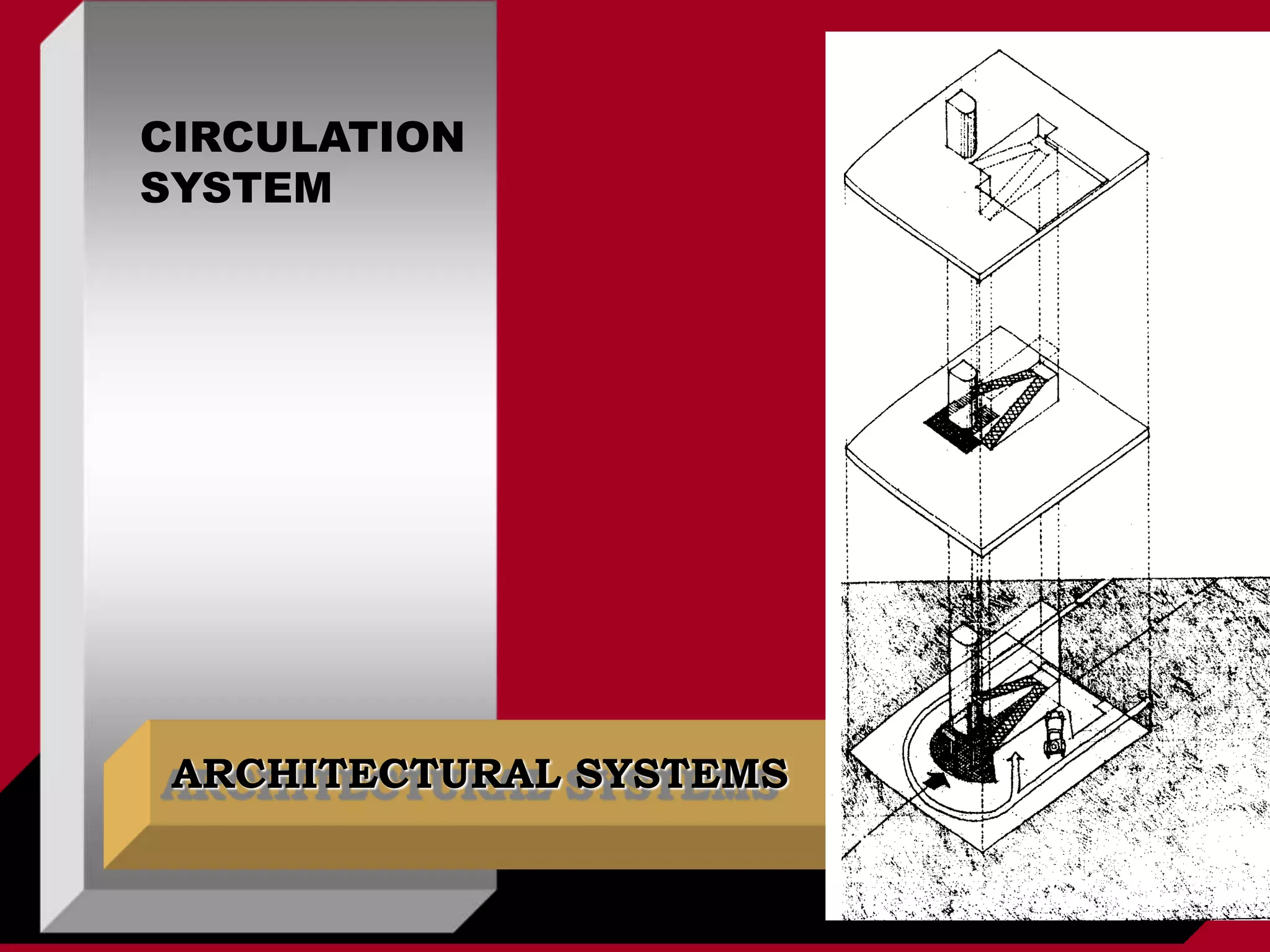
Experienced through Movement in
Space-time
 Approach and entry
 Path configuration and access
 Sequence of spaces
 Light, view, touch, hearing and smell
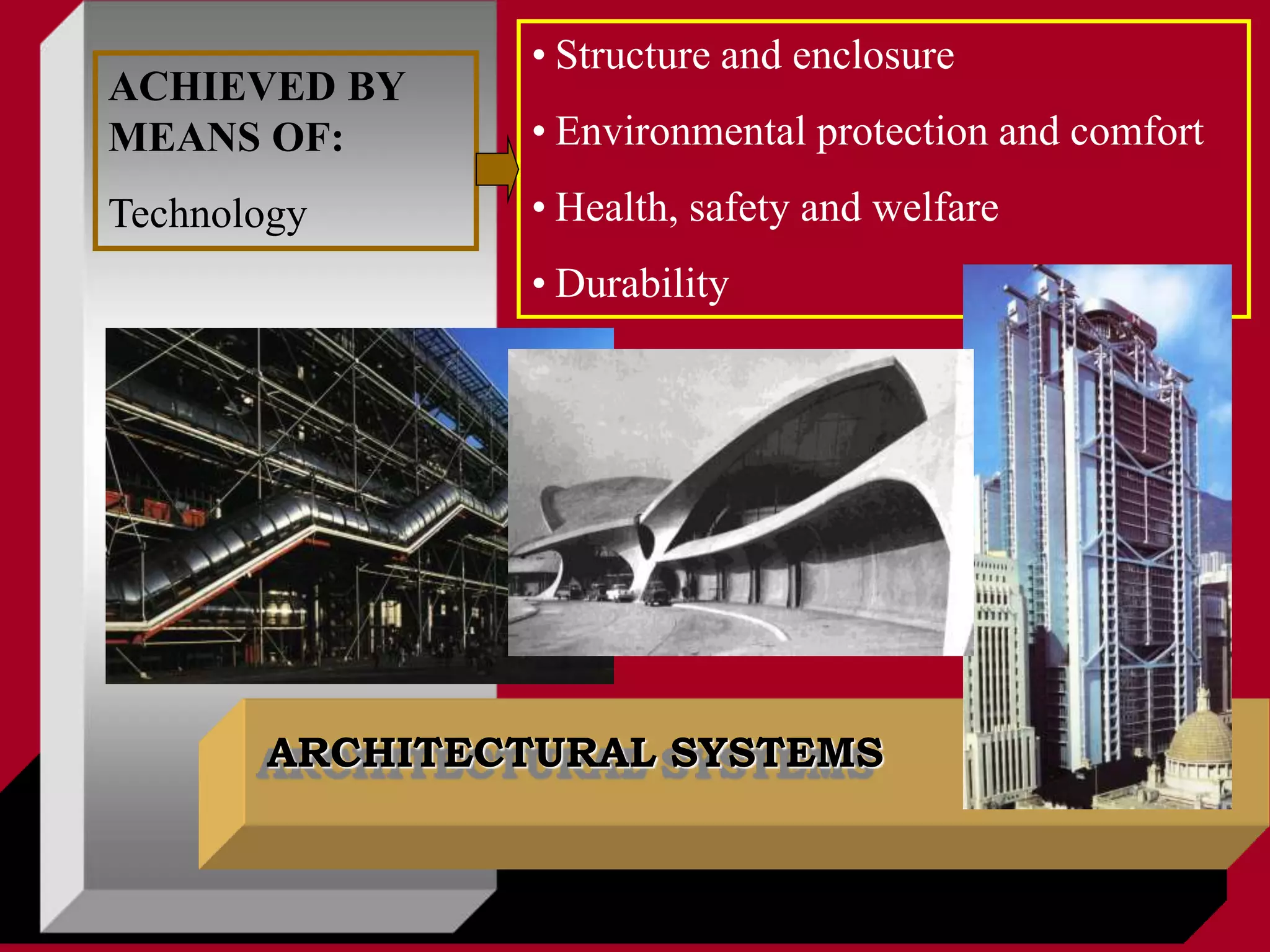
Achieved by means of Technology  Structure and enclosure
 Environmental protection and comfort
 Health, safety and welfare
 Durability
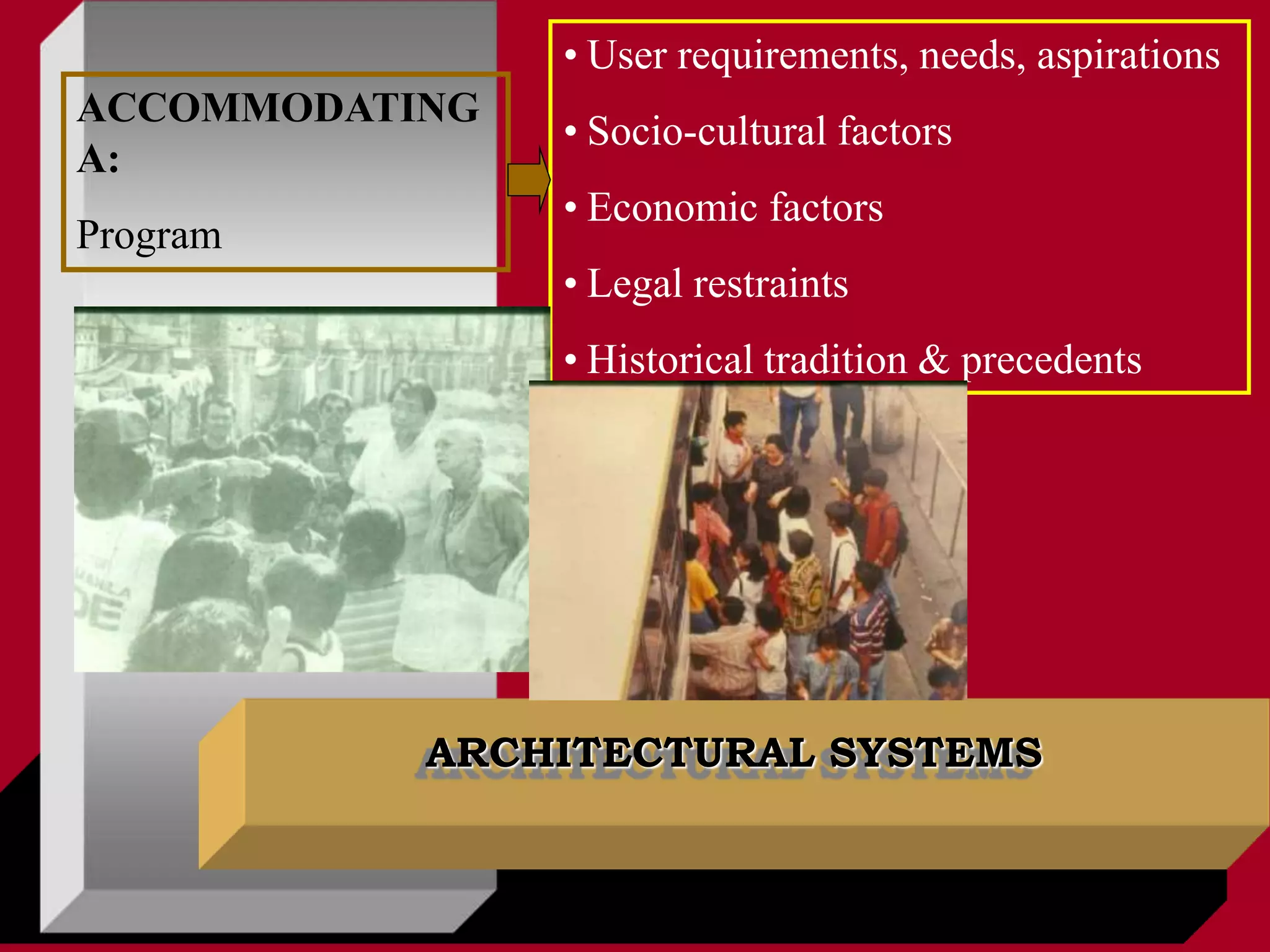
Accommodating a Program  User requirements, needs, aspirations
 Socio-cultural factors
 Economic factors
 Legal restraints
 Historical tradition and precedents
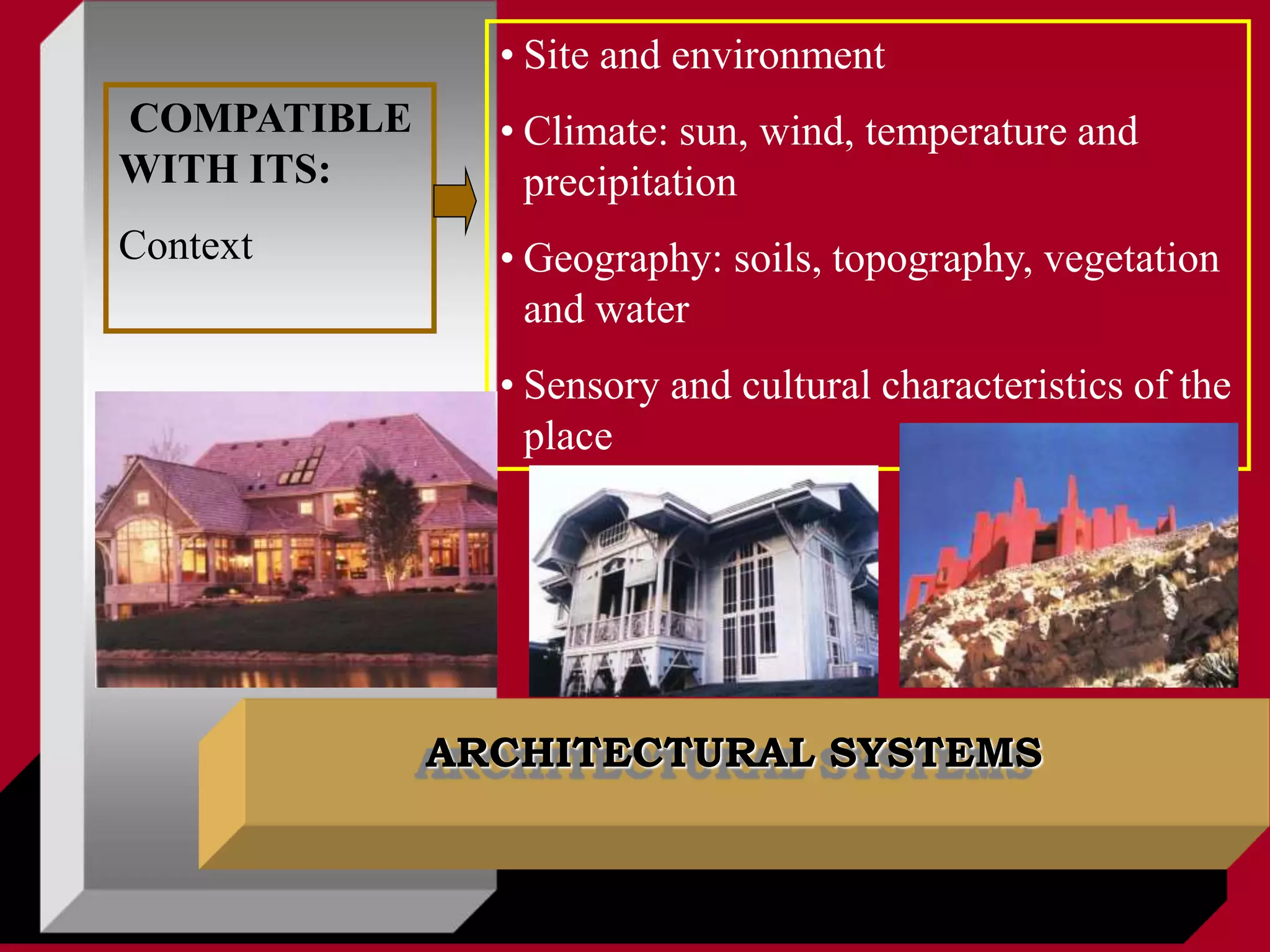
Compatible with its Context  Site and environment
 Climate: sun, wind, temperature and precipitation
 Geography: soils, topography, vegetation and water
 Sensory and cultural characteristics of the place
ARCHITECTURAL SYSTEMS
SPATIAL
SYSTEM
ARCHITECTURAL SYSTEMS
STRUCTURAL
SYSTEM
ARCHITECTURAL SYSTEMS
ENCLOSURE
SYSTEM
ARCHITECTURAL SYSTEMS
CIRCULATION
SYSTEM
ARCHITECTURAL SYSTEMS
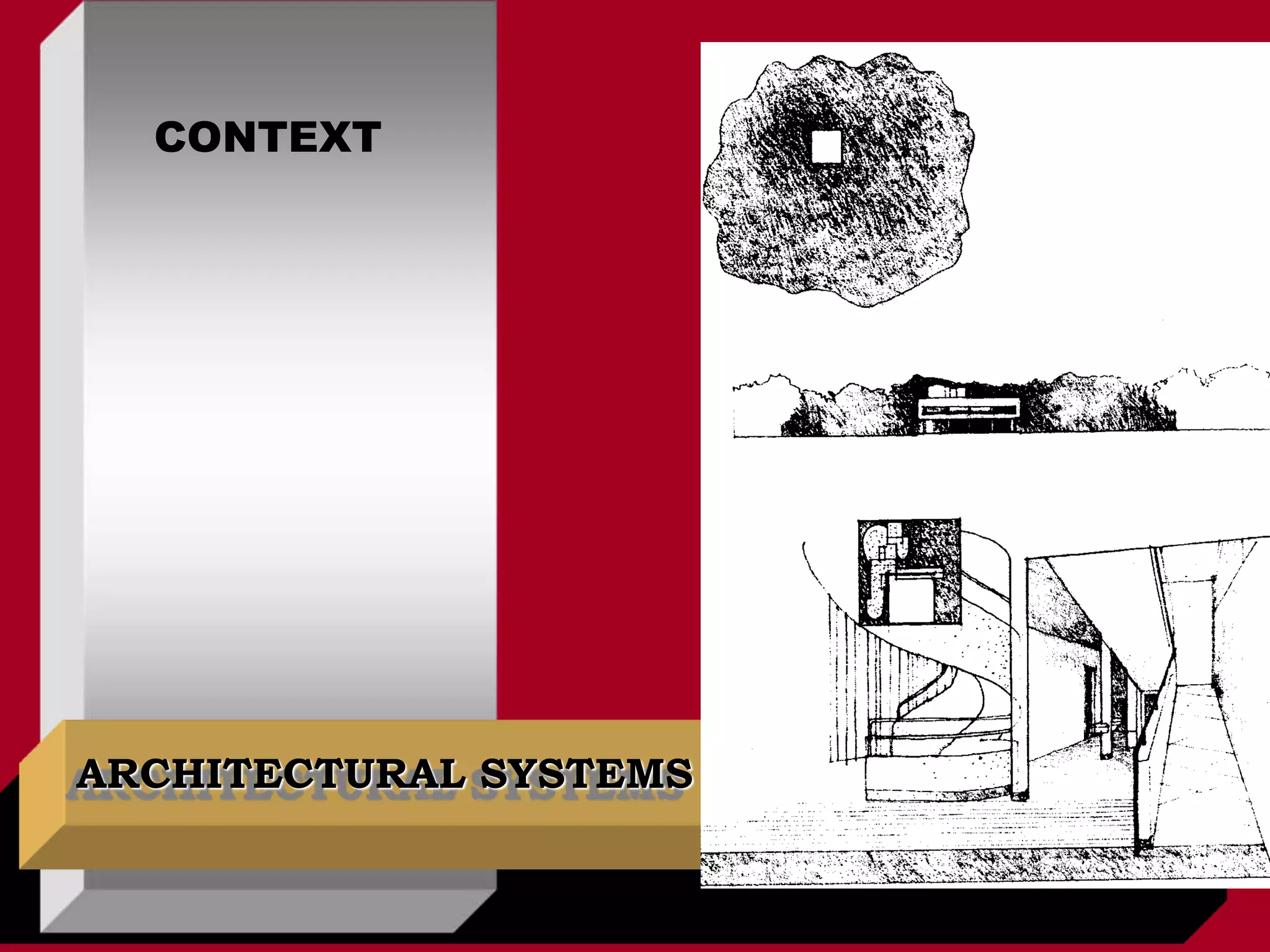
CONTEXT
ARCHITECTURAL SYSTEMS
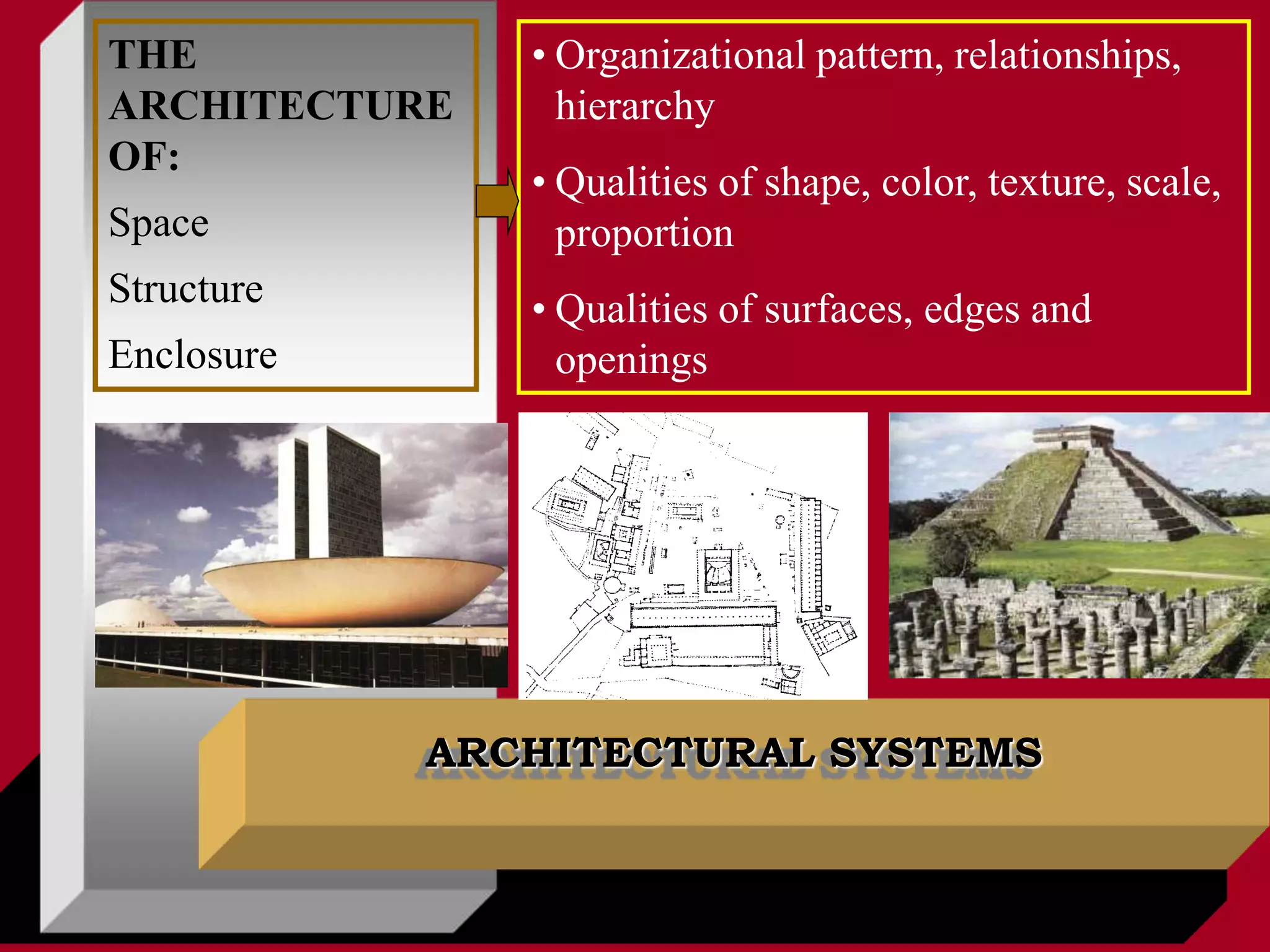
THE
ARCHITECTURE
OF:
Space
Structure
Enclosure
• Organizational pattern, relationships,
hierarchy
• Qualities of shape, color, texture, scale,
proportion
• Qualities of surfaces, edges and
openings
ARCHITECTURAL SYSTEMS
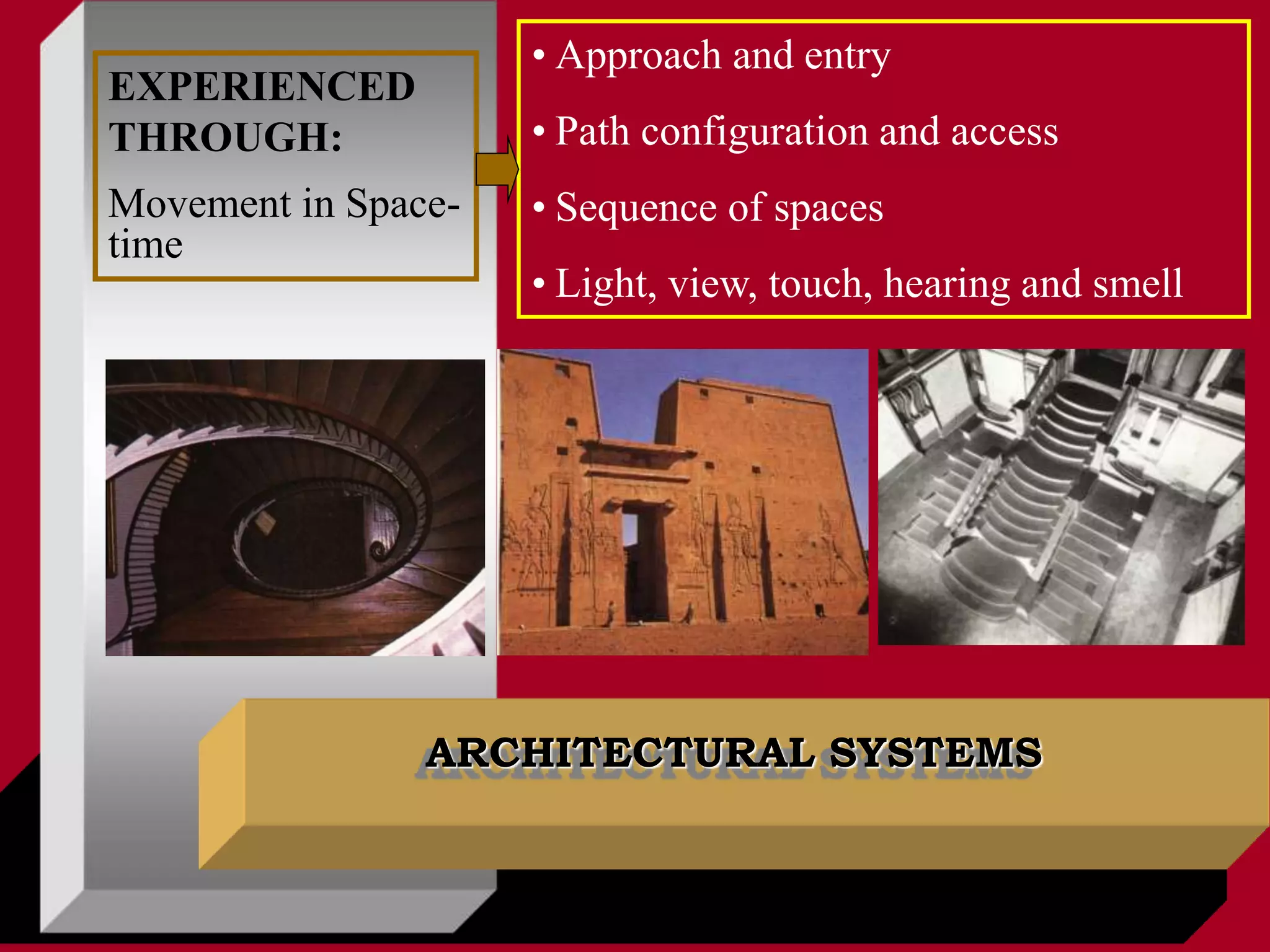
EXPERIENCED
THROUGH:
Movement in Space-
time
• Approach and entry
• Path configuration and access
• Sequence of spaces
• Light, view, touch, hearing and smell
ARCHITECTURAL SYSTEMS
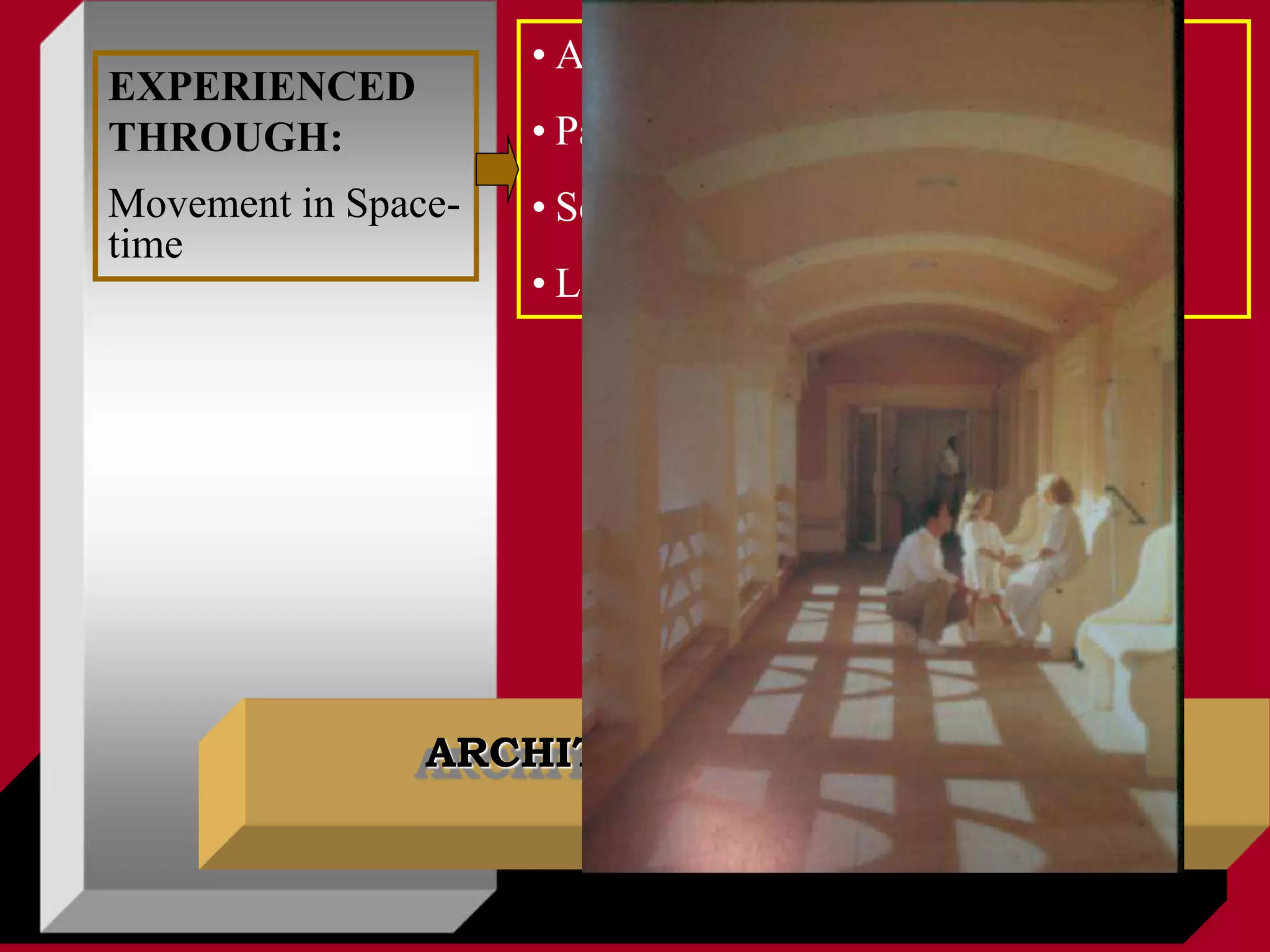
EXPERIENCED
THROUGH:
Movement in Space-
time
• Approach and entry
• Path configuration and access
• Sequence of spaces
• Light, view, touch, hearing and smell
ARCHITECTURAL SYSTEMS
ACHIEVED BY
MEANS OF:
Technology
• Structure and enclosure
• Environmental protection and comfort
• Health, safety and welfare
• Durability
ARCHITECTURAL SYSTEMS
ACCOMMODATING
A:
Program
• User requirements, needs, aspirations
• Socio-cultural factors
• Economic factors
• Legal restraints
• Historical tradition & precedents
ARCHITECTURAL SYSTEMS
COMPATIBLE
WITH ITS:
Context
• Site and environment
• Climate: sun, wind, temperature and
precipitation
• Geography: soils, topography, vegetation
and water
• Sensory and cultural characteristics of the
place
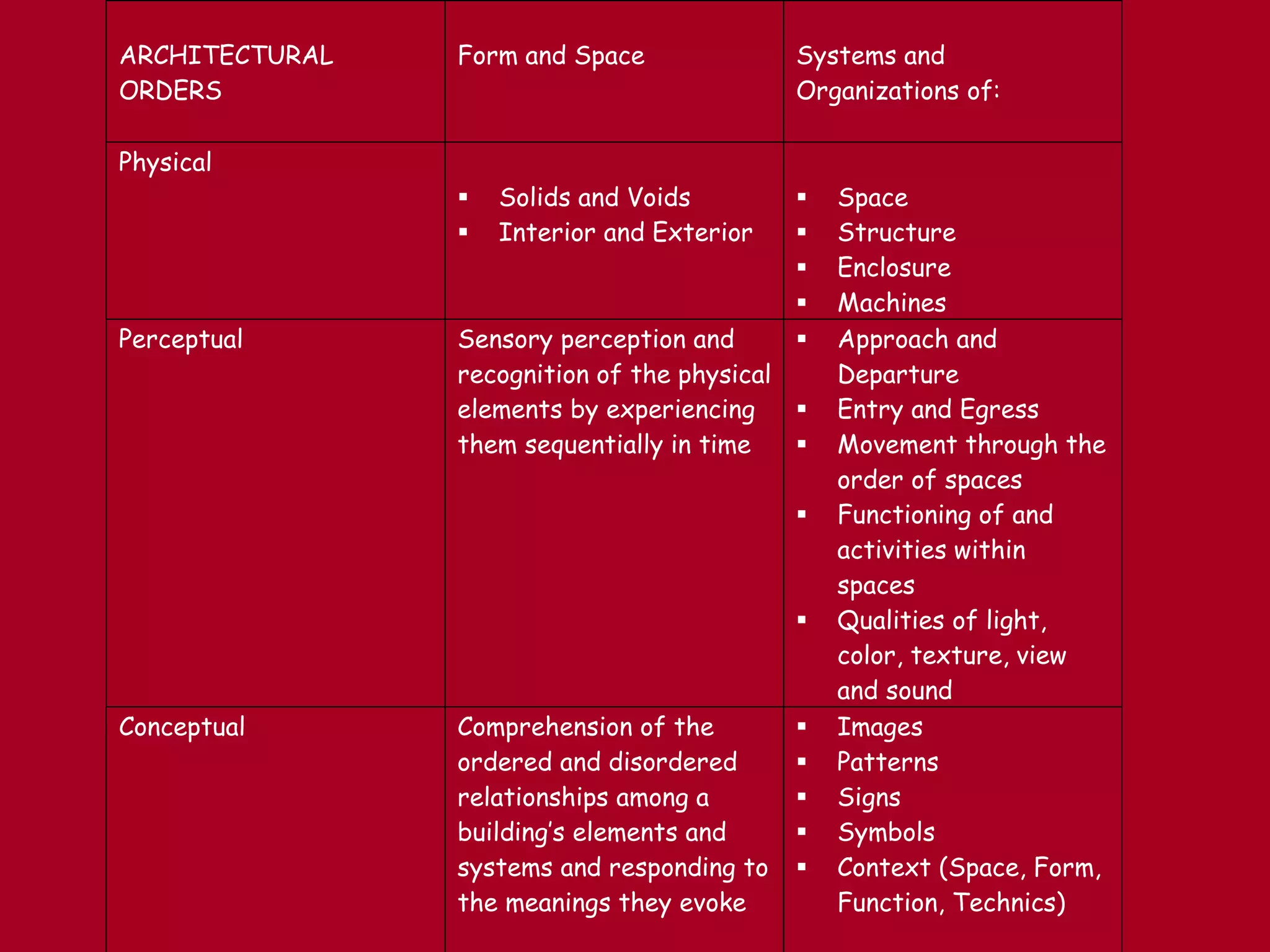
ARCHITECTURAL
ORDERS
Form and Space Systems and
Organizations of:
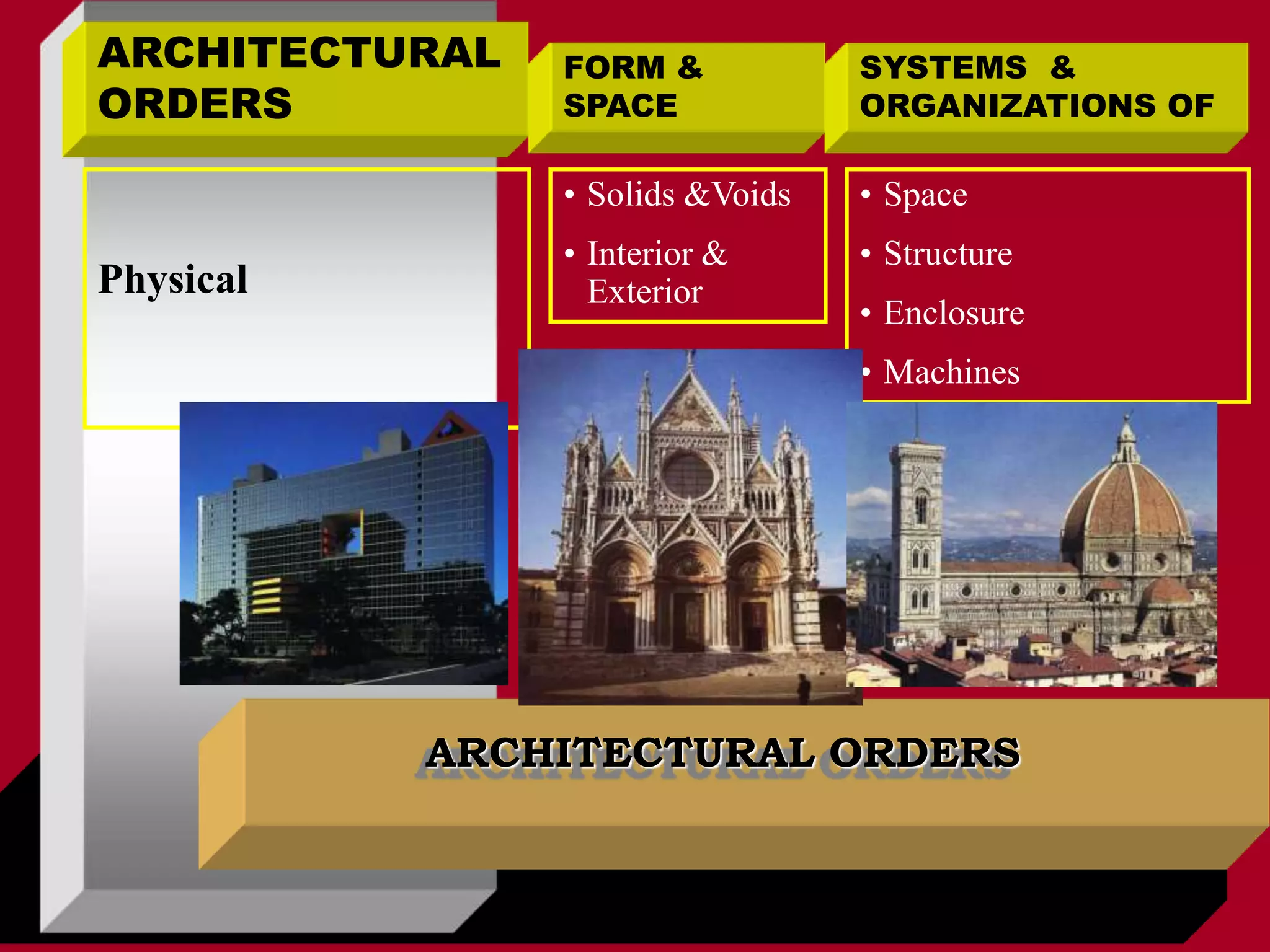
Physical
 Solids and Voids
 Interior and Exterior
 Space
 Structure
 Enclosure
 Machines
Perceptual Sensory perception and
recognition of the physical
elements by experiencing
them sequentially in time
 Approach and
Departure
 Entry and Egress
 Movement through the
order of spaces
 Functioning of and
activities within
spaces
 Qualities of light,
color, texture, view
and sound
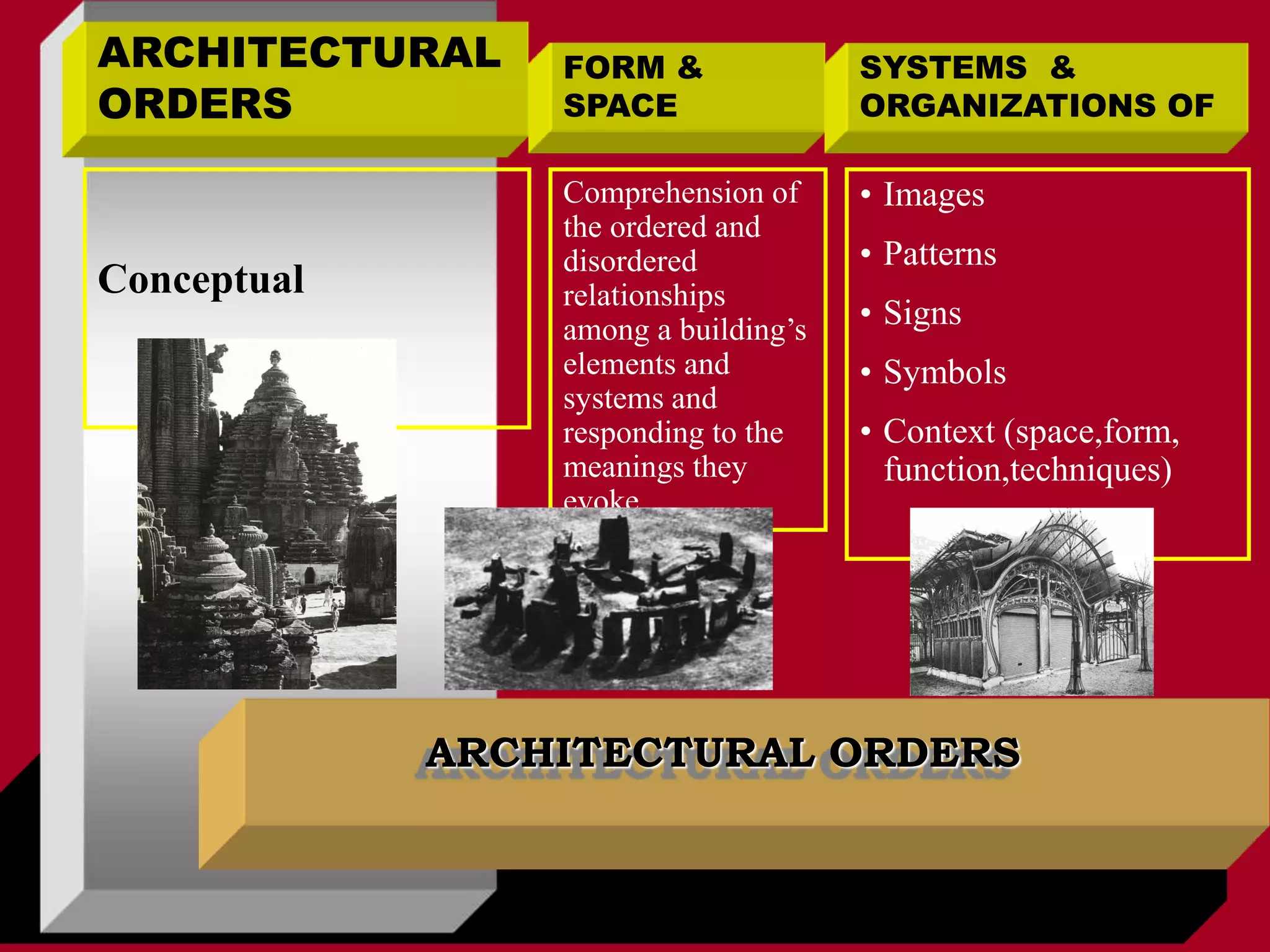
Conceptual Comprehension of the
ordered and disordered
relationships among a
building’s elements and
systems and responding to
the meanings they evoke
 Images
 Patterns
 Signs
 Symbols
 Context (Space, Form,
Function, Technics)
ARCHITECTURAL ORDERS
ARCHITECTURAL
ORDERS
FORM &
SPACE
SYSTEMS &
ORGANIZATIONS OF
Physical
• Solids &Voids
• Interior &
Exterior
• Space
• Structure
• Enclosure
• Machines
ARCHITECTURAL ORDERS
ARCHITECTURAL
ORDERS
FORM &
SPACE
SYSTEMS &
ORGANIZATIONS OF
Perceptual
Sensory
perception &
recognition of
the physical
elements by
experiencing
them sequentially
in time
• Approach & Departure
• Entry & Egress
• Movement through the
order of spaces
• Functioning of activities
within spaces
• Qualities of light, color,
texture, view & sound
ARCHITECTURAL ORDERS
ARCHITECTURAL
ORDERS
FORM &
SPACE
SYSTEMS &
ORGANIZATIONS OF
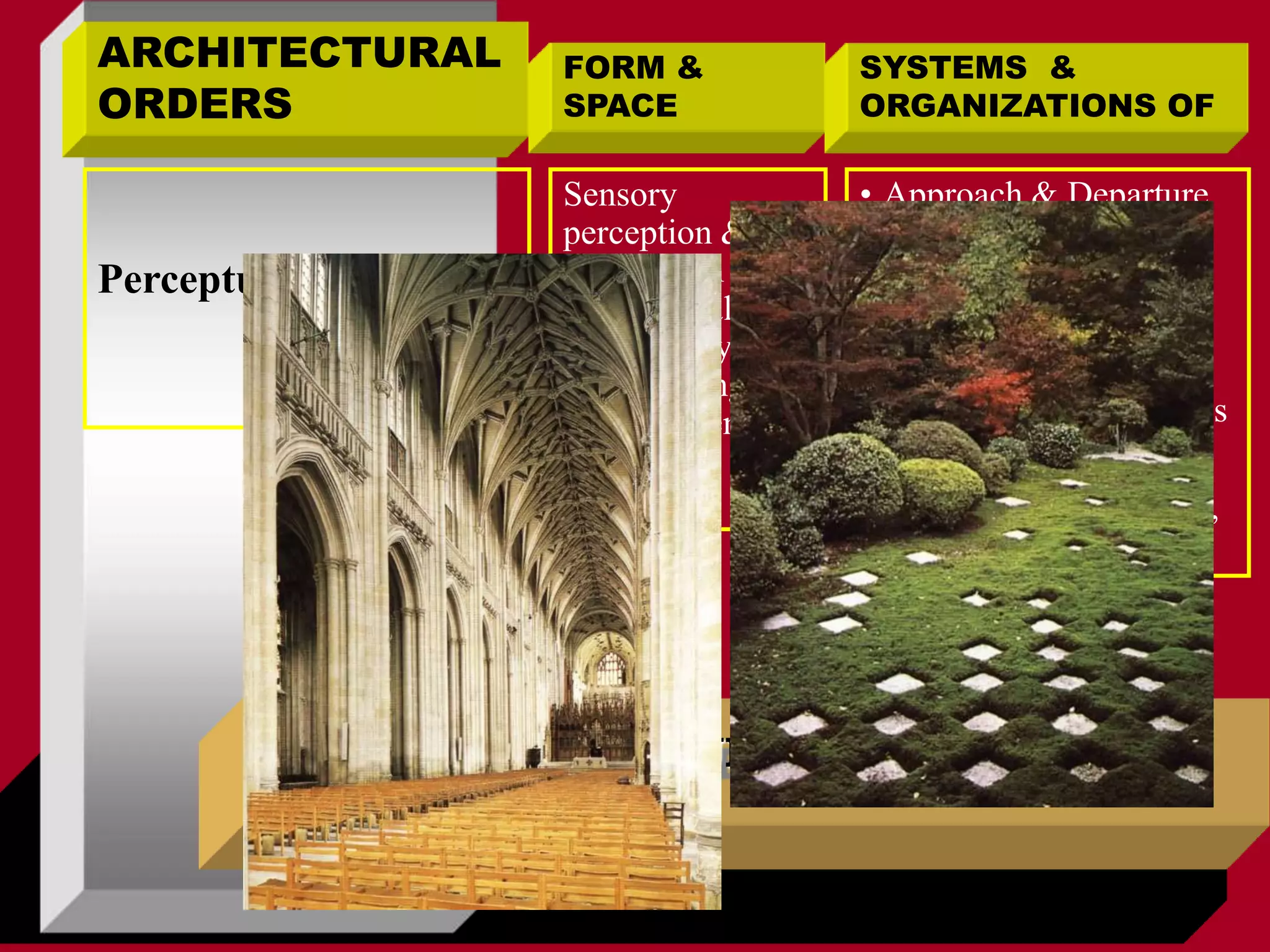
Perceptual
Sensory
perception &
recognition of
the physical
elements by
experiencing
them sequentially
in time
• Approach & Departure
• Entry & Egress
• Movement through the
order of spaces
• Functioning of activities
within spaces
• Qualities of light, color,
texture, view & sound
ARCHITECTURAL ORDERS
ARCHITECTURAL
ORDERS
FORM &
SPACE
SYSTEMS &
ORGANIZATIONS OF
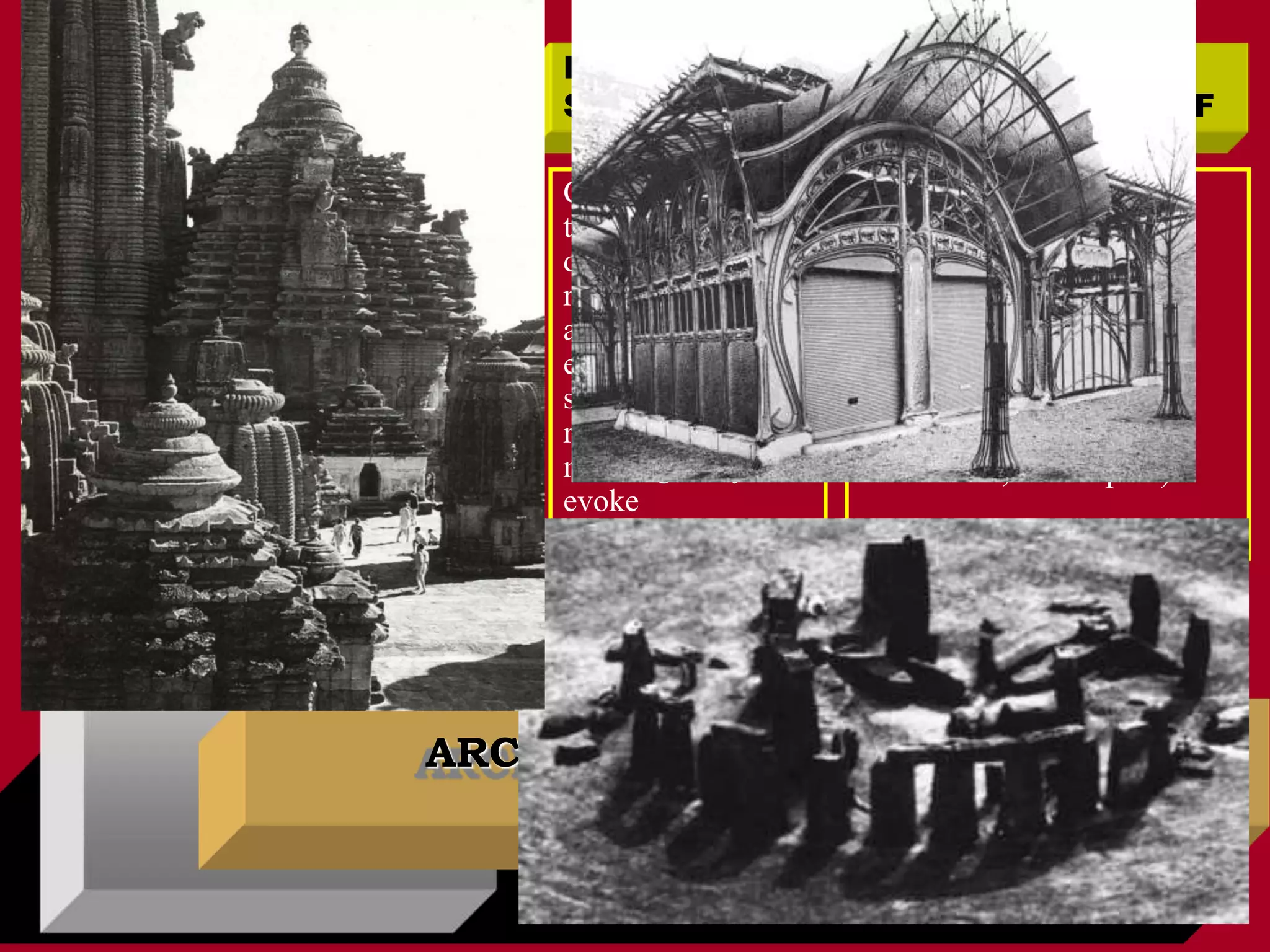
Conceptual
Comprehension of
the ordered and
disordered
relationships
among a building’s
elements and
systems and
responding to the
meanings they
evoke
• Images
• Patterns
• Signs
• Symbols
• Context (space,form,
function,techniques)
ARCHITECTURAL ORDERS
ARCHITECTURAL
ORDERS
FORM &
SPACE
SYSTEMS &
ORGANIZATIONS OF
Conceptual
Comprehension of
the ordered and
disordered
relationships
among a building’s
elements and
systems and
responding to the
meanings they
evoke
• Images
• Patterns
• Signs
• Symbols
• Context (space,form,
function,techniques)
ELEMENTS OF DESIGN
ELEMENTS OF DESIGN
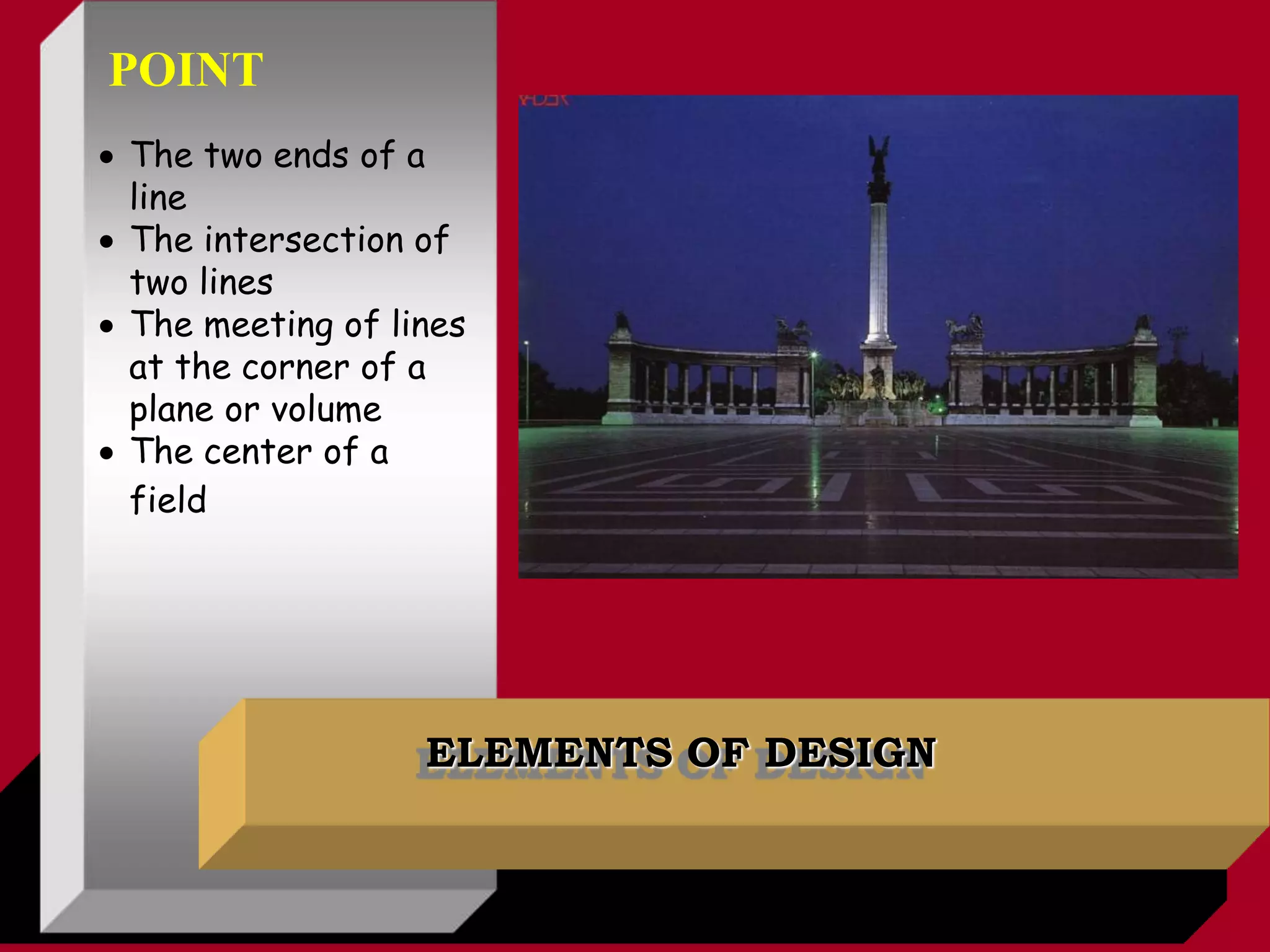
 The two ends of a
line
 The intersection of
two lines
 The meeting of lines
at the corner of a
plane or volume
 The center of a
field
POINT
ELEMENTS OF DESIGN
A point extended
becomes a line with
properties of:
 Length
 Direction
 Position
LINE
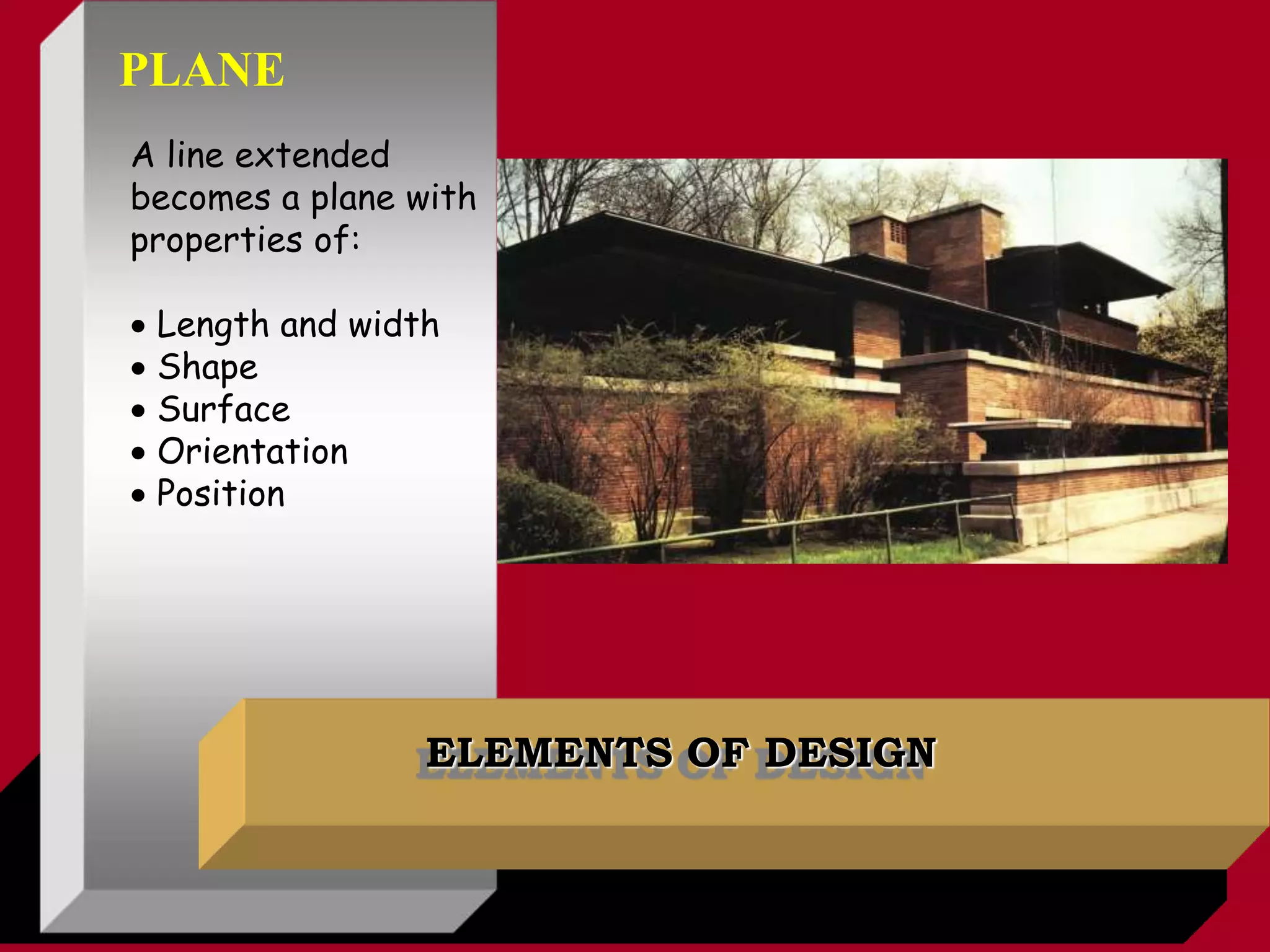
ELEMENTS OF DESIGN
A line extended
becomes a plane with
properties of:
 Length and width
 Shape
 Surface
 Orientation
 Position
PLANE
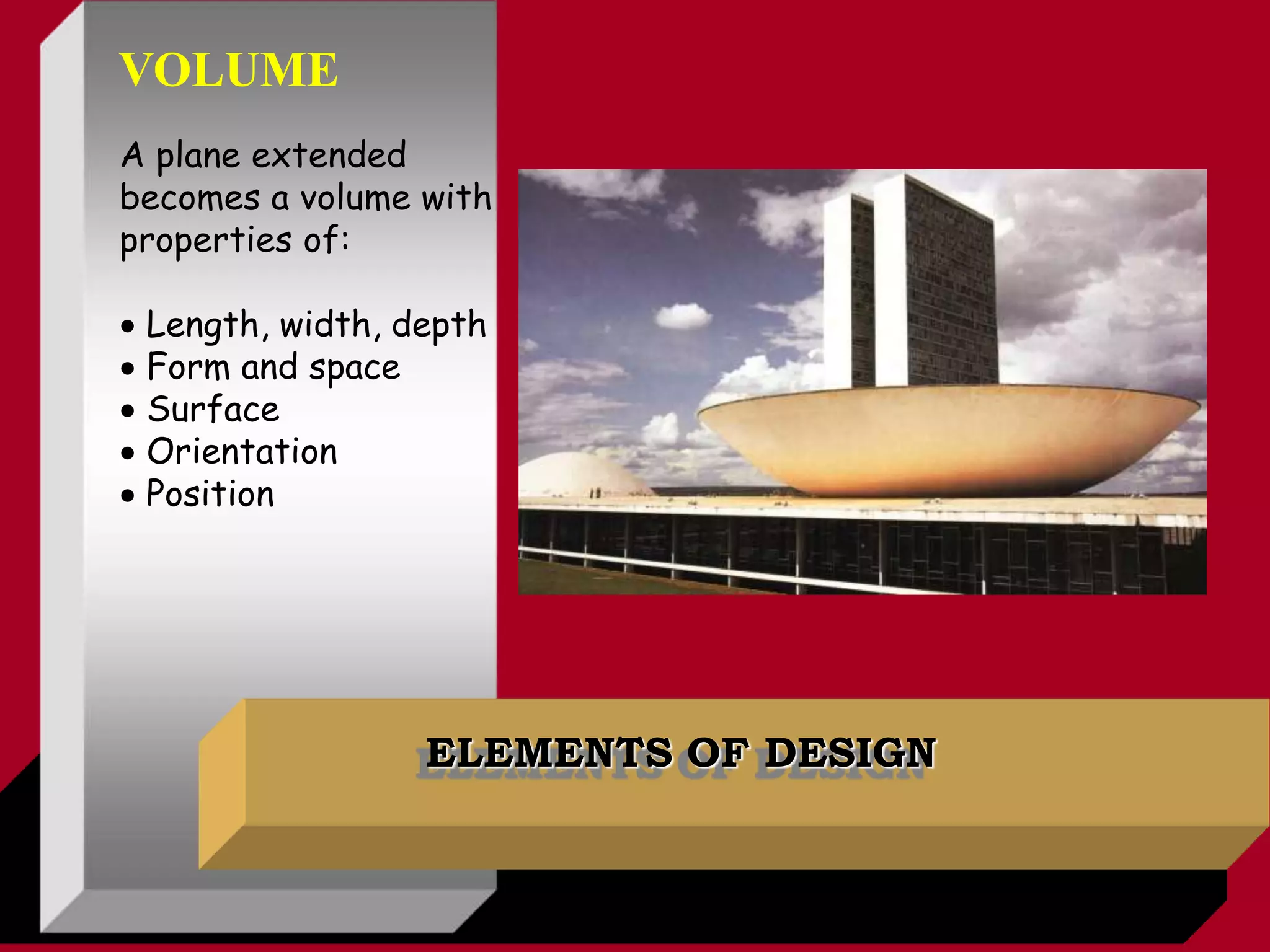
ELEMENTS OF DESIGN
A plane extended
becomes a volume with
properties of:
 Length, width, depth
 Form and space
 Surface
 Orientation
 Position
VOLUME
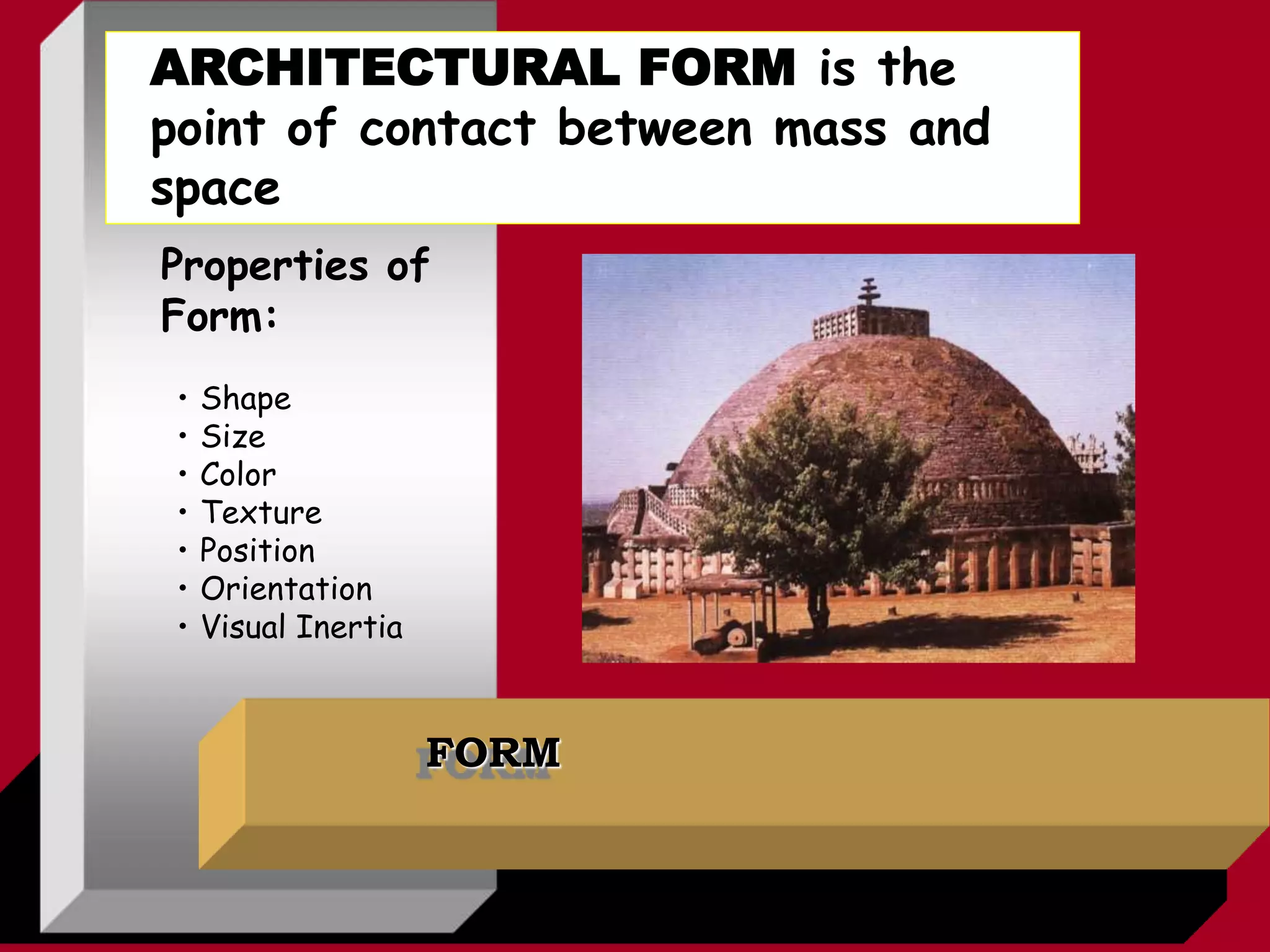
FORM
Properties of
Form:
• Shape
• Size
• Color
• Texture
• Position
• Orientation
• Visual Inertia
ARCHITECTURAL FORM is the
point of contact between mass and
space
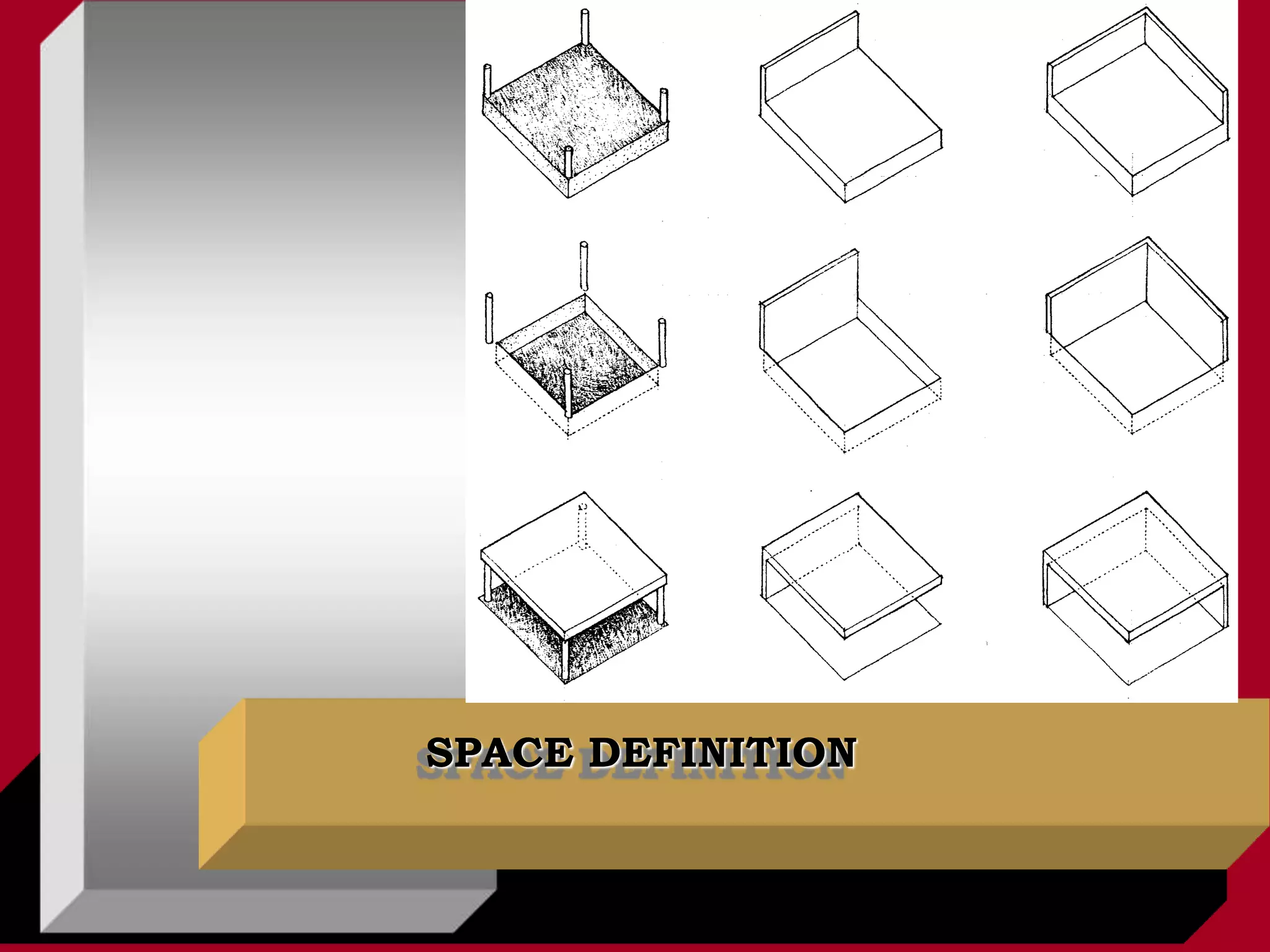
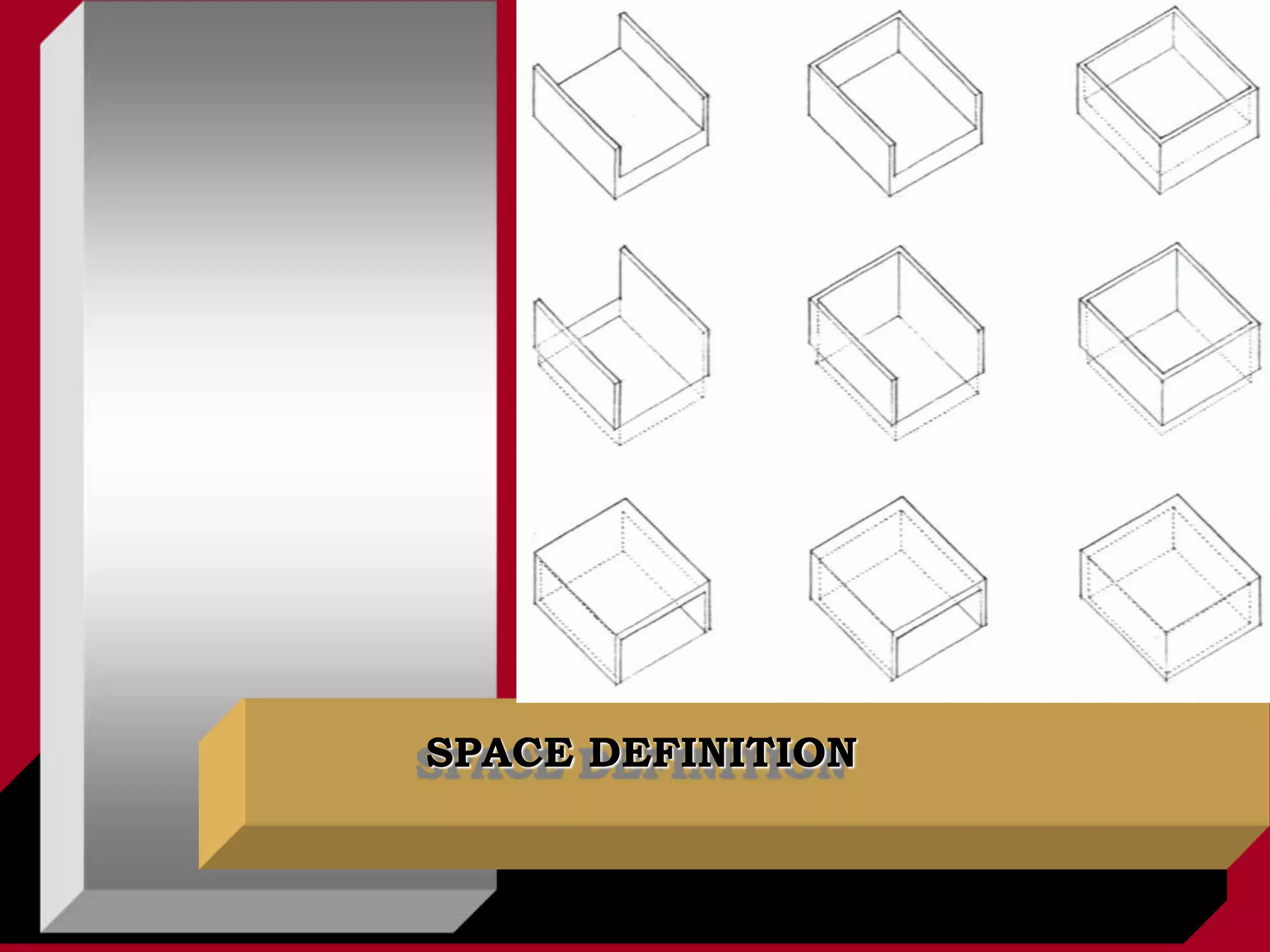
SPACE DEFINITION
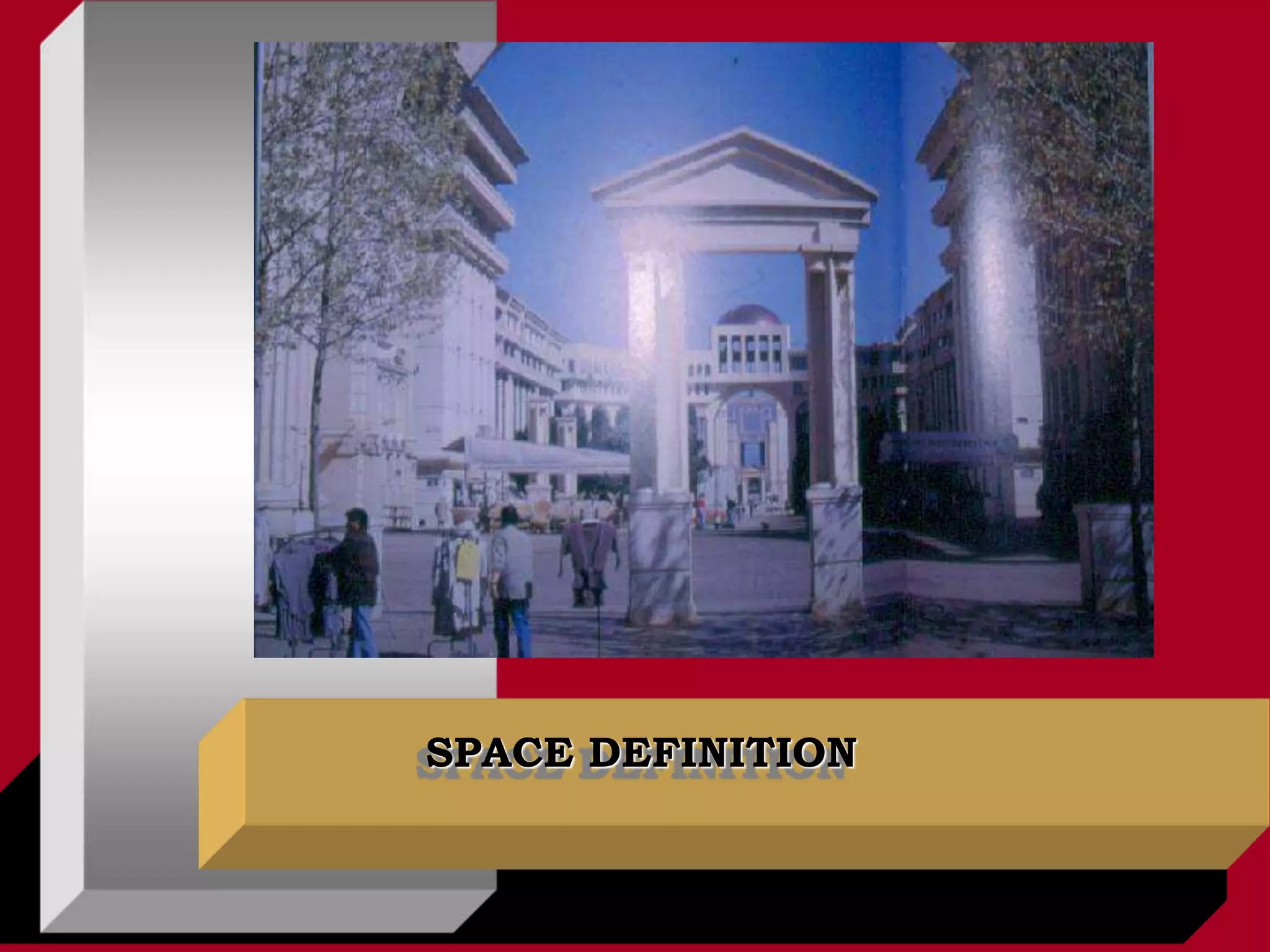
SPACE DEFINITION
SPACE DEFINITION
SPACE DEFINITION
FORM TRANSFORMTION
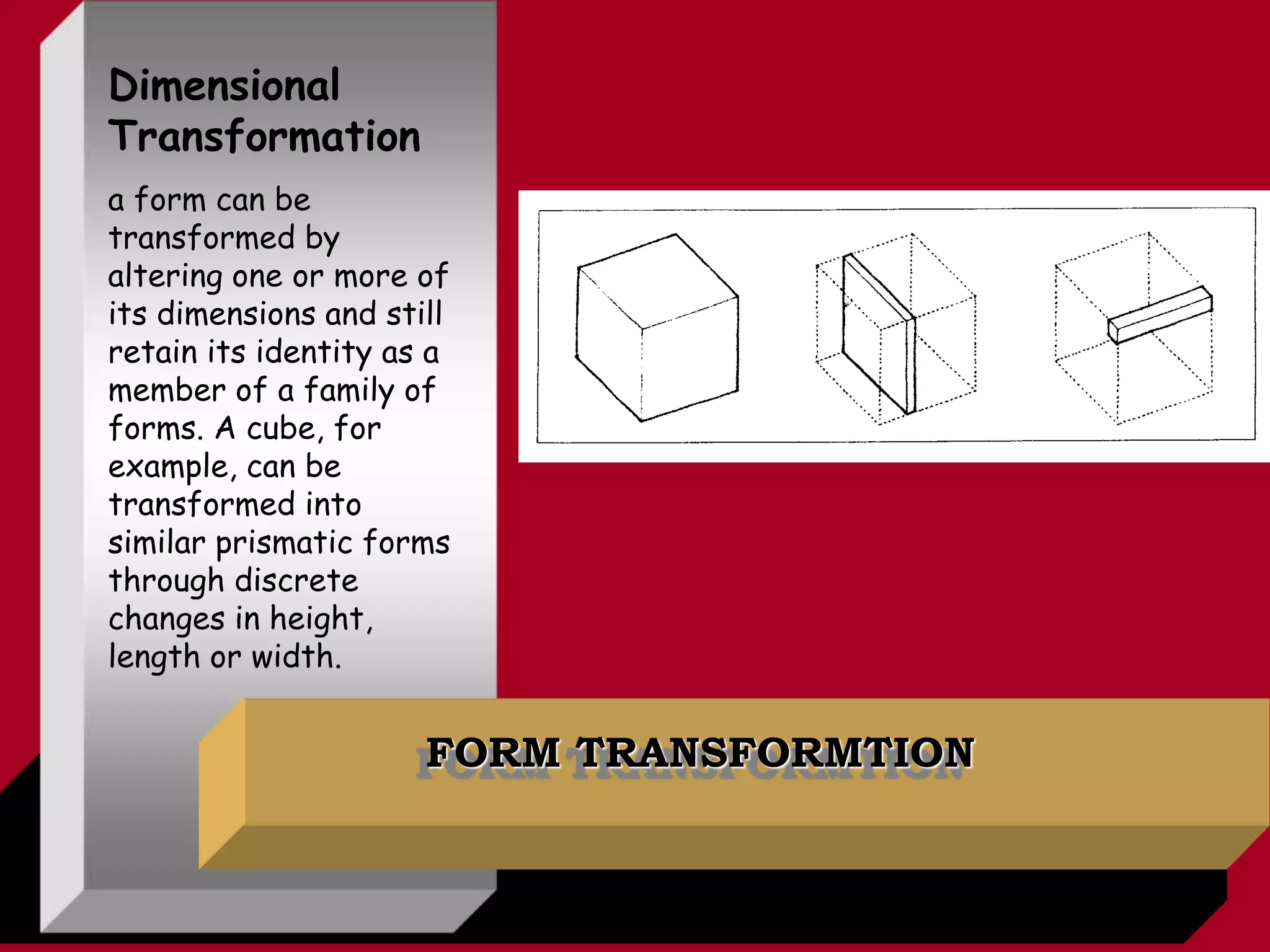
Dimensional
Transformation
a form can be
transformed by
altering one or more of
its dimensions and still
retain its identity as a
member of a family of
forms. A cube, for
example, can be
transformed into
similar prismatic forms
through discrete
changes in height,
length or width.
FORM TRANSFORMATION
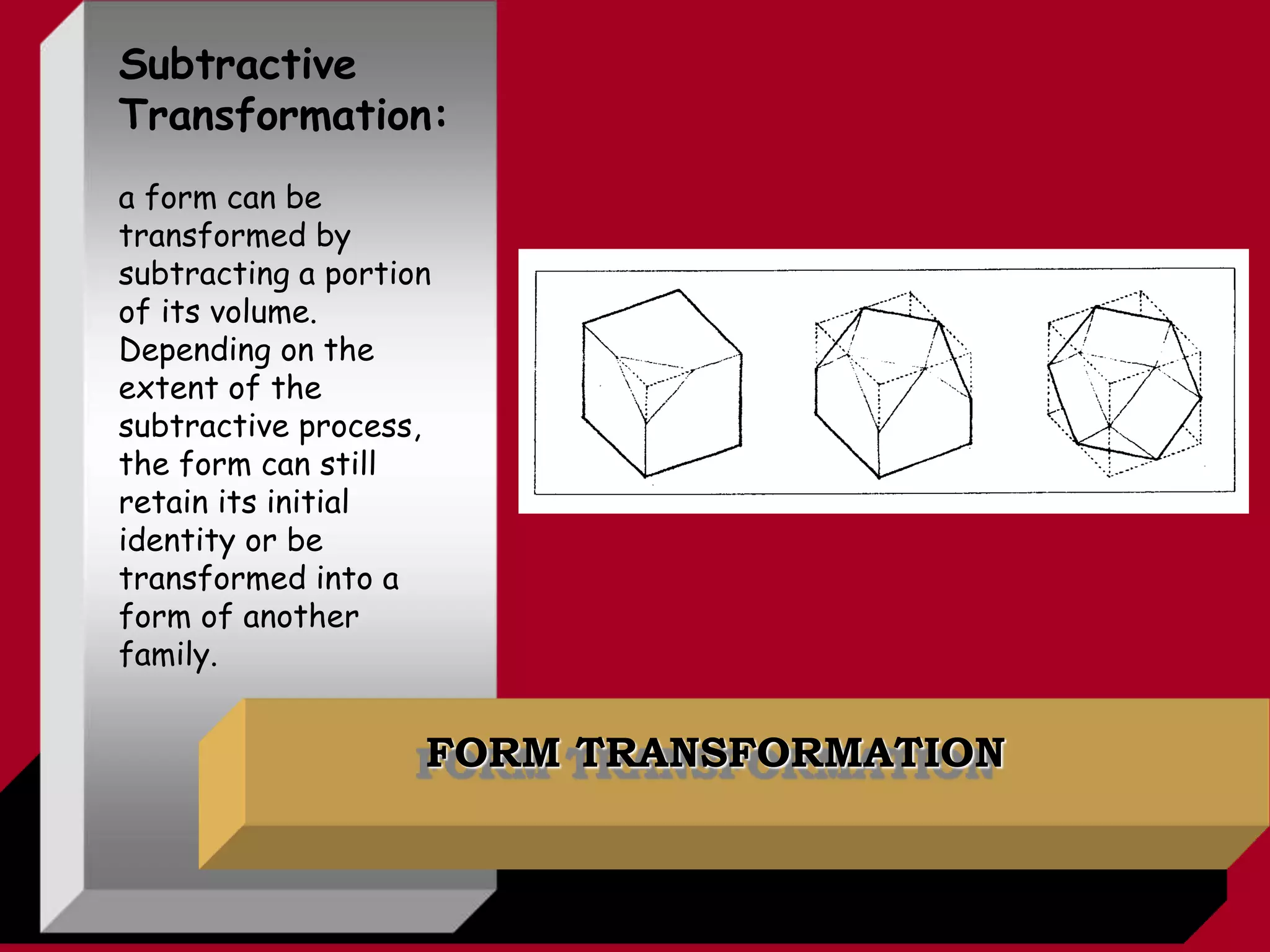
Subtractive
Transformation:
a form can be
transformed by
subtracting a portion
of its volume.
Depending on the
extent of the
subtractive process,
the form can still
retain its initial
identity or be
transformed into a
form of another
family.
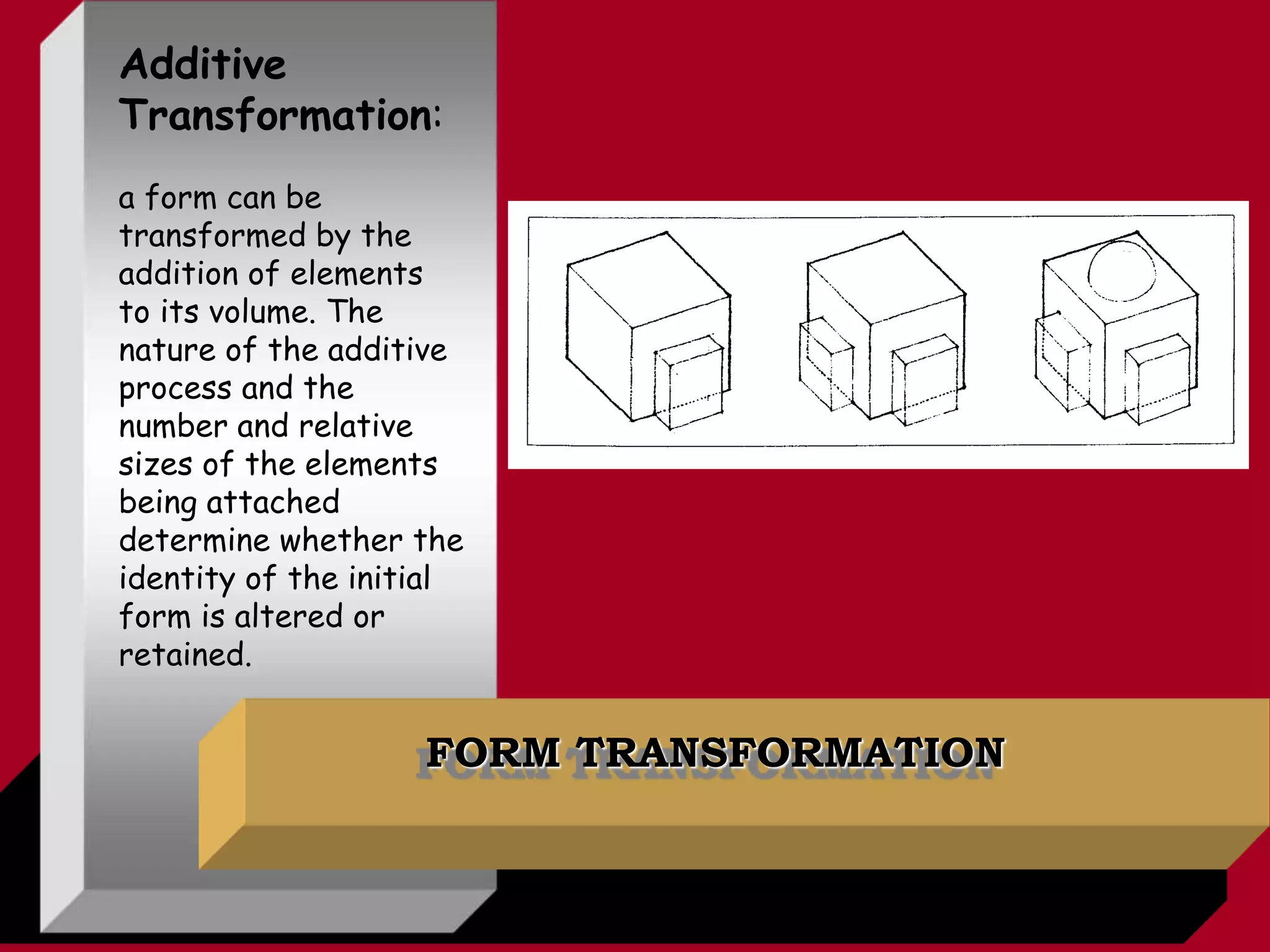
FORM TRANSFORMATION
Additive
Transformation:
a form can be
transformed by the
addition of elements
to its volume. The
nature of the additive
process and the
number and relative
sizes of the elements
being attached
determine whether the
identity of the initial
form is altered or
retained.
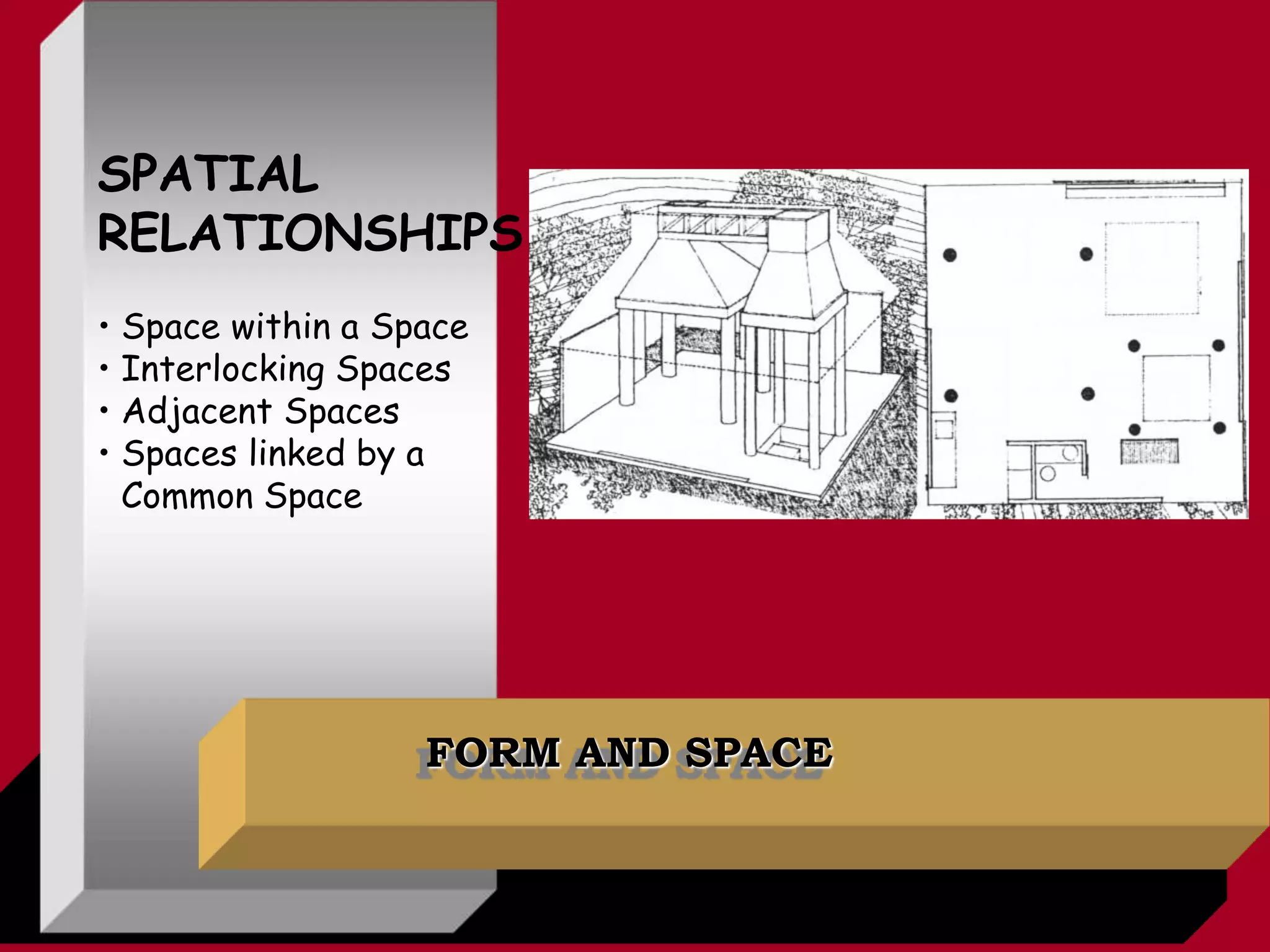
FORM AND SPACE
SPATIAL
RELATIONSHIPS
• Space within a Space
• Interlocking Spaces
• Adjacent Spaces
• Spaces linked by a
Common Space
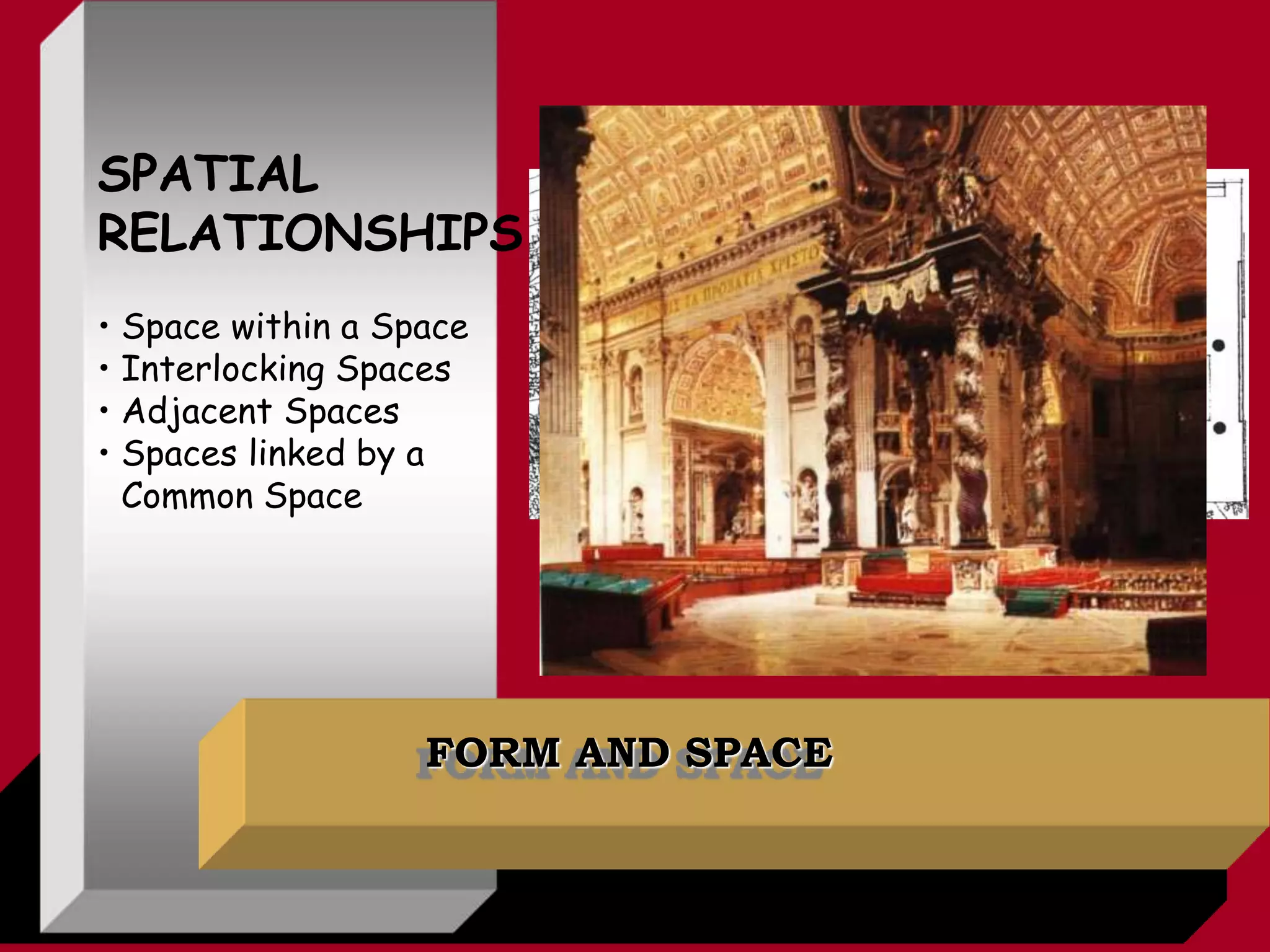
FORM AND SPACE
SPATIAL
RELATIONSHIPS
• Space within a Space
• Interlocking Spaces
• Adjacent Spaces
• Spaces linked by a
Common Space
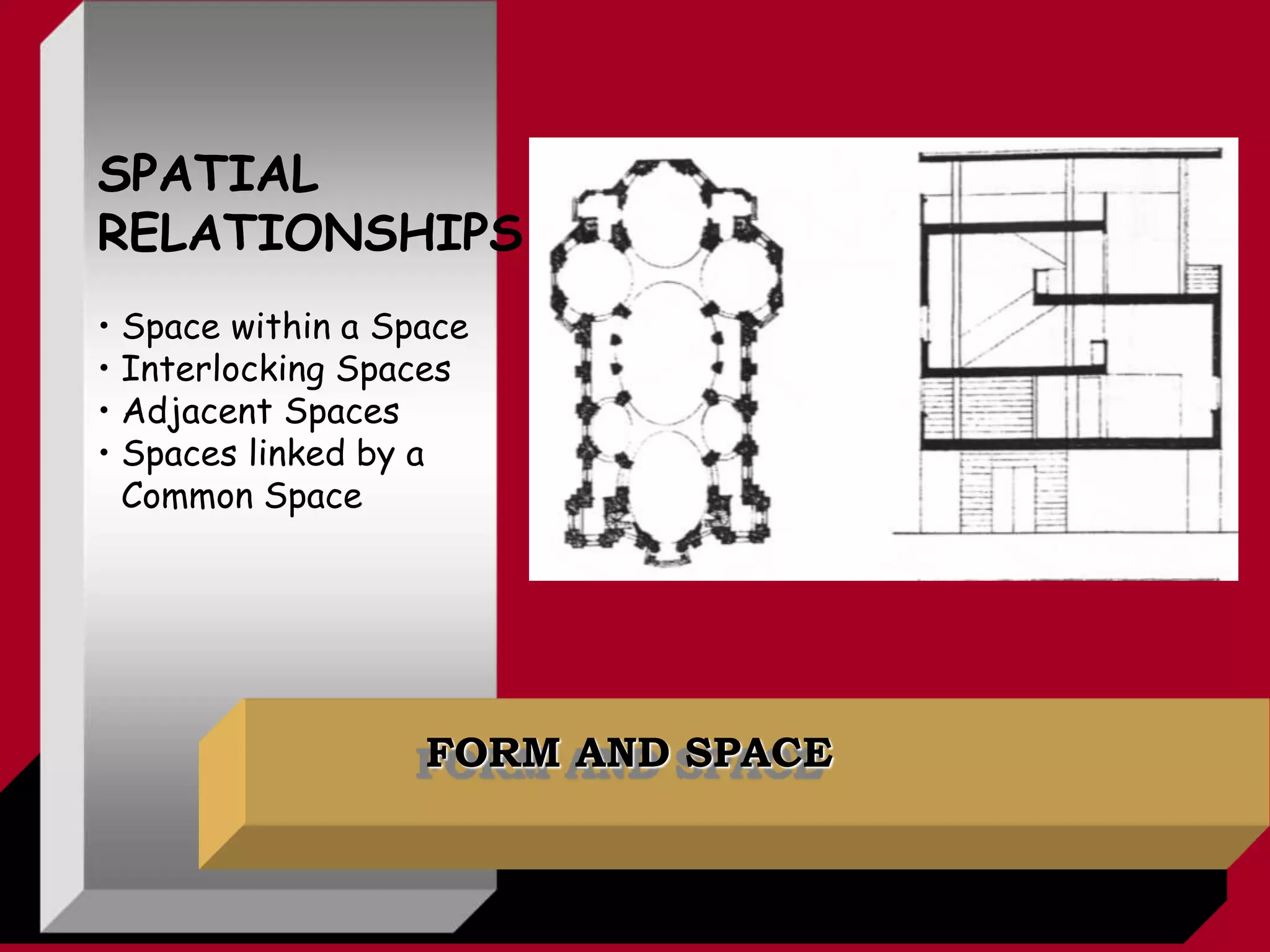
FORM AND SPACE
SPATIAL
RELATIONSHIPS
• Space within a Space
• Interlocking Spaces
• Adjacent Spaces
• Spaces linked by a
Common Space
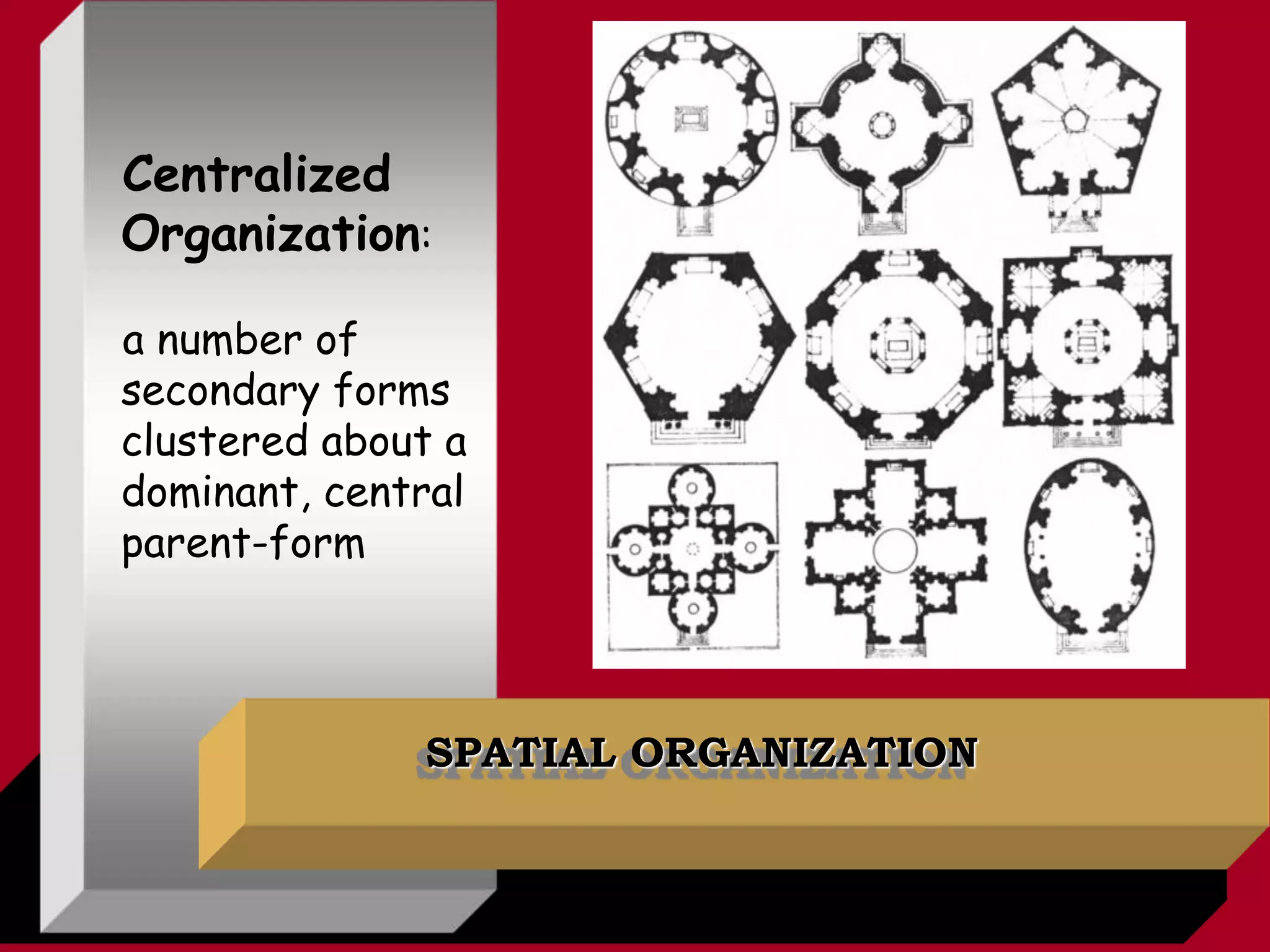
SPATIAL ORGANIZATION
Centralized
Organization:
a number of
secondary forms
clustered about a
dominant, central
parent-form
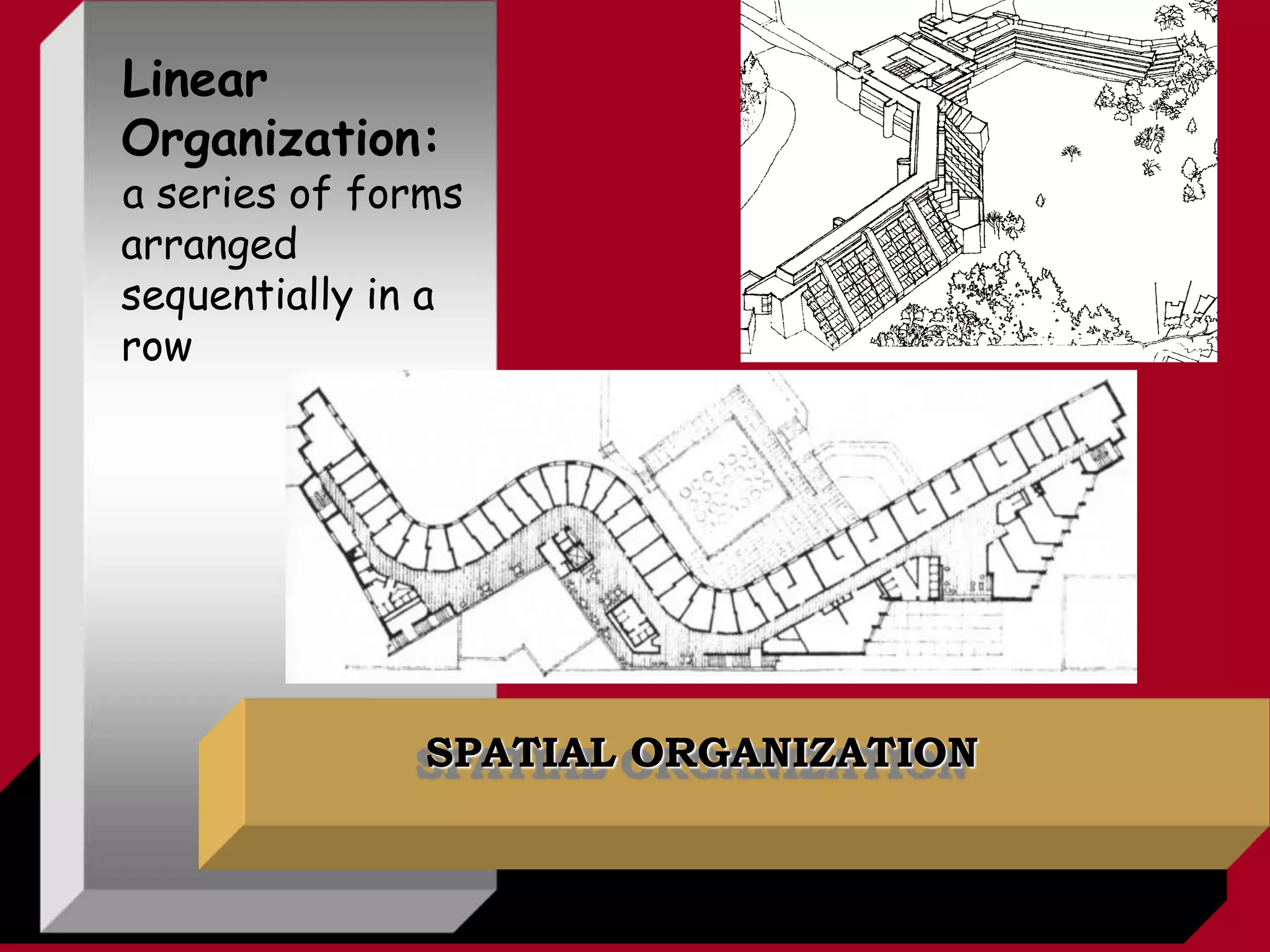
SPATIAL ORGANIZATION
Linear
Organization:
a series of forms
arranged
sequentially in a
row
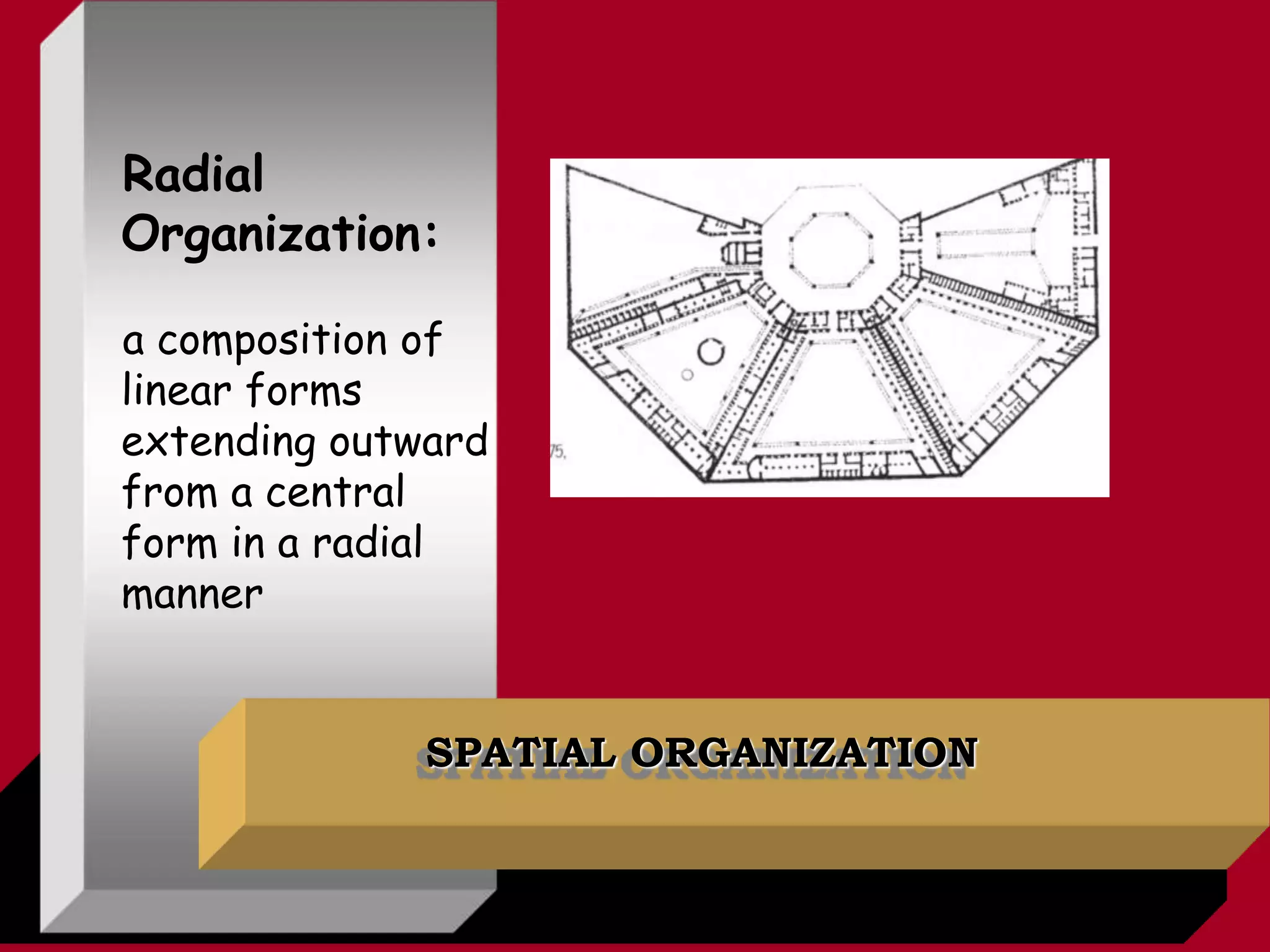
SPATIAL ORGANIZATION
Radial
Organization:
a composition of
linear forms
extending outward
from a central
form in a radial
manner
SPATIAL ORGANIZATION
Radial
Organization:
a composition of
linear forms
extending outward
from a central
form in a radial
manner
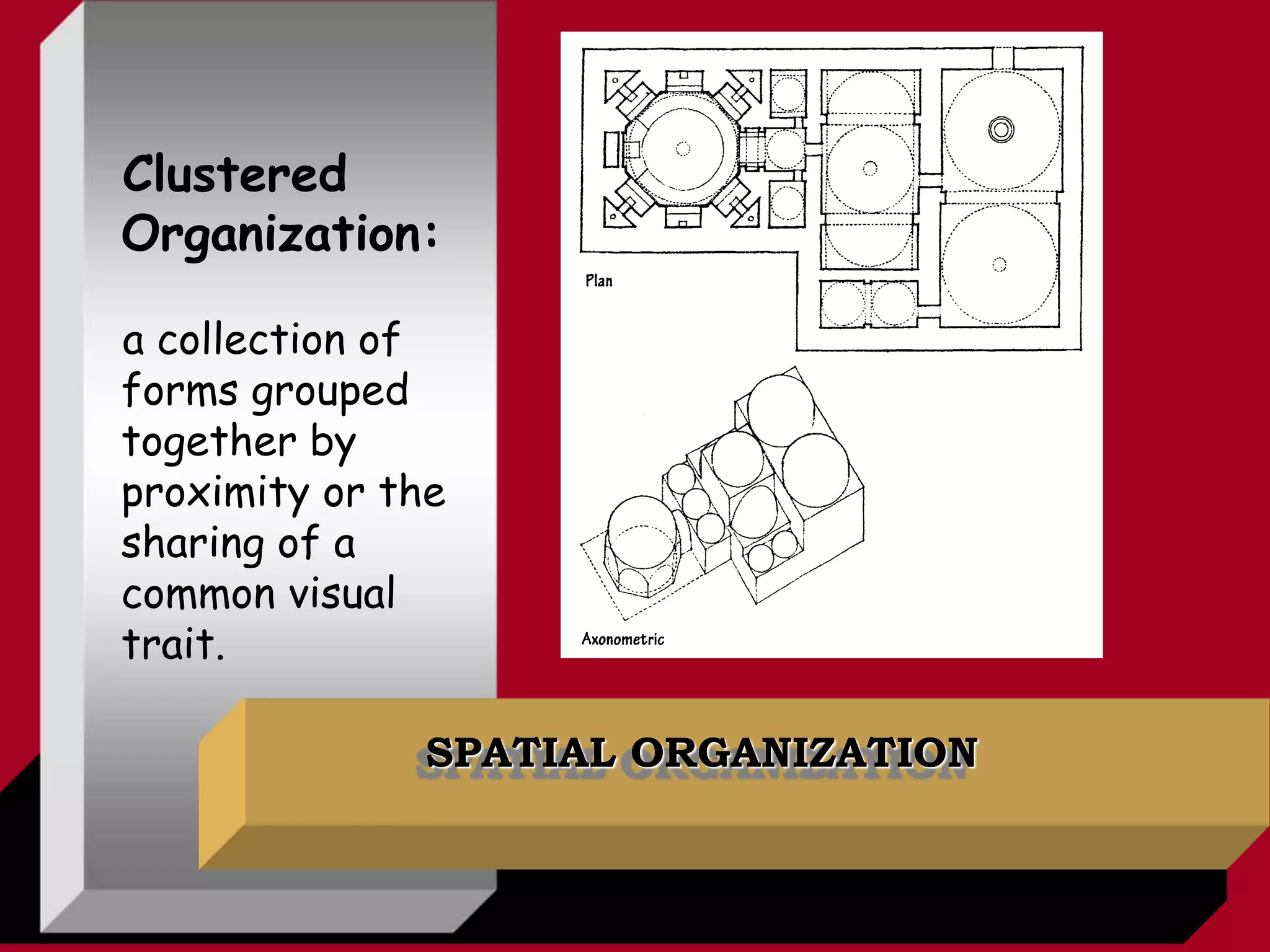
SPATIAL ORGANIZATION
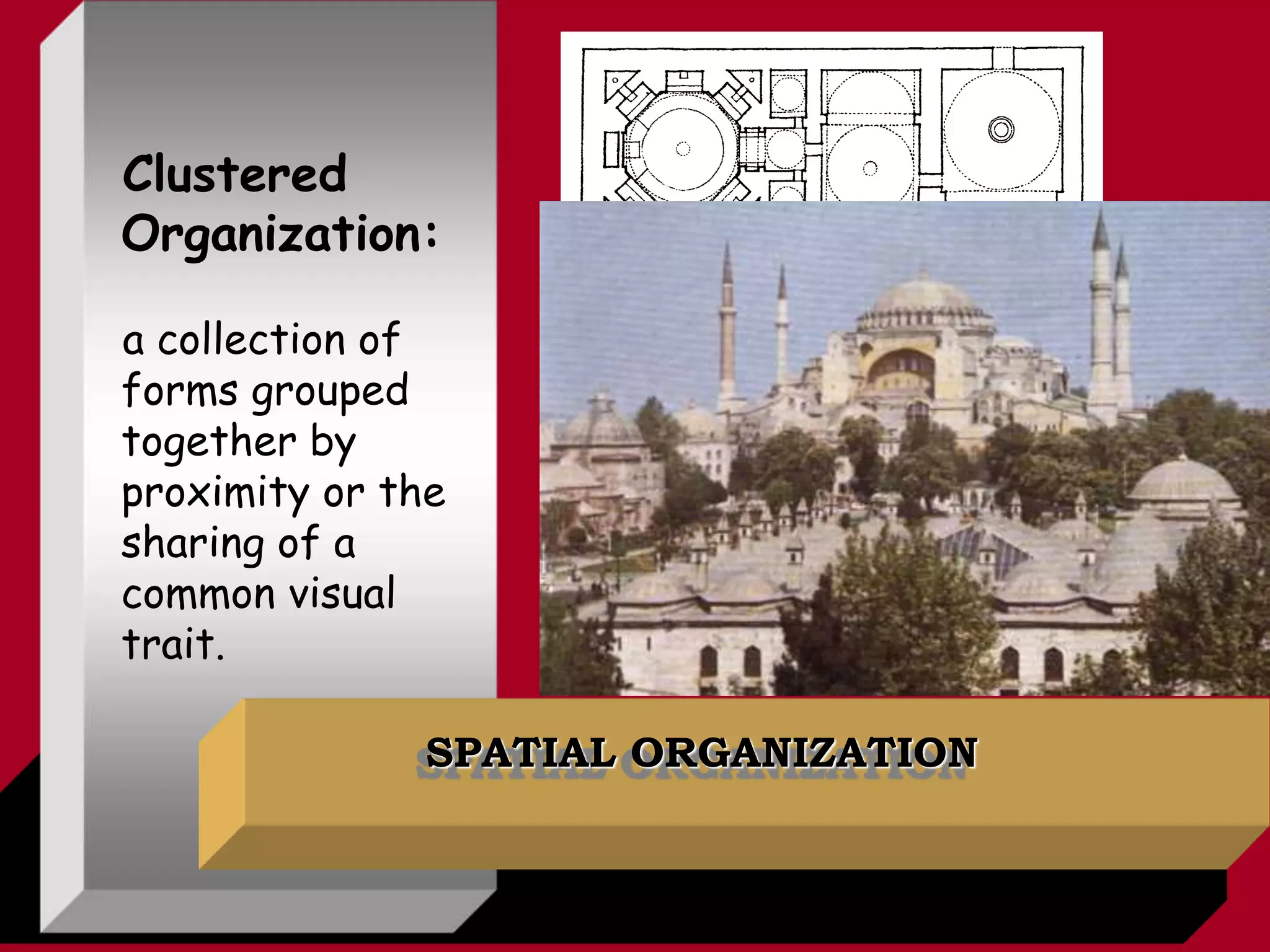
Clustered
Organization:
a collection of
forms grouped
together by
proximity or the
sharing of a
common visual
trait.
SPATIAL ORGANIZATION
Clustered
Organization:
a collection of
forms grouped
together by
proximity or the
sharing of a
common visual
trait.
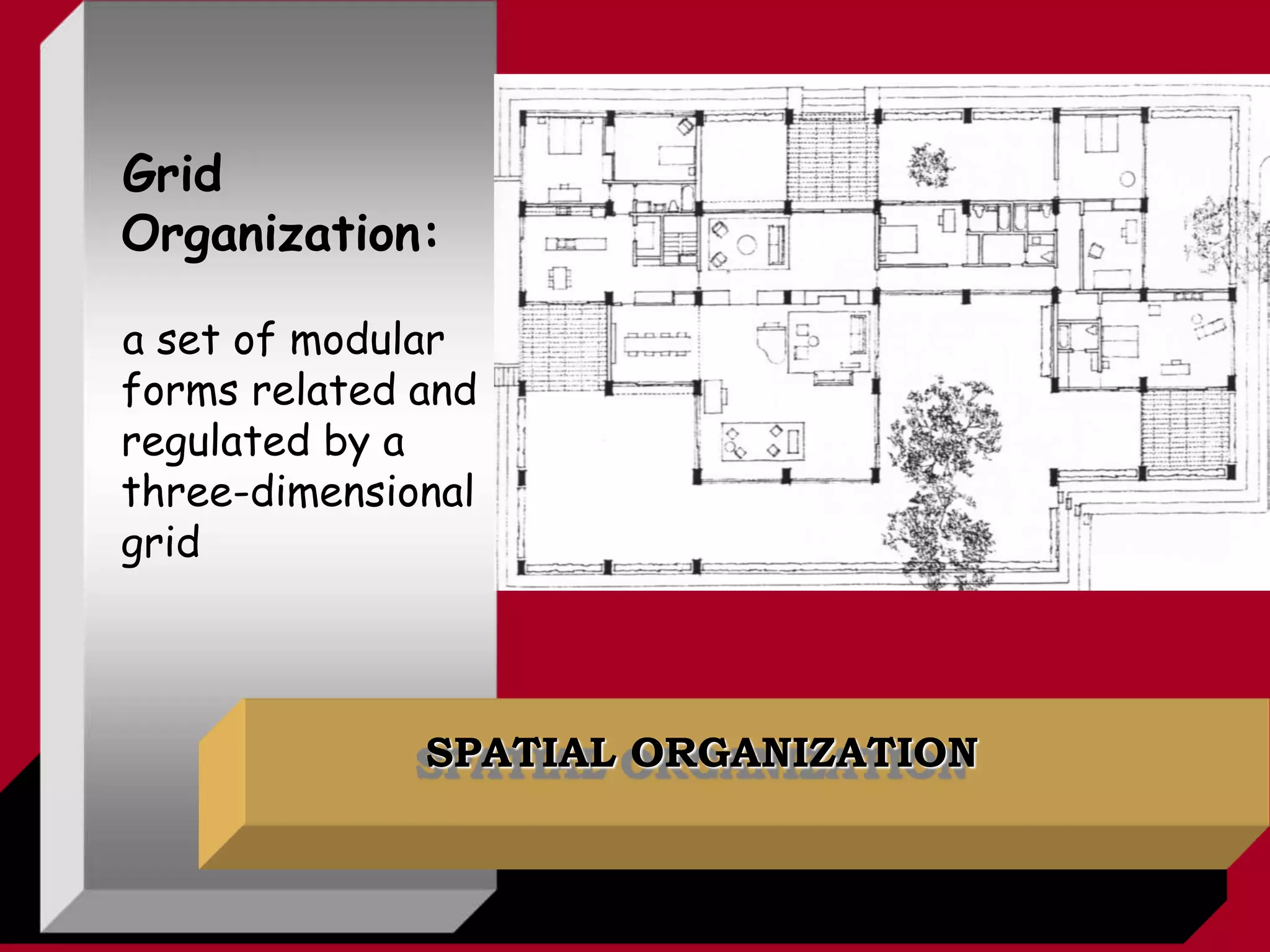
SPATIAL ORGANIZATION
Grid
Organization:
a set of modular
forms related and
regulated by a
three-dimensional
grid
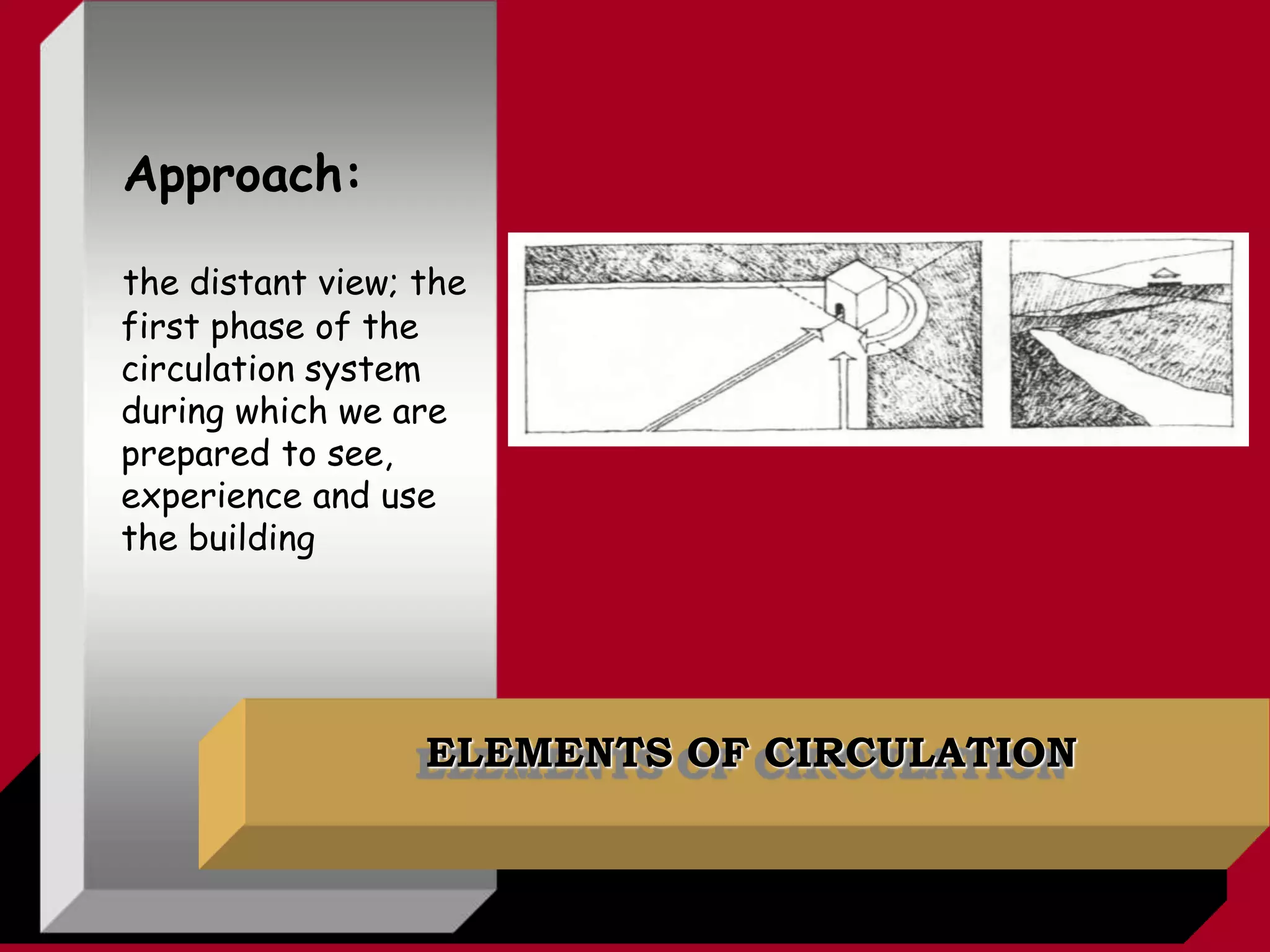
ELEMENTS OF CIRCULATION
Approach:
the distant view; the
first phase of the
circulation system
during which we are
prepared to see,
experience and use
the building
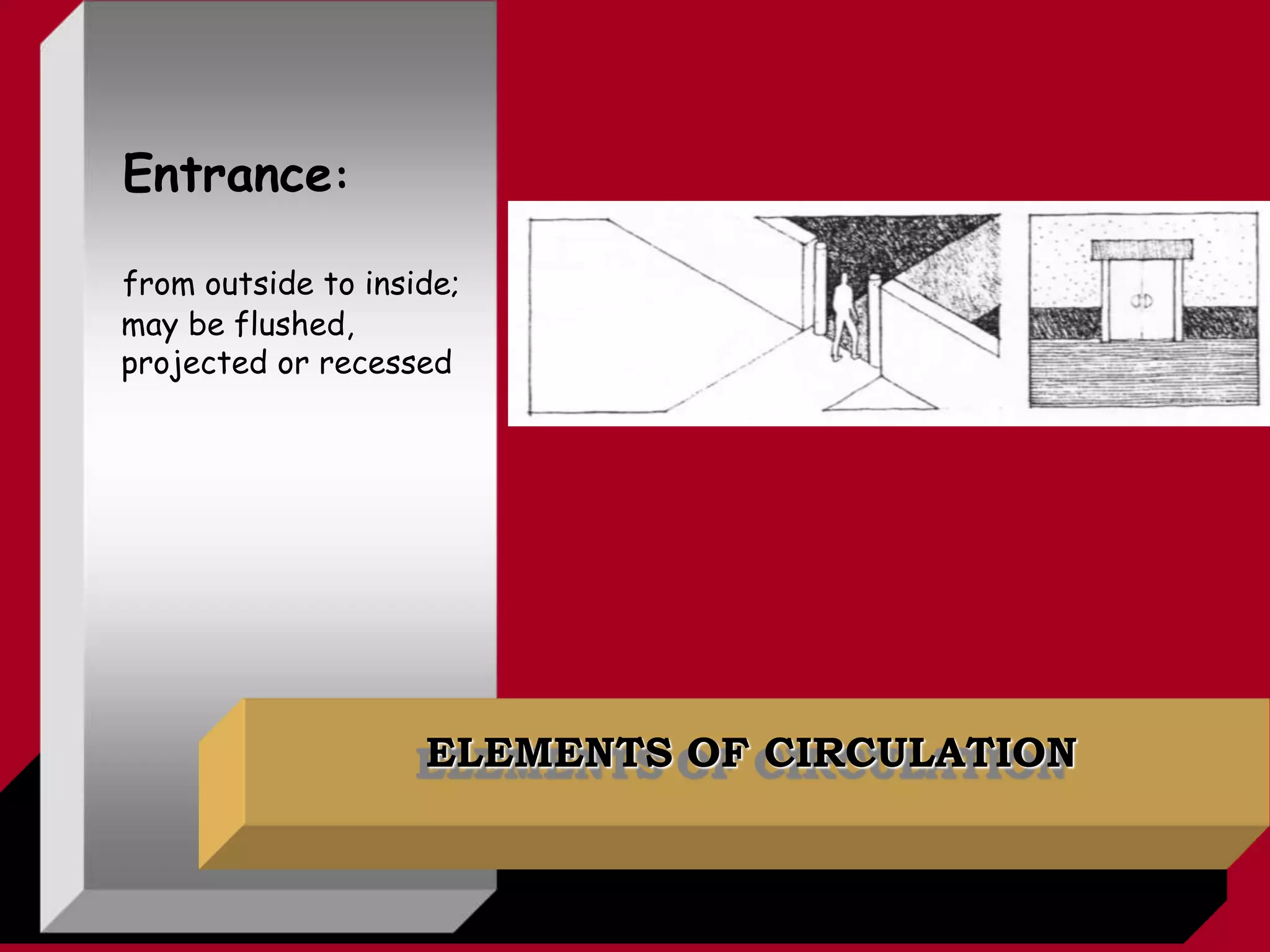
ELEMENTS OF CIRCULATION
Entrance:
from outside to inside;
may be flushed,
projected or recessed
ELEMENTS OF CIRCULATION
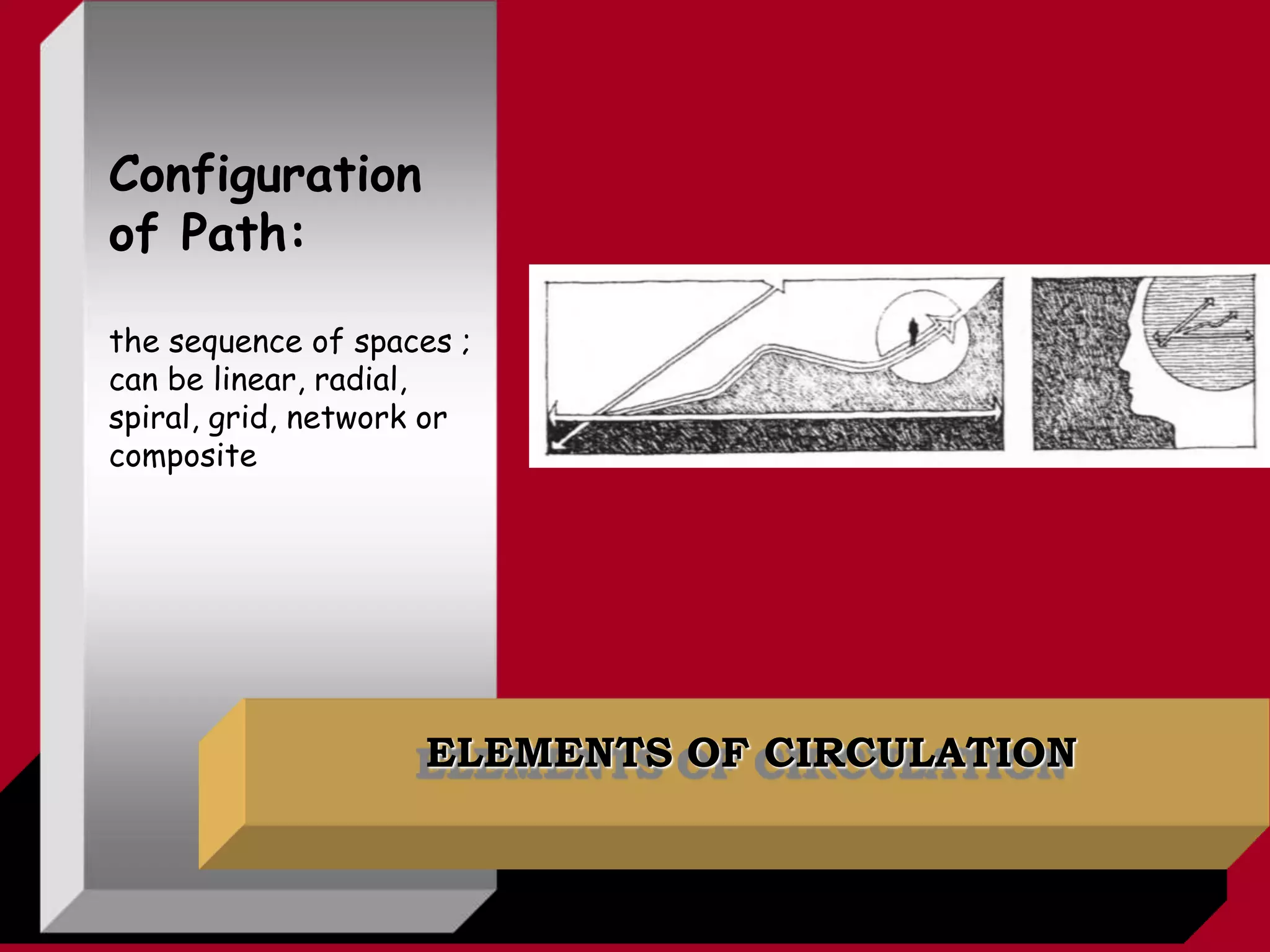
Configuration
of Path:
the sequence of spaces ;
can be linear, radial,
spiral, grid, network or
composite
SPATIAL THEORIES
Anthropocentri
sm:
the human being is the
most important entity in
the universe. The world is
perceived according to the
values and experiences of
the human being.
SPATIAL THEORIES
Anthropomorphis
m:
human qualities are
associated with non-human
entities/ events. Qualities
such as form, values and
emotions.
SPATIAL THEORIES
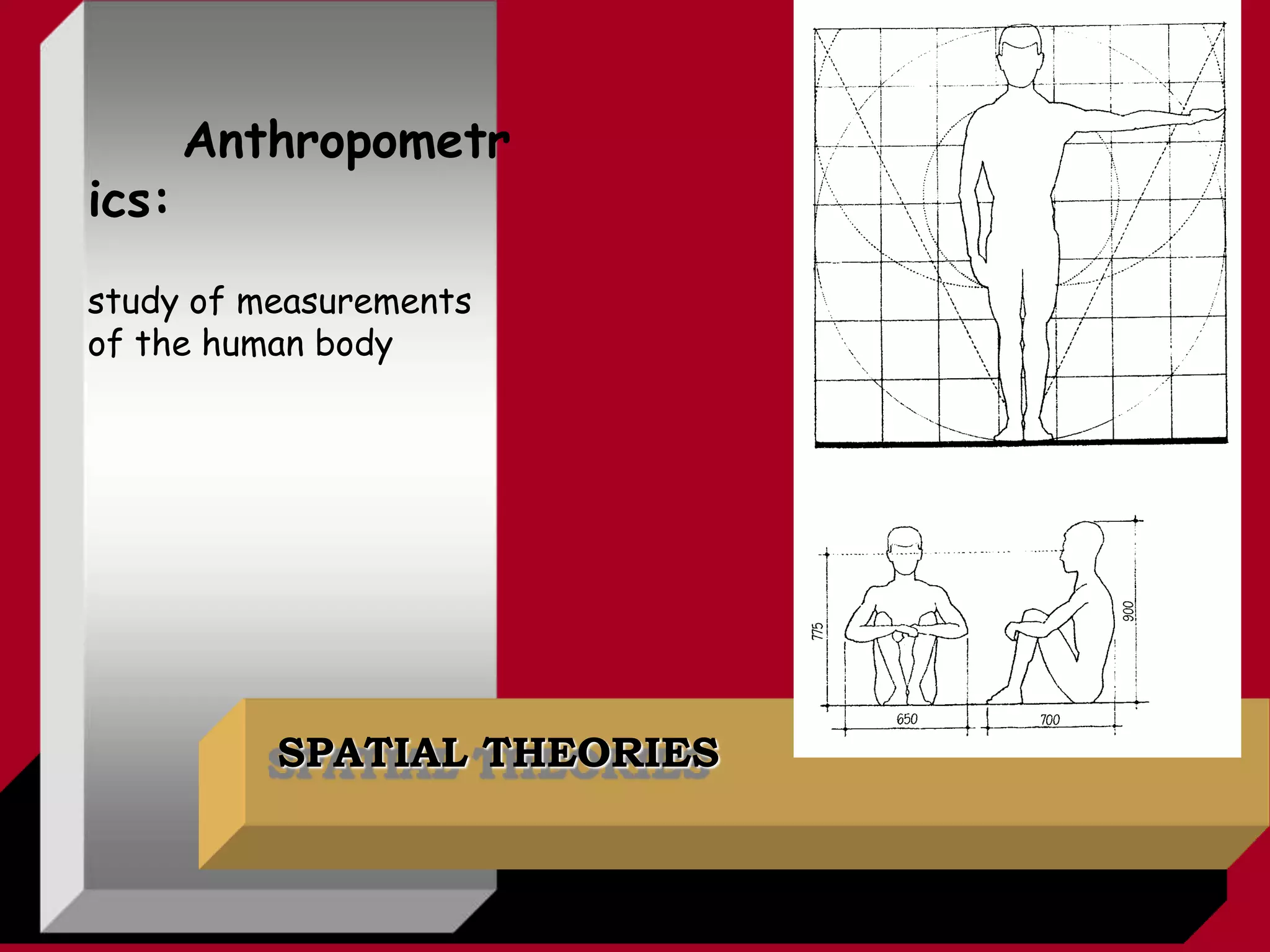
Anthropometr
ics:
study of measurements
of the human body
SPATIAL THEORIES
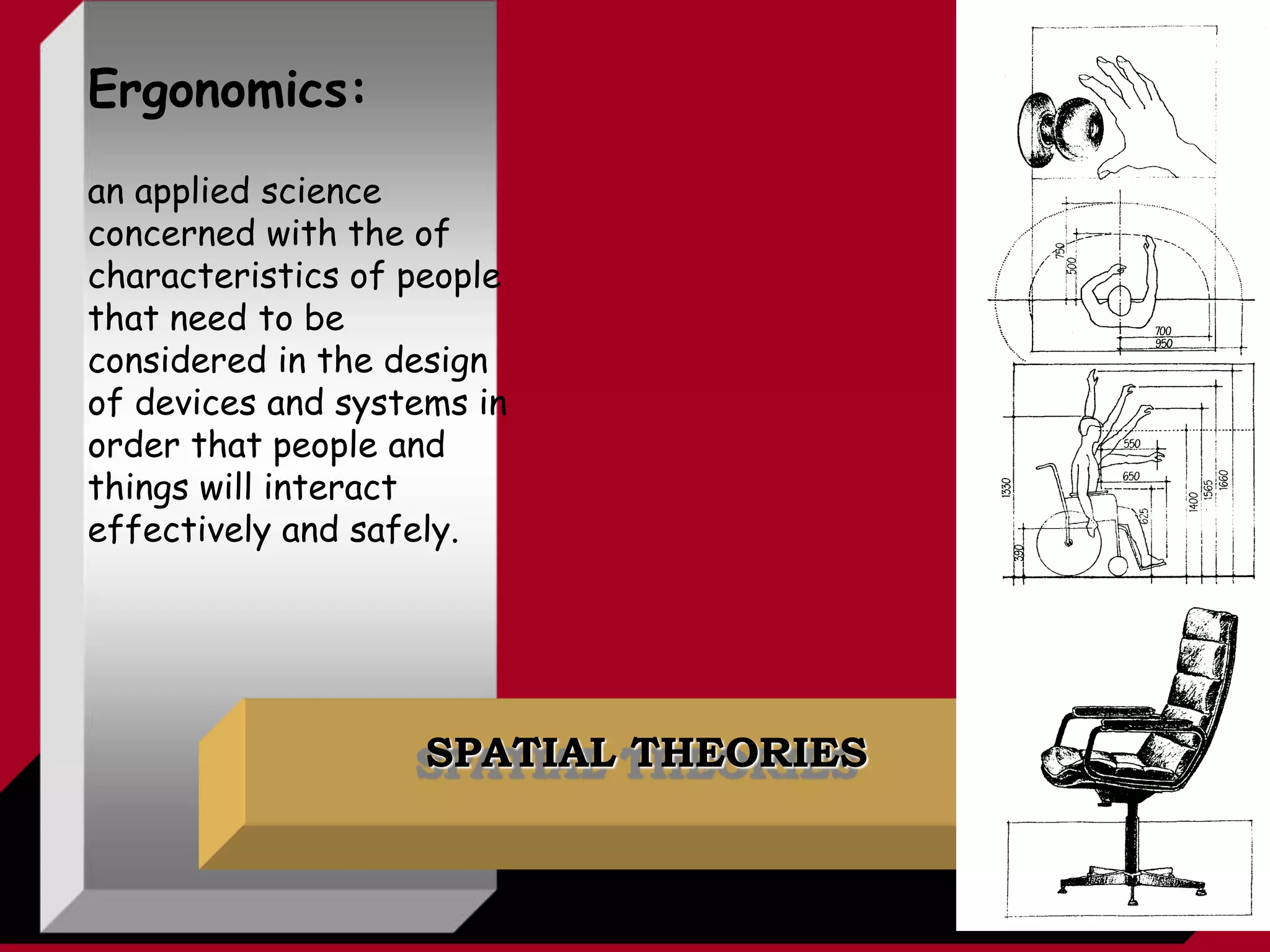
Ergonomics:
an applied science
concerned with the of
characteristics of people
that need to be
considered in the design
of devices and systems in
order that people and
things will interact
effectively and safely.
SPATIAL THEORIES
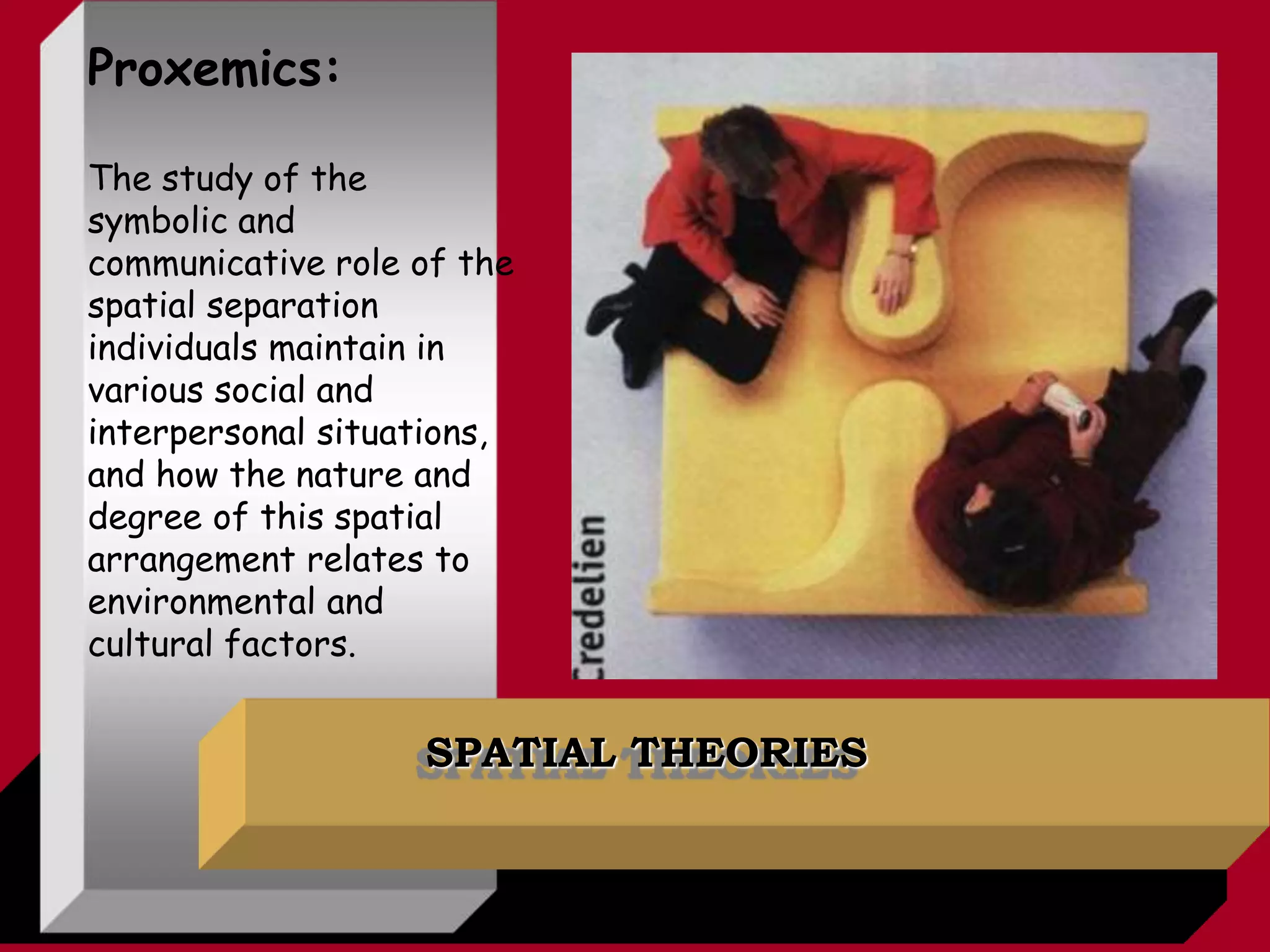
Proxemics:
The study of the
symbolic and
communicative role of the
spatial separation
individuals maintain in
various social and
interpersonal situations,
and how the nature and
degree of this spatial
arrangement relates to
environmental and
cultural factors.
SPATIAL THEORIES
Spatial illusions
through:
Changes in levels
Bringing outside in
Borrowing views
Use of glass and light
materials
Multiplicity of functions
Two-dimensional
treatments
Use of color
SPATIAL THEORIES
Spatial illusions
through:
Changes in levels
Bringing outside in
Borrowing views
Use of glass and light
materials
Multiplicity of functions
Two-dimensional
treatments
Use of color

ArchTheoryI.ppt