[ LANDSCAPE ARCHITECTURE ]
| 1
| 2
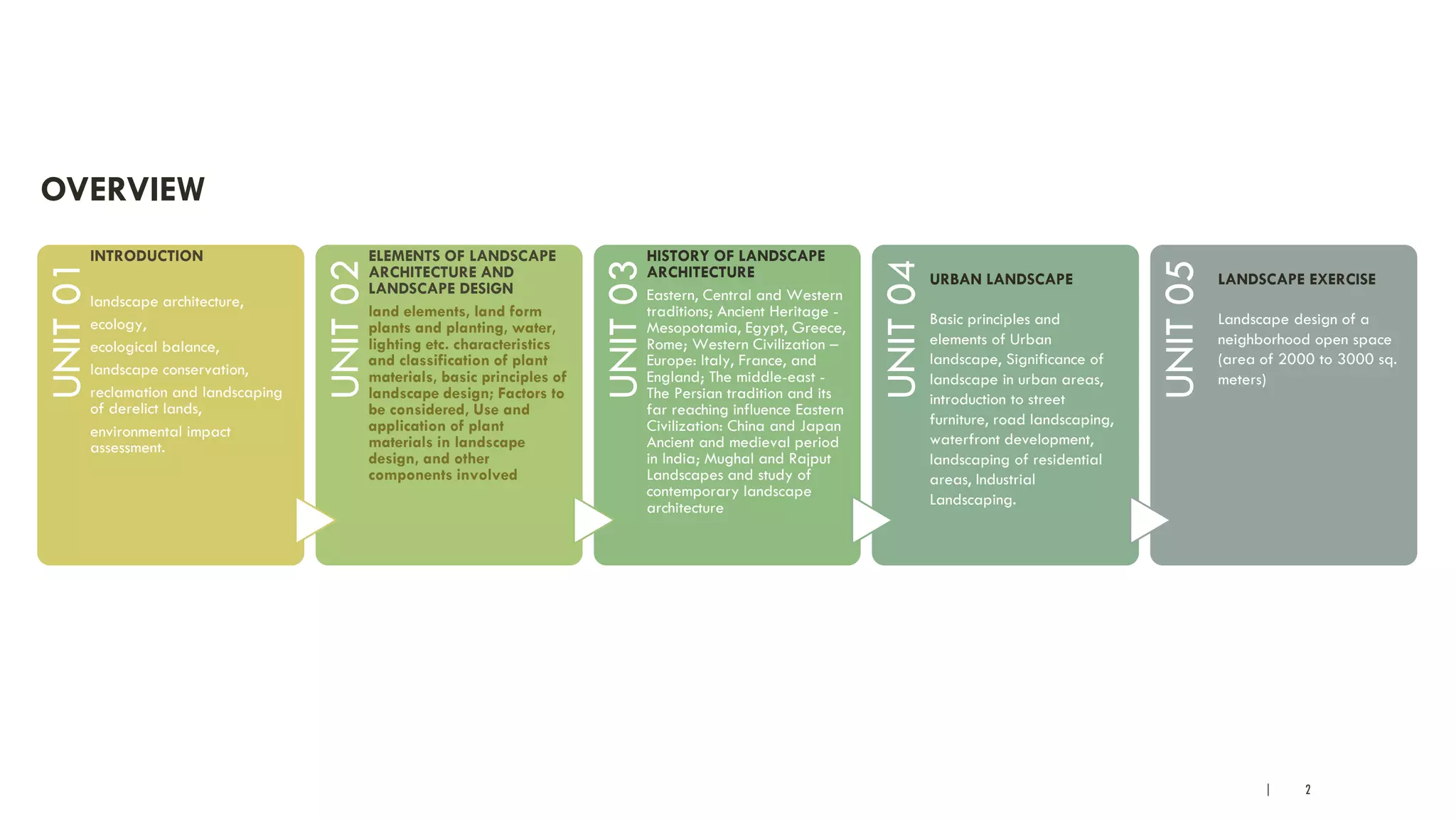
UNIT01
INTRODUCTION
landscape architecture,
ecology,
ecological balance,
landscape conservation,
reclamation and landscaping
of derelict lands,
environmental impact
assessment.
UNIT02
ELEMENTS OF LANDSCAPE
ARCHITECTURE AND
LANDSCAPE DESIGN
land elements, land form
plants and planting, water,
lighting etc. characteristics
and classification of plant
materials, basic principles of
landscape design; Factors to
be considered, Use and
application of plant
materials in landscape
design, and other
components involved
UNIT03
HISTORY OF LANDSCAPE
ARCHITECTURE
Eastern, Central and Western
traditions; Ancient Heritage -
Mesopotamia, Egypt, Greece,
Rome; Western Civilization –
Europe: Italy, France, and
England; The middle-east -
The Persian tradition and its
far reaching influence Eastern
Civilization: China and Japan
Ancient and medieval period
in India; Mughal and Rajput
Landscapes and study of
contemporary landscape
architecture
UNIT04
UNIT05
URBAN LANDSCAPE
Basic principles and
elements of Urban
landscape, Significance of
landscape in urban areas,
introduction to street
furniture, road landscaping,
waterfront development,
landscaping of residential
areas, Industrial
Landscaping.
LANDSCAPE EXERCISE
Landscape design of a
neighborhood open space
(area of 2000 to 3000 sq.
meters)
OVERVIEW
| 3
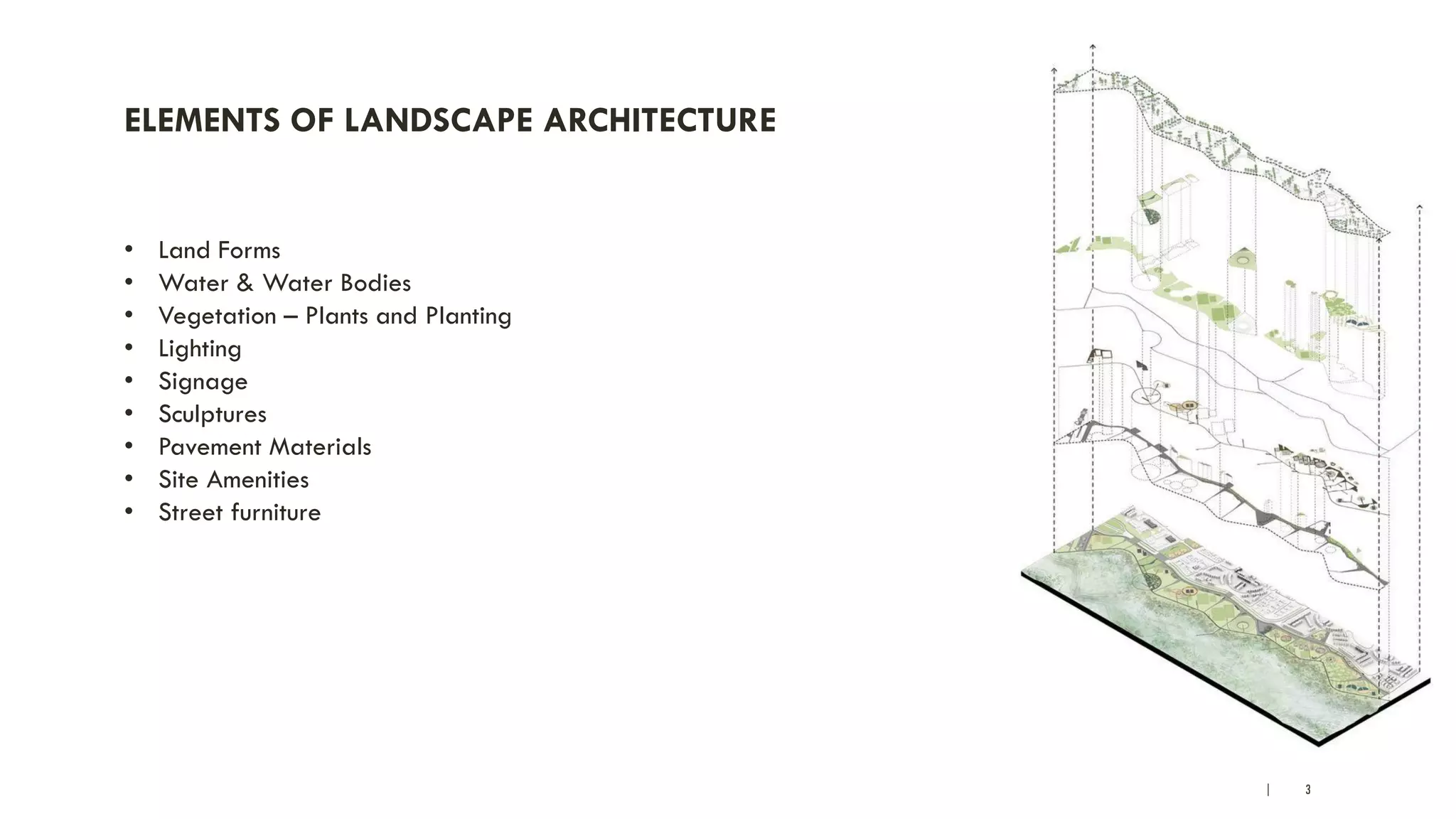
ELEMENTS OF LANDSCAPE ARCHITECTURE
• Land Forms
• Water & Water Bodies
• Vegetation – Plants and Planting
• Lighting
• Signage
• Sculptures
• Pavement Materials
• Site Amenities
• Street furniture
| 4
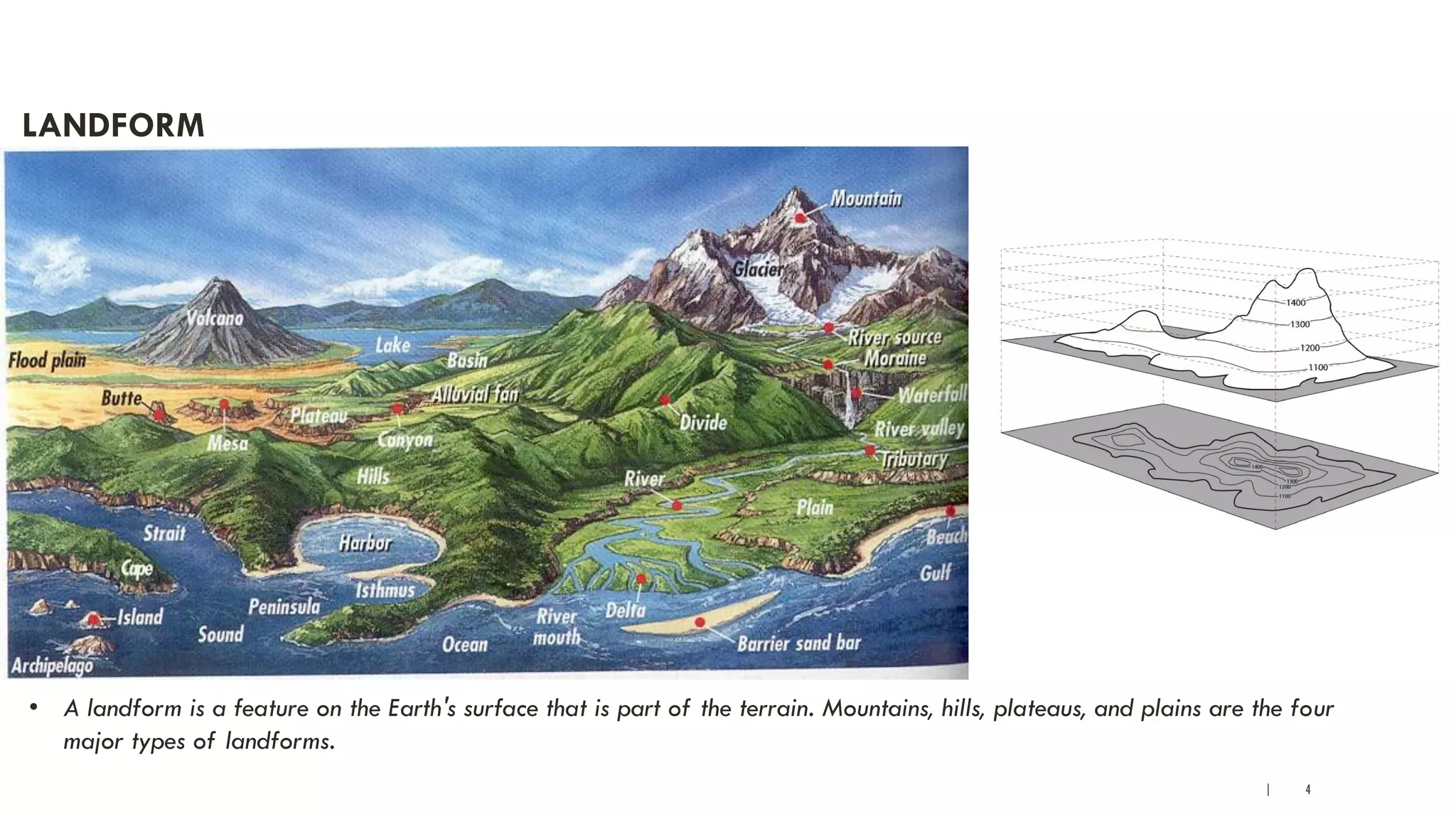
LANDFORM
• A landform is a feature on the Earth's surface that is part of the terrain. Mountains, hills, plateaus, and plains are the four
major types of landforms.
| 5
LANDFORM
| 6
LANDFORM
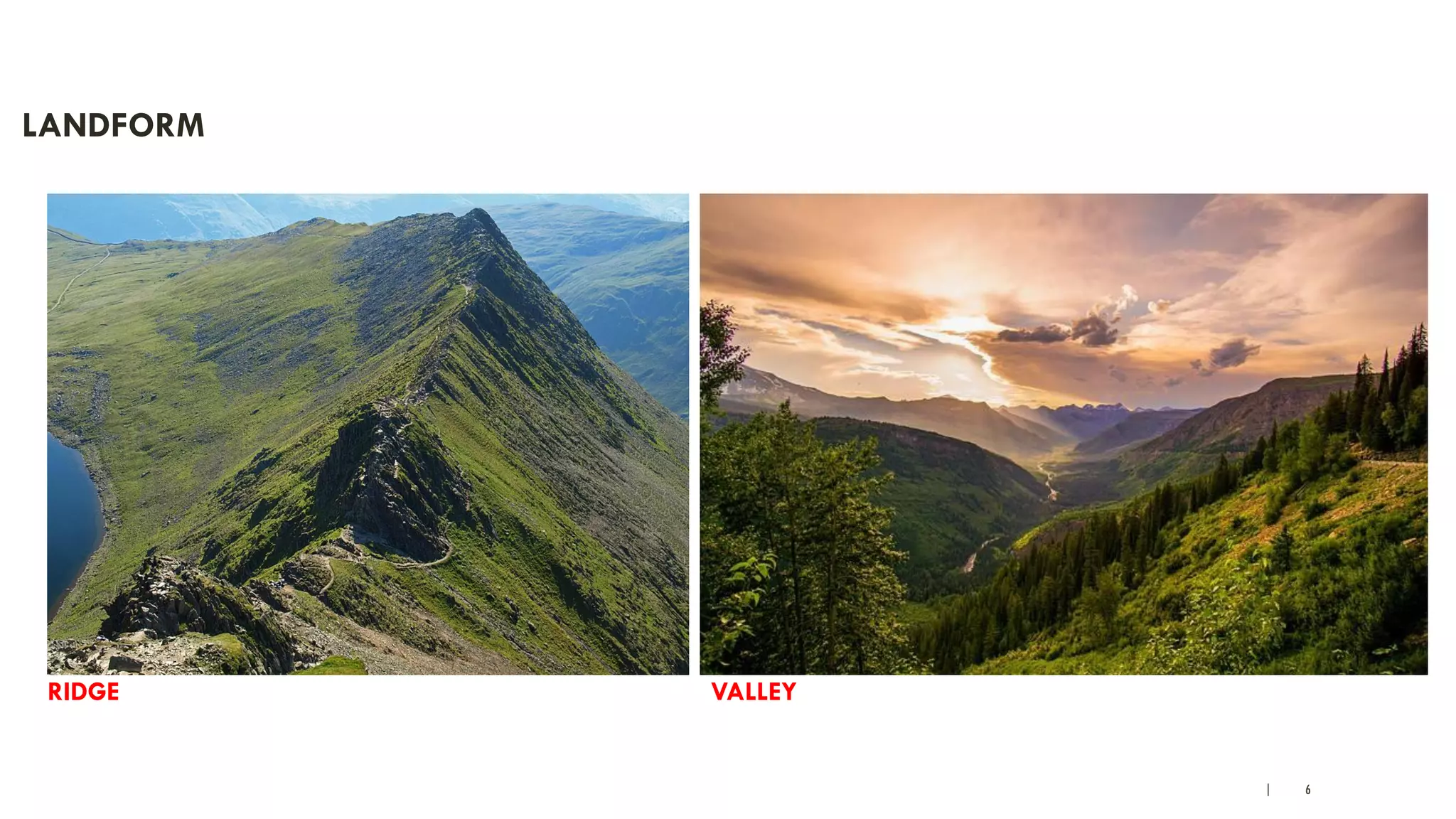
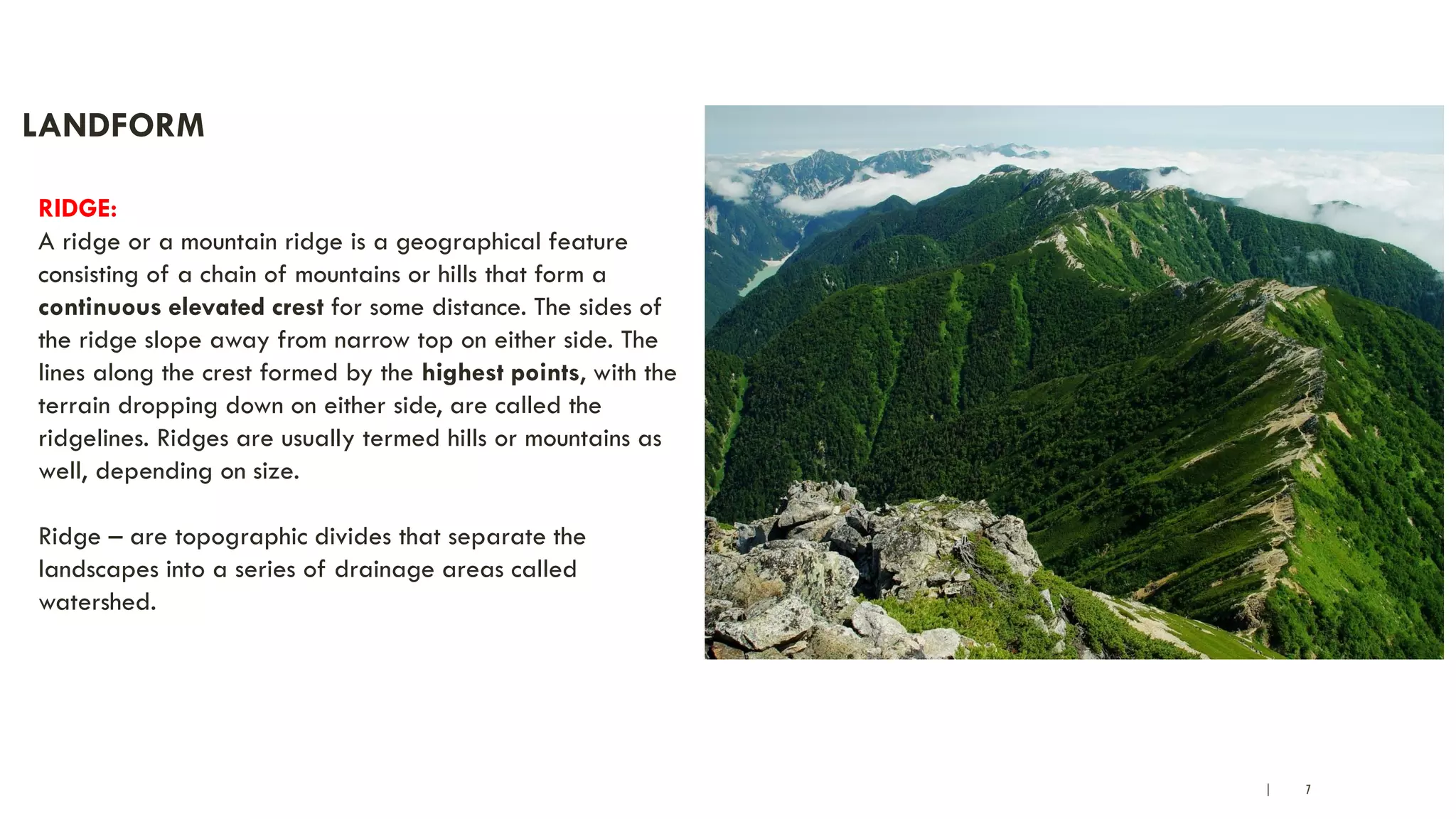
RIDGE VALLEY
| 7
LANDFORM
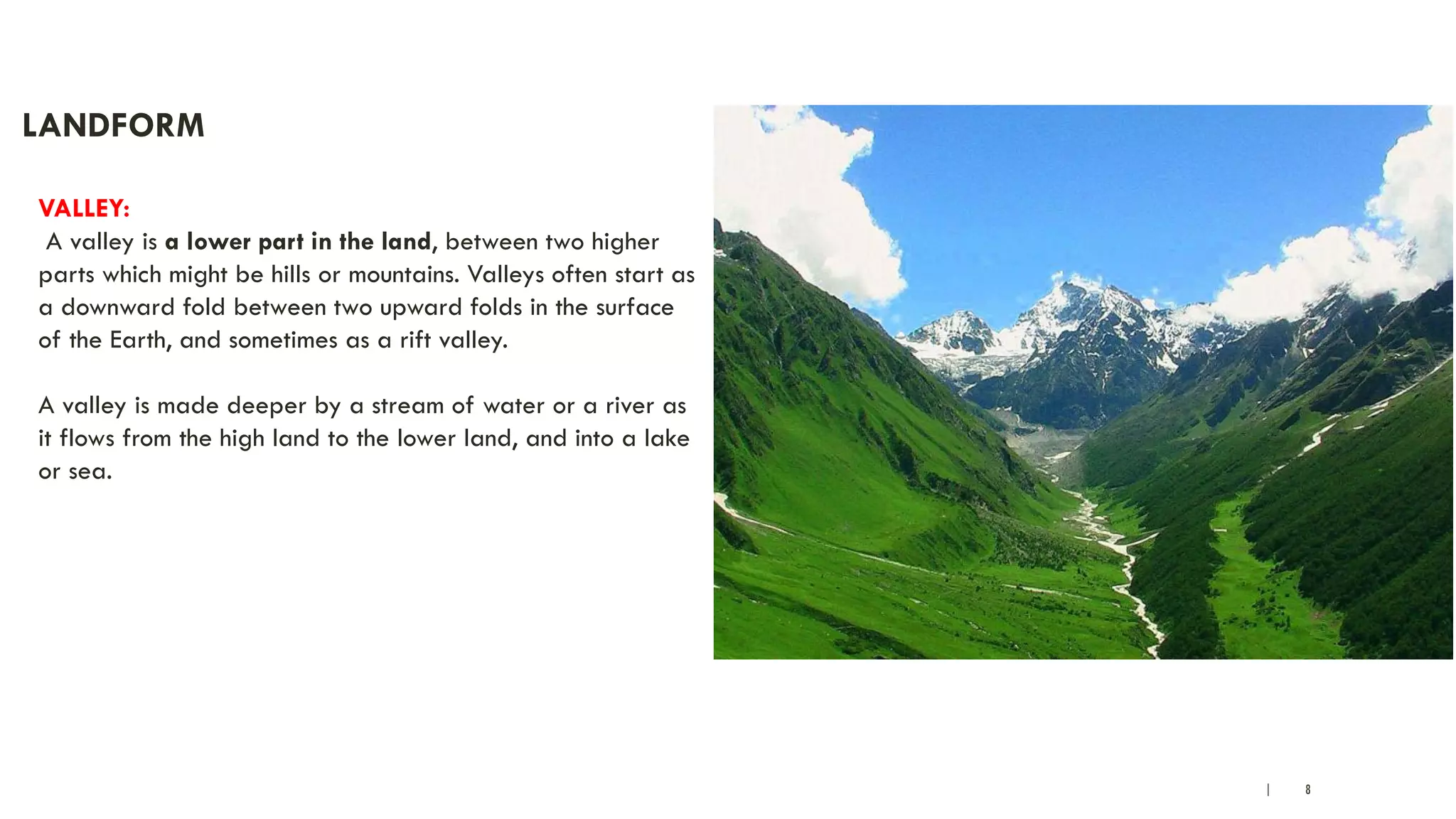
RIDGE:
A ridge or a mountain ridge is a geographical feature
consisting of a chain of mountains or hills that form a
continuous elevated crest for some distance. The sides of
the ridge slope away from narrow top on either side. The
lines along the crest formed by the highest points, with the
terrain dropping down on either side, are called the
ridgelines. Ridges are usually termed hills or mountains as
well, depending on size.
Ridge – are topographic divides that separate the
landscapes into a series of drainage areas called
watershed.
| 8
LANDFORM
VALLEY:
A valley is a lower part in the land, between two higher
parts which might be hills or mountains. Valleys often start as
a downward fold between two upward folds in the surface
of the Earth, and sometimes as a rift valley.
A valley is made deeper by a stream of water or a river as
it flows from the high land to the lower land, and into a lake
or sea.
| 9
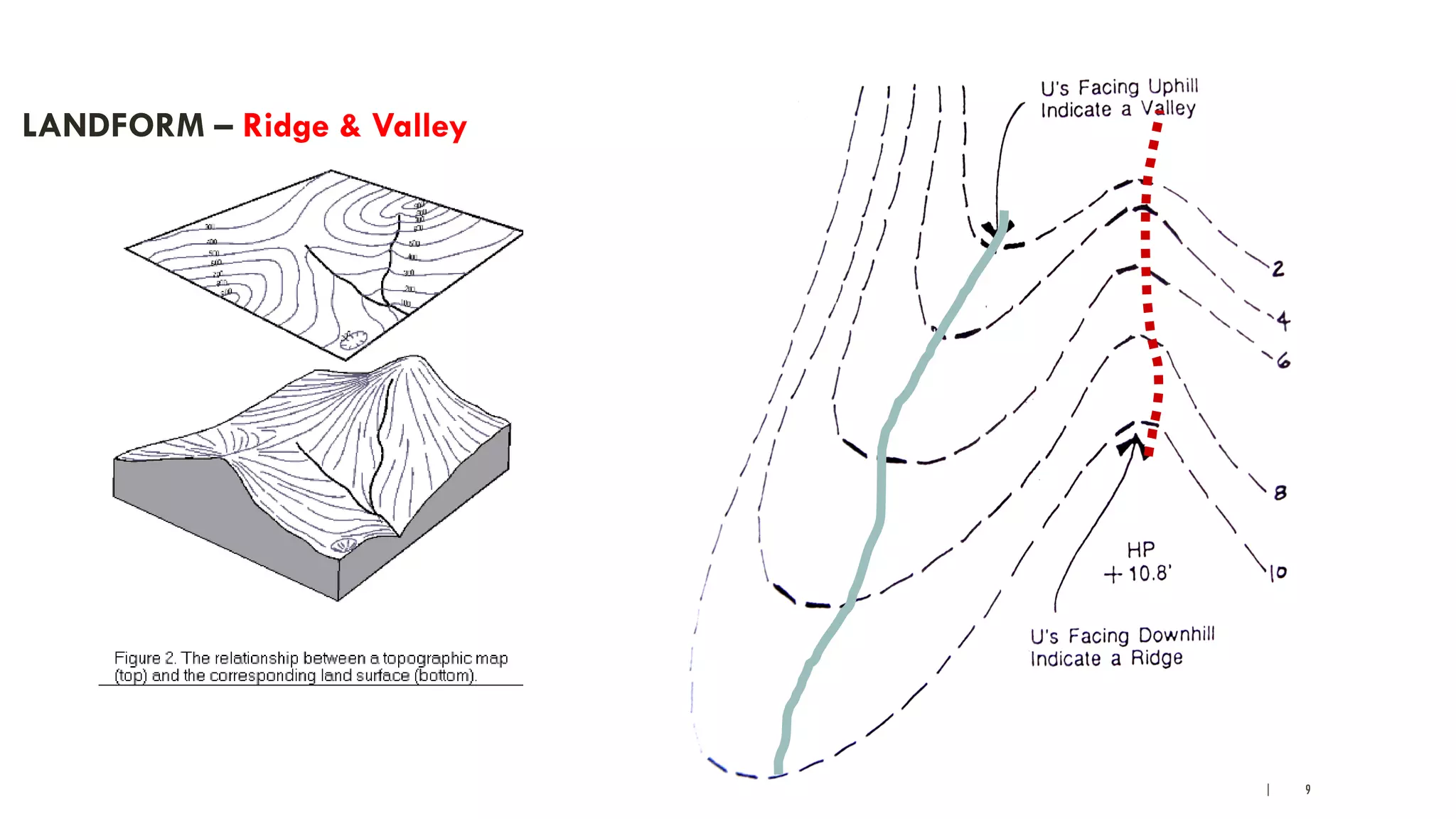
LANDFORM – Ridge & Valley
| 10
LANDFORM
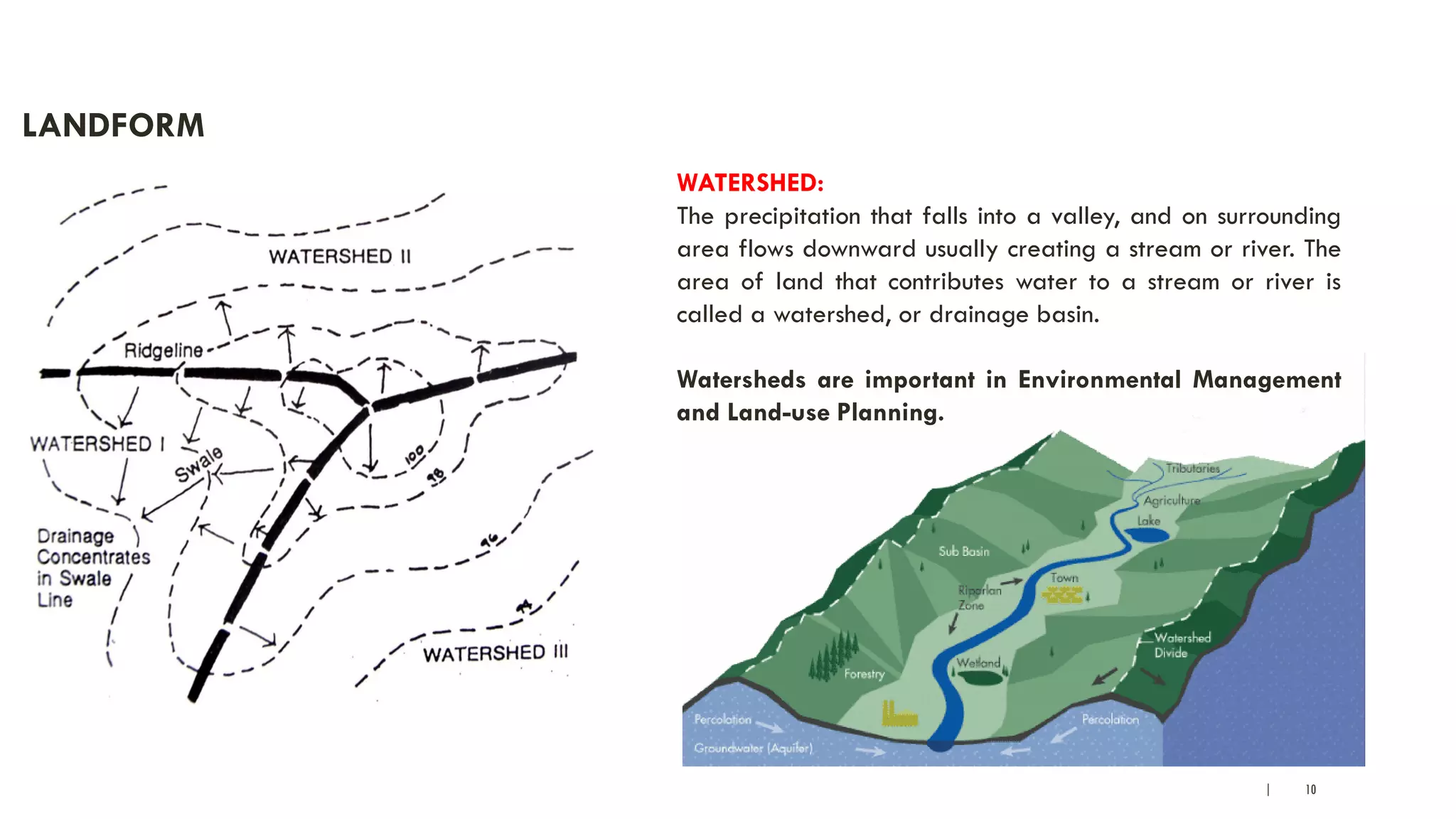
WATERSHED:
The precipitation that falls into a valley, and on surrounding
area flows downward usually creating a stream or river. The
area of land that contributes water to a stream or river is
called a watershed, or drainage basin.
Watersheds are important in Environmental Management
and Land-use Planning.
| 11
LANDFORM
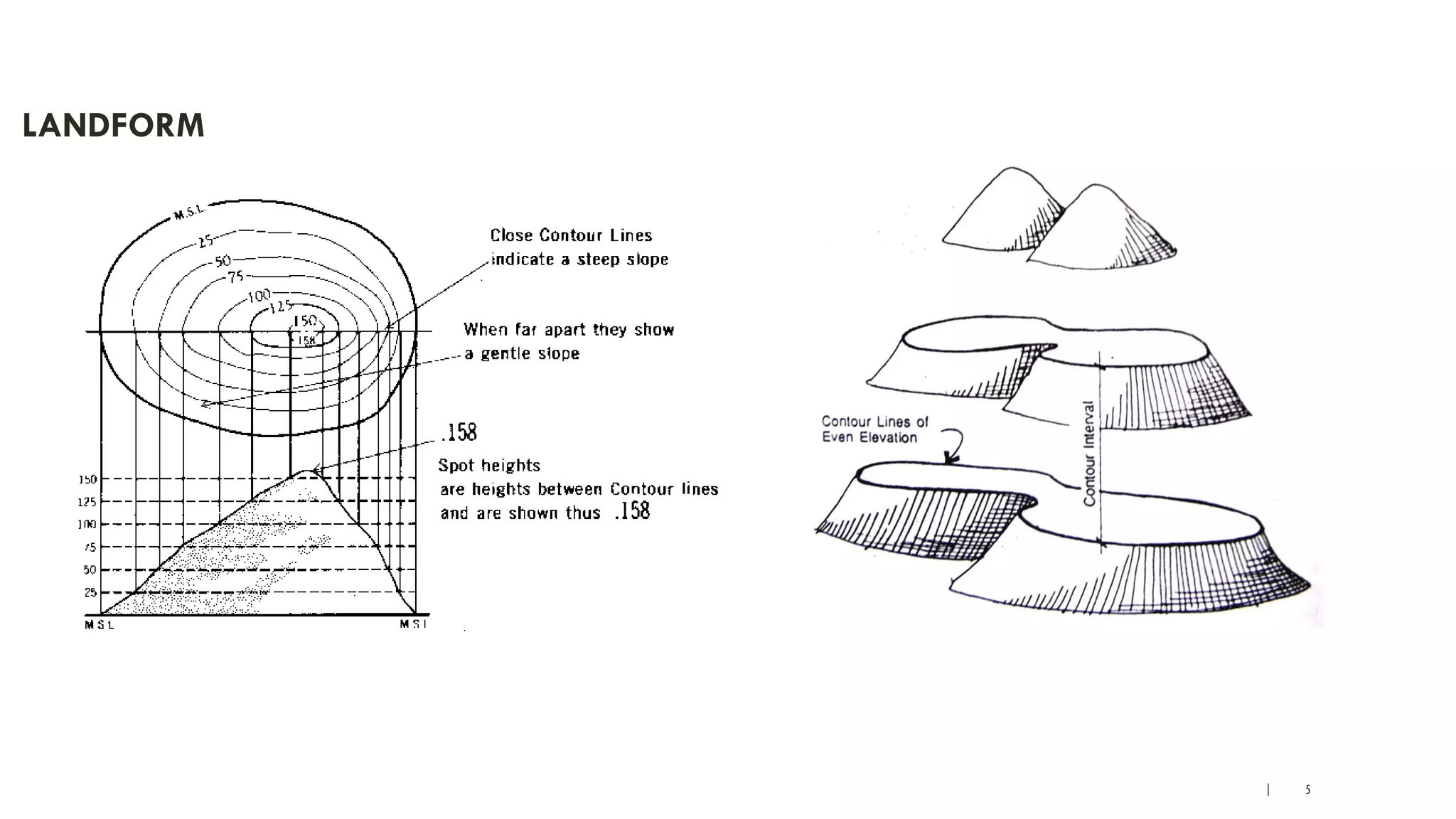
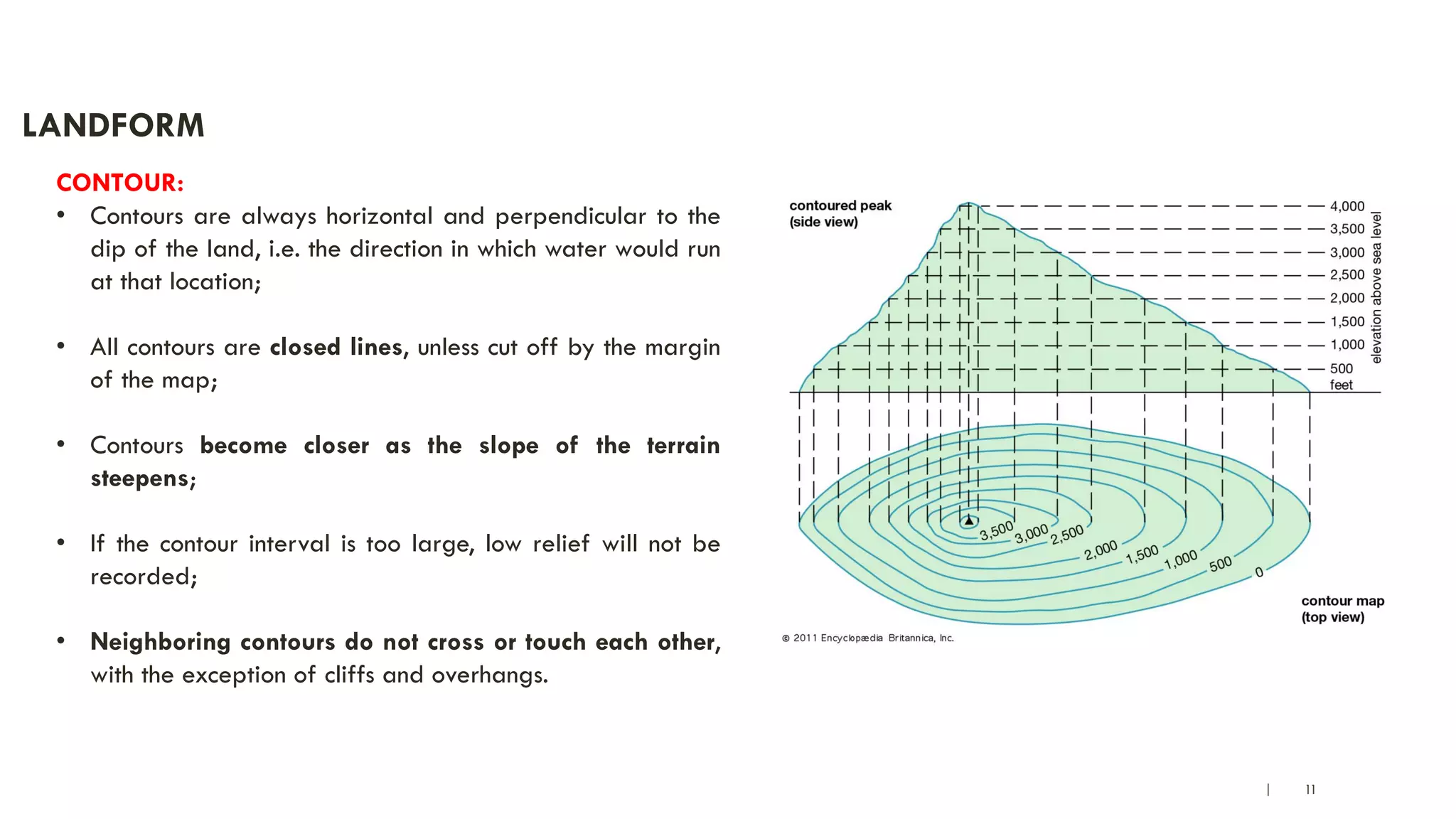
CONTOUR:
• Contours are always horizontal and perpendicular to the
dip of the land, i.e. the direction in which water would run
at that location;
• All contours are closed lines, unless cut off by the margin
of the map;
• Contours become closer as the slope of the terrain
steepens;
• If the contour interval is too large, low relief will not be
recorded;
• Neighboring contours do not cross or touch each other,
with the exception of cliffs and overhangs.
| 12
LANDFORM
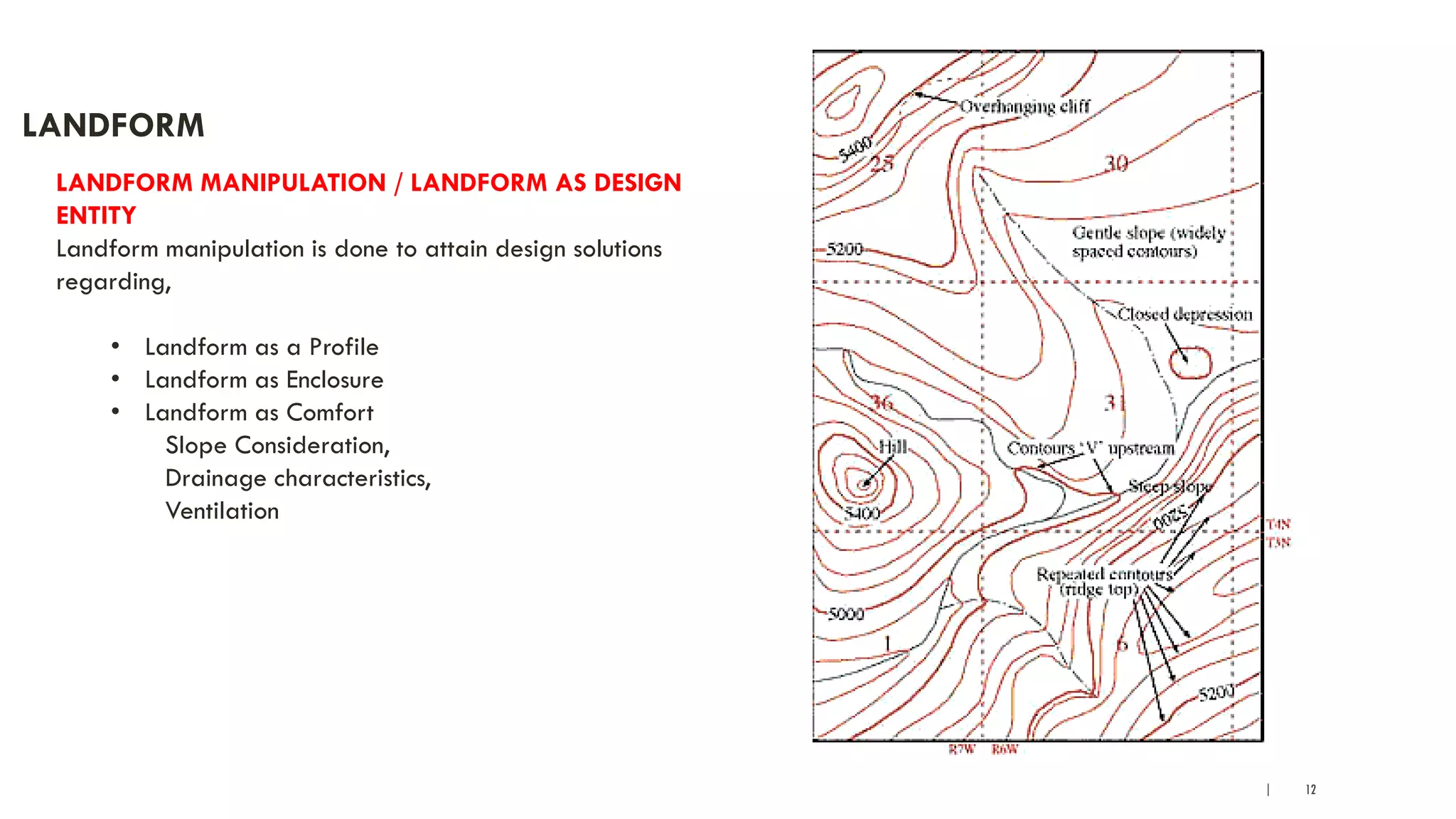
LANDFORM MANIPULATION / LANDFORM AS DESIGN
ENTITY
Landform manipulation is done to attain design solutions
regarding,
• Landform as a Profile
• Landform as Enclosure
• Landform as Comfort
Slope Consideration,
Drainage characteristics,
Ventilation
| 13
LANDFORM as Profile
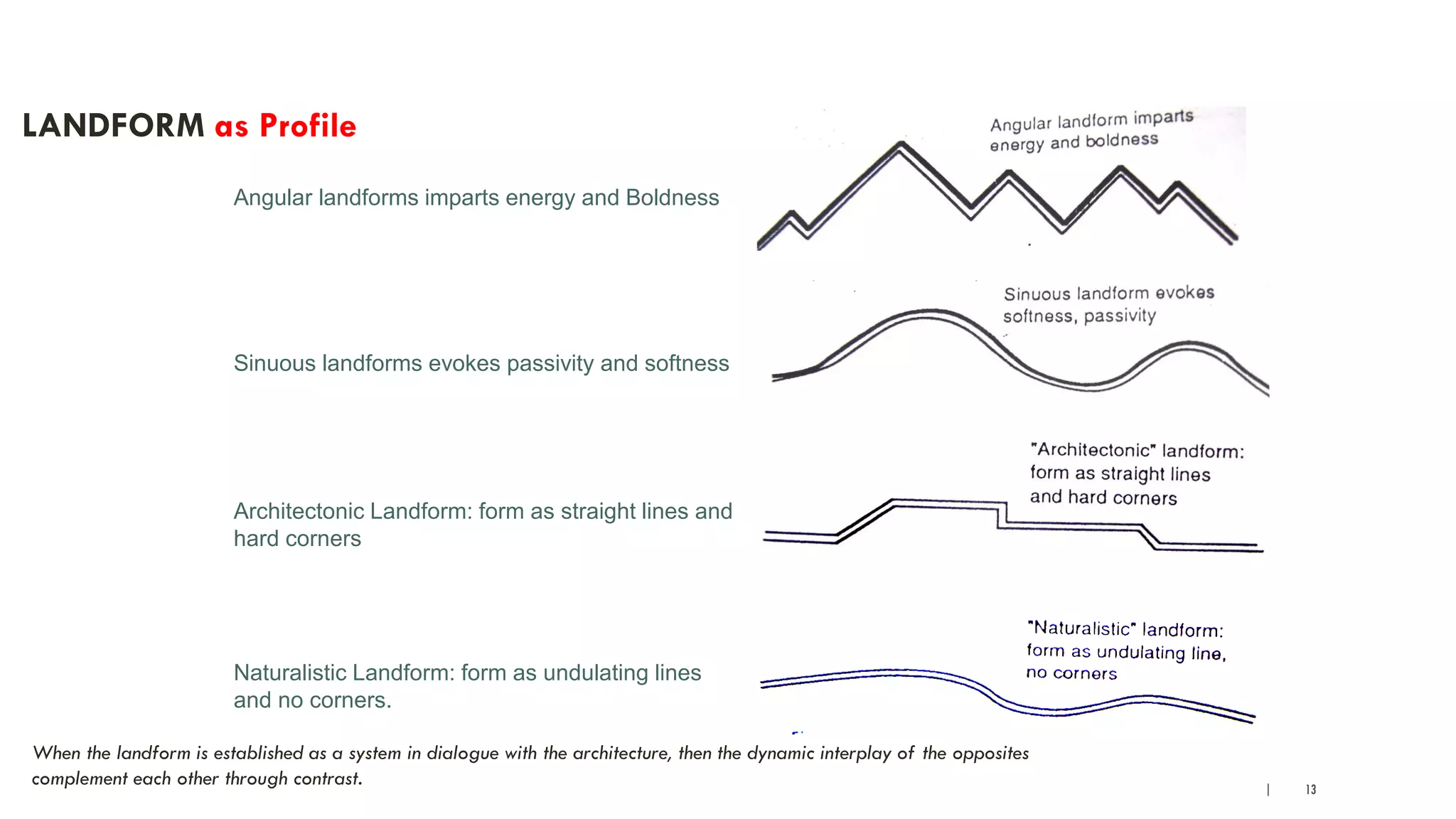
Angular landforms imparts energy and Boldness
Sinuous landforms evokes passivity and softness
Architectonic Landform: form as straight lines and
hard corners
Naturalistic Landform: form as undulating lines
and no corners.
When the landform is established as a system in dialogue with the architecture, then the dynamic interplay of the opposites
complement each other through contrast.
| 14
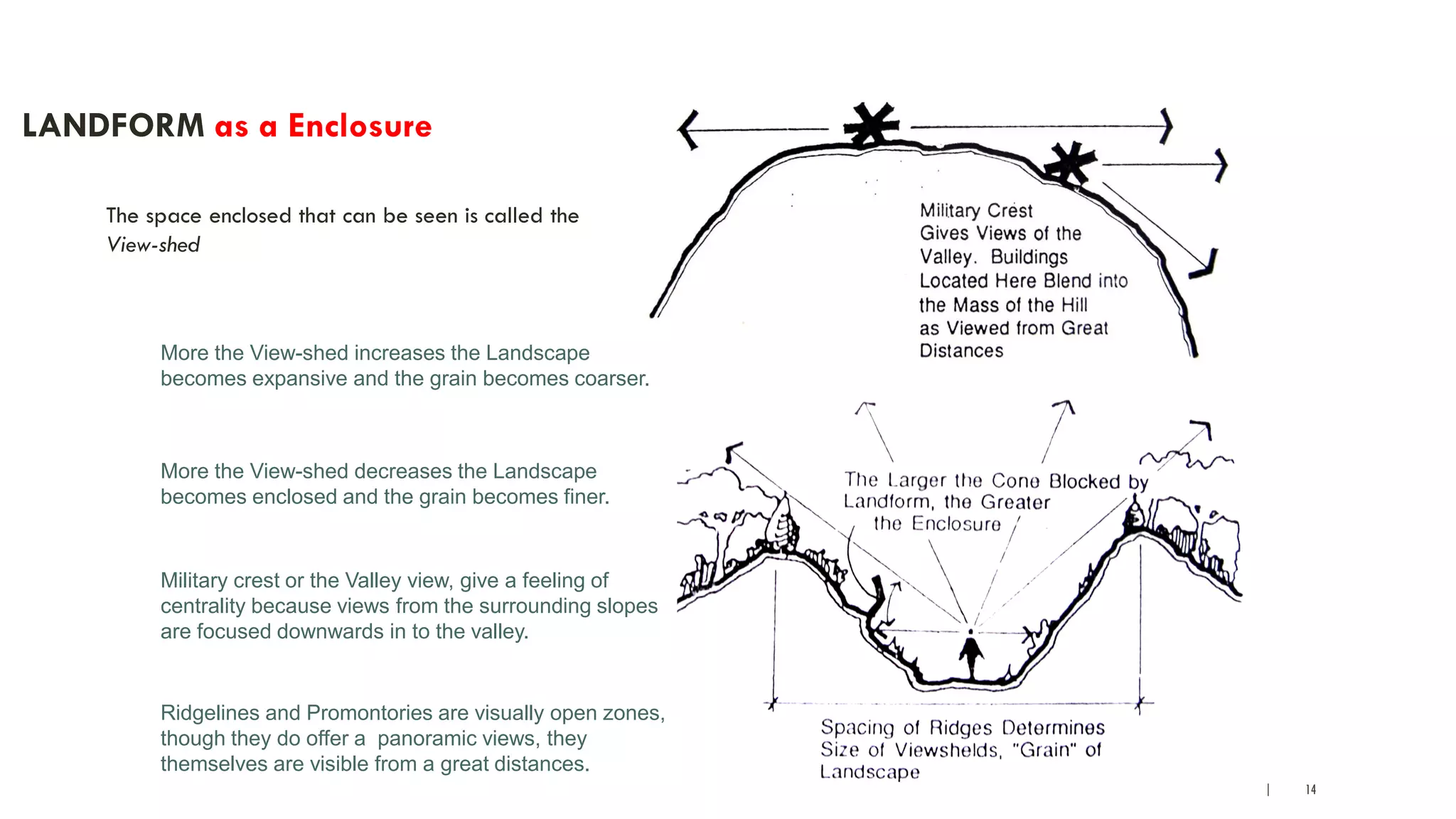
LANDFORM as a Enclosure
More the View-shed increases the Landscape
becomes expansive and the grain becomes coarser.
More the View-shed decreases the Landscape
becomes enclosed and the grain becomes finer.
Ridgelines and Promontories are visually open zones,
though they do offer a panoramic views, they
themselves are visible from a great distances.
Military crest or the Valley view, give a feeling of
centrality because views from the surrounding slopes
are focused downwards in to the valley.
The space enclosed that can be seen is called the
View-shed
| 15
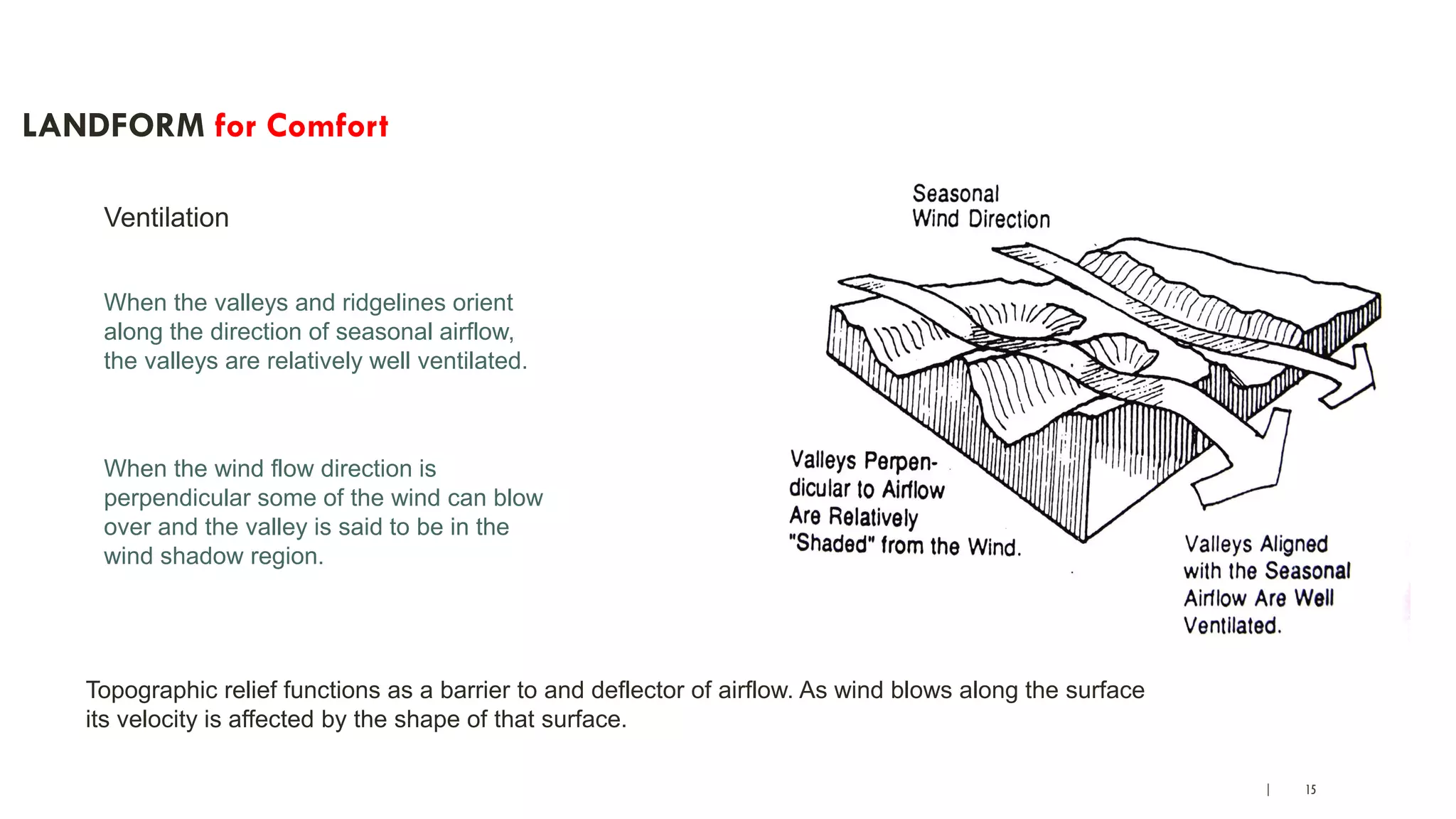
LANDFORM for Comfort
Ventilation
When the valleys and ridgelines orient
along the direction of seasonal airflow,
the valleys are relatively well ventilated.
When the wind flow direction is
perpendicular some of the wind can blow
over and the valley is said to be in the
wind shadow region.
Topographic relief functions as a barrier to and deflector of airflow. As wind blows along the surface
its velocity is affected by the shape of that surface.
| 16
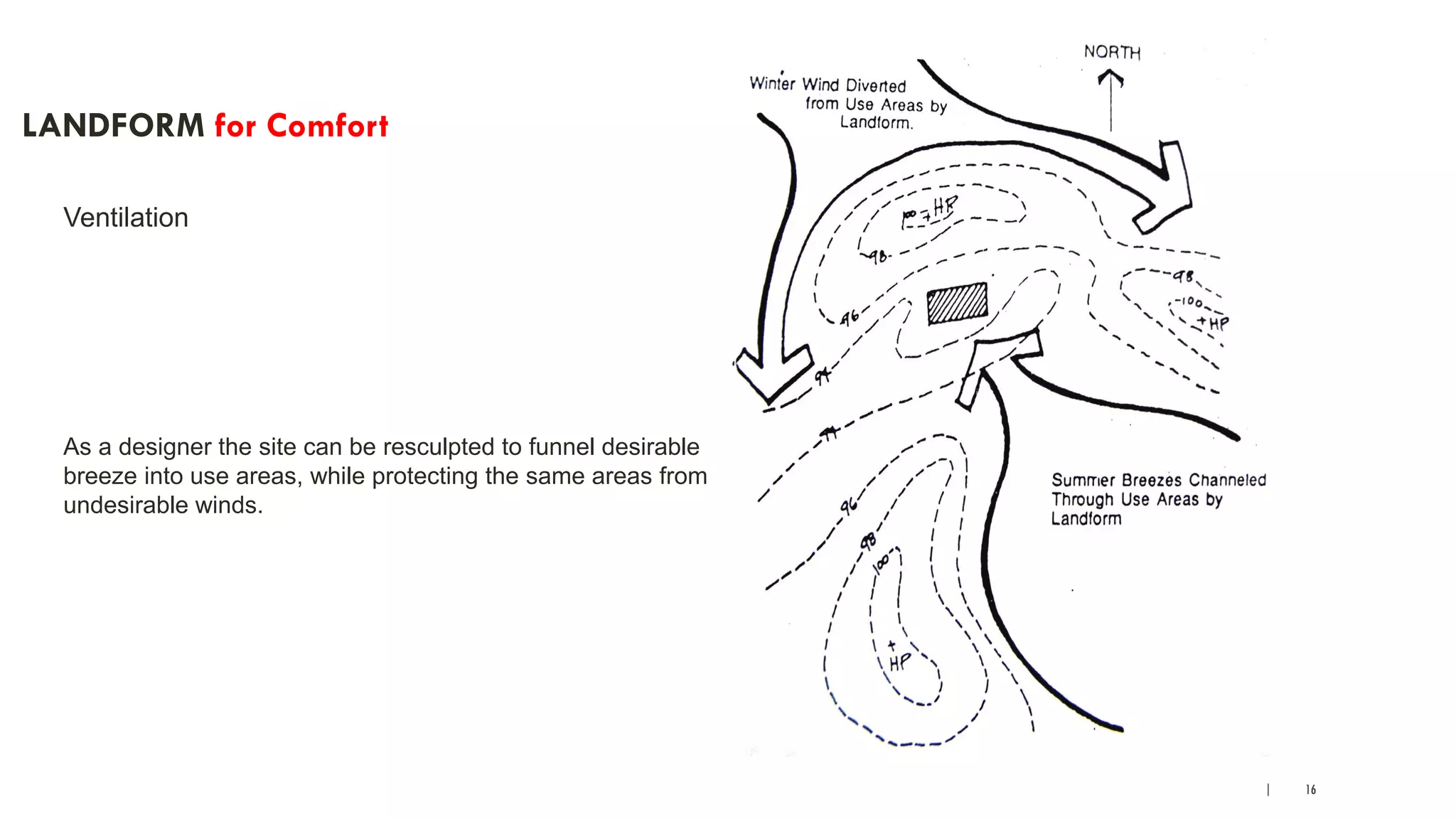
LANDFORM for Comfort
Ventilation
As a designer the site can be resculpted to funnel desirable
breeze into use areas, while protecting the same areas from
undesirable winds.
| 17
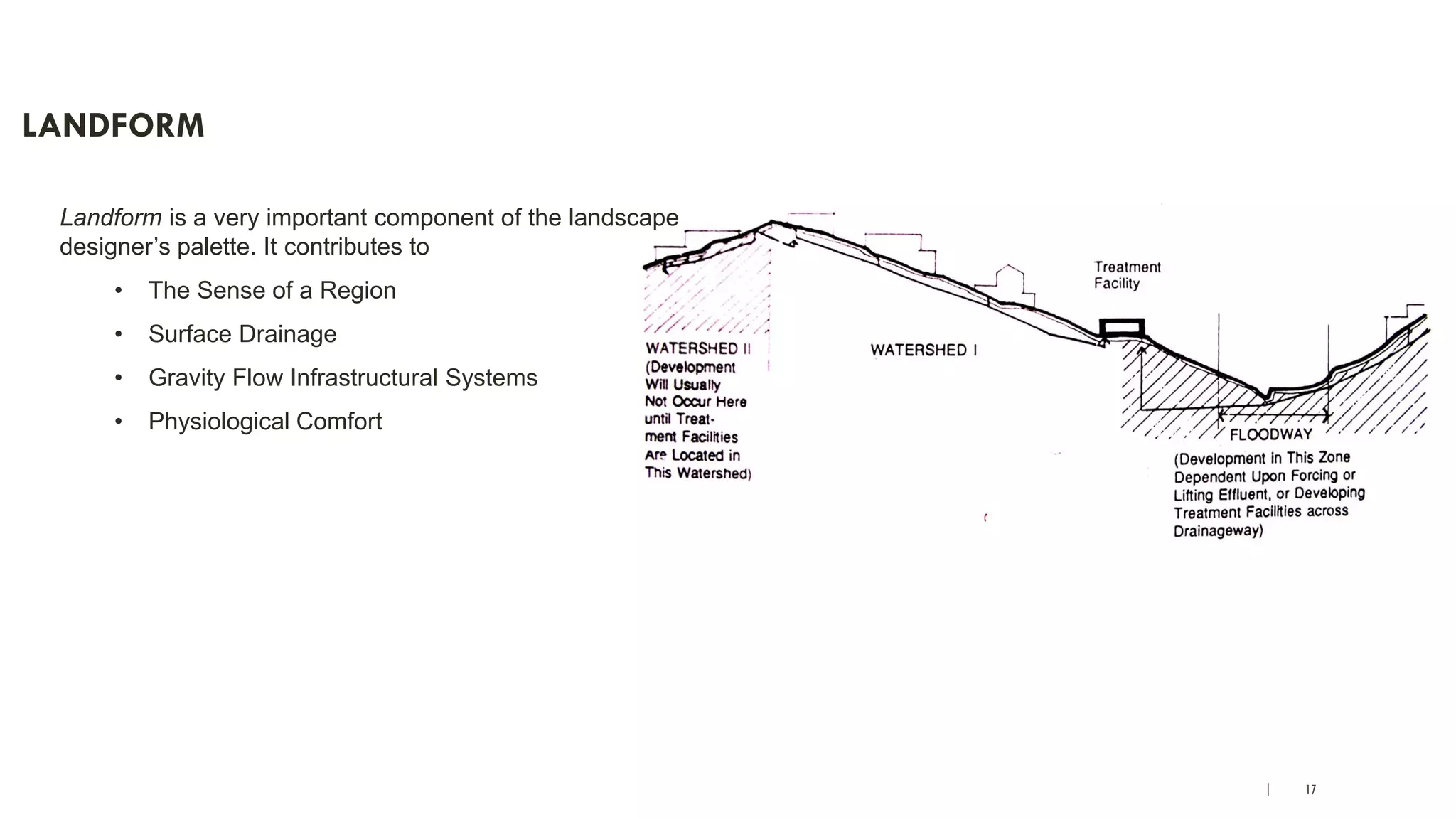
LANDFORM
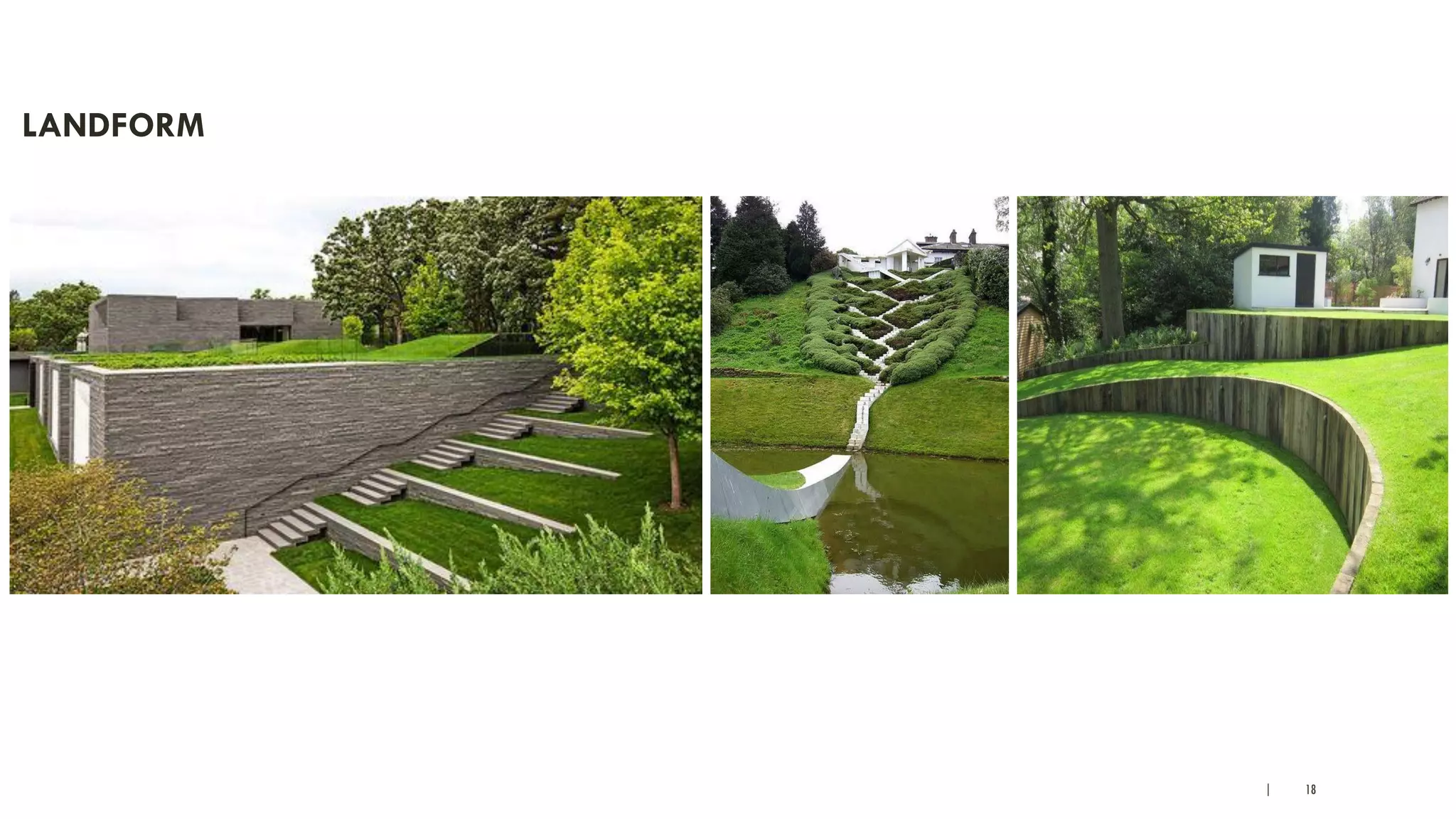
Landform is a very important component of the landscape
designer’s palette. It contributes to
• The Sense of a Region
• Surface Drainage
• Gravity Flow Infrastructural Systems
• Physiological Comfort
| 18
LANDFORM
| 19
WATER
| 20
WATER
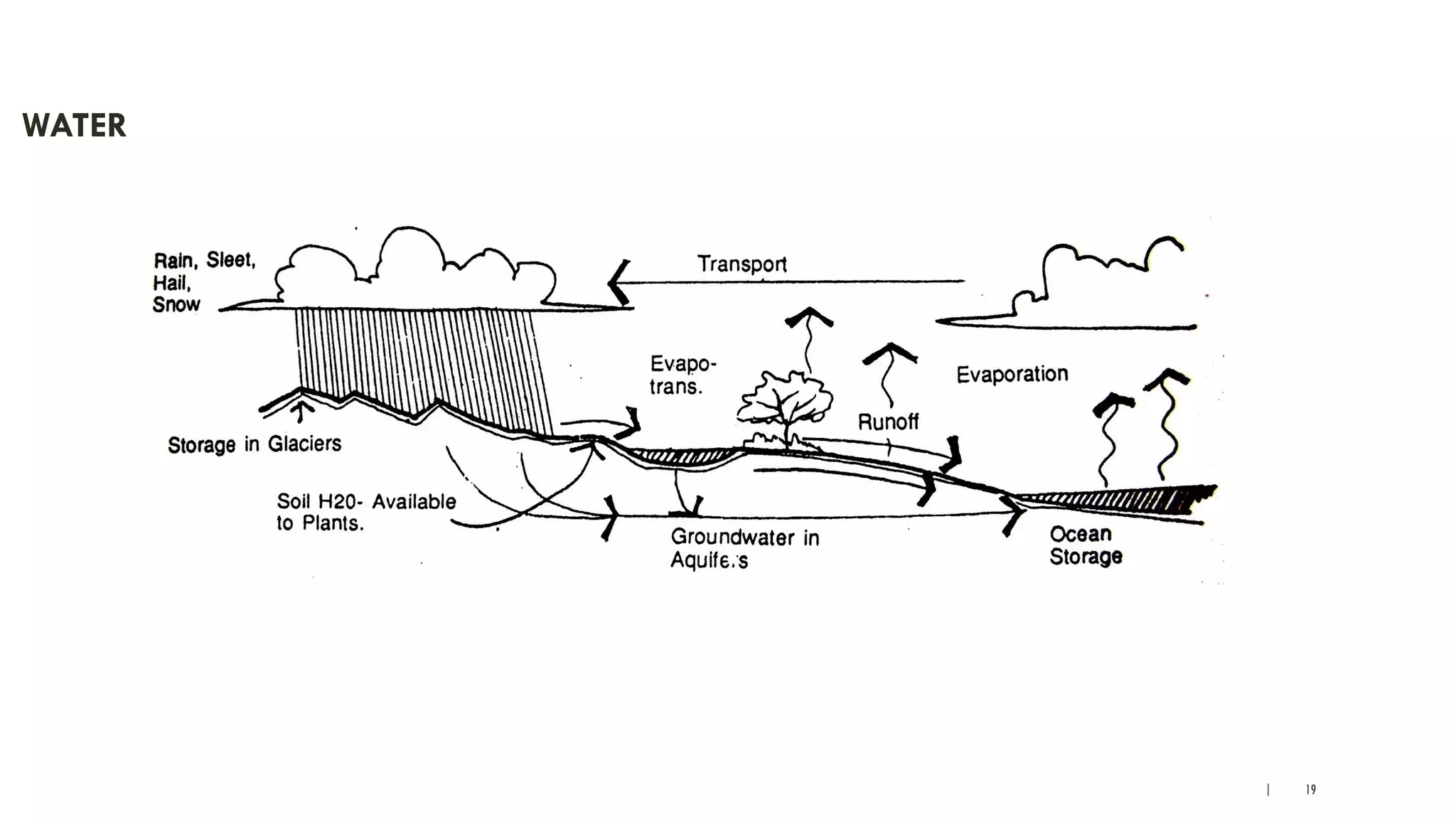
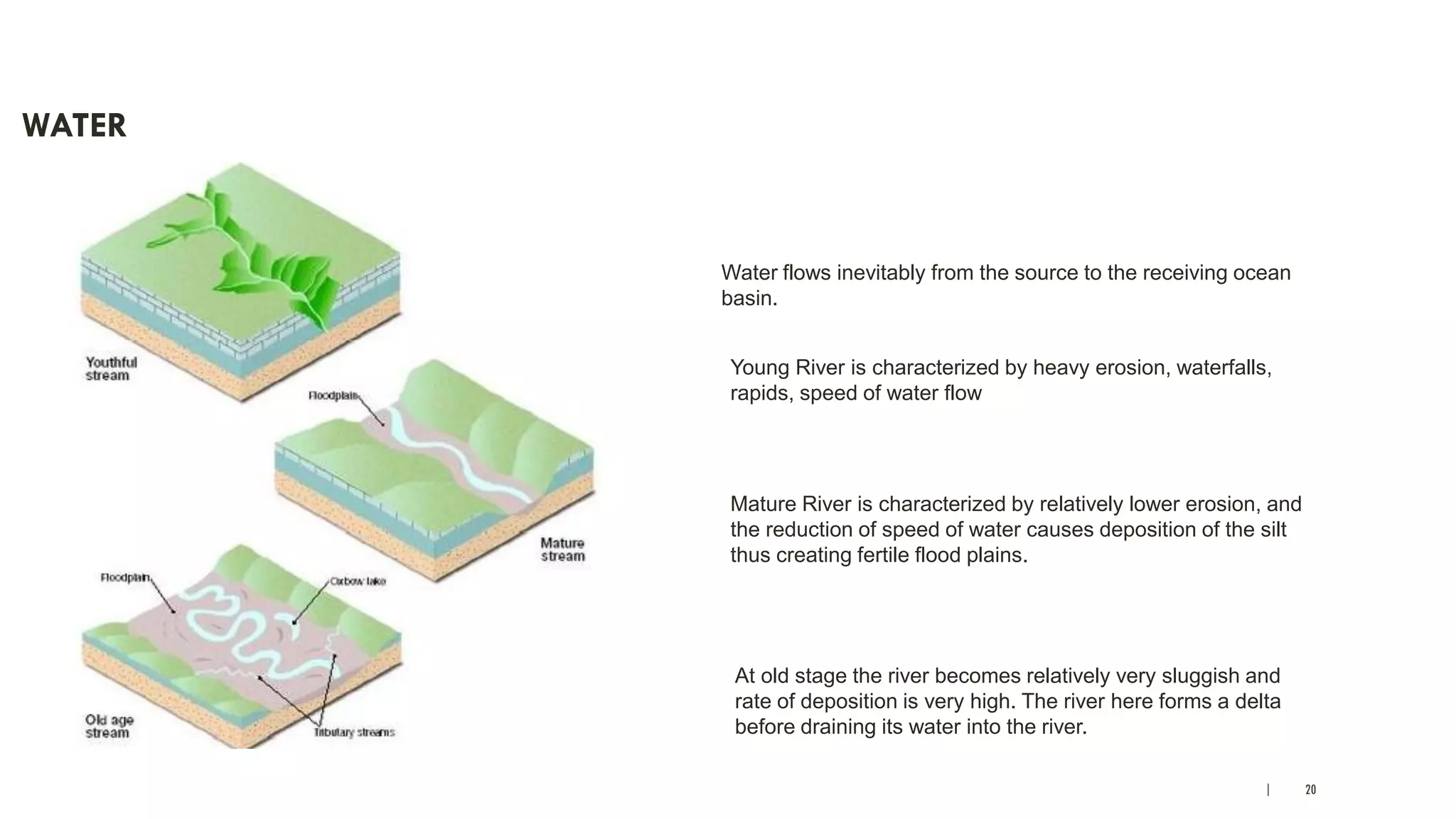
Water flows inevitably from the source to the receiving ocean
basin.
Young River is characterized by heavy erosion, waterfalls,
rapids, speed of water flow
Mature River is characterized by relatively lower erosion, and
the reduction of speed of water causes deposition of the silt
thus creating fertile flood plains.
At old stage the river becomes relatively very sluggish and
rate of deposition is very high. The river here forms a delta
before draining its water into the river.
| 21
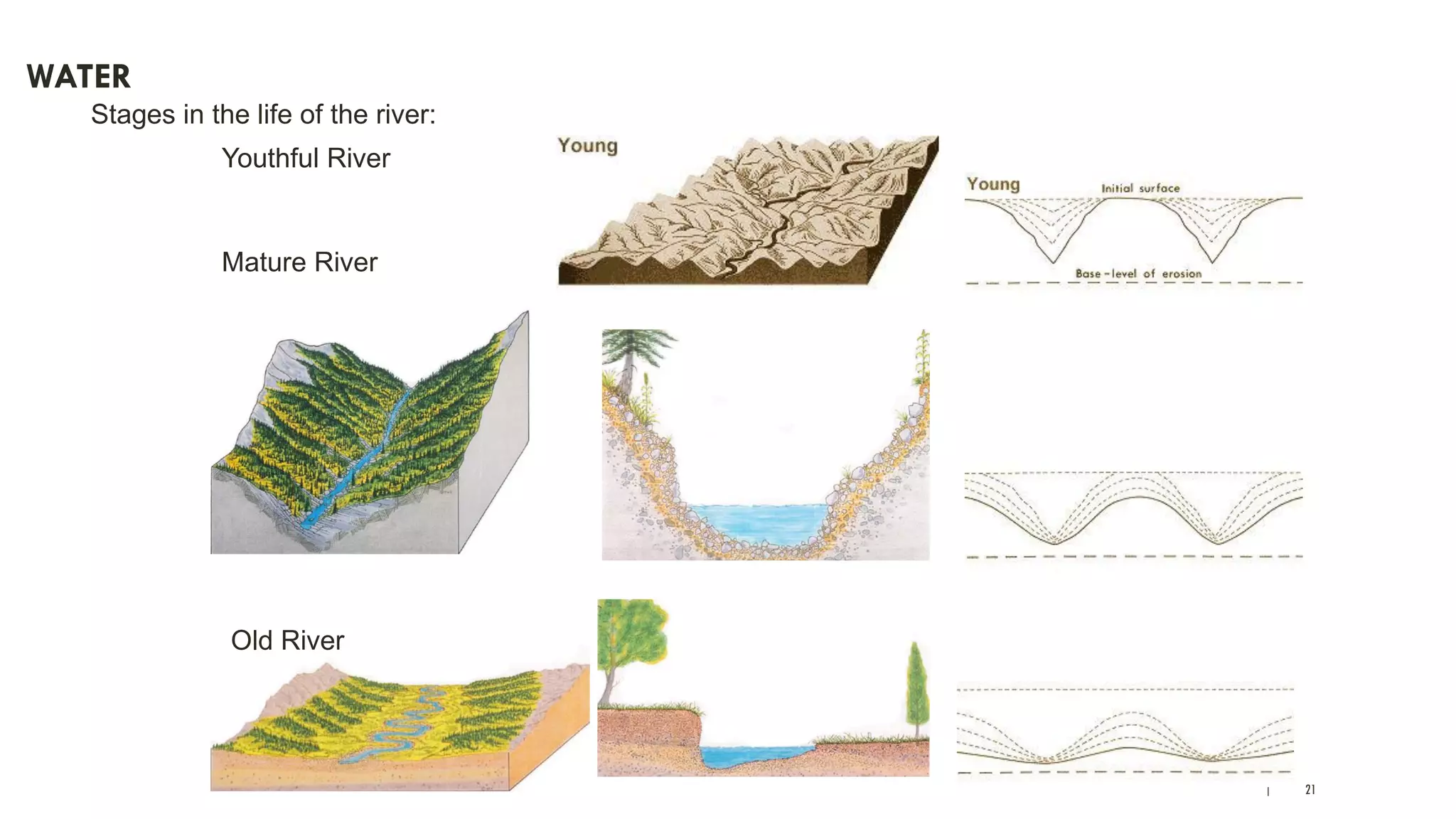
Stages in the life of the river:
Youthful River
Mature River
Old River
WATER
| 22
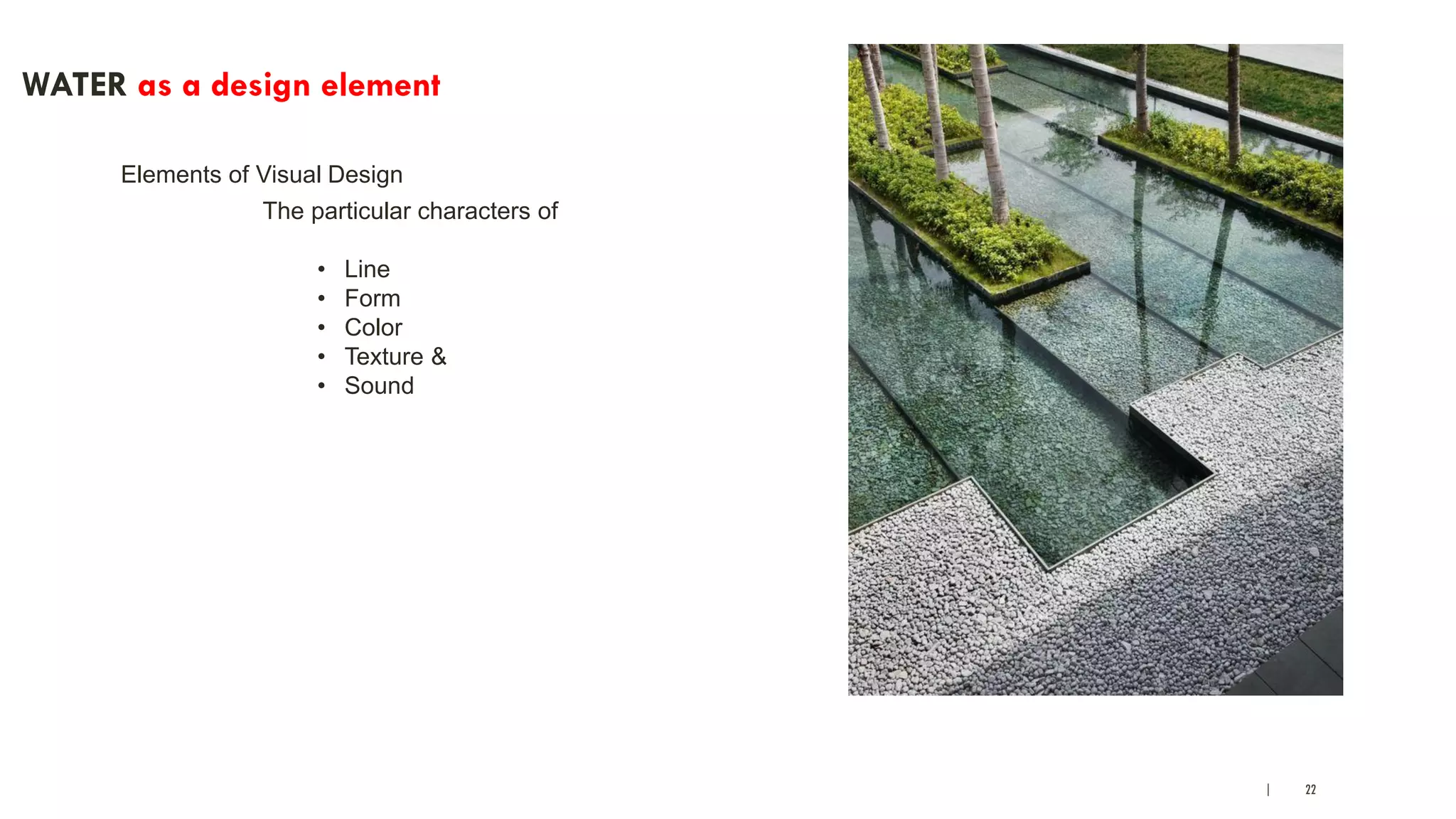
WATER as a design element
Elements of Visual Design
The particular characters of
• Line
• Form
• Color
• Texture &
• Sound
| 23
WATER as a design element
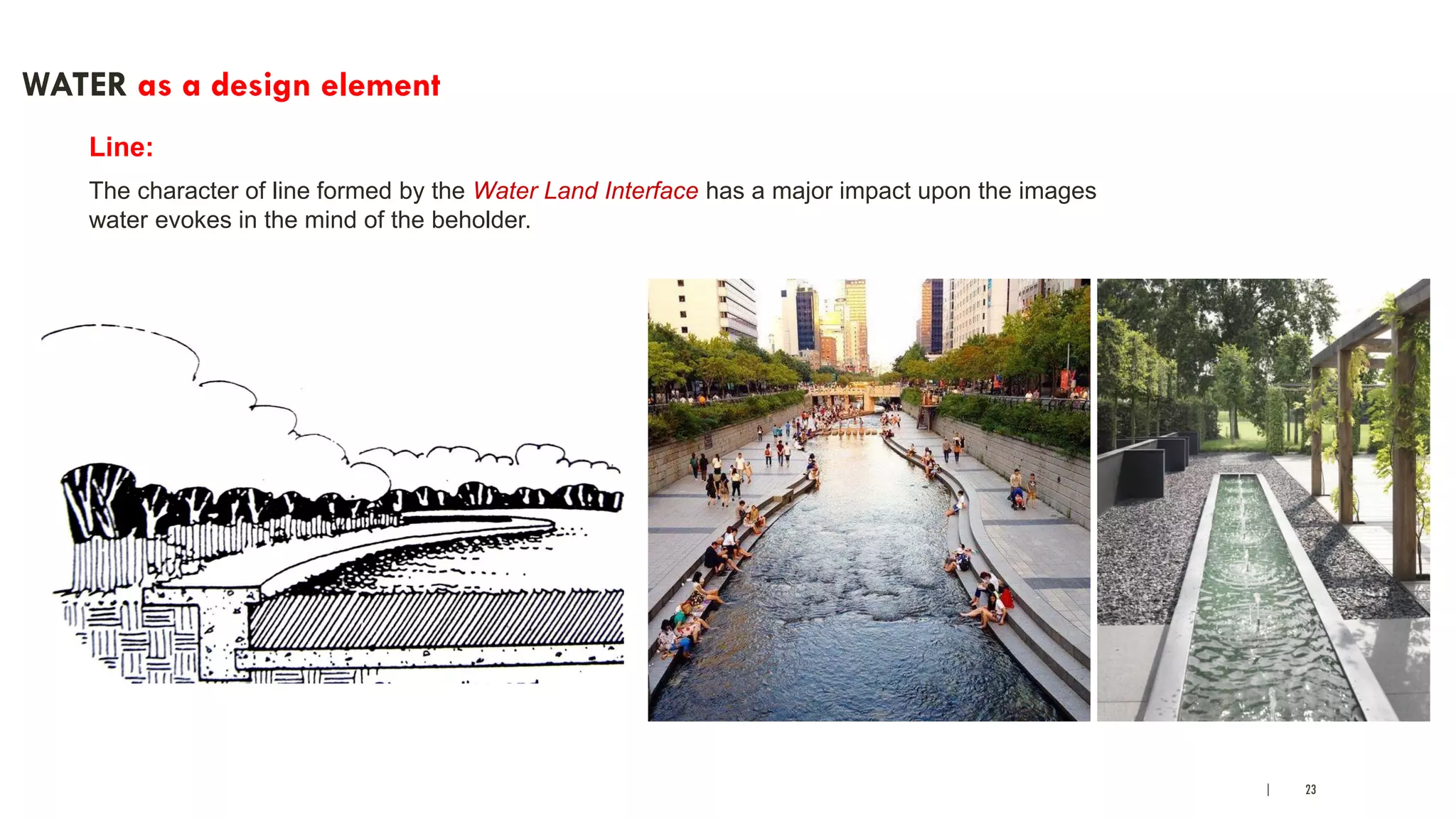
Line:
The character of line formed by the Water Land Interface has a major impact upon the images
water evokes in the mind of the beholder.
| 24
WATER as a design element
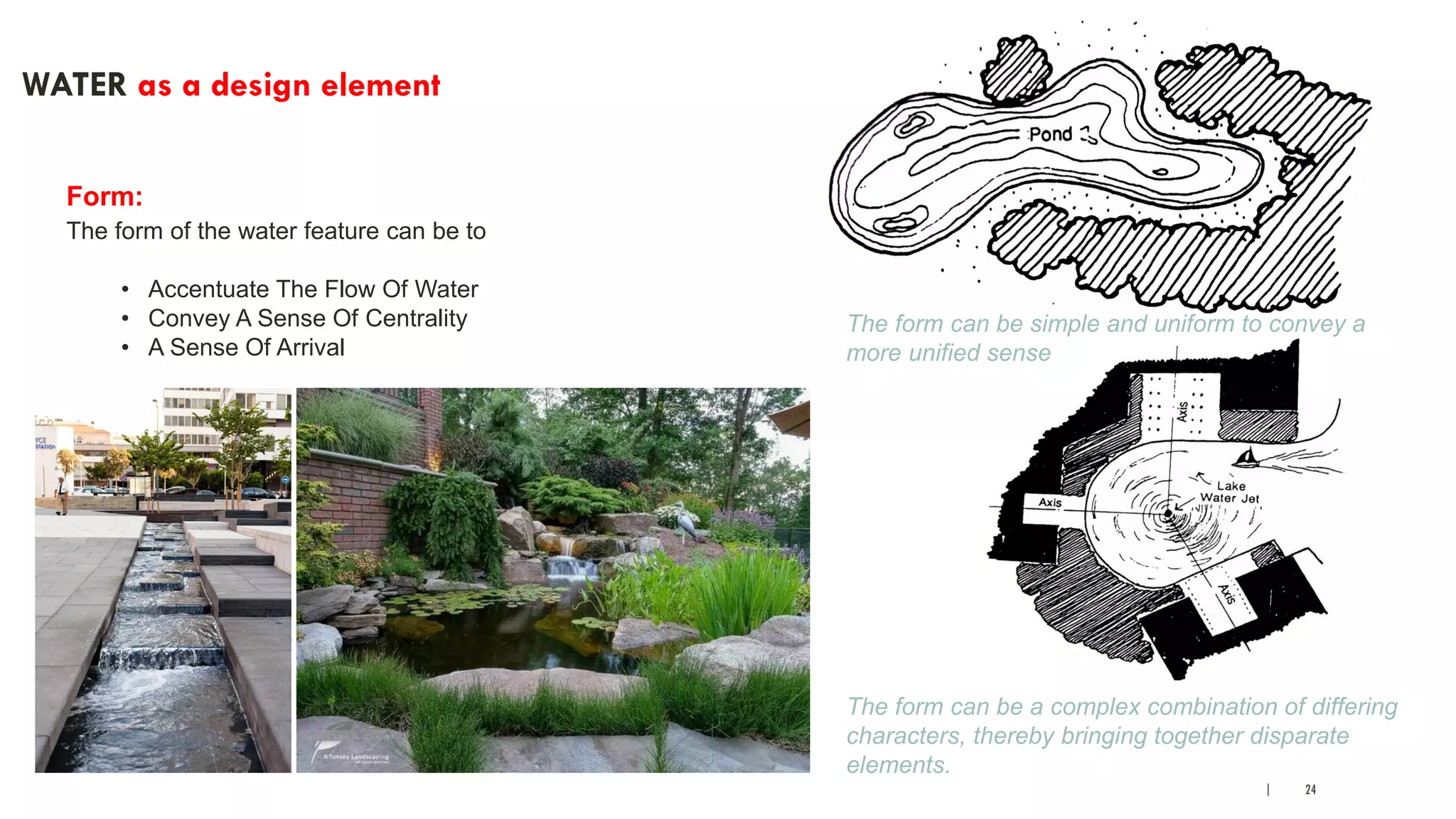
Form:
The form of the water feature can be to
• Accentuate The Flow Of Water
• Convey A Sense Of Centrality
• A Sense Of Arrival
The form can be a complex combination of differing
characters, thereby bringing together disparate
elements.
The form can be simple and uniform to convey a
more unified sense
| 25
WATER as a design element
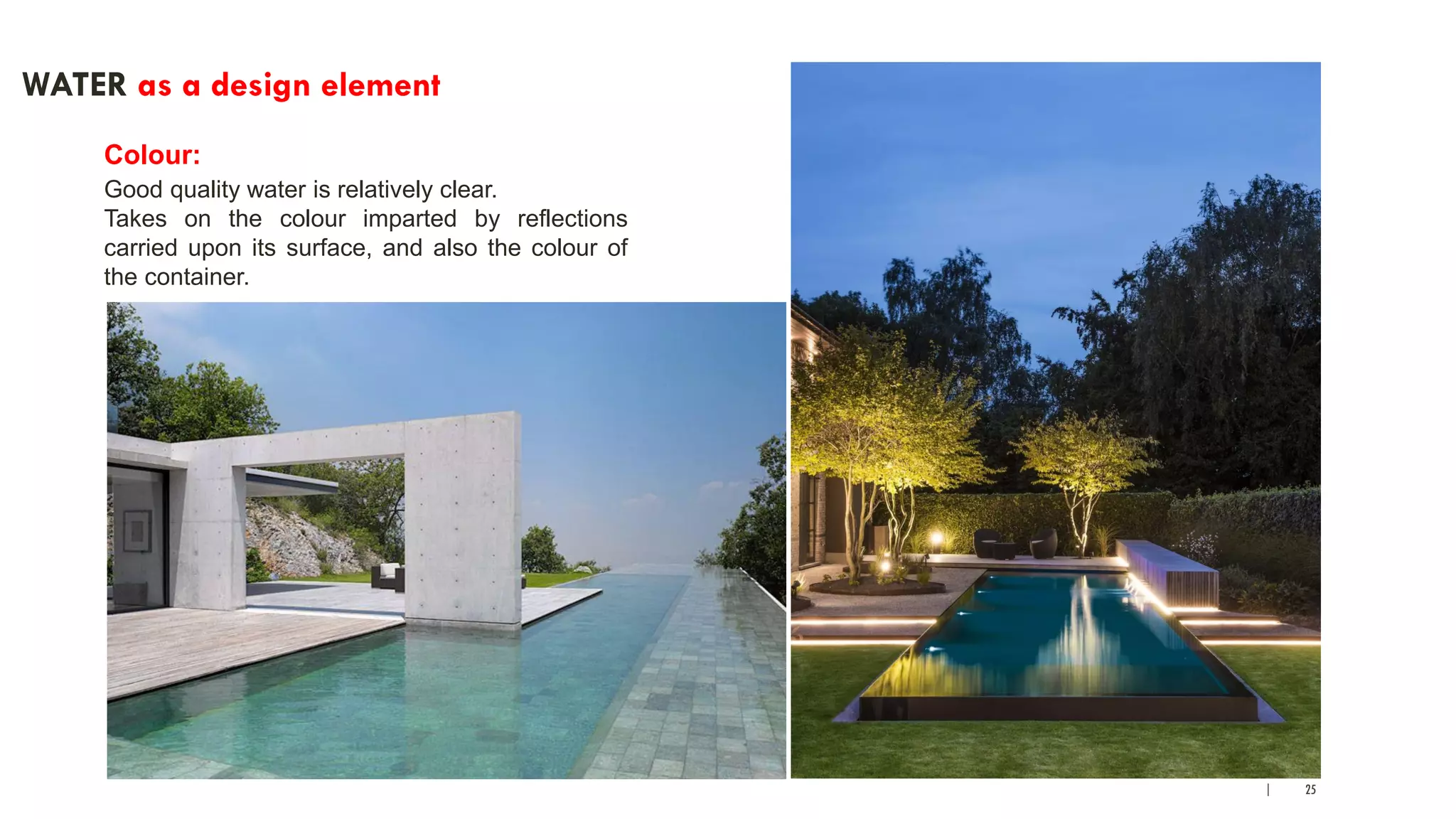
Colour:
Good quality water is relatively clear.
Takes on the colour imparted by reflections
carried upon its surface, and also the colour of
the container.
| 26
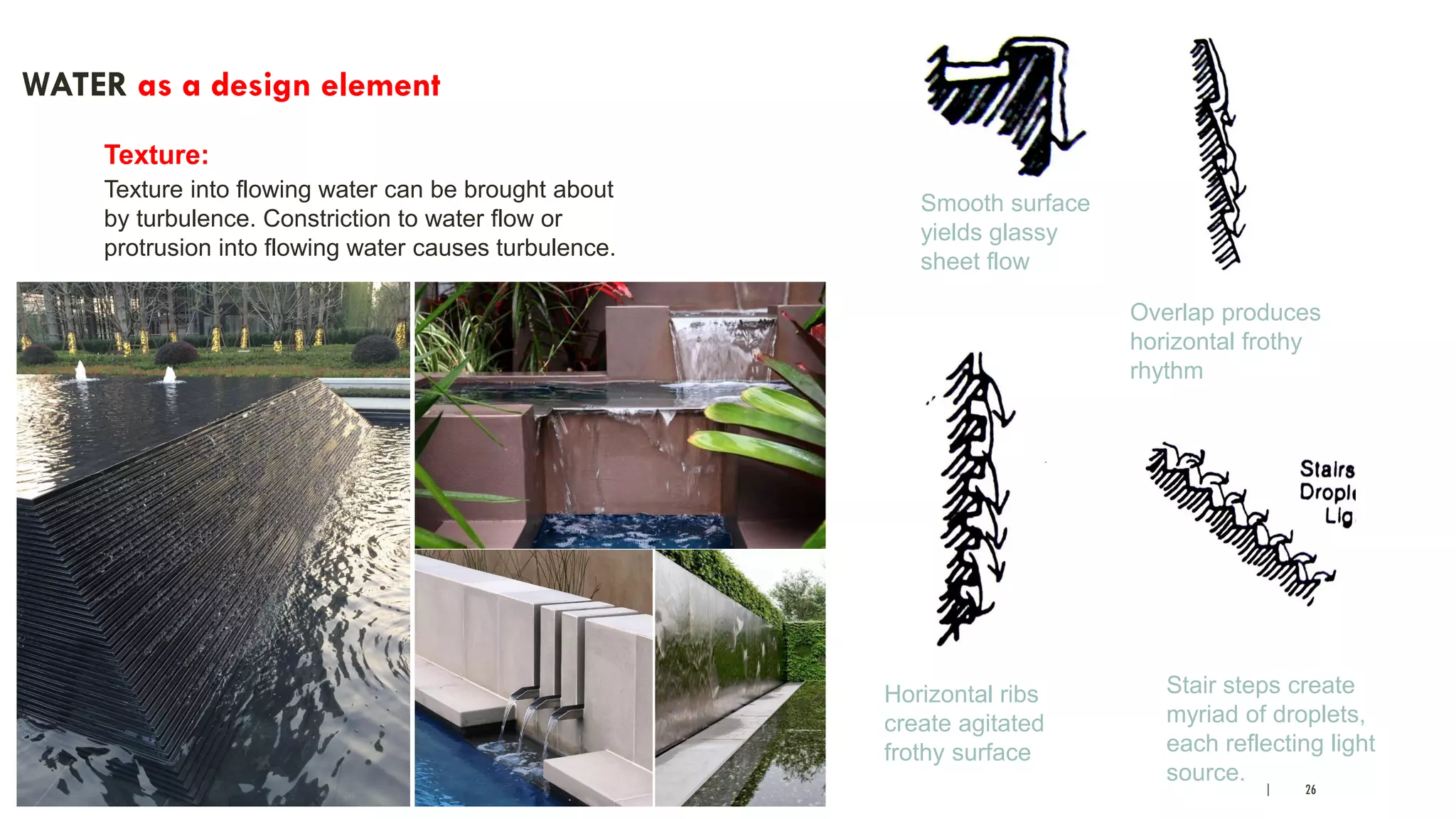
WATER as a design element
Texture:
Texture into flowing water can be brought about
by turbulence. Constriction to water flow or
protrusion into flowing water causes turbulence.
Smooth surface
yields glassy
sheet flow
Overlap produces
horizontal frothy
rhythm
Stair steps create
myriad of droplets,
each reflecting light
source.
Horizontal ribs
create agitated
frothy surface
| 27
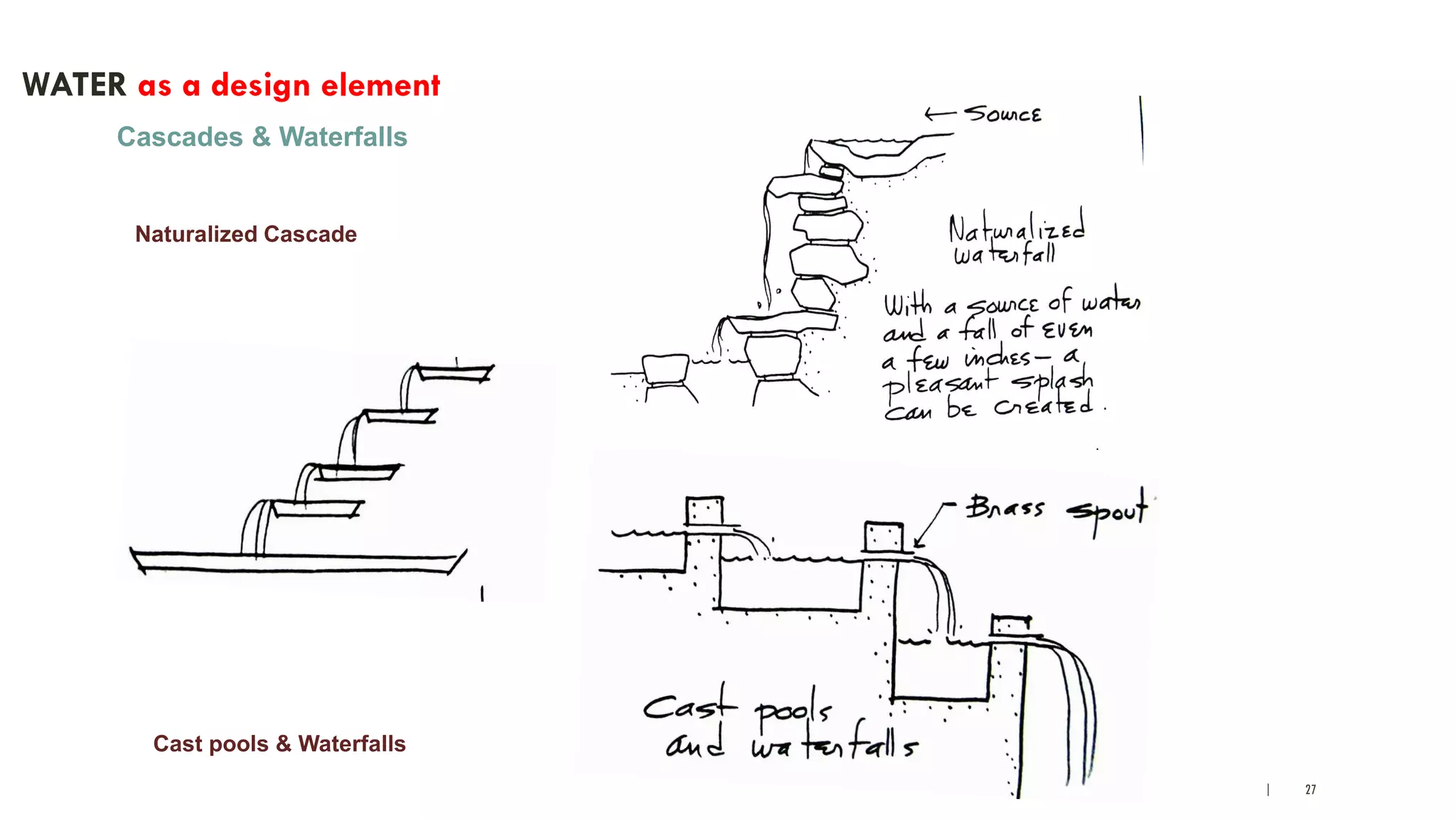
WATER as a design element
Cascades & Waterfalls
Naturalized Cascade
Cast pools & Waterfalls
| 28
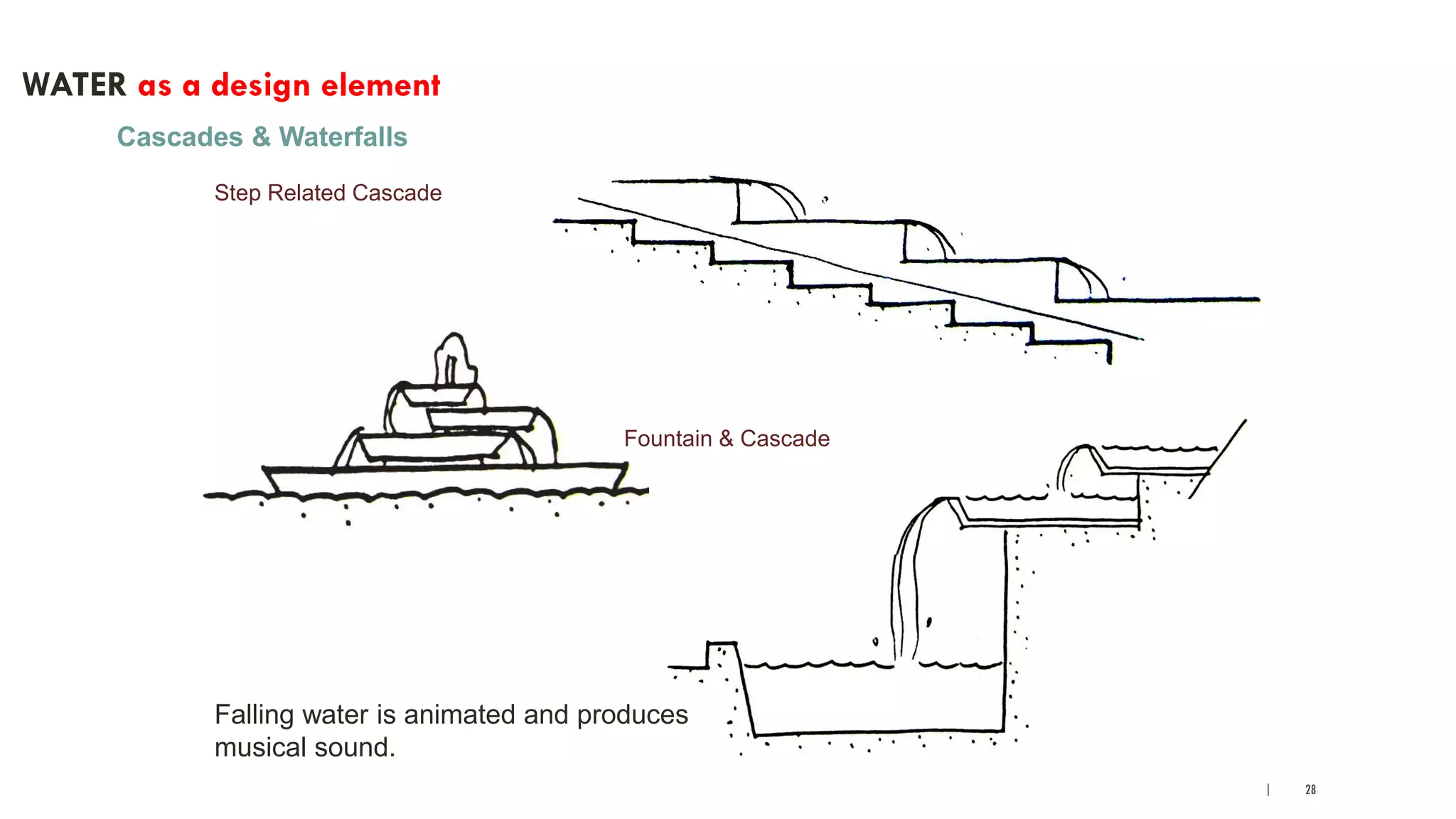
WATER as a design element
Cascades & Waterfalls
Step Related Cascade
Falling water is animated and produces
musical sound.
Fountain & Cascade
| 29
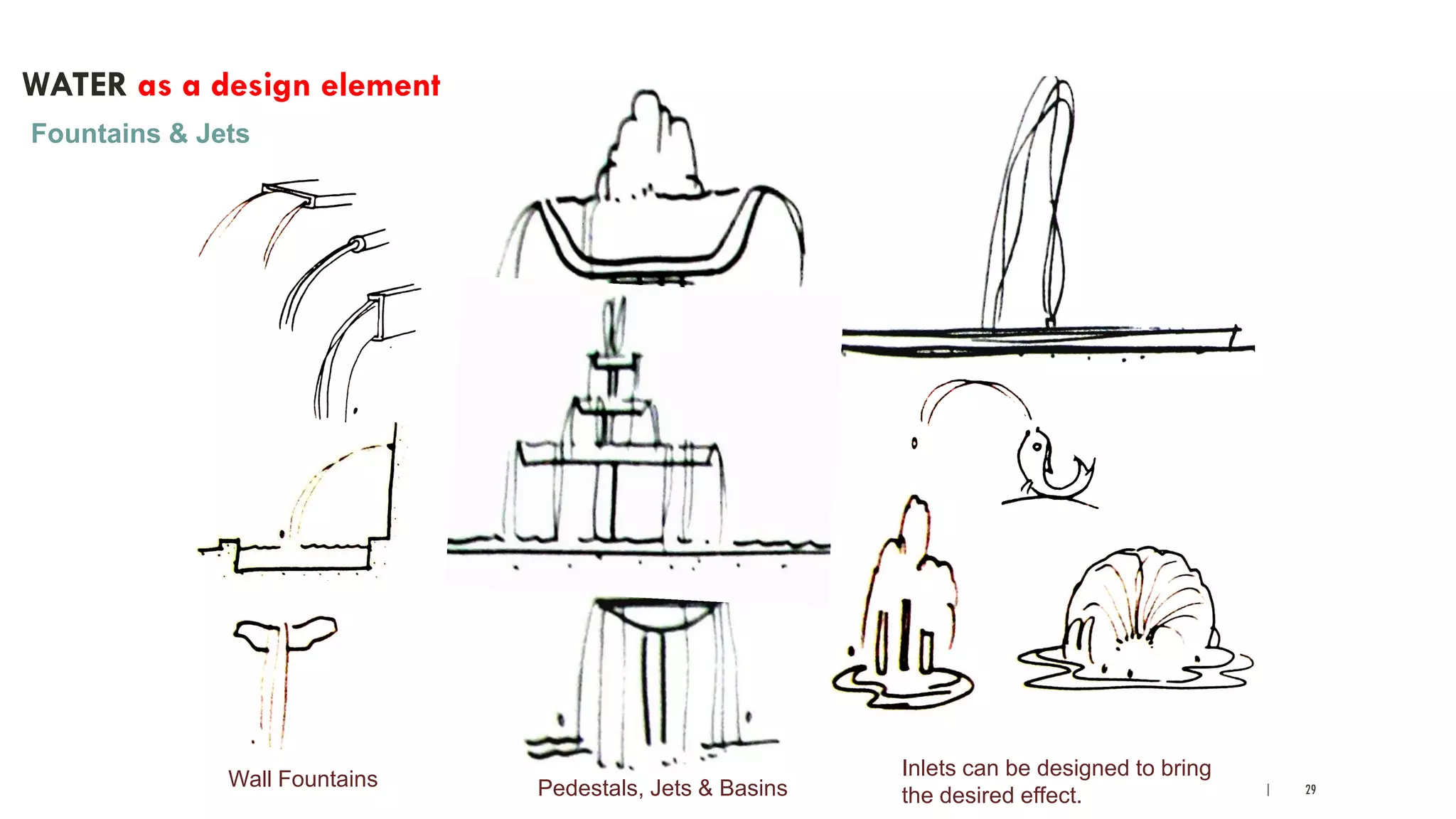
WATER as a design element
Fountains & Jets
Pedestals, Jets & Basins
Inlets can be designed to bring
the desired effect.
Wall Fountains
| 30
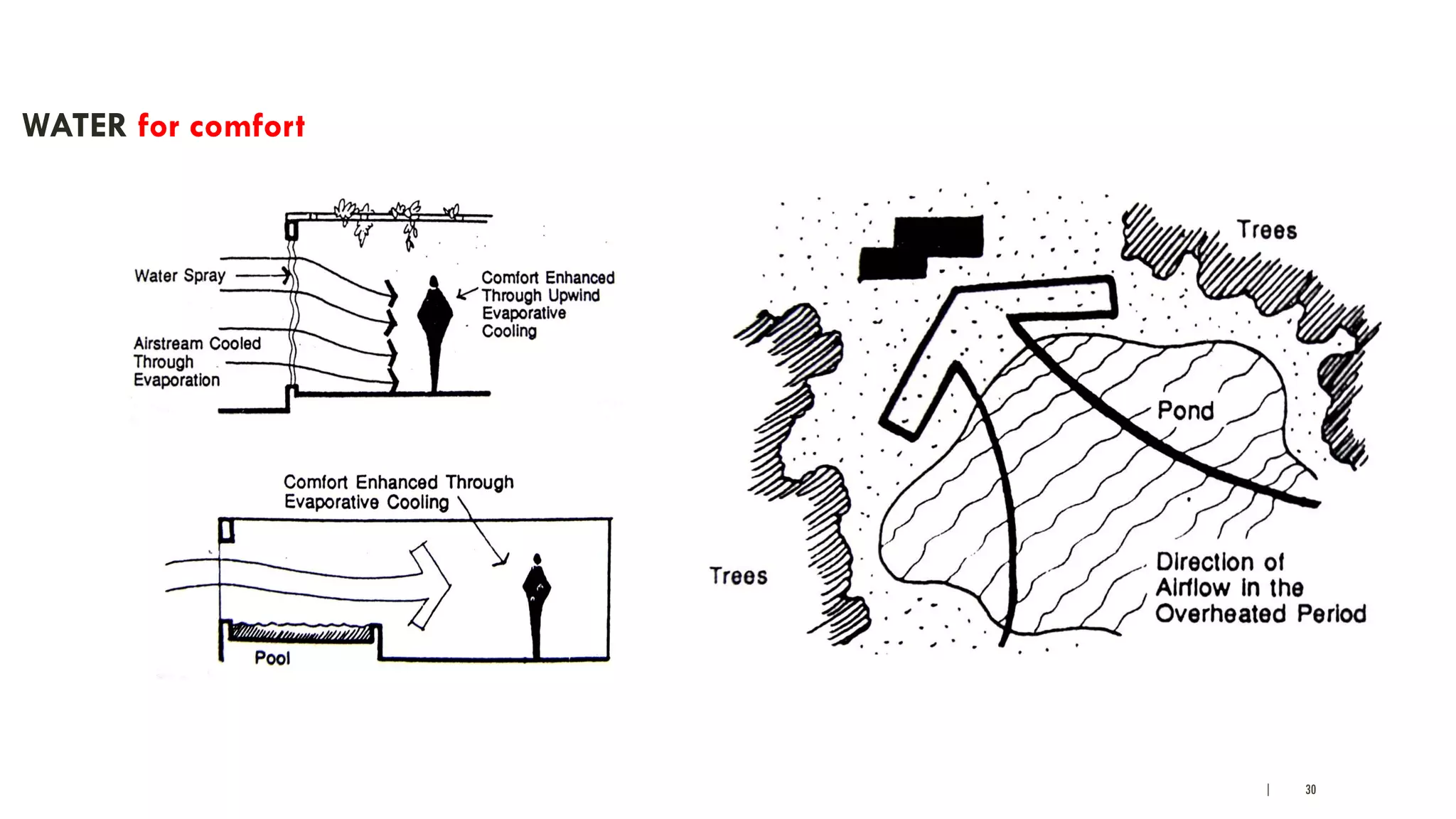
WATER for comfort
| 31
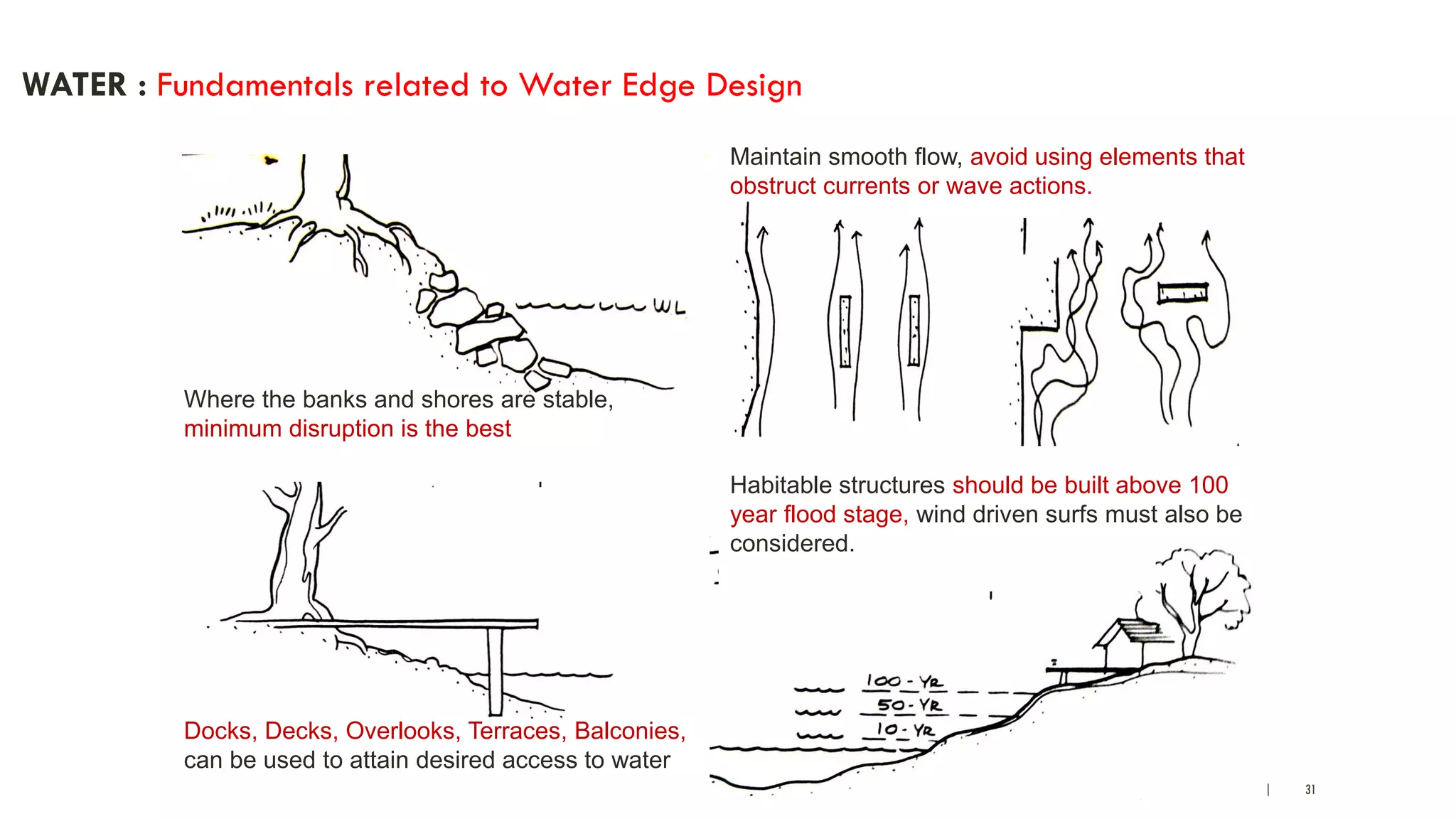
WATER : Fundamentals related to Water Edge Design
Docks, Decks, Overlooks, Terraces, Balconies,
can be used to attain desired access to water
Where the banks and shores are stable,
minimum disruption is the best
Habitable structures should be built above 100
year flood stage, wind driven surfs must also be
considered.
Maintain smooth flow, avoid using elements that
obstruct currents or wave actions.
| 32
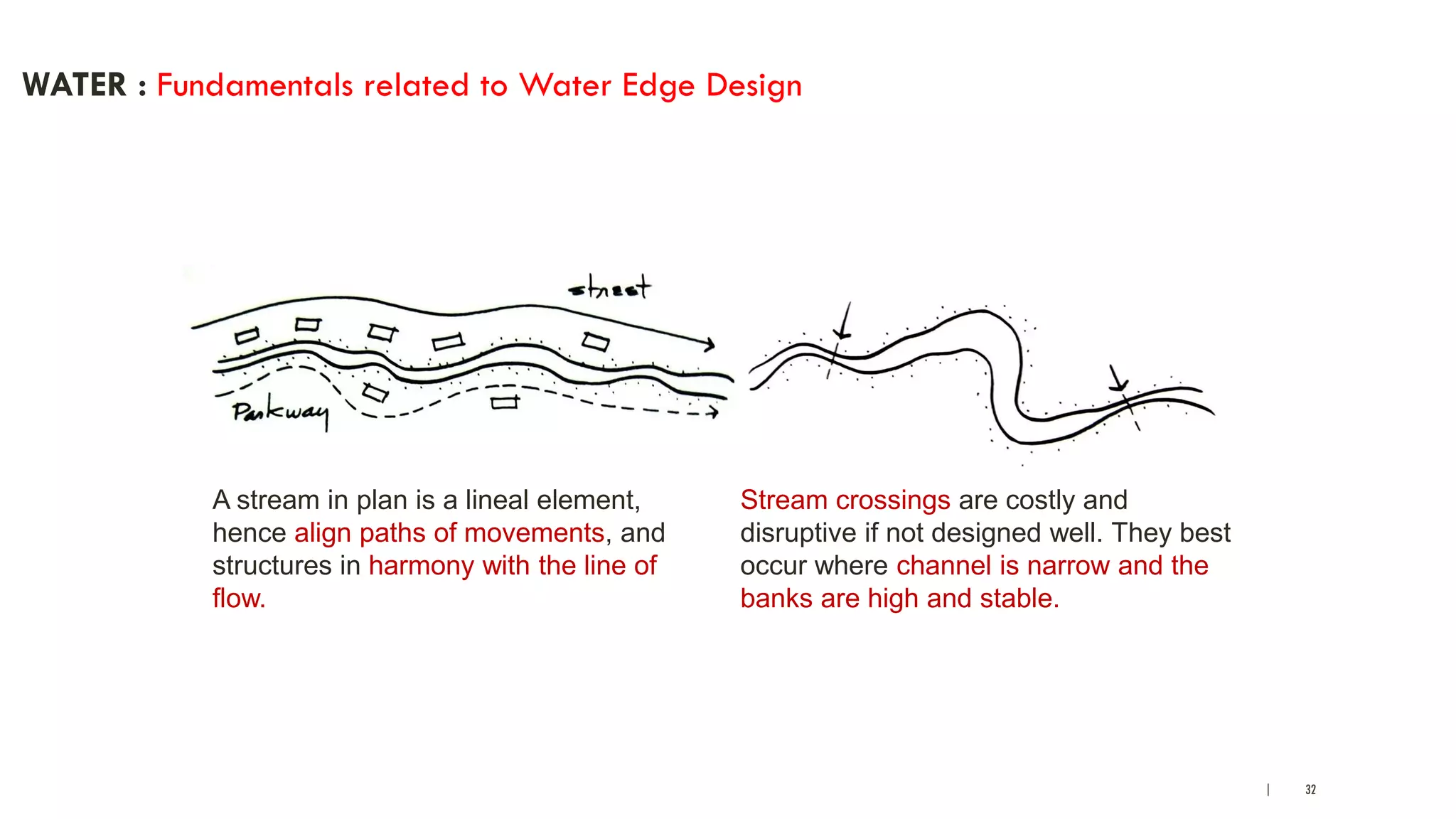
WATER : Fundamentals related to Water Edge Design
A stream in plan is a lineal element,
hence align paths of movements, and
structures in harmony with the line of
flow.
Stream crossings are costly and
disruptive if not designed well. They best
occur where channel is narrow and the
banks are high and stable.
| 33
PLANTING DESIGN
•Planting design is one of the essential tools in making and
managing a living environment where plants play a significant
role in the development of a lively, resilient, complex and
sustainable landscape.
•It helps us to restore and maintain a sustainable relationship
between people and their environment in a context of change.
| 34
PLANTING DESIGN : Plant Material as Process
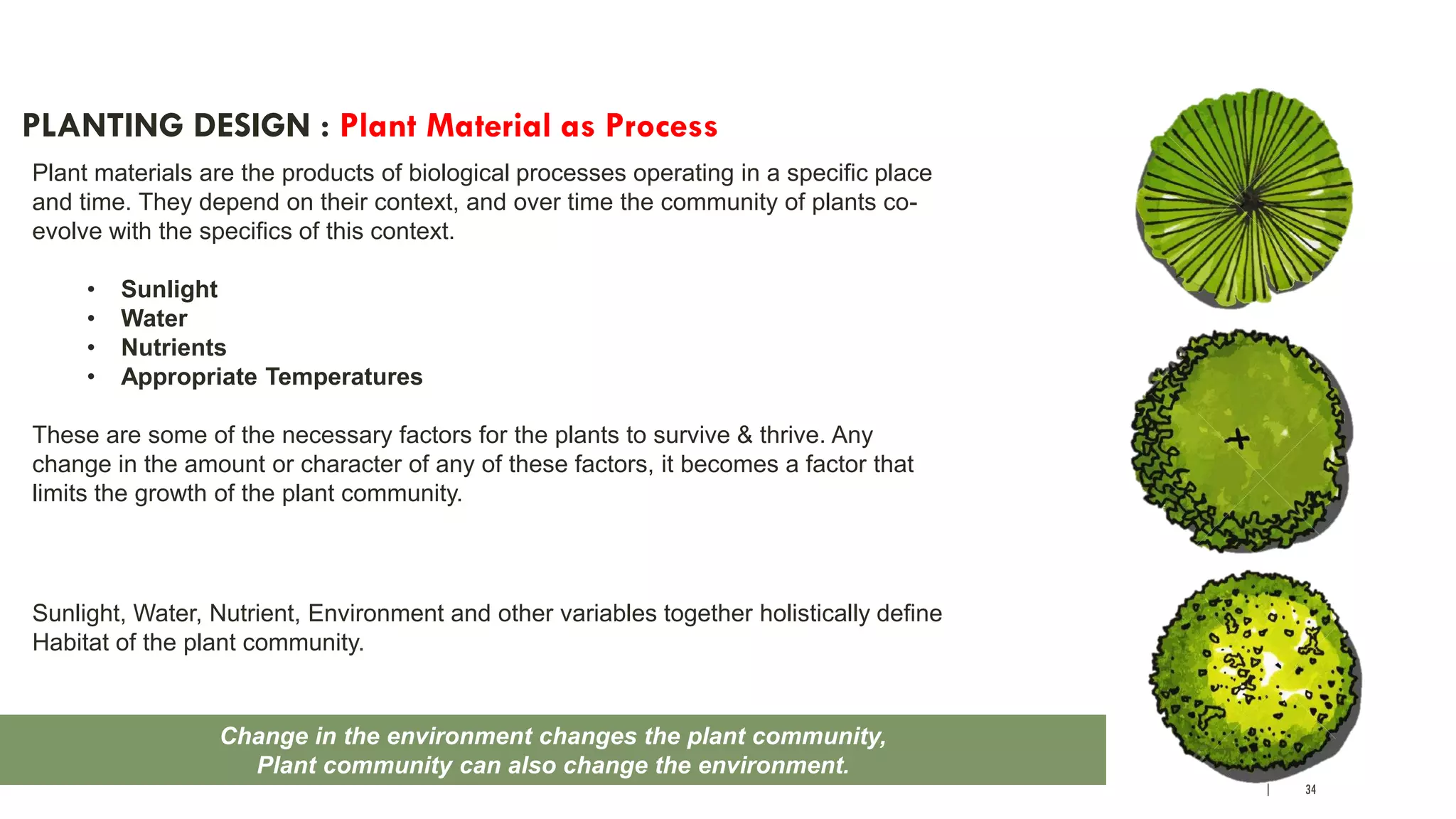
Plant materials are the products of biological processes operating in a specific place
and time. They depend on their context, and over time the community of plants co-
evolve with the specifics of this context.
• Sunlight
• Water
• Nutrients
• Appropriate Temperatures
These are some of the necessary factors for the plants to survive & thrive. Any
change in the amount or character of any of these factors, it becomes a factor that
limits the growth of the plant community.
Sunlight, Water, Nutrient, Environment and other variables together holistically define
Habitat of the plant community.
Change in the environment changes the plant community,
Plant community can also change the environment.
| 35
PLANTING DESIGN : Plant Material as Process
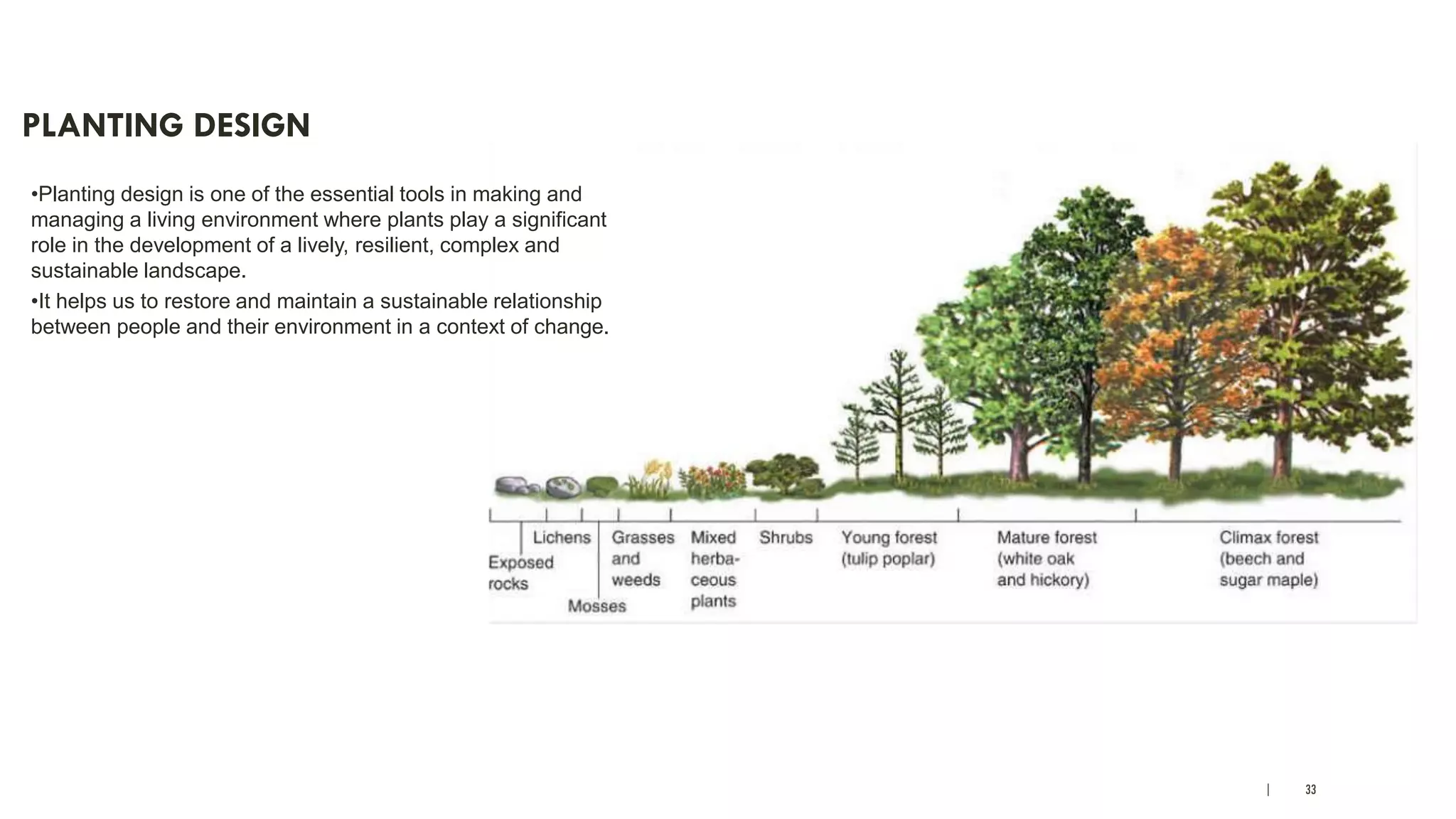
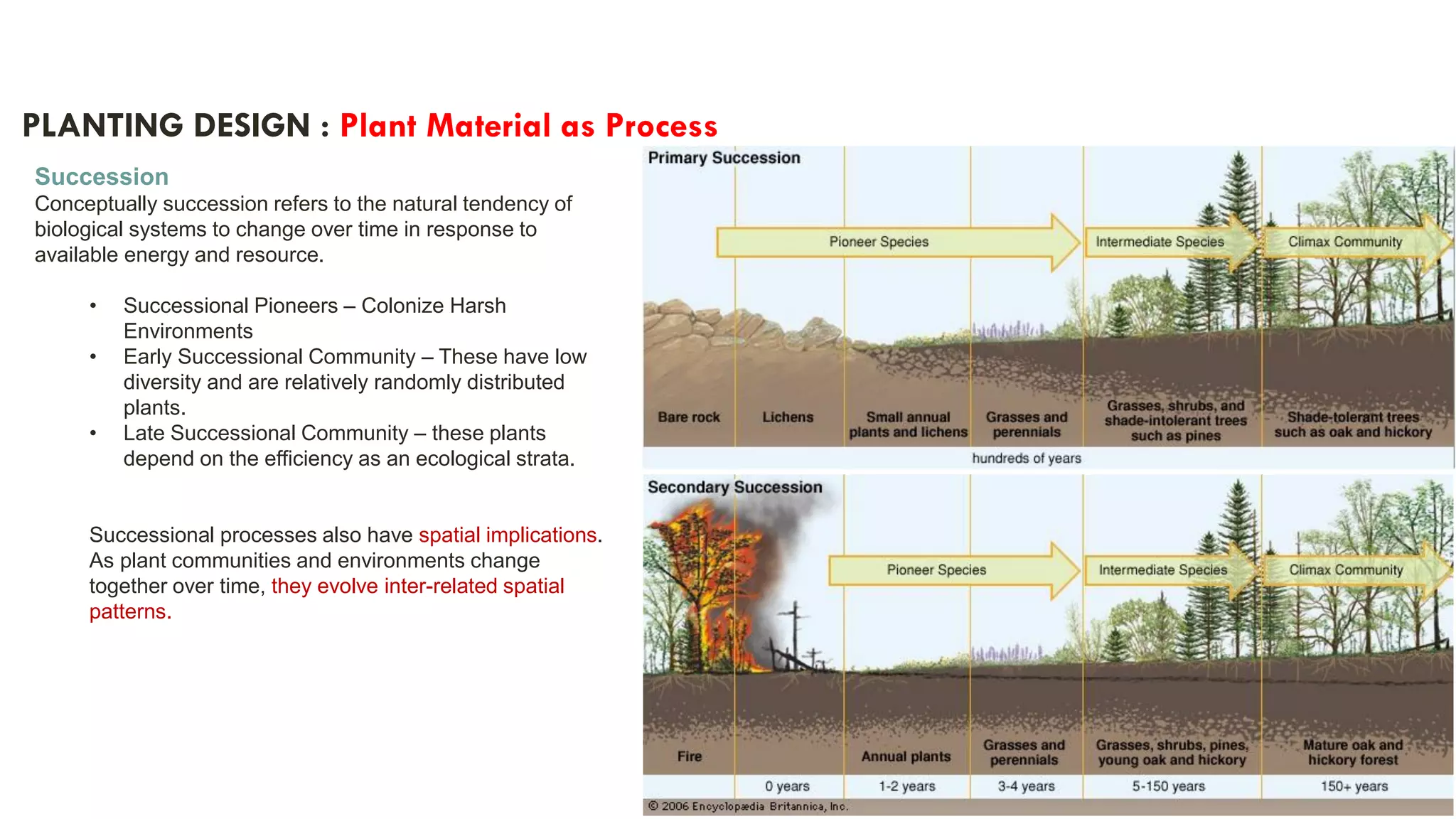
Succession
Conceptually succession refers to the natural tendency of
biological systems to change over time in response to
available energy and resource.
• Successional Pioneers – Colonize Harsh
Environments
• Early Successional Community – These have low
diversity and are relatively randomly distributed
plants.
• Late Successional Community – these plants
depend on the efficiency as an ecological strata.
Successional processes also have spatial implications.
As plant communities and environments change
together over time, they evolve inter-related spatial
patterns.
| 36
PLANTING DESIGN : Plant Material
Characteristics and Classification
 The structural/ spatial characteristics of plants are
those that contribute to the space structure of the
landscape. They include habit, crown shape, foliage
density and speed of growth, and en masse they
determine the spatial composition of the planted
environment. - Nick Robinson
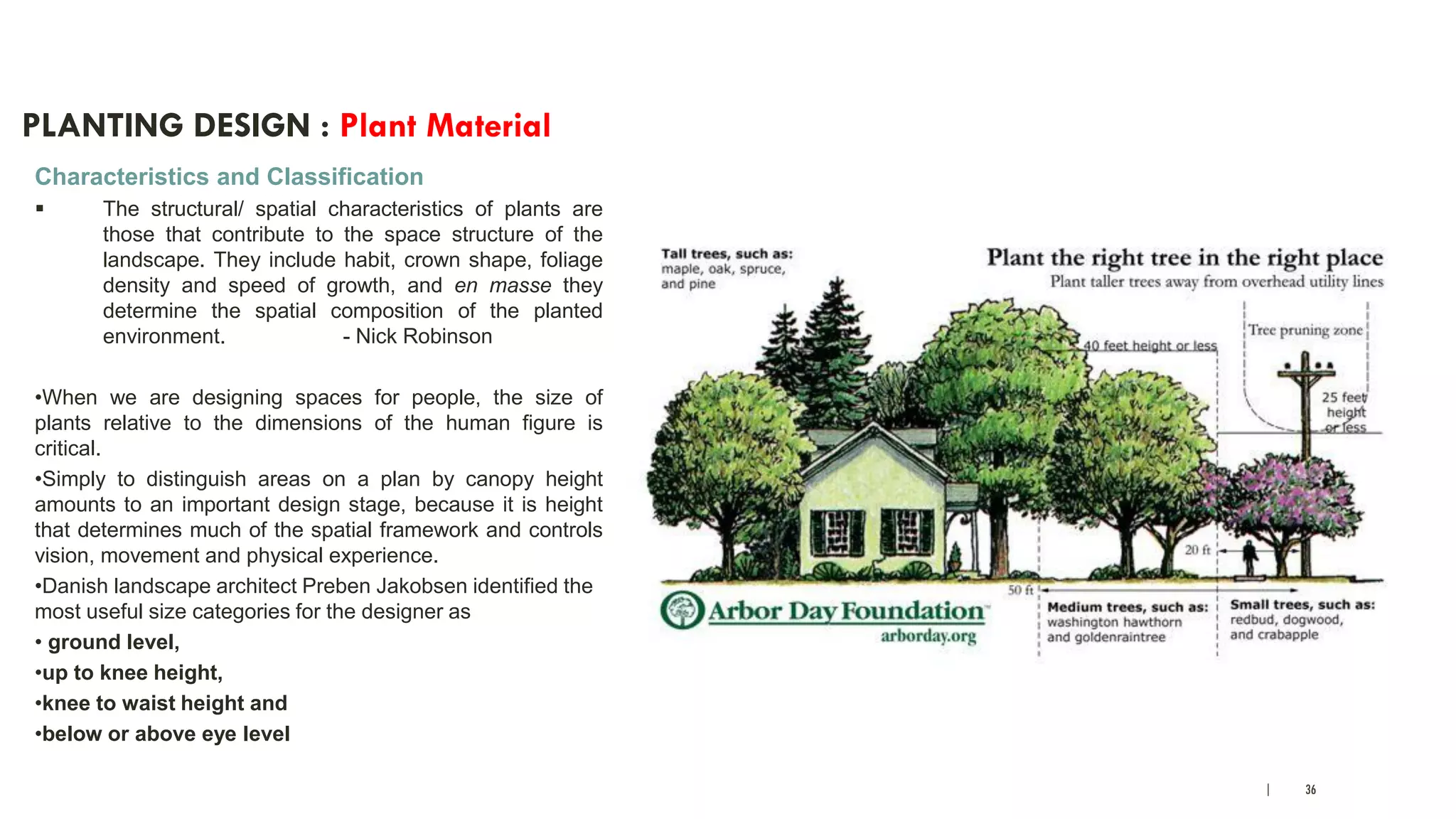
•When we are designing spaces for people, the size of
plants relative to the dimensions of the human figure is
critical.
•Simply to distinguish areas on a plan by canopy height
amounts to an important design stage, because it is height
that determines much of the spatial framework and controls
vision, movement and physical experience.
•Danish landscape architect Preben Jakobsen identified the
most useful size categories for the designer as
• ground level,
•up to knee height,
•knee to waist height and
•below or above eye level
| 37
PLANTING DESIGN : Plant Material
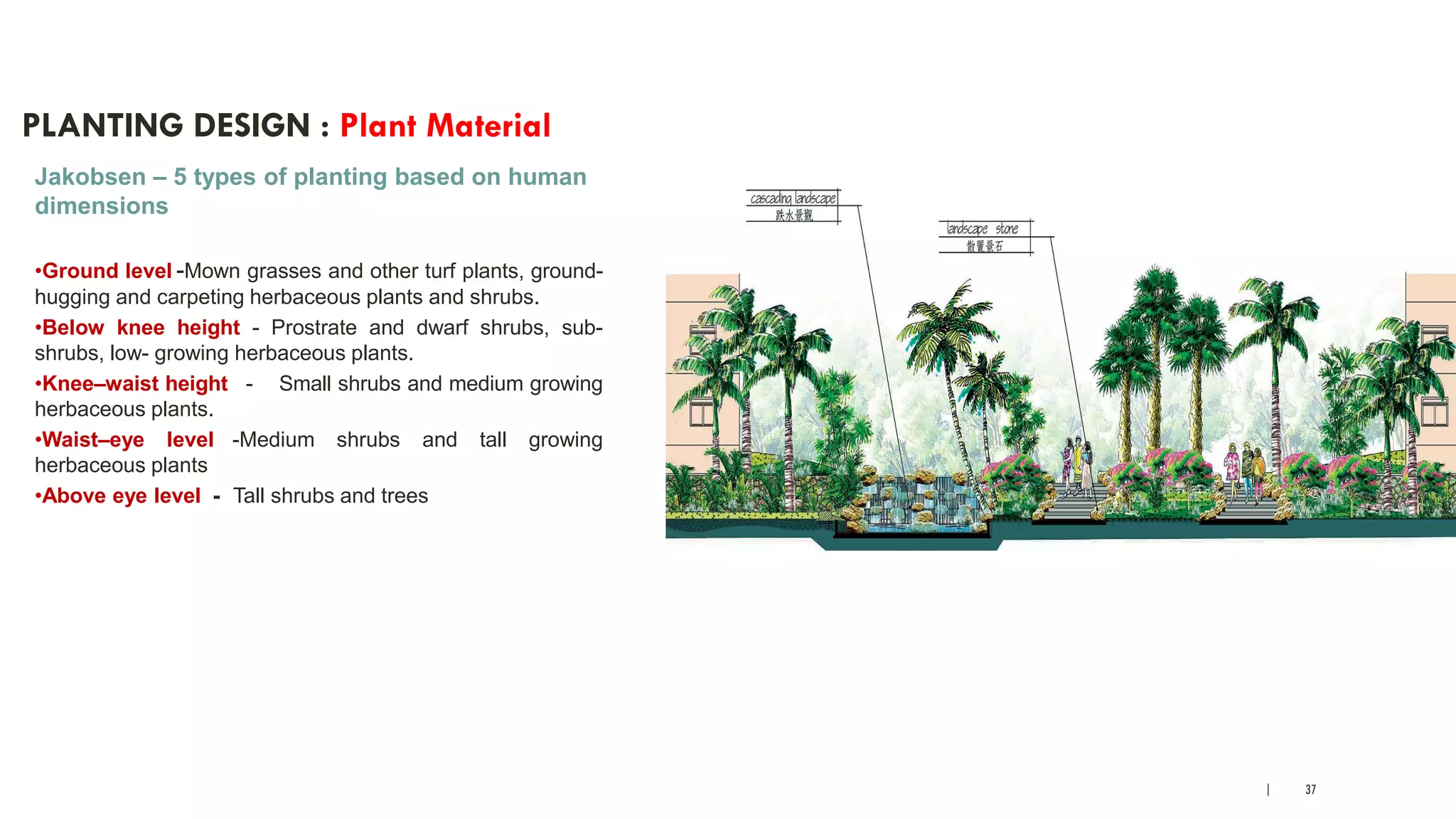
Jakobsen – 5 types of planting based on human
dimensions
•Ground level -Mown grasses and other turf plants, ground-
hugging and carpeting herbaceous plants and shrubs.
•Below knee height - Prostrate and dwarf shrubs, sub-
shrubs, low- growing herbaceous plants.
•Knee–waist height - Small shrubs and medium growing
herbaceous plants.
•Waist–eye level -Medium shrubs and tall growing
herbaceous plants
•Above eye level - Tall shrubs and trees
| 38
PLANTING DESIGN : Plant Type
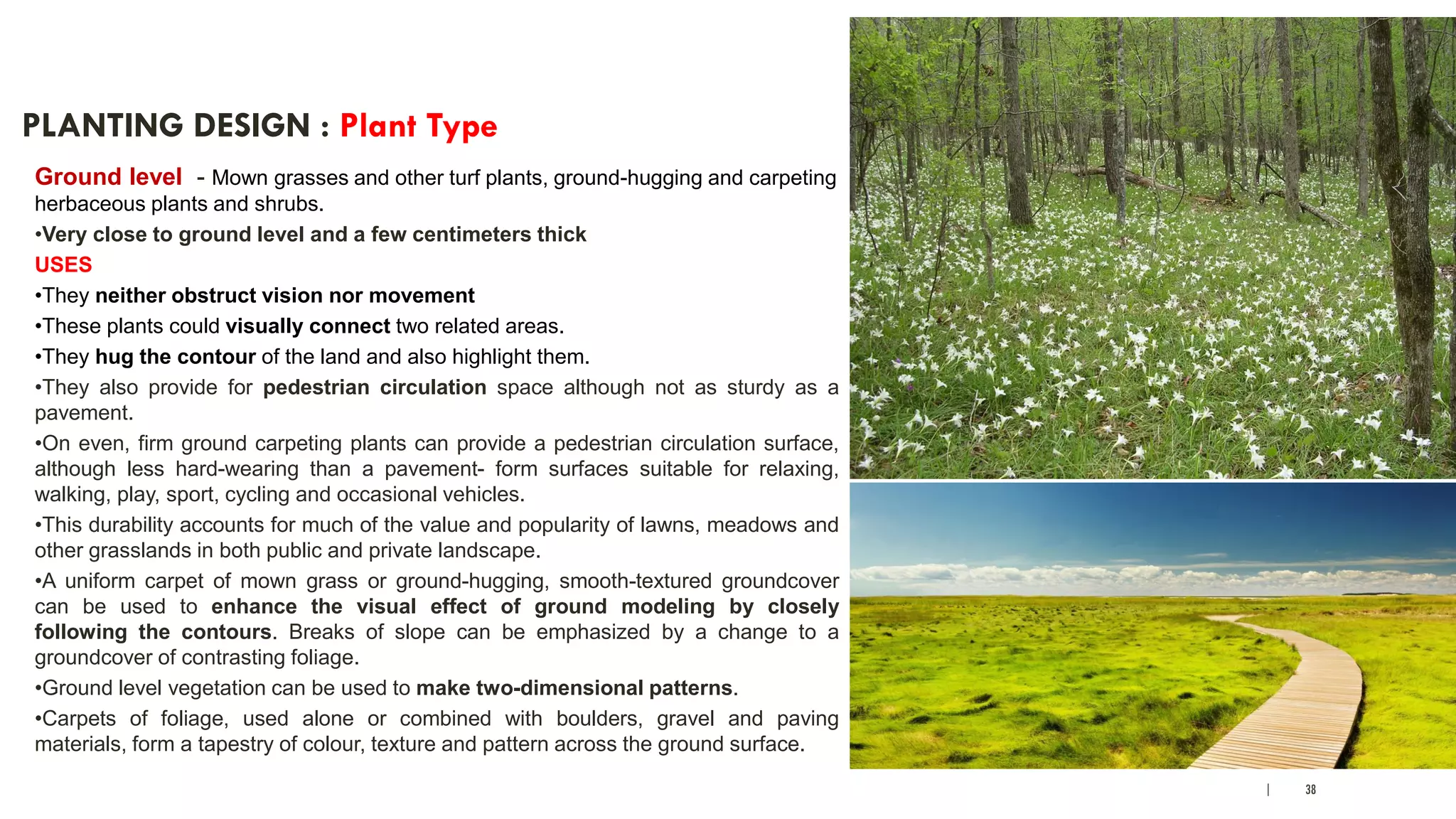
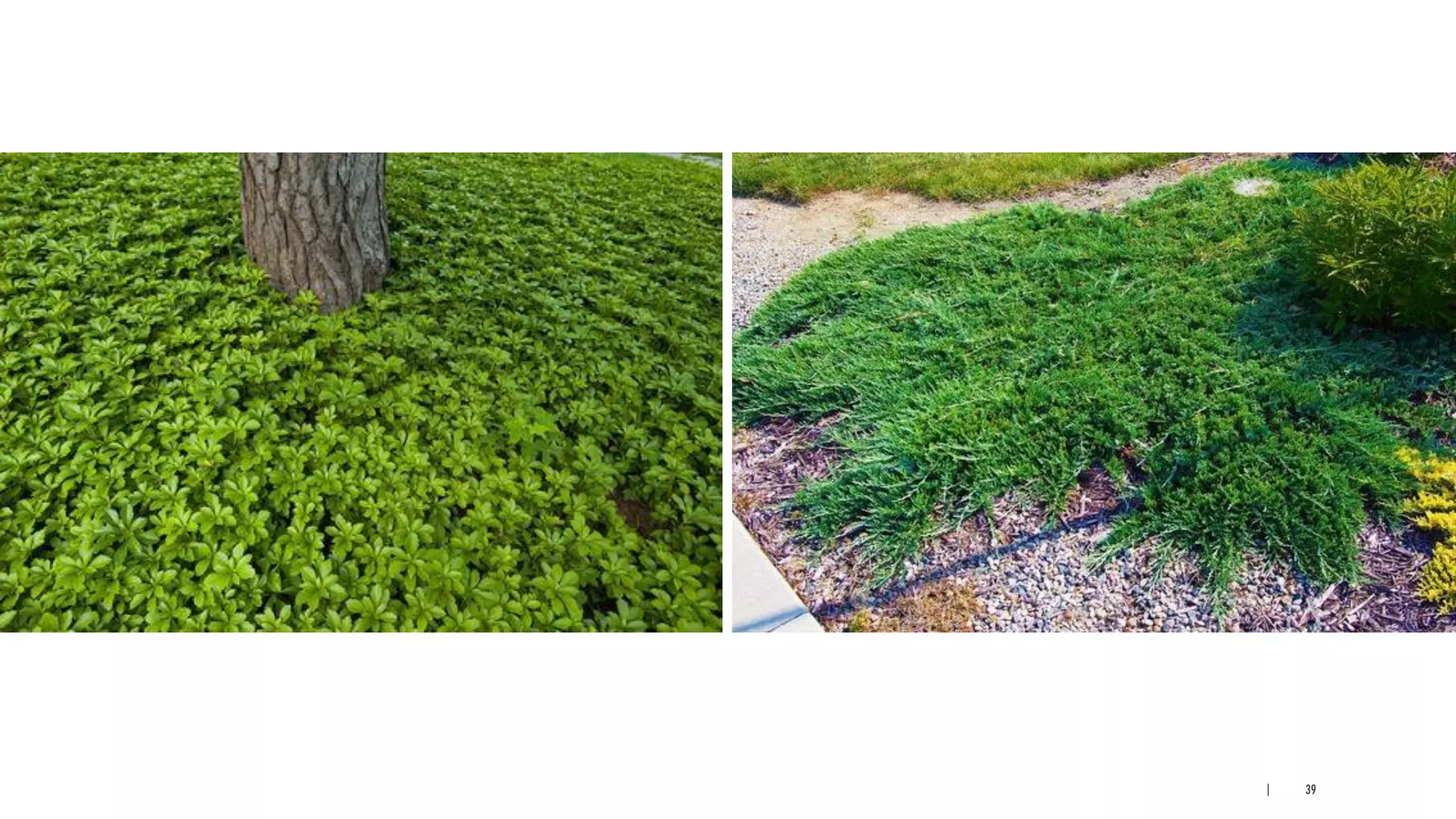
Ground level - Mown grasses and other turf plants, ground-hugging and carpeting
herbaceous plants and shrubs.
•Very close to ground level and a few centimeters thick
USES
•They neither obstruct vision nor movement
•These plants could visually connect two related areas.
•They hug the contour of the land and also highlight them.
•They also provide for pedestrian circulation space although not as sturdy as a
pavement.
•On even, firm ground carpeting plants can provide a pedestrian circulation surface,
although less hard-wearing than a pavement- form surfaces suitable for relaxing,
walking, play, sport, cycling and occasional vehicles.
•This durability accounts for much of the value and popularity of lawns, meadows and
other grasslands in both public and private landscape.
•A uniform carpet of mown grass or ground-hugging, smooth-textured groundcover
can be used to enhance the visual effect of ground modeling by closely
following the contours. Breaks of slope can be emphasized by a change to a
groundcover of contrasting foliage.
•Ground level vegetation can be used to make two-dimensional patterns.
•Carpets of foliage, used alone or combined with boulders, gravel and paving
materials, form a tapestry of colour, texture and pattern across the ground surface.
| 39
| 40
PLANTING DESIGN : Plant Type
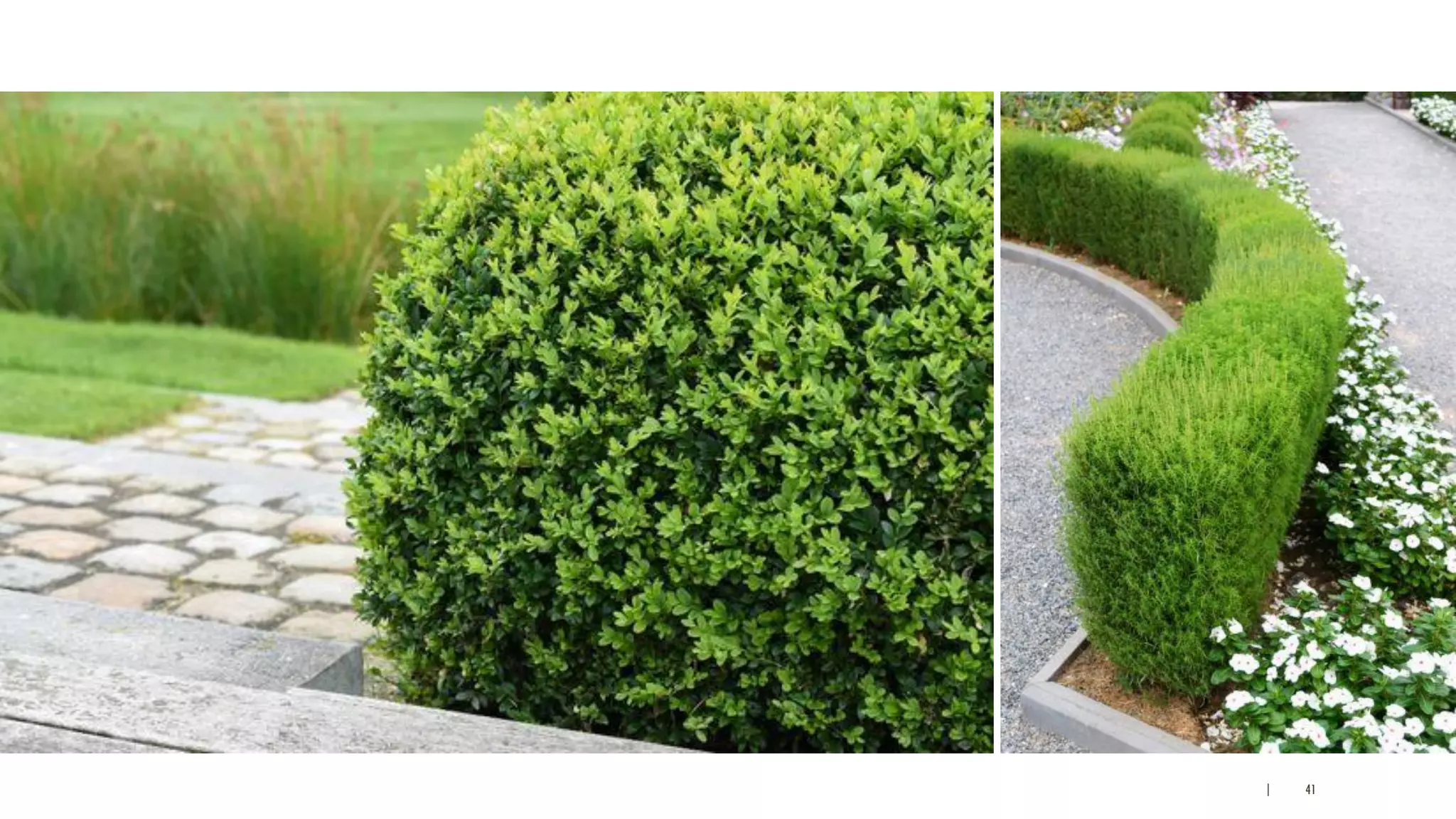
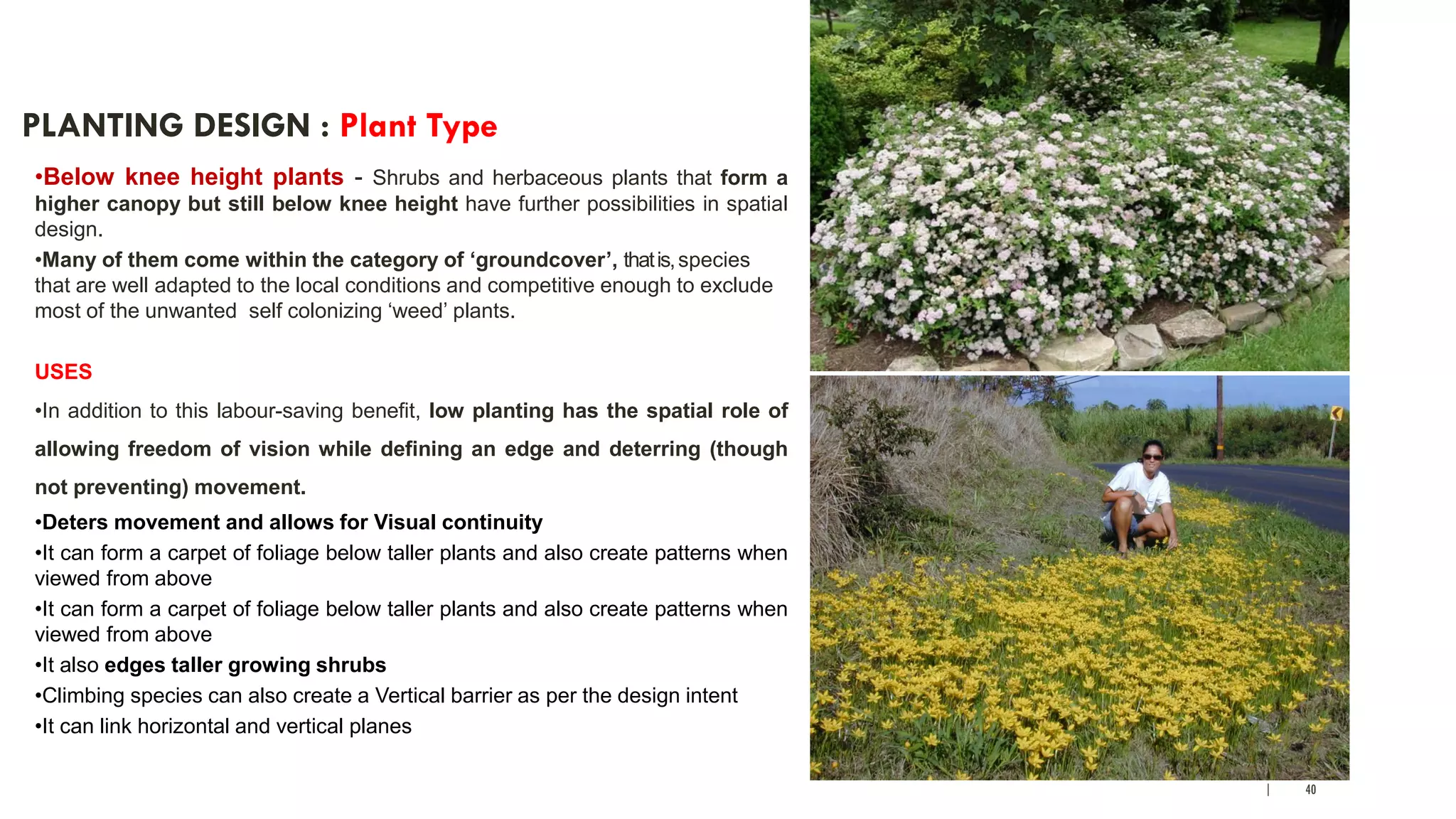
•Below knee height plants - Shrubs and herbaceous plants that form a
higher canopy but still below knee height have further possibilities in spatial
design.
•Many of them come within the category of ‘groundcover’, thatis,species
that are well adapted to the local conditions and competitive enough to exclude
most of the unwanted self colonizing ‘weed’ plants.
USES
•In addition to this labour-saving benefit, low planting has the spatial role of
allowing freedom of vision while defining an edge and deterring (though
not preventing) movement.
•Deters movement and allows for Visual continuity
•It can form a carpet of foliage below taller plants and also create patterns when
viewed from above
•It can form a carpet of foliage below taller plants and also create patterns when
viewed from above
•It also edges taller growing shrubs
•Climbing species can also create a Vertical barrier as per the design intent
•It can link horizontal and vertical planes
| 41
| 42
PLANTING DESIGN : Plant Type
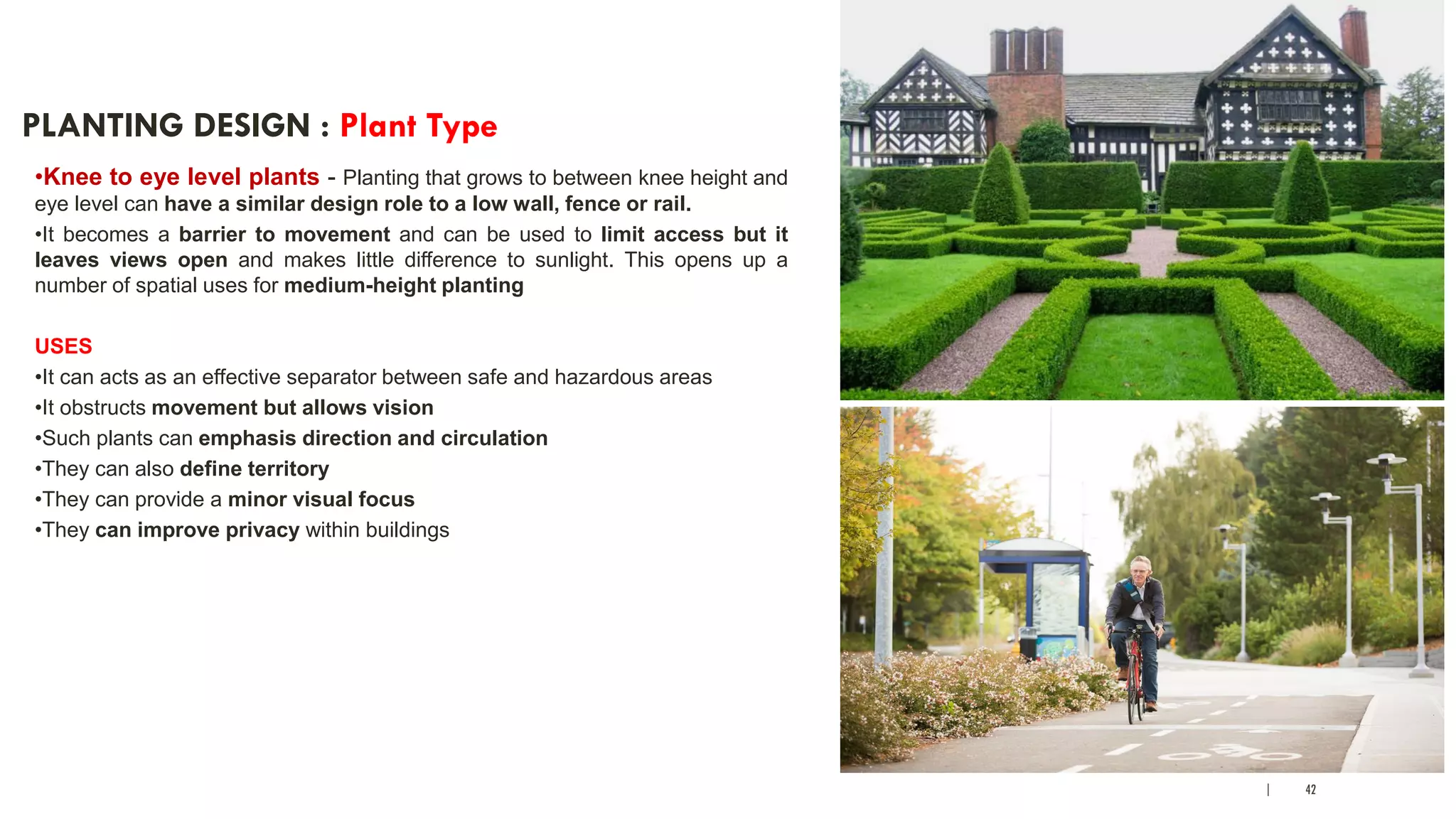
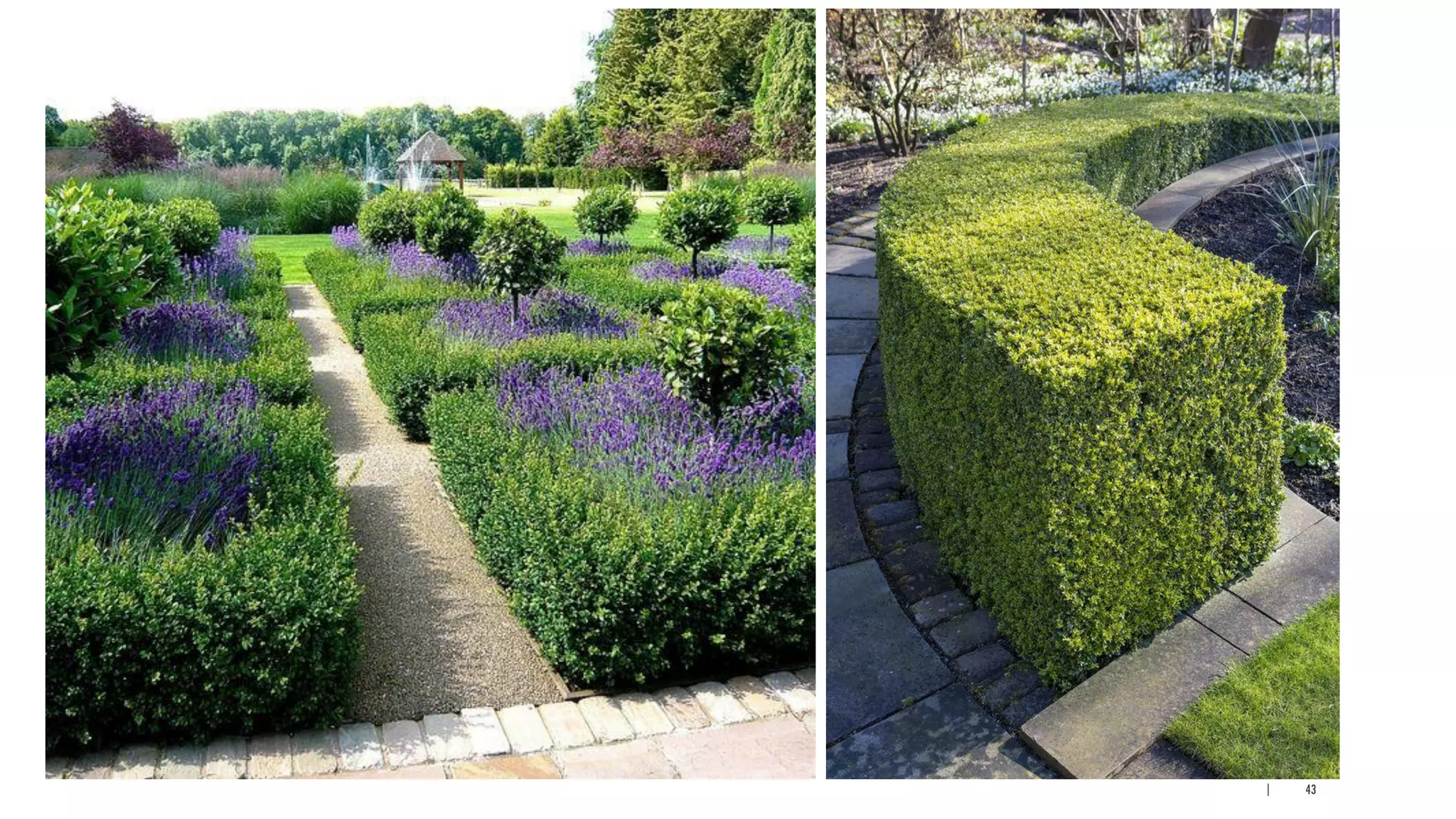
•Knee to eye level plants - Planting that grows to between knee height and
eye level can have a similar design role to a low wall, fence or rail.
•It becomes a barrier to movement and can be used to limit access but it
leaves views open and makes little difference to sunlight. This opens up a
number of spatial uses for medium-height planting
USES
•It can acts as an effective separator between safe and hazardous areas
•It obstructs movement but allows vision
•Such plants can emphasis direction and circulation
•They can also define territory
•They can provide a minor visual focus
•They can improve privacy within buildings
| 43
| 44
PLANTING DESIGN : Plant Type
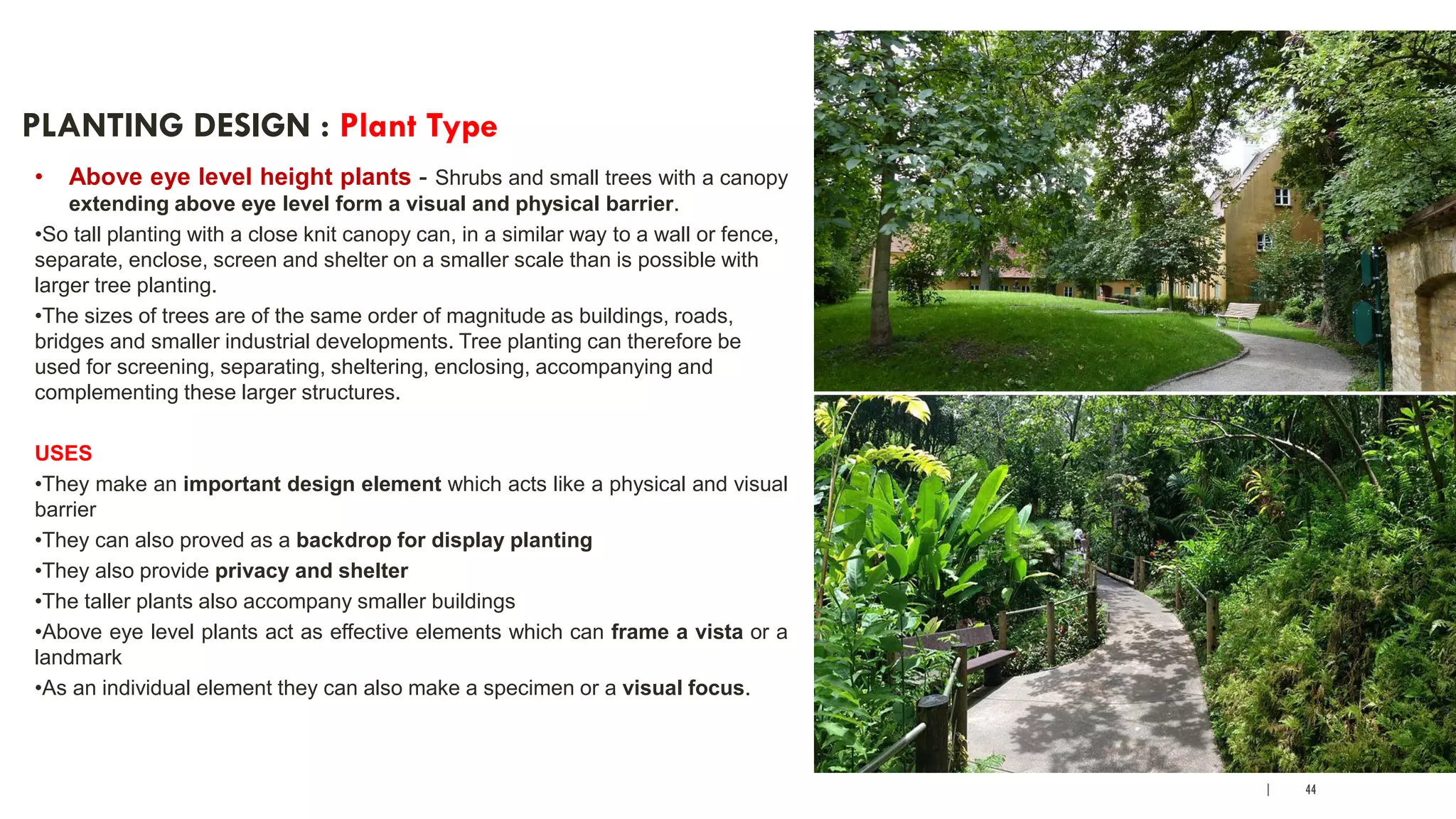
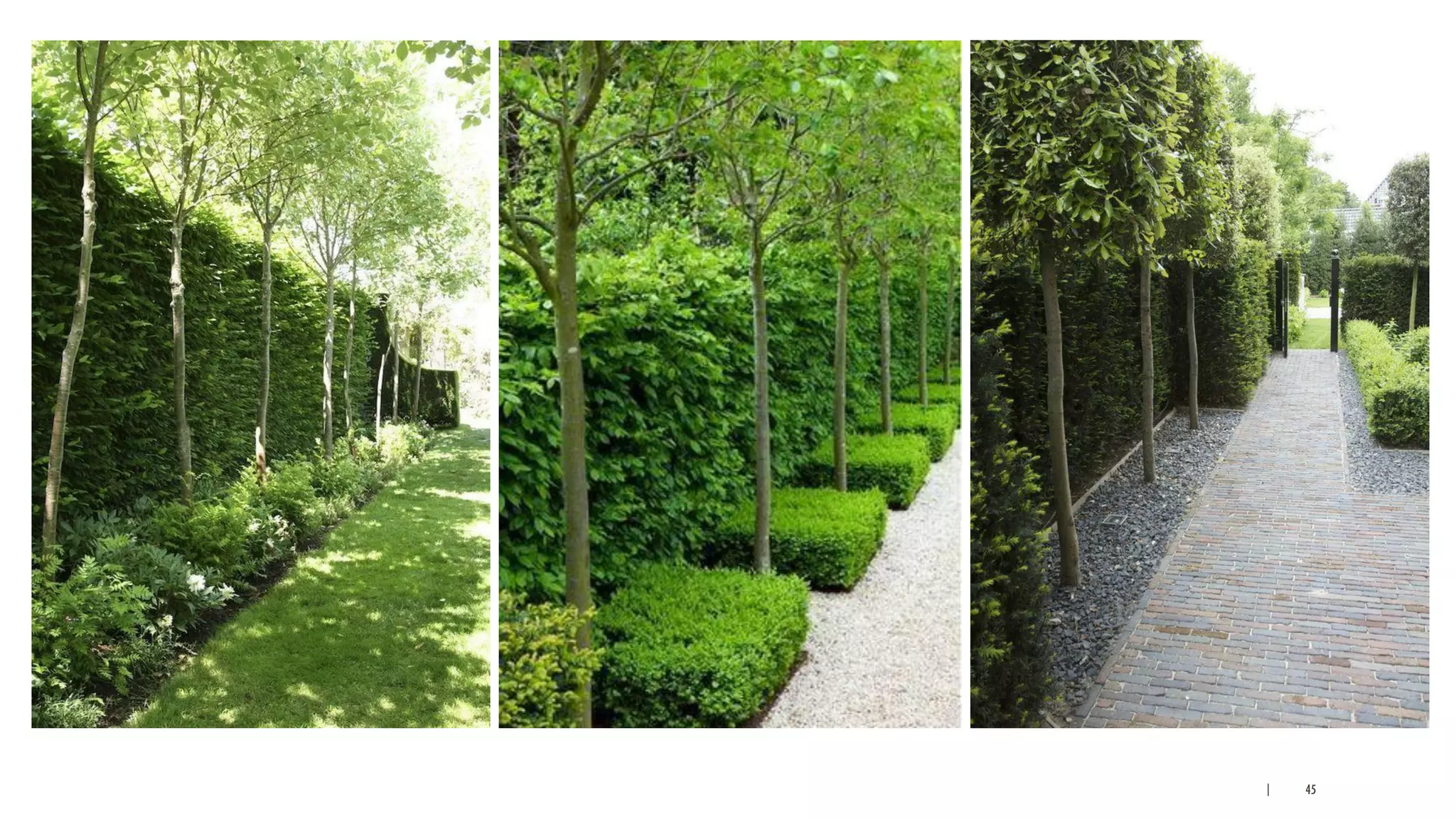
• Above eye level height plants - Shrubs and small trees with a canopy
extending above eye level form a visual and physical barrier.
•So tall planting with a close knit canopy can, in a similar way to a wall or fence,
separate, enclose, screen and shelter on a smaller scale than is possible with
larger tree planting.
•The sizes of trees are of the same order of magnitude as buildings, roads,
bridges and smaller industrial developments. Tree planting can therefore be
used for screening, separating, sheltering, enclosing, accompanying and
complementing these larger structures.
USES
•They make an important design element which acts like a physical and visual
barrier
•They can also proved as a backdrop for display planting
•They also provide privacy and shelter
•The taller plants also accompany smaller buildings
•Above eye level plants act as effective elements which can frame a vista or a
landmark
•As an individual element they can also make a specimen or a visual focus.
| 45
| 46
PLANTING DESIGN : Plant Type
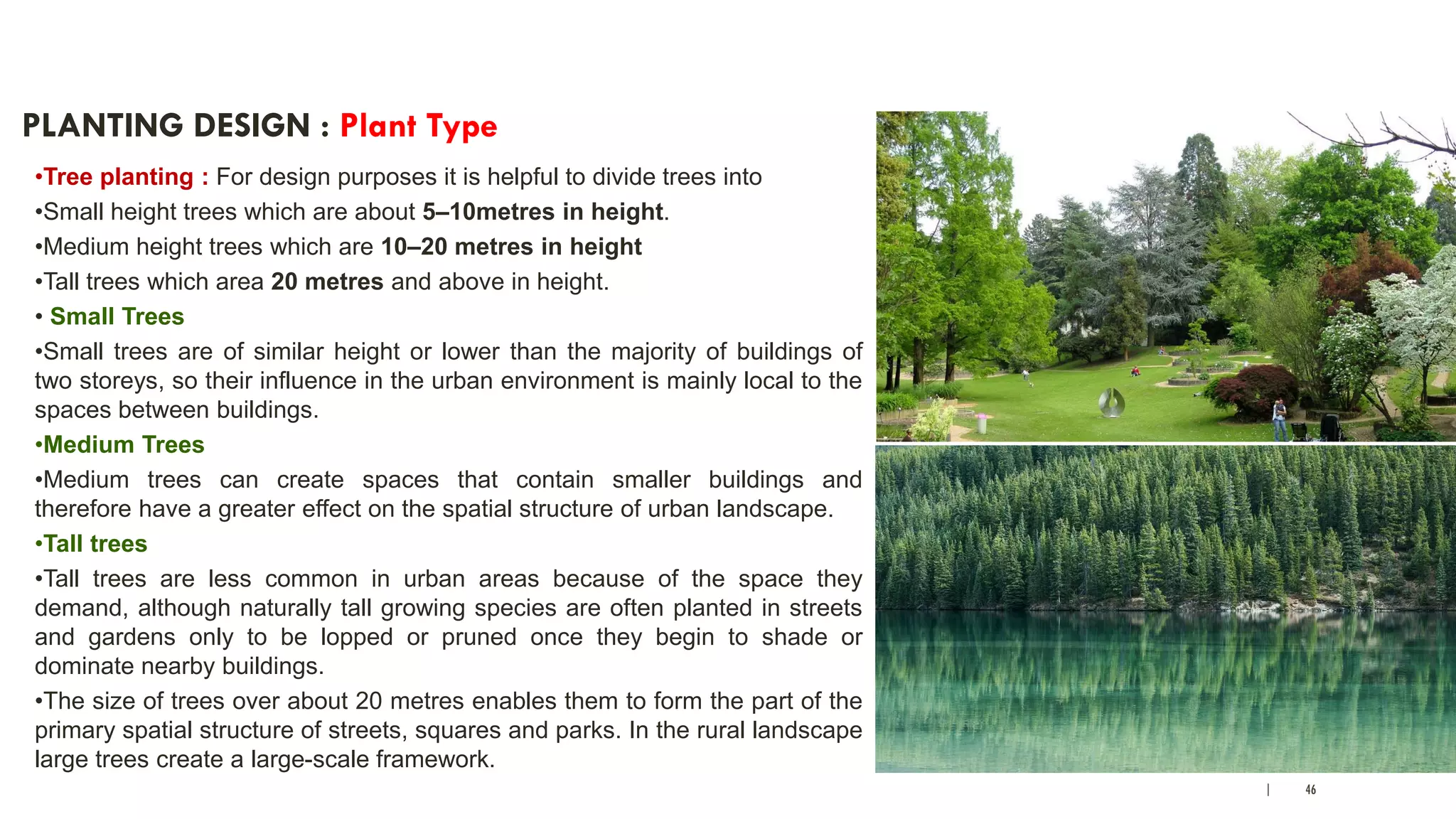
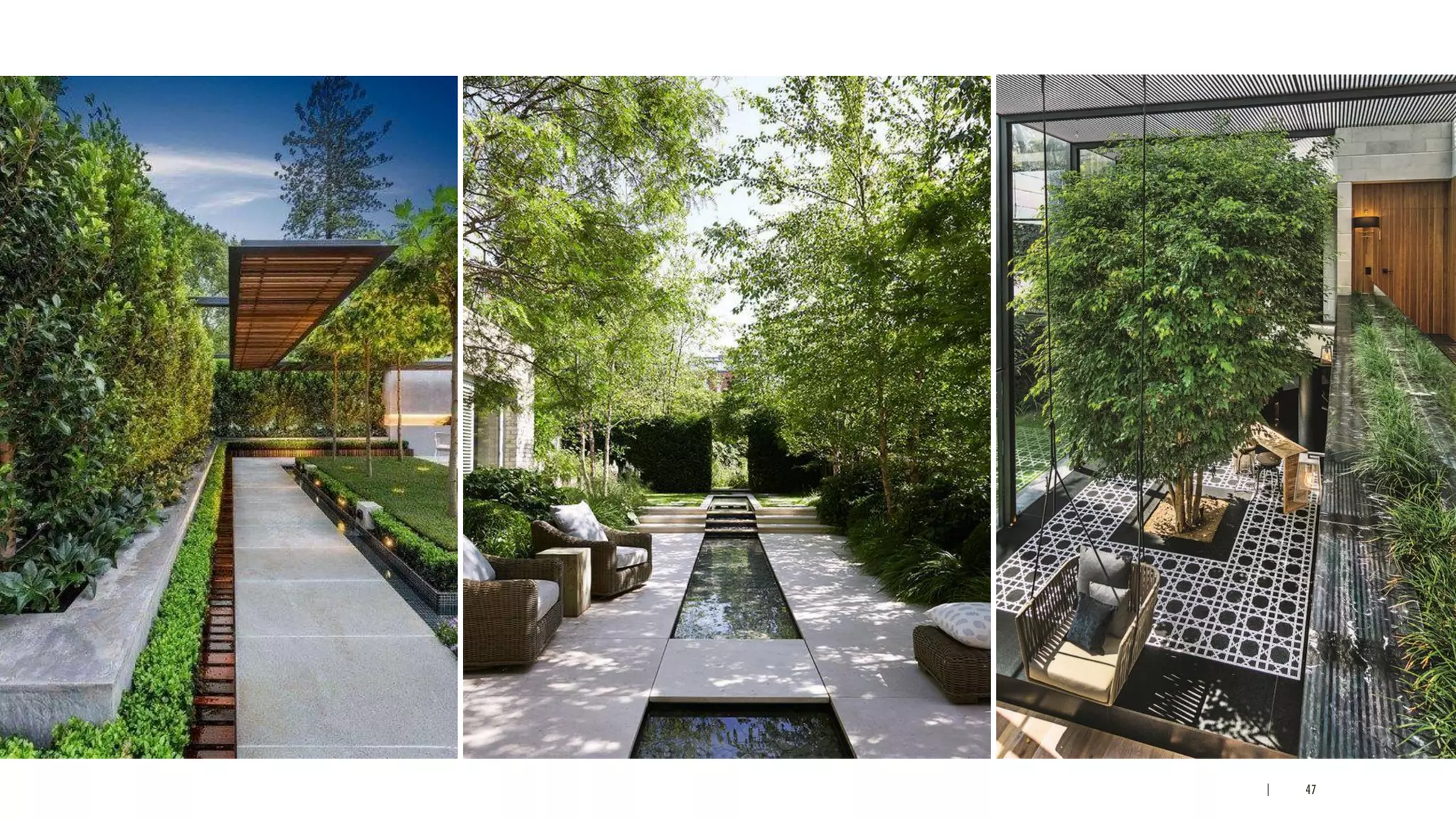
•Tree planting : For design purposes it is helpful to divide trees into
•Small height trees which are about 5–10metres in height.
•Medium height trees which are 10–20 metres in height
•Tall trees which area 20 metres and above in height.
• Small Trees
•Small trees are of similar height or lower than the majority of buildings of
two storeys, so their influence in the urban environment is mainly local to the
spaces between buildings.
•Medium Trees
•Medium trees can create spaces that contain smaller buildings and
therefore have a greater effect on the spatial structure of urban landscape.
•Tall trees
•Tall trees are less common in urban areas because of the space they
demand, although naturally tall growing species are often planted in streets
and gardens only to be lopped or pruned once they begin to shade or
dominate nearby buildings.
•The size of trees over about 20 metres enables them to form the part of the
primary spatial structure of streets, squares and parks. In the rural landscape
large trees create a large-scale framework.
| 47
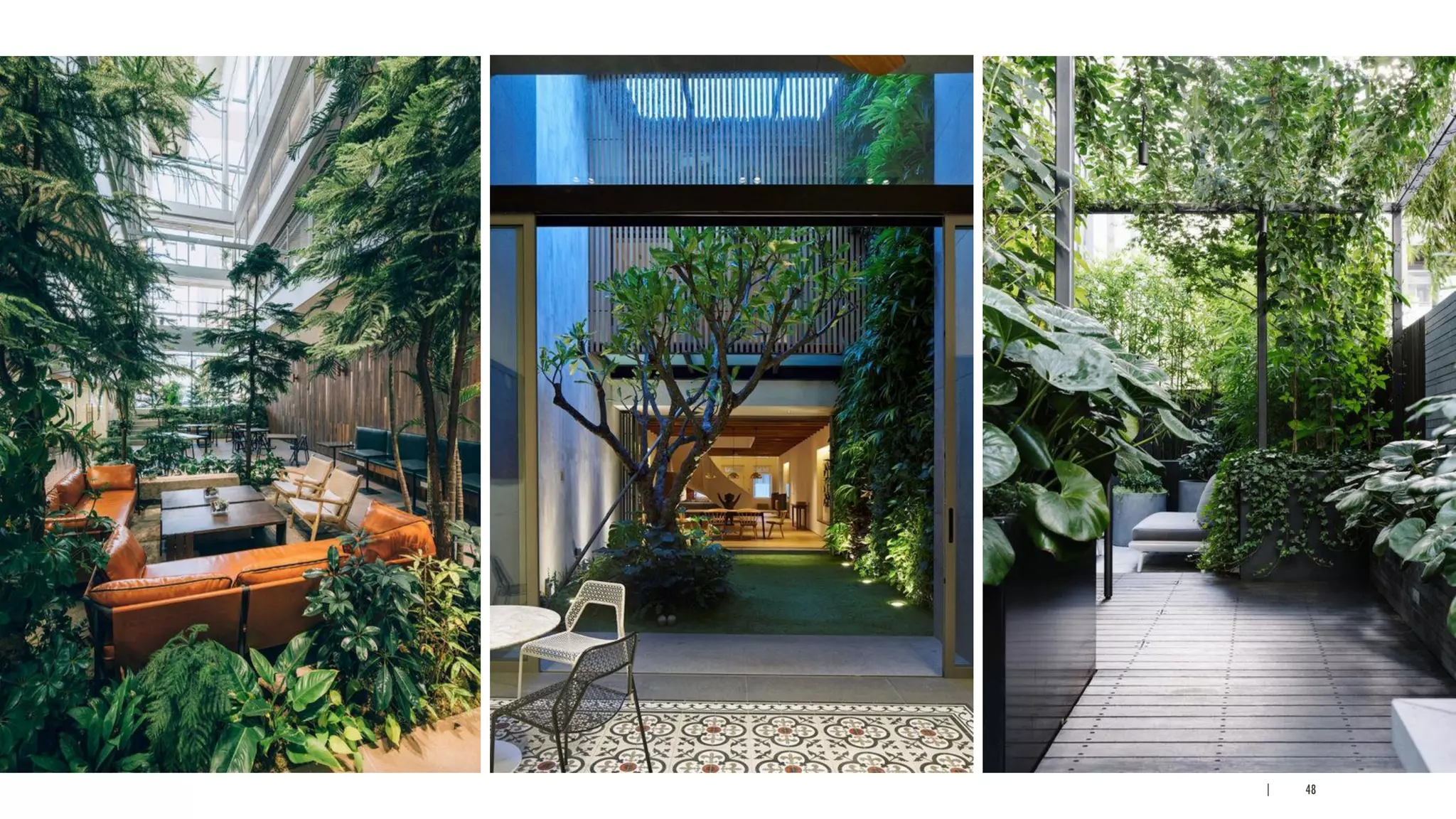
| 48
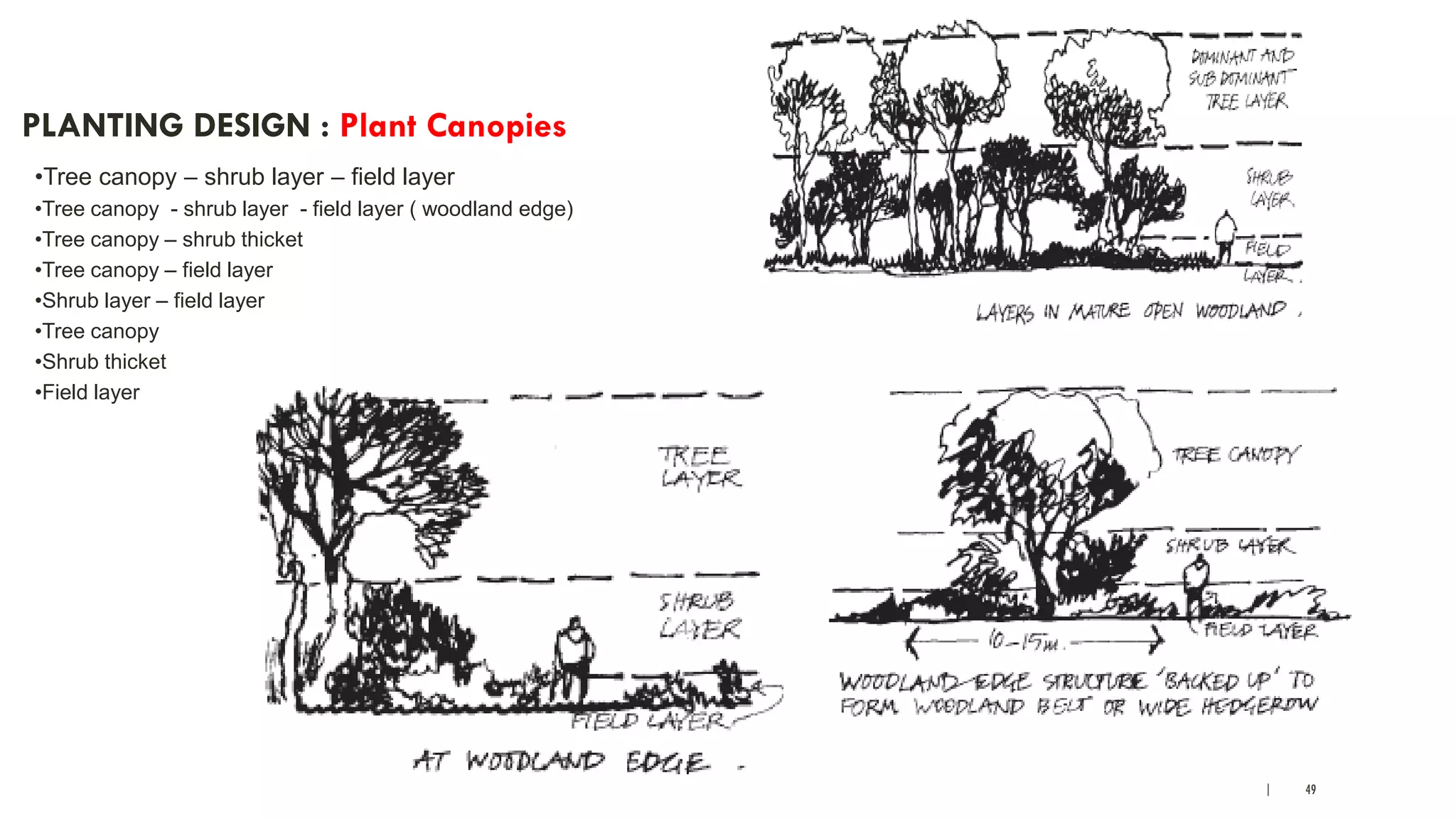
| 49
PLANTING DESIGN : Plant Canopies
•Tree canopy – shrub layer – field layer
•Tree canopy - shrub layer - field layer ( woodland edge)
•Tree canopy – shrub thicket
•Tree canopy – field layer
•Shrub layer – field layer
•Tree canopy
•Shrub thicket
•Field layer
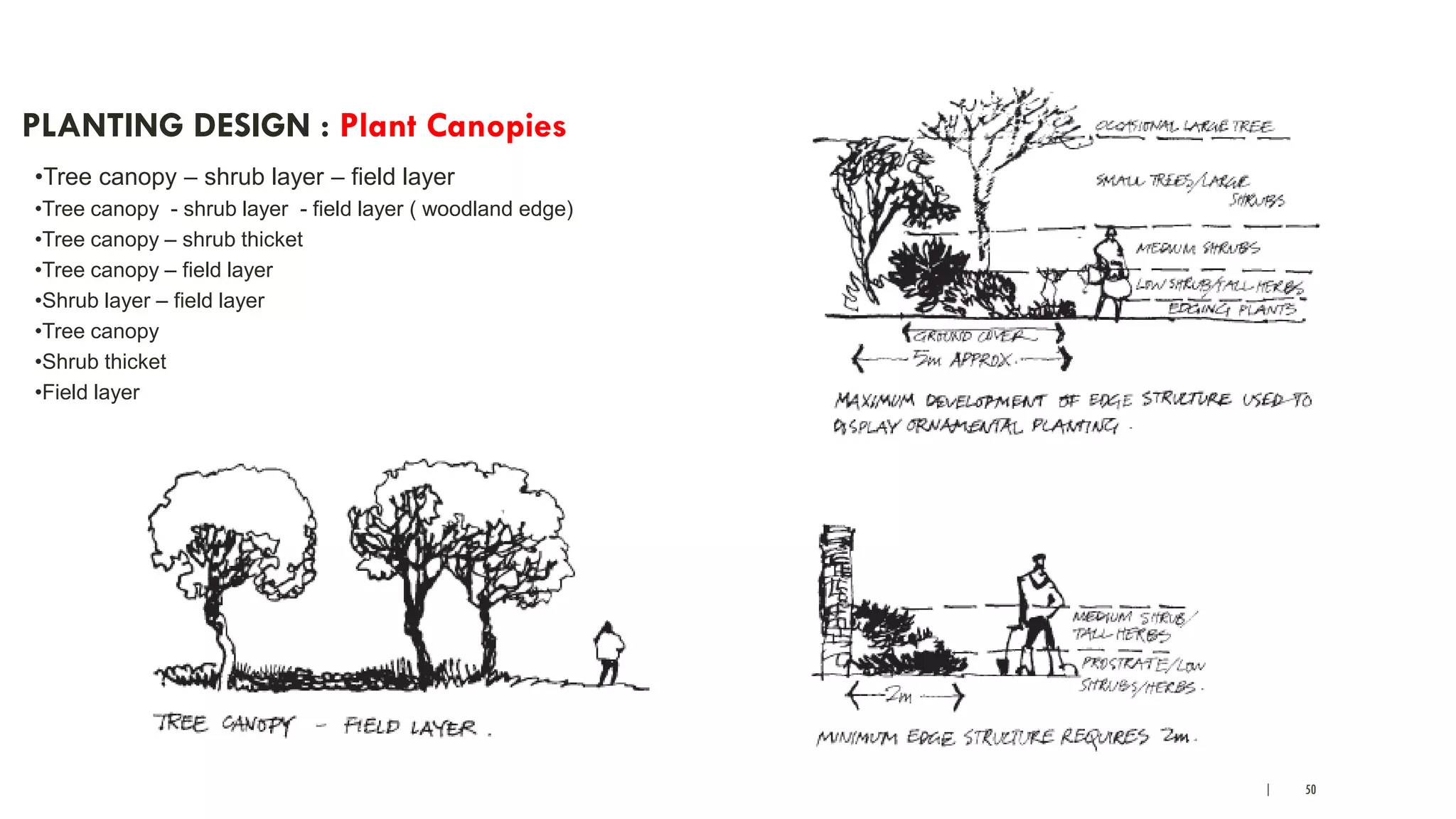
| 50
PLANTING DESIGN : Plant Canopies
•Tree canopy – shrub layer – field layer
•Tree canopy - shrub layer - field layer ( woodland edge)
•Tree canopy – shrub thicket
•Tree canopy – field layer
•Shrub layer – field layer
•Tree canopy
•Shrub thicket
•Field layer
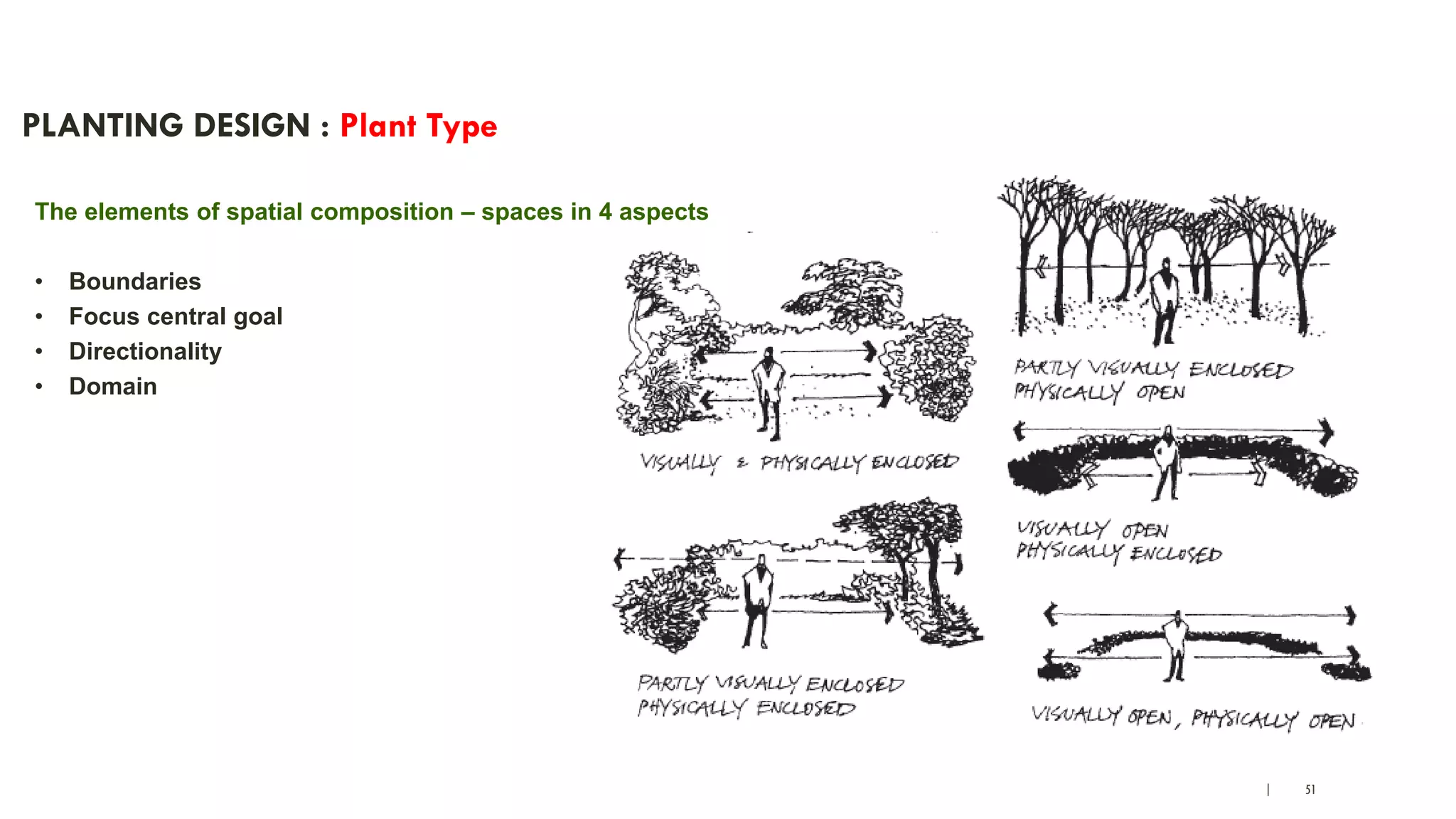
| 51
PLANTING DESIGN : Plant Type
The elements of spatial composition – spaces in 4 aspects
• Boundaries
• Focus central goal
• Directionality
• Domain
| 52
PLANTING DESIGN : Plant as Design Element
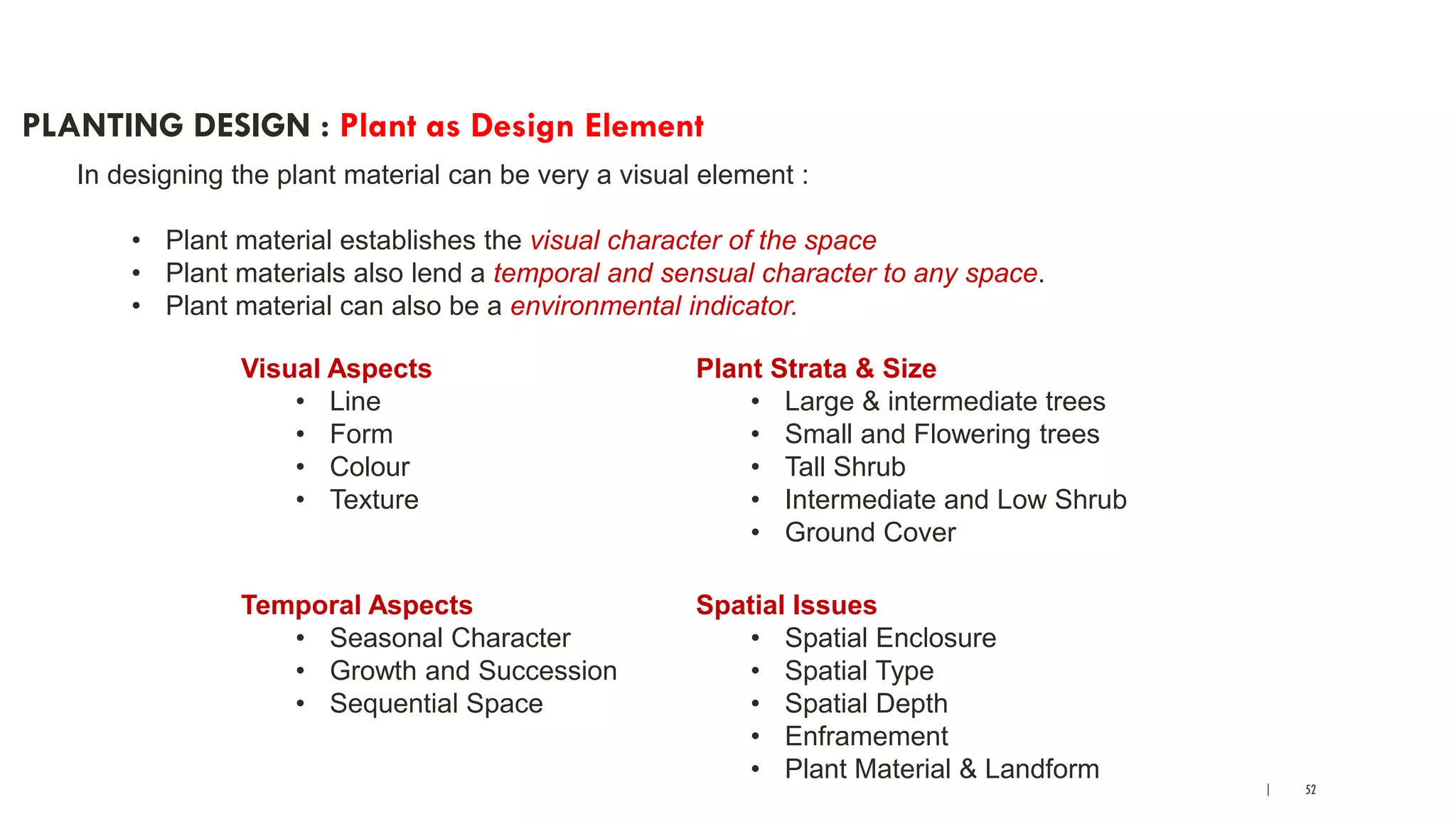
In designing the plant material can be very a visual element :
• Plant material establishes the visual character of the space
• Plant materials also lend a temporal and sensual character to any space.
• Plant material can also be a environmental indicator.
Visual Aspects
• Line
• Form
• Colour
• Texture
Temporal Aspects
• Seasonal Character
• Growth and Succession
• Sequential Space
Plant Strata & Size
• Large & intermediate trees
• Small and Flowering trees
• Tall Shrub
• Intermediate and Low Shrub
• Ground Cover
Spatial Issues
• Spatial Enclosure
• Spatial Type
• Spatial Depth
• Enframement
• Plant Material & Landform
| 53
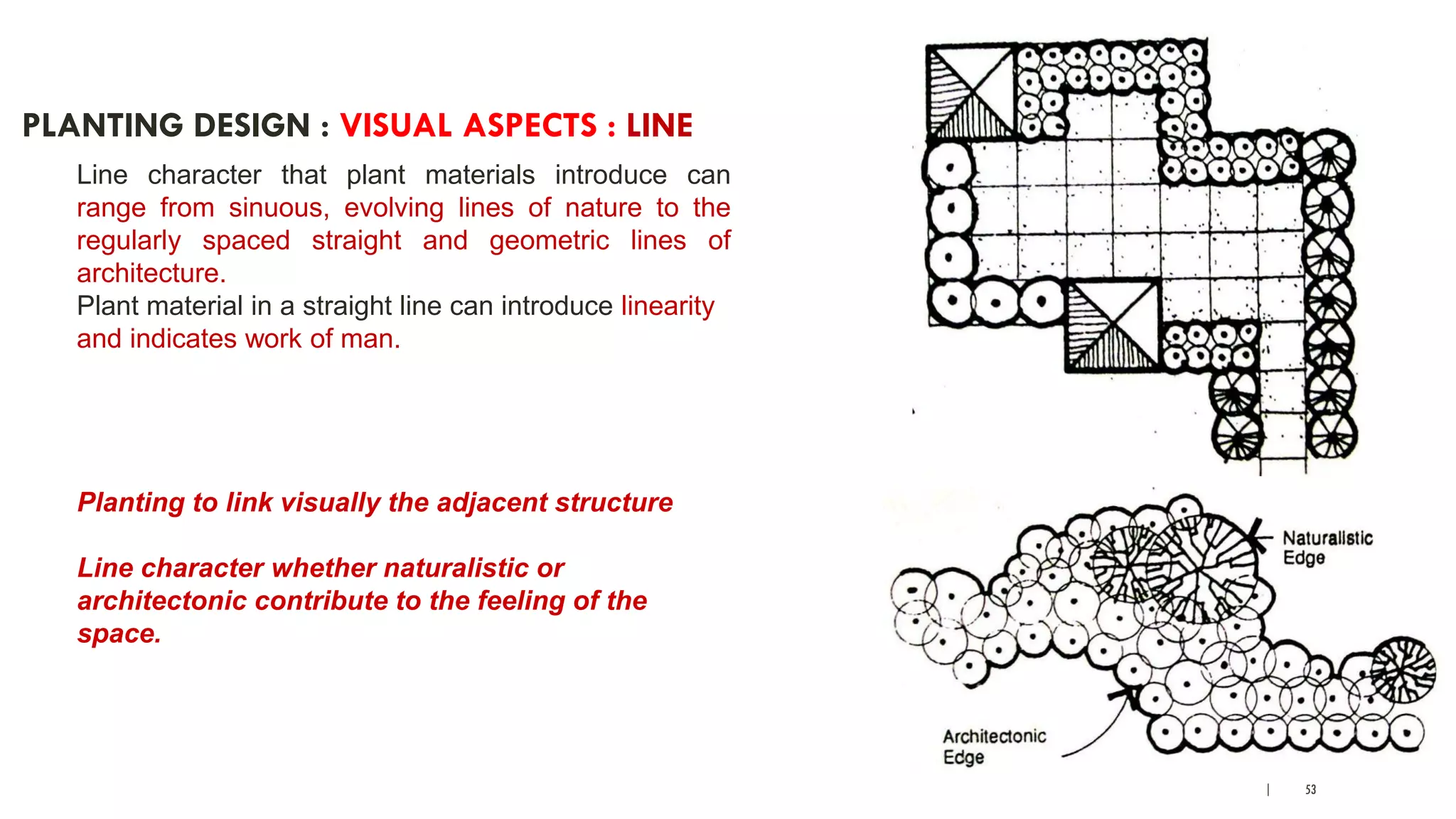
PLANTING DESIGN : VISUAL ASPECTS : LINE
Line character that plant materials introduce can
range from sinuous, evolving lines of nature to the
regularly spaced straight and geometric lines of
architecture.
Plant material in a straight line can introduce linearity
and indicates work of man.
Planting to link visually the adjacent structure
Line character whether naturalistic or
architectonic contribute to the feeling of the
space.
| 54
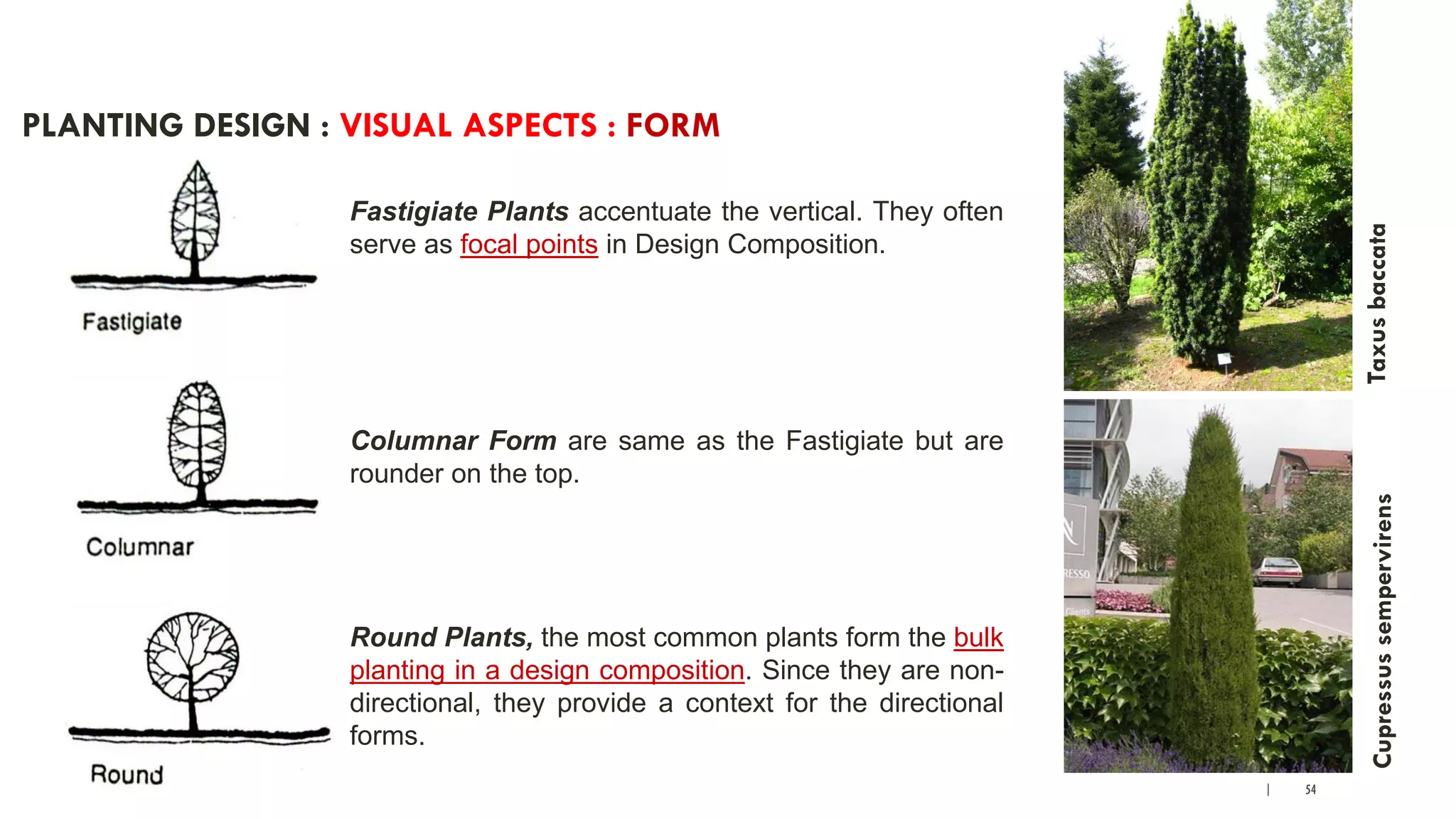
PLANTING DESIGN : VISUAL ASPECTS : FORM
Fastigiate Plants accentuate the vertical. They often
serve as focal points in Design Composition.
Columnar Form are same as the Fastigiate but are
rounder on the top.
Round Plants, the most common plants form the bulk
planting in a design composition. Since they are non-
directional, they provide a context for the directional
forms.
TaxusbaccataCupressussempervirens
| 55
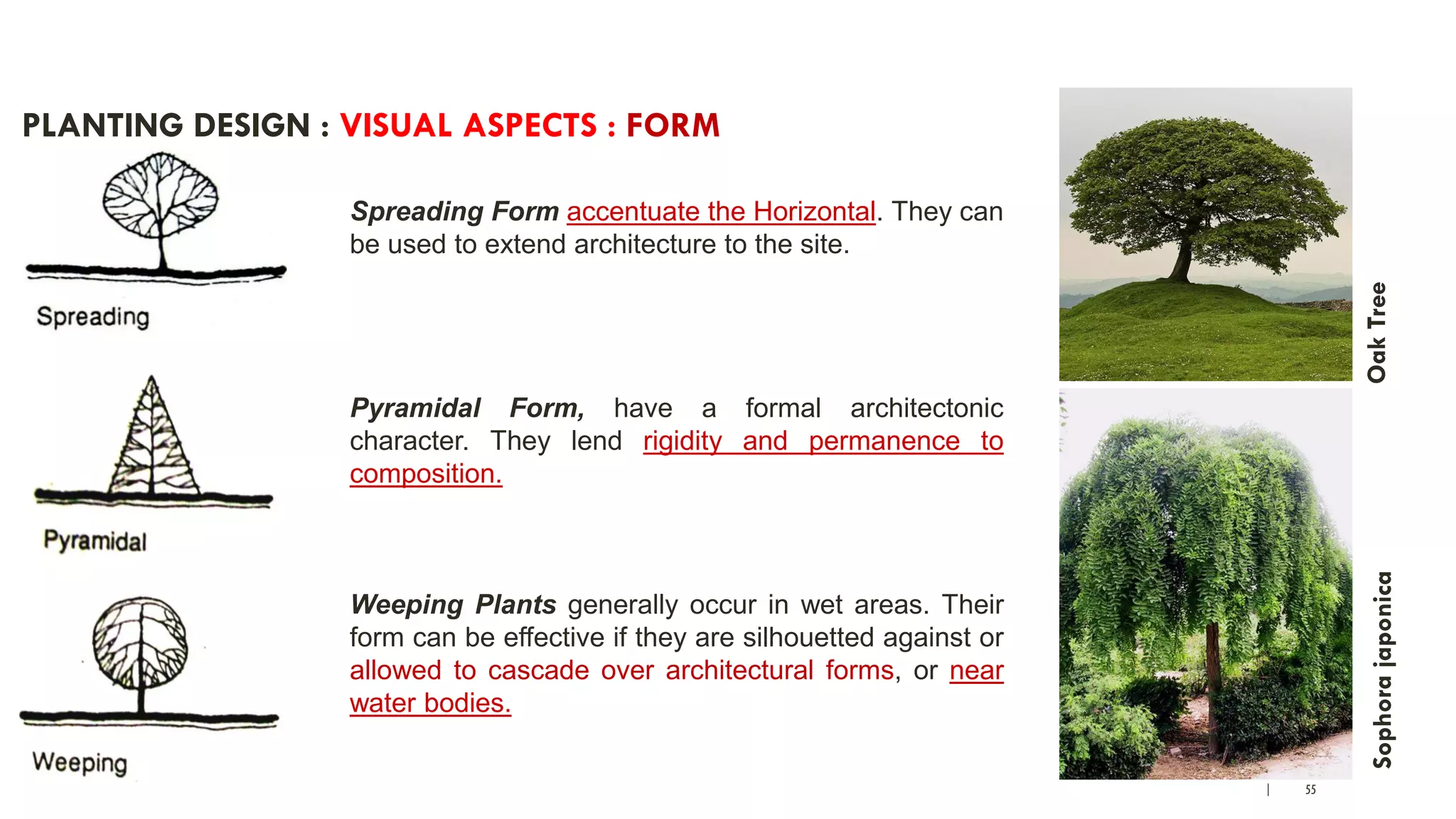
PLANTING DESIGN : VISUAL ASPECTS : FORM
Spreading Form accentuate the Horizontal. They can
be used to extend architecture to the site.
Pyramidal Form, have a formal architectonic
character. They lend rigidity and permanence to
composition.
Weeping Plants generally occur in wet areas. Their
form can be effective if they are silhouetted against or
allowed to cascade over architectural forms, or near
water bodies.
OakTreeSophorajaponica
| 56
PLANTING DESIGN : VISUAL ASPECTS : FORM
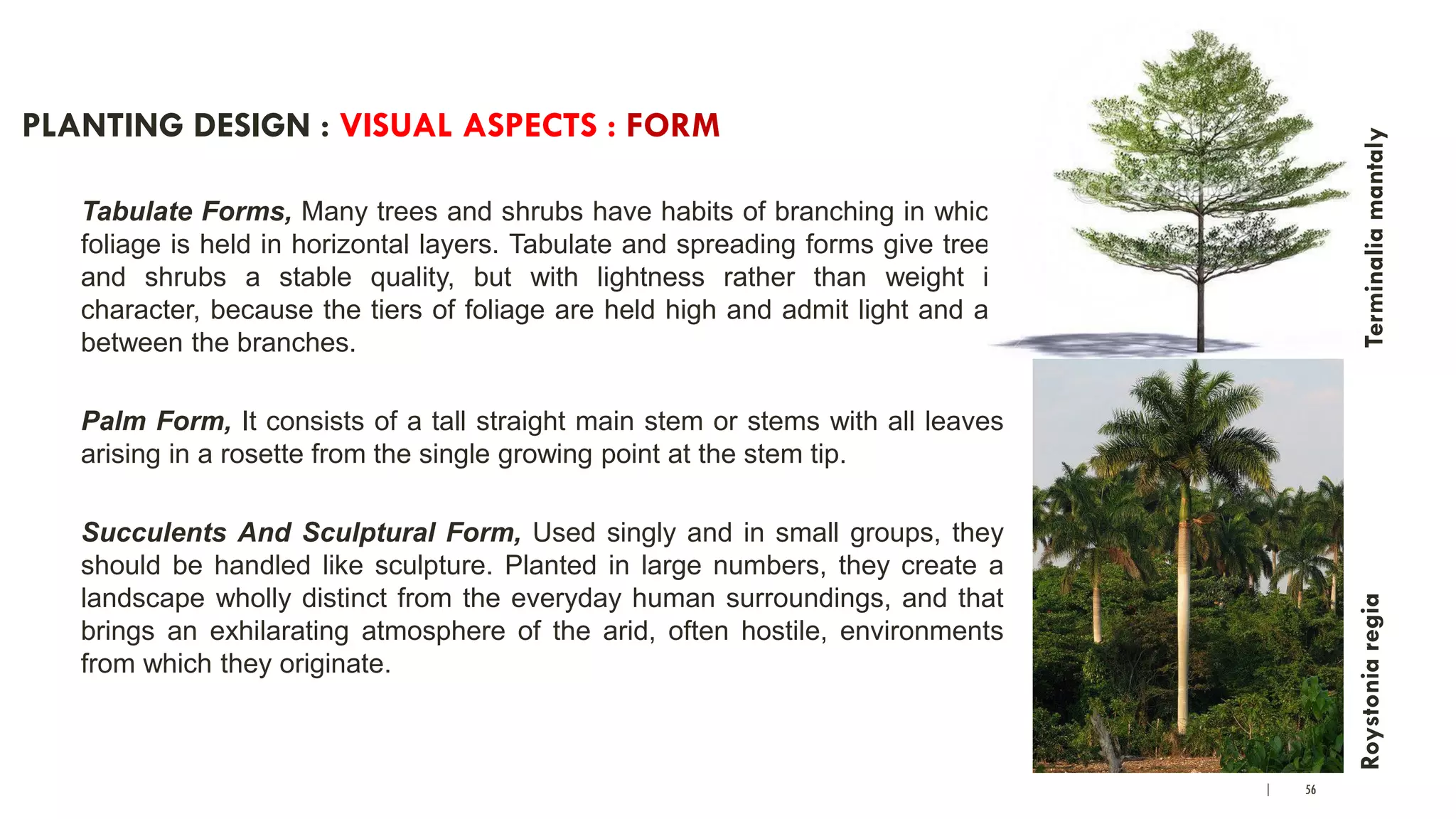
Tabulate Forms, Many trees and shrubs have habits of branching in which
foliage is held in horizontal layers. Tabulate and spreading forms give trees
and shrubs a stable quality, but with lightness rather than weight in
character, because the tiers of foliage are held high and admit light and air
between the branches.
Palm Form, It consists of a tall straight main stem or stems with all leaves
arising in a rosette from the single growing point at the stem tip.
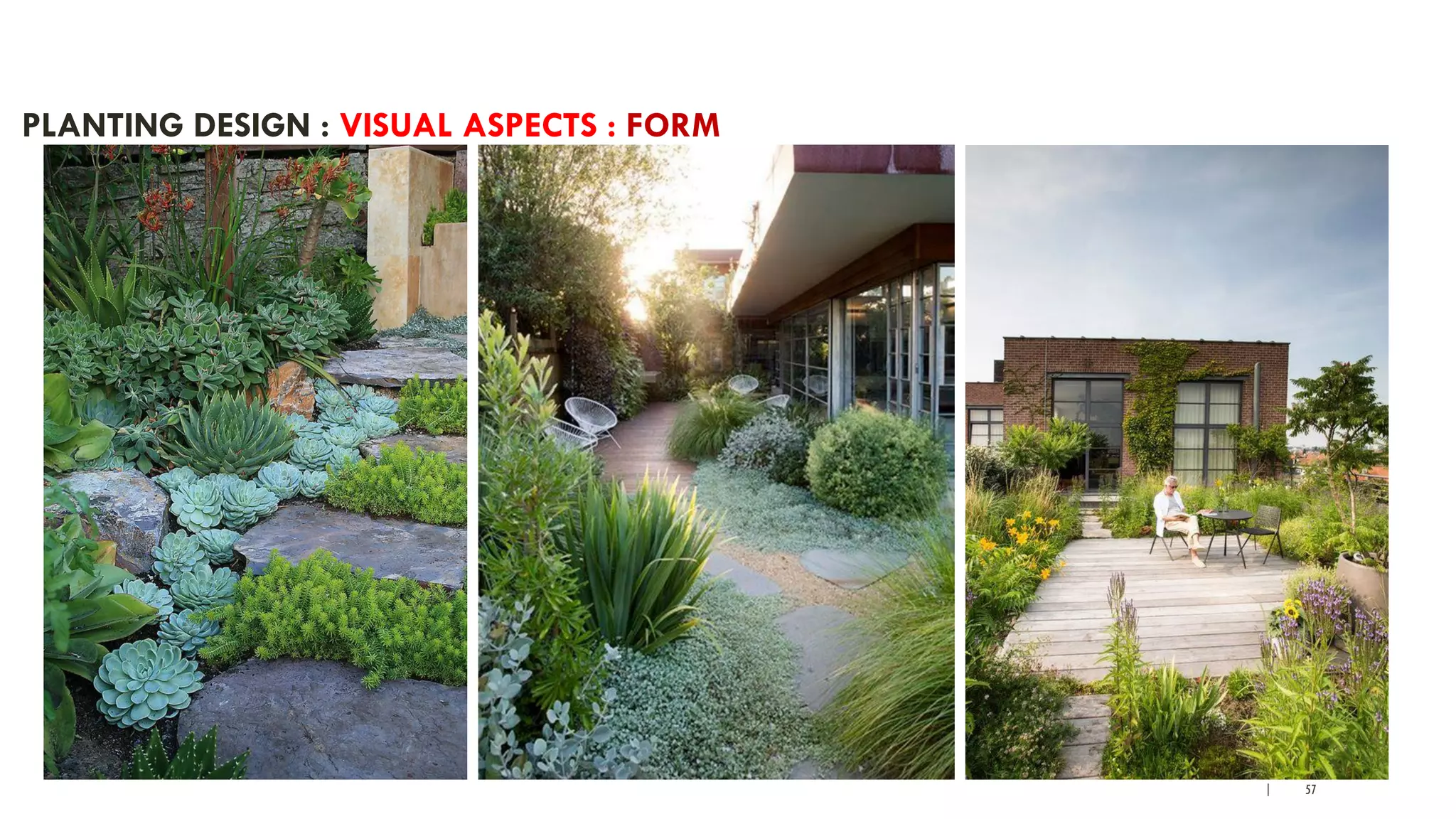
Succulents And Sculptural Form, Used singly and in small groups, they
should be handled like sculpture. Planted in large numbers, they create a
landscape wholly distinct from the everyday human surroundings, and that
brings an exhilarating atmosphere of the arid, often hostile, environments
from which they originate.
TerminaliamantalyRoystoniaregia
| 57
PLANTING DESIGN : VISUAL ASPECTS : FORM
| 58
PLANTING DESIGN : VISUAL ASPECTS : TEXTURE
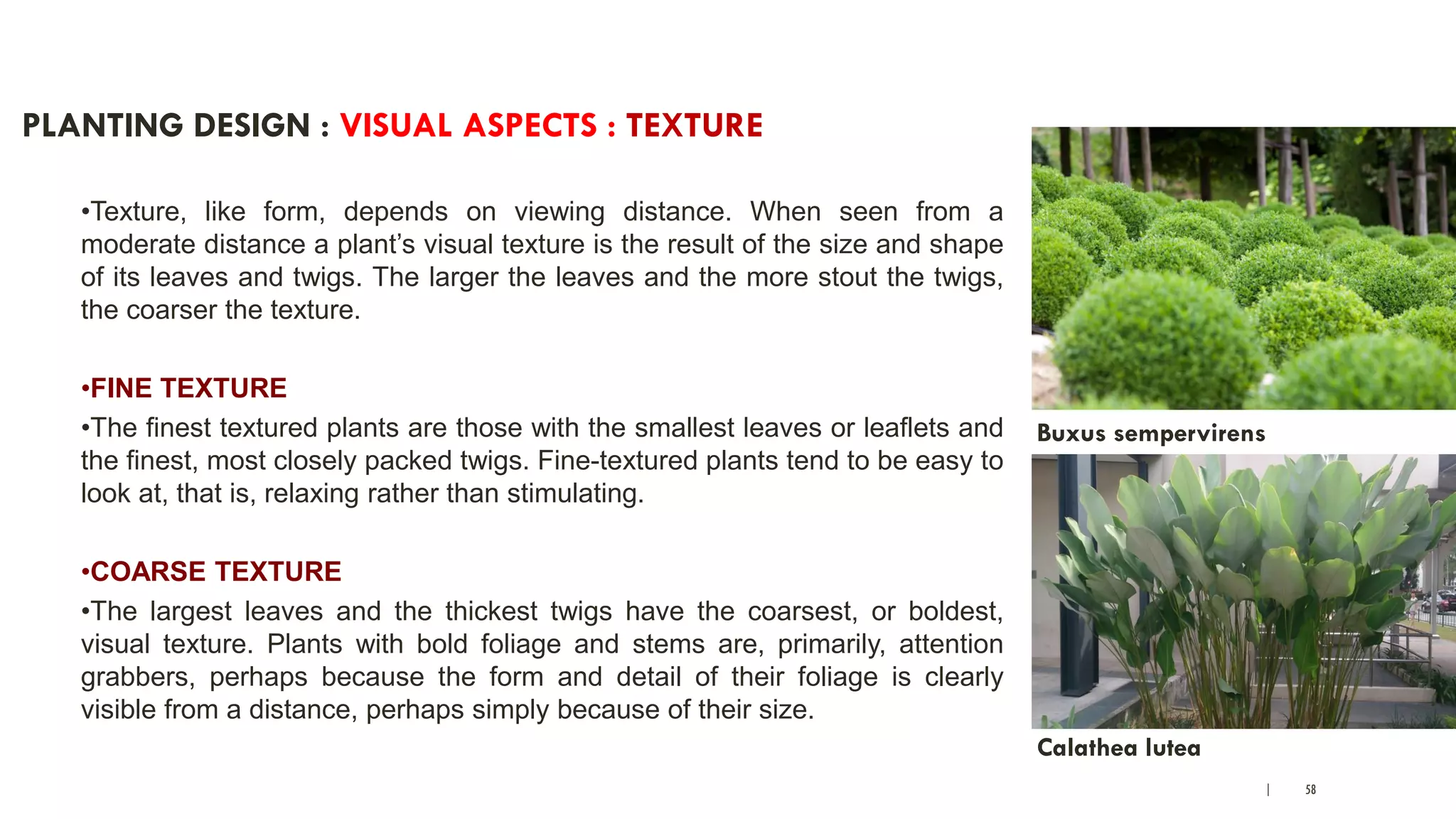
•Texture, like form, depends on viewing distance. When seen from a
moderate distance a plant’s visual texture is the result of the size and shape
of its leaves and twigs. The larger the leaves and the more stout the twigs,
the coarser the texture.
•FINE TEXTURE
•The finest textured plants are those with the smallest leaves or leaflets and
the finest, most closely packed twigs. Fine-textured plants tend to be easy to
look at, that is, relaxing rather than stimulating.
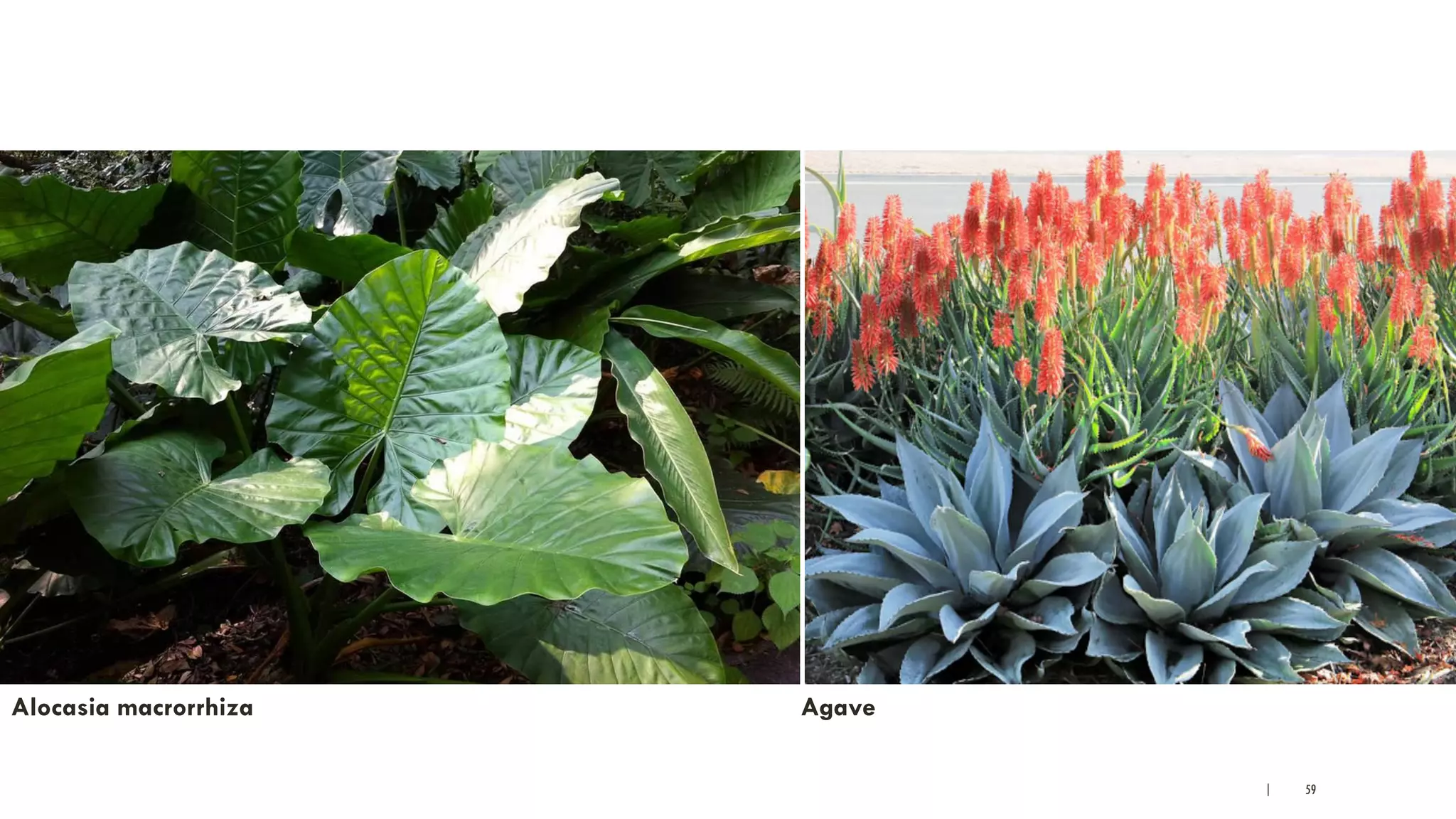
•COARSE TEXTURE
•The largest leaves and the thickest twigs have the coarsest, or boldest,
visual texture. Plants with bold foliage and stems are, primarily, attention
grabbers, perhaps because the form and detail of their foliage is clearly
visible from a distance, perhaps simply because of their size.
Buxus sempervirens
Calathea lutea
| 59
Alocasia macrorrhiza Agave
| 60
PLANTING DESIGN : VISUAL ASPECTS : TEXTURE
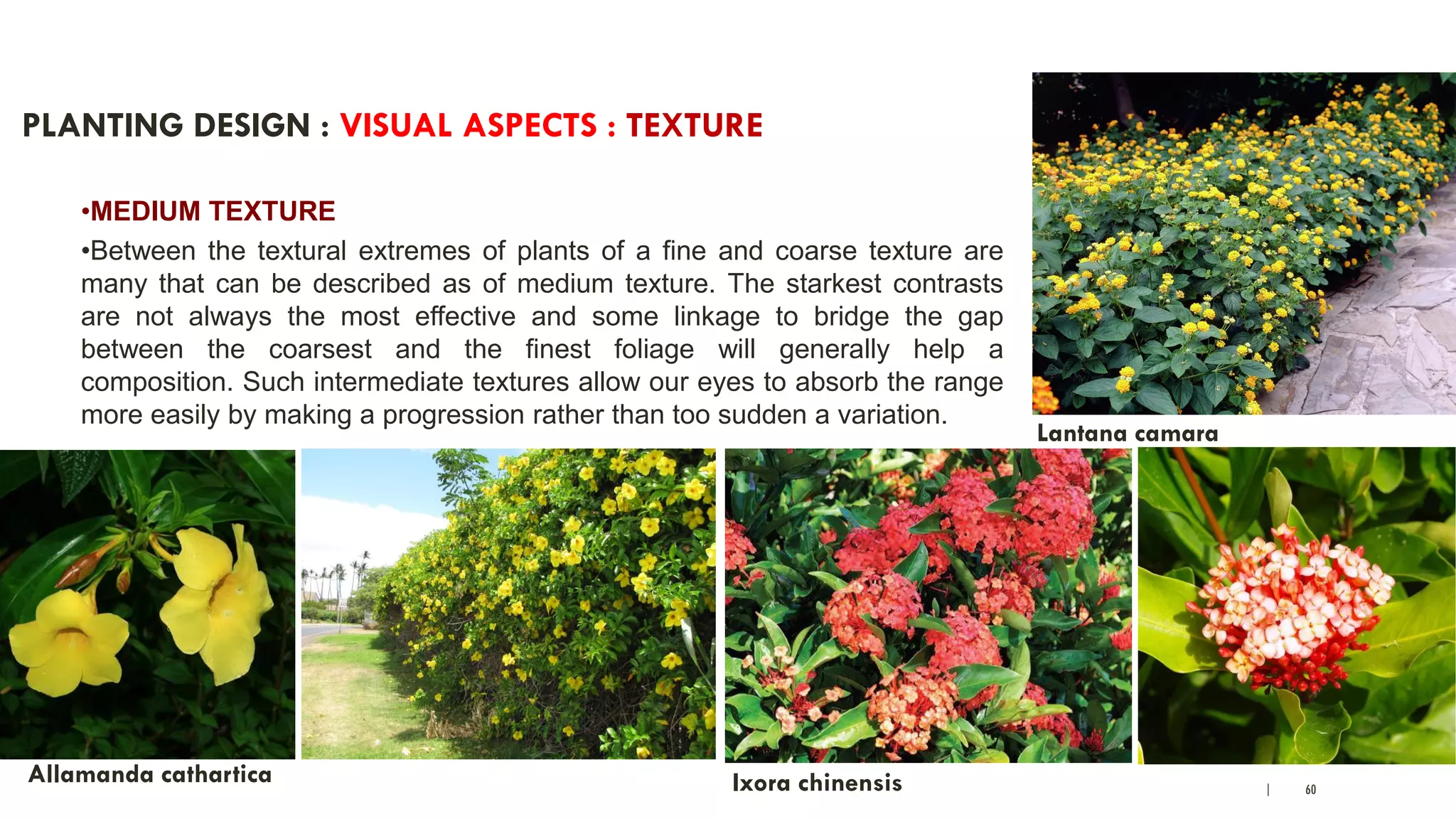
•MEDIUM TEXTURE
•Between the textural extremes of plants of a fine and coarse texture are
many that can be described as of medium texture. The starkest contrasts
are not always the most effective and some linkage to bridge the gap
between the coarsest and the finest foliage will generally help a
composition. Such intermediate textures allow our eyes to absorb the range
more easily by making a progression rather than too sudden a variation.
Lantana camara
Allamanda cathartica Ixora chinensis
| 61
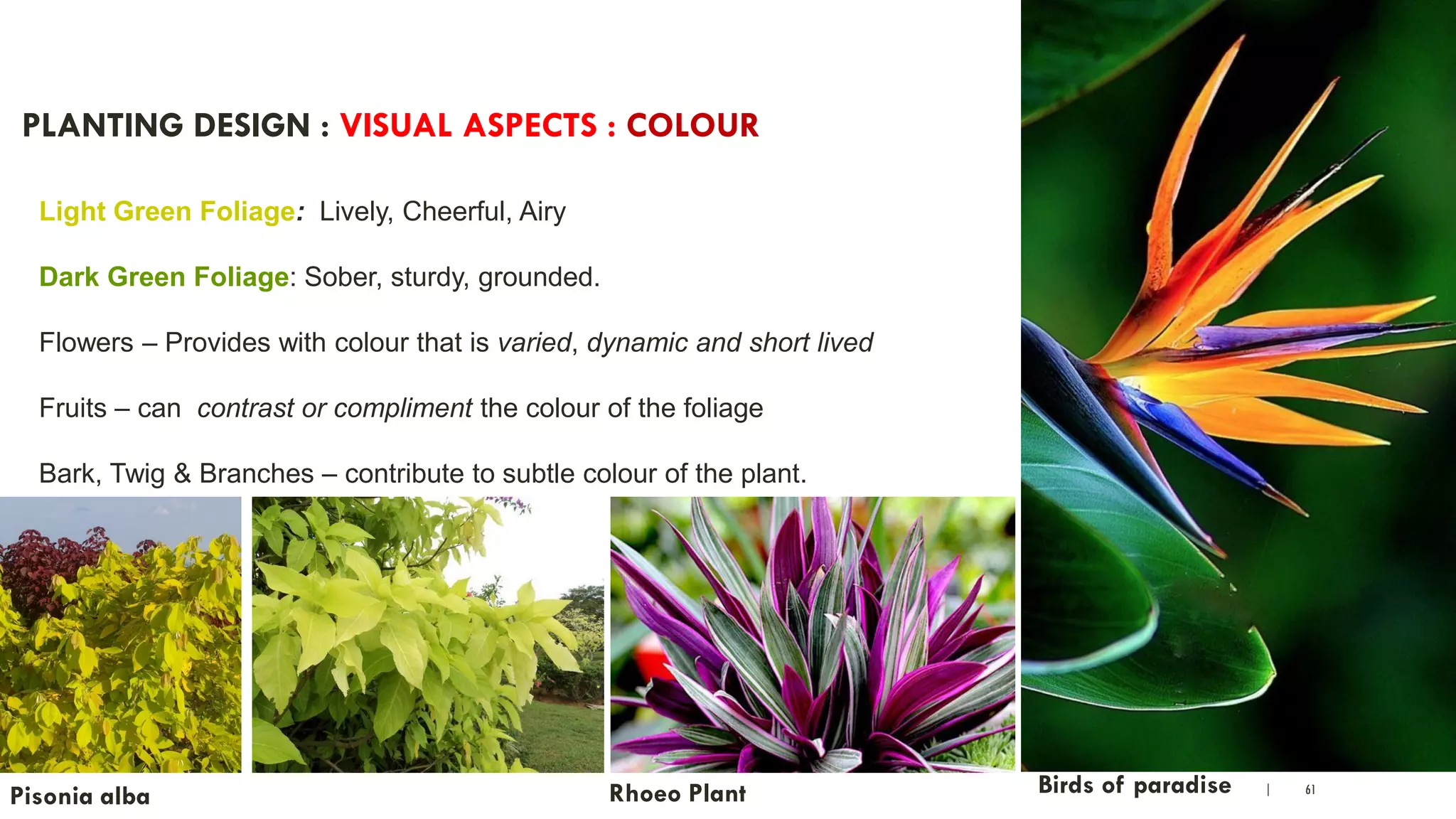
PLANTING DESIGN : VISUAL ASPECTS : COLOUR
Light Green Foliage: Lively, Cheerful, Airy
Dark Green Foliage: Sober, sturdy, grounded.
Flowers – Provides with colour that is varied, dynamic and short lived
Fruits – can contrast or compliment the colour of the foliage
Bark, Twig & Branches – contribute to subtle colour of the plant.
Pisonia alba Birds of paradiseRhoeo Plant
| 62
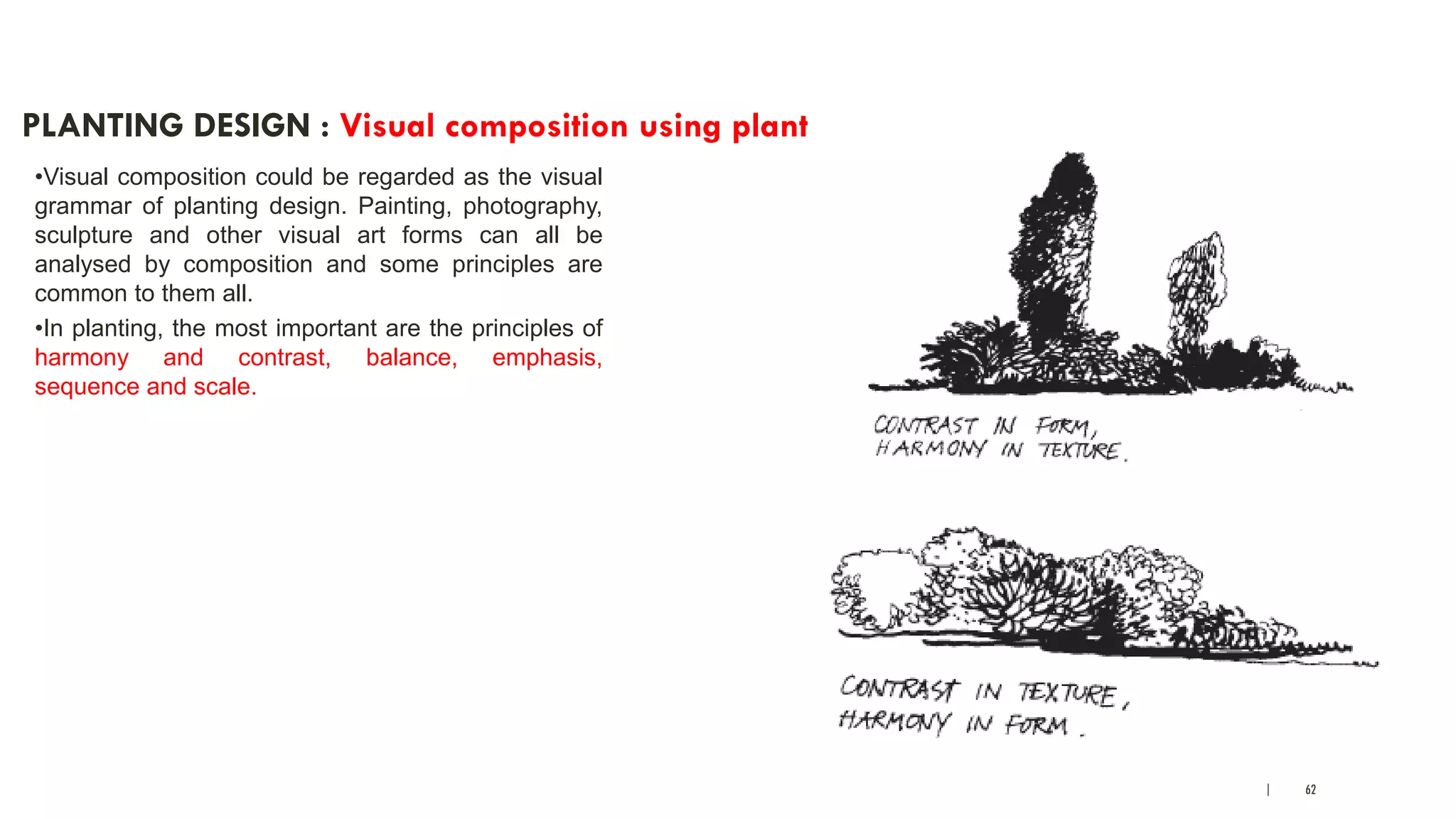
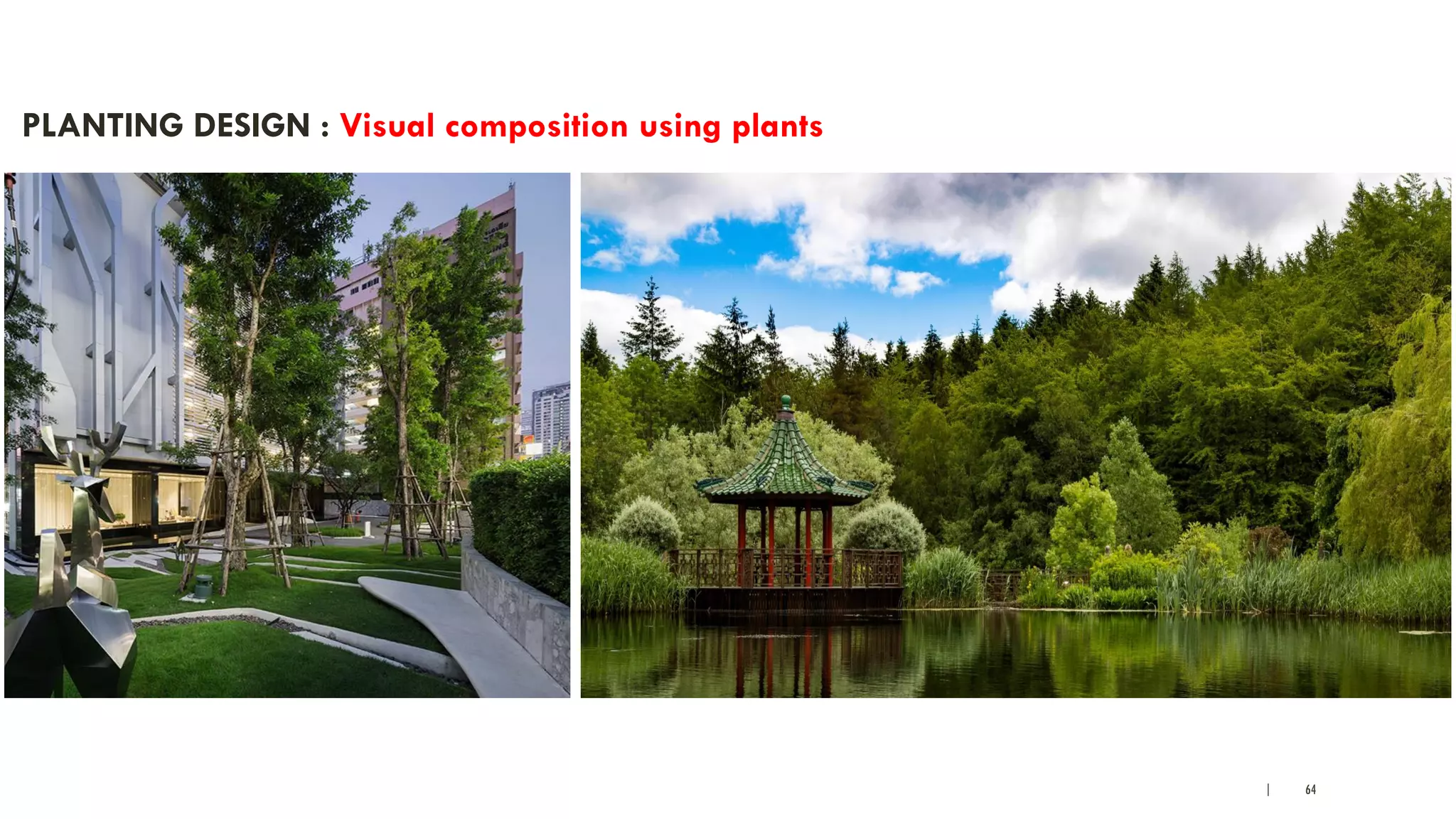
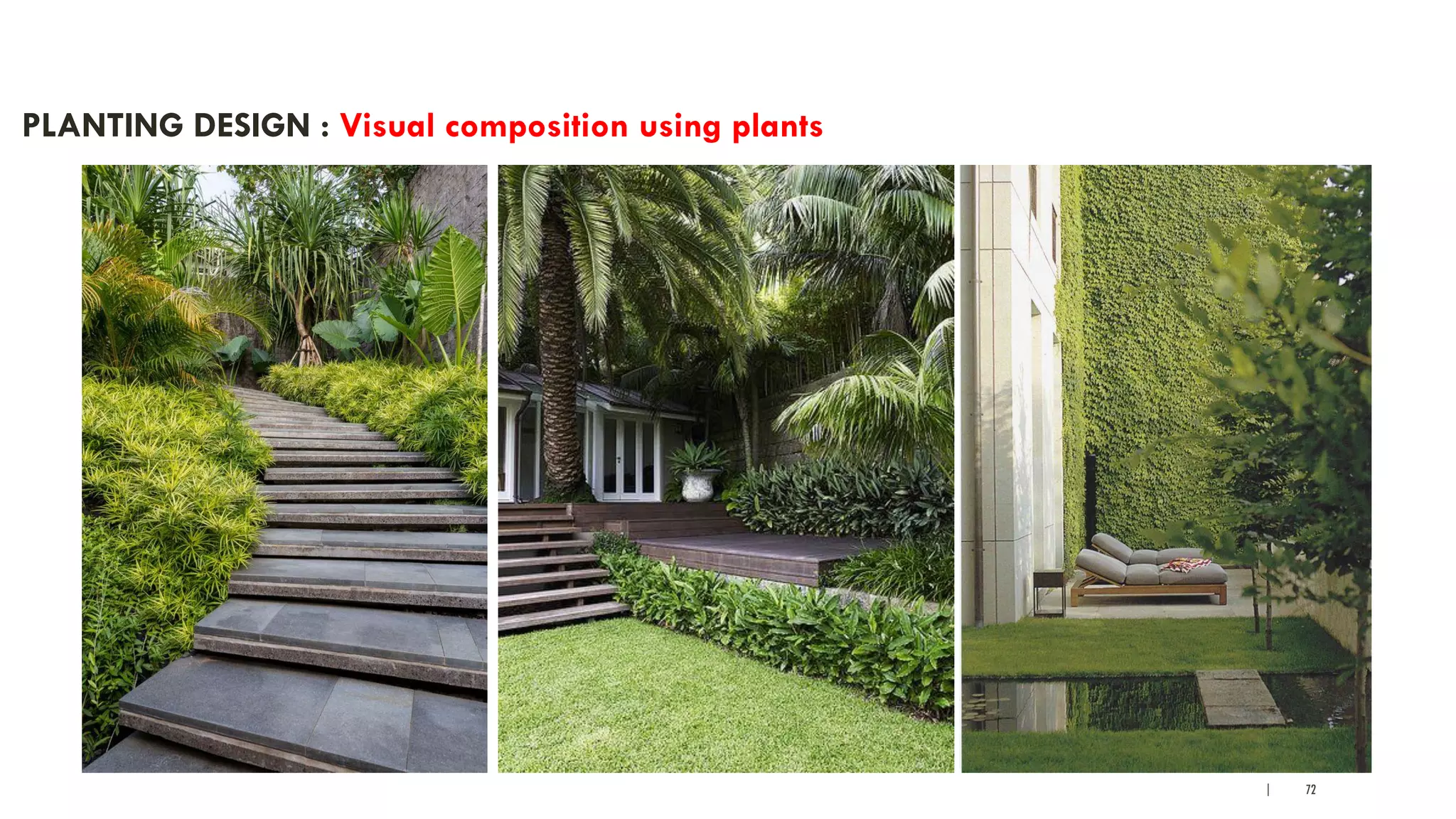
PLANTING DESIGN : Visual composition using plants
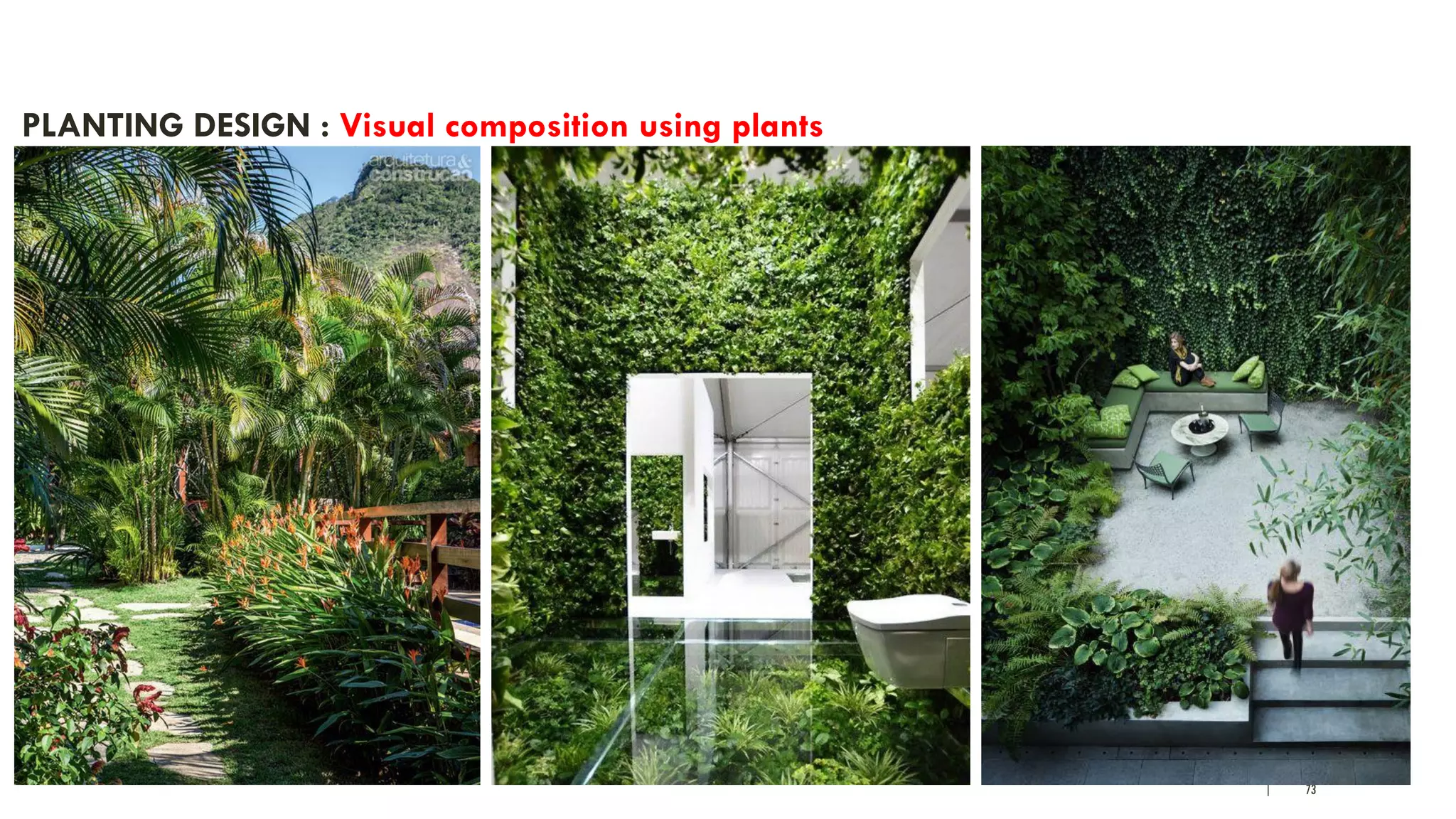
•Visual composition could be regarded as the visual
grammar of planting design. Painting, photography,
sculpture and other visual art forms can all be
analysed by composition and some principles are
common to them all.
•In planting, the most important are the principles of
harmony and contrast, balance, emphasis,
sequence and scale.
| 63
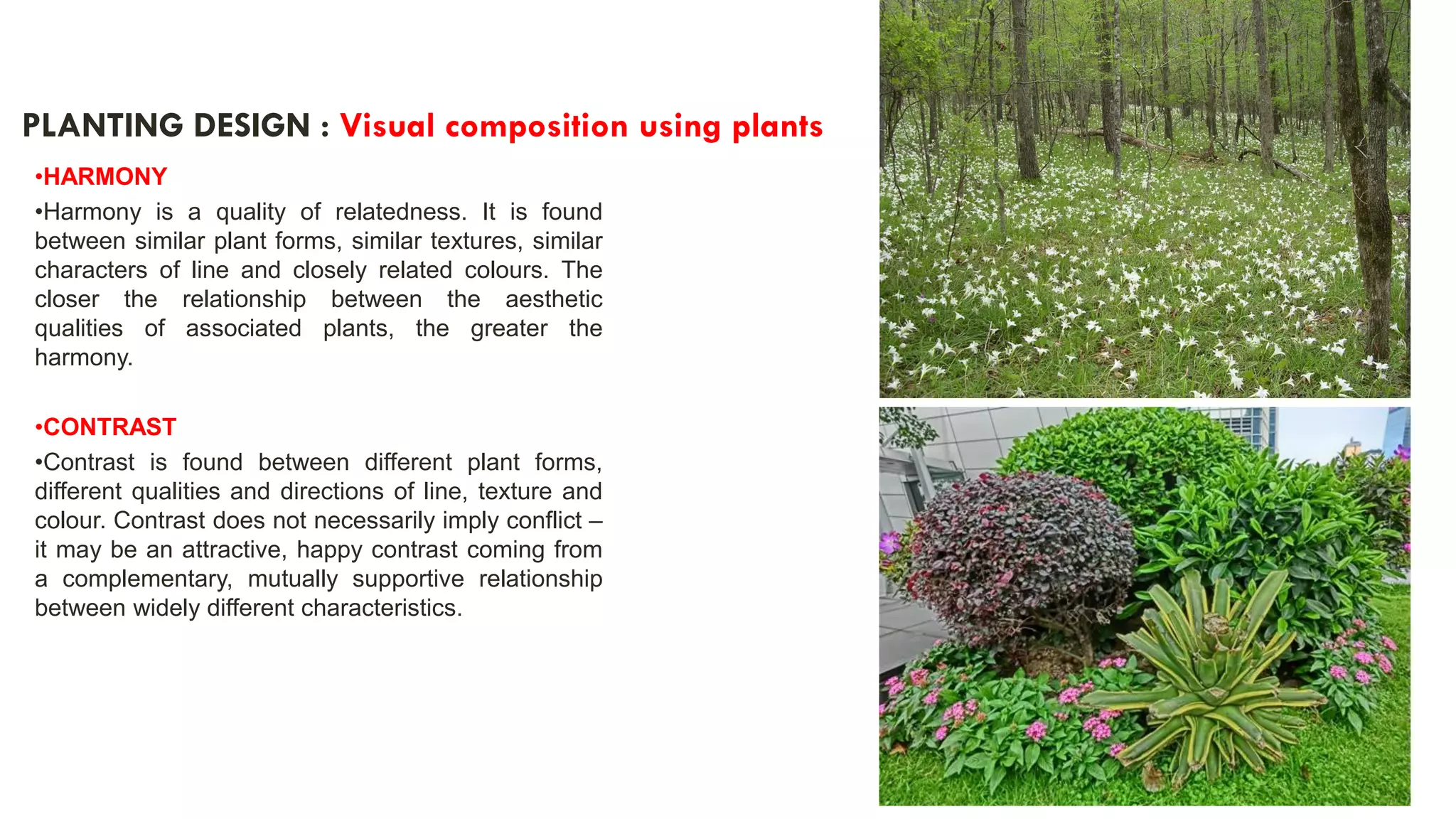
PLANTING DESIGN : Visual composition using plants
•HARMONY
•Harmony is a quality of relatedness. It is found
between similar plant forms, similar textures, similar
characters of line and closely related colours. The
closer the relationship between the aesthetic
qualities of associated plants, the greater the
harmony.
•CONTRAST
•Contrast is found between different plant forms,
different qualities and directions of line, texture and
colour. Contrast does not necessarily imply conflict –
it may be an attractive, happy contrast coming from
a complementary, mutually supportive relationship
between widely different characteristics.
| 64
PLANTING DESIGN : Visual composition using plants
| 65
PLANTING DESIGN : Visual composition using plants
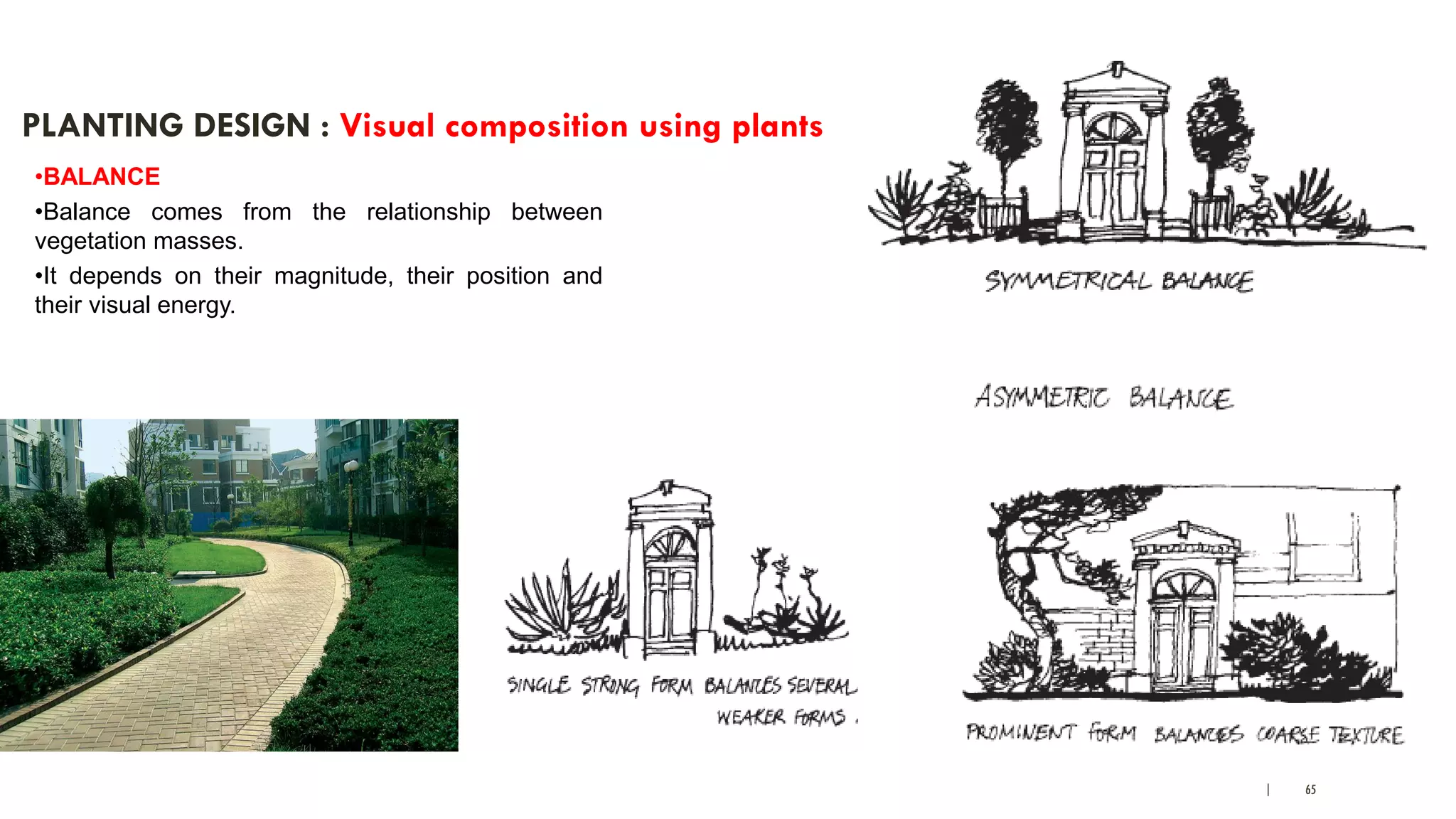
•BALANCE
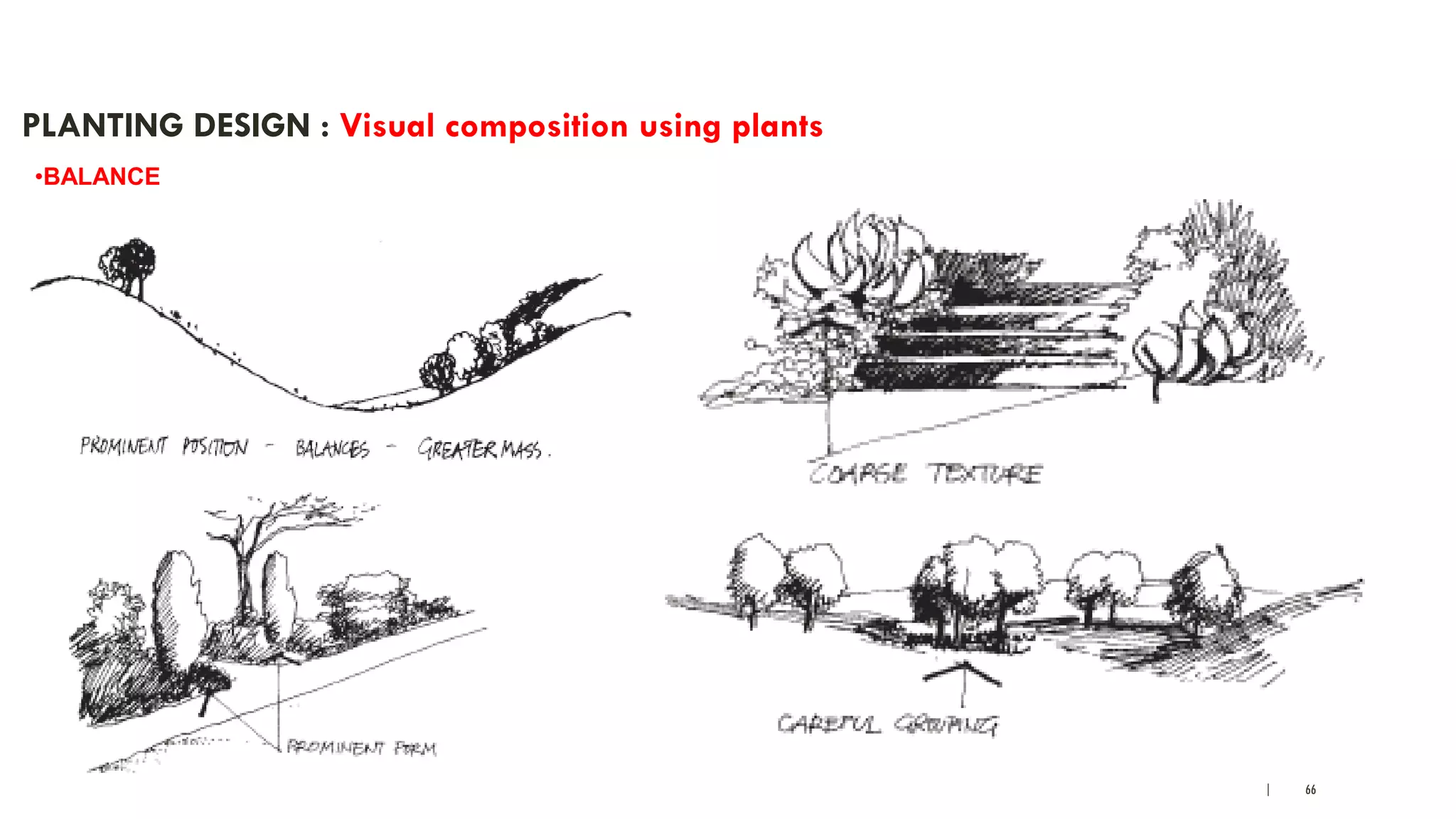
•Balance comes from the relationship between
vegetation masses.
•It depends on their magnitude, their position and
their visual energy.
| 66
PLANTING DESIGN : Visual composition using plants
•BALANCE
| 67
PLANTING DESIGN : Visual composition using plants
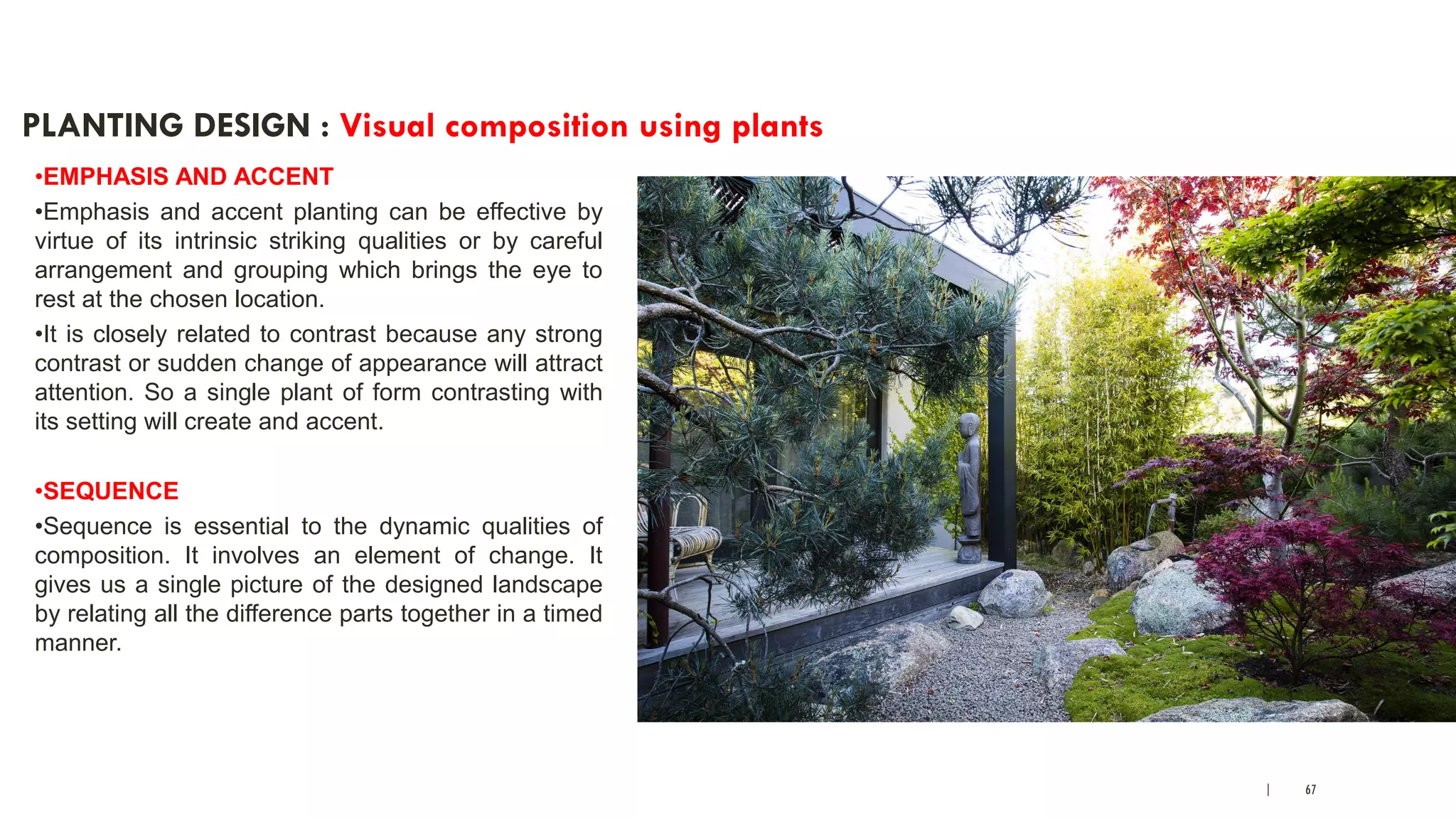
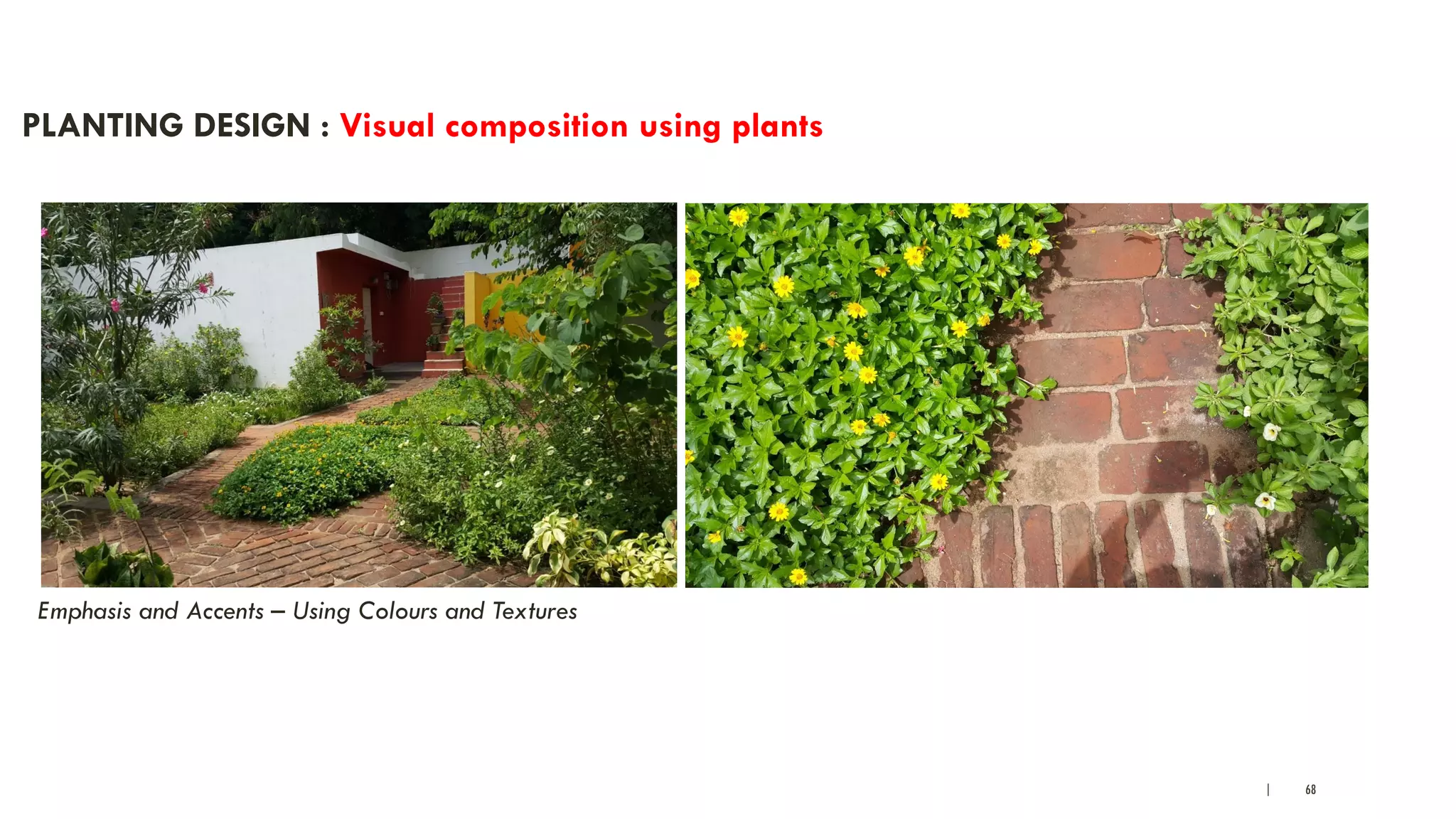
•EMPHASIS AND ACCENT
•Emphasis and accent planting can be effective by
virtue of its intrinsic striking qualities or by careful
arrangement and grouping which brings the eye to
rest at the chosen location.
•It is closely related to contrast because any strong
contrast or sudden change of appearance will attract
attention. So a single plant of form contrasting with
its setting will create and accent.
•SEQUENCE
•Sequence is essential to the dynamic qualities of
composition. It involves an element of change. It
gives us a single picture of the designed landscape
by relating all the difference parts together in a timed
manner.
| 68
PLANTING DESIGN : Visual composition using plants
Emphasis and Accents – Using Colours and Textures
| 69
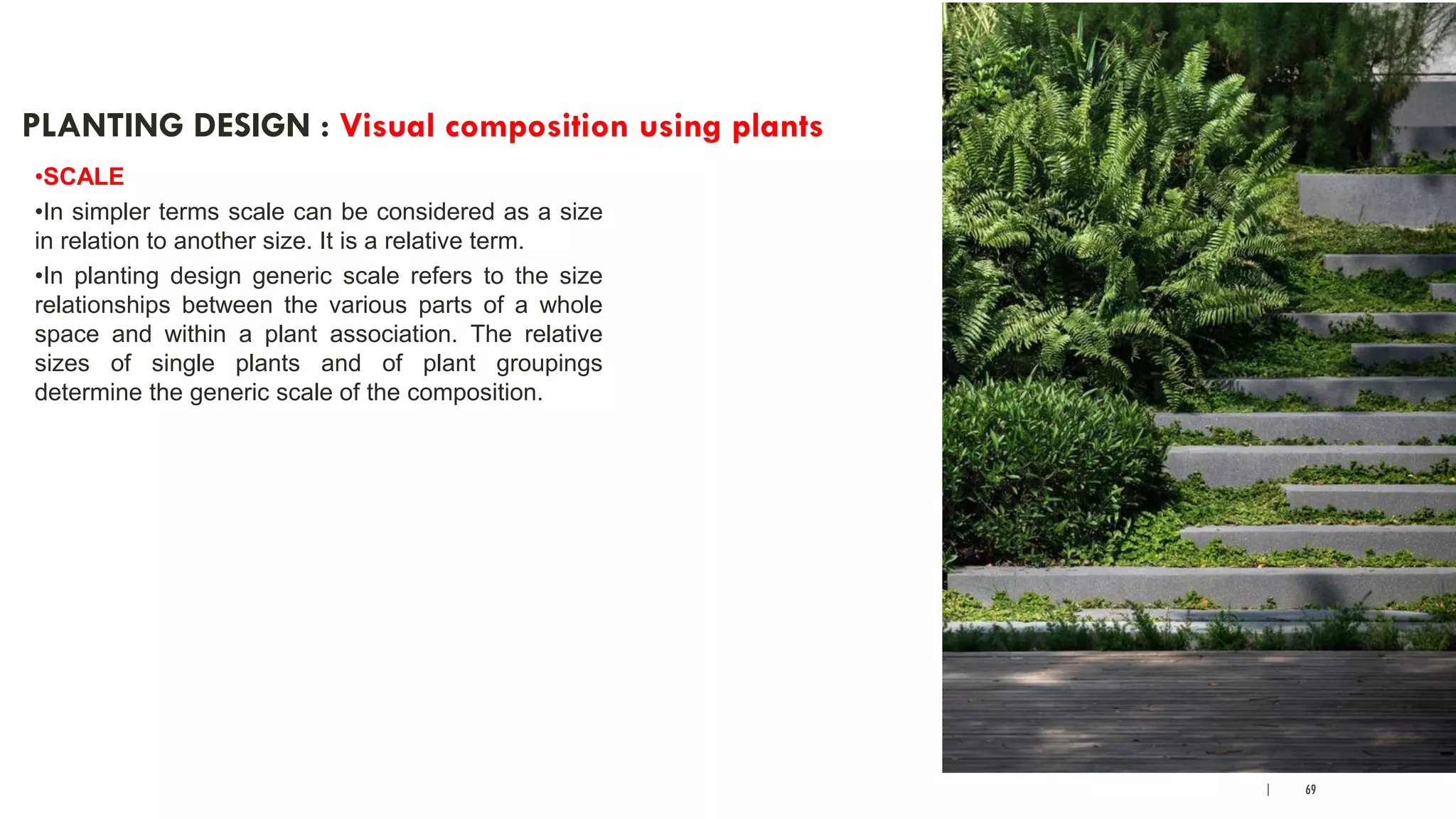
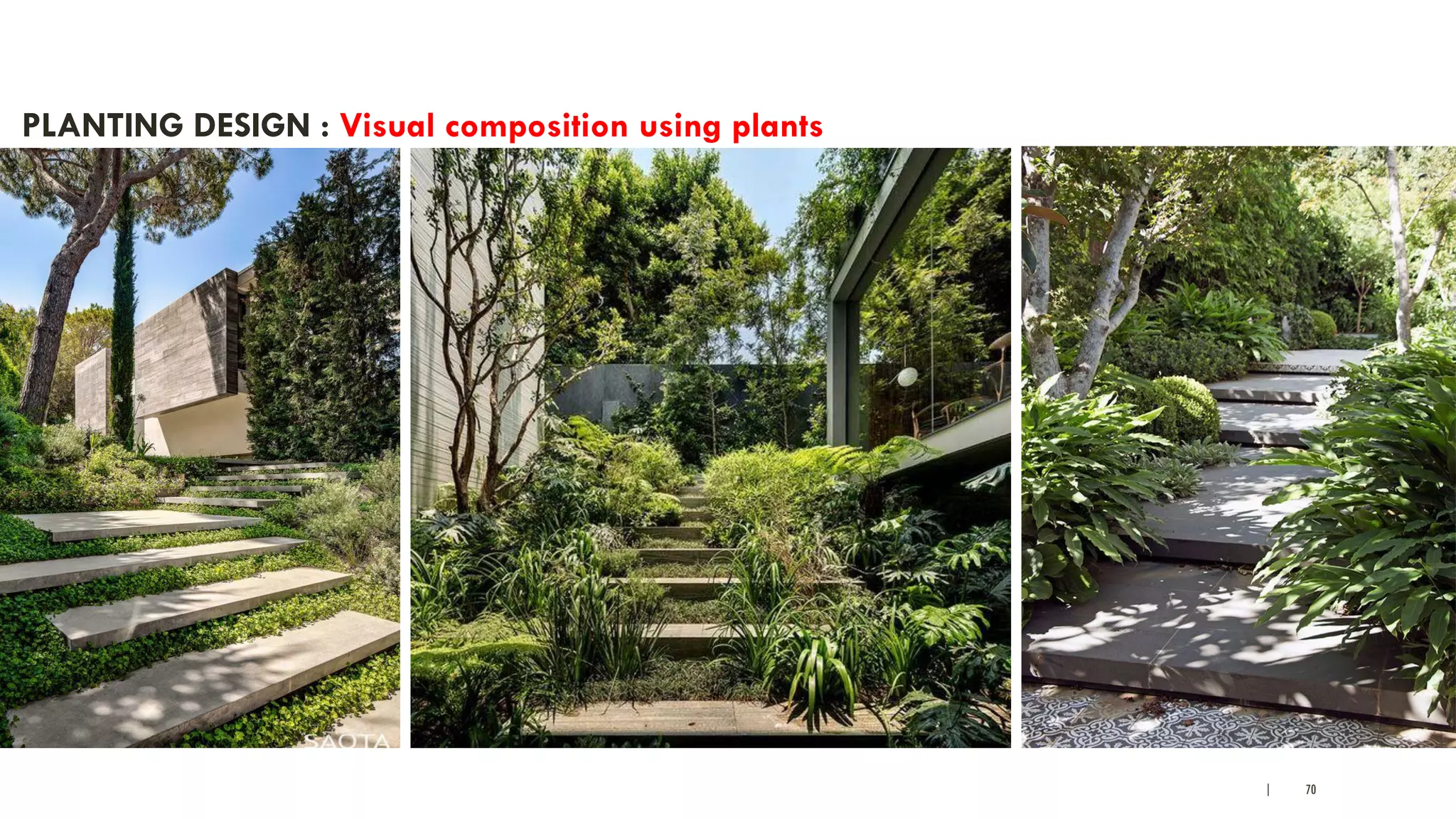
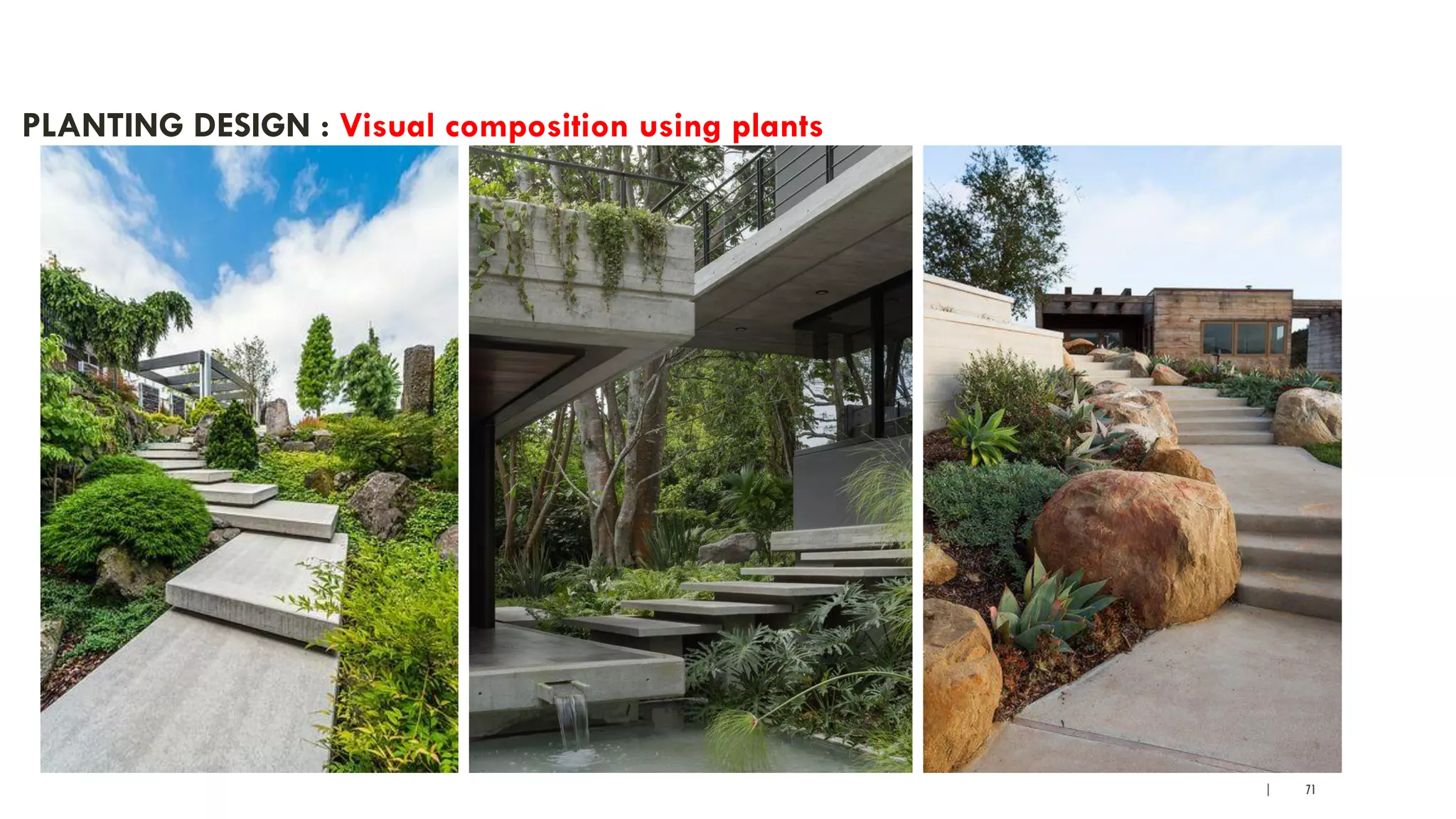
PLANTING DESIGN : Visual composition using plants
•SCALE
•In simpler terms scale can be considered as a size
in relation to another size. It is a relative term.
•In planting design generic scale refers to the size
relationships between the various parts of a whole
space and within a plant association. The relative
sizes of single plants and of plant groupings
determine the generic scale of the composition.
| 70
PLANTING DESIGN : Visual composition using plants
| 71
PLANTING DESIGN : Visual composition using plants
| 72
PLANTING DESIGN : Visual composition using plants
| 73
PLANTING DESIGN : Visual composition using plants
| 74
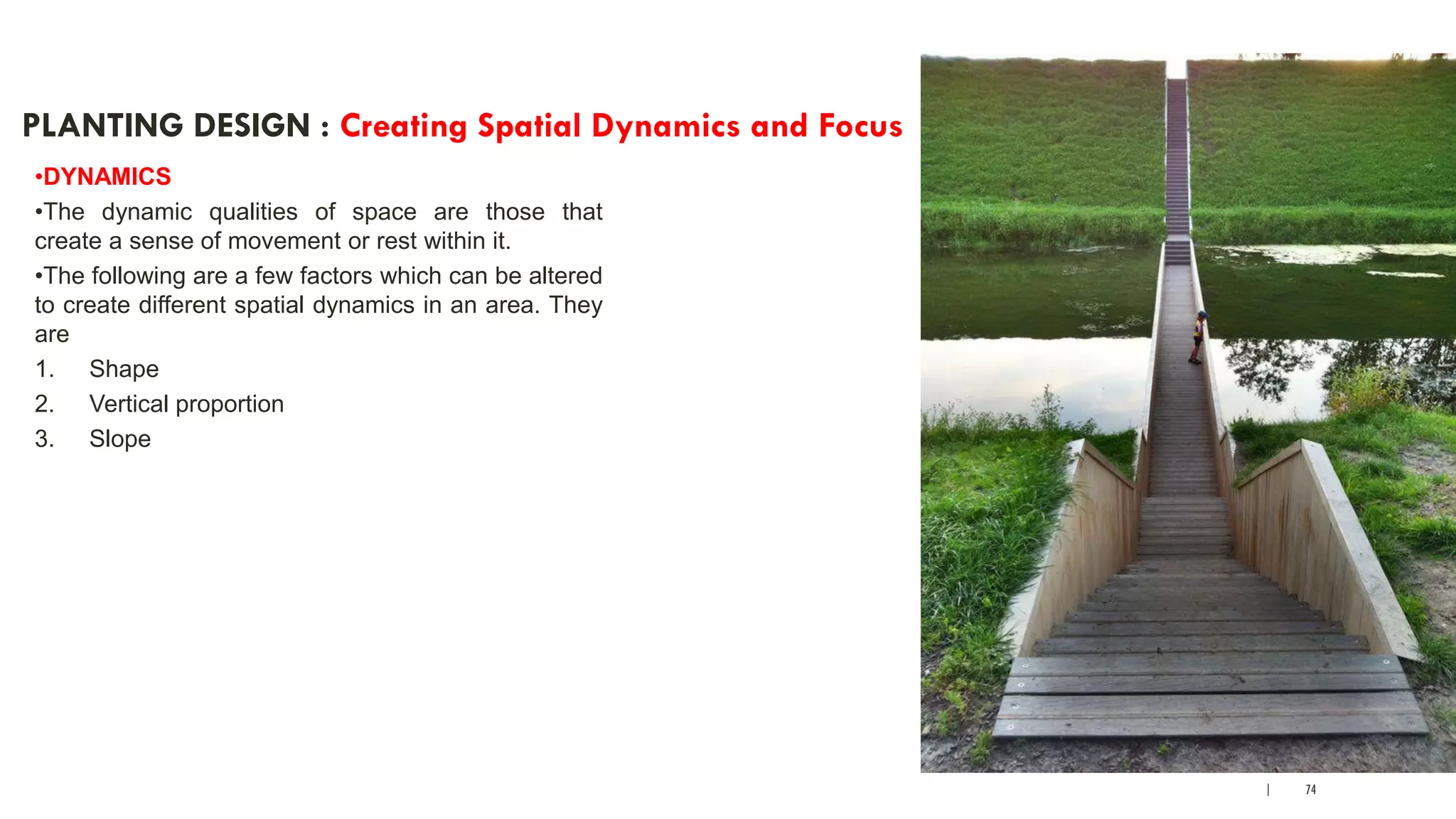
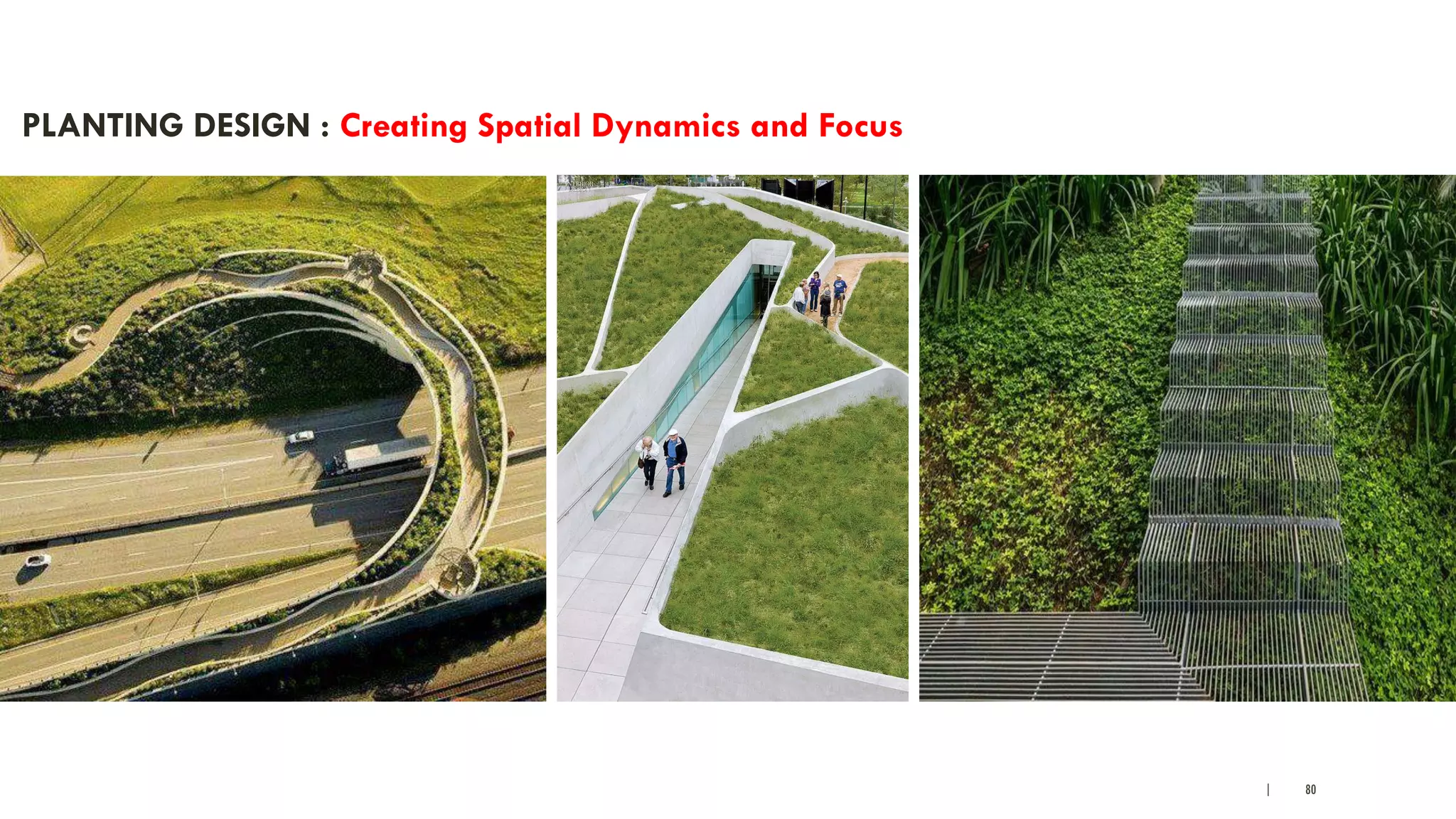
PLANTING DESIGN : Creating Spatial Dynamics and Focus
•DYNAMICS
•The dynamic qualities of space are those that
create a sense of movement or rest within it.
•The following are a few factors which can be altered
to create different spatial dynamics in an area. They
are
1. Shape
2. Vertical proportion
3. Slope
| 75
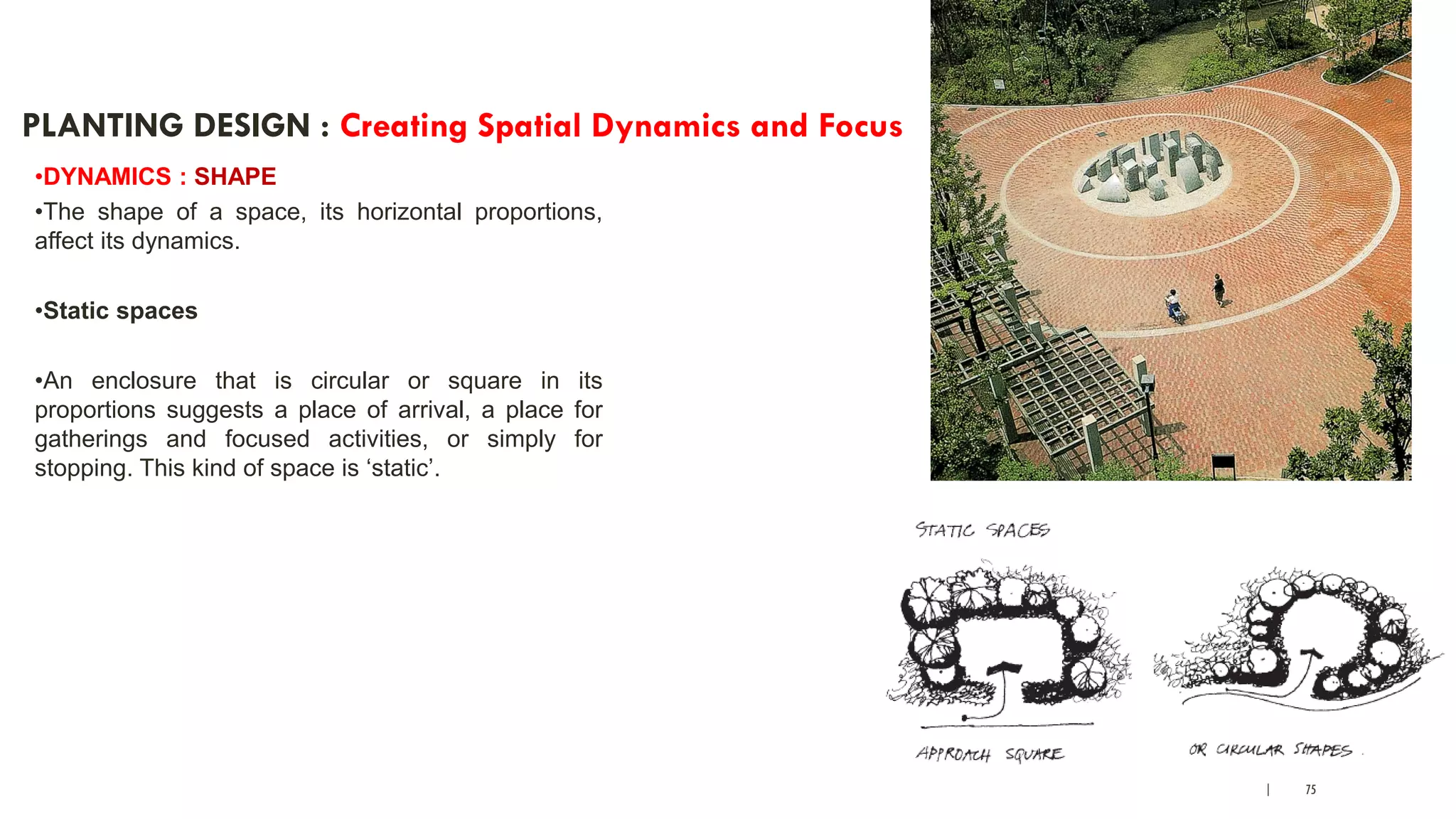
PLANTING DESIGN : Creating Spatial Dynamics and Focus
•DYNAMICS : SHAPE
•The shape of a space, its horizontal proportions,
affect its dynamics.
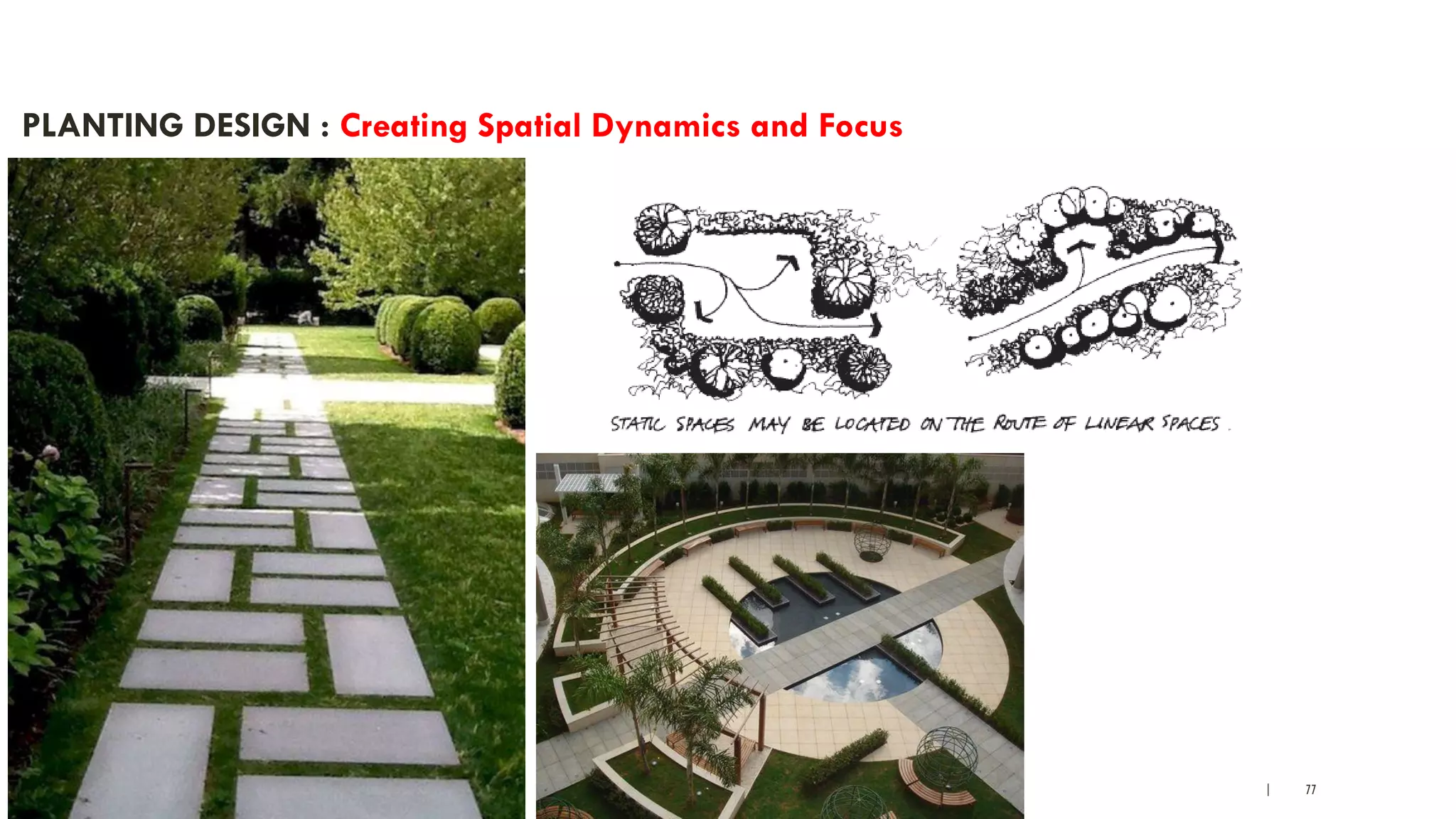
•Static spaces
•An enclosure that is circular or square in its
proportions suggests a place of arrival, a place for
gatherings and focused activities, or simply for
stopping. This kind of space is ‘static’.
| 76
PLANTING DESIGN : Creating Spatial Dynamics and Focus
•DYNAMICS : SHAPE
•The shape of a space, its horizontal proportions,
affect its dynamics.
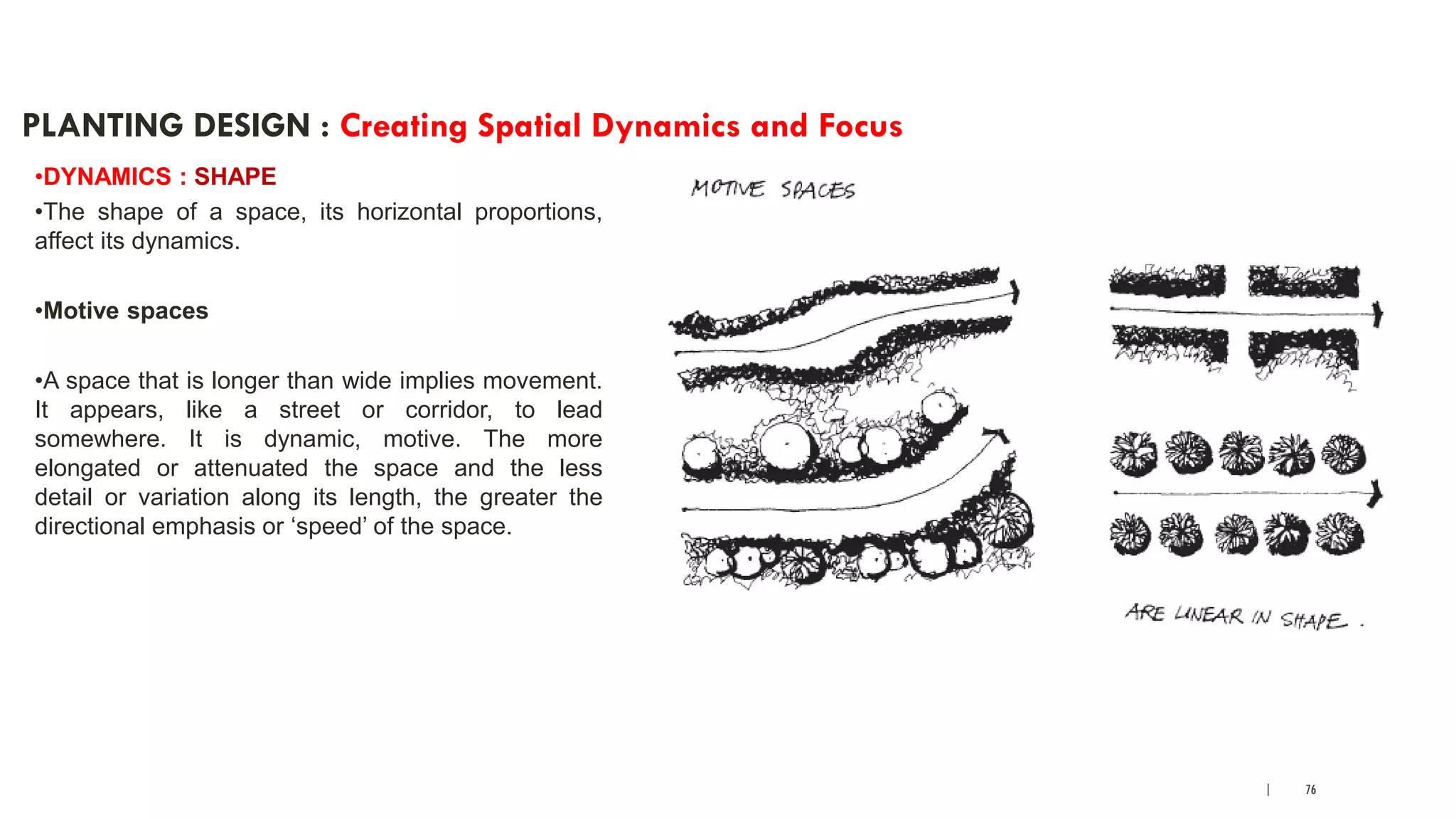
•Motive spaces
•A space that is longer than wide implies movement.
It appears, like a street or corridor, to lead
somewhere. It is dynamic, motive. The more
elongated or attenuated the space and the less
detail or variation along its length, the greater the
directional emphasis or ‘speed’ of the space.
| 77
PLANTING DESIGN : Creating Spatial Dynamics and Focus
| 78
PLANTING DESIGN : Creating Spatial Dynamics and Focus
| 79
PLANTING DESIGN : Creating Spatial Dynamics and Focus
| 80
PLANTING DESIGN : Creating Spatial Dynamics and Focus
| 81
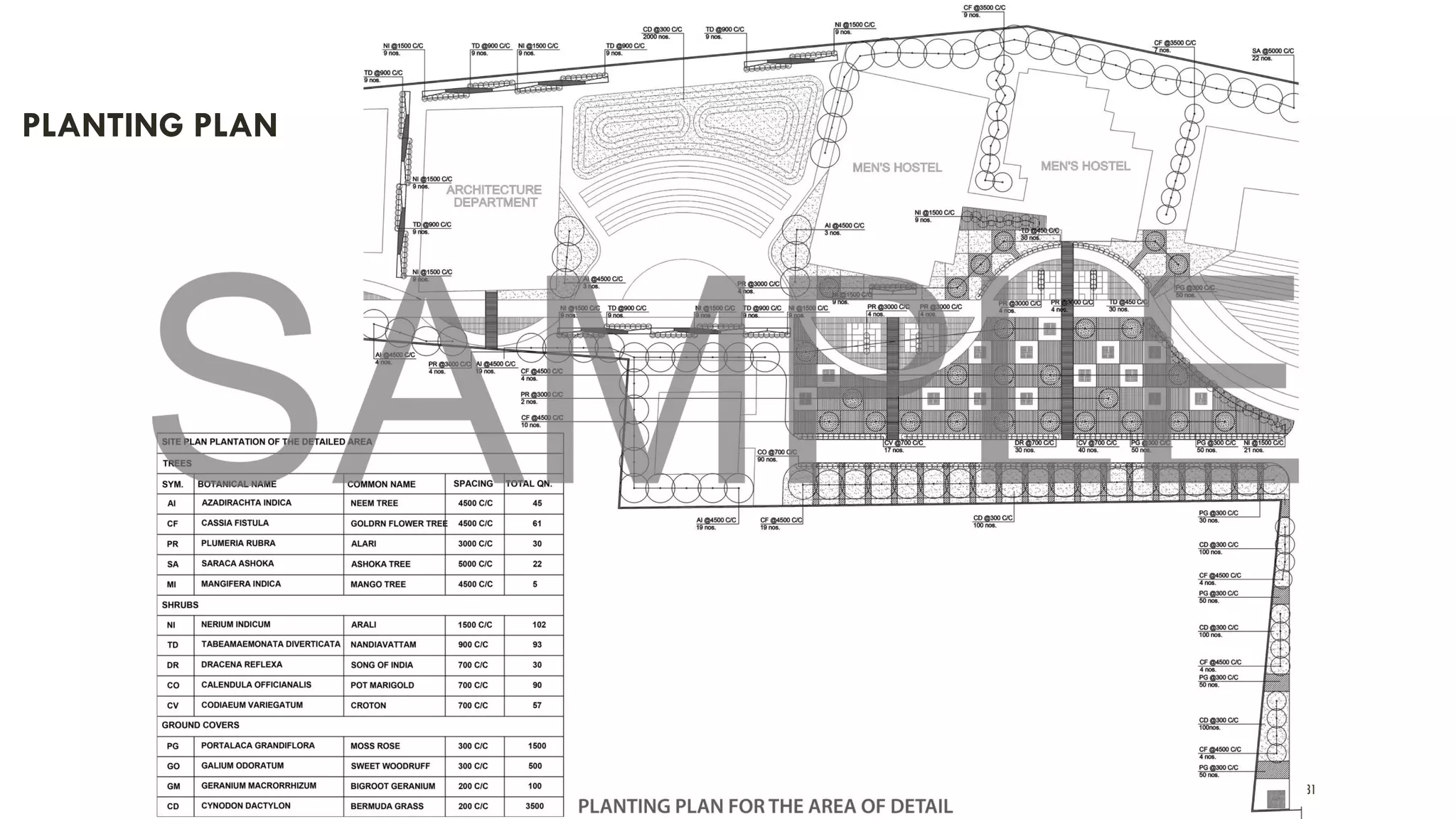
PLANTING PLAN
| 82
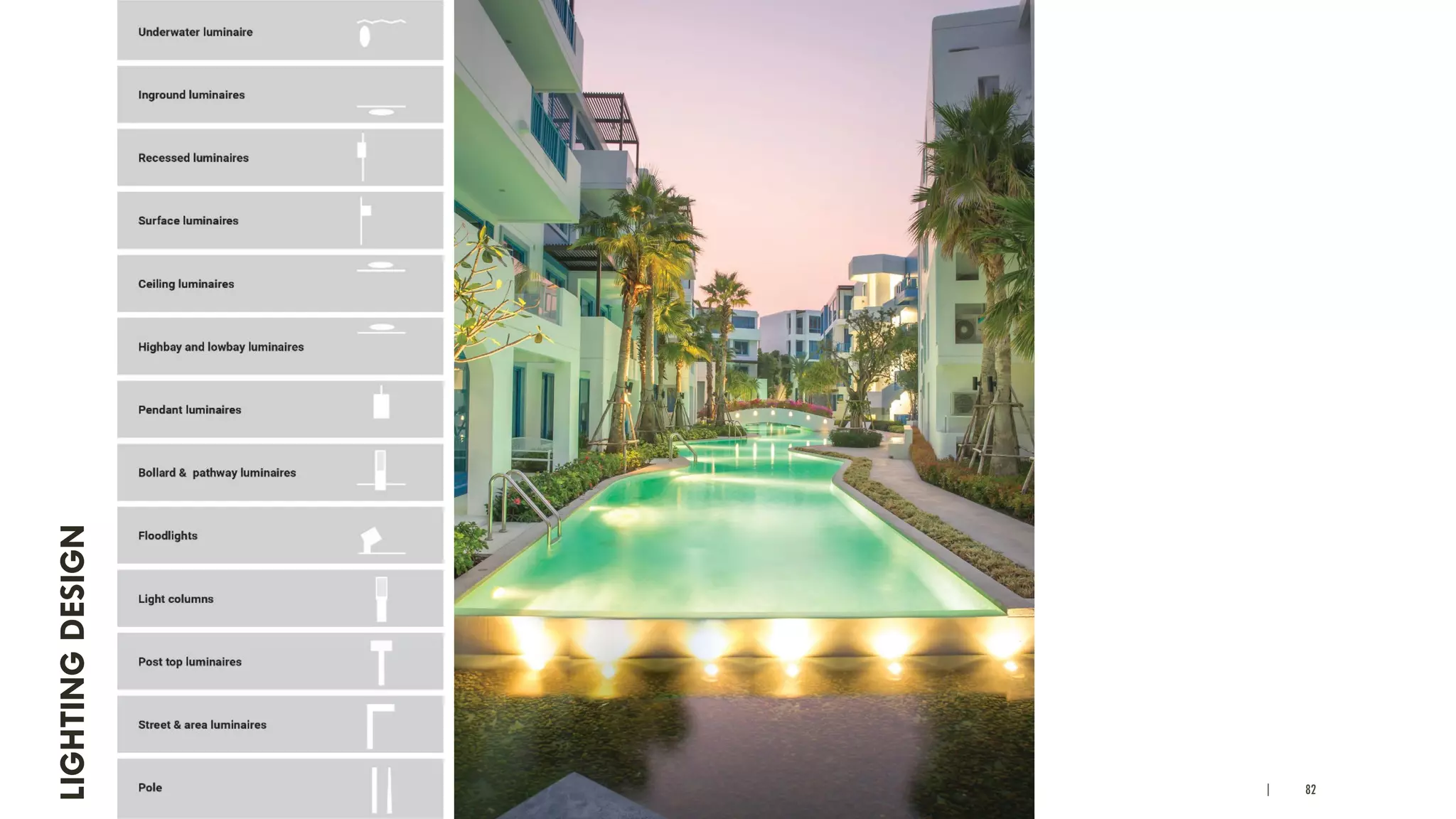
LIGHTINGDESIGN
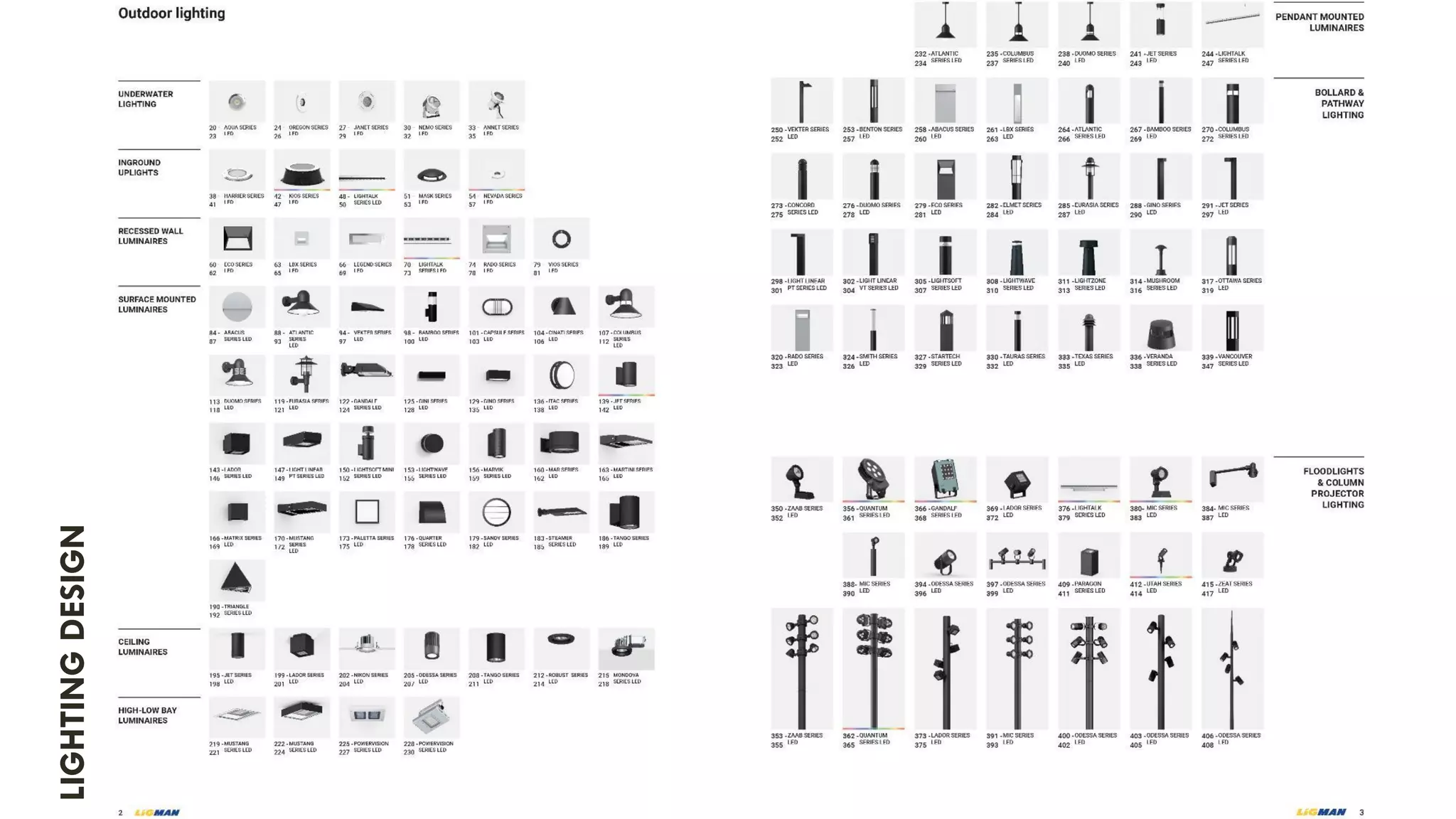
LIGHTINGDESIGN
LIGHTINGDESIGN
| 85
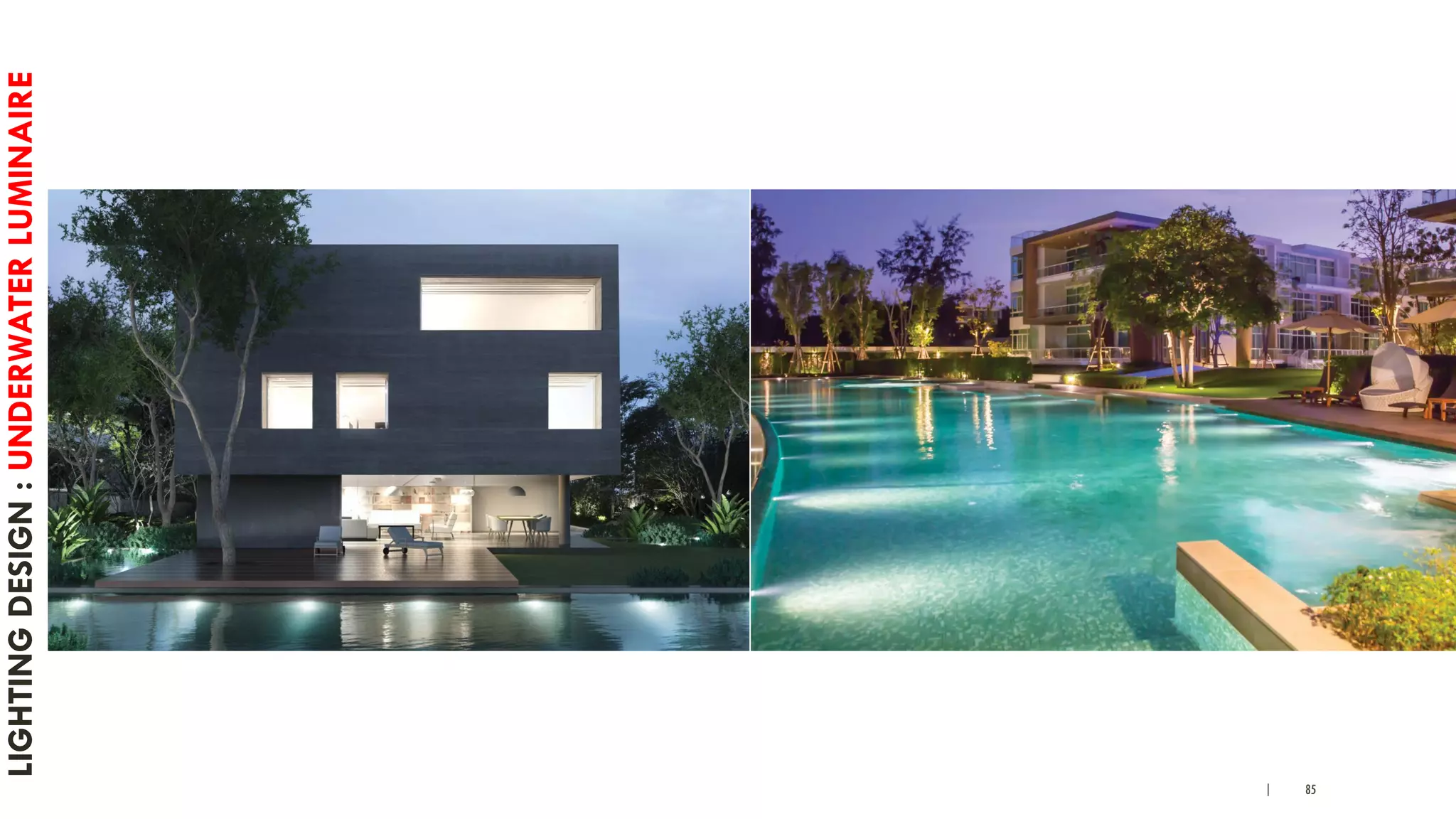
LIGHTINGDESIGN:UNDERWATERLUMINAIRE
| 86
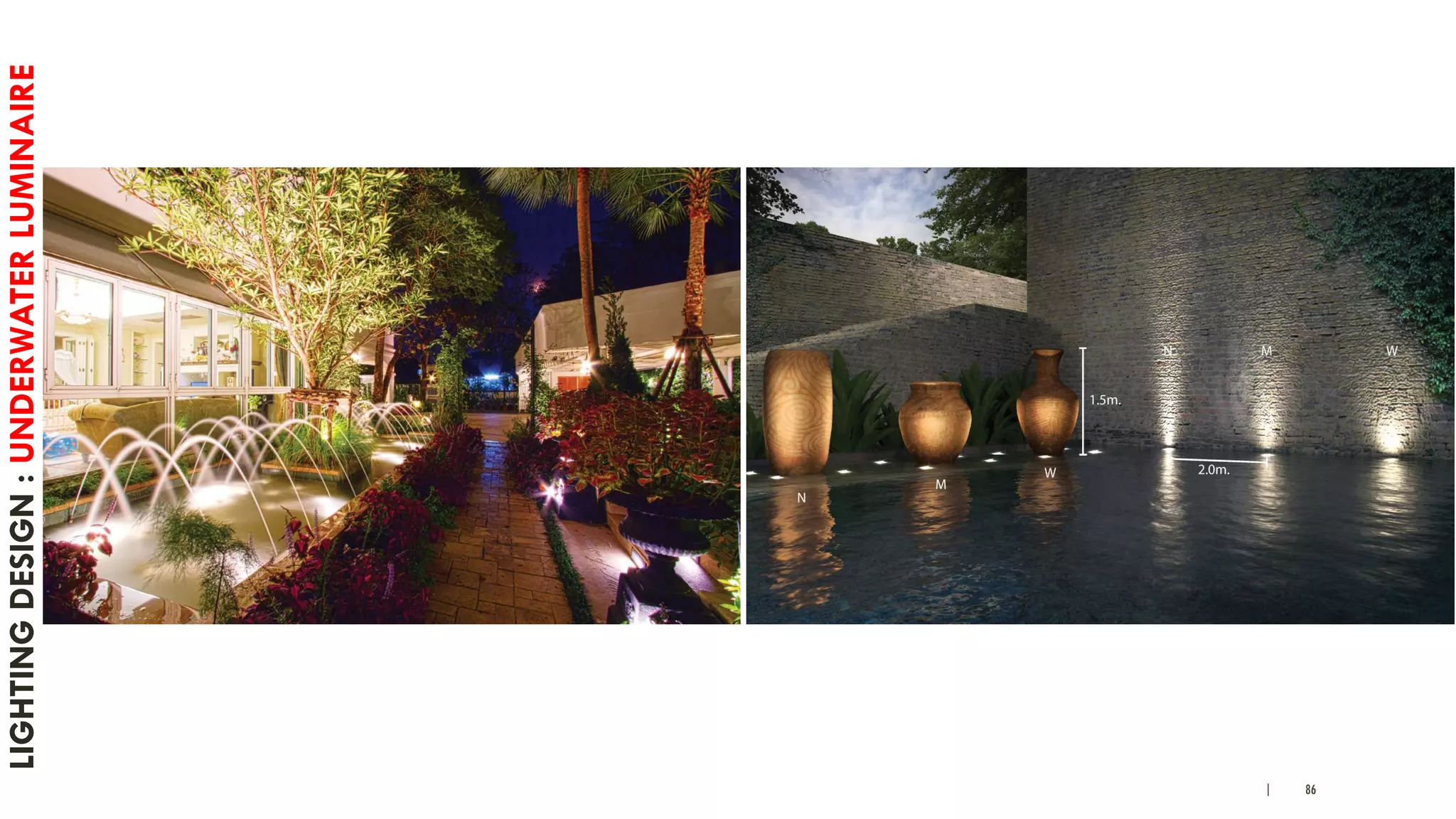
LIGHTINGDESIGN:UNDERWATERLUMINAIRE
| 87
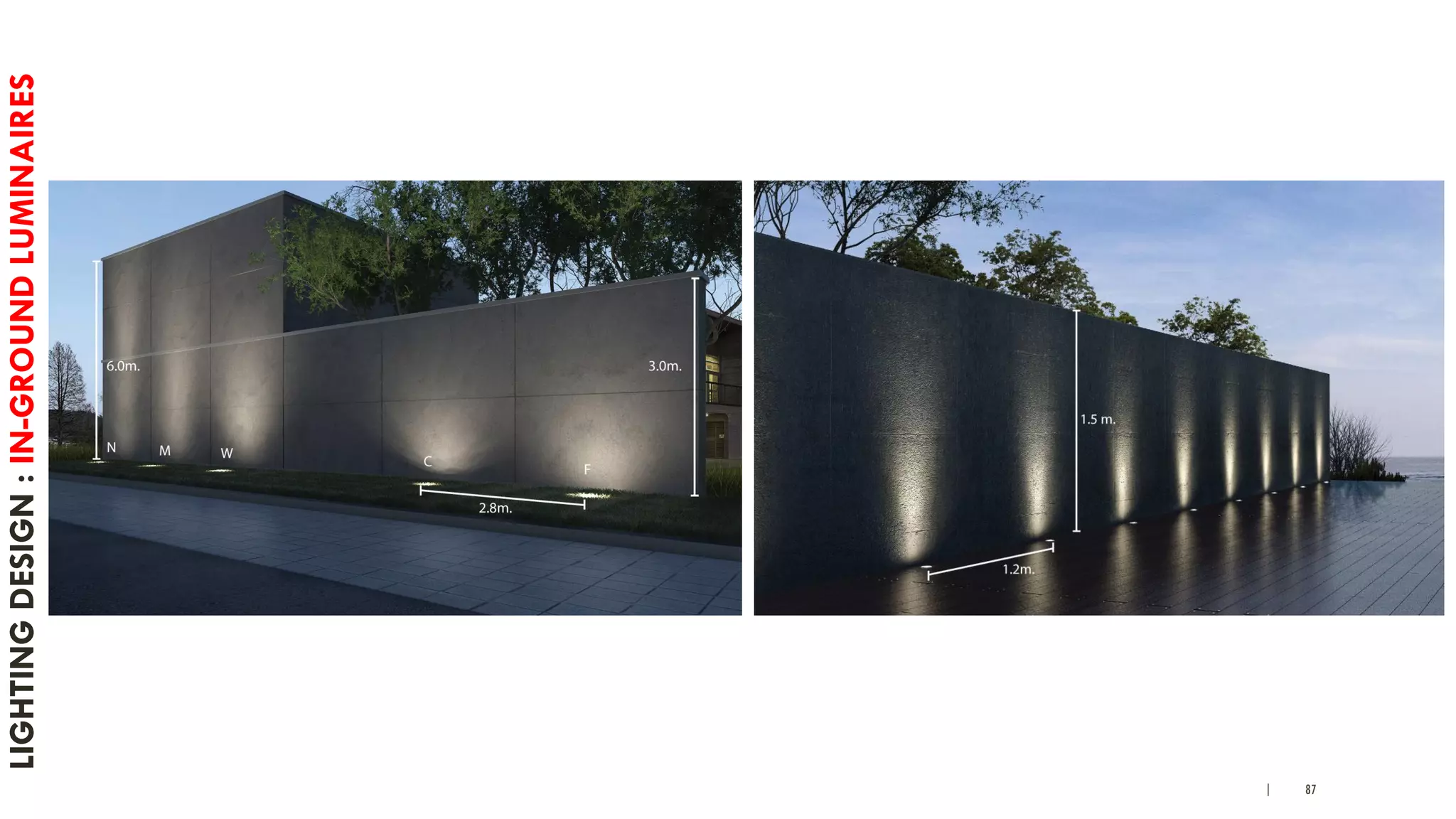
LIGHTINGDESIGN:IN-GROUNDLUMINAIRES
| 88
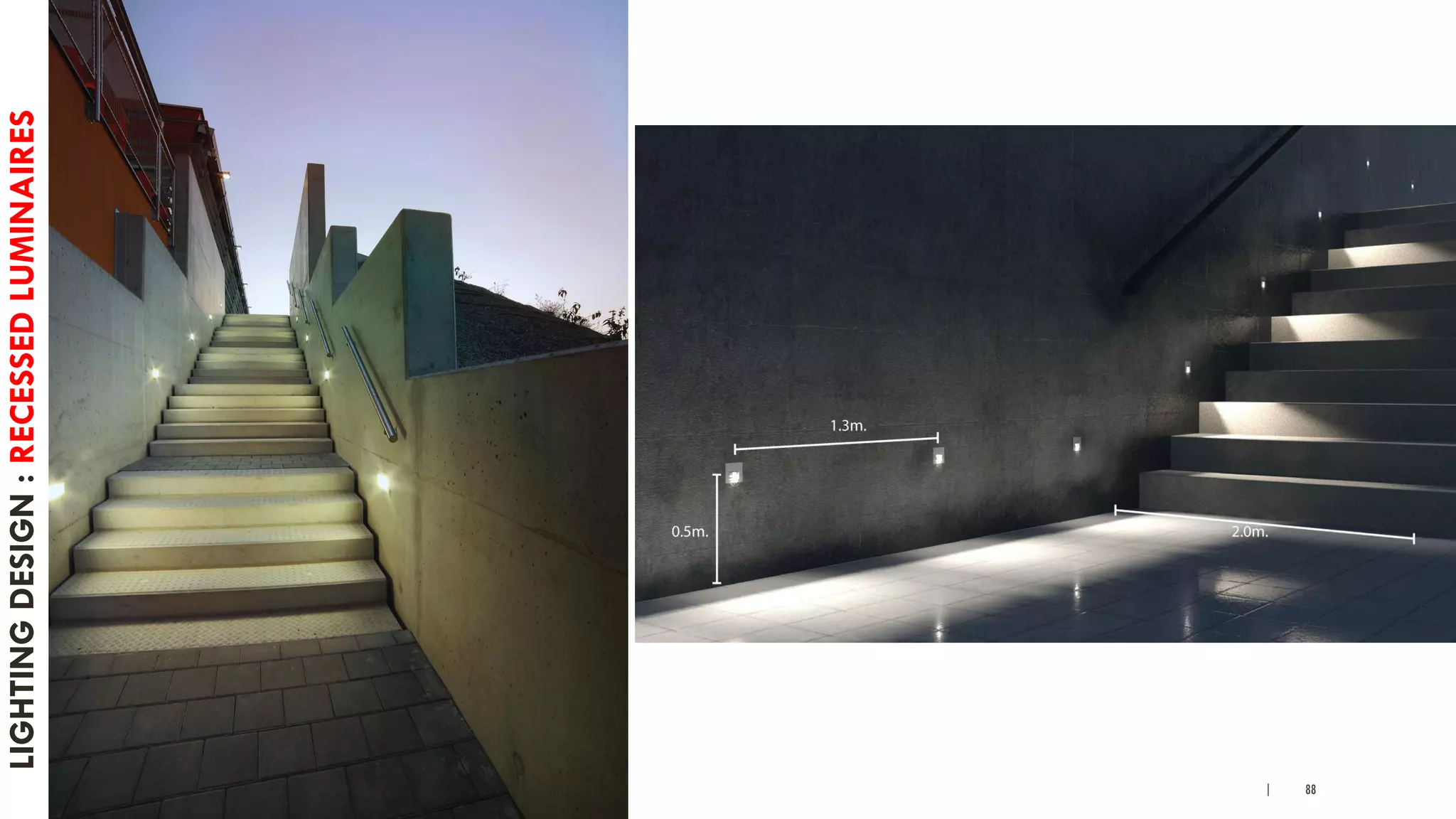
LIGHTINGDESIGN:RECESSEDLUMINAIRES
| 89
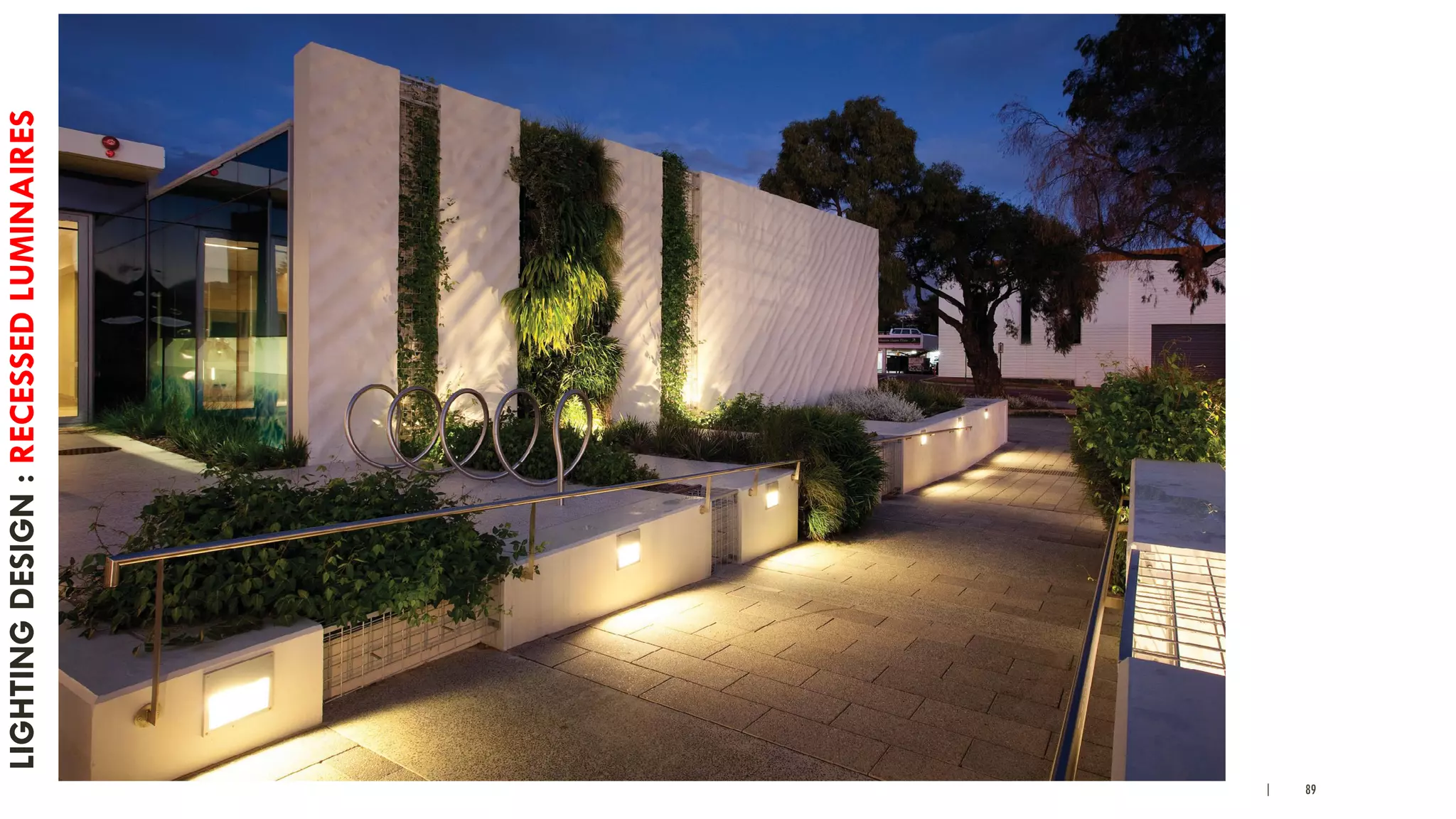
LIGHTINGDESIGN:RECESSEDLUMINAIRES
| 90
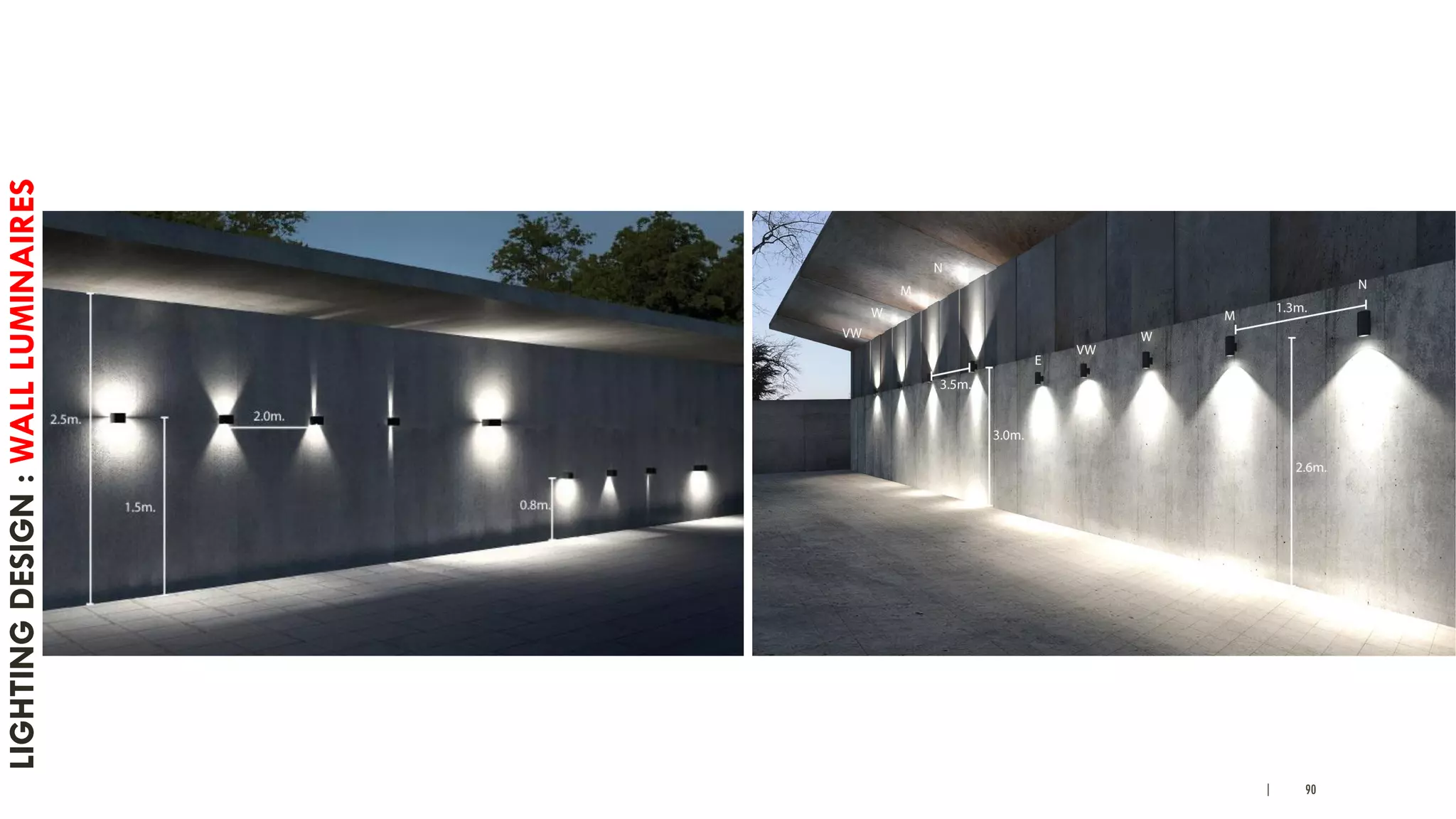
LIGHTINGDESIGN:WALLLUMINAIRES
| 91
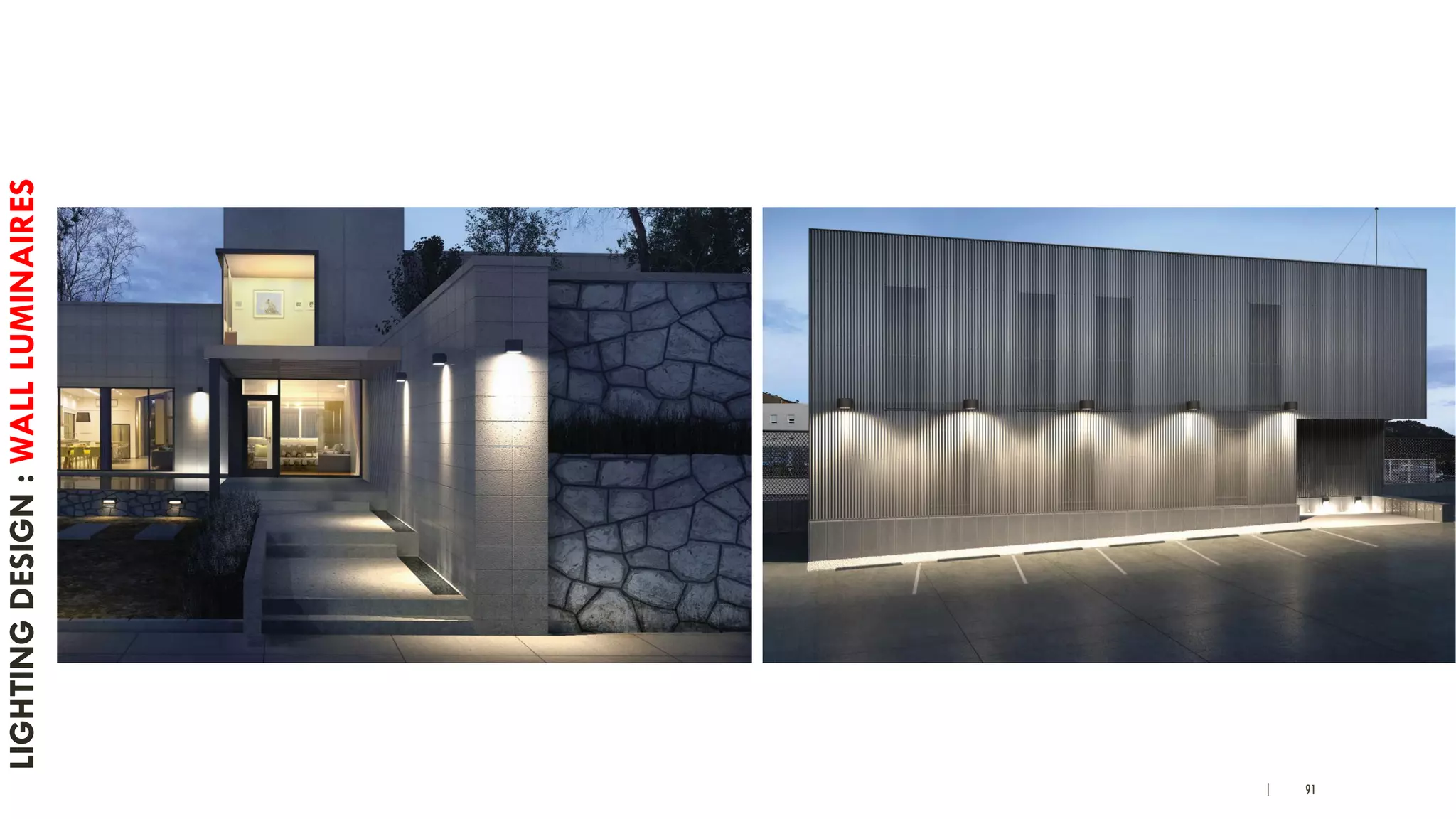
LIGHTINGDESIGN:WALLLUMINAIRES
| 92
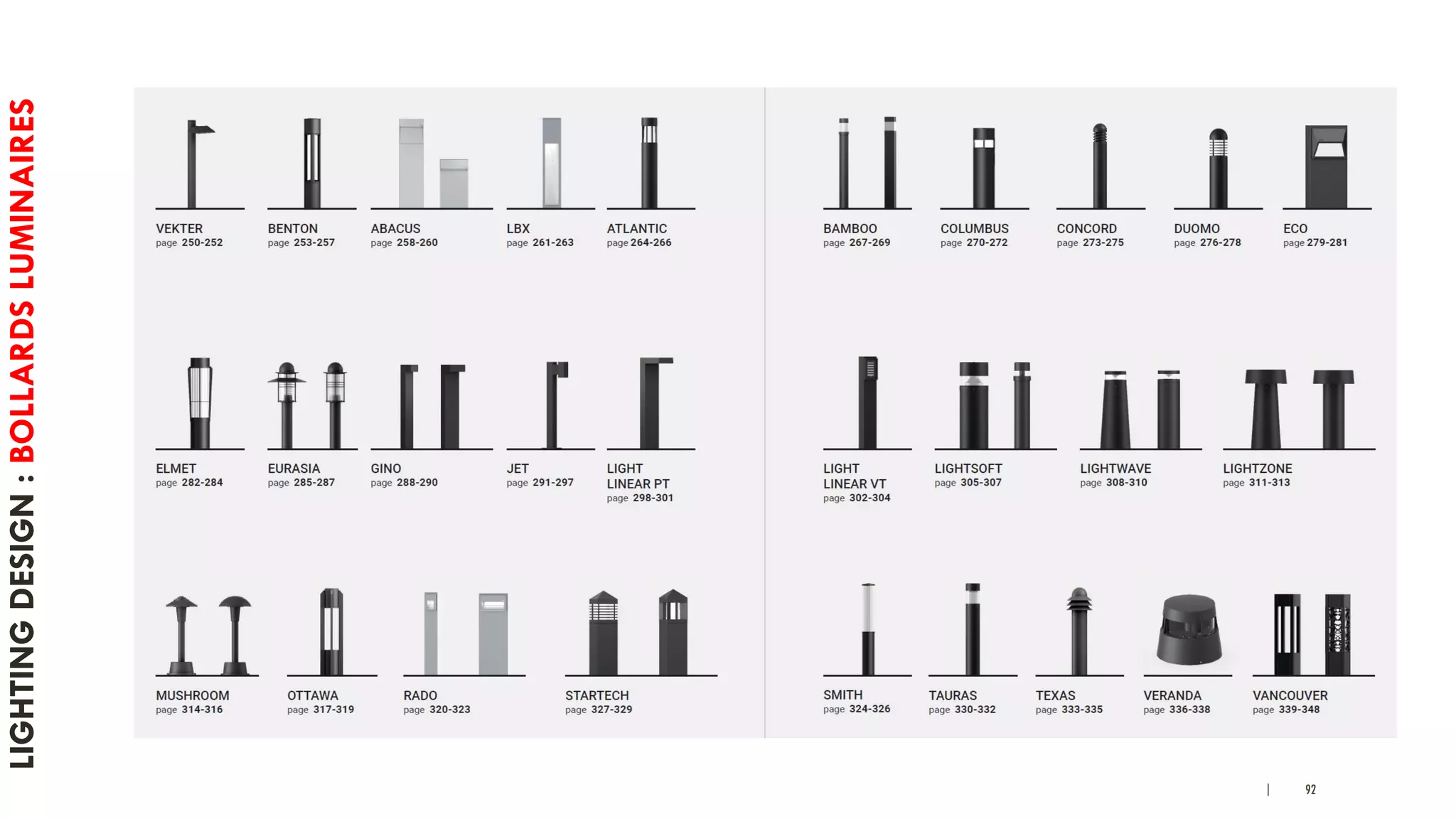
LIGHTINGDESIGN:BOLLARDSLUMINAIRES
| 93
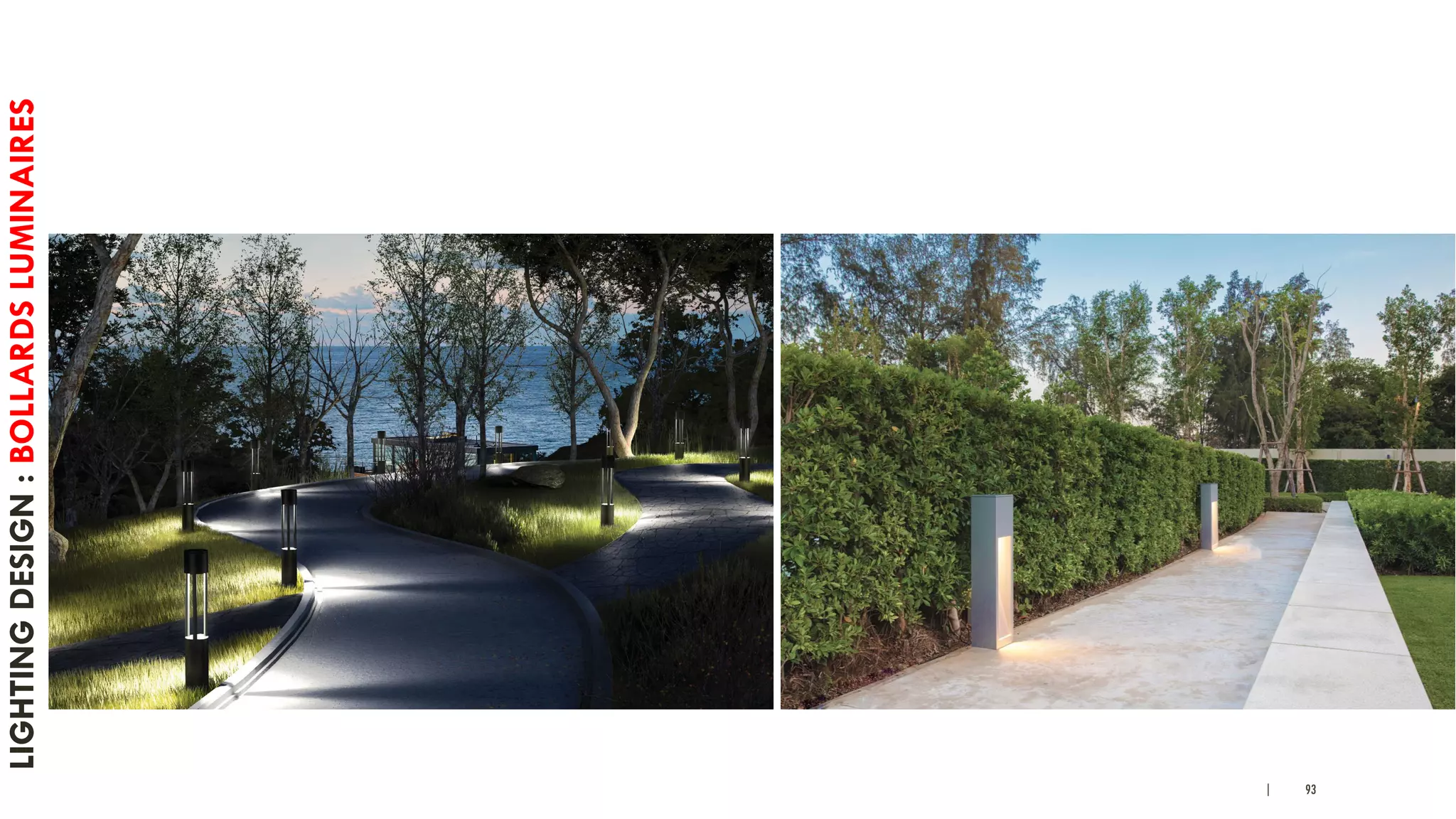
LIGHTINGDESIGN:BOLLARDSLUMINAIRES
| 94
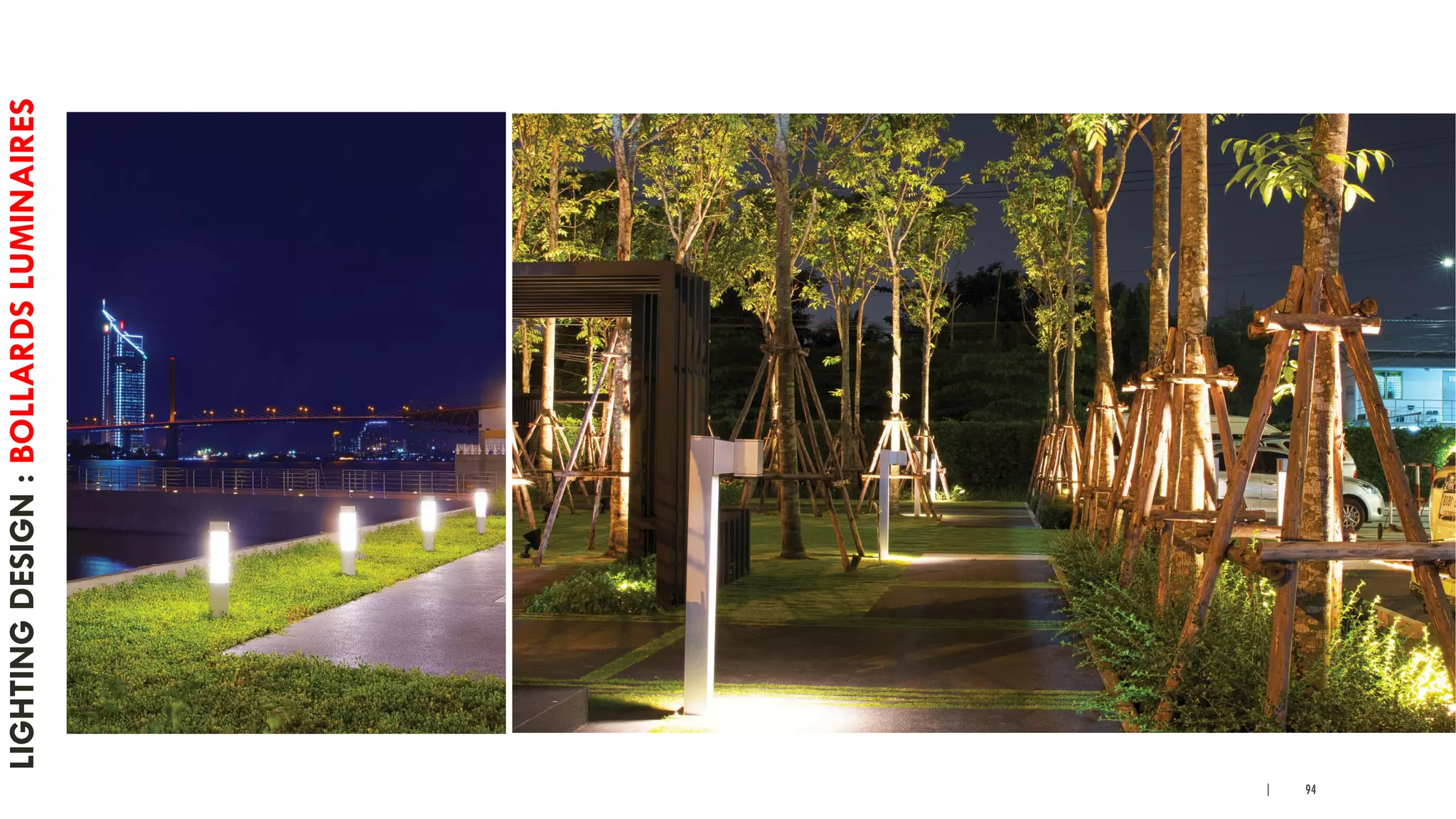
LIGHTINGDESIGN:BOLLARDSLUMINAIRES
| 95
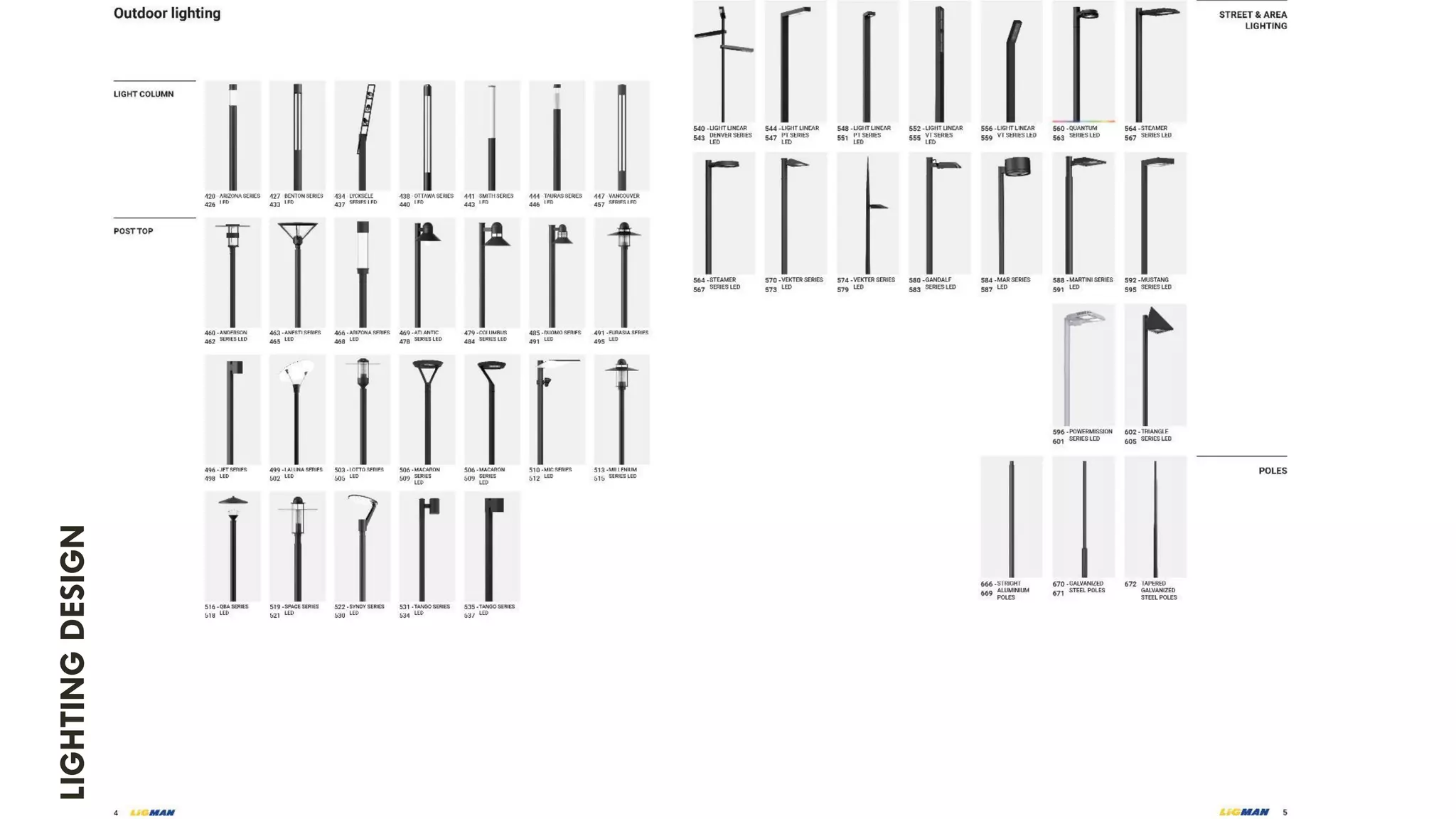
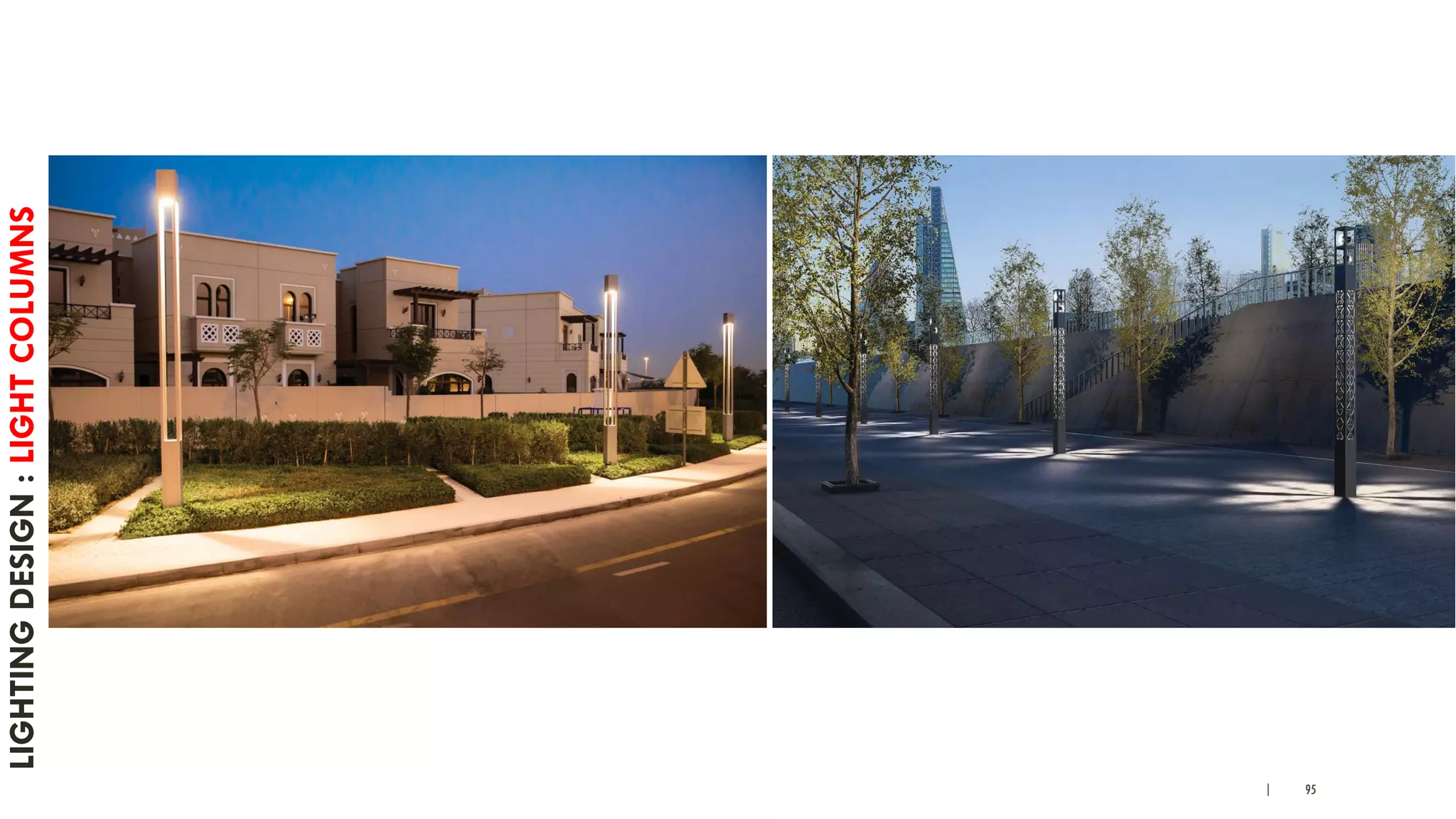
LIGHTINGDESIGN:LIGHTCOLUMNS
| 96
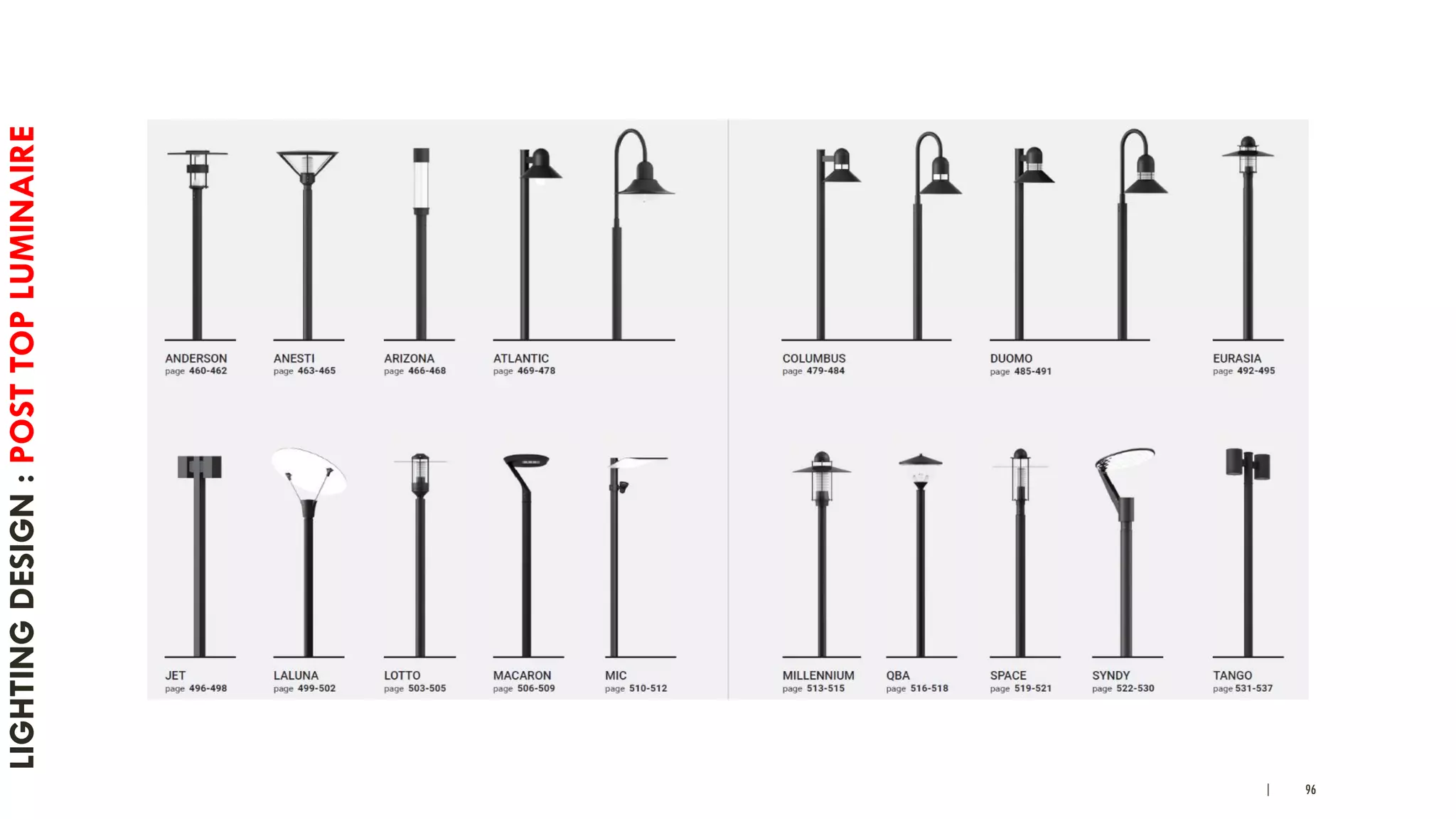
LIGHTINGDESIGN:POSTTOPLUMINAIRE
| 97
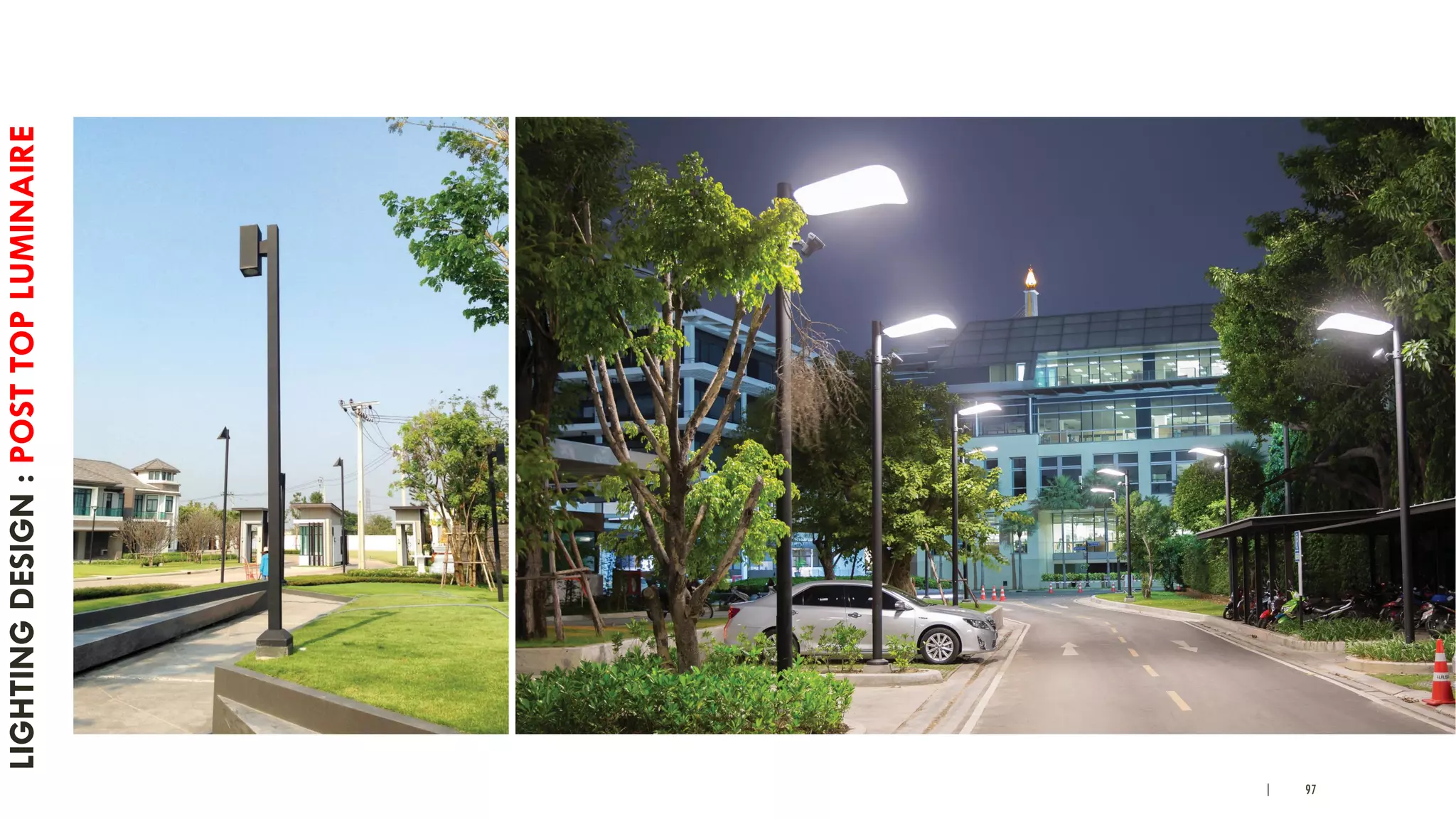
LIGHTINGDESIGN:POSTTOPLUMINAIRE
| 98
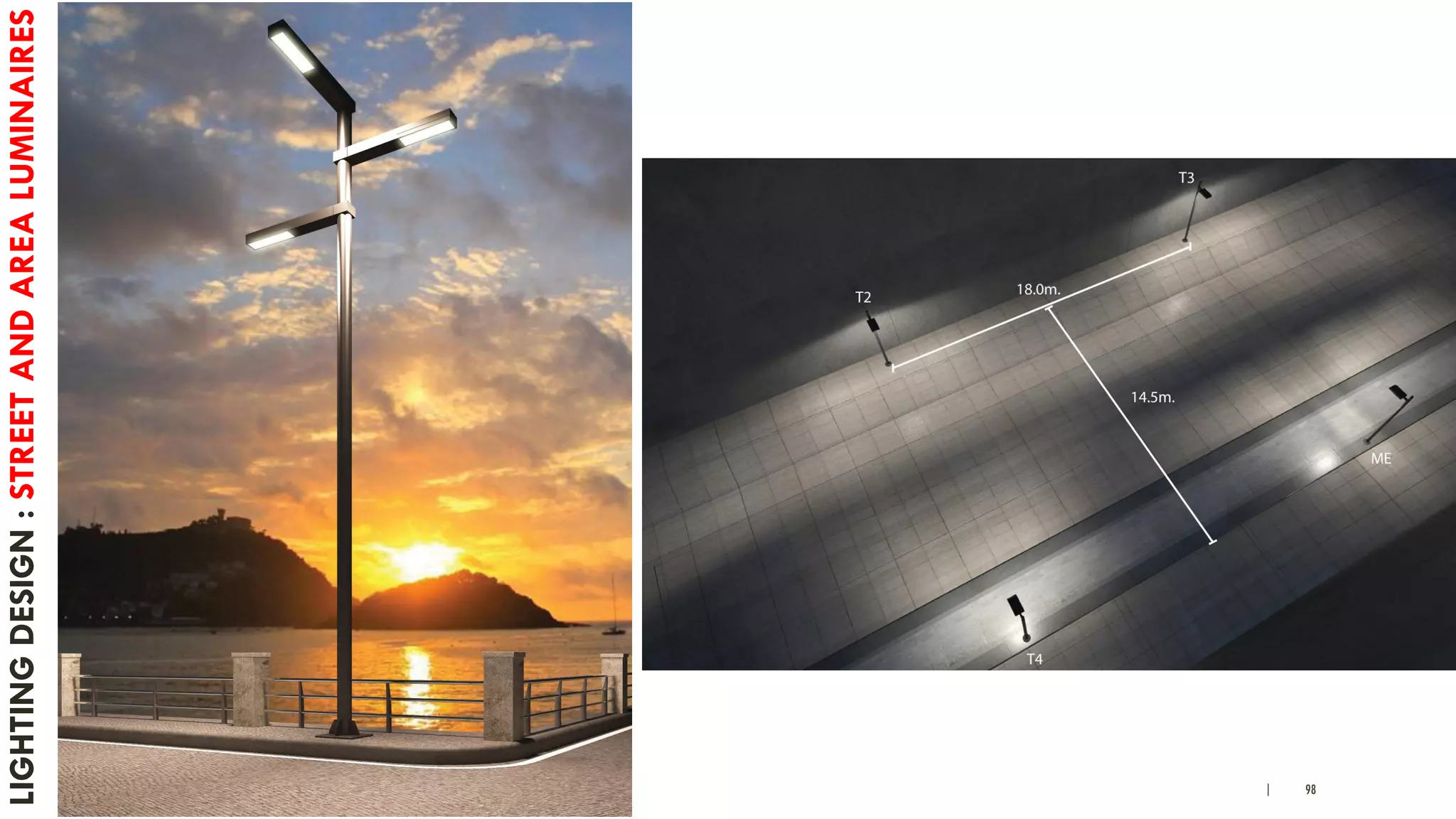
LIGHTINGDESIGN:STREETANDAREALUMINAIRES
| 99
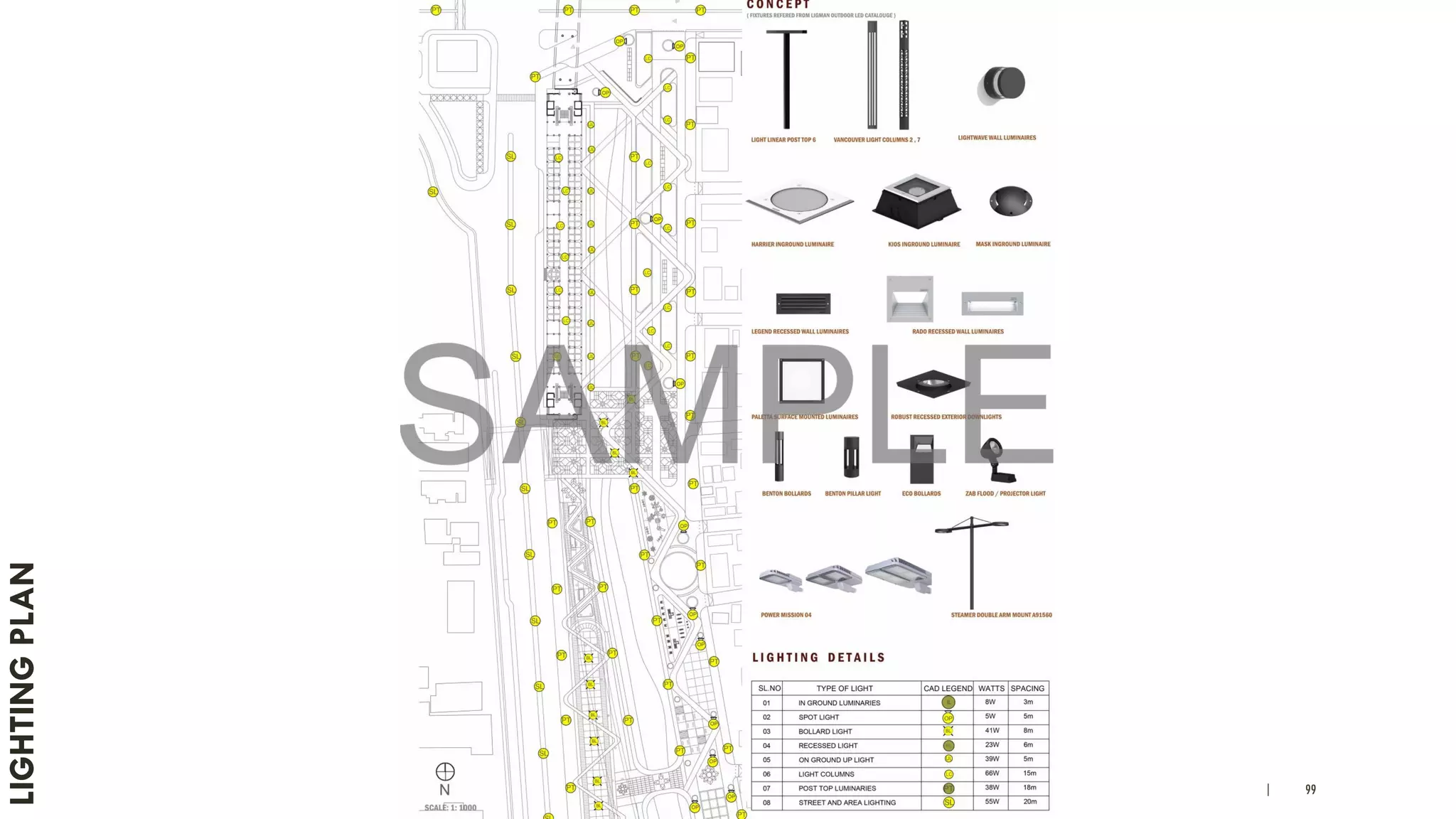
LIGHTINGPLAN
| 100
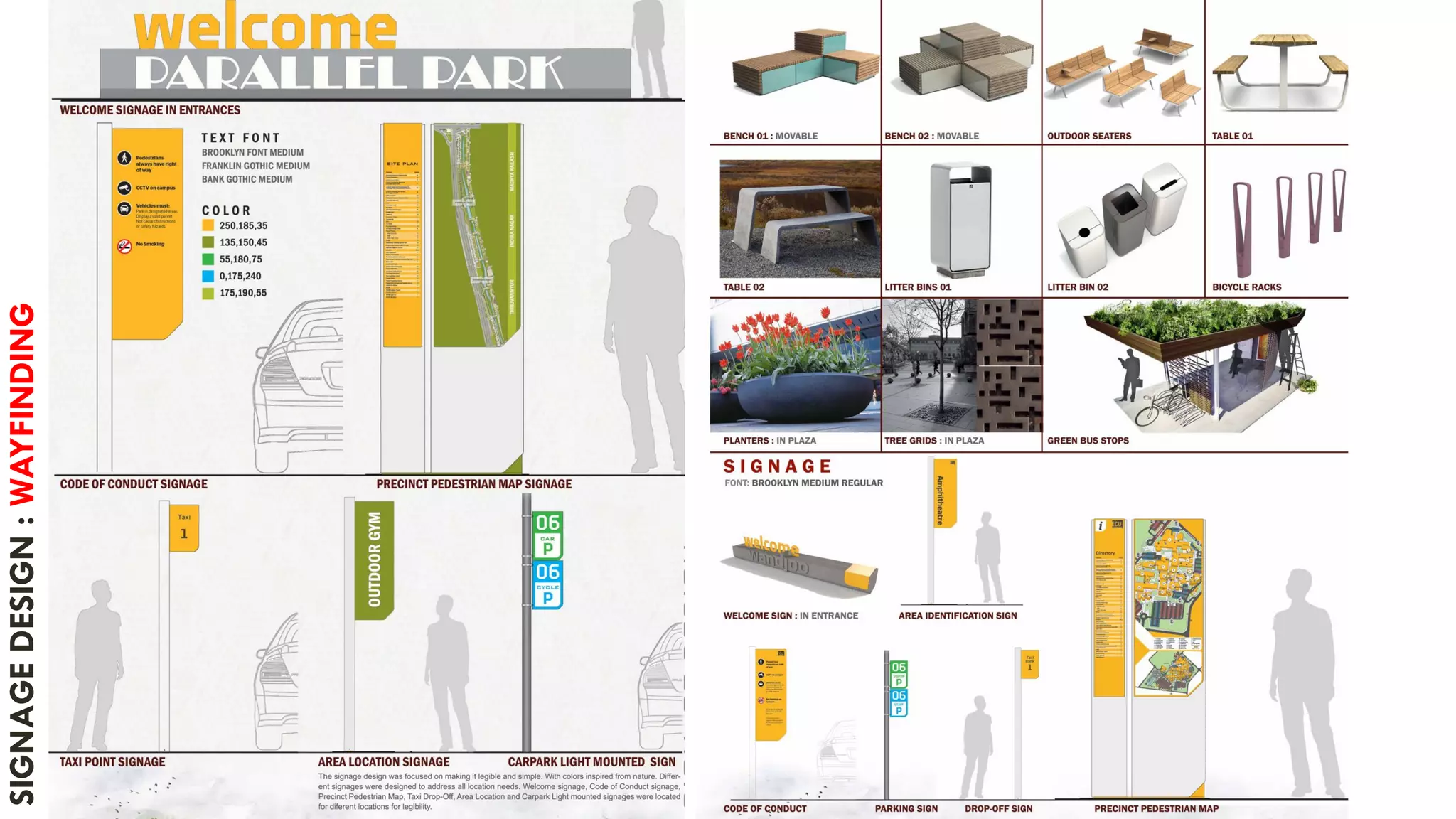
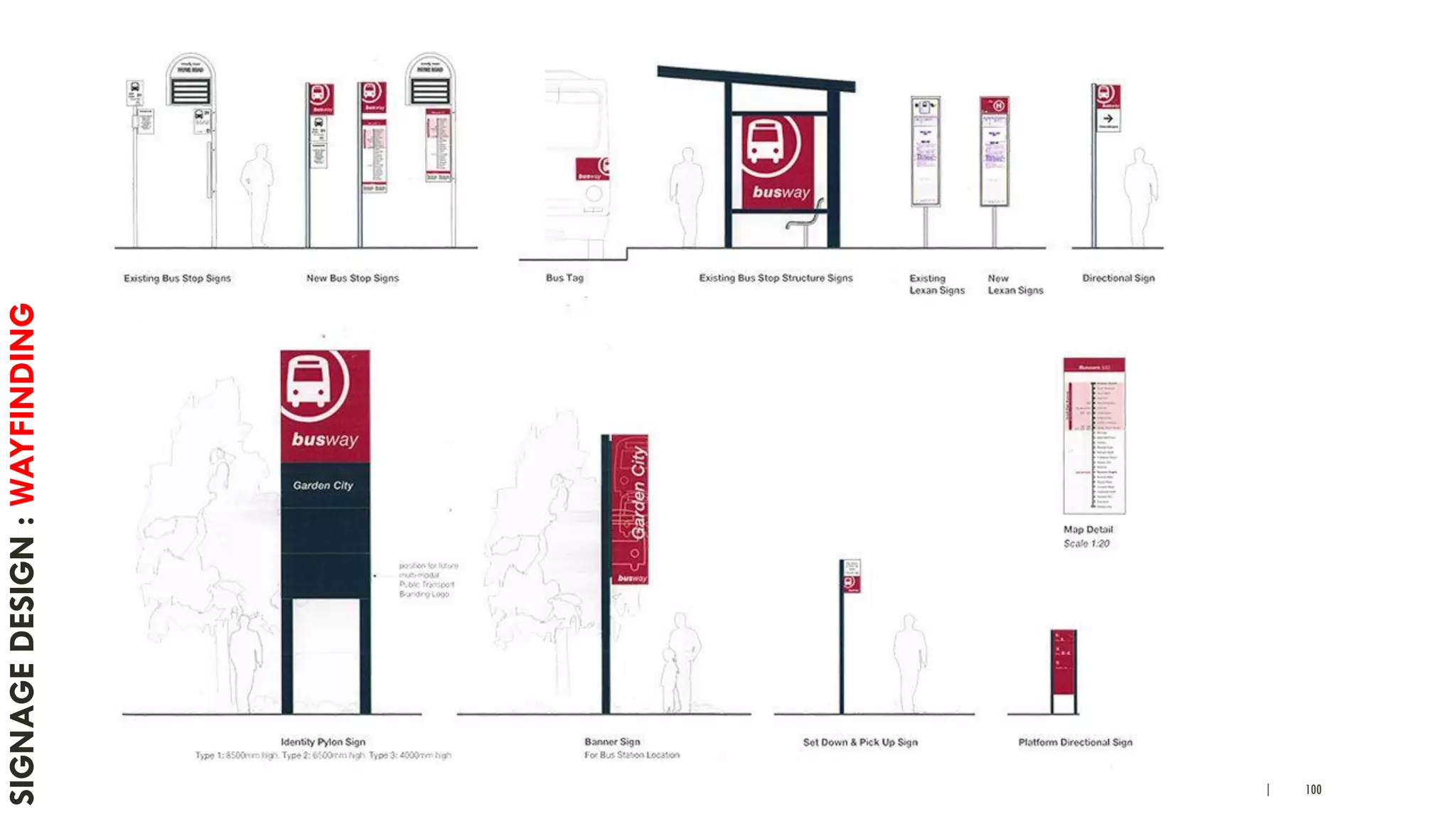
SIGNAGEDESIGN:WAYFINDING
| 101
SIGNAGEDESIGN:WAYFINDING
| 102
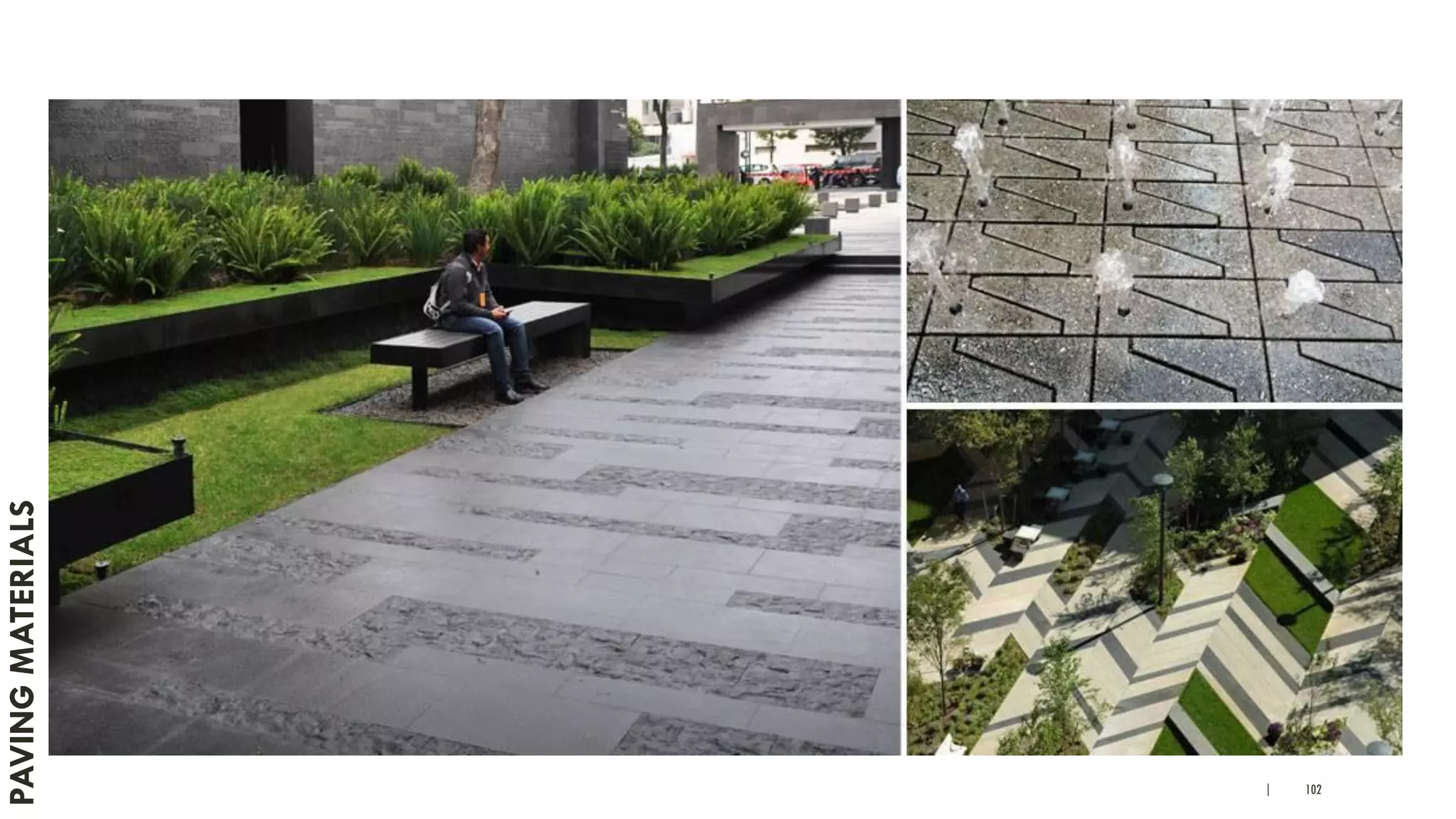
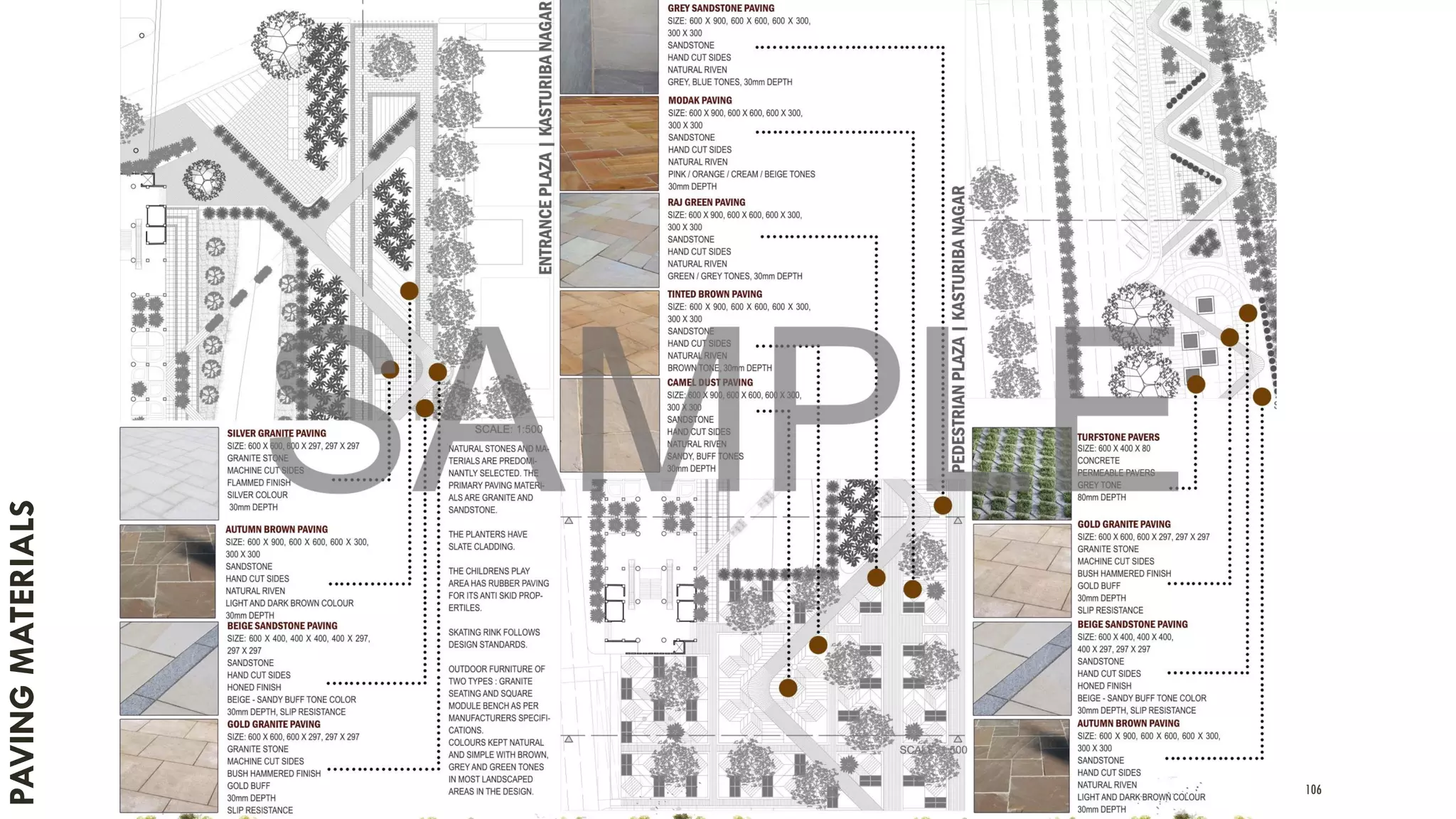
PAVINGMATERIALS
| 103
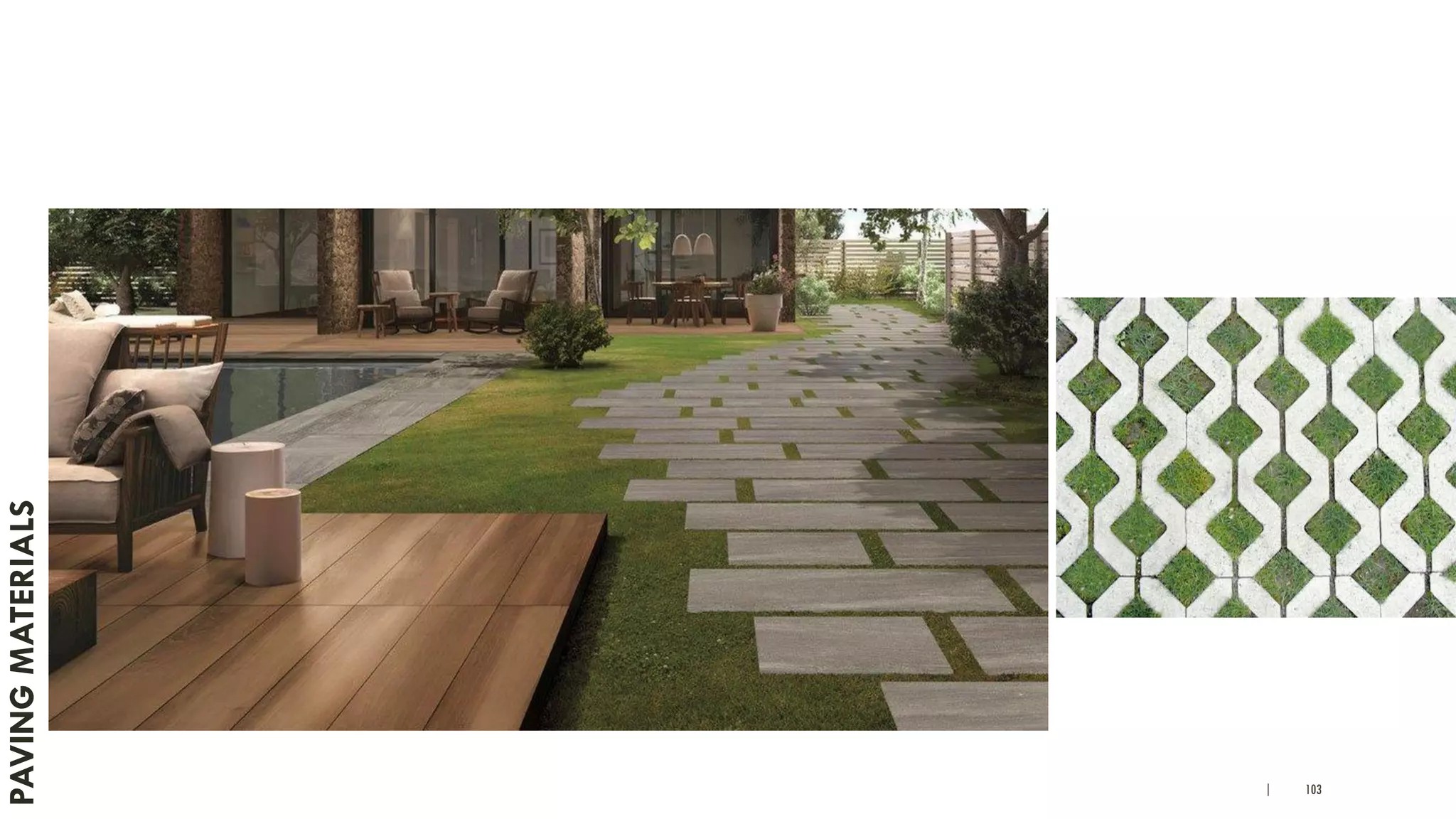
PAVINGMATERIALS
| 104
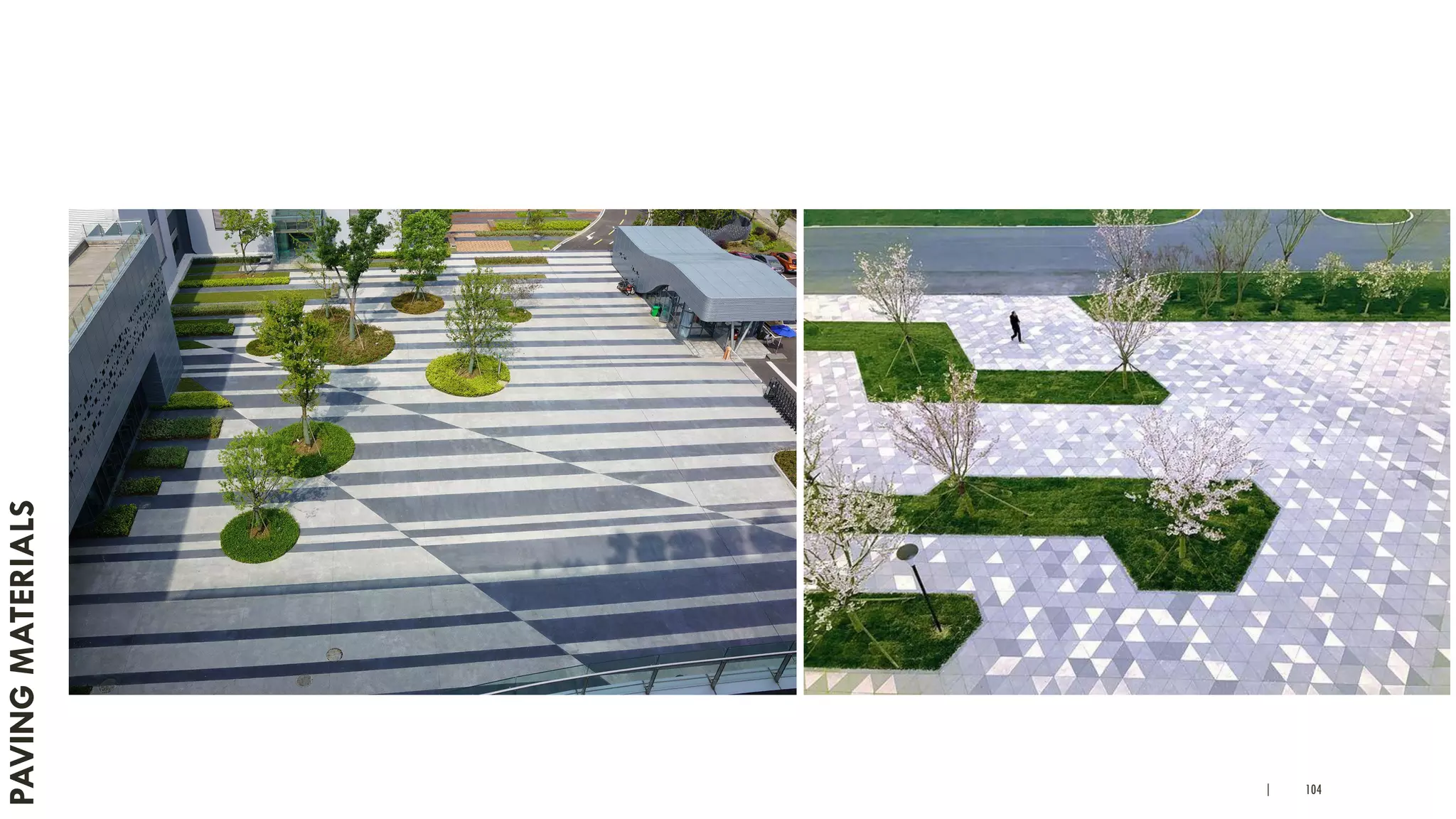
PAVINGMATERIALS
| 105
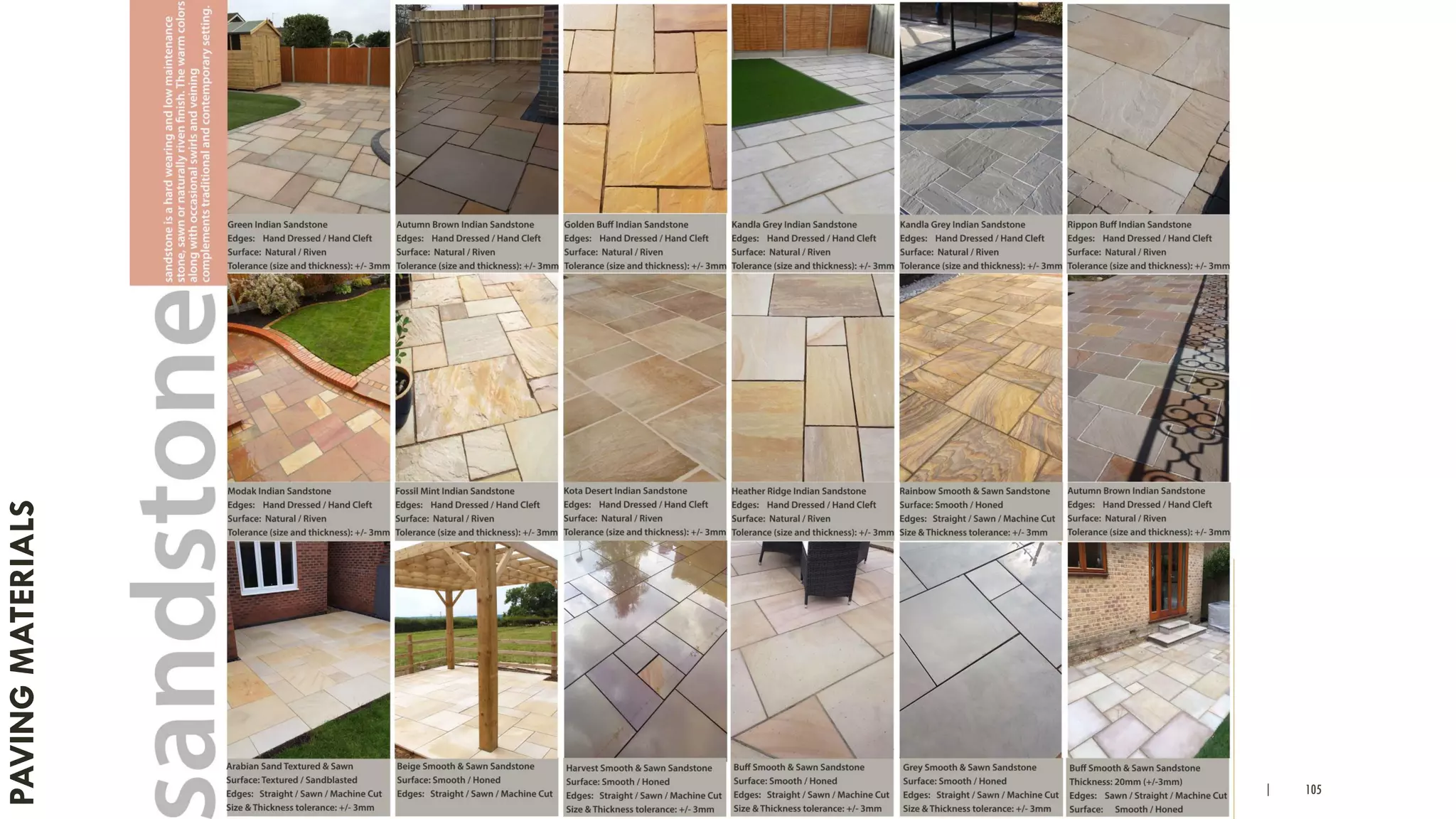
PAVINGMATERIALS
| 106
PAVINGMATERIALS
| 107
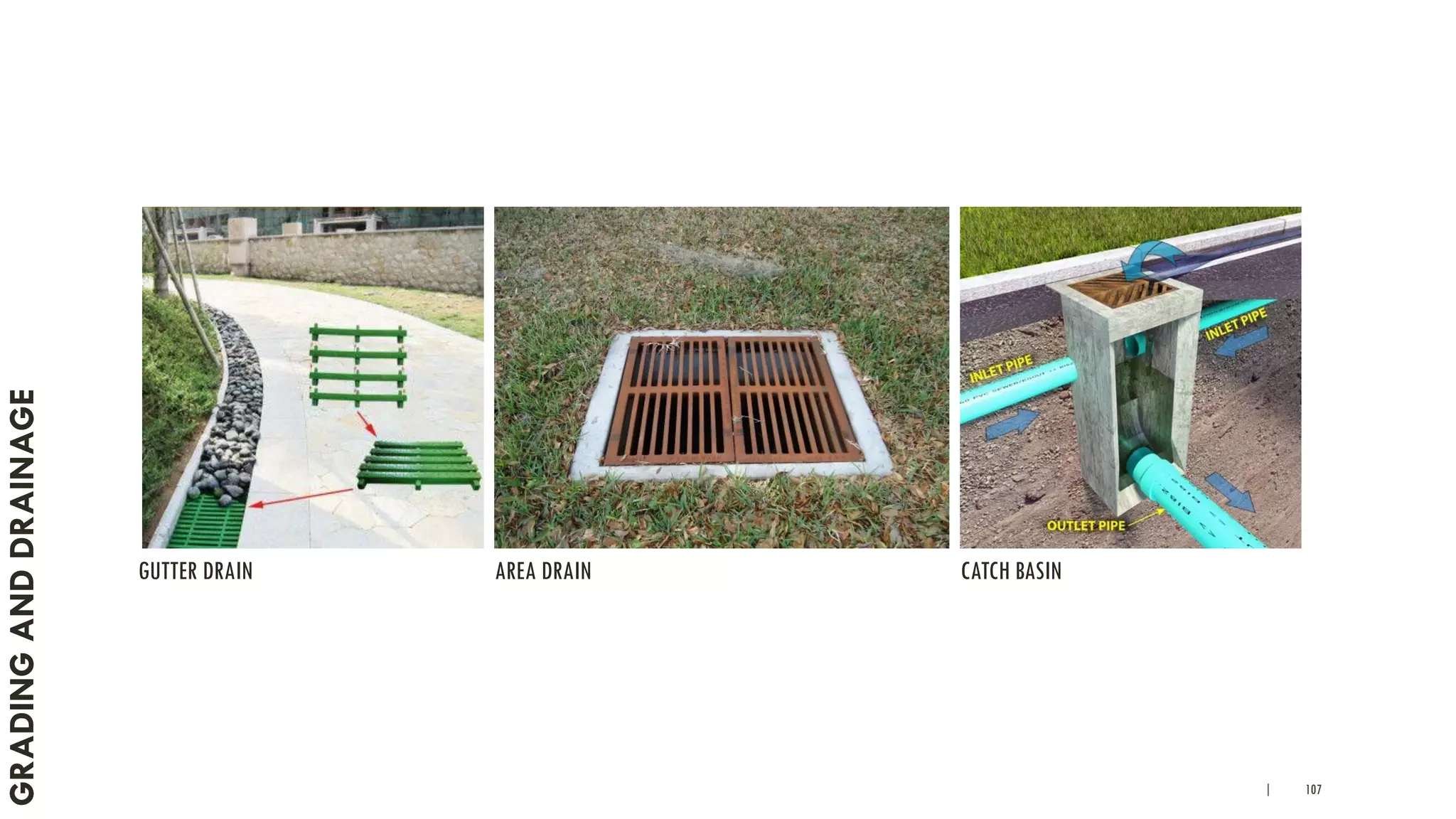
GRADINGANDDRAINAGE
GUTTER DRAIN AREA DRAIN CATCH BASIN
| 108
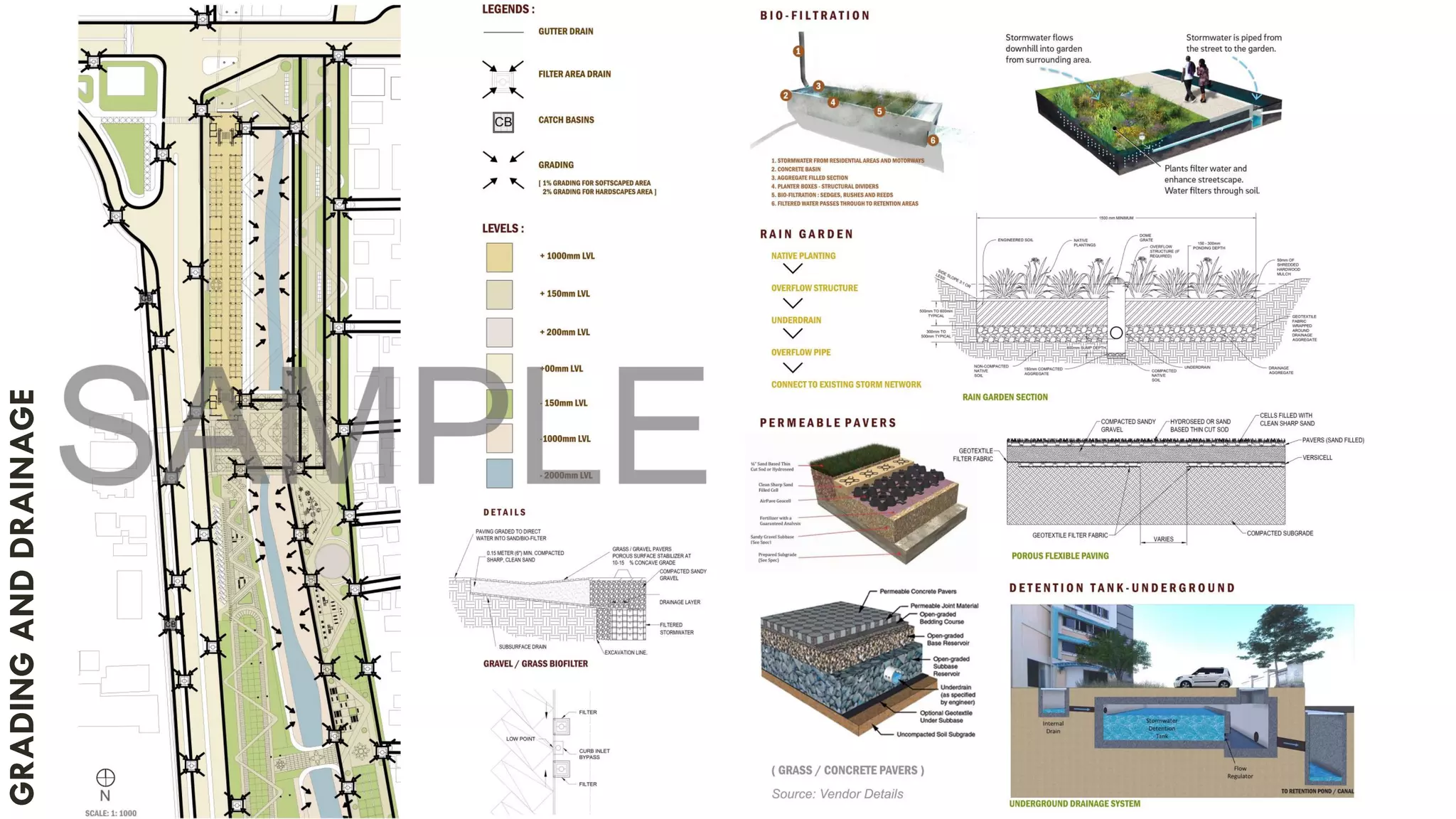
GRADINGANDDRAINAGE
| 109
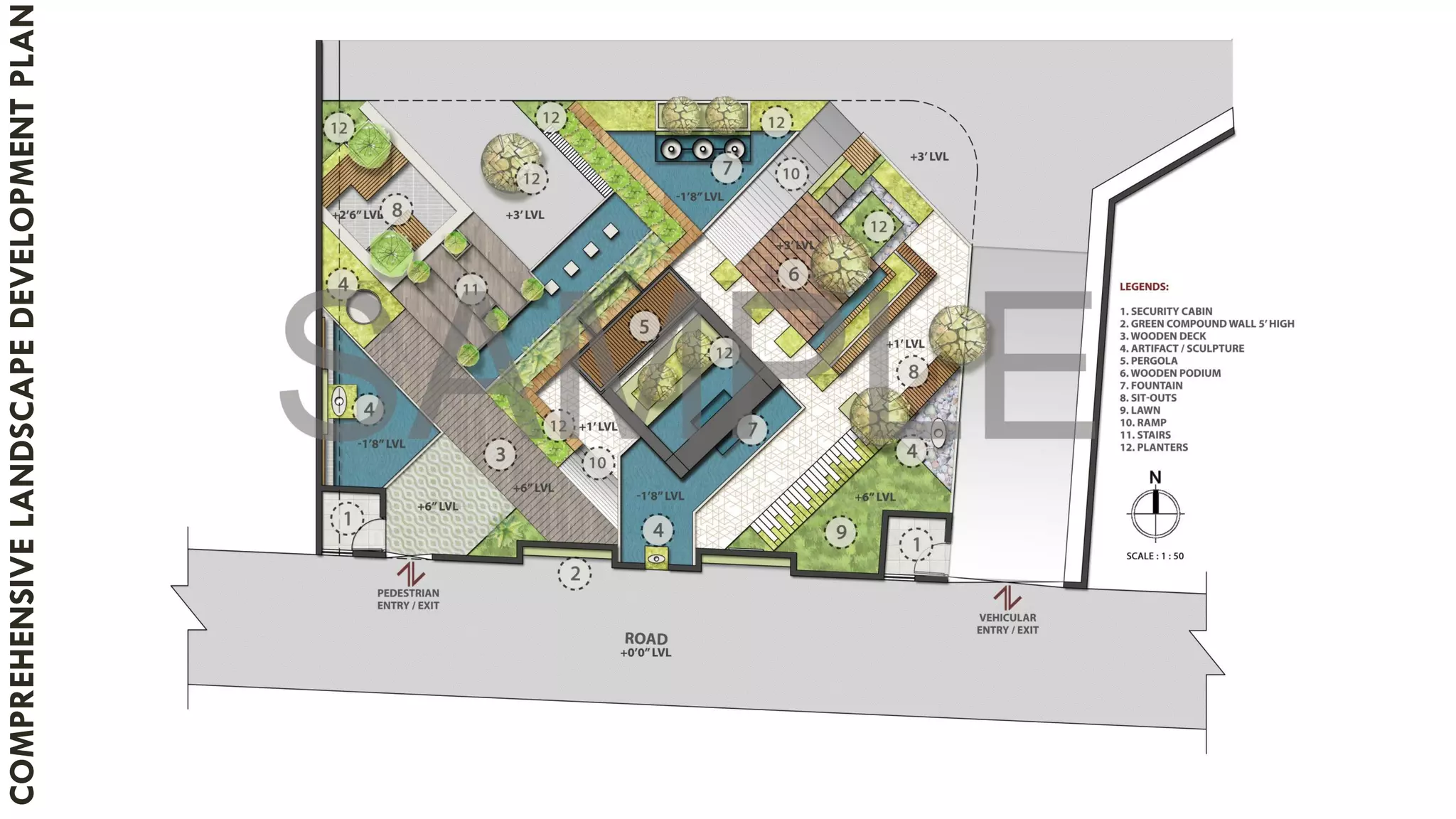
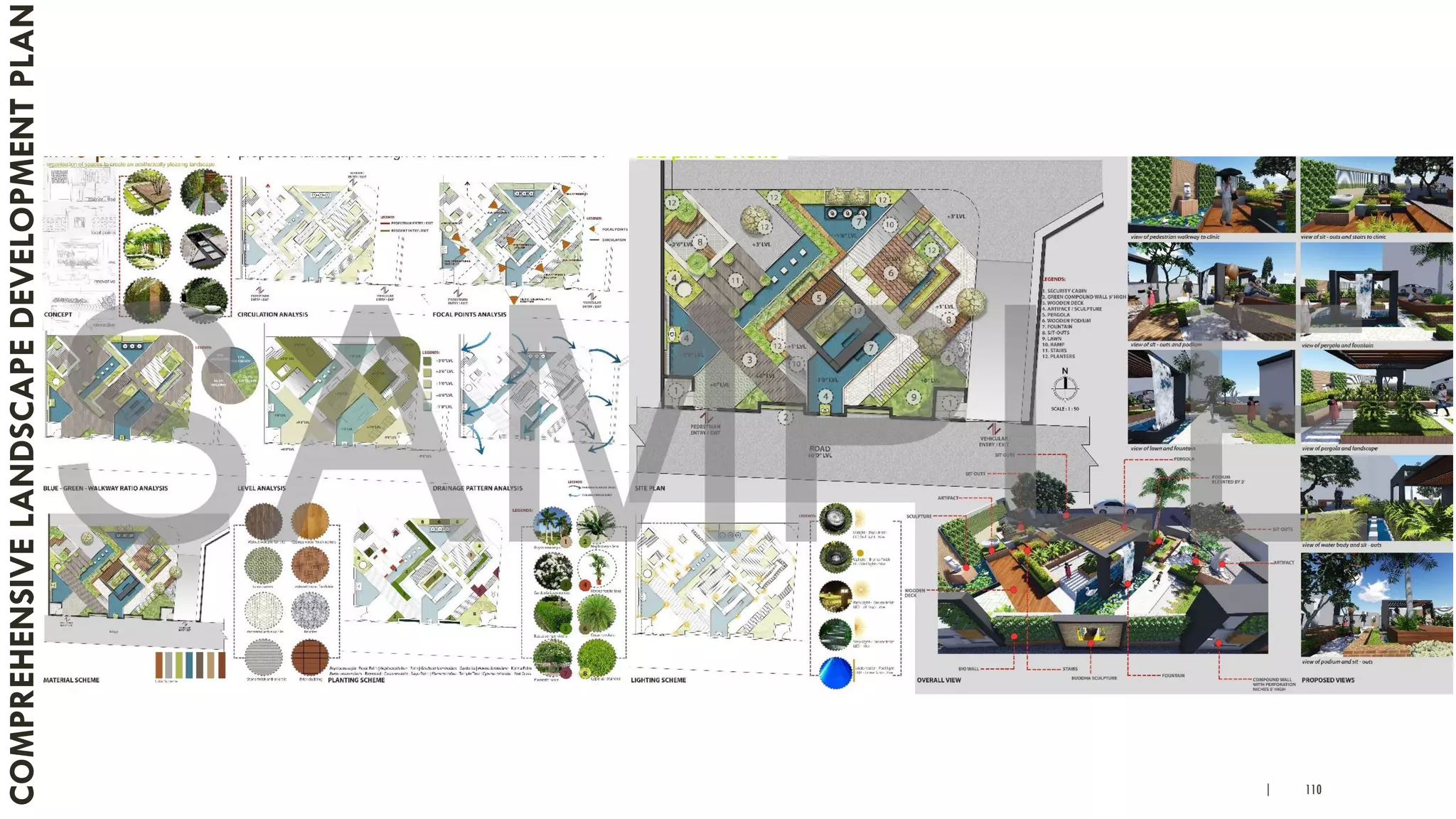
COMPREHENSIVELANDSCAPEDEVELOPMENTPLAN
| 110
COMPREHENSIVELANDSCAPEDEVELOPMENTPLAN
| 111

Unit 02 Elements of Landscape Architecture and Landscape Design

  • 1.
  • 2.
    | 2 UNIT01 INTRODUCTION landscape architecture, ecology, ecologicalbalance, landscape conservation, reclamation and landscaping of derelict lands, environmental impact assessment. UNIT02 ELEMENTS OF LANDSCAPE ARCHITECTURE AND LANDSCAPE DESIGN land elements, land form plants and planting, water, lighting etc. characteristics and classification of plant materials, basic principles of landscape design; Factors to be considered, Use and application of plant materials in landscape design, and other components involved UNIT03 HISTORY OF LANDSCAPE ARCHITECTURE Eastern, Central and Western traditions; Ancient Heritage - Mesopotamia, Egypt, Greece, Rome; Western Civilization – Europe: Italy, France, and England; The middle-east - The Persian tradition and its far reaching influence Eastern Civilization: China and Japan Ancient and medieval period in India; Mughal and Rajput Landscapes and study of contemporary landscape architecture UNIT04 UNIT05 URBAN LANDSCAPE Basic principles and elements of Urban landscape, Significance of landscape in urban areas, introduction to street furniture, road landscaping, waterfront development, landscaping of residential areas, Industrial Landscaping. LANDSCAPE EXERCISE Landscape design of a neighborhood open space (area of 2000 to 3000 sq. meters) OVERVIEW
  • 3.
    | 3 ELEMENTS OFLANDSCAPE ARCHITECTURE • Land Forms • Water & Water Bodies • Vegetation – Plants and Planting • Lighting • Signage • Sculptures • Pavement Materials • Site Amenities • Street furniture
  • 4.
    | 4 LANDFORM • Alandform is a feature on the Earth's surface that is part of the terrain. Mountains, hills, plateaus, and plains are the four major types of landforms.
  • 5.
  • 6.
  • 7.
    | 7 LANDFORM RIDGE: A ridgeor a mountain ridge is a geographical feature consisting of a chain of mountains or hills that form a continuous elevated crest for some distance. The sides of the ridge slope away from narrow top on either side. The lines along the crest formed by the highest points, with the terrain dropping down on either side, are called the ridgelines. Ridges are usually termed hills or mountains as well, depending on size. Ridge – are topographic divides that separate the landscapes into a series of drainage areas called watershed.
  • 8.
    | 8 LANDFORM VALLEY: A valleyis a lower part in the land, between two higher parts which might be hills or mountains. Valleys often start as a downward fold between two upward folds in the surface of the Earth, and sometimes as a rift valley. A valley is made deeper by a stream of water or a river as it flows from the high land to the lower land, and into a lake or sea.
  • 9.
    | 9 LANDFORM –Ridge & Valley
  • 10.
    | 10 LANDFORM WATERSHED: The precipitationthat falls into a valley, and on surrounding area flows downward usually creating a stream or river. The area of land that contributes water to a stream or river is called a watershed, or drainage basin. Watersheds are important in Environmental Management and Land-use Planning.
  • 11.
    | 11 LANDFORM CONTOUR: • Contoursare always horizontal and perpendicular to the dip of the land, i.e. the direction in which water would run at that location; • All contours are closed lines, unless cut off by the margin of the map; • Contours become closer as the slope of the terrain steepens; • If the contour interval is too large, low relief will not be recorded; • Neighboring contours do not cross or touch each other, with the exception of cliffs and overhangs.
  • 12.
    | 12 LANDFORM LANDFORM MANIPULATION/ LANDFORM AS DESIGN ENTITY Landform manipulation is done to attain design solutions regarding, • Landform as a Profile • Landform as Enclosure • Landform as Comfort Slope Consideration, Drainage characteristics, Ventilation
  • 13.
    | 13 LANDFORM asProfile Angular landforms imparts energy and Boldness Sinuous landforms evokes passivity and softness Architectonic Landform: form as straight lines and hard corners Naturalistic Landform: form as undulating lines and no corners. When the landform is established as a system in dialogue with the architecture, then the dynamic interplay of the opposites complement each other through contrast.
  • 14.
    | 14 LANDFORM asa Enclosure More the View-shed increases the Landscape becomes expansive and the grain becomes coarser. More the View-shed decreases the Landscape becomes enclosed and the grain becomes finer. Ridgelines and Promontories are visually open zones, though they do offer a panoramic views, they themselves are visible from a great distances. Military crest or the Valley view, give a feeling of centrality because views from the surrounding slopes are focused downwards in to the valley. The space enclosed that can be seen is called the View-shed
  • 15.
    | 15 LANDFORM forComfort Ventilation When the valleys and ridgelines orient along the direction of seasonal airflow, the valleys are relatively well ventilated. When the wind flow direction is perpendicular some of the wind can blow over and the valley is said to be in the wind shadow region. Topographic relief functions as a barrier to and deflector of airflow. As wind blows along the surface its velocity is affected by the shape of that surface.
  • 16.
    | 16 LANDFORM forComfort Ventilation As a designer the site can be resculpted to funnel desirable breeze into use areas, while protecting the same areas from undesirable winds.
  • 17.
    | 17 LANDFORM Landform isa very important component of the landscape designer’s palette. It contributes to • The Sense of a Region • Surface Drainage • Gravity Flow Infrastructural Systems • Physiological Comfort
  • 18.
  • 19.
  • 20.
    | 20 WATER Water flowsinevitably from the source to the receiving ocean basin. Young River is characterized by heavy erosion, waterfalls, rapids, speed of water flow Mature River is characterized by relatively lower erosion, and the reduction of speed of water causes deposition of the silt thus creating fertile flood plains. At old stage the river becomes relatively very sluggish and rate of deposition is very high. The river here forms a delta before draining its water into the river.
  • 21.
    | 21 Stages inthe life of the river: Youthful River Mature River Old River WATER
  • 22.
    | 22 WATER asa design element Elements of Visual Design The particular characters of • Line • Form • Color • Texture & • Sound
  • 23.
    | 23 WATER asa design element Line: The character of line formed by the Water Land Interface has a major impact upon the images water evokes in the mind of the beholder.
  • 24.
    | 24 WATER asa design element Form: The form of the water feature can be to • Accentuate The Flow Of Water • Convey A Sense Of Centrality • A Sense Of Arrival The form can be a complex combination of differing characters, thereby bringing together disparate elements. The form can be simple and uniform to convey a more unified sense
  • 25.
    | 25 WATER asa design element Colour: Good quality water is relatively clear. Takes on the colour imparted by reflections carried upon its surface, and also the colour of the container.
  • 26.
    | 26 WATER asa design element Texture: Texture into flowing water can be brought about by turbulence. Constriction to water flow or protrusion into flowing water causes turbulence. Smooth surface yields glassy sheet flow Overlap produces horizontal frothy rhythm Stair steps create myriad of droplets, each reflecting light source. Horizontal ribs create agitated frothy surface
  • 27.
    | 27 WATER asa design element Cascades & Waterfalls Naturalized Cascade Cast pools & Waterfalls
  • 28.
    | 28 WATER asa design element Cascades & Waterfalls Step Related Cascade Falling water is animated and produces musical sound. Fountain & Cascade
  • 29.
    | 29 WATER asa design element Fountains & Jets Pedestals, Jets & Basins Inlets can be designed to bring the desired effect. Wall Fountains
  • 30.
  • 31.
    | 31 WATER :Fundamentals related to Water Edge Design Docks, Decks, Overlooks, Terraces, Balconies, can be used to attain desired access to water Where the banks and shores are stable, minimum disruption is the best Habitable structures should be built above 100 year flood stage, wind driven surfs must also be considered. Maintain smooth flow, avoid using elements that obstruct currents or wave actions.
  • 32.
    | 32 WATER :Fundamentals related to Water Edge Design A stream in plan is a lineal element, hence align paths of movements, and structures in harmony with the line of flow. Stream crossings are costly and disruptive if not designed well. They best occur where channel is narrow and the banks are high and stable.
  • 33.
    | 33 PLANTING DESIGN •Plantingdesign is one of the essential tools in making and managing a living environment where plants play a significant role in the development of a lively, resilient, complex and sustainable landscape. •It helps us to restore and maintain a sustainable relationship between people and their environment in a context of change.
  • 34.
    | 34 PLANTING DESIGN: Plant Material as Process Plant materials are the products of biological processes operating in a specific place and time. They depend on their context, and over time the community of plants co- evolve with the specifics of this context. • Sunlight • Water • Nutrients • Appropriate Temperatures These are some of the necessary factors for the plants to survive & thrive. Any change in the amount or character of any of these factors, it becomes a factor that limits the growth of the plant community. Sunlight, Water, Nutrient, Environment and other variables together holistically define Habitat of the plant community. Change in the environment changes the plant community, Plant community can also change the environment.
  • 35.
    | 35 PLANTING DESIGN: Plant Material as Process Succession Conceptually succession refers to the natural tendency of biological systems to change over time in response to available energy and resource. • Successional Pioneers – Colonize Harsh Environments • Early Successional Community – These have low diversity and are relatively randomly distributed plants. • Late Successional Community – these plants depend on the efficiency as an ecological strata. Successional processes also have spatial implications. As plant communities and environments change together over time, they evolve inter-related spatial patterns.
  • 36.
    | 36 PLANTING DESIGN: Plant Material Characteristics and Classification  The structural/ spatial characteristics of plants are those that contribute to the space structure of the landscape. They include habit, crown shape, foliage density and speed of growth, and en masse they determine the spatial composition of the planted environment. - Nick Robinson •When we are designing spaces for people, the size of plants relative to the dimensions of the human figure is critical. •Simply to distinguish areas on a plan by canopy height amounts to an important design stage, because it is height that determines much of the spatial framework and controls vision, movement and physical experience. •Danish landscape architect Preben Jakobsen identified the most useful size categories for the designer as • ground level, •up to knee height, •knee to waist height and •below or above eye level
  • 37.
    | 37 PLANTING DESIGN: Plant Material Jakobsen – 5 types of planting based on human dimensions •Ground level -Mown grasses and other turf plants, ground- hugging and carpeting herbaceous plants and shrubs. •Below knee height - Prostrate and dwarf shrubs, sub- shrubs, low- growing herbaceous plants. •Knee–waist height - Small shrubs and medium growing herbaceous plants. •Waist–eye level -Medium shrubs and tall growing herbaceous plants •Above eye level - Tall shrubs and trees
  • 38.
    | 38 PLANTING DESIGN: Plant Type Ground level - Mown grasses and other turf plants, ground-hugging and carpeting herbaceous plants and shrubs. •Very close to ground level and a few centimeters thick USES •They neither obstruct vision nor movement •These plants could visually connect two related areas. •They hug the contour of the land and also highlight them. •They also provide for pedestrian circulation space although not as sturdy as a pavement. •On even, firm ground carpeting plants can provide a pedestrian circulation surface, although less hard-wearing than a pavement- form surfaces suitable for relaxing, walking, play, sport, cycling and occasional vehicles. •This durability accounts for much of the value and popularity of lawns, meadows and other grasslands in both public and private landscape. •A uniform carpet of mown grass or ground-hugging, smooth-textured groundcover can be used to enhance the visual effect of ground modeling by closely following the contours. Breaks of slope can be emphasized by a change to a groundcover of contrasting foliage. •Ground level vegetation can be used to make two-dimensional patterns. •Carpets of foliage, used alone or combined with boulders, gravel and paving materials, form a tapestry of colour, texture and pattern across the ground surface.
  • 39.
  • 40.
    | 40 PLANTING DESIGN: Plant Type •Below knee height plants - Shrubs and herbaceous plants that form a higher canopy but still below knee height have further possibilities in spatial design. •Many of them come within the category of ‘groundcover’, thatis,species that are well adapted to the local conditions and competitive enough to exclude most of the unwanted self colonizing ‘weed’ plants. USES •In addition to this labour-saving benefit, low planting has the spatial role of allowing freedom of vision while defining an edge and deterring (though not preventing) movement. •Deters movement and allows for Visual continuity •It can form a carpet of foliage below taller plants and also create patterns when viewed from above •It can form a carpet of foliage below taller plants and also create patterns when viewed from above •It also edges taller growing shrubs •Climbing species can also create a Vertical barrier as per the design intent •It can link horizontal and vertical planes
  • 41.
  • 42.
    | 42 PLANTING DESIGN: Plant Type •Knee to eye level plants - Planting that grows to between knee height and eye level can have a similar design role to a low wall, fence or rail. •It becomes a barrier to movement and can be used to limit access but it leaves views open and makes little difference to sunlight. This opens up a number of spatial uses for medium-height planting USES •It can acts as an effective separator between safe and hazardous areas •It obstructs movement but allows vision •Such plants can emphasis direction and circulation •They can also define territory •They can provide a minor visual focus •They can improve privacy within buildings
  • 43.
  • 44.
    | 44 PLANTING DESIGN: Plant Type • Above eye level height plants - Shrubs and small trees with a canopy extending above eye level form a visual and physical barrier. •So tall planting with a close knit canopy can, in a similar way to a wall or fence, separate, enclose, screen and shelter on a smaller scale than is possible with larger tree planting. •The sizes of trees are of the same order of magnitude as buildings, roads, bridges and smaller industrial developments. Tree planting can therefore be used for screening, separating, sheltering, enclosing, accompanying and complementing these larger structures. USES •They make an important design element which acts like a physical and visual barrier •They can also proved as a backdrop for display planting •They also provide privacy and shelter •The taller plants also accompany smaller buildings •Above eye level plants act as effective elements which can frame a vista or a landmark •As an individual element they can also make a specimen or a visual focus.
  • 45.
  • 46.
    | 46 PLANTING DESIGN: Plant Type •Tree planting : For design purposes it is helpful to divide trees into •Small height trees which are about 5–10metres in height. •Medium height trees which are 10–20 metres in height •Tall trees which area 20 metres and above in height. • Small Trees •Small trees are of similar height or lower than the majority of buildings of two storeys, so their influence in the urban environment is mainly local to the spaces between buildings. •Medium Trees •Medium trees can create spaces that contain smaller buildings and therefore have a greater effect on the spatial structure of urban landscape. •Tall trees •Tall trees are less common in urban areas because of the space they demand, although naturally tall growing species are often planted in streets and gardens only to be lopped or pruned once they begin to shade or dominate nearby buildings. •The size of trees over about 20 metres enables them to form the part of the primary spatial structure of streets, squares and parks. In the rural landscape large trees create a large-scale framework.
  • 47.
  • 48.
  • 49.
    | 49 PLANTING DESIGN: Plant Canopies •Tree canopy – shrub layer – field layer •Tree canopy - shrub layer - field layer ( woodland edge) •Tree canopy – shrub thicket •Tree canopy – field layer •Shrub layer – field layer •Tree canopy •Shrub thicket •Field layer
  • 50.
    | 50 PLANTING DESIGN: Plant Canopies •Tree canopy – shrub layer – field layer •Tree canopy - shrub layer - field layer ( woodland edge) •Tree canopy – shrub thicket •Tree canopy – field layer •Shrub layer – field layer •Tree canopy •Shrub thicket •Field layer
  • 51.
    | 51 PLANTING DESIGN: Plant Type The elements of spatial composition – spaces in 4 aspects • Boundaries • Focus central goal • Directionality • Domain
  • 52.
    | 52 PLANTING DESIGN: Plant as Design Element In designing the plant material can be very a visual element : • Plant material establishes the visual character of the space • Plant materials also lend a temporal and sensual character to any space. • Plant material can also be a environmental indicator. Visual Aspects • Line • Form • Colour • Texture Temporal Aspects • Seasonal Character • Growth and Succession • Sequential Space Plant Strata & Size • Large & intermediate trees • Small and Flowering trees • Tall Shrub • Intermediate and Low Shrub • Ground Cover Spatial Issues • Spatial Enclosure • Spatial Type • Spatial Depth • Enframement • Plant Material & Landform
  • 53.
    | 53 PLANTING DESIGN: VISUAL ASPECTS : LINE Line character that plant materials introduce can range from sinuous, evolving lines of nature to the regularly spaced straight and geometric lines of architecture. Plant material in a straight line can introduce linearity and indicates work of man. Planting to link visually the adjacent structure Line character whether naturalistic or architectonic contribute to the feeling of the space.
  • 54.
    | 54 PLANTING DESIGN: VISUAL ASPECTS : FORM Fastigiate Plants accentuate the vertical. They often serve as focal points in Design Composition. Columnar Form are same as the Fastigiate but are rounder on the top. Round Plants, the most common plants form the bulk planting in a design composition. Since they are non- directional, they provide a context for the directional forms. TaxusbaccataCupressussempervirens
  • 55.
    | 55 PLANTING DESIGN: VISUAL ASPECTS : FORM Spreading Form accentuate the Horizontal. They can be used to extend architecture to the site. Pyramidal Form, have a formal architectonic character. They lend rigidity and permanence to composition. Weeping Plants generally occur in wet areas. Their form can be effective if they are silhouetted against or allowed to cascade over architectural forms, or near water bodies. OakTreeSophorajaponica
  • 56.
    | 56 PLANTING DESIGN: VISUAL ASPECTS : FORM Tabulate Forms, Many trees and shrubs have habits of branching in which foliage is held in horizontal layers. Tabulate and spreading forms give trees and shrubs a stable quality, but with lightness rather than weight in character, because the tiers of foliage are held high and admit light and air between the branches. Palm Form, It consists of a tall straight main stem or stems with all leaves arising in a rosette from the single growing point at the stem tip. Succulents And Sculptural Form, Used singly and in small groups, they should be handled like sculpture. Planted in large numbers, they create a landscape wholly distinct from the everyday human surroundings, and that brings an exhilarating atmosphere of the arid, often hostile, environments from which they originate. TerminaliamantalyRoystoniaregia
  • 57.
    | 57 PLANTING DESIGN: VISUAL ASPECTS : FORM
  • 58.
    | 58 PLANTING DESIGN: VISUAL ASPECTS : TEXTURE •Texture, like form, depends on viewing distance. When seen from a moderate distance a plant’s visual texture is the result of the size and shape of its leaves and twigs. The larger the leaves and the more stout the twigs, the coarser the texture. •FINE TEXTURE •The finest textured plants are those with the smallest leaves or leaflets and the finest, most closely packed twigs. Fine-textured plants tend to be easy to look at, that is, relaxing rather than stimulating. •COARSE TEXTURE •The largest leaves and the thickest twigs have the coarsest, or boldest, visual texture. Plants with bold foliage and stems are, primarily, attention grabbers, perhaps because the form and detail of their foliage is clearly visible from a distance, perhaps simply because of their size. Buxus sempervirens Calathea lutea
  • 59.
  • 60.
    | 60 PLANTING DESIGN: VISUAL ASPECTS : TEXTURE •MEDIUM TEXTURE •Between the textural extremes of plants of a fine and coarse texture are many that can be described as of medium texture. The starkest contrasts are not always the most effective and some linkage to bridge the gap between the coarsest and the finest foliage will generally help a composition. Such intermediate textures allow our eyes to absorb the range more easily by making a progression rather than too sudden a variation. Lantana camara Allamanda cathartica Ixora chinensis
  • 61.
    | 61 PLANTING DESIGN: VISUAL ASPECTS : COLOUR Light Green Foliage: Lively, Cheerful, Airy Dark Green Foliage: Sober, sturdy, grounded. Flowers – Provides with colour that is varied, dynamic and short lived Fruits – can contrast or compliment the colour of the foliage Bark, Twig & Branches – contribute to subtle colour of the plant. Pisonia alba Birds of paradiseRhoeo Plant
  • 62.
    | 62 PLANTING DESIGN: Visual composition using plants •Visual composition could be regarded as the visual grammar of planting design. Painting, photography, sculpture and other visual art forms can all be analysed by composition and some principles are common to them all. •In planting, the most important are the principles of harmony and contrast, balance, emphasis, sequence and scale.
  • 63.
    | 63 PLANTING DESIGN: Visual composition using plants •HARMONY •Harmony is a quality of relatedness. It is found between similar plant forms, similar textures, similar characters of line and closely related colours. The closer the relationship between the aesthetic qualities of associated plants, the greater the harmony. •CONTRAST •Contrast is found between different plant forms, different qualities and directions of line, texture and colour. Contrast does not necessarily imply conflict – it may be an attractive, happy contrast coming from a complementary, mutually supportive relationship between widely different characteristics.
  • 64.
    | 64 PLANTING DESIGN: Visual composition using plants
  • 65.
    | 65 PLANTING DESIGN: Visual composition using plants •BALANCE •Balance comes from the relationship between vegetation masses. •It depends on their magnitude, their position and their visual energy.
  • 66.
    | 66 PLANTING DESIGN: Visual composition using plants •BALANCE
  • 67.
    | 67 PLANTING DESIGN: Visual composition using plants •EMPHASIS AND ACCENT •Emphasis and accent planting can be effective by virtue of its intrinsic striking qualities or by careful arrangement and grouping which brings the eye to rest at the chosen location. •It is closely related to contrast because any strong contrast or sudden change of appearance will attract attention. So a single plant of form contrasting with its setting will create and accent. •SEQUENCE •Sequence is essential to the dynamic qualities of composition. It involves an element of change. It gives us a single picture of the designed landscape by relating all the difference parts together in a timed manner.
  • 68.
    | 68 PLANTING DESIGN: Visual composition using plants Emphasis and Accents – Using Colours and Textures
  • 69.
    | 69 PLANTING DESIGN: Visual composition using plants •SCALE •In simpler terms scale can be considered as a size in relation to another size. It is a relative term. •In planting design generic scale refers to the size relationships between the various parts of a whole space and within a plant association. The relative sizes of single plants and of plant groupings determine the generic scale of the composition.
  • 70.
    | 70 PLANTING DESIGN: Visual composition using plants
  • 71.
    | 71 PLANTING DESIGN: Visual composition using plants
  • 72.
    | 72 PLANTING DESIGN: Visual composition using plants
  • 73.
    | 73 PLANTING DESIGN: Visual composition using plants
  • 74.
    | 74 PLANTING DESIGN: Creating Spatial Dynamics and Focus •DYNAMICS •The dynamic qualities of space are those that create a sense of movement or rest within it. •The following are a few factors which can be altered to create different spatial dynamics in an area. They are 1. Shape 2. Vertical proportion 3. Slope
  • 75.
    | 75 PLANTING DESIGN: Creating Spatial Dynamics and Focus •DYNAMICS : SHAPE •The shape of a space, its horizontal proportions, affect its dynamics. •Static spaces •An enclosure that is circular or square in its proportions suggests a place of arrival, a place for gatherings and focused activities, or simply for stopping. This kind of space is ‘static’.
  • 76.
    | 76 PLANTING DESIGN: Creating Spatial Dynamics and Focus •DYNAMICS : SHAPE •The shape of a space, its horizontal proportions, affect its dynamics. •Motive spaces •A space that is longer than wide implies movement. It appears, like a street or corridor, to lead somewhere. It is dynamic, motive. The more elongated or attenuated the space and the less detail or variation along its length, the greater the directional emphasis or ‘speed’ of the space.
  • 77.
    | 77 PLANTING DESIGN: Creating Spatial Dynamics and Focus
  • 78.
    | 78 PLANTING DESIGN: Creating Spatial Dynamics and Focus
  • 79.
    | 79 PLANTING DESIGN: Creating Spatial Dynamics and Focus
  • 80.
    | 80 PLANTING DESIGN: Creating Spatial Dynamics and Focus
  • 81.
  • 82.
  • 83.
  • 84.
  • 85.
  • 86.
  • 87.
  • 88.
  • 89.
  • 90.
  • 91.
  • 92.
  • 93.
  • 94.
  • 95.
  • 96.
  • 97.
  • 98.
  • 99.
  • 100.
  • 101.
  • 102.
  • 103.
  • 104.
  • 105.
  • 106.
  • 107.
  • 108.
  • 109.
  • 110.
  • 111.