• Architecture was the "art which so disposes and adorns
the edifices raised by men ... that the sight of them"
contributes "to his mental health, power, and pleasure“
-John Ruskin
• The mother art is architecture. Without an architecture
of our own we have no soul of our own civilization.
-Frank Lloyd Wright
• “All architecture is shelter, all great architecture is the
design of space that contains, cuddles, exalts, or
stimulates the persons in that space.” -Philip Johnson
• “Architecture is the will of an epoch translated into
space. -Mies van der Rohe
• Architecture is a continuing dialogue between
generations which creates an environment across time.
-Vincent Scully
Who am I?
• Shipra Singh, 22, Bachelors of Arch (I.D)
• Alma mater: Army School, Bolarum where I have been the C.C.A
Captain and the Vice Discipline Captain.
• Worked for 2 years at Facelift Architectural Solutions as Junior architect
during my 2nd and 3rd year.
• Worked in H.P Lakhani Associates as an intern for a semester.
• Designed a Specialized Defense Training Academy for my thesis and a
lot of other buildings like Art museum, convention centre, research
centers, hospitals and residential projects for my design portfolios.
• I love sketching, painting, designing, fixing things, writing, thinking,
researching, reading, dancing, exploring, traveling and most of all
learning.
• I see myself running my own sustainable architecture firm in at least
the next 10 years.
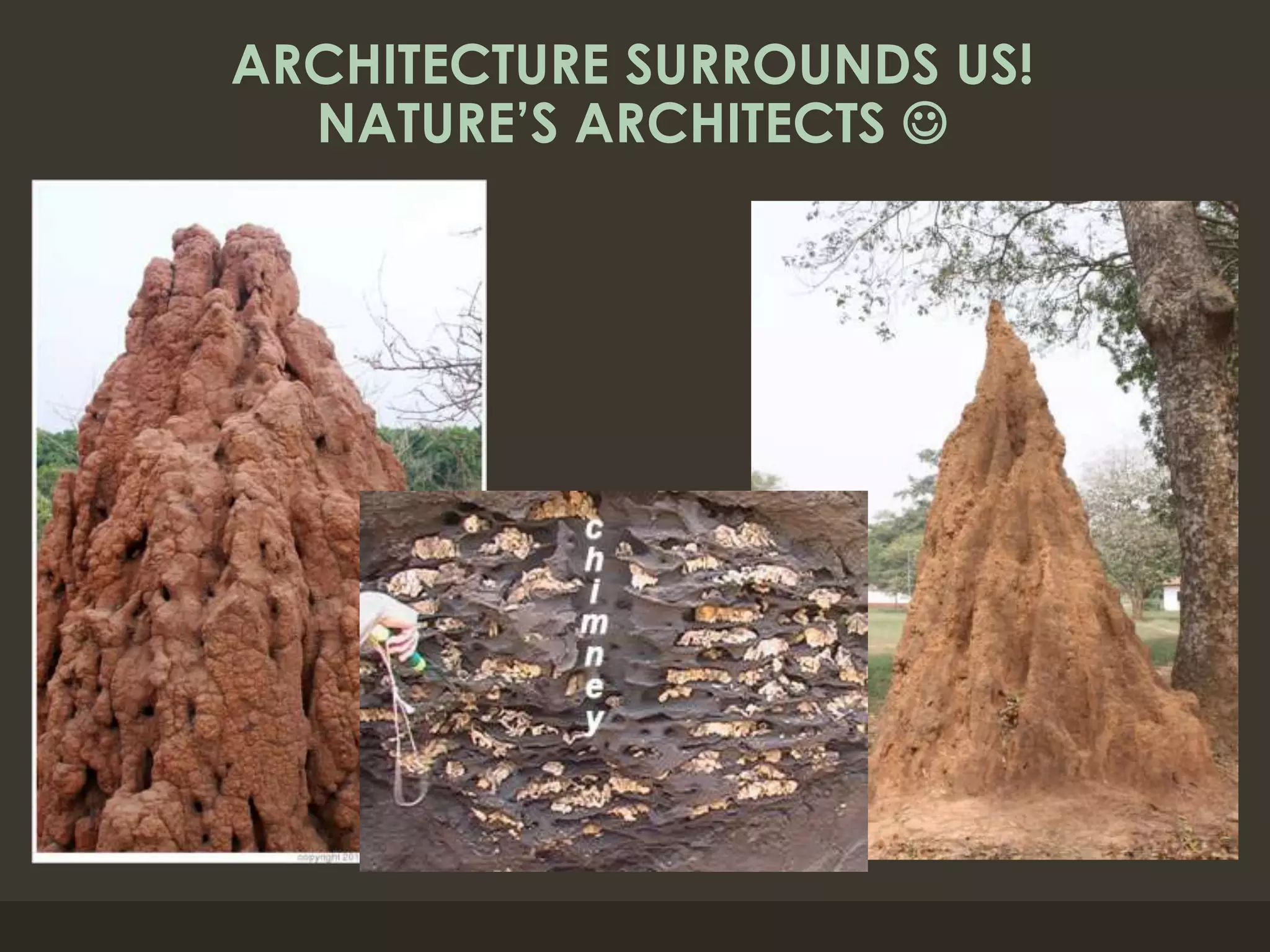
ARCHITECTURE SURROUNDS US!
NATURE’S ARCHITECTS 
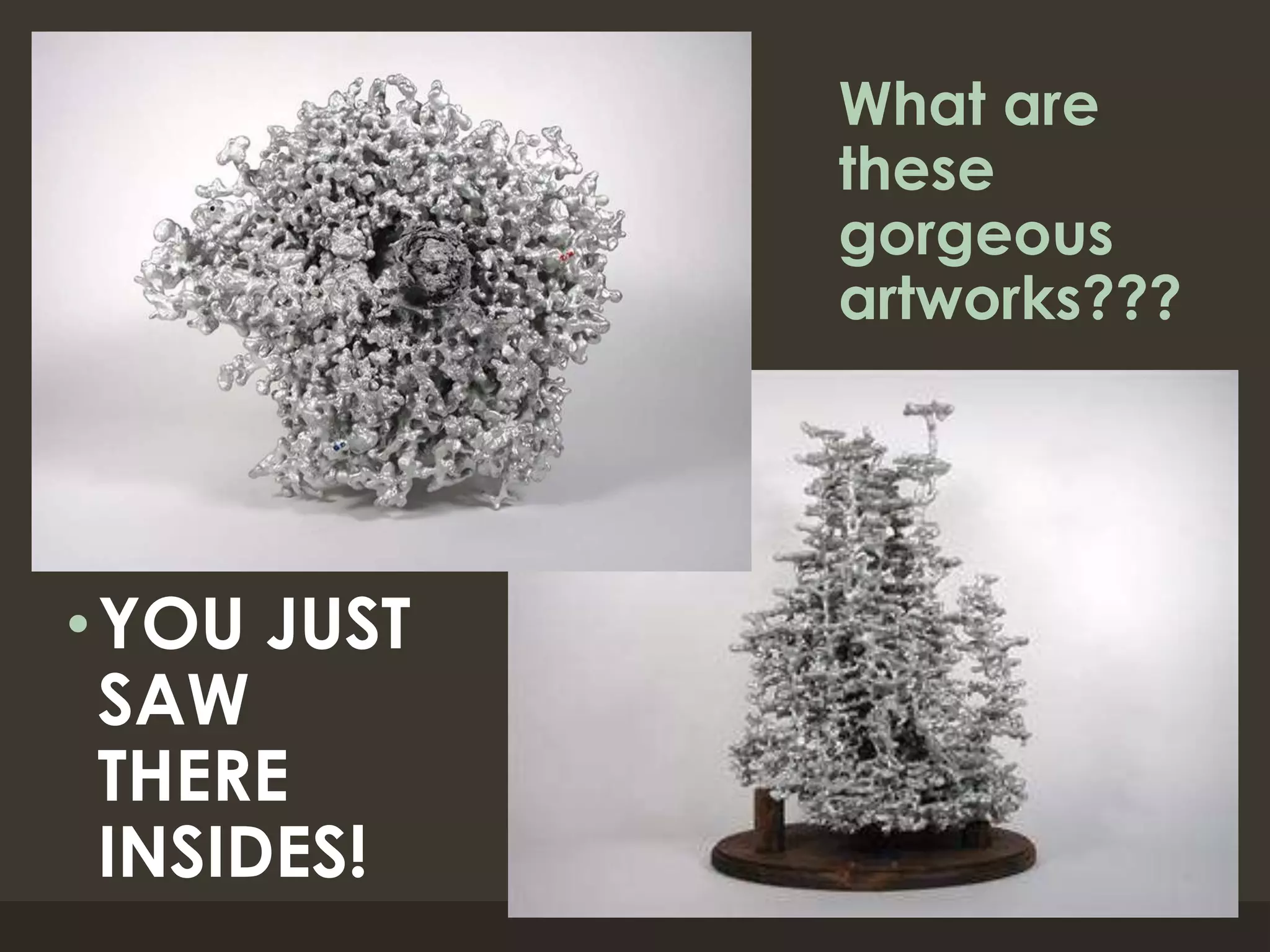
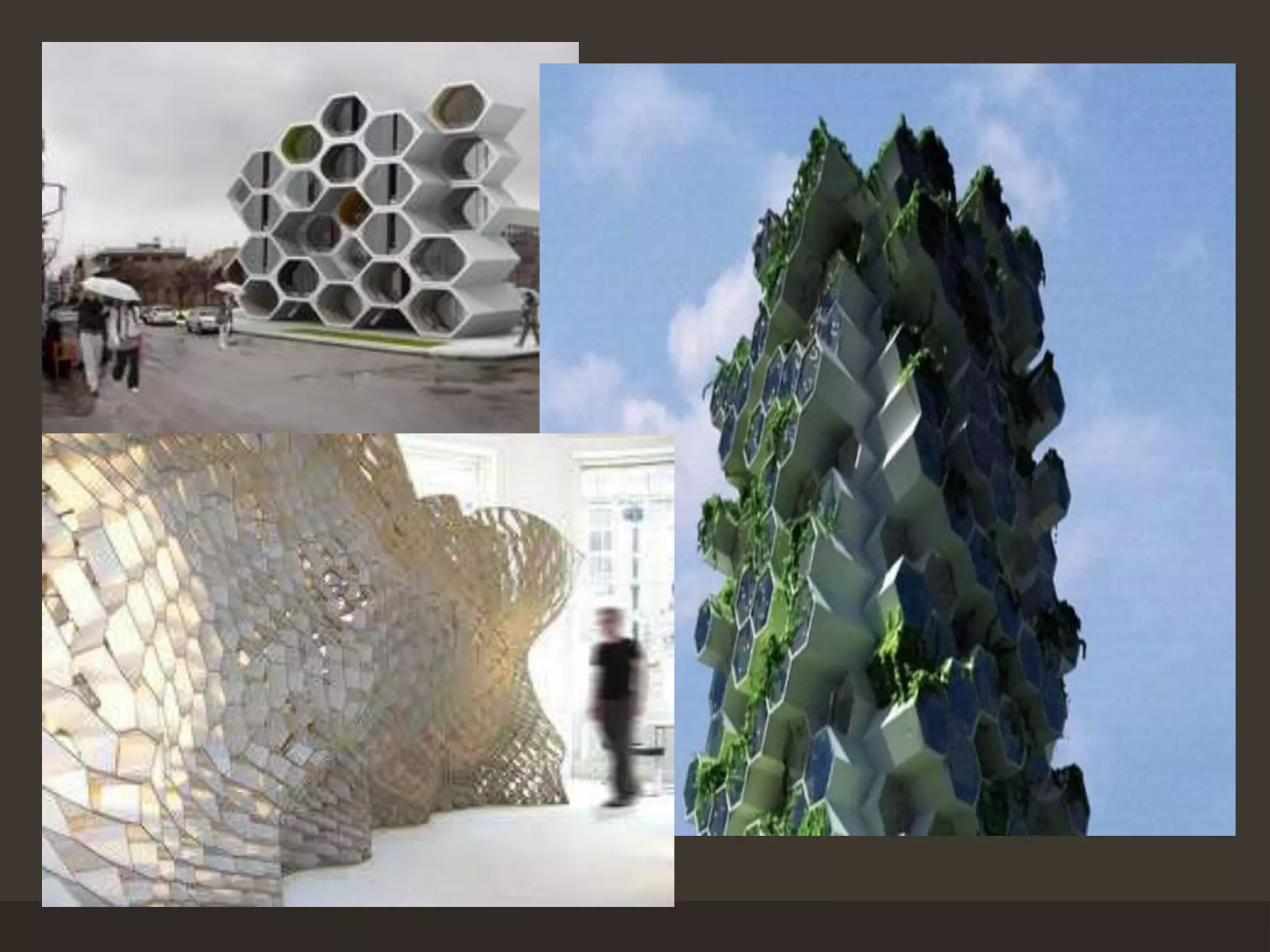
What are
these
gorgeous
artworks???
•YOU JUST
SAW
THERE
INSIDES!
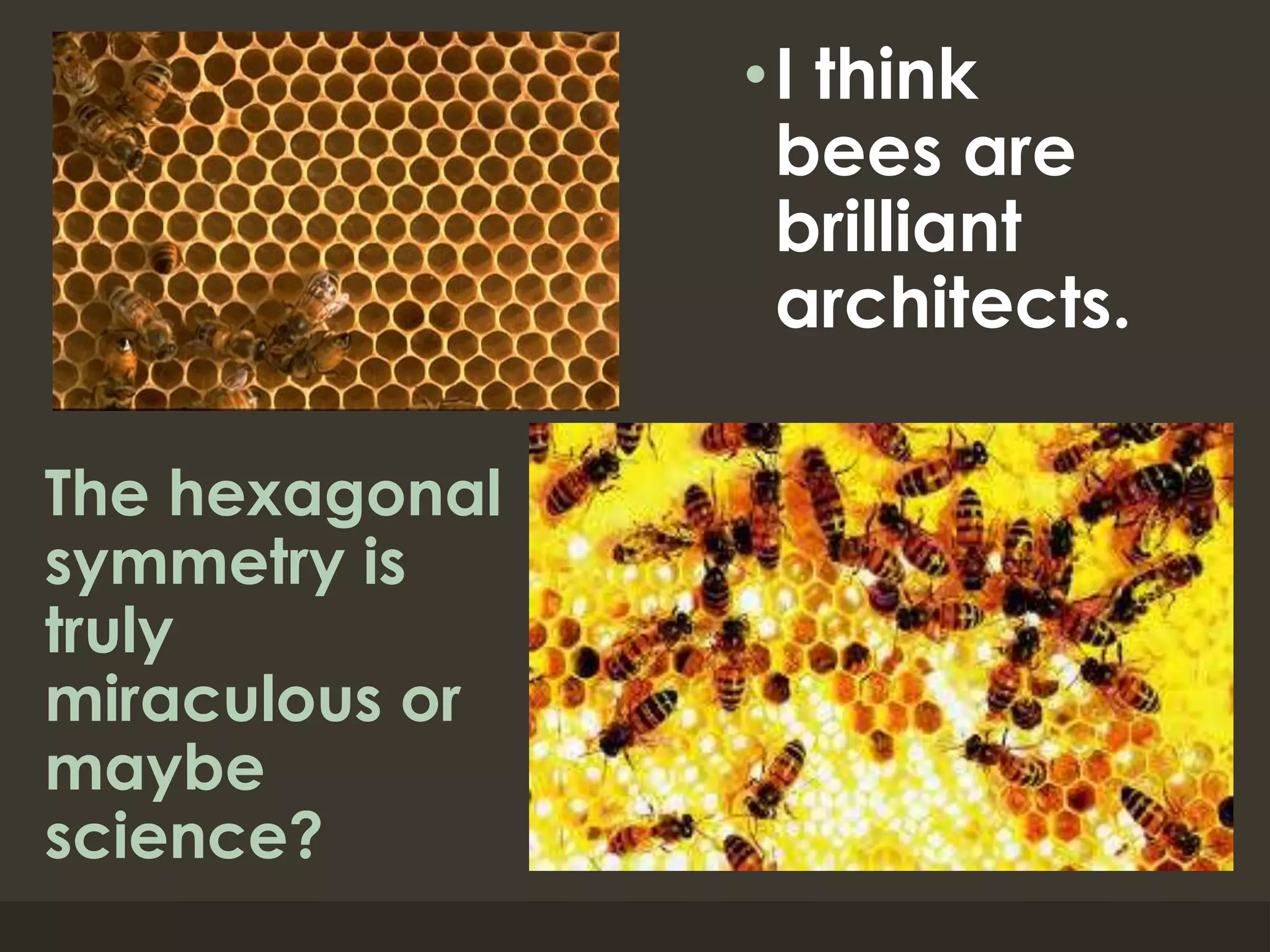
The hexagonal
symmetry is
truly
miraculous or
maybe
science?
•I think
bees are
brilliant
architects.
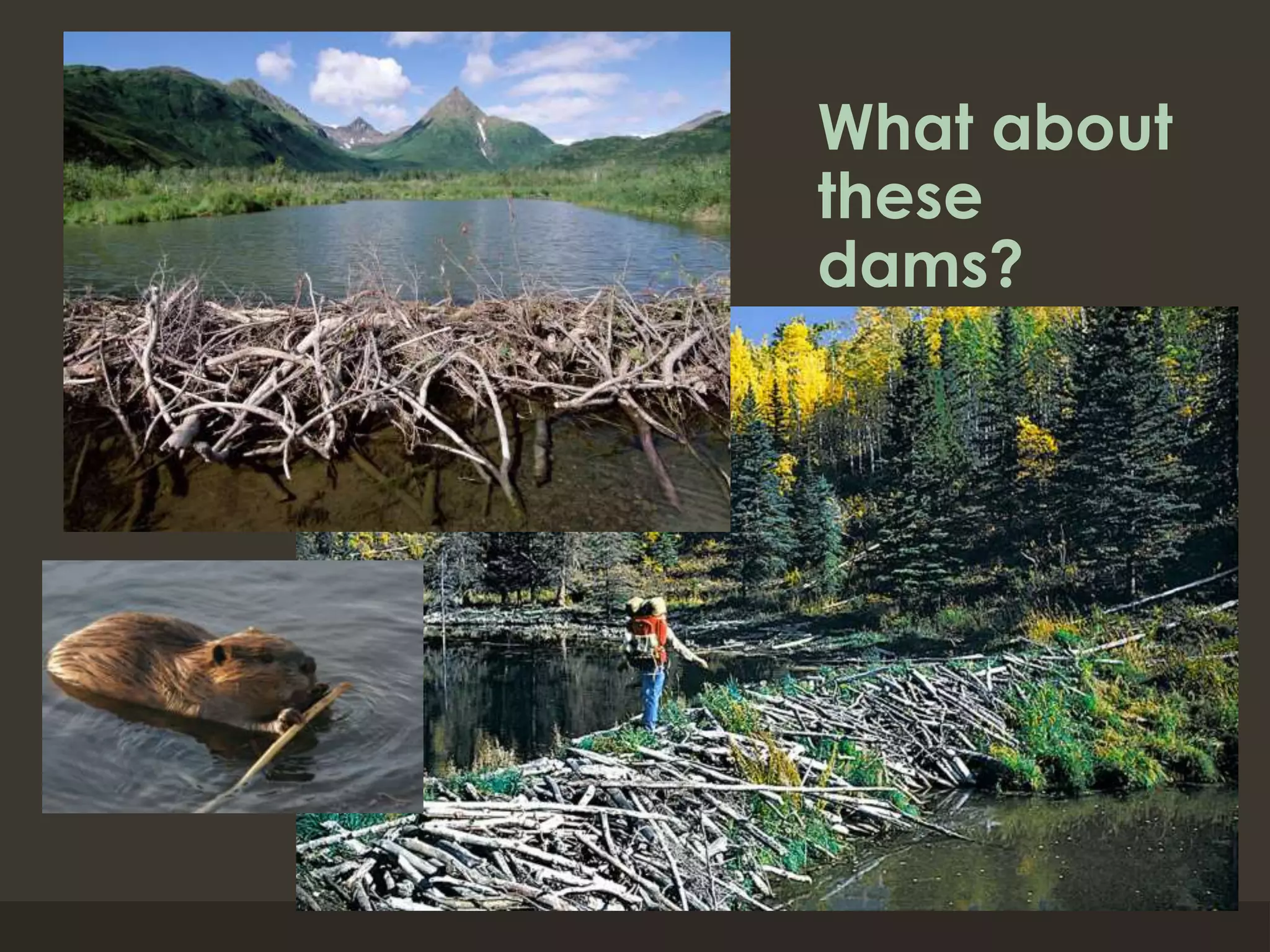
What about
these
dams?
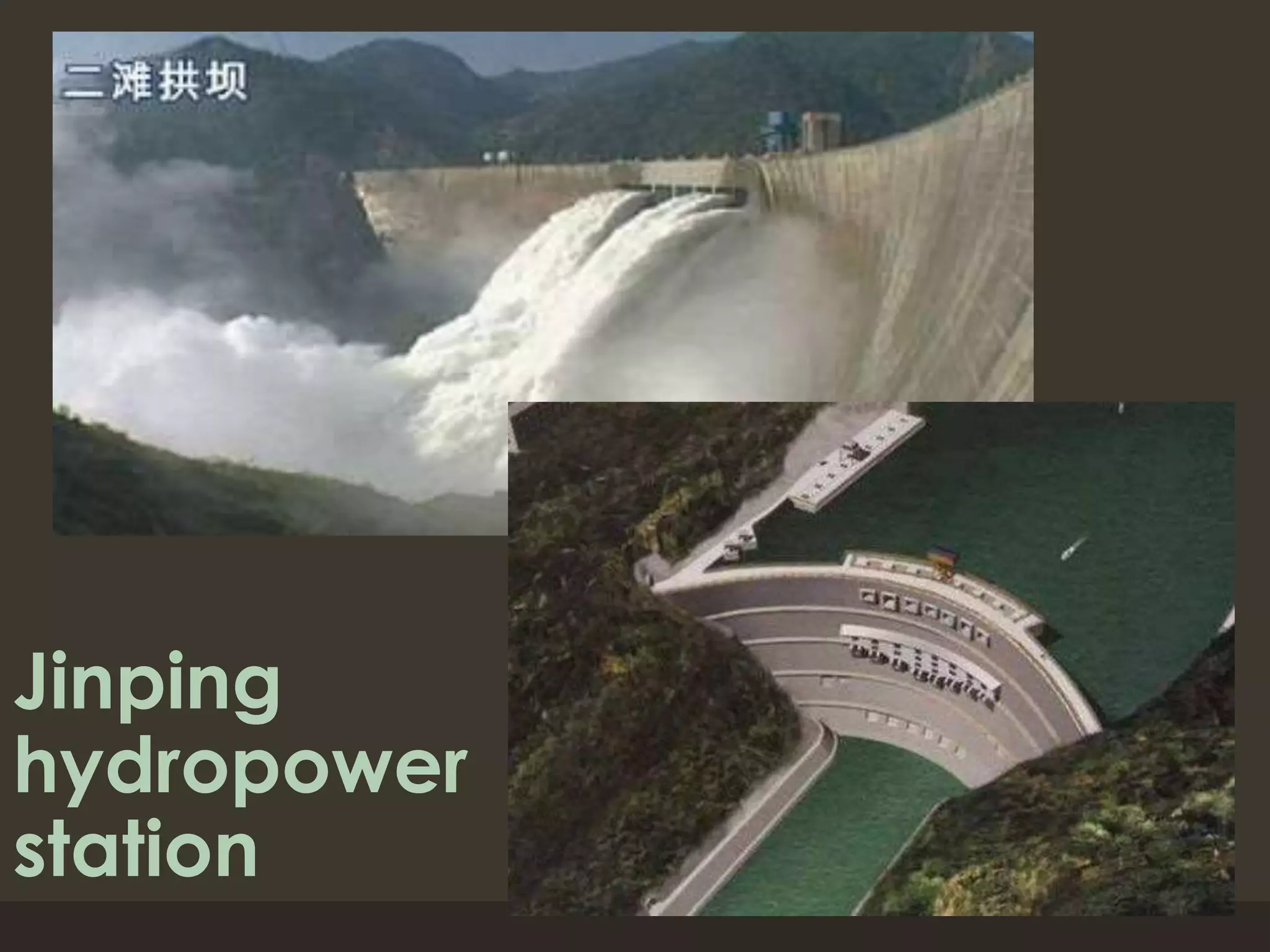
Jinping
hydropower
station
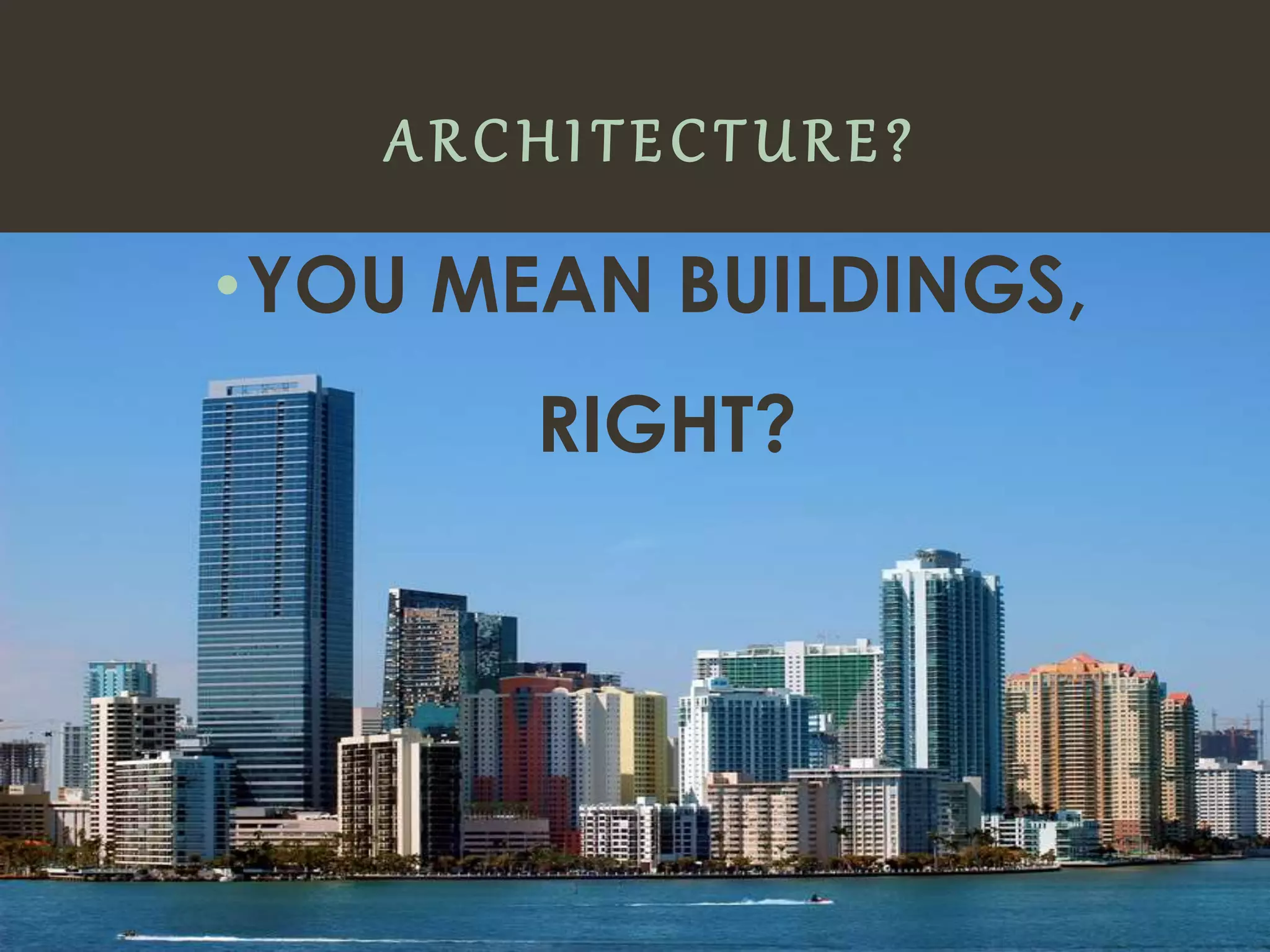
ARCHITECTURE?
•YOU MEAN BUILDINGS,
RIGHT?
YOU MEAN HIRING A BUILDER? A
CONTRACTOR?
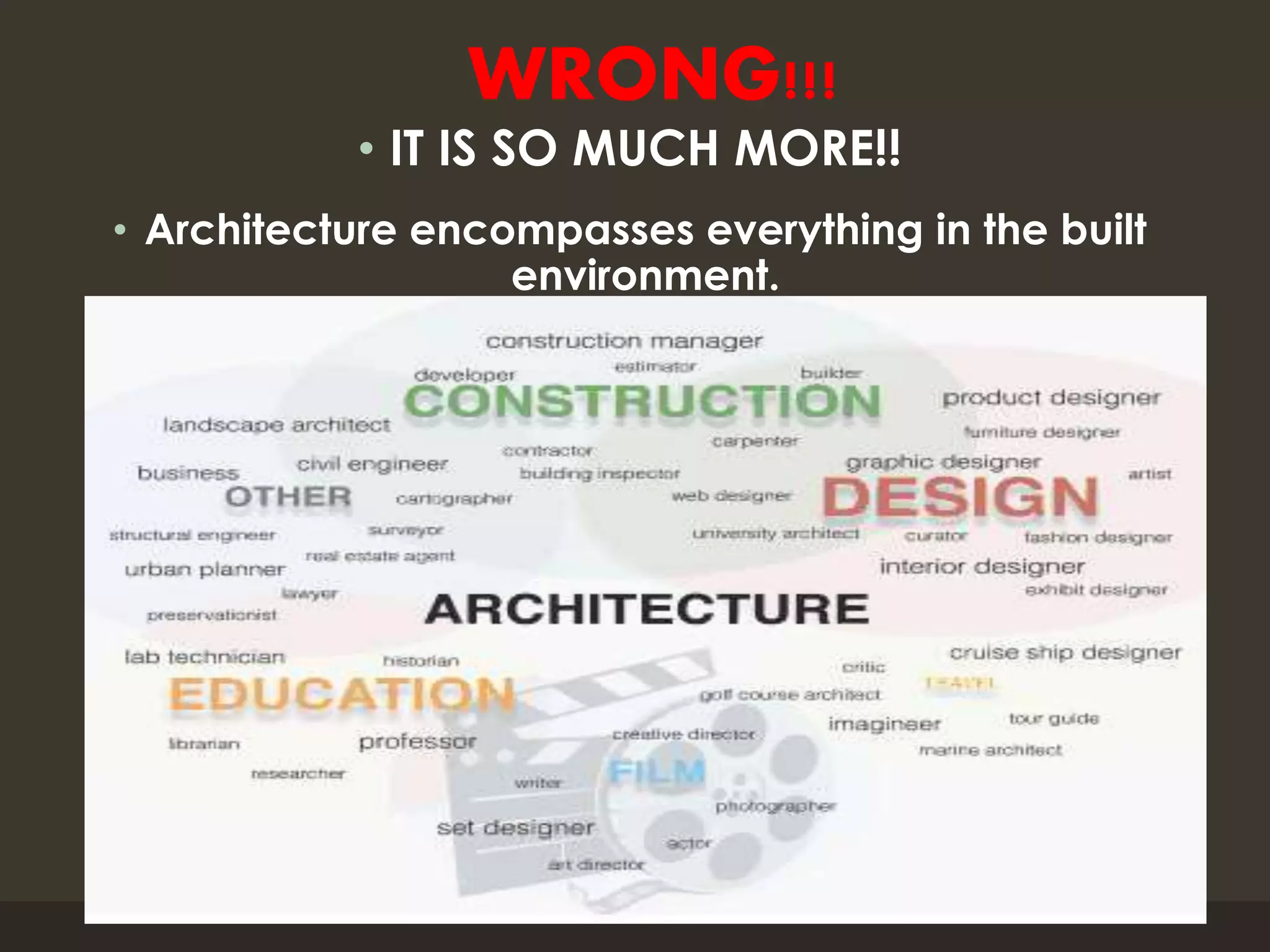
WRONG!!!
• IT IS SO MUCH MORE!!
• Architecture encompasses everything in the built
environment.
ARCHITECTURE SIMPLE PUT……
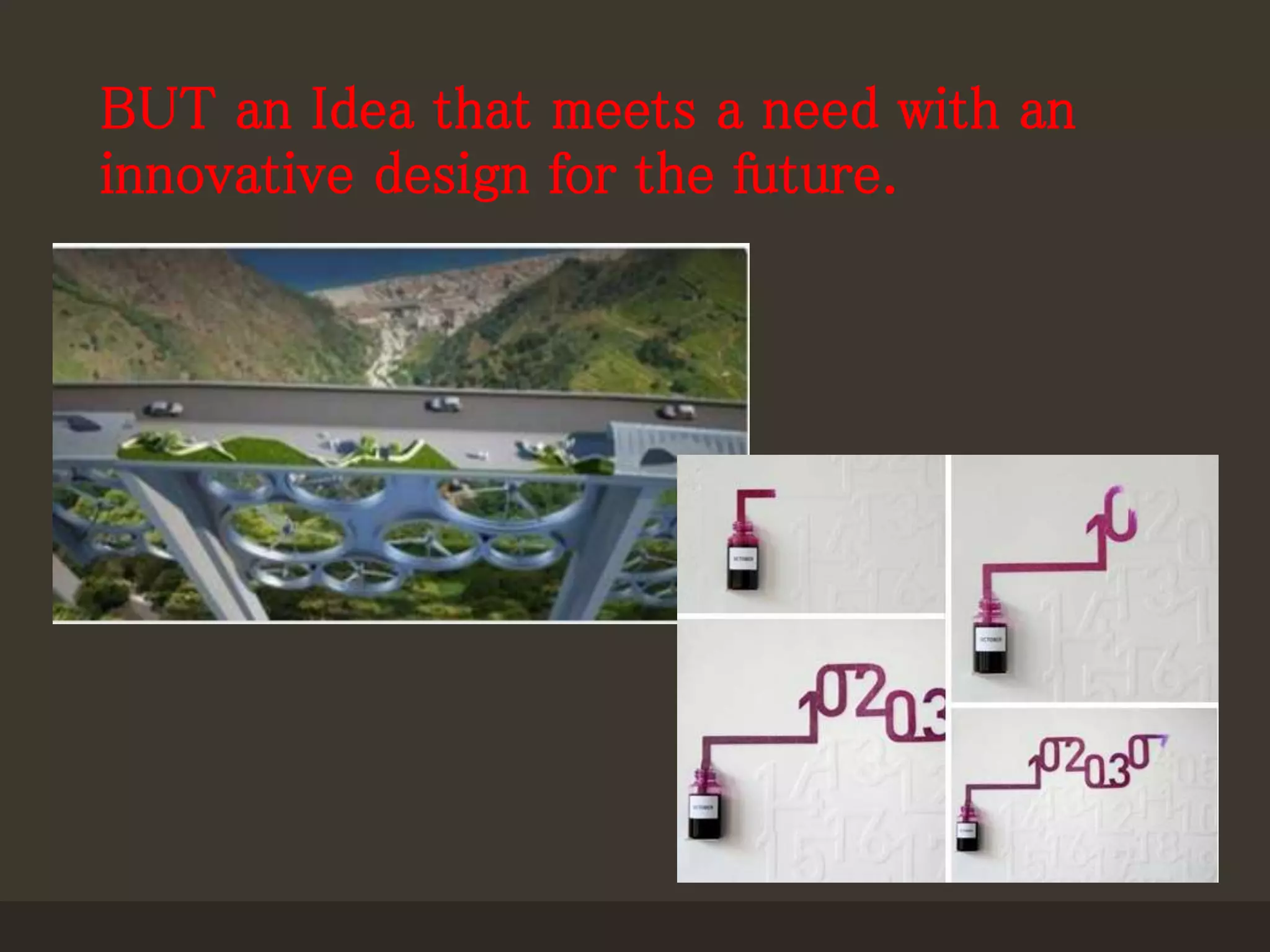
NOT THIS KIND OF
IDEA!!
BUT an Idea that meets a need with an
innovative design for the future.
What is Architecture?
What I was told: ‘Father of Science and Mother of Art.’
What I learnt: ‘A young, ever evolving child of science
and Art.’
Actually what isn't architecture?
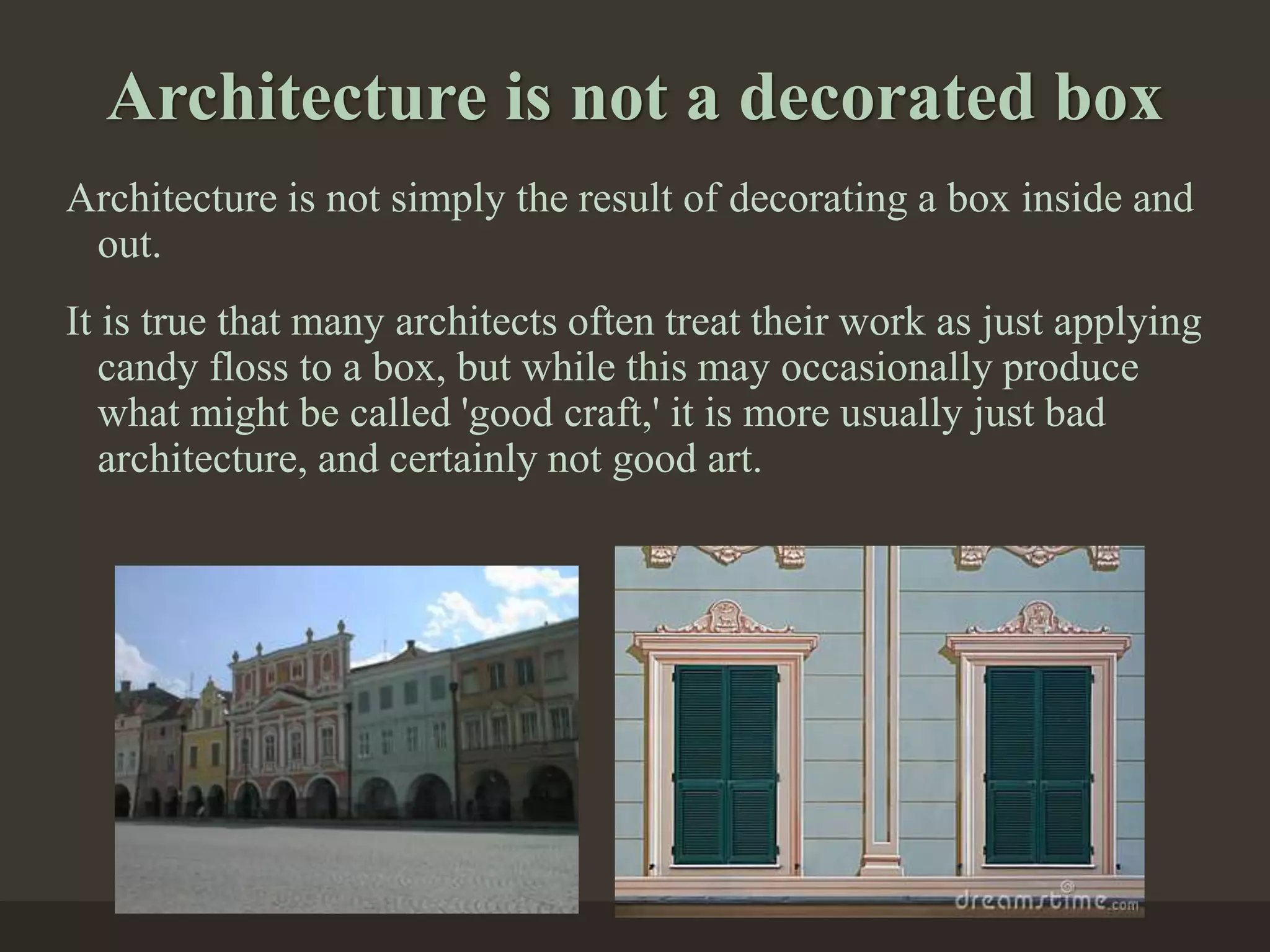
Architecture is not a decorated box
Architecture is not simply the result of decorating a box inside and
out.
It is true that many architects often treat their work as just applying
candy floss to a box, but while this may occasionally produce
what might be called 'good craft,' it is more usually just bad
architecture, and certainly not good art.
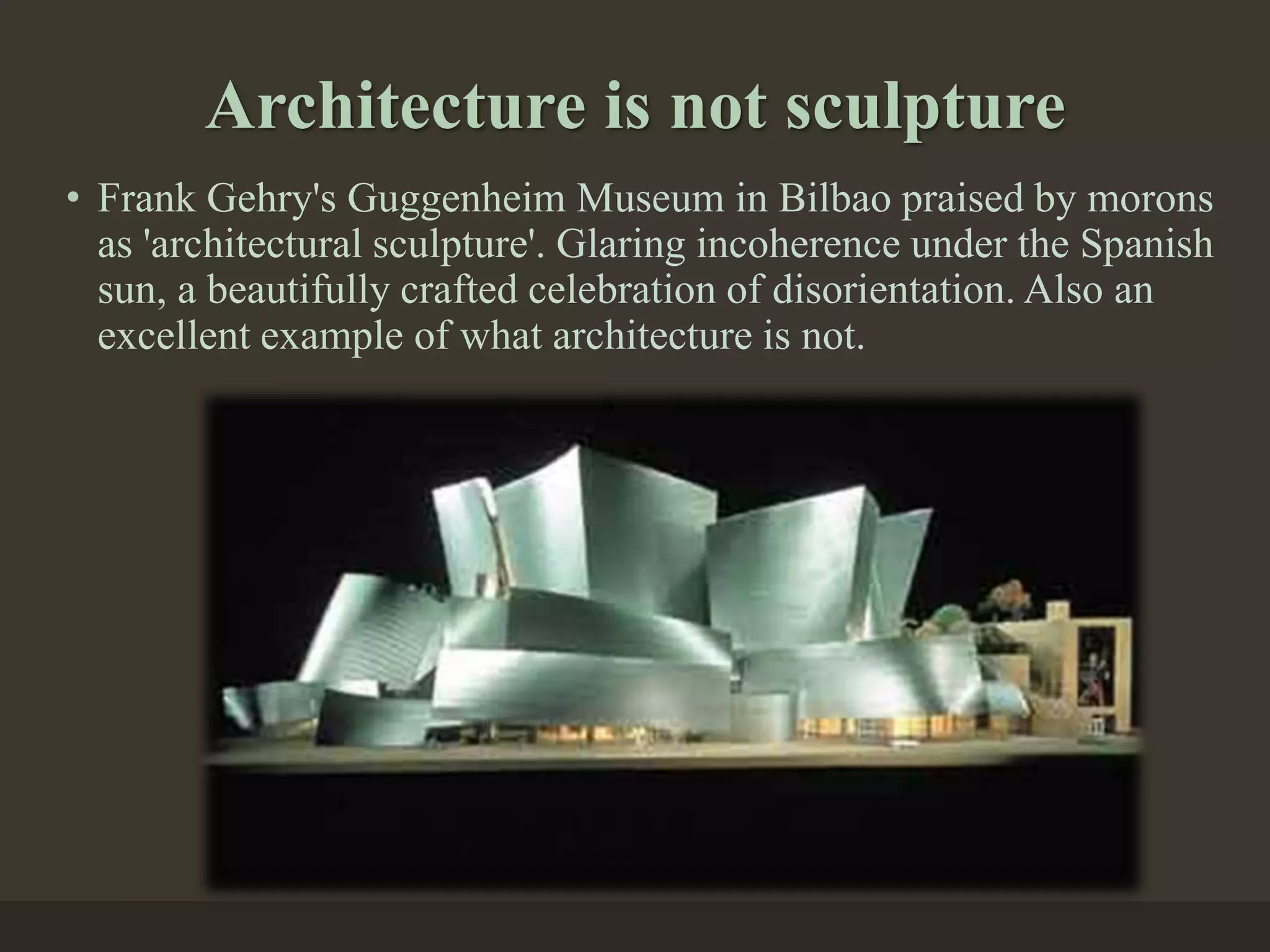
Architecture is not sculpture
• Frank Gehry's Guggenheim Museum in Bilbao praised by morons
as 'architectural sculpture'. Glaring incoherence under the Spanish
sun, a beautifully crafted celebration of disorientation. Also an
excellent example of what architecture is not.
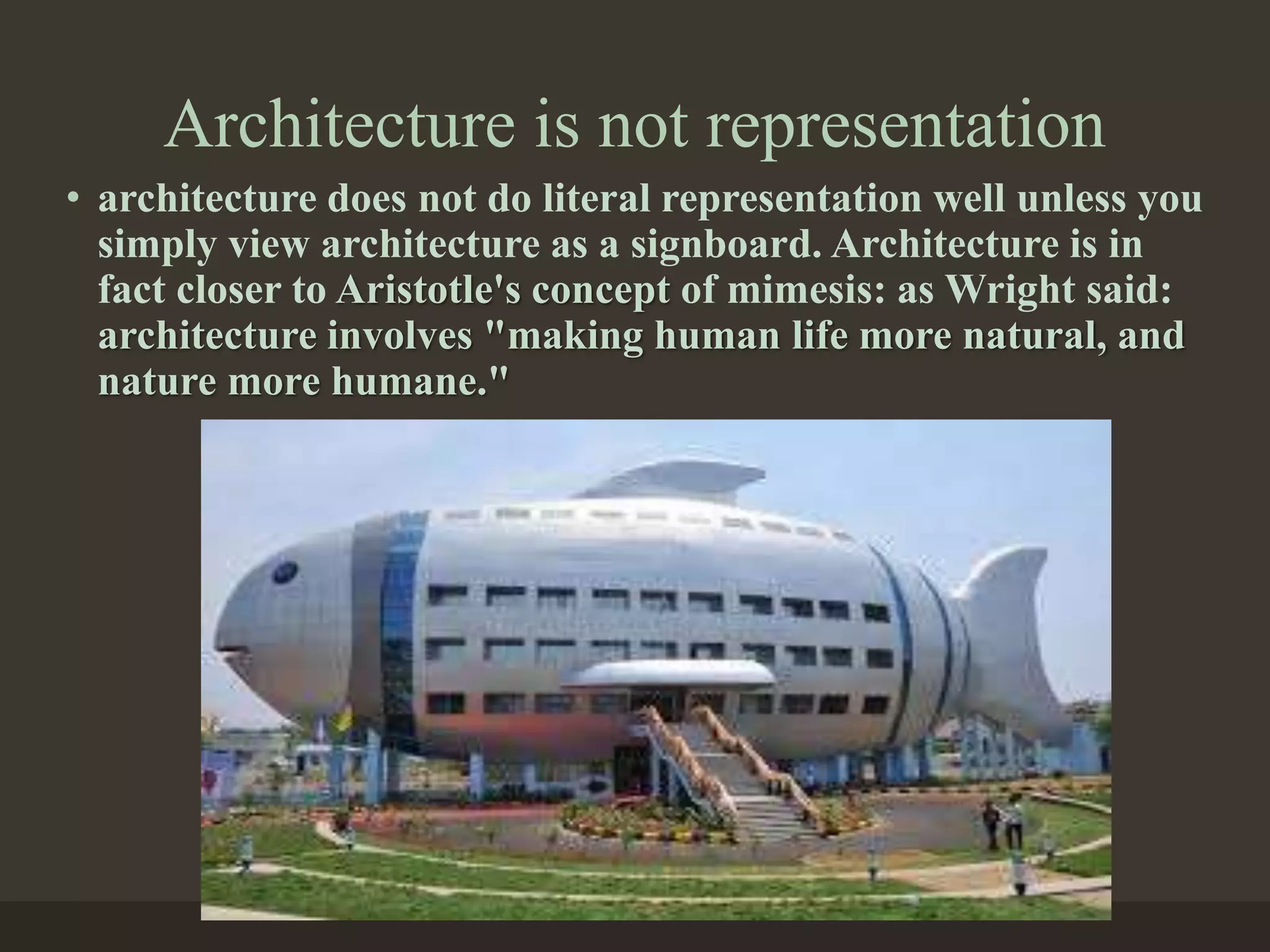
Architecture is not representation
• architecture does not do literal representation well unless you
simply view architecture as a signboard. Architecture is in
fact closer to Aristotle's concept of mimesis: as Wright said:
architecture involves "making human life more natural, and
nature more humane."
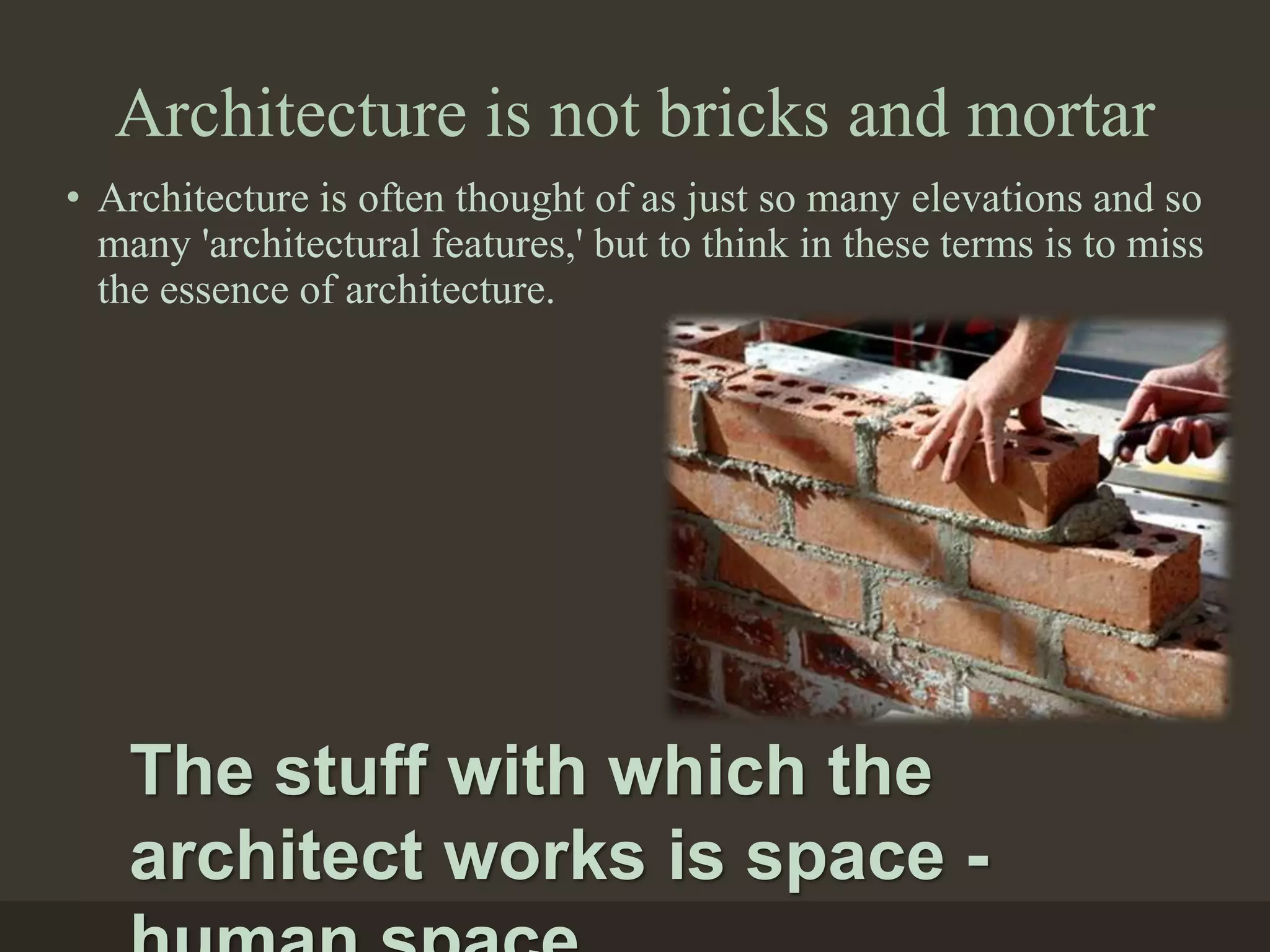
Architecture is not bricks and mortar
• Architecture is often thought of as just so many elevations and so
many 'architectural features,' but to think in these terms is to miss
the essence of architecture.
The stuff with which the
architect works is space -
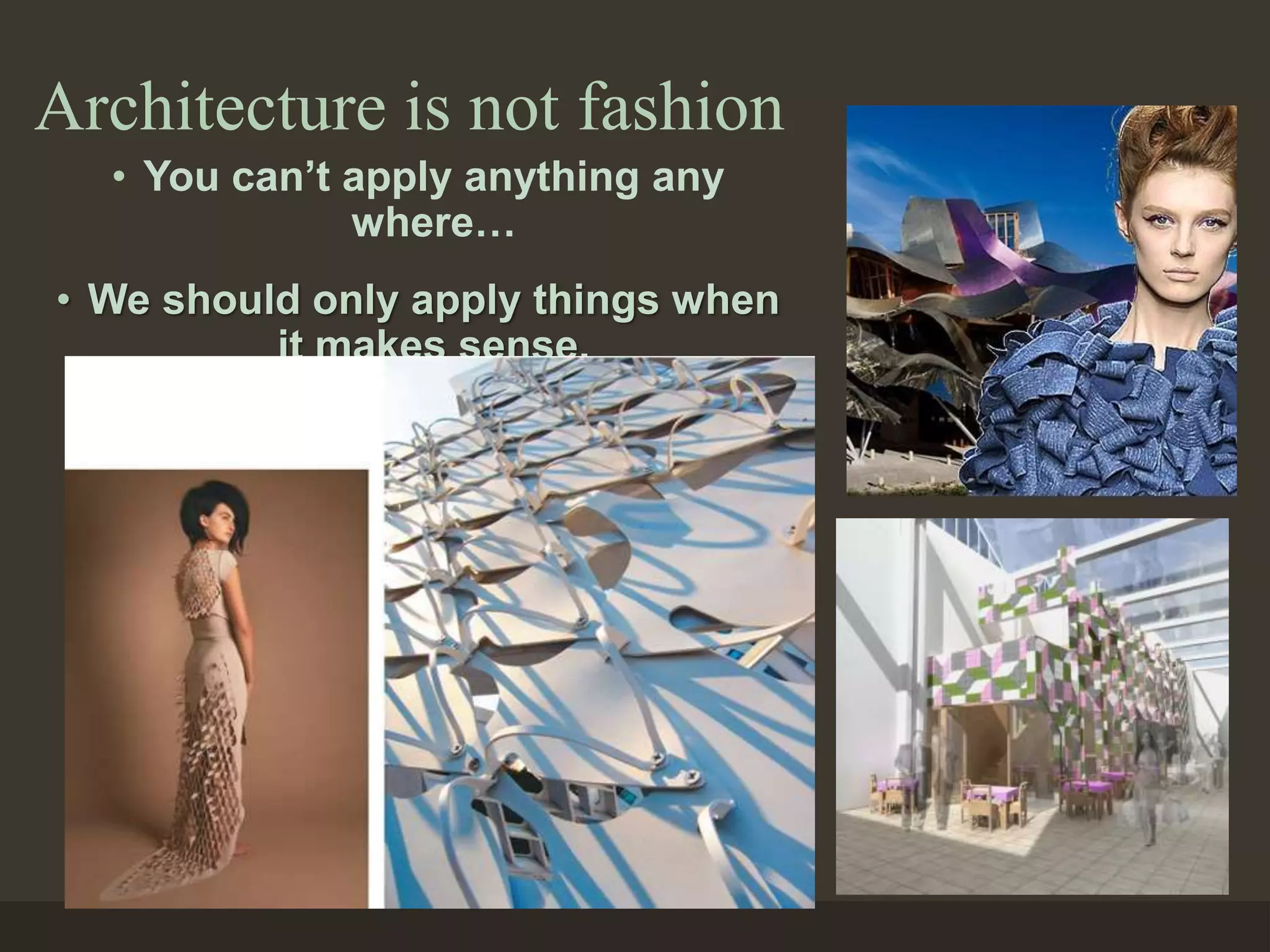
Architecture is not fashion
• You can’t apply anything any
where…
• We should only apply things when
it makes sense.
• In its broadest sense, an Architect is a person who translates a
user’s requirements into a built environment.
• Architecture does what no other art can do: All other art forms
recreate some portion of the world - a single human figure, or
a two-dimensional scene on a canvas.
• Only architecture can create a total environment, one that
literally surrounds the viewer.
• Architecture creates a man-made, idealized world - an
environment created by the architect to fit the kind of life he
sees as proper to man.
• Architecture conveys a view of man indirectly, not by projecting
an image of man himself [as sculpture, painting and literature
do] but by projecting a proper environment for man to live in.
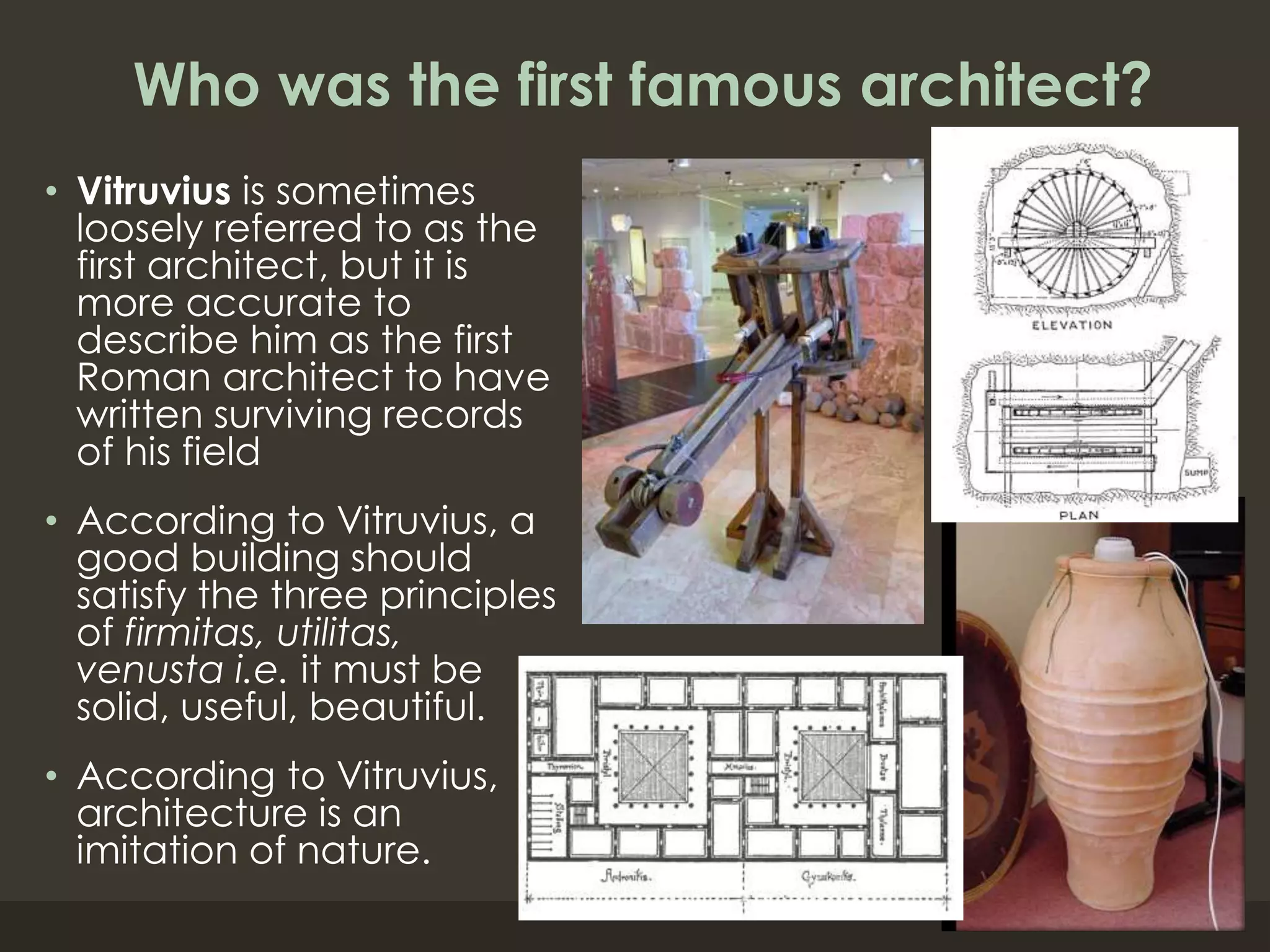
Who was the first famous architect?
• Vitruvius is sometimes
loosely referred to as the
first architect, but it is
more accurate to
describe him as the first
Roman architect to have
written surviving records
of his field
• According to Vitruvius, a
good building should
satisfy the three principles
of firmitas, utilitas,
venusta i.e. it must be
solid, useful, beautiful.
• According to Vitruvius,
architecture is an
imitation of nature.
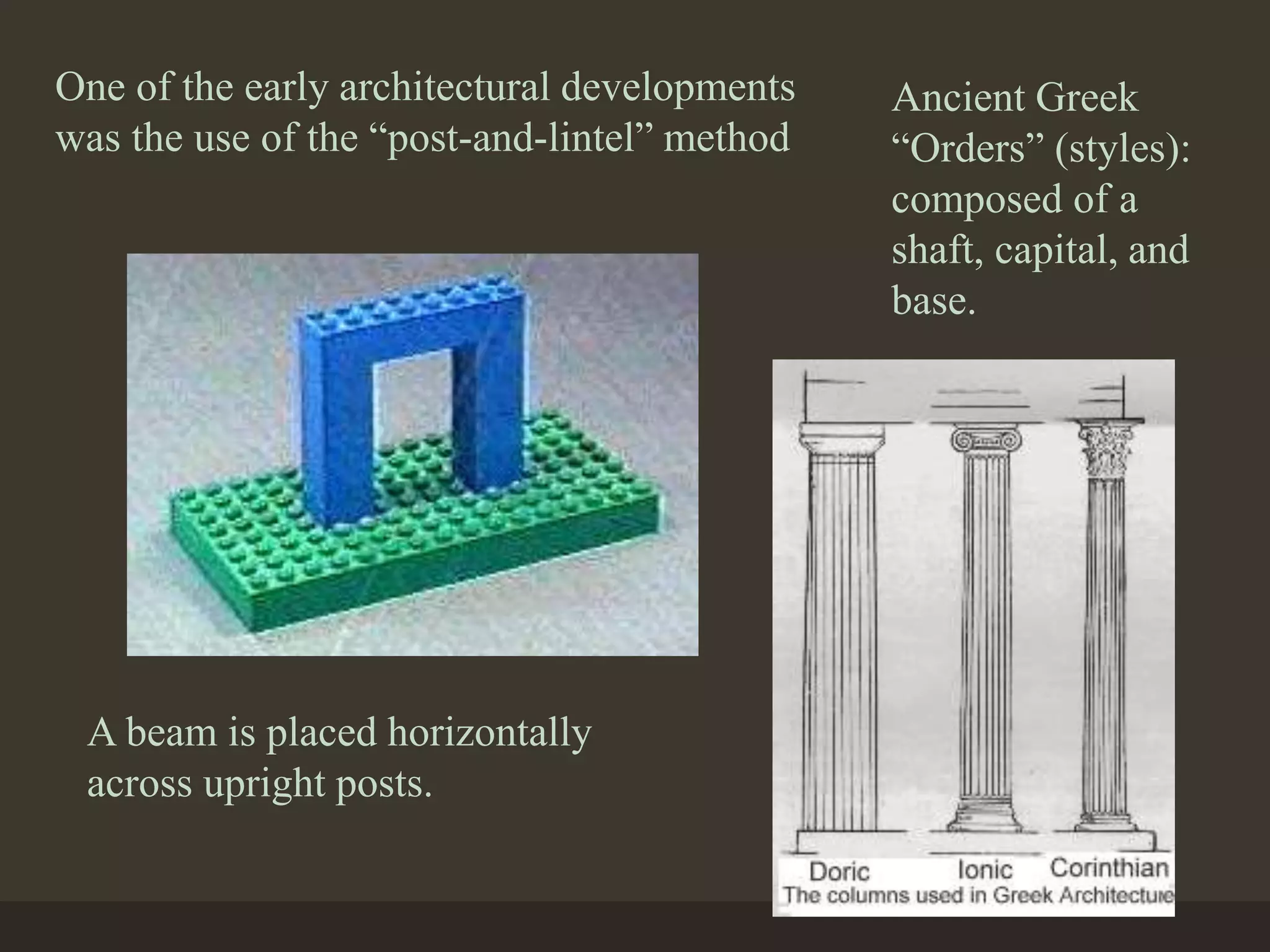
One of the early architectural developments
was the use of the “post-and-lintel” method
A beam is placed horizontally
across upright posts.
Ancient Greek
“Orders” (styles):
composed of a
shaft, capital, and
base.
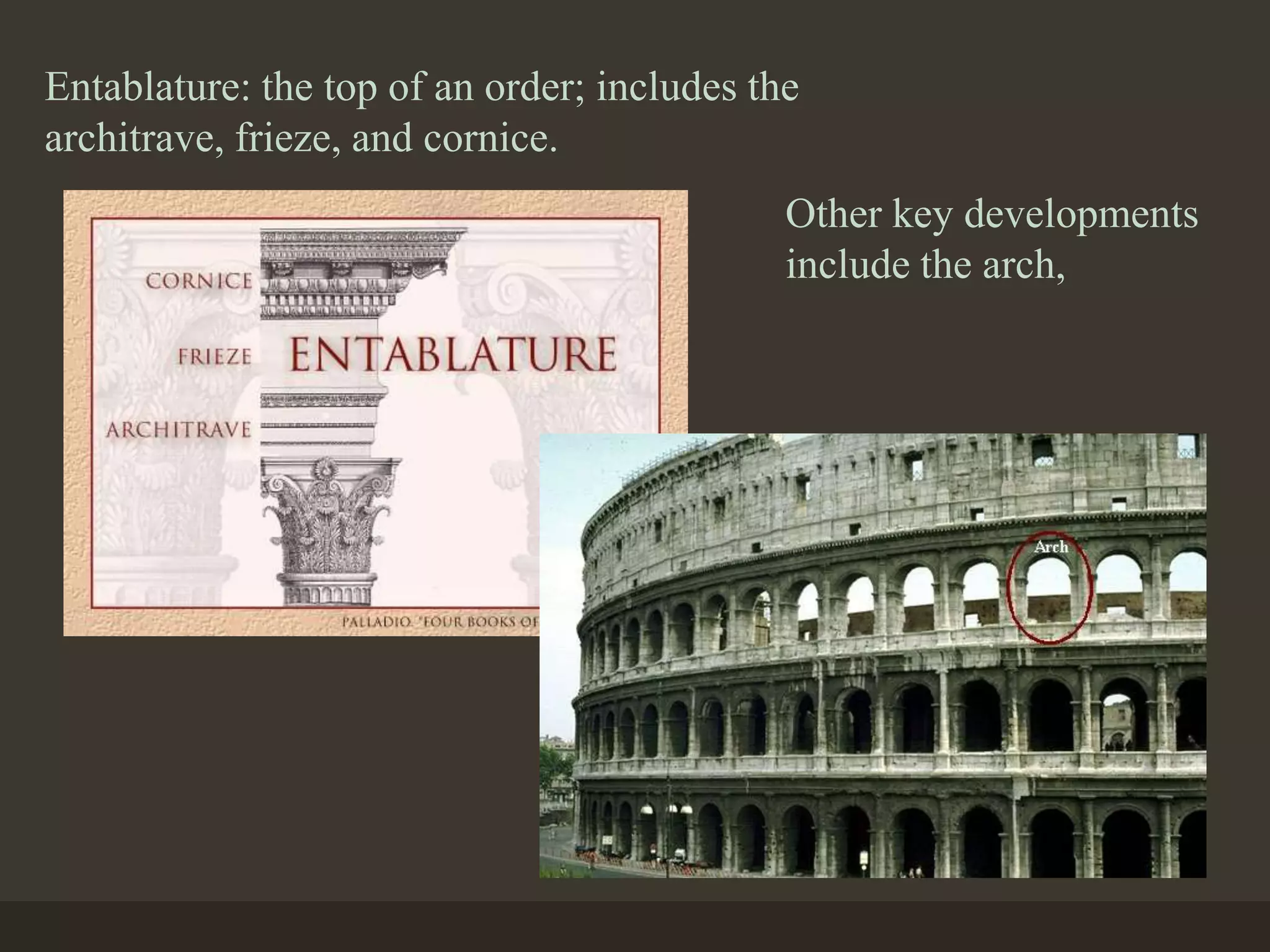
Entablature: the top of an order; includes the
architrave, frieze, and cornice.
Other key developments
include the arch,
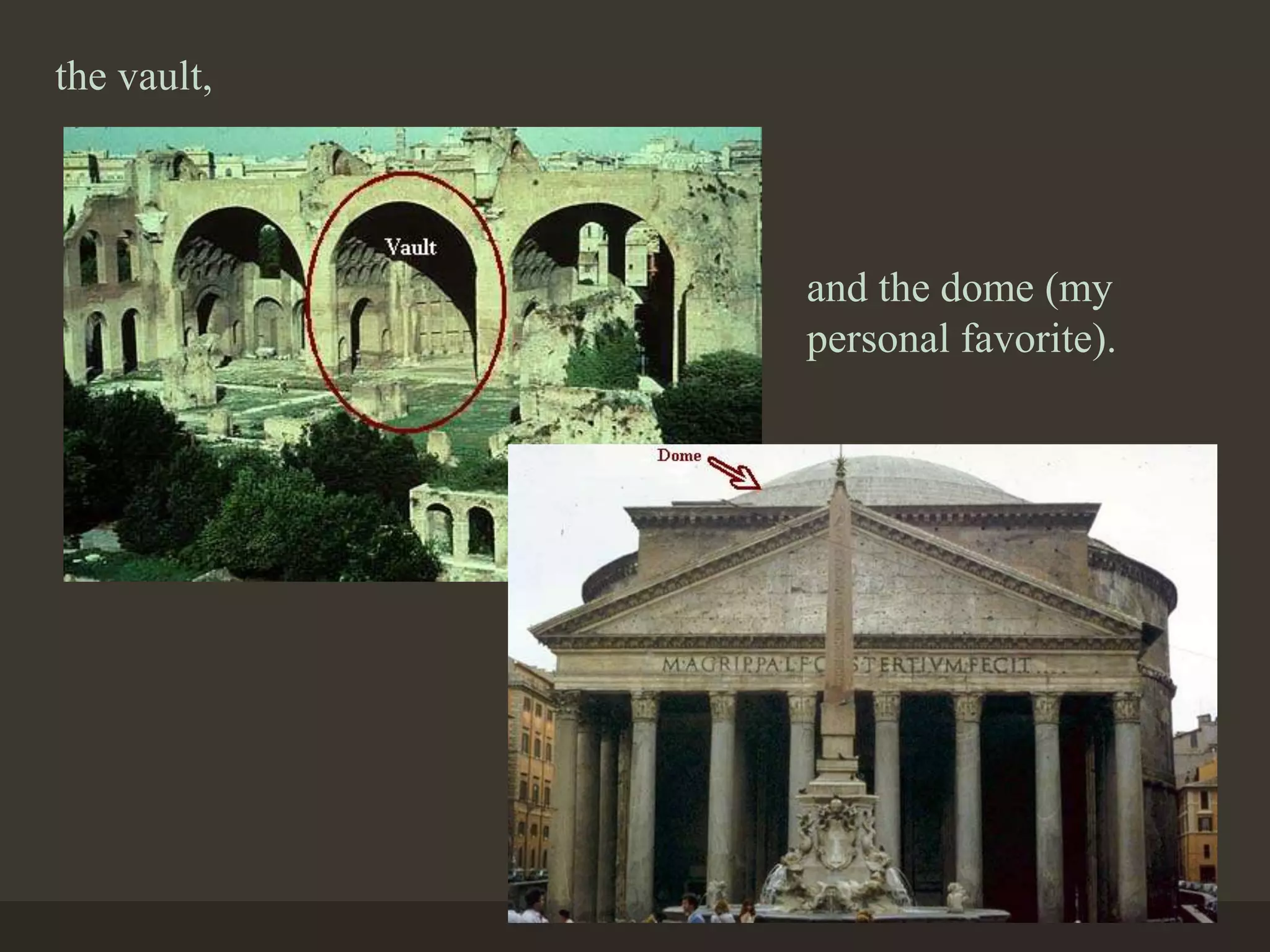
the vault,
and the dome (my
personal favorite).
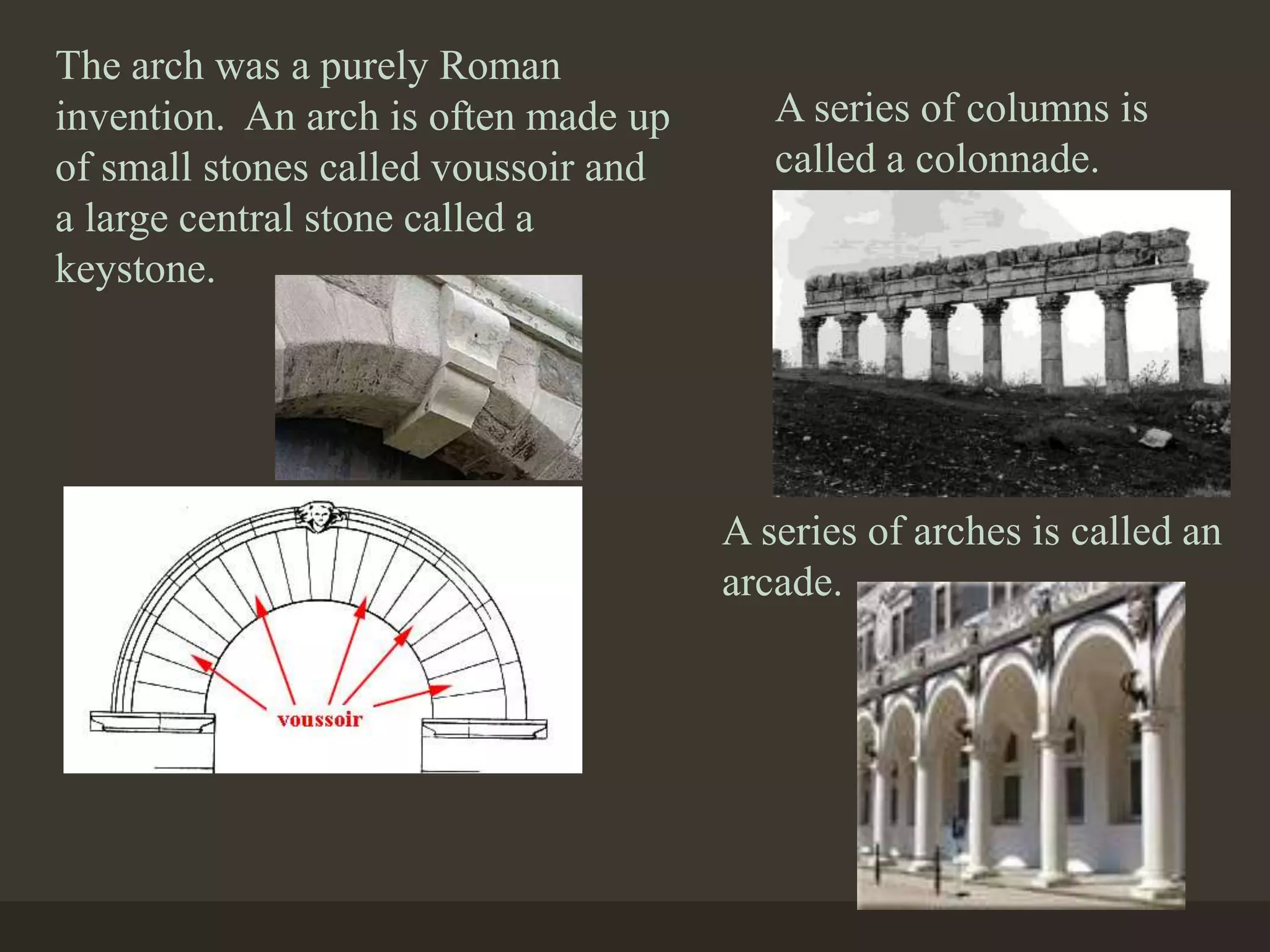
The arch was a purely Roman
invention. An arch is often made up
of small stones called voussoir and
a large central stone called a
keystone.
A series of columns is
called a colonnade.
A series of arches is called an
arcade.
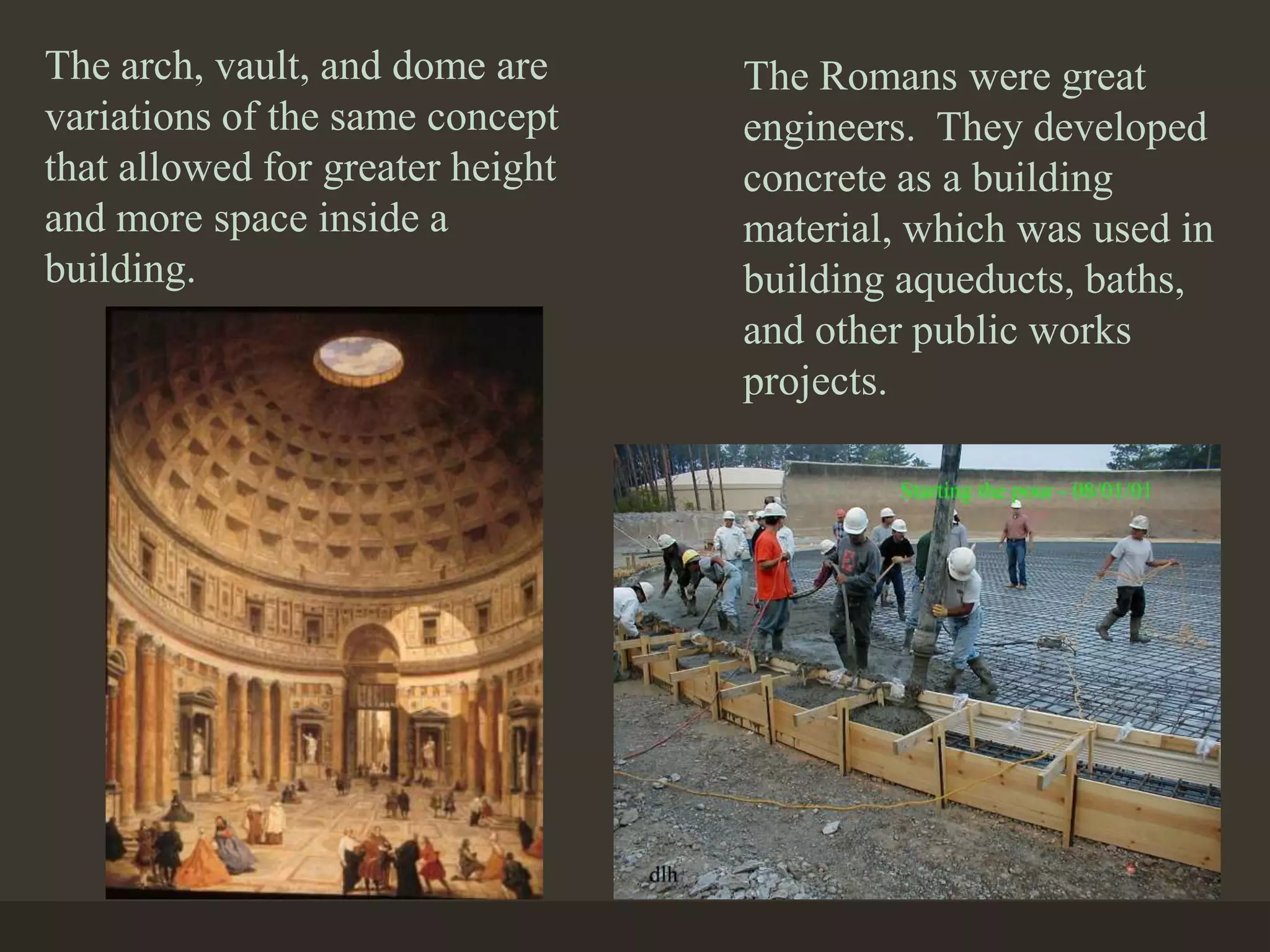
The arch, vault, and dome are
variations of the same concept
that allowed for greater height
and more space inside a
building.
The Romans were great
engineers. They developed
concrete as a building
material, which was used in
building aqueducts, baths,
and other public works
projects.
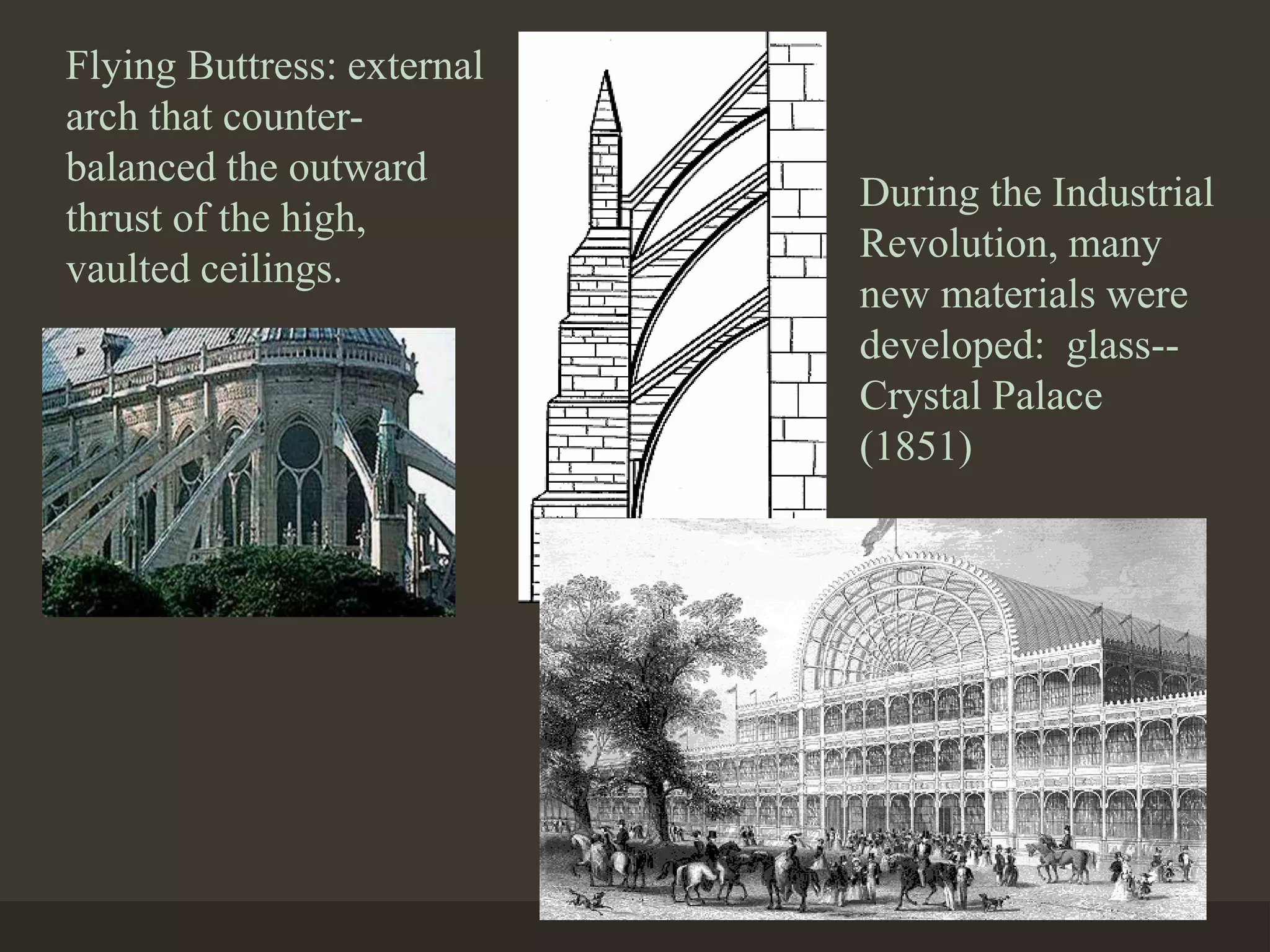
Flying Buttress: external
arch that counter-
balanced the outward
thrust of the high,
vaulted ceilings.
During the Industrial
Revolution, many
new materials were
developed: glass--
Crystal Palace
(1851)
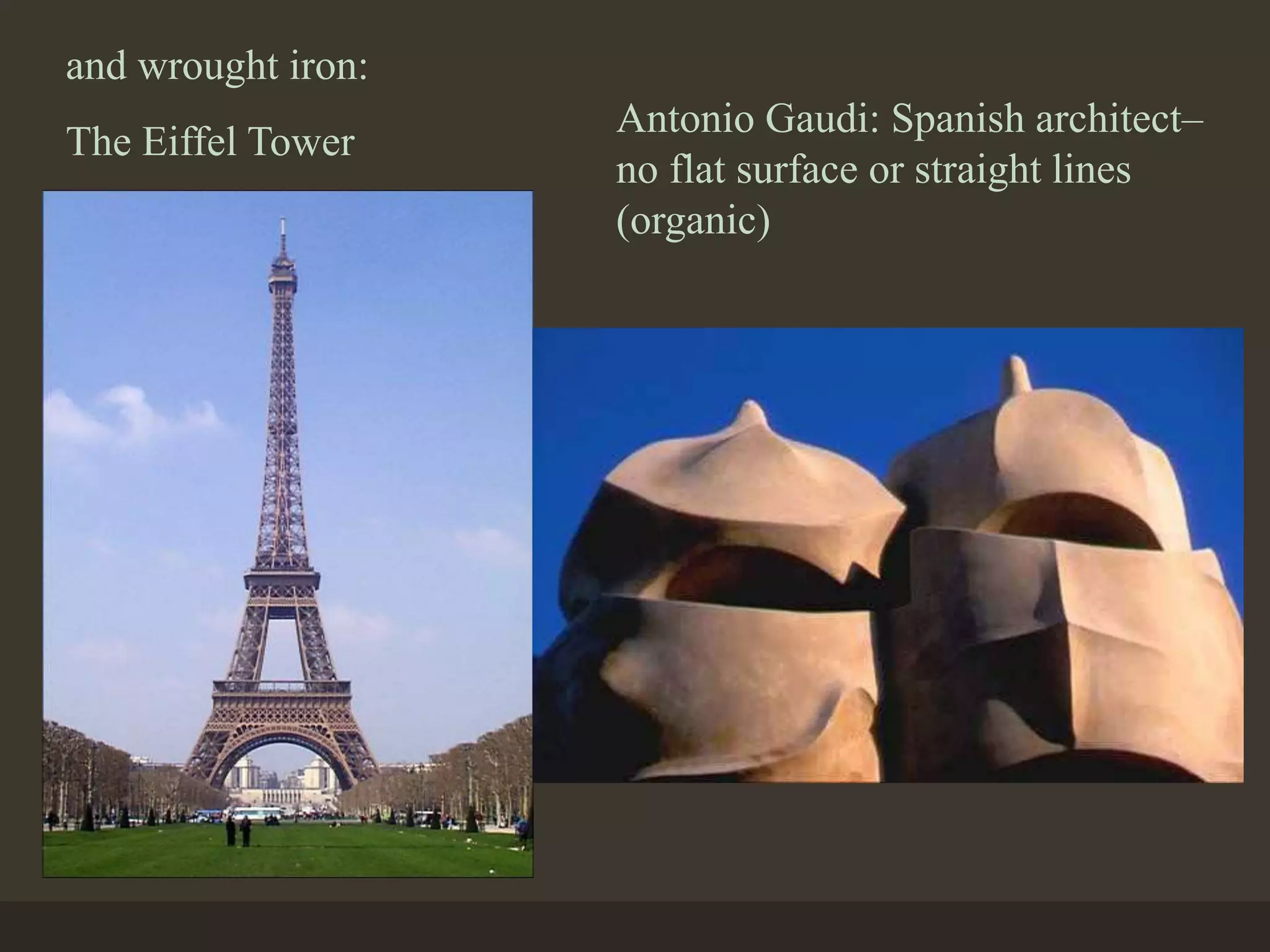
and wrought iron:
The Eiffel Tower
Antonio Gaudi: Spanish architect–
no flat surface or straight lines
(organic)
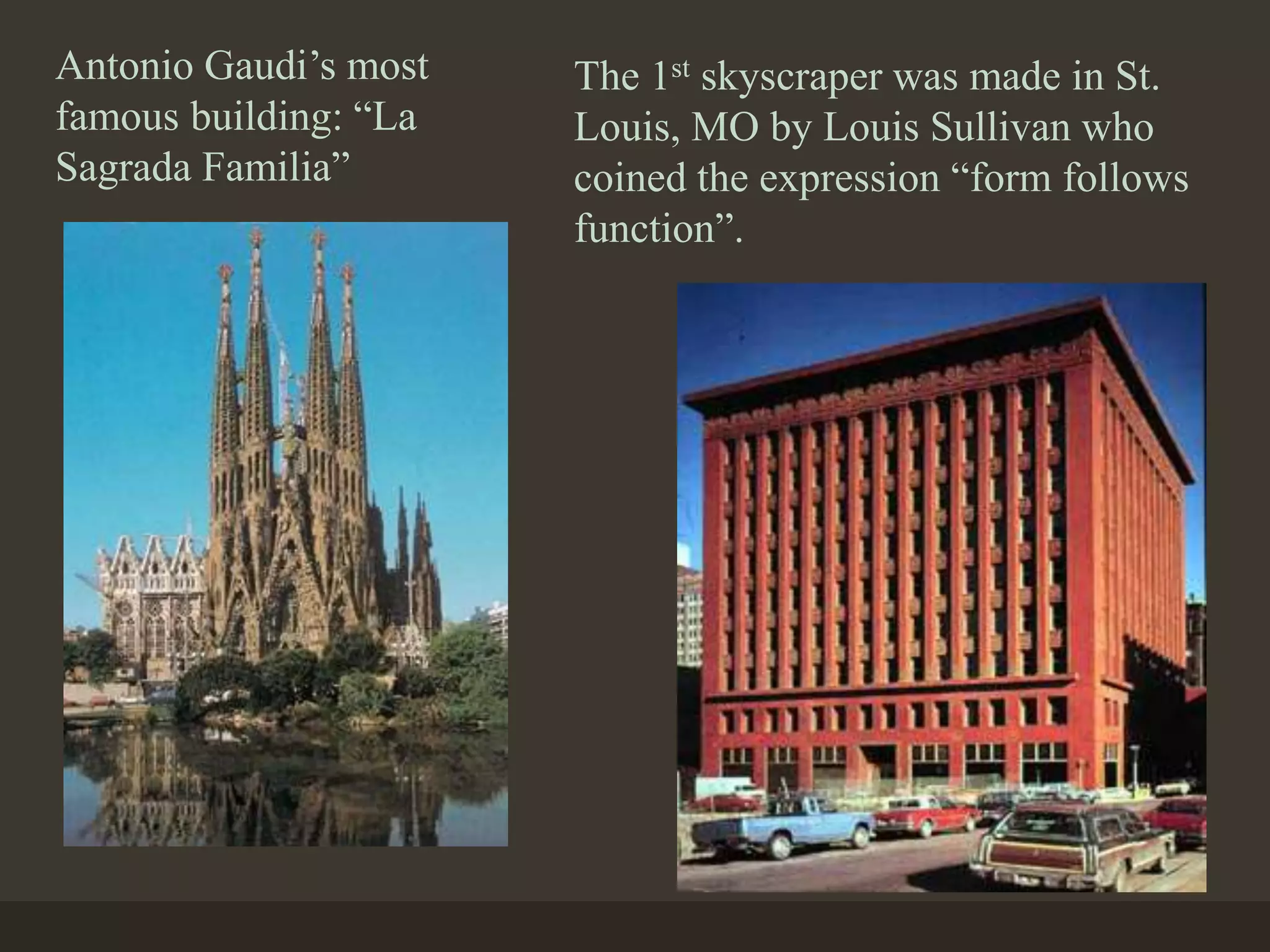
Antonio Gaudi’s most
famous building: “La
Sagrada Familia”
The 1st skyscraper was made in St.
Louis, MO by Louis Sullivan who
coined the expression “form follows
function”.
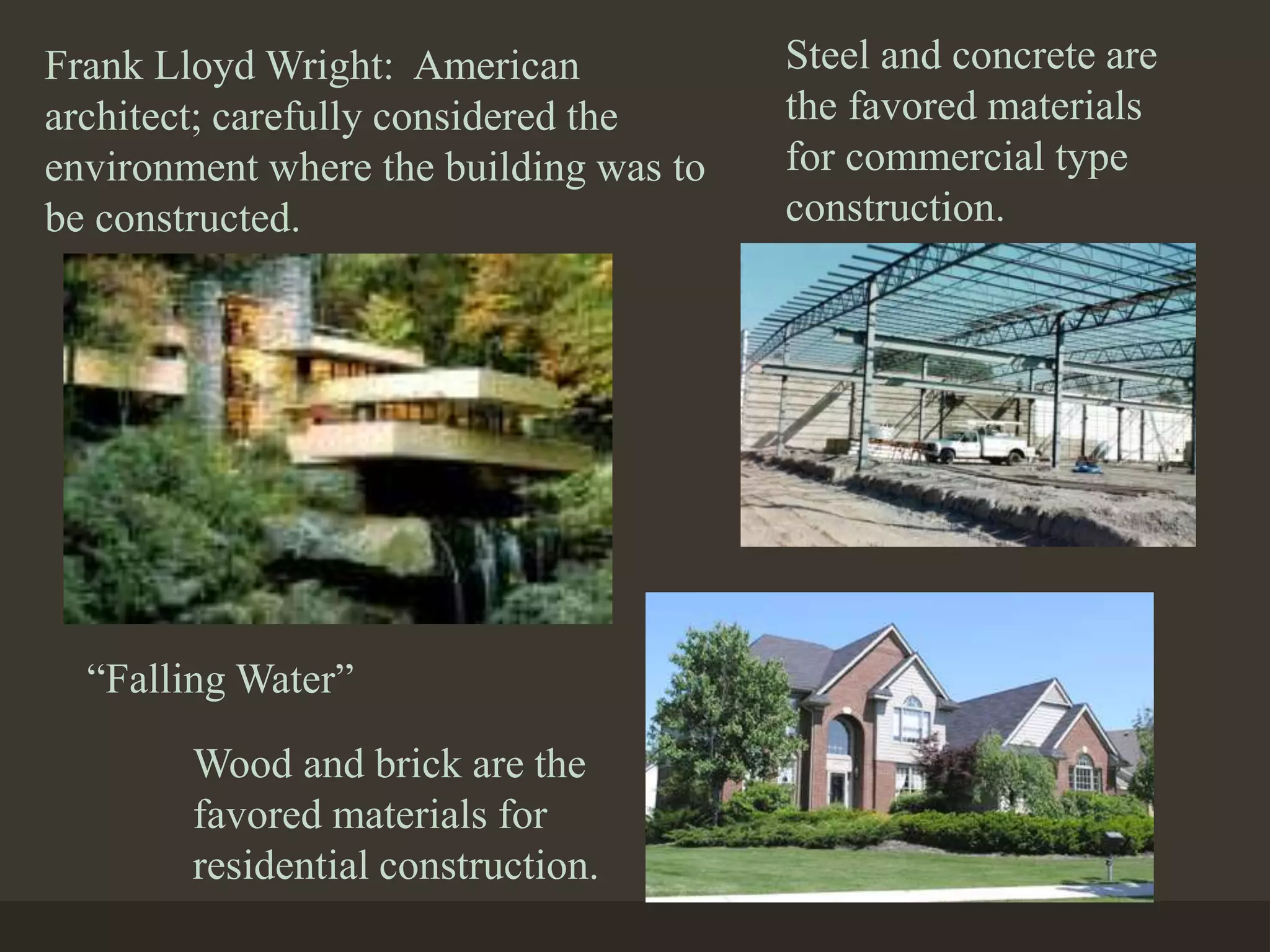
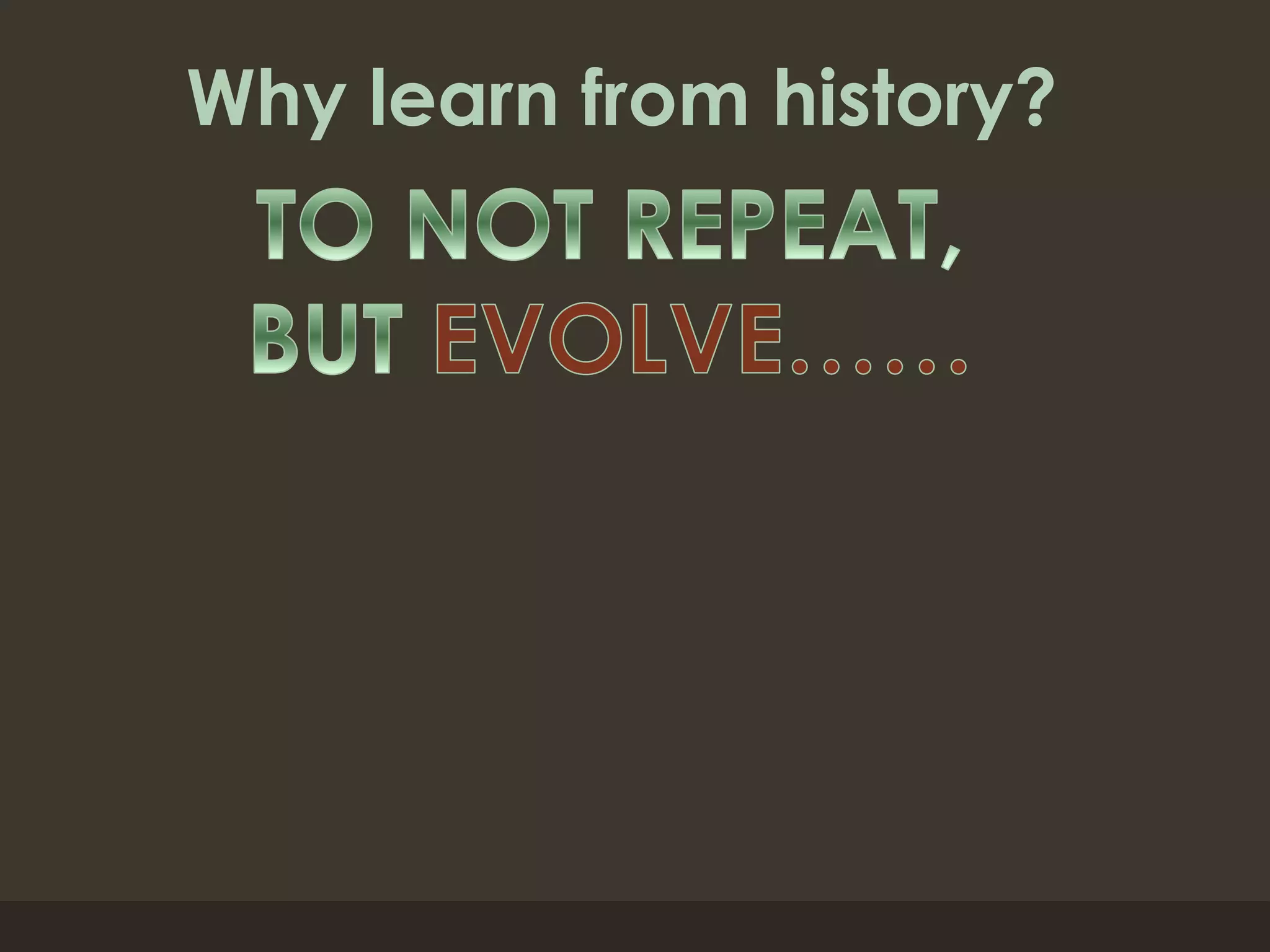
Frank Lloyd Wright: American
architect; carefully considered the
environment where the building was to
be constructed.
“Falling Water”
Steel and concrete are
the favored materials
for commercial type
construction.
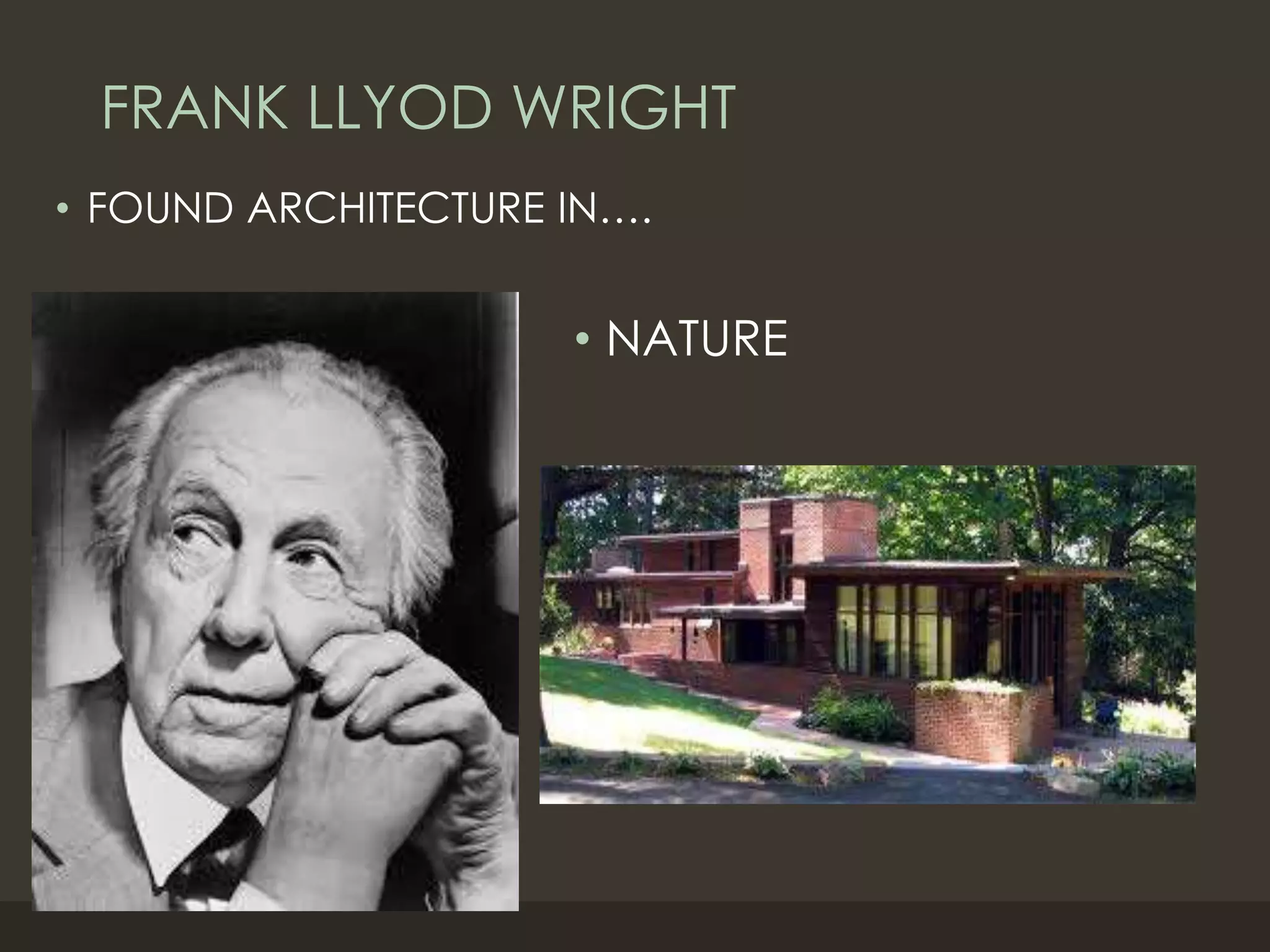
Wood and brick are the
favored materials for
residential construction.
Why learn from history?
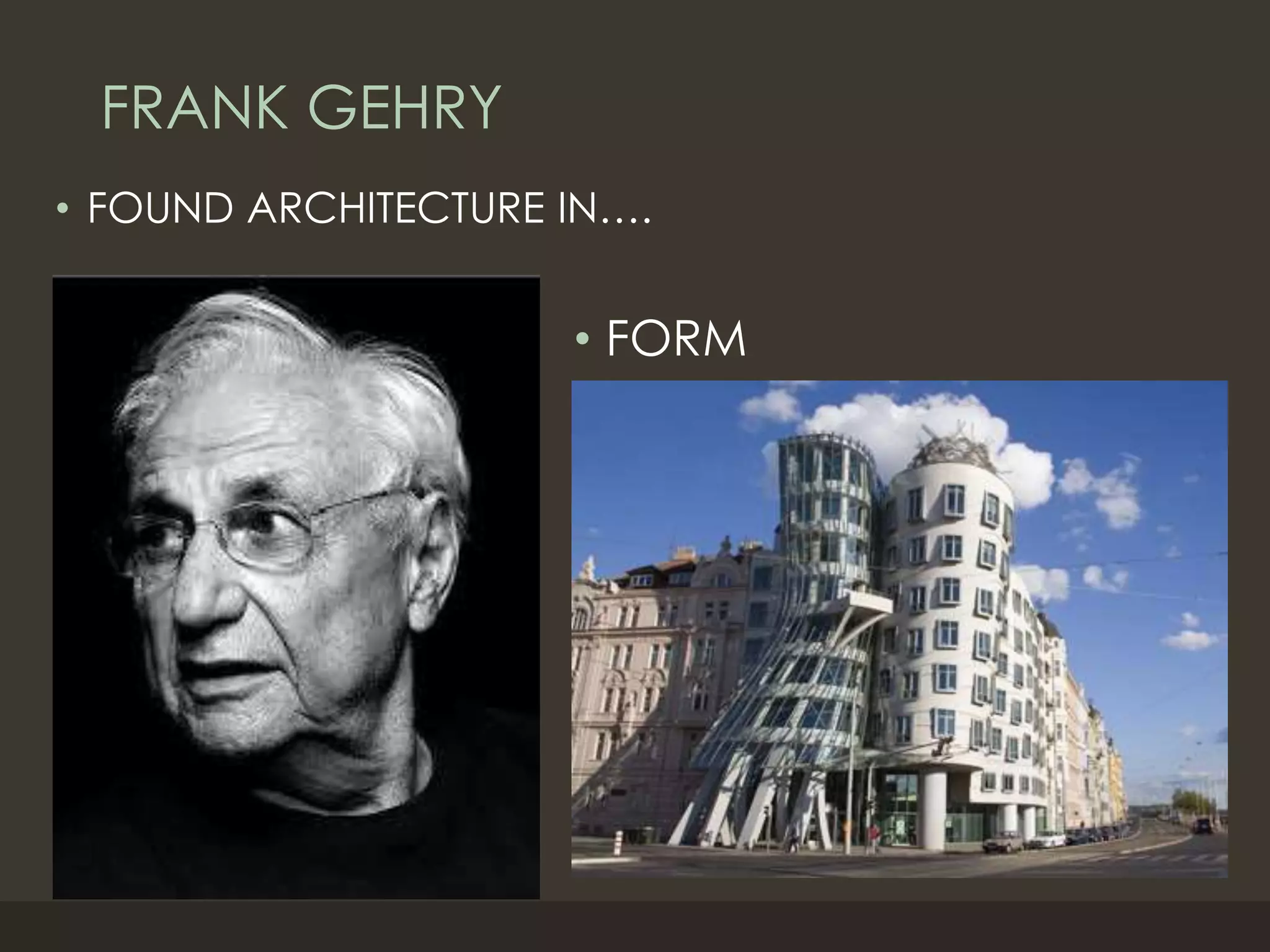
FRANK LLYOD WRIGHT
• FOUND ARCHITECTURE IN….
• NATURE
FRANK GEHRY
• FOUND ARCHITECTURE IN….
• FORM
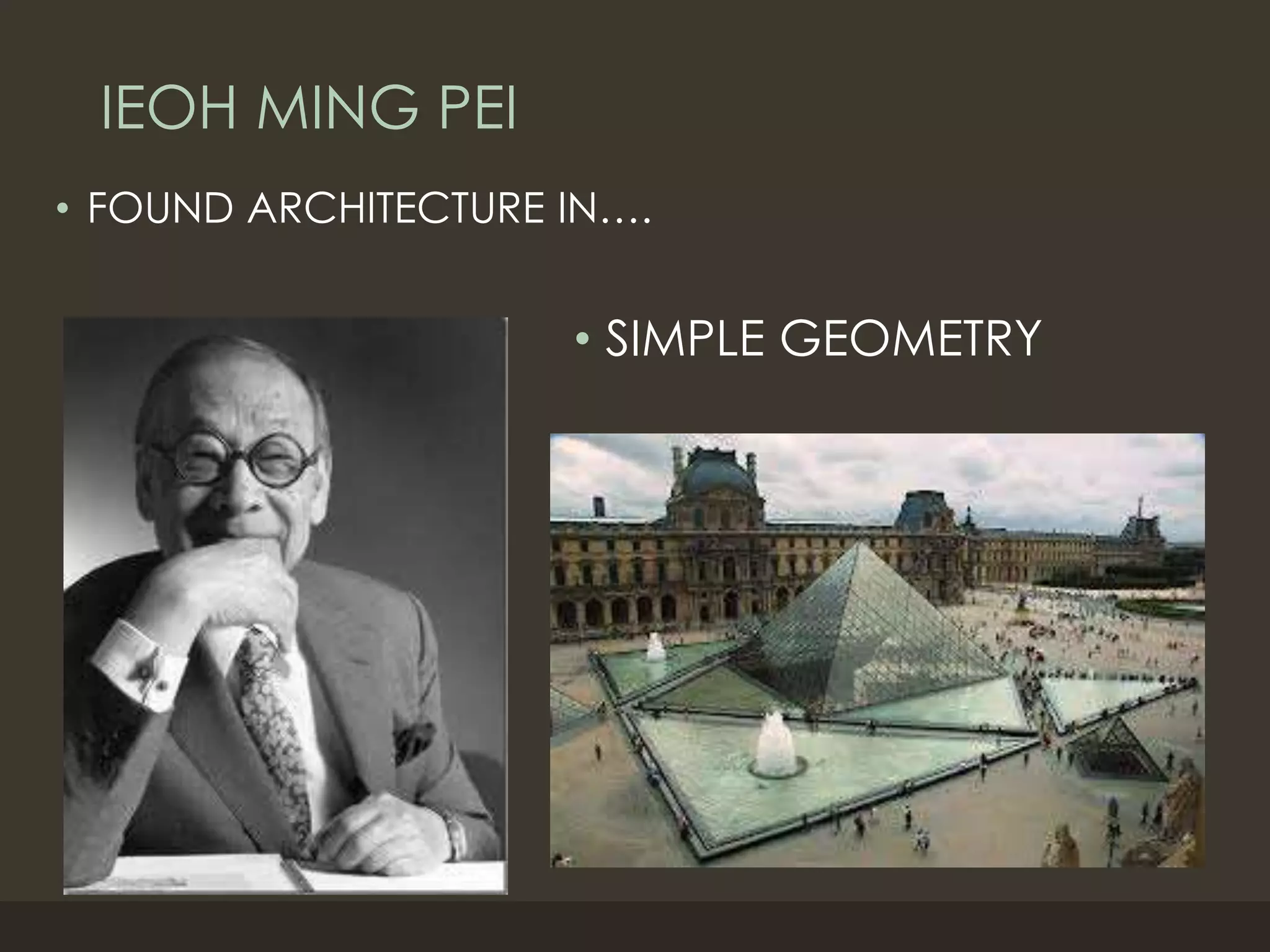
IEOH MING PEI
• FOUND ARCHITECTURE IN….
• SIMPLE GEOMETRY
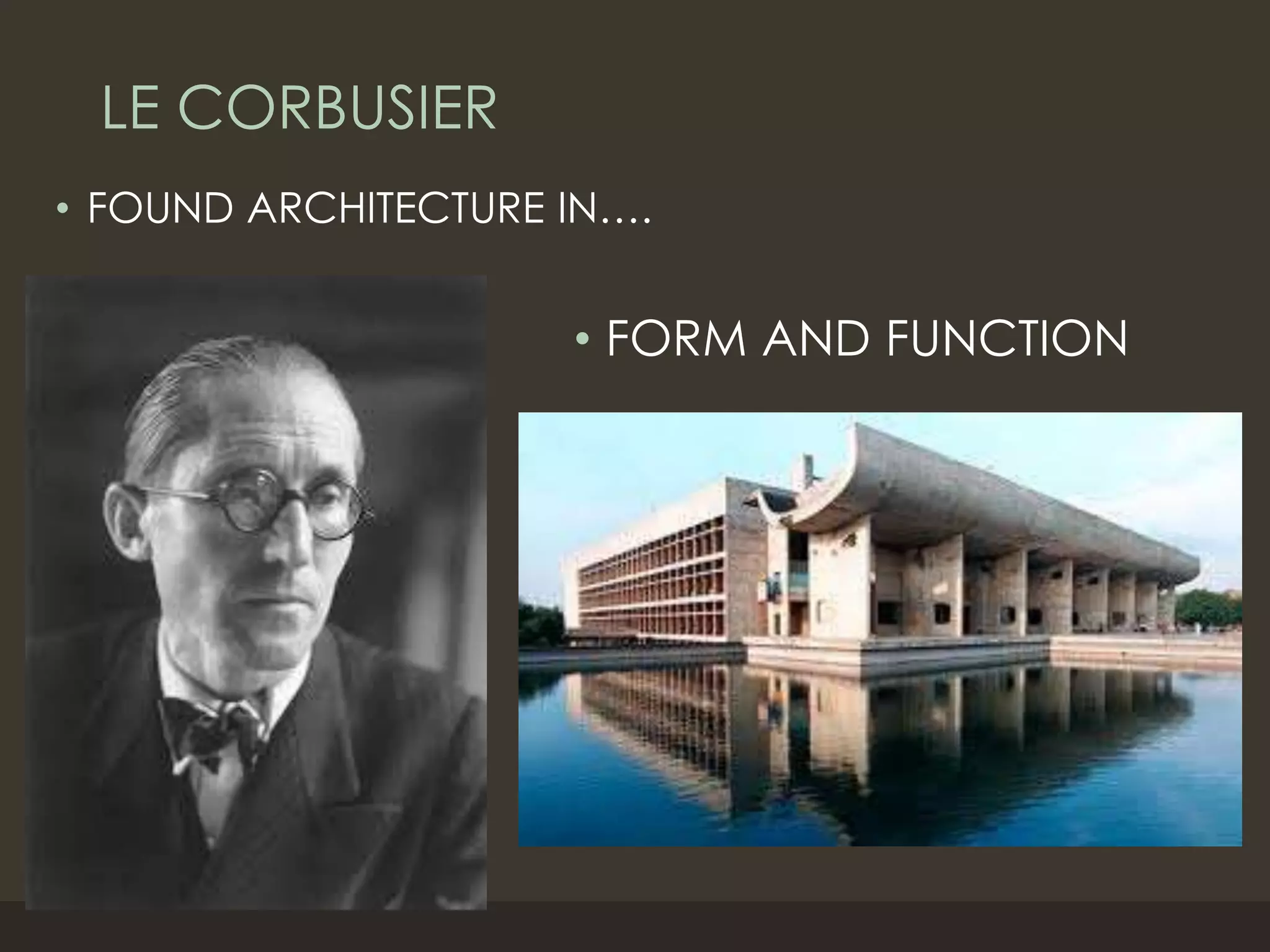
LE CORBUSIER
• FOUND ARCHITECTURE IN….
• FORM AND FUNCTION
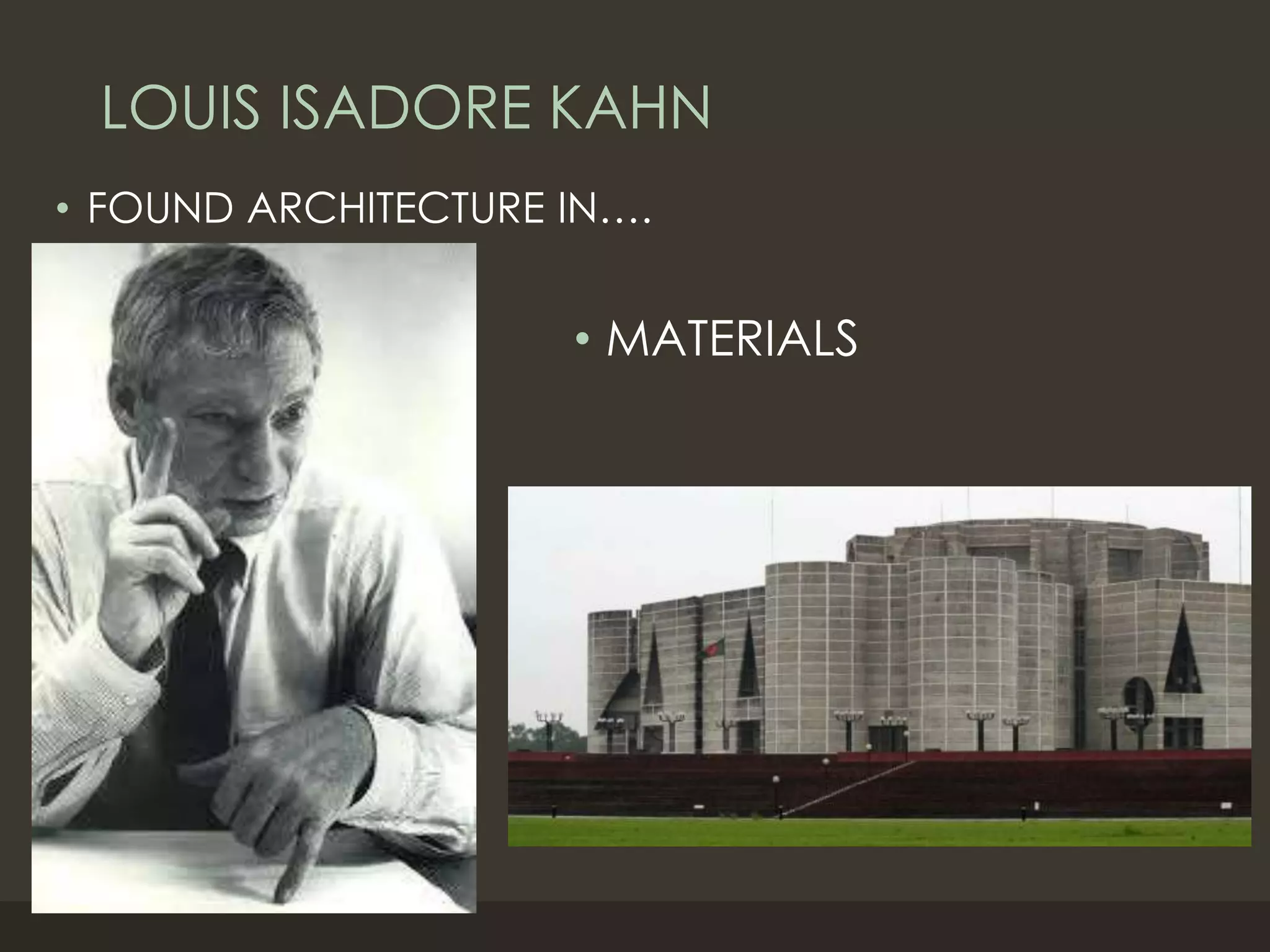
LOUIS ISADORE KAHN
• FOUND ARCHITECTURE IN….
• MATERIALS
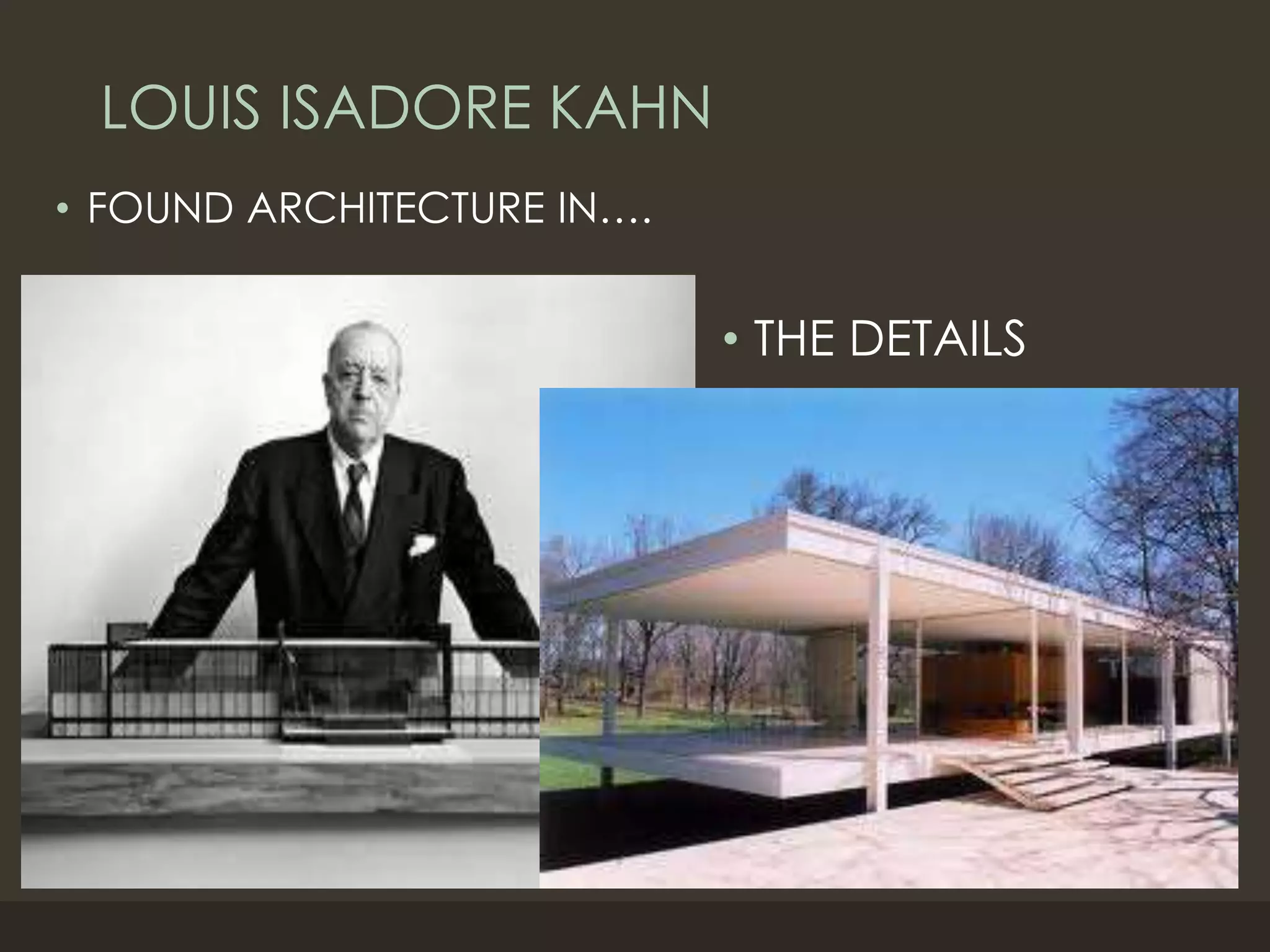
LOUIS ISADORE KAHN
• FOUND ARCHITECTURE IN….
• THE DETAILS
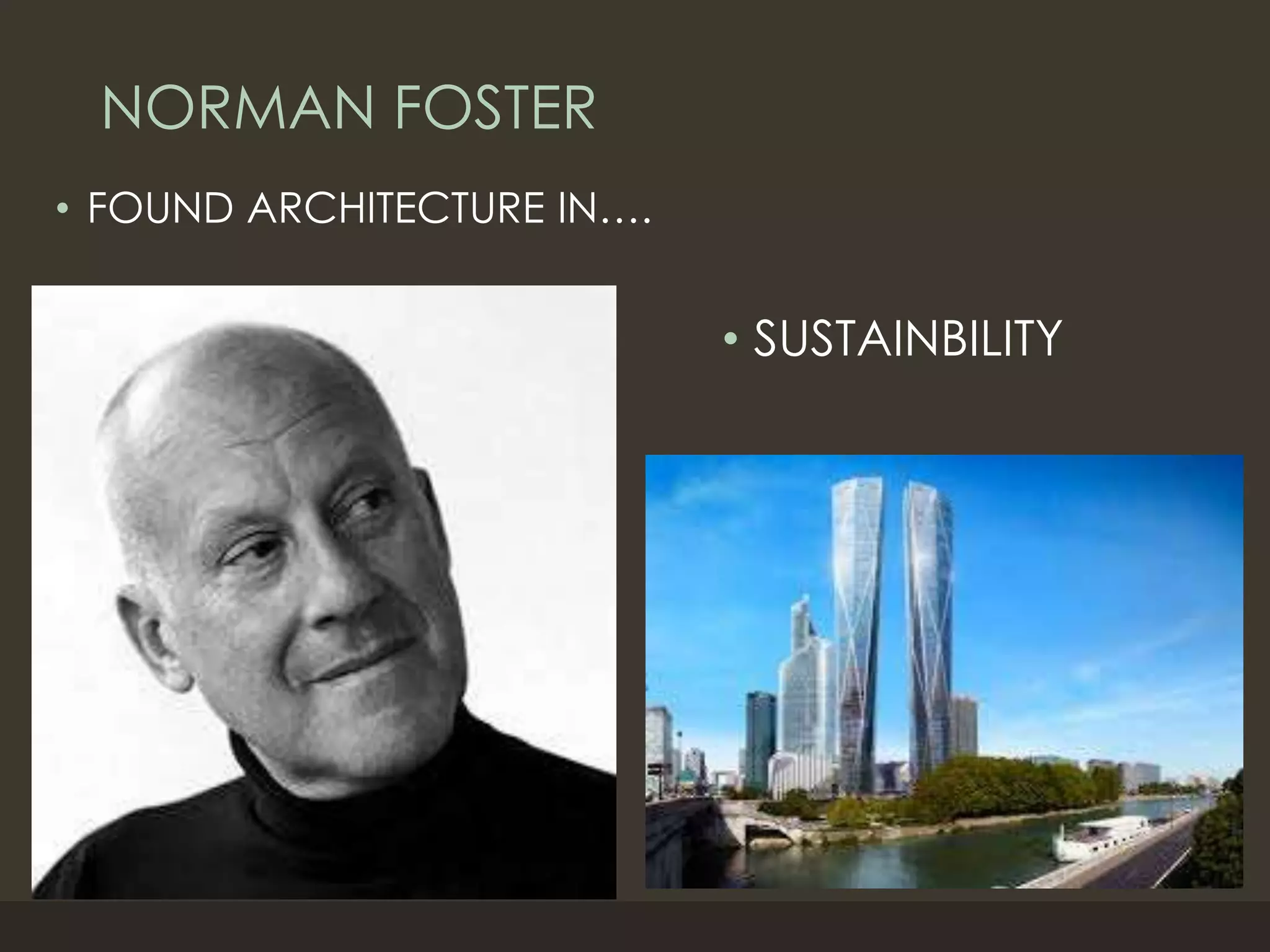
NORMAN FOSTER
• FOUND ARCHITECTURE IN….
• SUSTAINBILITY
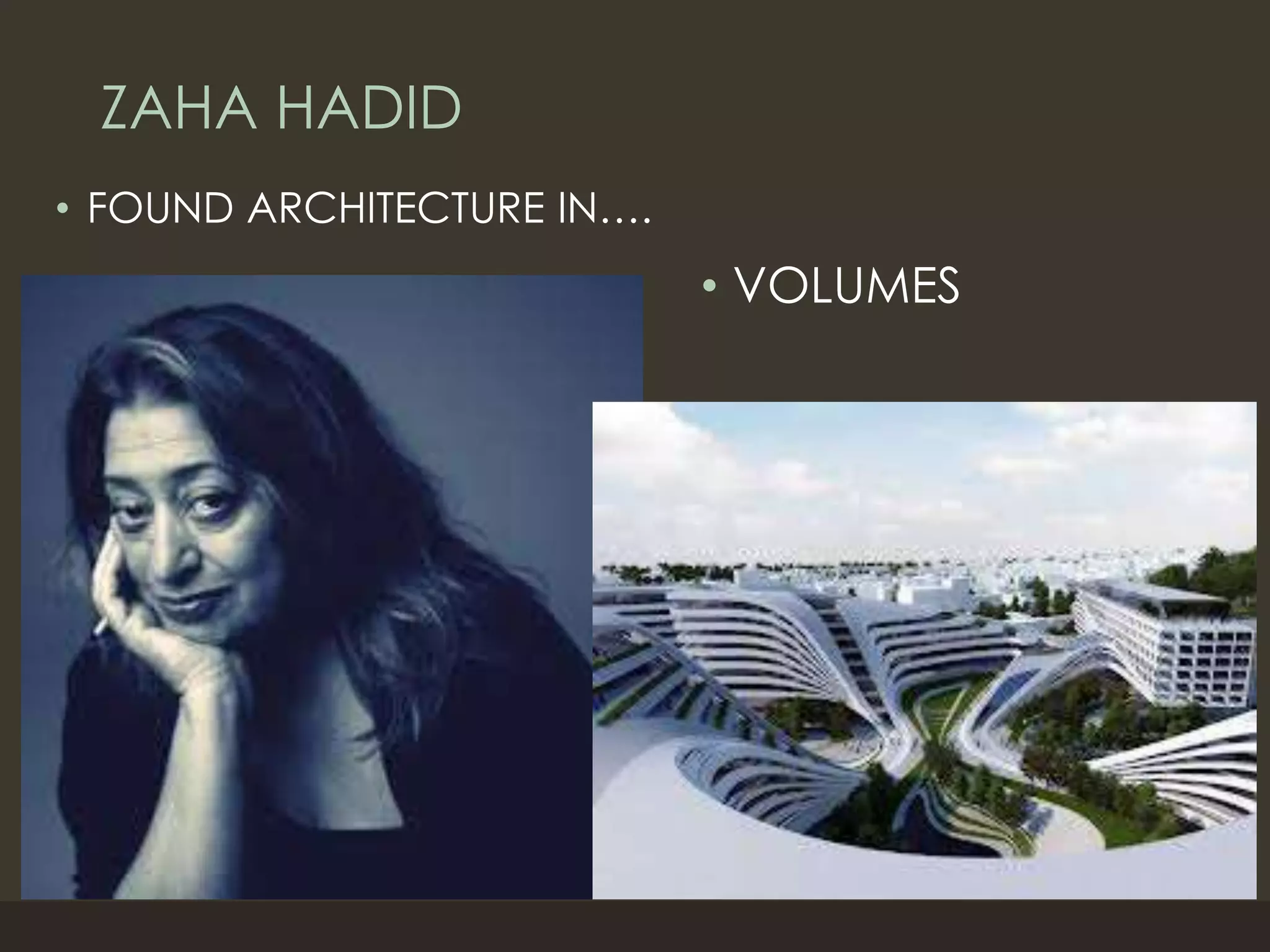
ZAHA HADID
• FOUND ARCHITECTURE IN….
• VOLUMES
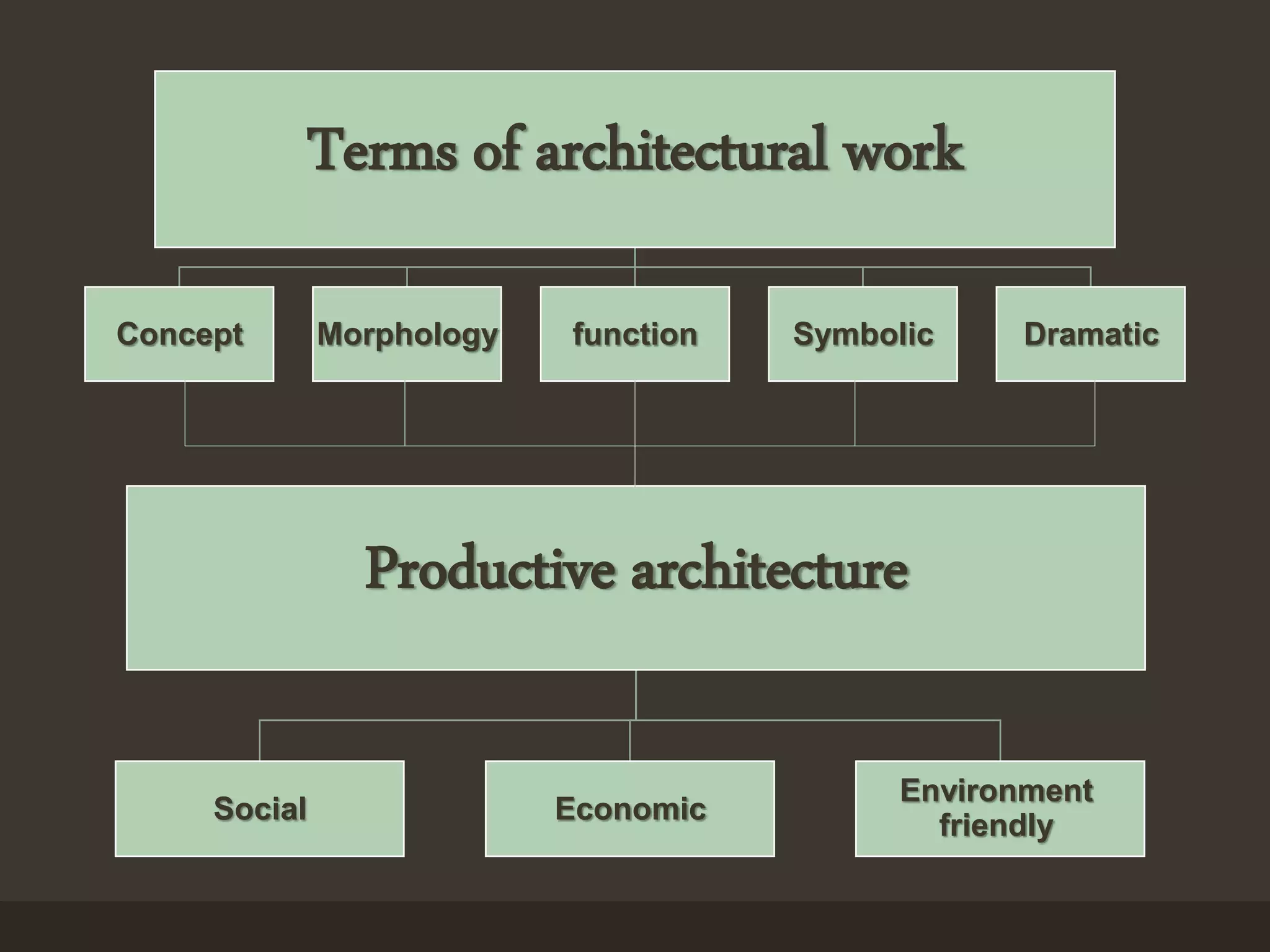
Terms of architectural work
Concept Morphology function Symbolic Dramatic
Productive architecture
Social Economic
Environment
friendly
WHY ARCHITECTURE?
• Growth and prosperity of an economy, to an extent is reflected
in its physical appearance.
• Times have changed and so has our focus. From, the basic
necessity of housing and shelter of yesteryears, emphasis is now
given on comfort, luxury and style.
• All this has importantly led to creation of avenues for those
interested in making a career in this sector.
• In the last few decades our economy has witnessed hectic and
massive construction activities, new structures have been raised,
townships have evolved, evident of growth in the sector.
• The construction task involves both the designer and
constructors.
• Any built structure is an outcome of close coordination and
participation of a number of people, technical and non-
technical, including architects, contractors, surveyors, engineers,
designers along with bricklayers, masons, carpenters,
electricians, plumbers etc.
AND WHERE?
• Substantial increase in investments in the construction sector has
been recorded year after year. As far as architects are concerned,
there is a huge gap in the demand and supply.
• All these factors contribute in making this field a very competitive one
with healthy career prospects.
• Employment opportunities for architects are available in government
as well as private sectors.
• Some of the government organizations include Public Works
Department, the Archaeological Department, Ministry of Defense,
Departments of Railways, Post and Telegraphs, Public Sector
Undertakings, National Building Organization, Town and Country
Planning Organization, National Institute of Urban Affairs, Housing and
Urban Development Corporation, National Building Construction
Corporation Ltd., City Development Authorities etc. Besides these
organizations, various other institutes and agencies like State
Departments, Housing Boards, Local Bodies responsible for
construction works also recruit architects.
• Openings in the private sector exist with the Builders, Architecture
Firms, Consultants etc. Architects with some experience can even set
up their own business as Consultants and Contractors.
TILL WHAT AGE DO ARCHITECTS
PRACTISE IN INDIA?
• By 2008, Out of the Thirty thousand architects in India, 15,000
Architects (50%) are in the age group of 20-35 and there are just
about 1500 Architects (10%) in the age group of 66-
75. Surprisingly, there are 267 Architects in the age group 76-
85, and believe it or not there are 54 Architects older
than 85 who are still practicing.
• Architecture being a creative field, one can just not fix an age
of retirement. So if you have the enthusiasm for it, you could still
be practicing at 90!
• By 2010, India has only 50,000 registered architects as against
the requirement of 500,000. Yet, there are few takers for this
career.
• In India, the ratio comes to 5,450 architects per 10 million
population
To be an architect, what subjects
should I take in high school?
• ALL SUBJECTS ARE EQUALLY IMPORTANT.
• Maths – calculus, trigonometry, geometry…..
• Physics – attention to structures, mechanics and systems…
• Chemistry – strength of materials…..
• Arts
• Humanities
• Any courses that develop your communication skills and
problem solving techniques
• Read books on art and architecture and design and take
courses if possible on sketching, painting and drawing.
What exam do I give? (in India)
NATA – national aptitude test for architecture
• NATA is an Aptitude Test which is compulsory for admission
to B.Arch as prescribed by the Council of Architecture
• Architecture entrance exams are a combination of the
drawing aptitude test and an aesthetic sensitivity test.
• Without clearing the NATA exam membership into the
council of architecture will not be given to any graduate
student.
AIEEE - All India Engineering Entrance
Examination
• The paper consists of Mathematics, an Aptitude Test and a
Drawing test.
• Scores are used by admissions authorities of different
Government, Govt aided & unaided Schools/Colleges of
architecture.
• In India, The Architecture degree course (B.Arch.) is of a minimum
period of 5 academic years or 10 semesters and includes 6 months
or 1 semester of practical training in a Professional Architect’s
office.
•The B.Arch degree programme is of 5 years duration and includes a period of practical
experience. The apprenticeship (usually for one semester) has to be done under a practicing
architect. The B. Arch degree prepares the theoretical foundations and gives some practical
insight on which a student later develops proficiency and functional accuracy.
•Subject content of B.Arch course includes architectural design (drawing and painting),
acoustics, surveying and leveling, estimating and costing, methods of construction, materials
management, history of architecture, draftsmanship, environmental planning, applied
mechanics, structural designing, computer applications etc. Some colleges teach architecture-
related software packages such as
•Further specialization in this field can be in Industrial Design, Urban Design, Landscape
Architecture, Town Planning/ Urban Planning, Environmental Planning, Building Engineering
and Management, Transport Planning, etc. These courses are open to B.Arch. degree/diploma
holders.
A Day in an Architect's Life:
• On a typical day an architect will:
• Discuss the objectives, requirements, and budget of a project
• Provide various pre-design services which may include conducting
feasibility and environmental impact studies, selecting a site, or
specifying the requirements the design must meet
• Prepare drawings and present ideas for the client to review
• Develop final construction plans that show the building's
appearance as well as details for its construction
• Follow building codes, zoning laws, fire regulations, and other
ordinances
• Make necessary changes throughout the planning process

Architecture Career Planning

  • 1.
    • Architecture wasthe "art which so disposes and adorns the edifices raised by men ... that the sight of them" contributes "to his mental health, power, and pleasure“ -John Ruskin • The mother art is architecture. Without an architecture of our own we have no soul of our own civilization. -Frank Lloyd Wright • “All architecture is shelter, all great architecture is the design of space that contains, cuddles, exalts, or stimulates the persons in that space.” -Philip Johnson • “Architecture is the will of an epoch translated into space. -Mies van der Rohe • Architecture is a continuing dialogue between generations which creates an environment across time. -Vincent Scully
  • 2.
    Who am I? •Shipra Singh, 22, Bachelors of Arch (I.D) • Alma mater: Army School, Bolarum where I have been the C.C.A Captain and the Vice Discipline Captain. • Worked for 2 years at Facelift Architectural Solutions as Junior architect during my 2nd and 3rd year. • Worked in H.P Lakhani Associates as an intern for a semester. • Designed a Specialized Defense Training Academy for my thesis and a lot of other buildings like Art museum, convention centre, research centers, hospitals and residential projects for my design portfolios. • I love sketching, painting, designing, fixing things, writing, thinking, researching, reading, dancing, exploring, traveling and most of all learning. • I see myself running my own sustainable architecture firm in at least the next 10 years.
  • 3.
  • 5.
  • 6.
    The hexagonal symmetry is truly miraculousor maybe science? •I think bees are brilliant architects.
  • 8.
  • 9.
  • 10.
  • 11.
    YOU MEAN HIRINGA BUILDER? A CONTRACTOR?
  • 12.
    WRONG!!! • IT ISSO MUCH MORE!! • Architecture encompasses everything in the built environment.
  • 13.
  • 15.
    NOT THIS KINDOF IDEA!!
  • 16.
    BUT an Ideathat meets a need with an innovative design for the future.
  • 17.
    What is Architecture? WhatI was told: ‘Father of Science and Mother of Art.’ What I learnt: ‘A young, ever evolving child of science and Art.’
  • 18.
    Actually what isn'tarchitecture?
  • 19.
    Architecture is nota decorated box Architecture is not simply the result of decorating a box inside and out. It is true that many architects often treat their work as just applying candy floss to a box, but while this may occasionally produce what might be called 'good craft,' it is more usually just bad architecture, and certainly not good art.
  • 20.
    Architecture is notsculpture • Frank Gehry's Guggenheim Museum in Bilbao praised by morons as 'architectural sculpture'. Glaring incoherence under the Spanish sun, a beautifully crafted celebration of disorientation. Also an excellent example of what architecture is not.
  • 21.
    Architecture is notrepresentation • architecture does not do literal representation well unless you simply view architecture as a signboard. Architecture is in fact closer to Aristotle's concept of mimesis: as Wright said: architecture involves "making human life more natural, and nature more humane."
  • 22.
    Architecture is notbricks and mortar • Architecture is often thought of as just so many elevations and so many 'architectural features,' but to think in these terms is to miss the essence of architecture. The stuff with which the architect works is space -
  • 23.
    Architecture is notfashion • You can’t apply anything any where… • We should only apply things when it makes sense.
  • 24.
    • In itsbroadest sense, an Architect is a person who translates a user’s requirements into a built environment. • Architecture does what no other art can do: All other art forms recreate some portion of the world - a single human figure, or a two-dimensional scene on a canvas. • Only architecture can create a total environment, one that literally surrounds the viewer. • Architecture creates a man-made, idealized world - an environment created by the architect to fit the kind of life he sees as proper to man. • Architecture conveys a view of man indirectly, not by projecting an image of man himself [as sculpture, painting and literature do] but by projecting a proper environment for man to live in.
  • 25.
    Who was thefirst famous architect? • Vitruvius is sometimes loosely referred to as the first architect, but it is more accurate to describe him as the first Roman architect to have written surviving records of his field • According to Vitruvius, a good building should satisfy the three principles of firmitas, utilitas, venusta i.e. it must be solid, useful, beautiful. • According to Vitruvius, architecture is an imitation of nature.
  • 26.
    One of theearly architectural developments was the use of the “post-and-lintel” method A beam is placed horizontally across upright posts. Ancient Greek “Orders” (styles): composed of a shaft, capital, and base.
  • 27.
    Entablature: the topof an order; includes the architrave, frieze, and cornice. Other key developments include the arch,
  • 28.
    the vault, and thedome (my personal favorite).
  • 29.
    The arch wasa purely Roman invention. An arch is often made up of small stones called voussoir and a large central stone called a keystone. A series of columns is called a colonnade. A series of arches is called an arcade.
  • 30.
    The arch, vault,and dome are variations of the same concept that allowed for greater height and more space inside a building. The Romans were great engineers. They developed concrete as a building material, which was used in building aqueducts, baths, and other public works projects.
  • 31.
    Flying Buttress: external archthat counter- balanced the outward thrust of the high, vaulted ceilings. During the Industrial Revolution, many new materials were developed: glass-- Crystal Palace (1851)
  • 32.
    and wrought iron: TheEiffel Tower Antonio Gaudi: Spanish architect– no flat surface or straight lines (organic)
  • 33.
    Antonio Gaudi’s most famousbuilding: “La Sagrada Familia” The 1st skyscraper was made in St. Louis, MO by Louis Sullivan who coined the expression “form follows function”.
  • 34.
    Frank Lloyd Wright:American architect; carefully considered the environment where the building was to be constructed. “Falling Water” Steel and concrete are the favored materials for commercial type construction. Wood and brick are the favored materials for residential construction.
  • 35.
  • 36.
    FRANK LLYOD WRIGHT •FOUND ARCHITECTURE IN…. • NATURE
  • 37.
    FRANK GEHRY • FOUNDARCHITECTURE IN…. • FORM
  • 38.
    IEOH MING PEI •FOUND ARCHITECTURE IN…. • SIMPLE GEOMETRY
  • 39.
    LE CORBUSIER • FOUNDARCHITECTURE IN…. • FORM AND FUNCTION
  • 40.
    LOUIS ISADORE KAHN •FOUND ARCHITECTURE IN…. • MATERIALS
  • 41.
    LOUIS ISADORE KAHN •FOUND ARCHITECTURE IN…. • THE DETAILS
  • 42.
    NORMAN FOSTER • FOUNDARCHITECTURE IN…. • SUSTAINBILITY
  • 43.
    ZAHA HADID • FOUNDARCHITECTURE IN…. • VOLUMES
  • 44.
    Terms of architecturalwork Concept Morphology function Symbolic Dramatic Productive architecture Social Economic Environment friendly
  • 45.
    WHY ARCHITECTURE? • Growthand prosperity of an economy, to an extent is reflected in its physical appearance. • Times have changed and so has our focus. From, the basic necessity of housing and shelter of yesteryears, emphasis is now given on comfort, luxury and style. • All this has importantly led to creation of avenues for those interested in making a career in this sector. • In the last few decades our economy has witnessed hectic and massive construction activities, new structures have been raised, townships have evolved, evident of growth in the sector. • The construction task involves both the designer and constructors. • Any built structure is an outcome of close coordination and participation of a number of people, technical and non- technical, including architects, contractors, surveyors, engineers, designers along with bricklayers, masons, carpenters, electricians, plumbers etc.
  • 46.
    AND WHERE? • Substantialincrease in investments in the construction sector has been recorded year after year. As far as architects are concerned, there is a huge gap in the demand and supply. • All these factors contribute in making this field a very competitive one with healthy career prospects. • Employment opportunities for architects are available in government as well as private sectors. • Some of the government organizations include Public Works Department, the Archaeological Department, Ministry of Defense, Departments of Railways, Post and Telegraphs, Public Sector Undertakings, National Building Organization, Town and Country Planning Organization, National Institute of Urban Affairs, Housing and Urban Development Corporation, National Building Construction Corporation Ltd., City Development Authorities etc. Besides these organizations, various other institutes and agencies like State Departments, Housing Boards, Local Bodies responsible for construction works also recruit architects. • Openings in the private sector exist with the Builders, Architecture Firms, Consultants etc. Architects with some experience can even set up their own business as Consultants and Contractors.
  • 47.
    TILL WHAT AGEDO ARCHITECTS PRACTISE IN INDIA? • By 2008, Out of the Thirty thousand architects in India, 15,000 Architects (50%) are in the age group of 20-35 and there are just about 1500 Architects (10%) in the age group of 66- 75. Surprisingly, there are 267 Architects in the age group 76- 85, and believe it or not there are 54 Architects older than 85 who are still practicing. • Architecture being a creative field, one can just not fix an age of retirement. So if you have the enthusiasm for it, you could still be practicing at 90! • By 2010, India has only 50,000 registered architects as against the requirement of 500,000. Yet, there are few takers for this career. • In India, the ratio comes to 5,450 architects per 10 million population
  • 48.
    To be anarchitect, what subjects should I take in high school? • ALL SUBJECTS ARE EQUALLY IMPORTANT. • Maths – calculus, trigonometry, geometry….. • Physics – attention to structures, mechanics and systems… • Chemistry – strength of materials….. • Arts • Humanities • Any courses that develop your communication skills and problem solving techniques • Read books on art and architecture and design and take courses if possible on sketching, painting and drawing.
  • 49.
    What exam doI give? (in India) NATA – national aptitude test for architecture • NATA is an Aptitude Test which is compulsory for admission to B.Arch as prescribed by the Council of Architecture • Architecture entrance exams are a combination of the drawing aptitude test and an aesthetic sensitivity test. • Without clearing the NATA exam membership into the council of architecture will not be given to any graduate student. AIEEE - All India Engineering Entrance Examination • The paper consists of Mathematics, an Aptitude Test and a Drawing test. • Scores are used by admissions authorities of different Government, Govt aided & unaided Schools/Colleges of architecture.
  • 50.
    • In India,The Architecture degree course (B.Arch.) is of a minimum period of 5 academic years or 10 semesters and includes 6 months or 1 semester of practical training in a Professional Architect’s office. •The B.Arch degree programme is of 5 years duration and includes a period of practical experience. The apprenticeship (usually for one semester) has to be done under a practicing architect. The B. Arch degree prepares the theoretical foundations and gives some practical insight on which a student later develops proficiency and functional accuracy. •Subject content of B.Arch course includes architectural design (drawing and painting), acoustics, surveying and leveling, estimating and costing, methods of construction, materials management, history of architecture, draftsmanship, environmental planning, applied mechanics, structural designing, computer applications etc. Some colleges teach architecture- related software packages such as •Further specialization in this field can be in Industrial Design, Urban Design, Landscape Architecture, Town Planning/ Urban Planning, Environmental Planning, Building Engineering and Management, Transport Planning, etc. These courses are open to B.Arch. degree/diploma holders.
  • 51.
    A Day inan Architect's Life: • On a typical day an architect will: • Discuss the objectives, requirements, and budget of a project • Provide various pre-design services which may include conducting feasibility and environmental impact studies, selecting a site, or specifying the requirements the design must meet • Prepare drawings and present ideas for the client to review • Develop final construction plans that show the building's appearance as well as details for its construction • Follow building codes, zoning laws, fire regulations, and other ordinances • Make necessary changes throughout the planning process