[ LANDSCAPE ARCHITECTURE ]
PRESENTATION BY AR. GEEVA CHANDANA | 1
PRESENTATION BY AR. GEEVA CHANDANA | 2
UNIT
01
INTRODUCTION
landscape architecture,
ecology,
ecological balance,
landscape conservation,
reclamation and landscaping
of derelict lands,
environmental impact
assessment.
UNIT
02
ELEMENTS OF LANDSCAPE
ARCHITECTURE AND
LANDSCAPE DESIGN
land elements, land form
plants and planting, water,
lighting etc. characteristics
and classification of plant
materials, basic principles of
landscape design; Factors to
be considered, Use and
application of plant materials
in landscape design, and
other components involved
UNIT
03
HISTORY OF LANDSCAPE
ARCHITECTURE
Eastern, Central and Western
traditions; Ancient Heritage -
Mesopotamia, Egypt, Greece,
Rome; Western Civilization –
Europe: Italy, France, and
England; The middle-east -
The Persian tradition and its
far reaching influence Eastern
Civilization: China and Japan
Ancient and medieval period
in India; Mughal and Rajput
Landscapes and study of
contemporary landscape
architecture
UNIT
04
UNIT
05
URBAN LANDSCAPE
Basic principles and
elements of Urban
landscape, Significance of
landscape in urban areas,
introduction to street
furniture, road
landscaping, waterfront
development, landscaping
of residential areas,
Industrial Landscaping.
LANDSCAPE EXERCISE
Landscape design of a
neighborhood open space
(area of 2000 to 3000 sq.
meters)
OVERVIEW
URBAN LANDSCAPE: ORIGIN
PRESENTATION BY AR. GEEVA CHANDANA | 3
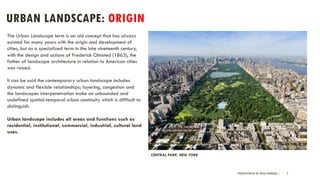
CENTRAL PARK, NEW YORK
The Urban Landscape term is an old concept that has always
existed for many years with the origin and development of
cities, but as a specialized term in the late nineteenth century,
with the design and actions of Frederick Olmsted (1863), the
father of landscape architecture in relation to American cities
was raised.
It can be said the contemporary urban landscape includes
dynamic and flexible relationships; layering, congestion and
the landscapes interpenetration make an unbounded and
undefined spatial-temporal urban continuity which is difficult to
distinguish.
Urban landscape includes all areas and functions such as
residential, institutional, commercial, industrial, cultural land
uses.
URBAN LANDSCAPE
PRESENTATION BY AR. GEEVA CHANDANA | 4
• Formed of open and green spaces within an urban environment. However, it is not totally
independent from the surrounding buildings and structures. Altogether, they form the
character and identity of a city, and sense of place.
• It contributes to the cityscape by means of aesthetics and function.
• It also supports urban ecology.
• It is dynamic and constantly evolving.
• Urban landscape elements function as separator and/or connector agents between
• different land uses. They can form a buffer zone between conflicting uses (e.g. between
industrial and housing areas) while they can facilitate movement of citizens throughout
the city (e.g. greenways).
• They have the flexibility to serve for multiple uses and for different group of users in
the community.
• Urban landscape also contributes to the cityscape in terms of visual quality. Within
dense built environments, it creates a sense of openness and more attractive places to
live.
• Urban landscape helps to balance human-scale in city centres where vertical effect of
buildings and structures dominates.
• It softens the “hardness” of buildings and structures. Well designed and managed urban
landscape can improve citizens’ quality of life in many other ways as well.
URBAN LANDSCAPE : BENEFITS
PRESENTATION BY AR. GEEVA CHANDANA | 5
Well designed and managed urban landscape can improve citizens’ quality
of life in many other ways as well. The benefits of urban landscape are
explained below. Ecological and environmental benefits Contemporary
urban ecology assumes that urban areas are ecosystems since they have
interacting biological and physical complexes .
McHarg played a major role in emergence of ecological landscape design
approaches in urban development. His work “Design with Nature”(1969)
displays how nature and city might coexist together. However, ecology has
been neglected in urban planning systems of most developing countries
which mostly focus on the relationship between physical and socioeconomic
aspects of an urban development. Urban green spaces are fundamental in
sustaining the urban ecology.
URBAN LANDSCAPE : BENEFITS
PRESENTATION BY AR. GEEVA CHANDANA | 6
THE ENVIRONMENTAL AND ECOLOGICAL BENEFITS OF THE URBAN LANDSCAPE
• Urban green spaces provide flora and fauna with a habitat to live and therefore support biodiversity conservation.
• They also act as ecological corridors between urban, periurban and rural areas. They support movement of living
organisms between these areas.
• Vegetation cover in urban landscape helps to improve micro-climate of urban areas where climate is warmer than their
surroundings due to dense built environment and human activities.
• Vegetation cover raises humidity levels, reduces the stress of the heat island and mitigates the less desirable effects of
urban climate . Daytime temperature in large parks was found to be 2-3°C lower than the surrounding streets.
• Vegetation helps to decrease carbon emission levels in cities. Through photosynthesis process in plants CO2 in the air is
converted to O2. Therefore, urban vegetation cover helps to reduce excess CO2 in the urban atmosphere. Although the
degree of trees’ drawing carbon emissions from the air is affected by their size, canopy cover, age and health, large
trees can lower carbon emission in the atmosphere by 2-3%.
• Vegetation cover also filters out other particles and dust in the air.
• Green spaces absorb and reduce the noise generated by human activities, especially trees act like noise barriers.
• Vegetation cover and soil in urban landscape controls water regime and reduces runoff, hence helps to prevent water
floods by absorbing excess water.
• Trees can also act like wind breaker.
URBAN LANDSCAPE : BENEFITS
PRESENTATION BY AR. GEEVA CHANDANA | 7
THE ENVIRONMENTAL AND ECOLOGICAL BENEFITS OF THE URBAN LANDSCAPE
• Humans are the dominating elements of an urban environment. Social interaction, as a basic need for humans, is
essential in developing sense of community, belonging and security. Social interaction in cities is possibly the highest in
public open and green spaces. Urban open and green spaces offer citizens various activity choices including
recreational and sports activities which promote social cohesion.
• Urban open and green spaces can be designed to serve the community’s leisure needs. Designers should consider the
ways to attract people to open and green spaces so that every group in the community can enjoy social benefits of
urban landscape as well.
• Environmental education can be regarded amongst the social benefits of urban landscapes. Green spaces can be
thought of as outdoor laboratories to observe and get to know about nature.
• Green spaces in urban landscape may play an important role in environmental education. For instance, botanical parks
are where people can learn about different plants, their living conditions and observe the physiological changes during
time. Even urban street trees present the seasonal physiological changes in plants.
URBAN LANDSCAPE : BENEFITS
PRESENTATION BY AR. GEEVA CHANDANA | 8
HEALTH BENEFITS OF THE URBAN LANDSCAPE
The degradation of natural environments inevitably affects human
health in a negative way.
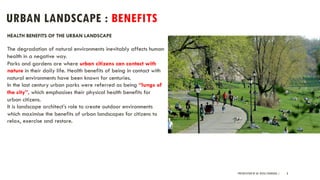
Parks and gardens are where urban citizens can contact with
nature in their daily life. Health benefits of being in contact with
natural environments have been known for centuries.
In the last century urban parks were referred as being “lungs of
the city”, which emphasises their physical health benefits for
urban citizens.
It is landscape architect’s role to create outdoor environments
which maximise the benefits of urban landscapes for citizens to
relax, exercise and restore.
URBAN LANDSCAPE : BENEFITS
PRESENTATION BY AR. GEEVA CHANDANA | 9
ECONOMIC BENEFITS OF THE URBAN LANDSCAPE
• Although the economic valuation of urban landscape is difficult, open and green spaces have economic benefits in
several ways:
Their aesthetic contribution to cityscape influences property values. In general, urban landscape elements increase the
nearby property value and enhance marketability of real estate. Accessibility, quality and visibility are basic factors
that determine economic value of urban landscapes in this context.
• Urban landscapes provide employment opportunities during their design, construction and maintenance. The
construction and maintenance of urban landscapes also supports other sectors such as playground manufacturers and
nurseries.
• The health benefits of urban landscapes which were summarized above can reduce the costs of national health
expenses.
• Public urban landscapes provide environments for walking, sports and other recreational activities for no cost at all,
especially for lower income groups.
• Green spaces can help energy saving. Right selection and planting of plants can provide cooler environments in summer
and warmer environments in winter thus reduce air conditioning expenses.
• Urban landscapes can enhance tourism in cities by attracting people. Park Güell in Barcelona, Spain is a perfect
example of how a park can become a global tourism destination.
LANDSCAPE DESIGN IN URBAN ENVIRONMENT
PRESENTATION BY AR. GEEVA CHANDANA | 10
Adaptability and sustainability
• Support and preserve biotic diversity and create habitat corridors.
• Minimize energy use and promote use of renewable energy resources. Reduce energy costs by using solar and
wind energy systems.
• Protect and improve quality of water resources.
• Reduce water and fertilizer use by selecting native and drought tolerant plant species.
• Reduce water runoff by decreasing the amount of hard surfaces and proper drainage design.
• Conserve aquifer recharge zones.
• Provide collection and storage of rainwater in order to use it for maintenance of green spaces.
• Support pedestrian and bicycle circulation within the city. People should move easily and freely within a city. Cities
should not be designed for vehicle traffic. Connected urban open and green space systems could create an
environmentally and people friendly transportation routes.
• Choose plants suitable for local climate and site conditions. Selecting right plant species will increase the survival
chance of plants in harsh urban environment, success of design and decrease maintenance costs.
• Provide collection and storage of rainwater in order to use it for maintenance of green spaces.
LANDSCAPE DESIGN IN URBAN ENVIRONMENT
PRESENTATION BY AR. GEEVA CHANDANA | 11
Coherence and legibility
• Coherence of landscape elements might be visual, functional or ecological. Hence, both natural and cultural landscape
elements should be assessed in terms of coherence.
• Both history and cultural values of a place should be considered in attempt to achieve coherence and strengthening
identity.
• Local architectural styles and materials should be taken into account in landscape design in order to provide integrity
and coherence and preserve local identity.
• Visual quality of a landscape is important for reading and understanding the place. The entrances and exits of a place
should be visually clear.
• Placing sculptures or other ornamental features can enhance the visual quality of the environment.
• Human scale is essential in legibility.
• Landscape construction materials should be selected to support or enhance visual coherence overall and between
different landscape elements.
• Designed environments should support perceived safety. Open spaces offer people a sense of security since they have
a wider perspective of a place to see what is going on around them, however people also needs to find a “niche” for
themselves to have some privacy or to hide if they feel insecure.
LANDSCAPE DESIGN IN URBAN ENVIRONMENT
PRESENTATION BY AR. GEEVA CHANDANA | 12
Coherence and legibility
• Spatial definition also helps people to feel more secure. Knowing
boundaries increases confidence. Hence, edges should be clear and
visible.
• For ecological coherence, green networks throughout and around the city
should be created and connected to each other.
• Time is another variable of coherence. Forms, textures and colours of an
urban landscape vary through time. Therefore changes through time and
alternatives for the future should be taken into account in design process.
• Coherence between user needs and expectations, and proposed activities
should be evaluated. Participation of local people in design process
may help to create more coherent design alternatives.
• Diversity is essential for both healthy functional landscapes and creating
more appealing environments for people. Diversity of landscape elements
without coherence may cause chaos. Connectivity between different
landscape elements enhances coherence.
LANDSCAPE DESIGN IN URBAN ENVIRONMENT
PRESENTATION BY AR. GEEVA CHANDANA | 13
EQUITY AND ACCESSIBILITY
• Urban environments are where people from various ethical, social, cultural, economic backgrounds, ages and gender live
together. Segregation of urban communities leads to both spatially and socially divided urban environments. As a result,
equity becomes an important issue in achieving sustainable community development. Thus, designing public spaces
for everyone is crucial in today’s communities for developing community identity and preventing social fragmentation.
• Urban landscape design helps to create accessible environments for everyone in the community in terms of public open
space.
• Open and green spaces should be distributed evenly throughout the city. Special design techniques are needed to be
taken into account for accessibility of disadvantaged groups, such as disabled and elderly.
• Children should also be amongst priority in landscape design. Encouraging children to spend their free time in urban
open and green spaces is a completely different research area itself.
• Therefore, urban landscape design should give importance to creating safe, enjoyable and creative environments for
children, and of course for their parents where they feel safe to let their children out.
• Urban open and green spaces offer a unique opportunity for integration of different social groups and individuals.
Hence, designers should seek ways to support social cohesion through space.
• Community involvement in planning and design schemes is necessary in order to have an idea of existing problems,
needs, and expectations of different groups within the community.
LANDSCAPE DESIGN IN URBAN ENVIRONMENT
PRESENTATION BY AR. GEEVA CHANDANA | 14
COMMUNITY INVOLVEMENT
• Community involvement in urban planning and environmental impact assessment has gained widespread recognition in
the last few decades. In urban design, community participation takes place mostly during decision making process in
urban renewal projects. Involvement of community in design process increases their confidence in the project and their
responsibility. Through information and knowledge exchange both local community and designers can be inspired. As a
result, local community is more likely to support the project and to embrace the designed environment. This leads to
satisfaction and long-lasting use of the designed place.
• The Urban planners and Landscape Architects design outdoor environments for public benefit. Hence, understanding
public opinions on their living environments could be helpful in creating livable urban environments. On the other hand,
designers should realize that it is impossible to please everyone and respond to everyone’s needs and expectations.
Therefore, community involvement should only be accepted as a tool to understand the possible effects of design
proposal on its future users.
Implementation and maintenance costs should be taken into account during design process. Cost efficient design
strategies should be adopted in order to maintain durability and longevity of the designed environment. Urban open
and green spaces can be designed and managed to minimise expenses.
For example, stored rainwater in ponds and lakes could be used in irrigation, or use of fertilisers can be minimised by
decreasing amount of lawn areas. Solar energy panels could be used to store energy during daytime which could be
turned into electricity for lighting at night time. Multifunctional spaces also reduce cost by letting various activities take
place in one place. Selection of durable paving material and site furniture will also decrease the maintenance costs in
long term.
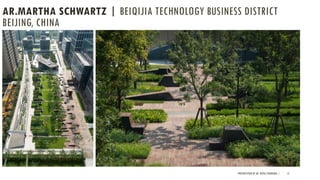
AR.MARTHA SCHWARTZ | BEIQIJIA TECHNOLOGY BUSINESS DISTRICT
BEIJING, CHINA
PRESENTATION BY AR. GEEVA CHANDANA | 15
AR.MARTHA SCHWARTZ | BEIQIJIA TECHNOLOGY BUSINESS DISTRICT
BEIJING, CHINA
PRESENTATION BY AR. GEEVA CHANDANA | 16
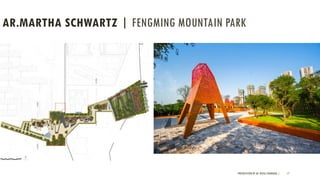
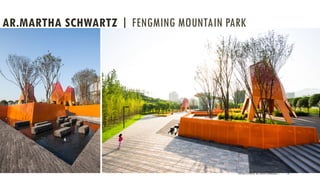
AR.MARTHA SCHWARTZ | FENGMING MOUNTAIN PARK
PRESENTATION BY AR. GEEVA CHANDANA | 17
AR.MARTHA SCHWARTZ | FENGMING MOUNTAIN PARK
PRESENTATION BY AR. GEEVA CHANDANA | 18
AR.MARTHA SCHWARTZ | GRAND CANAL SQUARE, DUBLIN, IRELAND
PRESENTATION BY AR. GEEVA CHANDANA | 19
AR.ROBERT BURLE MARX| NEW YORK BOTANICAL GARDEN
PRESENTATION BY AR. GEEVA CHANDANA | 20
AR.ROBERT BURLE MARX| NEW YORK BOTANICAL GARDEN
PRESENTATION BY AR. GEEVA CHANDANA | 21
AR.ROBERT BURLE MARX| RIO DE JANEIRO WATERFRONT
PRESENTATION BY AR. GEEVA CHANDANA | 22
AR.ROBERT BURLE MARX| RIO DE JANEIRO WATERFRONT
PRESENTATION BY AR. GEEVA CHANDANA | 23
ELEMENTS OF URBAN LANDSCAPE
PRESENTATION BY AR. GEEVA CHANDANA | 24
The elements of Urban Landscape encompasses much more than just the landscape. It is a collaboration of the landscape
and everything contained by it - buildings and structures, people, streets and walkways, open space, social spaces, and
functional spaces.
Achieving a livable urban fabric is accomplished through the main overlapping and interconnecting of three levels; the city
structure, its urban spaces and local design.
City structure: Roads, Areas
Urban spaces: Buildings , streets
Local places : Landscape of places / urban environment
Landscape elements should primarily relate in its expression, patterning,
levels and visual qualities to the physical characteristics of places,
human scale and activities.
Landscape is mainly divided to three parts the soft, the hard and
the furniture.
ELEMENTS OF URBAN LANDSCAPE
PRESENTATION BY AR. GEEVA CHANDANA | 25
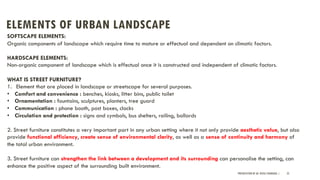
SOFTSCAPE ELEMENTS:
Organic components of landscape which require time to mature or effectual and dependent on climatic factors.
HARDSCAPE ELEMENTS:
Non-organic component of landscape which is effectual once it is constructed and independent of climatic factors.
WHAT IS STREET FURNITURE?
1. Element that are placed in landscape or streetscape for several purposes.
• Comfort and convenience : benches, kiosks, litter bins, public toilet
• Ornamentation : fountains, sculptures, planters, tree guard
• Communication : phone booth, post boxes, clocks
• Circulation and protection : signs and symbols, bus shelters, railing, bollards
2. Street furniture constitutes a very important part in any urban setting where it not only provide aesthetic value, but also
provide functional efficiency, create sense of environmental clarity, as well as a sense of continuity and harmony of
the total urban environment.
3. Street furniture can strengthen the link between a development and its surrounding can personalise the setting, can
enhance the positive aspect of the surrounding built environment.
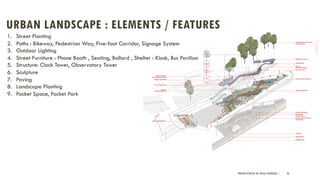
URBAN LANDSCAPE : ELEMENTS / FEATURES
PRESENTATION BY AR. GEEVA CHANDANA | 26
1. Street Planting
2. Paths : Bikeway, Pedestrian Way, Five-foot Corridor, Signage System
3. Outdoor Lighting
4. Street Furniture : Phone Booth , Seating, Bollard , Shelter : Kiosk, Bus Pavilion
5. Structure: Clock Tower, Observatory Tower
6. Sculpture
7. Paving
8. Landscape Planting
9. Pocket Space, Pocket Park
URBAN LANDSCAPE : ELEMENTS
PRESENTATION BY AR. GEEVA CHANDANA | 27
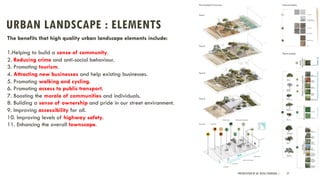
The benefits that high quality urban landscape elements include:
1.Helping to build a sense of community.
2. Reducing crime and anti-social behaviour.
3. Promoting tourism.
4. Attracting new businesses and help existing businesses.
5. Promoting walking and cycling.
6. Promoting access to public transport.
7. Boosting the morale of communities and individuals.
8. Building a sense of ownership and pride in our street environment.
9. Improving accessibility for all.
10. Improving levels of highway safety.
11. Enhancing the overall townscape.
URBAN LANDSCAPE : ELEMENTS
PRESENTATION BY AR. GEEVA CHANDANA | 28
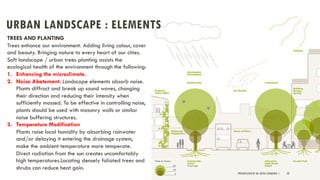
TREES AND PLANTING
Trees enhance our environment. Adding living colour, cover
and beauty. Bringing nature to every heart of our cities.
Soft landscape / urban trees planting assists the
ecological health of the environment through the following:
1. Enhancing the microclimate.
2. Noise Abatement: Landscape elements absorb noise.
Plants diffract and break up sound waves, changing
their direction and reducing their intensity when
sufficiently massed. To be effective in controlling noise,
plants should be used with masonry walls or similar
noise buffering structures.
3. Temperature Modification
Plants raise local humidity by absorbing rainwater
and/or delaying it entering the drainage system,
make the ambient temperature more temperate.
Direct radiation from the sun creates uncomfortably
high temperatures.Locating densely foliated trees and
shrubs can reduce heat gain.
URBAN LANDSCAPE : ELEMENTS
PRESENTATION BY AR. GEEVA CHANDANA | 29
TREES AND PLANTING
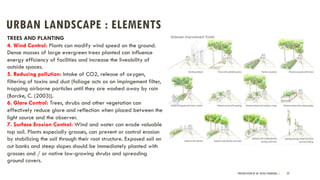
4. Wind Control: Plants can modify wind speed on the ground.
Dense masses of large evergreen trees planted can influence
energy efficiency of facilities and increase the liveability of
outside spaces.
5. Reducing pollution: Intake of CO2, release of oxygen,
filtering of toxins and dust (foliage acts as an impingement filter,
trapping airborne particles until they are washed away by rain
(Borcke, C. (2003)).
6. Glare Control: Trees, shrubs and other vegetation can
effectively reduce glare and reflection when placed between the
light source and the observer.
7. Surface Erosion Control: Wind and water can erode valuable
top soil. Plants especially grasses, can prevent or control erosion
by stabilizing the soil through their root structure. Exposed soil on
cut banks and steep slopes should be immediately planted with
grasses and / or native low-growing shrubs and spreading
ground covers.
URBAN LANDSCAPE : ELEMENTS
PRESENTATION BY AR. GEEVA CHANDANA | 30
SIGNAGE
Strategies for signage should be included at an early stage in the
design process, as the design of a layout can influence the need
for signage.
Make a place legible: Signage can be a major clutter problem
and can often be misleading. Not infrequently, the only signage
provided is for vehicles, so that the stranger on foot can find
himself circulating around one-way systems. The answer lies in:
1. Consistent and coordinated design of these elements over a
wide area.
2. Making the structure of the place legible so as to minimise the
need for signs, especially those concerned with traffic direction
and control.
3. Concentrating pedestrian signage in a designed locality at
specific nodal points.
4. Signage can also be used to enhance place identity.
URBAN LANDSCAPE : ELEMENTS
PRESENTATION BY AR. GEEVA CHANDANA | 31
LIGHTING
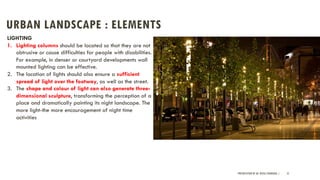
1. Lighting columns should be located so that they are not
obtrusive or cause difficulties for people with disabilities.
For example, in denser or courtyard developments wall
mounted lighting can be effective.
2. The location of lights should also ensure a sufficient
spread of light over the footway, as well as the street.
3. The shape and colour of light can also generate three-
dimensional sculpture, transforming the perception of a
place and dramatically painting its night landscape. The
more light-the more encouragement of night time
activities
URBAN LANDSCAPE : ELEMENTS
PRESENTATION BY AR. GEEVA CHANDANA | 32
LITTERBINS
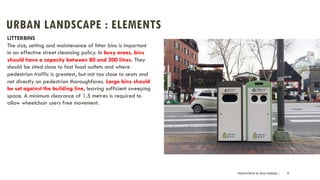
The size, setting and maintenance of litter bins is important
in an effective street cleansing policy. In busy areas, bins
should have a capacity between 80 and 200 litres. They
should be sited close to fast food outlets and where
pedestrian traffic is greatest, but not too close to seats and
not directly on pedestrian thoroughfares. Large bins should
be set against the building line, leaving sufficient sweeping
space. A minimum clearance of 1.5 metres is required to
allow wheelchair users free movement.
URBAN LANDSCAPE : ELEMENTS
PRESENTATION BY AR. GEEVA CHANDANA | 33
BOLLARDS
Select a design consistent with other similar items, such as
bases of finger posts (pedestrian direction signs), supports
for railings and traffic signs. They should not dominate the
pedestrian environment but will need to be around 900mm
high in areas where vehicles are permitted. They can be
painted in black or muted colours, and can have integral or
fitted town plaques.
URBAN LANDSCAPE : ELEMENTS
PRESENTATION BY AR. GEEVA CHANDANA | 34
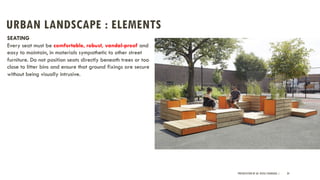
SEATING
Every seat must be comfortable, robust, vandal-proof and
easy to maintain, in materials sympathetic to other street
furniture. Do not position seats directly beneath trees or too
close to litter bins and ensure that ground fixings are secure
without being visually intrusive.
URBAN LANDSCAPE : ELEMENTS
PRESENTATION BY AR. GEEVA CHANDANA | 35
TOILETS
Public toilets should be available at most hours and kept
properly maintained. Some single, self cleansing toilets
include advertising to subsidise their cost.
URBAN LANDSCAPE : ELEMENTS
PRESENTATION BY AR. GEEVA CHANDANA | 36
CYCLE RACKS
To help reduce pollution in town centres we need to
encourage cyclists and provide racks where cycles can be
secured. There are some good modern designs available.
URBAN LANDSCAPE : ELEMENTS
PRESENTATION BY AR. GEEVA CHANDANA | 37
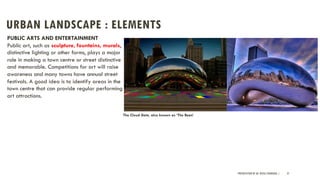
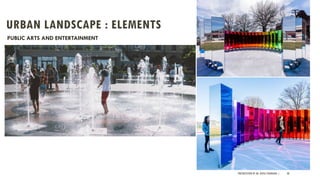
PUBLIC ARTS AND ENTERTAINMENT
Public art, such as sculpture, fountains, murals,
distinctive lighting or other forms, plays a major
role in making a town centre or street distinctive
and memorable. Competitions for art will raise
awareness and many towns have annual street
festivals. A good idea is to identify areas in the
town centre that can provide regular performing
art attractions.
The Cloud Gate, also known as ‘The Bean’
URBAN LANDSCAPE : ELEMENTS
PRESENTATION BY AR. GEEVA CHANDANA | 38
PUBLIC ARTS AND ENTERTAINMENT
URBAN LANDSCAPE : ELEMENTS
PRESENTATION BY AR. GEEVA CHANDANA | 39
PUBLIC ARTS AND ENTERTAINMENT
URBAN LANDSCAPE : ELEMENTS
PRESENTATION BY AR. GEEVA CHANDANA | 40
BUS SHELTERS
The installation of shelters, to protect waiting
passengers from weather and splashing from
vehicles, can be subsidized or wholly paid for
by advertising. They ought to include bus
timetable information, seating and lighting. The
new designs even incorporate facilities such as
telephones.
STREETSCAPING PRESENTATION BY AR. GEEVA CHANDANA | 41
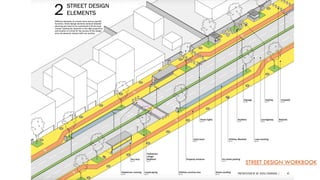
STREET DESIGN WORKBOOK
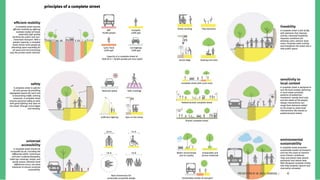
PRESENTATION BY AR. GEEVA CHANDANA | 42
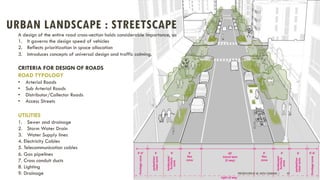
URBAN LANDSCAPE : STREETSCAPE
PRESENTATION BY AR. GEEVA CHANDANA | 43
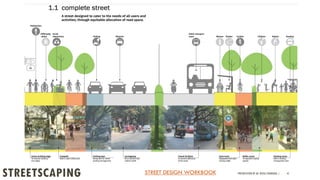
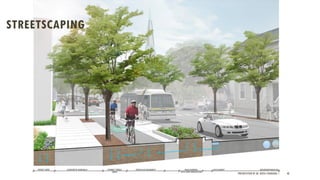
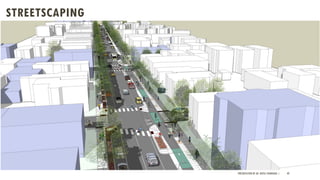
A design of the entire road cross-section holds considerable importance, as
1. It governs the design speed of vehicles
2. Reflects prioritization in space allocation
3. Introduces concepts of universal design and traffic calming.
CRITERIA FOR DESIGN OF ROADS
ROAD TYPOLOGY
• Arterial Roads
• Sub Arterial Roads
• Distributor/Collector Roads
• Access Streets
UTILITIES
1. Sewer and drainage
2. Storm Water Drain
3. Water Supply lines
4. Electricity Cables
5. Telecommunication cables
6. Gas pipelines
7. Cross conduit ducts
8. Lighting
9. Drainage
PRESENTATION BY AR. GEEVA CHANDANA | 44
STREET DESIGN WORKBOOK
PRESENTATION BY AR. GEEVA CHANDANA | 45
STREET DESIGN WORKBOOK
PRESENTATION BY AR. GEEVA CHANDANA | 46
STREET DESIGN WORKBOOK
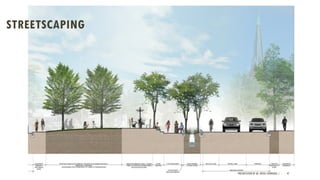
STREETSCAPING
PRESENTATION BY AR. GEEVA CHANDANA | 47
STREETSCAPING
PRESENTATION BY AR. GEEVA CHANDANA | 48
STREETSCAPING
PRESENTATION BY AR. GEEVA CHANDANA | 49
URBAN LANDSCAPE : WATERFRONTS
PRESENTATION BY AR. GEEVA CHANDANA | 50
WATERFRONT : REFERENCES
EXAMPLE
EXAMPLE 02
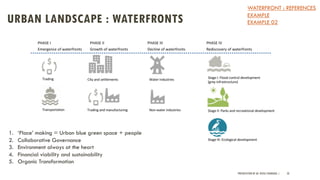
1. ‘Place’ making = Urban blue green space + people
2. Collaborative Governance
3. Environment always at the heart
4. Financial viability and sustainability
5. Organic Transformation
URBAN LANDSCAPE : WATERFRONTS
PRESENTATION BY AR. GEEVA CHANDANA | 51
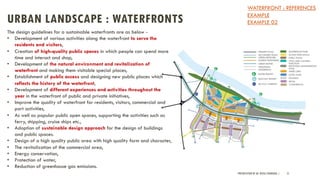
The design guidelines for a sustainable waterfronts are as below -
• Development of various activities along the waterfront to serve the
residents and visitors,
• Creation of high-quality public spaces in which people can spend more
time and interact and shop,
• Development of the natural environment and revitalization of
waterfront and making them visitable special places,
• Establishment of public access and designing new public places which
reflects the history of the waterfront,
• Development of different experiences and activities throughout the
year in the waterfront of public and private initiatives,
• Improve the quality of waterfront for residents, visitors, commercial and
port activities,
• As well as popular public open spaces, supporting the activities such as
ferry, shipping, cruise ships etc.,
• Adoption of sustainable design approach for the design of buildings
and public spaces.
• Design of a high quality public area with high quality form and character,
• The revitalization of the commercial area,
• Energy conservation,
• Protection of water,
• Reduction of greenhouse gas emissions.
WATERFRONT : REFERENCES
EXAMPLE
EXAMPLE 02
URBAN LANDSCAPE : WATERFRONTS
PRESENTATION BY AR. GEEVA CHANDANA | 52
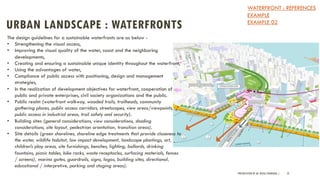
The design guidelines for a sustainable waterfronts are as below -
• Strengthening the visual access,
• Improving the visual quality of the water, coast and the neighboring
developments,
• Creating and ensuring a sustainable unique identity throughout the waterfront,
• Using the advantages of water,
• Compliance of public access with positioning, design and management
strategies,
• In the realization of development objectives for waterfront, cooperation of
public and private enterprises, civil society organizations and the public.
• Public realm (waterfront walkway, wooded trails, trailheads, community
gathering places, public access corridors, streetscapes, view areas/viewpoints,
public access in industrial areas, trail safety and security).
• Building sites (general considerations, view considerations, shading
considerations, site layout, pedestrian orientation, transition areas).
• Site details (green shorelines, shoreline edge treatments that provide closeness to
the water, wildlife habitat, low impact development, landscape plantings, art,
children’s play areas, site furnishings, benches, lighting, bollards, drinking
fountains, picnic tables, bike racks, waste receptacles, surfacing materials, fences
/ screens), marina gates, guardrails, signs, logos, building sites, directional,
educational / interpretive, parking and staging areas).
WATERFRONT : REFERENCES
EXAMPLE
EXAMPLE 02
URBAN LANDSCAPE : WATERFRONTS
PRESENTATION BY AR. GEEVA CHANDANA | 53
WATERFRONT : REFERENCES
EXAMPLE
EXAMPLE 02
URBAN LANDSCAPE : WATERFRONTS
PRESENTATION BY AR. GEEVA CHANDANA | 54
WATERFRONT : REFERENCES
EXAMPLE
EXAMPLE 02
URBAN LANDSCAPE : WATERFRONTS
PRESENTATION BY AR. GEEVA CHANDANA | 55
WATERFRONT : REFERENCES
EXAMPLE
EXAMPLE 02
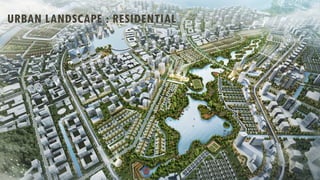
URBAN LANDSCAPE : RESIDENTIAL
PRESENTATION BY AR. GEEVA CHANDANA | 56
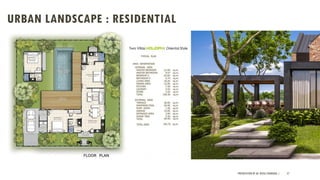
• Effective Use of Landscapes Improves the Home’s Value.
• Privacy
• The landscape must be inclusive in its focus and facilities for all age-groups.
• Ecological Balance
• Sustainability - ample natural light processing, extensive shading, energy saving avenues, rainwater harvesting, compost
reserves, etc. can be aesthetically added.
• Innovation - Often housing complexes are faced with a shortage of areas to introduce landscaping space on the surface.
With the aid of technology, landscape architecture has introduced roof gardens, green walls and facades.
• Highlighting the Best View - landscape architecture plays a major role in bringing out the view as well as in hiding the
unattractive elements, such as old walls, sewer pipelines and open drains.
• Through landscaping, there is an organised use of space related to right plantings, appropriate planning of paths and
shortcuts, implementation of all necessary residential formats like seating, parking for bikes, etc.
• Functionality - Landscape architecture is reshaping housing complexes by providing an outdoor environment that is
creative as well as functional in many ways. Parks can be elevated so that an ordinary children’s play area also has the
added advantage of being easy to keep watch at children. The surrounding areas can be equipped with open-air gyms
for the senior residents to have a place for healthy recreation and socialisation. Lighting is another tool for creating
beautiful landscapes and also aids in increasing safety.
URBAN LANDSCAPE : RESIDENTIAL
PRESENTATION BY AR. GEEVA CHANDANA | 57
URBAN LANDSCAPE : RESIDENTIAL
PRESENTATION BY AR. GEEVA CHANDANA | 58
URBAN LANDSCAPE : RESIDENTIAL
PRESENTATION BY AR. GEEVA CHANDANA | 59
URBAN LANDSCAPE : RESIDENTIAL
PRESENTATION BY AR. GEEVA CHANDANA | 60
URBAN LANDSCAPE : RESIDENTIAL
PRESENTATION BY AR. GEEVA CHANDANA | 61
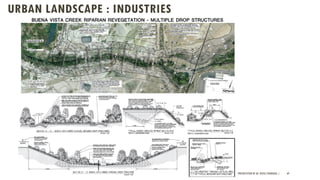
URBAN LANDSCAPE : INDUSTRIES
PRESENTATION BY AR. GEEVA CHANDANA | 62
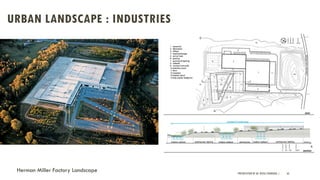
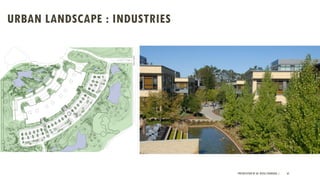
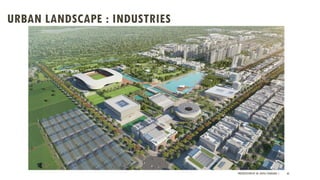
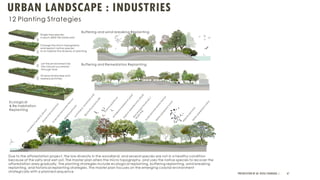
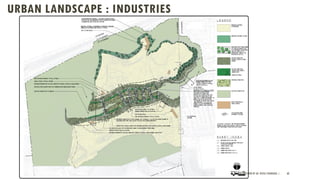
• These gardens are designed to check pollution and also to beautify the area. The majority of the industrial units are
surrounded by weeds, debris and unkempt areas. These units are the main source of air, water, noise and soil pollution.
• Beautification of factories and industrial townships to create a better environment for living working, recreation and
circulation are the objectives of landscape architects.
• Industrial townships consist of factory sites, various types of public buildings, industrial buildings, community centers and
residential complexes.
• Different areas are to be improved by providing streets, sidewalks, sewers and sanitation, installation of public
utilities such as water, electricity, gas and other conveniences.
• Between the factory and residential area, green belts may be created by planting trees.
• Tree-lined streets, well kept parks, gardens, playgrounds and woodlands should be permanent features in industrial
unit.
• Another important aim of industrial garden is to provide ample shade and coolness so that the worker gets a respite
under the coolness of trees from the hostile hot interior of the factory. If planted with appropriate plan, the trees bring
down the temperature in the factory premises to a considerable extent.
• In large factory a buffer zone may be created by afforestation between the factory and its residential colony.
• Hardy shrubs also play an important role in beautifying factories when planted in shrubberies. Lawns laid in vacant lands
not only add beauty but also cut down dust.
• Gardens can be laid in the factory in front of a canteen, rest-shed, hospital administration building and so on.
URBAN LANDSCAPE : INDUSTRIES
PRESENTATION BY AR. GEEVA CHANDANA | 63
Herman Miller Factory Landscape
URBAN LANDSCAPE : INDUSTRIES
PRESENTATION BY AR. GEEVA CHANDANA | 64
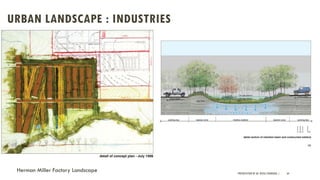
Herman Miller Factory Landscape
URBAN LANDSCAPE : INDUSTRIES
PRESENTATION BY AR. GEEVA CHANDANA | 65
URBAN LANDSCAPE : INDUSTRIES
PRESENTATION BY AR. GEEVA CHANDANA | 66
URBAN LANDSCAPE : INDUSTRIES
PRESENTATION BY AR. GEEVA CHANDANA | 67
URBAN LANDSCAPE : INDUSTRIES
PRESENTATION BY AR. GEEVA CHANDANA | 68
URBAN LANDSCAPE : INDUSTRIES
PRESENTATION BY AR. GEEVA CHANDANA | 69
PRESENTATION BY AR. GEEVA CHANDANA | 70

UNIT 04_URBAN LANDSCAPE.pdf

  • 1.
    [ LANDSCAPE ARCHITECTURE] PRESENTATION BY AR. GEEVA CHANDANA | 1
  • 2.
    PRESENTATION BY AR.GEEVA CHANDANA | 2 UNIT 01 INTRODUCTION landscape architecture, ecology, ecological balance, landscape conservation, reclamation and landscaping of derelict lands, environmental impact assessment. UNIT 02 ELEMENTS OF LANDSCAPE ARCHITECTURE AND LANDSCAPE DESIGN land elements, land form plants and planting, water, lighting etc. characteristics and classification of plant materials, basic principles of landscape design; Factors to be considered, Use and application of plant materials in landscape design, and other components involved UNIT 03 HISTORY OF LANDSCAPE ARCHITECTURE Eastern, Central and Western traditions; Ancient Heritage - Mesopotamia, Egypt, Greece, Rome; Western Civilization – Europe: Italy, France, and England; The middle-east - The Persian tradition and its far reaching influence Eastern Civilization: China and Japan Ancient and medieval period in India; Mughal and Rajput Landscapes and study of contemporary landscape architecture UNIT 04 UNIT 05 URBAN LANDSCAPE Basic principles and elements of Urban landscape, Significance of landscape in urban areas, introduction to street furniture, road landscaping, waterfront development, landscaping of residential areas, Industrial Landscaping. LANDSCAPE EXERCISE Landscape design of a neighborhood open space (area of 2000 to 3000 sq. meters) OVERVIEW
  • 3.
    URBAN LANDSCAPE: ORIGIN PRESENTATIONBY AR. GEEVA CHANDANA | 3 CENTRAL PARK, NEW YORK The Urban Landscape term is an old concept that has always existed for many years with the origin and development of cities, but as a specialized term in the late nineteenth century, with the design and actions of Frederick Olmsted (1863), the father of landscape architecture in relation to American cities was raised. It can be said the contemporary urban landscape includes dynamic and flexible relationships; layering, congestion and the landscapes interpenetration make an unbounded and undefined spatial-temporal urban continuity which is difficult to distinguish. Urban landscape includes all areas and functions such as residential, institutional, commercial, industrial, cultural land uses.
  • 4.
    URBAN LANDSCAPE PRESENTATION BYAR. GEEVA CHANDANA | 4 • Formed of open and green spaces within an urban environment. However, it is not totally independent from the surrounding buildings and structures. Altogether, they form the character and identity of a city, and sense of place. • It contributes to the cityscape by means of aesthetics and function. • It also supports urban ecology. • It is dynamic and constantly evolving. • Urban landscape elements function as separator and/or connector agents between • different land uses. They can form a buffer zone between conflicting uses (e.g. between industrial and housing areas) while they can facilitate movement of citizens throughout the city (e.g. greenways). • They have the flexibility to serve for multiple uses and for different group of users in the community. • Urban landscape also contributes to the cityscape in terms of visual quality. Within dense built environments, it creates a sense of openness and more attractive places to live. • Urban landscape helps to balance human-scale in city centres where vertical effect of buildings and structures dominates. • It softens the “hardness” of buildings and structures. Well designed and managed urban landscape can improve citizens’ quality of life in many other ways as well.
  • 5.
    URBAN LANDSCAPE :BENEFITS PRESENTATION BY AR. GEEVA CHANDANA | 5 Well designed and managed urban landscape can improve citizens’ quality of life in many other ways as well. The benefits of urban landscape are explained below. Ecological and environmental benefits Contemporary urban ecology assumes that urban areas are ecosystems since they have interacting biological and physical complexes . McHarg played a major role in emergence of ecological landscape design approaches in urban development. His work “Design with Nature”(1969) displays how nature and city might coexist together. However, ecology has been neglected in urban planning systems of most developing countries which mostly focus on the relationship between physical and socioeconomic aspects of an urban development. Urban green spaces are fundamental in sustaining the urban ecology.
  • 6.
    URBAN LANDSCAPE :BENEFITS PRESENTATION BY AR. GEEVA CHANDANA | 6 THE ENVIRONMENTAL AND ECOLOGICAL BENEFITS OF THE URBAN LANDSCAPE • Urban green spaces provide flora and fauna with a habitat to live and therefore support biodiversity conservation. • They also act as ecological corridors between urban, periurban and rural areas. They support movement of living organisms between these areas. • Vegetation cover in urban landscape helps to improve micro-climate of urban areas where climate is warmer than their surroundings due to dense built environment and human activities. • Vegetation cover raises humidity levels, reduces the stress of the heat island and mitigates the less desirable effects of urban climate . Daytime temperature in large parks was found to be 2-3°C lower than the surrounding streets. • Vegetation helps to decrease carbon emission levels in cities. Through photosynthesis process in plants CO2 in the air is converted to O2. Therefore, urban vegetation cover helps to reduce excess CO2 in the urban atmosphere. Although the degree of trees’ drawing carbon emissions from the air is affected by their size, canopy cover, age and health, large trees can lower carbon emission in the atmosphere by 2-3%. • Vegetation cover also filters out other particles and dust in the air. • Green spaces absorb and reduce the noise generated by human activities, especially trees act like noise barriers. • Vegetation cover and soil in urban landscape controls water regime and reduces runoff, hence helps to prevent water floods by absorbing excess water. • Trees can also act like wind breaker.
  • 7.
    URBAN LANDSCAPE :BENEFITS PRESENTATION BY AR. GEEVA CHANDANA | 7 THE ENVIRONMENTAL AND ECOLOGICAL BENEFITS OF THE URBAN LANDSCAPE • Humans are the dominating elements of an urban environment. Social interaction, as a basic need for humans, is essential in developing sense of community, belonging and security. Social interaction in cities is possibly the highest in public open and green spaces. Urban open and green spaces offer citizens various activity choices including recreational and sports activities which promote social cohesion. • Urban open and green spaces can be designed to serve the community’s leisure needs. Designers should consider the ways to attract people to open and green spaces so that every group in the community can enjoy social benefits of urban landscape as well. • Environmental education can be regarded amongst the social benefits of urban landscapes. Green spaces can be thought of as outdoor laboratories to observe and get to know about nature. • Green spaces in urban landscape may play an important role in environmental education. For instance, botanical parks are where people can learn about different plants, their living conditions and observe the physiological changes during time. Even urban street trees present the seasonal physiological changes in plants.
  • 8.
    URBAN LANDSCAPE :BENEFITS PRESENTATION BY AR. GEEVA CHANDANA | 8 HEALTH BENEFITS OF THE URBAN LANDSCAPE The degradation of natural environments inevitably affects human health in a negative way. Parks and gardens are where urban citizens can contact with nature in their daily life. Health benefits of being in contact with natural environments have been known for centuries. In the last century urban parks were referred as being “lungs of the city”, which emphasises their physical health benefits for urban citizens. It is landscape architect’s role to create outdoor environments which maximise the benefits of urban landscapes for citizens to relax, exercise and restore.
  • 9.
    URBAN LANDSCAPE :BENEFITS PRESENTATION BY AR. GEEVA CHANDANA | 9 ECONOMIC BENEFITS OF THE URBAN LANDSCAPE • Although the economic valuation of urban landscape is difficult, open and green spaces have economic benefits in several ways: Their aesthetic contribution to cityscape influences property values. In general, urban landscape elements increase the nearby property value and enhance marketability of real estate. Accessibility, quality and visibility are basic factors that determine economic value of urban landscapes in this context. • Urban landscapes provide employment opportunities during their design, construction and maintenance. The construction and maintenance of urban landscapes also supports other sectors such as playground manufacturers and nurseries. • The health benefits of urban landscapes which were summarized above can reduce the costs of national health expenses. • Public urban landscapes provide environments for walking, sports and other recreational activities for no cost at all, especially for lower income groups. • Green spaces can help energy saving. Right selection and planting of plants can provide cooler environments in summer and warmer environments in winter thus reduce air conditioning expenses. • Urban landscapes can enhance tourism in cities by attracting people. Park Güell in Barcelona, Spain is a perfect example of how a park can become a global tourism destination.
  • 10.
    LANDSCAPE DESIGN INURBAN ENVIRONMENT PRESENTATION BY AR. GEEVA CHANDANA | 10 Adaptability and sustainability • Support and preserve biotic diversity and create habitat corridors. • Minimize energy use and promote use of renewable energy resources. Reduce energy costs by using solar and wind energy systems. • Protect and improve quality of water resources. • Reduce water and fertilizer use by selecting native and drought tolerant plant species. • Reduce water runoff by decreasing the amount of hard surfaces and proper drainage design. • Conserve aquifer recharge zones. • Provide collection and storage of rainwater in order to use it for maintenance of green spaces. • Support pedestrian and bicycle circulation within the city. People should move easily and freely within a city. Cities should not be designed for vehicle traffic. Connected urban open and green space systems could create an environmentally and people friendly transportation routes. • Choose plants suitable for local climate and site conditions. Selecting right plant species will increase the survival chance of plants in harsh urban environment, success of design and decrease maintenance costs. • Provide collection and storage of rainwater in order to use it for maintenance of green spaces.
  • 11.
    LANDSCAPE DESIGN INURBAN ENVIRONMENT PRESENTATION BY AR. GEEVA CHANDANA | 11 Coherence and legibility • Coherence of landscape elements might be visual, functional or ecological. Hence, both natural and cultural landscape elements should be assessed in terms of coherence. • Both history and cultural values of a place should be considered in attempt to achieve coherence and strengthening identity. • Local architectural styles and materials should be taken into account in landscape design in order to provide integrity and coherence and preserve local identity. • Visual quality of a landscape is important for reading and understanding the place. The entrances and exits of a place should be visually clear. • Placing sculptures or other ornamental features can enhance the visual quality of the environment. • Human scale is essential in legibility. • Landscape construction materials should be selected to support or enhance visual coherence overall and between different landscape elements. • Designed environments should support perceived safety. Open spaces offer people a sense of security since they have a wider perspective of a place to see what is going on around them, however people also needs to find a “niche” for themselves to have some privacy or to hide if they feel insecure.
  • 12.
    LANDSCAPE DESIGN INURBAN ENVIRONMENT PRESENTATION BY AR. GEEVA CHANDANA | 12 Coherence and legibility • Spatial definition also helps people to feel more secure. Knowing boundaries increases confidence. Hence, edges should be clear and visible. • For ecological coherence, green networks throughout and around the city should be created and connected to each other. • Time is another variable of coherence. Forms, textures and colours of an urban landscape vary through time. Therefore changes through time and alternatives for the future should be taken into account in design process. • Coherence between user needs and expectations, and proposed activities should be evaluated. Participation of local people in design process may help to create more coherent design alternatives. • Diversity is essential for both healthy functional landscapes and creating more appealing environments for people. Diversity of landscape elements without coherence may cause chaos. Connectivity between different landscape elements enhances coherence.
  • 13.
    LANDSCAPE DESIGN INURBAN ENVIRONMENT PRESENTATION BY AR. GEEVA CHANDANA | 13 EQUITY AND ACCESSIBILITY • Urban environments are where people from various ethical, social, cultural, economic backgrounds, ages and gender live together. Segregation of urban communities leads to both spatially and socially divided urban environments. As a result, equity becomes an important issue in achieving sustainable community development. Thus, designing public spaces for everyone is crucial in today’s communities for developing community identity and preventing social fragmentation. • Urban landscape design helps to create accessible environments for everyone in the community in terms of public open space. • Open and green spaces should be distributed evenly throughout the city. Special design techniques are needed to be taken into account for accessibility of disadvantaged groups, such as disabled and elderly. • Children should also be amongst priority in landscape design. Encouraging children to spend their free time in urban open and green spaces is a completely different research area itself. • Therefore, urban landscape design should give importance to creating safe, enjoyable and creative environments for children, and of course for their parents where they feel safe to let their children out. • Urban open and green spaces offer a unique opportunity for integration of different social groups and individuals. Hence, designers should seek ways to support social cohesion through space. • Community involvement in planning and design schemes is necessary in order to have an idea of existing problems, needs, and expectations of different groups within the community.
  • 14.
    LANDSCAPE DESIGN INURBAN ENVIRONMENT PRESENTATION BY AR. GEEVA CHANDANA | 14 COMMUNITY INVOLVEMENT • Community involvement in urban planning and environmental impact assessment has gained widespread recognition in the last few decades. In urban design, community participation takes place mostly during decision making process in urban renewal projects. Involvement of community in design process increases their confidence in the project and their responsibility. Through information and knowledge exchange both local community and designers can be inspired. As a result, local community is more likely to support the project and to embrace the designed environment. This leads to satisfaction and long-lasting use of the designed place. • The Urban planners and Landscape Architects design outdoor environments for public benefit. Hence, understanding public opinions on their living environments could be helpful in creating livable urban environments. On the other hand, designers should realize that it is impossible to please everyone and respond to everyone’s needs and expectations. Therefore, community involvement should only be accepted as a tool to understand the possible effects of design proposal on its future users. Implementation and maintenance costs should be taken into account during design process. Cost efficient design strategies should be adopted in order to maintain durability and longevity of the designed environment. Urban open and green spaces can be designed and managed to minimise expenses. For example, stored rainwater in ponds and lakes could be used in irrigation, or use of fertilisers can be minimised by decreasing amount of lawn areas. Solar energy panels could be used to store energy during daytime which could be turned into electricity for lighting at night time. Multifunctional spaces also reduce cost by letting various activities take place in one place. Selection of durable paving material and site furniture will also decrease the maintenance costs in long term.
  • 15.
    AR.MARTHA SCHWARTZ |BEIQIJIA TECHNOLOGY BUSINESS DISTRICT BEIJING, CHINA PRESENTATION BY AR. GEEVA CHANDANA | 15
  • 16.
    AR.MARTHA SCHWARTZ |BEIQIJIA TECHNOLOGY BUSINESS DISTRICT BEIJING, CHINA PRESENTATION BY AR. GEEVA CHANDANA | 16
  • 17.
    AR.MARTHA SCHWARTZ |FENGMING MOUNTAIN PARK PRESENTATION BY AR. GEEVA CHANDANA | 17
  • 18.
    AR.MARTHA SCHWARTZ |FENGMING MOUNTAIN PARK PRESENTATION BY AR. GEEVA CHANDANA | 18
  • 19.
    AR.MARTHA SCHWARTZ |GRAND CANAL SQUARE, DUBLIN, IRELAND PRESENTATION BY AR. GEEVA CHANDANA | 19
  • 20.
    AR.ROBERT BURLE MARX|NEW YORK BOTANICAL GARDEN PRESENTATION BY AR. GEEVA CHANDANA | 20
  • 21.
    AR.ROBERT BURLE MARX|NEW YORK BOTANICAL GARDEN PRESENTATION BY AR. GEEVA CHANDANA | 21
  • 22.
    AR.ROBERT BURLE MARX|RIO DE JANEIRO WATERFRONT PRESENTATION BY AR. GEEVA CHANDANA | 22
  • 23.
    AR.ROBERT BURLE MARX|RIO DE JANEIRO WATERFRONT PRESENTATION BY AR. GEEVA CHANDANA | 23
  • 24.
    ELEMENTS OF URBANLANDSCAPE PRESENTATION BY AR. GEEVA CHANDANA | 24 The elements of Urban Landscape encompasses much more than just the landscape. It is a collaboration of the landscape and everything contained by it - buildings and structures, people, streets and walkways, open space, social spaces, and functional spaces. Achieving a livable urban fabric is accomplished through the main overlapping and interconnecting of three levels; the city structure, its urban spaces and local design. City structure: Roads, Areas Urban spaces: Buildings , streets Local places : Landscape of places / urban environment Landscape elements should primarily relate in its expression, patterning, levels and visual qualities to the physical characteristics of places, human scale and activities. Landscape is mainly divided to three parts the soft, the hard and the furniture.
  • 25.
    ELEMENTS OF URBANLANDSCAPE PRESENTATION BY AR. GEEVA CHANDANA | 25 SOFTSCAPE ELEMENTS: Organic components of landscape which require time to mature or effectual and dependent on climatic factors. HARDSCAPE ELEMENTS: Non-organic component of landscape which is effectual once it is constructed and independent of climatic factors. WHAT IS STREET FURNITURE? 1. Element that are placed in landscape or streetscape for several purposes. • Comfort and convenience : benches, kiosks, litter bins, public toilet • Ornamentation : fountains, sculptures, planters, tree guard • Communication : phone booth, post boxes, clocks • Circulation and protection : signs and symbols, bus shelters, railing, bollards 2. Street furniture constitutes a very important part in any urban setting where it not only provide aesthetic value, but also provide functional efficiency, create sense of environmental clarity, as well as a sense of continuity and harmony of the total urban environment. 3. Street furniture can strengthen the link between a development and its surrounding can personalise the setting, can enhance the positive aspect of the surrounding built environment.
  • 26.
    URBAN LANDSCAPE :ELEMENTS / FEATURES PRESENTATION BY AR. GEEVA CHANDANA | 26 1. Street Planting 2. Paths : Bikeway, Pedestrian Way, Five-foot Corridor, Signage System 3. Outdoor Lighting 4. Street Furniture : Phone Booth , Seating, Bollard , Shelter : Kiosk, Bus Pavilion 5. Structure: Clock Tower, Observatory Tower 6. Sculpture 7. Paving 8. Landscape Planting 9. Pocket Space, Pocket Park
  • 27.
    URBAN LANDSCAPE :ELEMENTS PRESENTATION BY AR. GEEVA CHANDANA | 27 The benefits that high quality urban landscape elements include: 1.Helping to build a sense of community. 2. Reducing crime and anti-social behaviour. 3. Promoting tourism. 4. Attracting new businesses and help existing businesses. 5. Promoting walking and cycling. 6. Promoting access to public transport. 7. Boosting the morale of communities and individuals. 8. Building a sense of ownership and pride in our street environment. 9. Improving accessibility for all. 10. Improving levels of highway safety. 11. Enhancing the overall townscape.
  • 28.
    URBAN LANDSCAPE :ELEMENTS PRESENTATION BY AR. GEEVA CHANDANA | 28 TREES AND PLANTING Trees enhance our environment. Adding living colour, cover and beauty. Bringing nature to every heart of our cities. Soft landscape / urban trees planting assists the ecological health of the environment through the following: 1. Enhancing the microclimate. 2. Noise Abatement: Landscape elements absorb noise. Plants diffract and break up sound waves, changing their direction and reducing their intensity when sufficiently massed. To be effective in controlling noise, plants should be used with masonry walls or similar noise buffering structures. 3. Temperature Modification Plants raise local humidity by absorbing rainwater and/or delaying it entering the drainage system, make the ambient temperature more temperate. Direct radiation from the sun creates uncomfortably high temperatures.Locating densely foliated trees and shrubs can reduce heat gain.
  • 29.
    URBAN LANDSCAPE :ELEMENTS PRESENTATION BY AR. GEEVA CHANDANA | 29 TREES AND PLANTING 4. Wind Control: Plants can modify wind speed on the ground. Dense masses of large evergreen trees planted can influence energy efficiency of facilities and increase the liveability of outside spaces. 5. Reducing pollution: Intake of CO2, release of oxygen, filtering of toxins and dust (foliage acts as an impingement filter, trapping airborne particles until they are washed away by rain (Borcke, C. (2003)). 6. Glare Control: Trees, shrubs and other vegetation can effectively reduce glare and reflection when placed between the light source and the observer. 7. Surface Erosion Control: Wind and water can erode valuable top soil. Plants especially grasses, can prevent or control erosion by stabilizing the soil through their root structure. Exposed soil on cut banks and steep slopes should be immediately planted with grasses and / or native low-growing shrubs and spreading ground covers.
  • 30.
    URBAN LANDSCAPE :ELEMENTS PRESENTATION BY AR. GEEVA CHANDANA | 30 SIGNAGE Strategies for signage should be included at an early stage in the design process, as the design of a layout can influence the need for signage. Make a place legible: Signage can be a major clutter problem and can often be misleading. Not infrequently, the only signage provided is for vehicles, so that the stranger on foot can find himself circulating around one-way systems. The answer lies in: 1. Consistent and coordinated design of these elements over a wide area. 2. Making the structure of the place legible so as to minimise the need for signs, especially those concerned with traffic direction and control. 3. Concentrating pedestrian signage in a designed locality at specific nodal points. 4. Signage can also be used to enhance place identity.
  • 31.
    URBAN LANDSCAPE :ELEMENTS PRESENTATION BY AR. GEEVA CHANDANA | 31 LIGHTING 1. Lighting columns should be located so that they are not obtrusive or cause difficulties for people with disabilities. For example, in denser or courtyard developments wall mounted lighting can be effective. 2. The location of lights should also ensure a sufficient spread of light over the footway, as well as the street. 3. The shape and colour of light can also generate three- dimensional sculpture, transforming the perception of a place and dramatically painting its night landscape. The more light-the more encouragement of night time activities
  • 32.
    URBAN LANDSCAPE :ELEMENTS PRESENTATION BY AR. GEEVA CHANDANA | 32 LITTERBINS The size, setting and maintenance of litter bins is important in an effective street cleansing policy. In busy areas, bins should have a capacity between 80 and 200 litres. They should be sited close to fast food outlets and where pedestrian traffic is greatest, but not too close to seats and not directly on pedestrian thoroughfares. Large bins should be set against the building line, leaving sufficient sweeping space. A minimum clearance of 1.5 metres is required to allow wheelchair users free movement.
  • 33.
    URBAN LANDSCAPE :ELEMENTS PRESENTATION BY AR. GEEVA CHANDANA | 33 BOLLARDS Select a design consistent with other similar items, such as bases of finger posts (pedestrian direction signs), supports for railings and traffic signs. They should not dominate the pedestrian environment but will need to be around 900mm high in areas where vehicles are permitted. They can be painted in black or muted colours, and can have integral or fitted town plaques.
  • 34.
    URBAN LANDSCAPE :ELEMENTS PRESENTATION BY AR. GEEVA CHANDANA | 34 SEATING Every seat must be comfortable, robust, vandal-proof and easy to maintain, in materials sympathetic to other street furniture. Do not position seats directly beneath trees or too close to litter bins and ensure that ground fixings are secure without being visually intrusive.
  • 35.
    URBAN LANDSCAPE :ELEMENTS PRESENTATION BY AR. GEEVA CHANDANA | 35 TOILETS Public toilets should be available at most hours and kept properly maintained. Some single, self cleansing toilets include advertising to subsidise their cost.
  • 36.
    URBAN LANDSCAPE :ELEMENTS PRESENTATION BY AR. GEEVA CHANDANA | 36 CYCLE RACKS To help reduce pollution in town centres we need to encourage cyclists and provide racks where cycles can be secured. There are some good modern designs available.
  • 37.
    URBAN LANDSCAPE :ELEMENTS PRESENTATION BY AR. GEEVA CHANDANA | 37 PUBLIC ARTS AND ENTERTAINMENT Public art, such as sculpture, fountains, murals, distinctive lighting or other forms, plays a major role in making a town centre or street distinctive and memorable. Competitions for art will raise awareness and many towns have annual street festivals. A good idea is to identify areas in the town centre that can provide regular performing art attractions. The Cloud Gate, also known as ‘The Bean’
  • 38.
    URBAN LANDSCAPE :ELEMENTS PRESENTATION BY AR. GEEVA CHANDANA | 38 PUBLIC ARTS AND ENTERTAINMENT
  • 39.
    URBAN LANDSCAPE :ELEMENTS PRESENTATION BY AR. GEEVA CHANDANA | 39 PUBLIC ARTS AND ENTERTAINMENT
  • 40.
    URBAN LANDSCAPE :ELEMENTS PRESENTATION BY AR. GEEVA CHANDANA | 40 BUS SHELTERS The installation of shelters, to protect waiting passengers from weather and splashing from vehicles, can be subsidized or wholly paid for by advertising. They ought to include bus timetable information, seating and lighting. The new designs even incorporate facilities such as telephones.
  • 41.
    STREETSCAPING PRESENTATION BYAR. GEEVA CHANDANA | 41 STREET DESIGN WORKBOOK
  • 42.
    PRESENTATION BY AR.GEEVA CHANDANA | 42
  • 43.
    URBAN LANDSCAPE :STREETSCAPE PRESENTATION BY AR. GEEVA CHANDANA | 43 A design of the entire road cross-section holds considerable importance, as 1. It governs the design speed of vehicles 2. Reflects prioritization in space allocation 3. Introduces concepts of universal design and traffic calming. CRITERIA FOR DESIGN OF ROADS ROAD TYPOLOGY • Arterial Roads • Sub Arterial Roads • Distributor/Collector Roads • Access Streets UTILITIES 1. Sewer and drainage 2. Storm Water Drain 3. Water Supply lines 4. Electricity Cables 5. Telecommunication cables 6. Gas pipelines 7. Cross conduit ducts 8. Lighting 9. Drainage
  • 44.
    PRESENTATION BY AR.GEEVA CHANDANA | 44 STREET DESIGN WORKBOOK
  • 45.
    PRESENTATION BY AR.GEEVA CHANDANA | 45 STREET DESIGN WORKBOOK
  • 46.
    PRESENTATION BY AR.GEEVA CHANDANA | 46 STREET DESIGN WORKBOOK
  • 47.
  • 48.
  • 49.
  • 50.
    URBAN LANDSCAPE :WATERFRONTS PRESENTATION BY AR. GEEVA CHANDANA | 50 WATERFRONT : REFERENCES EXAMPLE EXAMPLE 02 1. ‘Place’ making = Urban blue green space + people 2. Collaborative Governance 3. Environment always at the heart 4. Financial viability and sustainability 5. Organic Transformation
  • 51.
    URBAN LANDSCAPE :WATERFRONTS PRESENTATION BY AR. GEEVA CHANDANA | 51 The design guidelines for a sustainable waterfronts are as below - • Development of various activities along the waterfront to serve the residents and visitors, • Creation of high-quality public spaces in which people can spend more time and interact and shop, • Development of the natural environment and revitalization of waterfront and making them visitable special places, • Establishment of public access and designing new public places which reflects the history of the waterfront, • Development of different experiences and activities throughout the year in the waterfront of public and private initiatives, • Improve the quality of waterfront for residents, visitors, commercial and port activities, • As well as popular public open spaces, supporting the activities such as ferry, shipping, cruise ships etc., • Adoption of sustainable design approach for the design of buildings and public spaces. • Design of a high quality public area with high quality form and character, • The revitalization of the commercial area, • Energy conservation, • Protection of water, • Reduction of greenhouse gas emissions. WATERFRONT : REFERENCES EXAMPLE EXAMPLE 02
  • 52.
    URBAN LANDSCAPE :WATERFRONTS PRESENTATION BY AR. GEEVA CHANDANA | 52 The design guidelines for a sustainable waterfronts are as below - • Strengthening the visual access, • Improving the visual quality of the water, coast and the neighboring developments, • Creating and ensuring a sustainable unique identity throughout the waterfront, • Using the advantages of water, • Compliance of public access with positioning, design and management strategies, • In the realization of development objectives for waterfront, cooperation of public and private enterprises, civil society organizations and the public. • Public realm (waterfront walkway, wooded trails, trailheads, community gathering places, public access corridors, streetscapes, view areas/viewpoints, public access in industrial areas, trail safety and security). • Building sites (general considerations, view considerations, shading considerations, site layout, pedestrian orientation, transition areas). • Site details (green shorelines, shoreline edge treatments that provide closeness to the water, wildlife habitat, low impact development, landscape plantings, art, children’s play areas, site furnishings, benches, lighting, bollards, drinking fountains, picnic tables, bike racks, waste receptacles, surfacing materials, fences / screens), marina gates, guardrails, signs, logos, building sites, directional, educational / interpretive, parking and staging areas). WATERFRONT : REFERENCES EXAMPLE EXAMPLE 02
  • 53.
    URBAN LANDSCAPE :WATERFRONTS PRESENTATION BY AR. GEEVA CHANDANA | 53 WATERFRONT : REFERENCES EXAMPLE EXAMPLE 02
  • 54.
    URBAN LANDSCAPE :WATERFRONTS PRESENTATION BY AR. GEEVA CHANDANA | 54 WATERFRONT : REFERENCES EXAMPLE EXAMPLE 02
  • 55.
    URBAN LANDSCAPE :WATERFRONTS PRESENTATION BY AR. GEEVA CHANDANA | 55 WATERFRONT : REFERENCES EXAMPLE EXAMPLE 02
  • 56.
    URBAN LANDSCAPE :RESIDENTIAL PRESENTATION BY AR. GEEVA CHANDANA | 56 • Effective Use of Landscapes Improves the Home’s Value. • Privacy • The landscape must be inclusive in its focus and facilities for all age-groups. • Ecological Balance • Sustainability - ample natural light processing, extensive shading, energy saving avenues, rainwater harvesting, compost reserves, etc. can be aesthetically added. • Innovation - Often housing complexes are faced with a shortage of areas to introduce landscaping space on the surface. With the aid of technology, landscape architecture has introduced roof gardens, green walls and facades. • Highlighting the Best View - landscape architecture plays a major role in bringing out the view as well as in hiding the unattractive elements, such as old walls, sewer pipelines and open drains. • Through landscaping, there is an organised use of space related to right plantings, appropriate planning of paths and shortcuts, implementation of all necessary residential formats like seating, parking for bikes, etc. • Functionality - Landscape architecture is reshaping housing complexes by providing an outdoor environment that is creative as well as functional in many ways. Parks can be elevated so that an ordinary children’s play area also has the added advantage of being easy to keep watch at children. The surrounding areas can be equipped with open-air gyms for the senior residents to have a place for healthy recreation and socialisation. Lighting is another tool for creating beautiful landscapes and also aids in increasing safety.
  • 57.
    URBAN LANDSCAPE :RESIDENTIAL PRESENTATION BY AR. GEEVA CHANDANA | 57
  • 58.
    URBAN LANDSCAPE :RESIDENTIAL PRESENTATION BY AR. GEEVA CHANDANA | 58
  • 59.
    URBAN LANDSCAPE :RESIDENTIAL PRESENTATION BY AR. GEEVA CHANDANA | 59
  • 60.
    URBAN LANDSCAPE :RESIDENTIAL PRESENTATION BY AR. GEEVA CHANDANA | 60
  • 61.
    URBAN LANDSCAPE :RESIDENTIAL PRESENTATION BY AR. GEEVA CHANDANA | 61
  • 62.
    URBAN LANDSCAPE :INDUSTRIES PRESENTATION BY AR. GEEVA CHANDANA | 62 • These gardens are designed to check pollution and also to beautify the area. The majority of the industrial units are surrounded by weeds, debris and unkempt areas. These units are the main source of air, water, noise and soil pollution. • Beautification of factories and industrial townships to create a better environment for living working, recreation and circulation are the objectives of landscape architects. • Industrial townships consist of factory sites, various types of public buildings, industrial buildings, community centers and residential complexes. • Different areas are to be improved by providing streets, sidewalks, sewers and sanitation, installation of public utilities such as water, electricity, gas and other conveniences. • Between the factory and residential area, green belts may be created by planting trees. • Tree-lined streets, well kept parks, gardens, playgrounds and woodlands should be permanent features in industrial unit. • Another important aim of industrial garden is to provide ample shade and coolness so that the worker gets a respite under the coolness of trees from the hostile hot interior of the factory. If planted with appropriate plan, the trees bring down the temperature in the factory premises to a considerable extent. • In large factory a buffer zone may be created by afforestation between the factory and its residential colony. • Hardy shrubs also play an important role in beautifying factories when planted in shrubberies. Lawns laid in vacant lands not only add beauty but also cut down dust. • Gardens can be laid in the factory in front of a canteen, rest-shed, hospital administration building and so on.
  • 63.
    URBAN LANDSCAPE :INDUSTRIES PRESENTATION BY AR. GEEVA CHANDANA | 63 Herman Miller Factory Landscape
  • 64.
    URBAN LANDSCAPE :INDUSTRIES PRESENTATION BY AR. GEEVA CHANDANA | 64 Herman Miller Factory Landscape
  • 65.
    URBAN LANDSCAPE :INDUSTRIES PRESENTATION BY AR. GEEVA CHANDANA | 65
  • 66.
    URBAN LANDSCAPE :INDUSTRIES PRESENTATION BY AR. GEEVA CHANDANA | 66
  • 67.
    URBAN LANDSCAPE :INDUSTRIES PRESENTATION BY AR. GEEVA CHANDANA | 67
  • 68.
    URBAN LANDSCAPE :INDUSTRIES PRESENTATION BY AR. GEEVA CHANDANA | 68
  • 69.
    URBAN LANDSCAPE :INDUSTRIES PRESENTATION BY AR. GEEVA CHANDANA | 69
  • 70.
    PRESENTATION BY AR.GEEVA CHANDANA | 70