Presentation on
Principles of Architecture
By :
Prof . Pravin Minde
B.E. (Civil), M.E. (C & M)
LMISTE, LMIWWA, AMIE, MICE(I),
Introduction
ARCHITECTURE is “The science and art of
constructing buildings, according to some
proportions and rules determined by the
character and destination of the buildings”
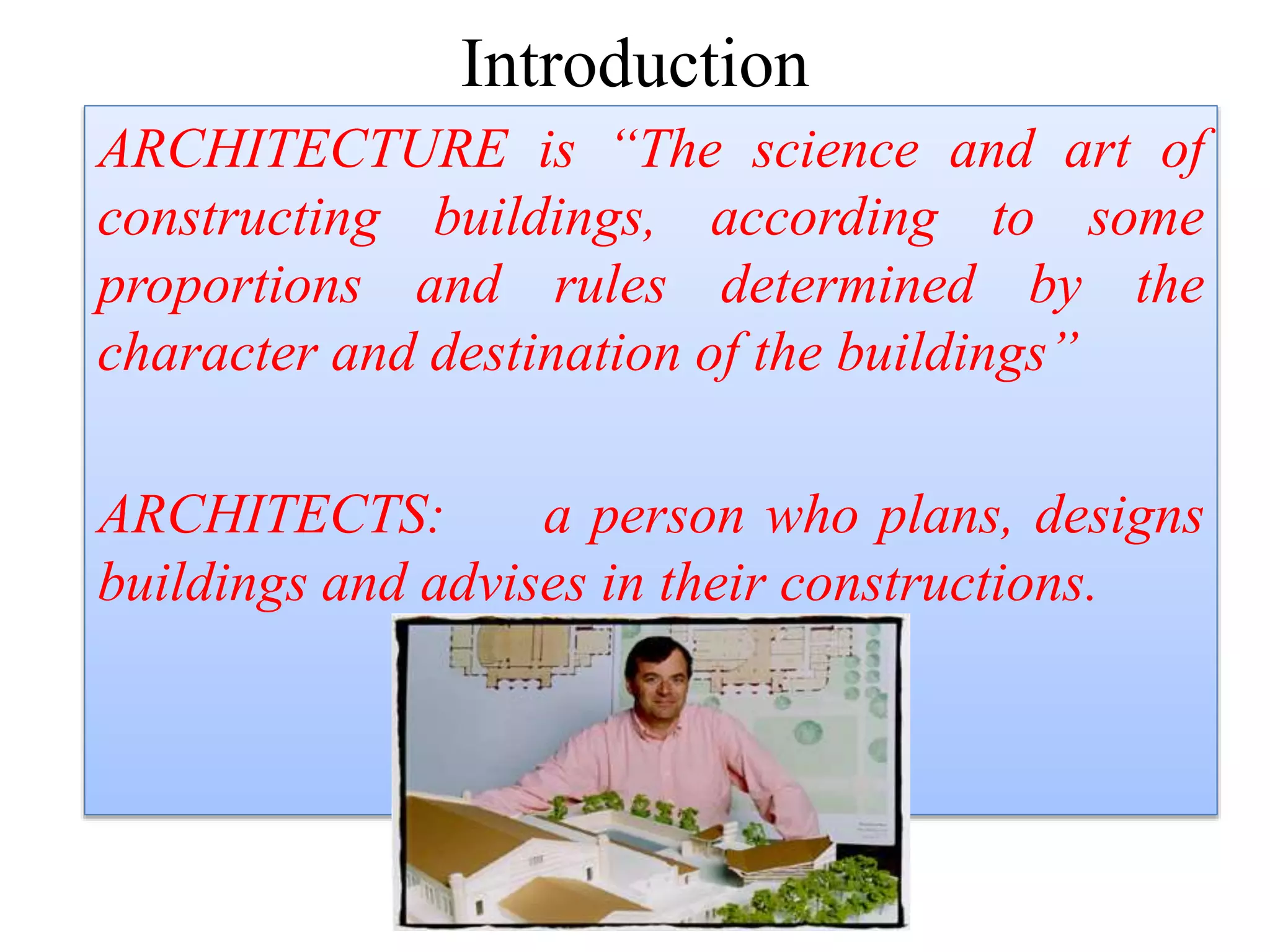
ARCHITECTS: a person who plans, designs
buildings and advises in their constructions.
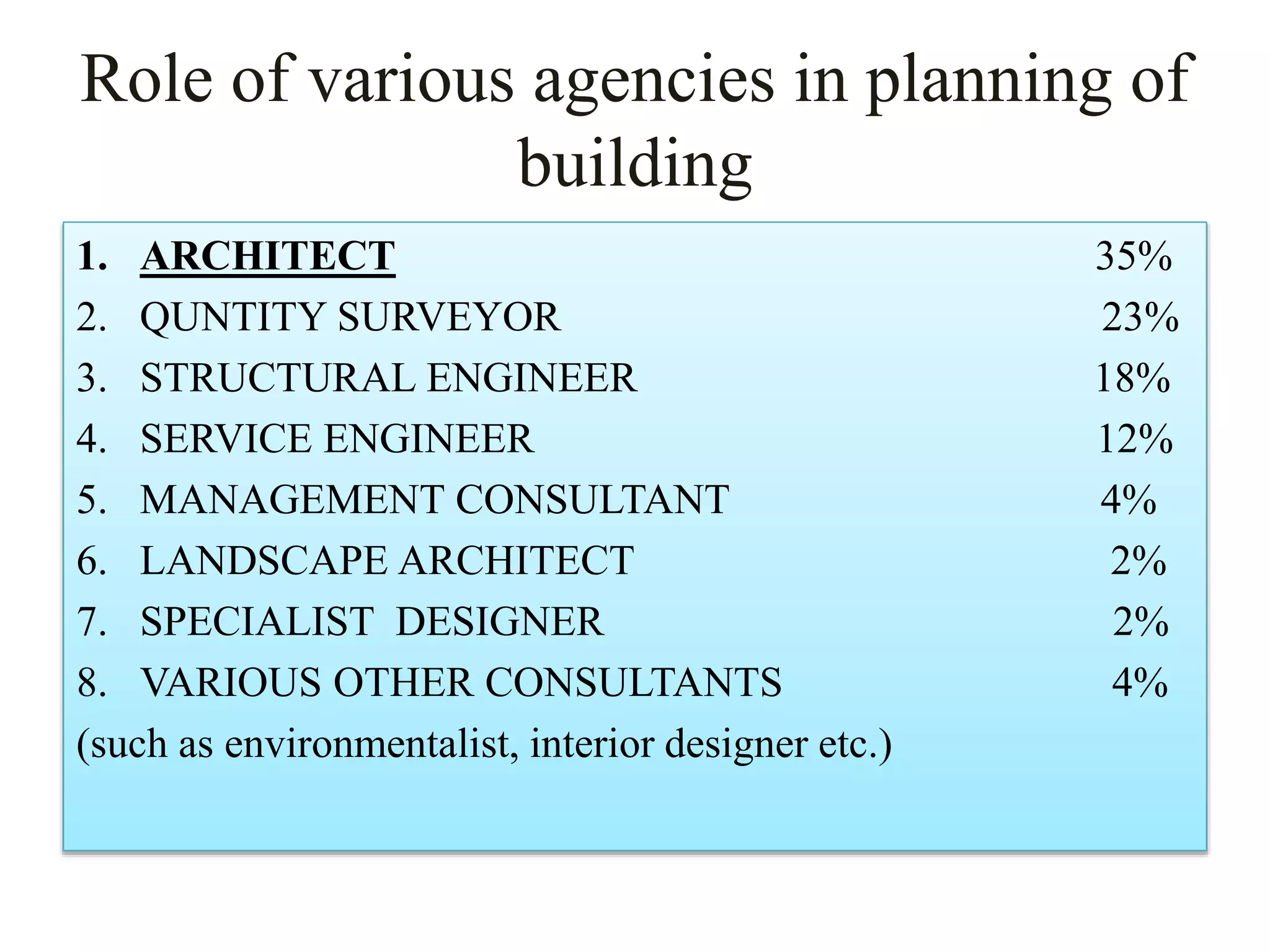
Role of various agencies in planning of
building
1. ARCHITECT 35%
2. QUNTITY SURVEYOR 23%
3. STRUCTURAL ENGINEER 18%
4. SERVICE ENGINEER 12%
5. MANAGEMENT CONSULTANT 4%
6. LANDSCAPE ARCHITECT 2%
7. SPECIALIST DESIGNER 2%
8. VARIOUS OTHER CONSULTANTS 4%
(such as environmentalist, interior designer etc.)
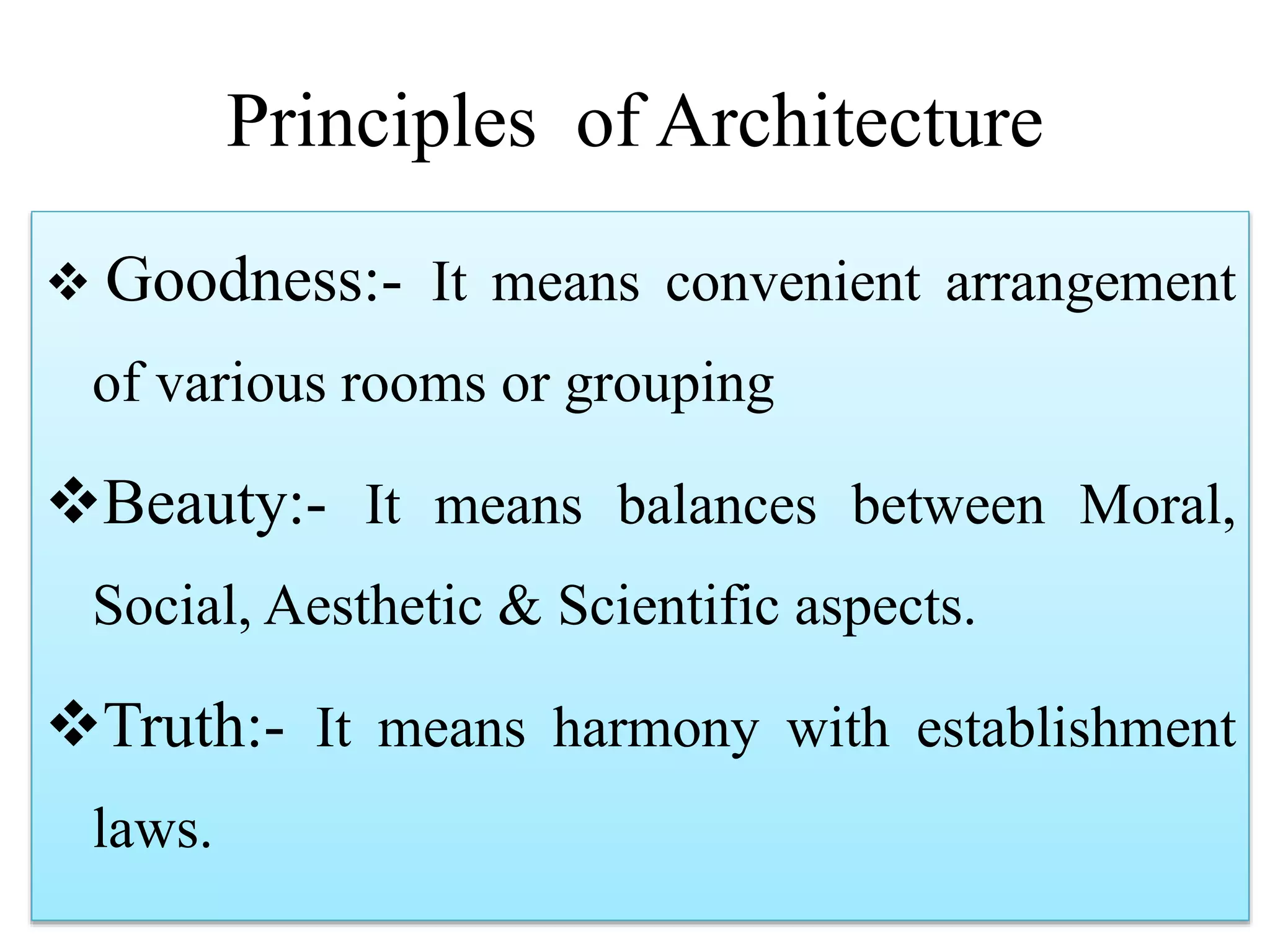
Principles of Architecture
 Goodness:- It means convenient arrangement
of various rooms or grouping
Beauty:- It means balances between Moral,
Social, Aesthetic & Scientific aspects.
Truth:- It means harmony with establishment
laws.
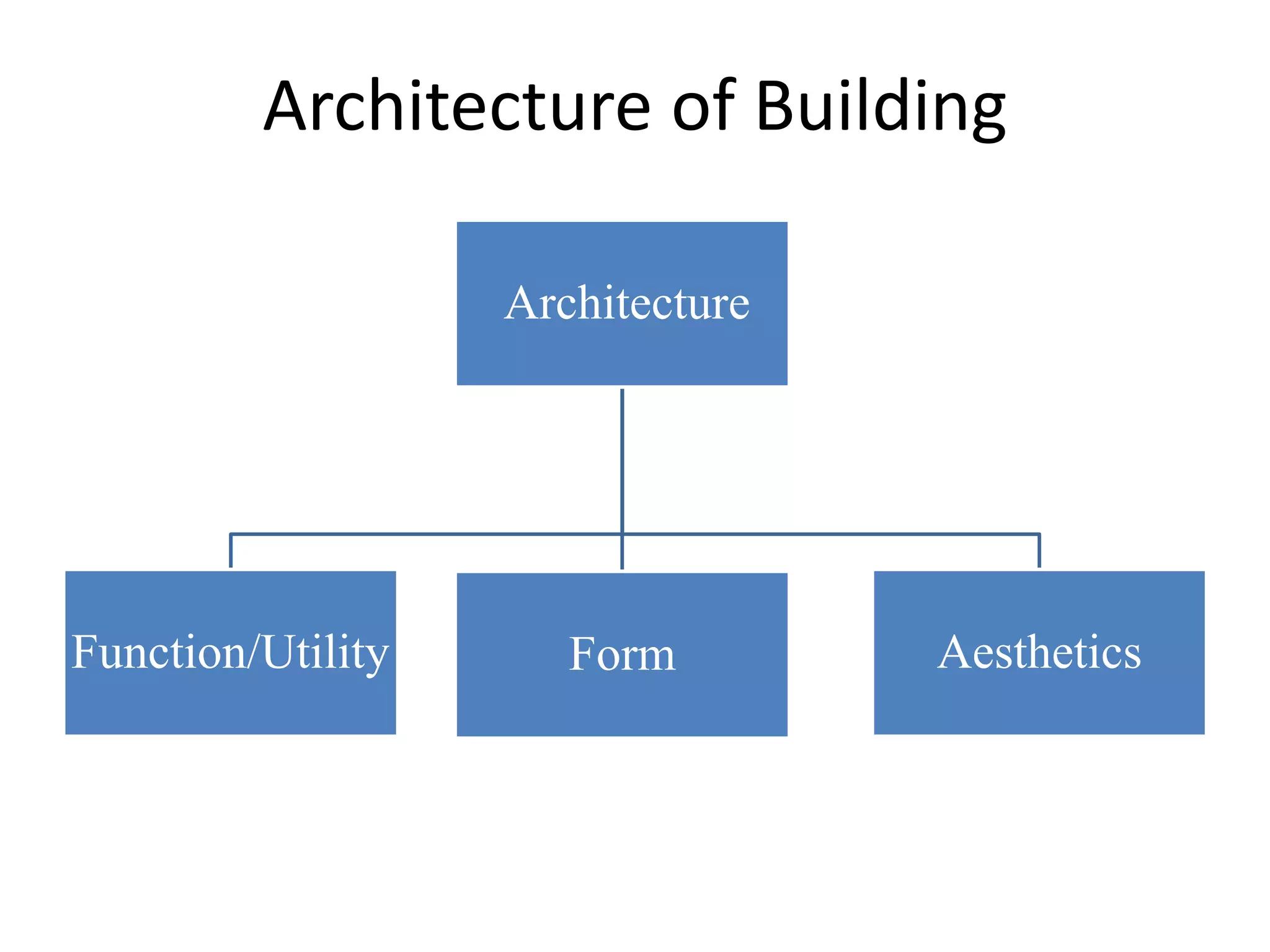
Architecture of Building
Architecture
Function/Utility Form Aesthetics
Function / Utility
• Requirement of Client.
• Requirement of Site.
• Building Rules And Byelaws.
• No. of Users.
• Principles of Building Planning like Aspect,
Prospect, Roominess, Circulation, Privacy etc.
• Sketch plan & layout plan
• Approval from Sanctioning authority
• Lighting & Ventilation
Form
 Structures
 Climate
 Materials
 Method And Technique of Construction
 Economy
 Skill Labors
 Earthquake Design
Aesthetics
• Nature
• Environment
• Unity
• Contrast
• Proportion
• Scale
• Expression
• Character of Building
• Interior Design
• Color
• Landscape
Principles and Elements of
Architectural Composition
1. Focus
2. Unity
3. Balance
4. Rhythm
5. Harmony
6. Discord
7. Texture
8. Contrast
9. Monotony
10.Scale
11.Proportion
12.Colour
13.Character.
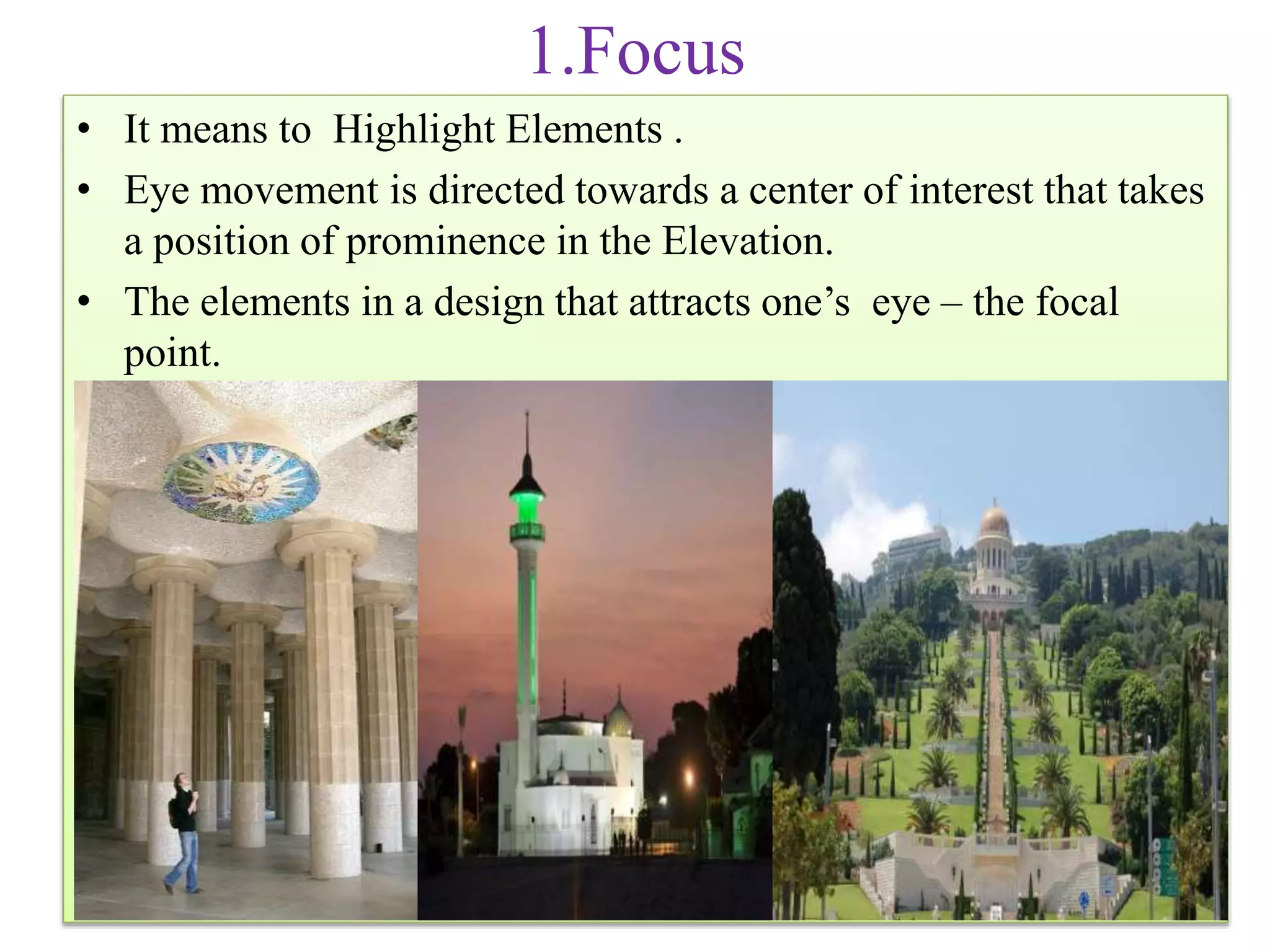
1.Focus
• It means to Highlight Elements .
• Eye movement is directed towards a center of interest that takes
a position of prominence in the Elevation.
• The elements in a design that attracts one’s eye – the focal
point.
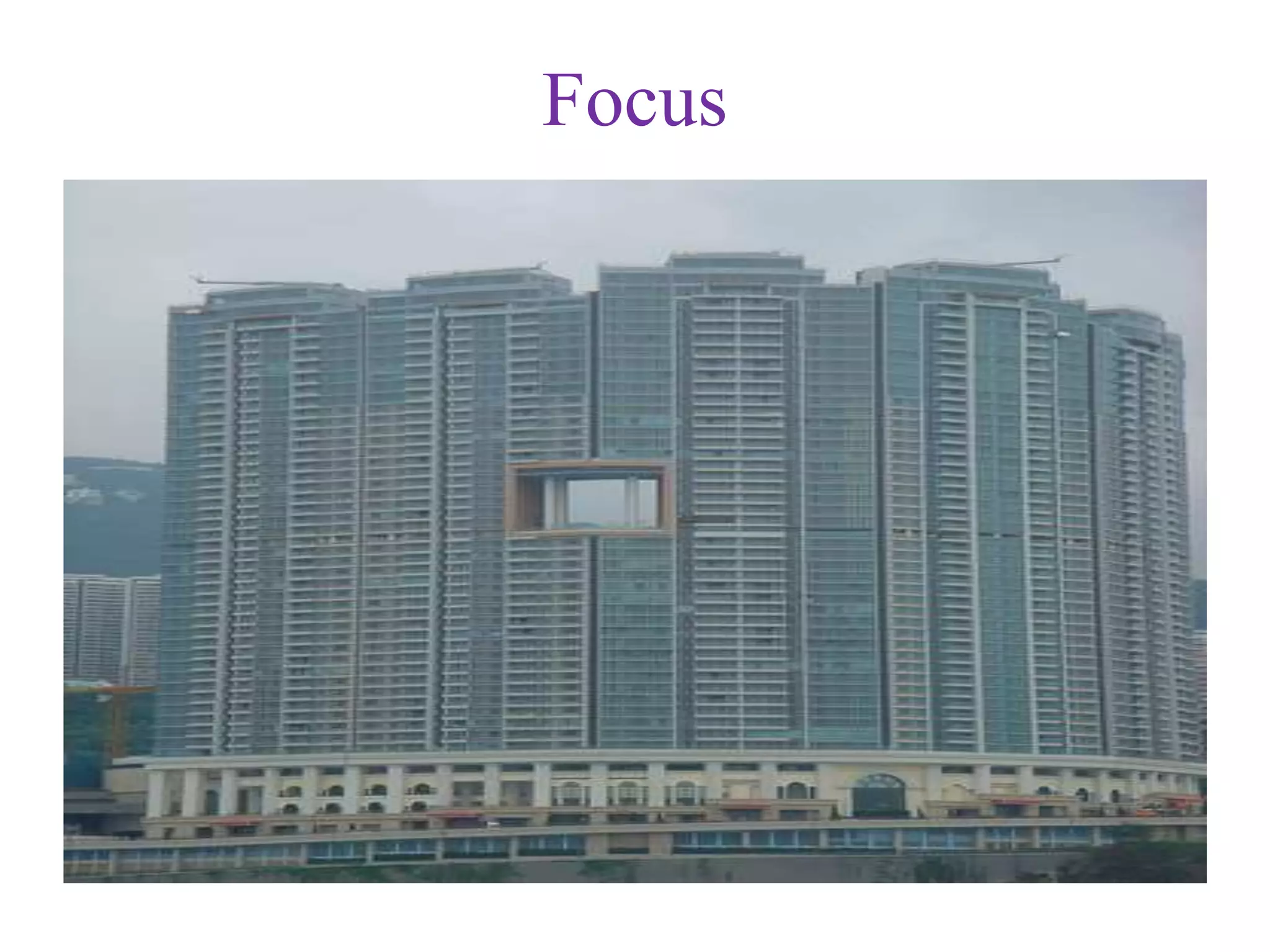
Focus
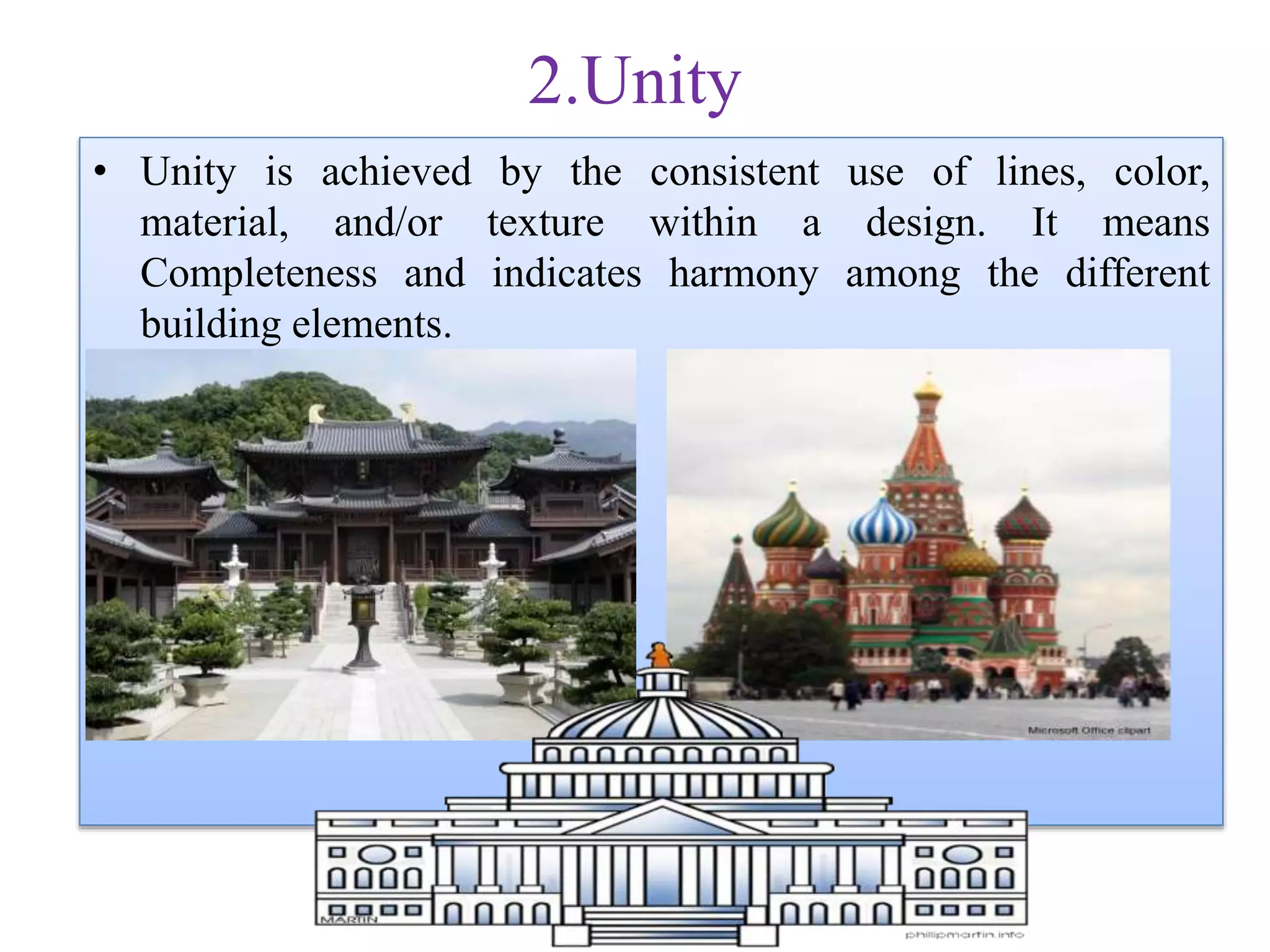
2.Unity
• Unity is achieved by the consistent use of lines, color,
material, and/or texture within a design. It means
Completeness and indicates harmony among the different
building elements.
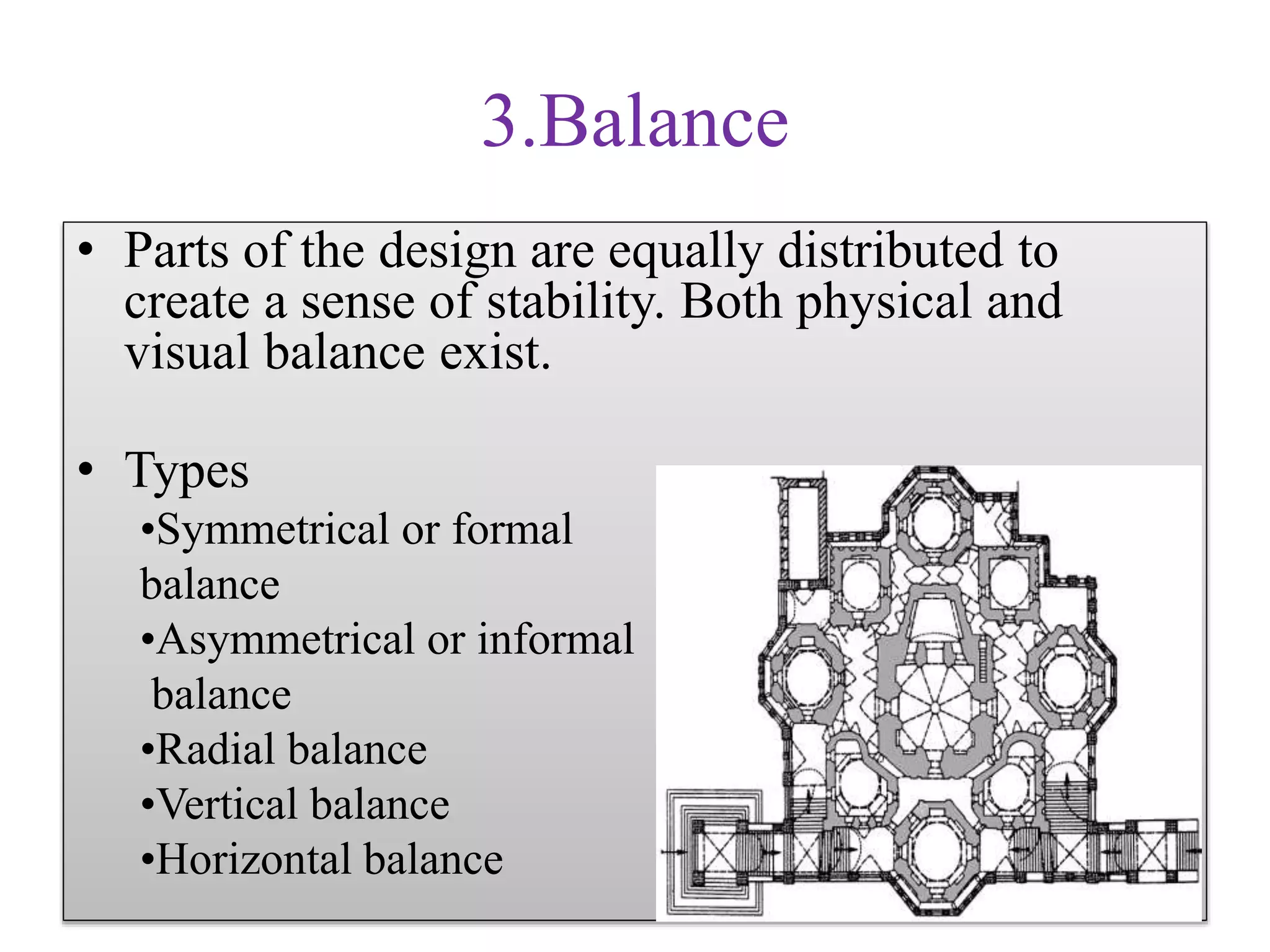
3.Balance
• Parts of the design are equally distributed to
create a sense of stability. Both physical and
visual balance exist.
• Types
•Symmetrical or formal
balance
•Asymmetrical or informal
balance
•Radial balance
•Vertical balance
•Horizontal balance
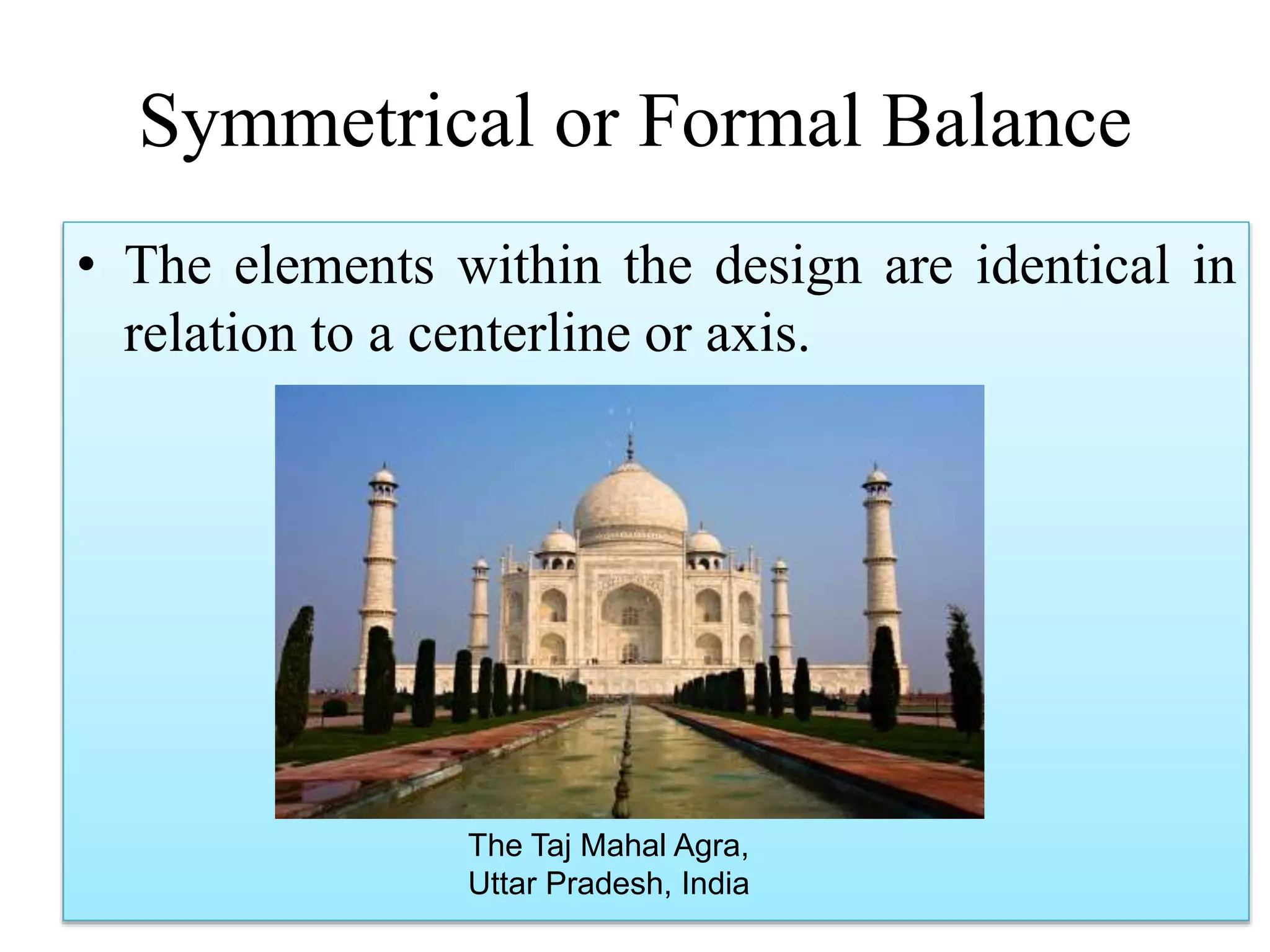
Symmetrical or Formal Balance
• The elements within the design are identical in
relation to a centerline or axis.
The Taj Mahal Agra,
Uttar Pradesh, India
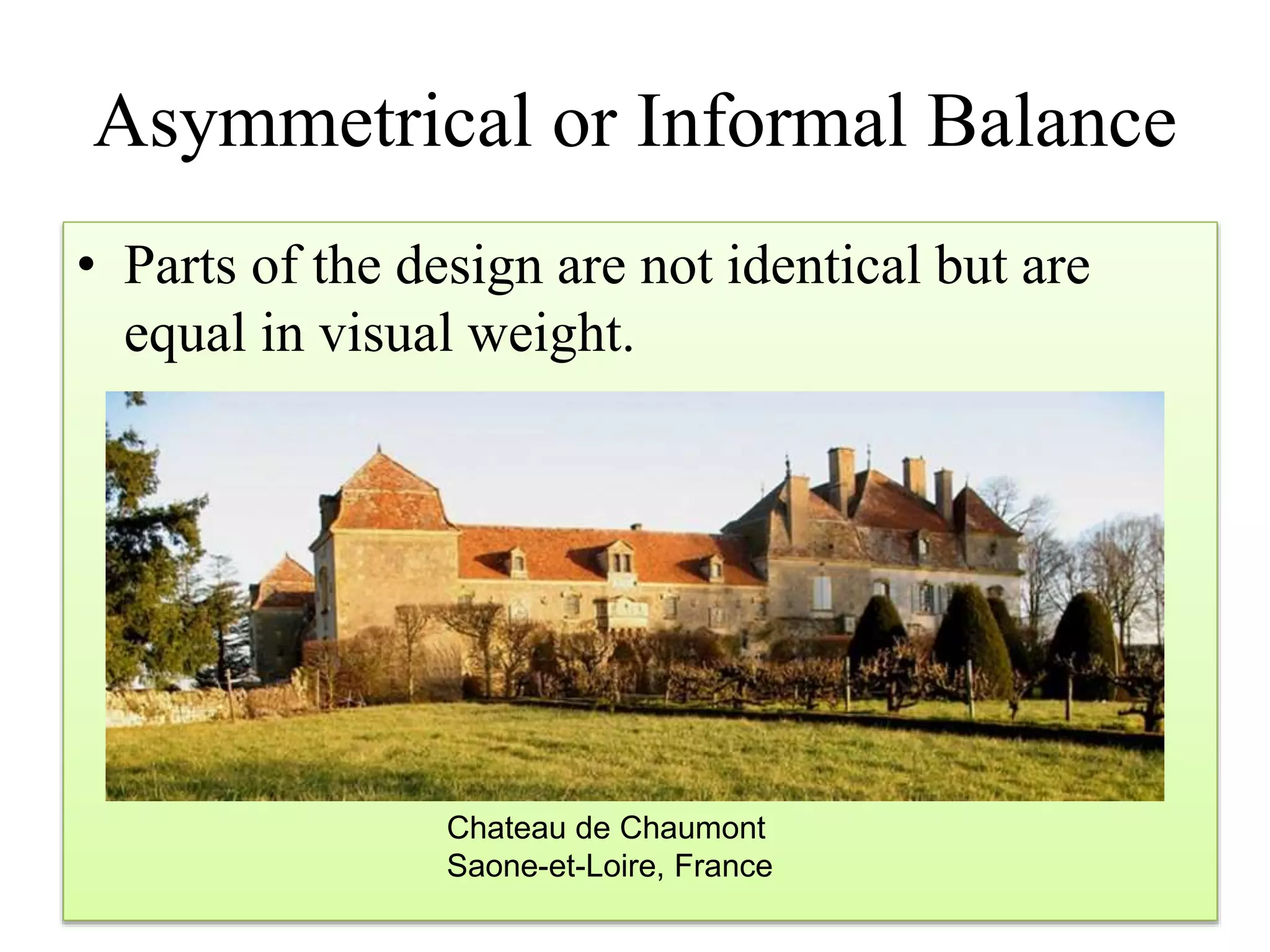
Asymmetrical or Informal Balance
• Parts of the design are not identical but are
equal in visual weight.
Chateau de Chaumont
Saone-et-Loire, France
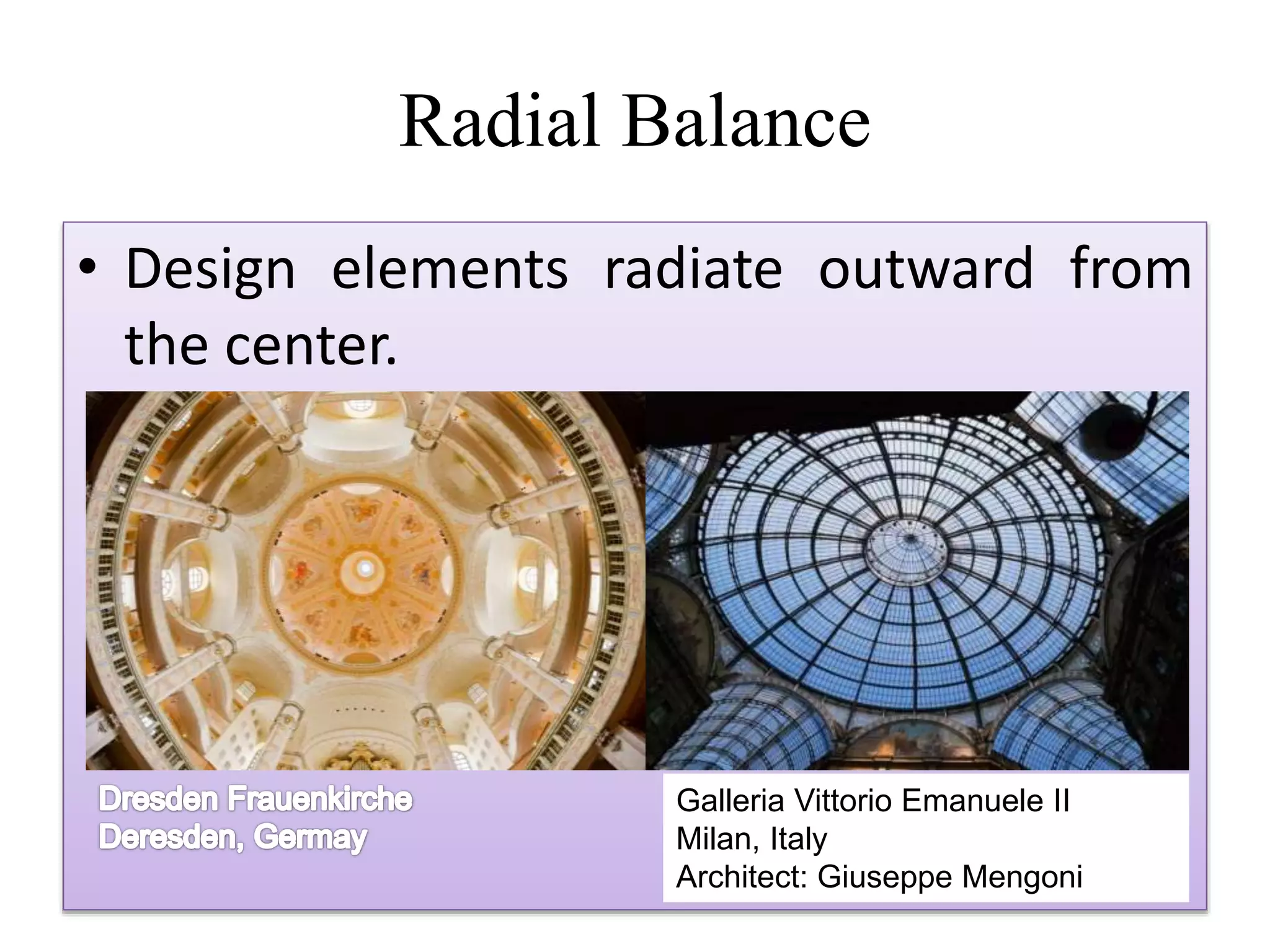
Radial Balance
• Design elements radiate outward from
the center.
Galleria Vittorio Emanuele II
Milan, Italy
Architect: Giuseppe Mengoni
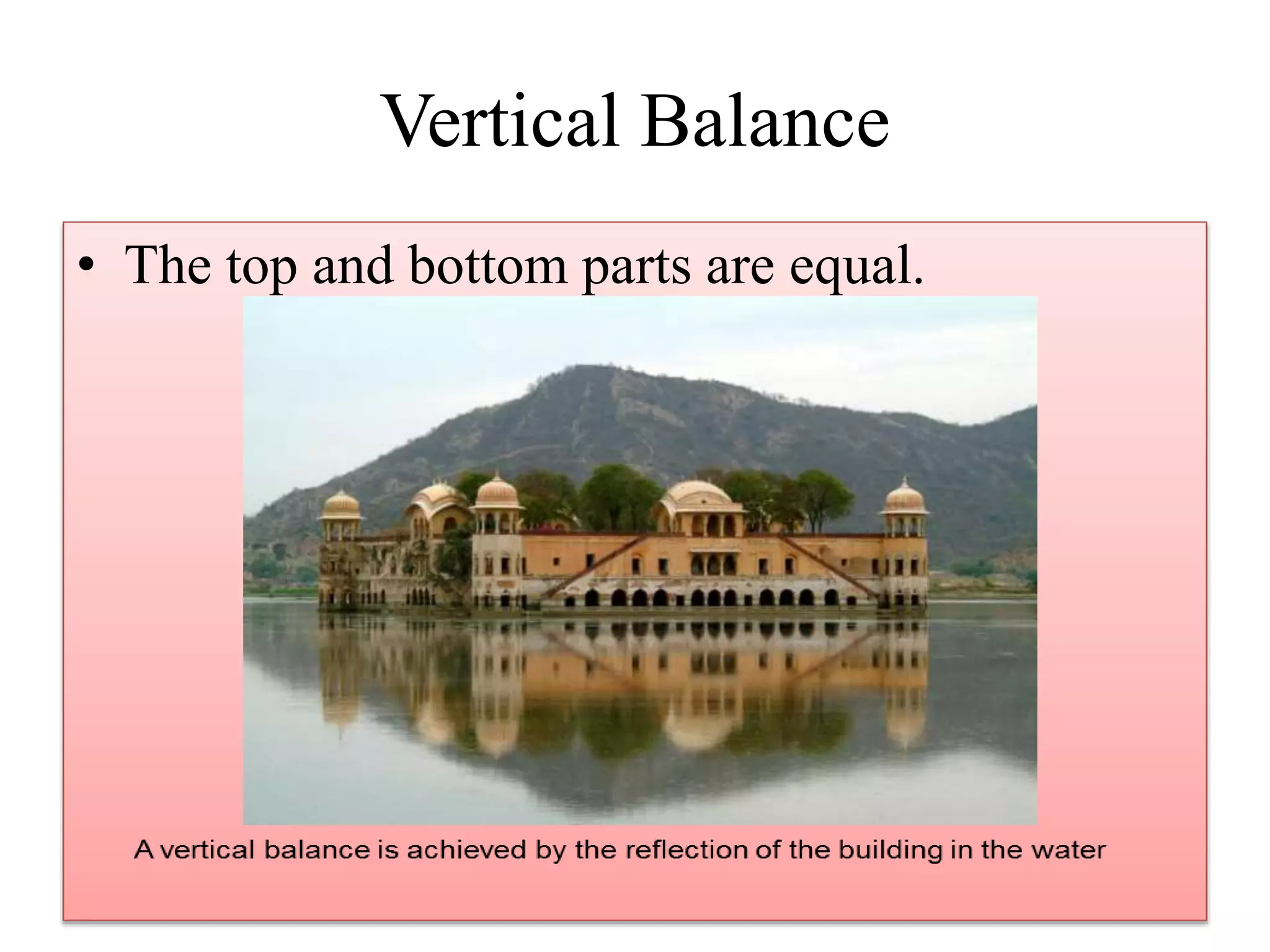
Vertical Balance
• The top and bottom parts are equal.
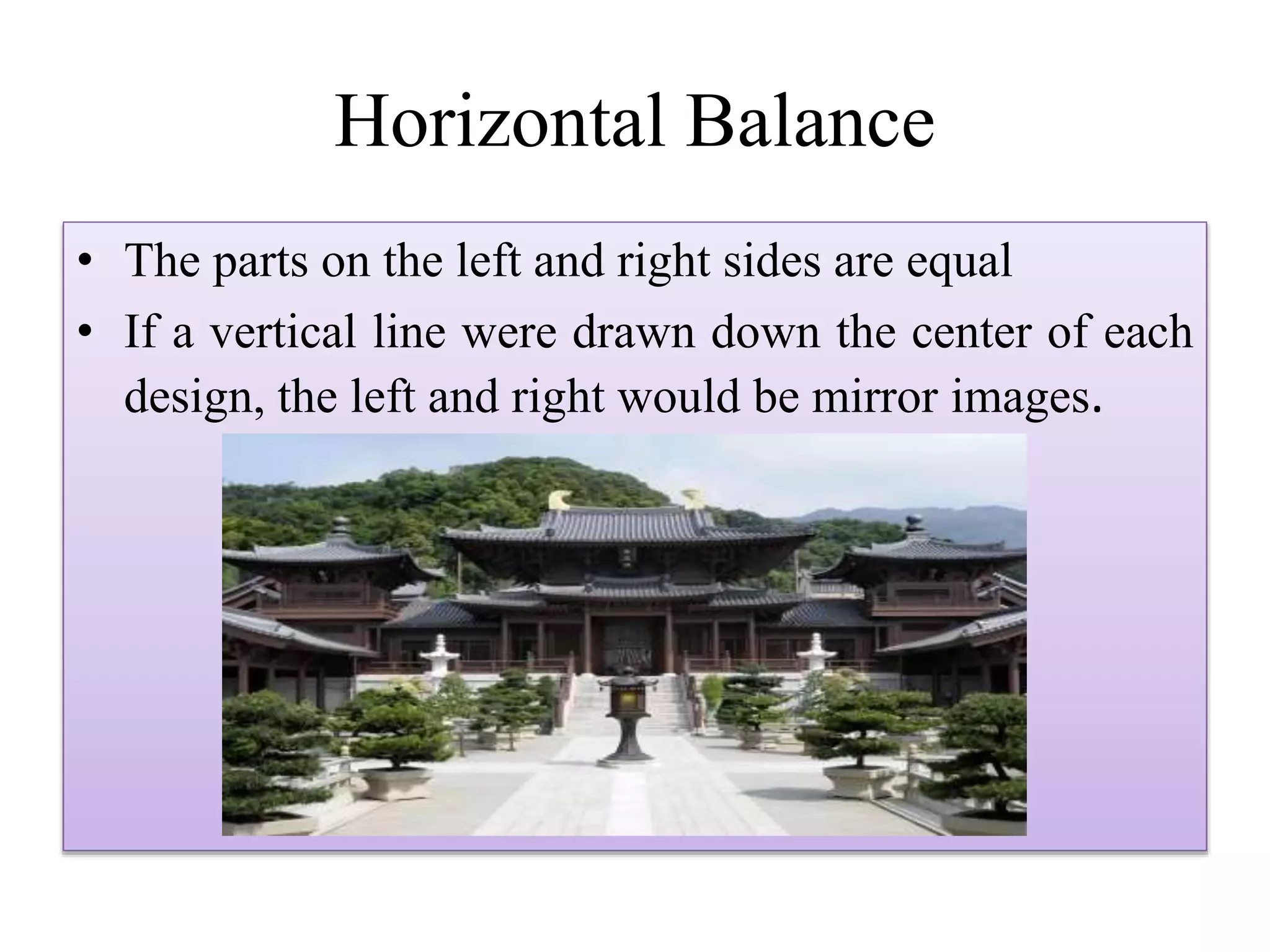
Horizontal Balance
• The parts on the left and right sides are equal
• If a vertical line were drawn down the center of each
design, the left and right would be mirror images.
4.Rhythm
• Repeated use of line, shape, color, texture or
pattern
• Types
• Regular rhythm
• Random rhythm
• Gradated rhythm
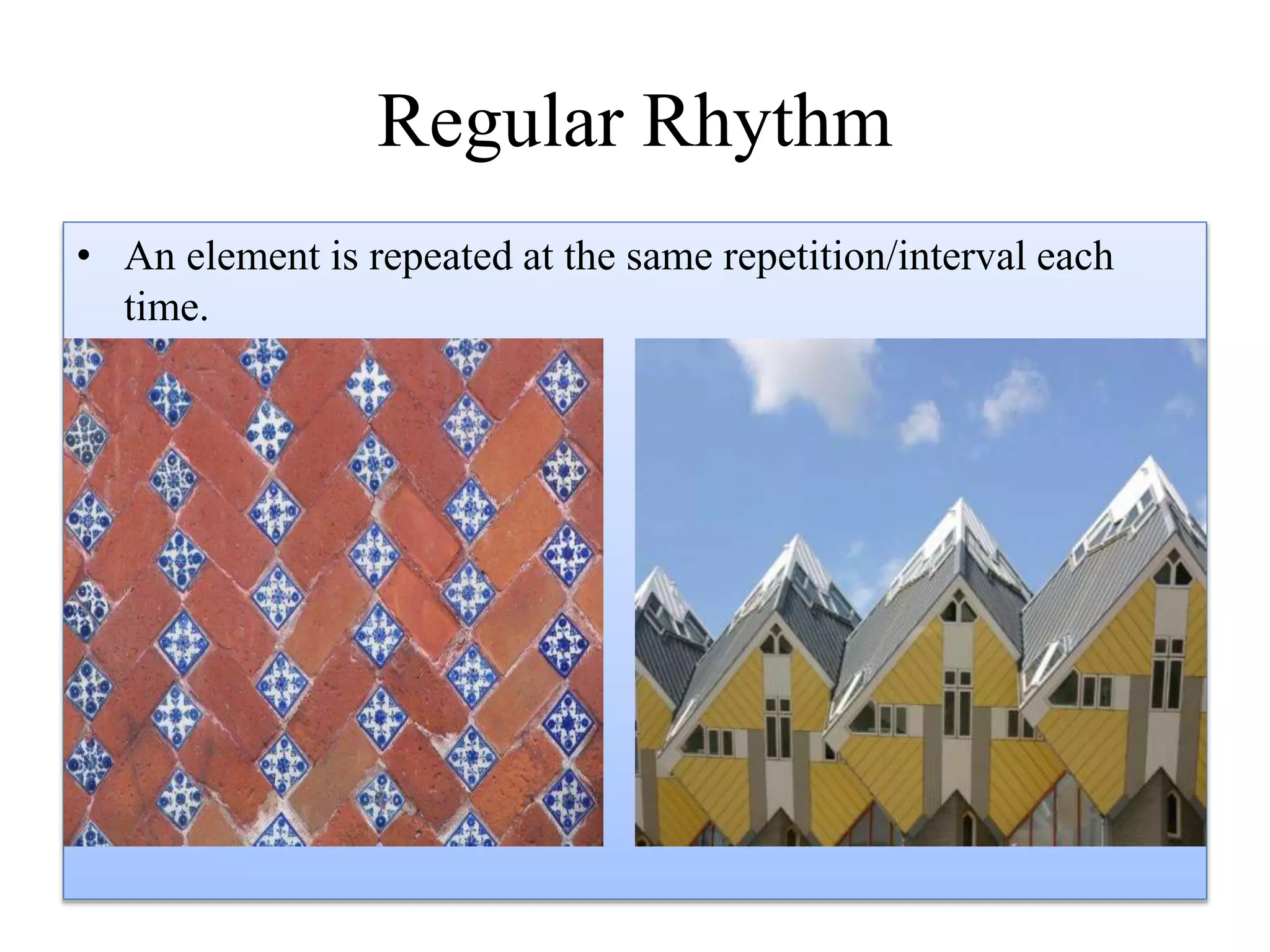
Regular Rhythm
• An element is repeated at the same repetition/interval each
time.
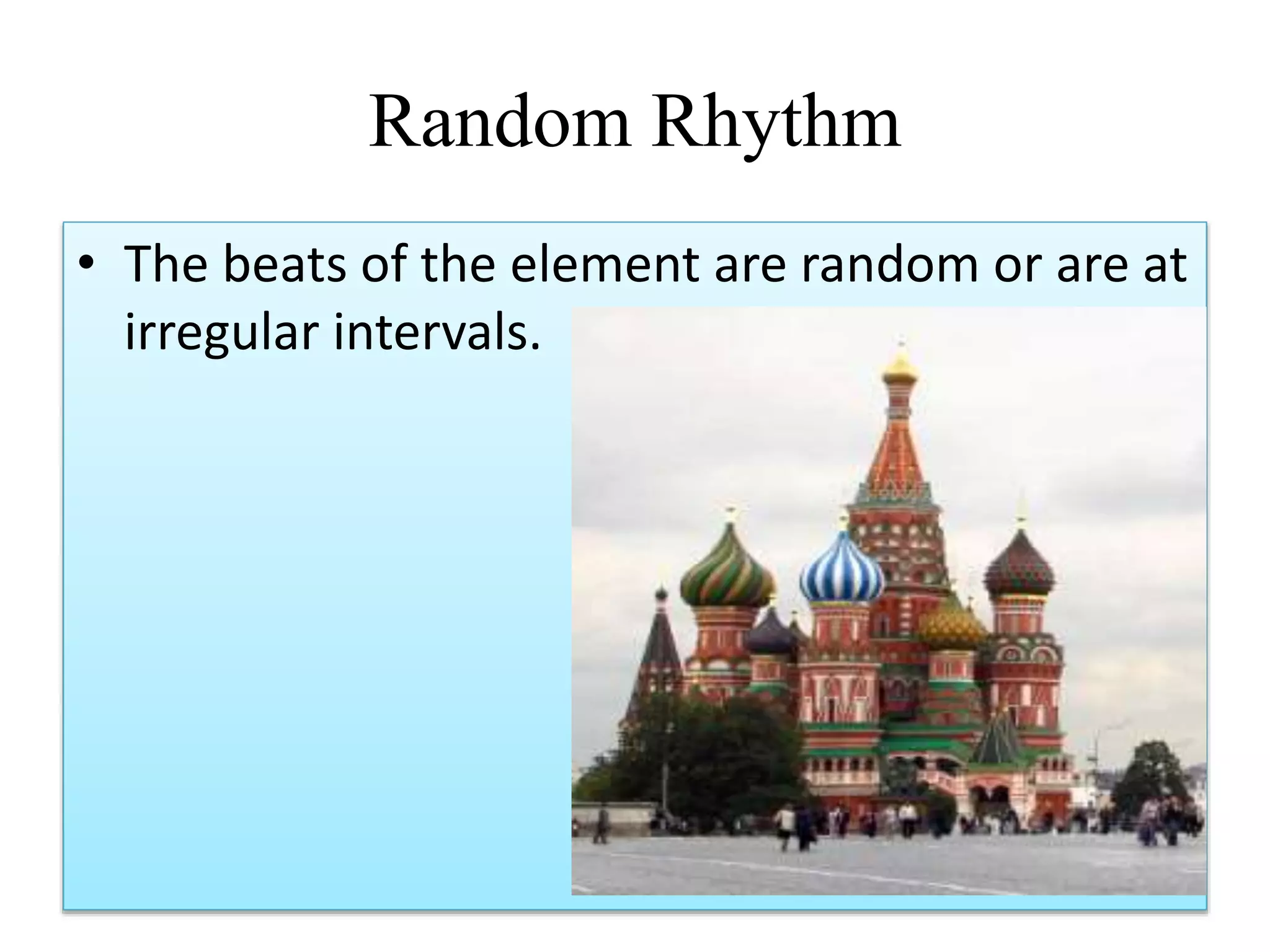
Random Rhythm
• The beats of the element are random or are at
irregular intervals.
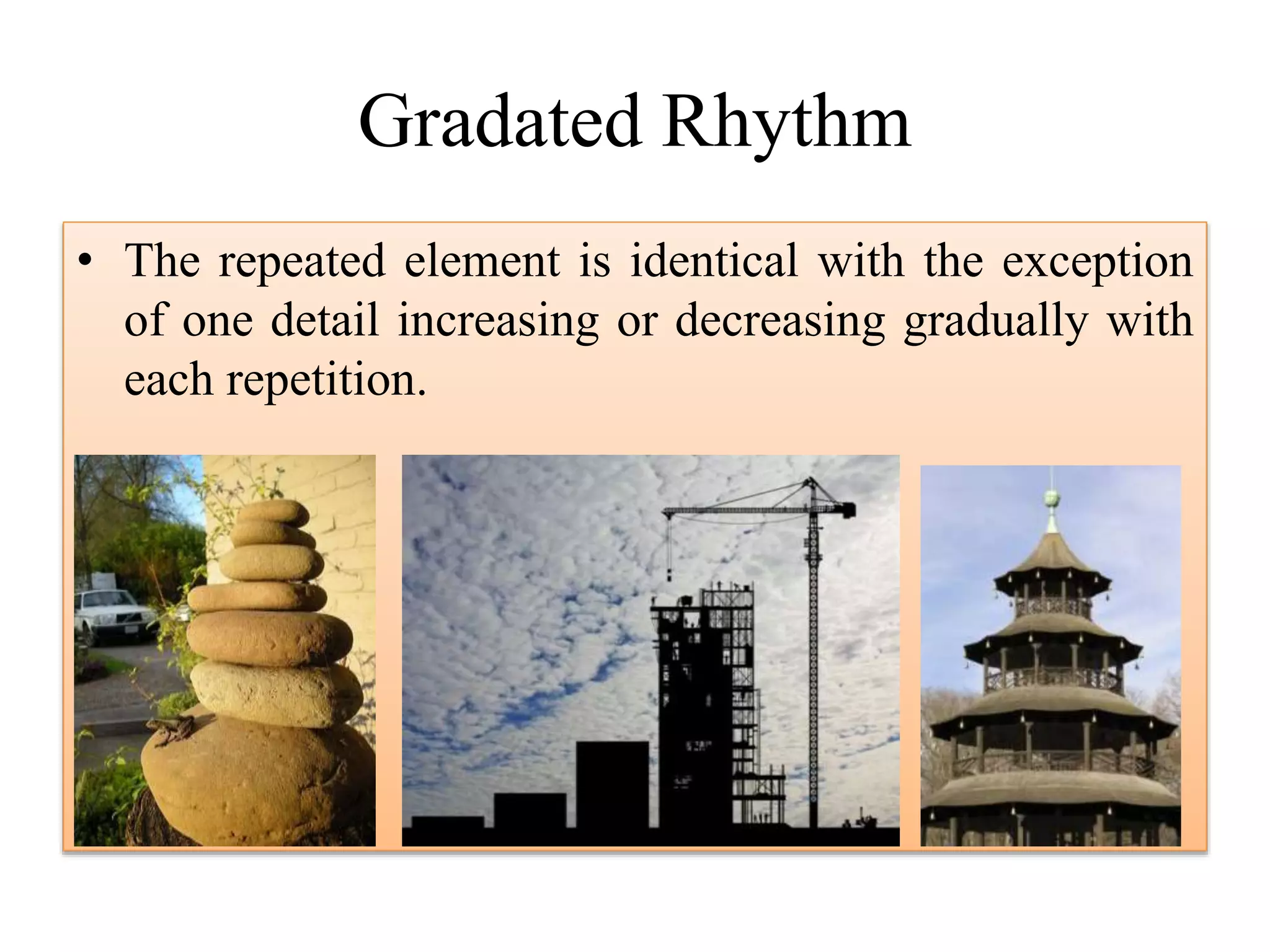
Gradated Rhythm
• The repeated element is identical with the exception
of one detail increasing or decreasing gradually with
each repetition.
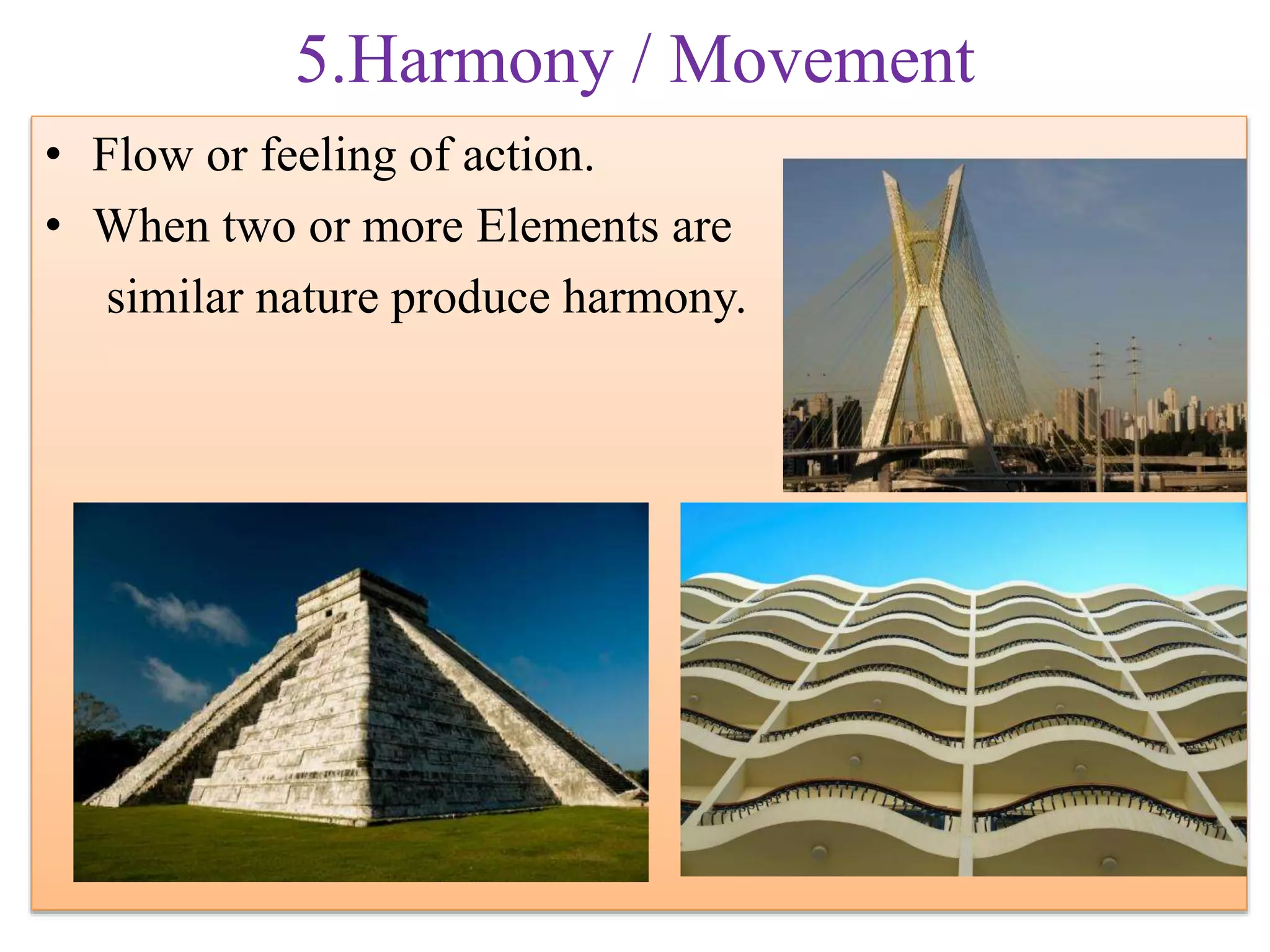
5.Harmony / Movement
• Flow or feeling of action.
• When two or more Elements are
similar nature produce harmony.
6.Discord
• It is a group of elements of entirely
different nature so that they have an
unpleasant effect. These can be
disturbed to all elements of harmony
7.Texture
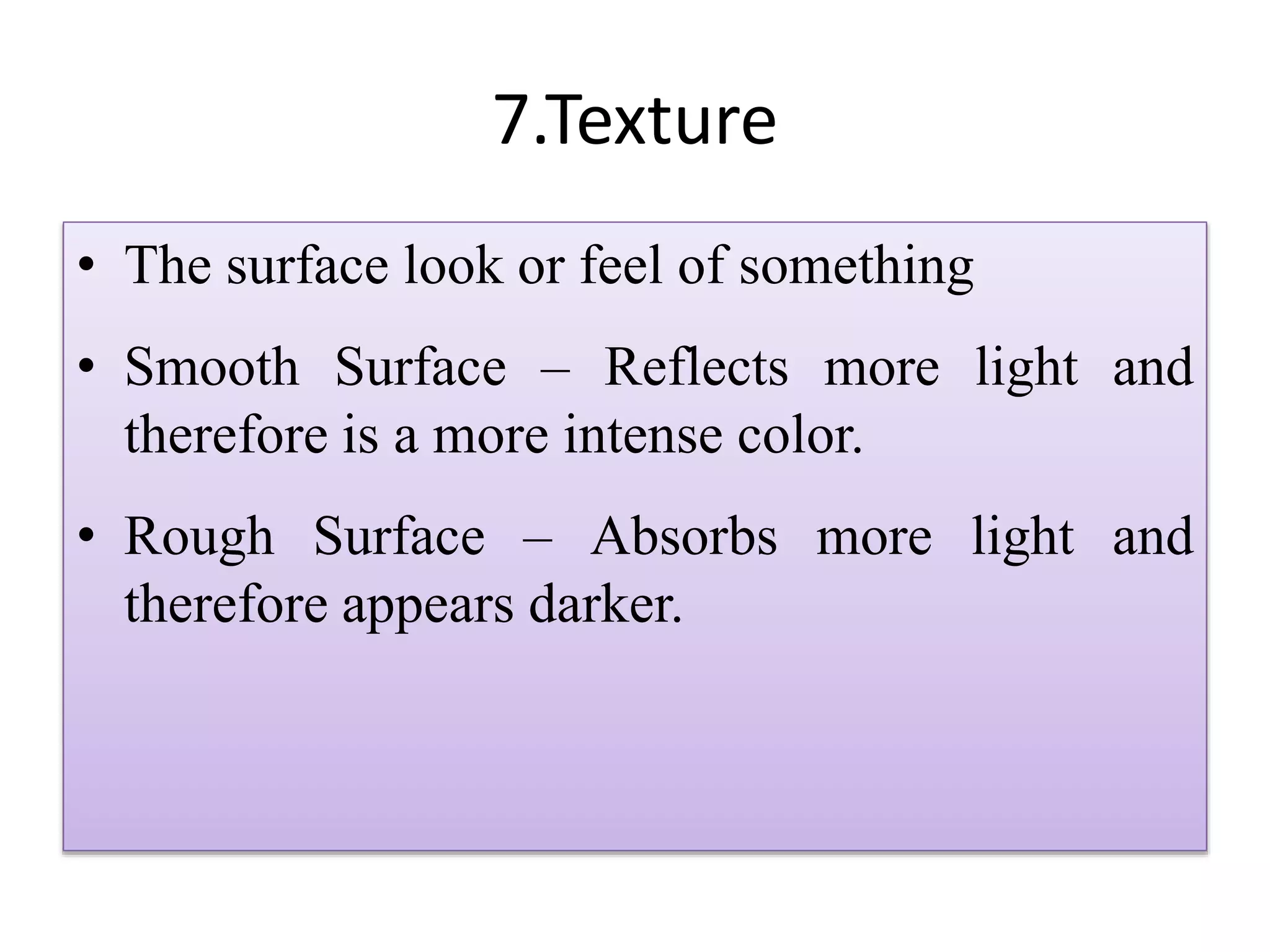
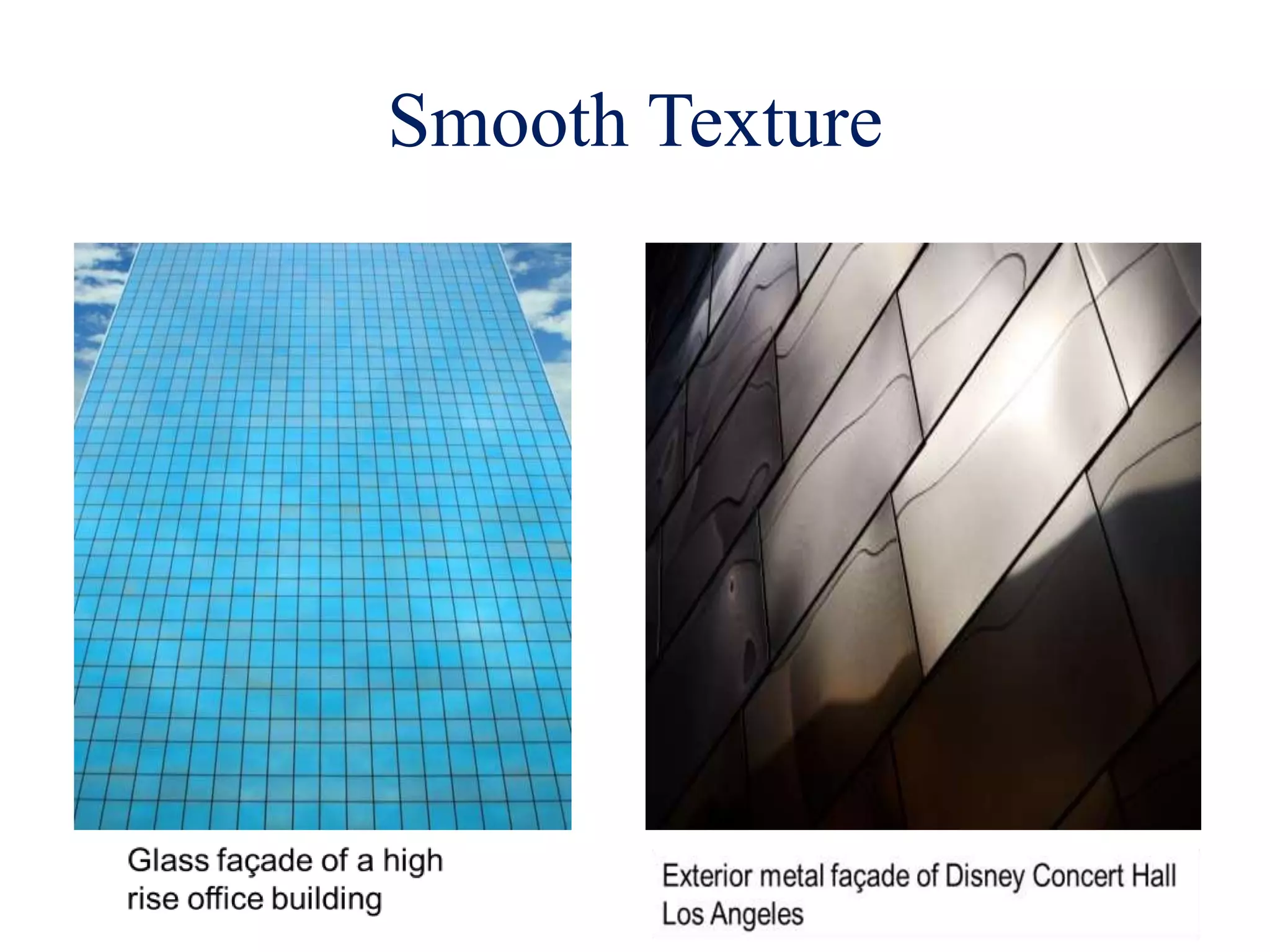
• The surface look or feel of something
• Smooth Surface – Reflects more light and
therefore is a more intense color.
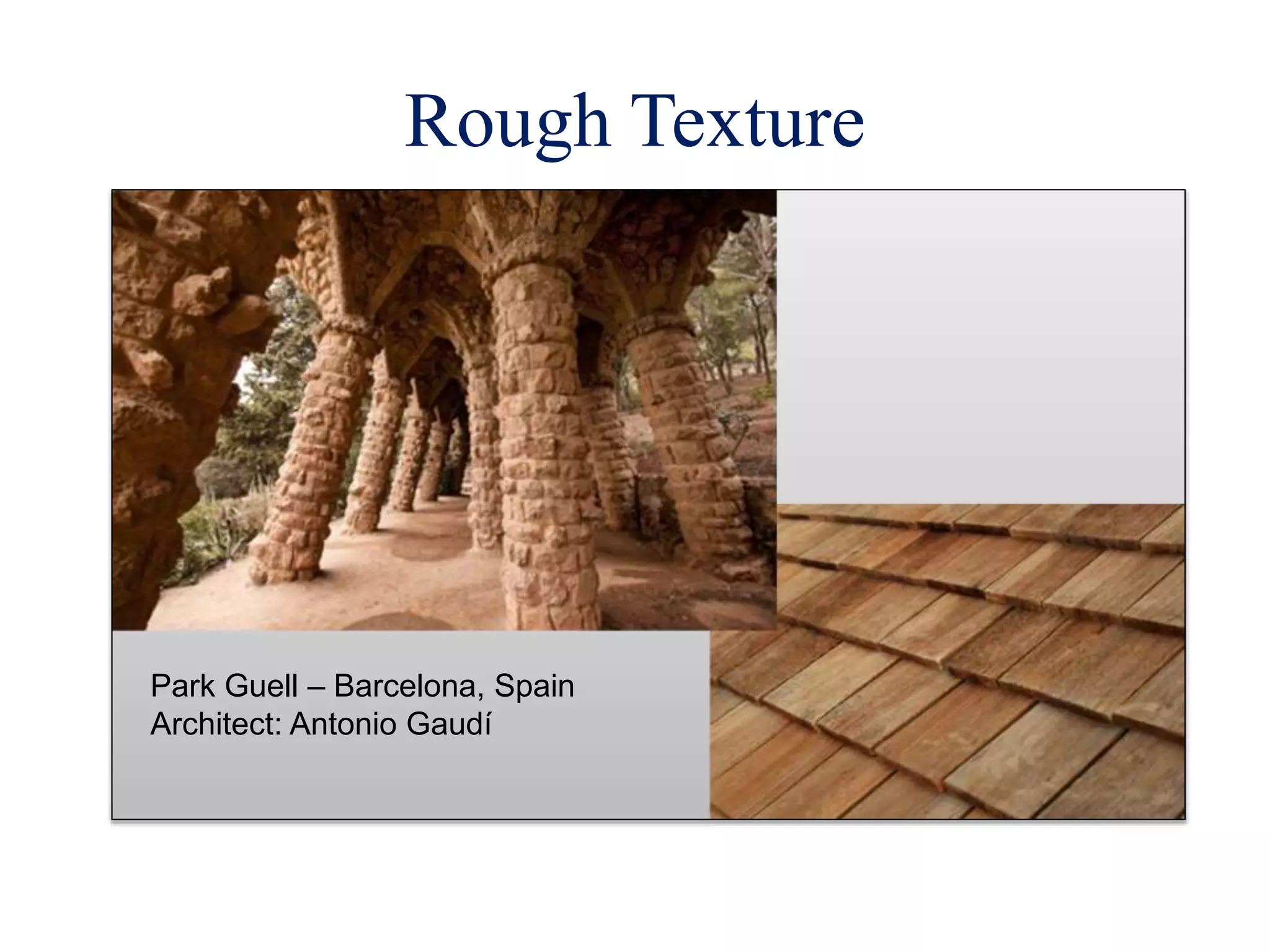
• Rough Surface – Absorbs more light and
therefore appears darker.
Smooth Texture
Rough Texture
Park Guell – Barcelona, Spain
Architect: Antonio Gaudí
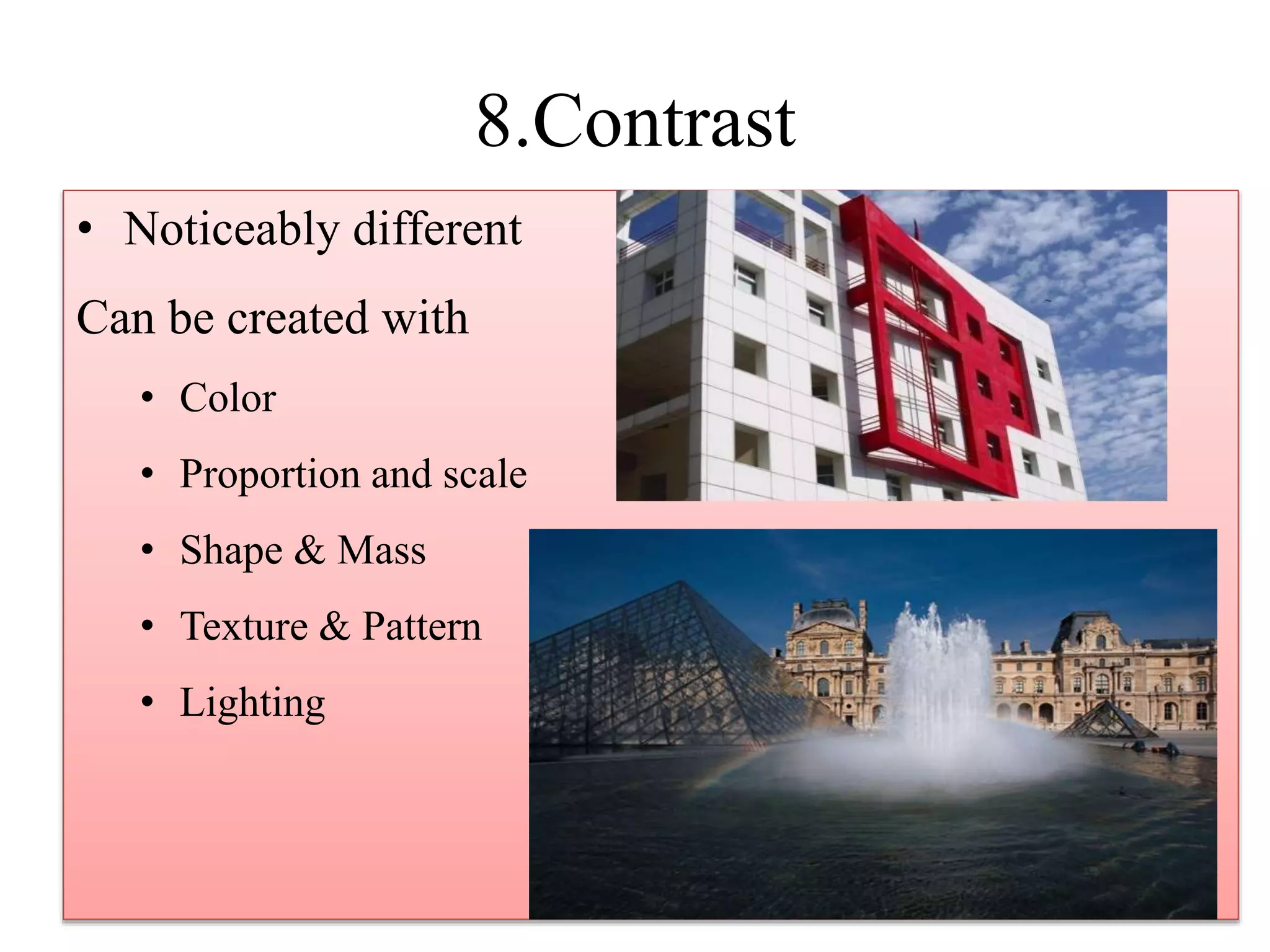
8.Contrast
• Noticeably different
Can be created with
• Color
• Proportion and scale
• Shape & Mass
• Texture & Pattern
• Lighting
9.Monotony
• Continuous repetition of single elements or a
number of elements producing an unpleasant
effects is call as monotony
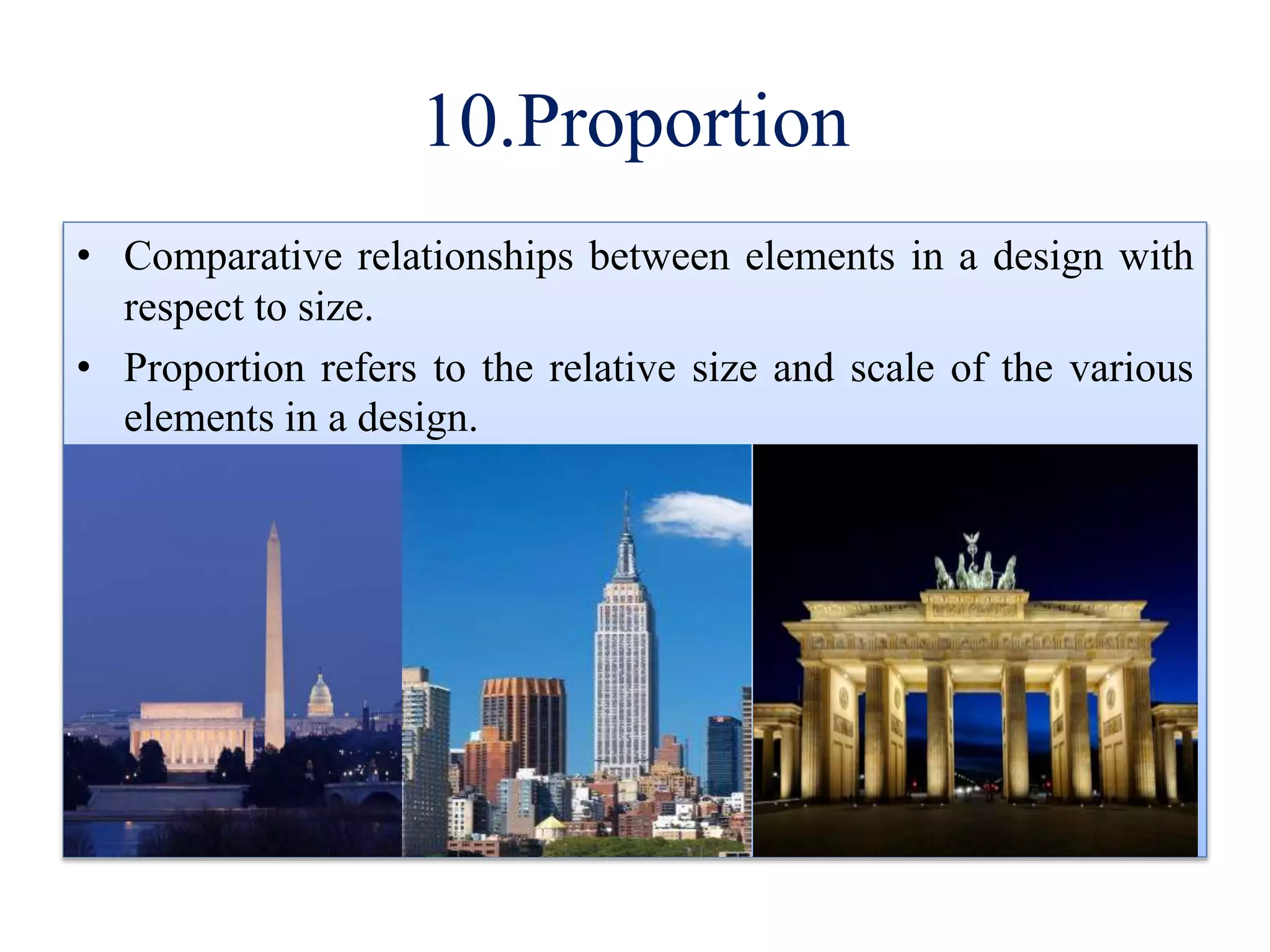
10.Proportion
• Comparative relationships between elements in a design with
respect to size.
• Proportion refers to the relative size and scale of the various
elements in a design.
11.scale
• The scale in architectural composition means
proper relation of different elements to one
another and to whole. The scale is considered
with respect to surroundings.
• The sizes of doors, windows and staircase are
different for residential building when
compared to public building.
• The proper scale is essential for better and
qualitative results of proportion.
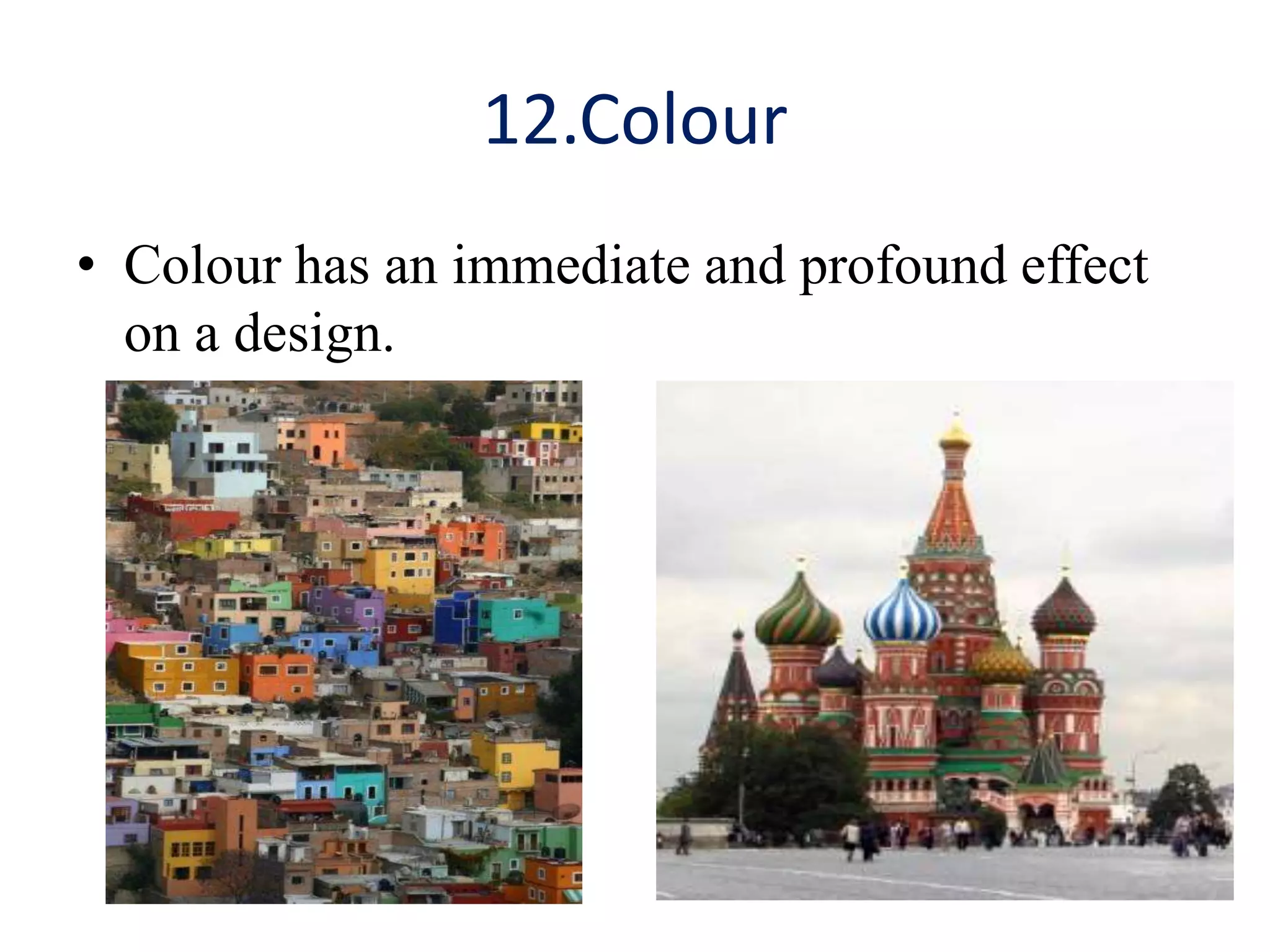
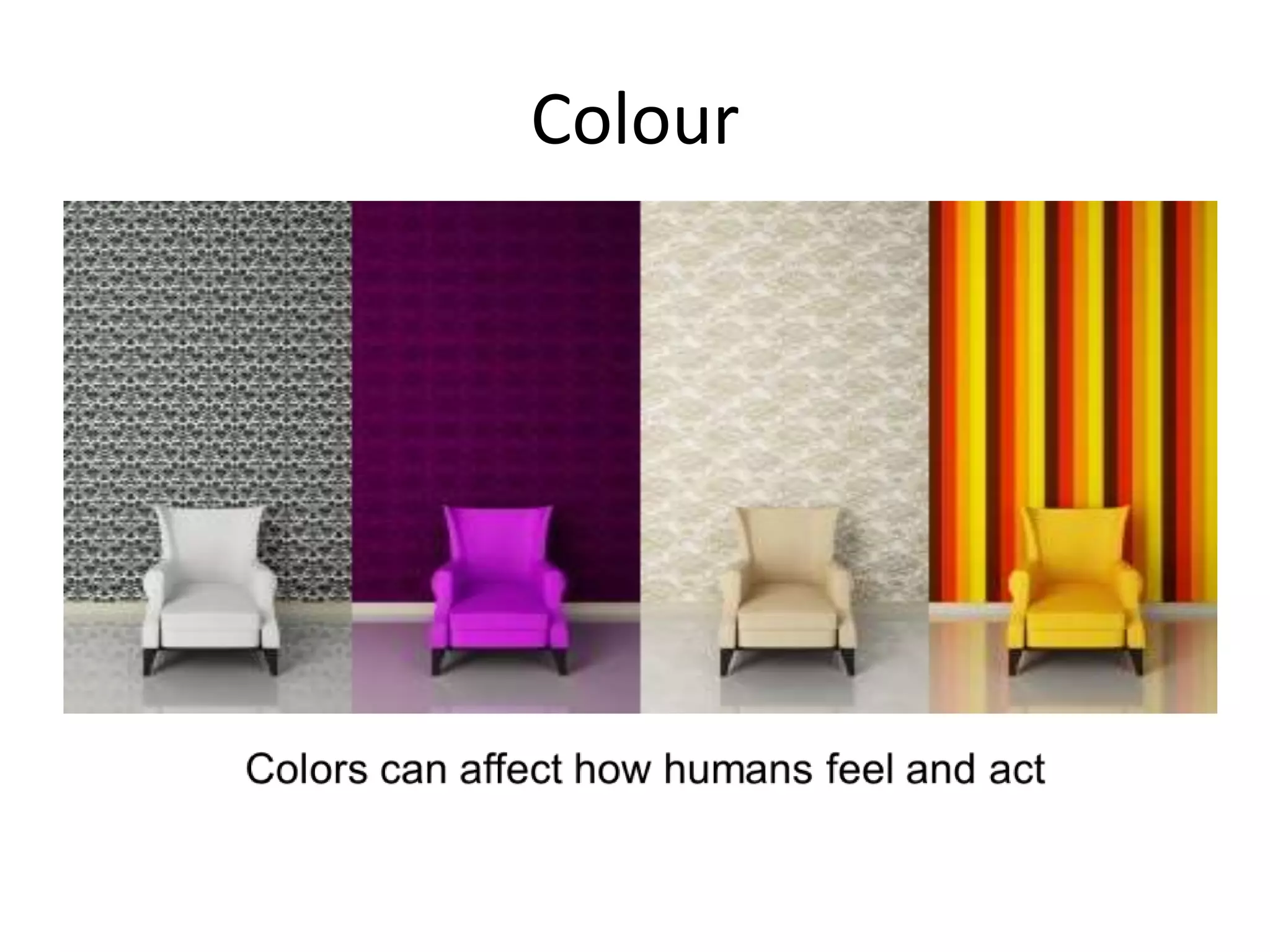
12.Colour
• Colour has an immediate and profound effect
on a design.
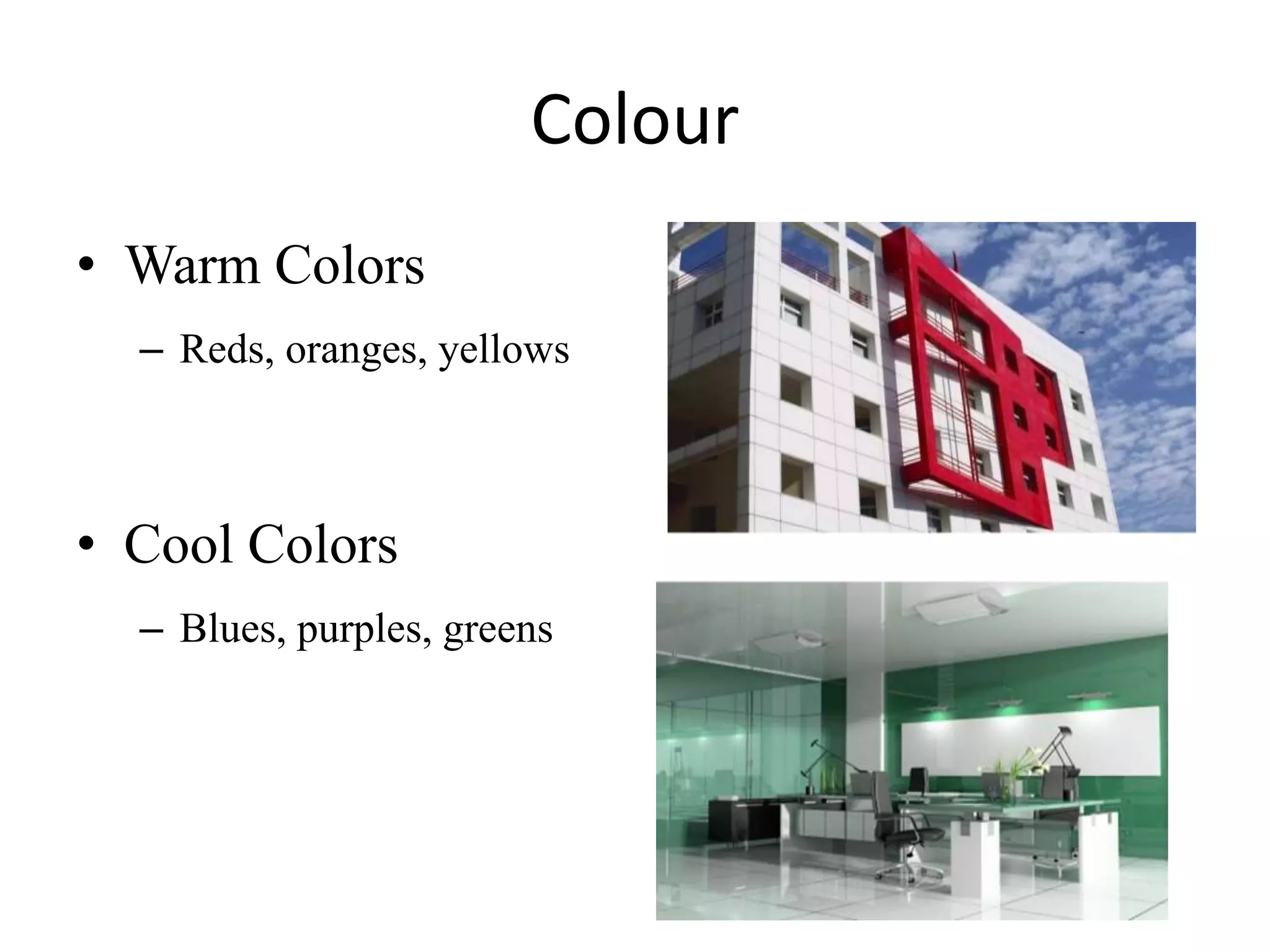
Colour
• Warm Colors
– Reds, oranges, yellows
• Cool Colors
– Blues, purples, greens
Colour
13.Character
It refers to the styles of the building.
The character is related to functional aspect of
the building and evolves from proper
combination of unity, mass composition,
proportion, scale etc. which constitutes the
basic principles of Architectural composition.
Types of character
1. Functional Character
2. Traditional Character
3. Personal Character
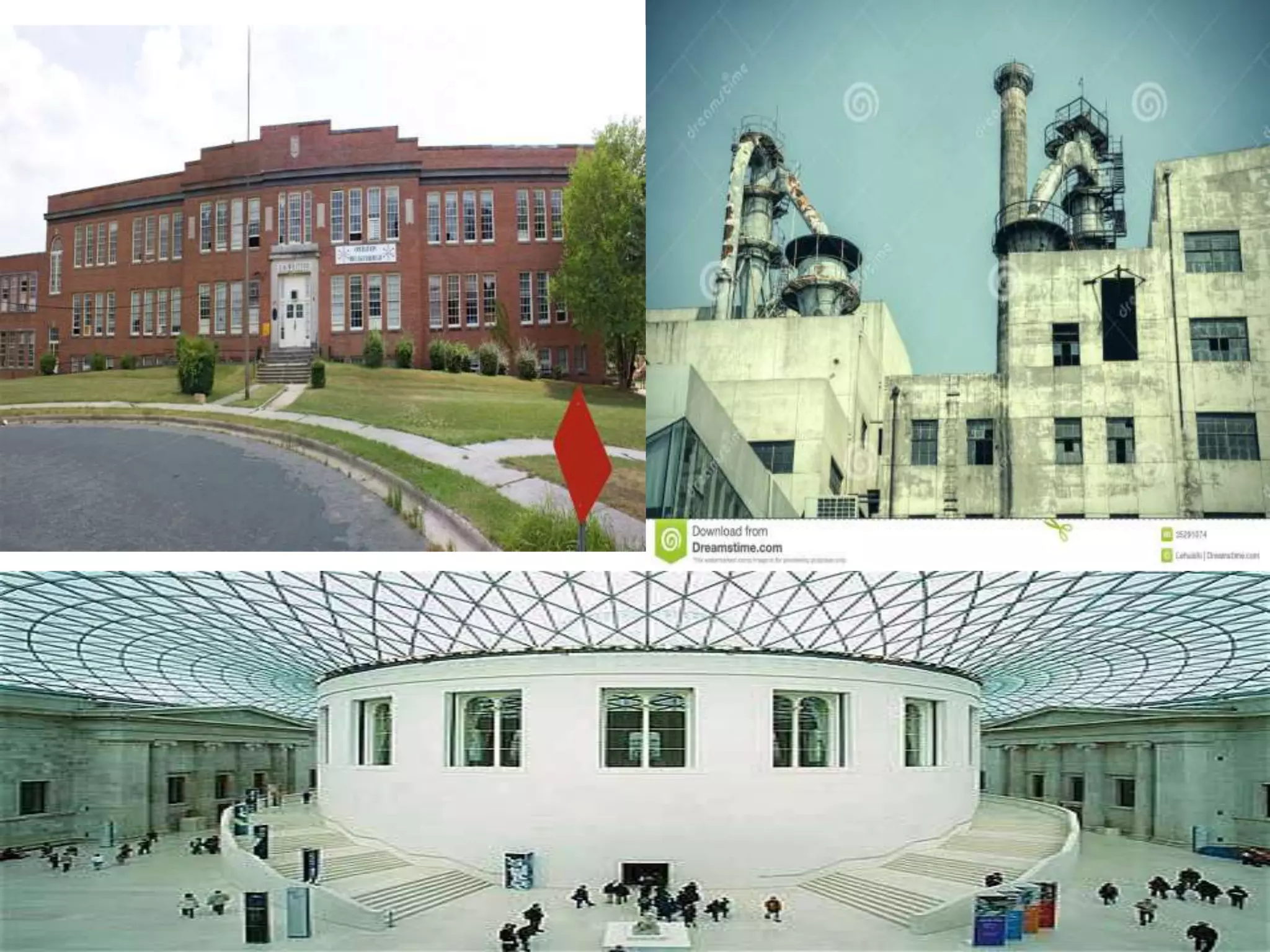
Functional character
That show the purpose of the building or
the reason for its erection.
The external appearance plays an
important role in determining the purpose
and the function of the structure.
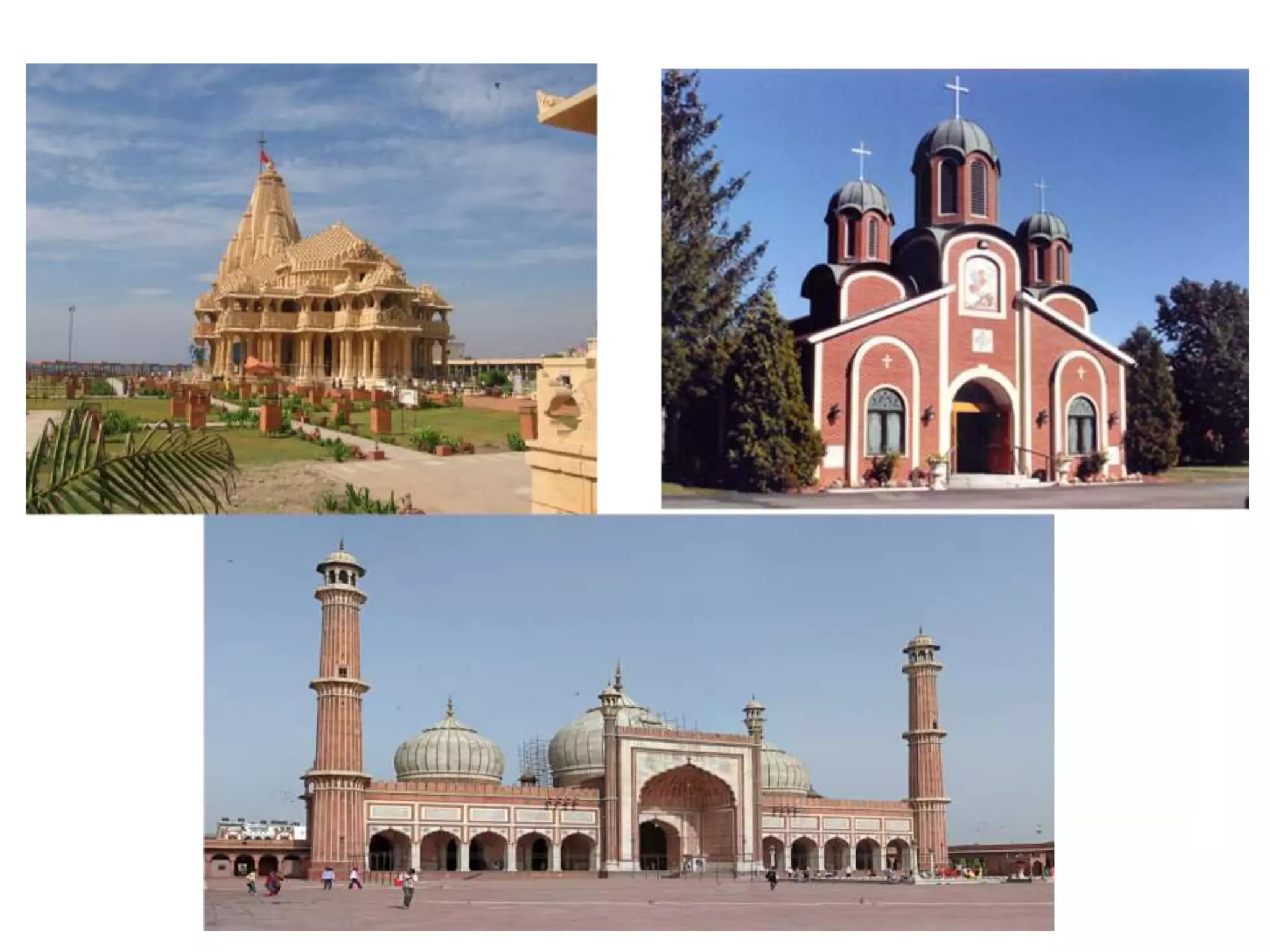
Traditional character
The character of some buildings is expressed
through elements associated with certain
influences. Such influences often go thousands
of years back in history and culture.
Cultural aspects play an important role in
determining the Associated Character of a
particular structure.
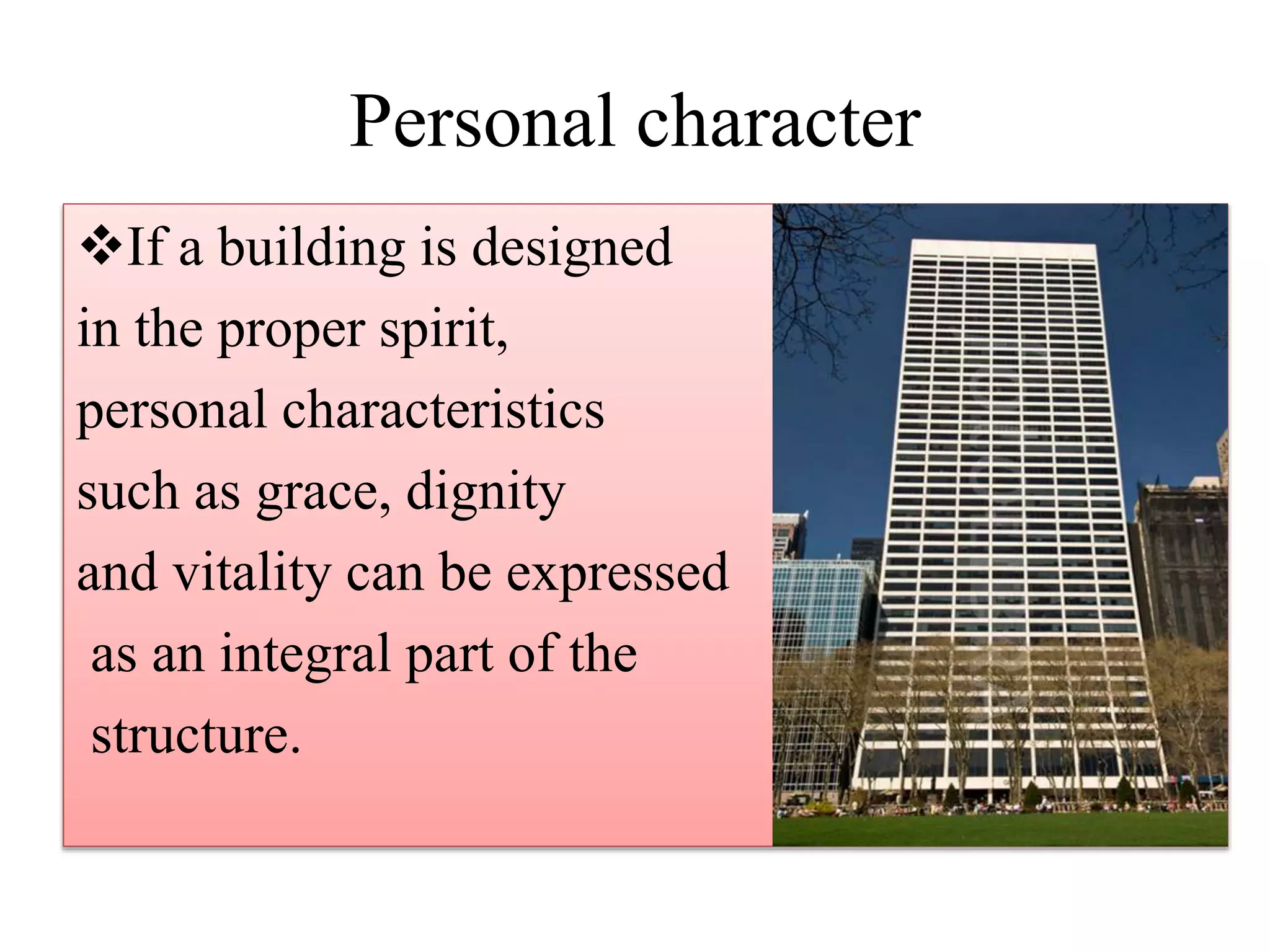
Personal character
If a building is designed
in the proper spirit,
personal characteristics
such as grace, dignity
and vitality can be expressed
as an integral part of the
structure.
Qualities of Architecture
1 Cohesion
2 Completeness
3 Elegance
4 Equivalence
5 Hierarchy
6 Modularity
7 Vision
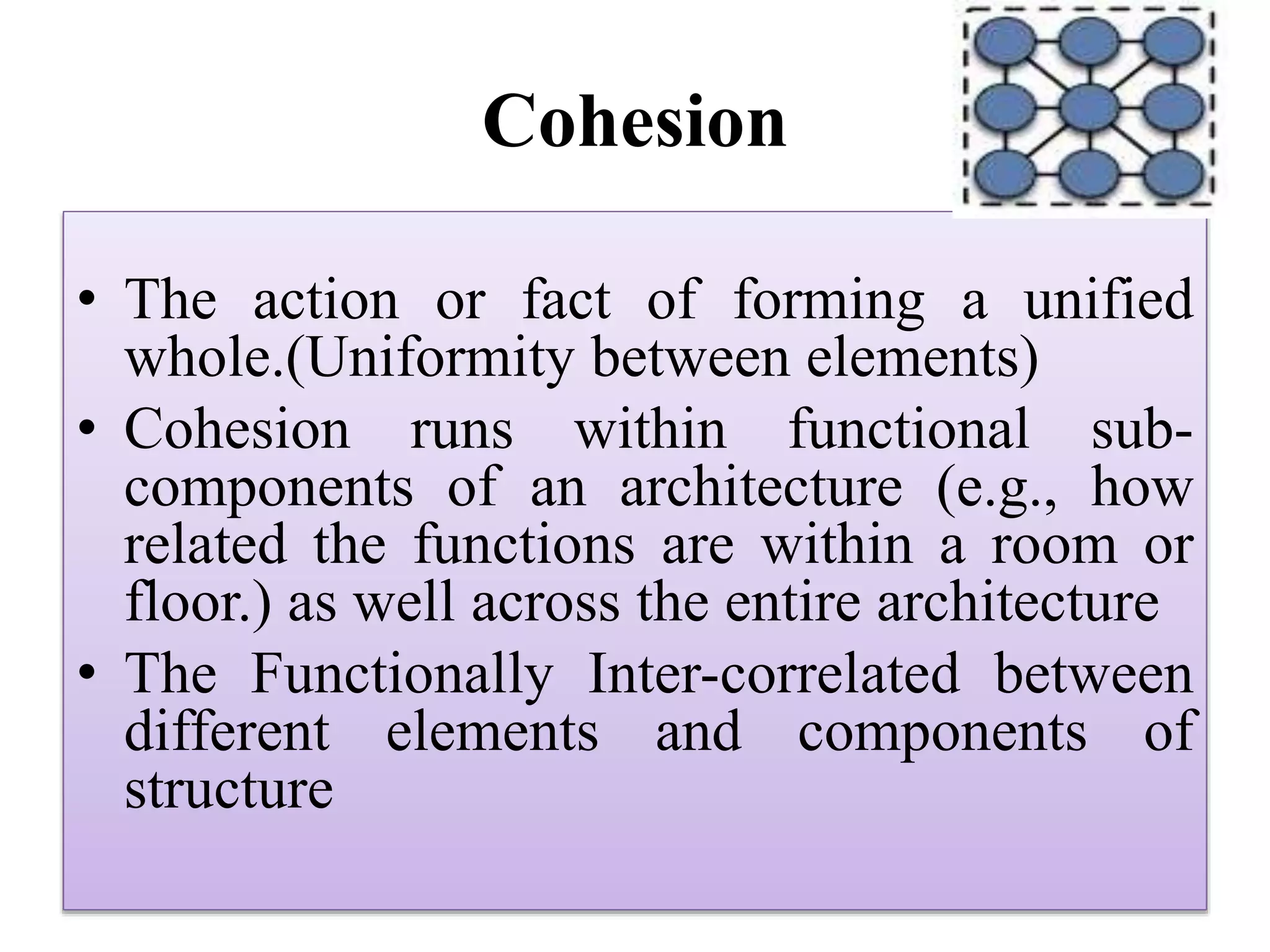
Cohesion
• The action or fact of forming a unified
whole.(Uniformity between elements)
• Cohesion runs within functional sub-
components of an architecture (e.g., how
related the functions are within a room or
floor.) as well across the entire architecture
• The Functionally Inter-correlated between
different elements and components of
structure
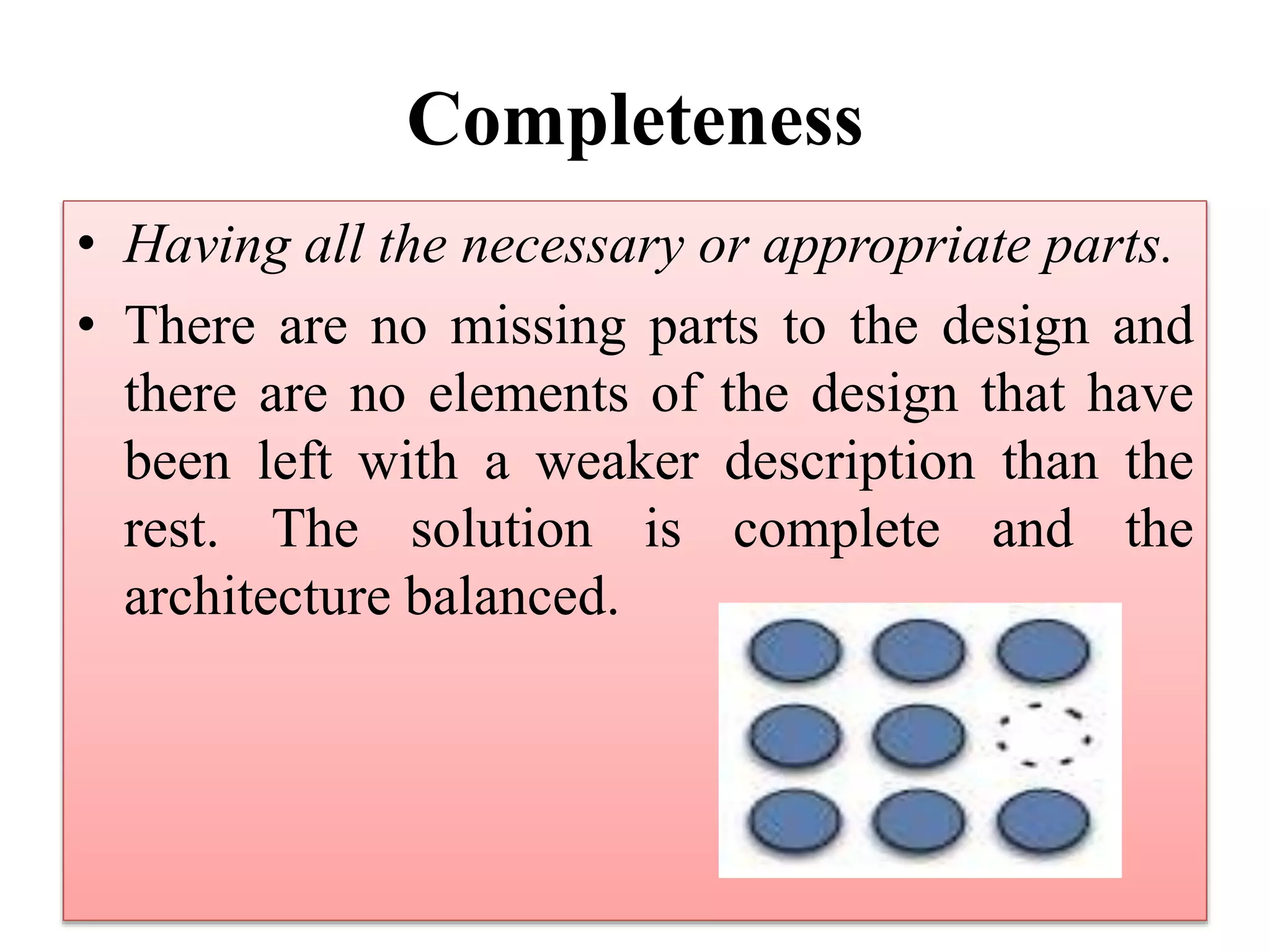
Completeness
• Having all the necessary or appropriate parts.
• There are no missing parts to the design and
there are no elements of the design that have
been left with a weaker description than the
rest. The solution is complete and the
architecture balanced.
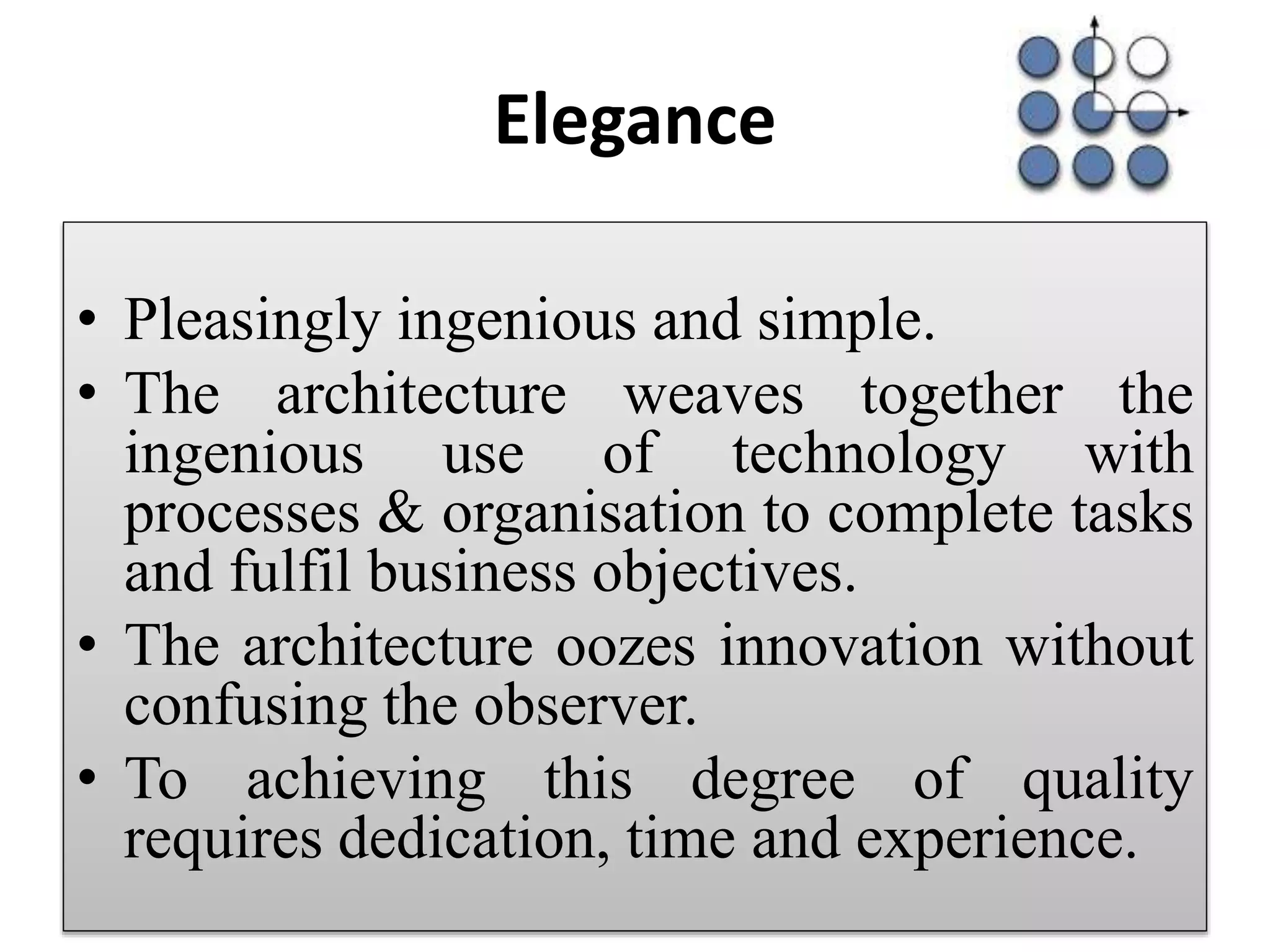
Elegance
• Pleasingly ingenious and simple.
• The architecture weaves together the
ingenious use of technology with
processes & organisation to complete tasks
and fulfil business objectives.
• The architecture oozes innovation without
confusing the observer.
• To achieving this degree of quality
requires dedication, time and experience.
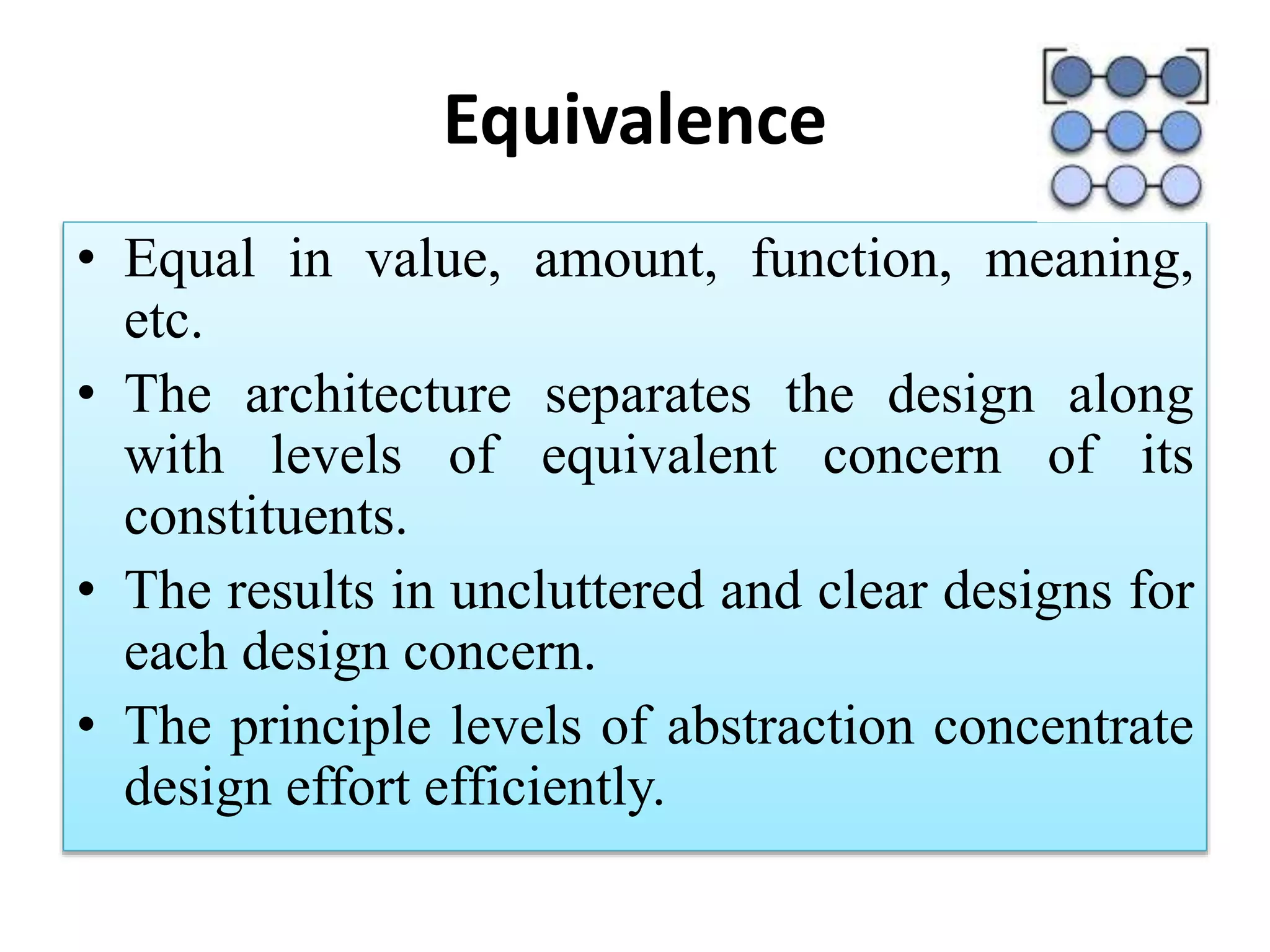
Equivalence
• Equal in value, amount, function, meaning,
etc.
• The architecture separates the design along
with levels of equivalent concern of its
constituents.
• The results in uncluttered and clear designs for
each design concern.
• The principle levels of abstraction concentrate
design effort efficiently.
Hierarchy
• An arrangement or classification of things
according to relative importance.
• The architecture demonstrates the inheritance
of properties from higher levels of abstraction
to lower levels of detail.
• This order of inheritance recognises patterns
to simplify complex problems, using
hierarchical relationships to avoid repetition
and confusion in detail.
Modularity
• Employing or involving a module or modules
as the basis of design or construction
(where module is each of a set of standardised
parts of independent units that can be used to
construct a more complex structure).
• Significances or ability of Modules/elements .
Vision
• A mental image of what the future will or could
be like.
• The architecture conveys an inspiring outline
of the future of the enterprise within the
bounds of the scope of the problem being
solved.
• Inspiration is born of creative innovation in
the solution, justification in the language &
context of the business.
Role of Architect
• Architecture has to do with planning and designing form,
space and ambience to reflect functional, technical, social,
environmental and aesthetic considerations.
• It requires the creative manipulation and coordination of
materials and technology, and of light and shadow. Often,
conflicting requirements must be resolved.
• The practice of architecture also encompasses the pragmatic
aspects of realizing buildings and structures, including
scheduling, cost estimation and construction administration.
• Documentation produced by architects, typically drawings,
plans and technical specifications, defines the structure and/or
behavior of a building or other kind of system that is to be or
has been constructed.
Principles  of  Architecture and qualities of architecture by Pravin Minde

Principles of Architecture and qualities of architecture by Pravin Minde

  • 1.
    Presentation on Principles ofArchitecture By : Prof . Pravin Minde B.E. (Civil), M.E. (C & M) LMISTE, LMIWWA, AMIE, MICE(I),
  • 2.
    Introduction ARCHITECTURE is “Thescience and art of constructing buildings, according to some proportions and rules determined by the character and destination of the buildings” ARCHITECTS: a person who plans, designs buildings and advises in their constructions.
  • 3.
    Role of variousagencies in planning of building 1. ARCHITECT 35% 2. QUNTITY SURVEYOR 23% 3. STRUCTURAL ENGINEER 18% 4. SERVICE ENGINEER 12% 5. MANAGEMENT CONSULTANT 4% 6. LANDSCAPE ARCHITECT 2% 7. SPECIALIST DESIGNER 2% 8. VARIOUS OTHER CONSULTANTS 4% (such as environmentalist, interior designer etc.)
  • 4.
    Principles of Architecture Goodness:- It means convenient arrangement of various rooms or grouping Beauty:- It means balances between Moral, Social, Aesthetic & Scientific aspects. Truth:- It means harmony with establishment laws.
  • 5.
  • 6.
    Function / Utility •Requirement of Client. • Requirement of Site. • Building Rules And Byelaws. • No. of Users. • Principles of Building Planning like Aspect, Prospect, Roominess, Circulation, Privacy etc. • Sketch plan & layout plan • Approval from Sanctioning authority • Lighting & Ventilation
  • 7.
    Form  Structures  Climate Materials  Method And Technique of Construction  Economy  Skill Labors  Earthquake Design
  • 8.
    Aesthetics • Nature • Environment •Unity • Contrast • Proportion • Scale • Expression • Character of Building • Interior Design • Color • Landscape
  • 9.
    Principles and Elementsof Architectural Composition 1. Focus 2. Unity 3. Balance 4. Rhythm 5. Harmony 6. Discord 7. Texture 8. Contrast 9. Monotony 10.Scale 11.Proportion 12.Colour 13.Character.
  • 10.
    1.Focus • It meansto Highlight Elements . • Eye movement is directed towards a center of interest that takes a position of prominence in the Elevation. • The elements in a design that attracts one’s eye – the focal point.
  • 11.
  • 12.
    2.Unity • Unity isachieved by the consistent use of lines, color, material, and/or texture within a design. It means Completeness and indicates harmony among the different building elements.
  • 13.
    3.Balance • Parts ofthe design are equally distributed to create a sense of stability. Both physical and visual balance exist. • Types •Symmetrical or formal balance •Asymmetrical or informal balance •Radial balance •Vertical balance •Horizontal balance
  • 14.
    Symmetrical or FormalBalance • The elements within the design are identical in relation to a centerline or axis. The Taj Mahal Agra, Uttar Pradesh, India
  • 15.
    Asymmetrical or InformalBalance • Parts of the design are not identical but are equal in visual weight. Chateau de Chaumont Saone-et-Loire, France
  • 16.
    Radial Balance • Designelements radiate outward from the center. Galleria Vittorio Emanuele II Milan, Italy Architect: Giuseppe Mengoni
  • 17.
    Vertical Balance • Thetop and bottom parts are equal.
  • 18.
    Horizontal Balance • Theparts on the left and right sides are equal • If a vertical line were drawn down the center of each design, the left and right would be mirror images.
  • 19.
    4.Rhythm • Repeated useof line, shape, color, texture or pattern • Types • Regular rhythm • Random rhythm • Gradated rhythm
  • 20.
    Regular Rhythm • Anelement is repeated at the same repetition/interval each time.
  • 21.
    Random Rhythm • Thebeats of the element are random or are at irregular intervals.
  • 22.
    Gradated Rhythm • Therepeated element is identical with the exception of one detail increasing or decreasing gradually with each repetition.
  • 23.
    5.Harmony / Movement •Flow or feeling of action. • When two or more Elements are similar nature produce harmony.
  • 24.
    6.Discord • It isa group of elements of entirely different nature so that they have an unpleasant effect. These can be disturbed to all elements of harmony
  • 25.
    7.Texture • The surfacelook or feel of something • Smooth Surface – Reflects more light and therefore is a more intense color. • Rough Surface – Absorbs more light and therefore appears darker.
  • 26.
  • 27.
    Rough Texture Park Guell– Barcelona, Spain Architect: Antonio Gaudí
  • 28.
    8.Contrast • Noticeably different Canbe created with • Color • Proportion and scale • Shape & Mass • Texture & Pattern • Lighting
  • 29.
    9.Monotony • Continuous repetitionof single elements or a number of elements producing an unpleasant effects is call as monotony
  • 30.
    10.Proportion • Comparative relationshipsbetween elements in a design with respect to size. • Proportion refers to the relative size and scale of the various elements in a design.
  • 31.
    11.scale • The scalein architectural composition means proper relation of different elements to one another and to whole. The scale is considered with respect to surroundings. • The sizes of doors, windows and staircase are different for residential building when compared to public building. • The proper scale is essential for better and qualitative results of proportion.
  • 32.
    12.Colour • Colour hasan immediate and profound effect on a design.
  • 33.
    Colour • Warm Colors –Reds, oranges, yellows • Cool Colors – Blues, purples, greens
  • 34.
  • 35.
    13.Character It refers tothe styles of the building. The character is related to functional aspect of the building and evolves from proper combination of unity, mass composition, proportion, scale etc. which constitutes the basic principles of Architectural composition. Types of character 1. Functional Character 2. Traditional Character 3. Personal Character
  • 36.
    Functional character That showthe purpose of the building or the reason for its erection. The external appearance plays an important role in determining the purpose and the function of the structure.
  • 38.
    Traditional character The characterof some buildings is expressed through elements associated with certain influences. Such influences often go thousands of years back in history and culture. Cultural aspects play an important role in determining the Associated Character of a particular structure.
  • 40.
    Personal character If abuilding is designed in the proper spirit, personal characteristics such as grace, dignity and vitality can be expressed as an integral part of the structure.
  • 41.
    Qualities of Architecture 1Cohesion 2 Completeness 3 Elegance 4 Equivalence 5 Hierarchy 6 Modularity 7 Vision
  • 42.
    Cohesion • The actionor fact of forming a unified whole.(Uniformity between elements) • Cohesion runs within functional sub- components of an architecture (e.g., how related the functions are within a room or floor.) as well across the entire architecture • The Functionally Inter-correlated between different elements and components of structure
  • 43.
    Completeness • Having allthe necessary or appropriate parts. • There are no missing parts to the design and there are no elements of the design that have been left with a weaker description than the rest. The solution is complete and the architecture balanced.
  • 44.
    Elegance • Pleasingly ingeniousand simple. • The architecture weaves together the ingenious use of technology with processes & organisation to complete tasks and fulfil business objectives. • The architecture oozes innovation without confusing the observer. • To achieving this degree of quality requires dedication, time and experience.
  • 45.
    Equivalence • Equal invalue, amount, function, meaning, etc. • The architecture separates the design along with levels of equivalent concern of its constituents. • The results in uncluttered and clear designs for each design concern. • The principle levels of abstraction concentrate design effort efficiently.
  • 46.
    Hierarchy • An arrangementor classification of things according to relative importance. • The architecture demonstrates the inheritance of properties from higher levels of abstraction to lower levels of detail. • This order of inheritance recognises patterns to simplify complex problems, using hierarchical relationships to avoid repetition and confusion in detail.
  • 47.
    Modularity • Employing orinvolving a module or modules as the basis of design or construction (where module is each of a set of standardised parts of independent units that can be used to construct a more complex structure). • Significances or ability of Modules/elements .
  • 48.
    Vision • A mentalimage of what the future will or could be like. • The architecture conveys an inspiring outline of the future of the enterprise within the bounds of the scope of the problem being solved. • Inspiration is born of creative innovation in the solution, justification in the language & context of the business.
  • 49.
    Role of Architect •Architecture has to do with planning and designing form, space and ambience to reflect functional, technical, social, environmental and aesthetic considerations. • It requires the creative manipulation and coordination of materials and technology, and of light and shadow. Often, conflicting requirements must be resolved. • The practice of architecture also encompasses the pragmatic aspects of realizing buildings and structures, including scheduling, cost estimation and construction administration. • Documentation produced by architects, typically drawings, plans and technical specifications, defines the structure and/or behavior of a building or other kind of system that is to be or has been constructed.