





Theories of the firm
Authors: Manukyan Ani, Melkonyan Anna, Kuzmich Valeria,
Petrosyan Felix
Group 5202
Table of Contents
 I. Introduction
 II. Theories of the firm
 1. The theory of transaction costs
 2. Agency theory
 3. Growth theory
 4. Knowledge-based theory of the firm
 III. Conclusion
 IV. Bibliography
 V. Q&A section
Introduction
Theories of the firm are ways of
conceptualising the firm. The answers
to the questions why firms exist and
what precisely a firm is are
fundamental for the understanding of
corporate governance.
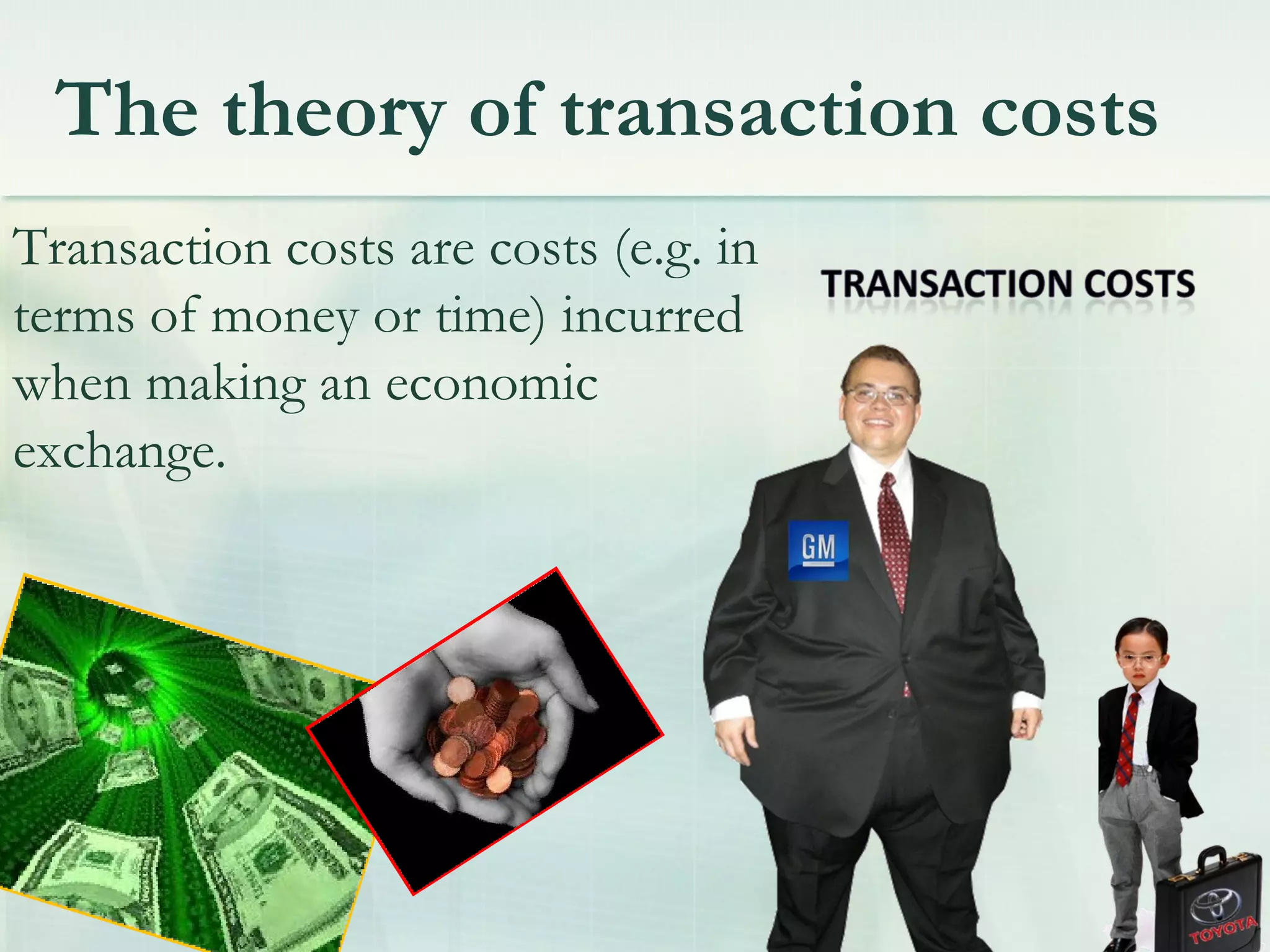
The theory of transaction costs
 Transaction costs are costs (e.g. in
terms of money or time) incurred
when making an economic
exchange.
 Transaction cost theory tries to explain why
companies exist, and why companies expand
 The transaction cost theory supposes that companies
try to minimize the costs of exchanging resources with
the environment, and that companies try to minimize
the bureaucratic costs of exchanges within the
company.
 Bureaucratic costs are the internal transaction costs
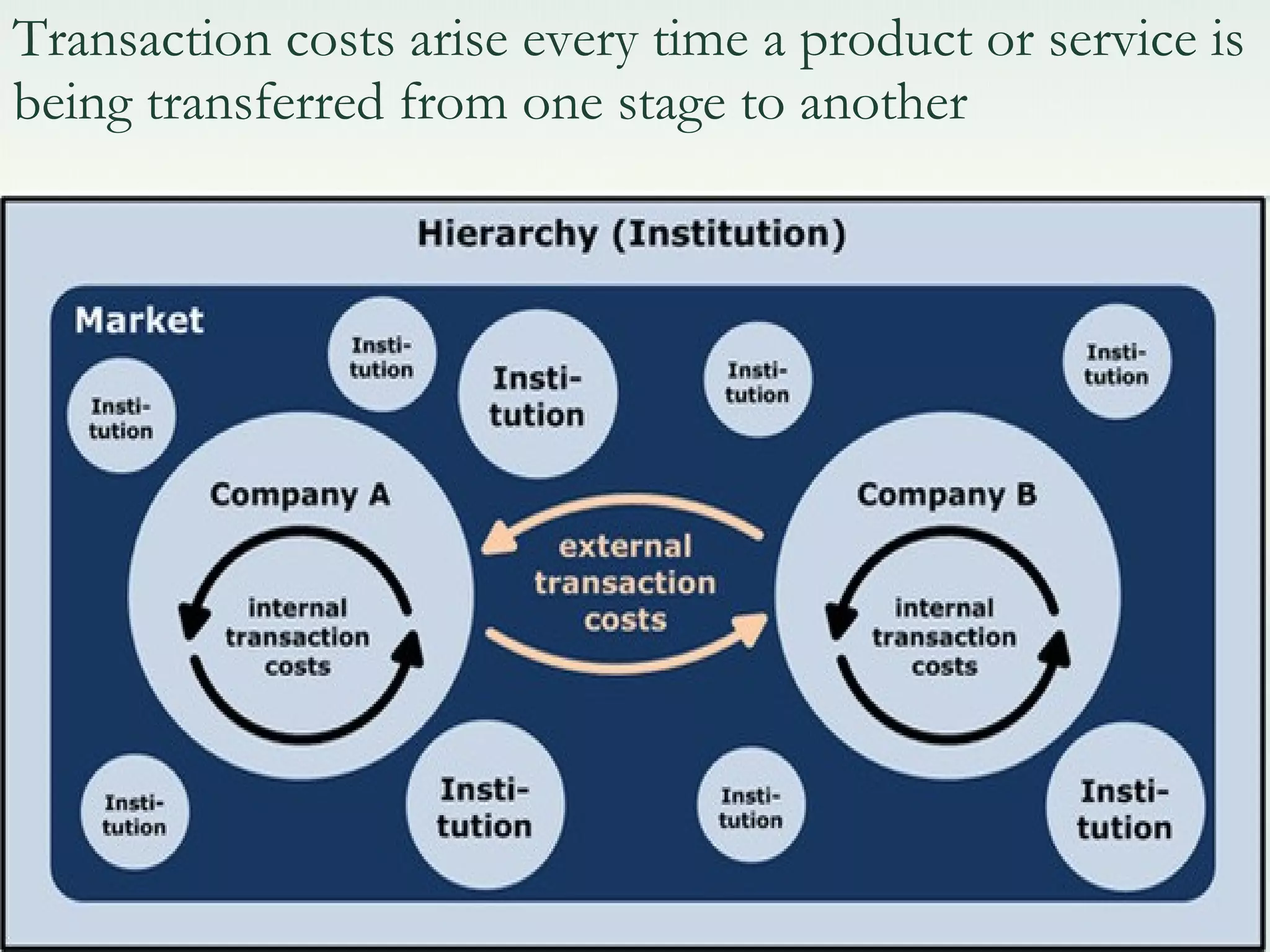
Transaction costs arise every time a product or service is
being transferred from one stage to another
Agency theory
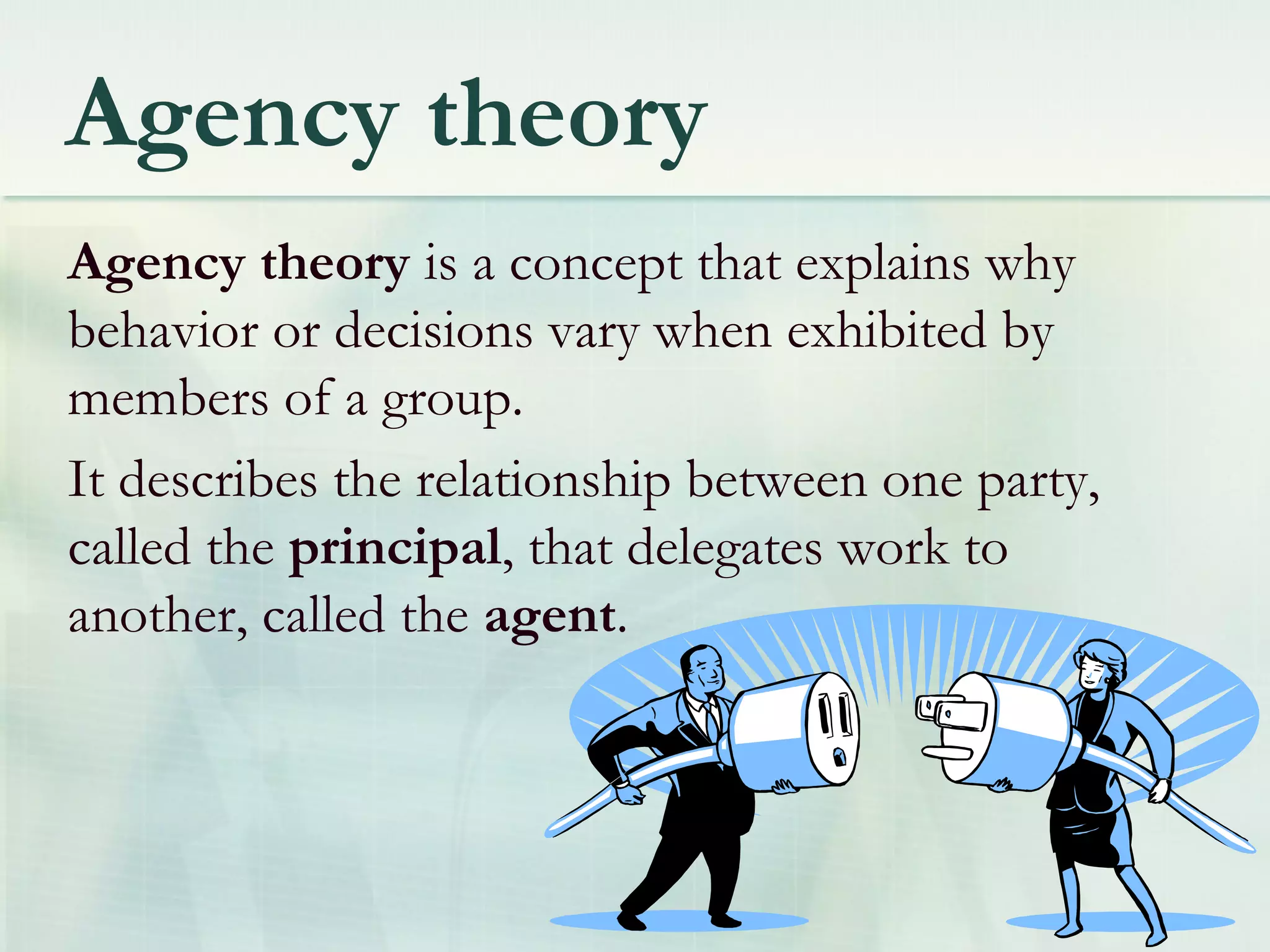
Agency theory is a concept that explains why
behavior or decisions vary when exhibited by
members of a group.
It describes the relationship between one party,
called the principal, that delegates work to
another, called the agent.
“Agency Loss”
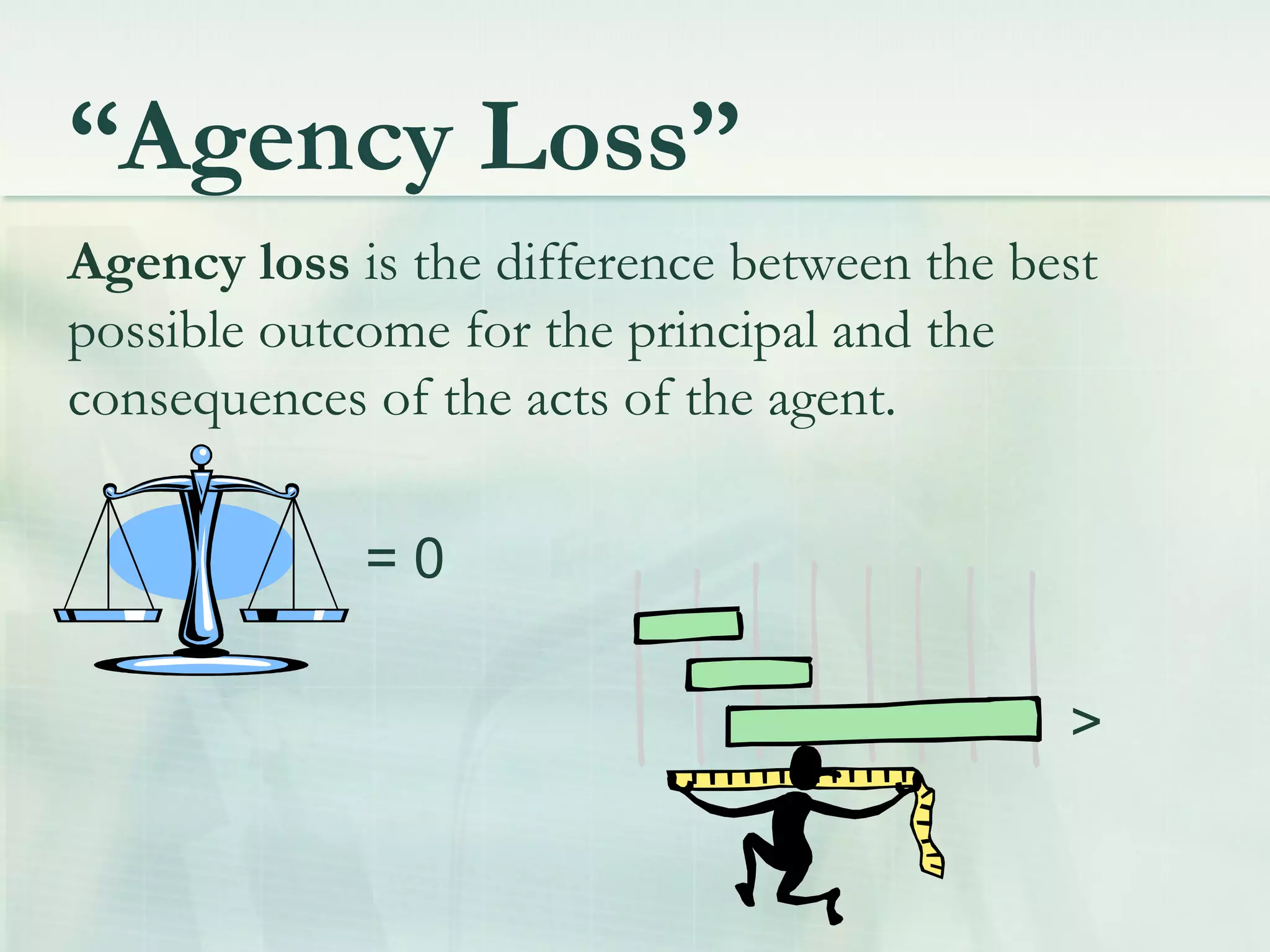
Agency loss is the difference between the best
possible outcome for the principal and the
consequences of the acts of the agent.  
                   = 0
                                                                >
The agency loss is minimized
when :
 the principal and the agent share
common interests
the principal is knowledgeable
about the consequences of the
agent’s activities
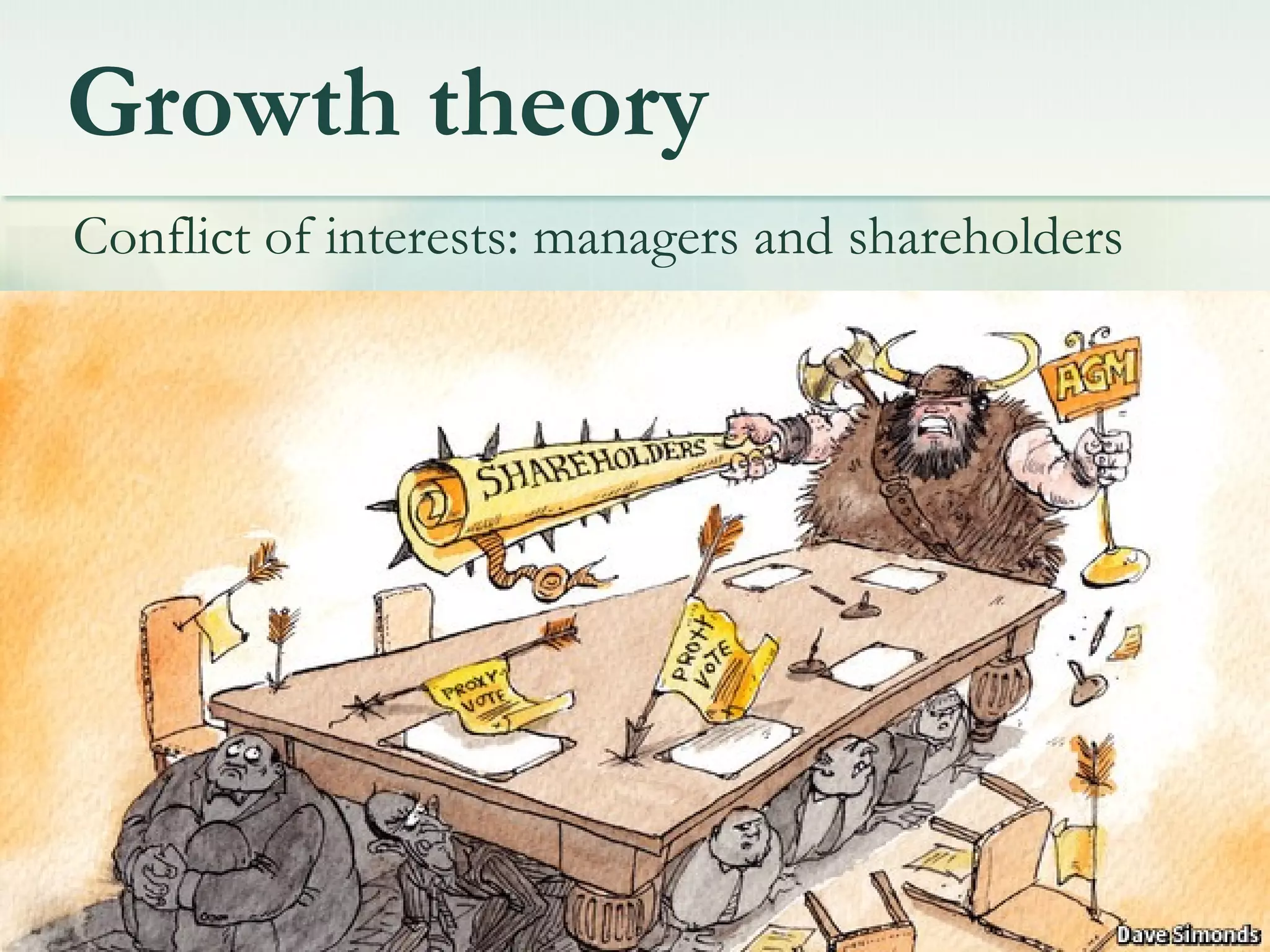
Growth theory
Conflict of interests: managers and shareholders
Growth by internal expansion
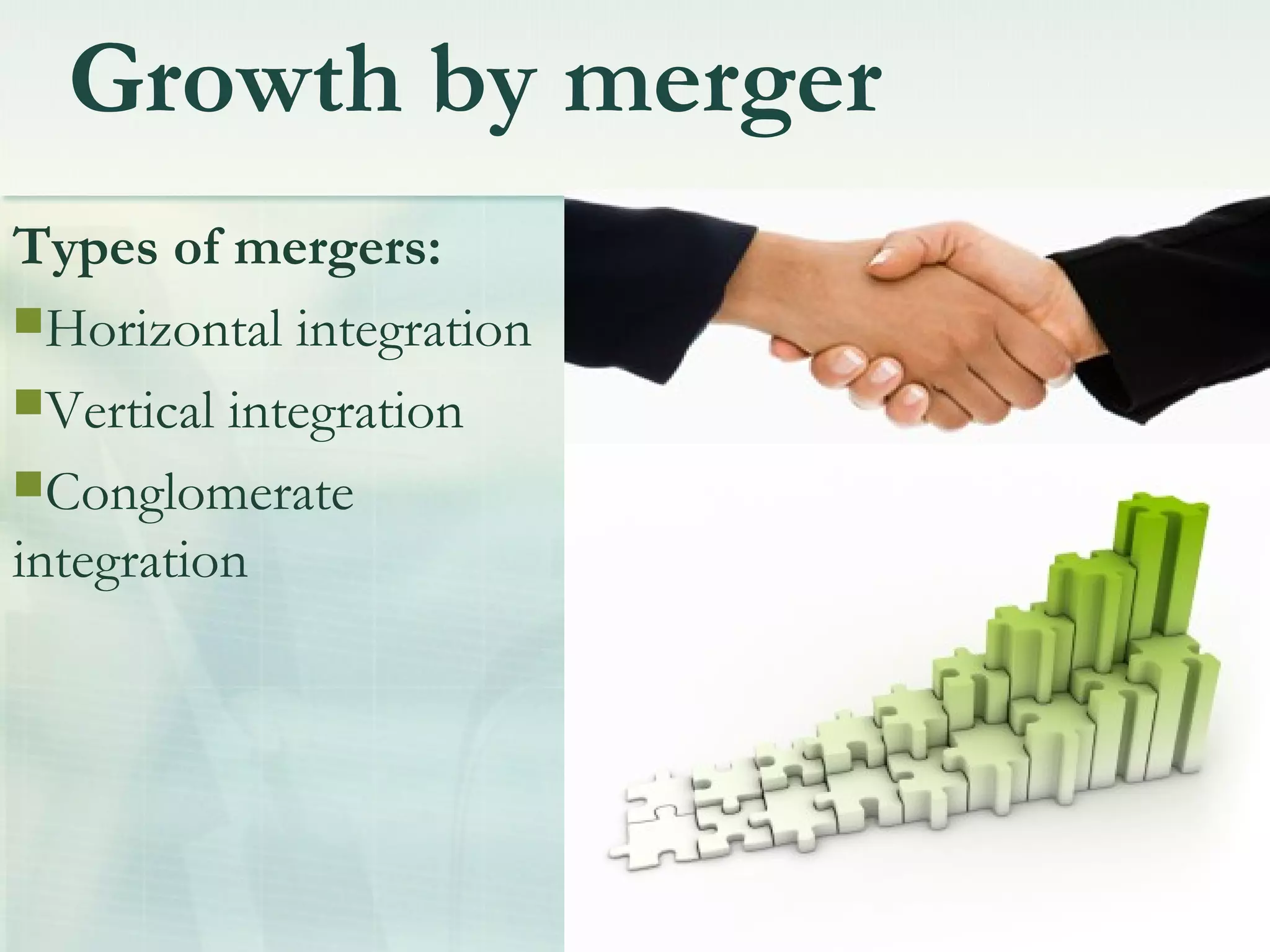
Growth by merger
Types of mergers:
Horizontal integration
Vertical integration
Conglomerate
integration
Knowledge-based theory
The knowledge-based theory of the firm considers
knowledge as the most strategically significant
resource of a firm.
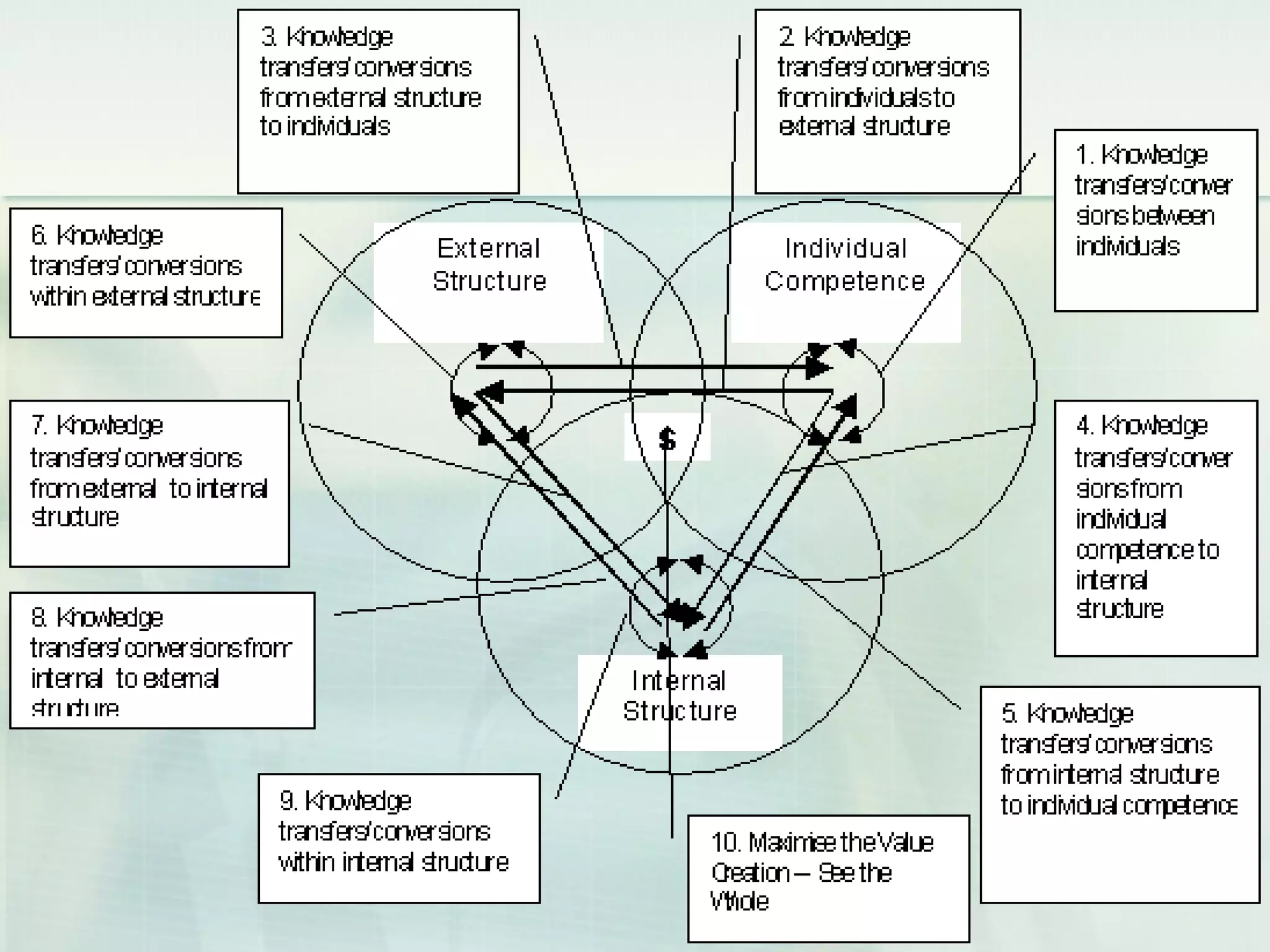
 1. Knowledge transfers/conversions between
individuals
Stand-up coffee bars or dialogue rooms" with a table
and chairs help employees relax while solving
problems or sharing knowledge
 2. Knowledge transfers/conversions from
individuals to external structure
Publishing information in different media spheres
 3. Knowledge transfers/conversions from
external structure to individuals
Organize customers' quality management teams in order
to gain a better understanding of, and even anticipate,
customer needs.
 4. Knowledge transfers/conversions from
individual competence into internal structure
AI systems as document handling systems, databases,
etc.
 5. Knowledge transfers/conversions from
internal structure to individual competence
Designed a demonstration factory to manufacture a new
product line.
 6. Knowledge transfers/conversions within the
external structure
Organize special meetings, excursions or seminars for
customer.
 7. Knowledge transfers/conversions from external
to internal structure
Use sales force to collect data about their customers.
 8. Knowledge transfers/conversions from internal
to external structure
Create database, which allows its clients to tap into the
data sources used also by its own consultants.
 9. Knowledge Transfers/conversions within
Internal Structure
IT system
 10. Maximize Value Creation - See the Whole
 The knowledge-based theory of
the firm considers a very
special resource that does not
depreciate, and can generate
increasing returns – knowledge.
 Organizational learning plays
an important role in the
sustainability of the
competitive advantage
considering the knowledge-
based theory of the firm.
 To share knowledge-based
theory, it is necessary to create
a strategy which concerns all
parts of your organization.
Conclusion
Bibliography
 "Agency Theory." Investopedia. N.p., n.d. Web. 12 Feb. 2014.
<http://www.investopedia.com/terms/a/agencytheory.asp>.
 "Appalachian State University." Boone, North Carolina. N.p., n.d. Web. 11 Feb. 2014.
<http://www.appstate.edu>.
 DeNisi, A., M. Hitt, and S. Jackson. The Knowledge-Based Approach to Sustainable
Competitive Advantage. In Jackson, Hitt and DeNisi (Eds.) Managing Knowledge for
Sustained Competitive Advantage. San Francisco : Jossey-Bass, 2003. Print.
 Garvin, D. A.. Building a learning organization. Harvard Business Review on
Knowledge Management. Boston: MA: Harvard Business School Publishing, 1998.
Print.
 "Resource Dependency Theory." Resource Dependency Theory. N.p., n.d. Web. 12
Feb. 2014. <http://www.istheory.yorku.ca/resourcedependencytheory.htm>.
 "shane3-AGENCY THEORY FRAMEWORK." shane3-AGENCY THEORY
FRAMEWORK. N.p., n.d. Web. 12 Feb. 2014.
<http://fusionmx.babson.edu/entrep/fer/papers96/shane/shane3.htm>.
 Громыко В.В. Микроэкономика – 1:учебное пособие. –М.: МАКС Пресс, 2005.-
236с. (на англ. яз.)
Let’s play a game!
 The theory tries to explain why companies exist,
and why companies expand
 According to this theory, costs arise every time a
product or service is being transferred from one
stage to another
 This theory supposes that companies try to
minimize the costs of exchanging resources with
the environment
The theory
of transaction
costs
 The theory describes the relationship between
one party – principal and another- the agent
 According to this theory, the standard of
“Agency Loss” uses to estimate the actions
among 2 parties
 This theory shows 2 principles for loss
minimization
Agency
theory
 The theory tries to resolve a conflict of interests
 This theory has an internal and an external
aspect
 The theory has grown to a whole new subject
Growth
theory
 This theory is based on resource, which is
difficult to imitate.
 A lot of companies use this theory inappropriate
way.
 This theory appeared as a part of another
theory.
Knowledge-based
theory
of the firm
Thank you for your attention!

Theories of the firm 2

  • 1.
    Theories of thefirm Authors: Manukyan Ani, Melkonyan Anna, Kuzmich Valeria, Petrosyan Felix Group 5202
  • 2.
    Table of Contents I. Introduction  II. Theories of the firm  1. The theory of transaction costs  2. Agency theory  3. Growth theory  4. Knowledge-based theory of the firm  III. Conclusion  IV. Bibliography  V. Q&A section
  • 3.
    Introduction Theories of thefirm are ways of conceptualising the firm. The answers to the questions why firms exist and what precisely a firm is are fundamental for the understanding of corporate governance.
  • 4.
    The theory oftransaction costs  Transaction costs are costs (e.g. in terms of money or time) incurred when making an economic exchange.
  • 5.
     Transaction costtheory tries to explain why companies exist, and why companies expand  The transaction cost theory supposes that companies try to minimize the costs of exchanging resources with the environment, and that companies try to minimize the bureaucratic costs of exchanges within the company.  Bureaucratic costs are the internal transaction costs
  • 6.
    Transaction costs ariseevery time a product or service is being transferred from one stage to another
  • 7.
    Agency theory Agency theory is aconcept that explains why behavior or decisions vary when exhibited by members of a group. It describes the relationship between one party, called the principal, that delegates work to another, called the agent.
  • 9.
    “Agency Loss” Agency lossis the difference between the best possible outcome for the principal and the consequences of the acts of the agent.                      = 0                                                                 >
  • 10.
    The agency lossis minimized when :  the principal and the agent share common interests the principal is knowledgeable about the consequences of the agent’s activities
  • 11.
    Growth theory Conflict ofinterests: managers and shareholders
  • 12.
  • 13.
    Growth by merger Typesof mergers: Horizontal integration Vertical integration Conglomerate integration
  • 14.
    Knowledge-based theory The knowledge-basedtheory of the firm considers knowledge as the most strategically significant resource of a firm.
  • 16.
     1. Knowledgetransfers/conversions between individuals Stand-up coffee bars or dialogue rooms" with a table and chairs help employees relax while solving problems or sharing knowledge  2. Knowledge transfers/conversions from individuals to external structure Publishing information in different media spheres
  • 17.
     3. Knowledgetransfers/conversions from external structure to individuals Organize customers' quality management teams in order to gain a better understanding of, and even anticipate, customer needs.  4. Knowledge transfers/conversions from individual competence into internal structure AI systems as document handling systems, databases, etc.
  • 18.
     5. Knowledgetransfers/conversions from internal structure to individual competence Designed a demonstration factory to manufacture a new product line.  6. Knowledge transfers/conversions within the external structure Organize special meetings, excursions or seminars for customer.
  • 19.
     7. Knowledgetransfers/conversions from external to internal structure Use sales force to collect data about their customers.  8. Knowledge transfers/conversions from internal to external structure Create database, which allows its clients to tap into the data sources used also by its own consultants.
  • 20.
     9. KnowledgeTransfers/conversions within Internal Structure IT system  10. Maximize Value Creation - See the Whole
  • 21.
     The knowledge-basedtheory of the firm considers a very special resource that does not depreciate, and can generate increasing returns – knowledge.  Organizational learning plays an important role in the sustainability of the competitive advantage considering the knowledge- based theory of the firm.  To share knowledge-based theory, it is necessary to create a strategy which concerns all parts of your organization.
  • 22.
  • 23.
    Bibliography  "Agency Theory."Investopedia. N.p., n.d. Web. 12 Feb. 2014. <http://www.investopedia.com/terms/a/agencytheory.asp>.  "Appalachian State University." Boone, North Carolina. N.p., n.d. Web. 11 Feb. 2014. <http://www.appstate.edu>.  DeNisi, A., M. Hitt, and S. Jackson. The Knowledge-Based Approach to Sustainable Competitive Advantage. In Jackson, Hitt and DeNisi (Eds.) Managing Knowledge for Sustained Competitive Advantage. San Francisco : Jossey-Bass, 2003. Print.  Garvin, D. A.. Building a learning organization. Harvard Business Review on Knowledge Management. Boston: MA: Harvard Business School Publishing, 1998. Print.  "Resource Dependency Theory." Resource Dependency Theory. N.p., n.d. Web. 12 Feb. 2014. <http://www.istheory.yorku.ca/resourcedependencytheory.htm>.  "shane3-AGENCY THEORY FRAMEWORK." shane3-AGENCY THEORY FRAMEWORK. N.p., n.d. Web. 12 Feb. 2014. <http://fusionmx.babson.edu/entrep/fer/papers96/shane/shane3.htm>.  Громыко В.В. Микроэкономика – 1:учебное пособие. –М.: МАКС Пресс, 2005.- 236с. (на англ. яз.)
  • 24.
  • 25.
     The theorytries to explain why companies exist, and why companies expand  According to this theory, costs arise every time a product or service is being transferred from one stage to another  This theory supposes that companies try to minimize the costs of exchanging resources with the environment
  • 26.
  • 27.
     The theorydescribes the relationship between one party – principal and another- the agent  According to this theory, the standard of “Agency Loss” uses to estimate the actions among 2 parties  This theory shows 2 principles for loss minimization
  • 28.
  • 29.
     The theorytries to resolve a conflict of interests  This theory has an internal and an external aspect  The theory has grown to a whole new subject
  • 30.
  • 31.
     This theoryis based on resource, which is difficult to imitate.  A lot of companies use this theory inappropriate way.  This theory appeared as a part of another theory.
  • 32.
  • 33.
    Thank you foryour attention!