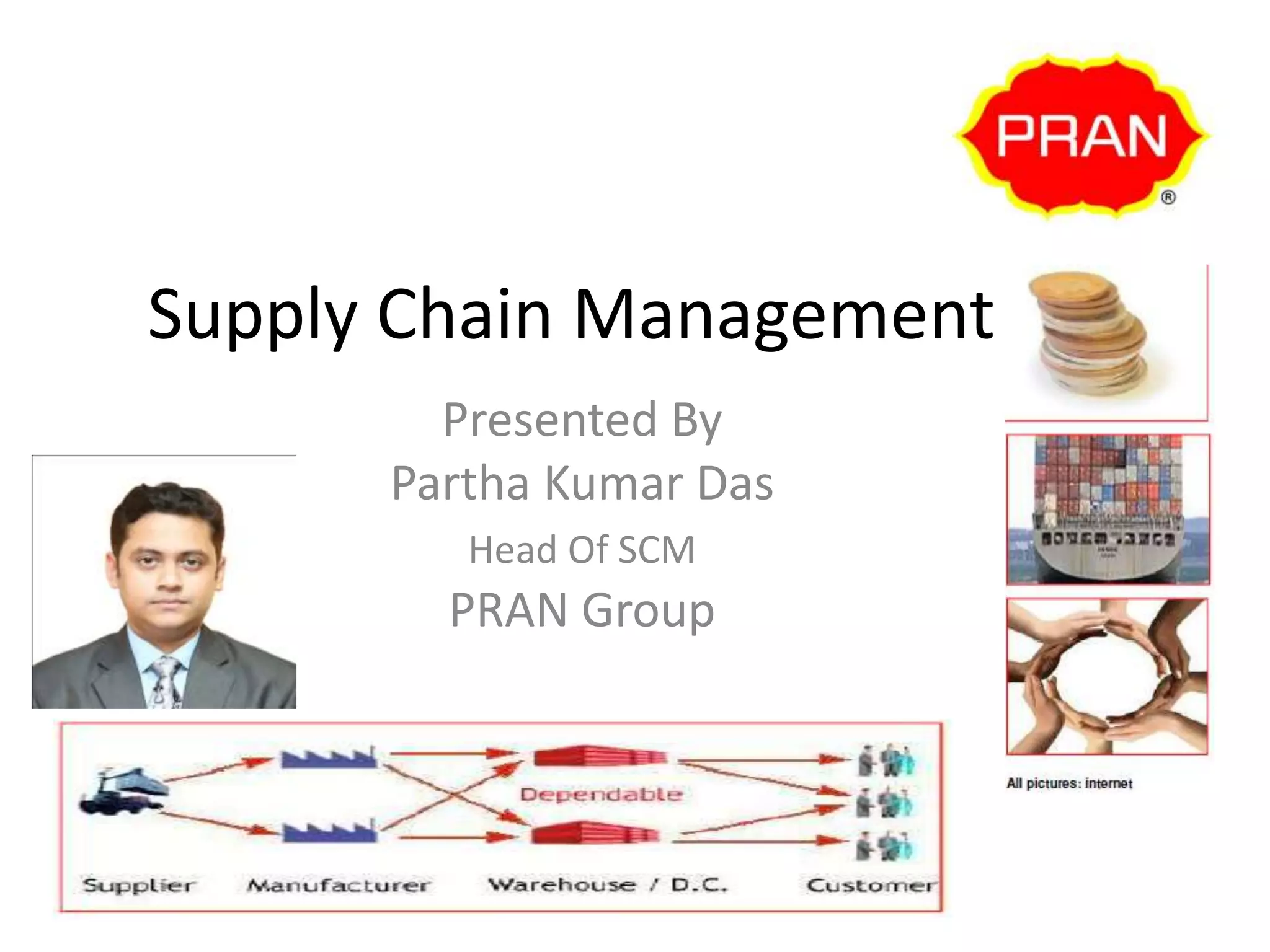
Supply Chain Management
Presented By
Partha Kumar Das
Head Of SCM
PRAN Group
Topics
• Key Concept
• SCM in Different Private sector
• Why Supply Chain Management
• Profit leverage by SCM
• 3 Cases
• Gartner Supply Chain Top 25 for 2016
• Career in Supply Chain Management
• Supportive Courses on Supply Chain
Key Concept
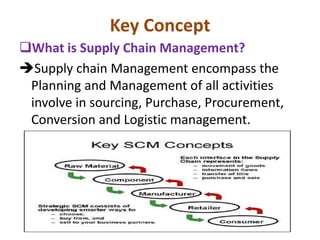
What is Supply Chain Management?
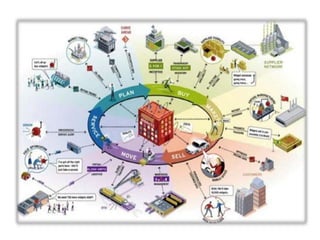
Supply chain Management encompass the
Planning and Management of all activities
involve in sourcing, Purchase, Procurement,
Conversion and Logistic management.
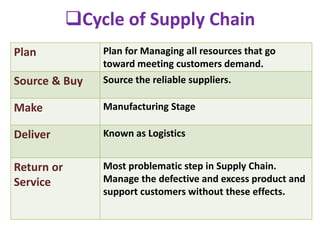
Cycle of Supply Chain
Plan Plan for Managing all resources that go
toward meeting customers demand.
Source & Buy Source the reliable suppliers.
Make Manufacturing Stage
Deliver Known as Logistics
Return or
Service
Most problematic step in Supply Chain.
Manage the defective and excess product and
support customers without these effects.
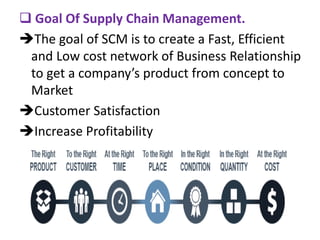
 Goal Of Supply Chain Management.
The goal of SCM is to create a Fast, Efficient
and Low cost network of Business Relationship
to get a company’s product from concept to
Market
Customer Satisfaction
Increase Profitability
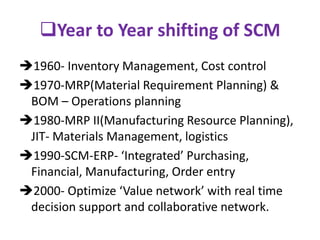
Year to Year shifting of SCM
1960- Inventory Management, Cost control
1970-MRP(Material Requirement Planning) &
BOM – Operations planning
1980-MRP II(Manufacturing Resource Planning),
JIT- Materials Management, logistics
1990-SCM-ERP- ‘Integrated’ Purchasing,
Financial, Manufacturing, Order entry
2000- Optimize ‘Value network’ with real time
decision support and collaborative network.
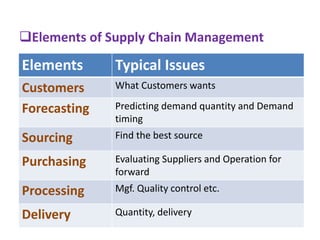
Elements of Supply Chain Management
Elements Typical Issues
Customers What Customers wants
Forecasting Predicting demand quantity and Demand
timing
Sourcing Find the best source
Purchasing Evaluating Suppliers and Operation for
forward
Processing Mgf. Quality control etc.
Delivery Quantity, delivery
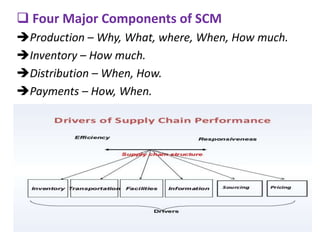
 Four Major Components of SCM
Production – Why, What, where, When, How much.
Inventory – How much.
Distribution – When, How.
Payments – How, When.
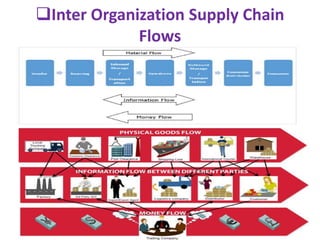
Inter Organization Supply Chain
Flows
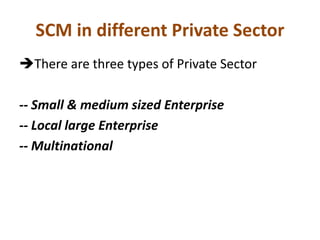
SCM in different Private Sector
There are three types of Private Sector
-- Small & medium sized Enterprise
-- Local large Enterprise
-- Multinational
SCM in SME
Operating by Traditional Way
 Single Decision Maker
 In most of the cases owner is the key
decision maker
No separate department
Operating by Accounts, Finance, Productions
or Stores
SCM in Local Large enterprise
Operating by Organize way.
 Operation starts from Plan and End to
Purchase and Procurement.
Decision maker Managerial hierarchy.
 In Most of the cases using Established
Software like ERP( Enterprise resource
planning), SAP(Systems, Applications,
Products)
SCM In Multinationals
Well Organized
Practice of Global SCM Process.
Research on new terms of SCM.
Use updated process flow.
Limited flexibility.
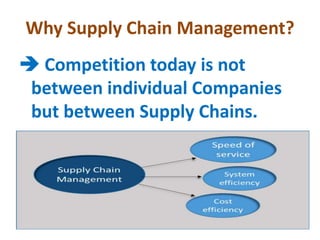
Why Supply Chain Management?
 Competition today is not
between individual Companies
but between Supply Chains.
Ensure Quality
Key objective of P&S is to ensure the quality
product to the customer/Consumer
considering the below points………..
o Functionality
o Flexibility and Adaptability
o Durability
o Uniqueness
In time Service
Efficient SCM speed up the delivery process
and service to ensure the uninterrupted chain
between the customer/Consumer demand vs.
delivery.
-- Forecasting
-- Demand Vs Efficient Order Plan
-- Delivery Plan
-- Logistics Plan
System Efficiency
 Supply Chain can highly utilize the capitals by
optimizing the inventory and other correlated
systems.
-- Reducing the lead time
-- Reducing the high inventory
-- Reducing Holding Cost
-- Develop the storage system
-- Offering the fresh products to consumer
-- S & OP Planning
-- Risk Management
-- Vendor Management
Cost control
Supply Chain plays the key rule to minimize the
cost and maximize the profit for any
organization.
-- Reducing the TCO
-- Reducing the Operational cost
-- Outsourcing
-- Cut the Non Value process cost
-- Negotiation
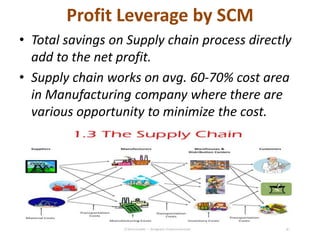
Profit Leverage by SCM
• Total savings on Supply chain process directly
add to the net profit.
• Supply chain works on avg. 60-70% cost area
in Manufacturing company where there are
various opportunity to minimize the cost.
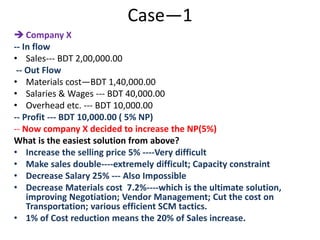
Case—1
 Company X
-- In flow
• Sales--- BDT 2,00,000.00
-- Out Flow
• Materials cost—BDT 1,40,000.00
• Salaries & Wages --- BDT 40,000.00
• Overhead etc. --- BDT 10,000.00
-- Profit --- BDT 10,000.00 ( 5% NP)
-- Now company X decided to increase the NP(5%)
What is the easiest solution from above?
• Increase the selling price 5% ----Very difficult
• Make sales double----extremely difficult; Capacity constraint
• Decrease Salary 25% --- Also Impossible
• Decrease Materials cost 7.2%----which is the ultimate solution,
improving Negotiation; Vendor Management; Cut the cost on
Transportation; various efficient SCM tactics.
• 1% of Cost reduction means the 20% of Sales increase.
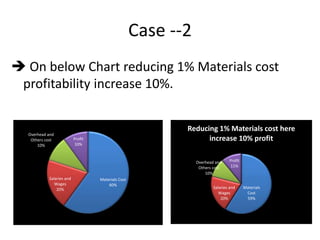
Case --2
 On below Chart reducing 1% Materials cost
profitability increase 10%.
Materials Cost
60%
Salaries and
Wages
20%
Overhead and
Others cost
10%
Profit
10%
Materials
Cost
59%
Salaries and
Wages
20%
Overhead and
Others cost
10%
Profit
11%
Reducing 1% Materials cost here
increase 10% profit
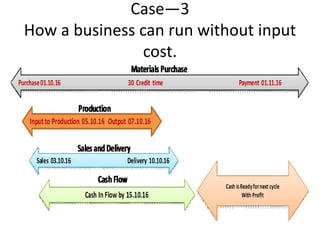
Case—3
How a business can run without input
cost.
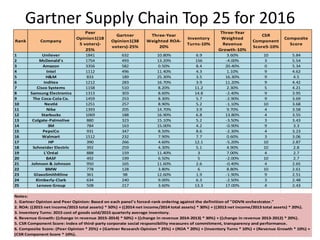
Gartner Supply Chain Top 25 for 2016
Rank Company
Peer
Opinion1(18
5 voters)-
25%
Gartner
Opinion1(38
voters)-25%
Three-Year
Weighted ROA-
20%
Inventory
Turns-10%
Three-Year
Weighted
Revenue
Growth-10%
CSR
Component
Score5-10%
Composite
Score
1 Unilever 1841 632 10.80% 6.9 3.60% 10 5.84
2 McDonald's 1754 493 13.20% 156 -4.00% 3 5.54
3 Amazon 3356 582 0.50% 8.4 20.40% 0 5.34
4 Intel 1112 496 11.40% 4.3 1.10% 9 4.62
5 H&M 833 189 25.30% 3.5 16.30% 9 4.5
6 Inditex 1212 283 16.70% 3.9 11.20% 9 4.42
7 Cisco Systems 1158 510 8.20% 11.2 2.30% 5 4.21
8 Samsung Electronics 1313 303 8.60% 14.8 -2.40% 9 3.95
9 The Coca-Cola Co. 1459 253 8.30% 5.7 -2.90% 9 3.69
10 Nestlé 1251 257 8.90% 5.2 -1.10% 10 3.68
11 Nike 1393 205 14.70% 3.9 9.70% 4 3.58
12 Starbucks 1069 188 16.90% 6.8 13.80% 4 3.55
13 Colgate-Palmolive 880 323 15.10% 5.2 -3.50% 3 3.43
14 3M 784 163 15.00% 4.2 -0.90% 9 3.3
15 PepsiCo 931 347 8.50% 8.6 -2.30% 4 3.23
16 Walmart 1512 232 7.90% 7.7 0.60% 3 3.06
17 HP 390 266 4.60% 12.1 -5.20% 10 2.87
18 Schneider Electric 392 259 4.30% 5.1 4.90% 10 2.8
19 L'Oréal 888 159 11.40% 3 7.00% 4 2.7
20 BASF 492 199 6.50% 5 -2.00% 10 2.7
21 Johnson & Johnson 950 165 11.60% 2.6 -0.40% 4 2.65
22 BMW 778 128 3.80% 6 8.80% 10 2.61
23 GlaxoSmithKline 361 98 12.60% 1.9 -1.90% 9 2.51
24 Kimberly-Clark 634 240 9.00% 6.3 -2.50% 3 2.48
25 Lenovo Group 508 217 3.60% 13.3 17.00% 4 2.43
Notes:
1. Gartner Opinion and Peer Opinion: Based on each panel's forced-rank ordering against the definition of "DDVN orchestrator."
2. ROA: ((2015 net income/2015 total assets) * 50%) + ((2014 net income/2014 total assets) * 30%) + ((2013 net income/2013 total assets) * 20%).
3. Inventory Turns: 2015 cost of goods sold/2015 quarterly average inventory.
4. Revenue Growth: ((change in revenue 2015-2014) * 50%) + ((change in revenue 2014-2013) * 30%) + ((change in revenue 2013-2012) * 20%).
5. CSR Component Score: Index of third-party corporate social responsibility measures of commitment, transparency and performance.
6. Composite Score: (Peer Opinion * 25%) + (Gartner Research Opinion * 25%) + (ROA * 20%) + (Inventory Turns * 10%) + (Revenue Growth * 10%) +
(CSR Component Score * 10%).
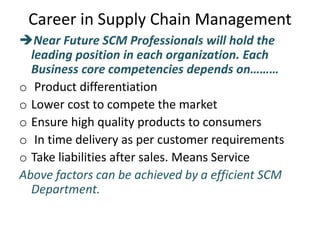
Career in Supply Chain Management
Near Future SCM Professionals will hold the
leading position in each organization. Each
Business core competencies depends on………
o Product differentiation
o Lower cost to compete the market
o Ensure high quality products to consumers
o In time delivery as per customer requirements
o Take liabilities after sales. Means Service
Above factors can be achieved by a efficient SCM
Department.
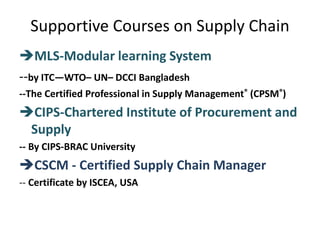
Supportive Courses on Supply Chain
MLS-Modular learning System
--by ITC—WTO– UN– DCCI Bangladesh
--The Certified Professional in Supply Management® (CPSM®)
CIPS-Chartered Institute of Procurement and
Supply
-- By CIPS-BRAC University
CSCM - Certified Supply Chain Manager
-- Certificate by ISCEA, USA
Thanks

Supply Chain Basic

  • 1.
    Supply Chain Management PresentedBy Partha Kumar Das Head Of SCM PRAN Group
  • 2.
    Topics • Key Concept •SCM in Different Private sector • Why Supply Chain Management • Profit leverage by SCM • 3 Cases • Gartner Supply Chain Top 25 for 2016 • Career in Supply Chain Management • Supportive Courses on Supply Chain
  • 3.
    Key Concept What isSupply Chain Management? Supply chain Management encompass the Planning and Management of all activities involve in sourcing, Purchase, Procurement, Conversion and Logistic management.
  • 5.
    Cycle of SupplyChain Plan Plan for Managing all resources that go toward meeting customers demand. Source & Buy Source the reliable suppliers. Make Manufacturing Stage Deliver Known as Logistics Return or Service Most problematic step in Supply Chain. Manage the defective and excess product and support customers without these effects.
  • 6.
     Goal OfSupply Chain Management. The goal of SCM is to create a Fast, Efficient and Low cost network of Business Relationship to get a company’s product from concept to Market Customer Satisfaction Increase Profitability
  • 7.
    Year to Yearshifting of SCM 1960- Inventory Management, Cost control 1970-MRP(Material Requirement Planning) & BOM – Operations planning 1980-MRP II(Manufacturing Resource Planning), JIT- Materials Management, logistics 1990-SCM-ERP- ‘Integrated’ Purchasing, Financial, Manufacturing, Order entry 2000- Optimize ‘Value network’ with real time decision support and collaborative network.
  • 8.
    Elements of SupplyChain Management Elements Typical Issues Customers What Customers wants Forecasting Predicting demand quantity and Demand timing Sourcing Find the best source Purchasing Evaluating Suppliers and Operation for forward Processing Mgf. Quality control etc. Delivery Quantity, delivery
  • 9.
     Four MajorComponents of SCM Production – Why, What, where, When, How much. Inventory – How much. Distribution – When, How. Payments – How, When.
  • 10.
  • 11.
    SCM in differentPrivate Sector There are three types of Private Sector -- Small & medium sized Enterprise -- Local large Enterprise -- Multinational
  • 12.
    SCM in SME Operatingby Traditional Way  Single Decision Maker  In most of the cases owner is the key decision maker No separate department Operating by Accounts, Finance, Productions or Stores
  • 13.
    SCM in LocalLarge enterprise Operating by Organize way.  Operation starts from Plan and End to Purchase and Procurement. Decision maker Managerial hierarchy.  In Most of the cases using Established Software like ERP( Enterprise resource planning), SAP(Systems, Applications, Products)
  • 14.
    SCM In Multinationals WellOrganized Practice of Global SCM Process. Research on new terms of SCM. Use updated process flow. Limited flexibility.
  • 15.
    Why Supply ChainManagement?  Competition today is not between individual Companies but between Supply Chains.
  • 16.
    Ensure Quality Key objectiveof P&S is to ensure the quality product to the customer/Consumer considering the below points……….. o Functionality o Flexibility and Adaptability o Durability o Uniqueness
  • 17.
    In time Service EfficientSCM speed up the delivery process and service to ensure the uninterrupted chain between the customer/Consumer demand vs. delivery. -- Forecasting -- Demand Vs Efficient Order Plan -- Delivery Plan -- Logistics Plan
  • 18.
    System Efficiency  SupplyChain can highly utilize the capitals by optimizing the inventory and other correlated systems. -- Reducing the lead time -- Reducing the high inventory -- Reducing Holding Cost -- Develop the storage system -- Offering the fresh products to consumer -- S & OP Planning -- Risk Management -- Vendor Management
  • 20.
    Cost control Supply Chainplays the key rule to minimize the cost and maximize the profit for any organization. -- Reducing the TCO -- Reducing the Operational cost -- Outsourcing -- Cut the Non Value process cost -- Negotiation
  • 21.
    Profit Leverage bySCM • Total savings on Supply chain process directly add to the net profit. • Supply chain works on avg. 60-70% cost area in Manufacturing company where there are various opportunity to minimize the cost.
  • 22.
    Case—1  Company X --In flow • Sales--- BDT 2,00,000.00 -- Out Flow • Materials cost—BDT 1,40,000.00 • Salaries & Wages --- BDT 40,000.00 • Overhead etc. --- BDT 10,000.00 -- Profit --- BDT 10,000.00 ( 5% NP) -- Now company X decided to increase the NP(5%) What is the easiest solution from above? • Increase the selling price 5% ----Very difficult • Make sales double----extremely difficult; Capacity constraint • Decrease Salary 25% --- Also Impossible • Decrease Materials cost 7.2%----which is the ultimate solution, improving Negotiation; Vendor Management; Cut the cost on Transportation; various efficient SCM tactics. • 1% of Cost reduction means the 20% of Sales increase.
  • 23.
    Case --2  Onbelow Chart reducing 1% Materials cost profitability increase 10%. Materials Cost 60% Salaries and Wages 20% Overhead and Others cost 10% Profit 10% Materials Cost 59% Salaries and Wages 20% Overhead and Others cost 10% Profit 11% Reducing 1% Materials cost here increase 10% profit
  • 24.
    Case—3 How a businesscan run without input cost.
  • 25.
    Gartner Supply ChainTop 25 for 2016 Rank Company Peer Opinion1(18 5 voters)- 25% Gartner Opinion1(38 voters)-25% Three-Year Weighted ROA- 20% Inventory Turns-10% Three-Year Weighted Revenue Growth-10% CSR Component Score5-10% Composite Score 1 Unilever 1841 632 10.80% 6.9 3.60% 10 5.84 2 McDonald's 1754 493 13.20% 156 -4.00% 3 5.54 3 Amazon 3356 582 0.50% 8.4 20.40% 0 5.34 4 Intel 1112 496 11.40% 4.3 1.10% 9 4.62 5 H&M 833 189 25.30% 3.5 16.30% 9 4.5 6 Inditex 1212 283 16.70% 3.9 11.20% 9 4.42 7 Cisco Systems 1158 510 8.20% 11.2 2.30% 5 4.21 8 Samsung Electronics 1313 303 8.60% 14.8 -2.40% 9 3.95 9 The Coca-Cola Co. 1459 253 8.30% 5.7 -2.90% 9 3.69 10 Nestlé 1251 257 8.90% 5.2 -1.10% 10 3.68 11 Nike 1393 205 14.70% 3.9 9.70% 4 3.58 12 Starbucks 1069 188 16.90% 6.8 13.80% 4 3.55 13 Colgate-Palmolive 880 323 15.10% 5.2 -3.50% 3 3.43 14 3M 784 163 15.00% 4.2 -0.90% 9 3.3 15 PepsiCo 931 347 8.50% 8.6 -2.30% 4 3.23 16 Walmart 1512 232 7.90% 7.7 0.60% 3 3.06 17 HP 390 266 4.60% 12.1 -5.20% 10 2.87 18 Schneider Electric 392 259 4.30% 5.1 4.90% 10 2.8 19 L'Oréal 888 159 11.40% 3 7.00% 4 2.7 20 BASF 492 199 6.50% 5 -2.00% 10 2.7 21 Johnson & Johnson 950 165 11.60% 2.6 -0.40% 4 2.65 22 BMW 778 128 3.80% 6 8.80% 10 2.61 23 GlaxoSmithKline 361 98 12.60% 1.9 -1.90% 9 2.51 24 Kimberly-Clark 634 240 9.00% 6.3 -2.50% 3 2.48 25 Lenovo Group 508 217 3.60% 13.3 17.00% 4 2.43 Notes: 1. Gartner Opinion and Peer Opinion: Based on each panel's forced-rank ordering against the definition of "DDVN orchestrator." 2. ROA: ((2015 net income/2015 total assets) * 50%) + ((2014 net income/2014 total assets) * 30%) + ((2013 net income/2013 total assets) * 20%). 3. Inventory Turns: 2015 cost of goods sold/2015 quarterly average inventory. 4. Revenue Growth: ((change in revenue 2015-2014) * 50%) + ((change in revenue 2014-2013) * 30%) + ((change in revenue 2013-2012) * 20%). 5. CSR Component Score: Index of third-party corporate social responsibility measures of commitment, transparency and performance. 6. Composite Score: (Peer Opinion * 25%) + (Gartner Research Opinion * 25%) + (ROA * 20%) + (Inventory Turns * 10%) + (Revenue Growth * 10%) + (CSR Component Score * 10%).
  • 26.
    Career in SupplyChain Management Near Future SCM Professionals will hold the leading position in each organization. Each Business core competencies depends on……… o Product differentiation o Lower cost to compete the market o Ensure high quality products to consumers o In time delivery as per customer requirements o Take liabilities after sales. Means Service Above factors can be achieved by a efficient SCM Department.
  • 27.
    Supportive Courses onSupply Chain MLS-Modular learning System --by ITC—WTO– UN– DCCI Bangladesh --The Certified Professional in Supply Management® (CPSM®) CIPS-Chartered Institute of Procurement and Supply -- By CIPS-BRAC University CSCM - Certified Supply Chain Manager -- Certificate by ISCEA, USA
  • 28.