Competitive Intelligence
Dr. Elijah Ezendu
FIMC, FCCM, FIIAN, FBDI, FAAFM, FSSM, MIMIS, MIAP, MITD, ACIArb, ACIPM,
PhD, DocM, MBA, CWM, CBDA, CMA, MPM, PME, CSOL, CCIP, CMC, CMgr
“The ability to focus attention on
important things is a defining
characteristic of intelligence”
- Robert J. Shiller, Irrational Exuberance
What is Competitive Intelligence?
“It’s the process of ethically collecting, analysing,
and disseminating accurate, relevant, specific,
timely, foresighted and actionable intelligence
regarding the implications of business
environment, competitors, and the organization
itself”
-Society of Competitive Intelligence Professionals
Why Intelligence?
Intelligence is usually ahead of its time,
and exploits analytics pertaining to
past behaviour for provision of much
required insight into course of events.
Competitive Intelligence as a Product
Competitive Intelligence is ethical, timely and useful
value-added information on customers,
competitors, other stakeholders in the competitive
environment and the within the firm.
Competitive Intelligence as a Process
In this case, it involves establishing intelligence
needs, generating information, analysing and
disseminating actionable intelligence to key
decision makers, for building competitive
advantage and boosting profitability.
“If you are ignorant of both your enemy
and yourself, then you are a fool and
certain to be defeated in every battle.”
- Sun Tzu
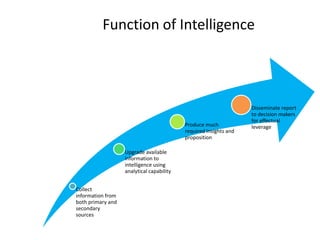
Function of Intelligence
Collect
information from
both primary and
secondary
sources
Upgrade available
information to
intelligence using
analytical capability
Produce much
required insights and
proposition
Disseminate report
to decision makers
for effectual
leverage
7Ps of CI
 People
 Porism
 Plan
 Processes
 Prod
 Pathfinder
 Performance
Source: Elijah Ezendu, Competitive Intelligence
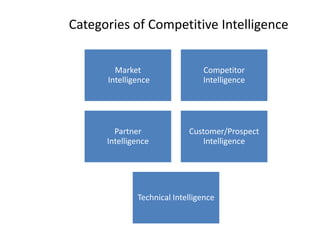
Categories of Competitive Intelligence
Market
Intelligence
Competitor
Intelligence
Partner
Intelligence
Customer/Prospect
Intelligence
Technical Intelligence
Market Intelligence
This highlights acquisition and analysis of
information pertaining to trends,
geopolitical issues and regulations in a
firm’s market.
Competitor Intelligence
This involves monitoring and analysis of
key competitors, budding competitors,
new competitors and probable
competitors.
Reasons for Monitoring Competitors
o Predict their next action
o Exploit their weaknesses
o Undermine their strength
o Blow up threats against them
o Undercut their opportunities
Partner Intelligence
This involves keeping tabs on every
individual and organization that has a
form of value network with the value
chain of a particular firm.
Customer/Prospect Intelligence
This embraces continuous identification and
analysis of demographic factors, budget
cycles, key internal influences and key focus
areas of customers/prospects.
Technical Intelligence
It entails examining every accessible research
and development report and allied technical
application in order to keep track of
competitive technical know-how, make out
business alternatives, and generate
appropriate and well-timed warning signal
to decision makers.
Three Types of Intelligence
Recurrent Intelligence: It’s done to be abreast
with activities and is not connected to a
specific strategic or tactical decision.
Reference Intelligence: It’s used as groundwork
for specific strategic or tactical decision and
regularly demanded.
Strategic Intelligence: This encompasses broad
spectrum of issues and is classically structured
to a specific strategic decision.
Counterintelligence
It’s a process of securing business
secrets, plans, techniques,
programmes and projects in order to
ward-off adversary.
How does CI improve Business Performance?
i. Lessens costs
ii. Boosts sales
iii. Captures alliance opportunities
iv. Discover gainful acquisition prospect
v. Clamps down on competitors’ profits and sales
vi. Enhances defensive strategies
vii. Improves organizational agility
viii. Achieve first-class status for higher prices
ix. Provides leverage for outwitting performance barrier
Overview of CI Process Models
Ashton and Stacey Business
Intelligence Process Model
4Cs Process Model
SCIP CI Process Model
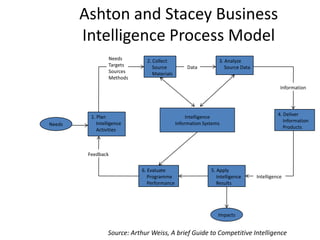
Ashton and Stacey Business
Intelligence Process Model
2. Collect
Source
Materials
3. Analyze
Source Data
1. Plan
Intelligence
Activities
Intelligence
Information Systems
4. Deliver
Information
Products
6. Evaluate
Programme
Performance
5. Apply
Intelligence
Results
Impacts
Needs
Data
Needs
Targets
Sources
Methods
Information
Feedback
Intelligence
Source: Arthur Weiss, A brief Guide to Competitive Intelligence
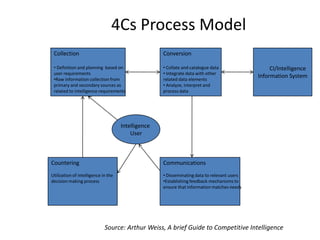
4Cs Process Model
Collection
• Definition and planning based on
user requirements
•Raw information collection from
primary and secondary sources as
related to intelligence requirements
Conversion
• Collate and catalogue data
• Integrate data with other
related data elements
• Analyze, interpret and
process data
CI/Intelligence
Information System
Countering
Utilization of intelligence in the
decision making process
Communications
• Disseminating data to relevant users
•Establishing feedback mechanisms to
ensure that information matches needs
Intelligence
User
Source: Arthur Weiss, A brief Guide to Competitive Intelligence
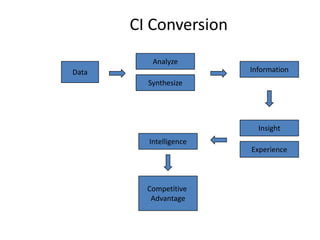
CI Conversion
Data
Analyze
Synthesize
Information
Insight
Experience
Intelligence
Competitive
Advantage
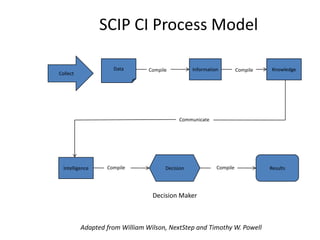
SCIP CI Process Model
Collect
Data Information
Intelligence Decision Results
Compile
Compile
Compile
Compile
Knowledge
Communicate
Decision Maker
Adapted from William Wilson, NextStep and Timothy W. Powell
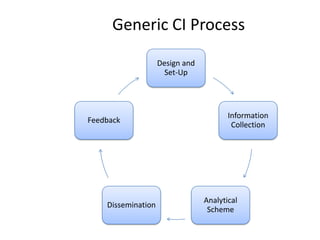
Generic CI Process
Design and
Set-Up
Information
Collection
Analytical
Scheme
Dissemination
Feedback
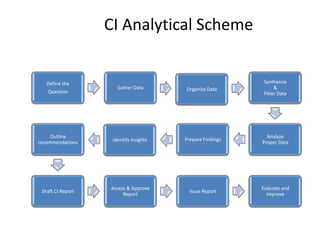
CI Analytical Scheme
Define the
Question
Gather Data Organize Data
Synthesize
&
Filter Data
Analyze
Proper Data
Prepare FindingsIdentify insights
Outline
recommendations
Draft CI Report
Assess & Approve
Report
Issue Report
Evaluate and
Improve
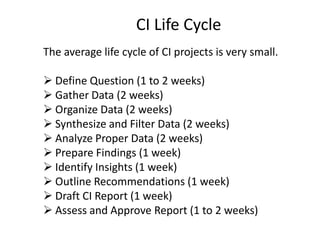
CI Life Cycle
The average life cycle of CI projects is very small.
 Define Question (1 to 2 weeks)
 Gather Data (2 weeks)
 Organize Data (2 weeks)
 Synthesize and Filter Data (2 weeks)
 Analyze Proper Data (2 weeks)
 Prepare Findings (1 week)
 Identify Insights (1 week)
 Outline Recommendations (1 week)
 Draft CI Report (1 week)
 Assess and Approve Report (1 to 2 weeks)
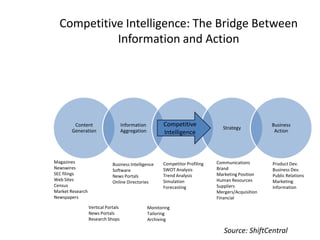
Competitive Intelligence: The Bridge Between
Information and Action
Content
Generation
Information
Aggregation
Strategy
Business
Action
Competitive
Intelligence
Magazines
Newswires
SEC filings
Web Sites
Census
Market Research
Newspapers
Business Intelligence
Software
News Portals
Online Directories
Vertical Portals
News Portals
Research Shops
Competitor Profiling
SWOT Analysis
Trend Analysis
Simulation
Forecasting
Monitoring
Tailoring
Archiving
Communications
Brand
Marketing Position
Human Resources
Suppliers
Mergers/Acquisition
Financial
Product Dev.
Business Dev.
Public Relations
Marketing
Information
Source: ShiftCentral
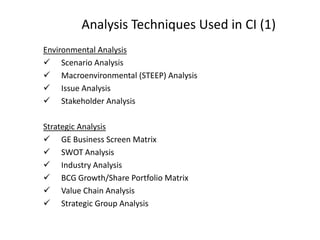
Analysis Techniques Used in CI (1)
Environmental Analysis
 Scenario Analysis
 Macroenvironmental (STEEP) Analysis
 Issue Analysis
 Stakeholder Analysis
Strategic Analysis
 GE Business Screen Matrix
 SWOT Analysis
 Industry Analysis
 BCG Growth/Share Portfolio Matrix
 Value Chain Analysis
 Strategic Group Analysis
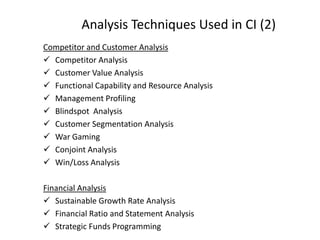
Analysis Techniques Used in CI (2)
Competitor and Customer Analysis
 Competitor Analysis
 Customer Value Analysis
 Functional Capability and Resource Analysis
 Management Profiling
 Blindspot Analysis
 Customer Segmentation Analysis
 War Gaming
 Conjoint Analysis
 Win/Loss Analysis
Financial Analysis
 Sustainable Growth Rate Analysis
 Financial Ratio and Statement Analysis
 Strategic Funds Programming
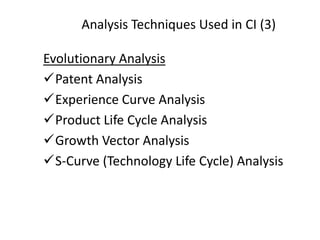
Analysis Techniques Used in CI (3)
Evolutionary Analysis
Patent Analysis
Experience Curve Analysis
Product Life Cycle Analysis
Growth Vector Analysis
S-Curve (Technology Life Cycle) Analysis
Primary Sources of Data
I. Observations
II. Marketplace Surveys
III. Interview with Internal Experts
IV. Journalists
V. Discussion Forums
VI. Internet Blog
VII. Industry/Product/General Wiki
VIII. Professional Institutes
IX. Trade Unions & Associations
X. Customers
XI. Professionals within the industry
XII. Suppliers to the industry
XIII. Competitors
XIV. Stockbrokers
XV. Conferences
Secondary Sources of Data
1) Directories
2) Trade Publications
3) Newspapers
4) Federal Office of Statistics
5) Magazines
6) Journals
7) Newsletters
8) Industry Periodicals
9) Government Statements and Reports
10) Annual Reports
11) Online Databases
12) Vendor’s Promotional Material
13) Press Releases
14) Websites
15) Subscription News Feeds
CI Products and Deliverables
i. Early Warning Alerts
ii. Market Audits
iii. Industry Audits
iv. Customer Profiles
v. Competitor Profiles
vi. Technology Profiles
vii.Supplier Profiles
viii.Competitive Benchmarking
Uses of Competitive Intelligence
 Acquisition and Prevention of Acquisition
 Merger Process
 Sales
 Business Modeling
 Strategic Alliances
 Manpower Development
 Organizational Development
 Strategic Course-Plotting
 Issues Monitoring
 Due Diligence
 Benchmarking
 Technology Assessment
 New Venture Development
 Satisfaction Surveys
 Environmental Scanning
 Business Opportunities and Risks Ascertainment
 Crafting Strategy
 Generic Business Development Programmes
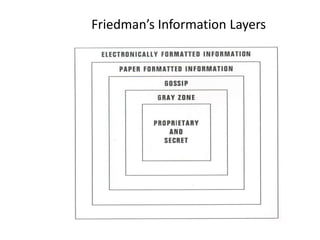
12 Application Priorities of CI
1. Current Competitor Activities and Strategy Monitoring
2. Customers, Vendors and Other External Allied Monitoring
3. Operational Performance and Benchmarking
4. Product/Service Sales and Marketing Support
5. Strategic Probabilities and Possible Futures
6. Internal Knowledge Management
7. Intellectual Property Exploitation and Protection
8. Mergers, Acquisitions, Alliance and Investment Support
9. Long-Term Market Prospects & Spotting Weak Signal Blindspots
10. Counter-Intelligence & Information Security
11. Legislative and Regulatory Activity as well as Impact on Business
Issues
12. Executive Decision-Support and Competitive Strategy Planning
Source: Recon Competitive Intelligence Solutions
Friedman’s Information Layers
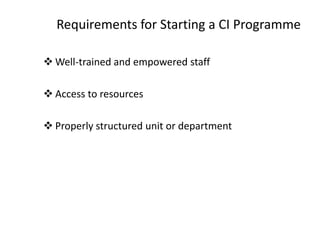
Requirements for Starting a CI Programme
 Well-trained and empowered staff
 Access to resources
 Properly structured unit or department
Roles in the Intelligence Process
Core Roles
i. Primary Researchers
ii. Secondary Researchers
iii. Integrators
iv. Analysts
Supporting Roles
i. Protectors
ii. Knowledge Builders
iii. System Builders
iv. Data Builders
v. Decision Makers
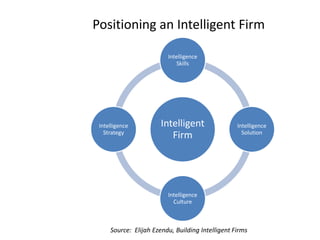
Positioning an Intelligent Firm
Intelligent
Firm
Intelligence
Skills
Intelligence
Solution
Intelligence
Culture
Intelligence
Strategy
Source: Elijah Ezendu, Building Intelligent Firms
Competitive Intelligence Solution
An apposite Competitive Intelligence Solution provides a
tested platform for conducting data-banking,
synthesis, analysis, structured evaluation and
sophisticated report generation.
Examples of CI Solution
1. Cipher Solution from Cipher Systems.
2. ACIS from Coemergence Inc.
3. Astragy from Astragy B.V.
4. Comintell KXC from Comintell.
5. Acuity from Acuity Software
Dr Elijah Ezendu is Award-Winning Business Expert & Certified Management Consultant with expertise
in Interim Management, Strategy, Competitive Intelligence, Transformation, Restructuring, Turnaround
Management, Business Development, Marketing, Project & Cost Management, Leadership, HR, CSR, e-
Business & Software Architecture. He had functioned as Founder, Initiative for Sustainable Business
Equity; Chairman of Board, Charisma Broadcast Film Academy; Group Chief Operating Officer, Idova
Group; CEO, Rubiini (UAE); Special Advisor, RTEAN; Director, MMNA Investments; Chair, Int’l Board of
GCC Business Council (UAE); Senior Partner, Shevach Consulting; Chairman (Certification & Training),
Coordinator (Board of Fellows), Lead Assessor & Governing Council Member, Institute of Management
Consultants, Nigeria; Lead Resource, Centre for Competitive Intelligence Development; Lead
Consultant/ Partner, JK Michaels; Turnaround Project Director, Consolidated Business Holdings Limited;
Technical Director, Gestalt; Chief Operating Officer, Rohan Group; Executive Director (Various Roles),
Fortuna, Gambia & Malta; Chief Advisor/ Partner, D & E; Vice Chairman of Board, Refined Shipping;
Director of Programmes & Governing Council Member, Institute of Business Development, Nigeria;
Member of TDD Committee, International Association of Software Architects, USA; Member of Strategic
Planning and Implementation Committee, Chartered Institute of Personnel Management of Nigeria;
Country Manager (Nigeria) & Adjunct Faculty (MBA Programme), Regent Business School, South Africa;
Adjunct Faculty (MBA Programme), Ladoke Akintola University of Technology; Editor-in-Chief, Cost
Management Journal; Council Member, Institute of Internal Auditors of Nigeria; Member, Board of
Directors (Several Organizations). He holds Doctoral Degree in Management, Master of Business
Administration and Fellow of Professional Institutes in North America, UK & Nigeria. He is Innovator of
Corporate Investment Structure Based on Financials and Intangibles, for valuation highlighting
intangible contributions of host communities and ecological environment: A model celebrated globally
as remedy for unmitigated depreciation of ecological capital and developmental deprivation of host
communities. He had served as Examiner to Professional Institutes and Universities. He had been a
member of Guild of Soundtrack Producers of Nigeria. He's an author and extensively featured speaker.
Thank You

Competitive Intelligence

  • 1.
    Competitive Intelligence Dr. ElijahEzendu FIMC, FCCM, FIIAN, FBDI, FAAFM, FSSM, MIMIS, MIAP, MITD, ACIArb, ACIPM, PhD, DocM, MBA, CWM, CBDA, CMA, MPM, PME, CSOL, CCIP, CMC, CMgr
  • 2.
    “The ability tofocus attention on important things is a defining characteristic of intelligence” - Robert J. Shiller, Irrational Exuberance
  • 3.
    What is CompetitiveIntelligence? “It’s the process of ethically collecting, analysing, and disseminating accurate, relevant, specific, timely, foresighted and actionable intelligence regarding the implications of business environment, competitors, and the organization itself” -Society of Competitive Intelligence Professionals
  • 4.
    Why Intelligence? Intelligence isusually ahead of its time, and exploits analytics pertaining to past behaviour for provision of much required insight into course of events.
  • 5.
    Competitive Intelligence asa Product Competitive Intelligence is ethical, timely and useful value-added information on customers, competitors, other stakeholders in the competitive environment and the within the firm.
  • 6.
    Competitive Intelligence asa Process In this case, it involves establishing intelligence needs, generating information, analysing and disseminating actionable intelligence to key decision makers, for building competitive advantage and boosting profitability.
  • 7.
    “If you areignorant of both your enemy and yourself, then you are a fool and certain to be defeated in every battle.” - Sun Tzu
  • 8.
    Function of Intelligence Collect informationfrom both primary and secondary sources Upgrade available information to intelligence using analytical capability Produce much required insights and proposition Disseminate report to decision makers for effectual leverage
  • 9.
    7Ps of CI People  Porism  Plan  Processes  Prod  Pathfinder  Performance Source: Elijah Ezendu, Competitive Intelligence
  • 10.
    Categories of CompetitiveIntelligence Market Intelligence Competitor Intelligence Partner Intelligence Customer/Prospect Intelligence Technical Intelligence
  • 11.
    Market Intelligence This highlightsacquisition and analysis of information pertaining to trends, geopolitical issues and regulations in a firm’s market.
  • 12.
    Competitor Intelligence This involvesmonitoring and analysis of key competitors, budding competitors, new competitors and probable competitors.
  • 13.
    Reasons for MonitoringCompetitors o Predict their next action o Exploit their weaknesses o Undermine their strength o Blow up threats against them o Undercut their opportunities
  • 14.
    Partner Intelligence This involveskeeping tabs on every individual and organization that has a form of value network with the value chain of a particular firm.
  • 15.
    Customer/Prospect Intelligence This embracescontinuous identification and analysis of demographic factors, budget cycles, key internal influences and key focus areas of customers/prospects.
  • 16.
    Technical Intelligence It entailsexamining every accessible research and development report and allied technical application in order to keep track of competitive technical know-how, make out business alternatives, and generate appropriate and well-timed warning signal to decision makers.
  • 17.
    Three Types ofIntelligence Recurrent Intelligence: It’s done to be abreast with activities and is not connected to a specific strategic or tactical decision. Reference Intelligence: It’s used as groundwork for specific strategic or tactical decision and regularly demanded. Strategic Intelligence: This encompasses broad spectrum of issues and is classically structured to a specific strategic decision.
  • 18.
    Counterintelligence It’s a processof securing business secrets, plans, techniques, programmes and projects in order to ward-off adversary.
  • 19.
    How does CIimprove Business Performance? i. Lessens costs ii. Boosts sales iii. Captures alliance opportunities iv. Discover gainful acquisition prospect v. Clamps down on competitors’ profits and sales vi. Enhances defensive strategies vii. Improves organizational agility viii. Achieve first-class status for higher prices ix. Provides leverage for outwitting performance barrier
  • 20.
    Overview of CIProcess Models Ashton and Stacey Business Intelligence Process Model 4Cs Process Model SCIP CI Process Model
  • 21.
    Ashton and StaceyBusiness Intelligence Process Model 2. Collect Source Materials 3. Analyze Source Data 1. Plan Intelligence Activities Intelligence Information Systems 4. Deliver Information Products 6. Evaluate Programme Performance 5. Apply Intelligence Results Impacts Needs Data Needs Targets Sources Methods Information Feedback Intelligence Source: Arthur Weiss, A brief Guide to Competitive Intelligence
  • 22.
    4Cs Process Model Collection •Definition and planning based on user requirements •Raw information collection from primary and secondary sources as related to intelligence requirements Conversion • Collate and catalogue data • Integrate data with other related data elements • Analyze, interpret and process data CI/Intelligence Information System Countering Utilization of intelligence in the decision making process Communications • Disseminating data to relevant users •Establishing feedback mechanisms to ensure that information matches needs Intelligence User Source: Arthur Weiss, A brief Guide to Competitive Intelligence
  • 23.
  • 24.
    SCIP CI ProcessModel Collect Data Information Intelligence Decision Results Compile Compile Compile Compile Knowledge Communicate Decision Maker Adapted from William Wilson, NextStep and Timothy W. Powell
  • 25.
    Generic CI Process Designand Set-Up Information Collection Analytical Scheme Dissemination Feedback
  • 26.
    CI Analytical Scheme Definethe Question Gather Data Organize Data Synthesize & Filter Data Analyze Proper Data Prepare FindingsIdentify insights Outline recommendations Draft CI Report Assess & Approve Report Issue Report Evaluate and Improve
  • 27.
    CI Life Cycle Theaverage life cycle of CI projects is very small.  Define Question (1 to 2 weeks)  Gather Data (2 weeks)  Organize Data (2 weeks)  Synthesize and Filter Data (2 weeks)  Analyze Proper Data (2 weeks)  Prepare Findings (1 week)  Identify Insights (1 week)  Outline Recommendations (1 week)  Draft CI Report (1 week)  Assess and Approve Report (1 to 2 weeks)
  • 28.
    Competitive Intelligence: TheBridge Between Information and Action Content Generation Information Aggregation Strategy Business Action Competitive Intelligence Magazines Newswires SEC filings Web Sites Census Market Research Newspapers Business Intelligence Software News Portals Online Directories Vertical Portals News Portals Research Shops Competitor Profiling SWOT Analysis Trend Analysis Simulation Forecasting Monitoring Tailoring Archiving Communications Brand Marketing Position Human Resources Suppliers Mergers/Acquisition Financial Product Dev. Business Dev. Public Relations Marketing Information Source: ShiftCentral
  • 29.
    Analysis Techniques Usedin CI (1) Environmental Analysis  Scenario Analysis  Macroenvironmental (STEEP) Analysis  Issue Analysis  Stakeholder Analysis Strategic Analysis  GE Business Screen Matrix  SWOT Analysis  Industry Analysis  BCG Growth/Share Portfolio Matrix  Value Chain Analysis  Strategic Group Analysis
  • 30.
    Analysis Techniques Usedin CI (2) Competitor and Customer Analysis  Competitor Analysis  Customer Value Analysis  Functional Capability and Resource Analysis  Management Profiling  Blindspot Analysis  Customer Segmentation Analysis  War Gaming  Conjoint Analysis  Win/Loss Analysis Financial Analysis  Sustainable Growth Rate Analysis  Financial Ratio and Statement Analysis  Strategic Funds Programming
  • 31.
    Analysis Techniques Usedin CI (3) Evolutionary Analysis Patent Analysis Experience Curve Analysis Product Life Cycle Analysis Growth Vector Analysis S-Curve (Technology Life Cycle) Analysis
  • 32.
    Primary Sources ofData I. Observations II. Marketplace Surveys III. Interview with Internal Experts IV. Journalists V. Discussion Forums VI. Internet Blog VII. Industry/Product/General Wiki VIII. Professional Institutes IX. Trade Unions & Associations X. Customers XI. Professionals within the industry XII. Suppliers to the industry XIII. Competitors XIV. Stockbrokers XV. Conferences
  • 33.
    Secondary Sources ofData 1) Directories 2) Trade Publications 3) Newspapers 4) Federal Office of Statistics 5) Magazines 6) Journals 7) Newsletters 8) Industry Periodicals 9) Government Statements and Reports 10) Annual Reports 11) Online Databases 12) Vendor’s Promotional Material 13) Press Releases 14) Websites 15) Subscription News Feeds
  • 34.
    CI Products andDeliverables i. Early Warning Alerts ii. Market Audits iii. Industry Audits iv. Customer Profiles v. Competitor Profiles vi. Technology Profiles vii.Supplier Profiles viii.Competitive Benchmarking
  • 35.
    Uses of CompetitiveIntelligence  Acquisition and Prevention of Acquisition  Merger Process  Sales  Business Modeling  Strategic Alliances  Manpower Development  Organizational Development  Strategic Course-Plotting  Issues Monitoring  Due Diligence  Benchmarking  Technology Assessment  New Venture Development  Satisfaction Surveys  Environmental Scanning  Business Opportunities and Risks Ascertainment  Crafting Strategy  Generic Business Development Programmes
  • 36.
    12 Application Prioritiesof CI 1. Current Competitor Activities and Strategy Monitoring 2. Customers, Vendors and Other External Allied Monitoring 3. Operational Performance and Benchmarking 4. Product/Service Sales and Marketing Support 5. Strategic Probabilities and Possible Futures 6. Internal Knowledge Management 7. Intellectual Property Exploitation and Protection 8. Mergers, Acquisitions, Alliance and Investment Support 9. Long-Term Market Prospects & Spotting Weak Signal Blindspots 10. Counter-Intelligence & Information Security 11. Legislative and Regulatory Activity as well as Impact on Business Issues 12. Executive Decision-Support and Competitive Strategy Planning Source: Recon Competitive Intelligence Solutions
  • 37.
  • 38.
    Requirements for Startinga CI Programme  Well-trained and empowered staff  Access to resources  Properly structured unit or department
  • 39.
    Roles in theIntelligence Process Core Roles i. Primary Researchers ii. Secondary Researchers iii. Integrators iv. Analysts Supporting Roles i. Protectors ii. Knowledge Builders iii. System Builders iv. Data Builders v. Decision Makers
  • 40.
    Positioning an IntelligentFirm Intelligent Firm Intelligence Skills Intelligence Solution Intelligence Culture Intelligence Strategy Source: Elijah Ezendu, Building Intelligent Firms
  • 41.
    Competitive Intelligence Solution Anapposite Competitive Intelligence Solution provides a tested platform for conducting data-banking, synthesis, analysis, structured evaluation and sophisticated report generation. Examples of CI Solution 1. Cipher Solution from Cipher Systems. 2. ACIS from Coemergence Inc. 3. Astragy from Astragy B.V. 4. Comintell KXC from Comintell. 5. Acuity from Acuity Software
  • 42.
    Dr Elijah Ezenduis Award-Winning Business Expert & Certified Management Consultant with expertise in Interim Management, Strategy, Competitive Intelligence, Transformation, Restructuring, Turnaround Management, Business Development, Marketing, Project & Cost Management, Leadership, HR, CSR, e- Business & Software Architecture. He had functioned as Founder, Initiative for Sustainable Business Equity; Chairman of Board, Charisma Broadcast Film Academy; Group Chief Operating Officer, Idova Group; CEO, Rubiini (UAE); Special Advisor, RTEAN; Director, MMNA Investments; Chair, Int’l Board of GCC Business Council (UAE); Senior Partner, Shevach Consulting; Chairman (Certification & Training), Coordinator (Board of Fellows), Lead Assessor & Governing Council Member, Institute of Management Consultants, Nigeria; Lead Resource, Centre for Competitive Intelligence Development; Lead Consultant/ Partner, JK Michaels; Turnaround Project Director, Consolidated Business Holdings Limited; Technical Director, Gestalt; Chief Operating Officer, Rohan Group; Executive Director (Various Roles), Fortuna, Gambia & Malta; Chief Advisor/ Partner, D & E; Vice Chairman of Board, Refined Shipping; Director of Programmes & Governing Council Member, Institute of Business Development, Nigeria; Member of TDD Committee, International Association of Software Architects, USA; Member of Strategic Planning and Implementation Committee, Chartered Institute of Personnel Management of Nigeria; Country Manager (Nigeria) & Adjunct Faculty (MBA Programme), Regent Business School, South Africa; Adjunct Faculty (MBA Programme), Ladoke Akintola University of Technology; Editor-in-Chief, Cost Management Journal; Council Member, Institute of Internal Auditors of Nigeria; Member, Board of Directors (Several Organizations). He holds Doctoral Degree in Management, Master of Business Administration and Fellow of Professional Institutes in North America, UK & Nigeria. He is Innovator of Corporate Investment Structure Based on Financials and Intangibles, for valuation highlighting intangible contributions of host communities and ecological environment: A model celebrated globally as remedy for unmitigated depreciation of ecological capital and developmental deprivation of host communities. He had served as Examiner to Professional Institutes and Universities. He had been a member of Guild of Soundtrack Producers of Nigeria. He's an author and extensively featured speaker.
  • 43.