Supply Chain Collaboration Clarifying Supply Chain Relationships
Clarifying Supply Chain Relationships Outline: Supply Chain Relationship Definition & Clarification Deeper Dive Into Collaboration Reality Check of Supply Chain Relationships Charting Collaboration Levels & Power Supply Chain Information Sharing Components of S C Relationships
Clarifying Supply Chain Relationships A Supply Chain Can Be Described as a  Set of Relationships  Among Suppliers, Manufacturers, Distributors, and Retailers That Facilitates The Transformation of Raw Materials Into Finished Goods
Clarifying Supply Chain Relationships “… The single most important ingredient for successful SCM may be trusting relationships among partners in the supply chain, where each party has confidence in the other members’ capabilities and actions. And trust building is characterized as an ongoing process that must be continually managed.”   Rob Handfield, Director Supply Chain Resource Consortium  (SCRC)
Clarifying Supply Chain Relationships True Partnerships are Difficult to Achieve and Maintain, but They Reap the Most Benefits Operationally and Financially Historically, it was Always Believed That an Adversarial Relationship was Necessary to Establish the Required Checks & Balances As Always, Global Supply Chains Make Relationship Building and Strengthening More Difficult
Clarifying Supply Chain Relationships One VP of Materials Management at a Fortune 500 Manufacturer Expressed this Feeling: “Supply chain management is one of the most emotional experiences I’ve ever witnessed. There have been so many mythologies that have developed over the years, people blaming other people for their problems, based on some incident that may or may not have occurred sometime in the past. Once you get everyone together into the same room, you begin to realize the number of false perceptions that exist. People are still very reluctant to let someone else make decisions within their area.”
Clarifying Supply Chain Relationships Supply Chain Collaboration is a Commonly Used Term That is Actually Applied to Several Different Kinds of Relationships: Arm-Length Relationships Cooperation Coordination Collaboration
Clarifying Supply Chain Relationships Some Other Terms That Have Been Used: Co-Opetition Relationship Between 2 Competitors That Have Agreed to Work Together for Mutual Benefit. Coercion Customer “Strong-Arms” Supplier to Provide Products or Services at a Predetermined Price Co-Packer Supplier Produces What Customer Is/Was Capable of Producing in Addition to or Replacing Customer’s Output
Clarifying Supply Chain Relationships Arm-Length Relationships Most Common Little Investment by Either Party in the Relationship (Able to Change Suppliers Quickly) Minimal Information Sharing Limited Interaction Between Companies Low Trust & Commitment Short Term, Contract Based Adversarial
Clarifying Supply Chain Relationships Cooperation Grew Out of the Need to Manage Increasingly Complicated Information & Material Flow Parties Are More Tightly Linked, Sharing More Information Fewer Suppliers, Longer Term Relationships Still Utilizing Short Term Perspective Initial Emergence of Integration & Interdependency
Clarifying Supply Chain Relationships Coordination Information Technology More of a Factor Amount of Data Infrastructure & Sharing is Increased Information Systems More Strongly Linked More Emphasis on Strategy Collaborative Planning, Forecasting, Replenishment Utilized Vendor Managed Inventory (VMI) an Option
Clarifying Supply Chain Relationships Collaboration Two Reasons Why Collaboration is Popular: Supply Chain Management Strategy Has Changed Priority From Mass Production/Quality to Customer Satisfaction (Which still requires a Quality focus) Information Technology is Advancing Rapidly and is More Affordable, Allowing Companies to Implement More Sophisticated Supply Chain Partnerships
Clarifying Supply Chain Relationships Collaboration  (cont.) Refers to the Most Committed Relationship Between Organizations With No Equity Relationship Link Between Companies, in a Supply Chain Context, is as Strong as it Can be Before Joint Venture or Vertical Integration
Clarifying Supply Chain Relationships Collaboration   (cont.) Two Key Points Separate Collaboration From the Preceding Relationships: Elements of Cooperation & Coordination Are Stronger Greater Trust, Commitment, Data Sharing Greater Diversity of Non-Logistics Activities Performed Jointly Product Design, PLM, Quality Assurance, Forecasting
Clarifying Supply Chain Relationships Collaboration  (cont.) Two Types of Collaboration Have Emerged: Type 1 ( Skill Substitution ) Involves Companies Working Together in Logistics and Manufacturing Activities (SCM) More Traditional SCM, Logistics Management Virtual Network With Each Organization Linked via Technology
Clarifying Supply Chain Relationships Collaboration  (cont.) Two Types of Collaboration Have Emerged  (cont.) Type 2 ( Organizational Learning ) Involves More Non-Logistics Activities Broader Definition of SCM Considered a Strategic Alliance Where Buyers & Suppliers Function More as a Single System
Clarifying Supply Chain Relationships Degrees of Collaboration Measuring the Level of Collaboration That Exists Falls Into Two Categories: How Companies Interact With Each Other Trust  Commitment Balance of Power Resolving Cultural Differences
Clarifying Supply Chain Relationships Degrees of Collaboration Measuring the Level of Collaboration That Exists Falls Into Two Categories:  (cont.) The Means By Which They Interact Information Systems Collaborative Controlling System  Risk/Reward Sharing Structure Joint Decision Making Process Conflict Management System
Clarifying Supply Chain Relationships Collaboration Reality Check Resources & Trust Are Scarce  “Winner Takes All” Still Prevails Distrust & Wariness Are Still Prevalent, Especially in Developing Economies Exerting Power by One Party (Customer) is Prevalent in the Auto Industry
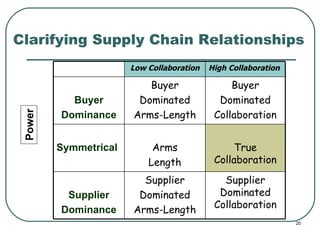
Clarifying Supply Chain Relationships Power High Collaboration Low Collaboration Supplier Dominated Collaboration Supplier Dominated Arms-Length Supplier Dominance True Collaboration Arms Length Symmetrical Buyer Dominated Collaboration Buyer Dominated Arms-Length Buyer Dominance
Clarifying Supply Chain Relationships Variables That Define the SC Relationship Formalization of the Relationship Intensity or Focus on the Relationship Frequency of Communication Standardization of the Data Being Shared Reciprocity Between Parties Combination of these Variables Give Rise to Various Buyer-Supplier Relationships
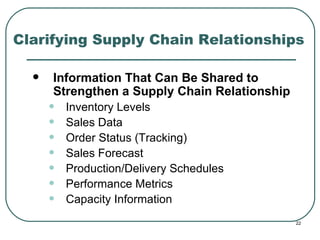
Clarifying Supply Chain Relationships Information That Can Be Shared to Strengthen a Supply Chain Relationship Inventory Levels Sales Data Order Status (Tracking) Sales Forecast Production/Delivery Schedules Performance Metrics Capacity Information
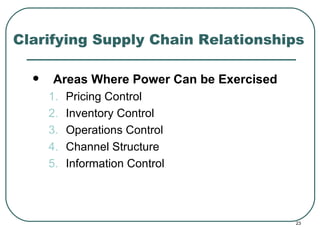
Clarifying Supply Chain Relationships Areas Where Power Can be Exercised Pricing Control Inventory Control Operations Control Channel Structure Information Control
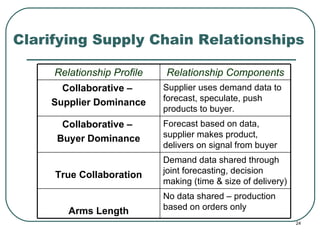
Clarifying Supply Chain Relationships No data shared – production based on orders only Arms Length Demand data shared through joint forecasting, decision making (time & size of delivery) True Collaboration Forecast based on data, supplier makes product, delivers on signal from buyer Collaborative –  Buyer Dominance Supplier uses demand data to forecast, speculate, push products to buyer. Collaborative –  Supplier Dominance Relationship Components Relationship Profile
Clarifying Supply Chain Relationships Conclusion: The Continual Globalization of Supply Chain Management Requires More Attention to Relationship Building and Maintenance to Address the Multitude of Communication and Logistics Issues That Are Now, and Will Continue to be, Critical to Successful Supply Chain Management.
Clarifying Supply Chain Relationships Review: Defining Supply Chain Relationships Collaboration Details Review Real World Look at Supply Chain Relationships Review of Collaboration Levels & Power Information Sharing Within Supply Chain Management Ingredients of S C Relationships Conclusion

Supply Chain Collaboration

  • 1.
    Supply Chain CollaborationClarifying Supply Chain Relationships
  • 2.
    Clarifying Supply ChainRelationships Outline: Supply Chain Relationship Definition & Clarification Deeper Dive Into Collaboration Reality Check of Supply Chain Relationships Charting Collaboration Levels & Power Supply Chain Information Sharing Components of S C Relationships
  • 3.
    Clarifying Supply ChainRelationships A Supply Chain Can Be Described as a Set of Relationships Among Suppliers, Manufacturers, Distributors, and Retailers That Facilitates The Transformation of Raw Materials Into Finished Goods
  • 4.
    Clarifying Supply ChainRelationships “… The single most important ingredient for successful SCM may be trusting relationships among partners in the supply chain, where each party has confidence in the other members’ capabilities and actions. And trust building is characterized as an ongoing process that must be continually managed.” Rob Handfield, Director Supply Chain Resource Consortium (SCRC)
  • 5.
    Clarifying Supply ChainRelationships True Partnerships are Difficult to Achieve and Maintain, but They Reap the Most Benefits Operationally and Financially Historically, it was Always Believed That an Adversarial Relationship was Necessary to Establish the Required Checks & Balances As Always, Global Supply Chains Make Relationship Building and Strengthening More Difficult
  • 6.
    Clarifying Supply ChainRelationships One VP of Materials Management at a Fortune 500 Manufacturer Expressed this Feeling: “Supply chain management is one of the most emotional experiences I’ve ever witnessed. There have been so many mythologies that have developed over the years, people blaming other people for their problems, based on some incident that may or may not have occurred sometime in the past. Once you get everyone together into the same room, you begin to realize the number of false perceptions that exist. People are still very reluctant to let someone else make decisions within their area.”
  • 7.
    Clarifying Supply ChainRelationships Supply Chain Collaboration is a Commonly Used Term That is Actually Applied to Several Different Kinds of Relationships: Arm-Length Relationships Cooperation Coordination Collaboration
  • 8.
    Clarifying Supply ChainRelationships Some Other Terms That Have Been Used: Co-Opetition Relationship Between 2 Competitors That Have Agreed to Work Together for Mutual Benefit. Coercion Customer “Strong-Arms” Supplier to Provide Products or Services at a Predetermined Price Co-Packer Supplier Produces What Customer Is/Was Capable of Producing in Addition to or Replacing Customer’s Output
  • 9.
    Clarifying Supply ChainRelationships Arm-Length Relationships Most Common Little Investment by Either Party in the Relationship (Able to Change Suppliers Quickly) Minimal Information Sharing Limited Interaction Between Companies Low Trust & Commitment Short Term, Contract Based Adversarial
  • 10.
    Clarifying Supply ChainRelationships Cooperation Grew Out of the Need to Manage Increasingly Complicated Information & Material Flow Parties Are More Tightly Linked, Sharing More Information Fewer Suppliers, Longer Term Relationships Still Utilizing Short Term Perspective Initial Emergence of Integration & Interdependency
  • 11.
    Clarifying Supply ChainRelationships Coordination Information Technology More of a Factor Amount of Data Infrastructure & Sharing is Increased Information Systems More Strongly Linked More Emphasis on Strategy Collaborative Planning, Forecasting, Replenishment Utilized Vendor Managed Inventory (VMI) an Option
  • 12.
    Clarifying Supply ChainRelationships Collaboration Two Reasons Why Collaboration is Popular: Supply Chain Management Strategy Has Changed Priority From Mass Production/Quality to Customer Satisfaction (Which still requires a Quality focus) Information Technology is Advancing Rapidly and is More Affordable, Allowing Companies to Implement More Sophisticated Supply Chain Partnerships
  • 13.
    Clarifying Supply ChainRelationships Collaboration (cont.) Refers to the Most Committed Relationship Between Organizations With No Equity Relationship Link Between Companies, in a Supply Chain Context, is as Strong as it Can be Before Joint Venture or Vertical Integration
  • 14.
    Clarifying Supply ChainRelationships Collaboration (cont.) Two Key Points Separate Collaboration From the Preceding Relationships: Elements of Cooperation & Coordination Are Stronger Greater Trust, Commitment, Data Sharing Greater Diversity of Non-Logistics Activities Performed Jointly Product Design, PLM, Quality Assurance, Forecasting
  • 15.
    Clarifying Supply ChainRelationships Collaboration (cont.) Two Types of Collaboration Have Emerged: Type 1 ( Skill Substitution ) Involves Companies Working Together in Logistics and Manufacturing Activities (SCM) More Traditional SCM, Logistics Management Virtual Network With Each Organization Linked via Technology
  • 16.
    Clarifying Supply ChainRelationships Collaboration (cont.) Two Types of Collaboration Have Emerged (cont.) Type 2 ( Organizational Learning ) Involves More Non-Logistics Activities Broader Definition of SCM Considered a Strategic Alliance Where Buyers & Suppliers Function More as a Single System
  • 17.
    Clarifying Supply ChainRelationships Degrees of Collaboration Measuring the Level of Collaboration That Exists Falls Into Two Categories: How Companies Interact With Each Other Trust Commitment Balance of Power Resolving Cultural Differences
  • 18.
    Clarifying Supply ChainRelationships Degrees of Collaboration Measuring the Level of Collaboration That Exists Falls Into Two Categories: (cont.) The Means By Which They Interact Information Systems Collaborative Controlling System Risk/Reward Sharing Structure Joint Decision Making Process Conflict Management System
  • 19.
    Clarifying Supply ChainRelationships Collaboration Reality Check Resources & Trust Are Scarce “Winner Takes All” Still Prevails Distrust & Wariness Are Still Prevalent, Especially in Developing Economies Exerting Power by One Party (Customer) is Prevalent in the Auto Industry
  • 20.
    Clarifying Supply ChainRelationships Power High Collaboration Low Collaboration Supplier Dominated Collaboration Supplier Dominated Arms-Length Supplier Dominance True Collaboration Arms Length Symmetrical Buyer Dominated Collaboration Buyer Dominated Arms-Length Buyer Dominance
  • 21.
    Clarifying Supply ChainRelationships Variables That Define the SC Relationship Formalization of the Relationship Intensity or Focus on the Relationship Frequency of Communication Standardization of the Data Being Shared Reciprocity Between Parties Combination of these Variables Give Rise to Various Buyer-Supplier Relationships
  • 22.
    Clarifying Supply ChainRelationships Information That Can Be Shared to Strengthen a Supply Chain Relationship Inventory Levels Sales Data Order Status (Tracking) Sales Forecast Production/Delivery Schedules Performance Metrics Capacity Information
  • 23.
    Clarifying Supply ChainRelationships Areas Where Power Can be Exercised Pricing Control Inventory Control Operations Control Channel Structure Information Control
  • 24.
    Clarifying Supply ChainRelationships No data shared – production based on orders only Arms Length Demand data shared through joint forecasting, decision making (time & size of delivery) True Collaboration Forecast based on data, supplier makes product, delivers on signal from buyer Collaborative – Buyer Dominance Supplier uses demand data to forecast, speculate, push products to buyer. Collaborative – Supplier Dominance Relationship Components Relationship Profile
  • 25.
    Clarifying Supply ChainRelationships Conclusion: The Continual Globalization of Supply Chain Management Requires More Attention to Relationship Building and Maintenance to Address the Multitude of Communication and Logistics Issues That Are Now, and Will Continue to be, Critical to Successful Supply Chain Management.
  • 26.
    Clarifying Supply ChainRelationships Review: Defining Supply Chain Relationships Collaboration Details Review Real World Look at Supply Chain Relationships Review of Collaboration Levels & Power Information Sharing Within Supply Chain Management Ingredients of S C Relationships Conclusion