The Theory of  Comparative Advantage - Given by David Ricardo
Background of the Theory the original description of the idea  can be found in an  Essay on the External Corn Trade  by Robert Torrens in 1815.  David Ricardo formalized the idea using a compelling, yet simple, numerical example in his 1817 book titled,  On the Principles of Political Economy and Taxation .  The idea appeared again in James Mill's  Elements of Political Economy  in 1821. Finally, the concept became a key feature of international political economy upon the publication of   Principles of Political Economy  by John Stuart Mill in 1848.
Ricardo’s Idea of Comparative Advantage Ricardo's  Law of Comparative Advantage  improved upon the earlier  Law of Absolute Advantage . How? If A (Advancedland) is more productive than B (Backwardland) in  every  productive activity, would  both  countries benefit from trade? The law of absolute advantage has  no answer  to this question. Ricardo's law of comparative advantage showed that the answer is  yes .
A country has a  comparative advantage  in the production of a good or service that it produces  The theory of comparative costs argues that, put simply, it is better for a country that is inefficient at producing a good or service to specialise in the production of that good it is least inefficient at, compared with producing other goods. Ricardo’s Idea of Comparative Advantage
Assumptions   2*2*1 model Homogeneous goods Labor is homogeneous within a country but heterogeneous across countries.  Complete mobility of labor in the country and complete immobility of labor across the country No transportation costs Full employment
Assumptions Production technology differences exist across industries and across countries and are reflected in labor productivity parameters.  The labor and goods markets are assumed to be perfectly competitive in both countries.  Firms are assumed to maximize profit while consumers (workers) are assumed to maximize utility.
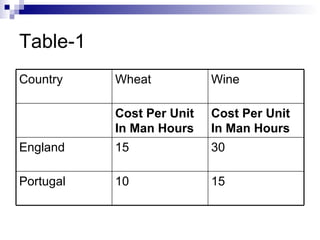
Ricardo’s numerical example In his example Ricardo imagined two countries, England and Portugal, producing two goods, cloth and wine, using labor as the sole input in production.  He assumed that the productivity of labor varied between industries and across countries. Ricardo assumed that Portugal was more productive in both goods.
Table-1 15 10 Portugal 30 15 England Cost Per Unit In Man Hours   Cost Per Unit In Man Hours   Wine Wheat Country
Ricardo’s numerical example Portugal is relatively better at producing wine than wheat: so Portugal is said to have a  COMPARATIVE ADVANTAGE  in the production of wine. England is relatively better at producing wheat than wine: so England is said to have a comparative advantage in the production of wheat.
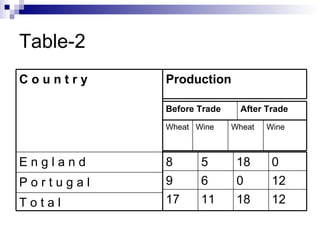
Ricardo’s numerical example Table 2 shows how trade might be advantageous. Costs of production are as set out in Table 1. England is assumed to have 270 man hours available for production. Before trade takes place it produces and consumes 8 units of wheat and 5 units of wine. Portugal has fewer labour resources with 180 man hours of labour available for production. Before trade takes place it produces and consumes 9 units of wheat and 6 units of wine. Total production between the two economies is 17 units of wheat and 11 units of wine
Table-2 T o t a l  P o r t u g a l  E n g l a n d  C o u n t r y   Production   Wine Wheat Wine Wheat After Trade Before Trade   12 18 11 17 12 0 6 9 0 18 5 8
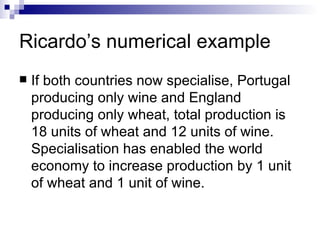
Ricardo’s numerical example If both countries now specialise, Portugal producing only wine and England producing only wheat, total production is 18 units of wheat and 12 units of wine. Specialisation has enabled the world economy to increase production by 1 unit of wheat and 1 unit of wine.
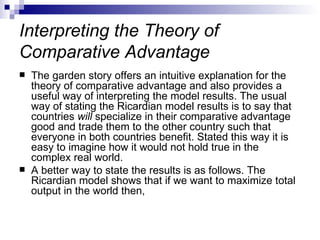
Interpreting the Theory of Comparative Advantage The garden story offers an intuitive explanation for the theory of comparative advantage and also provides a useful way of interpreting the model results. The usual way of stating the Ricardian model results is to say that countries  will  specialize in their comparative advantage good and trade them to the other country such that everyone in both countries benefit. Stated this way it is easy to imagine how it would not hold true in the complex real world.  A better way to state the results is as follows. The Ricardian model shows that if we want to maximize total output in the world then,
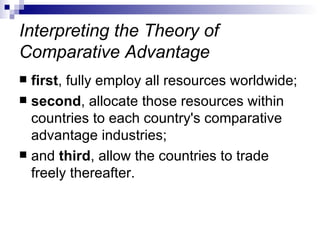
Interpreting the Theory of Comparative Advantage first , fully employ all resources worldwide;  second , allocate those resources within countries to each country's comparative advantage industries;  and  third , allow the countries to trade freely thereafter.
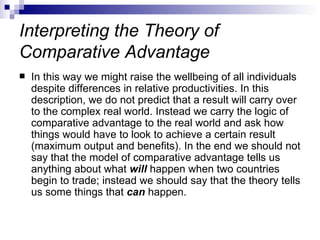
Interpreting the Theory of Comparative Advantage In this way we might raise the wellbeing of all individuals despite differences in relative productivities. In this description, we do not predict that a result will carry over to the complex real world. Instead we carry the logic of comparative advantage to the real world and ask how things would have to look to achieve a certain result (maximum output and benefits). In the end we should not say that the model of comparative advantage tells us anything about what  will  happen when two countries begin to trade; instead we should say that the theory tells us some things that  can  happen.

Absolute Advantage Theory

  • 1.
    The Theory of Comparative Advantage - Given by David Ricardo
  • 2.
    Background of theTheory the original description of the idea can be found in an Essay on the External Corn Trade by Robert Torrens in 1815. David Ricardo formalized the idea using a compelling, yet simple, numerical example in his 1817 book titled, On the Principles of Political Economy and Taxation . The idea appeared again in James Mill's Elements of Political Economy in 1821. Finally, the concept became a key feature of international political economy upon the publication of Principles of Political Economy by John Stuart Mill in 1848.
  • 3.
    Ricardo’s Idea ofComparative Advantage Ricardo's Law of Comparative Advantage improved upon the earlier Law of Absolute Advantage . How? If A (Advancedland) is more productive than B (Backwardland) in every productive activity, would both countries benefit from trade? The law of absolute advantage has no answer to this question. Ricardo's law of comparative advantage showed that the answer is yes .
  • 4.
    A country hasa comparative advantage in the production of a good or service that it produces The theory of comparative costs argues that, put simply, it is better for a country that is inefficient at producing a good or service to specialise in the production of that good it is least inefficient at, compared with producing other goods. Ricardo’s Idea of Comparative Advantage
  • 5.
    Assumptions 2*2*1 model Homogeneous goods Labor is homogeneous within a country but heterogeneous across countries. Complete mobility of labor in the country and complete immobility of labor across the country No transportation costs Full employment
  • 6.
    Assumptions Production technologydifferences exist across industries and across countries and are reflected in labor productivity parameters. The labor and goods markets are assumed to be perfectly competitive in both countries. Firms are assumed to maximize profit while consumers (workers) are assumed to maximize utility.
  • 7.
    Ricardo’s numerical exampleIn his example Ricardo imagined two countries, England and Portugal, producing two goods, cloth and wine, using labor as the sole input in production. He assumed that the productivity of labor varied between industries and across countries. Ricardo assumed that Portugal was more productive in both goods.
  • 8.
    Table-1 15 10Portugal 30 15 England Cost Per Unit In Man Hours Cost Per Unit In Man Hours Wine Wheat Country
  • 9.
    Ricardo’s numerical examplePortugal is relatively better at producing wine than wheat: so Portugal is said to have a COMPARATIVE ADVANTAGE in the production of wine. England is relatively better at producing wheat than wine: so England is said to have a comparative advantage in the production of wheat.
  • 10.
    Ricardo’s numerical exampleTable 2 shows how trade might be advantageous. Costs of production are as set out in Table 1. England is assumed to have 270 man hours available for production. Before trade takes place it produces and consumes 8 units of wheat and 5 units of wine. Portugal has fewer labour resources with 180 man hours of labour available for production. Before trade takes place it produces and consumes 9 units of wheat and 6 units of wine. Total production between the two economies is 17 units of wheat and 11 units of wine
  • 11.
    Table-2 T ot a l P o r t u g a l E n g l a n d C o u n t r y Production Wine Wheat Wine Wheat After Trade Before Trade 12 18 11 17 12 0 6 9 0 18 5 8
  • 12.
    Ricardo’s numerical exampleIf both countries now specialise, Portugal producing only wine and England producing only wheat, total production is 18 units of wheat and 12 units of wine. Specialisation has enabled the world economy to increase production by 1 unit of wheat and 1 unit of wine.
  • 13.
    Interpreting the Theoryof Comparative Advantage The garden story offers an intuitive explanation for the theory of comparative advantage and also provides a useful way of interpreting the model results. The usual way of stating the Ricardian model results is to say that countries will specialize in their comparative advantage good and trade them to the other country such that everyone in both countries benefit. Stated this way it is easy to imagine how it would not hold true in the complex real world. A better way to state the results is as follows. The Ricardian model shows that if we want to maximize total output in the world then,
  • 14.
    Interpreting the Theoryof Comparative Advantage first , fully employ all resources worldwide; second , allocate those resources within countries to each country's comparative advantage industries; and third , allow the countries to trade freely thereafter.
  • 15.
    Interpreting the Theoryof Comparative Advantage In this way we might raise the wellbeing of all individuals despite differences in relative productivities. In this description, we do not predict that a result will carry over to the complex real world. Instead we carry the logic of comparative advantage to the real world and ask how things would have to look to achieve a certain result (maximum output and benefits). In the end we should not say that the model of comparative advantage tells us anything about what will happen when two countries begin to trade; instead we should say that the theory tells us some things that can happen.