THEORIES OF CHILD
DEVELOPMENT
NAME : N. KALAIVANI
COLLEGE : SIVANTHI COLLEGE OF EDUCATION
TCP PRESENTO 2020, THIAGARAJAR COLLEGE OF PRECEPTORS, MADURAI.
 Psychologists have put forth their view points with respect to different aspects
of child development like physical,emotional, social.
 To attempt distinct stages found in each aspect of development and
characteristics that are known as theories of child development.
 Theory should allow us to predict and explain human behaviour.
INTRODUCTION
TCP PRESENTO 2020, THIAGARAJAR COLLEGE OF PRECEPTORS, MADURAI.
 Erikson's Theory of Psycho-social Development in Children.
 Jean Piaget's Theory of Cognitive Development in Children.
 Lawrence Kohlberg's Theory of Moral Development in Children.
 Lev Vygotsky's Socio-cultural Approach to Cognitive Development.
 Bronfenbrenner's Ecological Systems Theory.
THEORIES OF CHILD DEVELOPMENT
TCP PRESENTO 2020, THIAGARAJAR COLLEGE OF PRECEPTORS, MADURAI.
 E.H. Erikson listed a progression of developmental stages called Psycho-
social stages.
 Child encounters wide range of human relationships as he grows and has
specific problems to solve at each of these stages.
 8 stages of psycho-social development.
 Each has a unique development task.
 Development changes occurs throughout lifespan.
ERIKSON'S THEORY OF PSYCHO-SOCIAL
DEVELOPMENT IN CHILDREN
TCP PRESENTO 2020, THIAGARAJAR COLLEGE OF PRECEPTORS, MADURAI.
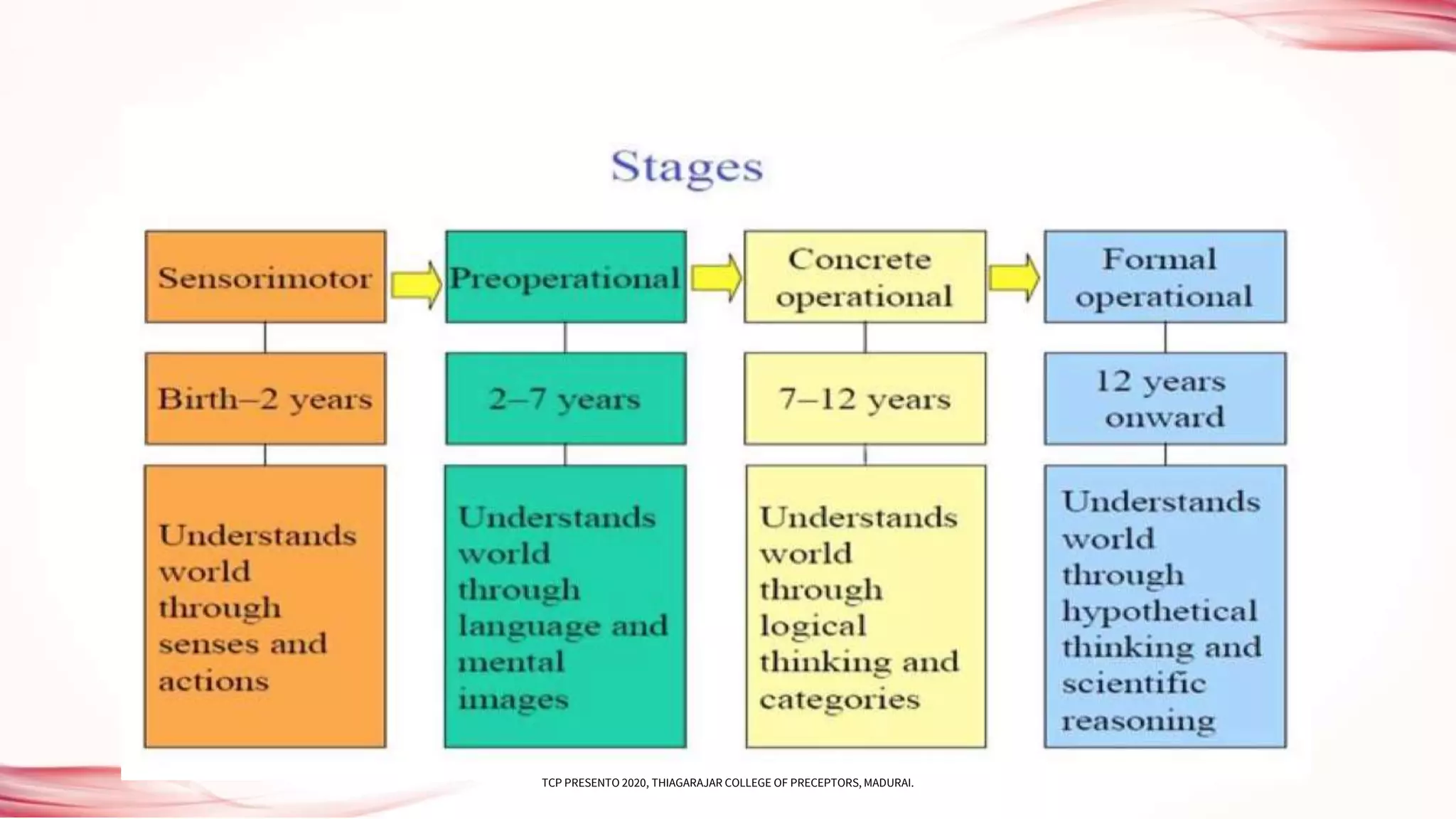
 It is a comprehensive theory about the nature and development of
human intelligence.
 According to him " to know an object one must act upon it either ". This
mental representation is called by Piaget as SCHEMA.
 Assimilation, Accommodation, Adaptation & Organization are termed
to be their components of cognitive process.
JEAN PIAGET'S THEORY OF COGNITIVE
DEVELOPMENT IN CHILDREN.
TCP PRESENTO 2020, THIAGARAJAR COLLEGE OF PRECEPTORS, MADURAI.
 Piaget connected cognitive development to moral reasoning.
 At first, children recognize "right and wrong" as determined by
authority figures.
 As children develop and think abstractly, they understand that the
same rules do not fill all situations - that there is no absolute right or
wrong.
JEAN PIAGET'S THEORY OF COGNITIVE
DEVELOPMENT IN CHILDREN.
TCP PRESENTO 2020, THIAGARAJAR COLLEGE OF PRECEPTORS, MADURAI.
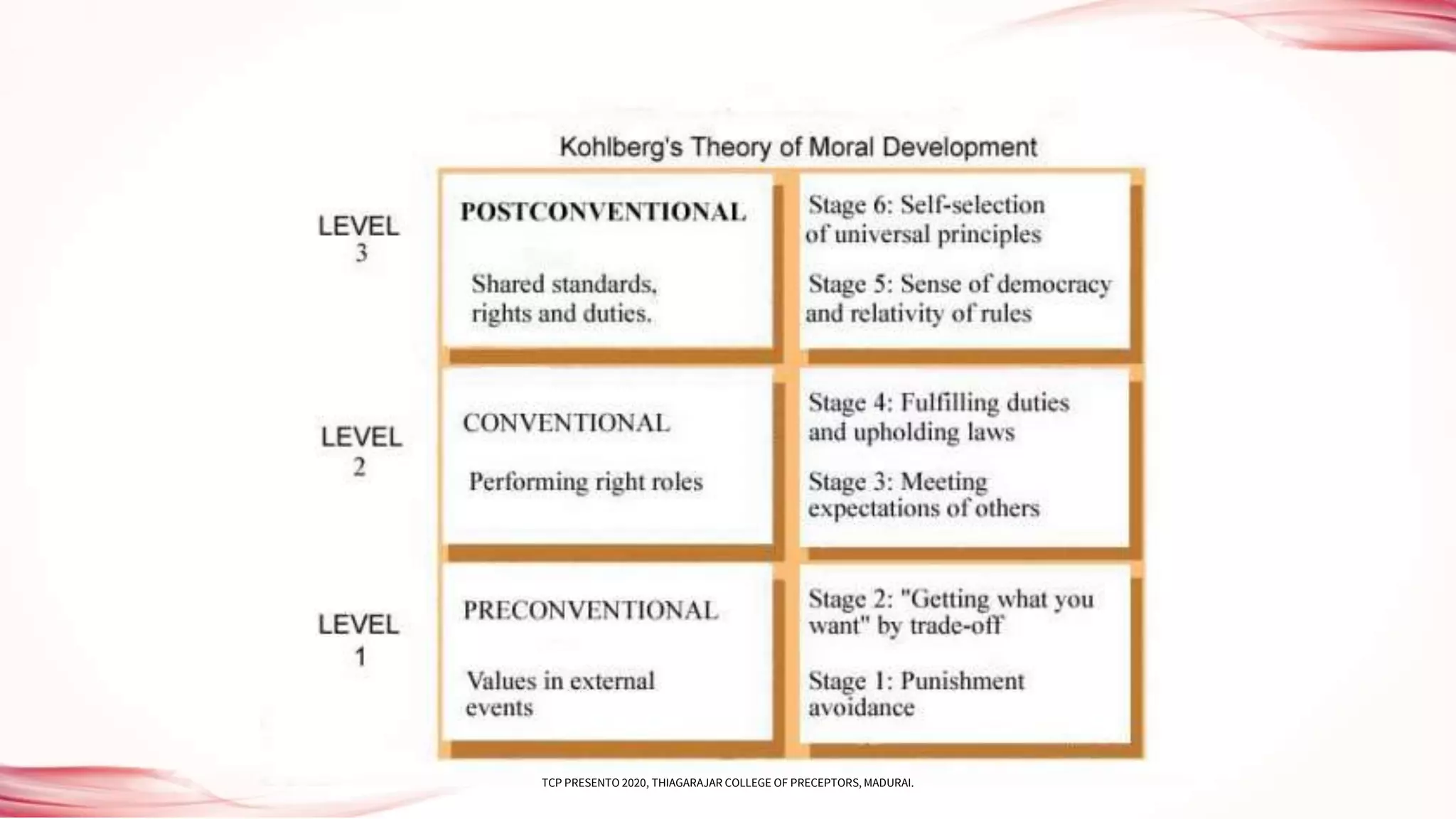
 Kohlberg's theory states that our ethical behavior stems from out
ability to reason.
 This scale illustrates how as humans we justify our behavior.
 Propose three distinct levels of moral reasoning: Pre-conventional,
Conventional, and Post-conventional.
 Each level is based on the degree to which a person conforms to
conventional standards of society.
KOHLBERG'S THEORY OF MORAL GROWTH
TCP PRESENTO 2020, THIAGARAJAR COLLEGE OF PRECEPTORS, MADURAI.
 Preconventional -
 Moral reasoning is based on external rewards and punishment.
 Characterized by the desire to avoid punishment or gain reward.
 Typically children under the age of 10.
 Conventional -
 Laws and rules are upheld simply because they are laws and rules.
KOHLBERG'S THEORY OF MORAL GROWTH
TCP PRESENTO 2020, THIAGARAJAR COLLEGE OF PRECEPTORS, MADURAI.
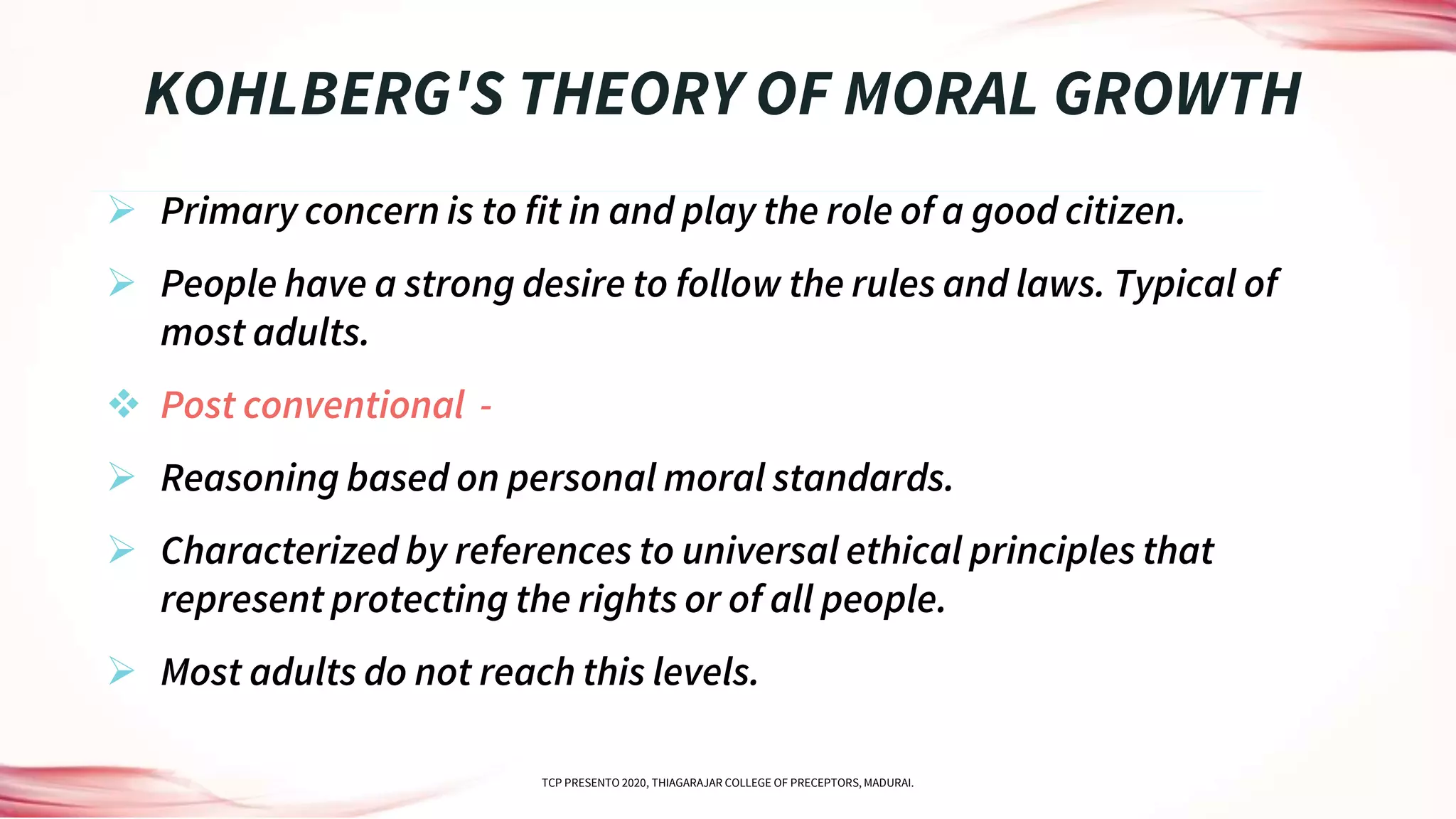
 Primary concern is to fit in and play the role of a good citizen.
 People have a strong desire to follow the rules and laws. Typical of
most adults.
 Post conventional -
 Reasoning based on personal moral standards.
 Characterized by references to universal ethical principles that
represent protecting the rights or of all people.
 Most adults do not reach this levels.
KOHLBERG'S THEORY OF MORAL GROWTH
TCP PRESENTO 2020, THIAGARAJAR COLLEGE OF PRECEPTORS, MADURAI.
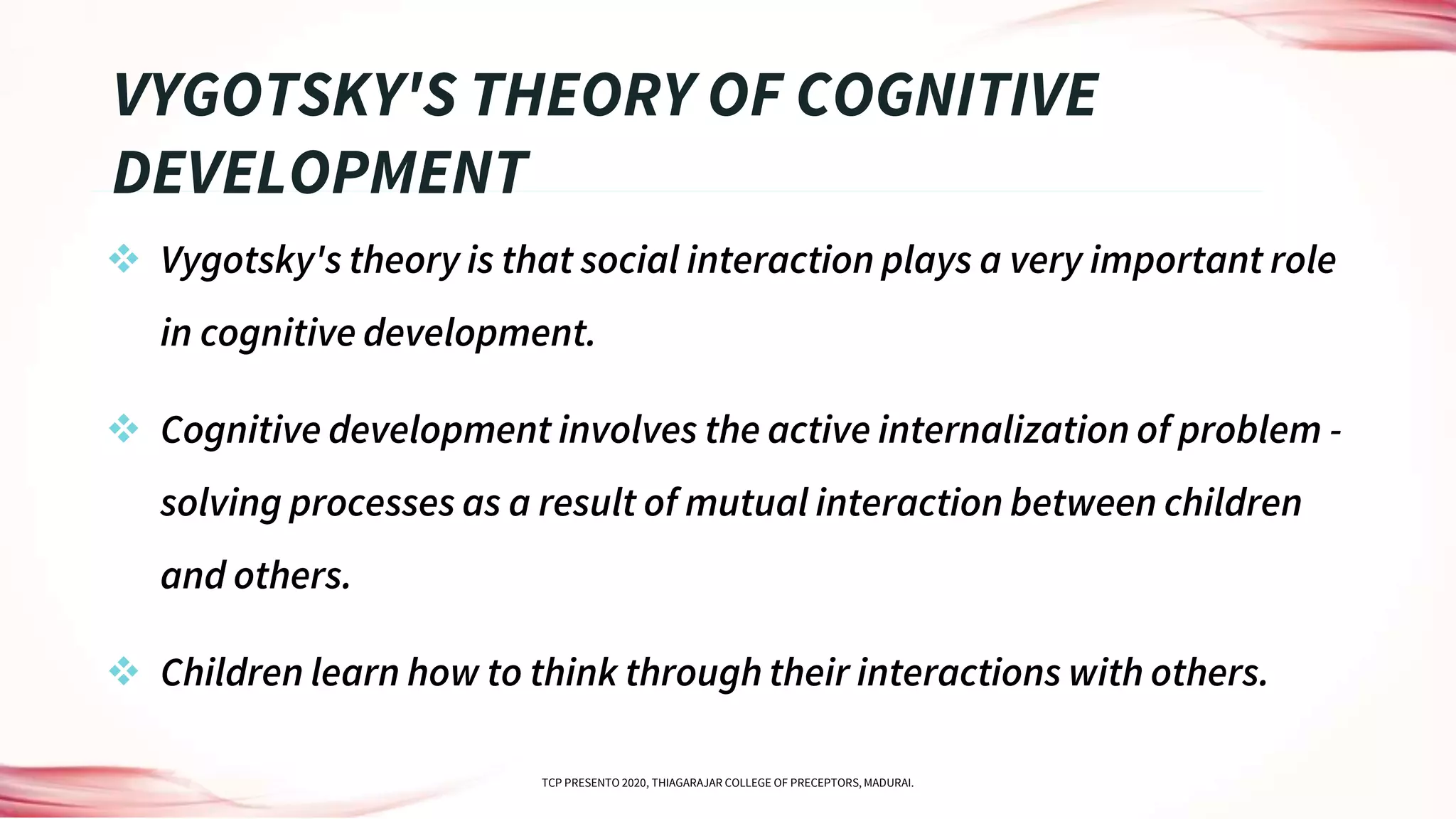
 Vygotsky's theory is that social interaction plays a very important role
in cognitive development.
 Cognitive development involves the active internalization of problem -
solving processes as a result of mutual interaction between children
and others.
 Children learn how to think through their interactions with others.
VYGOTSKY'S THEORY OF COGNITIVE
DEVELOPMENT
TCP PRESENTO 2020, THIAGARAJAR COLLEGE OF PRECEPTORS, MADURAI.
 Learning is largely mediated by social interaction of students and
"More Knowledgeable Others" (e.g. Teachers,
parents,coaches,experts,peers, etc.,)
VYGOTSKY'S THEORY OF COGNITIVE
DEVELOPMENT
TCP PRESENTO 2020, THIAGARAJAR COLLEGE OF PRECEPTORS, MADURAI.
1) Informal and formal conversations
2) Thought and language become independent
3) Complex mental processes begin as social activities.
4) Two levels of development:
5) Level of Actual Development
ASSUMPTIONS OF VYGOTSKY'S THEORY
TCP PRESENTO 2020, THIAGARAJAR COLLEGE OF PRECEPTORS, MADURAI.
 Level of Potential Development.
 Challenging tasks promote maximum cognitive growth. Vygotsky
described this as the Zone of Proximal Development ( ZPD ).
 Providing Scaffolding to make the child performing in the ZPD Zone.
 Play allows children to stretch themselves cognitively.
ASSUMPTIONS OF VYGOTSKY'S THEORY
TCP PRESENTO 2020, THIAGARAJAR COLLEGE OF PRECEPTORS, MADURAI.
 Urie Bronfenbrenner developed an ecological system that offers a
framework through which community psychologists examine
individuals' relationships within communities and the wider society.
 The theory is also commonly referred to as the ecological/systems
framework.
 It identifies five environmental systems with which an individual
interacts.
BRONFENBRENNER'S ECOLOGICAL SYSTEMS
THEORY
TCP PRESENTO 2020, THIAGARAJAR COLLEGE OF PRECEPTORS, MADURAI.
 Micro system : Refers to the institutions and groups that most
immediately and directly impact the child's development including:
family, school, religious institutions, neighborhood, and peers.
 Mesosystem : Consists of interconnections between the micro systems,
for example between the family and teachers or between the child’s
peers and the family.
BRONFENBRENNER'S ECOLOGICAL SYSTEMS
THEORY
TCP PRESENTO 2020, THIAGARAJAR COLLEGE OF PRECEPTORS, MADURAI.
 Exosystem : Involves links between social settings that do not involve the
child. For example, a child's experience at home may be influenced by their
parent's experiences at work. A parent might receive a promotion that
requires more travel, which in turn increases conflict with the other parent
resulting in changes in their patterns of interaction with the child.
 Macrosystem : Describes the overarching culture that influences the
developing child, as well as the micro systems and meso systems embedded in
those cultures. Cultural contexts can differ based on geographic location,
socioeconomic status, poverty, and ethnicity.
BRONFENBRENNER'S ECOLOGICAL SYSTEMS
THEORY
TCP PRESENTO 2020, THIAGARAJAR COLLEGE OF PRECEPTORS, MADURAI.
 Chronosystem : Consists of the pattern of environmental events and
transitions over the life course, as well as changing socio-historical
circumstances. For example, researchers have found that the negative
effects of divorce on children often peak in the first year after the
divorce. By two years after the divorce, family interaction is less
chaotic and more stable.
BRONFENBRENNER'S ECOLOGICAL SYSTEMS
THEORY
TCP PRESENTO 2020, THIAGARAJAR COLLEGE OF PRECEPTORS, MADURAI.
• http://mrmcnabb.weebly.com/moral-development
• https://raymondpronk.wordpress.com/2017/09/17/jean-piaget-piaget-
theory-of-cognitive-development-videos/
• Https://en.wikipedia.org/wiki/Ecological_systems_theory
REFERENCE LINKS
TCP PRESENTO 2020, THIAGARAJAR COLLEGE OF PRECEPTORS, MADURAI.
THANK YOU..
TCP PRESENTO 2020, THIAGARAJAR COLLEGE OF PRECEPTORS, MADURAI.

THEORIES OF CHILD DEVELOPMENT

  • 1.
    THEORIES OF CHILD DEVELOPMENT NAME: N. KALAIVANI COLLEGE : SIVANTHI COLLEGE OF EDUCATION TCP PRESENTO 2020, THIAGARAJAR COLLEGE OF PRECEPTORS, MADURAI.
  • 2.
     Psychologists haveput forth their view points with respect to different aspects of child development like physical,emotional, social.  To attempt distinct stages found in each aspect of development and characteristics that are known as theories of child development.  Theory should allow us to predict and explain human behaviour. INTRODUCTION TCP PRESENTO 2020, THIAGARAJAR COLLEGE OF PRECEPTORS, MADURAI.
  • 3.
     Erikson's Theoryof Psycho-social Development in Children.  Jean Piaget's Theory of Cognitive Development in Children.  Lawrence Kohlberg's Theory of Moral Development in Children.  Lev Vygotsky's Socio-cultural Approach to Cognitive Development.  Bronfenbrenner's Ecological Systems Theory. THEORIES OF CHILD DEVELOPMENT TCP PRESENTO 2020, THIAGARAJAR COLLEGE OF PRECEPTORS, MADURAI.
  • 4.
     E.H. Eriksonlisted a progression of developmental stages called Psycho- social stages.  Child encounters wide range of human relationships as he grows and has specific problems to solve at each of these stages.  8 stages of psycho-social development.  Each has a unique development task.  Development changes occurs throughout lifespan. ERIKSON'S THEORY OF PSYCHO-SOCIAL DEVELOPMENT IN CHILDREN TCP PRESENTO 2020, THIAGARAJAR COLLEGE OF PRECEPTORS, MADURAI.
  • 5.
    TCP PRESENTO 2020,THIAGARAJAR COLLEGE OF PRECEPTORS, MADURAI.
  • 6.
     It isa comprehensive theory about the nature and development of human intelligence.  According to him " to know an object one must act upon it either ". This mental representation is called by Piaget as SCHEMA.  Assimilation, Accommodation, Adaptation & Organization are termed to be their components of cognitive process. JEAN PIAGET'S THEORY OF COGNITIVE DEVELOPMENT IN CHILDREN. TCP PRESENTO 2020, THIAGARAJAR COLLEGE OF PRECEPTORS, MADURAI.
  • 7.
     Piaget connectedcognitive development to moral reasoning.  At first, children recognize "right and wrong" as determined by authority figures.  As children develop and think abstractly, they understand that the same rules do not fill all situations - that there is no absolute right or wrong. JEAN PIAGET'S THEORY OF COGNITIVE DEVELOPMENT IN CHILDREN. TCP PRESENTO 2020, THIAGARAJAR COLLEGE OF PRECEPTORS, MADURAI.
  • 8.
    TCP PRESENTO 2020,THIAGARAJAR COLLEGE OF PRECEPTORS, MADURAI.
  • 9.
     Kohlberg's theorystates that our ethical behavior stems from out ability to reason.  This scale illustrates how as humans we justify our behavior.  Propose three distinct levels of moral reasoning: Pre-conventional, Conventional, and Post-conventional.  Each level is based on the degree to which a person conforms to conventional standards of society. KOHLBERG'S THEORY OF MORAL GROWTH TCP PRESENTO 2020, THIAGARAJAR COLLEGE OF PRECEPTORS, MADURAI.
  • 10.
     Preconventional - Moral reasoning is based on external rewards and punishment.  Characterized by the desire to avoid punishment or gain reward.  Typically children under the age of 10.  Conventional -  Laws and rules are upheld simply because they are laws and rules. KOHLBERG'S THEORY OF MORAL GROWTH TCP PRESENTO 2020, THIAGARAJAR COLLEGE OF PRECEPTORS, MADURAI.
  • 11.
     Primary concernis to fit in and play the role of a good citizen.  People have a strong desire to follow the rules and laws. Typical of most adults.  Post conventional -  Reasoning based on personal moral standards.  Characterized by references to universal ethical principles that represent protecting the rights or of all people.  Most adults do not reach this levels. KOHLBERG'S THEORY OF MORAL GROWTH TCP PRESENTO 2020, THIAGARAJAR COLLEGE OF PRECEPTORS, MADURAI.
  • 12.
    TCP PRESENTO 2020,THIAGARAJAR COLLEGE OF PRECEPTORS, MADURAI.
  • 13.
     Vygotsky's theoryis that social interaction plays a very important role in cognitive development.  Cognitive development involves the active internalization of problem - solving processes as a result of mutual interaction between children and others.  Children learn how to think through their interactions with others. VYGOTSKY'S THEORY OF COGNITIVE DEVELOPMENT TCP PRESENTO 2020, THIAGARAJAR COLLEGE OF PRECEPTORS, MADURAI.
  • 14.
     Learning islargely mediated by social interaction of students and "More Knowledgeable Others" (e.g. Teachers, parents,coaches,experts,peers, etc.,) VYGOTSKY'S THEORY OF COGNITIVE DEVELOPMENT TCP PRESENTO 2020, THIAGARAJAR COLLEGE OF PRECEPTORS, MADURAI.
  • 15.
    1) Informal andformal conversations 2) Thought and language become independent 3) Complex mental processes begin as social activities. 4) Two levels of development: 5) Level of Actual Development ASSUMPTIONS OF VYGOTSKY'S THEORY TCP PRESENTO 2020, THIAGARAJAR COLLEGE OF PRECEPTORS, MADURAI.
  • 16.
     Level ofPotential Development.  Challenging tasks promote maximum cognitive growth. Vygotsky described this as the Zone of Proximal Development ( ZPD ).  Providing Scaffolding to make the child performing in the ZPD Zone.  Play allows children to stretch themselves cognitively. ASSUMPTIONS OF VYGOTSKY'S THEORY TCP PRESENTO 2020, THIAGARAJAR COLLEGE OF PRECEPTORS, MADURAI.
  • 17.
     Urie Bronfenbrennerdeveloped an ecological system that offers a framework through which community psychologists examine individuals' relationships within communities and the wider society.  The theory is also commonly referred to as the ecological/systems framework.  It identifies five environmental systems with which an individual interacts. BRONFENBRENNER'S ECOLOGICAL SYSTEMS THEORY TCP PRESENTO 2020, THIAGARAJAR COLLEGE OF PRECEPTORS, MADURAI.
  • 18.
    TCP PRESENTO 2020,THIAGARAJAR COLLEGE OF PRECEPTORS, MADURAI.
  • 19.
     Micro system: Refers to the institutions and groups that most immediately and directly impact the child's development including: family, school, religious institutions, neighborhood, and peers.  Mesosystem : Consists of interconnections between the micro systems, for example between the family and teachers or between the child’s peers and the family. BRONFENBRENNER'S ECOLOGICAL SYSTEMS THEORY TCP PRESENTO 2020, THIAGARAJAR COLLEGE OF PRECEPTORS, MADURAI.
  • 20.
     Exosystem :Involves links between social settings that do not involve the child. For example, a child's experience at home may be influenced by their parent's experiences at work. A parent might receive a promotion that requires more travel, which in turn increases conflict with the other parent resulting in changes in their patterns of interaction with the child.  Macrosystem : Describes the overarching culture that influences the developing child, as well as the micro systems and meso systems embedded in those cultures. Cultural contexts can differ based on geographic location, socioeconomic status, poverty, and ethnicity. BRONFENBRENNER'S ECOLOGICAL SYSTEMS THEORY TCP PRESENTO 2020, THIAGARAJAR COLLEGE OF PRECEPTORS, MADURAI.
  • 21.
     Chronosystem :Consists of the pattern of environmental events and transitions over the life course, as well as changing socio-historical circumstances. For example, researchers have found that the negative effects of divorce on children often peak in the first year after the divorce. By two years after the divorce, family interaction is less chaotic and more stable. BRONFENBRENNER'S ECOLOGICAL SYSTEMS THEORY TCP PRESENTO 2020, THIAGARAJAR COLLEGE OF PRECEPTORS, MADURAI.
  • 22.
    • http://mrmcnabb.weebly.com/moral-development • https://raymondpronk.wordpress.com/2017/09/17/jean-piaget-piaget- theory-of-cognitive-development-videos/ •Https://en.wikipedia.org/wiki/Ecological_systems_theory REFERENCE LINKS TCP PRESENTO 2020, THIAGARAJAR COLLEGE OF PRECEPTORS, MADURAI.
  • 23.
    THANK YOU.. TCP PRESENTO2020, THIAGARAJAR COLLEGE OF PRECEPTORS, MADURAI.