VISION
A Catholic Ignacian Marian
Institution of diverse culture
that empowers learners toward
service for the common good
thereby contribute to the
transformation of the world.
MISSION
NDRVMCC commits itself to:
1. Develop Ignacian-Marian Leaders who are witnesses of
Faith, Excellence and Services
2. Intensify instruction by pursuing innovative programs
that employ relevant educational strategies for
technological advancement and stewarship of creation
3. Enhance linkages and build up resources to facilitate
institution, research, and community involvement for
quality life.
APProaches to HUMAN
DEVELOPMENT
Topic 2:
1.) Traditional Perspective
• Believes that individuals will show extensive change
from birth to adolescence, little or no change in
adulthood and decline in late old age
2. Life Span Approach
Believes that even in adulthood,
developmental change takes place as it
does
during childhood.
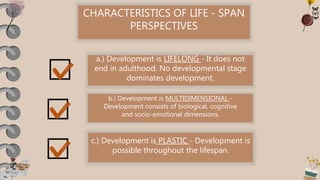
CHARACTERISTICS OF LIFE - SPAN
PERSPECTIVES
b.) Development is MULTIDIMENSIONAL -
Development consists of biological, cognitive
and socio-emotional dimensions.
c.) Development is PLASTIC - Development is
possible throughout the lifespan.
a.) Development is LIFELONG - It does not
end in adulthood. No developmental stage
dominates development.
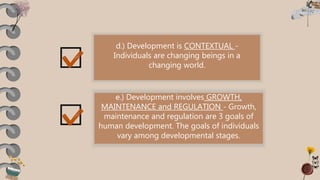
d.) Development is CONTEXTUAL -
Individuals are changing beings in a
changing world.
e.) Development involves GROWTH,
MAINTENANCE and REGULATION - Growth,
maintenance and regulation are 3 goals of
human development. The goals of individuals
vary among developmental stages.
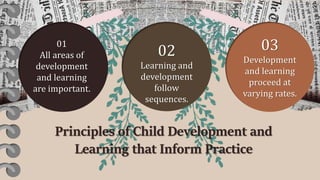
01
All areas of
development
and learning
are important.
02
Learning and
development
follow
sequences.
03
Development
and learning
proceed at
varying rates.
Principles of Child Development and
Learning that Inform Practice
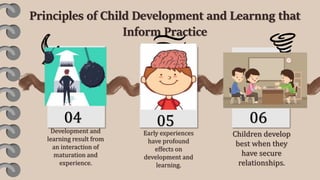
Development and
learning result from
an interaction of
maturation and
experience.
Early experiences
have profound
effects on
development and
learning.
Children develop
best when they
have secure
relationships.
Principles of Child Development and Learnng that
Inform Practice
04 05 06
Principles of Child Development and Learning
that Inform Practice
07. Development proceeds toward greater complexity, self-
regulation, and symbolic or representational capacities.
08. Development and learning occur in and are influenced by
multiple social and cultural contexts.
09. Children learn in a variety of ways.
10. Play is an important vehicle for developing self-regulation and
promoting language, cognition, and social competence.
11. Development and learning advance when children are
challenged.
12. Children‘s experiences shape their motivation and approaches to
learning.
Thank You
For Listening!
Identification:
1. it is consists of biological, cognitive and
emotional dimensions.
Development is MULTIDIMENSIONAL
2. Three goals of human development. The
goals of individuals vary among developmental
stages.
Development involves GROWTH,
MAINTENANCE and REGULATION
3. It does not end in adulthood. No
developmental stage dominates development.
Development is LIFELONG
4.Development is possible throughout the
lifespan .
Development is PLASTIC
5. Individuals are changing beings in a
world.
Development is CONTEXTUAL
6. show extensive change from birth to adolescence,
little or no change in adulthood and decline in late
old age.
Tradition Perspective
7. Believes that even in adulthood, developmental
change takes place as it does during childhood.
Life-span approach
8. believes that income determines the level of
freedom that one enjoys.
Income Approach
9. responsible for providing basic facilities like health,
education, and amenities to people.
Welfare Approach
10. aims to build human capabilities health, education
and access to resources in order to increase human
development.
Capability Approach
Reflection:
If you were given a chance, which
CHARACTERISTICS OF LIFE - SPAN
PERSPECTIVES would you like to be
in? Why?
APPROACHES-to-HUMAN-DEVELOPMENT.pptx

APPROACHES-to-HUMAN-DEVELOPMENT.pptx

  • 2.
    VISION A Catholic IgnacianMarian Institution of diverse culture that empowers learners toward service for the common good thereby contribute to the transformation of the world.
  • 3.
    MISSION NDRVMCC commits itselfto: 1. Develop Ignacian-Marian Leaders who are witnesses of Faith, Excellence and Services 2. Intensify instruction by pursuing innovative programs that employ relevant educational strategies for technological advancement and stewarship of creation 3. Enhance linkages and build up resources to facilitate institution, research, and community involvement for quality life.
  • 4.
  • 5.
    1.) Traditional Perspective •Believes that individuals will show extensive change from birth to adolescence, little or no change in adulthood and decline in late old age
  • 6.
    2. Life SpanApproach Believes that even in adulthood, developmental change takes place as it does during childhood.
  • 7.
    CHARACTERISTICS OF LIFE- SPAN PERSPECTIVES b.) Development is MULTIDIMENSIONAL - Development consists of biological, cognitive and socio-emotional dimensions. c.) Development is PLASTIC - Development is possible throughout the lifespan. a.) Development is LIFELONG - It does not end in adulthood. No developmental stage dominates development.
  • 8.
    d.) Development isCONTEXTUAL - Individuals are changing beings in a changing world. e.) Development involves GROWTH, MAINTENANCE and REGULATION - Growth, maintenance and regulation are 3 goals of human development. The goals of individuals vary among developmental stages.
  • 9.
    01 All areas of development andlearning are important. 02 Learning and development follow sequences. 03 Development and learning proceed at varying rates. Principles of Child Development and Learning that Inform Practice
  • 10.
    Development and learning resultfrom an interaction of maturation and experience. Early experiences have profound effects on development and learning. Children develop best when they have secure relationships. Principles of Child Development and Learnng that Inform Practice 04 05 06
  • 11.
    Principles of ChildDevelopment and Learning that Inform Practice 07. Development proceeds toward greater complexity, self- regulation, and symbolic or representational capacities. 08. Development and learning occur in and are influenced by multiple social and cultural contexts. 09. Children learn in a variety of ways. 10. Play is an important vehicle for developing self-regulation and promoting language, cognition, and social competence. 11. Development and learning advance when children are challenged. 12. Children‘s experiences shape their motivation and approaches to learning.
  • 12.
  • 13.
    Identification: 1. it isconsists of biological, cognitive and emotional dimensions. Development is MULTIDIMENSIONAL 2. Three goals of human development. The goals of individuals vary among developmental stages. Development involves GROWTH, MAINTENANCE and REGULATION 3. It does not end in adulthood. No developmental stage dominates development. Development is LIFELONG 4.Development is possible throughout the lifespan . Development is PLASTIC 5. Individuals are changing beings in a world. Development is CONTEXTUAL 6. show extensive change from birth to adolescence, little or no change in adulthood and decline in late old age. Tradition Perspective 7. Believes that even in adulthood, developmental change takes place as it does during childhood. Life-span approach 8. believes that income determines the level of freedom that one enjoys. Income Approach 9. responsible for providing basic facilities like health, education, and amenities to people. Welfare Approach 10. aims to build human capabilities health, education and access to resources in order to increase human development. Capability Approach
  • 14.
    Reflection: If you weregiven a chance, which CHARACTERISTICS OF LIFE - SPAN PERSPECTIVES would you like to be in? Why?