Theoretical and Practical Design Considerations for a Small, Multi-Band SAR: The SlimSAR 26 July 2010 Evan Zaugg, Matthew Edwards, and Alex Margulis  ARTEMIS Inc.  Hauppauge, NY
Introduction Design Heritage SlimSAR System Design Details Methodology Multiple Operating Frequencies Deramp Mode System Performance Trade-offs and Flexibility Example SAR Imagery Conclusion
Introduction:  Using SAR on a Small UAS UAS are extremely useful in dangerous, remote, or long duration situations Provide intelligence, surveillance, and reconnaissance capabilities Electro-optic/infrared (EO/IR) instruments are useful and very common Limited by obstruction due to clouds, fog, dust, and smoke Synthetic aperture radar (SAR) can be used on larger platforms Provides high-resolution imagery Day and night All weather conditions Additional information available at different frequencies Change detection Shallow dry-ground penetration Enhanced target detection Operating a SAR on a small UAS is beneficial Often precluded by size weight and power (SWAP) of SAR systems
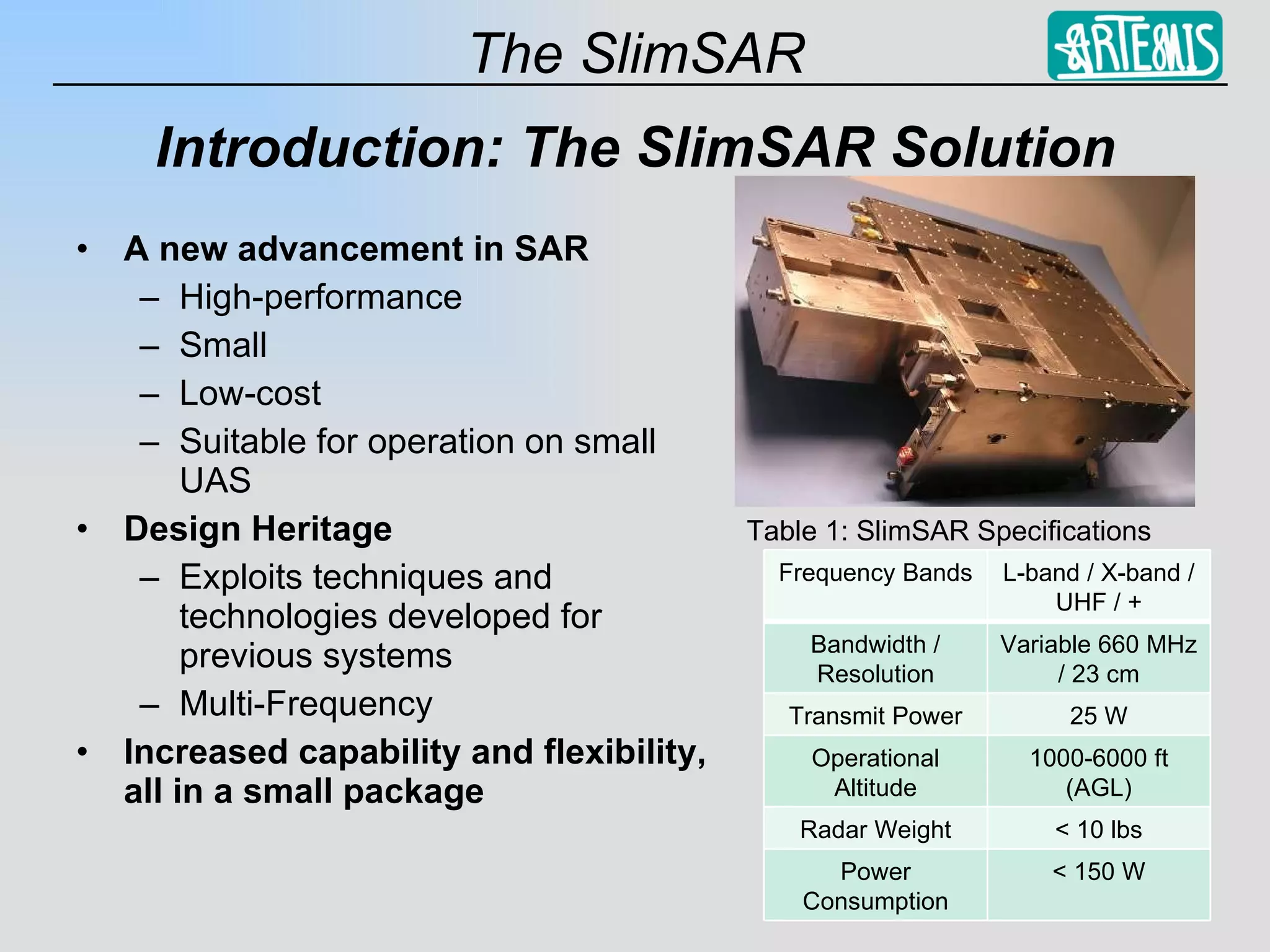
Introduction: The SlimSAR Solution A new advancement in SAR High-performance Small Low-cost Suitable for operation on small UAS Design Heritage Exploits techniques and technologies developed for previous systems Multi-Frequency Increased capability and flexibility, all in a small package Table 1: SlimSAR Specifications Frequency Bands L-band / X-band / UHF / + Bandwidth / Resolution Variable 660 MHz / 23 cm Transmit Power 25 W Operational Altitude 1000-6000 ft (AGL) Radar Weight < 10 lbs Power Consumption < 150 W
History ARTEMIS, Inc. has been supporting SAR programs for over a decade with development and manufacturing Our receivers, exciters, and up-converters (REUs) are a part of Global Hawk U-2 ASTOR. Recent experimental programs include UAVSAR (with Jet Propulsion Laboratory) NuSAR (with the Naval Research Laboratory and Space Dynamics Laboratory) MicroASAR (with Brigham Young University)
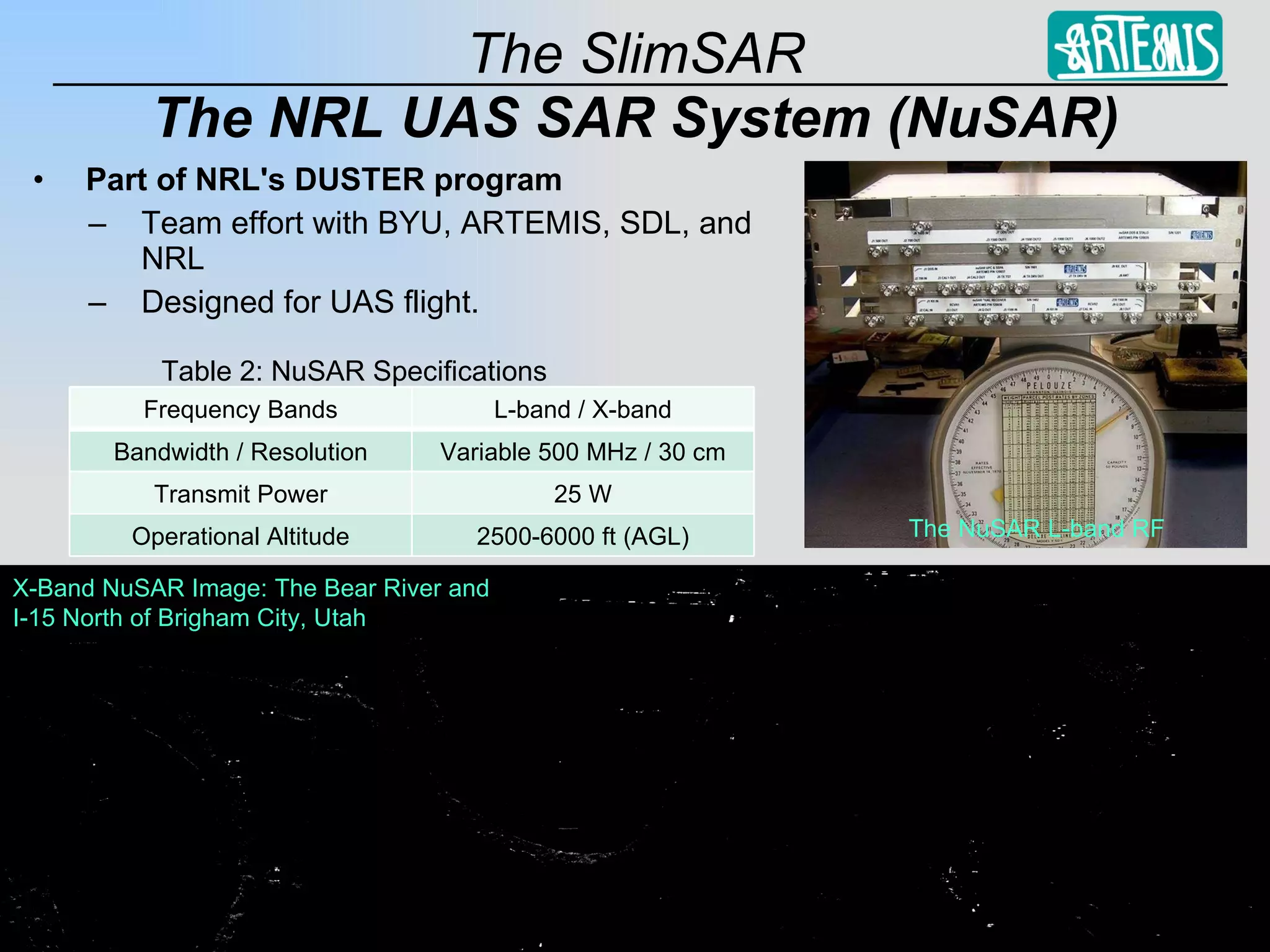
The NRL UAS SAR System (NuSAR) Part of NRL's DUSTER program Team effort with BYU, ARTEMIS, SDL, and NRL Designed for UAS flight.  X-Band NuSAR Image: The Bear River and I-15 North of Brigham City, Utah The NuSAR L-band RF Table 2: NuSAR Specifications Frequency Bands L-band / X-band Bandwidth / Resolution Variable 500 MHz / 30 cm Transmit Power 25 W Operational Altitude 2500-6000 ft (AGL)
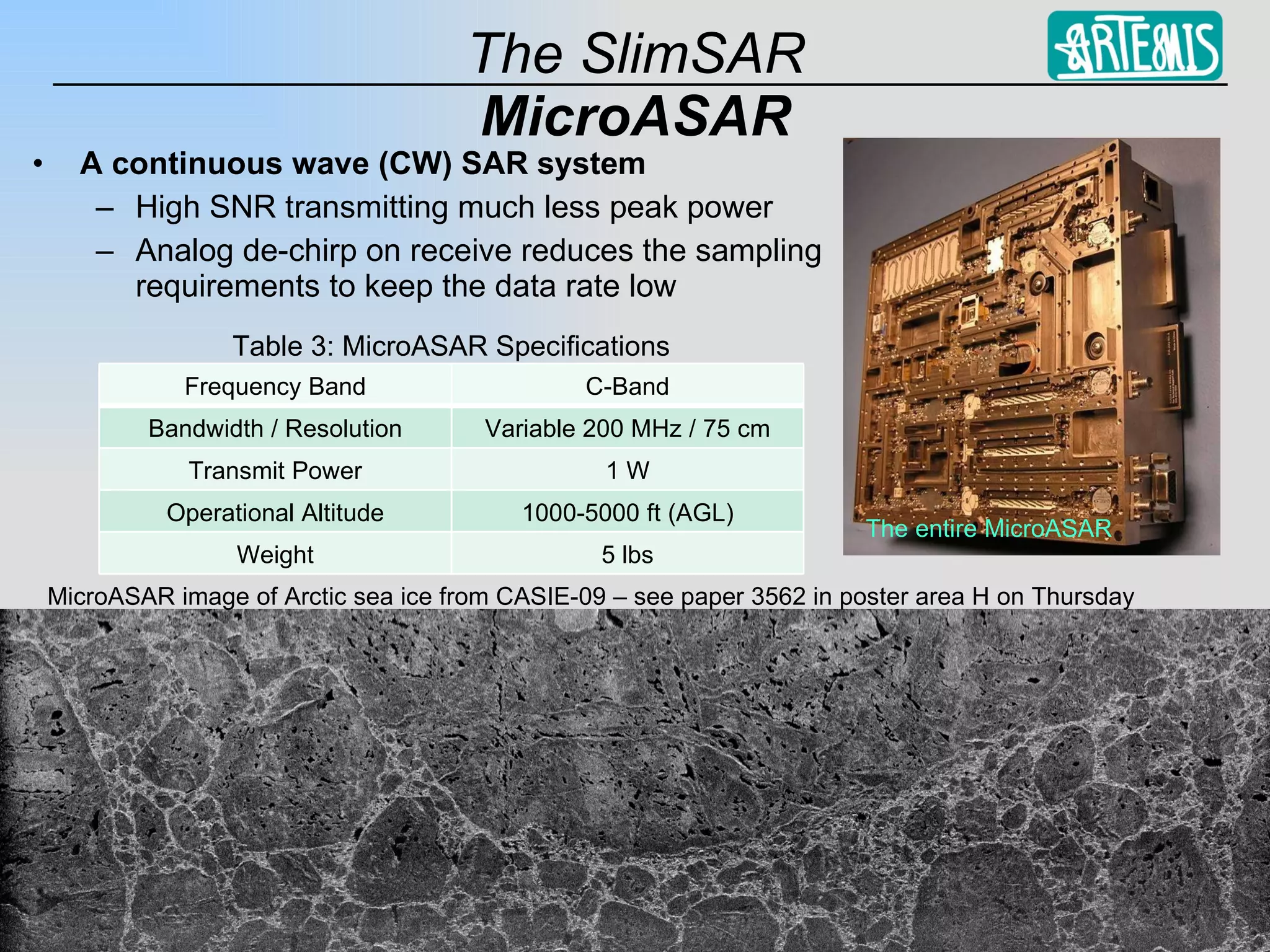
MicroASAR A continuous wave (CW) SAR system High SNR transmitting much less peak power Analog de-chirp on receive reduces the sampling requirements to keep the data rate low The entire MicroASAR Table 3: MicroASAR Specifications MicroASAR image of Arctic sea ice from CASIE-09 – see paper 3562 in poster area H on Thursday Frequency Band C-Band Bandwidth / Resolution Variable 200 MHz / 75 cm Transmit Power 1 W Operational Altitude 1000-5000 ft (AGL) Weight 5 lbs
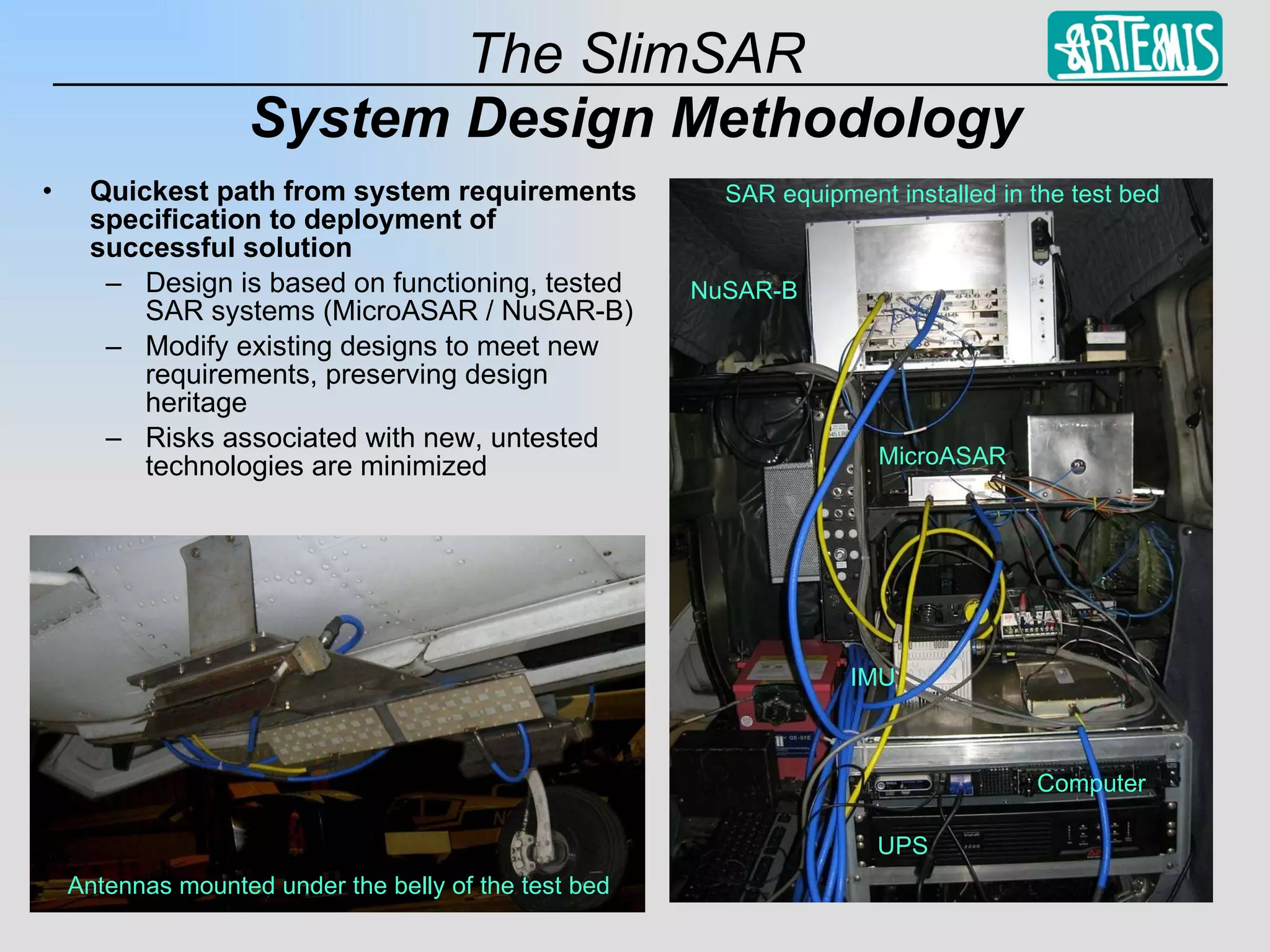
System Design Methodology Quickest path from system requirements specification to deployment of successful solution Design is based on functioning, tested SAR systems (MicroASAR / NuSAR-B) Modify existing designs to meet new requirements, preserving design heritage Risks associated with new, untested technologies are minimized Antennas mounted under the belly of the test bed SAR equipment installed in the test bed NuSAR-B MicroASAR Computer UPS IMU
System Design Methodology Benefits in system testing and integration MicroASAR has been operating during the SlimSAR development period on a small, manned aircraft which is used as a UAS surrogate Test and refine data collection, handling, and processing methods which are used with very little modification for SlimSAR Ready for initial flight testing as soon as the hardware is completed Immediate flight testing on the test bed aircraft reveals any changes which may be necessary in the processing algorithms or other supporting systems A Cessna O-2 Skymaster, our test bed aircraft “Surf Angel” on the runway at Brigham City, Utah
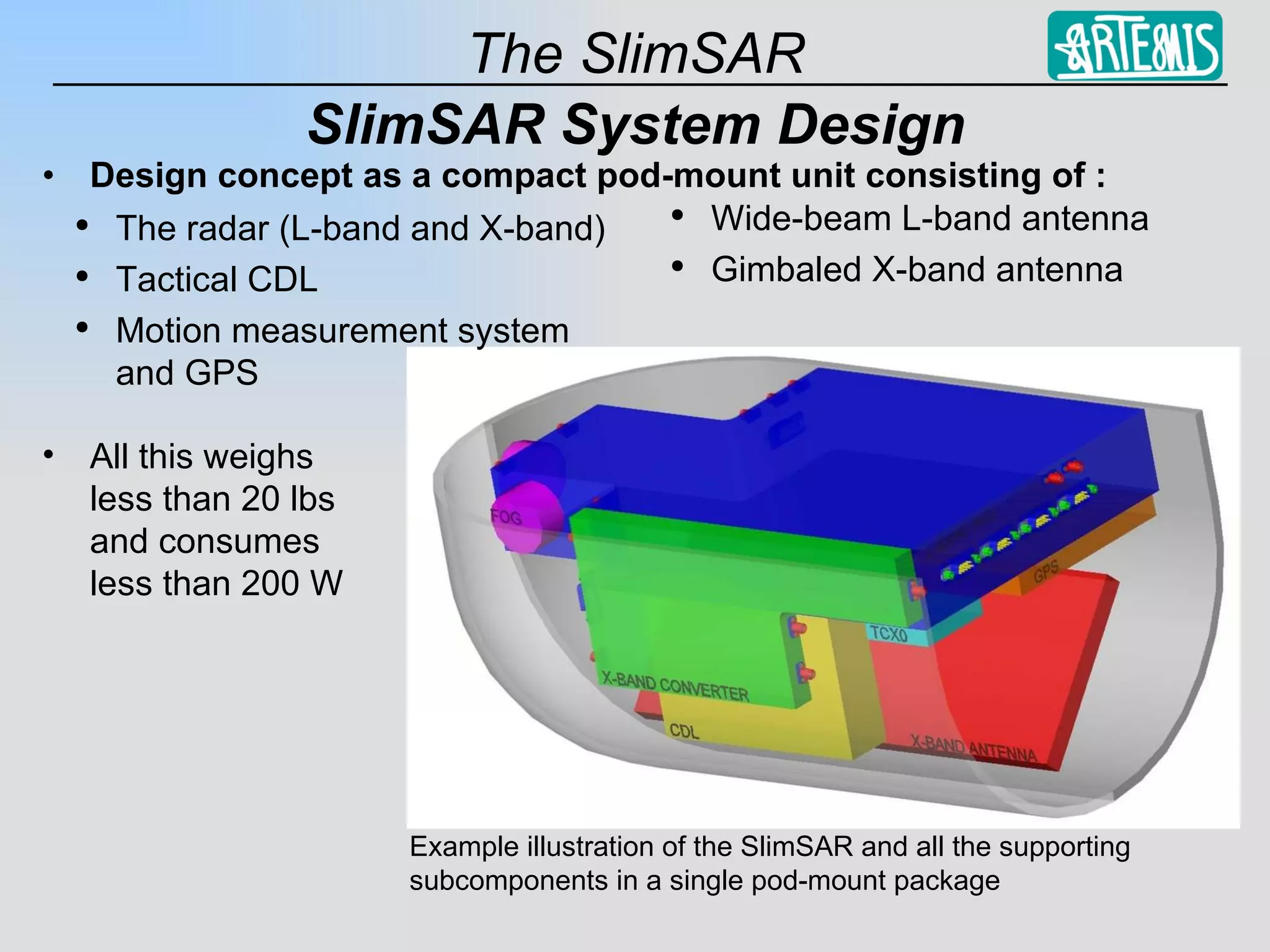
SlimSAR System Design Design concept as a compact pod-mount unit consisting of : Wide-beam L-band antenna Gimbaled X-band antenna The radar (L-band and X-band) Tactical CDL Motion measurement system and GPS Example illustration of the SlimSAR and all the supporting subcomponents in a single pod-mount package All this weighs less than 20 lbs and consumes less than 200 W
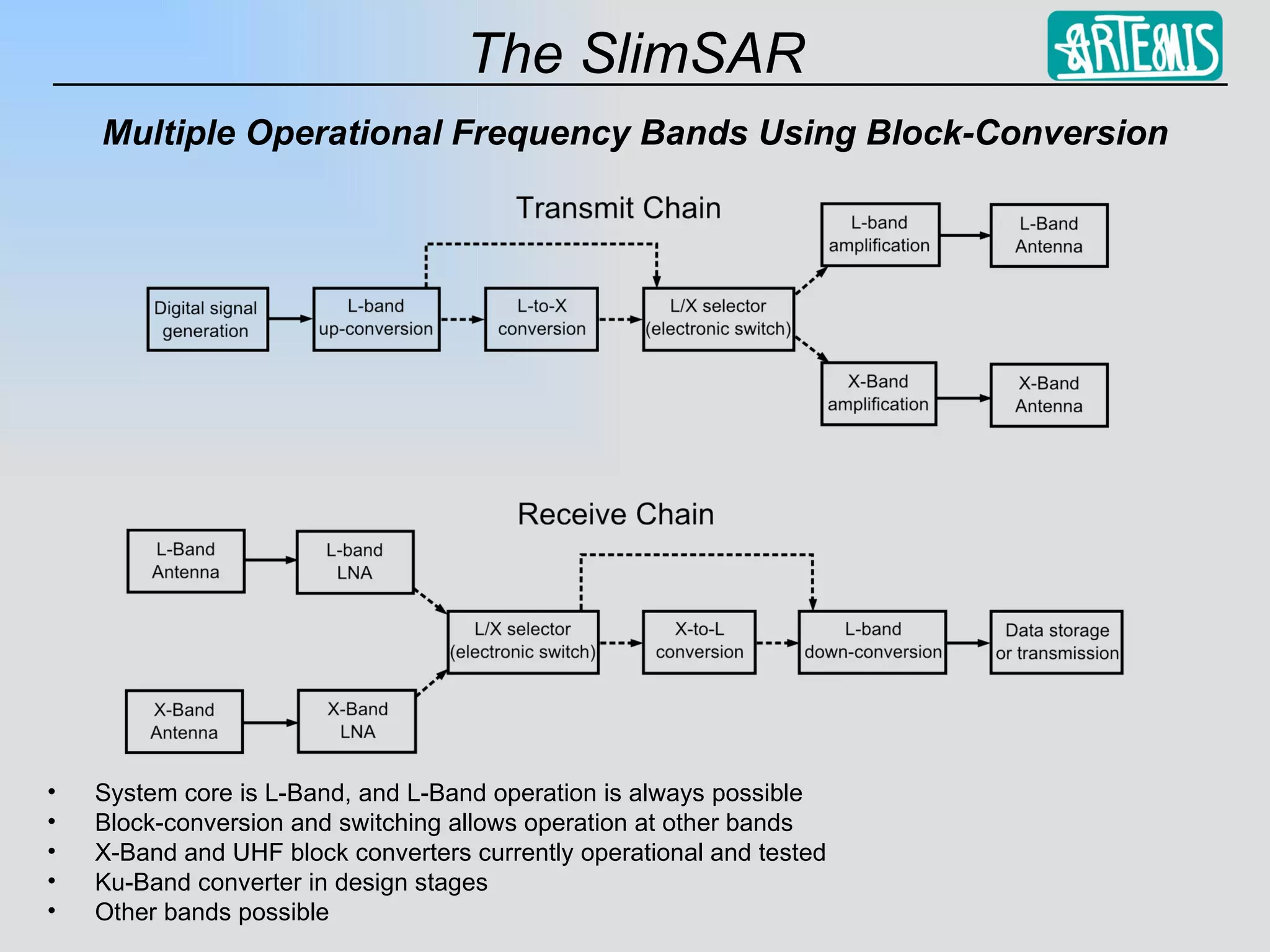
Multiple Operational Frequency Bands Using Block-Conversion System core is L-Band, and L-Band operation is always possible Block-conversion and switching allows operation at other bands X-Band and UHF block converters currently operational and tested Ku-Band converter in design stages Other bands possible
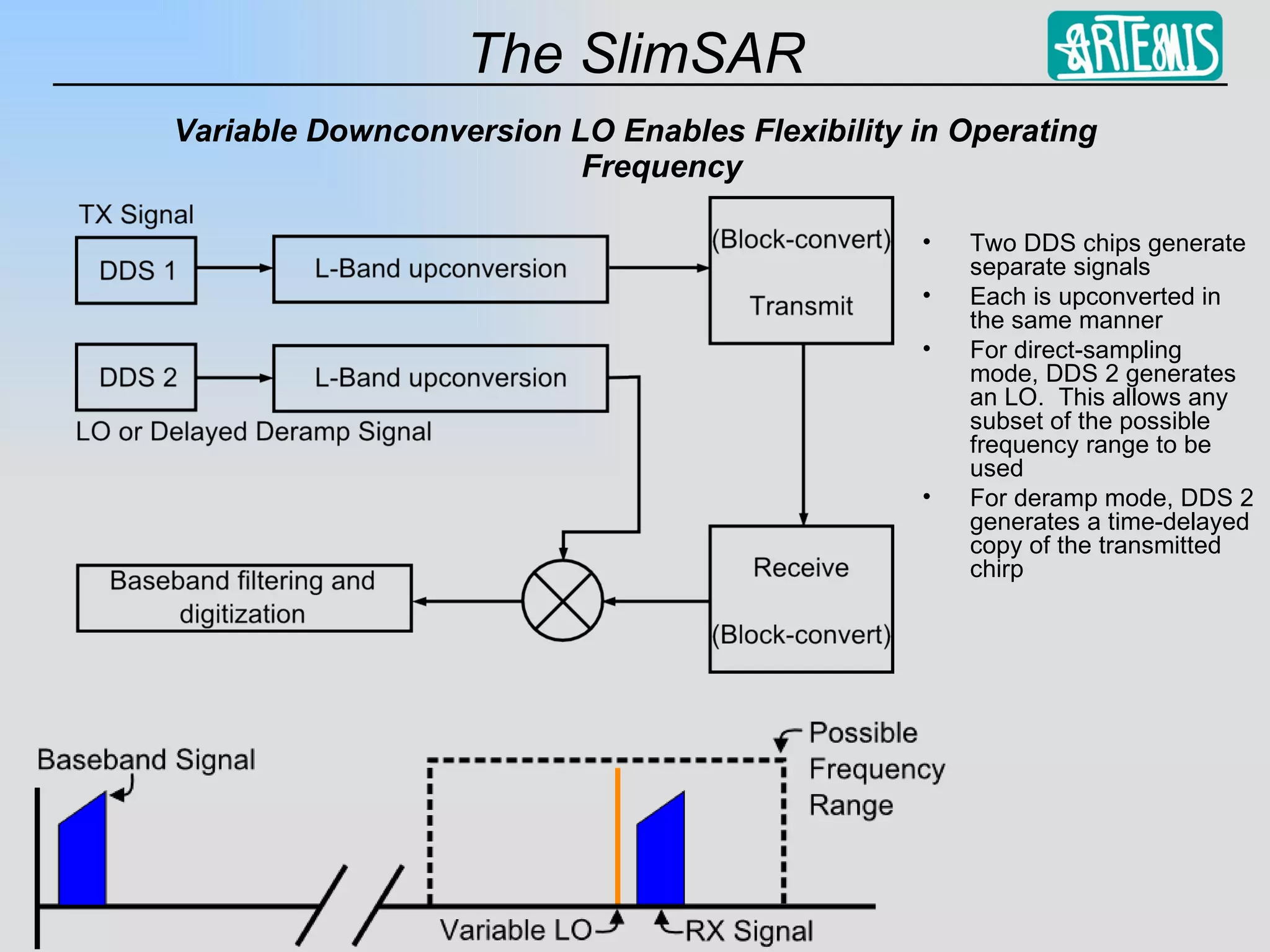
Variable Downconversion LO Enables Flexibility in Operating Frequency Two DDS chips generate separate signals Each is upconverted in the same manner For direct-sampling mode, DDS 2 generates an LO.  This allows any subset of the possible frequency range to be used For deramp mode, DDS 2 generates a time-delayed copy of the transmitted chirp
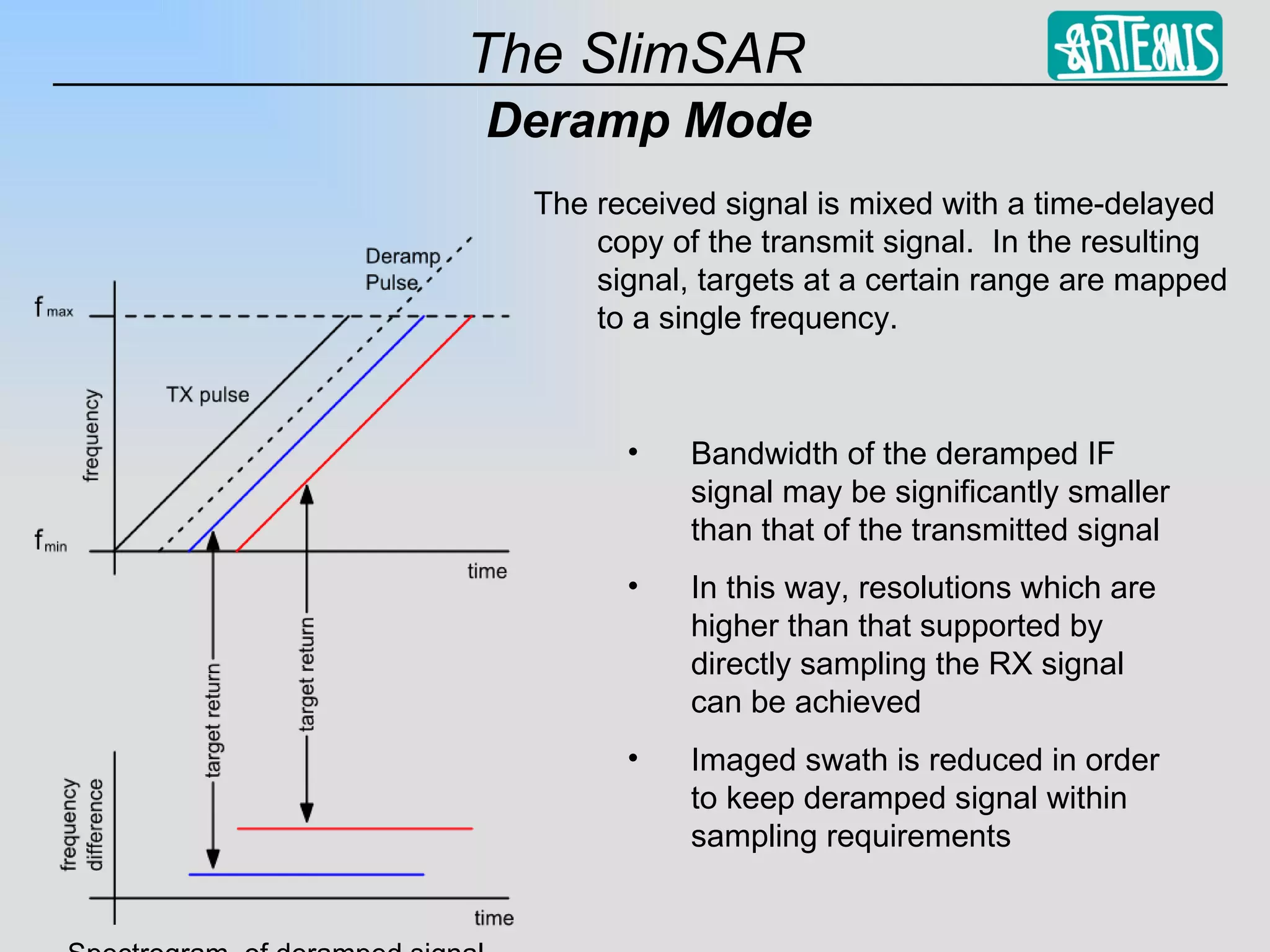
Deramp Mode The received signal is mixed with a time-delayed copy of the transmit signal.  In the resulting signal, targets at a certain range are mapped to a single frequency. Spectrogram  of deramped signal Bandwidth of the deramped IF signal may be significantly smaller than that of the transmitted signal In this way, resolutions which are higher than that supported by directly sampling the RX signal can be achieved Imaged swath is reduced in order to keep deramped signal within sampling requirements
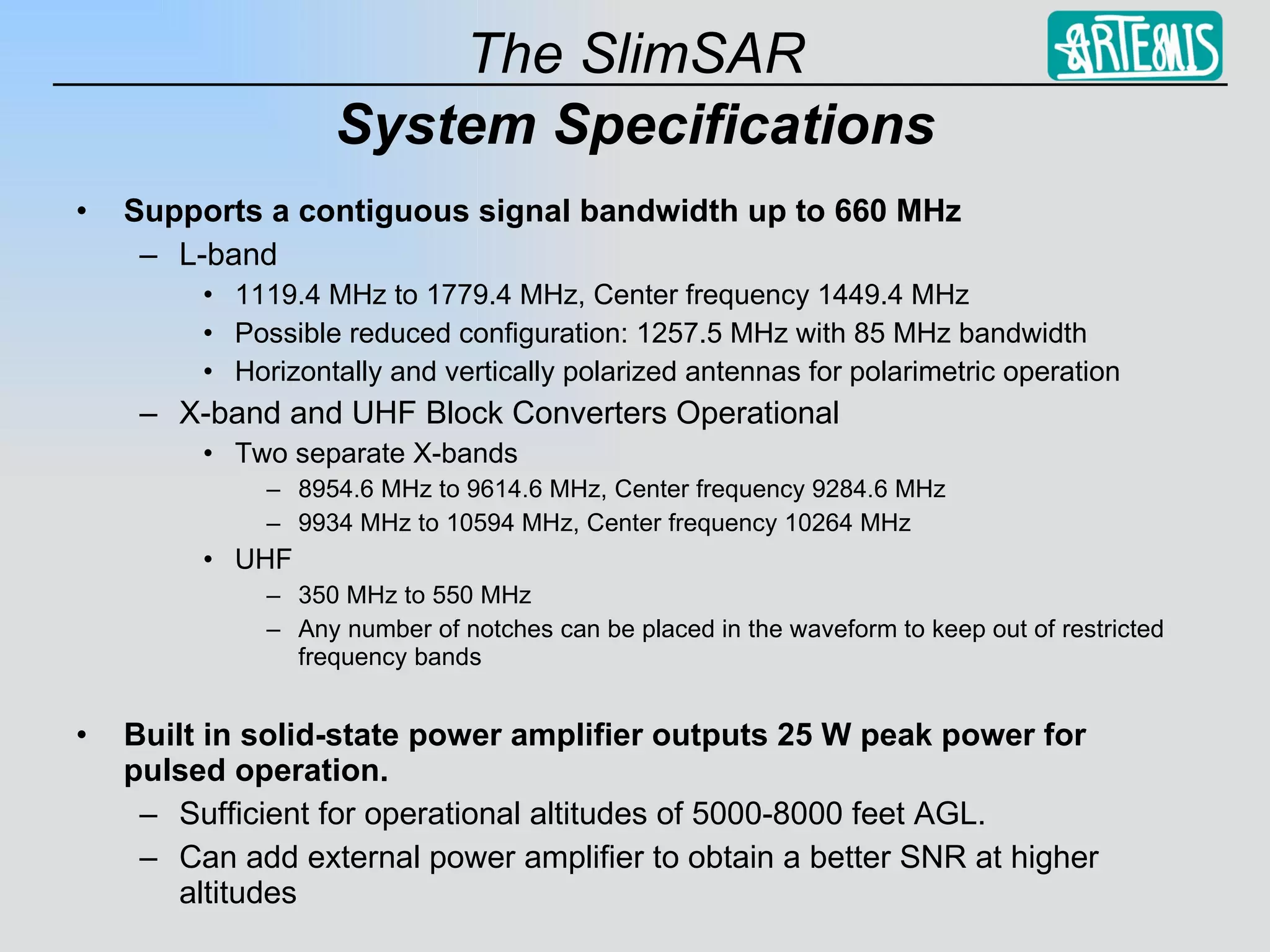
System Specifications Supports a contiguous signal bandwidth up to 660 MHz L-band 1119.4 MHz to 1779.4 MHz, Center frequency 1449.4 MHz Possible reduced configuration: 1257.5 MHz with 85 MHz bandwidth Horizontally and vertically polarized antennas for polarimetric operation X-band and UHF Block Converters Operational Two separate X-bands 8954.6 MHz to 9614.6 MHz, Center frequency 9284.6 MHz 9934 MHz to 10594 MHz, Center frequency 10264 MHz UHF 350 MHz to 550 MHz Any number of notches can be placed in the waveform to keep out of restricted frequency bands Built in solid-state power amplifier outputs 25 W peak power for pulsed operation. Sufficient for operational altitudes of 5000-8000 feet AGL. Can add external power amplifier to obtain a better SNR at higher altitudes
System Performance Trade-offs and Flexibility Every radar system has inherent performance tradeoffs, and SlimSAR is no exception The unique design of the SlimSAR, however, makes it very flexible By simply adjusting some of its operational parameters, the SlimSAR can be made to operate in a wide variety of imaging situations Second DDS and upconversion chain enable a wide range of operating frequencies and bandwidths in either direct-sampled or deramp mode.
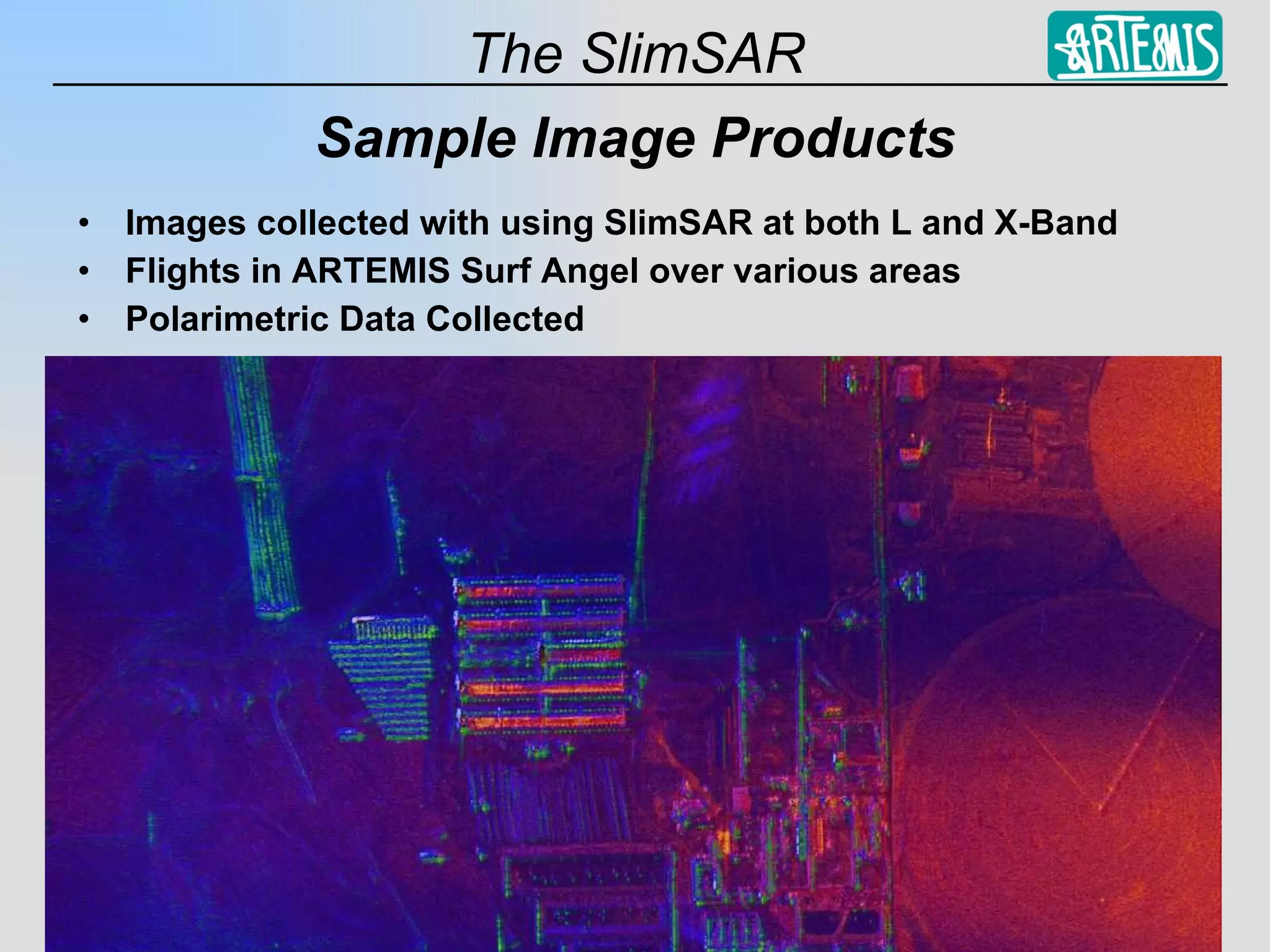
Sample Image Products Images collected with using SlimSAR at both L and X-Band Flights in ARTEMIS Surf Angel over various areas Polarimetric Data Collected
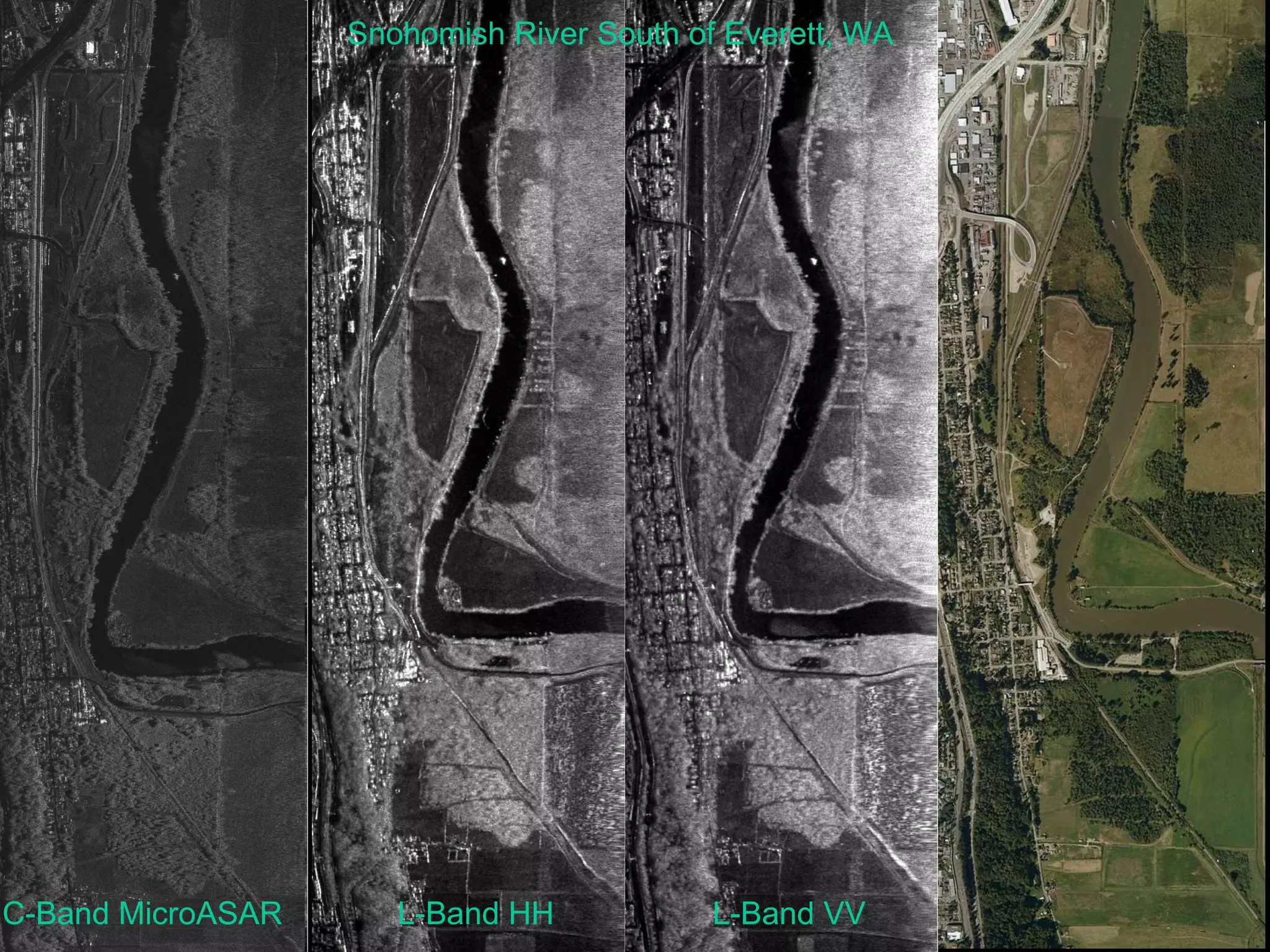
Images L-Band HH L-Band VV Snohomish River South of Everett, WA C-Band MicroASAR
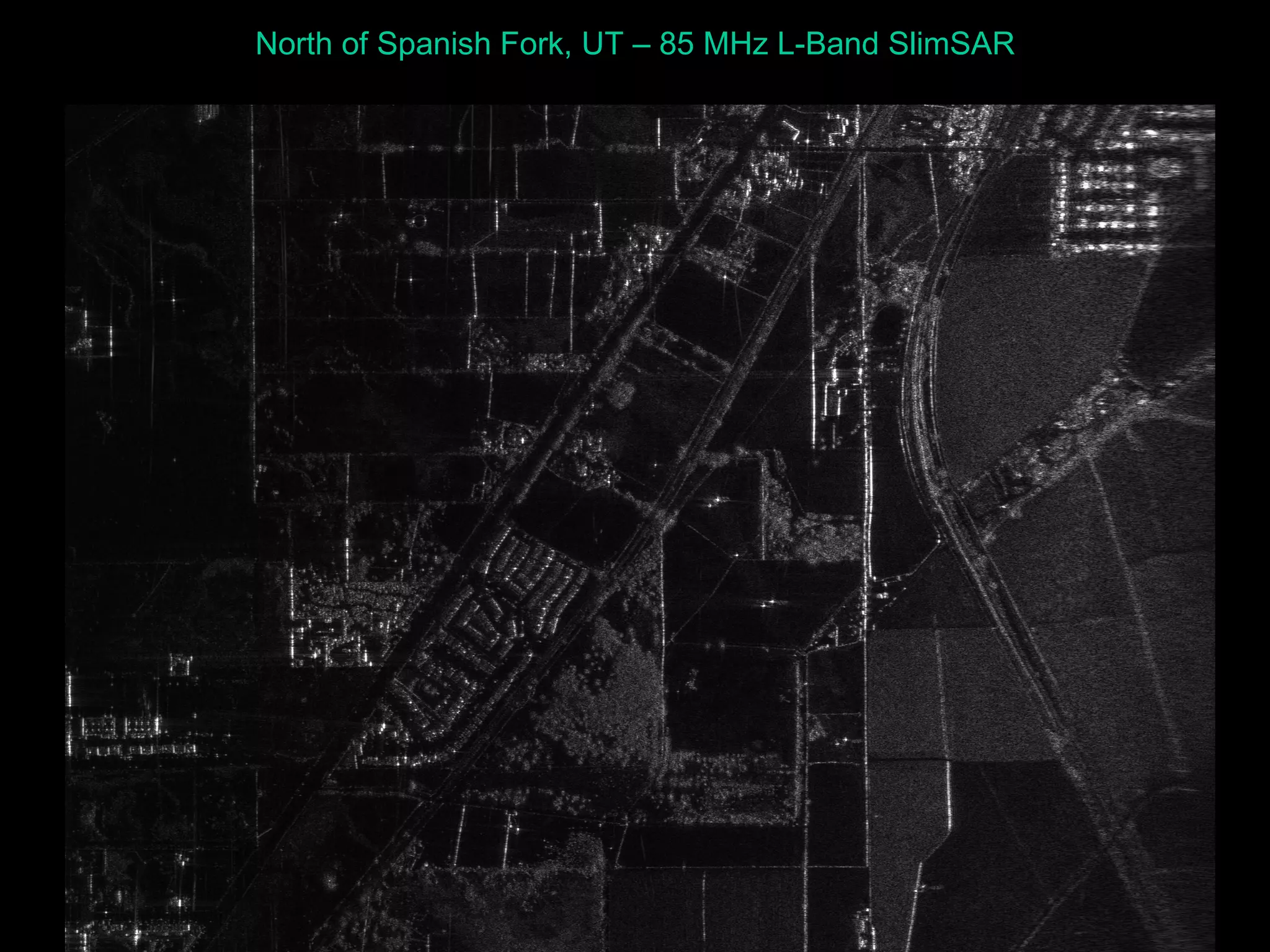
L-band Sample Image Products Images North of Spanish Fork, UT
Images North of Spanish Fork, UT – 85 MHz L-Band SlimSAR
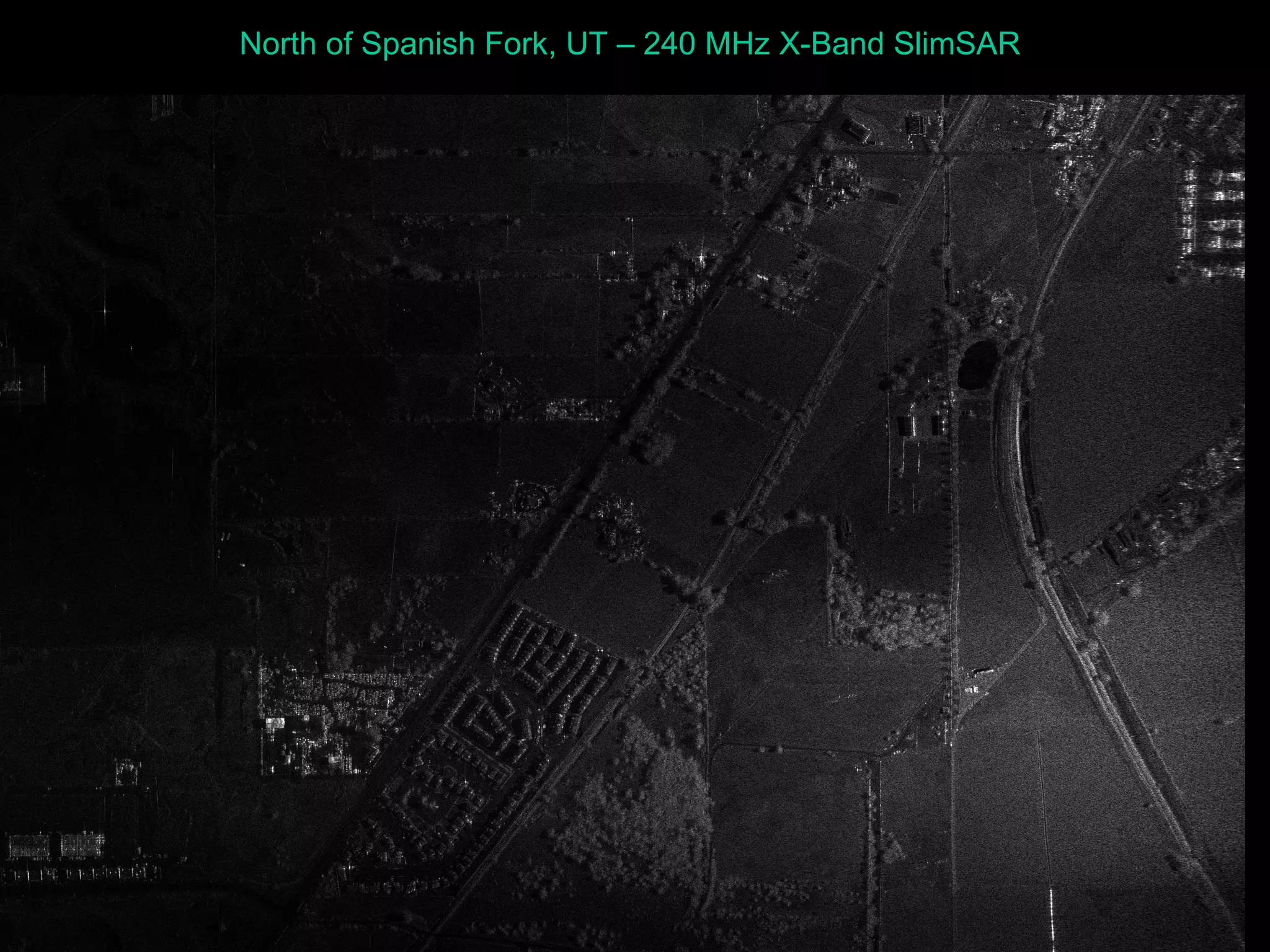
North of Spanish Fork, UT – 240 MHz X-Band SlimSAR
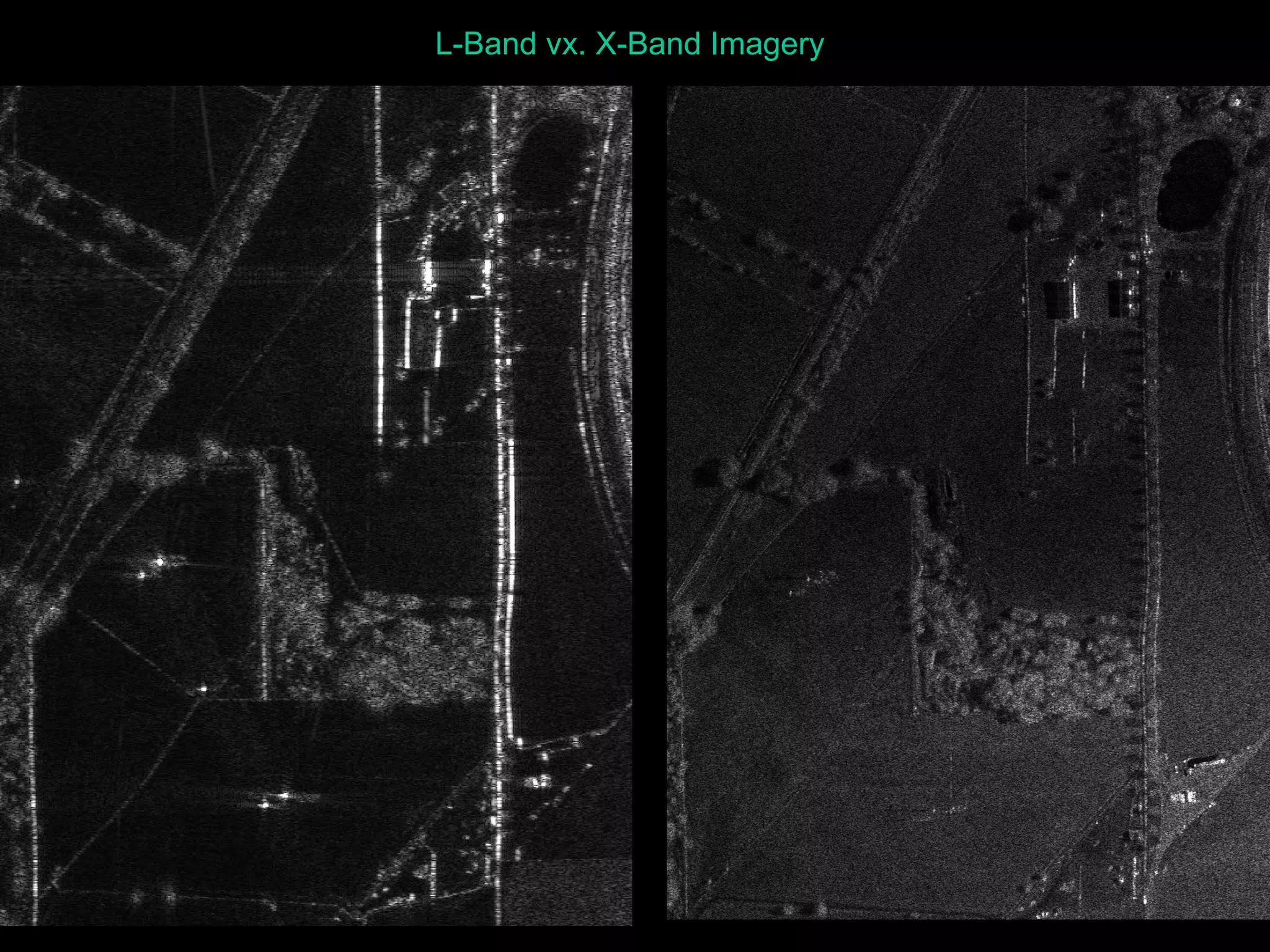
L-Band vx. X-Band Imagery
Conclusion SlimSAR Advantages : A strong design heritage  Rapid testing and integration  Quick schedule from initial concept designs in October 2008 to flight testing an LFM-CW version the week of 15 June 2009.  The pulsed version had it’s first flight tests the week of 11 January 2010. Flight tests aimed at proving the SlimSAR against an array of targets of interest and readying the system for integration onto a small UAS The flexible design facilitates future modifications Alternative frequencies Higher bandwidths GMTI Interferometry Littoral and maritime modes Polarimetry

MO3.L09 - THEORETICAL AND PRACTICAL DESIGN CONSIDERATIONS FOR A SMALL, MULTI-BAND SAR: THE SLIMSAR

  • 1.
    Theoretical and PracticalDesign Considerations for a Small, Multi-Band SAR: The SlimSAR 26 July 2010 Evan Zaugg, Matthew Edwards, and Alex Margulis ARTEMIS Inc. Hauppauge, NY
  • 2.
    Introduction Design HeritageSlimSAR System Design Details Methodology Multiple Operating Frequencies Deramp Mode System Performance Trade-offs and Flexibility Example SAR Imagery Conclusion
  • 3.
    Introduction: UsingSAR on a Small UAS UAS are extremely useful in dangerous, remote, or long duration situations Provide intelligence, surveillance, and reconnaissance capabilities Electro-optic/infrared (EO/IR) instruments are useful and very common Limited by obstruction due to clouds, fog, dust, and smoke Synthetic aperture radar (SAR) can be used on larger platforms Provides high-resolution imagery Day and night All weather conditions Additional information available at different frequencies Change detection Shallow dry-ground penetration Enhanced target detection Operating a SAR on a small UAS is beneficial Often precluded by size weight and power (SWAP) of SAR systems
  • 4.
    Introduction: The SlimSARSolution A new advancement in SAR High-performance Small Low-cost Suitable for operation on small UAS Design Heritage Exploits techniques and technologies developed for previous systems Multi-Frequency Increased capability and flexibility, all in a small package Table 1: SlimSAR Specifications Frequency Bands L-band / X-band / UHF / + Bandwidth / Resolution Variable 660 MHz / 23 cm Transmit Power 25 W Operational Altitude 1000-6000 ft (AGL) Radar Weight < 10 lbs Power Consumption < 150 W
  • 5.
    History ARTEMIS, Inc.has been supporting SAR programs for over a decade with development and manufacturing Our receivers, exciters, and up-converters (REUs) are a part of Global Hawk U-2 ASTOR. Recent experimental programs include UAVSAR (with Jet Propulsion Laboratory) NuSAR (with the Naval Research Laboratory and Space Dynamics Laboratory) MicroASAR (with Brigham Young University)
  • 6.
    The NRL UASSAR System (NuSAR) Part of NRL's DUSTER program Team effort with BYU, ARTEMIS, SDL, and NRL Designed for UAS flight. X-Band NuSAR Image: The Bear River and I-15 North of Brigham City, Utah The NuSAR L-band RF Table 2: NuSAR Specifications Frequency Bands L-band / X-band Bandwidth / Resolution Variable 500 MHz / 30 cm Transmit Power 25 W Operational Altitude 2500-6000 ft (AGL)
  • 7.
    MicroASAR A continuouswave (CW) SAR system High SNR transmitting much less peak power Analog de-chirp on receive reduces the sampling requirements to keep the data rate low The entire MicroASAR Table 3: MicroASAR Specifications MicroASAR image of Arctic sea ice from CASIE-09 – see paper 3562 in poster area H on Thursday Frequency Band C-Band Bandwidth / Resolution Variable 200 MHz / 75 cm Transmit Power 1 W Operational Altitude 1000-5000 ft (AGL) Weight 5 lbs
  • 8.
    System Design MethodologyQuickest path from system requirements specification to deployment of successful solution Design is based on functioning, tested SAR systems (MicroASAR / NuSAR-B) Modify existing designs to meet new requirements, preserving design heritage Risks associated with new, untested technologies are minimized Antennas mounted under the belly of the test bed SAR equipment installed in the test bed NuSAR-B MicroASAR Computer UPS IMU
  • 9.
    System Design MethodologyBenefits in system testing and integration MicroASAR has been operating during the SlimSAR development period on a small, manned aircraft which is used as a UAS surrogate Test and refine data collection, handling, and processing methods which are used with very little modification for SlimSAR Ready for initial flight testing as soon as the hardware is completed Immediate flight testing on the test bed aircraft reveals any changes which may be necessary in the processing algorithms or other supporting systems A Cessna O-2 Skymaster, our test bed aircraft “Surf Angel” on the runway at Brigham City, Utah
  • 10.
    SlimSAR System DesignDesign concept as a compact pod-mount unit consisting of : Wide-beam L-band antenna Gimbaled X-band antenna The radar (L-band and X-band) Tactical CDL Motion measurement system and GPS Example illustration of the SlimSAR and all the supporting subcomponents in a single pod-mount package All this weighs less than 20 lbs and consumes less than 200 W
  • 11.
    Multiple Operational FrequencyBands Using Block-Conversion System core is L-Band, and L-Band operation is always possible Block-conversion and switching allows operation at other bands X-Band and UHF block converters currently operational and tested Ku-Band converter in design stages Other bands possible
  • 12.
    Variable Downconversion LOEnables Flexibility in Operating Frequency Two DDS chips generate separate signals Each is upconverted in the same manner For direct-sampling mode, DDS 2 generates an LO. This allows any subset of the possible frequency range to be used For deramp mode, DDS 2 generates a time-delayed copy of the transmitted chirp
  • 13.
    Deramp Mode Thereceived signal is mixed with a time-delayed copy of the transmit signal. In the resulting signal, targets at a certain range are mapped to a single frequency. Spectrogram of deramped signal Bandwidth of the deramped IF signal may be significantly smaller than that of the transmitted signal In this way, resolutions which are higher than that supported by directly sampling the RX signal can be achieved Imaged swath is reduced in order to keep deramped signal within sampling requirements
  • 14.
    System Specifications Supportsa contiguous signal bandwidth up to 660 MHz L-band 1119.4 MHz to 1779.4 MHz, Center frequency 1449.4 MHz Possible reduced configuration: 1257.5 MHz with 85 MHz bandwidth Horizontally and vertically polarized antennas for polarimetric operation X-band and UHF Block Converters Operational Two separate X-bands 8954.6 MHz to 9614.6 MHz, Center frequency 9284.6 MHz 9934 MHz to 10594 MHz, Center frequency 10264 MHz UHF 350 MHz to 550 MHz Any number of notches can be placed in the waveform to keep out of restricted frequency bands Built in solid-state power amplifier outputs 25 W peak power for pulsed operation. Sufficient for operational altitudes of 5000-8000 feet AGL. Can add external power amplifier to obtain a better SNR at higher altitudes
  • 15.
    System Performance Trade-offsand Flexibility Every radar system has inherent performance tradeoffs, and SlimSAR is no exception The unique design of the SlimSAR, however, makes it very flexible By simply adjusting some of its operational parameters, the SlimSAR can be made to operate in a wide variety of imaging situations Second DDS and upconversion chain enable a wide range of operating frequencies and bandwidths in either direct-sampled or deramp mode.
  • 16.
    Sample Image ProductsImages collected with using SlimSAR at both L and X-Band Flights in ARTEMIS Surf Angel over various areas Polarimetric Data Collected
  • 17.
    Images L-Band HHL-Band VV Snohomish River South of Everett, WA C-Band MicroASAR
  • 18.
    L-band Sample ImageProducts Images North of Spanish Fork, UT
  • 19.
    Images North ofSpanish Fork, UT – 85 MHz L-Band SlimSAR
  • 20.
    North of SpanishFork, UT – 240 MHz X-Band SlimSAR
  • 21.
  • 22.
    Conclusion SlimSAR Advantages: A strong design heritage Rapid testing and integration Quick schedule from initial concept designs in October 2008 to flight testing an LFM-CW version the week of 15 June 2009. The pulsed version had it’s first flight tests the week of 11 January 2010. Flight tests aimed at proving the SlimSAR against an array of targets of interest and readying the system for integration onto a small UAS The flexible design facilitates future modifications Alternative frequencies Higher bandwidths GMTI Interferometry Littoral and maritime modes Polarimetry