Accurate Focusing of Single-Pass Airborne InSAR Data at L-band IGARSS 2010 Honolulu, Hawaii, July 26 - 30, 2010 Marcus Schwäbisch, Bryan Mercer, Qiaoping Zhang, Wei Huang Intermap Technologies
Overview Motivation Investigated Focusing Options Omega-k and dual-line mocomp vs. single-line mocomp Time domain backprojection Performance Evaluation Focusing Mis-registration Squint handling PolInSAR Conclusion
Motivation Goal accurate products from an  airborne long-wavelength polarimetric interferometric  SAR in an operational scenario Intermap’s TopoSAR L-band single-pass PolInSAR Processing challenges airborne: motion compensation long wavelength: wide azimuth beamwidth, long integration time interferometry: differential phase accuracy PolInSAR: requires high resolution processing to achieve sufficient number of looks operational aspect: requires high squint capability Processing aspects azimuth focusing motion compensation
Investigated processing options Omega-k focusing with single-line mocomp Omega-k in principle is an optimum SAR focusing technique without approximations requires data to be acquired along a straight line single-line mocomp is fast and efficient, but non-optimal for significant InSAR baselines Omega-k focusing with dual-line mocomp dual-line mocomp avoids differential effects in interferometric channels center-beam approximation in mocomp still does not avoid focusing degradation caused by FM rate errors  Time domain backprojection with integrated mocomp full-aperture solution for mocomp terrain dependent  time consuming
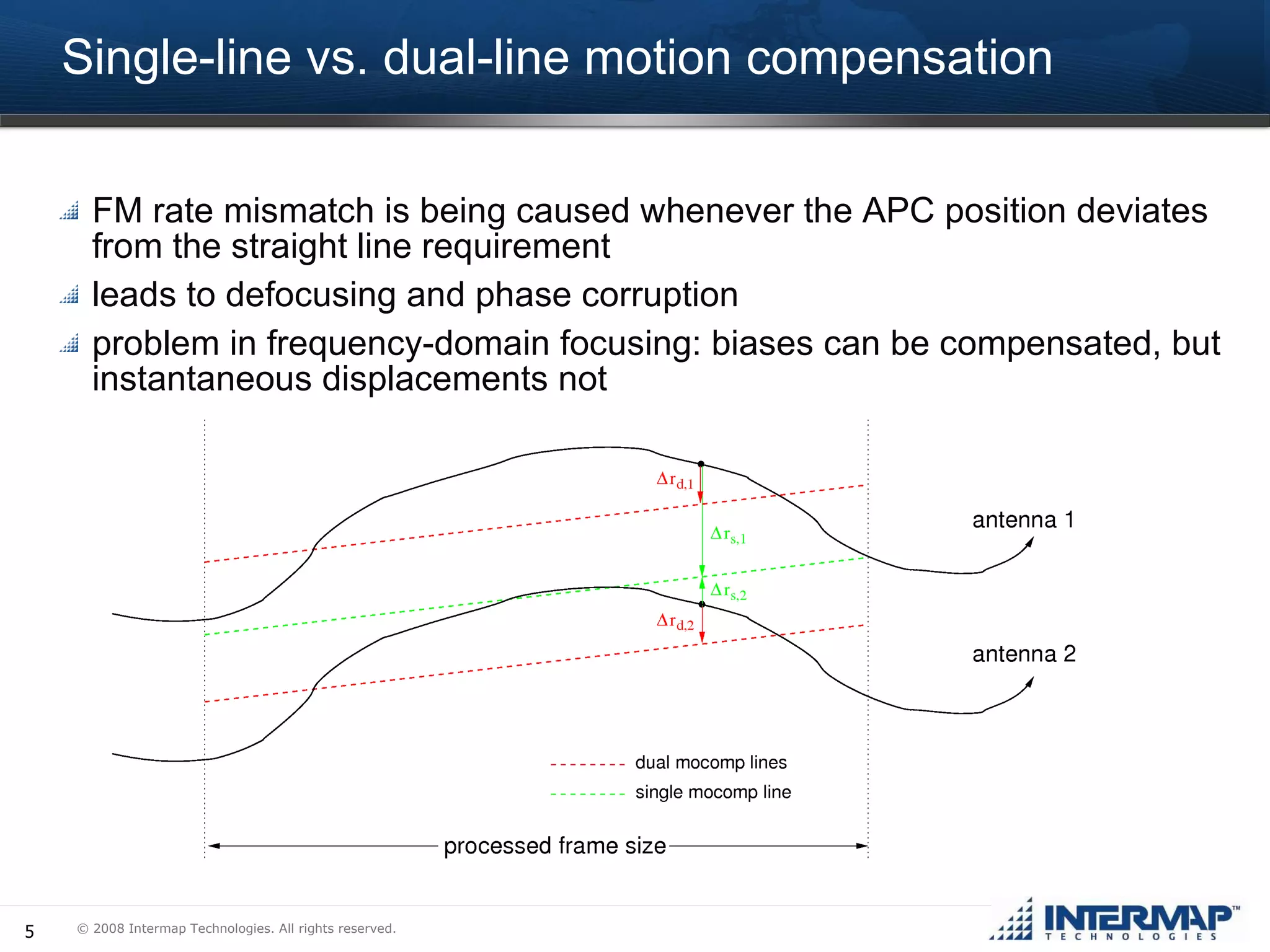
Single-line vs. dual-line motion compensation FM rate mismatch is being caused whenever the APC position deviates from the straight line requirement leads to defocusing and phase corruption problem in frequency-domain focusing: biases can be compensated, but instantaneous displacements not
Analysis Experimental setup L-band single-pass test data from Intermap’s experimental TopoSAR platform various testsites in Western Canada Performance evaluation focusing performance interferometric performance channel mis-registration coherence high squint handling PolInSAR performance
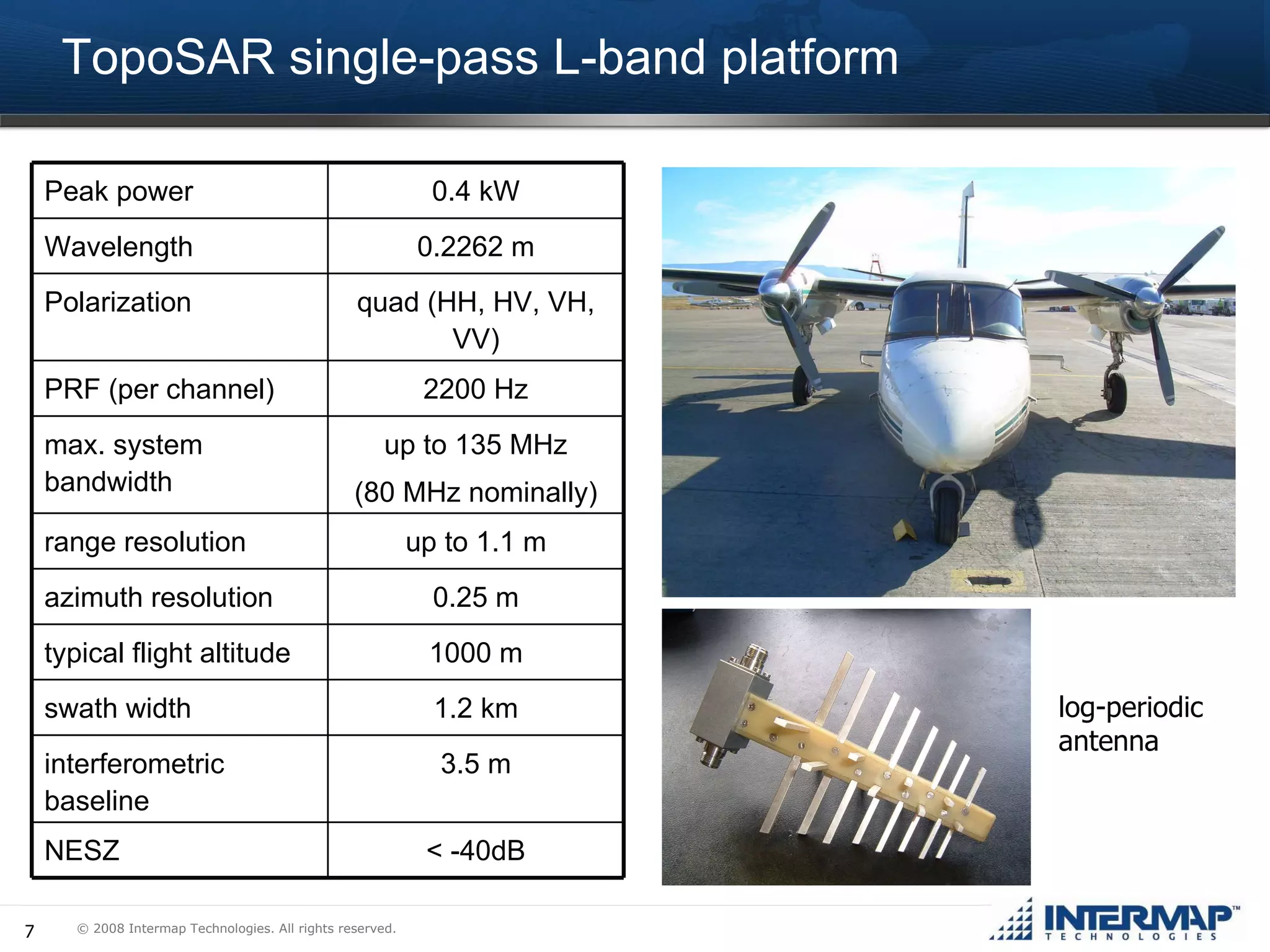
TopoSAR single-pass L-band platform log-periodic antenna < -40dB NESZ 3.5 m interferometric baseline 1.2 km swath width 1000 m typical flight altitude 0.25 m azimuth resolution up to 1.1 m range resolution up to 135 MHz (80 MHz nominally) max. system bandwidth 2200 Hz PRF (per channel) quad (HH, HV, VH, VV) Polarization 0.2262 m Wavelength 0.4 kW Peak power
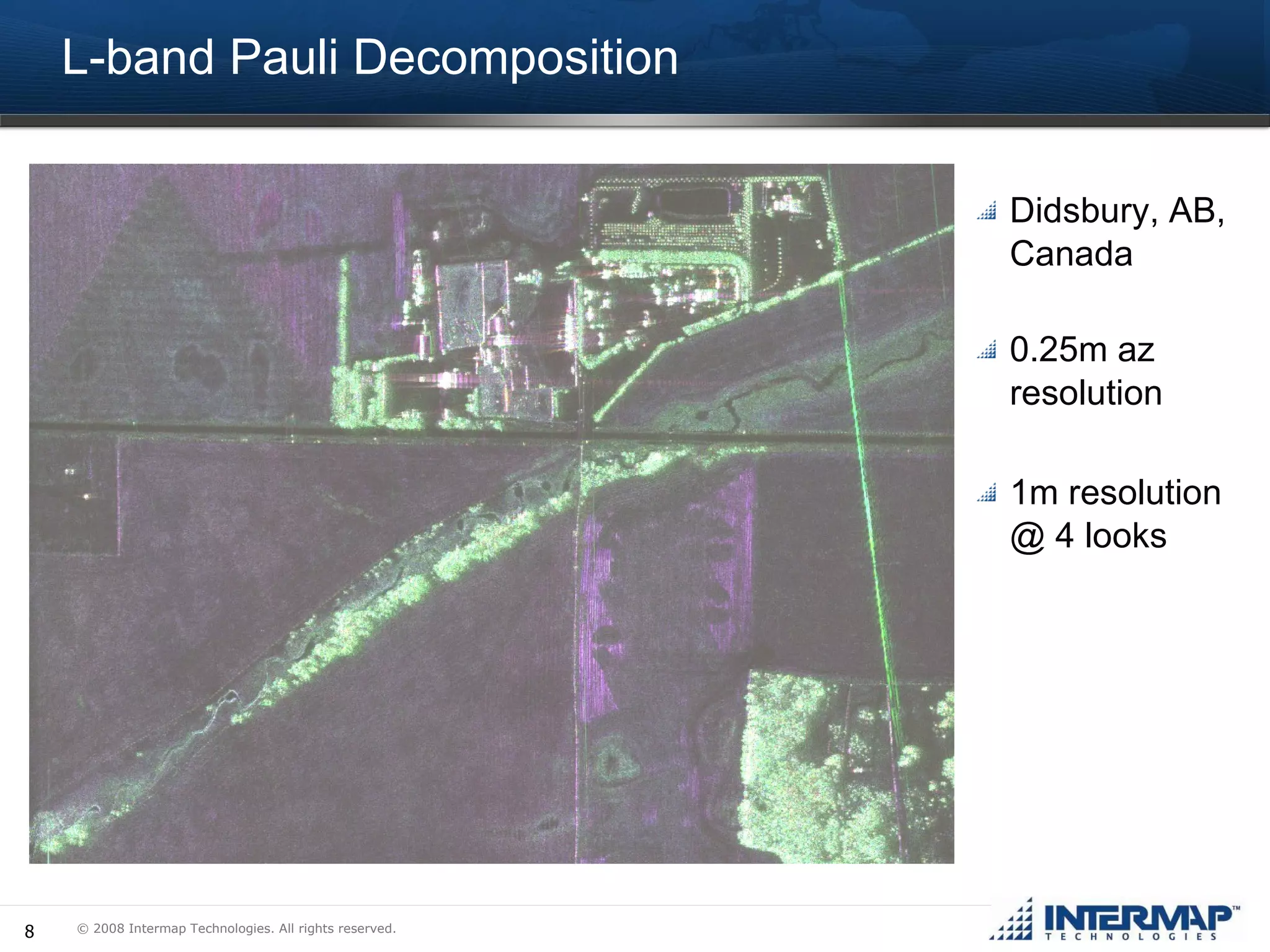
L-band Pauli Decomposition Didsbury, AB, Canada 0.25m az resolution 1m resolution @ 4 looks
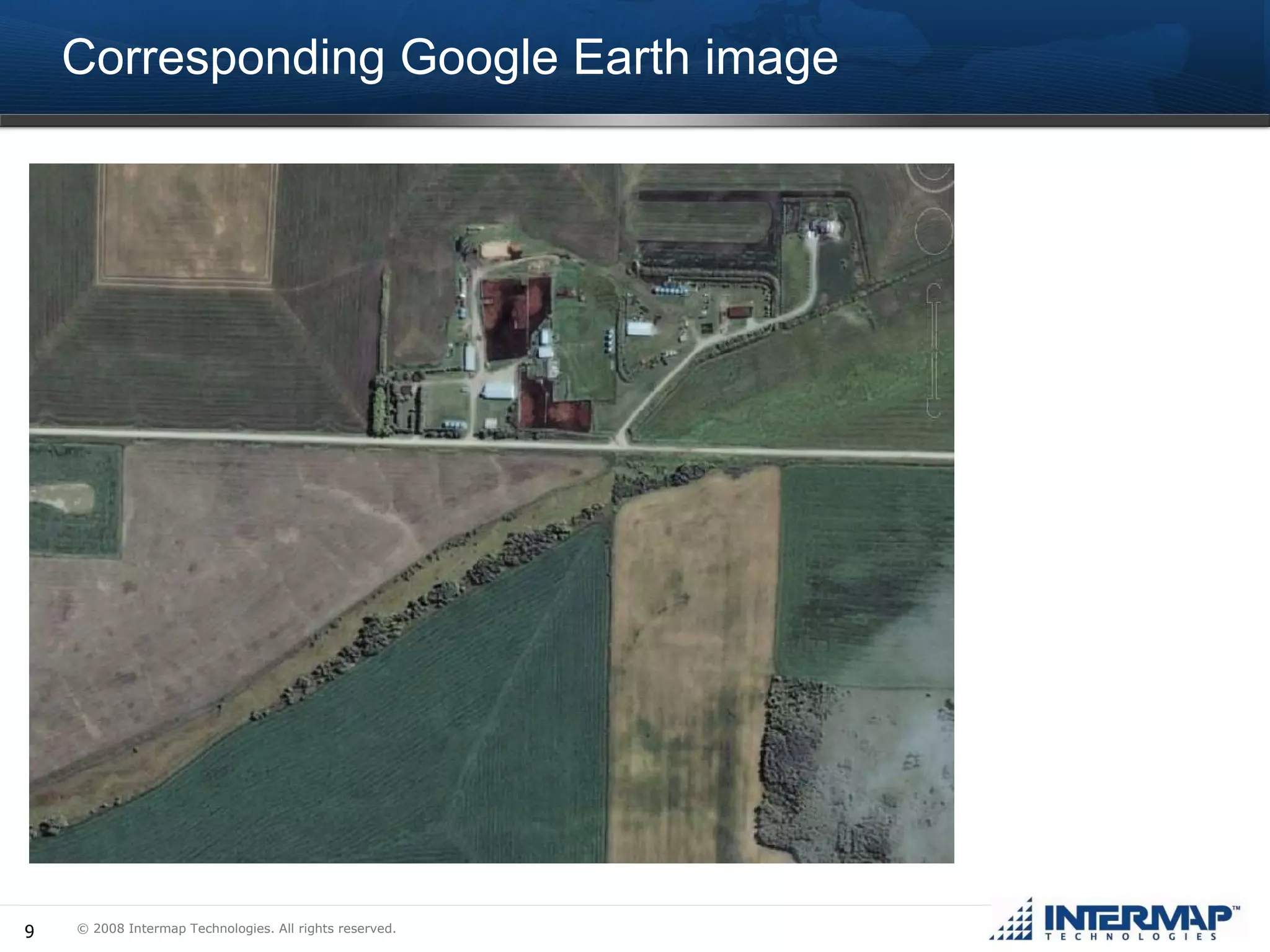
Corresponding Google Earth image
Analysis Experimental setup L-band single-pass test data from Intermap’s experimental TopoSAR platform various testsites in Western Canada Performance evaluation focusing performance interferometric performance channel mis-registration coherence high squint performance PolInSAR performance
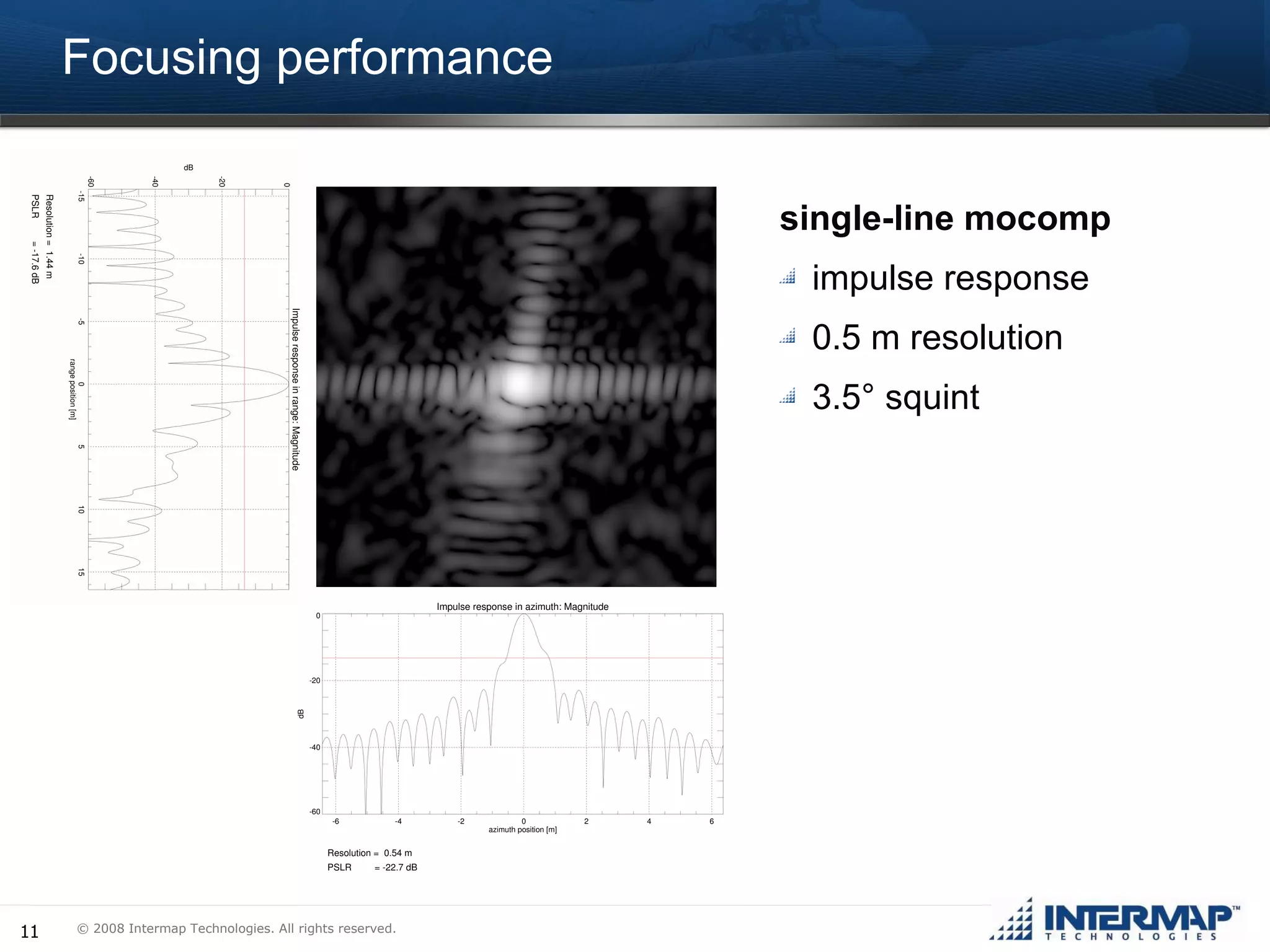
Focusing performance single-line mocomp impulse response  0.5 m resolution 3.5° squint
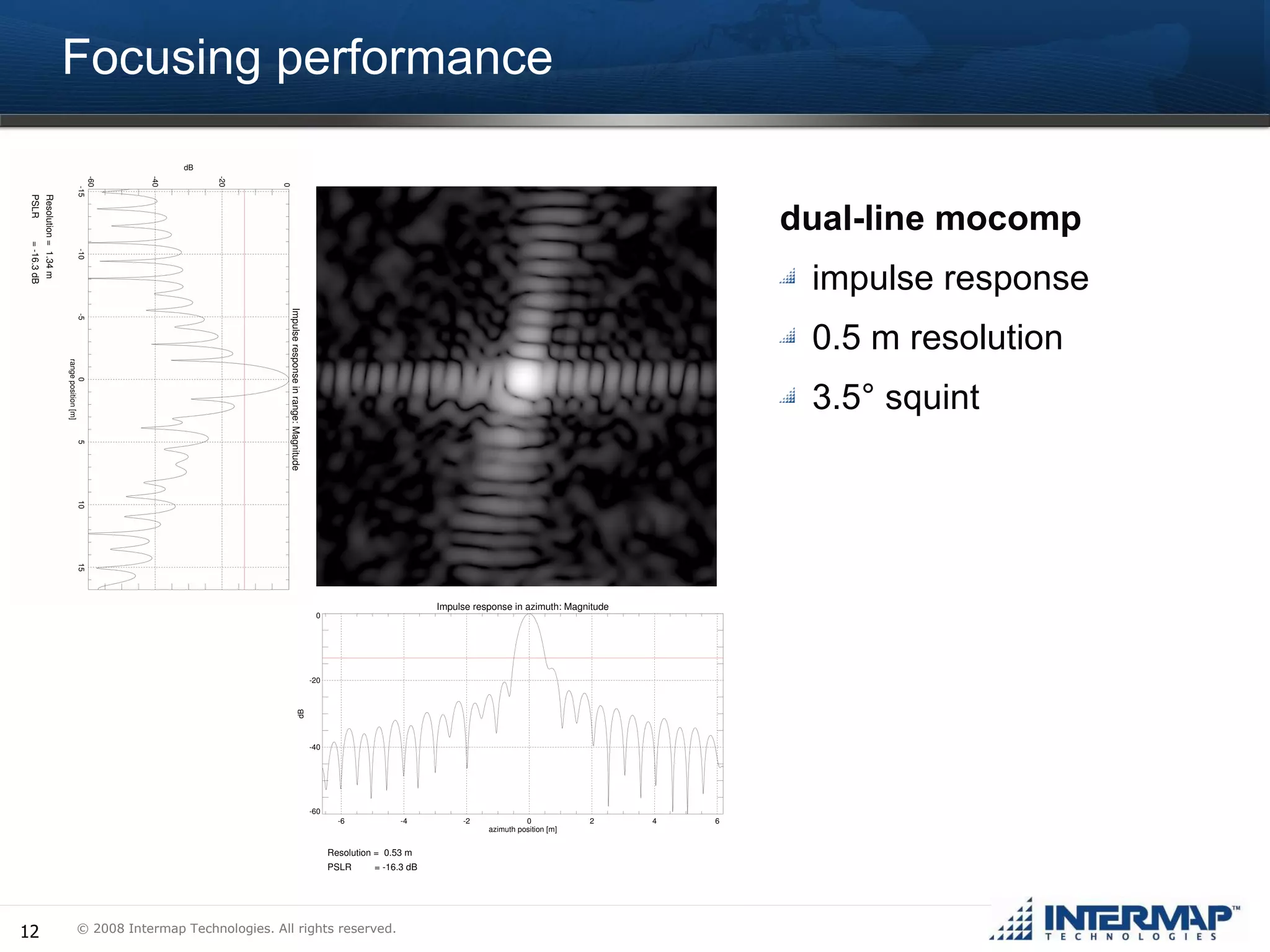
Focusing performance dual-line mocomp impulse response  0.5 m resolution 3.5° squint
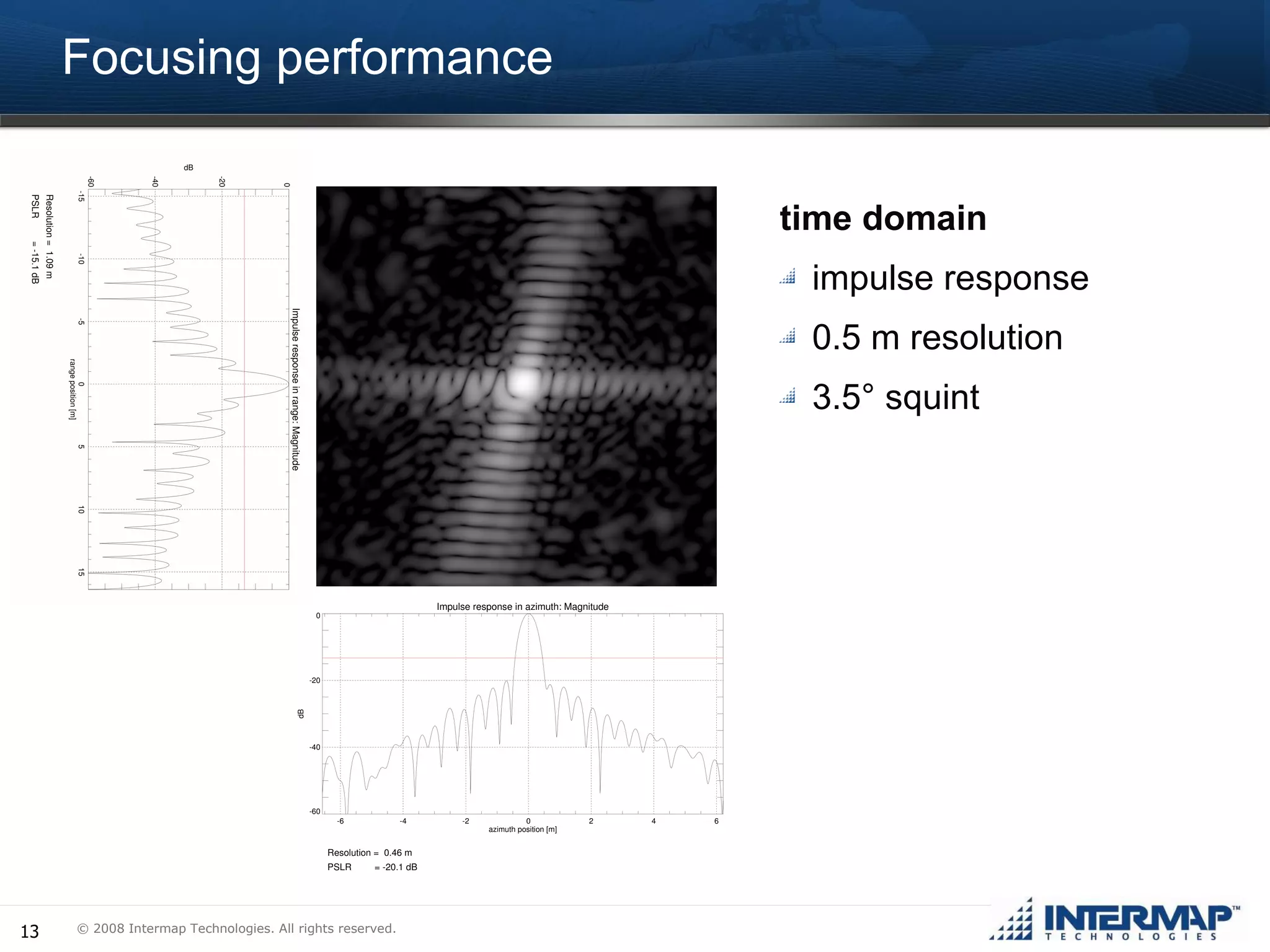
Focusing performance time domain impulse response  0.5 m resolution 3.5° squint
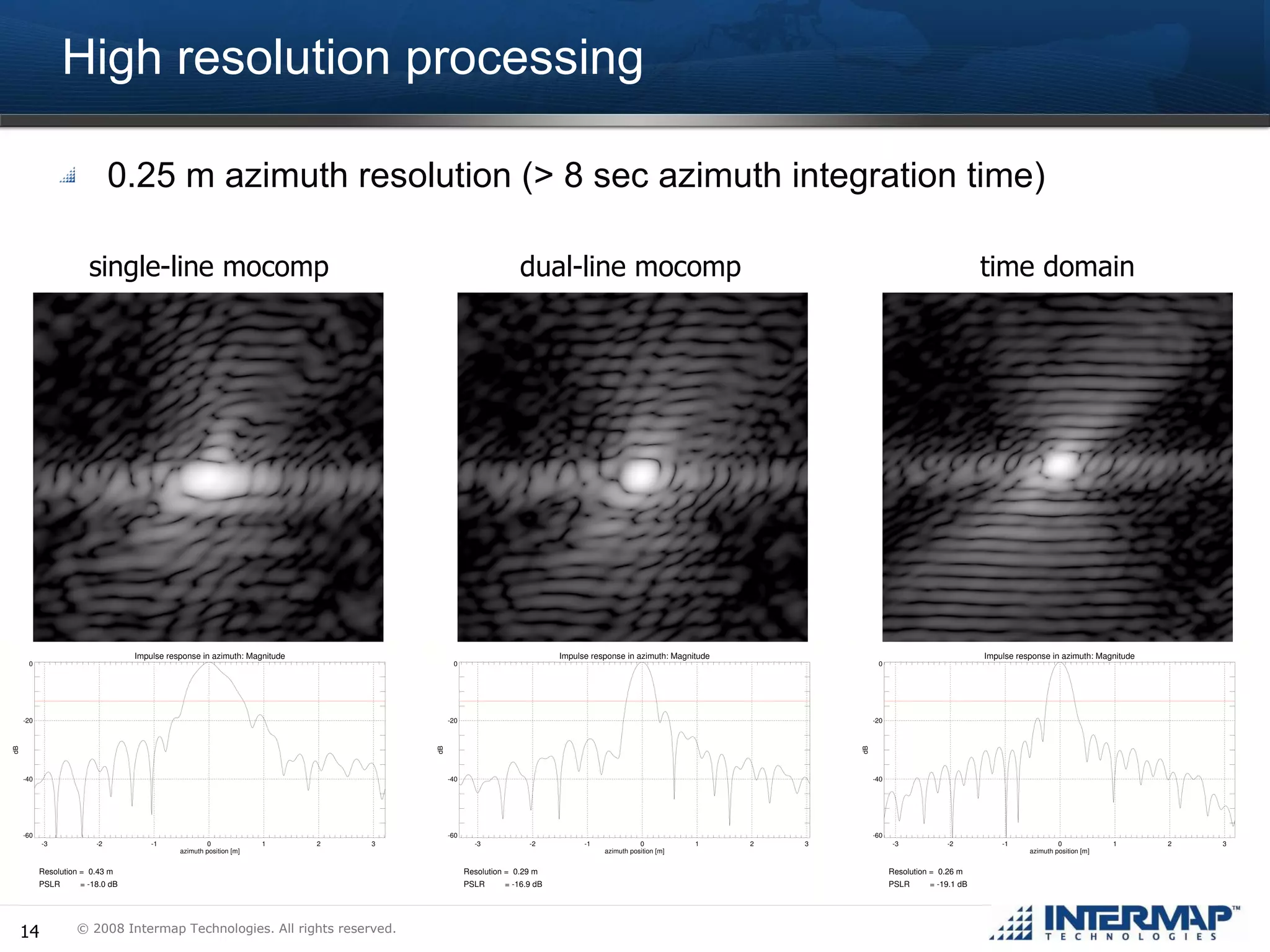
High resolution processing 0.25 m azimuth resolution (> 8 sec azimuth integration time) single-line mocomp dual-line mocomp time domain
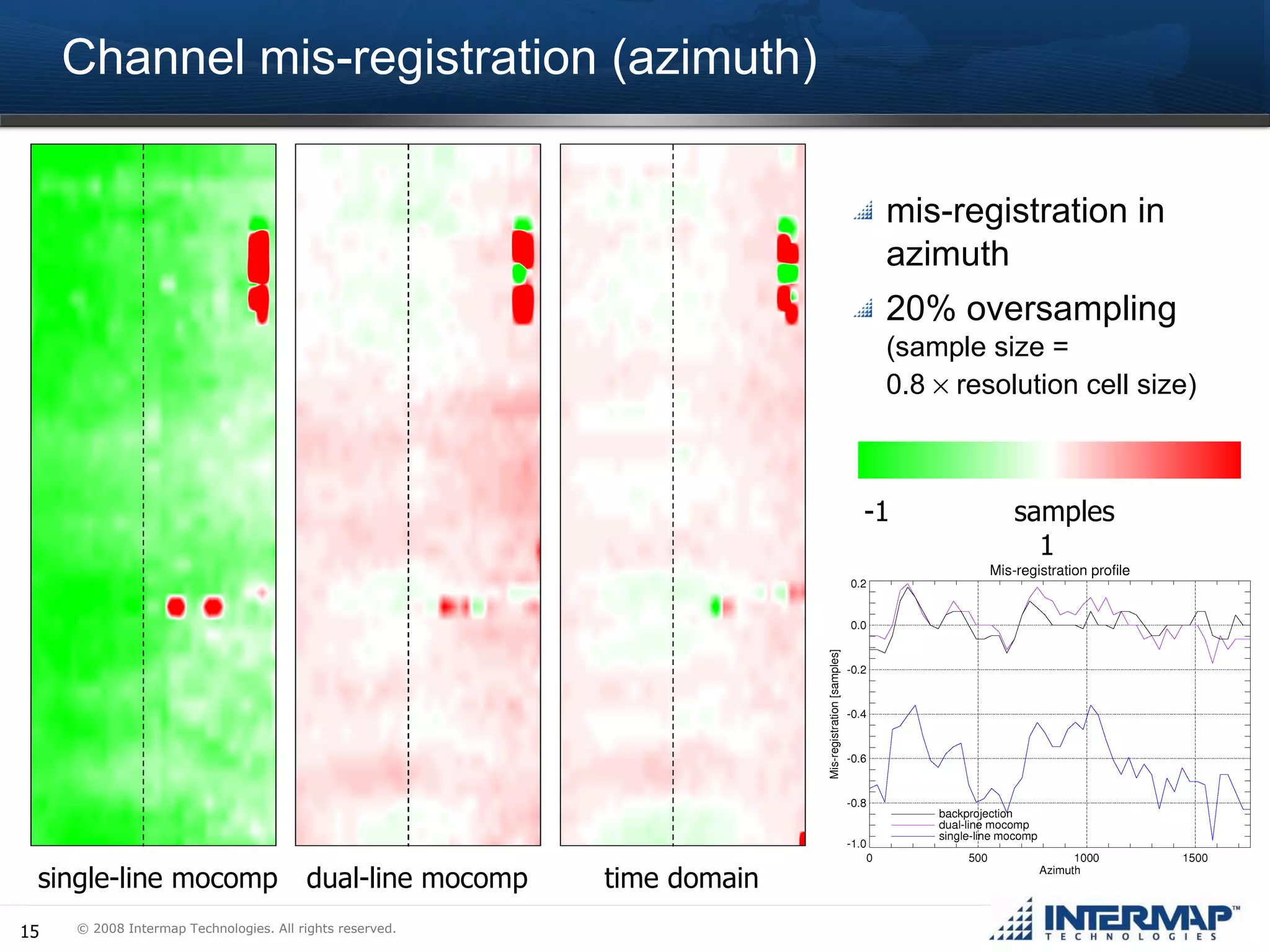
Channel mis-registration (azimuth) mis-registration in azimuth 20% oversampling  (sample size =  0.8    resolution cell size) single-line mocomp dual-line mocomp time domain -1  samples  1
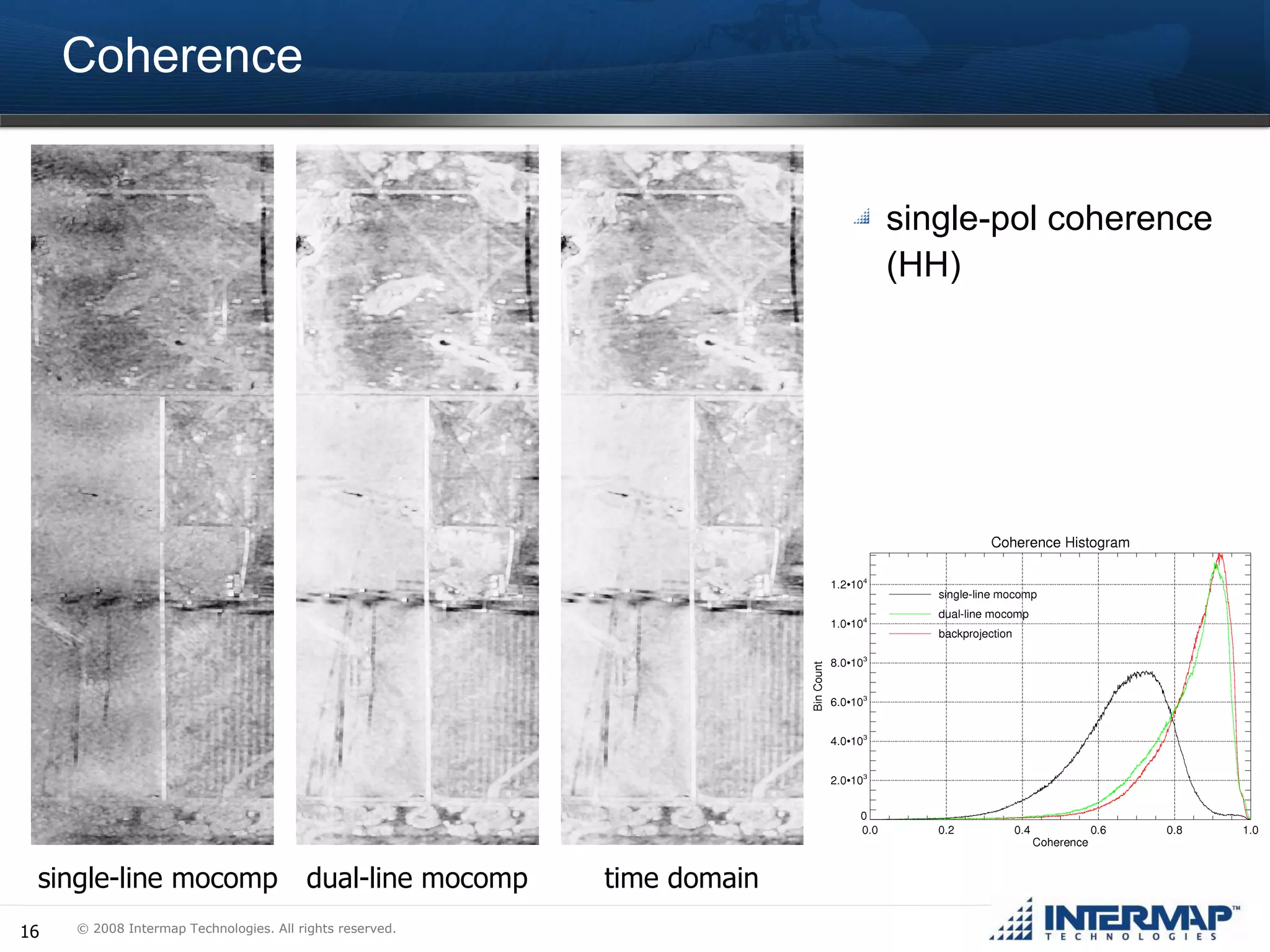
Coherence single-line mocomp dual-line mocomp time domain single-pol coherence (HH)
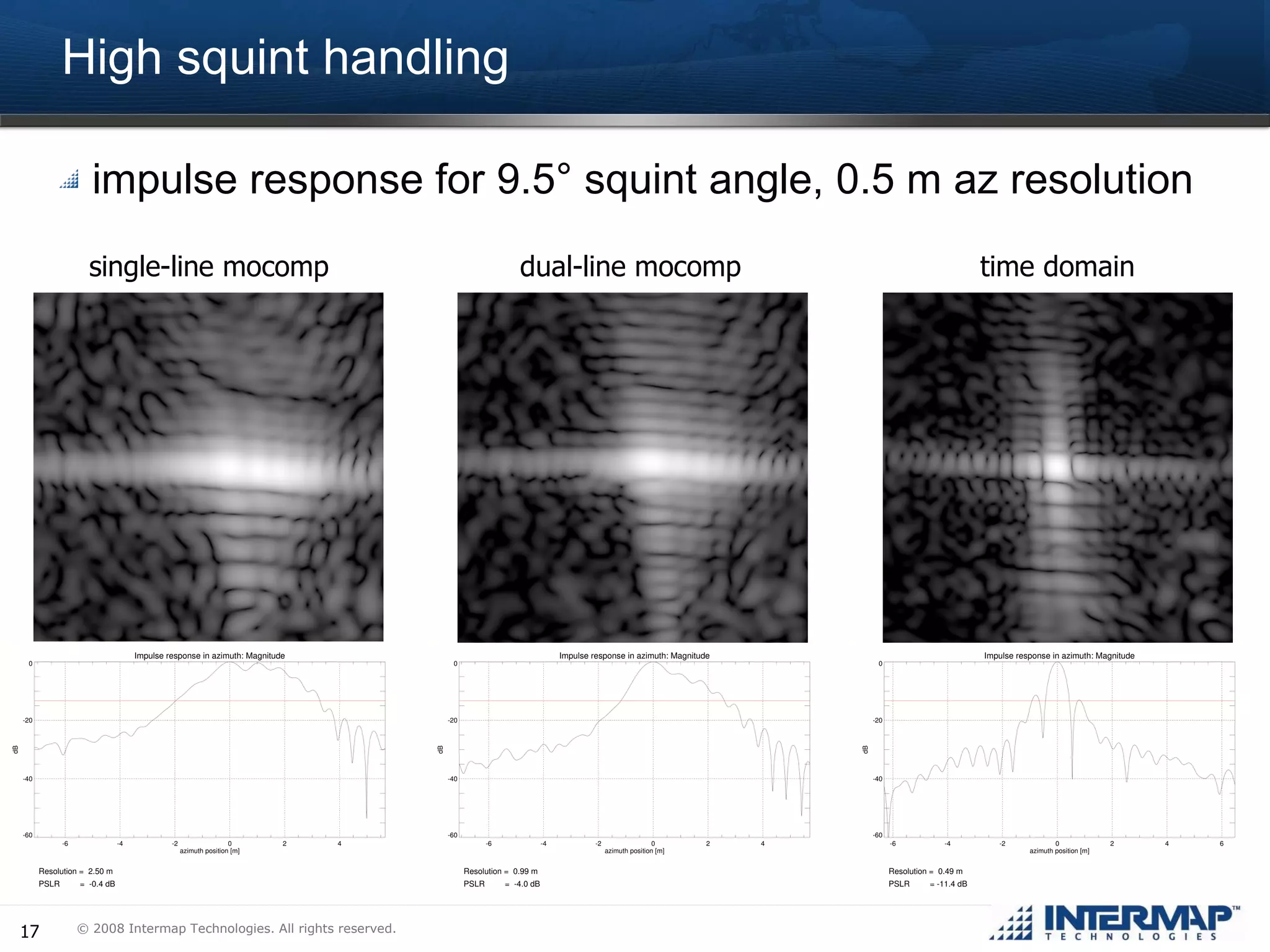
High squint handling impulse response for 9.5° squint angle, 0.5 m az resolution single-line mocomp dual-line mocomp time domain
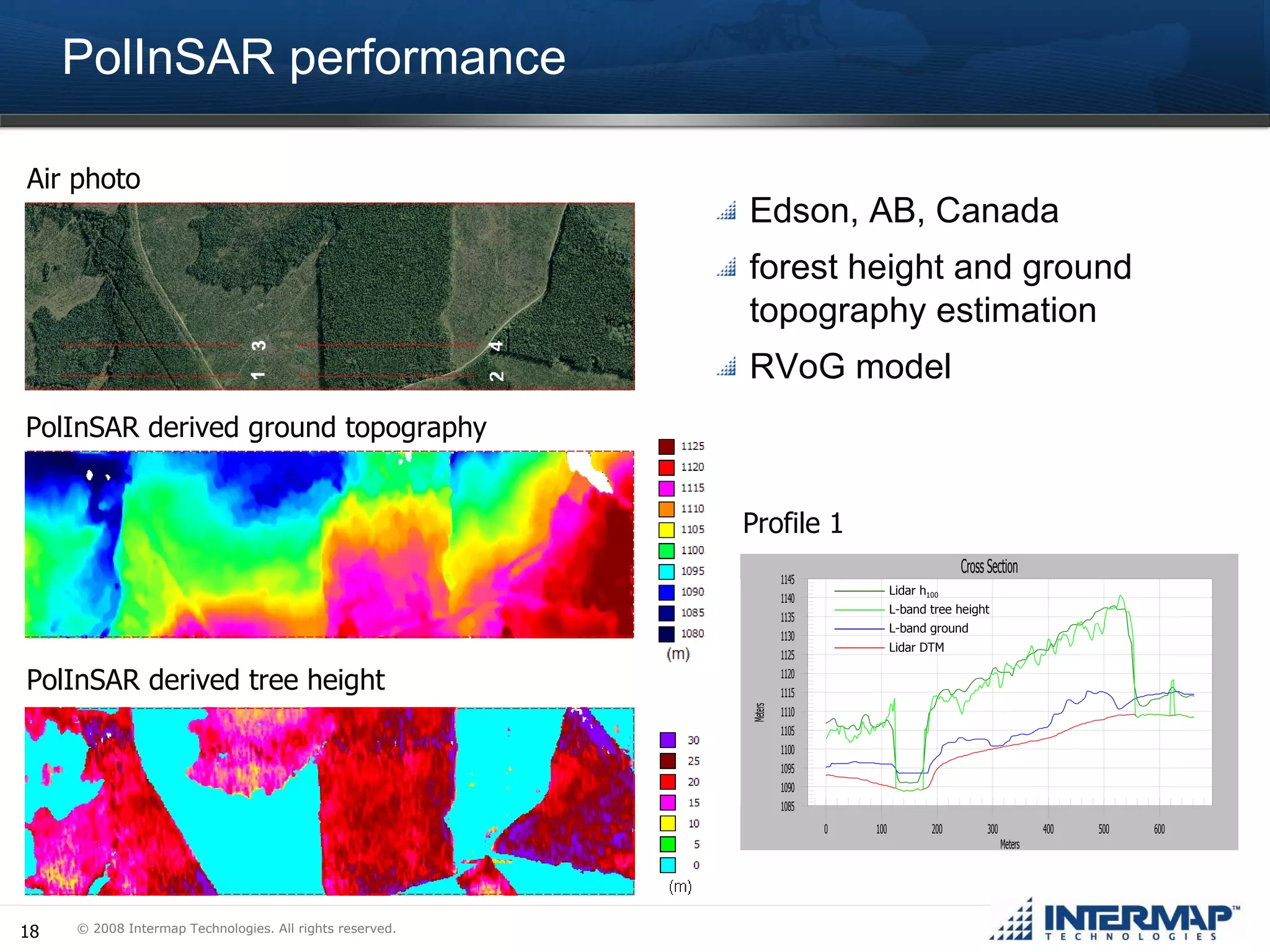
PolInSAR performance Edson, AB, Canada forest height and ground topography estimation RVoG model PolInSAR derived tree height PolInSAR derived ground topography Air photo Profile 1 Lidar h 100 Lidar DTM L-band tree height L-band ground
Summary and Conclusions We have analyzed various focusing/mocomp options to accurately process single-pass airborne PolInSAR data at L-band Omega-k focusing with dual-line mocomp and center-beam approximation is sufficient for moderate resolution and moderate platform motion Time domain backprojection with terrain-based mocomp greatly improves the performance for high-res and high squint applications Future steps system re-calibration (geometric and polarimetric) PolInSAR performance evaluation speed up the time domain implementation fast backprojection techniques GPU processing

TH1.L09 - ACCURATE FOCUSING OF SINGLE-PASS AIRBORNE INSAR DATA AT L-BAND

  • 1.
    Accurate Focusing ofSingle-Pass Airborne InSAR Data at L-band IGARSS 2010 Honolulu, Hawaii, July 26 - 30, 2010 Marcus Schwäbisch, Bryan Mercer, Qiaoping Zhang, Wei Huang Intermap Technologies
  • 2.
    Overview Motivation InvestigatedFocusing Options Omega-k and dual-line mocomp vs. single-line mocomp Time domain backprojection Performance Evaluation Focusing Mis-registration Squint handling PolInSAR Conclusion
  • 3.
    Motivation Goal accurateproducts from an airborne long-wavelength polarimetric interferometric SAR in an operational scenario Intermap’s TopoSAR L-band single-pass PolInSAR Processing challenges airborne: motion compensation long wavelength: wide azimuth beamwidth, long integration time interferometry: differential phase accuracy PolInSAR: requires high resolution processing to achieve sufficient number of looks operational aspect: requires high squint capability Processing aspects azimuth focusing motion compensation
  • 4.
    Investigated processing optionsOmega-k focusing with single-line mocomp Omega-k in principle is an optimum SAR focusing technique without approximations requires data to be acquired along a straight line single-line mocomp is fast and efficient, but non-optimal for significant InSAR baselines Omega-k focusing with dual-line mocomp dual-line mocomp avoids differential effects in interferometric channels center-beam approximation in mocomp still does not avoid focusing degradation caused by FM rate errors Time domain backprojection with integrated mocomp full-aperture solution for mocomp terrain dependent time consuming
  • 5.
    Single-line vs. dual-linemotion compensation FM rate mismatch is being caused whenever the APC position deviates from the straight line requirement leads to defocusing and phase corruption problem in frequency-domain focusing: biases can be compensated, but instantaneous displacements not
  • 6.
    Analysis Experimental setupL-band single-pass test data from Intermap’s experimental TopoSAR platform various testsites in Western Canada Performance evaluation focusing performance interferometric performance channel mis-registration coherence high squint handling PolInSAR performance
  • 7.
    TopoSAR single-pass L-bandplatform log-periodic antenna < -40dB NESZ 3.5 m interferometric baseline 1.2 km swath width 1000 m typical flight altitude 0.25 m azimuth resolution up to 1.1 m range resolution up to 135 MHz (80 MHz nominally) max. system bandwidth 2200 Hz PRF (per channel) quad (HH, HV, VH, VV) Polarization 0.2262 m Wavelength 0.4 kW Peak power
  • 8.
    L-band Pauli DecompositionDidsbury, AB, Canada 0.25m az resolution 1m resolution @ 4 looks
  • 9.
  • 10.
    Analysis Experimental setupL-band single-pass test data from Intermap’s experimental TopoSAR platform various testsites in Western Canada Performance evaluation focusing performance interferometric performance channel mis-registration coherence high squint performance PolInSAR performance
  • 11.
    Focusing performance single-linemocomp impulse response 0.5 m resolution 3.5° squint
  • 12.
    Focusing performance dual-linemocomp impulse response 0.5 m resolution 3.5° squint
  • 13.
    Focusing performance timedomain impulse response 0.5 m resolution 3.5° squint
  • 14.
    High resolution processing0.25 m azimuth resolution (> 8 sec azimuth integration time) single-line mocomp dual-line mocomp time domain
  • 15.
    Channel mis-registration (azimuth)mis-registration in azimuth 20% oversampling (sample size = 0.8  resolution cell size) single-line mocomp dual-line mocomp time domain -1 samples 1
  • 16.
    Coherence single-line mocompdual-line mocomp time domain single-pol coherence (HH)
  • 17.
    High squint handlingimpulse response for 9.5° squint angle, 0.5 m az resolution single-line mocomp dual-line mocomp time domain
  • 18.
    PolInSAR performance Edson,AB, Canada forest height and ground topography estimation RVoG model PolInSAR derived tree height PolInSAR derived ground topography Air photo Profile 1 Lidar h 100 Lidar DTM L-band tree height L-band ground
  • 19.
    Summary and ConclusionsWe have analyzed various focusing/mocomp options to accurately process single-pass airborne PolInSAR data at L-band Omega-k focusing with dual-line mocomp and center-beam approximation is sufficient for moderate resolution and moderate platform motion Time domain backprojection with terrain-based mocomp greatly improves the performance for high-res and high squint applications Future steps system re-calibration (geometric and polarimetric) PolInSAR performance evaluation speed up the time domain implementation fast backprojection techniques GPU processing