Mission Statement: Introduction
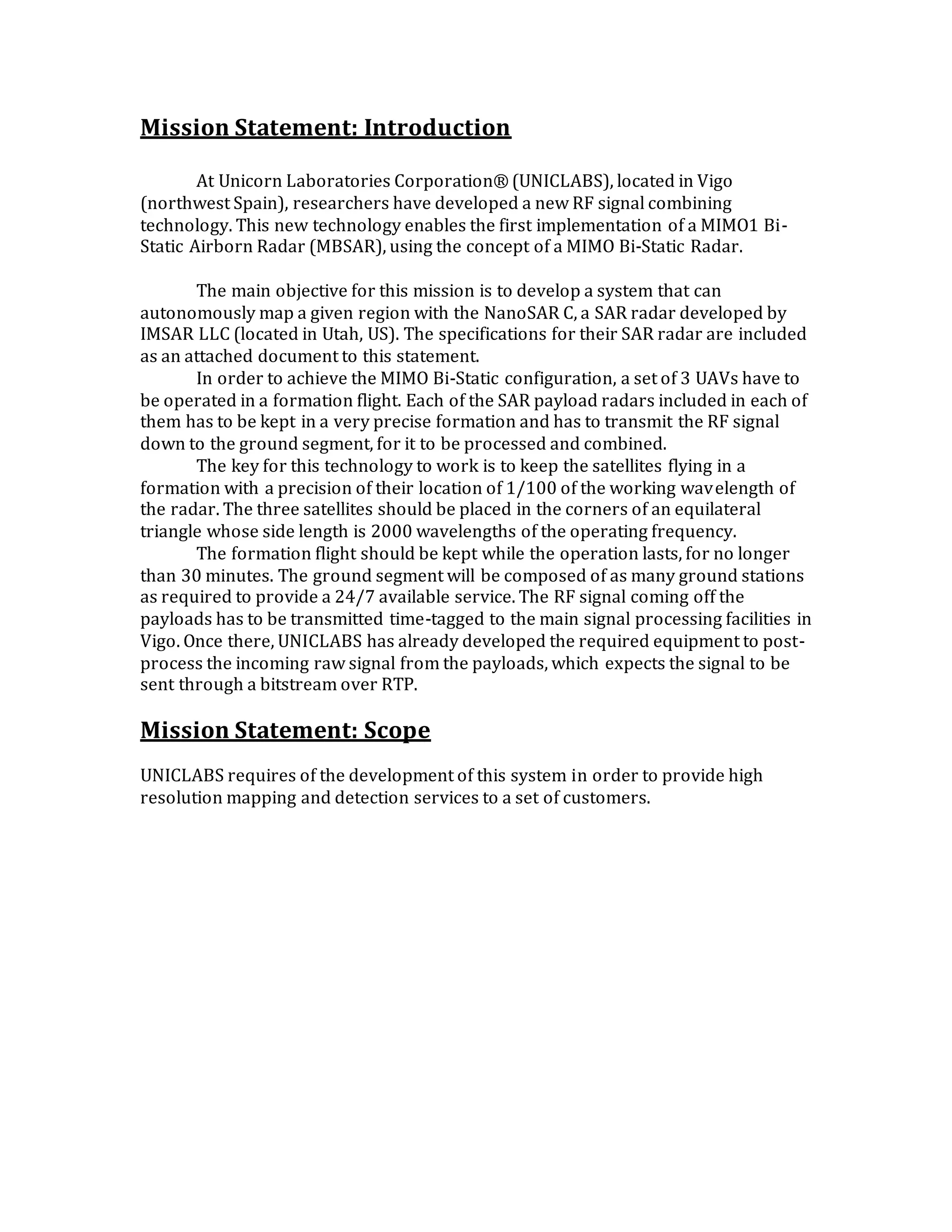
At Unicorn Laboratories Corporation® (UNICLABS), located in Vigo
(northwest Spain), researchers have developed a new RF signal combining
technology. This new technology enables the first implementation of a MIMO1 Bi-
Static Airborn Radar (MBSAR), using the concept of a MIMO Bi-Static Radar.
The main objective for this mission is to develop a system that can
autonomously map a given region with the NanoSAR C, a SAR radar developed by
IMSAR LLC (located in Utah, US). The specifications for their SAR radar are included
as an attached document to this statement.
In order to achieve the MIMO Bi-Static configuration, a set of 3 UAVs have to
be operated in a formation flight. Each of the SAR payload radars included in each of
them has to be kept in a very precise formation and has to transmit the RF signal
down to the ground segment, for it to be processed and combined.
The key for this technology to work is to keep the satellites flying in a
formation with a precision of their location of 1/100 of the working wavelength of
the radar. The three satellites should be placed in the corners of an equilateral
triangle whose side length is 2000 wavelengths of the operating frequency.
The formation flight should be kept while the operation lasts, for no longer
than 30 minutes. The ground segment will be composed of as many ground stations
as required to provide a 24/7 available service. The RF signal coming off the
payloads has to be transmitted time-tagged to the main signal processing facilities in
Vigo. Once there, UNICLABS has already developed the required equipment to post-
process the incoming raw signal from the payloads, which expects the signal to be
sent through a bitstream over RTP.
Mission Statement: Scope
UNICLABS requires of the development of this system in order to provide high
resolution mapping and detection services to a set of customers.
Operational Modes, Events and Transitions
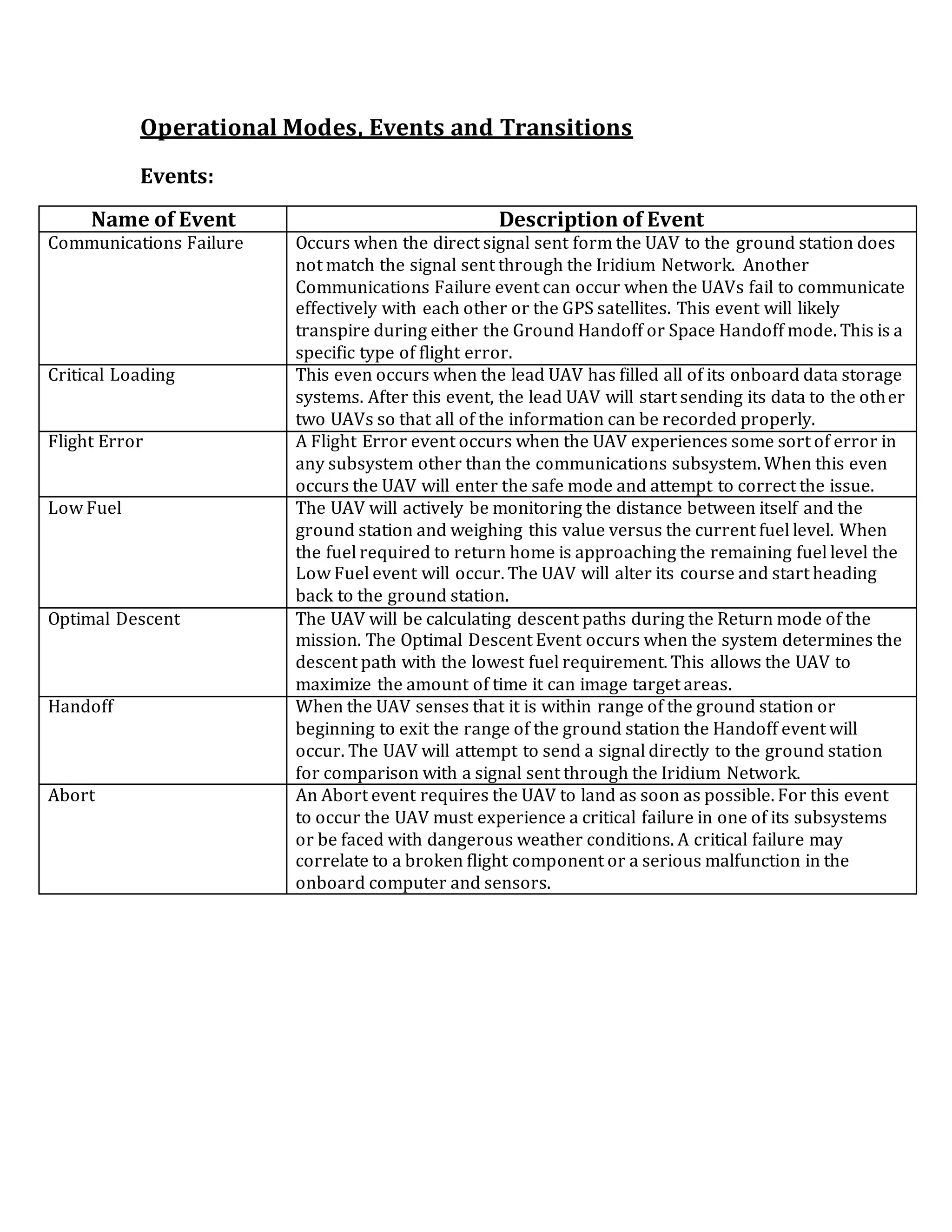
Events:
Name of Event Description of Event
Communications Failure Occurs when the direct signal sent form the UAV to the ground station does
not match the signal sent through the Iridium Network. Another
Communications Failure event can occur when the UAVs fail to communicate
effectively with each other or the GPS satellites. This event will likely
transpire during either the Ground Handoff or Space Handoff mode. This is a
specific type of flight error.
Critical Loading This even occurs when the lead UAV has filled all of its onboard data storage
systems. After this event, the lead UAV will start sending its data to the other
two UAVs so that all of the information can be recorded properly.
Flight Error A Flight Error event occurs when the UAV experiences some sort of error in
any subsystem other than the communications subsystem. When this even
occurs the UAV will enter the safe mode and attempt to correct the issue.
Low Fuel The UAV will actively be monitoring the distance between itself and the
ground station and weighing this value versus the current fuel level. When
the fuel required to return home is approaching the remaining fuel level the
Low Fuel event will occur. The UAV will alter its course and start heading
back to the ground station.
Optimal Descent The UAV will be calculating descent paths during the Return mode of the
mission. The Optimal Descent Event occurs when the system determines the
descent path with the lowest fuel requirement. This allows the UAV to
maximize the amount of time it can image target areas.
Handoff When the UAV senses that it is within range of the ground station or
beginning to exit the range of the ground station the Handoff event will
occur. The UAV will attempt to send a signal directly to the ground station
for comparison with a signal sent through the Iridium Network.
Abort An Abort event requires the UAV to land as soon as possible. For this event
to occur the UAV must experience a critical failure in one of its subsystems
or be faced with dangerous weather conditions. A critical failure may
correlate to a broken flight component or a serious malfunction in the
onboard computer and sensors.
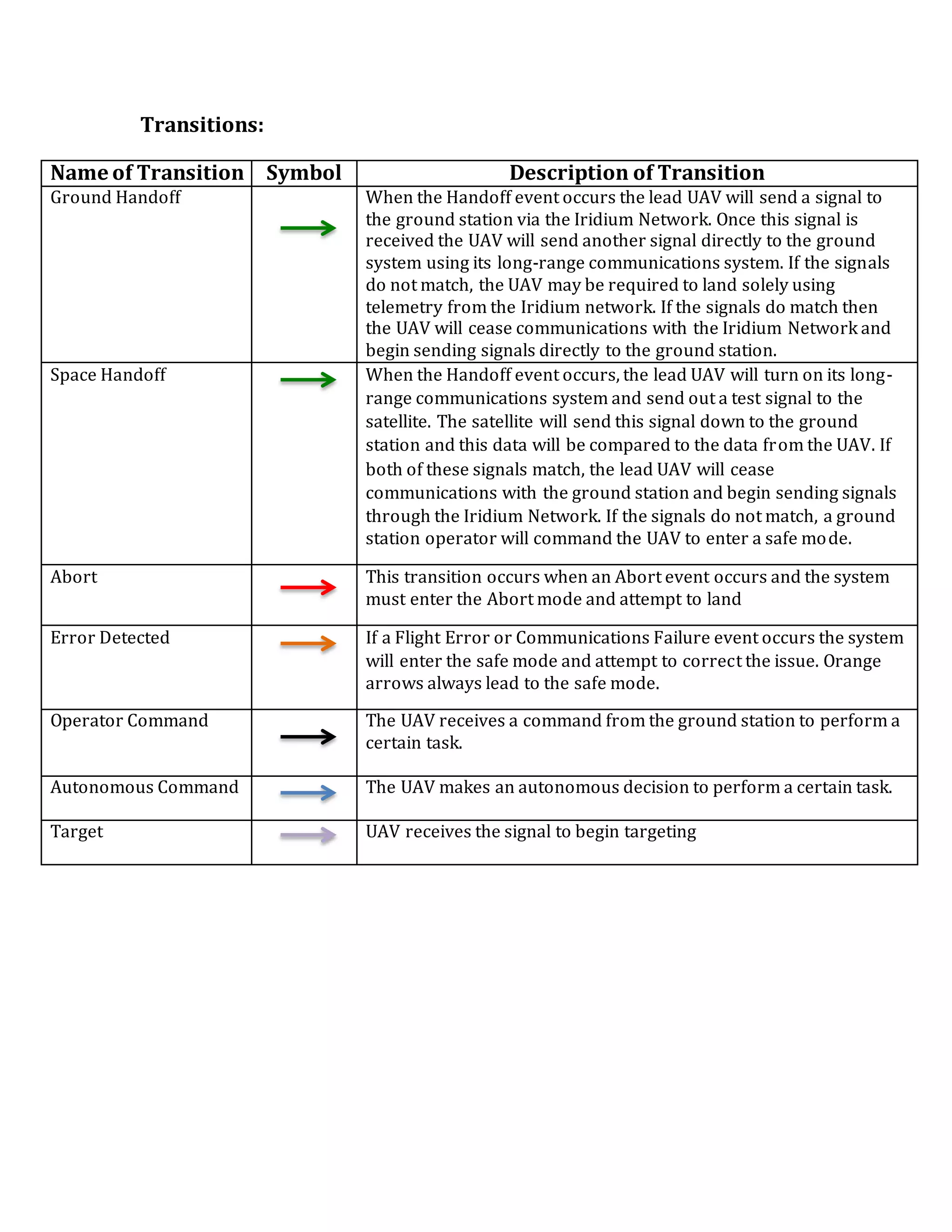
Transitions:
Name of Transition Symbol Description of Transition
Ground Handoff When the Handoff event occurs the lead UAV will send a signal to
the ground station via the Iridium Network. Once this signal is
received the UAV will send another signal directly to the ground
system using its long-range communications system. If the signals
do not match, the UAV may be required to land solely using
telemetry from the Iridium network. If the signals do match then
the UAV will cease communications with the Iridium Network and
begin sending signals directly to the ground station.
Space Handoff When the Handoff event occurs, the lead UAV will turn on its long-
range communications system and send out a test signal to the
satellite. The satellite will send this signal down to the ground
station and this data will be compared to the data from the UAV. If
both of these signals match, the lead UAV will cease
communications with the ground station and begin sending signals
through the Iridium Network. If the signals do not match, a ground
station operator will command the UAV to enter a safe mode.
Abort This transition occurs when an Abort event occurs and the system
must enter the Abort mode and attempt to land
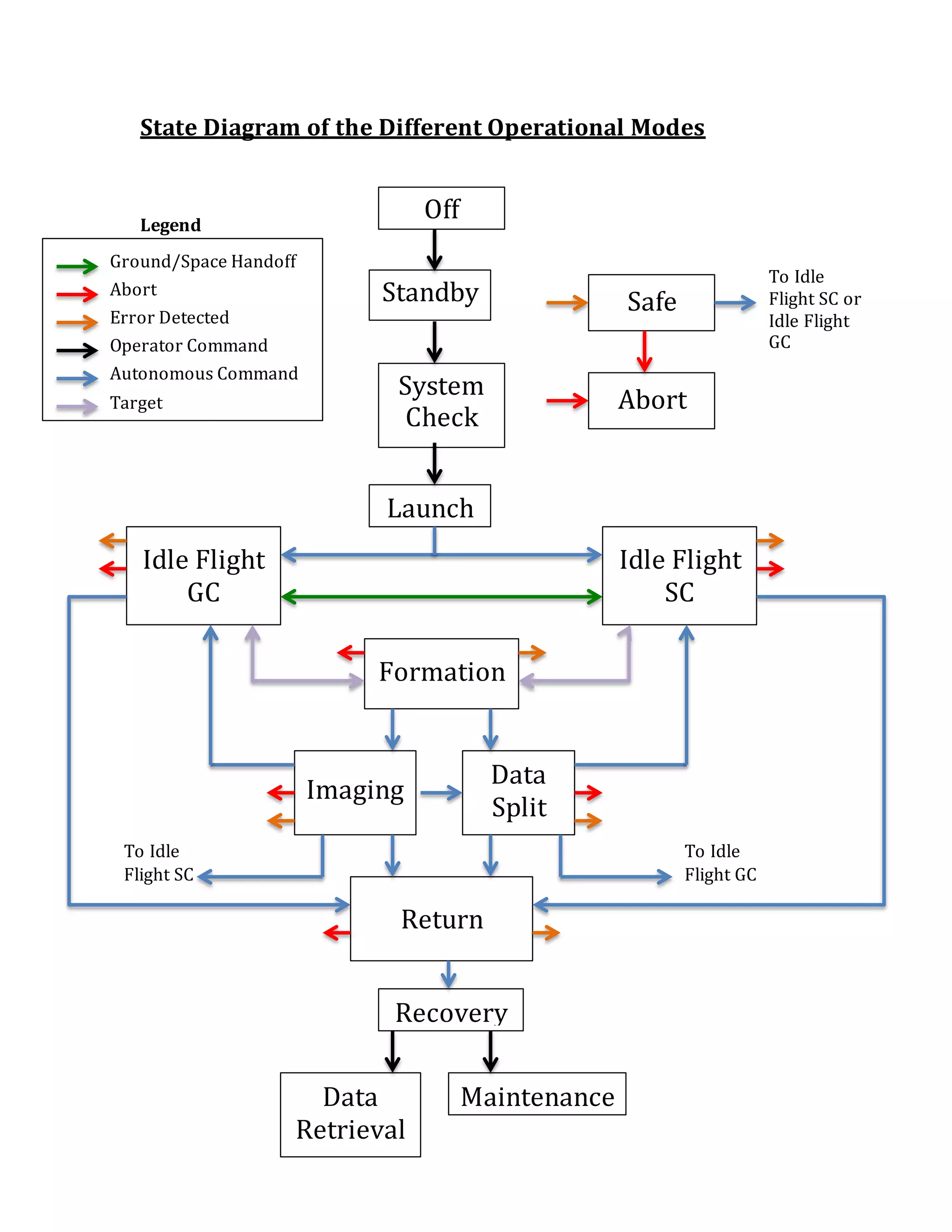
Error Detected If a Flight Error or Communications Failure event occurs the system
will enter the safe mode and attempt to correct the issue. Orange
arrows always lead to the safe mode.
Operator Command The UAV receives a command from the ground station to perform a
certain task.
Autonomous Command The UAV makes an autonomous decision to perform a certain task.
Target UAV receives the signal to begin targeting
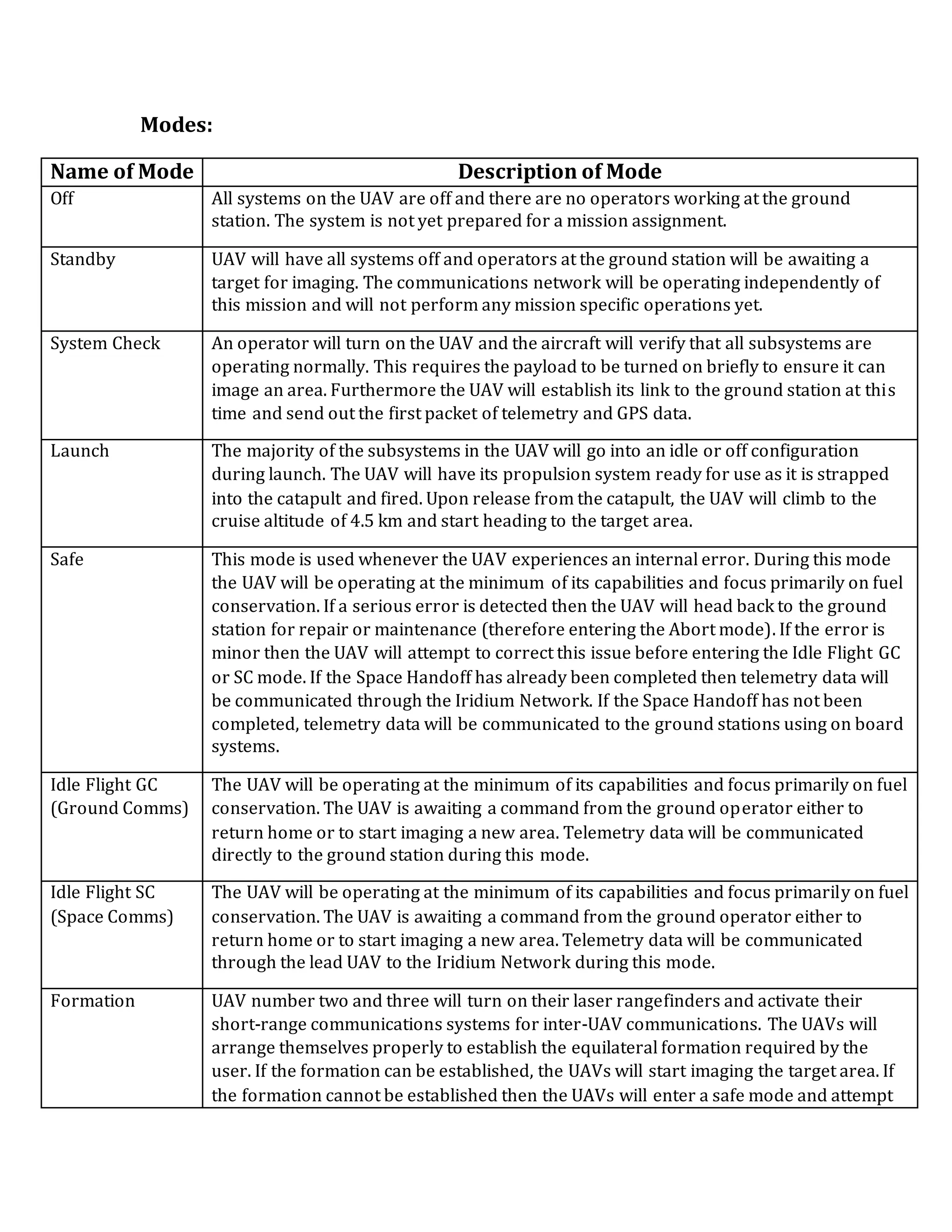
Modes:
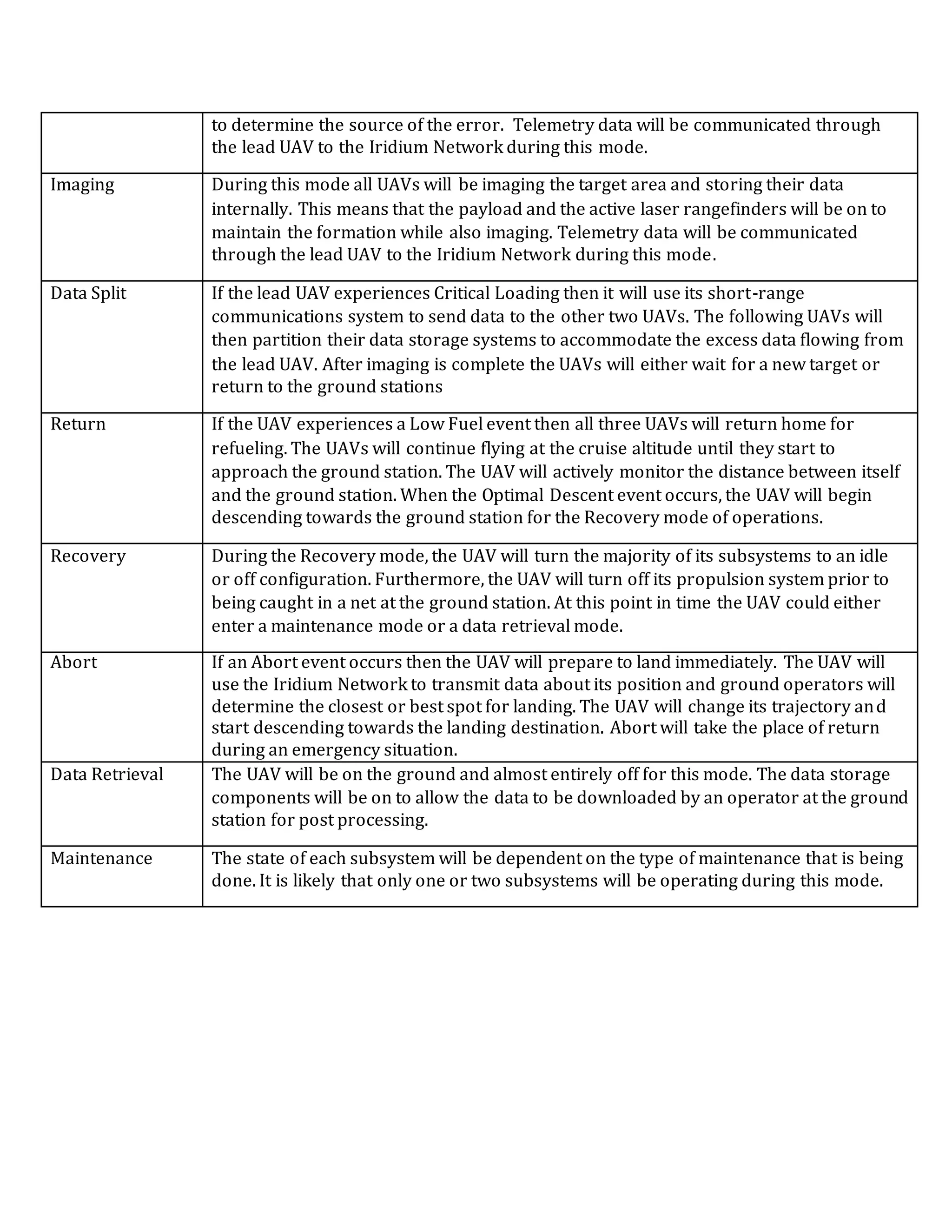
Name of Mode Description of Mode
Off All systems on the UAV are off and there are no operators working at the ground
station. The system is not yet prepared for a mission assignment.
Standby UAV will have all systems off and operators at the ground station will be awaiting a
target for imaging. The communications network will be operating independently of
this mission and will not perform any mission specific operations yet.
System Check An operator will turn on the UAV and the aircraft will verify that all subsystems are
operating normally. This requires the payload to be turned on briefly to ensure it can
image an area. Furthermore the UAV will establish its link to the ground station at this
time and send out the first packet of telemetry and GPS data.
Launch The majority of the subsystems in the UAV will go into an idle or off configuration
during launch. The UAV will have its propulsion system ready for use as it is strapped
into the catapult and fired. Upon release from the catapult, the UAV will climb to the
cruise altitude of 4.5 km and start heading to the target area.
Safe This mode is used whenever the UAV experiences an internal error. During this mode
the UAV will be operating at the minimum of its capabilities and focus primarily on fuel
conservation. If a serious error is detected then the UAV will head back to the ground
station for repair or maintenance (therefore entering the Abort mode). If the error is
minor then the UAV will attempt to correct this issue before entering the Idle Flight GC
or SC mode. If the Space Handoff has already been completed then telemetry data will
be communicated through the Iridium Network. If the Space Handoff has not been
completed, telemetry data will be communicated to the ground stations using on board
systems.
Idle Flight GC
(Ground Comms)
The UAV will be operating at the minimum of its capabilities and focus primarily on fuel
conservation. The UAV is awaiting a command from the ground operator either to
return home or to start imaging a new area. Telemetry data will be communicated
directly to the ground station during this mode.
Idle Flight SC
(Space Comms)
The UAV will be operating at the minimum of its capabilities and focus primarily on fuel
conservation. The UAV is awaiting a command from the ground operator either to
return home or to start imaging a new area. Telemetry data will be communicated
through the lead UAV to the Iridium Network during this mode.
Formation UAV number two and three will turn on their laser rangefinders and activate their
short-range communications systems for inter-UAV communications. The UAVs will
arrange themselves properly to establish the equilateral formation required by the
user. If the formation can be established, the UAVs will start imaging the target area. If
the formation cannot be established then the UAVs will enter a safe mode and attempt
to determine the source of the error. Telemetry data will be communicated through
the lead UAV to the Iridium Network during this mode.
Imaging During this mode all UAVs will be imaging the target area and storing their data
internally. This means that the payload and the active laser rangefinders will be on to
maintain the formation while also imaging. Telemetry data will be communicated
through the lead UAV to the Iridium Network during this mode.
Data Split If the lead UAV experiences Critical Loading then it will use its short-range
communications system to send data to the other two UAVs. The following UAVs will
then partition their data storage systems to accommodate the excess data flowing from
the lead UAV. After imaging is complete the UAVs will either wait for a new target or
return to the ground stations
Return If the UAV experiences a Low Fuel event then all three UAVs will return home for
refueling. The UAVs will continue flying at the cruise altitude until they start to
approach the ground station. The UAV will actively monitor the distance between itself
and the ground station. When the Optimal Descent event occurs, the UAV will begin
descending towards the ground station for the Recovery mode of operations.
Recovery During the Recovery mode, the UAV will turn the majority of its subsystems to an idle
or off configuration. Furthermore, the UAV will turn off its propulsion system prior to
being caught in a net at the ground station. At this point in time the UAV could either
enter a maintenance mode or a data retrieval mode.
Abort If an Abort event occurs then the UAV will prepare to land immediately. The UAV will
use the Iridium Network to transmit data about its position and ground operators will
determine the closest or best spot for landing. The UAV will change its trajectory and
start descending towards the landing destination. Abort will take the place of return
during an emergency situation.
Data Retrieval The UAV will be on the ground and almost entirely off for this mode. The data storage
components will be on to allow the data to be downloaded by an operator at the ground
station for post processing.
Maintenance The state of each subsystem will be dependent on the type of maintenance that is being
done. It is likely that only one or two subsystems will be operating during this mode.
State Diagram of the Different Operational Modes
Legend
Ground/Space Handoff
Abort
Error Detected
Operator Command
Autonomous Command
Target
Off
System
Check
Standby
Launch
Idle Flight
SC
Formation
Imaging
Data
Split
Return
Recovery
Data
Retrieval
Maintenance
Idle Flight
GC
To Idle
Flight SC
To Idle
Flight GC
Safe
Abort
To Idle
Flight SC or
Idle Flight
GC

Operational modes, systems project 2

  • 1.
    Mission Statement: Introduction AtUnicorn Laboratories Corporation® (UNICLABS), located in Vigo (northwest Spain), researchers have developed a new RF signal combining technology. This new technology enables the first implementation of a MIMO1 Bi- Static Airborn Radar (MBSAR), using the concept of a MIMO Bi-Static Radar. The main objective for this mission is to develop a system that can autonomously map a given region with the NanoSAR C, a SAR radar developed by IMSAR LLC (located in Utah, US). The specifications for their SAR radar are included as an attached document to this statement. In order to achieve the MIMO Bi-Static configuration, a set of 3 UAVs have to be operated in a formation flight. Each of the SAR payload radars included in each of them has to be kept in a very precise formation and has to transmit the RF signal down to the ground segment, for it to be processed and combined. The key for this technology to work is to keep the satellites flying in a formation with a precision of their location of 1/100 of the working wavelength of the radar. The three satellites should be placed in the corners of an equilateral triangle whose side length is 2000 wavelengths of the operating frequency. The formation flight should be kept while the operation lasts, for no longer than 30 minutes. The ground segment will be composed of as many ground stations as required to provide a 24/7 available service. The RF signal coming off the payloads has to be transmitted time-tagged to the main signal processing facilities in Vigo. Once there, UNICLABS has already developed the required equipment to post- process the incoming raw signal from the payloads, which expects the signal to be sent through a bitstream over RTP. Mission Statement: Scope UNICLABS requires of the development of this system in order to provide high resolution mapping and detection services to a set of customers.
  • 2.
    Operational Modes, Eventsand Transitions Events: Name of Event Description of Event Communications Failure Occurs when the direct signal sent form the UAV to the ground station does not match the signal sent through the Iridium Network. Another Communications Failure event can occur when the UAVs fail to communicate effectively with each other or the GPS satellites. This event will likely transpire during either the Ground Handoff or Space Handoff mode. This is a specific type of flight error. Critical Loading This even occurs when the lead UAV has filled all of its onboard data storage systems. After this event, the lead UAV will start sending its data to the other two UAVs so that all of the information can be recorded properly. Flight Error A Flight Error event occurs when the UAV experiences some sort of error in any subsystem other than the communications subsystem. When this even occurs the UAV will enter the safe mode and attempt to correct the issue. Low Fuel The UAV will actively be monitoring the distance between itself and the ground station and weighing this value versus the current fuel level. When the fuel required to return home is approaching the remaining fuel level the Low Fuel event will occur. The UAV will alter its course and start heading back to the ground station. Optimal Descent The UAV will be calculating descent paths during the Return mode of the mission. The Optimal Descent Event occurs when the system determines the descent path with the lowest fuel requirement. This allows the UAV to maximize the amount of time it can image target areas. Handoff When the UAV senses that it is within range of the ground station or beginning to exit the range of the ground station the Handoff event will occur. The UAV will attempt to send a signal directly to the ground station for comparison with a signal sent through the Iridium Network. Abort An Abort event requires the UAV to land as soon as possible. For this event to occur the UAV must experience a critical failure in one of its subsystems or be faced with dangerous weather conditions. A critical failure may correlate to a broken flight component or a serious malfunction in the onboard computer and sensors.
  • 3.
    Transitions: Name of TransitionSymbol Description of Transition Ground Handoff When the Handoff event occurs the lead UAV will send a signal to the ground station via the Iridium Network. Once this signal is received the UAV will send another signal directly to the ground system using its long-range communications system. If the signals do not match, the UAV may be required to land solely using telemetry from the Iridium network. If the signals do match then the UAV will cease communications with the Iridium Network and begin sending signals directly to the ground station. Space Handoff When the Handoff event occurs, the lead UAV will turn on its long- range communications system and send out a test signal to the satellite. The satellite will send this signal down to the ground station and this data will be compared to the data from the UAV. If both of these signals match, the lead UAV will cease communications with the ground station and begin sending signals through the Iridium Network. If the signals do not match, a ground station operator will command the UAV to enter a safe mode. Abort This transition occurs when an Abort event occurs and the system must enter the Abort mode and attempt to land Error Detected If a Flight Error or Communications Failure event occurs the system will enter the safe mode and attempt to correct the issue. Orange arrows always lead to the safe mode. Operator Command The UAV receives a command from the ground station to perform a certain task. Autonomous Command The UAV makes an autonomous decision to perform a certain task. Target UAV receives the signal to begin targeting
  • 4.
    Modes: Name of ModeDescription of Mode Off All systems on the UAV are off and there are no operators working at the ground station. The system is not yet prepared for a mission assignment. Standby UAV will have all systems off and operators at the ground station will be awaiting a target for imaging. The communications network will be operating independently of this mission and will not perform any mission specific operations yet. System Check An operator will turn on the UAV and the aircraft will verify that all subsystems are operating normally. This requires the payload to be turned on briefly to ensure it can image an area. Furthermore the UAV will establish its link to the ground station at this time and send out the first packet of telemetry and GPS data. Launch The majority of the subsystems in the UAV will go into an idle or off configuration during launch. The UAV will have its propulsion system ready for use as it is strapped into the catapult and fired. Upon release from the catapult, the UAV will climb to the cruise altitude of 4.5 km and start heading to the target area. Safe This mode is used whenever the UAV experiences an internal error. During this mode the UAV will be operating at the minimum of its capabilities and focus primarily on fuel conservation. If a serious error is detected then the UAV will head back to the ground station for repair or maintenance (therefore entering the Abort mode). If the error is minor then the UAV will attempt to correct this issue before entering the Idle Flight GC or SC mode. If the Space Handoff has already been completed then telemetry data will be communicated through the Iridium Network. If the Space Handoff has not been completed, telemetry data will be communicated to the ground stations using on board systems. Idle Flight GC (Ground Comms) The UAV will be operating at the minimum of its capabilities and focus primarily on fuel conservation. The UAV is awaiting a command from the ground operator either to return home or to start imaging a new area. Telemetry data will be communicated directly to the ground station during this mode. Idle Flight SC (Space Comms) The UAV will be operating at the minimum of its capabilities and focus primarily on fuel conservation. The UAV is awaiting a command from the ground operator either to return home or to start imaging a new area. Telemetry data will be communicated through the lead UAV to the Iridium Network during this mode. Formation UAV number two and three will turn on their laser rangefinders and activate their short-range communications systems for inter-UAV communications. The UAVs will arrange themselves properly to establish the equilateral formation required by the user. If the formation can be established, the UAVs will start imaging the target area. If the formation cannot be established then the UAVs will enter a safe mode and attempt
  • 5.
    to determine thesource of the error. Telemetry data will be communicated through the lead UAV to the Iridium Network during this mode. Imaging During this mode all UAVs will be imaging the target area and storing their data internally. This means that the payload and the active laser rangefinders will be on to maintain the formation while also imaging. Telemetry data will be communicated through the lead UAV to the Iridium Network during this mode. Data Split If the lead UAV experiences Critical Loading then it will use its short-range communications system to send data to the other two UAVs. The following UAVs will then partition their data storage systems to accommodate the excess data flowing from the lead UAV. After imaging is complete the UAVs will either wait for a new target or return to the ground stations Return If the UAV experiences a Low Fuel event then all three UAVs will return home for refueling. The UAVs will continue flying at the cruise altitude until they start to approach the ground station. The UAV will actively monitor the distance between itself and the ground station. When the Optimal Descent event occurs, the UAV will begin descending towards the ground station for the Recovery mode of operations. Recovery During the Recovery mode, the UAV will turn the majority of its subsystems to an idle or off configuration. Furthermore, the UAV will turn off its propulsion system prior to being caught in a net at the ground station. At this point in time the UAV could either enter a maintenance mode or a data retrieval mode. Abort If an Abort event occurs then the UAV will prepare to land immediately. The UAV will use the Iridium Network to transmit data about its position and ground operators will determine the closest or best spot for landing. The UAV will change its trajectory and start descending towards the landing destination. Abort will take the place of return during an emergency situation. Data Retrieval The UAV will be on the ground and almost entirely off for this mode. The data storage components will be on to allow the data to be downloaded by an operator at the ground station for post processing. Maintenance The state of each subsystem will be dependent on the type of maintenance that is being done. It is likely that only one or two subsystems will be operating during this mode.
  • 6.
    State Diagram ofthe Different Operational Modes Legend Ground/Space Handoff Abort Error Detected Operator Command Autonomous Command Target Off System Check Standby Launch Idle Flight SC Formation Imaging Data Split Return Recovery Data Retrieval Maintenance Idle Flight GC To Idle Flight SC To Idle Flight GC Safe Abort To Idle Flight SC or Idle Flight GC