ptsb/jka/burger


CG605
    Underground Utility Detection??


                             Utility Detection


ptsb/jka/burg/dis11
                                                 2
    Safety on site is a necessary ingredient of all civil works.

       Information provided by locating before digging is an essential
        contribution to safe digging.

       Spiking a buried power cable or fracturing a pipeline is a cause of
        serious and dramatic danger that can mutilate or even kill.

       Knowing their presence and position helps avoid the possibility of
        damage.


ptsb/jka/burg/dis11
                                                                              3
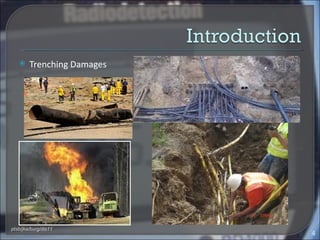
    Trenching Damages


ptsb/jka/burg/dis11
                            4
What’s all this about locating?

       It’s about ;
          • reducing unnecessary cost
          • efficient working
          • site safety
          • maintaining essential services to the community


       Information is the end product of locating buried utility pipes and
        cables.

       Positive, accurate and precise information is the only kind of
        information worth having or worth paying for.

ptsb/jka/burg/dis11
                                                                              5
    Faulty or incomplete information can misled, it can be the cause of
        unnecessary cost and it can expose people to danger.

       Underground Utility Mapping is a process to determine the utilities
        beneath the ground surface.
         Such as : telephone line, power distribution cable, natural gas
                     pipeline, fiber optic line, street light cable, water
                     pipes,sewerage etc.


                                            Faulty 01       Faulty 02

ptsb/jka/burg/dis11
                                                                              6
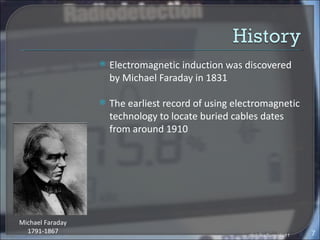
   Electromagnetic induction was discovered
                      by Michael Faraday in 1831

                     The earliest record of using electromagnetic
                      technology to locate buried cables dates
                      from around 1910


Michael Faraday
  1791-1867                                                                 7
                                                      ptsb/jka/burg/dis11
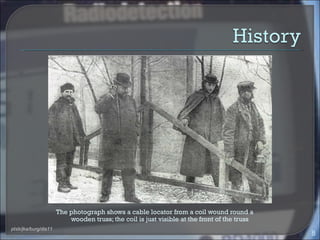
The photograph shows a cable locator from a coil wound round a
                          wooden truss; the coil is just visible at the front of the truss
ptsb/jka/burg/dis11
                                                                                             8
 Survey    and Mapping Department are responsible
                 to manage utility mapping for Malaysia (24th
                 August 1994)

             To   handle disruption of existing utility services
                 due to excavation works

             Follow   the ‘
                 Standard Guideline for Underground Utility Mapping
                 ’

ptsb/jka/burg/dis11
                                                                    9
    Underground utility installations involved the use of different
                 materials and sizes and can be placed at different depths.

                In addition, the environment in which it is buried can vary from
                 one place to another and can be packed with a variety of utility
                 placement.

                This makes possible the need for using more than one
                 technique to detect its position.

                The selection of appropriate techniques is essential to ensure
                 effective detection.


ptsb/jka/burg/dis11
                                                                                    10
    In general, the detection techniques that can be used can be
                 classified as follows:

                  • Electromagnetic
                         Pipe and Cable Locator (PCL)
                         Terrain Conductivity
                         Resistivity Measurements
                         Metal Detectors
                         Ground Penetrating Radar (GPR)
                         Optical Methods
                         X-ray Methods (Penetrating Radiation)


ptsb/jka/burg/dis11
                                                                                11
    In general, the detection techniques that can be used can be
                 classified as follows:

                  • Magnetic
                       Magnetometer
                         Total Field Measurements
                         Gradiometric Measurements

                  • Elastic Wave
                       Seismic Reflection
                       Seismic Refraction   However, utility detection activity typically
                       Acoustic Emission    involve two types of equipment
                                                      * Pipe and Cable Locators (PCL)
                                                      * Ground penetration radar (GPR).
ptsb/jka/burg/dis11
                                                                                             12
ptsb/jka/burg/dis11
                      13
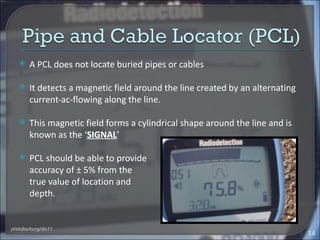
    A PCL does not locate buried pipes or cables

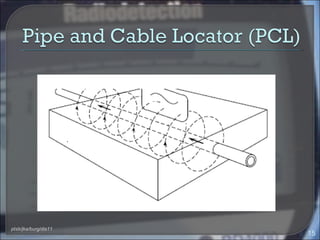
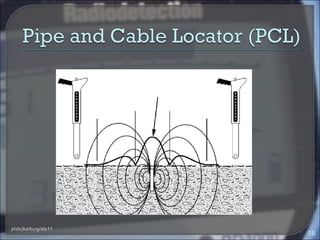
       It detects a magnetic field around the line created by an alternating
        current-ac-flowing along the line.

       This magnetic field forms a cylindrical shape around the line and is
        known as the ‘SIGNAL’

       PCL should be able to provide
        accuracy of ± 5% from the
        true value of location and
        depth.


ptsb/jka/burg/dis11
                                                                                14
ptsb/jka/burg/dis11
                      15
ptsb/jka/burg/dis11
                      16
 Signal;
          • Active Signal
             Is produce by a signal transmitter and applied to a line so that it can be
              located and traced with a receiver.
             The signal transmitter can also flood an area with signal so that all the
              lines in the area can be located

          • Passive Signal
             Occur ‘naturally’ on lines as an effect of 50/60Hz electric power energy or
              VLF radio energy

             ** Despite the existence of passive signals the best signal to
              locate and trace a line is an active signal which has been
              deliberately applied for the purpose of locating and tracing

ptsb/jka/burg/dis11
                                                                                            17
 Active           Signal;
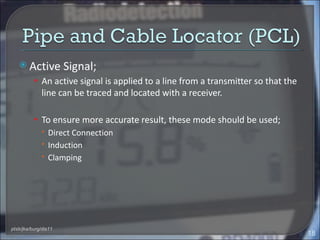
          • An active signal is applied to a line from a transmitter so that the
              line can be traced and located with a receiver.

          • To ensure more accurate result, these mode should be used;
             Direct Connection
             Induction
             Clamping


ptsb/jka/burg/dis11
                                                                                   18
 Direct           Connection
          • The output ac voltage from the signal transmitter is connected directly
              to the pipe or cable at an access point such as a valve, meter or end of
              the conductor, and the circuit is completed by a connection to a stake
              or the ground connection point


ptsb/jka/burg/dis11
                                                                                         19
 Direct           Connection


ptsb/jka/burg/dis11
                                   20
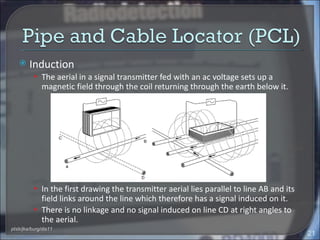
    Induction
          • The aerial in a signal transmitter fed with an ac voltage sets up a
              magnetic field through the coil returning through the earth below it.


          • In the first drawing the transmitter aerial lies parallel to line AB and its
            field links around the line which therefore has a signal induced on it.
          • There is no linkage and no signal induced on line CD at right angles to
            the aerial.
ptsb/jka/burg/dis11
                                                                                           21
 Clamping
          • Uses the induction principle to give similar result to direct
            connection, but without electrical contact to the line.
          • The output from the signal transmitter is applied to a target line
            by clamping round it with a split toroidal magnetic core, which
            carries a primary winding magnetizing the core with the ac signal
          • The line becomes the secondary of a transformer, and will carry a
            strong signal, provided that it is adequately grounded on each
            side.


ptsb/jka/burg/dis11
                                                                                 22
ptsb/jka/burg/dis11
                      23
 Passive            Signal;
          • Are ‘naturally’ present on many buried pipes and cables.
             Eg. Power cables which carry currents as part of their normal duty.
          • Current flowing in a cable produces a magnetic field or passive
              signal.


ptsb/jka/burg/dis11
                                                                                    24
 Passive          Signal;
          • Very low frequency long wave radio energy from distant
              transmitters is present in the atmosphere world-wide.
          •   The ground provides return paths for this energy, and burried
              metallic lines form preferred paths.
          •   They then act as aerials re-radiating these signals.
          •   The signals are strong enough to be located in most part of the
              country.
          •   This can be check by trial and error before relying on them for
              location work.


ptsb/jka/burg/dis11
                                                                                25
 Passive          Signal;


ptsb/jka/burg/dis11
                                26
    Sweeping
          • To locate any conductor underground
          • Walk in grid pattern as shown on illustration
          • Sweeping in two perpendicular directions
          • ‘STOP’ when you get a response
          • Move the transmitter to that point and trace the conductor
            you’ve found out of the area of interest, marking as you go.
          • Return to your starting point and resume sweeping, looking for
            more conductors to trace.
          • When finished sweeping using the inductive method, sweep
            again using passive power mode.
          • This technique will reveal all grounded metal pipes and cables,
            and non-conducting lines with properly installed tracer wires.

ptsb/jka/burg/dis11
  ptsb/jka/burg/dis11                                                         27
    SWEEPING


                      Sweep

ptsb/jka/burg/dis11
                              28
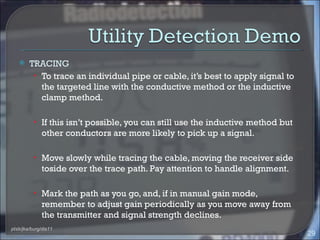
    TRACING
         • To trace an individual pipe or cable, it’s best to apply signal to
           the targeted line with the conductive method or the inductive
           clamp method.

          • If this isn’t possible, you can still use the inductive method but
              other conductors are more likely to pick up a signal.

          • Move slowly while tracing the cable, moving the receiver side
              toside over the trace path. Pay attention to handle alignment.

          • Mark the path as you go, and, if in manual gain mode,
              remember to adjust gain periodically as you move away from
              the transmitter and signal strength declines.
ptsb/jka/burg/dis11
                                                                                 29
 PCL


                      RD 7000/8000 Demo


ptsb/jka/burg/dis11
                                          30
ptsb/jka/burg/dis11
                      31
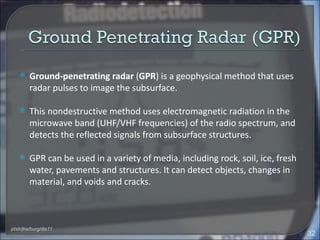
    Ground-penetrating radar (GPR) is a geophysical method that uses
        radar pulses to image the subsurface.

       This nondestructive method uses electromagnetic radiation in the
        microwave band (UHF/VHF frequencies) of the radio spectrum, and
        detects the reflected signals from subsurface structures.

       GPR can be used in a variety of media, including rock, soil, ice, fresh
        water, pavements and structures. It can detect objects, changes in
        material, and voids and cracks.


ptsb/jka/burg/dis11
                                                                                  32
    Depending on the depth and soil conditions, a range of frequencies
        should be used:


ptsb/jka/burg/dis11
                                                                             33
ptsb/jka/burg/dis11
                      34
 GPR


                      01   02   03


ptsb/jka/burg/dis11
                                     35
The American Public Works Association (APWA) Uniform Color Codes for
      temporary marking of underground utilities are listed below:


ptsb/jka/burg/dis11
                                                                             36
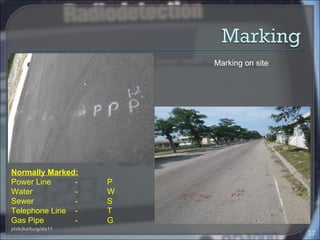
Marking on site


Normally Marked:
Power Line     -      P
Water          -      W
Sewer          -      S
Telephone Line -      T
Gas Pipe       -      G
ptsb/jka/burg/dis11
                                            37
    ABC & XYZ of Locating Buried Pipes and Cables (for the beginner
        and the specialist)
         • Radiodetection Limited

       Locating 101- A quick guide to underground locating
         • Schonstedt

       Pekeliling KPUP bil. 1/2006 – Garis Panduan Pemetaan Utiliti
        Bawah Tanah
         • Jupem

       Pekeliling KPUP bil. 1/2007 – Garis Panduan Ukuran Pepasangan
        Utiliti
         • Jupem

ptsb/jka/burg/dis11
                                                                          38

Underground utility detection

  • 1.
  • 2.
    Underground Utility Detection?? Utility Detection ptsb/jka/burg/dis11 2
  • 3.
    Safety on site is a necessary ingredient of all civil works.  Information provided by locating before digging is an essential contribution to safe digging.  Spiking a buried power cable or fracturing a pipeline is a cause of serious and dramatic danger that can mutilate or even kill.  Knowing their presence and position helps avoid the possibility of damage. ptsb/jka/burg/dis11 3
  • 4.
    Trenching Damages ptsb/jka/burg/dis11 4
  • 5.
    What’s all thisabout locating?  It’s about ; • reducing unnecessary cost • efficient working • site safety • maintaining essential services to the community  Information is the end product of locating buried utility pipes and cables.  Positive, accurate and precise information is the only kind of information worth having or worth paying for. ptsb/jka/burg/dis11 5
  • 6.
    Faulty or incomplete information can misled, it can be the cause of unnecessary cost and it can expose people to danger.  Underground Utility Mapping is a process to determine the utilities beneath the ground surface.  Such as : telephone line, power distribution cable, natural gas pipeline, fiber optic line, street light cable, water pipes,sewerage etc. Faulty 01 Faulty 02 ptsb/jka/burg/dis11 6
  • 7.
    Electromagnetic induction was discovered by Michael Faraday in 1831  The earliest record of using electromagnetic technology to locate buried cables dates from around 1910 Michael Faraday 1791-1867 7 ptsb/jka/burg/dis11
  • 8.
    The photograph showsa cable locator from a coil wound round a wooden truss; the coil is just visible at the front of the truss ptsb/jka/burg/dis11 8
  • 9.
     Survey and Mapping Department are responsible to manage utility mapping for Malaysia (24th August 1994)  To handle disruption of existing utility services due to excavation works  Follow the ‘ Standard Guideline for Underground Utility Mapping ’ ptsb/jka/burg/dis11 9
  • 10.
    Underground utility installations involved the use of different materials and sizes and can be placed at different depths.  In addition, the environment in which it is buried can vary from one place to another and can be packed with a variety of utility placement.  This makes possible the need for using more than one technique to detect its position.  The selection of appropriate techniques is essential to ensure effective detection. ptsb/jka/burg/dis11 10
  • 11.
    In general, the detection techniques that can be used can be classified as follows: • Electromagnetic  Pipe and Cable Locator (PCL)  Terrain Conductivity  Resistivity Measurements  Metal Detectors  Ground Penetrating Radar (GPR)  Optical Methods  X-ray Methods (Penetrating Radiation) ptsb/jka/burg/dis11 11
  • 12.
    In general, the detection techniques that can be used can be classified as follows: • Magnetic  Magnetometer  Total Field Measurements  Gradiometric Measurements • Elastic Wave  Seismic Reflection  Seismic Refraction However, utility detection activity typically  Acoustic Emission involve two types of equipment * Pipe and Cable Locators (PCL) * Ground penetration radar (GPR). ptsb/jka/burg/dis11 12
  • 13.
  • 14.
    A PCL does not locate buried pipes or cables  It detects a magnetic field around the line created by an alternating current-ac-flowing along the line.  This magnetic field forms a cylindrical shape around the line and is known as the ‘SIGNAL’  PCL should be able to provide accuracy of ± 5% from the true value of location and depth. ptsb/jka/burg/dis11 14
  • 15.
  • 16.
  • 17.
     Signal; • Active Signal  Is produce by a signal transmitter and applied to a line so that it can be located and traced with a receiver.  The signal transmitter can also flood an area with signal so that all the lines in the area can be located • Passive Signal  Occur ‘naturally’ on lines as an effect of 50/60Hz electric power energy or VLF radio energy ** Despite the existence of passive signals the best signal to locate and trace a line is an active signal which has been deliberately applied for the purpose of locating and tracing ptsb/jka/burg/dis11 17
  • 18.
     Active Signal; • An active signal is applied to a line from a transmitter so that the line can be traced and located with a receiver. • To ensure more accurate result, these mode should be used;  Direct Connection  Induction  Clamping ptsb/jka/burg/dis11 18
  • 19.
     Direct Connection • The output ac voltage from the signal transmitter is connected directly to the pipe or cable at an access point such as a valve, meter or end of the conductor, and the circuit is completed by a connection to a stake or the ground connection point ptsb/jka/burg/dis11 19
  • 20.
     Direct Connection ptsb/jka/burg/dis11 20
  • 21.
    Induction • The aerial in a signal transmitter fed with an ac voltage sets up a magnetic field through the coil returning through the earth below it. • In the first drawing the transmitter aerial lies parallel to line AB and its field links around the line which therefore has a signal induced on it. • There is no linkage and no signal induced on line CD at right angles to the aerial. ptsb/jka/burg/dis11 21
  • 22.
     Clamping • Uses the induction principle to give similar result to direct connection, but without electrical contact to the line. • The output from the signal transmitter is applied to a target line by clamping round it with a split toroidal magnetic core, which carries a primary winding magnetizing the core with the ac signal • The line becomes the secondary of a transformer, and will carry a strong signal, provided that it is adequately grounded on each side. ptsb/jka/burg/dis11 22
  • 23.
  • 24.
     Passive Signal; • Are ‘naturally’ present on many buried pipes and cables.  Eg. Power cables which carry currents as part of their normal duty. • Current flowing in a cable produces a magnetic field or passive signal. ptsb/jka/burg/dis11 24
  • 25.
     Passive Signal; • Very low frequency long wave radio energy from distant transmitters is present in the atmosphere world-wide. • The ground provides return paths for this energy, and burried metallic lines form preferred paths. • They then act as aerials re-radiating these signals. • The signals are strong enough to be located in most part of the country. • This can be check by trial and error before relying on them for location work. ptsb/jka/burg/dis11 25
  • 26.
     Passive Signal; ptsb/jka/burg/dis11 26
  • 27.
    Sweeping • To locate any conductor underground • Walk in grid pattern as shown on illustration • Sweeping in two perpendicular directions • ‘STOP’ when you get a response • Move the transmitter to that point and trace the conductor you’ve found out of the area of interest, marking as you go. • Return to your starting point and resume sweeping, looking for more conductors to trace. • When finished sweeping using the inductive method, sweep again using passive power mode. • This technique will reveal all grounded metal pipes and cables, and non-conducting lines with properly installed tracer wires. ptsb/jka/burg/dis11 ptsb/jka/burg/dis11 27
  • 28.
    SWEEPING Sweep ptsb/jka/burg/dis11 28
  • 29.
    TRACING • To trace an individual pipe or cable, it’s best to apply signal to the targeted line with the conductive method or the inductive clamp method. • If this isn’t possible, you can still use the inductive method but other conductors are more likely to pick up a signal. • Move slowly while tracing the cable, moving the receiver side toside over the trace path. Pay attention to handle alignment. • Mark the path as you go, and, if in manual gain mode, remember to adjust gain periodically as you move away from the transmitter and signal strength declines. ptsb/jka/burg/dis11 29
  • 30.
     PCL RD 7000/8000 Demo ptsb/jka/burg/dis11 30
  • 31.
  • 32.
    Ground-penetrating radar (GPR) is a geophysical method that uses radar pulses to image the subsurface.  This nondestructive method uses electromagnetic radiation in the microwave band (UHF/VHF frequencies) of the radio spectrum, and detects the reflected signals from subsurface structures.  GPR can be used in a variety of media, including rock, soil, ice, fresh water, pavements and structures. It can detect objects, changes in material, and voids and cracks. ptsb/jka/burg/dis11 32
  • 33.
    Depending on the depth and soil conditions, a range of frequencies should be used: ptsb/jka/burg/dis11 33
  • 34.
  • 35.
     GPR 01 02 03 ptsb/jka/burg/dis11 35
  • 36.
    The American PublicWorks Association (APWA) Uniform Color Codes for temporary marking of underground utilities are listed below: ptsb/jka/burg/dis11 36
  • 37.
    Marking on site NormallyMarked: Power Line - P Water - W Sewer - S Telephone Line - T Gas Pipe - G ptsb/jka/burg/dis11 37
  • 38.
    ABC & XYZ of Locating Buried Pipes and Cables (for the beginner and the specialist) • Radiodetection Limited  Locating 101- A quick guide to underground locating • Schonstedt  Pekeliling KPUP bil. 1/2006 – Garis Panduan Pemetaan Utiliti Bawah Tanah • Jupem  Pekeliling KPUP bil. 1/2007 – Garis Panduan Ukuran Pepasangan Utiliti • Jupem ptsb/jka/burg/dis11 38