The WeChat
story.
Joey Rigor, Kontak Mobile Apps April 29, 2016
With 700 million users
transacting with 10 million
business accounts,
WeChat’s success fired up SiIicon
Valley’s new-found fixation in its
business model.
In just 5 years,
WeChat transformed China’s
mobile landscape by enabling its
users to practically live within the
confines of its chat platform.
The app today is where Facebook and
other messaging apps would like to go and
where the future of mobile could lead us.
This is WeChat’s story.
The start of a
messaging app.
In 2011, Tencent, one of the largest
internet companies in the world, made a
mobile-only messaging app, Weixin, as
an alternative to SMS offered by
telecommunication companies.
https://www.techinasia.com/5-years-of-wechat
Tencent already has the desktop-based
QQ instant messenger and Qzone social
network (with 780 million active users at
the start of 2011).
The mobile messaging app it launched was
a bet against Kik and WhatsApp
messaging platforms that is making
inroads in China.
About 14 months after launching, in 2012,
WeChat hit a major milestone when
Tencent reported it had 100 million
registered users.
By this time Weixin became known as
WeChat as Tencent wanted it to go global.
The first 100 million users.
It was also in 2012 that Tencent opened up WeChat
to brand accounts, prompting Chinese companies
and foreign brands doing business in China to start
using the app.
To get people to add and follow a brand account, a
company could display its personalised QR code
anywhere and encourage shoppers to scan it.
The rise of brand
accounts and QR Codes.
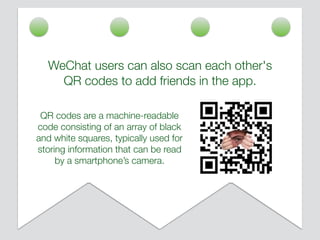
WeChat users can also scan each other's
QR codes to add friends in the app.
QR codes are a machine-readable
code consisting of an array of black
and white squares, typically used for
storing information that can be read
by a smartphone’s camera.
By 2013, the app reached 300 million
registered users.
It was also this time that the app went into
gaming and mobile payments, WeChat
Wallet, which can be connected with a variety
of Chinese-issued credit and debit cards.
Adding more features.
eCommerce and the
WeChat Wallet.
In 2014, Tencent, in its quest to enter eCommerce,
took a stake in Alibaba’s major competitor, JD.
This allowed Tencent to embed JD’s store into
WeChat as the main shopping area.
Tencent also allowed any business to open a store
inside a WeChat brand account. The feature was
open to major companies as well as small businesses.
https://www.techinasia.com/5-years-of-wechat
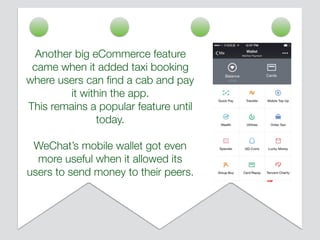
Another big eCommerce feature
came when it added taxi booking
where users can find a cab and pay
it within the app.
This remains a popular feature until
today.
WeChat’s mobile wallet got even
more useful when it allowed its
users to send money to their peers.
A variation of peer-to-peer payment is Red Packets
(formerly called “Lucky Money” or “Red Envelopes”)
stuffed with digital cash where users send each other
every day on WeChat.
A famous Chinese tradition gone digital!
This Lunar New Year’s Eve alone, over 8 billion Red
Packets were sent and received by 420 millions users.
http://blog.wechat.com/
It was also in 2014 that an influx of Chinese
startups began launching as a WeChat brand
account instead of building apps for Android
or iOS. Most have build bots and lightweight
web-enabled apps to transact their business.
This trend continues until today.
Bots better than apps.
By 2015, WeChat reached another milestone
when it hit 500 million MAUs (monthly active
users) rocketing to 650 million MAUs by the
end of that year.
From this trajectory, it is projected that it will
reach a billion MAUs by the end of 2016.
A billion active users.
So what made it work?
What started out as a simple messaging
app eventually became a platform for 10
millions mini apps build by its brand or
official accounts.
An app-within-an-app model.
http://a16z.com/2015/08/06/wechat-china-mobile-first/
This model, supported by its built-in
payment system, WeChat Wallets, provide
users the complete functionality of an
ecosystem where they can transact almost
any activity within the confines of the
messaging platform.
A real mobile lifestyle.
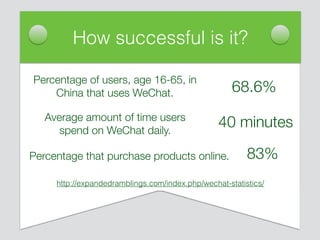
How successful is it?
Average amount of time users
spend on WeChat daily.
Percentage that purchase products online.
Percentage of users, age 16-65, in
China that uses WeChat.
http://expandedramblings.com/index.php/wechat-statistics/
68.6%
40 minutes
83%
WeChat’s average revenue per user or
ARPU is estimated to be at least $7
USD — that’s 7X the ARPU of
WhatsApp, the largest messaging
platform in the world.
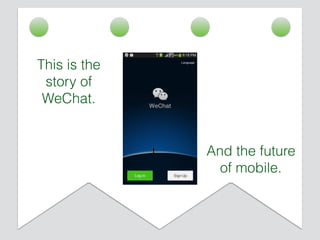
And the future
of mobile.
This is the
story of
WeChat.
AboutMe
As a software developer, I have always
been interested in discovering new
technology, how it can be used and how
to harness its potential.
Joey Rigor, CEO Kontak Mobile Apps.
kontakios.com

The WeChat Story

  • 1.
    The WeChat story. Joey Rigor,Kontak Mobile Apps April 29, 2016
  • 2.
    With 700 millionusers transacting with 10 million business accounts, WeChat’s success fired up SiIicon Valley’s new-found fixation in its business model.
  • 3.
    In just 5years, WeChat transformed China’s mobile landscape by enabling its users to practically live within the confines of its chat platform.
  • 4.
    The app todayis where Facebook and other messaging apps would like to go and where the future of mobile could lead us. This is WeChat’s story.
  • 5.
    The start ofa messaging app. In 2011, Tencent, one of the largest internet companies in the world, made a mobile-only messaging app, Weixin, as an alternative to SMS offered by telecommunication companies. https://www.techinasia.com/5-years-of-wechat
  • 6.
    Tencent already hasthe desktop-based QQ instant messenger and Qzone social network (with 780 million active users at the start of 2011). The mobile messaging app it launched was a bet against Kik and WhatsApp messaging platforms that is making inroads in China.
  • 7.
    About 14 monthsafter launching, in 2012, WeChat hit a major milestone when Tencent reported it had 100 million registered users. By this time Weixin became known as WeChat as Tencent wanted it to go global. The first 100 million users.
  • 8.
    It was alsoin 2012 that Tencent opened up WeChat to brand accounts, prompting Chinese companies and foreign brands doing business in China to start using the app. To get people to add and follow a brand account, a company could display its personalised QR code anywhere and encourage shoppers to scan it. The rise of brand accounts and QR Codes.
  • 9.
    WeChat users canalso scan each other's QR codes to add friends in the app. QR codes are a machine-readable code consisting of an array of black and white squares, typically used for storing information that can be read by a smartphone’s camera.
  • 10.
    By 2013, theapp reached 300 million registered users. It was also this time that the app went into gaming and mobile payments, WeChat Wallet, which can be connected with a variety of Chinese-issued credit and debit cards. Adding more features.
  • 11.
    eCommerce and the WeChatWallet. In 2014, Tencent, in its quest to enter eCommerce, took a stake in Alibaba’s major competitor, JD. This allowed Tencent to embed JD’s store into WeChat as the main shopping area. Tencent also allowed any business to open a store inside a WeChat brand account. The feature was open to major companies as well as small businesses. https://www.techinasia.com/5-years-of-wechat
  • 12.
    Another big eCommercefeature came when it added taxi booking where users can find a cab and pay it within the app. This remains a popular feature until today. WeChat’s mobile wallet got even more useful when it allowed its users to send money to their peers.
  • 13.
    A variation ofpeer-to-peer payment is Red Packets (formerly called “Lucky Money” or “Red Envelopes”) stuffed with digital cash where users send each other every day on WeChat. A famous Chinese tradition gone digital! This Lunar New Year’s Eve alone, over 8 billion Red Packets were sent and received by 420 millions users. http://blog.wechat.com/
  • 14.
    It was alsoin 2014 that an influx of Chinese startups began launching as a WeChat brand account instead of building apps for Android or iOS. Most have build bots and lightweight web-enabled apps to transact their business. This trend continues until today. Bots better than apps.
  • 15.
    By 2015, WeChatreached another milestone when it hit 500 million MAUs (monthly active users) rocketing to 650 million MAUs by the end of that year. From this trajectory, it is projected that it will reach a billion MAUs by the end of 2016. A billion active users.
  • 16.
    So what madeit work? What started out as a simple messaging app eventually became a platform for 10 millions mini apps build by its brand or official accounts. An app-within-an-app model. http://a16z.com/2015/08/06/wechat-china-mobile-first/
  • 17.
    This model, supportedby its built-in payment system, WeChat Wallets, provide users the complete functionality of an ecosystem where they can transact almost any activity within the confines of the messaging platform. A real mobile lifestyle.
  • 18.
    How successful isit? Average amount of time users spend on WeChat daily. Percentage that purchase products online. Percentage of users, age 16-65, in China that uses WeChat. http://expandedramblings.com/index.php/wechat-statistics/ 68.6% 40 minutes 83%
  • 19.
    WeChat’s average revenueper user or ARPU is estimated to be at least $7 USD — that’s 7X the ARPU of WhatsApp, the largest messaging platform in the world.
  • 20.
    And the future ofmobile. This is the story of WeChat.
  • 21.
    AboutMe As a softwaredeveloper, I have always been interested in discovering new technology, how it can be used and how to harness its potential. Joey Rigor, CEO Kontak Mobile Apps. kontakios.com