January 2016
WECHAT
WHY THE WEST SHOULD PAY ATTENTION
1. Points to where Facebook and other messaging apps could head.
2. WeChat indicates where the future of mobile commerce may lie.
3. Third, WeChat shows what it’s like to be both a platform and a mobile portal (what
Yahoo could have been).
“WeChat should matter to all of us because it shows what’s possible when an entire country — which
currently has a smartphone penetration of 62% — “leapfrogs” over the PC era directly to mobile.
WeChat was not a product that started as a website and then was adapted for mobile, it was (to
paraphrase a certain movie) born into it, molded by it.”
Connie Chan, Partner at Andreessen Horowitz
WeChat is by far the most popular messaging app in China. With over 650 million monthly active users the app has seen
exponential growth in tier 1 and 2 cities over the past few years which have now steadied and almost reached saturation
point. WeChat is the “go to app” for virtually everything, from shopping to banking, and media to marketing - they have
successfully personalised and monetised a messaging app built on a strong user foundation. This presentation will
highlight the three following key themes:
Source: Tech in Asia, Statista
The ‘Great Firewall of China’ restricts many popular global sites
such as Google, (all services including YouTube, Gmail) Twitter
and Facebook encouraging home grown, state approved
platforms, serving similar but very different equivalents to
emerge.
WECHAT DOMINATES IN CHINA
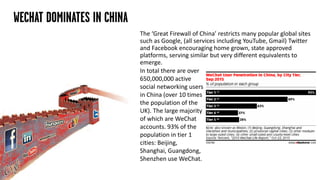
In total there are over
650,000,000 active
social networking users
in China (over 10 times
the population of the
UK). The large majority
of which are WeChat
accounts. 93% of the
population in tier 1
cities: Beijing,
Shanghai, Guangdong,
Shenzhen use WeChat.
CHINA IS YEARS AHEAD OF THE WEST IN SOCIAL TECHNOLOGY (ESP S-COMMERCE)
“Social media is a small component of the overall marketing activity in the West; it is the backbone of any brand engagement in
China.”
Vincent Digonnet
WeChat has tailored its service to be culturally specific, it
thrives on content creation, a more rather than less
interface (going against the western sleek, simplistic
design). It engages with the overlap between social media
population and purchasing power.
It is a holistic mobile experience that brings brands and
people together. Chinese businesses are moving away
from websites and opting for WeChat accounts instead,
people are able to engage in conversation with staff about
their products, building a relationship on trust, and
increasing their fan base as their friendship circle grows.
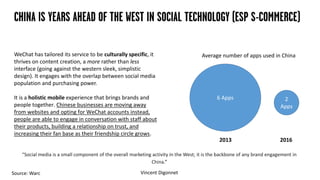
6 Apps 2
Apps
Source: Warc
2013 2016
Average number of apps used in China
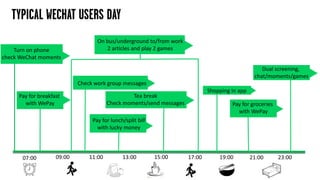
07:00 13:00 23:0009:00 11:00 15:00 17:00 19:00 21:00
Turn on phone
check WeChat moments
On bus/underground to/from work
2 articles and play 2 games
Pay for breakfast
with WePay
Check work group messages
Tea break
Check moments/send messages
Pay for lunch/split bill
with lucky money
Shopping in app
Pay for groceries
with WePay
Dual screening,
chat/moments/games
TYPICAL WECHAT USERS DAY
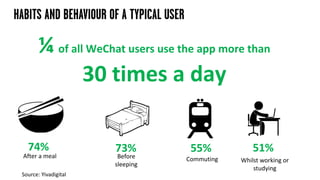
HABITS AND BEHAVIOUR OF A TYPICAL USER
After a meal Before
sleeping
Commuting Whilst working or
studying
74% 73% 55% 51%
¼ of all WeChat users use the app more than
30 times a day
Source: Yivadigital
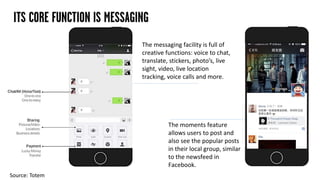
ITS CORE FUNCTION IS MESSAGING
The messaging facility is full of
creative functions: voice to chat,
translate, stickers, photo’s, live
sight, video, live location
tracking, voice calls and more.
The moments feature
allows users to post and
also see the popular posts
in their local group, similar
to the newsfeed in
Facebook.
Source: Totem
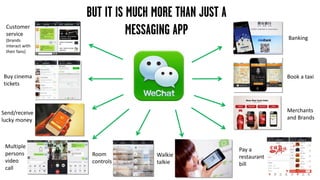
BUT IT IS MUCH MORE THAN JUST A
MESSAGING APP
Buy cinema
tickets
Send/receive
lucky money
Multiple
persons
video
call
Room
controls
Walkie
talkie
Merchants
and Brands
Book a taxi
Customer
service
(brands
interact with
their fans)
Pay a
restaurant
bill
Banking
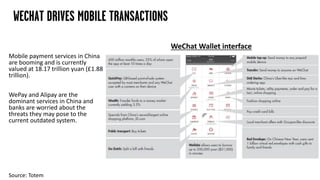
Mobile payment services in China
are booming and is currently
valued at 18.17 trillion yuan (£1.88
trillion).
WePay and Alipay are the
dominant services in China and
banks are worried about the
threats they may pose to the
current outdated system.
WECHAT DRIVES MOBILE TRANSACTIONS
WeChat Wallet interface
Source: Totem
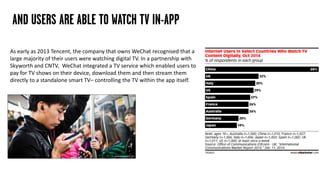
AND USERS ARE ABLE TO WATCH TV IN-APP
As early as 2013 Tencent, the company that owns WeChat recognised that a
large majority of their users were watching digital TV. In a partnership with
Skyworth and CNTV, WeChat integrated a TV service which enabled users to
pay for TV shows on their device, download them and then stream them
directly to a standalone smart TV– controlling the TV within the app itself.
HOW BRANDS USE WECHAT
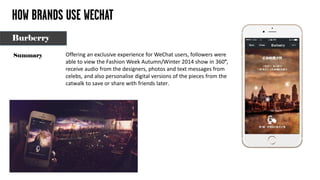
Offering an exclusive experience for WeChat users, followers were
able to view the Fashion Week Autumn/Winter 2014 show in 360°,
receive audio from the designers, photos and text messages from
celebs, and also personalise digital versions of the pieces from the
catwalk to save or share with friends later.
Summary
Burberry
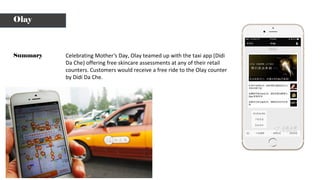
Celebrating Mother’s Day, Olay teamed up with the taxi app (Didi
Da Che) offering free skincare assessments at any of their retail
counters. Customers would receive a free ride to the Olay counter
by Didi Da Che.
Summary
Olay
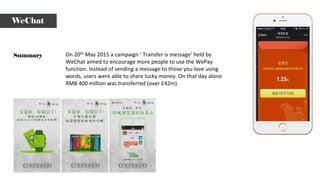
Summary
WeChat
On 20th May 2015 a campaign ‘ Transfer is message’ held by
WeChat aimed to encourage more people to use the WePay
function. Instead of sending a message to those you love using
words, users were able to share lucky money. On that day alone
RMB 400 million was transferred (over £42m).
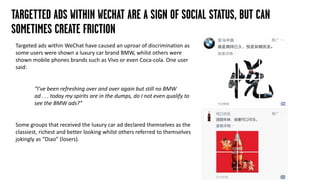
TARGETTED ADS WITHIN WECHAT ARE A SIGN OF SOCIAL STATUS, BUT CAN
SOMETIMES CREATE FRICTION
Targeted ads within WeChat have caused an uproar of discrimination as
some users were shown a luxury car brand BMW, whilst others were
shown mobile phones brands such as Vivo or even Coca-cola. One user
said:
“I’ve been refreshing over and over again but still no BMW
ad . . . today my spirits are in the dumps, do I not even qualify to
see the BMW ads?”
Some groups that received the luxury car ad declared themselves as the
classiest, richest and better looking whilst others referred to themselves
jokingly as “Diao” (losers).
WHY SHOULD THIS MATTER TO ME?
• WeChat is a glimpse into how many western, traditionally unmonetizable, messaging
platforms will perform and connect with consumers.
• Brands currently on WeChat use the numerous functions at their disposal, using
innovative ways to engage with their audience in a personal way (personalising
conversations to consumers).
• Western social media platforms are looking to and learning from their Asian
counterparts.
“What's happening in Asia is an inspiration […] but that's more about proof of
what's possible. It's proof that everything starts from a conversation.”
Stan Chudnovsky, Head of Product Management for Messenger

WeChat and the West

  • 1.
  • 2.
    WHY THE WESTSHOULD PAY ATTENTION 1. Points to where Facebook and other messaging apps could head. 2. WeChat indicates where the future of mobile commerce may lie. 3. Third, WeChat shows what it’s like to be both a platform and a mobile portal (what Yahoo could have been). “WeChat should matter to all of us because it shows what’s possible when an entire country — which currently has a smartphone penetration of 62% — “leapfrogs” over the PC era directly to mobile. WeChat was not a product that started as a website and then was adapted for mobile, it was (to paraphrase a certain movie) born into it, molded by it.” Connie Chan, Partner at Andreessen Horowitz WeChat is by far the most popular messaging app in China. With over 650 million monthly active users the app has seen exponential growth in tier 1 and 2 cities over the past few years which have now steadied and almost reached saturation point. WeChat is the “go to app” for virtually everything, from shopping to banking, and media to marketing - they have successfully personalised and monetised a messaging app built on a strong user foundation. This presentation will highlight the three following key themes: Source: Tech in Asia, Statista
  • 3.
    The ‘Great Firewallof China’ restricts many popular global sites such as Google, (all services including YouTube, Gmail) Twitter and Facebook encouraging home grown, state approved platforms, serving similar but very different equivalents to emerge. WECHAT DOMINATES IN CHINA In total there are over 650,000,000 active social networking users in China (over 10 times the population of the UK). The large majority of which are WeChat accounts. 93% of the population in tier 1 cities: Beijing, Shanghai, Guangdong, Shenzhen use WeChat.
  • 4.
    CHINA IS YEARSAHEAD OF THE WEST IN SOCIAL TECHNOLOGY (ESP S-COMMERCE) “Social media is a small component of the overall marketing activity in the West; it is the backbone of any brand engagement in China.” Vincent Digonnet WeChat has tailored its service to be culturally specific, it thrives on content creation, a more rather than less interface (going against the western sleek, simplistic design). It engages with the overlap between social media population and purchasing power. It is a holistic mobile experience that brings brands and people together. Chinese businesses are moving away from websites and opting for WeChat accounts instead, people are able to engage in conversation with staff about their products, building a relationship on trust, and increasing their fan base as their friendship circle grows. 6 Apps 2 Apps Source: Warc 2013 2016 Average number of apps used in China
  • 5.
    07:00 13:00 23:0009:0011:00 15:00 17:00 19:00 21:00 Turn on phone check WeChat moments On bus/underground to/from work 2 articles and play 2 games Pay for breakfast with WePay Check work group messages Tea break Check moments/send messages Pay for lunch/split bill with lucky money Shopping in app Pay for groceries with WePay Dual screening, chat/moments/games TYPICAL WECHAT USERS DAY
  • 6.
    HABITS AND BEHAVIOUROF A TYPICAL USER After a meal Before sleeping Commuting Whilst working or studying 74% 73% 55% 51% ¼ of all WeChat users use the app more than 30 times a day Source: Yivadigital
  • 7.
    ITS CORE FUNCTIONIS MESSAGING The messaging facility is full of creative functions: voice to chat, translate, stickers, photo’s, live sight, video, live location tracking, voice calls and more. The moments feature allows users to post and also see the popular posts in their local group, similar to the newsfeed in Facebook. Source: Totem
  • 8.
    BUT IT ISMUCH MORE THAN JUST A MESSAGING APP Buy cinema tickets Send/receive lucky money Multiple persons video call Room controls Walkie talkie Merchants and Brands Book a taxi Customer service (brands interact with their fans) Pay a restaurant bill Banking
  • 9.
    Mobile payment servicesin China are booming and is currently valued at 18.17 trillion yuan (£1.88 trillion). WePay and Alipay are the dominant services in China and banks are worried about the threats they may pose to the current outdated system. WECHAT DRIVES MOBILE TRANSACTIONS WeChat Wallet interface Source: Totem
  • 10.
    AND USERS AREABLE TO WATCH TV IN-APP As early as 2013 Tencent, the company that owns WeChat recognised that a large majority of their users were watching digital TV. In a partnership with Skyworth and CNTV, WeChat integrated a TV service which enabled users to pay for TV shows on their device, download them and then stream them directly to a standalone smart TV– controlling the TV within the app itself.
  • 11.
    HOW BRANDS USEWECHAT Offering an exclusive experience for WeChat users, followers were able to view the Fashion Week Autumn/Winter 2014 show in 360°, receive audio from the designers, photos and text messages from celebs, and also personalise digital versions of the pieces from the catwalk to save or share with friends later. Summary Burberry
  • 12.
    Celebrating Mother’s Day,Olay teamed up with the taxi app (Didi Da Che) offering free skincare assessments at any of their retail counters. Customers would receive a free ride to the Olay counter by Didi Da Che. Summary Olay
  • 13.
    Summary WeChat On 20th May2015 a campaign ‘ Transfer is message’ held by WeChat aimed to encourage more people to use the WePay function. Instead of sending a message to those you love using words, users were able to share lucky money. On that day alone RMB 400 million was transferred (over £42m).
  • 14.
    TARGETTED ADS WITHINWECHAT ARE A SIGN OF SOCIAL STATUS, BUT CAN SOMETIMES CREATE FRICTION Targeted ads within WeChat have caused an uproar of discrimination as some users were shown a luxury car brand BMW, whilst others were shown mobile phones brands such as Vivo or even Coca-cola. One user said: “I’ve been refreshing over and over again but still no BMW ad . . . today my spirits are in the dumps, do I not even qualify to see the BMW ads?” Some groups that received the luxury car ad declared themselves as the classiest, richest and better looking whilst others referred to themselves jokingly as “Diao” (losers).
  • 15.
    WHY SHOULD THISMATTER TO ME? • WeChat is a glimpse into how many western, traditionally unmonetizable, messaging platforms will perform and connect with consumers. • Brands currently on WeChat use the numerous functions at their disposal, using innovative ways to engage with their audience in a personal way (personalising conversations to consumers). • Western social media platforms are looking to and learning from their Asian counterparts. “What's happening in Asia is an inspiration […] but that's more about proof of what's possible. It's proof that everything starts from a conversation.” Stan Chudnovsky, Head of Product Management for Messenger