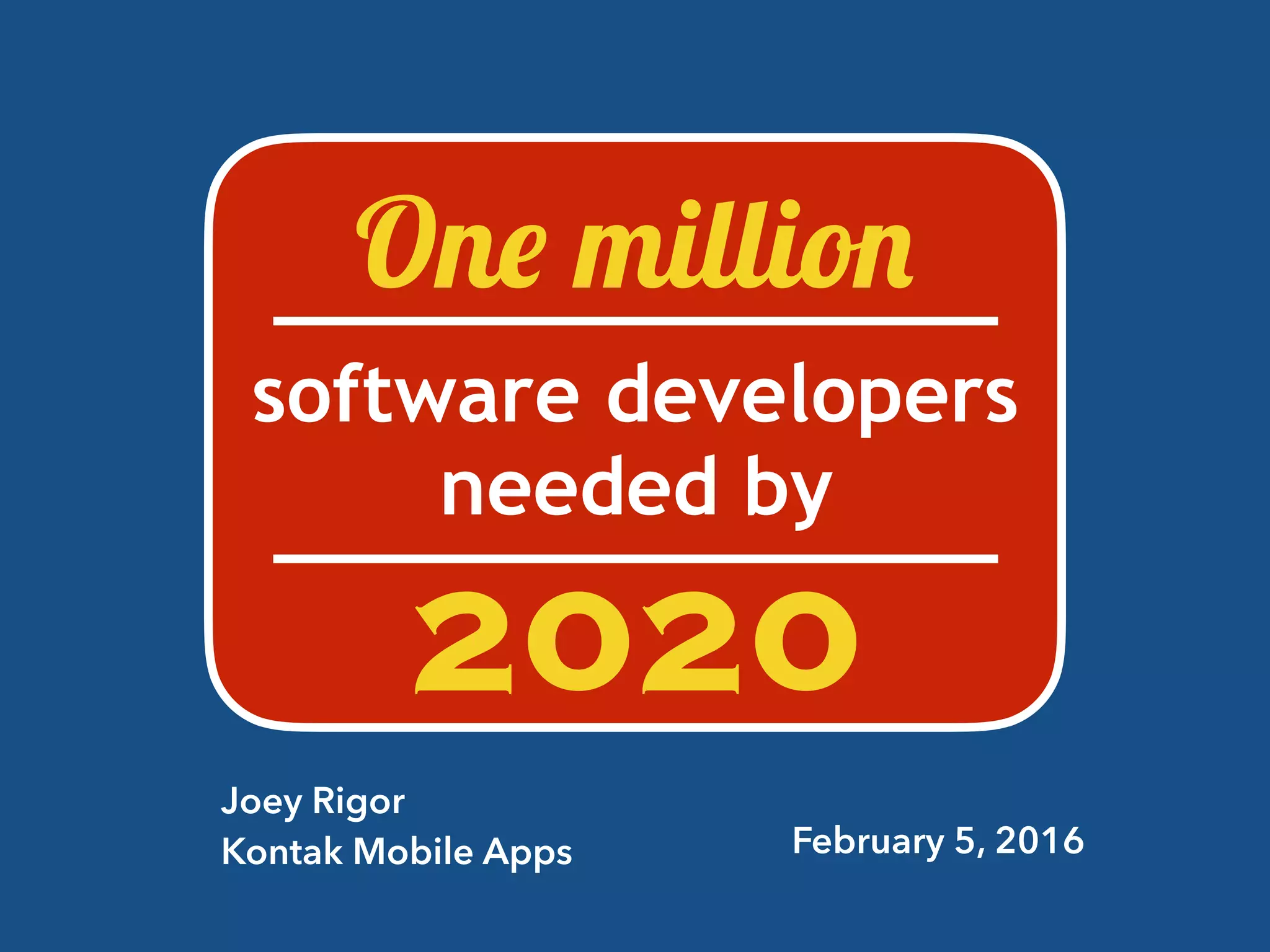
One million
software developers
needed by
2020
Joey Rigor
Kontak Mobile Apps February 5, 2016
This post talks about
how anyone can become a
software developer.
Yup, including you.
http://www.scientificalhamster.com/photo/old-computers/
Based on projections
from the U.S. Bureau of Labor
Statistics, more than one million
software developers will be
employed by US companies
by 2020.
http://www.bls.gov/ooh/computer-and-information-technology/
software-developers.htm
http://www.scientificalhamster.com/photo/old-computers/
There is big demand.
The surge in information technology.
Mobile, big data and now IoT
(Internet of Things).
There were 1,114,600 software
developers employed in 2014.
http://www.bls.gov/ooh/computer-and-information-technology/
software-developers.htm
But supply cannot
cope up.
There were only 48,700
undergraduate computer science
graduates from accredited US
universities in 2014.
https://www.coursereport.com/resources/course-report-2015-
bootcamp-market-size-study
http://www2.southeastern.edu/external/gallery/albums/history/
graduation_in_old_union.jpg
Bootcamp coding schools
contributed 16,056 graduates
in 2015.
https://www.coursereport.com/resources/course-report-2015-
bootcamp-market-size-study
This means millions use apps
in their smartphones but
relatively few know what apps
really are and how it runs.
Organizations are advocating
that more should be done to
teach young people about
computer programming and
coding.
The White House
announced an initiative, TechHire,
to coordinate the efforts of the
federal government, cities,
corporations and schools to train
workers for the thousands of
current job openings in the tech
sector.
Launched in 2013, Code.org®
is a non-profit dedicated to expanding
access to computer science.
Their vision is that every student in
every school should have the
opportunity to learn computer
science.
Even Facebook is
contributing to this by 
launching TechPrep, a new online
computer science and programming
resource, to address what it sees as a
“lack of exposure to computer science
and careers in technology”.
Inspite of these efforts
 projected growth cannot meet
the big demand. 
This means that U.S.
companies
would be forced to outsource
valuable coding jobs to other
countries with growing IT sectors.
To seize this opportunity
we should start learning
how to code.
Nope. You don’t have to go
back to school
to get a Computer Science (CS)
degree.
There are other options.
That are shorter and way
cheaper.
Start with the
freebies.
Begin your learning journey
by teaching yourself using all
the free resources online.
http://learntocodewith.me/posts/code-for-free/
http://www.entrepreneur.com/article/250323
This way, you can check out what
you like before investing time and
money into the serious stuff.
When you’re ready, then you can
level up to the paid courses.
One is going to
boot camps
One is going to
boot camps
that teach how to code.
Sometimes much better than
getting a CS degree.
Unlike a CS degree
boot camps focus on real-world
practice, and less on theory,
given the time constraints for
their programs.
A focused program
is definitely faster and more cost-
effective than getting an
undergrad or master’s degree in
CS.
In only 11 weeks*
you can learn a specialty on
what’s in-demand in the coding
job market.
But you have to be there full-
time.
*Average duration of a full course
https://www.coursereport.com/resources/course-report-2015-
bootcamp-market-size-study
For US$ 11,000*
you can enroll on a full program
that gets you ready for an
immediate coding job.
*Average cost of a full course
https://www.coursereport.com/resources/course-report-2015-
bootcamp-market-size-study
There are also
online courses
There are also
online courses
that provide the same
program at a lesser cost.
And you do it on your own
time.
But without
hands-on training and guidance of
professional coders.
Meaning you’re on your own.
It’s much cheaper though.
From US$ 300 to US$ 5,000.
Depending on the program.
http://learntocodewith.me/posts/online-coding-bootcamps/
So there you are.
Changing careers is not that
difficult.
Just put your heart into it.
And your time and money,
of course.
http://www.letterology.com/2010/12/to-bring-back-clocks-of-time.html
http://www.kontakios.com
Now what?
This is part of a series of posts trying to
convince you to be a coder.
Hope you are ready,
grasshopper.
To know more about our company and
other blogs, just click the link below.

One million programmers needed by 2020

  • 1.
    One million software developers neededby 2020 Joey Rigor Kontak Mobile Apps February 5, 2016
  • 2.
    This post talksabout how anyone can become a software developer. Yup, including you. http://www.scientificalhamster.com/photo/old-computers/
  • 3.
    Based on projections fromthe U.S. Bureau of Labor Statistics, more than one million software developers will be employed by US companies by 2020. http://www.bls.gov/ooh/computer-and-information-technology/ software-developers.htm http://www.scientificalhamster.com/photo/old-computers/
  • 4.
    There is bigdemand. The surge in information technology. Mobile, big data and now IoT (Internet of Things). There were 1,114,600 software developers employed in 2014. http://www.bls.gov/ooh/computer-and-information-technology/ software-developers.htm
  • 5.
    But supply cannot copeup. There were only 48,700 undergraduate computer science graduates from accredited US universities in 2014. https://www.coursereport.com/resources/course-report-2015- bootcamp-market-size-study http://www2.southeastern.edu/external/gallery/albums/history/ graduation_in_old_union.jpg
  • 6.
    Bootcamp coding schools contributed16,056 graduates in 2015. https://www.coursereport.com/resources/course-report-2015- bootcamp-market-size-study
  • 7.
    This means millionsuse apps in their smartphones but relatively few know what apps really are and how it runs.
  • 8.
    Organizations are advocating thatmore should be done to teach young people about computer programming and coding.
  • 9.
    The White House announcedan initiative, TechHire, to coordinate the efforts of the federal government, cities, corporations and schools to train workers for the thousands of current job openings in the tech sector.
  • 10.
    Launched in 2013,Code.org® is a non-profit dedicated to expanding access to computer science. Their vision is that every student in every school should have the opportunity to learn computer science.
  • 11.
    Even Facebook is contributingto this by  launching TechPrep, a new online computer science and programming resource, to address what it sees as a “lack of exposure to computer science and careers in technology”.
  • 12.
    Inspite of theseefforts  projected growth cannot meet the big demand. 
  • 13.
    This means thatU.S. companies would be forced to outsource valuable coding jobs to other countries with growing IT sectors.
  • 14.
    To seize thisopportunity we should start learning how to code.
  • 15.
    Nope. You don’thave to go back to school to get a Computer Science (CS) degree.
  • 16.
    There are otheroptions. That are shorter and way cheaper.
  • 17.
    Start with the freebies. Beginyour learning journey by teaching yourself using all the free resources online. http://learntocodewith.me/posts/code-for-free/ http://www.entrepreneur.com/article/250323
  • 18.
    This way, youcan check out what you like before investing time and money into the serious stuff. When you’re ready, then you can level up to the paid courses.
  • 19.
    One is goingto boot camps
  • 20.
    One is goingto boot camps that teach how to code. Sometimes much better than getting a CS degree.
  • 21.
    Unlike a CSdegree boot camps focus on real-world practice, and less on theory, given the time constraints for their programs.
  • 22.
    A focused program isdefinitely faster and more cost- effective than getting an undergrad or master’s degree in CS.
  • 23.
    In only 11weeks* you can learn a specialty on what’s in-demand in the coding job market. But you have to be there full- time. *Average duration of a full course https://www.coursereport.com/resources/course-report-2015- bootcamp-market-size-study
  • 24.
    For US$ 11,000* youcan enroll on a full program that gets you ready for an immediate coding job. *Average cost of a full course https://www.coursereport.com/resources/course-report-2015- bootcamp-market-size-study
  • 25.
  • 26.
    There are also onlinecourses that provide the same program at a lesser cost. And you do it on your own time.
  • 27.
    But without hands-on trainingand guidance of professional coders. Meaning you’re on your own.
  • 28.
    It’s much cheaperthough. From US$ 300 to US$ 5,000. Depending on the program. http://learntocodewith.me/posts/online-coding-bootcamps/
  • 29.
    So there youare. Changing careers is not that difficult. Just put your heart into it.
  • 30.
    And your timeand money, of course. http://www.letterology.com/2010/12/to-bring-back-clocks-of-time.html
  • 31.
    http://www.kontakios.com Now what? This ispart of a series of posts trying to convince you to be a coder. Hope you are ready, grasshopper. To know more about our company and other blogs, just click the link below.