Present simple
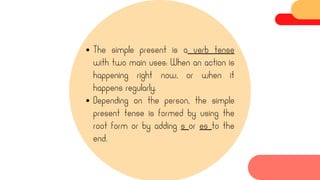
The simple present is a verb tense
with two main uses: When an action is
happening right now, or when it
happens regularly.
Depending on the person, the simple
present tense is formed by using the
root form or by adding s or es to the
end.
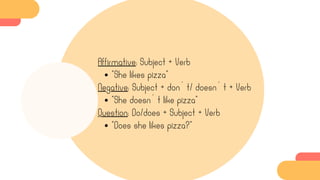
Affirmative: Subject + Verb
“She likes pizza”
Negative: Subject + don´t/ doesn´t + Verb
“She doesn´t like pizza”
Question: Do/does + Subject + Verb
“Does she likes pizza?”
Third person (she/he/it)
To regular verbs just add an -s.
Ex: travel -> travels, give -> gives, play -> plays
To verbs that end in s, ss, sh, ch, x, and o, add an -es.
Ex: wash -> washes, mix -> mixes, go ->goes
To verbs end in -y after a consonant, change the -y to -i and add -es.
Ex: study -> studies, fly -> flies
To verbs end in -y after a vowel, keep the -y and add an -s.
Ex: pay -> pays, say -> says
Excercises
1. (he / read / a book) (afirmativa)
He __________ a book.
2. (they / play / soccer) (afirmativa)
They __________ soccer.
3. (I / not like / broccoli) (negativa)
I __________ broccoli.
4. (she / not go / to the gym)
(negativa)
She __________ to the gym.
5. (you / enjoy / music?) (interrogativa)
__________ you __________ music?
6. (he / work / here?) (interrogativa)
__________ he __________ here?
7. (we / watch / TV) (afirmativa)
We __________ TV.
8. (they / not eat / meat) (negativa)
They __________ meat.
9. (she / drive / a car?) (interrogativa)
__________ she __________ a car?
10. (I / go / to school) (afirmativa)
I __________ to school.
Answers
reads
1.
play
2.
do not like / don't like
3.
does not go / doesn't go
4.
Do you enjoy
5.
6. Does he work
7. watch
8. do not eat / don't eat
9. Does she drive
10. go
Simple future
Used to refer to events that will happen in
the future:
Affirmative: Subject + WILL + Infinitive verb
“I’ll see you tomorrow”
Negative: Subject + WON´T + Infinitive verb
“I won´t go to the party”
Question: WILL/WON´T + Subject +
Infinitive verb?
Will they come to the high school
reunion?
Will is used when referring to the
future with certainty and for recent,
rapid decisions.
Going to is used to refer to events that
have been previously planned
“Will” or “going to”
Subject + form of “to be”
(am/is/are) + going to + base
of a verb.
I am going to travel to
Ireland for vacation next
month.
He is going to feel sad if
you don’t invite him to the
party.
Excercises
I _____________ (travel) to Europe next summer.
1.
My dogs ___________ (bite) you if you come
near me.
2.
My parents and I ___________ (visit) my aunt in
Colorado.
3.
They informed me that I ________ (work) here
starting monday.
4.
The president elect ____________ (begin) his
period until next month.
5.
Answers
will travel.
1.
will bite.
2.
will visit.
3.
will not (won’t) work.
4.
will not (won’t) begin.
5.
Simple past
The form of a verb used to describe an action
that happened before and is no longer
happening:
Affirmative: Subject + Verb in the past form
“You spoke really well”
Negative: Subject + Didn’t + Verb in the base
form
“You did not speak really well.”
Question: Did + Subject + Verb in the base form
“Did you speak really well?”
Conjugating regular verbs
In order to present the main verb in the sentence, you just have to
add ‘-ed’ to the end of the regular verb and ‘-d’ to the end of a regular
verb which ends with an ‘e’: walk – walked, work – worked, save -
saved, live - lived.
Verbs that remain the same – Some verbs take the same spelling as
the base verb and remain the same in the past tense: cut – cut, put –
put, hurt – hurt, set – set, hit – hit.
Verbs that take different spelling patterns – Irregular verbs are seen to
follow different spelling patterns and there is no rule as such to explain
why they are so: Buy – bought, think – thought, draw – drew, drink.
Excercises
1. I _____ (pay) the bills already.
2. The teacher ________ (motivate) her kids to stand up for
themselves and their fellow classmates.
3. Reena ______ (to be) a student at Delhi University.
4. ______ you ______ (finish – interrogative) the science and
maths assignments?
5. Tina __________ (know – negative) about yesterday’s test.
Answers
1. I paid the bills already.
2. The teacher motivated her kids to stand
up for themselves and their fellow
classmates.
3. Reena was a student at Delhi University.
4. Did you finish the science and maths
assignments?
5. Tina did not know about yesterday’s test.

Present simple + Simple future + Past simple

  • 1.
  • 2.
    The simple presentis a verb tense with two main uses: When an action is happening right now, or when it happens regularly. Depending on the person, the simple present tense is formed by using the root form or by adding s or es to the end.
  • 3.
    Affirmative: Subject +Verb “She likes pizza” Negative: Subject + don´t/ doesn´t + Verb “She doesn´t like pizza” Question: Do/does + Subject + Verb “Does she likes pizza?”
  • 4.
    Third person (she/he/it) Toregular verbs just add an -s. Ex: travel -> travels, give -> gives, play -> plays To verbs that end in s, ss, sh, ch, x, and o, add an -es. Ex: wash -> washes, mix -> mixes, go ->goes To verbs end in -y after a consonant, change the -y to -i and add -es. Ex: study -> studies, fly -> flies To verbs end in -y after a vowel, keep the -y and add an -s. Ex: pay -> pays, say -> says
  • 5.
    Excercises 1. (he /read / a book) (afirmativa) He __________ a book. 2. (they / play / soccer) (afirmativa) They __________ soccer. 3. (I / not like / broccoli) (negativa) I __________ broccoli. 4. (she / not go / to the gym) (negativa) She __________ to the gym. 5. (you / enjoy / music?) (interrogativa) __________ you __________ music? 6. (he / work / here?) (interrogativa) __________ he __________ here? 7. (we / watch / TV) (afirmativa) We __________ TV. 8. (they / not eat / meat) (negativa) They __________ meat. 9. (she / drive / a car?) (interrogativa) __________ she __________ a car? 10. (I / go / to school) (afirmativa) I __________ to school.
  • 6.
    Answers reads 1. play 2. do not like/ don't like 3. does not go / doesn't go 4. Do you enjoy 5. 6. Does he work 7. watch 8. do not eat / don't eat 9. Does she drive 10. go
  • 7.
  • 8.
    Used to referto events that will happen in the future: Affirmative: Subject + WILL + Infinitive verb “I’ll see you tomorrow” Negative: Subject + WON´T + Infinitive verb “I won´t go to the party” Question: WILL/WON´T + Subject + Infinitive verb? Will they come to the high school reunion?
  • 9.
    Will is usedwhen referring to the future with certainty and for recent, rapid decisions. Going to is used to refer to events that have been previously planned “Will” or “going to” Subject + form of “to be” (am/is/are) + going to + base of a verb. I am going to travel to Ireland for vacation next month. He is going to feel sad if you don’t invite him to the party.
  • 10.
    Excercises I _____________ (travel)to Europe next summer. 1. My dogs ___________ (bite) you if you come near me. 2. My parents and I ___________ (visit) my aunt in Colorado. 3. They informed me that I ________ (work) here starting monday. 4. The president elect ____________ (begin) his period until next month. 5.
  • 11.
    Answers will travel. 1. will bite. 2. willvisit. 3. will not (won’t) work. 4. will not (won’t) begin. 5.
  • 12.
  • 13.
    The form ofa verb used to describe an action that happened before and is no longer happening: Affirmative: Subject + Verb in the past form “You spoke really well” Negative: Subject + Didn’t + Verb in the base form “You did not speak really well.” Question: Did + Subject + Verb in the base form “Did you speak really well?”
  • 14.
    Conjugating regular verbs Inorder to present the main verb in the sentence, you just have to add ‘-ed’ to the end of the regular verb and ‘-d’ to the end of a regular verb which ends with an ‘e’: walk – walked, work – worked, save - saved, live - lived. Verbs that remain the same – Some verbs take the same spelling as the base verb and remain the same in the past tense: cut – cut, put – put, hurt – hurt, set – set, hit – hit. Verbs that take different spelling patterns – Irregular verbs are seen to follow different spelling patterns and there is no rule as such to explain why they are so: Buy – bought, think – thought, draw – drew, drink.
  • 15.
    Excercises 1. I _____(pay) the bills already. 2. The teacher ________ (motivate) her kids to stand up for themselves and their fellow classmates. 3. Reena ______ (to be) a student at Delhi University. 4. ______ you ______ (finish – interrogative) the science and maths assignments? 5. Tina __________ (know – negative) about yesterday’s test.
  • 16.
    Answers 1. I paidthe bills already. 2. The teacher motivated her kids to stand up for themselves and their fellow classmates. 3. Reena was a student at Delhi University. 4. Did you finish the science and maths assignments? 5. Tina did not know about yesterday’s test.