Chapter 4The Verb Group
Elements of verbs group 1- Lexical Verbs2- Auxiliary Verbs
Auxiliary verbs (AUX):Means additionalGiving helpAuxiliary verbs can modify the lexical verb by indicating modality, or aspect, or voice
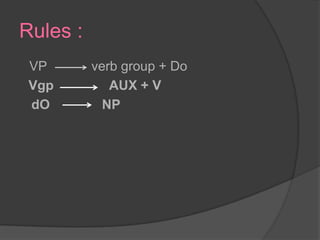
Rules :VP            verb group + Do                       Vgp               AUX + V                              dO              NP
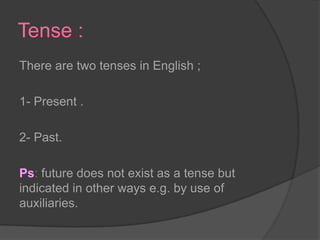
Tense : There are two tenses in English ;1- Present .2- Past.Ps: future does not exist as a tense but indicated in other ways e.g. by use of auxiliaries.
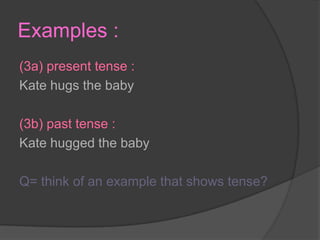
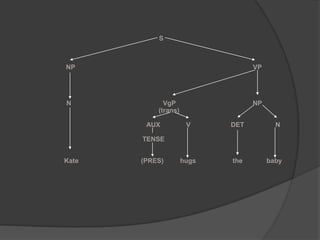
Examples :(3a) present tense :Kate hugs the baby (3b) past tense :Kate hugged the baby Q= think of an example that shows tense?
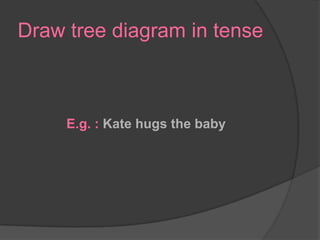
Draw tree diagram in tenseE.g. : Kate hugs the baby
S   NP                                                                                                 VPN                                                  VgP                                          NP                           (trans)                                                                                                        AUX              V                      DET                 N               TENSE                                                                           Kate                                  (PRES)         hugs                    the             baby
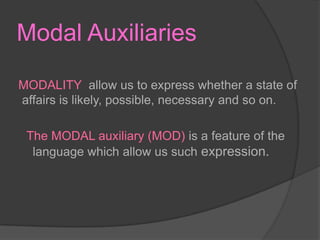
Modal AuxiliariesMODALITY allow us to express whether a state of affairs is likely, possible, necessary and so on.  The MODAL auxiliary (MOD) is a feature of the language which allow us such expression.
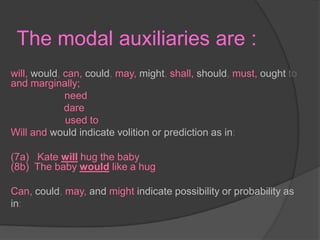
The modal auxiliaries are :will, would, can, could, may, might, shall, should,must, ought to and marginally;                                                   need                                                                              dare                                                                               used to                                                                          Will and wouldindicatevolitionorpredictionasin: (7a)   Kate will hug the baby                                                        (8b)  The baby would like a hug        Can, could,may, andmightindicatepossibility or probability asin:
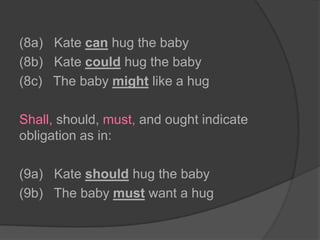
(8a)   Kate can hug the baby(8b)   Kate could hug the baby (8c)   The baby might like a hug Shall, should, must, and ought indicate obligation as in:(9a)   Kate should hug the baby (9b)   The baby must want a hug
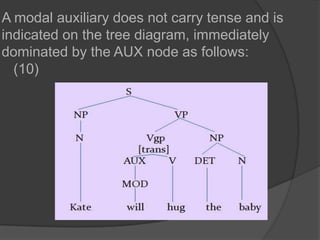
A modal auxiliary does not carry tense and is indicated on the tree diagram, immediately dominated by the AUX node as follows:                (10)
           The form of the lexical verb hug is again different from      those we looked at when considering tense ( Kate hugs the baby ) and ( Kate hugged the baby ).          A verb group incorporating a modal  auxiliary however has no tenseso it is the modal auxiliary that has served to dictate the verb form hug in e.g. ( Kate will hug the baby).          The form of the verb which appears after a modal is called the INFINITIVE.        The infinitivecarries no ending either for  person as in   (shehug-s) or for tense (as in hugg-ed). It can appear with the particle to, to + infinitive, as in to hug, or as a bare  infinitive(without to) as in hug.
The bare infinitiveIt is the second form that follows a modal. Most infinitive forms are fairly straightforward and can be  arrived at either from the present- or past-tense forms. For example walk-s or walk-ed become (to) walk …. find-s becomes found, the infinitive   (to) findThe verb to be is mostly known as irregular verb: its infinitive form doesn’t appear again as part of the other forms.
A modal auxiliary then always appears with the infinitive form ofthe following verb( in( Kate will hug the baby ) the lexical verb) and also as in:  (11a)   The dog found a bone                      (11b)   The dog must find a bone                   (11c)   Jenny hits him                                       (11d)   Jenny may hit him                                (11e)   The baby cried hourly                          (11f)   The baby might cry hourly
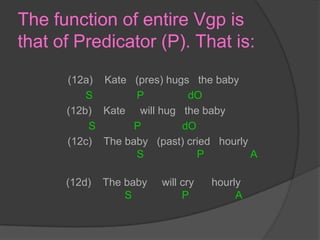
The function of entire Vgp is that of Predicator (P). That is:      (12a)    Kate   (pres) hugs   the babyS               P               dO(12b)    Kate     will hug   the babyS             P              dO        (12c)    The baby   (past) cried   hourly                                                       S                  P                A     (12d)    The baby     will cry      hourly                                                   S                 P                A
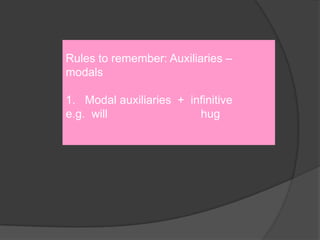
Rules to remember: Auxiliaries – modals1.   Modal auxiliaries  +  infinitivee.g.  will                             hug
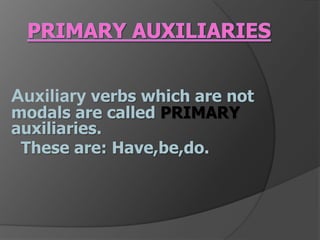
Primary AuxiliariesAuxiliaryverbs which are not modals are calledPRIMARYauxiliaries.These are: Have,be,do.
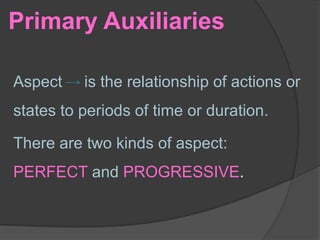
Primary Auxiliaries Aspect     is the relationship of actions or states to periods of time or duration.There are two kinds of aspect: PERFECTand PROGRESSIVE.
Perfect AspectPerfect aspect (PERF) is indicated by the presence of the auxiliary verb have. For example:(13a)   Sally hasfinished this book(13b)   Sue hadgiven the dog a bone
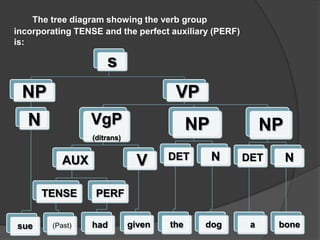
Unlike the modal auxiliaries do carry tense. In a verb group without a modal, it is always the first element which is marked for tense; that is element immediately following TENSE._Draw a tree diagram onSue had given the dog a bone
   The tree diagram showing the verb group incorporating TENSE and the perfect auxiliary (PERF) is:
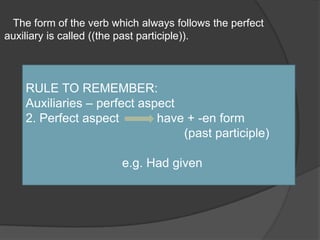
   The form of the verb which always follows the perfect auxiliary is called ((the past participle)).RULE TO REMEMBER:Auxiliaries – perfect aspect2. Perfect aspect           have + -en form(past participle)                            e.g. Had given
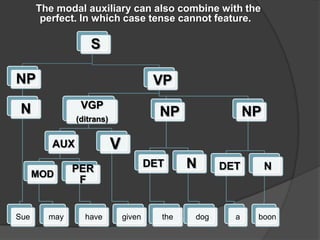
     The modal auxiliary can also combine with the perfect. In which case tense cannot feature.
25Progressive Aspect
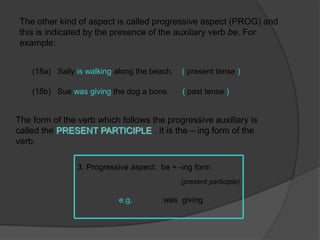
The other kind of aspect is called progressive aspect (PROG) and this is indicated by the presence of the auxiliary verb be. Forexample:(18a)   Sallyis walkingalong the beach.(present tense)(18b)   Suewas givingthe dog a bone.( past tense)The form of the verb which follows the progressive auxiliary is called the PRESENTPARTICIPLE . It is the – ing form of the verb.3. Progressive aspect:  be + -ing form (present participle)             e.g.              was  giving
(18b)   Sue was giving the dog a bone.SNPVPVgPNP                  NPN[ditrans]AUXDETN     DETNVTensePROGSue(Past)wasgivingthedogabone
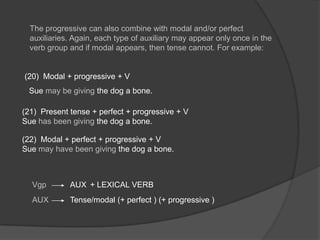
28The progressive can also combine with modal and/or perfect auxiliaries. Again, each type of auxiliary may appear only once in the verb group and if modal appears, then tense cannot. For example:(20)  Modal + progressive + V  Sue may be giving the dog a bone.(21)  Present tense + perfect + progressive + V                  Sue has been giving the dog a bone.(22)  Modal + perfect + progressive + V      Sue may have been giving the dog a bone.VgpAUX+ LEXICAL VERBAUXTense/modal (+ perfect ) (+ progressive )
Passive Voice
Passive VoiceVoice  refers to  whether a sentence or utterance is in the ACTIVE or the PASSIVE .
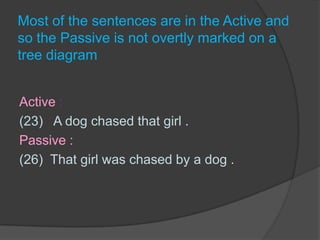
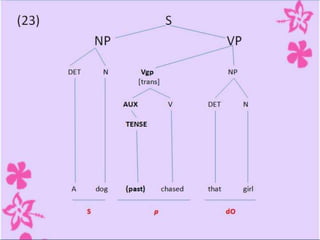
Most of the sentences are in the Active and so the Passive is not overtly marked on a tree diagramActive :(23)   A dog chased that girl . Passive :(26)  That girl was chased by a dog .
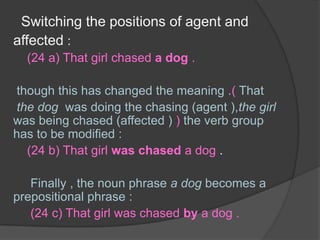
Switching the positions of agent and affected :(24 a) That girl chased a dog .though this has changed the meaning .( Thatthe dog  was doing the chasing (agent ),the girl was being chased (affected ) ) the verb group has to be modified :   (24 b) That girl was chased a dog .Finally , the noun phrase a dog becomes a prepositional phrase :(24 c) That girl was chased by a dog .
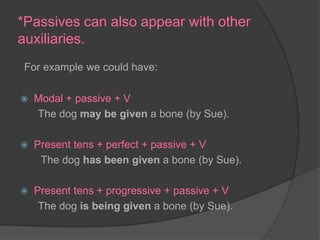
*Passives can also appear with other auxiliaries.For example we could have:Modal + passive + VThe dog may be given a bone (by Sue).Present tens + perfect + passive + VThe dog has been given a bone (by Sue).Present tens + progressive + passive + VThe dog is being given a bone (by Sue).
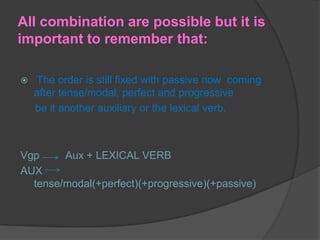
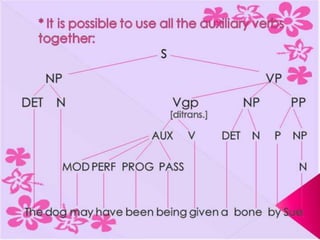
All combination are possible but it is important to remember that: The order is still fixed with passive now  coming after tense/modal, perfect and progressive      be it another auxiliary or the lexical verb.VgpAux + LEXICAL VERBAUX      tense/modal(+perfect)(+progressive)(+passive)
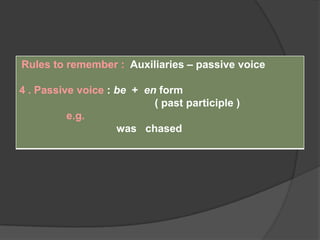
Rules to remember: order of Auxiliaries:1- Tense or modal+ infinitive2- Perfect: have+ -en3- Progressive: be+ -ing4- Passive: be + -en       + LEXICAL VERB
 :DoDo turns up to lend support to the lexical verb only in certain constructions and where there is no other auxiliary verb is already present (31) I like bananasbut in order to make the same statement negative the verb requires DO support as in(32) I do not like bananas
If you want to questions the statement in (I like bananas ) do is necessary in the absence of another auxiliary verb as in :(34) Do you like bananas?Another functions for do is to provide emphasis . For example (36) you do like bananas.
Do when it appears as an auxiliary is followed by a bare infinitive  Rules to remember : Auxiliary doDo + infinitive
Thanks for listening ……………………………………….Prepared by :HaneenAl.Maghrabi

Chapter 4

  • 1.
  • 2.
    Elements of verbsgroup 1- Lexical Verbs2- Auxiliary Verbs
  • 3.
    Auxiliary verbs (AUX):MeansadditionalGiving helpAuxiliary verbs can modify the lexical verb by indicating modality, or aspect, or voice
  • 4.
    Rules :VP verb group + Do Vgp AUX + V dO NP
  • 5.
    Tense : Thereare two tenses in English ;1- Present .2- Past.Ps: future does not exist as a tense but indicated in other ways e.g. by use of auxiliaries.
  • 6.
    Examples :(3a) presenttense :Kate hugs the baby (3b) past tense :Kate hugged the baby Q= think of an example that shows tense?
  • 7.
    Draw tree diagramin tenseE.g. : Kate hugs the baby
  • 8.
    S NP VPN VgP NP (trans) AUX V DET N TENSE Kate (PRES) hugs the baby
  • 9.
    Modal AuxiliariesMODALITY allowus to express whether a state of affairs is likely, possible, necessary and so on. The MODAL auxiliary (MOD) is a feature of the language which allow us such expression.
  • 10.
    The modal auxiliariesare :will, would, can, could, may, might, shall, should,must, ought to and marginally; need dare used to Will and wouldindicatevolitionorpredictionasin: (7a) Kate will hug the baby (8b) The baby would like a hug Can, could,may, andmightindicatepossibility or probability asin:
  • 11.
    (8a) Kate can hug the baby(8b) Kate could hug the baby (8c) The baby might like a hug Shall, should, must, and ought indicate obligation as in:(9a) Kate should hug the baby (9b) The baby must want a hug
  • 12.
    A modal auxiliarydoes not carry tense and is indicated on the tree diagram, immediately dominated by the AUX node as follows: (10)
  • 13.
    The form of the lexical verb hug is again different from those we looked at when considering tense ( Kate hugs the baby ) and ( Kate hugged the baby ). A verb group incorporating a modal auxiliary however has no tenseso it is the modal auxiliary that has served to dictate the verb form hug in e.g. ( Kate will hug the baby). The form of the verb which appears after a modal is called the INFINITIVE. The infinitivecarries no ending either for person as in (shehug-s) or for tense (as in hugg-ed). It can appear with the particle to, to + infinitive, as in to hug, or as a bare infinitive(without to) as in hug.
  • 14.
    The bare infinitiveItis the second form that follows a modal. Most infinitive forms are fairly straightforward and can be arrived at either from the present- or past-tense forms. For example walk-s or walk-ed become (to) walk …. find-s becomes found, the infinitive (to) findThe verb to be is mostly known as irregular verb: its infinitive form doesn’t appear again as part of the other forms.
  • 15.
    A modal auxiliarythen always appears with the infinitive form ofthe following verb( in( Kate will hug the baby ) the lexical verb) and also as in: (11a) The dog found a bone (11b) The dog must find a bone (11c) Jenny hits him (11d) Jenny may hit him (11e) The baby cried hourly (11f) The baby might cry hourly
  • 16.
    The function ofentire Vgp is that of Predicator (P). That is: (12a) Kate (pres) hugs the babyS P dO(12b) Kate will hug the babyS P dO (12c) The baby (past) cried hourly S P A (12d) The baby will cry hourly S P A
  • 17.
    Rules to remember:Auxiliaries – modals1. Modal auxiliaries + infinitivee.g. will hug
  • 18.
    Primary AuxiliariesAuxiliaryverbs whichare not modals are calledPRIMARYauxiliaries.These are: Have,be,do.
  • 19.
    Primary Auxiliaries Aspect is the relationship of actions or states to periods of time or duration.There are two kinds of aspect: PERFECTand PROGRESSIVE.
  • 20.
    Perfect AspectPerfect aspect(PERF) is indicated by the presence of the auxiliary verb have. For example:(13a) Sally hasfinished this book(13b) Sue hadgiven the dog a bone
  • 21.
    Unlike the modalauxiliaries do carry tense. In a verb group without a modal, it is always the first element which is marked for tense; that is element immediately following TENSE._Draw a tree diagram onSue had given the dog a bone
  • 22.
    The tree diagram showing the verb group incorporating TENSE and the perfect auxiliary (PERF) is:
  • 23.
    The form of the verb which always follows the perfect auxiliary is called ((the past participle)).RULE TO REMEMBER:Auxiliaries – perfect aspect2. Perfect aspect have + -en form(past participle) e.g. Had given
  • 24.
    The modal auxiliary can also combine with the perfect. In which case tense cannot feature.
  • 25.
  • 26.
    The other kindof aspect is called progressive aspect (PROG) and this is indicated by the presence of the auxiliary verb be. Forexample:(18a) Sallyis walkingalong the beach.(present tense)(18b) Suewas givingthe dog a bone.( past tense)The form of the verb which follows the progressive auxiliary is called the PRESENTPARTICIPLE . It is the – ing form of the verb.3. Progressive aspect: be + -ing form (present participle) e.g. was giving
  • 27.
    (18b) Sue was giving the dog a bone.SNPVPVgPNP NPN[ditrans]AUXDETN DETNVTensePROGSue(Past)wasgivingthedogabone
  • 28.
    28The progressive canalso combine with modal and/or perfect auxiliaries. Again, each type of auxiliary may appear only once in the verb group and if modal appears, then tense cannot. For example:(20) Modal + progressive + V Sue may be giving the dog a bone.(21) Present tense + perfect + progressive + V Sue has been giving the dog a bone.(22) Modal + perfect + progressive + V Sue may have been giving the dog a bone.VgpAUX+ LEXICAL VERBAUXTense/modal (+ perfect ) (+ progressive )
  • 29.
  • 30.
    Passive VoiceVoice refers to whether a sentence or utterance is in the ACTIVE or the PASSIVE .
  • 31.
    Most of thesentences are in the Active and so the Passive is not overtly marked on a tree diagramActive :(23) A dog chased that girl . Passive :(26) That girl was chased by a dog .
  • 32.
    Switching the positionsof agent and affected :(24 a) That girl chased a dog .though this has changed the meaning .( Thatthe dog was doing the chasing (agent ),the girl was being chased (affected ) ) the verb group has to be modified : (24 b) That girl was chased a dog .Finally , the noun phrase a dog becomes a prepositional phrase :(24 c) That girl was chased by a dog .
  • 35.
    *Passives can alsoappear with other auxiliaries.For example we could have:Modal + passive + VThe dog may be given a bone (by Sue).Present tens + perfect + passive + VThe dog has been given a bone (by Sue).Present tens + progressive + passive + VThe dog is being given a bone (by Sue).
  • 36.
    All combination arepossible but it is important to remember that: The order is still fixed with passive now coming after tense/modal, perfect and progressive be it another auxiliary or the lexical verb.VgpAux + LEXICAL VERBAUX tense/modal(+perfect)(+progressive)(+passive)
  • 38.
    Rules to remember:order of Auxiliaries:1- Tense or modal+ infinitive2- Perfect: have+ -en3- Progressive: be+ -ing4- Passive: be + -en + LEXICAL VERB
  • 39.
    :DoDo turnsup to lend support to the lexical verb only in certain constructions and where there is no other auxiliary verb is already present (31) I like bananasbut in order to make the same statement negative the verb requires DO support as in(32) I do not like bananas
  • 40.
    If you wantto questions the statement in (I like bananas ) do is necessary in the absence of another auxiliary verb as in :(34) Do you like bananas?Another functions for do is to provide emphasis . For example (36) you do like bananas.
  • 41.
    Do when itappears as an auxiliary is followed by a bare infinitive Rules to remember : Auxiliary doDo + infinitive
  • 42.
    Thanks for listening……………………………………….Prepared by :HaneenAl.Maghrabi