PRACTICAL RESEARCH
1
DEFINITION OF RESEARCH AND ITS VARIOUS TYPES
0BJECTIVES:
After studying this chapter, you will be able to:
a. define what is research (CS_RS11-IIIa-1)
b. Identify different types of research.
Say Something…
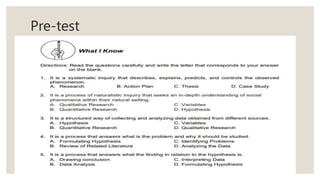
Pre-test
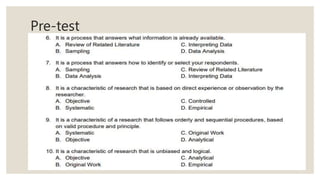
Pre-test
WHAT IS RESEARCH?
Nowadays society has many forms of problems that
require solutions. These solutions must be based on
facts, valid investigations, experiences and not just
on mere beliefs and suggestions. Indeed, to attain
such knowledge and accuracy, a systematic
procedure and well-planned research are required.
WHAT IS RESEARCH?
Research is a process of inquiring about the
solution to the problem, collecting data, and
logically evaluating information. To develop
good research, one must investigate reliable
information.
WHAT IS RESEARCH?
As students, understanding event around you requires systematic studies in order to
generate acceptable rationalization. Thus, research is a vital component of our course
curriculum. How then do we define research?
Research is a systematic investigation designed to extend the knowledge of what is
already known of the physical, biological, or social world” (University of San Diego,
para.1) on the other hand, Coryn (2007) define research in three ways:
1. Research is truth seeking, which refers to research or investigation, of or for a
body of real things, events, or facts, or the explanation of them.
2. Research describes, which involves representing or giving an account of and
explains which is about giving reason for or cause of; both of which contribute to
knowledge.
3. Research is conducted and governed by those who have the requisite
proficiency or expertise; meaning research is conducted by one who is an
expert in a branch of knowledge derived from training or experience.
WHAT IS RESEARCH?
As students, understanding event around you requires systematic studies in order to
generate acceptable rationalization. Thus, research is a vital component of our course
curriculum. How then do we define research?
Research is a systematic investigation designed to extend the knowledge of what is
already known of the physical, biological, or social world” (University of San Diego,
para.1) on the other hand, Coryn (2007) define research in three ways:
1. Research is truth seeking, which refers to research or investigation, of or for a
body of real things, events, or facts, or the explanation of them.
2. Research describes, which involves representing or giving an account of and
explains which is about giving reason for or cause of; both of which contribute to
knowledge.
3. Research is conducted and governed by those who have the requisite
proficiency or expertise; meaning research is conducted by one who is an
expert in a branch of knowledge derived from training or experience.
WHAT IS RESEARCH?
Research is an organized investigation and study of materials and sources to create
facts and reach new inferences. Research has come up with developing appropriate
solutions to improve the individual’s quality of life. Although it may take place in a
different setting and may use different methods, scientific research is universally a
systematic and objective search for reliable knowledge (Walker, 2010).
Research is a verified approach of thinking and employing legalized instruments
and steps to obtain a more adequate solution to a problem that is otherwise
impossible to address under ordinary means (Crawford, as cited by Alcantara &
Espina, 1995).
In most cases, research helps society to answer the WHAT and HOW questions. It
must be a proper investigation and should reach a valid conclusion that would
facilitate the finding of answers to the questions. Some of these questions are: How
can research affect society? What is the impact of the research to daily life?
WHAT IS RESEARCH?
Research is an organized investigation and study of materials and sources to create
facts and reach new inferences. Research has come up with developing appropriate
solutions to improve the individual’s quality of life. Although it may take place in a
different setting and may use different methods, scientific research is universally a
systematic and objective search for reliable knowledge (Walker, 2010).
Research is a verified approach of thinking and employing legalized instruments
and steps to obtain a more adequate solution to a problem that is otherwise
impossible to address under ordinary means (Crawford, as cited by Alcantara &
Espina, 1995).
In most cases, research helps society to answer the WHAT and HOW questions. It
must be a proper investigation and should reach a valid conclusion that would
facilitate the finding of answers to the questions. Some of these questions are: How
can research affect society? What is the impact of the research to daily life?
Types of Research
On a more specific description, research has four main types which also signifies the
different purposes of a research. These types were highlighted by Patton (1990) as
follows:
1. Basic Research – the purpose of this research is to understand and explain, i.e. the
research is interested in formulating and testing theoretical construct and
propositions that ideally generalize across time and space. It takes the form of
the theory to explain the phenomenon under I investigation to give its
contribution to knowledge. This research is more descriptive in nature, exploring,
what, why, and how questions.
This is the type of research that is a purely direct application but increasing
the nature of understanding about the problem. It develops the scientific
theories to be more understandable to the readers.
Example: Teacher Zi may try to probe for answers as to why did the Phil-IRI result of
San Juan National High School is declining for the last 5 years.
Types of Research
2. Applied Research – the purpose of this research is to help people
understand the nature problems so that human beings can more
effectively control their environment. In other words, this type of research
pursues potential solutions to human and societal problems. This research
is more prescriptive in nature, focusing on how questions.
◦ This scientific research is used in business, medicine, and education. It
focuses on intervention and giving solutions to a problem.
Example: In order to probe why the Phil-IRI result is declining, Teacher Zi
may determine the level of receptive and productive vocabulary skills of
the students first before finding some intervention to develop these skills
as salient elements in comprehension test.
Types of Research
3. Evaluation Research (summative and formative)- evaluation
research studies the processes and outcomes aimed at
attempted solution. The purpose of formative research is to
improve human intervention within specific conditions, such
as activities, time, and groups of people; the purpose of
summative evaluation is to judge the effectiveness of a
program, policy, or product.
Example: The research group of Grade 12 Ruby may try to
investigate the effectiveness of a v vocabulary mobile
application in enhancing the vocabulary skills of the Junior
High School students.
Types of Research
4.Action Research- Action research aims at solving specific
problems within a program, organization, or community.
Patton (1990) described the design and data collection in
action research tend to be more informal, and the people
in the situation are directly involved in gathering
information and studying themselves.
Example: Enhancing the English language spelling
difficulties of Grade 7 students by assigning daily five
minutes dictation of unfamiliar words
IMPORTANCE OF RESEARCH
◦ “Research is to see what everybody else has seen, and to think what nobody else has
thought.” – Albert Szent-Gyorgyi
◦ Research is important in our daily life because it describes what is happening around
us. Through this, we get to know what people think, what people feel, and what people
do. For example, determining the attitude of the Senior High School students towards the
use of mobile phones in learning.
◦ Research is important in our daily lives because it explains why things happen in certain
ways. Through this we get to understand different situations in our lives and helps us
identify the factors that hinder or facilitate why certain things fail. For example,
determining the factors that affect the development of the vocabulary skills of the
learners.
◦ Research is important it predicts what will happen. Through this, we get to caution
ourselves in doing or not doing something; it warns us not to pursue an action, and
encourages us to continue a certain act, as well. For example, a student may try to use an
existing research result about career choices before deciding what course to be taken in
college.
IMPORTANCE OF RESEARCH
◦ Research is important because it evaluates what happened in our lives. It gives you an
idea why things are not turning out the way you wanted. It provides areas that you need
to improve in a program delivery. For example, a teacher can investigate how a current
program in a school is working.
◦ Research is important because it helps us solve our problems. It provides us relevant
data in order to determine why people are against a certain government program, for
example through research, we can make necessary recommendations to improve the
government’s program to suit the needs of those who are affected by the program.
◦ Whatever your reasons are for undertaking a research, any data that you get would
definitely be of value to you and may influence you in your decisions in life. We know
that people decide on gathered information. That is why research is a valuable endeavor,
not just for the scientist but also for ordinary people like us. For example, when you try
to look into the most in demand courses 10 years from now. Through research you will
be able to take a look into statistics that would likely influence in your decision making.
IMPORTANCE OF RESEARCH
◦ Research is important because it evaluates what happened in our lives. It gives you an
idea why things are not turning out the way you wanted. It provides areas that you need
to improve in a program delivery. For example, a teacher can investigate how a current
program in a school is working.
◦ Research is important because it helps us solve our problems. It provides us relevant
data in order to determine why people are against a certain government program, for
example through research, we can make necessary recommendations to improve the
government’s program to suit the needs of those who are affected by the program.
◦ Whatever your reasons are for undertaking a research, any data that you get would
definitely be of value to you and may influence you in your decisions in life. We know
that people decide on gathered information. That is why research is a valuable endeavor,
not just for the scientist but also for ordinary people like us. For example, when you try
to look into the most in demand courses 10 years from now. Through research you will
be able to take a look into statistics that would likely influence in your decision making.
KEY POINTS
Research is important in our daily life because it:
describes what is happening.
explains why things happen in certain ways
predicts what will happen
evaluates what happens in our lives
helps us solve our problems
influences you in your decisions in life
What I have learned!
Brush up your knowledge. Answer the blank space.
Research is _____________________________________ .
Give at least two (2) importance of research.
1. _____________________________________
2. _____________________________________
What’s More (Dyad Activity)
Directions: Arrange the scrambled words/phrase properly to form a
logical sentence.
1. answer to a specific question is a type of research applied
research that needs
_____________________________________________________
1. is a type of research that is purely direct application but
expanding the nature of understanding basic research
______________________________________________________
What’s More (Dyad Activity)
Directions: Arrange the scrambled words/phrase properly to form a
logical sentence.
1. answer to a specific question is a type of research applied
research that needs
Applied Research is a type of research the needs answer to a specific
question.
1. is a type of research that is purely direct application but
expanding the nature of understanding basic research
Basic Research is a type of that is purely direct application but
expanding the nature of understanding.
SPELLING BEE
◦ ABSOLVE – (v) to be free from punishment, blame, or guilt
◦ She asked the priest to absolve him from his sins.
BALSAMIC – (adj) relating to kind of vinegar
She put balsamic vinegar on her salad.
DICHOTOMY (N) – Opposition or entirely different
There is a dichotomy between science and mysticism.
EGOMINIACAL (adj) – relating to egomaniac - a person who is obsessively egotistical or self-centered
Because of his good looks, he became egomaniacal
RHYTHMIC – relating to rhythm – occurring regulary
We can hear rhythmic patterns a poem
MICROCOSM - something (such as a place or an event) that is seen as a small version of something much larger
A barangay is a microcosm of a city.
GREEN-EYED – Jealous
I get green-eyed whenever I see you with him.
PHYSICAL - Relating to material things
Physical science is my favorite subject.
RESEARCH - the collecting of information about a particular subject
I will have to do a research on this project.
PURSUE – to reach, to chase after, to go after
The policeman pursued the thief who robbed the woman’s bag.
I am going to pursue higher education after SHS.
ACTIVITY NO. 1
◦ Learning Task
◦ The Teacher will do a group activity on writing different steps/ways on the
following situations:
◦ 1. To win the heart of your crush
◦ 2. To become effective public speaker
◦ 3. To fry crunchy fried chicken
◦ 4. To bake a pie
◦ 5. To overcome shyness
CHARACTERISTICS, PROCESSES AND
ETHICS OF RESEARCH
describes the characteristics, processes and
ethics of research
Objectives: Identify the characteristics and
processes of research
Explain the importance of ethics
in research
1. MEIPIRACL
2. CITAMYSSTE
3. DORLYER
4. DELLROTONC
5. ALYNACTIAL
6. LANGIRIO
7. LICAREPLIBITY
8. ONCSICLUVE
9. RSEOBIOVATN
10.TIEVBOJEC
CHARACTERISTICS OF RESEARCH
Conducting research is indeed very challenging; you need to undergo processes and
adhere to ethical principles. It has also characteristics such as:
◦ Empirical – Your research must be based on observations and experimentations of
theories. This involves your direct experiences in conducting research. As a researcher,
you cannot just do any magic in coming up with data; you need to experience in
doing it.
◦ Systematic- Your research follows orderly and sequential procedures; it must be
based on valid procedures and principles. You cannot just jump into conclusion with
undergoing the steps.
◦ Controlled- In research, all variables, except those that are tested/experimented on,
are kept constant.
◦ Analytical – The data that you have gathered must be analyzed critically so that
there is no error in the coming up with interpretations.
CHARACTERISTICS OF RESEARCH
◦ Objective – As a researcher, your research must be
unbiased and logical. All findings must be logically based on
empirical data which are based on real life situations.
◦ Original Work-This implies that the research requires effort
to get at the researcher’s own investigation and produce the
data needed to complete the study.
◦ Replicability – The research findings, research design and
procedures can be repeated to enable the researcher to arrive
at valid and conclusive results
CHARACTERISTIC OF RESEARCH
S
SPECIFIC
• GOALS
• VARIABLES
• LOCALE
M
Measurable
• QUANTIFIABLE
DATA
• RESULTS
A
ATTAINABLE
• REALISTIC
• REASONABLE
R
RELEVANT
• APPROPRIATE
TO THE
CURRENT
TIME, PERIOD,
AND
SITUATION
T
TIME
BOUND
• WITHIN THE
SPECIFED
PERIOD OF
TIME
STEPS IN DOING THE RESEARCH
DEFINE
RESEARCH
PROBLEM
REVIEW OF
THE RELATED
LITERATURE
FORMULATE
HYPOTHESIS
DESIGN
RESEARCH
COLLECT
DATA
ANALYZE
DATA
INTERPRET
AND REPORT
DEFINE
RESEARCH
PROBLEM
STEPS IN DOING THE RESEARCH
◦ Prieto, et.al. (2017) also added that the following are involved in the Research
Processes:
◦ 1. DEFINE RESEARCH PROBLEM: What is the problem?
◦ 2. REVIEW OF RELATED LITERATURE: What evidence is already presented?
◦ 3. FORMULATING HYPOTHESIS: How are we going to find/look for the answer
to questions being studied?
◦ 4. RESEARCH DESIGN: Where will the study be shown and with what
population?
◦ 5. COLLECTING DATA: Are we ready to gather the data? Where do we find the
data?
◦ 6. ANALYZING DATA: How do the data answer the research queries?
◦ 7. INTERPRET AND REPORT: What are the implications of the results
STEPS IN DOING THE RESEARCH
1. Identification of a
research problem
• A good research always starts with a good problem. You can observe people or things, visit places, read print
materials, or consult experts to find the research problem that is right for you. The research problem guides you
in formulating the hypothesis and interpretation of your findings so that you can formulate the right conclusion.
A good research problem is important because it is the basis of all subsequent research activities you are going
to undertake. Factors like area of interest, availability of fund, socio-economic significance of the study, and the
safety measures to be undertaken should be considered in finding a good research problem.
2. REVIEW OF THE
RELATED LITERATURE
• A research problem is vague at first. To give you a vivid picture of the whole research, you shall read various
publications or surf the internet to become aware of the previous works already done. In doing so, it could spur
an idea that can be the subject of your investigation. The review of related literature can be taken from science
books, magazines, journals, newspapers, or even in the internet.
STEPS IN DOING THE RESEARCH
3. Formulation of
Hypothesis
.
• After finding your research problem, the next step is to formulate your own hypothesis. A
hypothesis is a theoretical statement in solving a logical relationship between variables.
Do not be afraid if your hypothesis proves to be incorrect after the experimentation
because it is only considered as an educated guess. Always remember that when you
formulate a hypothesis, it should be based on the research problem being solved
4. Preparation of
Research Design
• A research design is the blueprint of the research you are going to undertake. It serves as
the work plan of the whole study not only because it entails the resources needed in
conducting the research but also the ways these resources are utilized.F THE RELATED
LITERATURE
STEPS IN DOING THE RESEARCH
5. DATA
COLLECTION
• Actual experimentation is an implementation of the research design. In actual
experimentation, you have to conduct an experiment to prove the validity of the
hypothesis you have formulated. Actual experimentation includes the methodology that
you have followed in doing your research. The methodology should be carefully planned
prior to the actual experimentation to ensure the validity and accuracy of the result.
6. DATA
ANALYSIS
• This is the heart of the research process because this is part where the findings of the
research can be found. You can use table (not the table in your kitchen) and graph to
interpret the results of your research.
STEPS IN DOING RESEARCH
◦ Prieto, et.al. (2017) also added that the following are involved in the
Research
◦ Processes:
◦ 1. DEFINE RESEARCH PROBLEM: What is the problem?
◦ 2. REVIEW OF RELATED LITERATURE: What evidence is already
presented?
◦ 3. FORMULATING HYPOTHESIS: How are we going to find/look for the
answer to
◦ questions being studied?
◦ 4. RESEARCH DESIGN: Where will the study be shown and with what
population?
◦ Conducting research is a tiresome task because it is a year-round
activity. You have to be committed to become successful in
making a good research which would benefit not only you but of
everyone. The willingness in you in making future researches
should always be there because doing research without your
‘heart’ and ‘mind’ on it is a burden on your part.
◦ Always enjoy doing it. Enjoy the ride. The more that you enjoy
doing the task, the more that you ease the burden in conducting
this difficult endeavor. Never hesitate to ask questions. Asking
questions from other people who is aware of your research topic
would help you arrive at the correct conclusions. Now that you
have finally learned the steps in the research process, you can now
start doing one. Good luck!
Ethics in Research
◦ Important Ethics (moral issues) in Research
Honesty. Strive for honesty in all scientific communications. Honestly
report data, results, methods and procedures, and publication status. Do not
fabricate, falsify, or misrepresent data. Do not deceive colleagues, research
sponsors, or the public
Objectivity. Strive to avoid bias in experimental design, data analysis, data
interpretation, peer review, personnel decisions, grant writing, expert
testimony, and other aspects of research where objectivity is expected or
required. Avoid or minimize bias or self-deception.
Integrity. Keep your promises and agreements; act with sincerity; strive for
consistency of thought and action.
Ethics in Research
◦ Important Ethics (moral issues) in Research
◦ Carefulness. Avoid careless errors and negligence; carefully and critically examine your
own work and the work of your peers. Keep good records of research activities,
◦ Openness. Share data, results, ideas, tools, resources. Share your findings especially to
your informants/respondents.
◦ Intellectual Property. Honor patents, copyrights, and other forms of intellectual
property. Do not use unpublished data, methods, or results without permission. Give proper
acknowledgement or credit for all contributions to research. Never plagiarize.
◦ Confidentiality. Protect confidential communications, such as papers or grants
submitted for publication, personnel records, trade or military secrets, and patient records.
Ethics in Research
◦ Important Ethics (moral issues) in Research
◦ Responsible Publication. Publish in order to advance research and scholarship, not to
advance just your own career. Avoid wasteful and duplicative publication
◦ Social Responsibility. Strive to promote social good and prevent or mitigate social
harms through research, public education, and advocacy.
◦ Legality. Know and obey relevant laws and institutional and governmental policies.
◦ Non-Discrimination. Avoid discrimination against colleagues or students on the basis
of sex, race, ethnicity, or other factors not related to scientific competence and integrity.
◦ Human Subjects protection. When conducting research on human subjects, minimize
harms and risks and maximize benefits; respect human dignity, privacy, and autonomy;
take special precautions with vulnerable populations; and strive to distribute the benefits
and burdens of research fairly
ETHICS IN RESEARCH
According to Resnik, 2007, ethical norms are significant in conducting
research studies as explained in the following:
◦ First, ethics promotes the pursuit of knowledge, truth, and credibility. It also
fosters values that are essential to collaborative work.
◦ Second, ethical norms help individuals to be accountable in every act that
the researcher/s undertake.
◦ Third, ensure that researchers are held accountable to the public.
◦ Lastly, an ethical norm in research also needs public awareness. This can be
evaluated by the researcher before conducting the study because this may
help a certain population in an area once the study is completed.
PRACTICAL RESEARCH 1 -lesson 1.pptx

PRACTICAL RESEARCH 1 -lesson 1.pptx

  • 1.
    PRACTICAL RESEARCH 1 DEFINITION OFRESEARCH AND ITS VARIOUS TYPES
  • 2.
    0BJECTIVES: After studying thischapter, you will be able to: a. define what is research (CS_RS11-IIIa-1) b. Identify different types of research.
  • 3.
  • 4.
  • 5.
  • 6.
    WHAT IS RESEARCH? Nowadayssociety has many forms of problems that require solutions. These solutions must be based on facts, valid investigations, experiences and not just on mere beliefs and suggestions. Indeed, to attain such knowledge and accuracy, a systematic procedure and well-planned research are required.
  • 7.
    WHAT IS RESEARCH? Researchis a process of inquiring about the solution to the problem, collecting data, and logically evaluating information. To develop good research, one must investigate reliable information.
  • 8.
    WHAT IS RESEARCH? Asstudents, understanding event around you requires systematic studies in order to generate acceptable rationalization. Thus, research is a vital component of our course curriculum. How then do we define research? Research is a systematic investigation designed to extend the knowledge of what is already known of the physical, biological, or social world” (University of San Diego, para.1) on the other hand, Coryn (2007) define research in three ways: 1. Research is truth seeking, which refers to research or investigation, of or for a body of real things, events, or facts, or the explanation of them. 2. Research describes, which involves representing or giving an account of and explains which is about giving reason for or cause of; both of which contribute to knowledge. 3. Research is conducted and governed by those who have the requisite proficiency or expertise; meaning research is conducted by one who is an expert in a branch of knowledge derived from training or experience.
  • 9.
    WHAT IS RESEARCH? Asstudents, understanding event around you requires systematic studies in order to generate acceptable rationalization. Thus, research is a vital component of our course curriculum. How then do we define research? Research is a systematic investigation designed to extend the knowledge of what is already known of the physical, biological, or social world” (University of San Diego, para.1) on the other hand, Coryn (2007) define research in three ways: 1. Research is truth seeking, which refers to research or investigation, of or for a body of real things, events, or facts, or the explanation of them. 2. Research describes, which involves representing or giving an account of and explains which is about giving reason for or cause of; both of which contribute to knowledge. 3. Research is conducted and governed by those who have the requisite proficiency or expertise; meaning research is conducted by one who is an expert in a branch of knowledge derived from training or experience.
  • 10.
    WHAT IS RESEARCH? Researchis an organized investigation and study of materials and sources to create facts and reach new inferences. Research has come up with developing appropriate solutions to improve the individual’s quality of life. Although it may take place in a different setting and may use different methods, scientific research is universally a systematic and objective search for reliable knowledge (Walker, 2010). Research is a verified approach of thinking and employing legalized instruments and steps to obtain a more adequate solution to a problem that is otherwise impossible to address under ordinary means (Crawford, as cited by Alcantara & Espina, 1995). In most cases, research helps society to answer the WHAT and HOW questions. It must be a proper investigation and should reach a valid conclusion that would facilitate the finding of answers to the questions. Some of these questions are: How can research affect society? What is the impact of the research to daily life?
  • 11.
    WHAT IS RESEARCH? Researchis an organized investigation and study of materials and sources to create facts and reach new inferences. Research has come up with developing appropriate solutions to improve the individual’s quality of life. Although it may take place in a different setting and may use different methods, scientific research is universally a systematic and objective search for reliable knowledge (Walker, 2010). Research is a verified approach of thinking and employing legalized instruments and steps to obtain a more adequate solution to a problem that is otherwise impossible to address under ordinary means (Crawford, as cited by Alcantara & Espina, 1995). In most cases, research helps society to answer the WHAT and HOW questions. It must be a proper investigation and should reach a valid conclusion that would facilitate the finding of answers to the questions. Some of these questions are: How can research affect society? What is the impact of the research to daily life?
  • 12.
    Types of Research Ona more specific description, research has four main types which also signifies the different purposes of a research. These types were highlighted by Patton (1990) as follows: 1. Basic Research – the purpose of this research is to understand and explain, i.e. the research is interested in formulating and testing theoretical construct and propositions that ideally generalize across time and space. It takes the form of the theory to explain the phenomenon under I investigation to give its contribution to knowledge. This research is more descriptive in nature, exploring, what, why, and how questions. This is the type of research that is a purely direct application but increasing the nature of understanding about the problem. It develops the scientific theories to be more understandable to the readers. Example: Teacher Zi may try to probe for answers as to why did the Phil-IRI result of San Juan National High School is declining for the last 5 years.
  • 13.
    Types of Research 2.Applied Research – the purpose of this research is to help people understand the nature problems so that human beings can more effectively control their environment. In other words, this type of research pursues potential solutions to human and societal problems. This research is more prescriptive in nature, focusing on how questions. ◦ This scientific research is used in business, medicine, and education. It focuses on intervention and giving solutions to a problem. Example: In order to probe why the Phil-IRI result is declining, Teacher Zi may determine the level of receptive and productive vocabulary skills of the students first before finding some intervention to develop these skills as salient elements in comprehension test.
  • 14.
    Types of Research 3.Evaluation Research (summative and formative)- evaluation research studies the processes and outcomes aimed at attempted solution. The purpose of formative research is to improve human intervention within specific conditions, such as activities, time, and groups of people; the purpose of summative evaluation is to judge the effectiveness of a program, policy, or product. Example: The research group of Grade 12 Ruby may try to investigate the effectiveness of a v vocabulary mobile application in enhancing the vocabulary skills of the Junior High School students.
  • 15.
    Types of Research 4.ActionResearch- Action research aims at solving specific problems within a program, organization, or community. Patton (1990) described the design and data collection in action research tend to be more informal, and the people in the situation are directly involved in gathering information and studying themselves. Example: Enhancing the English language spelling difficulties of Grade 7 students by assigning daily five minutes dictation of unfamiliar words
  • 17.
    IMPORTANCE OF RESEARCH ◦“Research is to see what everybody else has seen, and to think what nobody else has thought.” – Albert Szent-Gyorgyi ◦ Research is important in our daily life because it describes what is happening around us. Through this, we get to know what people think, what people feel, and what people do. For example, determining the attitude of the Senior High School students towards the use of mobile phones in learning. ◦ Research is important in our daily lives because it explains why things happen in certain ways. Through this we get to understand different situations in our lives and helps us identify the factors that hinder or facilitate why certain things fail. For example, determining the factors that affect the development of the vocabulary skills of the learners. ◦ Research is important it predicts what will happen. Through this, we get to caution ourselves in doing or not doing something; it warns us not to pursue an action, and encourages us to continue a certain act, as well. For example, a student may try to use an existing research result about career choices before deciding what course to be taken in college.
  • 18.
    IMPORTANCE OF RESEARCH ◦Research is important because it evaluates what happened in our lives. It gives you an idea why things are not turning out the way you wanted. It provides areas that you need to improve in a program delivery. For example, a teacher can investigate how a current program in a school is working. ◦ Research is important because it helps us solve our problems. It provides us relevant data in order to determine why people are against a certain government program, for example through research, we can make necessary recommendations to improve the government’s program to suit the needs of those who are affected by the program. ◦ Whatever your reasons are for undertaking a research, any data that you get would definitely be of value to you and may influence you in your decisions in life. We know that people decide on gathered information. That is why research is a valuable endeavor, not just for the scientist but also for ordinary people like us. For example, when you try to look into the most in demand courses 10 years from now. Through research you will be able to take a look into statistics that would likely influence in your decision making.
  • 19.
    IMPORTANCE OF RESEARCH ◦Research is important because it evaluates what happened in our lives. It gives you an idea why things are not turning out the way you wanted. It provides areas that you need to improve in a program delivery. For example, a teacher can investigate how a current program in a school is working. ◦ Research is important because it helps us solve our problems. It provides us relevant data in order to determine why people are against a certain government program, for example through research, we can make necessary recommendations to improve the government’s program to suit the needs of those who are affected by the program. ◦ Whatever your reasons are for undertaking a research, any data that you get would definitely be of value to you and may influence you in your decisions in life. We know that people decide on gathered information. That is why research is a valuable endeavor, not just for the scientist but also for ordinary people like us. For example, when you try to look into the most in demand courses 10 years from now. Through research you will be able to take a look into statistics that would likely influence in your decision making.
  • 20.
    KEY POINTS Research isimportant in our daily life because it: describes what is happening. explains why things happen in certain ways predicts what will happen evaluates what happens in our lives helps us solve our problems influences you in your decisions in life
  • 21.
    What I havelearned! Brush up your knowledge. Answer the blank space. Research is _____________________________________ . Give at least two (2) importance of research. 1. _____________________________________ 2. _____________________________________
  • 22.
    What’s More (DyadActivity) Directions: Arrange the scrambled words/phrase properly to form a logical sentence. 1. answer to a specific question is a type of research applied research that needs _____________________________________________________ 1. is a type of research that is purely direct application but expanding the nature of understanding basic research ______________________________________________________
  • 25.
    What’s More (DyadActivity) Directions: Arrange the scrambled words/phrase properly to form a logical sentence. 1. answer to a specific question is a type of research applied research that needs Applied Research is a type of research the needs answer to a specific question. 1. is a type of research that is purely direct application but expanding the nature of understanding basic research Basic Research is a type of that is purely direct application but expanding the nature of understanding.
  • 26.
    SPELLING BEE ◦ ABSOLVE– (v) to be free from punishment, blame, or guilt ◦ She asked the priest to absolve him from his sins. BALSAMIC – (adj) relating to kind of vinegar She put balsamic vinegar on her salad. DICHOTOMY (N) – Opposition or entirely different There is a dichotomy between science and mysticism. EGOMINIACAL (adj) – relating to egomaniac - a person who is obsessively egotistical or self-centered Because of his good looks, he became egomaniacal RHYTHMIC – relating to rhythm – occurring regulary We can hear rhythmic patterns a poem MICROCOSM - something (such as a place or an event) that is seen as a small version of something much larger A barangay is a microcosm of a city. GREEN-EYED – Jealous I get green-eyed whenever I see you with him. PHYSICAL - Relating to material things Physical science is my favorite subject. RESEARCH - the collecting of information about a particular subject I will have to do a research on this project. PURSUE – to reach, to chase after, to go after The policeman pursued the thief who robbed the woman’s bag. I am going to pursue higher education after SHS.
  • 27.
    ACTIVITY NO. 1 ◦Learning Task ◦ The Teacher will do a group activity on writing different steps/ways on the following situations: ◦ 1. To win the heart of your crush ◦ 2. To become effective public speaker ◦ 3. To fry crunchy fried chicken ◦ 4. To bake a pie ◦ 5. To overcome shyness
  • 28.
    CHARACTERISTICS, PROCESSES AND ETHICSOF RESEARCH describes the characteristics, processes and ethics of research Objectives: Identify the characteristics and processes of research Explain the importance of ethics in research
  • 29.
    1. MEIPIRACL 2. CITAMYSSTE 3.DORLYER 4. DELLROTONC 5. ALYNACTIAL
  • 30.
    6. LANGIRIO 7. LICAREPLIBITY 8.ONCSICLUVE 9. RSEOBIOVATN 10.TIEVBOJEC
  • 31.
    CHARACTERISTICS OF RESEARCH Conductingresearch is indeed very challenging; you need to undergo processes and adhere to ethical principles. It has also characteristics such as: ◦ Empirical – Your research must be based on observations and experimentations of theories. This involves your direct experiences in conducting research. As a researcher, you cannot just do any magic in coming up with data; you need to experience in doing it. ◦ Systematic- Your research follows orderly and sequential procedures; it must be based on valid procedures and principles. You cannot just jump into conclusion with undergoing the steps. ◦ Controlled- In research, all variables, except those that are tested/experimented on, are kept constant. ◦ Analytical – The data that you have gathered must be analyzed critically so that there is no error in the coming up with interpretations.
  • 32.
    CHARACTERISTICS OF RESEARCH ◦Objective – As a researcher, your research must be unbiased and logical. All findings must be logically based on empirical data which are based on real life situations. ◦ Original Work-This implies that the research requires effort to get at the researcher’s own investigation and produce the data needed to complete the study. ◦ Replicability – The research findings, research design and procedures can be repeated to enable the researcher to arrive at valid and conclusive results
  • 33.
    CHARACTERISTIC OF RESEARCH S SPECIFIC •GOALS • VARIABLES • LOCALE M Measurable • QUANTIFIABLE DATA • RESULTS A ATTAINABLE • REALISTIC • REASONABLE R RELEVANT • APPROPRIATE TO THE CURRENT TIME, PERIOD, AND SITUATION T TIME BOUND • WITHIN THE SPECIFED PERIOD OF TIME
  • 34.
    STEPS IN DOINGTHE RESEARCH DEFINE RESEARCH PROBLEM REVIEW OF THE RELATED LITERATURE FORMULATE HYPOTHESIS DESIGN RESEARCH COLLECT DATA ANALYZE DATA INTERPRET AND REPORT DEFINE RESEARCH PROBLEM
  • 35.
    STEPS IN DOINGTHE RESEARCH ◦ Prieto, et.al. (2017) also added that the following are involved in the Research Processes: ◦ 1. DEFINE RESEARCH PROBLEM: What is the problem? ◦ 2. REVIEW OF RELATED LITERATURE: What evidence is already presented? ◦ 3. FORMULATING HYPOTHESIS: How are we going to find/look for the answer to questions being studied? ◦ 4. RESEARCH DESIGN: Where will the study be shown and with what population? ◦ 5. COLLECTING DATA: Are we ready to gather the data? Where do we find the data? ◦ 6. ANALYZING DATA: How do the data answer the research queries? ◦ 7. INTERPRET AND REPORT: What are the implications of the results
  • 36.
    STEPS IN DOINGTHE RESEARCH 1. Identification of a research problem • A good research always starts with a good problem. You can observe people or things, visit places, read print materials, or consult experts to find the research problem that is right for you. The research problem guides you in formulating the hypothesis and interpretation of your findings so that you can formulate the right conclusion. A good research problem is important because it is the basis of all subsequent research activities you are going to undertake. Factors like area of interest, availability of fund, socio-economic significance of the study, and the safety measures to be undertaken should be considered in finding a good research problem. 2. REVIEW OF THE RELATED LITERATURE • A research problem is vague at first. To give you a vivid picture of the whole research, you shall read various publications or surf the internet to become aware of the previous works already done. In doing so, it could spur an idea that can be the subject of your investigation. The review of related literature can be taken from science books, magazines, journals, newspapers, or even in the internet.
  • 37.
    STEPS IN DOINGTHE RESEARCH 3. Formulation of Hypothesis . • After finding your research problem, the next step is to formulate your own hypothesis. A hypothesis is a theoretical statement in solving a logical relationship between variables. Do not be afraid if your hypothesis proves to be incorrect after the experimentation because it is only considered as an educated guess. Always remember that when you formulate a hypothesis, it should be based on the research problem being solved 4. Preparation of Research Design • A research design is the blueprint of the research you are going to undertake. It serves as the work plan of the whole study not only because it entails the resources needed in conducting the research but also the ways these resources are utilized.F THE RELATED LITERATURE
  • 38.
    STEPS IN DOINGTHE RESEARCH 5. DATA COLLECTION • Actual experimentation is an implementation of the research design. In actual experimentation, you have to conduct an experiment to prove the validity of the hypothesis you have formulated. Actual experimentation includes the methodology that you have followed in doing your research. The methodology should be carefully planned prior to the actual experimentation to ensure the validity and accuracy of the result. 6. DATA ANALYSIS • This is the heart of the research process because this is part where the findings of the research can be found. You can use table (not the table in your kitchen) and graph to interpret the results of your research.
  • 39.
    STEPS IN DOINGRESEARCH ◦ Prieto, et.al. (2017) also added that the following are involved in the Research ◦ Processes: ◦ 1. DEFINE RESEARCH PROBLEM: What is the problem? ◦ 2. REVIEW OF RELATED LITERATURE: What evidence is already presented? ◦ 3. FORMULATING HYPOTHESIS: How are we going to find/look for the answer to ◦ questions being studied? ◦ 4. RESEARCH DESIGN: Where will the study be shown and with what population?
  • 40.
    ◦ Conducting researchis a tiresome task because it is a year-round activity. You have to be committed to become successful in making a good research which would benefit not only you but of everyone. The willingness in you in making future researches should always be there because doing research without your ‘heart’ and ‘mind’ on it is a burden on your part. ◦ Always enjoy doing it. Enjoy the ride. The more that you enjoy doing the task, the more that you ease the burden in conducting this difficult endeavor. Never hesitate to ask questions. Asking questions from other people who is aware of your research topic would help you arrive at the correct conclusions. Now that you have finally learned the steps in the research process, you can now start doing one. Good luck!
  • 41.
    Ethics in Research ◦Important Ethics (moral issues) in Research Honesty. Strive for honesty in all scientific communications. Honestly report data, results, methods and procedures, and publication status. Do not fabricate, falsify, or misrepresent data. Do not deceive colleagues, research sponsors, or the public Objectivity. Strive to avoid bias in experimental design, data analysis, data interpretation, peer review, personnel decisions, grant writing, expert testimony, and other aspects of research where objectivity is expected or required. Avoid or minimize bias or self-deception. Integrity. Keep your promises and agreements; act with sincerity; strive for consistency of thought and action.
  • 42.
    Ethics in Research ◦Important Ethics (moral issues) in Research ◦ Carefulness. Avoid careless errors and negligence; carefully and critically examine your own work and the work of your peers. Keep good records of research activities, ◦ Openness. Share data, results, ideas, tools, resources. Share your findings especially to your informants/respondents. ◦ Intellectual Property. Honor patents, copyrights, and other forms of intellectual property. Do not use unpublished data, methods, or results without permission. Give proper acknowledgement or credit for all contributions to research. Never plagiarize. ◦ Confidentiality. Protect confidential communications, such as papers or grants submitted for publication, personnel records, trade or military secrets, and patient records.
  • 43.
    Ethics in Research ◦Important Ethics (moral issues) in Research ◦ Responsible Publication. Publish in order to advance research and scholarship, not to advance just your own career. Avoid wasteful and duplicative publication ◦ Social Responsibility. Strive to promote social good and prevent or mitigate social harms through research, public education, and advocacy. ◦ Legality. Know and obey relevant laws and institutional and governmental policies. ◦ Non-Discrimination. Avoid discrimination against colleagues or students on the basis of sex, race, ethnicity, or other factors not related to scientific competence and integrity. ◦ Human Subjects protection. When conducting research on human subjects, minimize harms and risks and maximize benefits; respect human dignity, privacy, and autonomy; take special precautions with vulnerable populations; and strive to distribute the benefits and burdens of research fairly
  • 44.
    ETHICS IN RESEARCH Accordingto Resnik, 2007, ethical norms are significant in conducting research studies as explained in the following: ◦ First, ethics promotes the pursuit of knowledge, truth, and credibility. It also fosters values that are essential to collaborative work. ◦ Second, ethical norms help individuals to be accountable in every act that the researcher/s undertake. ◦ Third, ensure that researchers are held accountable to the public. ◦ Lastly, an ethical norm in research also needs public awareness. This can be evaluated by the researcher before conducting the study because this may help a certain population in an area once the study is completed.