KREB'S CYCLE
It was named after
the Hans Adolf Krebs
who discovered it in
1937.
It is also known by
several other names:
•Citric Acid Cycle
•Tricarboxylic Acid
Cycle (TCA)
DEFINATION
 It is the sequence of reactions by which most
living cells generate energy during the process of
aerobic respiration. It takes place in the
mitochondria, using up oxygen and producing
carbon dioxide and water as waste products, and
ADP is converted to energy-rich ATP.
An Overview of the Citric Acid Cycle
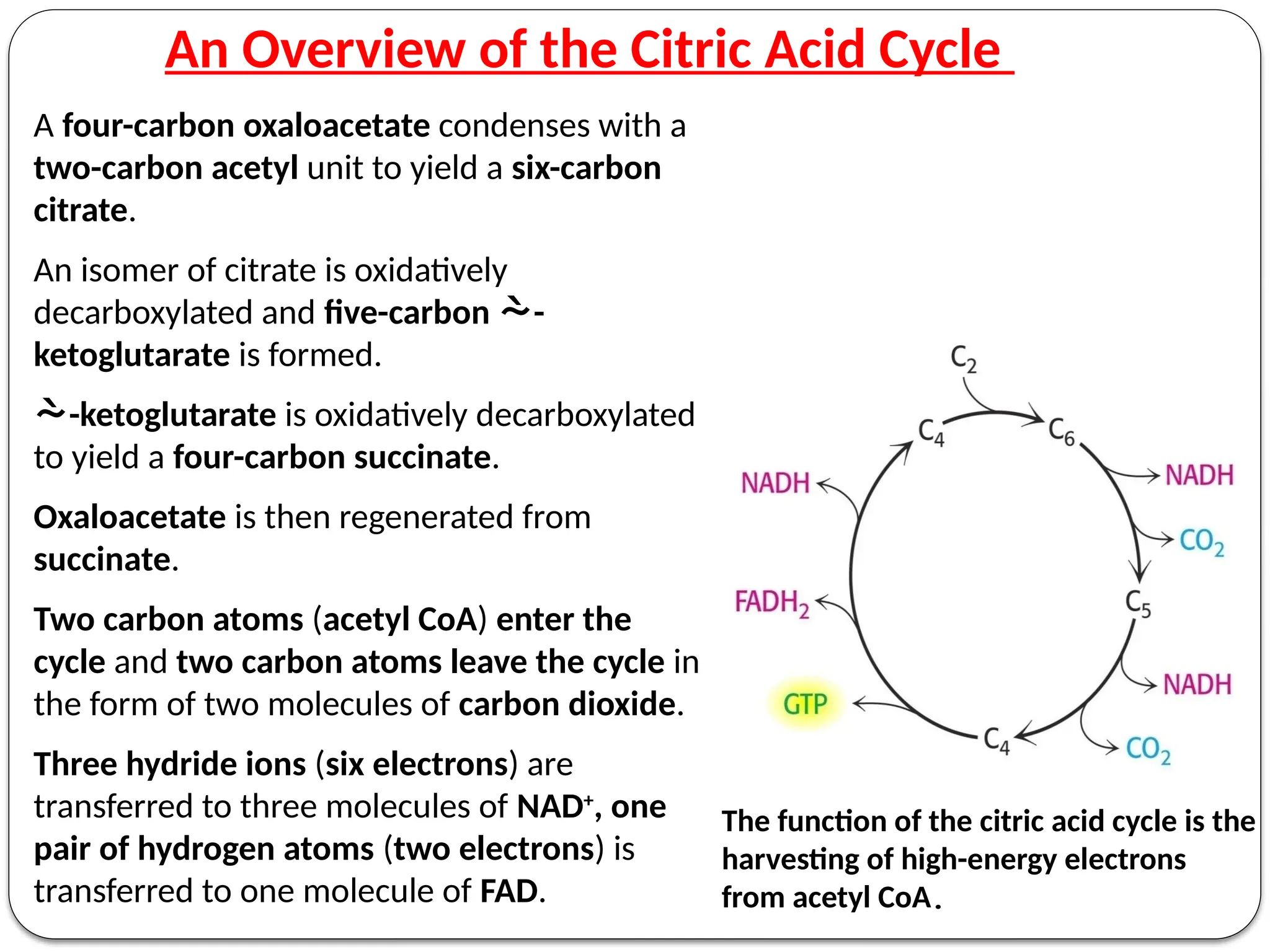
A four-carbon oxaloacetate condenses with a
two-carbon acetyl unit to yield a six-carbon
citrate.
An isomer of citrate is oxidatively
decarboxylated and five-carbon -
ketoglutarate is formed.
-ketoglutarate is oxidatively decarboxylated
to yield a four-carbon succinate.
Oxaloacetate is then regenerated from
succinate.
Two carbon atoms (acetyl CoA) enter the
cycle and two carbon atoms leave the cycle in
the form of two molecules of carbon dioxide.
Three hydride ions (six electrons) are
transferred to three molecules of NAD+
, one
pair of hydrogen atoms (two electrons) is
transferred to one molecule of FAD.
The function of the citric acid cycle is the
harvesting of high-energy electrons
from acetyl CoA.
STEPS IN CITRIC ACID CYCLE
1. Citrate Synthase: Formation of Citroyl CoA
intermediate
2. Aconitase
3. Isocitrate dehydrogenase
4. a-Ketoglutarate dehydrogenase
5. Succinyl CoA synthatse
6. Succinate Dehydrogenase
7. Fumarase
8. L-Malate dehydrogenase
1. Citrate Synthase
• Citrate formed from acetyl CoA and oxaloacetate
• Only cycle reaction with C-C bond formation
• Addition of C2 unit (acetyl) to the keto double bond of C4 acid,
oxaloacetate, to produce C6 compound, citrate
citrate synthase
2. Aconitase
• Elimination of H2O from citrate to form C=C bond of cis-
aconitate
• Stereospecific addition of H2O to cis-aconitate to form
isocitrate
aconitase aconitase
3. Isocitrate Dehydrogenase
• Oxidative decarboxylation of isocitrate to
a-ketoglutarate (a metabolically irreversible reaction)
• One of four oxidation-reduction reactions of the cycle
• Hydride ion from the C-2 of isocitrate is transferred to NAD+
to form
NADH
• Oxalosuccinate is decarboxylated to a-ketoglutarate
isocitrate dehydrogenase
4. The -Ketoglutarate Dehydrogenase Complex
• Similar to pyruvate dehydrogenase complex
• Same coenzymes, identical mechanisms
• E1 - a-ketoglutarate dehydrogenase (with TPP)
• E2 – dihydrolipoyl succinyltransferase (with flexible lipoamide
prosthetic group)
• E3 - dihydrolipoyl dehydrogenase (with FAD)
a-ketoglutarate
dehydrogenase
5. Succinyl-CoA Synthetase
• Free energy in thioester bond of succinyl CoA is conserved
as GTP or ATP in higher animals (or ATP in plants, some
bacteria)
• Substrate level phosphorylation reaction
HS-
+
GTP + ADP GDP + ATP
Succinyl-CoA
Synthetase
• Complex of several polypeptides, an FAD prosthetic group and iron-sulfur
clusters
• Embedded in the inner mitochondrial membrane
• Electrons are transferred from succinate to FAD and then to ubiquinone
(Q) in electron transport chain
• Dehydrogenation is stereospecific; only the transisomer is formed
6. The Succinate Dehydrogenase Complex
Succinate
Dehydrogenase
7. Fumarase
• Stereospecific trans addition of water to the double
bond of fumarate to form L-malate
• Only the L isomer of malate is formed
Fumarase
8. Malate Dehydrogenase
Malate Dehydrogenase
Malate is oxidized to form oxaloacetate.
• Integration of metabolism. The citric acid cycle is
amphibolic (both catabolic and anabolic)
Functions of the Citric Acid Cycle
The cycle is involved in the
aerobic catabolism of
carbohydrates, lipids and
amino acids.
Intermediates of the cycle
are starting points for
many anabolic reactions.
• Yields energy in the form of GTP (ATP).
• Yields reducing power in the form of NADH2 and FADH2.
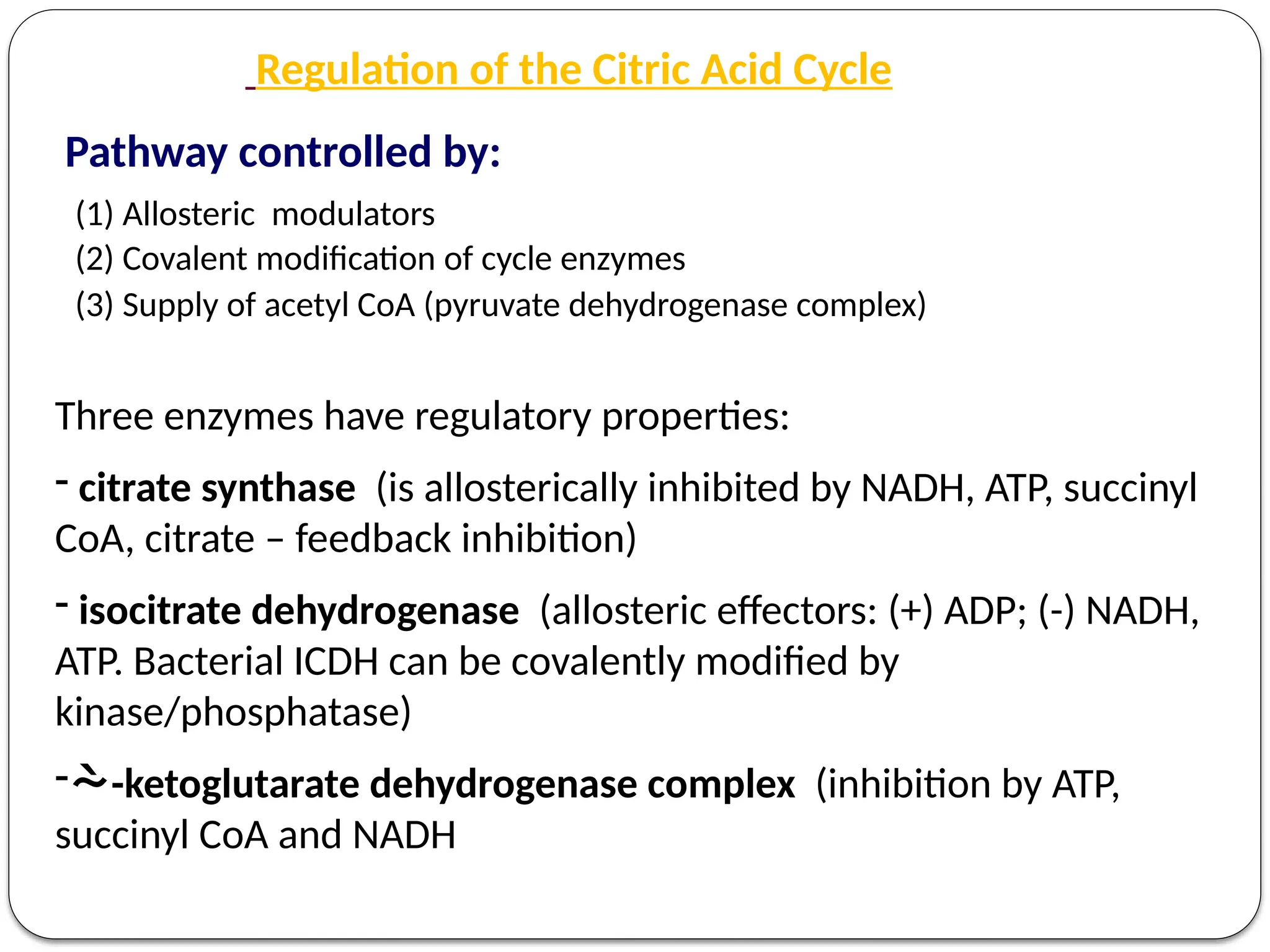
Regulation of the Citric Acid Cycle
Pathway controlled by:
(1) Allosteric modulators
(2) Covalent modification of cycle enzymes
(3) Supply of acetyl CoA (pyruvate dehydrogenase complex)
Three enzymes have regulatory properties:
- citrate synthase (is allosterically inhibited by NADH, ATP, succinyl
CoA, citrate – feedback inhibition)
- isocitrate dehydrogenase (allosteric effectors: (+) ADP; (-) NADH,
ATP. Bacterial ICDH can be covalently modified by
kinase/phosphatase)
--ketoglutarate dehydrogenase complex (inhibition by ATP,
succinyl CoA and NADH
NADH, ATP,
succinyl CoA,
citrate
-
Regulation of the citric acid cycle

KREB'S CYCLE or citric acid cycle 1.pptx

  • 1.
  • 2.
    It was namedafter the Hans Adolf Krebs who discovered it in 1937. It is also known by several other names: •Citric Acid Cycle •Tricarboxylic Acid Cycle (TCA)
  • 3.
    DEFINATION  It isthe sequence of reactions by which most living cells generate energy during the process of aerobic respiration. It takes place in the mitochondria, using up oxygen and producing carbon dioxide and water as waste products, and ADP is converted to energy-rich ATP.
  • 4.
    An Overview ofthe Citric Acid Cycle A four-carbon oxaloacetate condenses with a two-carbon acetyl unit to yield a six-carbon citrate. An isomer of citrate is oxidatively decarboxylated and five-carbon - ketoglutarate is formed. -ketoglutarate is oxidatively decarboxylated to yield a four-carbon succinate. Oxaloacetate is then regenerated from succinate. Two carbon atoms (acetyl CoA) enter the cycle and two carbon atoms leave the cycle in the form of two molecules of carbon dioxide. Three hydride ions (six electrons) are transferred to three molecules of NAD+ , one pair of hydrogen atoms (two electrons) is transferred to one molecule of FAD. The function of the citric acid cycle is the harvesting of high-energy electrons from acetyl CoA.
  • 5.
    STEPS IN CITRICACID CYCLE 1. Citrate Synthase: Formation of Citroyl CoA intermediate 2. Aconitase 3. Isocitrate dehydrogenase 4. a-Ketoglutarate dehydrogenase 5. Succinyl CoA synthatse 6. Succinate Dehydrogenase 7. Fumarase 8. L-Malate dehydrogenase
  • 6.
    1. Citrate Synthase •Citrate formed from acetyl CoA and oxaloacetate • Only cycle reaction with C-C bond formation • Addition of C2 unit (acetyl) to the keto double bond of C4 acid, oxaloacetate, to produce C6 compound, citrate citrate synthase
  • 7.
    2. Aconitase • Eliminationof H2O from citrate to form C=C bond of cis- aconitate • Stereospecific addition of H2O to cis-aconitate to form isocitrate aconitase aconitase
  • 8.
    3. Isocitrate Dehydrogenase •Oxidative decarboxylation of isocitrate to a-ketoglutarate (a metabolically irreversible reaction) • One of four oxidation-reduction reactions of the cycle • Hydride ion from the C-2 of isocitrate is transferred to NAD+ to form NADH • Oxalosuccinate is decarboxylated to a-ketoglutarate isocitrate dehydrogenase isocitrate dehydrogenase
  • 9.
    4. The -KetoglutarateDehydrogenase Complex • Similar to pyruvate dehydrogenase complex • Same coenzymes, identical mechanisms • E1 - a-ketoglutarate dehydrogenase (with TPP) • E2 – dihydrolipoyl succinyltransferase (with flexible lipoamide prosthetic group) • E3 - dihydrolipoyl dehydrogenase (with FAD) a-ketoglutarate dehydrogenase
  • 10.
    5. Succinyl-CoA Synthetase •Free energy in thioester bond of succinyl CoA is conserved as GTP or ATP in higher animals (or ATP in plants, some bacteria) • Substrate level phosphorylation reaction HS- + GTP + ADP GDP + ATP Succinyl-CoA Synthetase
  • 11.
    • Complex ofseveral polypeptides, an FAD prosthetic group and iron-sulfur clusters • Embedded in the inner mitochondrial membrane • Electrons are transferred from succinate to FAD and then to ubiquinone (Q) in electron transport chain • Dehydrogenation is stereospecific; only the transisomer is formed 6. The Succinate Dehydrogenase Complex Succinate Dehydrogenase
  • 12.
    7. Fumarase • Stereospecifictrans addition of water to the double bond of fumarate to form L-malate • Only the L isomer of malate is formed Fumarase
  • 13.
    8. Malate Dehydrogenase MalateDehydrogenase Malate is oxidized to form oxaloacetate.
  • 14.
    • Integration ofmetabolism. The citric acid cycle is amphibolic (both catabolic and anabolic) Functions of the Citric Acid Cycle The cycle is involved in the aerobic catabolism of carbohydrates, lipids and amino acids. Intermediates of the cycle are starting points for many anabolic reactions. • Yields energy in the form of GTP (ATP). • Yields reducing power in the form of NADH2 and FADH2.
  • 15.
    Regulation of theCitric Acid Cycle Pathway controlled by: (1) Allosteric modulators (2) Covalent modification of cycle enzymes (3) Supply of acetyl CoA (pyruvate dehydrogenase complex) Three enzymes have regulatory properties: - citrate synthase (is allosterically inhibited by NADH, ATP, succinyl CoA, citrate – feedback inhibition) - isocitrate dehydrogenase (allosteric effectors: (+) ADP; (-) NADH, ATP. Bacterial ICDH can be covalently modified by kinase/phosphatase) --ketoglutarate dehydrogenase complex (inhibition by ATP, succinyl CoA and NADH
  • 16.