TELECOMMUNICATIONS
TELECOMMUNICATION is communication at a
distance by technological means, particularly
through electrical signals or electromagnetic
waves.

Electrical and electromagnetic telecommunication
technologies
include telegraph, telephone, and teleprinter, network
s, radio, microwave transmission, fiber
optics, communications satellites and the Internet.
• collection of terminal nodes, links and

any intermediate nodes.

•transmission links connect the nodes
together.

•nodes use circuit switching, message
switching or packet switching to pass the
signal through the correct links and nodes to
reach the correct destination terminal.
•The Telelphone network
•Computer Networks
•The Internet
•The Global Telex network
•The Aeronautical ACARS Network
A Telephone Network is a telecommunications network used
for telephone calls between two or more parties.
Types of Telephone Networks:
•A fixed line network or PSTN.
•A wireless network 0r Cellular networks.
•A private network such as a private branch exchange (PBX).
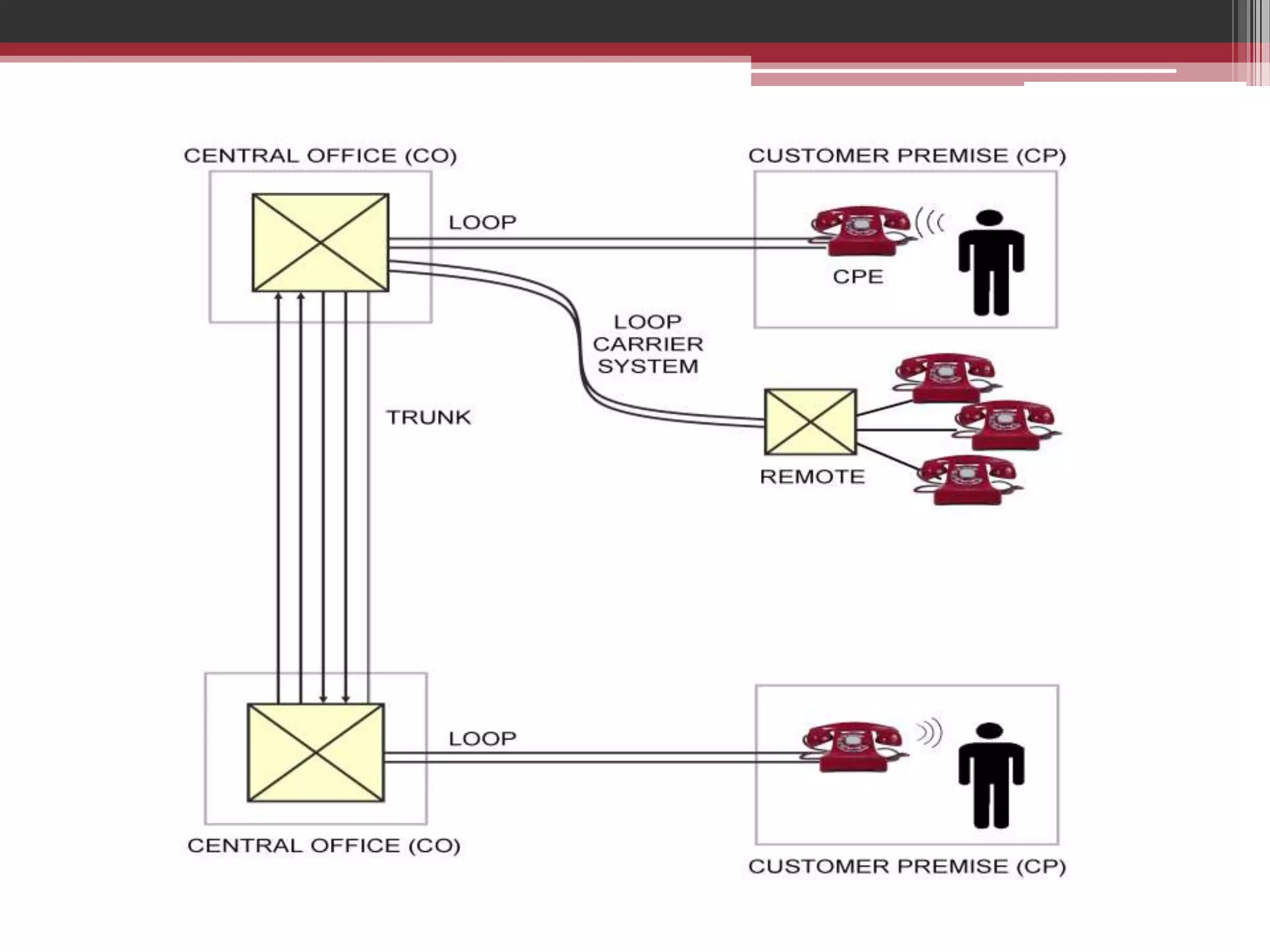
The public switched telephone network (PSTN) is the aggregate of
the world's circuit-switched telephone networks that are operated by
national, regional, or local telephony operators, providing infrastructure
and services for public telecommunication.
The PSTN consists of :•Telephone lines,
•Fiber optic cables,
•Microwave transmission links,
•Cellular networks,
•Communications satellites,
•Undersea telephone cables.
all interconnected by switching centers.
Transit
Exchange or
TAX

Local Exchange

Transit
Exchange or
TAX

Trunk
Line
Local Exchange

CPE

CPE
•A Switch transfers signals from one input port to
an appropriate output port.
•Basic function of any switch is to set up and
release connections between transmission
channels on an “as-needed” basis.
•Circuit Switching
•Message Switching
•Packet Switching
Circuit-Switched network assigns a dedicated communication path
between the two stations. It involves
Point to Point from terminal node to network
Internal Switching and multiplexing among switching nodes.
Data Transfer.
Circuit Disconnect.
Advantages
connection is established only once
Network is transparent.
Disadvantages
Connection even if no data is sent.
Delay prior to usage of connection
•It was the precursor of packet switching, where messages were
routed in their entirety, one hop at a time.
•It was first built by Collins Radio Company, Newport
Beach, California.
•Each message contains addressing information, and at each
switch this information is read and the transfer path to the next
switch is decided.
•Each message is stored before being transmitted to the next
switch. Because of this it is also known as a 'store-andforward' network.

•Email is a common application for Message Switching.
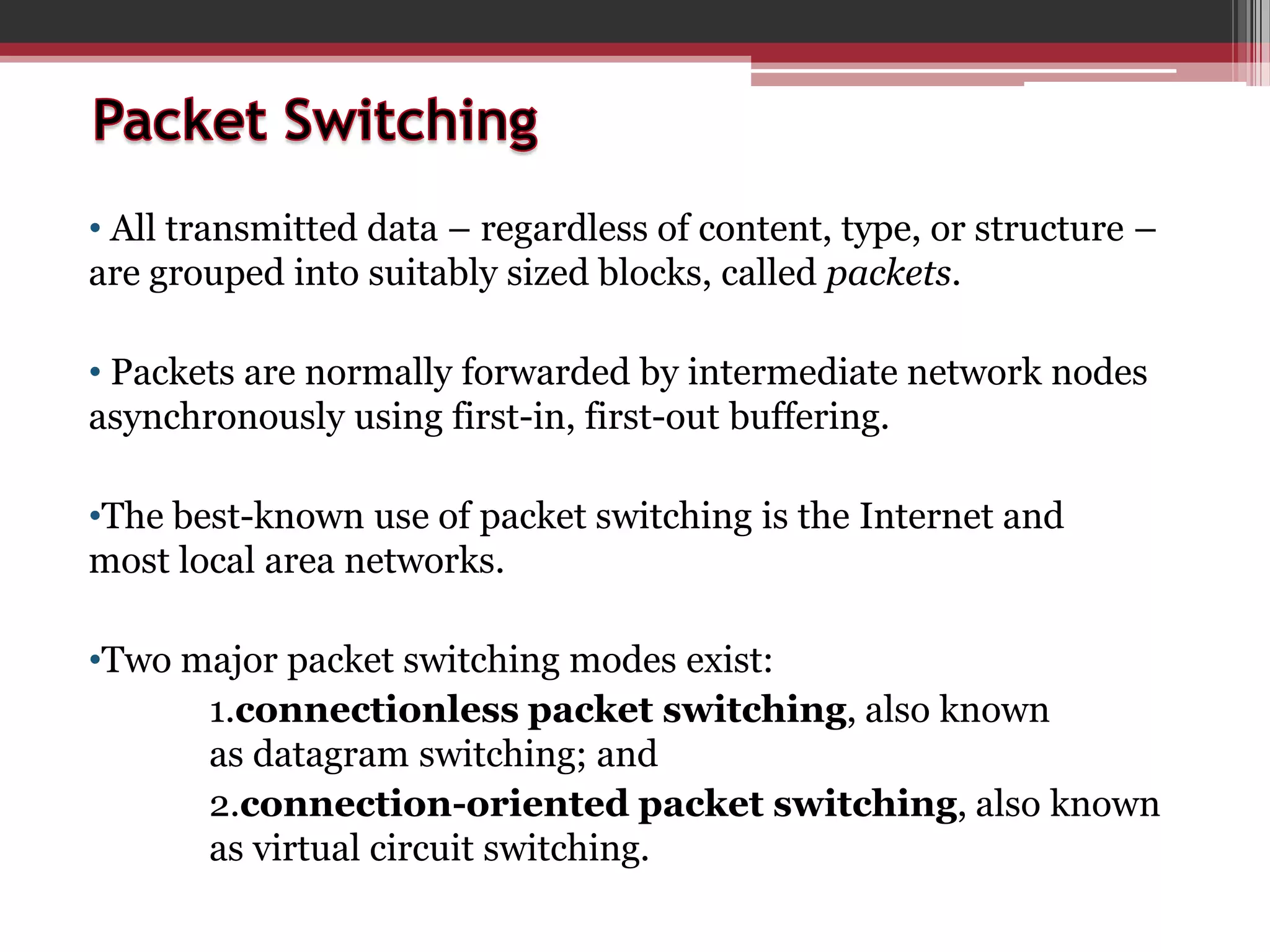
• All transmitted data – regardless of content, type, or structure –
are grouped into suitably sized blocks, called packets.
• Packets are normally forwarded by intermediate network nodes
asynchronously using first-in, first-out buffering.
•The best-known use of packet switching is the Internet and
most local area networks.

•Two major packet switching modes exist:
1.connectionless packet switching, also known
as datagram switching; and
2.connection-oriented packet switching, also known
as virtual circuit switching.
•One of the most widely installed telephone exchange systems in
the world.
•The main hardware units of an EWSD switch are as under:

Digital Line Unit (DLU)
Line/Trunk Group (LTG)

Switching Network (SN)
Coordination Processor (CP)
Common Channel Signalling Network Control Unit (CCNC)
•An optical fiber is a flexible, transparent fiber made of
high quality extruded glass (silica) or plastic, slightly
thicker than a human hair.
•It can function as a waveguide, or “light pipe”, to
transmit light between the two ends of the fiber.
•Light is kept in the core of the optical fiber through
TOTAL INTERNAL REFLECTION.
•The field of applied science and engineering concerned
with the design and application of optical fibers is known
as fiber optics.
Core:
•Glass or plastic with higher refractive
Index than cladding
•Carries the signal
Cladding:
•Glass or plastic with lower refractive
index
Buffer:
•Protects the fiber from damage or
Moisture
Jacket:
•Holds one or more fibers in a cable
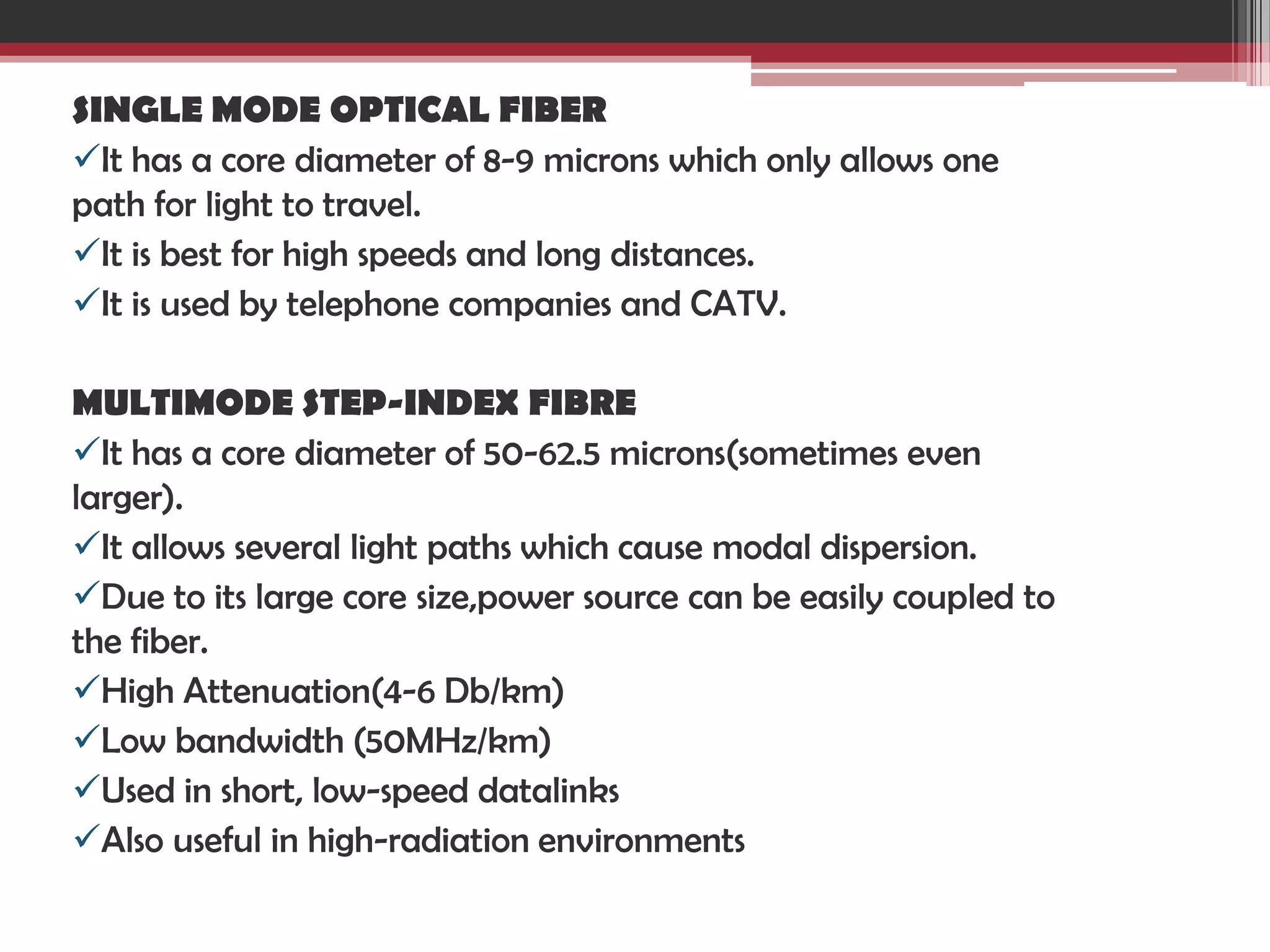
SINGLE MODE OPTICAL FIBER
It has a core diameter of 8-9 microns which only allows one
path for light to travel.
It is best for high speeds and long distances.
It is used by telephone companies and CATV.
MULTIMODE STEP-INDEX FIBRE
It has a core diameter of 50-62.5 microns(sometimes even
larger).
It allows several light paths which cause modal dispersion.
Due to its large core size,power source can be easily coupled to
the fiber.
High Attenuation(4-6 Db/km)
Low bandwidth (50MHz/km)
Used in short, low-speed datalinks
Also useful in high-radiation environments
MULTIMODE GRADED-INDEX FIBER
The index of refraction gradually changes across the core.
Modes that travel further also move faster reducing the modal
dispersion thus increasing the bandwidth
The most widely used core diameter is 62.5 /125 micron
It is useful for premises networks like LAN’s, Saecurity systems
etc
LOSSES IN FIBERS
In fibre-optic systems,losses from splices and connections are
more than in the cable itself.Losses result from:
oAxial or angular misalignment
oAir gaps between fibers
oRough surface at the end of fibers
ADVANTAGES OF OPTICAL FIBERS
Thinner
Less Expensive
Higher carrying Density
Less signal Degradation
Light Signals
Non Flammable
Light Weight
AREAS OF APPLICATION
Telecommunications
Local Area Networks(LAN)
Cable TV (CATV)
CCTV
Optical fiber sensors
•A cellular network provides cell phones or mobile stations
(MSs), to use a more general term, with wireless access to
the public switched telephone network (PSTN).
•The service coverage area of a cellular network is divided into many
smaller areas, referred to as cells, each of which
is served by a base station (BS).
•The BS is fixed, and it is connected to the mobile telephone switching
office (MTSO), also known as the mobile switching center.
•Within a cell covered by a BS, there are multiple MSs
that need to communicate with the BS.
•The methods for MSs to share the air interface in an orderly
manner are referred to as multiple access methods.
•The popular multiple access methods include
FDMA, TDMA, and CDMA.
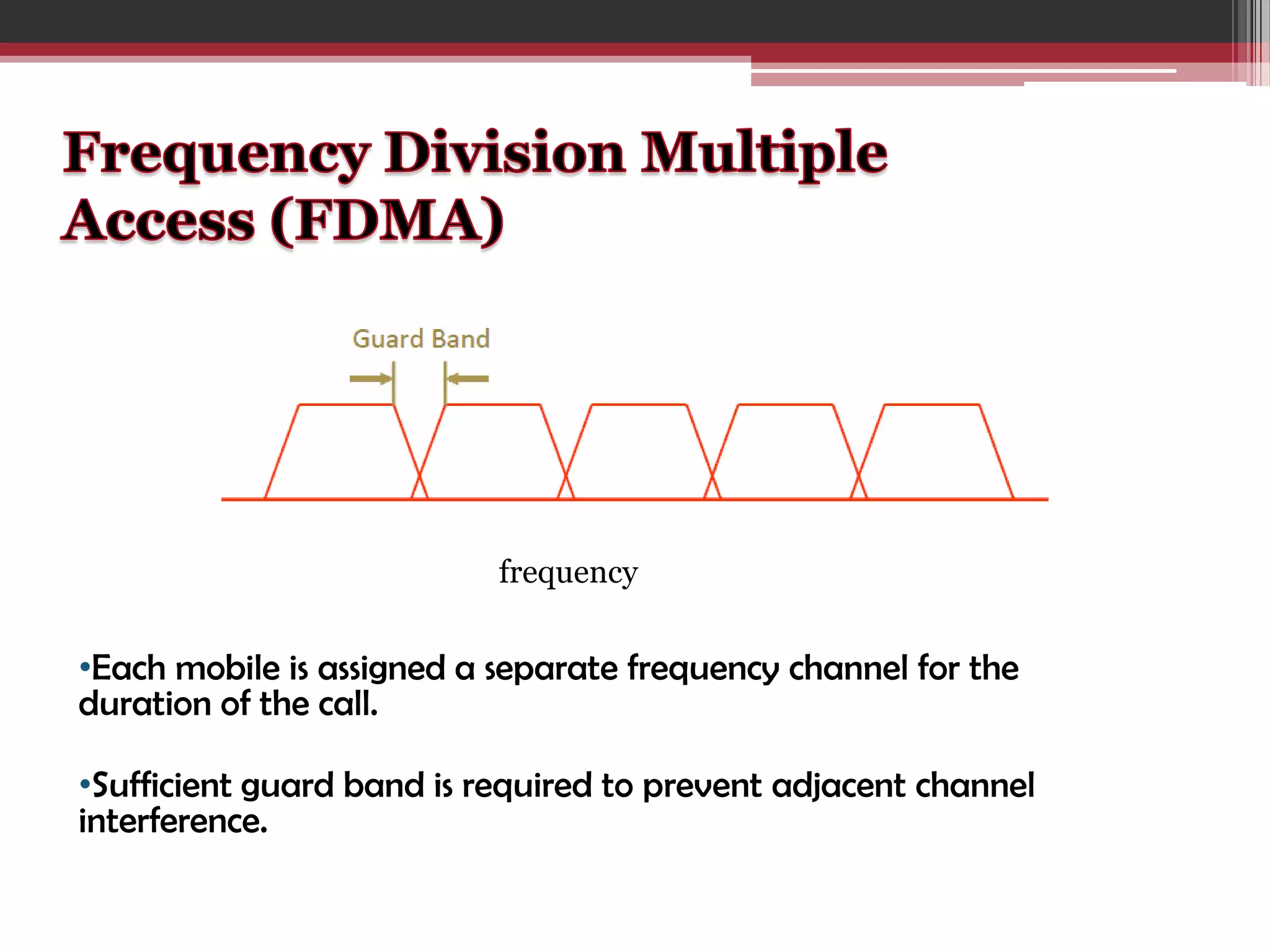
frequency

•Each mobile is assigned a separate frequency channel for the
duration of the call.

•Sufficient guard band is required to prevent adjacent channel
interference.
Guard time – signal transmitted by mobile
terminals at different locations do no arrive
at the base station at the same time

Time is divided into slots and only one mobile terminal transmits
during each slot.
•Use of orthogonal codes to separate different transmissions.
•Each symbol of bit is transmitted as a larger number of bits using the user
specific code – Spreading.
Orthogonal among users
•It is a standard set developed by the European
Telecommunications Standards Institute (ETSI) to describe
protocols for second generation (2G ) digital cellular
networks used by mobile phones.
•It became the de facto global standard for mobile
communications.
•GSM networks operate in a number of different carrier
frequency ranges (separated into GSM frequency ranges for 2G
and UMTS frequency bands for 3G), with most 2G GSM
networks operating in the 900 MHz or 1800 MHz bands.
•Wireless Technology is an alternative to Wired
Technology, which is commonly used, for connecting
devices in wireless mode.
•Wi-Fi (Wireless Fidelity) is a generic term that refers to
the IEEE 802.11 communications standard for Wireless
Local Area Networks (WLANs).
•Wi-Fi Network connect computers to each other, to
the internet and to the wired network.
•Basic concept is same as Walkie talkies.
•A Wi-Fi hotspot is created by installing an access point
to an internet connection.

•An access point acts as a base station.
•When Wi-Fi enabled device encounters a hotspot the
device can then connect to that network wirelessly.
•Home
•Small Businesses or SOHO
•Large Corporations & Campuses
•Health Care
•Wireless ISP (WISP)
•Travellers
Telecommunications

Telecommunications

  • 1.
  • 2.
    TELECOMMUNICATION is communicationat a distance by technological means, particularly through electrical signals or electromagnetic waves. Electrical and electromagnetic telecommunication technologies include telegraph, telephone, and teleprinter, network s, radio, microwave transmission, fiber optics, communications satellites and the Internet.
  • 4.
    • collection ofterminal nodes, links and any intermediate nodes. •transmission links connect the nodes together. •nodes use circuit switching, message switching or packet switching to pass the signal through the correct links and nodes to reach the correct destination terminal.
  • 5.
    •The Telelphone network •ComputerNetworks •The Internet •The Global Telex network •The Aeronautical ACARS Network
  • 7.
    A Telephone Networkis a telecommunications network used for telephone calls between two or more parties. Types of Telephone Networks: •A fixed line network or PSTN. •A wireless network 0r Cellular networks. •A private network such as a private branch exchange (PBX).
  • 8.
    The public switchedtelephone network (PSTN) is the aggregate of the world's circuit-switched telephone networks that are operated by national, regional, or local telephony operators, providing infrastructure and services for public telecommunication. The PSTN consists of :•Telephone lines, •Fiber optic cables, •Microwave transmission links, •Cellular networks, •Communications satellites, •Undersea telephone cables. all interconnected by switching centers.
  • 10.
    Transit Exchange or TAX Local Exchange Transit Exchangeor TAX Trunk Line Local Exchange CPE CPE
  • 12.
    •A Switch transferssignals from one input port to an appropriate output port. •Basic function of any switch is to set up and release connections between transmission channels on an “as-needed” basis.
  • 13.
  • 14.
    Circuit-Switched network assignsa dedicated communication path between the two stations. It involves Point to Point from terminal node to network Internal Switching and multiplexing among switching nodes. Data Transfer. Circuit Disconnect. Advantages connection is established only once Network is transparent. Disadvantages Connection even if no data is sent. Delay prior to usage of connection
  • 15.
    •It was theprecursor of packet switching, where messages were routed in their entirety, one hop at a time. •It was first built by Collins Radio Company, Newport Beach, California. •Each message contains addressing information, and at each switch this information is read and the transfer path to the next switch is decided. •Each message is stored before being transmitted to the next switch. Because of this it is also known as a 'store-andforward' network. •Email is a common application for Message Switching.
  • 16.
    • All transmitteddata – regardless of content, type, or structure – are grouped into suitably sized blocks, called packets. • Packets are normally forwarded by intermediate network nodes asynchronously using first-in, first-out buffering. •The best-known use of packet switching is the Internet and most local area networks. •Two major packet switching modes exist: 1.connectionless packet switching, also known as datagram switching; and 2.connection-oriented packet switching, also known as virtual circuit switching.
  • 18.
    •One of themost widely installed telephone exchange systems in the world. •The main hardware units of an EWSD switch are as under: Digital Line Unit (DLU) Line/Trunk Group (LTG) Switching Network (SN) Coordination Processor (CP) Common Channel Signalling Network Control Unit (CCNC)
  • 22.
    •An optical fiberis a flexible, transparent fiber made of high quality extruded glass (silica) or plastic, slightly thicker than a human hair. •It can function as a waveguide, or “light pipe”, to transmit light between the two ends of the fiber. •Light is kept in the core of the optical fiber through TOTAL INTERNAL REFLECTION. •The field of applied science and engineering concerned with the design and application of optical fibers is known as fiber optics.
  • 23.
    Core: •Glass or plasticwith higher refractive Index than cladding •Carries the signal Cladding: •Glass or plastic with lower refractive index Buffer: •Protects the fiber from damage or Moisture Jacket: •Holds one or more fibers in a cable
  • 25.
    SINGLE MODE OPTICALFIBER It has a core diameter of 8-9 microns which only allows one path for light to travel. It is best for high speeds and long distances. It is used by telephone companies and CATV. MULTIMODE STEP-INDEX FIBRE It has a core diameter of 50-62.5 microns(sometimes even larger). It allows several light paths which cause modal dispersion. Due to its large core size,power source can be easily coupled to the fiber. High Attenuation(4-6 Db/km) Low bandwidth (50MHz/km) Used in short, low-speed datalinks Also useful in high-radiation environments
  • 26.
    MULTIMODE GRADED-INDEX FIBER Theindex of refraction gradually changes across the core. Modes that travel further also move faster reducing the modal dispersion thus increasing the bandwidth The most widely used core diameter is 62.5 /125 micron It is useful for premises networks like LAN’s, Saecurity systems etc LOSSES IN FIBERS In fibre-optic systems,losses from splices and connections are more than in the cable itself.Losses result from: oAxial or angular misalignment oAir gaps between fibers oRough surface at the end of fibers
  • 27.
    ADVANTAGES OF OPTICALFIBERS Thinner Less Expensive Higher carrying Density Less signal Degradation Light Signals Non Flammable Light Weight AREAS OF APPLICATION Telecommunications Local Area Networks(LAN) Cable TV (CATV) CCTV Optical fiber sensors
  • 29.
    •A cellular networkprovides cell phones or mobile stations (MSs), to use a more general term, with wireless access to the public switched telephone network (PSTN). •The service coverage area of a cellular network is divided into many smaller areas, referred to as cells, each of which is served by a base station (BS). •The BS is fixed, and it is connected to the mobile telephone switching office (MTSO), also known as the mobile switching center.
  • 30.
    •Within a cellcovered by a BS, there are multiple MSs that need to communicate with the BS. •The methods for MSs to share the air interface in an orderly manner are referred to as multiple access methods. •The popular multiple access methods include FDMA, TDMA, and CDMA.
  • 31.
    frequency •Each mobile isassigned a separate frequency channel for the duration of the call. •Sufficient guard band is required to prevent adjacent channel interference.
  • 32.
    Guard time –signal transmitted by mobile terminals at different locations do no arrive at the base station at the same time Time is divided into slots and only one mobile terminal transmits during each slot.
  • 33.
    •Use of orthogonalcodes to separate different transmissions. •Each symbol of bit is transmitted as a larger number of bits using the user specific code – Spreading. Orthogonal among users
  • 36.
    •It is astandard set developed by the European Telecommunications Standards Institute (ETSI) to describe protocols for second generation (2G ) digital cellular networks used by mobile phones. •It became the de facto global standard for mobile communications. •GSM networks operate in a number of different carrier frequency ranges (separated into GSM frequency ranges for 2G and UMTS frequency bands for 3G), with most 2G GSM networks operating in the 900 MHz or 1800 MHz bands.
  • 39.
    •Wireless Technology isan alternative to Wired Technology, which is commonly used, for connecting devices in wireless mode. •Wi-Fi (Wireless Fidelity) is a generic term that refers to the IEEE 802.11 communications standard for Wireless Local Area Networks (WLANs). •Wi-Fi Network connect computers to each other, to the internet and to the wired network.
  • 40.
    •Basic concept issame as Walkie talkies. •A Wi-Fi hotspot is created by installing an access point to an internet connection. •An access point acts as a base station. •When Wi-Fi enabled device encounters a hotspot the device can then connect to that network wirelessly.
  • 41.
    •Home •Small Businesses orSOHO •Large Corporations & Campuses •Health Care •Wireless ISP (WISP) •Travellers