TOPIC
STUDY OF THERMOELECTRIC EFFECT ON MAGNETIC
NANOSTRUCTURE
S U B M I T T E D T O :
M R . A D I T I Y A M I S H R A
A S S T . P R O F .
D E P A R T M E N T O F M E C H A N I C A L E N G I N E E R I N G
C A R E E R P O I N T U N I V E R S I T Y K O T A
S U B M I T T E D B Y :
S H I V A M
U I D - K 1 1 9 1 5
V I T H S E M / I I I N D Y E A R
D E P T . O F M E C H A N I C A L E N G I N E E R I N G
CAREER POINT UNIVERSITY
CONTENT
 Introduction
 Thermoelectric effect
 Magnetic nanostructure
 Importance of nano-crystalline alloys
 Applications
 Advantages
 Conclusions
Introduction
• Later, in 1834, french scientist, peltier and in 1851,
Thomson (later lord kelvin) described the
thermal effects on conductors
• The pioneer in thermoelectric was a German scientist
Thomas Johann see beck (1770-1831)
• Thermoelectricity refers to a class of phenomena in
which a temperature difference creates an
electric potential or an electric potential
creates a temperature difference.
WHAT IS THERMOELECTRIC EFFECT
 The thermoelectric effect is the direct conversion of
temperature differences to electric voltage and vice versa.
 A thermoelectric device creates voltage when there is a
different temperature on each side. Conversely, when a voltage
is applied to it, it creates a temperature difference. At the atomic
scale, an applied temperature gradient causes charge carriers in
the material to diffuse from the hot side to the cold side.
 This effect can be used to generate electricity, measure
temperature or change the temperature of objects. Because the
direction of heating and cooling is determined by the polarity of
the applied voltage, thermoelectric devices can be used as
temperature controllers.
WHAT IS MAGNETIC NANOSTRUCTURE
 A nanostructure is a structure of intermediate size between microscopic
and molecular structures. Nanostructural detail is microstructure at
nanoscale. In describing nanostructures it is necessary to differentiate
between the number of dimensions on the nanoscale.
 Nanotextured surfaces have one dimension on the nanoscale, i.e., only
the thickness of the surface of an object is between 0.1 and 100 nm.
Nanotubes have two dimensions on the nanoscale, i.e., the diameter of
the tube is between 0.1 and 100 nm; its length could be much greater.
 Finally, spherical nanoparticles have three dimensions on the nanoscale,
i.e., the particle is between 0.1 and 100 nm in each spatial dimension.
The terms nanoparticles and ultrafine particles often are used
synonymously although UFP can reach into the micrometre range.
 The term 'nanostructure' is often used when referring to magnetic
technology.
Thermoelectric Phenomena
Electrically conductive materials exhibit
three types of
thermoelectric phenomena:
 the Seebeck effect,
 the Peltier effect, and
 the Thomson effect.
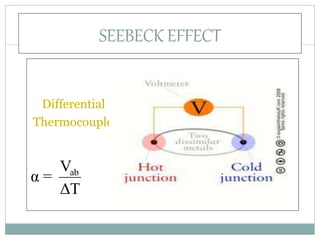
SEEBECK EFFECT
Differential
Thermocouple
abV
α =
ΔT
SEEBECK EFFECT
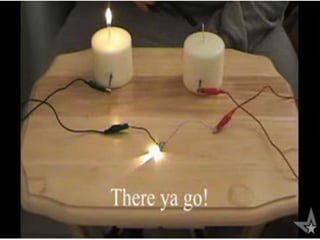
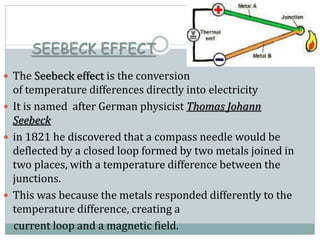
 The Seebeck effect is the conversion
of temperature differences directly into electricity
 It is named after German physicist Thomas Johann
Seebeck
 in 1821 he discovered that a compass needle would be
deflected by a closed loop formed by two metals joined in
two places, with a temperature difference between the
junctions.
 This was because the metals responded differently to the
temperature difference, creating a
current loop and a magnetic field.
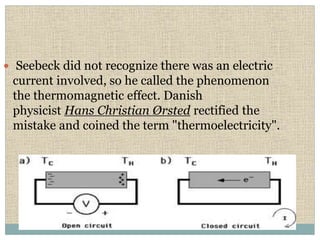
 Seebeck did not recognize there was an electric
current involved, so he called the phenomenon
the thermomagnetic effect. Danish
physicist Hans Christian Ørsted rectified the
mistake and coined the term "thermoelectricity".
Cause of seebeck effect
 As we know that no of free electrons per unit volume
and their average velocity varies from one metal to
another .
 At the junction of two dissimilar metals, electrons
migrate in one direction across the junction.
 It sets up an opposing electric field .
 As a result a fixed potential difference is developed .
 This effect is called Seebeck effect.
 The combination of two metals in such a manner is
called thermocouple
 The e.m.f generated in a thermocouple is known as
thermo e.m.f
 The current which flows along the closed circuit is
called thermo electric current
Cause (Contd.)
 Since a migration of charges creates an electric
potential, the buildup of charged carriers onto the
cold side eventually ceases at some maximum
value since the electric field is at equilibrium.
 An increase in the temperature difference resumes
a buildup of charge carriers on the cold side,
leading to an increase in the thermoelectric
voltage, and vice versa.
 The voltage created by this effect is on the order of
several micro volts per Kelvin difference.
 One such combination, copper-constantan, has a
Seebeck coefficient of 41 microvolt per Kelvin at
room temperature.
 S is positive when the direction of electric current is
same as the direction of thermal current
Thermoelectric series
 For a given temperature range, the thermo e.m.f induced
is different for different metal combinations.
 Seebeck arranged 35 metals in a series in such away
when any two form a thermocouple:-
 Current will flow through the cold junction from the one
that occurs first in series to the other that occurs later in
series
 Between 0oC & 1000C the thermoelectric series is:
Antimony, Fe, Cd, Zn, Ag, Au,
Rb,Mo,Cr,Sn,Pb,Hg,Mn,Cu,Pt,Cob,
Ni, Bismuth.
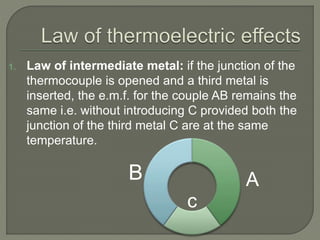
1. Law of intermediate metal: if the junction of the
thermocouple is opened and a third metal is
inserted, the e.m.f. for the couple AB remains the
same i.e. without introducing C provided both the
junction of the third metal C are at the same
temperature.
AB
c
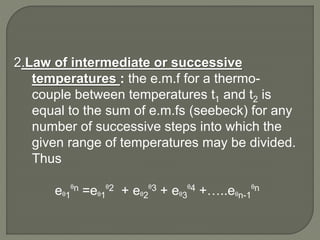
2.Law of intermediate or successive
temperatures : the e.m.f for a thermo-
couple between temperatures t1 and t2 is
equal to the sum of e.m.fs (seebeck) for any
number of successive steps into which the
given range of temperatures may be divided.
Thus
eᶿ1
ᶿn =eᶿ1
ᶿ2 + eᶿ2
ᶿ3 + eᶿ3
ᶿ4 +…..eᶿn-1
ᶿn
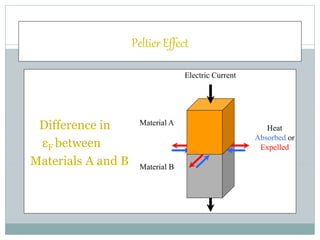
Peltier Effect
Difference in
εF between
Materials A and B
Material A
Material B
Heat
Absorbed or
Expelled
Electric Current
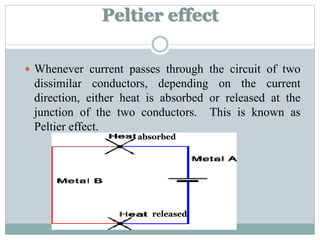
 Whenever current passes through the circuit of two
dissimilar conductors, depending on the current
direction, either heat is absorbed or released at the
junction of the two conductors. This is known as
Peltier effect.
Peltier effect
released
absorbed
 The rate of evolution of or absorption of heat is
proportional to the current &thus the peltier effect is
reversible.
 If direction of current is changed then the peltier effect
is also reversed.
 The energy absorbed or evolved at one of the junctions
of the two dissimilar metals when one ampere of current
flows for one second is called Peltier coefficient ,denoted
by ∏
Applications
Seebeck effect
 The Seebeck effect is used in the thermoelectric generator,
which functions like a heat engine
 These have a use in power plants for converting waste
heat into additional power (a form of energy recycling).
 in automobiles as automotive thermoelectric
generators (ATGs) for increasing fuel efficiency.
 Space probes often use radioisotope thermoelectric
generators with the same mechanism but using
radioisotopes to generate the required heat difference.
Peltier effect
 The Peltier effect can be used to
create a refrigerator which is
compact and has no circulating
fluid or moving parts
 such refrigerators are useful in
applications where their
advantages out weigh the
disadvantage of their very low
efficiency.
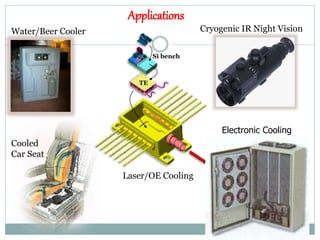
Applications
23
Water/Beer Cooler
Cooled
Car Seat
Electronic Cooling
Cryogenic IR Night Vision
Laser/OE Cooling
TE
Si bench
THANK
YOU

K11915shivam

  • 1.
    TOPIC STUDY OF THERMOELECTRICEFFECT ON MAGNETIC NANOSTRUCTURE S U B M I T T E D T O : M R . A D I T I Y A M I S H R A A S S T . P R O F . D E P A R T M E N T O F M E C H A N I C A L E N G I N E E R I N G C A R E E R P O I N T U N I V E R S I T Y K O T A S U B M I T T E D B Y : S H I V A M U I D - K 1 1 9 1 5 V I T H S E M / I I I N D Y E A R D E P T . O F M E C H A N I C A L E N G I N E E R I N G CAREER POINT UNIVERSITY
  • 2.
    CONTENT  Introduction  Thermoelectriceffect  Magnetic nanostructure  Importance of nano-crystalline alloys  Applications  Advantages  Conclusions
  • 3.
    Introduction • Later, in1834, french scientist, peltier and in 1851, Thomson (later lord kelvin) described the thermal effects on conductors • The pioneer in thermoelectric was a German scientist Thomas Johann see beck (1770-1831) • Thermoelectricity refers to a class of phenomena in which a temperature difference creates an electric potential or an electric potential creates a temperature difference.
  • 4.
    WHAT IS THERMOELECTRICEFFECT  The thermoelectric effect is the direct conversion of temperature differences to electric voltage and vice versa.  A thermoelectric device creates voltage when there is a different temperature on each side. Conversely, when a voltage is applied to it, it creates a temperature difference. At the atomic scale, an applied temperature gradient causes charge carriers in the material to diffuse from the hot side to the cold side.  This effect can be used to generate electricity, measure temperature or change the temperature of objects. Because the direction of heating and cooling is determined by the polarity of the applied voltage, thermoelectric devices can be used as temperature controllers.
  • 5.
    WHAT IS MAGNETICNANOSTRUCTURE  A nanostructure is a structure of intermediate size between microscopic and molecular structures. Nanostructural detail is microstructure at nanoscale. In describing nanostructures it is necessary to differentiate between the number of dimensions on the nanoscale.  Nanotextured surfaces have one dimension on the nanoscale, i.e., only the thickness of the surface of an object is between 0.1 and 100 nm. Nanotubes have two dimensions on the nanoscale, i.e., the diameter of the tube is between 0.1 and 100 nm; its length could be much greater.  Finally, spherical nanoparticles have three dimensions on the nanoscale, i.e., the particle is between 0.1 and 100 nm in each spatial dimension. The terms nanoparticles and ultrafine particles often are used synonymously although UFP can reach into the micrometre range.  The term 'nanostructure' is often used when referring to magnetic technology.
  • 6.
    Thermoelectric Phenomena Electrically conductivematerials exhibit three types of thermoelectric phenomena:  the Seebeck effect,  the Peltier effect, and  the Thomson effect.
  • 8.
  • 9.
    SEEBECK EFFECT  TheSeebeck effect is the conversion of temperature differences directly into electricity  It is named after German physicist Thomas Johann Seebeck  in 1821 he discovered that a compass needle would be deflected by a closed loop formed by two metals joined in two places, with a temperature difference between the junctions.  This was because the metals responded differently to the temperature difference, creating a current loop and a magnetic field.
  • 10.
     Seebeck didnot recognize there was an electric current involved, so he called the phenomenon the thermomagnetic effect. Danish physicist Hans Christian Ørsted rectified the mistake and coined the term "thermoelectricity".
  • 11.
    Cause of seebeckeffect  As we know that no of free electrons per unit volume and their average velocity varies from one metal to another .  At the junction of two dissimilar metals, electrons migrate in one direction across the junction.  It sets up an opposing electric field .  As a result a fixed potential difference is developed .
  • 12.
     This effectis called Seebeck effect.  The combination of two metals in such a manner is called thermocouple  The e.m.f generated in a thermocouple is known as thermo e.m.f  The current which flows along the closed circuit is called thermo electric current
  • 13.
    Cause (Contd.)  Sincea migration of charges creates an electric potential, the buildup of charged carriers onto the cold side eventually ceases at some maximum value since the electric field is at equilibrium.  An increase in the temperature difference resumes a buildup of charge carriers on the cold side, leading to an increase in the thermoelectric voltage, and vice versa.
  • 14.
     The voltagecreated by this effect is on the order of several micro volts per Kelvin difference.  One such combination, copper-constantan, has a Seebeck coefficient of 41 microvolt per Kelvin at room temperature.  S is positive when the direction of electric current is same as the direction of thermal current
  • 15.
    Thermoelectric series  Fora given temperature range, the thermo e.m.f induced is different for different metal combinations.  Seebeck arranged 35 metals in a series in such away when any two form a thermocouple:-  Current will flow through the cold junction from the one that occurs first in series to the other that occurs later in series  Between 0oC & 1000C the thermoelectric series is: Antimony, Fe, Cd, Zn, Ag, Au, Rb,Mo,Cr,Sn,Pb,Hg,Mn,Cu,Pt,Cob, Ni, Bismuth.
  • 16.
    1. Law ofintermediate metal: if the junction of the thermocouple is opened and a third metal is inserted, the e.m.f. for the couple AB remains the same i.e. without introducing C provided both the junction of the third metal C are at the same temperature. AB c
  • 17.
    2.Law of intermediateor successive temperatures : the e.m.f for a thermo- couple between temperatures t1 and t2 is equal to the sum of e.m.fs (seebeck) for any number of successive steps into which the given range of temperatures may be divided. Thus eᶿ1 ᶿn =eᶿ1 ᶿ2 + eᶿ2 ᶿ3 + eᶿ3 ᶿ4 +…..eᶿn-1 ᶿn
  • 18.
    Peltier Effect Difference in εFbetween Materials A and B Material A Material B Heat Absorbed or Expelled Electric Current
  • 19.
     Whenever currentpasses through the circuit of two dissimilar conductors, depending on the current direction, either heat is absorbed or released at the junction of the two conductors. This is known as Peltier effect. Peltier effect released absorbed
  • 20.
     The rateof evolution of or absorption of heat is proportional to the current &thus the peltier effect is reversible.  If direction of current is changed then the peltier effect is also reversed.  The energy absorbed or evolved at one of the junctions of the two dissimilar metals when one ampere of current flows for one second is called Peltier coefficient ,denoted by ∏
  • 21.
    Applications Seebeck effect  TheSeebeck effect is used in the thermoelectric generator, which functions like a heat engine  These have a use in power plants for converting waste heat into additional power (a form of energy recycling).  in automobiles as automotive thermoelectric generators (ATGs) for increasing fuel efficiency.  Space probes often use radioisotope thermoelectric generators with the same mechanism but using radioisotopes to generate the required heat difference.
  • 22.
    Peltier effect  ThePeltier effect can be used to create a refrigerator which is compact and has no circulating fluid or moving parts  such refrigerators are useful in applications where their advantages out weigh the disadvantage of their very low efficiency.
  • 23.
    Applications 23 Water/Beer Cooler Cooled Car Seat ElectronicCooling Cryogenic IR Night Vision Laser/OE Cooling TE Si bench
  • 24.