
Relational database
Relational Model
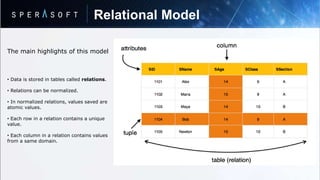
The main highlights of this model
• Data is stored in tables called relations.
• Relations can be normalized.
• In normalized relations, values saved are
atomic values.
• Each row in a relation contains a unique
value.
• Each column in a relation contains values
from a same domain.
Concepts
Concepts
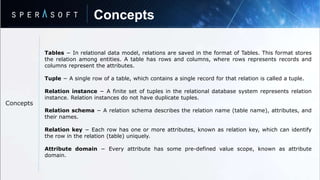
Tables − In relational data model, relations are saved in the format of Tables. This format stores
the relation among entities. A table has rows and columns, where rows represents records and
columns represent the attributes.
Tuple − A single row of a table, which contains a single record for that relation is called a tuple.
Relation instance − A finite set of tuples in the relational database system represents relation
instance. Relation instances do not have duplicate tuples.
Relation schema − A relation schema describes the relation name (table name), attributes, and
their names.
Relation key − Each row has one or more attributes, known as relation key, which can identify
the row in the relation (table) uniquely.
Attribute domain − Every attribute has some pre-defined value scope, known as attribute
domain.
Normalization
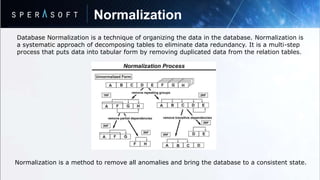
Database Normalization is a technique of organizing the data in the database. Normalization is
a systematic approach of decomposing tables to eliminate data redundancy. It is a multi-step
process that puts data into tabular form by removing duplicated data from the relation tables.
Normalization is a method to remove all anomalies and bring the database to a consistent state.
First Normal Form
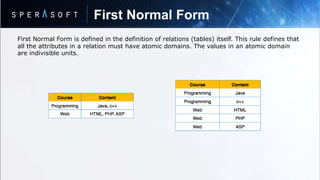
First Normal Form is defined in the definition of relations (tables) itself. This rule defines that
all the attributes in a relation must have atomic domains. The values in an atomic domain
are indivisible units.
Second Normal Form
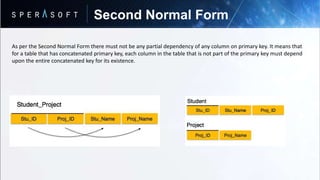
As per the Second Normal Form there must not be any partial dependency of any column on primary key. It means that
for a table that has concatenated primary key, each column in the table that is not part of the primary key must depend
upon the entire concatenated key for its existence.
Third Normal Form
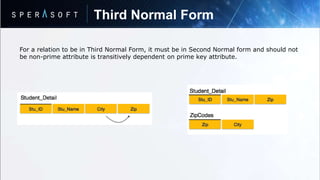
For a relation to be in Third Normal Form, it must be in Second Normal form and should not
be non-prime attribute is transitively dependent on prime key attribute.
SQL Overview
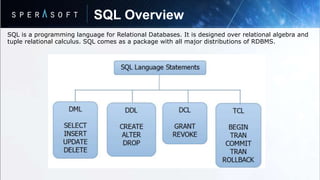
SQL is a programming language for Relational Databases. It is designed over relational algebra and
tuple relational calculus. SQL comes as a package with all major distributions of RDBMS.
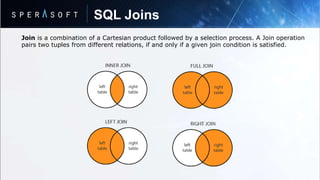
SQL Joins
Join is a combination of a Cartesian product followed by a selection process. A Join operation
pairs two tuples from different relations, if and only if a given join condition is satisfied.
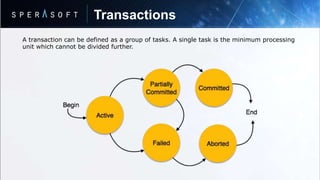
Transactions
A transaction can be defined as a group of tasks. A single task is the minimum processing
unit which cannot be divided further.
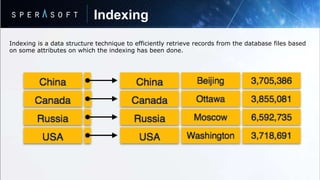
Indexing
Indexing is a data structure technique to efficiently retrieve records from the database files based
on some attributes on which the indexing has been done.
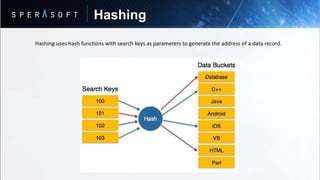
Hashing
Hashing uses hash functions with search keys as parameters to generate the address of a data record.
www.sperasoft.com
www.facebook.com/Sperasoft
www.twitter.com/Sperasoft

The theory of relational databases

  • 1.
  • 2.
    Relational Model The mainhighlights of this model • Data is stored in tables called relations. • Relations can be normalized. • In normalized relations, values saved are atomic values. • Each row in a relation contains a unique value. • Each column in a relation contains values from a same domain.
  • 3.
    Concepts Concepts Tables − Inrelational data model, relations are saved in the format of Tables. This format stores the relation among entities. A table has rows and columns, where rows represents records and columns represent the attributes. Tuple − A single row of a table, which contains a single record for that relation is called a tuple. Relation instance − A finite set of tuples in the relational database system represents relation instance. Relation instances do not have duplicate tuples. Relation schema − A relation schema describes the relation name (table name), attributes, and their names. Relation key − Each row has one or more attributes, known as relation key, which can identify the row in the relation (table) uniquely. Attribute domain − Every attribute has some pre-defined value scope, known as attribute domain.
  • 4.
    Normalization Database Normalization isa technique of organizing the data in the database. Normalization is a systematic approach of decomposing tables to eliminate data redundancy. It is a multi-step process that puts data into tabular form by removing duplicated data from the relation tables. Normalization is a method to remove all anomalies and bring the database to a consistent state.
  • 5.
    First Normal Form FirstNormal Form is defined in the definition of relations (tables) itself. This rule defines that all the attributes in a relation must have atomic domains. The values in an atomic domain are indivisible units.
  • 6.
    Second Normal Form Asper the Second Normal Form there must not be any partial dependency of any column on primary key. It means that for a table that has concatenated primary key, each column in the table that is not part of the primary key must depend upon the entire concatenated key for its existence.
  • 7.
    Third Normal Form Fora relation to be in Third Normal Form, it must be in Second Normal form and should not be non-prime attribute is transitively dependent on prime key attribute.
  • 8.
    SQL Overview SQL isa programming language for Relational Databases. It is designed over relational algebra and tuple relational calculus. SQL comes as a package with all major distributions of RDBMS.
  • 9.
    SQL Joins Join isa combination of a Cartesian product followed by a selection process. A Join operation pairs two tuples from different relations, if and only if a given join condition is satisfied.
  • 10.
    Transactions A transaction canbe defined as a group of tasks. A single task is the minimum processing unit which cannot be divided further.
  • 11.
    Indexing Indexing is adata structure technique to efficiently retrieve records from the database files based on some attributes on which the indexing has been done.
  • 12.
    Hashing Hashing uses hashfunctions with search keys as parameters to generate the address of a data record.
  • 13.

Editor's Notes

  • #3 “Sperasoft: Everything Games” needs to look more punchy Replace core values with facts about executive team (without names, just years of experience, companies worked, titles worked) Add more exciting facts about company (under about us)
  • #4 Remove the names of execs, remove companies worked before and exec fact). Increase the map size and personalize it with photos of studios of photos of people (team)
  • #5 Remove the names of execs, remove companies worked before and exec fact). Increase the map size and personalize it with photos of studios of photos of people (team)
  • #6 Remove the names of execs, remove companies worked before and exec fact). Increase the map size and personalize it with photos of studios of photos of people (team)
  • #7 Remove the names of execs, remove companies worked before and exec fact). Increase the map size and personalize it with photos of studios of photos of people (team)
  • #8 Remove the names of execs, remove companies worked before and exec fact). Increase the map size and personalize it with photos of studios of photos of people (team)
  • #9 Remove the names of execs, remove companies worked before and exec fact). Increase the map size and personalize it with photos of studios of photos of people (team)
  • #10 Remove the names of execs, remove companies worked before and exec fact). Increase the map size and personalize it with photos of studios of photos of people (team)
  • #11 Remove the names of execs, remove companies worked before and exec fact). Increase the map size and personalize it with photos of studios of photos of people (team)
  • #12 Remove the names of execs, remove companies worked before and exec fact). Increase the map size and personalize it with photos of studios of photos of people (team)
  • #13 Remove the names of execs, remove companies worked before and exec fact). Increase the map size and personalize it with photos of studios of photos of people (team)