Chapter 5
The Relational Data Model and
Relational Database Constraints
Copyright © 2004 Pearson Education, Inc.
Copyright © 2004 Ramez Elmasri and Shamkant Navathe
Elmasri/Navathe, Fundamentals of Database Systems, Fourth Edition Chapter 5-3
Chapter Outline
 Relational Model Concepts
 Relational Model Constraints and Relational Database
Schemas
 Update Operations and Dealing with Constraint
Violations
Copyright © 2004 Ramez Elmasri and Shamkant Navathe
Elmasri/Navathe, Fundamentals of Database Systems, Fourth Edition Chapter 5-4
Relational Model Concepts
 The relational Model of Data is based on the
concept of a Relation.
 A Relation is a mathematical concept based on the
ideas of sets.
 The strength of the relational approach to data
management comes from the formal foundation
provided by the theory of relations.
 We review the essentials of the relational approach
in this chapter.
Copyright © 2004 Ramez Elmasri and Shamkant Navathe
Elmasri/Navathe, Fundamentals of Database Systems, Fourth Edition Chapter 5-5
Relational Model Concepts
 The model was first proposed by Dr. E.F. Codd of
IBM in 1970 in the following paper:
"A Relational Model for Large Shared Data
Banks," Communications of the ACM, June 1970.
The above paper caused a major revolution in the field of
Database management and earned Ted Codd the coveted
ACM Turing Award.
Copyright © 2004 Ramez Elmasri and Shamkant Navathe
Elmasri/Navathe, Fundamentals of Database Systems, Fourth Edition Chapter 5-6
INFORMAL DEFINITIONS
 RELATION: A table of values
– A relation may be thought of as a set of rows.
– A relation may alternately be though of as a set of columns.
– Each row represents a fact that corresponds to a real-world entity or
relationship.
– Each row has a value of an item or set of items that uniquely identifies
that row in the table.
– Sometimes row-ids or sequential numbers are assigned to identify the
rows in the table.
– Each column typically is called by its column name or column header
or attribute name.
Copyright © 2004 Ramez Elmasri and Shamkant Navathe
Elmasri/Navathe, Fundamentals of Database Systems, Fourth Edition Chapter 5-7
FORMAL DEFINITIONS
 A Relation may be defined in multiple ways.
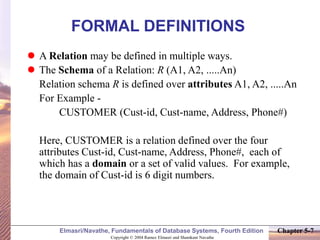
 The Schema of a Relation: R (A1, A2, .....An)
Relation schema R is defined over attributes A1, A2, .....An
For Example -
CUSTOMER (Cust-id, Cust-name, Address, Phone#)
Here, CUSTOMER is a relation defined over the four
attributes Cust-id, Cust-name, Address, Phone#, each of
which has a domain or a set of valid values. For example,
the domain of Cust-id is 6 digit numbers.
Copyright © 2004 Ramez Elmasri and Shamkant Navathe
Elmasri/Navathe, Fundamentals of Database Systems, Fourth Edition Chapter 5-8
FORMAL DEFINITIONS
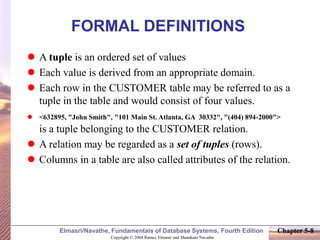
 A tuple is an ordered set of values
 Each value is derived from an appropriate domain.
 Each row in the CUSTOMER table may be referred to as a
tuple in the table and would consist of four values.
 <632895, "John Smith", "101 Main St. Atlanta, GA 30332", "(404) 894-2000">
is a tuple belonging to the CUSTOMER relation.
 A relation may be regarded as a set of tuples (rows).
 Columns in a table are also called attributes of the relation.
Copyright © 2004 Ramez Elmasri and Shamkant Navathe
Elmasri/Navathe, Fundamentals of Database Systems, Fourth Edition Chapter 5-9
FORMAL DEFINITIONS
 A domain has a logical definition: e.g.,
“USA_phone_numbers” are the set of 10 digit phone
numbers valid in the U.S.
 A domain may have a data-type or a format defined for it.
The USA_phone_numbers may have a format: (ddd)-ddd-
dddd where each d is a decimal digit. E.g., Dates have various
formats such as monthname, date, year or yyyy-mm-dd, or dd
mm,yyyy etc.
 An attribute designates the role played by the domain. E.g.,
the domain Date may be used to define attributes “Invoice-
date” and “Payment-date”.
Copyright © 2004 Ramez Elmasri and Shamkant Navathe
Elmasri/Navathe, Fundamentals of Database Systems, Fourth Edition Chapter 5-10
FORMAL DEFINITIONS
 The relation is formed over the cartesian product of the sets;
each set has values from a domain; that domain is used in a
specific role which is conveyed by the attribute name.
 For example, attribute Cust-name is defined over the domain
of strings of 25 characters. The role these strings play in the
CUSTOMER relation is that of the name of customers.
 Formally,
Given R(A1, A2, .........., An)
r(R)  dom (A1) X dom (A2) X ....X dom(An)
 R: schema of the relation
 r of R: a specific "value" or population of R.
 R is also called the intension of a relation
 r is also called the extension of a relation
Copyright © 2004 Ramez Elmasri and Shamkant Navathe
Elmasri/Navathe, Fundamentals of Database Systems, Fourth Edition Chapter 5-11
FORMAL DEFINITIONS
 Let S1 = {0,1}
 Let S2 = {a,b,c}
 Let R  S1 X S2
 Then for example: r(R) = {<0,a> , <0,b> , <1,c> }
is one possible “state” or “population” or
“extension” r of the relation R, defined over domains
S1 and S2. It has three tuples.
Copyright © 2004 Ramez Elmasri and Shamkant Navathe
Elmasri/Navathe, Fundamentals of Database Systems, Fourth Edition Chapter 5-12
DEFINITION SUMMARY
Informal Terms Formal Terms
Table Relation
Column Attribute/Domain
Row Tuple
Values in a column Domain
Table Definition Schema of a Relation
Populated Table Extension
Copyright © 2004 Ramez Elmasri and Shamkant Navathe
Elmasri/Navathe, Fundamentals of Database Systems, Fourth Edition Chapter 5-13
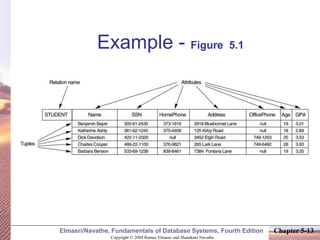
Example - Figure 5.1
Copyright © 2004 Ramez Elmasri and Shamkant Navathe
Elmasri/Navathe, Fundamentals of Database Systems, Fourth Edition Chapter 5-14
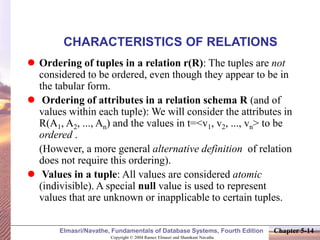
CHARACTERISTICS OF RELATIONS
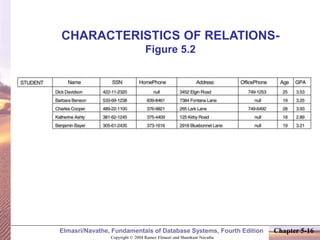
 Ordering of tuples in a relation r(R): The tuples are not
considered to be ordered, even though they appear to be in
the tabular form.
 Ordering of attributes in a relation schema R (and of
values within each tuple): We will consider the attributes in
R(A1, A2, ..., An) and the values in t=<v1, v2, ..., vn> to be
ordered .
(However, a more general alternative definition of relation
does not require this ordering).
 Values in a tuple: All values are considered atomic
(indivisible). A special null value is used to represent
values that are unknown or inapplicable to certain tuples.
Copyright © 2004 Ramez Elmasri and Shamkant Navathe
Elmasri/Navathe, Fundamentals of Database Systems, Fourth Edition Chapter 5-15
CHARACTERISTICS OF RELATIONS
Notation:
- We refer to component values of a tuple t
by t[Ai] = vi (the value of attribute Ai for
tuple t).
Similarly, t[Au, Av, ..., Aw] refers to the
subtuple of t containing the values of
attributes Au, Av, ..., Aw, respectively.
Copyright © 2004 Ramez Elmasri and Shamkant Navathe
Elmasri/Navathe, Fundamentals of Database Systems, Fourth Edition Chapter 5-16
CHARACTERISTICS OF RELATIONS-
Figure 5.2
Copyright © 2004 Ramez Elmasri and Shamkant Navathe
Elmasri/Navathe, Fundamentals of Database Systems, Fourth Edition Chapter 5-17
Relational Integrity Constraints
 Constraints are conditions that must hold
on all valid relation instances. There are
three main types of constraints:
1. Key constraints
2. Entity integrity constraints
3. Referential integrity constraints
Copyright © 2004 Ramez Elmasri and Shamkant Navathe
Elmasri/Navathe, Fundamentals of Database Systems, Fourth Edition Chapter 5-18
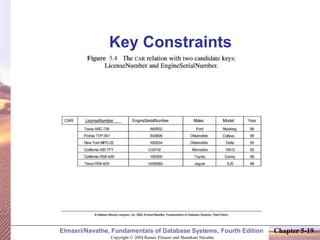
Key Constraints
 Superkey of R: A set of attributes SK of R such that no
two tuples in any valid relation instance r(R) will have
the same value for SK. That is, for any distinct tuples t1
and t2 in r(R), t1[SK]  t2[SK].
 Key of R: A "minimal" superkey; that is, a superkey K
such that removal of any attribute from K results in a set
of attributes that is not a superkey.
Example: The CAR relation schema:
CAR(State, Reg#, SerialNo, Make, Model, Year)
has two keys Key1 = {State, Reg#}, Key2 = {SerialNo}, which are
also superkeys. {SerialNo, Make} is a superkey but not a key.
 If a relation has several candidate keys, one is chosen
arbitrarily to be the primary key. The primary key
attributes are underlined.
Copyright © 2004 Ramez Elmasri and Shamkant Navathe
Elmasri/Navathe, Fundamentals of Database Systems, Fourth Edition Chapter 5-19
Key Constraints
5.4
Copyright © 2004 Ramez Elmasri and Shamkant Navathe
Elmasri/Navathe, Fundamentals of Database Systems, Fourth Edition Chapter 5-20
Entity Integrity
 Relational Database Schema: A set S of relation schemas
that belong to the same database. S is the name of the
database.
S = {R1, R2, ..., Rn}
 Entity Integrity: The primary key attributes PK of each
relation schema R in S cannot have null values in any tuple
of r(R). This is because primary key values are used to
identify the individual tuples.
t[PK]  null for any tuple t in r(R)
 Note: Other attributes of R may be similarly constrained
to disallow null values, even though they are not members
of the primary key.
Copyright © 2004 Ramez Elmasri and Shamkant Navathe
Elmasri/Navathe, Fundamentals of Database Systems, Fourth Edition Chapter 5-21
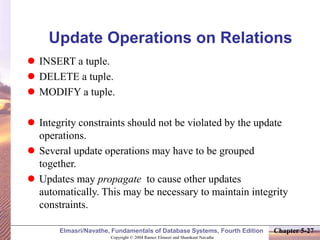
Referential Integrity
 A constraint involving two relations (the previous
constraints involve a single relation).
 Used to specify a relationship among tuples in two
relations: the referencing relation and the referenced
relation.
 Tuples in the referencing relation R1 have attributes FK
(called foreign key attributes) that reference the primary
key attributes PK of the referenced relation R2. A tuple t1
in R1 is said to reference a tuple t2 in R2 if t1[FK] = t2[PK].
 A referential integrity constraint can be displayed in a
relational database schema as a directed arc from R1.FK to
R2.
Copyright © 2004 Ramez Elmasri and Shamkant Navathe
Elmasri/Navathe, Fundamentals of Database Systems, Fourth Edition Chapter 5-22
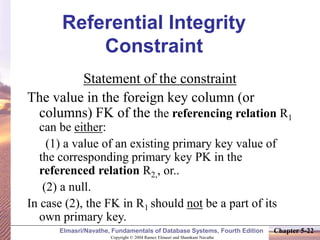
Referential Integrity
Constraint
Statement of the constraint
The value in the foreign key column (or
columns) FK of the the referencing relation R1
can be either:
(1) a value of an existing primary key value of
the corresponding primary key PK in the
referenced relation R2,, or..
(2) a null.
In case (2), the FK in R1 should not be a part of its
own primary key.
Copyright © 2004 Ramez Elmasri and Shamkant Navathe
Elmasri/Navathe, Fundamentals of Database Systems, Fourth Edition Chapter 5-23
Other Types of Constraints
Semantic Integrity Constraints:
- based on application semantics and cannot
be expressed by the model per se
- E.g., “the max. no. of hours per employee
for all projects he or she works on is 56 hrs
per week”
- A constraint specification language may
have to be used to express these
- SQL-99 allows triggers and ASSERTIONS
to allow for some of these
Copyright © 2004 Ramez Elmasri and Shamkant Navathe
Elmasri/Navathe, Fundamentals of Database Systems, Fourth Edition Chapter 5-24
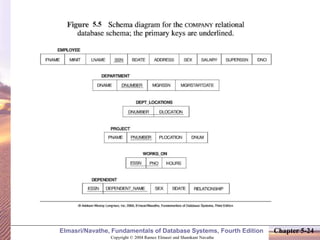
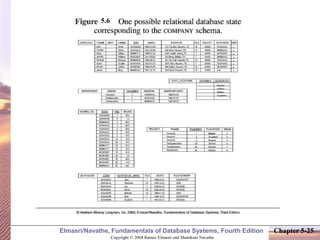
5.5
Copyright © 2004 Ramez Elmasri and Shamkant Navathe
Elmasri/Navathe, Fundamentals of Database Systems, Fourth Edition Chapter 5-25
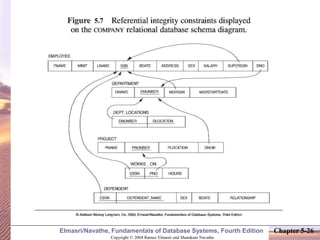
5.6
Copyright © 2004 Ramez Elmasri and Shamkant Navathe
Elmasri/Navathe, Fundamentals of Database Systems, Fourth Edition Chapter 5-26
5.7
Copyright © 2004 Ramez Elmasri and Shamkant Navathe
Elmasri/Navathe, Fundamentals of Database Systems, Fourth Edition Chapter 5-27
Update Operations on Relations
 INSERT a tuple.
 DELETE a tuple.
 MODIFY a tuple.
 Integrity constraints should not be violated by the update
operations.
 Several update operations may have to be grouped
together.
 Updates may propagate to cause other updates
automatically. This may be necessary to maintain integrity
constraints.
Copyright © 2004 Ramez Elmasri and Shamkant Navathe
Elmasri/Navathe, Fundamentals of Database Systems, Fourth Edition Chapter 5-28
Update Operations on Relations
 In case of integrity violation, several actions can
be taken:
– Cancel the operation that causes the violation (REJECT
option)
– Perform the operation but inform the user of the
violation
– Trigger additional updates so the violation is corrected
(CASCADE option, SET NULL option)
– Execute a user-specified error-correction routine
Copyright © 2004 Ramez Elmasri and Shamkant Navathe
Elmasri/Navathe, Fundamentals of Database Systems, Fourth Edition Chapter 5-29
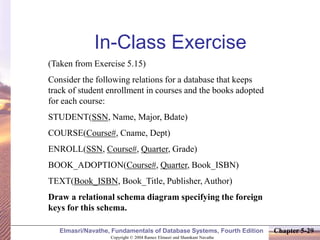
In-Class Exercise
(Taken from Exercise 5.15)
Consider the following relations for a database that keeps
track of student enrollment in courses and the books adopted
for each course:
STUDENT(SSN, Name, Major, Bdate)
COURSE(Course#, Cname, Dept)
ENROLL(SSN, Course#, Quarter, Grade)
BOOK_ADOPTION(Course#, Quarter, Book_ISBN)
TEXT(Book_ISBN, Book_Title, Publisher, Author)
Draw a relational schema diagram specifying the foreign
keys for this schema.

ENCh05.ppt

  • 2.
    Chapter 5 The RelationalData Model and Relational Database Constraints Copyright © 2004 Pearson Education, Inc.
  • 3.
    Copyright © 2004Ramez Elmasri and Shamkant Navathe Elmasri/Navathe, Fundamentals of Database Systems, Fourth Edition Chapter 5-3 Chapter Outline  Relational Model Concepts  Relational Model Constraints and Relational Database Schemas  Update Operations and Dealing with Constraint Violations
  • 4.
    Copyright © 2004Ramez Elmasri and Shamkant Navathe Elmasri/Navathe, Fundamentals of Database Systems, Fourth Edition Chapter 5-4 Relational Model Concepts  The relational Model of Data is based on the concept of a Relation.  A Relation is a mathematical concept based on the ideas of sets.  The strength of the relational approach to data management comes from the formal foundation provided by the theory of relations.  We review the essentials of the relational approach in this chapter.
  • 5.
    Copyright © 2004Ramez Elmasri and Shamkant Navathe Elmasri/Navathe, Fundamentals of Database Systems, Fourth Edition Chapter 5-5 Relational Model Concepts  The model was first proposed by Dr. E.F. Codd of IBM in 1970 in the following paper: "A Relational Model for Large Shared Data Banks," Communications of the ACM, June 1970. The above paper caused a major revolution in the field of Database management and earned Ted Codd the coveted ACM Turing Award.
  • 6.
    Copyright © 2004Ramez Elmasri and Shamkant Navathe Elmasri/Navathe, Fundamentals of Database Systems, Fourth Edition Chapter 5-6 INFORMAL DEFINITIONS  RELATION: A table of values – A relation may be thought of as a set of rows. – A relation may alternately be though of as a set of columns. – Each row represents a fact that corresponds to a real-world entity or relationship. – Each row has a value of an item or set of items that uniquely identifies that row in the table. – Sometimes row-ids or sequential numbers are assigned to identify the rows in the table. – Each column typically is called by its column name or column header or attribute name.
  • 7.
    Copyright © 2004Ramez Elmasri and Shamkant Navathe Elmasri/Navathe, Fundamentals of Database Systems, Fourth Edition Chapter 5-7 FORMAL DEFINITIONS  A Relation may be defined in multiple ways.  The Schema of a Relation: R (A1, A2, .....An) Relation schema R is defined over attributes A1, A2, .....An For Example - CUSTOMER (Cust-id, Cust-name, Address, Phone#) Here, CUSTOMER is a relation defined over the four attributes Cust-id, Cust-name, Address, Phone#, each of which has a domain or a set of valid values. For example, the domain of Cust-id is 6 digit numbers.
  • 8.
    Copyright © 2004Ramez Elmasri and Shamkant Navathe Elmasri/Navathe, Fundamentals of Database Systems, Fourth Edition Chapter 5-8 FORMAL DEFINITIONS  A tuple is an ordered set of values  Each value is derived from an appropriate domain.  Each row in the CUSTOMER table may be referred to as a tuple in the table and would consist of four values.  <632895, "John Smith", "101 Main St. Atlanta, GA 30332", "(404) 894-2000"> is a tuple belonging to the CUSTOMER relation.  A relation may be regarded as a set of tuples (rows).  Columns in a table are also called attributes of the relation.
  • 9.
    Copyright © 2004Ramez Elmasri and Shamkant Navathe Elmasri/Navathe, Fundamentals of Database Systems, Fourth Edition Chapter 5-9 FORMAL DEFINITIONS  A domain has a logical definition: e.g., “USA_phone_numbers” are the set of 10 digit phone numbers valid in the U.S.  A domain may have a data-type or a format defined for it. The USA_phone_numbers may have a format: (ddd)-ddd- dddd where each d is a decimal digit. E.g., Dates have various formats such as monthname, date, year or yyyy-mm-dd, or dd mm,yyyy etc.  An attribute designates the role played by the domain. E.g., the domain Date may be used to define attributes “Invoice- date” and “Payment-date”.
  • 10.
    Copyright © 2004Ramez Elmasri and Shamkant Navathe Elmasri/Navathe, Fundamentals of Database Systems, Fourth Edition Chapter 5-10 FORMAL DEFINITIONS  The relation is formed over the cartesian product of the sets; each set has values from a domain; that domain is used in a specific role which is conveyed by the attribute name.  For example, attribute Cust-name is defined over the domain of strings of 25 characters. The role these strings play in the CUSTOMER relation is that of the name of customers.  Formally, Given R(A1, A2, .........., An) r(R)  dom (A1) X dom (A2) X ....X dom(An)  R: schema of the relation  r of R: a specific "value" or population of R.  R is also called the intension of a relation  r is also called the extension of a relation
  • 11.
    Copyright © 2004Ramez Elmasri and Shamkant Navathe Elmasri/Navathe, Fundamentals of Database Systems, Fourth Edition Chapter 5-11 FORMAL DEFINITIONS  Let S1 = {0,1}  Let S2 = {a,b,c}  Let R  S1 X S2  Then for example: r(R) = {<0,a> , <0,b> , <1,c> } is one possible “state” or “population” or “extension” r of the relation R, defined over domains S1 and S2. It has three tuples.
  • 12.
    Copyright © 2004Ramez Elmasri and Shamkant Navathe Elmasri/Navathe, Fundamentals of Database Systems, Fourth Edition Chapter 5-12 DEFINITION SUMMARY Informal Terms Formal Terms Table Relation Column Attribute/Domain Row Tuple Values in a column Domain Table Definition Schema of a Relation Populated Table Extension
  • 13.
    Copyright © 2004Ramez Elmasri and Shamkant Navathe Elmasri/Navathe, Fundamentals of Database Systems, Fourth Edition Chapter 5-13 Example - Figure 5.1
  • 14.
    Copyright © 2004Ramez Elmasri and Shamkant Navathe Elmasri/Navathe, Fundamentals of Database Systems, Fourth Edition Chapter 5-14 CHARACTERISTICS OF RELATIONS  Ordering of tuples in a relation r(R): The tuples are not considered to be ordered, even though they appear to be in the tabular form.  Ordering of attributes in a relation schema R (and of values within each tuple): We will consider the attributes in R(A1, A2, ..., An) and the values in t=<v1, v2, ..., vn> to be ordered . (However, a more general alternative definition of relation does not require this ordering).  Values in a tuple: All values are considered atomic (indivisible). A special null value is used to represent values that are unknown or inapplicable to certain tuples.
  • 15.
    Copyright © 2004Ramez Elmasri and Shamkant Navathe Elmasri/Navathe, Fundamentals of Database Systems, Fourth Edition Chapter 5-15 CHARACTERISTICS OF RELATIONS Notation: - We refer to component values of a tuple t by t[Ai] = vi (the value of attribute Ai for tuple t). Similarly, t[Au, Av, ..., Aw] refers to the subtuple of t containing the values of attributes Au, Av, ..., Aw, respectively.
  • 16.
    Copyright © 2004Ramez Elmasri and Shamkant Navathe Elmasri/Navathe, Fundamentals of Database Systems, Fourth Edition Chapter 5-16 CHARACTERISTICS OF RELATIONS- Figure 5.2
  • 17.
    Copyright © 2004Ramez Elmasri and Shamkant Navathe Elmasri/Navathe, Fundamentals of Database Systems, Fourth Edition Chapter 5-17 Relational Integrity Constraints  Constraints are conditions that must hold on all valid relation instances. There are three main types of constraints: 1. Key constraints 2. Entity integrity constraints 3. Referential integrity constraints
  • 18.
    Copyright © 2004Ramez Elmasri and Shamkant Navathe Elmasri/Navathe, Fundamentals of Database Systems, Fourth Edition Chapter 5-18 Key Constraints  Superkey of R: A set of attributes SK of R such that no two tuples in any valid relation instance r(R) will have the same value for SK. That is, for any distinct tuples t1 and t2 in r(R), t1[SK]  t2[SK].  Key of R: A "minimal" superkey; that is, a superkey K such that removal of any attribute from K results in a set of attributes that is not a superkey. Example: The CAR relation schema: CAR(State, Reg#, SerialNo, Make, Model, Year) has two keys Key1 = {State, Reg#}, Key2 = {SerialNo}, which are also superkeys. {SerialNo, Make} is a superkey but not a key.  If a relation has several candidate keys, one is chosen arbitrarily to be the primary key. The primary key attributes are underlined.
  • 19.
    Copyright © 2004Ramez Elmasri and Shamkant Navathe Elmasri/Navathe, Fundamentals of Database Systems, Fourth Edition Chapter 5-19 Key Constraints 5.4
  • 20.
    Copyright © 2004Ramez Elmasri and Shamkant Navathe Elmasri/Navathe, Fundamentals of Database Systems, Fourth Edition Chapter 5-20 Entity Integrity  Relational Database Schema: A set S of relation schemas that belong to the same database. S is the name of the database. S = {R1, R2, ..., Rn}  Entity Integrity: The primary key attributes PK of each relation schema R in S cannot have null values in any tuple of r(R). This is because primary key values are used to identify the individual tuples. t[PK]  null for any tuple t in r(R)  Note: Other attributes of R may be similarly constrained to disallow null values, even though they are not members of the primary key.
  • 21.
    Copyright © 2004Ramez Elmasri and Shamkant Navathe Elmasri/Navathe, Fundamentals of Database Systems, Fourth Edition Chapter 5-21 Referential Integrity  A constraint involving two relations (the previous constraints involve a single relation).  Used to specify a relationship among tuples in two relations: the referencing relation and the referenced relation.  Tuples in the referencing relation R1 have attributes FK (called foreign key attributes) that reference the primary key attributes PK of the referenced relation R2. A tuple t1 in R1 is said to reference a tuple t2 in R2 if t1[FK] = t2[PK].  A referential integrity constraint can be displayed in a relational database schema as a directed arc from R1.FK to R2.
  • 22.
    Copyright © 2004Ramez Elmasri and Shamkant Navathe Elmasri/Navathe, Fundamentals of Database Systems, Fourth Edition Chapter 5-22 Referential Integrity Constraint Statement of the constraint The value in the foreign key column (or columns) FK of the the referencing relation R1 can be either: (1) a value of an existing primary key value of the corresponding primary key PK in the referenced relation R2,, or.. (2) a null. In case (2), the FK in R1 should not be a part of its own primary key.
  • 23.
    Copyright © 2004Ramez Elmasri and Shamkant Navathe Elmasri/Navathe, Fundamentals of Database Systems, Fourth Edition Chapter 5-23 Other Types of Constraints Semantic Integrity Constraints: - based on application semantics and cannot be expressed by the model per se - E.g., “the max. no. of hours per employee for all projects he or she works on is 56 hrs per week” - A constraint specification language may have to be used to express these - SQL-99 allows triggers and ASSERTIONS to allow for some of these
  • 24.
    Copyright © 2004Ramez Elmasri and Shamkant Navathe Elmasri/Navathe, Fundamentals of Database Systems, Fourth Edition Chapter 5-24 5.5
  • 25.
    Copyright © 2004Ramez Elmasri and Shamkant Navathe Elmasri/Navathe, Fundamentals of Database Systems, Fourth Edition Chapter 5-25 5.6
  • 26.
    Copyright © 2004Ramez Elmasri and Shamkant Navathe Elmasri/Navathe, Fundamentals of Database Systems, Fourth Edition Chapter 5-26 5.7
  • 27.
    Copyright © 2004Ramez Elmasri and Shamkant Navathe Elmasri/Navathe, Fundamentals of Database Systems, Fourth Edition Chapter 5-27 Update Operations on Relations  INSERT a tuple.  DELETE a tuple.  MODIFY a tuple.  Integrity constraints should not be violated by the update operations.  Several update operations may have to be grouped together.  Updates may propagate to cause other updates automatically. This may be necessary to maintain integrity constraints.
  • 28.
    Copyright © 2004Ramez Elmasri and Shamkant Navathe Elmasri/Navathe, Fundamentals of Database Systems, Fourth Edition Chapter 5-28 Update Operations on Relations  In case of integrity violation, several actions can be taken: – Cancel the operation that causes the violation (REJECT option) – Perform the operation but inform the user of the violation – Trigger additional updates so the violation is corrected (CASCADE option, SET NULL option) – Execute a user-specified error-correction routine
  • 29.
    Copyright © 2004Ramez Elmasri and Shamkant Navathe Elmasri/Navathe, Fundamentals of Database Systems, Fourth Edition Chapter 5-29 In-Class Exercise (Taken from Exercise 5.15) Consider the following relations for a database that keeps track of student enrollment in courses and the books adopted for each course: STUDENT(SSN, Name, Major, Bdate) COURSE(Course#, Cname, Dept) ENROLL(SSN, Course#, Quarter, Grade) BOOK_ADOPTION(Course#, Quarter, Book_ISBN) TEXT(Book_ISBN, Book_Title, Publisher, Author) Draw a relational schema diagram specifying the foreign keys for this schema.

Editor's Notes