JPoint 2015
Conference
overview
 Memory leaks profiling basics
 Some notes about java.lang.String class
 What technical debt is. How to measure it and how to sell.
 Regular expressions under hood
 Conclusion
Agenda
Memory Leaks
Different regions of memory
Default sizes
java -XX:+UnlockDiagnosticVMOptions -XX:+PrintFlagsFinal –version
Non-default sizes
-Xmx2g -Xms2g -XX:MaxPermSize=128m
-XX:MaxPermSize=128m
Garbage Collector
JVM subsystem responsible for object allocation and removing
OutOfMemoryError
JVM and Memory
Unused object - object with no reference on it
References:
From an object to the value of one of its instance fields
From an array to one of its elements
From an object to its class
From a class to its class loader
From a class to the value of one of its static fields
From a class to its superclass
GC roots - special objects, always considered to be alive
Reachability
Memory Leaks: Unused Objects
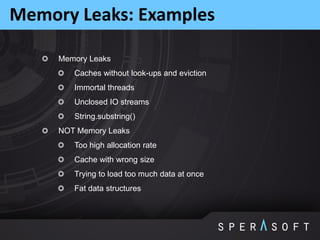
Memory Leaks
Caches without look-ups and eviction
Immortal threads
Unclosed IO streams
String.substring()
NOT Memory Leaks
Too high allocation rate
Cache with wrong size
Trying to load too much data at once
Fat data structures
Memory Leaks: Examples
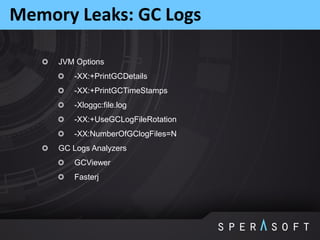
JVM Options
-XX:+PrintGCDetails
-XX:+PrintGCTimeStamps
-Xloggc:file.log
-XX:+UseGCLogFileRotation
-XX:NumberOfGClogFiles=N
GC Logs Analyzers
GCViewer
Fasterj
Memory Leaks: GC Logs
Binary representation of objects graph written to a file
One of the best ways to find out what consumes memory
Getting memory dump:
jmap -dump:format=b,file=heap.hprof
(!) Stop The World, 1 Thread, 4Gb ~4 sec
-XX:+HeapDumpOnOutOfMemoryError
-XX:HeapDumpPath=./java_pid<pid>.hprof
Get as late as possible
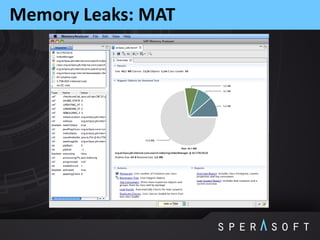
Memory dump analyze tool:
MAT
Memory Leaks: Memory Dump
Shallow – size of the object itself with headers and fields but without
fields values
Deep – size of the object itself with headers, fields and fields values
Retained – the sub-graph size that will be unreached if we remove the
object
Memory Leaks: Object Size
Memory Leaks: MAT
Some Notes about
java.lang.String
Immutable
25% of objects are java.lang.String
String concat vs StringBuilder (3250 op/sec vs 125000 op/sec)
-XX:±OptimizeStringConcat
String
OFFSET SIZE TYPE DESCRIPTION
0 12 object header
12 4 char[] value
16 4 int hash
20 4 alligmeent loss
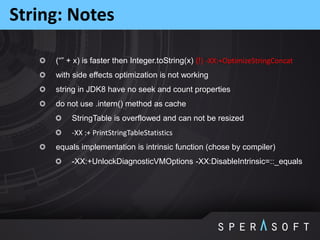
(“” + x) is faster then Integer.toString(x) (!) -XX:+OptimizeStringConcat
with side effects optimization is not working
string in JDK8 have no seek and count properties
do not use .intern() method as cache
StringTable is overflowed and can not be resized
-XX :+ PrintStringTableStatistics
equals implementation is intrinsic function (chose by compiler)
-XX:+UnlockDiagnosticVMOptions -XX:DisableIntrinsic=::_equals
String: Notes
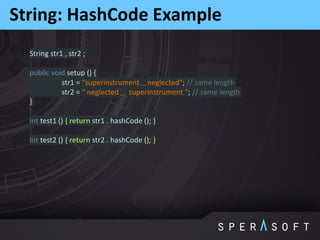
String: HashCode Example
String str1 , str2 ;
public void setup () {
str1 = “superinstrument␣neglected"; // same length
str2 = " neglected␣ superinstrument "; // same length
}
int test1 () { return str1 . hashCode (); }
int test2 () { return str2 . hashCode (); }
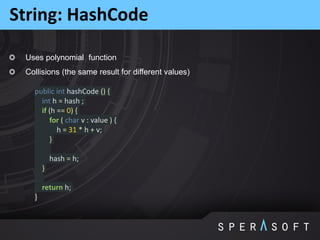
Uses polynomial function
Collisions (the same result for different values)
String: HashCode
public int hashCode () {
int h = hash ;
if (h == 0) {
for ( char v : value ) {
h = 31 * h + v;
}
hash = h;
}
return h;
}
String: Regexp
String text = “Funny␣girl␣danced␣fell␣hurt␣and␣cried␣aloud.";
String textDup = text.replaceAll ("␣", "␣␣");
Pattern pattern = Pattern.compile ("␣␣");
String [] charSplit () { return text.split ("␣"); } //191.6 ns/op
String [] strSplit () { return textDup.split ("␣␣"); } //527.9 ns/op
String [] strSplit_pattern () { return pattern.split(textDup); } //416.2 ns/op
charSplit: fast path for 1 byte symbols
strSplit: internally creates Pattern
strSplit_pattern: reuse Pattern
Technical debt
Try to not create a technical debt
Code review
Precision estimates
Bus factor (save information)
Try to measure the date your application will start suffer from this debt
Collect metrics as much as possible
Try to build trend
Fishy code
Technical Debt
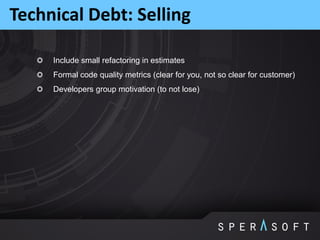
Include small refactoring in estimates
Formal code quality metrics (clear for you, not so clear for customer)
Developers group motivation (to not lose)
Technical Debt: Selling
Regular expressions
under hood
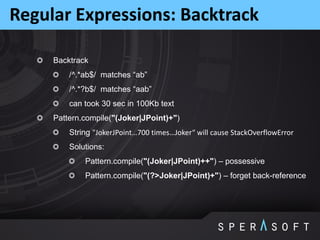
Backtrack
/^.*ab$/ matches “ab”
/^.*?b$/ matches “aab”
can took 30 sec in 100Kb text
Pattern.compile("(Joker|JPoint)+")
String "JokerJPoint…700 times…Joker“ will cause StackOverflowError
Solutions:
Pattern.compile("(Joker|JPoint)++") – possessive
Pattern.compile("(?>Joker|JPoint)+") – forget back-reference
Regular Expressions: Backtrack
Regular Expressions: Impl
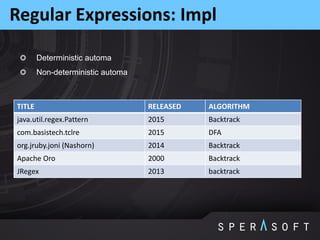
TITLE RELEASED ALGORITHM
java.util.regex.Pattern 2015 Backtrack
com.basistech.tclre 2015 DFA
org.jruby.joni (Nashorn) 2014 Backtrack
Apache Oro 2000 Backtrack
JRegex 2013 backtrack
Deterministic automa
Non-deterministic automa
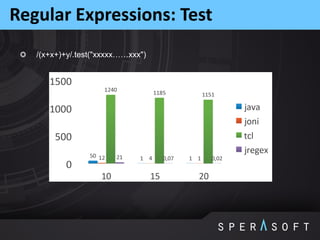
Regular Expressions: Test
/(x+x+)+y/.test("xxxxx……xxx")
Regular Expressions: Tradeoff
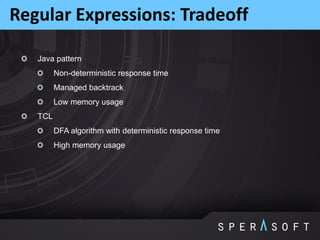
Java pattern
Non-deterministic response time
Managed backtrack
Low memory usage
TCL
DFA algorithm with deterministic response time
High memory usage
Visit Sperasoft online:
www/sperasoft.com
www.facebook.com/Sperasoft
www.twitter.com/sperasoft
Thanks!

Sperasoft‬ talks j point 2015

  • 1.
  • 2.
     Memory leaksprofiling basics  Some notes about java.lang.String class  What technical debt is. How to measure it and how to sell.  Regular expressions under hood  Conclusion Agenda
  • 3.
  • 4.
    Different regions ofmemory Default sizes java -XX:+UnlockDiagnosticVMOptions -XX:+PrintFlagsFinal –version Non-default sizes -Xmx2g -Xms2g -XX:MaxPermSize=128m -XX:MaxPermSize=128m Garbage Collector JVM subsystem responsible for object allocation and removing OutOfMemoryError JVM and Memory
  • 5.
    Unused object -object with no reference on it References: From an object to the value of one of its instance fields From an array to one of its elements From an object to its class From a class to its class loader From a class to the value of one of its static fields From a class to its superclass GC roots - special objects, always considered to be alive Reachability Memory Leaks: Unused Objects
  • 6.
    Memory Leaks Caches withoutlook-ups and eviction Immortal threads Unclosed IO streams String.substring() NOT Memory Leaks Too high allocation rate Cache with wrong size Trying to load too much data at once Fat data structures Memory Leaks: Examples
  • 7.
  • 8.
    Binary representation ofobjects graph written to a file One of the best ways to find out what consumes memory Getting memory dump: jmap -dump:format=b,file=heap.hprof (!) Stop The World, 1 Thread, 4Gb ~4 sec -XX:+HeapDumpOnOutOfMemoryError -XX:HeapDumpPath=./java_pid<pid>.hprof Get as late as possible Memory dump analyze tool: MAT Memory Leaks: Memory Dump
  • 9.
    Shallow – sizeof the object itself with headers and fields but without fields values Deep – size of the object itself with headers, fields and fields values Retained – the sub-graph size that will be unreached if we remove the object Memory Leaks: Object Size
  • 10.
  • 11.
  • 12.
    Immutable 25% of objectsare java.lang.String String concat vs StringBuilder (3250 op/sec vs 125000 op/sec) -XX:±OptimizeStringConcat String OFFSET SIZE TYPE DESCRIPTION 0 12 object header 12 4 char[] value 16 4 int hash 20 4 alligmeent loss
  • 13.
    (“” + x)is faster then Integer.toString(x) (!) -XX:+OptimizeStringConcat with side effects optimization is not working string in JDK8 have no seek and count properties do not use .intern() method as cache StringTable is overflowed and can not be resized -XX :+ PrintStringTableStatistics equals implementation is intrinsic function (chose by compiler) -XX:+UnlockDiagnosticVMOptions -XX:DisableIntrinsic=::_equals String: Notes
  • 14.
    String: HashCode Example Stringstr1 , str2 ; public void setup () { str1 = “superinstrument␣neglected"; // same length str2 = " neglected␣ superinstrument "; // same length } int test1 () { return str1 . hashCode (); } int test2 () { return str2 . hashCode (); }
  • 15.
    Uses polynomial function Collisions(the same result for different values) String: HashCode public int hashCode () { int h = hash ; if (h == 0) { for ( char v : value ) { h = 31 * h + v; } hash = h; } return h; }
  • 16.
    String: Regexp String text= “Funny␣girl␣danced␣fell␣hurt␣and␣cried␣aloud."; String textDup = text.replaceAll ("␣", "␣␣"); Pattern pattern = Pattern.compile ("␣␣"); String [] charSplit () { return text.split ("␣"); } //191.6 ns/op String [] strSplit () { return textDup.split ("␣␣"); } //527.9 ns/op String [] strSplit_pattern () { return pattern.split(textDup); } //416.2 ns/op charSplit: fast path for 1 byte symbols strSplit: internally creates Pattern strSplit_pattern: reuse Pattern
  • 17.
  • 18.
    Try to notcreate a technical debt Code review Precision estimates Bus factor (save information) Try to measure the date your application will start suffer from this debt Collect metrics as much as possible Try to build trend Fishy code Technical Debt
  • 19.
    Include small refactoringin estimates Formal code quality metrics (clear for you, not so clear for customer) Developers group motivation (to not lose) Technical Debt: Selling
  • 20.
  • 21.
    Backtrack /^.*ab$/ matches “ab” /^.*?b$/matches “aab” can took 30 sec in 100Kb text Pattern.compile("(Joker|JPoint)+") String "JokerJPoint…700 times…Joker“ will cause StackOverflowError Solutions: Pattern.compile("(Joker|JPoint)++") – possessive Pattern.compile("(?>Joker|JPoint)+") – forget back-reference Regular Expressions: Backtrack
  • 22.
    Regular Expressions: Impl TITLERELEASED ALGORITHM java.util.regex.Pattern 2015 Backtrack com.basistech.tclre 2015 DFA org.jruby.joni (Nashorn) 2014 Backtrack Apache Oro 2000 Backtrack JRegex 2013 backtrack Deterministic automa Non-deterministic automa
  • 23.
  • 24.
    Regular Expressions: Tradeoff Javapattern Non-deterministic response time Managed backtrack Low memory usage TCL DFA algorithm with deterministic response time High memory usage
  • 25.