26/08/2025
2
Normalization: Database DesignTheory
Normalization
Normalization is the process of organizing the data in the
database.
Normalization is used to minimize the redundancy from a
relation or set of relations.
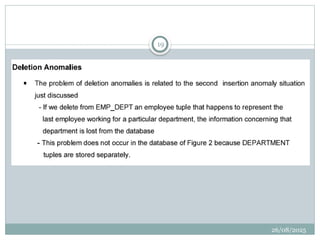
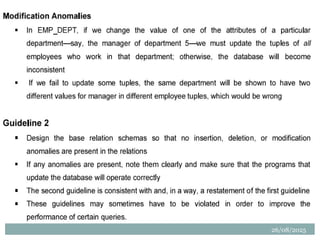
It is also used to eliminate the undesirable characteristics
like Insertion, Update and Deletion Anomalies.
3.
26/08/2025
3
NOTE :
REDUNDANCY :
In Database Management Systems (DBMS), redundancy refers
to the unnecessary duplication of data within a database.
ANOMALIES:
In Database Management Systems (DBMS), anomalies refer to
problems or inconsistencies that can arise in a database due
to redundancy or poor database design. These anomalies can
compromise data integrity and affect the database's overall
functionality.
4.
26/08/2025
4
Normalization dividesthe larger table into the smaller
table and links them using relationship.
The normal form is used to reduce redundancy from the database
table.
26/08/2025
7
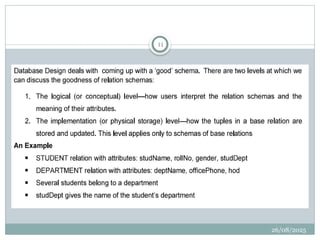
Introduction to databasedesign
Database design can be generally defined as a collection of
tasks or processes that enhance the designing,
development, implementation, and maintenance of
enterprise data management system.
Designing a proper database reduces the maintenance
cost thereby improving data consistency and the cost-
effective measures which are greatly influenced in terms of
disk storage space.
8.
26/08/2025
8
Therefore, therehas to be a brilliant concept of designing a
database.
The designer should follow the constraints and decide how the
elements correlate and what kind of data must be
stored.
The main objectives behind database designing are to
produce physical and logical design models of the
proposed database system.
9.
26/08/2025
9
Why is DatabaseDesign important?
The important consideration that can be taken into account
while emphasizing the importance of database design can be
explained in terms of the following points given below.
1. Database designs provide the blueprints of how the data
is going to be stored in a system.
A proper design of a database highly affects the overall
performance of any application.
10.
26/08/2025
10
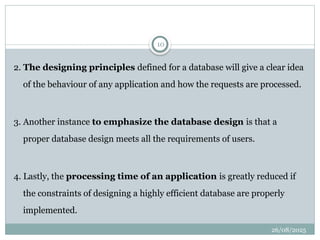
2. The designingprinciples defined for a database will give a clear idea
of the behaviour of any application and how the requests are processed.
3. Another instance to emphasize the database design is that a
proper database design meets all the requirements of users.
4. Lastly, the processing time of an application is greatly reduced if
the constraints of designing a highly efficient database are properly
implemented.
26/08/2025
23
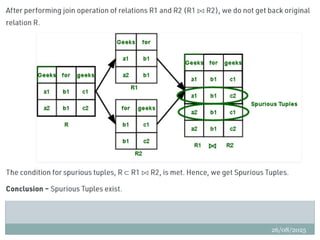
Spurious Tuples
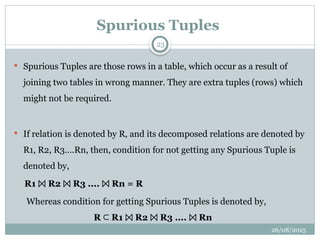
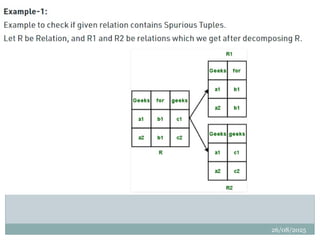
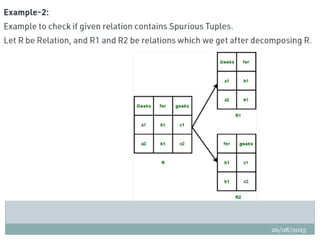
SpuriousTuples are those rows in a table, which occur as a result of
joining two tables in wrong manner. They are extra tuples (rows) which
might not be required.
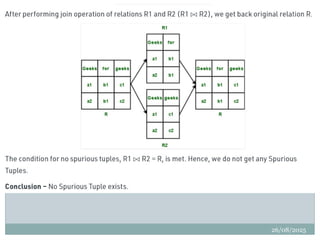
If relation is denoted by R, and its decomposed relations are denoted by
R1, R2, R3….Rn, then, condition for not getting any Spurious Tuple is
denoted by,
R1 R2 R3 .... Rn = R
⨝ ⨝ ⨝
Whereas condition for getting Spurious Tuples is denoted by,
R R1 R2 R3 .... Rn
⊂ ⨝ ⨝ ⨝
24.
26/08/2025
24
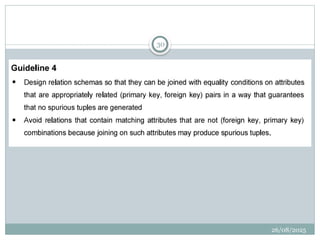
How can weprevent spurious tuples?
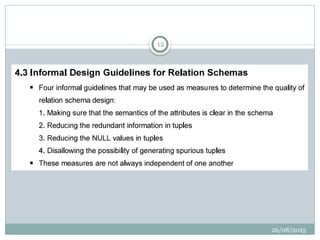
Disallowing the possibility of generating spurious tuples.
Avoid relations that contain matching attributes that are not
(foreign key, primary key) combinations because joining on
such attributes may produce spurious tuples.
26/08/2025
29
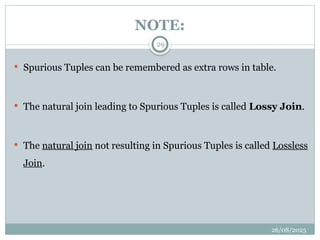
NOTE:
Spurious Tuplescan be remembered as extra rows in table.
The natural join leading to Spurious Tuples is called Lossy Join.
The natural join not resulting in Spurious Tuples is called Lossless
Join.
26/08/2025
43
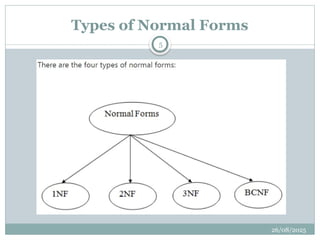
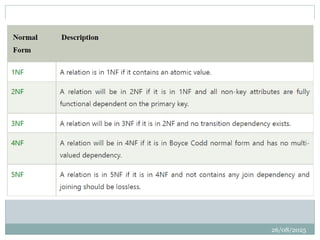
First Normal Form(1NF)
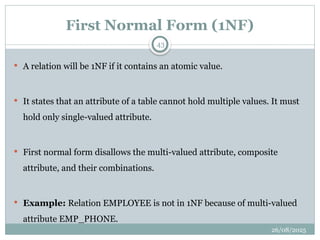
A relation will be 1NF if it contains an atomic value.
It states that an attribute of a table cannot hold multiple values. It must
hold only single-valued attribute.
First normal form disallows the multi-valued attribute, composite
attribute, and their combinations.
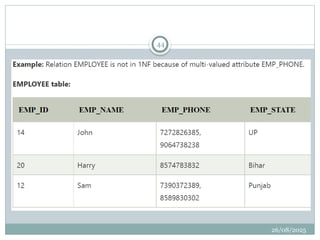
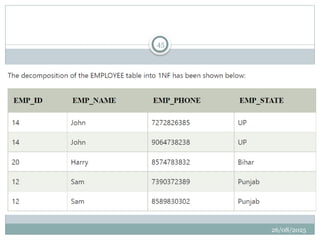
Example: Relation EMPLOYEE is not in 1NF because of multi-valued
attribute EMP_PHONE.
26/08/2025
46
Second Normal Form(2NF)
In the 2NF, relational must be in 1NF.
In the second normal form, all non-key attributes are fully
functional dependent on the primary key
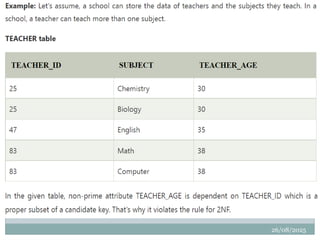
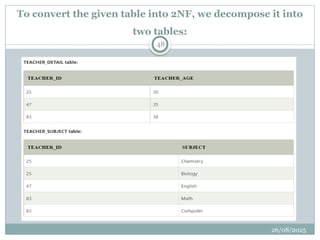
Example: Let's assume, a school can store the data of teachers
and the subjects they teach. In a school, a teacher can teach more
than one subject.
26/08/2025
49
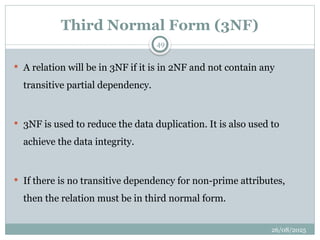
Third Normal Form(3NF)
A relation will be in 3NF if it is in 2NF and not contain any
transitive partial dependency.
3NF is used to reduce the data duplication. It is also used to
achieve the data integrity.
If there is no transitive dependency for non-prime attributes,
then the relation must be in third normal form.
50.
26/08/2025
50
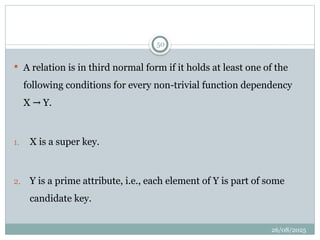
A relationis in third normal form if it holds at least one of the
following conditions for every non-trivial function dependency
X Y.
→
1. X is a super key.
2. Y is a prime attribute, i.e., each element of Y is part of some
candidate key.
26/08/2025
54
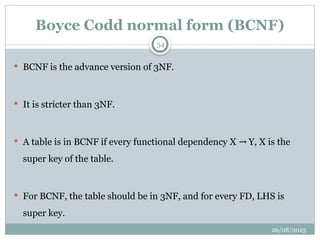
Boyce Codd normalform (BCNF)
BCNF is the advance version of 3NF.
It is stricter than 3NF.
A table is in BCNF if every functional dependency X Y, X is the
→
super key of the table.
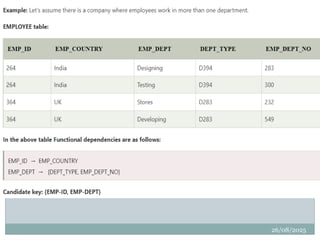
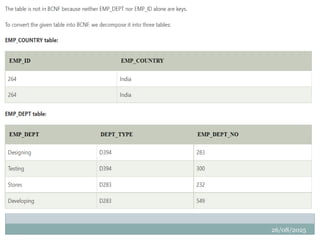
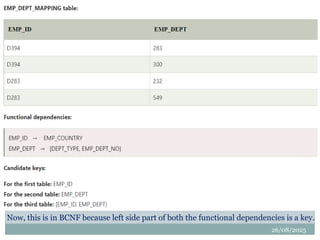
For BCNF, the table should be in 3NF, and for every FD, LHS is
super key.