1. Relational Model
The relational model uses a collection of tables to represent both data and relationships among those data.
Each table has multiple columns and each column has a unique name.
Characteristics
1. The primary data model for commercial data-processing applications.
2. It provides very simple but powerful way of representing data that eases the job of the programmer.
3. This is a record-based model. The database is structured in fixed-format records of several types. Each
table contains records of a particular type. Each record type defines a fixed no. of fields, or attributes. The
columns of the table correspond to the attributes of the record type.
4. The relational model is at a lower level than the E-R model. Database designs are often carried out in
the E-R model and then translated to the relational model.
2. Structure of Relational Databases
2.1 Basic Structure
Relation and tuple: In relational model these are synonymous to table and row.
Attribute: In relational model we refer column headers as attributes.
Domain: a domain is a set of acceptable values that a column is allowed to contain. This is based on
various properties and the data type for the column. For the attribute branch_name, the domain is the set
of all branch names.
Atomic domain: A domain is atomic if elements of the domain are considered to be indivisible parts. For
example: The domain of Marital Status has a set of possibilities: Married, Single, Divorced.
Null value: One domain value that is a member of any possible domain is the null value, which signifies
that the value is unknown or does not exist. Example: telephone_no.
 Null values cause a number of difficulties while accessing or updating the database, thus should be
eliminated if at all possible.
Tuple variable: A tuple variable is variable that takes on tuples of a particular relation schema as values.
That is, every value assigned to a given tuple variable has the same number and type of fields.
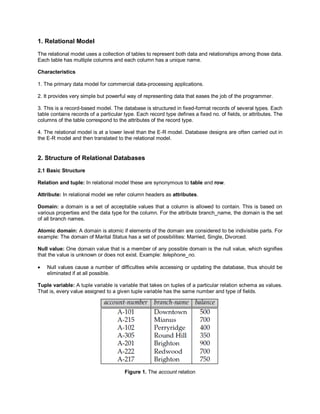
Figure 1. The account relation
In the account relation of Figure 1, there are seven tuples. Let the tuple variable t refer to the first tuple of
the relation.We use the notation t[account-number] to denote the value of t on the account-number attribute.
Thus, t[account-number] = “A-101,” and t[branch-name] = “Downtown”. Alternatively, we may write t[1] to
denote the value of tuple t on the first attribute (account-number), t[2] to denote branch-name, and so on.
Since a relation is a set of tuples, we use the mathematical notation of t ∈ r to denote that tuple t is in
relation r.
2.2 Database Schema
Database schema: Logical design of the database.
Database instance: A snapshot of the data in the database at a given instant in time.
Relation schema:
 The concept of relation schema corresponds to the programming-language notion of type definition.
 There should be a name of a relation schema. The convention is to use names beginning with an
uppercase letter.
 In general, a relation schema consists of a list of attributes and their corresponding domains.
Branch_schema = (branch_name, branch_city, assets)
Customer_schema = (customer_id, customer_name, customer_street, customer_city)
Loan_schema = (loan_no., branch_name, amount)
Relation instance:
 The concept of relation instance corresponds to the programming-language notion of a value of a
variable. In other words, A relation instance is a tuple or row in a relation, i.e. one particular combination
of attribute values.
Let there be a relation Student. The schema of the relation Student has the following attributes:
{ID,first_name,last_name}
Now each of the attributes have their own domain i.e. a range of values they can take up.
Student
ID f_name l_name
1 Bob Dylan
2 Adam Levine
3 Chris Martin
(1, Bob, Dylan) is a relation instance.
Table 1. Terms and their synonyms by A. Watt.
A. S. M. Shafi
Lecturer
Department of Computer Science and Engineering
Khwaja Yunus Ali University
Enaytpur, Sirajgonj-6751, Bangladesh

Relational Model

  • 1.
    1. Relational Model Therelational model uses a collection of tables to represent both data and relationships among those data. Each table has multiple columns and each column has a unique name. Characteristics 1. The primary data model for commercial data-processing applications. 2. It provides very simple but powerful way of representing data that eases the job of the programmer. 3. This is a record-based model. The database is structured in fixed-format records of several types. Each table contains records of a particular type. Each record type defines a fixed no. of fields, or attributes. The columns of the table correspond to the attributes of the record type. 4. The relational model is at a lower level than the E-R model. Database designs are often carried out in the E-R model and then translated to the relational model. 2. Structure of Relational Databases 2.1 Basic Structure Relation and tuple: In relational model these are synonymous to table and row. Attribute: In relational model we refer column headers as attributes. Domain: a domain is a set of acceptable values that a column is allowed to contain. This is based on various properties and the data type for the column. For the attribute branch_name, the domain is the set of all branch names. Atomic domain: A domain is atomic if elements of the domain are considered to be indivisible parts. For example: The domain of Marital Status has a set of possibilities: Married, Single, Divorced. Null value: One domain value that is a member of any possible domain is the null value, which signifies that the value is unknown or does not exist. Example: telephone_no.  Null values cause a number of difficulties while accessing or updating the database, thus should be eliminated if at all possible. Tuple variable: A tuple variable is variable that takes on tuples of a particular relation schema as values. That is, every value assigned to a given tuple variable has the same number and type of fields. Figure 1. The account relation
  • 2.
    In the accountrelation of Figure 1, there are seven tuples. Let the tuple variable t refer to the first tuple of the relation.We use the notation t[account-number] to denote the value of t on the account-number attribute. Thus, t[account-number] = “A-101,” and t[branch-name] = “Downtown”. Alternatively, we may write t[1] to denote the value of tuple t on the first attribute (account-number), t[2] to denote branch-name, and so on. Since a relation is a set of tuples, we use the mathematical notation of t ∈ r to denote that tuple t is in relation r. 2.2 Database Schema Database schema: Logical design of the database. Database instance: A snapshot of the data in the database at a given instant in time. Relation schema:  The concept of relation schema corresponds to the programming-language notion of type definition.  There should be a name of a relation schema. The convention is to use names beginning with an uppercase letter.  In general, a relation schema consists of a list of attributes and their corresponding domains. Branch_schema = (branch_name, branch_city, assets) Customer_schema = (customer_id, customer_name, customer_street, customer_city) Loan_schema = (loan_no., branch_name, amount) Relation instance:  The concept of relation instance corresponds to the programming-language notion of a value of a variable. In other words, A relation instance is a tuple or row in a relation, i.e. one particular combination of attribute values. Let there be a relation Student. The schema of the relation Student has the following attributes: {ID,first_name,last_name} Now each of the attributes have their own domain i.e. a range of values they can take up. Student ID f_name l_name 1 Bob Dylan 2 Adam Levine 3 Chris Martin (1, Bob, Dylan) is a relation instance. Table 1. Terms and their synonyms by A. Watt.
  • 3.
    A. S. M.Shafi Lecturer Department of Computer Science and Engineering Khwaja Yunus Ali University Enaytpur, Sirajgonj-6751, Bangladesh