Chapter 2: Relational Model
G.Amudha
Assistant professor
Department of information technology
e.m.g.yadava women’s college
Structure of Relational Databases
Fundamental Relational-Algebra-Operations
Additional Relational-Algebra-Operations
Extended Relational-Algebra-Operations
Null Values
Modification of the Database
Relational Model
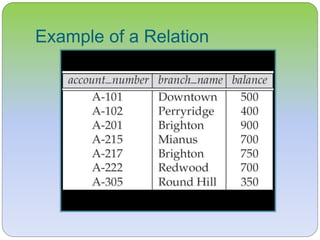
Example of a Relation
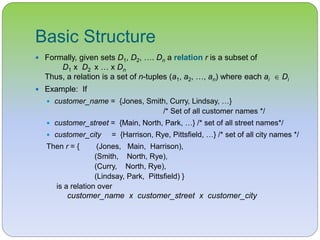
Basic Structure
 Formally, given sets D1, D2, …. Dn a relation r is a subset of
D1 x D2 x … x Dn
Thus, a relation is a set of n-tuples (a1, a2, …, an) where each ai  Di
 Example: If
 customer_name = {Jones, Smith, Curry, Lindsay, …}
/* Set of all customer names */
 customer_street = {Main, North, Park, …} /* set of all street names*/
 customer_city = {Harrison, Rye, Pittsfield, …} /* set of all city names */
Then r = { (Jones, Main, Harrison),
(Smith, North, Rye),
(Curry, North, Rye),
(Lindsay, Park, Pittsfield) }
is a relation over
customer_name x customer_street x customer_city
Attribute Types
 Each attribute of a relation has a name
 The set of allowed values for each attribute is called
the domain of the attribute
 Attribute values are (normally) required to be atomic;
that is, indivisible
 E.g. the value of an attribute can be an account number,
but cannot be a set of account numbers
 Domain is said to be atomic if all its members are
atomic
 The special value null is a member of every domain
 The null value causes complications in the definition
of many operations
 We shall ignore the effect of null values in our main
presentation and consider their effect later
Relation Schema
 A1, A2, …, An are attributes
 R = (A1, A2, …, An ) is a relation schema
Example:
Customer_schema = (customer_name,
customer_street, customer_city)
 r(R) denotes a relation r on the relation schema R
Example:
customer (Customer_schema)
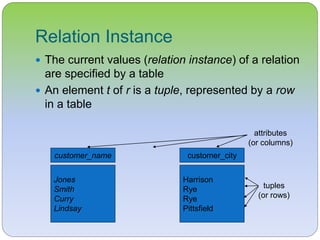
Relation Instance
 The current values (relation instance) of a relation
are specified by a table
 An element t of r is a tuple, represented by a row
in a table
Jones
Smith
Curry
Lindsay
customer_name
Harrison
Rye
Rye
Pittsfield
customer_city
attributes
(or columns)
tuples
(or rows)
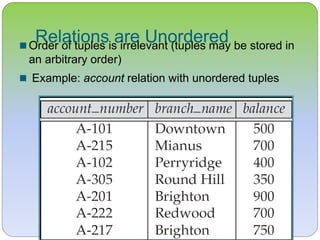
Relations are Unordered
 Order of tuples is irrelevant (tuples may be stored in
an arbitrary order)
 Example: account relation with unordered tuples
Database
 A database consists of multiple relations
 Information about an enterprise is broken up into parts, with each relation
storing one part of the information
account : stores information about accounts
depositor : stores information about which customer
owns which account
customer : stores information about customers
 Storing all information as a single relation such as
bank(account_number, balance, customer_name, ..)
results in
 repetition of information
 e.g.,if two customers own an account (What gets repeated?)
 the need for null values
 e.g., to represent a customer without an account
 Normalization theory (Chapter 7) deals with how to design relational
schemas
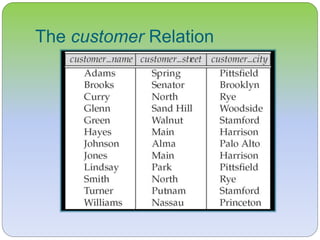
The customer Relation
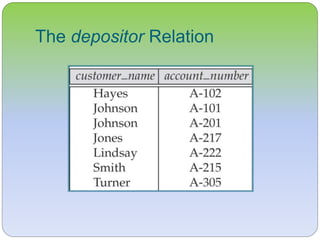
The depositor Relation
Keys
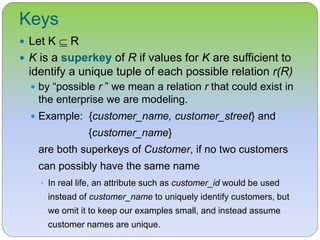
 Let K  R
 K is a superkey of R if values for K are sufficient to
identify a unique tuple of each possible relation r(R)
 by “possible r ” we mean a relation r that could exist in
the enterprise we are modeling.
 Example: {customer_name, customer_street} and
{customer_name}
are both superkeys of Customer, if no two customers
can possibly have the same name
 In real life, an attribute such as customer_id would be used
instead of customer_name to uniquely identify customers, but
we omit it to keep our examples small, and instead assume
customer names are unique.
Keys (Cont.)
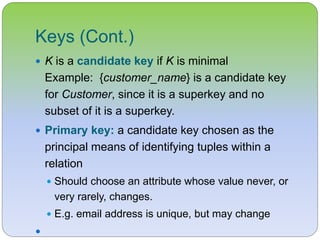
 K is a candidate key if K is minimal
Example: {customer_name} is a candidate key
for Customer, since it is a superkey and no
subset of it is a superkey.
 Primary key: a candidate key chosen as the
principal means of identifying tuples within a
relation
 Should choose an attribute whose value never, or
very rarely, changes.
 E.g. email address is unique, but may change

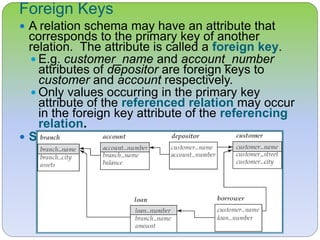
Foreign Keys
 A relation schema may have an attribute that
corresponds to the primary key of another
relation. The attribute is called a foreign key.
 E.g. customer_name and account_number
attributes of depositor are foreign keys to
customer and account respectively.
 Only values occurring in the primary key
attribute of the referenced relation may occur
in the foreign key attribute of the referencing
relation.
 Schema diagram
Query Languages
 Language in which user requests information
from the database.
 Categories of languages
 Procedural
 Non-procedural, or declarative
 “Pure” languages:
 Relational algebra
 Tuple relational calculus
 Domain relational calculus
 Pure languages form underlying basis of query
languages that people use.

chapter2 Relational Model

  • 1.
    Chapter 2: RelationalModel G.Amudha Assistant professor Department of information technology e.m.g.yadava women’s college
  • 2.
    Structure of RelationalDatabases Fundamental Relational-Algebra-Operations Additional Relational-Algebra-Operations Extended Relational-Algebra-Operations Null Values Modification of the Database Relational Model
  • 3.
    Example of aRelation
  • 4.
    Basic Structure  Formally,given sets D1, D2, …. Dn a relation r is a subset of D1 x D2 x … x Dn Thus, a relation is a set of n-tuples (a1, a2, …, an) where each ai  Di  Example: If  customer_name = {Jones, Smith, Curry, Lindsay, …} /* Set of all customer names */  customer_street = {Main, North, Park, …} /* set of all street names*/  customer_city = {Harrison, Rye, Pittsfield, …} /* set of all city names */ Then r = { (Jones, Main, Harrison), (Smith, North, Rye), (Curry, North, Rye), (Lindsay, Park, Pittsfield) } is a relation over customer_name x customer_street x customer_city
  • 5.
    Attribute Types  Eachattribute of a relation has a name  The set of allowed values for each attribute is called the domain of the attribute  Attribute values are (normally) required to be atomic; that is, indivisible  E.g. the value of an attribute can be an account number, but cannot be a set of account numbers  Domain is said to be atomic if all its members are atomic  The special value null is a member of every domain  The null value causes complications in the definition of many operations  We shall ignore the effect of null values in our main presentation and consider their effect later
  • 6.
    Relation Schema  A1,A2, …, An are attributes  R = (A1, A2, …, An ) is a relation schema Example: Customer_schema = (customer_name, customer_street, customer_city)  r(R) denotes a relation r on the relation schema R Example: customer (Customer_schema)
  • 7.
    Relation Instance  Thecurrent values (relation instance) of a relation are specified by a table  An element t of r is a tuple, represented by a row in a table Jones Smith Curry Lindsay customer_name Harrison Rye Rye Pittsfield customer_city attributes (or columns) tuples (or rows)
  • 8.
    Relations are Unordered Order of tuples is irrelevant (tuples may be stored in an arbitrary order)  Example: account relation with unordered tuples
  • 9.
    Database  A databaseconsists of multiple relations  Information about an enterprise is broken up into parts, with each relation storing one part of the information account : stores information about accounts depositor : stores information about which customer owns which account customer : stores information about customers  Storing all information as a single relation such as bank(account_number, balance, customer_name, ..) results in  repetition of information  e.g.,if two customers own an account (What gets repeated?)  the need for null values  e.g., to represent a customer without an account  Normalization theory (Chapter 7) deals with how to design relational schemas
  • 10.
  • 11.
  • 12.
    Keys  Let K R  K is a superkey of R if values for K are sufficient to identify a unique tuple of each possible relation r(R)  by “possible r ” we mean a relation r that could exist in the enterprise we are modeling.  Example: {customer_name, customer_street} and {customer_name} are both superkeys of Customer, if no two customers can possibly have the same name  In real life, an attribute such as customer_id would be used instead of customer_name to uniquely identify customers, but we omit it to keep our examples small, and instead assume customer names are unique.
  • 13.
    Keys (Cont.)  Kis a candidate key if K is minimal Example: {customer_name} is a candidate key for Customer, since it is a superkey and no subset of it is a superkey.  Primary key: a candidate key chosen as the principal means of identifying tuples within a relation  Should choose an attribute whose value never, or very rarely, changes.  E.g. email address is unique, but may change 
  • 14.
    Foreign Keys  Arelation schema may have an attribute that corresponds to the primary key of another relation. The attribute is called a foreign key.  E.g. customer_name and account_number attributes of depositor are foreign keys to customer and account respectively.  Only values occurring in the primary key attribute of the referenced relation may occur in the foreign key attribute of the referencing relation.  Schema diagram
  • 15.
    Query Languages  Languagein which user requests information from the database.  Categories of languages  Procedural  Non-procedural, or declarative  “Pure” languages:  Relational algebra  Tuple relational calculus  Domain relational calculus  Pure languages form underlying basis of query languages that people use.