Shai Borwick-Cooper


The History of the Iberian Peninsular
   The Romans conquered Spain starting in 218 bc and ended
    in 17bc. The kingdom of Hispana was divided into two
    parts Hispania Ulterior and Hispania Citerior.
   Rome improved cities and built roads in the area.
   The 5th to the 8th centuries saw the Germanic tribes
    invading the Iberian peninsular.
   The Barbarian rule was not felt very much as they tended
    not to have too much bureaucracy and did not leave much
    in the way of architecture.
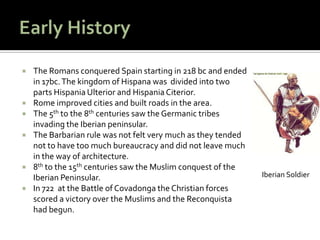
   8th to the 15th centuries saw the Muslim conquest of the
    Iberian Peninsular.                                        Iberian Soldier
   In 722 at the Battle of Covadonga the Christian forces
    scored a victory over the Muslims and the Reconquista
    had begun.
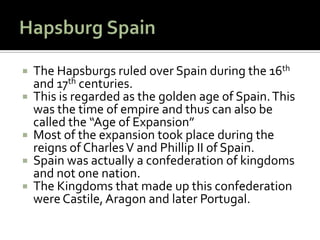
   The Hapsburgs ruled over Spain during the 16th
    and 17th centuries.
   This is regarded as the golden age of Spain. This
    was the time of empire and thus can also be
    called the “Age of Expansion”
   Most of the expansion took place during the
    reigns of Charles V and Phillip II of Spain.
   Spain was actually a confederation of kingdoms
    and not one nation.
   The Kingdoms that made up this confederation
    were Castile, Aragon and later Portugal.
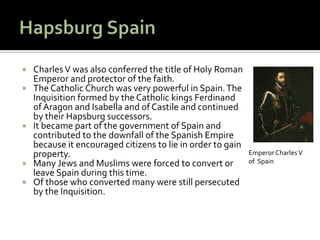
   Charles V was also conferred the title of Holy Roman
    Emperor and protector of the faith.
   The Catholic Church was very powerful in Spain. The
    Inquisition formed by the Catholic kings Ferdinand
    of Aragon and Isabella and of Castile and continued
    by their Hapsburg successors.
   It became part of the government of Spain and
    contributed to the downfall of the Spanish Empire
    because it encouraged citizens to lie in order to gain
    property.                                                Emperor Charles V
   Many Jews and Muslims were forced to convert or          of Spain
    leave Spain during this time.
   Of those who converted many were still persecuted
    by the Inquisition.
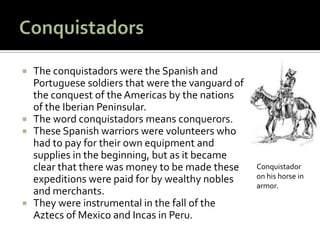
 The conquistadors were the Spanish and
  Portuguese soldiers that were the vanguard of
  the conquest of the Americas by the nations
  of the Iberian Peninsular.
 The word conquistadors means conquerors.
 These Spanish warriors were volunteers who
  had to pay for their own equipment and
  supplies in the beginning, but as it became
  clear that there was money to be made these     Conquistador
  expeditions were paid for by wealthy nobles     on his horse in
                                                  armor.
  and merchants.
 They were instrumental in the fall of the
  Aztecs of Mexico and Incas in Peru.
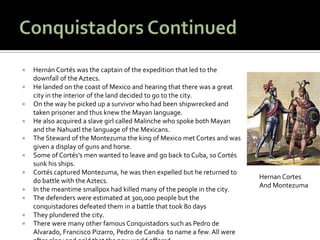
   Hernán Cortés was the captain of the expedition that led to the
    downfall of the Aztecs.
   He landed on the coast of Mexico and hearing that there was a great
    city in the interior of the land decided to go to the city.
   On the way he picked up a survivor who had been shipwrecked and
    taken prisoner and thus knew the Mayan language.
   He also acquired a slave girl called Malinche who spoke both Mayan
    and the Nahuatl the language of the Mexicans.
   The Steward of the Montezuma the king of Mexico met Cortes and was
    given a display of guns and horse.
   Some of Cortés's men wanted to leave and go back to Cuba, so Cortés
    sunk his ships.
   Cortés captured Montezuma, he was then expelled but he returned to
                                                                           Hernan Cortes
    do battle with the Aztecs.
                                                                           And Montezuma
   In the meantime smallpox had killed many of the people in the city.
   The defenders were estimated at 300,000 people but the
    conquistadores defeated them in a battle that took 80 days
   They plundered the city.
   There were many other famous Conquistadors such as Pedro de
    Alvarado, Francisco Pizarro, Pedro de Candia to name a few. All were
   During the time of the Hapsburg dynasty Spain was
    at her zenith.
   Charles V and Phillip II had control over the largest
    empire of the world.
   Spain’s economy was built around the silver of the
    Americas and not manufacturing. The result was
    massive inflation.
   Because of the wars fought with France, England
    and Holland Spain was bankrupted more than once.
   In the 1640s the Catalonians, Neapolitans and the
    Portuguese rose up in revolt.
   After the Battle of Lens the Spanish gave the Dutch
    independence at the Peace of Westphalia. This
    marked the end of the 80 year war
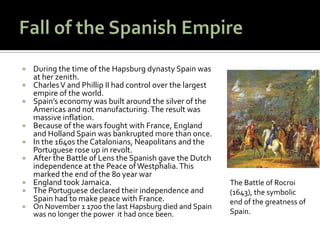
   England took Jamaica.                                   The Battle of Rocroi
   The Portuguese declared their independence and          (1643), the symbolic
    Spain had to make peace with France.                    end of the greatness of
   On November 1 1700 the last Hapsburg died and Spain
    was no longer the power it had once been.               Spain.

The Spanish Empire

  • 1.
    Shai Borwick-Cooper The Historyof the Iberian Peninsular
  • 2.
    The Romans conquered Spain starting in 218 bc and ended in 17bc. The kingdom of Hispana was divided into two parts Hispania Ulterior and Hispania Citerior.  Rome improved cities and built roads in the area.  The 5th to the 8th centuries saw the Germanic tribes invading the Iberian peninsular.  The Barbarian rule was not felt very much as they tended not to have too much bureaucracy and did not leave much in the way of architecture.  8th to the 15th centuries saw the Muslim conquest of the Iberian Peninsular. Iberian Soldier  In 722 at the Battle of Covadonga the Christian forces scored a victory over the Muslims and the Reconquista had begun.
  • 3.
    The Hapsburgs ruled over Spain during the 16th and 17th centuries.  This is regarded as the golden age of Spain. This was the time of empire and thus can also be called the “Age of Expansion”  Most of the expansion took place during the reigns of Charles V and Phillip II of Spain.  Spain was actually a confederation of kingdoms and not one nation.  The Kingdoms that made up this confederation were Castile, Aragon and later Portugal.
  • 4.
    Charles V was also conferred the title of Holy Roman Emperor and protector of the faith.  The Catholic Church was very powerful in Spain. The Inquisition formed by the Catholic kings Ferdinand of Aragon and Isabella and of Castile and continued by their Hapsburg successors.  It became part of the government of Spain and contributed to the downfall of the Spanish Empire because it encouraged citizens to lie in order to gain property. Emperor Charles V  Many Jews and Muslims were forced to convert or of Spain leave Spain during this time.  Of those who converted many were still persecuted by the Inquisition.
  • 5.
     The conquistadorswere the Spanish and Portuguese soldiers that were the vanguard of the conquest of the Americas by the nations of the Iberian Peninsular.  The word conquistadors means conquerors.  These Spanish warriors were volunteers who had to pay for their own equipment and supplies in the beginning, but as it became clear that there was money to be made these Conquistador expeditions were paid for by wealthy nobles on his horse in armor. and merchants.  They were instrumental in the fall of the Aztecs of Mexico and Incas in Peru.
  • 6.
    Hernán Cortés was the captain of the expedition that led to the downfall of the Aztecs.  He landed on the coast of Mexico and hearing that there was a great city in the interior of the land decided to go to the city.  On the way he picked up a survivor who had been shipwrecked and taken prisoner and thus knew the Mayan language.  He also acquired a slave girl called Malinche who spoke both Mayan and the Nahuatl the language of the Mexicans.  The Steward of the Montezuma the king of Mexico met Cortes and was given a display of guns and horse.  Some of Cortés's men wanted to leave and go back to Cuba, so Cortés sunk his ships.  Cortés captured Montezuma, he was then expelled but he returned to Hernan Cortes do battle with the Aztecs. And Montezuma  In the meantime smallpox had killed many of the people in the city.  The defenders were estimated at 300,000 people but the conquistadores defeated them in a battle that took 80 days  They plundered the city.  There were many other famous Conquistadors such as Pedro de Alvarado, Francisco Pizarro, Pedro de Candia to name a few. All were
  • 7.
    During the time of the Hapsburg dynasty Spain was at her zenith.  Charles V and Phillip II had control over the largest empire of the world.  Spain’s economy was built around the silver of the Americas and not manufacturing. The result was massive inflation.  Because of the wars fought with France, England and Holland Spain was bankrupted more than once.  In the 1640s the Catalonians, Neapolitans and the Portuguese rose up in revolt.  After the Battle of Lens the Spanish gave the Dutch independence at the Peace of Westphalia. This marked the end of the 80 year war  England took Jamaica. The Battle of Rocroi  The Portuguese declared their independence and (1643), the symbolic Spain had to make peace with France. end of the greatness of  On November 1 1700 the last Hapsburg died and Spain was no longer the power it had once been. Spain.