Poetic Forms & GenresThe Sonnet & Other Fixed FormsSarah Law Poetic Forms & Genres
Fixed FormsA poem in fixed form is controlled as to its length; and it may have other restrictions as well, such as particular rhyme or metrical schemes, or line-lengths, or the repetition of lines.Fixed Forms include the limerick and the haikuSarah Law Poetic Forms & Genres
HaikuA 17 syllable poem divided into 3 lines, the first consisting of 5 syllables, the second of 7, and the third of 5.  Modern example:Rain turns creatorall the dandelions explodelike supernovae(Michael Hartnett)Sarah Law Poetic Forms & Genres
On to the SonnetThe word comes from the Italian word sonetto, meaning a little sound or song,
Originated in 12thC Italy based on old folk song stanza
First recognisable sonnets associated with ‘Courtly Love’
Petrarch 1304-74
Sir Thomas Wyatt 1502-42, Henry Howard 1517-47
Shakespeare, Spenser, Sir Philip Sidney: Elizabethan SonnetSarah Law Poetic Forms & Genres
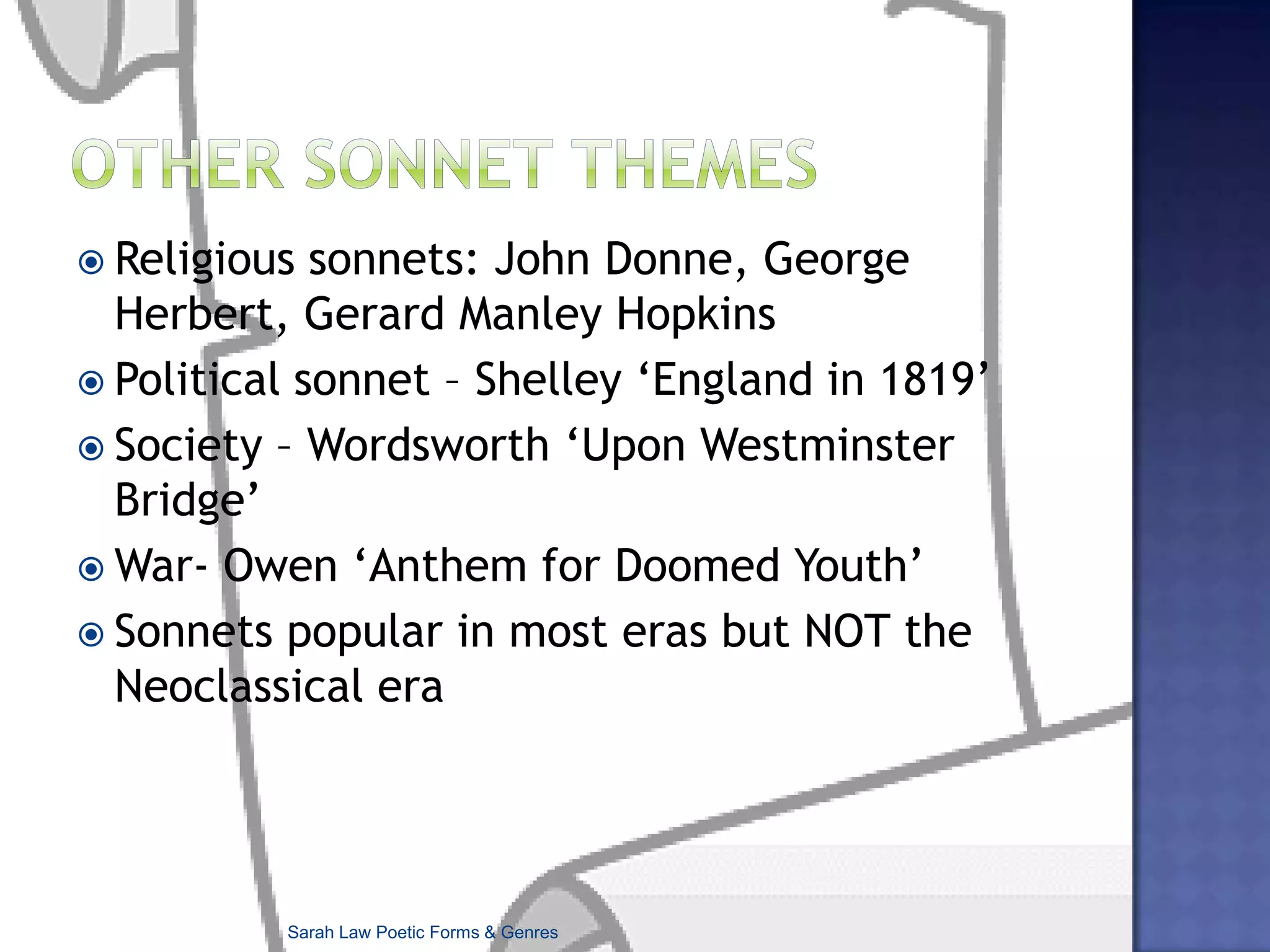
Other Sonnet themesReligious sonnets: John Donne, George Herbert, Gerard Manley HopkinsPolitical sonnet – Shelley ‘England in 1819’Society – Wordsworth ‘Upon Westminster Bridge’War- Owen ‘Anthem for Doomed Youth’Sonnets popular in most eras but NOT the Neoclassical eraSarah Law Poetic Forms & Genres
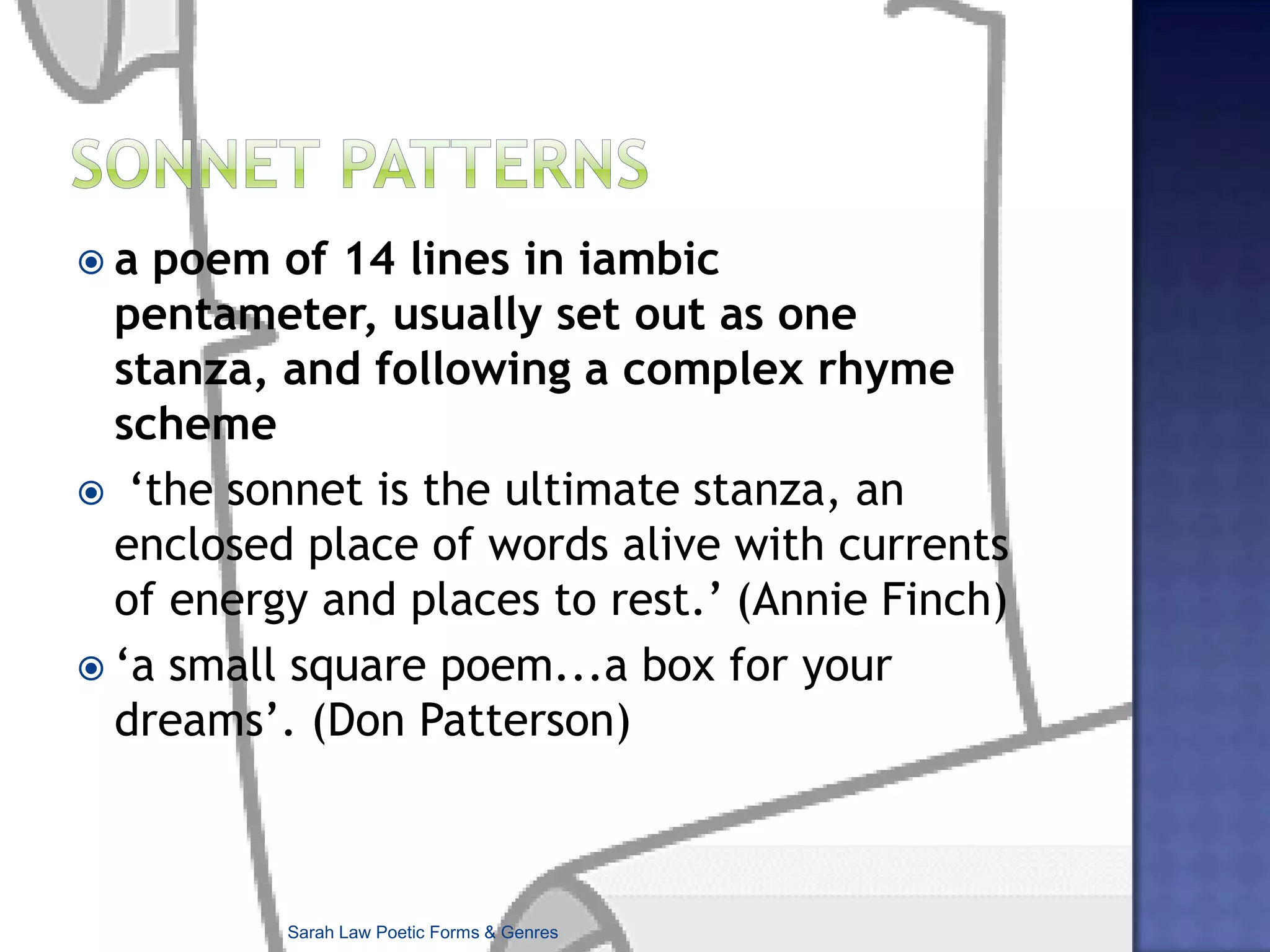
Sonnet Patternsa poem of 14 lines in iambic pentameter, usually set out as one stanza, and following a complex rhyme scheme ‘the sonnet is the ultimate stanza, an enclosed place of words alive with currents of energy and places to rest.’ (Annie Finch)‘a small square poem...a box for your dreams’. (Don Patterson)Sarah Law Poetic Forms & Genres
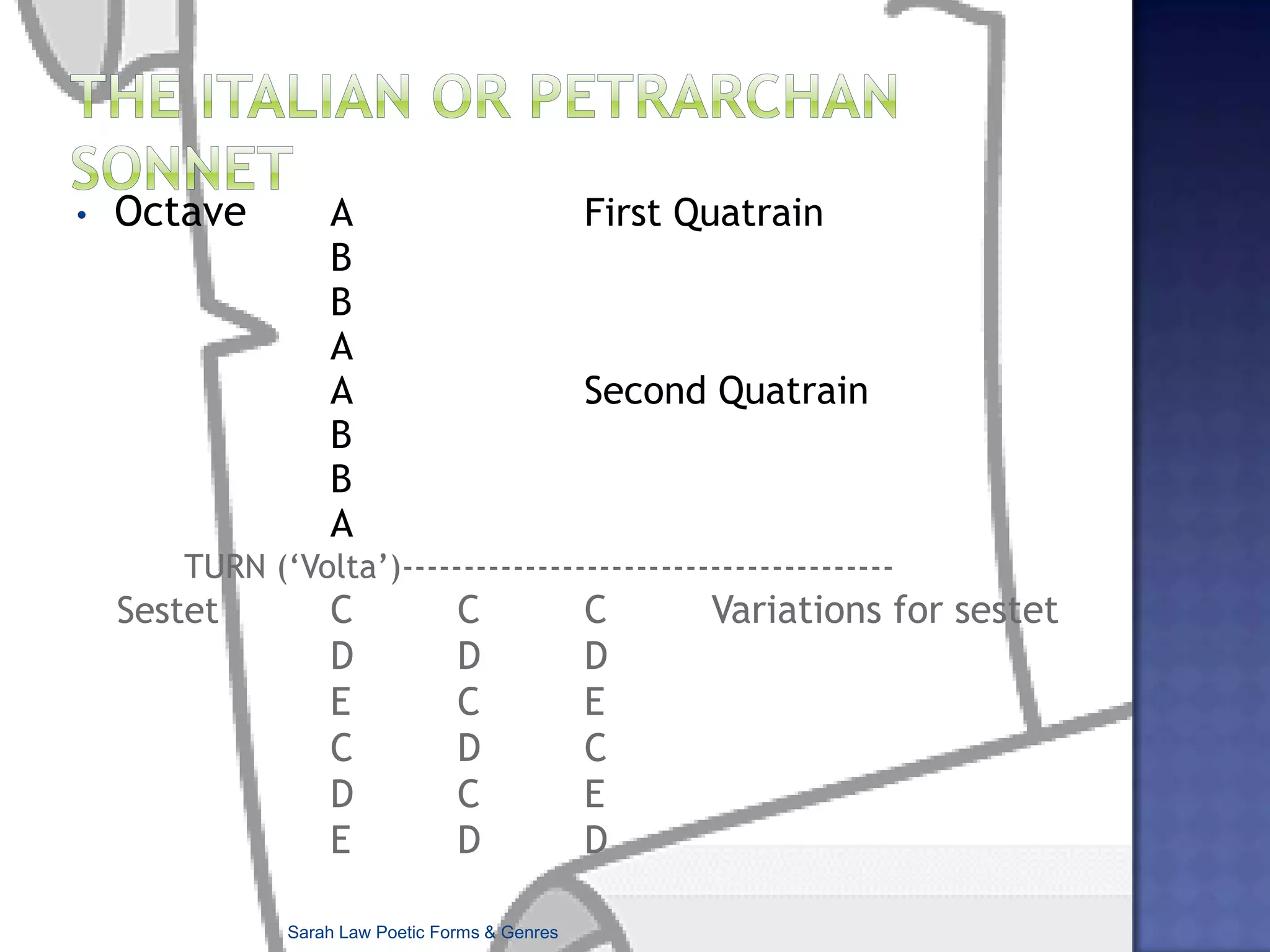
The Italian or Petrarchan SonnetOctave 	A		First Quatrain		B		B		A		ASecond Quatrain		B		B		ATURN (‘Volta’)----------------------------------------Sestet	C	C	C	Variations for sestet			D	DD			E	C	E			C	D	C			D	C	E			E	D	DSarah Law Poetic Forms & Genres
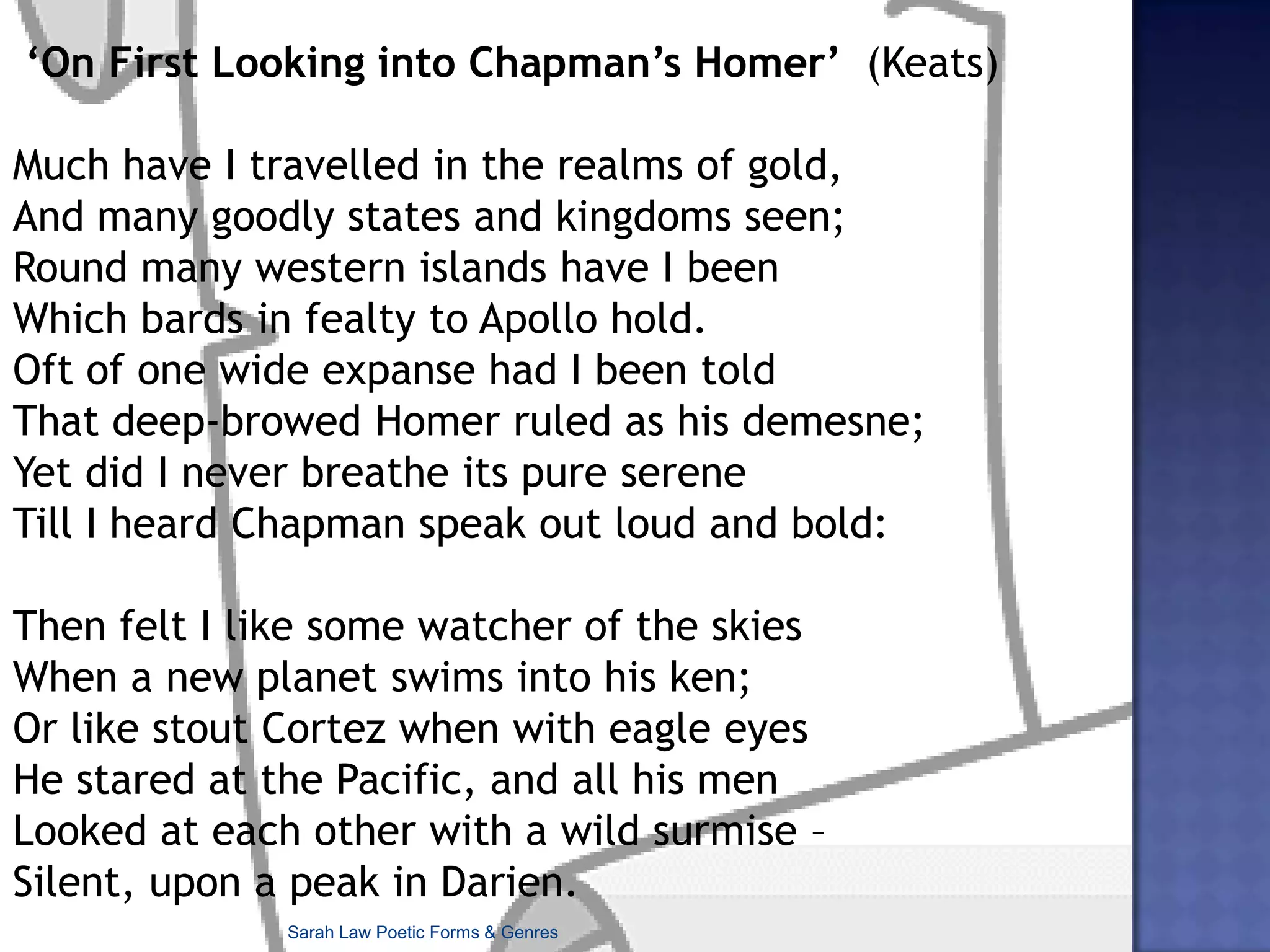
 ‘On First Looking into Chapman’s Homer’  (Keats) Much have I travelled in the realms of gold, And many goodly states and kingdoms seen; Round many western islands have I been Which bards in fealty to Apollo hold. Oft of one wide expanse had I been told That deep-browed Homer ruled as his demesne; Yet did I never breathe its pure serene Till I heard Chapman speak out loud and bold:  Then felt I like some watcher of the skies When a new planet swims into his ken; Or like stout Cortez when with eagle eyesHe stared at the Pacific, and all his men Looked at each other with a wild surmise – Silent, upon a peak in Darien. Sarah Law Poetic Forms & Genres
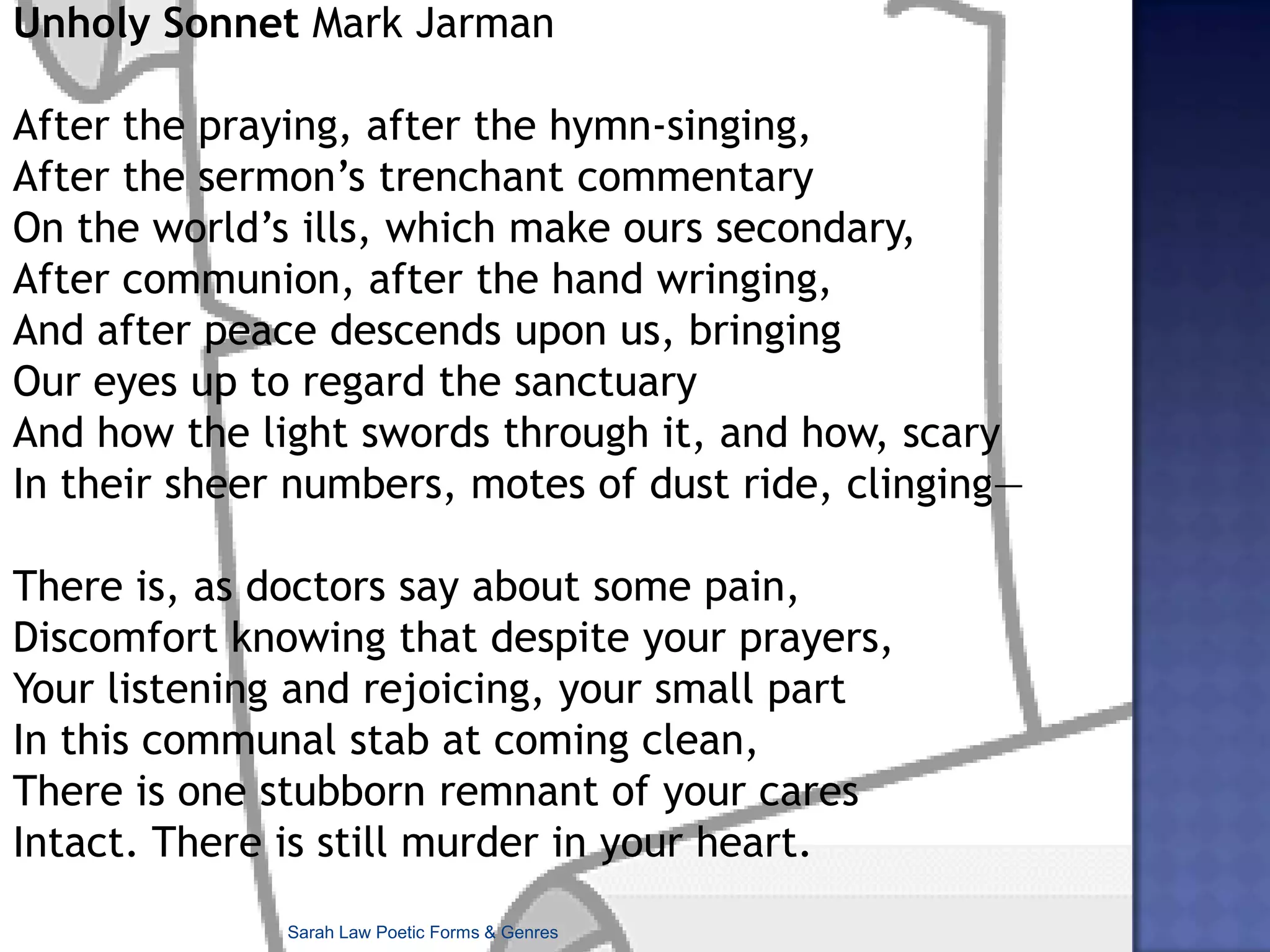
Unholy Sonnet Mark Jarman  After the praying, after the hymn-singing, After the sermon’s trenchant commentary On the world’s ills, which make ours secondary, After communion, after the hand wringing, And after peace descends upon us, bringing Our eyes up to regard the sanctuary And how the light swords through it, and how, scary In their sheer numbers, motes of dust ride, clinging— There is, as doctors say about some pain, Discomfort knowing that despite your prayers, Your listening and rejoicing, your small part In this communal stab at coming clean, There is one stubborn remnant of your cares Intact. There is still murder in your heart. Sarah Law Poetic Forms & Genres
The VoltaSome critics connect the Volta with general tendencies in art, nature and maths e.g.Fibonacci sequence and Golden Ratio (8:13)Achange of mood or tone about two thirds into a poem, piece of music or painting?Sarah Law Poetic Forms & Genres
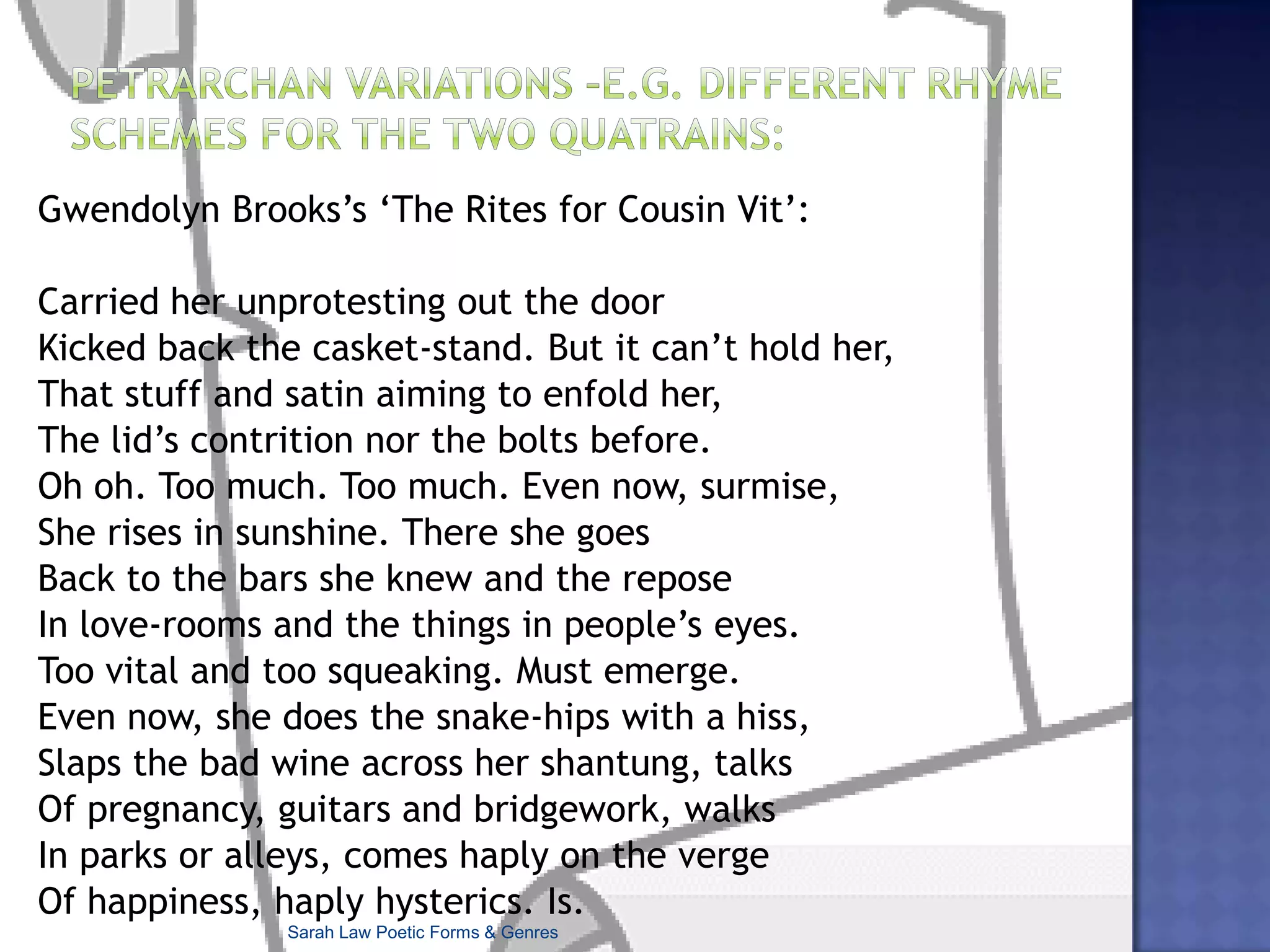
Petrarchan Variations –e.g. different rhyme schemes for the two quatrains:Gwendolyn Brooks’s ‘The Rites for Cousin Vit’: Carried her unprotesting out the doorKicked back the casket-stand. But it can’t hold her,That stuff and satin aiming to enfold her,The lid’s contrition nor the bolts before.Oh oh. Too much. Too much. Even now, surmise,She rises in sunshine. There she goesBack to the bars she knew and the reposeIn love-rooms and the things in people’s eyes.Too vital and too squeaking. Must emerge.Even now, she does the snake-hips with a hiss,Slaps the bad wine across her shantung, talksOf pregnancy, guitars and bridgework, walksIn parks or alleys, comes haply on the vergeOf happiness, haply hysterics. Is.Sarah Law Poetic Forms & Genres
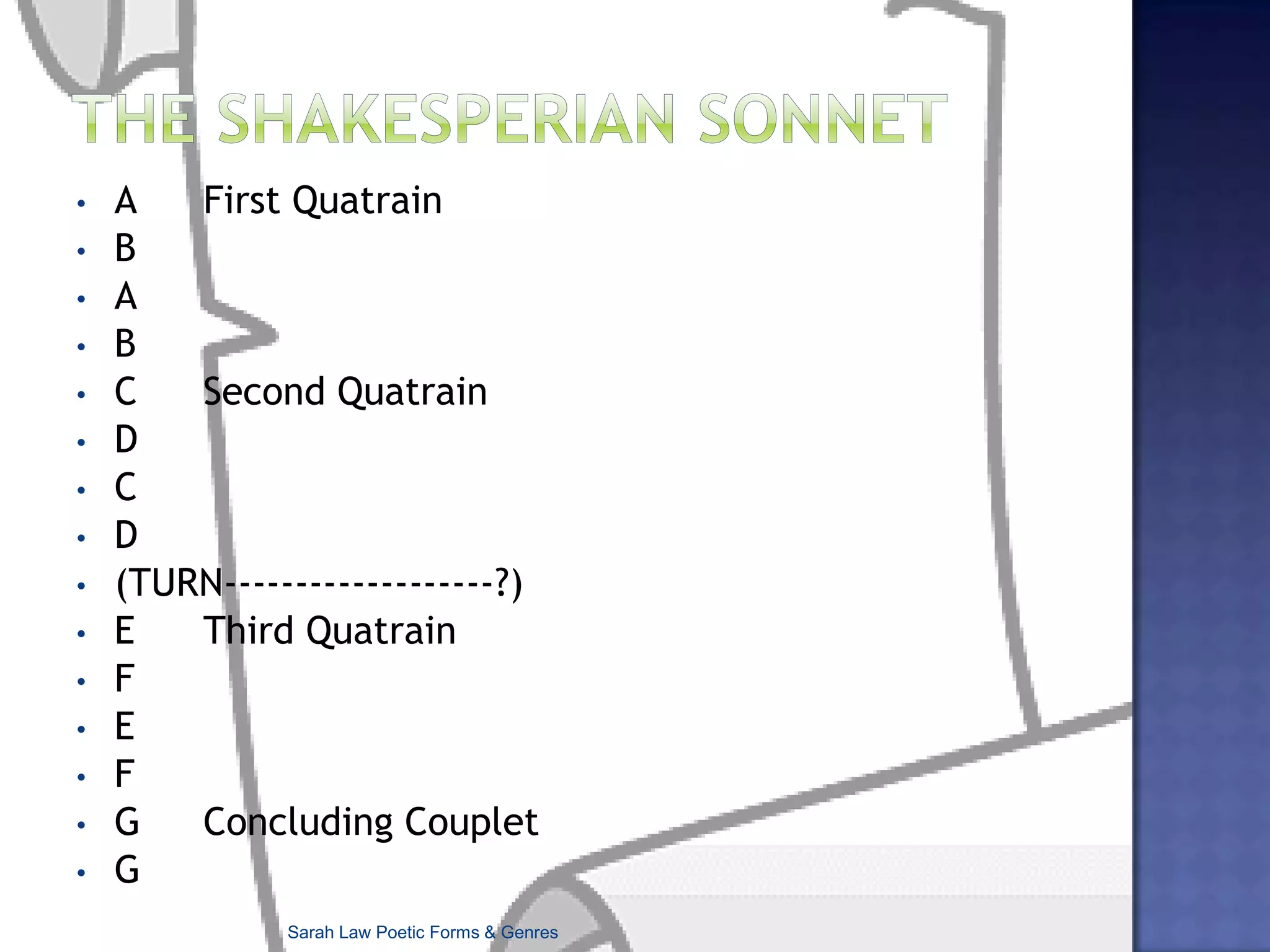
The Shakesperian SonnetA	First Quatrain
B
A
B
C	Second Quatrain
D
C

The sonnet

  • 1.
    Poetic Forms &GenresThe Sonnet & Other Fixed FormsSarah Law Poetic Forms & Genres
  • 2.
    Fixed FormsA poemin fixed form is controlled as to its length; and it may have other restrictions as well, such as particular rhyme or metrical schemes, or line-lengths, or the repetition of lines.Fixed Forms include the limerick and the haikuSarah Law Poetic Forms & Genres
  • 3.
    HaikuA 17 syllablepoem divided into 3 lines, the first consisting of 5 syllables, the second of 7, and the third of 5. Modern example:Rain turns creatorall the dandelions explodelike supernovae(Michael Hartnett)Sarah Law Poetic Forms & Genres
  • 4.
    On to theSonnetThe word comes from the Italian word sonetto, meaning a little sound or song,
  • 5.
    Originated in 12thCItaly based on old folk song stanza
  • 6.
    First recognisable sonnetsassociated with ‘Courtly Love’
  • 7.
  • 8.
    Sir Thomas Wyatt1502-42, Henry Howard 1517-47
  • 9.
    Shakespeare, Spenser, SirPhilip Sidney: Elizabethan SonnetSarah Law Poetic Forms & Genres
  • 10.
    Other Sonnet themesReligioussonnets: John Donne, George Herbert, Gerard Manley HopkinsPolitical sonnet – Shelley ‘England in 1819’Society – Wordsworth ‘Upon Westminster Bridge’War- Owen ‘Anthem for Doomed Youth’Sonnets popular in most eras but NOT the Neoclassical eraSarah Law Poetic Forms & Genres
  • 11.
    Sonnet Patternsa poemof 14 lines in iambic pentameter, usually set out as one stanza, and following a complex rhyme scheme ‘the sonnet is the ultimate stanza, an enclosed place of words alive with currents of energy and places to rest.’ (Annie Finch)‘a small square poem...a box for your dreams’. (Don Patterson)Sarah Law Poetic Forms & Genres
  • 12.
    The Italian orPetrarchan SonnetOctave A First Quatrain B B A ASecond Quatrain B B ATURN (‘Volta’)----------------------------------------Sestet C C C Variations for sestet D DD E C E C D C D C E E D DSarah Law Poetic Forms & Genres
  • 13.
    ‘On FirstLooking into Chapman’s Homer’ (Keats) Much have I travelled in the realms of gold, And many goodly states and kingdoms seen; Round many western islands have I been Which bards in fealty to Apollo hold. Oft of one wide expanse had I been told That deep-browed Homer ruled as his demesne; Yet did I never breathe its pure serene Till I heard Chapman speak out loud and bold:  Then felt I like some watcher of the skies When a new planet swims into his ken; Or like stout Cortez when with eagle eyesHe stared at the Pacific, and all his men Looked at each other with a wild surmise – Silent, upon a peak in Darien. Sarah Law Poetic Forms & Genres
  • 14.
    Unholy Sonnet MarkJarman  After the praying, after the hymn-singing, After the sermon’s trenchant commentary On the world’s ills, which make ours secondary, After communion, after the hand wringing, And after peace descends upon us, bringing Our eyes up to regard the sanctuary And how the light swords through it, and how, scary In their sheer numbers, motes of dust ride, clinging— There is, as doctors say about some pain, Discomfort knowing that despite your prayers, Your listening and rejoicing, your small part In this communal stab at coming clean, There is one stubborn remnant of your cares Intact. There is still murder in your heart. Sarah Law Poetic Forms & Genres
  • 15.
    The VoltaSome criticsconnect the Volta with general tendencies in art, nature and maths e.g.Fibonacci sequence and Golden Ratio (8:13)Achange of mood or tone about two thirds into a poem, piece of music or painting?Sarah Law Poetic Forms & Genres
  • 16.
    Petrarchan Variations –e.g.different rhyme schemes for the two quatrains:Gwendolyn Brooks’s ‘The Rites for Cousin Vit’: Carried her unprotesting out the doorKicked back the casket-stand. But it can’t hold her,That stuff and satin aiming to enfold her,The lid’s contrition nor the bolts before.Oh oh. Too much. Too much. Even now, surmise,She rises in sunshine. There she goesBack to the bars she knew and the reposeIn love-rooms and the things in people’s eyes.Too vital and too squeaking. Must emerge.Even now, she does the snake-hips with a hiss,Slaps the bad wine across her shantung, talksOf pregnancy, guitars and bridgework, walksIn parks or alleys, comes haply on the vergeOf happiness, haply hysterics. Is.Sarah Law Poetic Forms & Genres
  • 17.
  • 18.
  • 19.
  • 20.
  • 21.
  • 22.
  • 23.
  • 24.
  • 25.
  • 26.
  • 27.
  • 28.
  • 29.
  • 30.
  • 31.
    GSarah Law PoeticForms & Genres
  • 32.
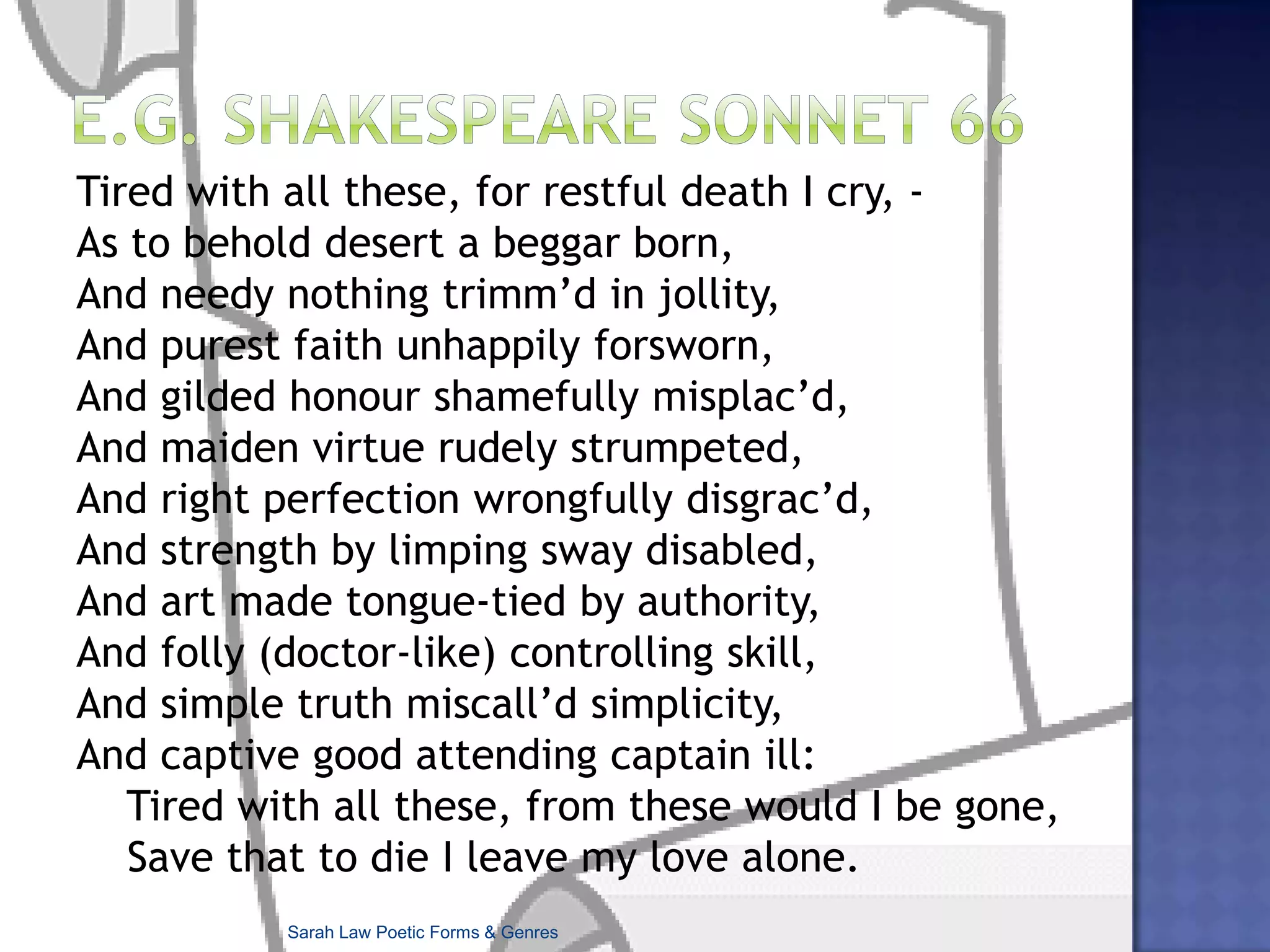
    e.g. Shakespeare Sonnet66Tired with all these, for restful death I cry, -As to behold desert a beggar born,And needy nothing trimm’d in jollity,And purest faith unhappily forsworn,And gilded honour shamefully misplac’d,And maiden virtue rudely strumpeted,And right perfection wrongfully disgrac’d,And strength by limping sway disabled,And art made tongue-tied by authority,And folly (doctor-like) controlling skill,And simple truth miscall’d simplicity,And captive good attending captain ill: Tired with all these, from these would I be gone, Save that to die I leave my love alone.Sarah Law Poetic Forms & Genres
  • 33.
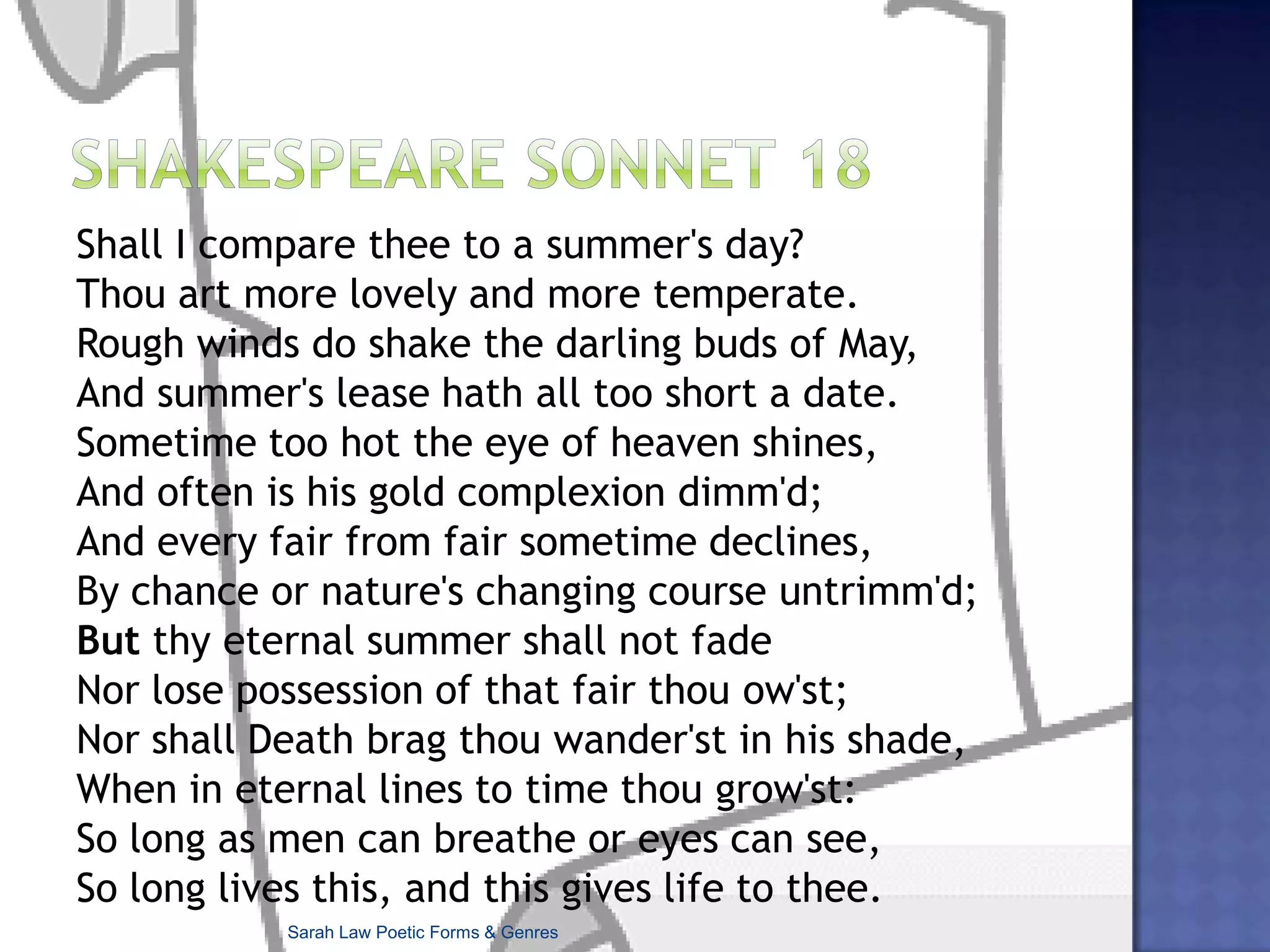
    Shakespeare Sonnet 18ShallI compare thee to a summer's day?Thou art more lovely and more temperate.Rough winds do shake the darling buds of May,And summer's lease hath all too short a date.Sometime too hot the eye of heaven shines,And often is his gold complexion dimm'd;And every fair from fair sometime declines,By chance or nature's changing course untrimm'd;But thy eternal summer shall not fadeNor lose possession of that fair thou ow'st;Nor shall Death brag thou wander'st in his shade,When in eternal lines to time thou grow'st:So long as men can breathe or eyes can see,So long lives this, and this gives life to thee.Sarah Law Poetic Forms & Genres
  • 34.
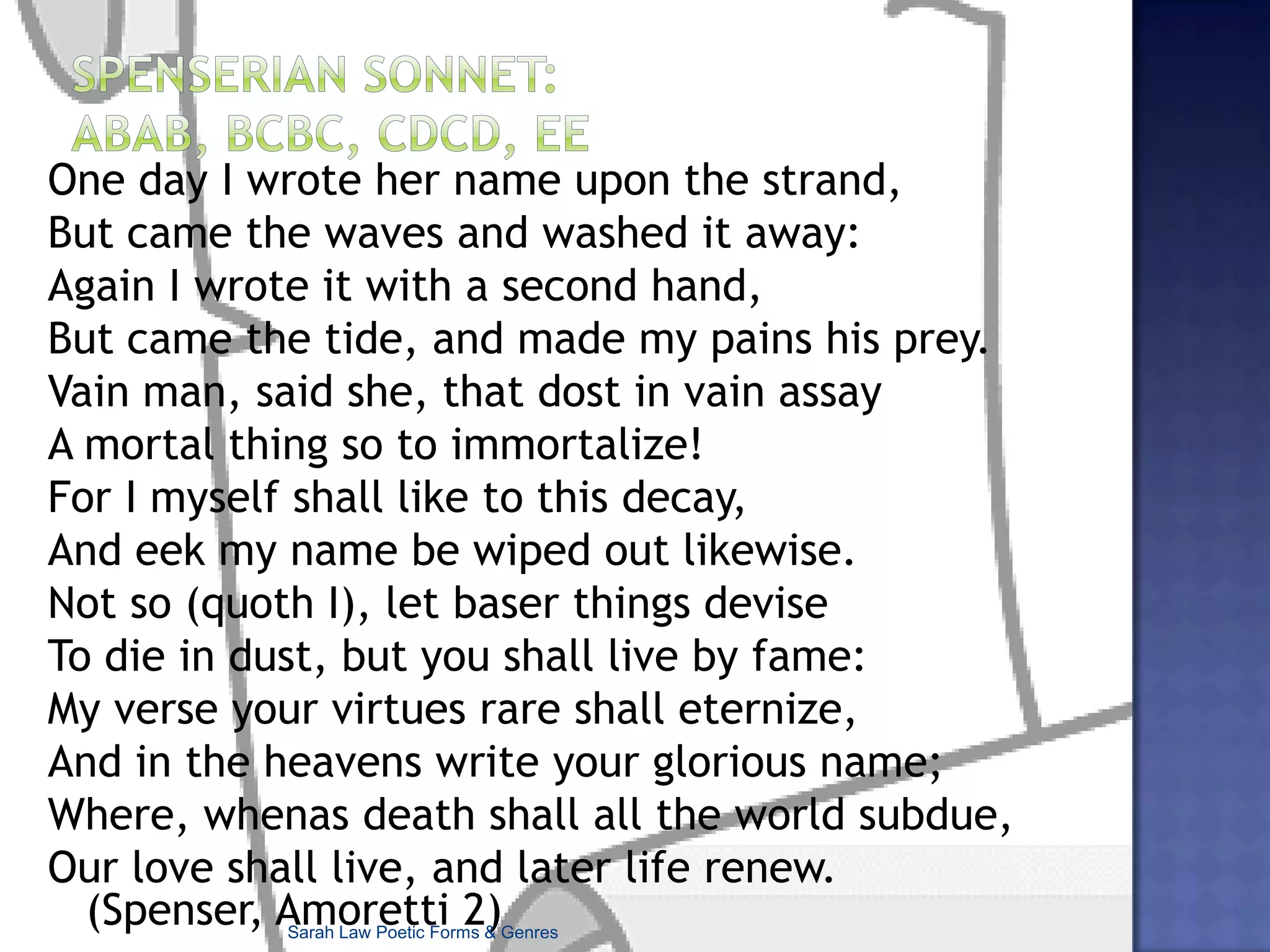
    Spenserian Sonnet: abab,bcbc, cdcd, eeOne day I wrote her name upon the strand, But came the waves and washed it away: Again I wrote it with a second hand, But came the tide, and made my pains his prey. Vain man, said she, that dost in vain assay A mortal thing so to immortalize! For I myself shall like to this decay, And eek my name be wiped out likewise. Not so (quoth I), let baser things devise To die in dust, but you shall live by fame: My verse your virtues rare shall eternize, And in the heavens write your glorious name; Where, whenas death shall all the world subdue, Our love shall live, and later life renew. (Spenser, Amoretti 2)Sarah Law Poetic Forms & Genres
  • 35.
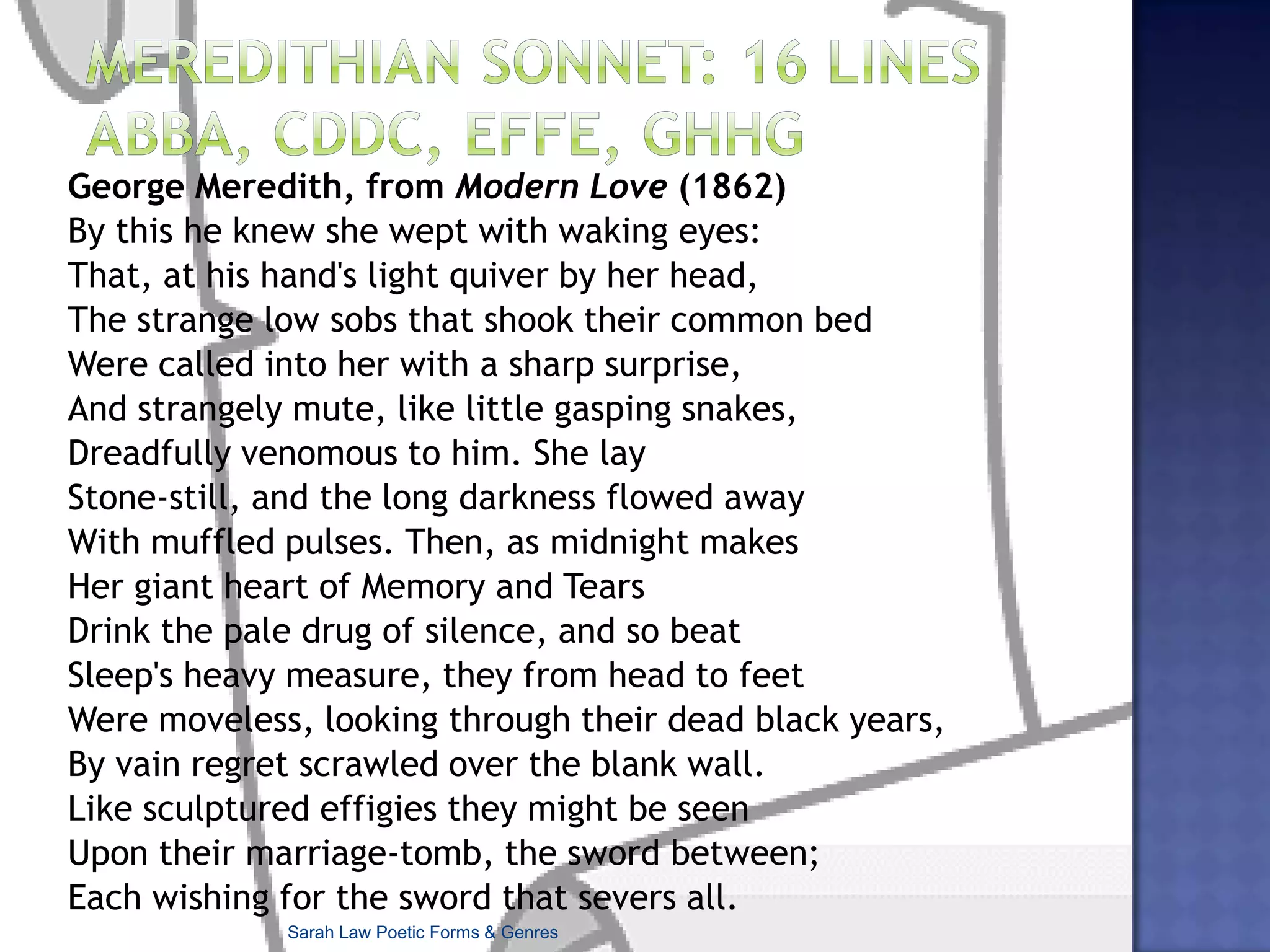
    Meredithian Sonnet: 16linesAbba, cddc, effe, ghhgGeorge Meredith, from Modern Love (1862)By this he knew she wept with waking eyes: That, at his hand's light quiver by her head, The strange low sobs that shook their common bed Were called into her with a sharp surprise, And strangely mute, like little gasping snakes, Dreadfully venomous to him. She lay Stone-still, and the long darkness flowed away With muffled pulses. Then, as midnight makes Her giant heart of Memory and Tears Drink the pale drug of silence, and so beat Sleep's heavy measure, they from head to feet Were moveless, looking through their dead black years, By vain regret scrawled over the blank wall. Like sculptured effigies they might be seen Upon their marriage-tomb, the sword between; Each wishing for the sword that severs all. Sarah Law Poetic Forms & Genres
  • 36.
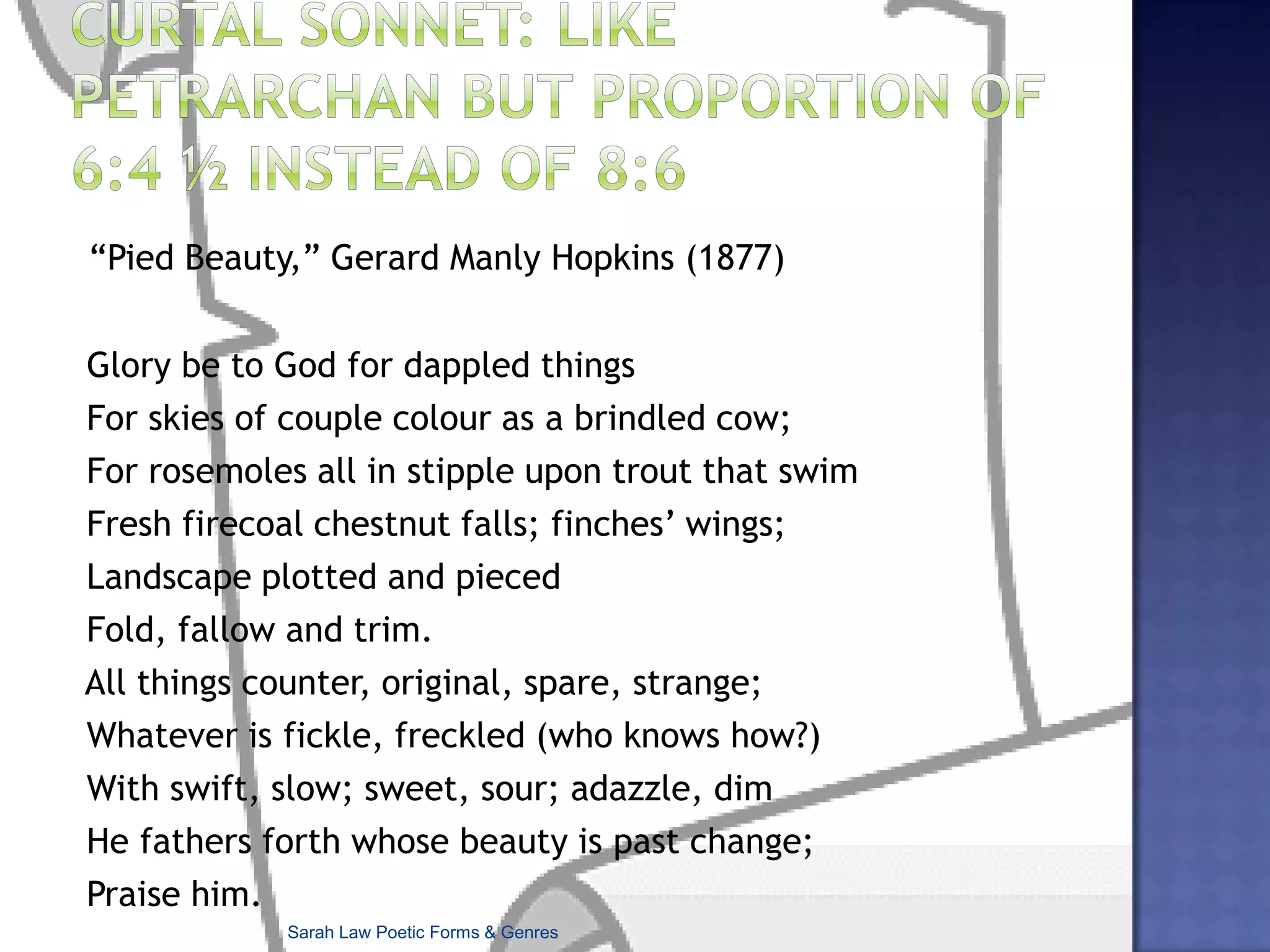
    Curtal Sonnet: likePetrarchan but proportion of 6:4 ½ instead of 8:6 “Pied Beauty,” Gerard Manly Hopkins (1877)    Glory be to God for dappled things  For skies of couple colour as a brindled cow;  For rosemoles all in stipple upon trout that swim  Fresh firecoal chestnut falls; finches’ wings;  Landscape plotted and pieced  Fold, fallow and trim.  All things counter, original, spare, strange;  Whatever is fickle, freckled (who knows how?)  With swift, slow; sweet, sour; adazzle, dim  He fathers forth whose beauty is past change;  Praise him.  Sarah Law Poetic Forms & Genres
  • 37.
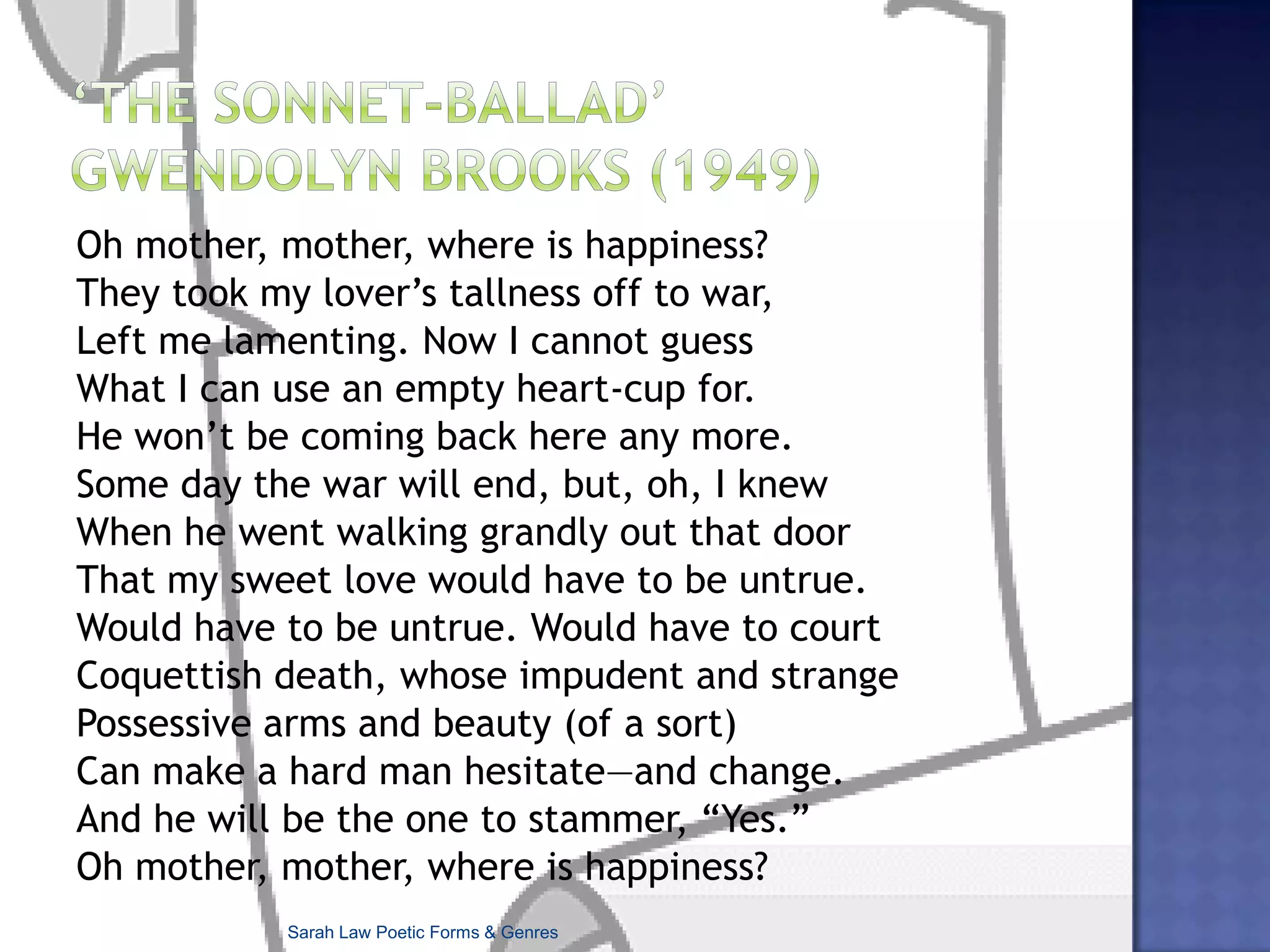
    ‘The Sonnet-Ballad’Gwendolyn Brooks(1949)Oh mother, mother, where is happiness? They took my lover’s tallness off to war, Left me lamenting. Now I cannot guess What I can use an empty heart-cup for. He won’t be coming back here any more. Some day the war will end, but, oh, I knew When he went walking grandly out that door That my sweet love would have to be untrue. Would have to be untrue. Would have to court Coquettish death, whose impudent and strange Possessive arms and beauty (of a sort) Can make a hard man hesitate—and change. And he will be the one to stammer, “Yes.” Oh mother, mother, where is happiness?  Sarah Law Poetic Forms & Genres
  • 38.
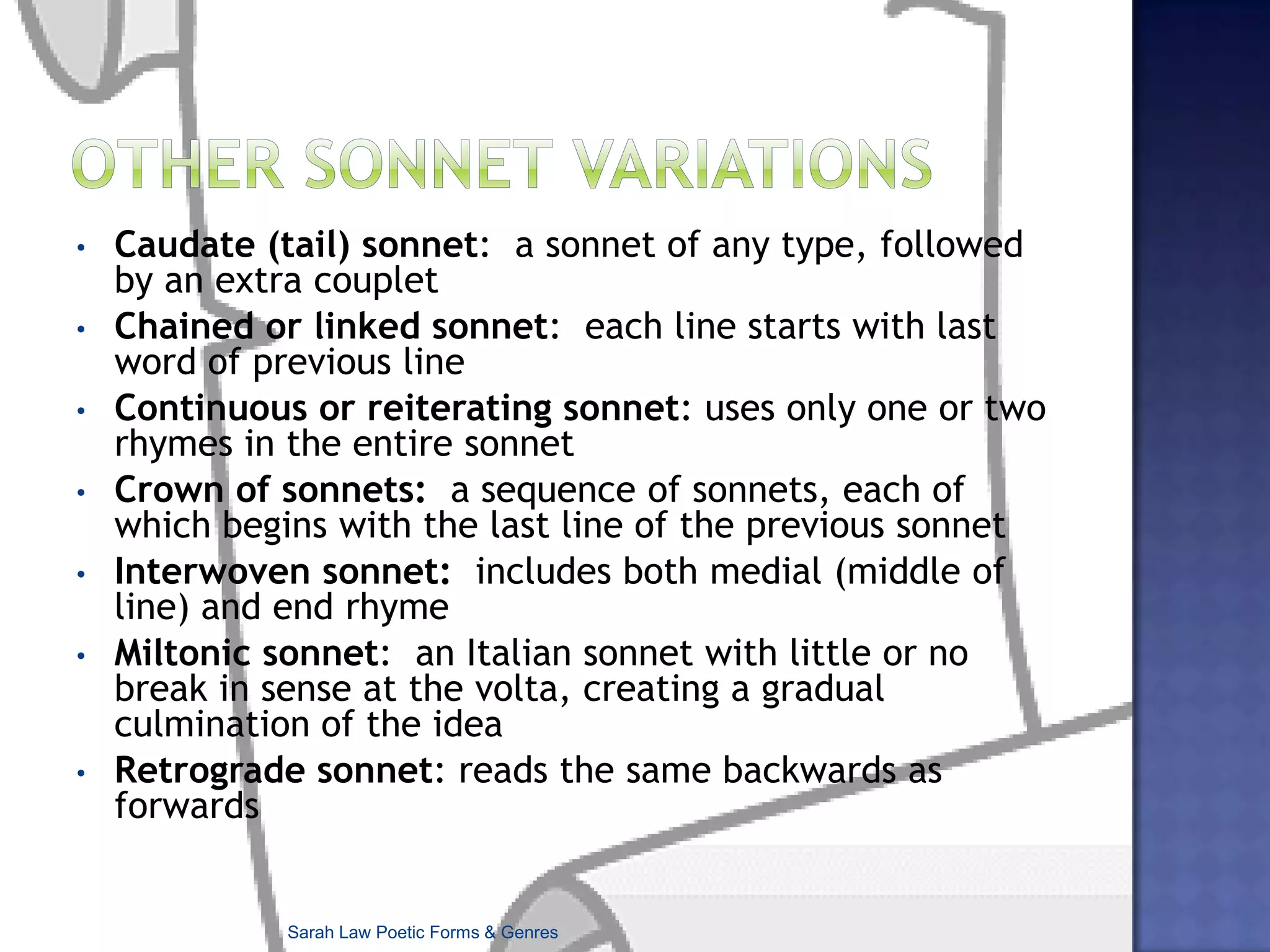
    Other Sonnet VariationsCaudate(tail) sonnet:  a sonnet of any type, followed by an extra couplet
  • 39.
    Chained or linkedsonnet:  each line starts with last word of previous line
  • 40.
    Continuous or reiteratingsonnet: uses only one or two rhymes in the entire sonnet
  • 41.
    Crown of sonnets: a sequence of sonnets, each of which begins with the last line of the previous sonnet
  • 42.
    Interwoven sonnet:  includesboth medial (middle of line) and end rhyme
  • 43.
    Miltonic sonnet:  anItalian sonnet with little or no break in sense at the volta, creating a gradual culmination of the idea
  • 44.
    Retrograde sonnet: readsthe same backwards as forwards Sarah Law Poetic Forms & Genres
  • 45.
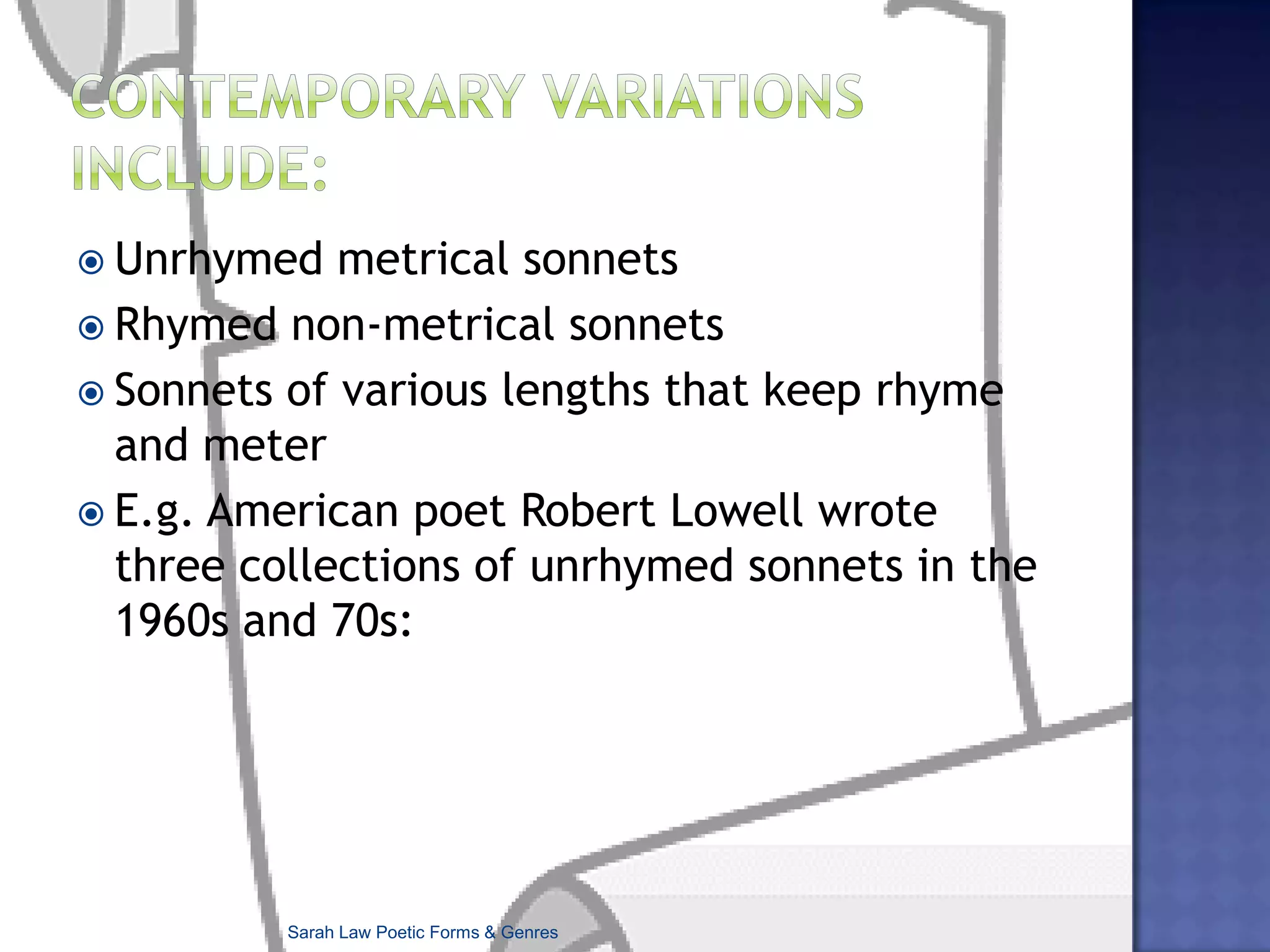
    Contemporary variations include:Unrhymedmetrical sonnetsRhymed non-metrical sonnets Sonnets of various lengths that keep rhyme and meterE.g. American poet Robert Lowell wrote three collections of unrhymed sonnets in the 1960s and 70s:Sarah Law Poetic Forms & Genres
  • 46.
    History, Robert Lowell  History has to live with what was here, clutching and close to fumbling all we had— it is so dull and gruesome how we die, unlike writing, life never finishes. Abel was finished; death is not remote, a flash-in-the-pan electrifies the skeptic, his cows crowding like skulls against high-voltage wire, his baby crying all night like a new machine. As in our Bibles, white-faced, predatory, the beautiful, mist-drunken hunter’s moon ascends— a child could give it a face: two holes, two holes, my eyes, my mouth, between them a skull’s no-nose— O there’s a terrifying innocence in my face drenched with the silver salvage of the mornfrost.  Sarah Law Poetic Forms & Genres
  • 47.
    Other Fixed Forms:The VillanelleDo not go gentle into that good night,Old age should burn and rave at close of day;Rage, rage against the dying of the light. Though wise men at their end know dark is right,Because their words had forked no lightning theyDo not go gentle into that good night. Good men, the last wave by, crying how brightTheir frail deeds might have danced in a green bay,Rage, rage against the dying of the light. Wild men who caught and sang the sun in flight,And learn, too late, they grieved it on its way,Do not go gentle into that good night. Grave men, near death, who see with blinding sightBlind eyes could blaze like meteors and be gay, Rage, rage against the dying of the light. And you, my father, there on the sad height,Curse, bless, me now with your fierce tears, I pray.Do not go gentle into that good night.Rage, rage against the dying of the light. (Dylan Thomas) Sarah Law Poetic Forms & Genres
  • 48.
    Fixed and Semi-FixedFormsFixed Forms include : Haiku, Limerick, Sonnet, Villanelle, SestinaSemi-Fixed Forms (no prescribed length) include: Pantoum, Terza RimaFurther investigation in theNorton Book of Poetic Forms edited by Strand & Boland.Sarah Law Poetic Forms & Genres